Wynne Government is Destroying Ontario, Tells Us, It Is “Good” for Us!

How green energy subsidies work: the government makes stuff up, then wastes billions of dollars while the economy bleeds jobs

Two items in the Toronto Sun caught my eye earlier this month, both written by Lorrie Goldstein about what the paper calls “the Wynne Liberals’ mad obsession with expensive and unneeded green energy.”  The first column is about a recent report published by Parker Gallant and Scott Luft of Wind Concerns Ontario, agrassroots organization that opposes wind turbines.

According to Wind Concerns Ontario, last month the provincial government spent over $1 billionmore for electricity than its market value.  The organization blames the government’s “rush to incorporate ‘renewable’ energy in the form of wind, solar, biomass, etc. into the grid, without a cost-benefit analysis” as the reason for rapidly increasing energy prices in Ontario.  And as Lorrie noted in his column the following week, whenever the “Liberals are called on the carpet over skyrocketing electricity prices in Ontario, they go into their patented, ‘but we eliminated coal’ routine.  Meaning they eliminated coal-fired electricity and replaced it with ‘clean’ energy sources such as solar and wind power.”

This makes no sense, according to Goldstein, who points out that coal-fired electricity generating stations supplied 25% of Ontario’s power needs in 2007 but wind and solar provide only 4% today.

Furthermore, according to the Fraser Institute, the 4% solar and wind provides accounts “for about 20 percent of the average commodity cost,” even though the Ontario Energy Board said last year that solar and wind would provide 7% of Ontario’s power and “their direct costs would account for about the same fraction of the average commodity cost.”

This wouldn’t be the first time that the government’s estimates were wildly off.  Dalton McGuinty promised in 2009 that the Green Energy Act would create 50,000 jobs by the end of 2012, but as Lorrie Goldstein wrote in the Sun last year, as of mid-2013 only 31,000 jobs had materialized.  Most of them were temporary (lasting only one to three years) and were “indirect” jobs, so even the claim that 31,000 jobs were created is difficult to verify.

To make matters worse, the figure of 31,000 did not take into account the jobs that would be permanently lost as a result of increased electricity prices.  A Fraser Institute report published last year found that the Green Energy Act “will not create jobs or improve economic growth in Ontario.” Lorrie Goldstein wrote that the 31,000 new jobs cost the economy 62,000 to 124,000 jobs in other sectors, as a result of high energy prices.

Such dismal results for government investments in green energy are not unique to Ontario, of course.

Consider, for example, this paper published in 2009 by researchers from the King Juan Carlos University in Spain.  The researchers found that for every “green job” created by the government, 2.2 jobs were lost elsewhere in the economy (note that this number falls into the range of Lorrie’s estimate).
The researchers also found that every green energy job created by Spain since 2000 cost the government, on average, 571,138 Euros.  The final cost of the Spanish experience with renewable energy subsidies is massive.   Between subsidies and higher electricity prices, tens of billions of Euros were lost.  The researchers also found that these enormous costs “do not appear to be unique to Spain’s approach but instead are largely inherent in schemes to promote renewable energy sources.”

It is unclear to me, therefore, what the Ontario Government expects its residents to gain in return for all the time and money poured into green energy projects.  Ontarians are paying outrageous electricity prices, jobs have been lost, and billions of dollars have been wasted – and all we have appeared to gain is a few kind words from ‘Saint’ David Suzuki, which is of no value to anyone.

There is No Reason for Them To Lie! Google Engineers Expose the Renewables Scam!

Google’s Top Engineers say: “Renewable Energy Simply Won’t Work”

google-dr-evil

Renewable energy ‘simply WON’T WORK’: Top Google engineers
The Register
Lewis Page
21 November 2014

Windmills, solar, tidal – all a ‘false hope’, say Stanford PhDs

Two highly qualified Google engineers who have spent years studying and trying to improve renewable energy technology have stated quite bluntly that renewables will never permit the human race to cut CO2emissions to the levels demanded by climate activists. Whatever the future holds, it is not a renewables-powered civilisation: such a thing is impossible.

Both men are Stanford PhDs, Ross Koningstein having trained in aerospace engineering and David Fork in applied physics. These aren’t guys who fiddle about with websites or data analytics or “technology” of that sort: they are real engineers who understand difficult maths and physics, and top-bracket even among that distinguished company. The duo were employed at Google on the RE<C project, which sought to enhance renewable technology to the point where it could produce energy more cheaply than coal.

RE<C was a failure, and Google closed it down after four years. Now, Koningstein and Fork have explained the conclusions they came to after a lengthy period of applying their considerable technological expertise to renewables, in an article posted at IEEE Spectrum.

The two men write:

At the start of RE<C, we had shared the attitude of many stalwart environmentalists: We felt that with steady improvements to today’s renewable energy technologies, our society could stave off catastrophic climate change. We now know that to be a false hope …

Renewable energy technologies simply won’t work; we need a fundamentally different approach.

One should note that RE<C didn’t restrict itself to conventional renewable ideas like solar PV, windfarms, tidal, hydro etc. It also looked extensively into more radical notions such as solar-thermal, geothermal, “self-assembling” wind towers and so on and so forth. There’s no get-out clause for renewables believers here.

Koningstein and Fork aren’t alone. Whenever somebody with a decent grasp of maths and physics looks into the idea of a fully renewables-powered civilised future for the human race with a reasonably open mind, they normally come to the conclusion that it simply isn’t feasible. Merely generating the relatively small proportion of our energy that we consume today in the form of electricity is already an insuperably difficult task for renewables: generating huge amounts more on top to carry out the tasks we do today using fossil-fuelled heat isn’t even vaguely plausible.

Even if one were to electrify all of transport, industry, heating and so on, so much renewable generation and balancing/storage equipment would be needed to power it that astronomical new requirements for steel, concrete, copper, glass, carbon fibre, neodymium, shipping and haulage etc etc would appear. All these things are made using mammoth amounts of energy: far from achieving massive energy savings, which most plans for a renewables future rely on implicitly, we would wind up needing far more energy, which would mean even more vast renewables farms – and even more materials and energy to make and maintain them and so on. The scale of the building would be like nothing ever attempted by the human race.

In reality, well before any such stage was reached, energy would become horrifyingly expensive – which means that everything would become horrifyingly expensive (even the present well-under-one-per-cent renewables level in the UK has pushed up utility bills very considerably). This in turn means that everyone would become miserably poor and economic growth would cease (the more honest hardline greens admit this openly). That, however, means that such expensive luxuries as welfare states and pensioners, proper healthcare (watch out for that pandemic), reasonable public services, affordable manufactured goods and transport, decent personal hygiene, space programmes (watch out for the meteor!) etc etc would all have to go – none of those things are sustainable without economic growth.

So nobody’s up for that. And yet, stalwart environmentalists like Koningstein and Fork – and many others – remain convinced that the dangers of carbon-driven warming are real and massive. Indeed the pair reference the famous NASA boffin Dr James Hansen, who is more or less the daddy of modern global warming fears, and say like him that we must move rapidly not just to lessened but to zero carbon emissions (and on top of that, suck a whole lot of CO2 out of the air by such means as planting forests).

So, how is this to be done?

Koningstein and Fork say that humanity’s only hope is a new method of energy generation which can provide power – ideally “dispatchable” (can be turned on and off) and/or “distributed” (produced near where it’s wanted) – at costs well below those of coal or gas. They write:

What’s needed are zero-carbon energy sources so cheap that the operators of power plants and industrial facilities alike have an economic rationale for switching over within the next 40 years …

Incremental improvements to existing technologies aren’t enough; we need something truly disruptive.

Unfortunately the two men don’t know what that is, or if they do they aren’t saying. James Hansen does, though: it’s nuclear power.

As applied at the moment, of course, nuclear power isn’t cheap enough to provide a strong economic rationale. That’s because its costs have been forced enormously higher than they would otherwise be by the imposition of cripplingly high health and safety standards (in its three “disasters” so far – Three Mile Island, Chernobyl and Fukushima – the scientifically verified death tolls from all causes have been and will be zero, 56 and zero: a record which other power industries including renewables can only envy*).

Nuclear costs have also been artificially driven up by the non-issue of “waste”. In the UK for instance, all “higher activity nuclear waste” must be kept expensively stored in a secure specialist facility and can only ever – perhaps – be finally disposed of in a wildly expensive geological vault. No less than 99.7 per cent of this “waste” is actually intermediate-level, meaning that it basically isn’t radioactive at all: you could theoretically make half a tonne of ordinary dirt into such “intermediate level nuclear waste” by burying a completely legal luminous wristwatch in it. (If you did that inside the boundaries of a licensed nuclear facility, the dirt really would then become ridiculously costly “waste”.)

The remaining 0.003 of “nuclear waste” actually is dangerous, but it can almost all be reprocessed into fuel and used again. So waste really doesn’t need to be an issue at all.

There can’t be any doubt that if nuclear power had been allowed to be as dangerous per unit of energy generated as, say, the gas industry* – let alone the terribly dangerous coal business – it truly would be too cheap to meter and Messrs Koningstein and Fork’s problem would have been solved for them decades ago: by now, nobody with access to uranium would be bothering with fossil fuels except for specialist purposes – and there’s no reason why nations “of concern” couldn’t be kept safely supplied. Would we run out of uranium? Not until the year 5000AD.

Cheap power solves a lot more problems than just carbon emissions, too. If power is cheap, so is fresh water (the fact is we’re really at that point already, though a lot of people refuse to admit it and prefer to treat fresh water as some sort of scarce and finite resource). If fresh water is cheap, an awful lot more of the planet is habitable and/or arable than is the case if it’s expensive: and that is truly game-changing stuff for the human race.

And as a side benefit we’d by now have actual useful spacecraft which could actually go to places in reasonable amounts of time carrying reasonable amounts of stuff at reasonable costs. We’d be able to establish viable bases on other planets – for instance to mine uranium there, should we ever find ourselves running low.

Even if you aren’t terribly convinced about the looming menace of carbon-driven warming, the fact that we have decided of our own free will not to have cheap, abundant energy and all the miracles it would bring with it … that’s a terrible human tragedy. Nobody knows how much misery might result from climate change in the future, but one can say with certainty that a lot of misery has been caused by the absence of cheap energy, water, food and decent places to live over the last sixty-plus years.

Anyway the truth is that the disruptive new technology which Koningstein and Fork are dreaming of already exists: but it’s been stolen from us by our foolish fears, inflated in many cases by dishonest activists. Even if someone could come up with some other way of making terrifically cheap energy, there’s no guarantee that the ignorant fearmongers of the world wouldn’t manage to suppress that too. There would almost certainly be a powerful application in weapons, just as there is in nuclear; this is, after all, energy we’re talking about.

Koningstein and Fork believe that the answer to the carbon menace is a reallocation of R&D spending, to seek out high-risk disruptive technologies. But the fact is it would probably make more sense to spend money on making sure that people don’t reach voting age without understanding basic mathematics and facts about risk and energy.

You wouldn’t need to take that money from R&D. You could instead repurpose some of the huge and growing amounts of money that are currently being diverted into the purchase of tiny amounts of ridiculously expensive renewable energy.

After all, no matter the wider issues, we now have it on the best and unimpeachably environmentalist of authorities that renewable energy can’t achieve its stated purpose. So – no matter what – there can’t be any point in continuing with it.

None of this is new, of course. These realities have been wilfully ignored by the British governing class and others for many years. But the British/American governing classes, so fatally committed to renewables, often seem willing to listen to Google even if they won’t listen to anyone else.

So, just maybe, this time the message will have some impact.

Bootnote

*The Piper Alpha gas rig explosion of 1988 on its own caused three times as many deaths as the nuclear power industry has in its entire history. Bizarrely though, no nations ceased using gas.
The Register

James Delingpole followed up on The Register’s brilliant piece of analysis with his usual dash and flair.

james-delingpole_3334

Renewable Energy: So Useless That Even Greenie Google Gave up on it
Breitbart.com
James Delingpole
22 November 2014

Some people call it “renewable energy” but I prefer to call it “alternative energy” because that’s what it really is: an alternative to energy that actually works (eg nuclear and anything made from wonderful, energy-rich fossil fuel.)

Now a pair of top boffins from uber-green Google’s research department have reached the same conclusion.

Ross Konigstein and David Fork, both Stanford PhDs (aerospace engineering; applied physics) were employed on a Google research project which sought to enhance renewable technology to the point where it could produce energy more cheaply than coal. But after four years, the project was closed down. In this post at IEEE Spectrum they tell us why.

We came to the conclusion that even if Google and others had led the way toward a wholesale adoption of renewable energy, that switch would not have resulted in significant reductions of carbon dioxide emissions. Trying to combat climate change exclusively with today’s renewable energy technologies simply won’t work; we need a fundamentally different approach.

Why is renewable energy such a total fail? Because, as Lewis Page explains here, it’s so ludicrously inefficient and impossibly expensive that if ever we were so foolish as to try rolling it out on a scale beyond its current boutique levels, it would necessitate bankrupting the global economy.

In a nutshell, renewable energy is rubbish because so much equipment is needed to make it work – steel, concrete, copper, glass, carbon fibre, neodymium, shipping and haulage – that it very likely uses up more energy than it actually produces.

Yet our political class remains committed to the fantasy that the emperor’s green clothes are perfectly magnificent. Earlier this week, for example, the British government chucked £720 million of taxpayers’ money into a cesspit labelled the Green Climate Fund.

In theory this UN-driven initiative is supposed to help Third World countries cope with the effects of climate change. In reality, all it will do is force on their struggling economies more of the costly, intermittent renewable technologies (wind turbines; solar; etc) which have proved such a disaster for the advanced Western economies.

If we really want to throw money at the developing world so it can combat climate change, then what we should really be doing is insist that it is spent on adaptation projects – not, heaven forfend, ones to do with “decarbonisation.”

As Benny Peiser and Daniel Mahoney write here, adaptation projects make a real difference and save lives.

Bangladesh’s investment in cyclone shelters, better weather forecasts, and smarter construction practices is a prime example of how effective adaptation can be. The country has learnt how to prepare for the threat of cyclones, succeeding in significantly reducing related deaths. The two deadliest cyclones in Bangladesh’s history occurred in 1970 and 1991, killing up to 500,000 and almost 140,000 respectively. Through adaptation investment, in the last two decades the country has been able to reduce deaths and injuries from such disasters 100-fold.

Instead, though, our leaders are still ideologically committed to wasting much of our foreign aid on renewables.

Take the UK’s recent contributions. Just over a quarter of UK climate aid from 2011 to the beginning of 2014 went to adaptation measures, whereas well over 50 per cent was allocated to renewables, according to the Independent Commission for Aid Impact. The World Resources Institute estimates that, between 2010 and 2012, of a total of $35bn in global climate aid, a mere $5bn was allocated to adaptation.

You know that scene right at the end of Spartacus? Well I think I’d like to recreate it, using wind turbines instead of crucifixes, and, instead of rebellious gladiators, all those lovely people – green activists, wind and solar industry parasites, idiot politicians – who’ve been telling us that renewable energy is the way forward.
Breitbart.com

Spartacus2

GE Scientists, and Mic, Have Been Studying the Effects of Sleep Deprivation!

What Sleep Deprivation Does to Your Brain, in One Stunning Infographic

This partner story is part of BrainMic, a collaboration with GE to share the latest advances in brain research and technology.

If you yawn during the day, conk out as soon as your head hits the pillow or re-read this sentence a few times to absorb its meaning, here’s some bad news: You need more sleep.

Scientists still don’t know exactly why we sleep, but according to a near-constant stream of research, most of us need between six and eight hours of shut-eye each night. Unfortunately, only about 30% of us are getting it. That means 70 million Americans suffer from sleep deprivation, a certified public health epidemic, according to the Centers for Disease Control and Prevention.

Sleep deprivation takes an enormous toll on our bodies, including bloodshot eyes, increased blood pressure and a fuller waistline. But what’s equally alarming is the negative impact of sleep deprivation on the brain.

This infographic explains what happens to your brain, and what it means for you, when you don’t get enough sleep:

Links to infographic resources: The Journal of Neuroscience, International Scholarly Research Notes,Experimental Brain Research, Psychological Bulletin, UC Berkeley Walker Sleep Lab, PNAS, International Journal of Occupational Medicine and Environmental Health, CDC, The Journal of Neuroscience, SLEEP,PLOS one, Psychological Science, Frontiers in Human Neuroscience, Daytime Sleepiness Affects Prefrontal Regulation of Food Intake

All images by: Liran Okanon and Tri Vo

GE Scientists and Mic are partnering to share the latest advances in brain research and technology through BrainMic, a Spotlight Series that explores the universe in our heads, now through December 2014. Click here to read more from this series on BrainMic >>

Big wind Pressing Congress, For More Money! $$$$$$$$ It’s a money-pit!

Via. Greenie Watch    30 November 2014

Big Wind is pressing Congress for yet another bailout

By Mary Kay Barton

Taxpayers beware! While you were sleeping, enjoying your family and eating turkey,

Congress has been busy.

Congressional Republicans are negotiating with Senate Democrats to extend the infamous wind energy Production Tax Credit through to

2017, after which it will supposedly be phased out, just as was supposed to happen in the past. This sneaky, dark-of-night “lame duck”

session tactic should be flatly rejected.

While you’ve been busy just trying to make ends meet, wondering why the cost of everything is going up, and agonizing over how your

children and grandchildren will ever pay the mounting $18 TRILLION dollar national debt – the wind industry lobbyists’ group, the

American Wind Energy Association (AWEA), just sent Congress a letter seeking to extend the federal, taxpayer-funded wind Production Tax

Credit (PTC).

The list of signers to AWEA’s letter include rent-seeking industries and “green” groups who’ve all benefitted by tapping into

taxpayers’ wallets via the Big Wind PTC (aka: Pork-To-Cronies). It certainly isn’t hard to figure out why these corporations pay many

millions of dollars to hire lobbyists and run national TV advertising campaigns geared at convincing crony-politicians to vote to

continue these TAXES and higher energy prices on American citizens.

AWEA’a letter is typical of wind industry propaganda. It makes specious claims about creating jobs and reducing pollution, without

providing a shred of evidence to PROVE any of their claims. AWEA apparently hopes Congressional officials are “too stupid” to

understand what energy-literate citizens nationwide know: Industrial wind can NEVER provide reliable power. It raises electricity

costs, even after subsidies are factored in. It kills more jobs than it creates. It defiles wildlife habitats and kills eagles, hawks,

other birds and bats – with no penalties to Big Wind operators.

Here’s the reality: After 22+ years of picking U.S. taxpayers’ and ratepayers’ pockets, industrial wind has NOT significantly reduced

carbon dioxide emissions. It has not replaced any conventional power plants, anywhere. However, the $Trillions spent on these “green”

boondoggles to date have significantly added to the $18+ TRILLION dollar debt that our children and grandchildren will have to bear.

AWEA’s own statements from years and decades past can be used against them. To cite just one example, 31 years ago, a study coauthored

by the AWEA stated:

The private sector can be expected to develop improved solar and wind technologies which will begin to become competitive and self-

supporting on a national level by the end of the decade if assisted by tax credits and augmented by federally sponsored R&D.

[American Wind Energy Association, et al. Quoted in Renewable Energy Industry, Joint Hearing before the Subcommittees of the Committee

on Energy and Commerce et al., House of Representatives, 98th Cong., 1st sess. Washington, DC: Government Printing Office, 1983, p.

52.]

In other words, the PTC should have ended 20 years ago, because wind energy would be self-sustaining by then. It wasn’t. It still

isn’t. It never will be. We need to pull the PTC plug now!

Here are some details about the bill that is currently being negotiated during the lame duck session –before the newly elected,

Republican majority Senate takes office and can do much about it.

In 2016, wind developers would be eligible for 80% percent of the PTC’s value. They could also claim 60% of its value through the first

nine months of 2017, after which it would supposedly expire.

The proposed congressional deal also seems to continue basing PTC eligibility on when project construction project begins. That opens

huge doors for abuse.

The last time Congress extended the PTC, as part of its “fiscal cliff” deal in 2013, it said “eligibility” for taxpayer largesse

covered projects “under construction,” rather than requiring that they be “placed in service” by a certain date. In practice, this

means just a shovelful of dirt has to be moved by that date.

Remember too that the Production Tax Credit supposedly expired last year. But this clever language has allowed construction and

expansion in the meantime. Meanwhile, Lois Lerner’s Internal Revenue Service has helpfully said projects that were started or “safe-

harbored” prior to the PTC’s most recent pseudo-expiration can claim tax credits if they are in service by 2015. And then they can

claim the $23-per-MWh credit for ten more years!

What a wonderful holiday gift for Big Wind and its political sponsors – at your expense.

Our government should NOT be in the business of picking and choosing the winners and losers in the energy marketplace – while

assaulting and harming the very citizens they are forcing to pay for this “green” energy scam. It’s time for government to get out of

the way and let the markets work!

The best solutions will rise to the top of their own accord because they will provide modern power at the best prices – thereby

maintaining the reliable, affordable power that has made America great.

Citizens nation-wide have awakened to this massive “green” energy scam. Many have sent letters to Congress like the one below. You can

join the fight by contacting your representatives and urging them to do the right thing: Protect American consumers, taxpayers and

ratepayers. END Wind Welfare (#EndWindWelfare)!

Ontario’s Liberal Government Ignores, and Denies, Health Effects of Wind Turbines…

Ontario’s Wind Powered Health Calamity

sleepingOntario is the scene of a perfectly avoidable and entirely unnecessarypublic health disaster.

The rights of people to live peaceful, healthy lives in rural Ontario have been trampled under the jackboots of Kathleen Wynne’s Liberals – a solid team of hard-‘green’-left eco-fascist nutjobs, responsible for the most bizarre, pointless and costly energy policy on Earth (see our posts hereand here and here)

The scale and scope of the disaster was laid bare in the brilliant documentary, Down Wind (see our post here) and has been pursued with proper journalistic zeal by Sun News’ investigative reporter, Rebecca Thompson (see our posts here and here).

A couple of weeks back, Wynne’s puppets at her Health Department (laughably called “Health Canada”) threw together yet another half-baked, wind industry approved pile of tosh parading as “research” on the known and obvious impacts of turbine generated low-frequency noise and infrasound.

Ever since, properly qualified people have been slamming it for the sloppiness of the work and the wild assumptions upon which its undercooked “conclusions” rest.

Two of them – Carmen Krogh and Bob McMurtry penned the piece below.

carmen krogh

Carmen Krogh, BScPharm (retired), is a peer reviewed IWT health researcher and former Director of Publications and Editor-in-Chief of the CPS.

bob mcmurtry

RY “Bob” McMurtry is Professor Emeritus (Surgery) of Western University (formerly University of Western Ontario). Dr. McMurtry was also an ADM at Health Canada 2000-02.

Health Canada and Wind Turbines: Too little too late?
CMAJ
28 November 2014

Industrial wind turbines (IWTs) are being erected at rapid pace around the world. Coinciding with the introduction of IWTs, some individuals living in proximity to IWTs report adverse health effects including annoyance, sleep disturbance, stress-related health impacts and reduced quality of life. [i],[ii],[iii],[iv],[v],[vi],[vii],[viii],[ix],[x],[xi],[xii] In some cases Canadian families reporting adverse health effects have abandoned their homes, been billeted away from their homes or hired legal counsel to successfully reach a financial agreement with the wind energy developer.[xiii]

To help address public concern over these health effects Health Canada (HC) announced the Health Canada Wind Turbine Noise and Health Study(HC Study) 2 years ago and brought forth preliminary results November 6, 2014.

Here we briefly comment on the HC Study results and provide some historical context.

Acknowledgement of IWT adverse health effects is not new. The term “annoyance” frequently appears when discussing IWT health effects.

In a 2009 letter the Honourable Rona Ambrose, disclosed:

“Health Canada provides advice on the health effect of noise and low-frequency electric and magnetic fields from proposed wind turbine projects…To date, their examination of the scientific literature on wind turbine noise is that the only health effect conclusively demonstrated from exposure to wind turbine noise is an increase of self-reported general annoyance and complaints (i.e., headaches, nausea, tinnitus, vertigo).” [xiv]

In 2009, the Canadian Wind Energy Association (CanWEA) sponsored a literature review which acknowledges the reported symptoms such as headaches, nausea, tinnitus, vertigo and state they “… are not new and have been published previously in the context of “annoyance”…” and are the “… well-known stress effects of exposure to noise …”[xv]

In 2011, a health survey of people exposed to IWTs in Ontario reported altered quality of life, sleep disturbance, excessive tiredness, headaches, stress and distress. [xvi]

In the same year, CanWEA posted a media release which advised those impacted by wind turbine annoyance stating “The association has always acknowledged that a small percentage of people can be annoyed by wind turbines in their vicinity. … When annoyance has a significant impact on an individual’s quality of life, it is important that they consult their doctor.”[xvii]

It turns out it’s not a small percentage of people annoyed by wind turbines. An Ontario Government report concluded a non-trivial percentage of persons are expected to be highly annoyed.

The December 2011 report prepared by a member of CanWEA for the Ontario Ministry of Environment states in the conclusions:

“The audible sound from wind turbines, at the levels experienced at typical receptor distances in Ontario, is nonetheless expected to result in a non-trivial percentage of persons being highly annoyed. As with sounds from many sources, research has shown that annoyance associated with sound from wind turbines can be expected to contribute to stress related health impacts in some persons.”[xviii]

The World Health Organization (WHO) acknowledges noise induced annoyance to be a health effect [xix] and the results of WHO research “…confirmed, on an epidemiological level, an increased health risk from chronic noise annoyance…”[xx]

HC also acknowledges noise induced annoyance to be an adverse health effect. [xxi],[xxii] The Principal Investigator of the recent HC Study also states “noise-induced annoyance is an adverse health effect”. [xxiii]

Canadian Government sponsored research has found statistically significant relationships from IWT noise exposure.

A 2014 review article in the Canadian Journal of Rural Medicine reports:

“In 2013, research funded by the Ontario Ministry of the Environment indicated a statistically significant relation between residents’ distance from the turbine and the symptoms of disturbed sleep, vertigo and tinnitus, and recommended that future research focus on the effects of wind turbine noise on sleep disturbance and symptoms of inner ear problems.” [xxiv]

Recently on November 6, 2014, HC posted on its website preliminary results of its HC Study[xxv]. Wind turbine noise “…. annoyance was found to be statistically related to several self-reporting health effects including, but not limited to, blood pressure, migraines, tinnitus, dizziness, scores on the PSQI, and perceived stress” as well as related to “measured hair cortisol, systolic and diastolic blood pressure.”

These troubling results come as no surprise. Since at least 2007 HC employees including the Principal Investigator of the HC Study recommended wind turbine noise criteria which they predict will result in adverse health effects. (i.e. result in an increase percentage highly annoyed).[xxvi],[xxvii],[xxviii]

Then turbines were built and HC spent 2.1 million dollars to find out it appears to have under predicted the impact of IWT noise. HC’s IWT noise criteria does not use a dose response based on IWT noise but rather road noise. But of course IWTs are not cars and peer-reviewed studies consistently document that IWTs produce sound that is perceived to be more annoying than transportation or industrial noise at comparable sound pressure levels. [xxix],[xxx]

IWT noise annoyance starts at dBA sound pressure levels in the low 30s and rises sharply at 35 dBA as compared to road noise which starts at 55 dBA. These findings are further supported by the HC Study’s preliminary results. [xxxi]

IWT noise characteristics that are identified as plausible causes for reported health effects include amplitude modulation, audible low- frequency noise (LFN), infrasound, tonal noise, impulse noise and night-time noise. [xxxii]

The logical solution would be to develop IWT noise criteria which will protect human health but that would present a barrier to wind energy development. Noise limits impacts IWT siting, cost of energy produced[xxxiii] and by extension corporate profits. The wind energy industry has actively lobbied governments to be granted IWT noise exposure limits which benefit their industry.

Canadians trying to understand this should be mindful the Government of Canada has invested and distributed significant amounts of public money to attract and support the wind energy industry. [xxxiv],[xxxv],[xxxvi],[xxxvii],[xxxviii],[xxxix],[xl],[xli] In addition to providing funding, the Government of Canada in collaboration with wind industry stakeholders has developed the Wind Technology Road Map (Wind TRM) [xlii] which Natural Resources Canada defined to be an “…industry-led, government supported initiative that has developed a long-term vision for the Canadian wind energy industry …”.[xliii]

Canada’s Wind TRM states “Members of the Steering Committee, government and our industry will be using this roadmap to direct the actions that are necessary for Canada to develop its vast wind resources.”[xliv] HC is a member of the Interdepartmental Wind Technology Road Map Committee [xlv] which was created to assist in the implementation of Canada’s Wind TRM. [xlvi] One of the “key action items” detailed in the Wind TRM calls for Government and Industry collaboration to develop and maintain government documents that address concerns raised about wind energy projects including that of noise, infrasound and other. [xlvii]

Some jurisdictions are trying to take action to protect their residents. For example, several municipalities in Ontario are trying to establish bylaws that protect from IWT noise. In Wisconsin, on October 14, 2014 the Brown County Board of Health unanimously approved a motion to declare the IWTs at a local project a Human Health Hazard. [xlviii]

It would appear HC’s research effort is too little too late. A non-trivial percentage of Canadians continue to experience adverse health effects. HC now has additional scientific evidence of the “conclusively demonstrated” effects from exposure to IWT noise. It is time for HC to take action to help Canadians maintain and improve their health. (for the references, see below)
CMAJ

Bob and Carmen aren’t the only qualified experts dumping on the woeful “methods” and flawed assumptions of the Health Canada “research”.

john harrison

John Harrison, a Queen’s University professor emeritus in physics, slammed the “research”, saying that: “the Health Canada study is more politics than science“.

John Harrison is joined by Denise Wolfe – a highly experienced clinical trial research auditor – who has taken a well-honed axe to the “study” – hammering it for:

  • hiding and fudging the raw data;
  • failing to meet the study design’s own sample size criteria;
  • only taking its noise samples during summer, when there is little or no wind;
  • inherent inconsistencies between the data relied on and the arguments presented in the report;
  • incomplete and inconsistent noise modelling;
  • excluding children – the most vulnerable group – from the study altogether;
  • failing to point out that annoyance of the kind identified by the study (which includes sleep deprivation) is defined by the WHO as an adverse health effect (refer to its Night-time Noise Guidelines for Europe – the Executive Summary at XI to XII covers the point);
  • failing to even bother analysing the infrasound data gathered;
  • and, having failed to even analyse the infrasound data, making wholly unsupported conclusions about its impact on sleep and health;
  • in relation to its flawed noise data modelling, relying on wind speed data up to 50km away from the residences involved;
  • making the bogus claim that the study has been published in a peer-reviewed journal (it hasn’t);
  • misleading verbiage (ie waffle and gobbledygook);
  • prematurely publishing what is a piece of political propaganda, based on incomplete and deliberately misleading and inconsistent information; and
  • failing to disclose links between those that worked on the study and their wind industry backers.

sleeping baby

References (to the CMAJ article)

[i] Pedersen E, Persson KW. Perception and annoyance due to wind turbine noise–a dose response relationship. Journal of the Acoustical Society of America. 2004; 116: 3460-70.

[ii] Harry A. Wind turbines, noise and health. 2007, February. Availablehere

[iii] Pedersen E, Persson Waye K. Wind turbine noise, annoyance and self-reported health and well being in different living environments. Occupational and Environmental Medicine. 2007;64:480-86.

[iv] Phipps R, Amati M, McCoard S, Fisher R. Visual and noise effects reported by residents living close to Manawatu wind farms: Preliminary survey results. 2007. Available here

[v] Pedersen E, Bakker R, Bouma J, van den Berg F. Response to noise from modern wind farms in the Netherlands. Journal of the Acoustical Society of America, 2009; 126: 634-43.

[vi] Pierpont N. Wind turbine syndrome: A report on a natural experiment. Santa Fe, NM: K-Selected Books. 2009. Available here

[vii] Krogh C, Gillis L, Kouwen N, Aramini J. WindVOiCe, a self-reporting survey: Adverse health effects, industrial wind turbines, and the need for vigilance monitoring. Bulletin of Science Technology & Society. 2011; 31: 334-45.

[viii] Shepherd D, McBride D, Welch D, Dirks KN, Hill EM. Evaluating the impact of wind turbine noise on health-related quality of life. Noise Health. 2011;13:333-9.

[ix] Thorne B. The problems with noise numbers for wind farm noise assessment. Bulletin of Science, Technology & Society. 2011;31:262-90.

[x] Rand R., Ambrose S, Krogh C. Wind turbine acoustic investigation: infrasound and low-frequency noise–a case study, Bulletin of Science Technology & Society. 2012;32:128–41

[xi] Falmouth Health Department. Letter to Massachusetts Department of Public Health. June 11, 2012. Available on request.

[xii] Nissenbaum M, Aramini J, Hanning C. Effects of industrial wind turbine noise on sleep and health. Noise Health. 2012;14:60:237-43.

[xiii] Roy D. Jeffery, Carmen Krogh, and Brett Horner Industrial wind turbines and adverse health effects

[xiv] Can J Rural Med 2014;19(1):21-26

[xiv] Krogh – Correspondence from the Honourable Rona Ambrose, June 30, 2009. Available on request.

[xv] Colby, W. D., Dobie, R., Leventhall, G., Lipscomb, D. M., McCunney, R. J., Seilo, M. T., & Søndergaard, B., Wind Turbine Sound and Health Effects: An Expert Panel Review, Washington, DC: American Wind Energy Association and Canadian Wind Energy Association. (2009). Available here

[xvi] Krogh C, Gillis L, Kouwen N, Aramini J. WindVOiCe, a self-reporting survey: Adverse health effects, industrial wind turbines, and the need for vigilance monitoring. Bulletin of Science Technology & Society. 2011; 31: 334-45.

[xvii] The Canadian Wind Energy Association, The Canadian Wind Energy Association Responds To October 14, 2011 Statement By Wind Concerns Ontario, Media Release (2011, October 14) PDF Available on request.

[xviii] Howe Gastmeier Chapnik Limited. (2010, December 10). Low frequency noise and infrasound associated with wind turbine generator systems: A literature review (Rfp No. Oss-078696). Mississauga, Ontario, Canada: Ministry of the Environment.

[xix] World Health Organization, Guidelines for Community Noise,1999 Available here

[xx] Niemann H, Bonnefoy X, Braubach M, Hecht K, Maschke C, Rodrigues C, Robbel N. Noise-induced annoyance and morbidity results from the pan-European LARES study. Noise Health 2006;8:63-79

[xxi] Health Canada, Community Noise Annoyance, It’s Your Health, (2005, September). [cited 2014 Nov 25]. Available here

[xxii] Health Canada, Useful Information for Environmental Assessments, (2010), Published by authority of the Minister of Health. [cited 2014 Nov 25]]. Available here

[xxiii] Michaud, D. S., Keith, S. E., & McMurchy, D., “Noise Annoyance in Canada”, Noise Health, 7, 39-47, (2005)

[xxiv] Roy D. Jeffery, Carmen Krogh, and Brett Horner Industrial wind turbines and adverse health effects

[xiv] Can J Rural Med 2014;19(1) Available here

[xxv] Health Canada, Wind Turbine Noise and Health Study: Summary of Results, November 6 2014. Available here

[xxvi] Keith SE, Michaud DS, Bly SHP. A justification for using a 45 dBA sound level criterion for wind turbine projects. N.D.

[xxvii] Keith SE, Michaud DS, Bly SHP. A proposal for evaluating the potential health effects of wind turbine noise for projects under the Canadian Environmental Assessment Act. Second International Meeting on Wind Turbine Noise, Lyon France September 20 -21 2007

[xxviii] Keith SE, Michaud DS, Bly SHP. A proposal for evaluating the potential health effects of wind turbine noise for projects under the Canadian Environmental Assessment Act. J Low Freq Noise. 2008:27:253-65.

[xxix] Pedersen E, Persson KW. Perception and annoyance due to wind turbine noise–a dose response relationship. Journal of the Acoustical Society of America. 2004; 116: 3460-70.

[xxx] Pedersen E, Bakker R, Bouma J, van den Berg F. Response to noise from modern wind farms in the Netherlands. Journal of the Acoustical Society of America, 2009; 126: 634-43.

[xxxi] Health Canada, Wind Turbine Noise and Health Study: Summary of Results, November 6 2014. Available here

[xxxii] Jeffery RD, Krogh CME, and Horner B, [Review] Industrial wind turbines and adverse health effects Can J Rural Med 2014;19(1), 21-26. Available here

[xxxiii] Canadian Wind Energy Association [website]. Letter to Neil Parish re: sound level limits for wind farms. Ottawa, ON: Canadian Wind Energy Association; 2004. Available on request.

[xxxiv] Government of Canada, Natural Resources Canada, EcoEnergy for Renewable Power, web update June 1 2009 Improving Energy Performance in Canada an ecoACTION initiative. Available here

[xxxv] Government of Canada Natural Resources Canada: Government of Canada Announces $9.2 Million for Alberta Wind Energy Project. July 07, Available here

[xxxvi] Minister of Natural Resources Lisa Raitt (Thursday, 10 Sept 2009) MEDIA RELEASE -Renewable Energy Expands in Ontario. Available here

[xxxvii] Government of Canada, Natural Resources Canada. ecoENERGY for Renewable Power Program Power Program Date Modified: 2011-02-25 Available here

[xxxviii] Government of Canada, Natural Resources Canada. About Renewable Energy

[xxxix] Government of Canada, Natural Resources Canada. ecoENERGY for Renewable Power Program, Available here

[xl] Government of Canada, Natural Resources Canada. ecoENERGY for Renewable Power Program Power Program. Available here

[xli] The Honourable Joe Oliver, Minister of Natural Resources Canada, Letter of correspondence August 10, 2012. Available on request.

[xlii] Access to Information and Privacy Request (ATIP) Briefing Note to the Ministers Office, Update on the Development of Federal-Provincial-Territorial Guidelines on Wind Turbine Noise

[xliii] Government of Canada, Natural Resources Canada (NRCAN) Wind Energy | Canada’s Wind TRM (Technology Road Map). Available here

[xliv] Government of Canada, Natural Resources Canada (NRCAN) Wind Energy | Canada’s Wind TRM (Technology Road Map). Available here

[xlv] Health Canada, (2012) Health Canada Policy and Research Approach for Wind Turbine Noise – A presentation to the Science Advisory Board, February 2, 2012 Available here

[xlvi] Government of Canada, Natural Resources Canada. Wind Technology Road Map. Next Steps. Available here

[xlvii] Government of Canada, Natural Resources Canada (NRCAN) Wind Energy | Canada’s Wind TRM (Technology Road Map). Available here

[xlviii] Proceedings of the Brown County Board of Health, Meeting, Tuesday, October 14, 2014 Available here (see page 13)
CMAJ

Please help the citizens of Brown County! We Are All In This Together!

Shirley Wind Human Health Hazard Declaration — Request for Words of Support

At the October 14, 2014, Brown County (Wisconsin, USA) Board of Health meeting a motion was made to declare the Shirley Wind turbines a Human Health Hazard. The motion was unanimously approved by the Board:

“To declare the Industrial Wind Turbines at Shirley Wind Project in the Town of Glenmore, Brown County, Wisconsin, a Human Health Hazard for all people (residents, workers, visitors, and sensitive passersby) who are exposed to Infrasound/Low-Frequency Noise and other emissions potentially harmful to human health.”

Brown County Citizens for Responsible Wind Energy (BCCRWE) has issued a press release regarding this Human Health Hazard declaration, which can be seen at:http://bccrwe.com/index.php/8-news/16-duke-energy-s-shirley-wind-declared-human-health-hazard. BCCRWE is requesting your words of support for this action.

Research indicates that industrial wind turbines can negatively affect the physical, mental and social well-being of individuals if placed too close to homes. BCCRWE has been working intensively for the past 5 years with professional researchers, physicians, acousticians, and legislators to protect citizens of Brown County, the state of Wisconsin, the United States, and those in other countries from the negative health impacts resulting from industrial wind turbines being built too close to people.

BCCRWE welcomes and encourages individuals, organizations, and governmental agencies from around the world to send their words of support regarding the Board of Health’s action. BCCRWE will pass your emails on to the Brown County Board of Health as support for their courage, integrity, responsibility, intellectual honesty, and care in declaring the industrial wind turbines at Shirley Wind to be human health hazards.

If you or others you know have experienced negative health impacts from living in close proximity to industrial wind turbines and would like to share that experience along with your words of support with the Brown County Board of Health, please do so.

Send your words of support, and if applicable your experiences, to: BOHsupport/bccrwe.      Thank you!

Data Tampering the Cause of Much Global Warming…

The End Game In US Data Tampering

A lack of transparency is a huge political advantage

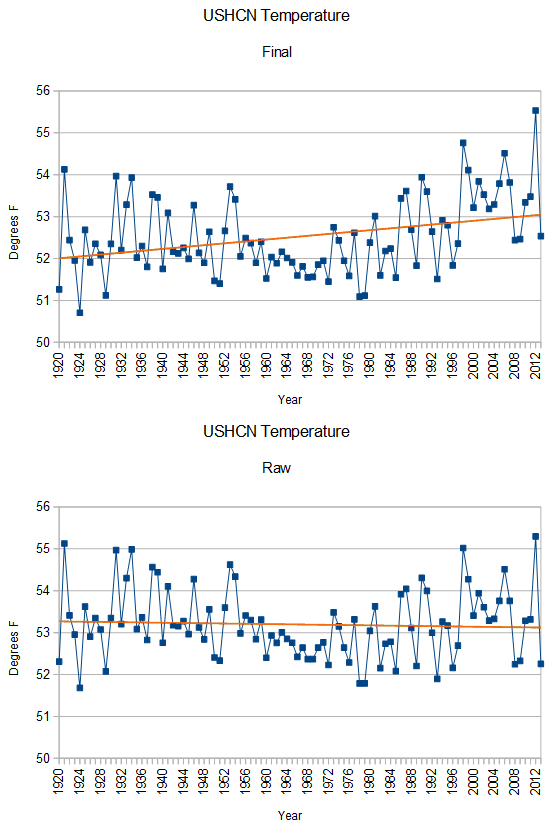
The animation below flashes between raw (measured) US thermometer data, and the final version which is reported to the public. The thermometers show no warming over the past 95 years – all of the reported warming is Mann-made by government employeestampering with data.

USHCNRawVFinal

A big part of this data tampering is implemented by making up monthly temperatures at stations where USHCN says they have no thermometer data. The amount of fabricated data is increasing exponentially, and at current rates of fabrication 100% of the data will be fake by the year 2035 – i.e. there will be no actual thermometer data used after that date. NCDC says that their software which does this, is working “as expected.”

ScreenHunter_4791 Nov. 25 09.21

The next graph shows the total adjustments NCDC are making to the US temperature record. They knock about one degree off of older temperatures, and add a few tenths of a degree on to recent temperatures. Extrapolating out to the year 2035 when 100% of reported temperatures will be fake, the total upwards adjustment will be about one degree, making for a total adjustment of about two degrees.

ScreenHunter_4802 Nov. 25 09.49

The global warming agenda depends on a belief that temperatures are warming, so the fake graphs and press releases released by government agencies about warming and “record temperatures” are critical for perpetuating the big lie about climate.

The Wind Industry Denies, What Wind Turbine Victims Experience is Their Fault….They’re Wrong!

Lawrence Solomon: Ill winds blow from wind turbines

Wind turbines produce audible sound waves known to cause what medical science calls “annoyance,” a state of health that can lead to a constellation of illnesses called wind turbine syndrome (WTS).

THE CANADIAN PRESS / Colin Perkel Wind turbines produce audible sound waves known to cause what medical science calls “annoyance,” a state of health that can lead to a constellation of illnesses called wind turbine syndrome (WTS)

The wind industry is dangerous to human health, posing risks to everything from dizziness and nausea to chronic stress and heart conditions

A Canadian court will soon decide if wind turbines violate Canada’s Charter of Rights and Freedoms by posing a risk to human health. Charter case decisions can be convoluted but the fundamental question of health at issue here is straightforward. Wind turbines, from all that is today known and by any rational measure, represent a risk to those living in their vicinity.

Although the wind industry and its government backers tend to dismiss concerns, the evidence of harm in communities that host wind turbines is overwhelming. Literally thousands of people around the world report similar adverse health effects, some so serious that owners abandon their homes. Studies of noise from turbines — though few in number, short in duration, tentative in their findings and conducted by interested parties — point to dangers. As if that wasn’t enough, basic science sounds the alarm on wind turbines.

Wind turbines produce audible sound waves known to cause what medical science calls “annoyance,” a state of health that can lead to a constellation of illnesses called wind turbine syndrome (WTS). As Health Canada reported earlier this month, following a Statistics Canada survey it commissioned of people living in the vicinity of wind turbines, “[wind turbine noise] annoyance was found to be statistically related to several self-reported health effects including, but not limited to, blood pressure, migraines, tinnitus [ringing in the ears], dizziness” and sleep disorders. The annoyance was also found to be statistically associated with objective measurements of chronic stress and blood pressure. Health Canada’s bottom line: “the findings support a potential link between long-term high annoyance and health.”

The audible sound waves — these have a frequency above 20 Hz — may be the least of the worries faced by those living near wind turbines. The turbines also produce copious amounts of sound waves below 20 Hz, making them inaudible to the human ear and thus, say wind proponents, harmless. Yet sound at this low frequency, known as infrasound, should not be thought of as faint or weak. The U.S. military has studied the use of infrasound in non-lethal weapons. Many mammals — giraffes, elephants, whales — communicate with each other at infrasound frequencies, even when many kilometres apart. Powerful infrasound waves, in fact, explain how animals sense the coming of earthquakes well before humans do — and why animals fled to safety during the calamitous Sumatran and Japanese tsunamis of recent years.

Like other mammals, humans are sensitive to infrasound, even though the human ear doesn’t “hear” it. Our inner ear has four rows of hair cells, only one of which — the fourth row — “hears.” It does this by converting sound-wave energy above 20 Hz to electricity that then travels to the brain, which makes the sounds intelligible to us. The first three rows of hair cells also convert sound, this time for sound-wave energy below 20 Hz. The electric signals from this infrasound also enter the brain but the current state of science doesn’t know much of what happens next. It especially doesn’t know what happens when the brain receives infrasound stimulation for prolonged periods, let alone 24/7 as happens with people living near wind turbines, because no long-term study has ever been conducted to find out, either on animals or on humans.

Numerous short-term studies in both animals and humans do exist — a 2001 review by the U.S. National Institute of Environmental Health Sciences, the Infrasound Toxicological Summary, located more than 100 infrasound studies around the world, many of the subjects in the human studies reporting the same adverse health effects — fatigue, sleeplessness, nausea, heart disorders — that afflict those living near wind turbines. In an unusual 2003 U.K. experiment involving the National Physical Laboratory, the country’s largest applied physics organization, back-to-back music concerts were staged in London’s Purcell Hall, similar in all respects except that two different musical pieces in each concert were laced with infrasound. The result: while hearing the infrasound-laced pieces, audience members reported significantly elevated sensations of nausea, dizziness, increased heart rates, and tingling in the neck and shoulders, among other sensations.

It’s clear from the documents that come out of the wind industry that they’re trying very hard to suppress the notion of wind turbine syndrome.

Despite the well-document effects of infrasound on animals and humans, the vast majority of studies of sound from wind turbines ignore the effects of infrasound; they instead compare wind turbine sounds to audible sounds coming from benign appliances such as refrigerators, say Alec Salt and Jeffery Lichtenhan of Washington University’s school of Medicine, authorities in the field of acoustics. The failure to take infrasound seriously, they state, is “quite astounding … Given the knowledge that the ear responds to low frequency sounds and infrasound, we knew that comparisons with benign sources were invalid and the logic [of relying on audible] sound measurements was deeply flawed scientifically.”

Salt and Lichtenhan have documented the many ways that wind turbine noise can affect the ear, concluding that it is “highly unlikely” that wind turbines don’t present a danger. “Given the present evidence, it seems risky at best to continue the current gamble that infrasound stimulation of the ear stays confined to the ear and has no other effects on the body.”

Their view, and that of other experts in the acoustics field such as Harvard Medical School’s Steven D. Rauch, is that, in the absence of other explanations, it is preposterous to dismiss wind turbines as a cause of wind turbine syndrome (WTS).

“The patients deserve the benefit of the doubt,” says Rauch, who believes that wind turbine syndrome is real. “It’s clear from the documents that come out of the industry that they’re trying very hard to suppress the notion of WTS and they’ve done it in a way that [involves] a lot of blaming the victim.”

Salt, Lichtenhan and Rauch may one day be proven wrong, and wind turbines may be found to be benign. Or wind turbine technology may change, to mitigate or altogether avoid any harmful production of sounds. Until that day comes, the risks from wind turbines are palpable, even if not always audible.

Lawrence Solomon is executive Director of Energy Probe.LawrenceSolomon@nextcity.com