This is the Result of Politicians, Thinking They are Scientists!…..Disaster!

The physics of a boiling kettle – my question to the commission!

2fa36b2
MY WRITTEN QUESTION TO THE COMMISSION:

“I understand that the Commission proposes to introduce measures to limit the power of electric kettles. Is this the case?

Does the Commission have any grasp of the basic physics of boiling a kettle?

Is the Commission aware that so far as the water itself is concerned, it takes just the same energy to boil a litre of water slowly as to boil it quickly?

Is the Commission aware that in boiling it slowly, over a longer time, more waste heat will be lost to the environment through conduction, convection and radiation?

Does the Commission therefore recognise that this proposal will increase electricity consumption, generate more waste heat, and tend to increase emissions, both of CO2 and water vapour?”


Finally! Something Useful to do With Turbine blades, …Burn ’em for Fuel!

Finally, a way to get energy from Wind Turbines. Burn them, make cement!

Blades being chopped for transport. | Global Cement Magazine

It’s the new alternative fuel — decommissioned turbines. There are 21,000 wind turbines in Germany alone at the moment. With 15,000 tons a year of old blades expected to be dumped by 2019, it’s a real problem to get rid of them. The EU says they can’t be dumped in landfill. Here’s the perfect solution. Chop them, shred them, then deliver the fibreglass reinforced plastic to the local cement plant. The resins hold 15MJ per kilo. “One tonne of resin saves 600 kg of coal at the cement plant!”

It’s a win-win all round. Residents get rid of the bird chopping towers, the cement plant gets energy, and the windmills may, possibly for the first time, save some CO2 for the Greens. What’s not to like?

Indeed this is recycling you can like. The raw materials in old blades can even be used in the cement too.

Wind Turbines make good alternative fuels for cement production.

Global Cement Magazine Sept 2014 page 10

Since 2009 Zajons has been working with Holcim’s Geocycle division to process and recycle wind turbine blades for use as an alternative fuel and raw material in the cement industry. The Cross-Flow Shredder has been customised to effect 100% recy cling of fibreglass-reinforced wind turbine blades.

The huge number of new wind farms is one catalyst for this, coupled with the fact that decommissioned wind turbine blades can no longer be sent to landfill. This has been prohibited in Germany since 2005 on the back of EU regulations. Conventional low-temperature waste incineration is not an option as melted glass fibres would cause the blockages in the system. A wind turbine has a maximum life-span of 20 years.

“By 2019 we expect decommissioned wind turbine blades to exceed 15,000t/yr,” said Lempke. “There are major technical issues involved in recycling these huge blades, the first being transporting the blades to the reprocessing plant. We saw the blades into transport-friendly lengths of around 10m on-site at the wind farm and use a special liquid to minimise dust, thus preventing site contamination.” Sawing the blades into manageable lengths on-site significantly reduces transportation costs (Figure 4). Once at the reprocessing plant, the metal components are removed and the blades are sawn into smaller pieces.

Suction, filter and watering technologies largely prevent dust production. The blade is ground in a Cross-Flow Shredder. The resulting material, which is primarily composed of fibreglass reinforced plastic, is homogenised and delivered to a nearby cement plant. The calorific value of the resins (around 15MJ/kg) is harnessed in the cement calciner and is used to thermally degrade the lime. One tonne of resin replaces 600kg of coal at the cement plant.

Even better, the silicon dioxide in the fibreglass can be used instead of sand:

Ash constitutes >50% of the wind turbine blade, which is mixed with the raw meal in the calciner. This is where an  additional benefit comes into play. The ash contains SiO 2 from the fibreglass, which is used in place of sand in the raw material mix. In addition to wind turbine blades, other fibreglass materials can also be used once ground. Thus, valuable raw materials can be substituted and supply conserved.

Using this method, more than 1000 wind turbine blades have been processed into homogeneous refuse derived fuel (RDF) for cement kilns. Working closely with partners like Holcim has enabled Zajons to develop innovative solutions for the manufacture of alternative raw materials for cement and incineration feedstocks, thereby generating significant added value for its cement industry customers.


http://www.globalcement.com/pdf/eGCSept2014ns.pdf

Leading Scientists Warn of Vibro-Acoustic Disease, from Wind Turbines!

Are wind turbines a headache?

turbine1LEADING SCIENTISTS are concerned that a new threat may be posed by wind turbines, a threat that could damage our ears known as ‘Vibro-Acoustic Disease’. 

This new warning may come as too little too late for a local Pembrokeshire resident, Gwen Burkhardt, who it is alleged had to sell her Newcastle Emlyn farm several years ago because the of the three wind turbines that were a mile away from her home and were adversely affecting her health. Her doctor, apparently, put it down to ‘infra-sound’, that sound which is inaudible to human ears. She was suffering from headaches at home, which was on a B road near to Emlyn’s three 250 foot wind turbines. According to Gwen Burkhardt, once she sold up and moved from the area, the headaches disappeared.

The main proponent of this theory, ‘Vibro-Acoustic Disease’, is Dr Nina Pierpont, who published a book entitled ‘Wind Turbine Syndrome’ in 2001. In this book a link is alleged between low frequency noise and vibration and a range of symptoms such as tinnitus, dizziness, nausea, palpitations, sleep disturbance and migraines. Another disturbing case was reported in the Danish press who reported the story of a garden centre going out of business because of nearby wind turbines. Headaches were frequent among employees, and female workers complained of unusual bleeding and problems with their menstrual cycles.

The employers were worried that more serious illnesses may have followed after five employees resigned. The owner, Boye Jensen, closed the business for fear of being held liable should a child be born with deformities. The World Council for Nature (WCFN) is calling attention to the fact that, as occurred for tobacco, asbestos, thalidomide etc, governments are siding with private financial interests in ignoring or denying the existence of what they see as obvious health problems linked to wind turbines.

They went on to say: “In Denmark as elsewhere in the world, many rural families are suffering, particularly since the manufacture of the mega turbines, which emit more infrasound as they grow bigger. This may explain why the complaints are growing. How much longer can this suffering be ignored, or even denied by health authorities? Some countries, including Canada and Australia, have commissioned studies into the matter of noise emitted by windfarms. But the studies’ scope and methodology doom them to failure, perhaps intentionally”. Such is the concern of the potential damage caused by these turbines that the WCFN have called for an epidemiological study, and the measurement of low frequency sound (including infrasound down to 0.1 Hz), inside the homes of windfarm victims.

They suggest that as a precaution, no mega turbines should be erected less than 10 km from habitations until these studies are completed, published and analyzed. They finished by saying: “There is indeed compelling evidence that infrasound travels much farther than other noise, and tortures sensitive people in their homes at distances of 10 km and more. Shorter distances could be temporarily set for smaller turbines, in proportion with their generating capacity”. Pembrokeshire residents, many of whom may be living near to these turbines, will be hoping that this concern proves to be a false alarm.


Economic Storage of Wind Power will Never be Feasible!

The Economic Storage of Wind Power is a Pipe-Dream

giant battery 2

The wind industry is the perpetual infant of power generation: always looking for the subsidies to last that little bit longer; always promising to improve its performance; always claiming it will outdo hydro, coal and gas – provided, of course, that the subsidies keep flowing. STT for one thinks the wind industry has had ample time to grow up and stand on its own two feet.

Like the brat that it is, the wind industry can’t be told what to do and, especially, won’t ever respond to demands from power users about when its product should be delivered.

output vs demand

It’s quite happy to produce plenty of power when it’s not needed at night time; and much less during the day, when it is (as seen in the graph above); and often, none at all during periods of peak demand: as seen in the graph below, showing the entire fleet of wind farms connected to the Eastern Grid (based in SA, NSW, Tasmania and Victoria, which in July had a notional capacity of 2,952 MW) producing 20 MW or 0.67% of total capacity, just as demand starts to peak – and see our posts here and hereand here and here and here and here and here and here.

JULY20

In it’s “quick, look over there” response to any inconvenient facts, the wind industry never concedes that wind power is “intermittent” – it prefers the term “variable” – which we showed to be a monstrous abuse of both the facts and the English language (see our post here).

When challenged about its consistent failures to match output with demand, the wind industry and its parasites respond by mumbling about “battery technology improving”.

The pitch is that – one day “soon” – there will batteries big enough and cheap enough to allow huge volumes of wind power produced when it’s not needed, to be stored for the occasions when it is. That way, the “variable” output from wind farms could be delivered when there might just be a market for it.

Of course, the pitch is made so the subsidies keep flowing to allow an endless sea of giant fans to be erected now – in order to take advantage of the (so far, elusive) storage technology that’s just over the “horizon”. Except that the “soon” is more like light-years and the “horizon” is a mirage.

Even if a technology was invented (STT likens it to the chances of finding a perpetual motion machine or alchemy turning lead into gold) to store large volumes of the electricity output (in bulk) from all of the wind farms connected to the Eastern Grid, say (which now have a notional capacity of 3,342 MW) – the economic cost would be astronomical – and readily eclipse the value of the power produced. Not that the wind industry has ever made any economic sense.

One way of analysing the economics (ie costs versus benefits) of storing, in bulk quantities, the electricity generated from wind farms is to quantify what’s called the “energy returned on energy invested” (EROEI). Put simply, that’s the amount of energy required as an input in order to return a given energy output. To be economically viable, a generation source has to produce a surplus of energy well over and above what was required to establish it.

In this article, Dr John Morgan – an Adjunct Professor at RMIT – comes up with the (not so surprising) conclusion that energy storage cannot (and will never) provide an economic solution to the intermittency of wind power.

The Catch 22 of Energy Storage
Brave New Climate
22 August 2014

Pick up a research paper on battery technology, fuel cells, energy storage technologies or any of the advanced materials science used in these fields, and you will likely find somewhere in the introductory paragraphs a throwaway line about its application to the storage of renewable energy. Energy storage makes sense for enabling a transition away from fossil fuels to more intermittent sources like wind and solar, and the storage problem presents a meaningful challenge for chemists and materials scientists… Or does it?

Guest Post by John Morgan.

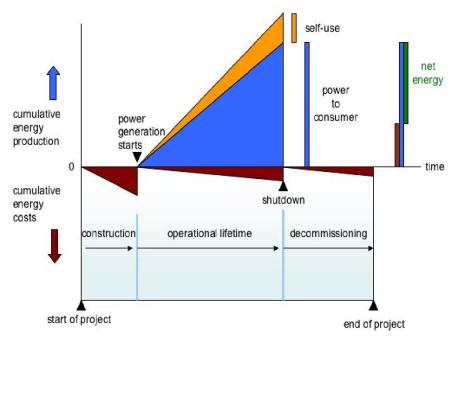
Several recent analyses of the inputs to our energy systems indicate that, against expectations, energy storage cannot solve the problem of intermittency of wind or solar power. Not for reasons of technical performance, cost, or storage capacity, but for something more intractable: there is not enough surplus energy left over after construction of the generators and the storage system to power our present civilization.

The problem is analysed in an important paper by Weißbach et al. (1) in terms of energy returned on energy invested, or EROEI – the ratio of the energy produced over the life of a power plant to the energy that was required to build it. It takes energy to make a power plant – to manufacture its components, mine the fuel, and so on. The power plant needs to make at least this much energy to break even. A break-even powerplant has an EROEI of 1. But such a plant would pointless, as there is no energy surplus to do the useful things we use energy for.

There is a minimum EROEI, greater than 1, that is required for an energy source to be able to run society. An energy system must produce a surplus large enough to sustain things like food production, hospitals, and universities to train the engineers to build the plant, transport, construction, and all the elements of the civilization in which it is embedded.

morganesbox

For countries like the US and Germany, Weißbach et al. (1) estimate this minimum viable EROEI to be about 7. An energy source with lower EROEI cannot sustain a society at those levels of complexity, structured along similar lines. If we are to transform our energy system, in particular to one without climate impacts, we need to pay close attention to the EROEI of the end result.

The EROEI values for various electrical power plants are summarized in the figure. The fossil fuel power sources we’re most accustomed to have a high EROEI of about 30, well above the minimum requirement. Wind power at 16, and concentrating solar power (CSP, or solar thermal power) at 19, are lower, but the energy surplus is still sufficient, in principle, to sustain a developed industrial society. Biomass, and solar photovoltaic (at least in Germany), however, cannot. With an EROEI of only 3.9 and 3.5 respectively, these power sources cannot support with their energy alone both their own fabrication and the societal services we use energy for in a first world country.

morganesfig1

Energy Returned on Invested, from Weißbach et al.,(1) with and without energy storage (buffering). CCGT is closed-cycle gas turbine. PWR is a Pressurized Water (conventional nuclear) Reactor. Energy sources must exceed the “economic threshold”, of about 7, to yield the surplus energy required to support an OECD level society.

These EROEI values are for energy directly delivered (the “unbuffered” values in the figure). But things change if we need to store energy. If we were to store energy in, say, batteries, we must invest energy in mining the materials and manufacturing those batteries. So a larger energy investment is required, and the EROEI consequently drops.

Weißbach et al. calculated the EROEIs assuming pumped hydroelectric energy storage. This is the least energy intensive storage technology. The energy input is mostly earthmoving and construction. It’s a conservative basis for the calculation; chemical storage systems requiring large quantities of refined specialty materials would be much more energy intensive. Carbajales-Dale et al. (2) cite data asserting batteries are about ten times more energy intensive than pumped hydro storage.

Adding storage greatly reduces the EROEI (the “buffered” values in the figure). Wind “firmed” with storage, with an EROEI of 3.9, joins solar PV and biomass as an unviable energy source. CSP becomes marginal (EROEI ~9) with pumped storage, so is probably not viable with molten salt thermal storage. The EROEI of solar PV with pumped hydro storage drops to 1.6, barely above breakeven, and with battery storage is likely in energy deficit.

This is a rather unsettling conclusion if we are looking to renewable energy for a transition to a low carbon energy system: we cannot use energy storage to overcome the variability of solar and wind power.

In particular, we can’t use batteries or chemical energy storage systems, as they would lead to much worse figures than those presented by Weißbach et al (1). Hydroelectricity is the only renewable power source that is unambiguously viable. However, hydroelectric capacity is not readily scaled up as it is restricted by suitable geography, a constraint that also applies to pumped hydro storage.

This particular study does not stand alone. Closer to home, Springer have just published a monograph, Energy in Australia, (3) which contains an extended discussion of energy systems with a particular focus on EROEI analysis, and draws similar conclusions to Weißbach. Another study by a group at Stanford (2) is more optimistic, ruling out storage for most forms of solar, but suggesting it is viable for wind. However, this viability is judged only on achieving an energy surplus (EROEI>1), not sustaining society (EROEI~7), and excludes the round trip energy losses in storage, finite cycle life, and the energetic cost of replacement of storage. Were these included, wind would certainly fall below the sustainability threshold.
energy-outputs-and-energy-costs

It’s important to understand the nature of this EROEI limit. This is not a question of inadequate storage capacity – we can’t just buy or make more storage to make it work. It’s not a question of energy losses during charge and discharge, or the number of cycles a battery can deliver. We can’t look to new materials or technological advances, because the limits at the leading edge are those of earthmoving and civil engineering. The problem can’t be addressed through market support mechanisms, carbon pricing, or cost reductions. This is a fundamental energetic limit that will likely only shift if we find less materially intensive methods for dam construction.

This is not to say wind and solar have no role to play. They can expand within a fossil fuel system, reducing overall emissions. But without storage the amount we can integrate in the grid is greatly limited by the stochastically variable output. We could, perhaps, build out a generation of solar and wind and storage at high penetration. But we would be doing so on an endowment of fossil fuel net energy, which is not sustainable. Without storage, we could smooth out variability by building redundant generator capacity over large distances. But the additional infrastructure also forces the EROEI down to unviable levels. The best way to think about wind and solar is that they can reduce the emissions of fossil fuels, but they cannot eliminate them. They offer mitigation, but not replacement.

Nor is this to say there is no value in energy storage. Battery systems in electric vehicles clearly offer potential to reduce dependency on, and emissions from, oil (provided the energy is sourced from clean power). Rooftop solar power combined with four hours of battery storage can usefully timeshift peak electricity demand, (3) reducing the need for peaking power plants and grid expansion. And battery technology advances make possible many of our recently indispensable consumer electronics. But what storage can’t do is enable significant replacement of fossil fuels by renewable energy.

If we want to cut emissions and replace fossil fuels, it can be done, and the solution is to be found in the upper right of the figure. France and Ontario, two modern, advanced societies, have all but eliminated fossil fuels from their electricity grids, which they have built from the high EROEI sources of hydroelectricity and nuclear power. Ontario in particular recently burnt its last tonne of coal, and each jurisdiction uses just a few percent of gas fired power. This is a proven path to a decarbonized electricity grid.

But the idea that advances in energy storage will enable renewable energy is a chimera – the Catch-22 is that in overcoming intermittency by adding storage, the net energy is reduced below the level required to sustain our present civilization.
John Morgan
22 August 2014

John is Chief Scientist at a Sydney startup developing smart grid and grid scale energy storage technologies. He is Adjunct Professor in the School of Electrical and Computer Engineering at RMIT, holds a PhD in Physical Chemistry, and is an experienced industrial R&D leader. You can follow John on twitter at @JohnDPMorgan. First published in Chemistry in Australia.

Brave New Climate Postscript

When this article was published in CiA some readers had difficulty with the idea of a minimum societal EROI. Why can’t we make do with any positive energy surplus, if we just build more plant? Hall (4) breaks it down with the example of oil:

Think of a society dependent upon one resource: its domestic oil. If the EROI for this oil was 1.1:1 then one could pump the oil out of the ground and look at it. If it were 1.2:1 you could also refine it and look at it, 1.3:1 also distribute it to where you want to use it but all you could do is look at it. Hall et al. 2008 examined the EROI required to actually run a truck and found that if the energy included was enough to build and maintain the truck and the roads and bridges required to use it, one would need at least a 3:1 EROI at the wellhead.

Now if you wanted to put something in the truck, say some grain, and deliver it, that would require an EROI of, say, 5:1 to grow the grain. If you wanted to include depreciation on the oil field worker, the refinery worker, the truck driver and the farmer you would need an EROI of say 7 or 8:1 to support their families. If the children were to be educated you would need perhaps 9 or 10:1, have health care 12:1, have arts in their life maybe 14:1, and so on. Obviously to have a modern civilization one needs not simply surplus energy but lots of it, and that requires either a high EROI or a massive source of moderate EROI fuels.

The point is illustrated in the EROI pyramid.(4) (The blue values are published values: the yellow values are increasingly speculative.)

morganesfig2

Finally, if you are interested in pumped hydro storage, a previous Brave New Climate article by Peter Lang covers the topic in detail, and the comment stream is an amazing resource on the operational characteristics and limits of this means of energy storage.

References

(1). Weißbach et al., Energy 52 (2013) 210. Preprint available here.

(2). Carbajales-Dale et al., Energy Environ. Sci. DOI: 10.1039/c3ee42125b

(3). Graham Palmer, Energy in Australia: Peak Oil, Solar Power, and Asia’s Economic Growth; Springer 2014.

(4). Pedro Prieto and Charles Hall, Spain’s Photovoltaic Revolution, Springer 2013.

light-in-darkness

The Consequences of Faux-green Renewable Energy, on Nature, in Germany!

germany Deutschland
How The Green Energy Transition Is Destroying Germany’s Nature

 Date: 28/08/14

  • Fritz Vahrenholt, Die Welt

Germany’s climate and energy policy is the main threat to bio-diversity. Politicians, however, have closed their eyes from the destructive effects of the rampant expansion of renewable energy.

Dankwart Guratzsch has convincingly described the destruction of the environment by the energy transition in these pages. The mayor of Tübingen, Boris Palmer (Green Party), responded in an article, saying: “Everything is not so bad. The impact of wind farms on nature is almost zero … The only relevant negative aspect of wind power is the optical … Many wind farms attract visitors, who do not find repulsive.”

What a devastating form of denial by the Green mayor. But he shares the fatal disregard for the destruction of nature with many greens who – helped by the WWF and Greenpeace – open up forests and premium areas of natural beauty for businesses and belittle the intrusion by wind turbines into nature.

More and more citizens are beginning to realise how the green energy transition is at odds with nature conservation and environmental protection in Germany. A grassroot protest movement has started with thousands of local citizens’ initiatives, barely connected with each other, who are against the planting of biofuels far and wide and which is destroying biodiversity, against the threats to indigenous birds by wind turbines built in forests, and against the devastation of unique cultural and landscape areas by photovoltaic excesses.

A biodiversity disaster

Of Germany’s 115 most common bird species, 51 have declined significantly in the last 20 years. The head of the biosphere reserve in Schorfheide, Martin Flade, speaks of a “biodiversity disaster” which is due to “the hectic climate, energy and agricultural policy: In the corn farmland birds have no chance – the field processing falls in the breeding season, and later they hardly find any insects to eat in these mono-cultures. Of the 30 most common species, there are just four that could hold their numbers, all the rest are declining since at least since 2007.”

The Lesser Spotted Eagle, also called Pomerania Eagle, became extinct in Saxony-Anhalt last year. Only 108 breeding pairs remain in Germany. It finds less and less food in the declining grassland and open meadow. The distances between breeding sites and food areas are getting longer and are also increasingly endangered by wind turbines.

Notably countries with Green Party ministers (North Rhine-Westphalia, Rhineland-Palatinate, Baden-Wurttemberg, Brandenburg and Hessen) have approved regulations which open the use of forests for wind turbines. To place a wind farm every 500 meters in the forest, six meter wide open lanes have to be cut through the forest in order to transport the 100-ton turbines and to maintain them later. Around each turbine, a five-acre open area must be created to lift the blades by giant cranes.

Wind farms in pristine forests

What a wind farm forest looks like can now be seen in many parts of Germany – for instance around Soonwaldsteig, a part of the Hunsrück, one of the last great, largely untouched forest areas in Rhineland-Palatinate with high biodiversity and the presence of numerous highly endangered species. There, the project developer Juwi has erected eight wind turbines in the middle of a forest – despite public protests – and then sold the park to an Austrian energy supplier. Faced with the images of demonstrating citizens, the Green minister Evelin Lemke could only come up with: “Without climate protection, there will be no more biodiversity here.”

But a policy that overestimates the dangers of climate change and that subordinates all other policy objectives, including nature conservation, whatever the cost, generates resistance. The Soonwaldsteig has become a nationwide focal point of citizens’ initiatives against the use of wind power in sensitive areas.

Today, 200,000 dead bats are found under wind turbines annually. The clever animals locate the rotors, fly through them and in the lee behind the turbines, where the air pressure decreases sharply, the bats’ lungs burst. Particularly affected are the noctule, the Serotine, the Small Noctule or the parti-colored bat. The female bat only gives birth to one or two young per year, thus these useful insectivores are endangered by a further uncontrolled construction of new wind turbines.

The red kite is acutely threatened

Following the review of the German Council for Bird Preservation (DRV) and the umbrella organization of German Avifaunists (DDA, 2012), the Red Kite is also in particular danger. After an investigation by the State Ornithological Institute of Brandenburg, the Red Kite is no longer safe in this state with its 3,200 wind turbines. About 300 Red Kites are killed annually in Brandenburg alone by wind turbines.

The decline of the red kites since 2005 in West Germany is striking, as Klaus Richarz, former head of the State Ornithological Institutes for Hesse, Rhineland-Palatinate and Saarland, has warned. For him too, windmills built in the habitats of kites are fatal for the birds. The protection of the Red Kite is of special obligation for Germany, because a large percentage of the global population of the birds live in Germany. If you like, it is the real national bird of Germany.

In his hard-hitting article “From the energy transition to biodiversity disaster” Martin Flade, the recognized bird expert, describes climate protection and energy policy as a “major threat to biological diversity”. He concludes: “Overall, you have to draw the bitter conclusion that effects of climate change on biodiversity are hardly detectable; the effects of climate and energy policies, however, are dramatic.”

The problem with intermittent wind turbines

Tübingen’s mayor Boris Palmer demands: “We need to double the number of currently 25,000 wind turbines in order to supply Germany.” What a mistake!

Even 50,000 wind turbines only lead to massive surpluses if the wind blows. Wind turbines have on average around 2,500 full load hours per year, but the year has 8,760 hours. In times of no wind, no electricity is generated, even if one multiplies the number of facilities. Zero times x is zero. The intermittency of renewable energy such as wind and solar require either backup fossil power plants or energy storage capacities.

Storage technologies can only do this tasks with excessive costs. Without fossil power plants to balance the intermittency of renewable energy there will be no guaranteed power supply in Germany, with fatal consequences for the competitiveness of German industry and the manufacturing industry.

It should also be known to the Greens that the expansion of renewable energy due to Germany’s Renewable Energy Law is completely ineffective in terms of CO2 emissions in Europe. The CO2 emissions in Europe are determined solely by the capping of the emissions trading scheme. New wind and solar power, in fact, set more emission allowances free.

These certificates float through the stock exchanges to coal power plants in other EU countries where they allow further increase in CO2 emissions which amount to the same level as the reductions in Germany. Besides additional costs for citizens and the devastation of nature, any expansion of renewable energy will not achieve a single ton of CO2 reduction.

Assumptions of climate policy are flawed

Fossil fuel power plants are not an alternative for Boris Palmer and the Greens because they cause climate change, claiming that “some nature reserves, but also some urban areas cannot be saved from rising sea levels, drought and floods and devastating storms”.

But there are growing signs that the assumptions used for German and European climate policy are flawed. Surprisingly, no global temperature increase has occurred for about 15 years. However, computer models used by climate scientists had predicted a temperature rise of 0.2 degrees Celsius per decade.

In early 2013, 17 renowned climate scientists came to the conclusion that the climate sensitivity of greenhouse gases should be significantly reduced. Hans von Storch, researcher from the Helmholtz Centre in Geesthacht, admits: “First option: global warming is weaker because the greenhouse gases, especially CO2, have a lower impact than assumed. That does not mean that there is no man-made greenhouse effect, only that our influence on the climate system would not be as strong as expected. The other possibility: In our simulations we have underestimated how much the climate varies due to natural causes “.

In fact, there are good reasons for the global warming pause. Solar activity has reached a maximum in the second half of the last century. But since the last eleven-year solar cycle, solar activity has decreased dramatically, the solar maximum exited very quickly. The current solar cycle 24 is the weakest in 200 years.

Ocean currents shift into cold phase

Another crucial error by the Intergovernmental Panel on Climate Change was its failure to take into account the 60-year-old oceanic-atmospheric cycle of the Pacific Decadal Oscillation (PDO) and the Atlantic Multidecadal Oscillation (AMO). The ocean currents change in 30-year intervals between warm and cold phases. They are now moving into a cold phase in which they will remain until 2035. The natural temperature rise in the past was also blamed on CO2, and so scientists got the wrong predictions.

Yes, CO2 is a greenhouse gas; it causes a warming of about 1.1 degrees Celsius per doubling of its concentration. But catastrophic global warming of three to six degrees Celsius this century, which justifies energy policies that threaten the existence of local wildlife, is not to be feared.

The sacrifice of German forests may do for wind energy what the battle against the Whyl nuclear power plant was for Germany’s nuclear energy. None of the political parties represented in the German parliament intends to end this attack on the environment. However, the Green Party would feel the impact most if the growing protest movement against the destruction of nature were to raise this threat onto the political agenda.

Fritz Vahrenholt is the chairman of the German Wildlife Foundation and author of the 2012 bestseller “The Neglected Sun”. He is a member of the GWPF’s Academic Advisory Council.

Translation Philipp Mueller


High Court in Denmark Awards Damages to Victims, for Noise, and Property Devaluation!

Environment & Climate Change – Denmark

High Court rules on compensation for noise from wind turbines

September 01 2014

Background

Depending on their location, wind turbines can cause noise, visual interference and light reflections.

These issues are governed by public and private law, including neighbour law. The main rules regarding noise from wind turbines can be found in Executive Order 1284 of December 15 2011 on wind turbine noise, issued pursuant to the Environmental Protection Act. To some extent, the order safeguards neighbours from noise inconvenience by establishing maximum noise levels from wind turbines in outdoor areas. The noise limit varies depending on the surroundings.

Wind turbines may also cause visual interference which may negatively affect the value of surrounding properties. Thus, the location of wind turbines on land has proved a difficult political issue for years. Every municipality supports the idea of more wind turbines – just not within its own borders.

In order to promote local support for wind energy projects, the Parliament passed the Promoting Renewable Energy Act, which establishes a compensation scheme for neighbours of wind turbines. Under the scheme, those who build one or more wind turbines are obliged to compensate their neighbours for any reduction in property value that the wind turbines may cause, regardless of whether the wind turbines accord with the necessary permits.

The compensation scheme departs from the court-based neighbour law in that it does not operate with a tolerance limit which the neighbour must prove has been exceeded.

The starting point is that the issue of compensation must be settled before the wind turbines are built. However, the Promoting Renewable Energy Act does allow neighbours to claim compensation in certain circumstances thereafter. The competent authority to deal with claims for compensation is the assessment authority set up by the act.

Compensation granted to neighbours under the act has been relatively low so far.

Facts

In a recent case before the High Court for Western Denmark the plaintiffs had been awarded Dkr250,000 in compensation for the erection of eight wind turbines by the assessment authority. They brought the matter before the courts seeking higher compensation.

Before the erection of the wind turbines, an environmental study had concluded that the noise level at their property would amount to 38.8 decibels at wind speeds of 12 knots and 40.9 decibels at wind speeds of 16 knots.

Before the city court, a court-appointed expert stated that the reduction in the value of the property amounted to between Dkr600,000 and Dkr800,000. The city court also arranged a visit to the property.

Where the assessment authority found that the plaintiffs’ property would be subject to limited noise pollution, the city court found the level to be more significant. The court further ruled that the plaintiffs had documented their loss of value at Dkr600,000 and thus awarded them an additional Dkr350,000.

Finally, the court held that the plaintiffs had suffered no other economic loss covered by the Promoting Renewable Energy Act. In particular, the court held that the fact that the wind turbines had been erected with all necessary permits prevented the plaintiffs from claiming compensation under neighbour rules.

The High Court for Western Denmark upheld the city court’s judgment, but fixed the compensation at Dkr500,000 because, among other things, there were certain deficiencies in the masonry of the house. However, the court also considered the findings of the court-appointed expert witness who had seen the plaintiffs’ house after the erection of the wind turbines – which the assessment authority had not done – as well as the city court’s own observation of the property. Finally, the court ruled that the Promoting Renewable Energy Act does not restrict the courts’ competence to review decisions from the assessment authority.

Comment

The judgment is significant as it granted compensation after the erection of the wind turbines. This is contrary to the main rule in the Promoting Renewable Energy Act; however,both the city court and the high court found sufficient legal authority under the act to admit the claim after the erection of the wind turbines.

Moreover, both courts paid considerable attention to the evaluation of the court-appointed expert. While this is quite normal in Danish case law, it is unusual in cases where an authority such as the assessment authority has previously dealt with the matter.

Finally, the high court paid attention to the city court’s own observations of the property. It is quite unusual to see such a reference to the observations of a lower court in a higher court’s grounds of judgment.

The judgment gives cause for optimism to those who intend to challenge decisions of the assessment authority under the Promoting Renewable Energy Act. From a procedural point of view, it seems to be important for the court to see the property at issue to form its own opinion of the level of noise pollution caused by wind turbines.

For further information on this topic please contact Søren Stenderup Jensen at Plesner by telephone (+45 33 12 11 33), fax (+45 33 12 00 14) or email (ssj@plesner.com). The Plesner website can be accessed at www.plesner.com.


Comment or question for author

ILO provides online commentaries as specialist Legal Newsletters. Written in collaboration with over 500 of the world’s leading experts and covering more than 100 jurisdictions, it delivers individually requested information via email to an influential global audience of law firm partners and international corporate counsel. Please click here to register for the service.

The materials contained on this website are for general information purposes only and are subject to the disclaimer.

ILO is a premium online legal update service for major companies and law firms worldwide. In-house corporate counsel and other users of legal services, as well as law firm partners, qualify for a free subscription. Register at www.iloinfo.com.

Would you Mind Waiting Till the Wind blows, if you want Electricity? (but not too much)

Of Unicorns & Pink Elephants: “Reliance” on Wind Power is Pure “Green” Fantasy

Unicorn Drinking from a River

When it comes to their demand for electricity, the power consumer has a couple of basic needs: when they hit the light switch they assume illumination will shortly follow and that when the kettle is kicked into gear it’ll be boiling soon thereafter. And the power consumer assumes that these – and similar actions in a household or business – will be open to them at any time of the night or day, every day of the year.

For conventional generators, delivering power on the basic terms outlined above is a doddle: delivering base-load power around the clock, rain, hail or shine is just good business. It’s what the customer wants and is prepared to pay for, so it makes good sense to deliver on-demand.

But for wind power generators it’s never about how much the customer wants or when they want it, it’s always and everywhere about the vagaries of the wind. When the wind speed increases to 25 m/s, turbines are automatically shut-off to protect the blades and bearings; and below 6-7 m/s turbines are incapable of producing any power at all.

Even with the most geographically widespread grid-connected set of wind farms in the world (the 3,342 MW of wind power capacity connected to Australia’s Eastern grid across SA, Victoria, Tasmania and NSW) there are dozens of occasions each year when total wind power output struggles to top 2% of installed capacity – and hundreds when it fails to muster even 5% (see our posts here and here and here).

Now, if the power consumer was given advance warning of when these total output failures were going to occur, they might simply reconsider their selfish demands of having illumination after dark or that hot cuppa in the morning. That way, they might still consider wind power a “perfect substitute” for conventional power; and plump for the (purportedly cheaper) former over the latter every time?

But, so far, power consumers remain stubbornly selfish; wedded to the idea that when they hit the switch, their power needs will be satisfied that very instant (the cheek, hey?). And that’s where claims that wind power is a “substitute” for conventional generation fall in a heap.

Power delivered at crazy, random intervals (which in practical terms means no power at all, hundreds of times each year) is NO substitute for power delivered on-demand; anytime of the day or night; every single day of the year – and in volumes sufficient to satisfy all consumers connected to the same network, at the same time.

Wind power cannot, therefore, be considered a “substitute” for power which is available on-demand. With every MW of wind power capacity matched with a MW of conventional generation capacity at all times – needed to keep the grid stable by balancing the wild fluctuations in wind power output (see our post here) and to meet demand when output collapses to nothing (see our post here) – wind power is nothing but childish nonsense.

The only reason turbines have been slung up anywhere is in order for wind power outfits and their backers to reap a fat pile of taxpayer and power consumer subsidies. Here’s a take on the greatest rort of all time from the US.

Obama’s Green Unicorn
US News
Peter Roff
25 August 2014

The true cost of renewable energy is being masked by government subsidies and bailouts.

America is about as likely to become reliant on green energy to meet its baseload power requirements as a unicorn is to stroll down the middle of Washington’s Pennsylvania Avenue during rush hour followed by a pink elephant.

It’s just not happening – but that’s hasn’t deterred the modern day snake oil salesmen and their allies inside the Obama administration from continuing to make a push for wind and solar power as an eventual replacement for energy generated from traditional sources like coal, oil and natural gas. Renewable technology has improved, no doubt, but it’s a long way away from being ready to make a substantial contribution to the heating of our homes and the powering of our businesses unless the generous tax subsidies that create the illusion of cost competitiveness continue.

There’s nothing wrong per se with the pursuit of renewable energy; it’s just that what it actually costs is being masked by taxpayer subsidies, federal loan guarantees and renewable fuels mandates at the state level that force power companies to put wind and solar into the energy mix, sometimes at two to three times what traditional power costs. Ultimately, one way or another, the taxpayers and energy consumers are footing the bill even if they don’t know it.

Congress has taken a few positive steps in the right direction. The federal Wind Production Tax Credit was allowed to expire at the end of the year, meaning new wind projects are going to have to be competitive at market rates to attract funding. Remember it was none other than billionaire Warren Buffett, the “Oracle of Omaha,” who explained recently to a group of investors that the tax credit was the only reason that any sensible person invested in wind projects in the first place.

Unfortunately, some federal agencies are trying to keep the program alive through the backdoor.

The worst offender in this regard may be the IRS, which recently issued new “guidelines” that make it even easier for wind projects currently in development to qualify for the tax credit on the basis of work already contemplated or completed. According to Politico, “The IRS says completed or in-progress facilities can be sold and the costs incurred by the seller will still count toward qualifying for the [credit], except in cases where tangible property (think equipment like wind turbines) bought for one project is sold and used at another site.”

To translate this into English, it’s a move to help keep the whole shell game alive until such time as wind power supporters can get the tax credit reauthorized. “There is a large pipeline of projects that were under development at some stage that by virtue of this guidance will be able to go forward. In that regard it is going to permit a lot of projects to be developed,” said one wind energy expert cited by Politico.

Outside groups are also weighing in, including the Sierra Club, which has targeted nine members of Congress in a pressure campaign over the August recess to push for re-authorization of the Wind Production Tax Credit. That is in addition to the online ad buys in 16 other districts that started in June.

The Democrats who run the Senate want to keep the now-expired credit alive and have, in the Senate Finance Committee, already approved a package of so-called “extenders” that would breathe new life into it. The House has thus far refused to go along – and kudos to Texas Republican Rep. Randy Weber, who deserves credit for successfully introducing an amendment to shut the whole business down permanently. But he’s not just fighting the lobbyists and green groups in favor of the credit, but the entire federal bureaucracy which, once a program has been established, is loath to let it die.

Major government investment in speculative green projects may have at one time made sense. But even if that were once the case, it is so no longer. The Obama green energy push has enriched more than a few politically well-connected liberals who used tax credits and government bailouts to enlarge their portfolios, but it has done little to make energy more abundant or lower costs to consumers, which is the justification in the first place to get the taxpayers involved.

If people want to build wind farms – on land or offshore – and they want to reap the benefits of their investments, then they should be willing to take the same risks as everyone else. The way the bureaucrats have it structured now, the taxpayers are making payments on both ends through subsidies for construction and higher rates on consumption. It’s a system only a bureaucrat could love.
US News

yacht

Wind Turbines Killing a Very High number of bats!

BAT DEATHS PROMPT CHANGE AT WIND FARM

A White Pine County wind farm that sells power to NV Energy has been forced to change operations after its massive turbines killed triple the number of bats allowed under an agreement with federal regulators.

The 152-megawatt Spring Valley Wind Energy project about 260 miles northeast of Las Vegas killed an estimated 566 bats in 2013, so its operator agreed to change when the windmills kick on in hopes of reducing the number of deaths.

In June, the wind farm’s 66 turbines — each standing up to 425 feet tall — were adjusted on nights with high bat activity so they would only start turning when sustained winds reach about 11 mph instead of the usual “cut-in” speed of about 7 mph.

The move was designed to reduce the number bats killed in collisions with the spinning blades because “when it gets too windy, the bats aren’t flying as much,” said Paul Podborny, a field manager with the U.S. Bureau of Land Management’s office in Ely.

Podborny is scheduled to meet next week with Spring Valley Wind representatives to review whether the new operating protocols are working. If bats continue to die in unacceptably high numbers, additional measures might include increasing the number of nights the higher cut-in speeds are used, increasing the cut-in speed even more or shutting down the turbines altogether on nights when a lot of bats are active, he said.

Matt Dallas, spokesman for San Francisco-based Pattern Energy, which owns the wind farm, said the turbine speed adjustment results in a small reduction in power output, “but we are willing to accept this in order to reduce our environmental impact.”

In an email, Pattern’s director of environmental compliance, Rene Braud, said the vast majority of the bats were Mexican free-tail bats, “a very common and abundant species” that migrates by the millions through the Spring Valley each year and is not protected under federal law.

“The project has had no impact at all on any threatened or endangered bat species,” Braud said.

To environmentalists, though, the higher-than-expected bat deaths prove what they have said all along.

Rob Mrowka, senior scientist for the Center for Biological Diversity in Nevada, put it this way: “The Spring Valley Wind project is an important component of a renewable energy portfolio placed in absolutely the wrong location.”

CAVE OF CONCERN

The $225 million project went online in August 2012 as the first utility-scale wind farm in Nevada. It features 66 turbines scattered across more than 7,600 acres of federal land at the heart of the vast Spring Valley, which runs north-south for about 110 miles between the Schell Creek and Snake mountain ranges in eastern Nevada.

The facility was designed to generate enough electricity to supply about 40,000 homes, with NV Energy as its only customer for the first 20 years of operation. It drew stiff opposition from environmentalists.

The Center for Biological Diversity and the Western Watersheds Project sued to block construction in January 2011, accusing the BLM of skirting environmental regulations to fast-track the project. Settlement talks began after a federal judge refused to stop work to allow more study of the impact on bats and sage grouse, and the resulting agreement spelled out what Pattern must do to track and curb bird and bat mortality. It also set limits on the number of deaths allowed each year: 178 birds and 169 bats.

“To me, it was a compromise to both protect the bats and allow renewable energy to still be produced,” Mrowka said. “It is highly unlikely that without the agreement and without the vigilance by the conservation groups that any action would have been taken to protect the bats.”

Biologists think as many as 3 million Mexican free-tailed bats roost in Rose Cave, about five miles from the wind farm, on their southern migration to Central America from late July through early October.

Laser beams at the cavern’s mouth track the bats as they come and go. At peak times in August as many as 2,000 bats per minute leave Rose Cave.

Research suggests bats easily can navigate around stationary wind turbines, but not even echo-location will save some of them when the blades are turning.

Each of the 262-foot towers in Spring Valley holds a rotor the diameter of a football field. When one of its three blades is pointed straight up the structure stands taller than Planet Hollywood Resort on the Strip. Though the blades appear to spin slowly, their tips can reach 170 mph, churning the air into tornado-like swirls. Even a close call can be deadly for a bird or bat because sudden changes in barometric pressure cause their insides to explode.

FEWER BIRDS THAN BATS

While bat deaths at Spring Valley Wind were well above the mitigation threshold in 2013, bird deaths were well below it. The operation reported just 40 bird fatalities last year, though one in particular garnered widespread attention. A golden eagle was killed there in February, prompting an investigation by the U.S. Fish & Wildlife Service and stoking national debate over the environmental trade-offs associated with the sort of large-scale green energy projects championed by the Obama administration in the face of climate change.

The Associated Press earlier this year documented the illegal killing of eagles around wind farms, the federal government’s reluctance to prosecute such cases and flaws in the regulatory framework.

In December, the Interior Department exempted wind farms from penalties associated with bald and golden eagle deaths for up to 30 years, provided companies obtain permits and make efforts to avoid killing protected birds.

The 30-year rule replaced an earlier version of the so-called “incidental take permit” implemented in 2009 to cover eagle deaths for up to five years. Wind energy developers argued the shorter-term permits created uncertainty that chilled investment in their projects. And since administration officials showed little appetite to penalize wind farms for killing eagles, no company ever bothered to get one of the five-year permits.

No other eagle deaths have been reported by Spring Valley Wind, but Podborny said even one more would be cause for concern and possible mitigation measures. Though bird deaths in general do not appear to be a problem at the facility, he said, “We still have to look at what species are being killed.”

Pattern Energy officials said they have been working with federal regulators since the eagle death. The company formally applied for a 30-year eagle take permit earlier this year. They expect the permitting process to last into 2015.

The Associated Press contributed to this report. Contact Henry Brean at hbrean@reviewjournal.com or 702-383-0350. Follow @RefriedBrea

Renewable Energy Targets Force Consumers to Use Inefficient, Unreliable, Overpriced Products!

The crazy world of Renewable Energy Targets

Nothing makes sense about Renewable Energy Targets, except at a “Bumper-Sticker” level. Today the AFR front page suggests* the federal government is shifting to remove the scheme (by closing it to new entrants) rather than just scaling it back. It can’t come a day too soon. Right now, the Greens who care about CO2 emissions should be cheering too. The scheme was designed to promote an  industry, not to cut CO2.

UPDATE: Mathias Cormann later says “that the government’s position was to “keep the renewable energy target in place” SMH.  Mixed messages indeed.

We’ve been sold the idea that if we subsidize “renewable” energy (which produces less CO2) we’d get a world with lower CO2 emissions. But it ain’t so. The fake “free” market in renewables does not remotely achieve what it was advertised to do — the perverse incentives make the RET good for increasing “renewables” but bad for reducing CO2, and, worse, the more wind power you have, the less CO2 you save. Coal fired electricity is so cheap that doing anything other than making it more efficient is a wildly expensive and inefficient way to reduce CO2. But the Greens hate coal more than they want to reduce carbon dioxide. The dilemma!

The RET scheme in Australian pays a subsidy to wind farms and solar installations. Below, Tom Quirk shows that this is effectively a carbon tax (but a lousy one), and it shifts supply — perversely taxing brown coal at $27/ton, black coal at $40/ton and gas at up to $100/ton. Because it’s applied to renewables rather than CO2 directly, it’s effectively a higher tax rate for the non-renewable but lower CO2 emitters.

Calculating the true cost of electricity is fiendishly difficult. “Levelized costs” is the simple idea that we can add up the entire lifecycle cost of each energy type, but it’s almost impossible to calculate meaningful numbers. Because wind power is fickle, yet electricity demand is most definitely not, the real cost of wind power is not just the construction, maintenance and final disposal, but also the cost of having a gas back-up or expensive battery (give-us-your-gold) storage. It’s just inefficient every which way. Coal and nuclear stations are cheaper when run constantly rather than in a stop-start fashion (just like your car is). So the cost of renewables also includes the cost of shifting these “base load” suppliers from efficient to inefficient use — and in the case of coal it means producing more CO2 for the same megawatts. South Australia is the most renewable-dependent state in mainland Australia, and it’s a basketcase (look at the cost stack below). Real costs only come with modeling, and we all know how difficult that is.

If the aim is really the research and development of renewables (and not “low CO2″) then I’ve long said that we should pay for the research and development directly, not pay companies to put up inefficient and fairly useless versions in the hope that companies might earn enough to pay for the research out of the profits. Tom Quirk points out that it’s all frightfully perverse again, because most innovations come from industry, not government funded research, but in Australia we hardly have any industry making parts used in power generation — we don’t have the teams of electrical engineers working on the problem anymore. I suppose the theory is that Chinese companies will profit from solar panels and do the R&D for us (keeping “our” patents too)? It would be cheaper just to gift them the money direct wouldn’t it — rather than pay an industry to produce and install a product that no one would buy, which doesn’t work, and hope that the “profits” translate into discoveries that will produce royalties and jobs for people overseas. I’m sure Chinese workers and entrepreneurs will be grateful. Yay.

Meanwhile, Green fans have suddenly discovered the idea of sovereign risk (where were they while the Rudd-Gillard team blitzed Australia’s reputation for stable, predictable policy?). According to the AFR, the government is scornful (and rightly so):

The government source said the market was oversupplied with energy and there was no longer any cause for a mandated use of any specific type of power. The source said while there would be investment losses if the RET was abolished, or even scaled back, investors “would have to have been blind to know this wasn’t coming’’.

On Catalaxy files, Judith Sloan mocks the Fin for pushing a press release from a rent-seeking firm, and guesses the Abbott government will be too “gutless” to ditch this economic and environmental dog of a policy.

—   Jo