Agenda 21, and How it Affects Rural Ontario! A MUST-READ!

Rural Ontario is certainly in the throes of a “correction”.

http://cherylgallant.com/2014/08/28/report-parliament-9/

Report from Parliament

August 28, 2014

I hope everyone had an enjoyable summer. Thank-you to all who attended the various constituency clinics that have been held throughout our Renfrew-Nipissing-Pembroke riding. Whether it was just to drop by and say hi, or to share an interest or concern, I appreciate the opportunity of you letting me know what is on your mind.

After the high cost of electricity, one of the issues that has arisen as a topic of concern is the public move by the City of Ottawa to petition the province to use its legislation to restrict growth in places like Renfrew County. That could mean no more provincial funding for roads, sewers, hospitals and other infrastructure renewal. Without infrastructure renewal, employment opportunities would leave as would residents who need services, and particularly our young people who need jobs. It has been suggested this is a result of “Agenda 21”, a United Nations’ policy the provincial government has adopted in an extreme form. This radicalized environmental version is now being pushed in Ottawa by the same liberal advisors behind the so-called “Green Energy Act” that has meant crippling electricity prices, resulting in high provincial unemployment and energy poverty.

In 2005, the liberal government in Ontario passed legislation called the “Places to Grow Act” to align its land use/planning codes and government policies to United Nations Agenda 21. Like many ideas that may sound good on paper, when it comes to implementation by individuals with no real-world experience, these ideas can become dangerous.

While many people support the United Nations for its ‘peacekeeping’ efforts, hardly anyone knows the organization has very specific land use policies they would like to see implemented in every village, town, city, county, province and nation.  The specific plan is called United Nations Agenda 21 Sustainable Development, which has its basis in Communitarianism.  Most Canadians have heard of sustainable development, but are largely unaware of the U.N. initiative Agenda 21. A non-governmental organization headquartered in Toronto called theInternational Council of Local Environmental Initiatives, ICLEI, is tasked with carrying out the goals of Agenda 21 worldwide.

In a nutshell, the plan calls for government to eventually take control of all land use removing decision making from the hands of private property owners.  It is assumed people are not good stewards of their land and “the government” will do a better job if it is in total control.  Individual rights in general are to give way to the needs of communities as determined by the governing body.

Human habitation, as it is referred to in Agenda 21, would be restricted to lands within the “Urban Growth Boundaries” of a city like Ottawa.  Only certain building designs are permitted.  Opponents of Agenda 21 also assert that rural property could be more and more restricted in what uses can be done on it.  The provincial government says it will support agricultural uses, eating locally produced food, and farmer’s markets, etc. In fact there are so many regulations restricting water and land use (there are scenic corridors, inland rural corridors, baylands corridors, area plans, specific plans, redevelopment plans, tree-cutting by-laws, endangered species legislation, huge fees, fines, etc.) that small farmers and rural landowners are struggling to keep their lands altogether.  County roads will not get paved. The push will be for people to get off of the land, become more dependent, and go into the cities.  People will have to move from private homes and into single dwellings like apartments, as homeownership will become largely unaffordable the way it is in many urban areas like Toronto today. More extreme measures like a federal liberal carbon tax will force people out of private cars and onto public transit that only exists in cities.

U.N. Agenda 21 proponents cite the affluence of North Americans as being a major problem which needs to be corrected. The document calls for a redistribution of wealth, lowering the standard of living for Canadians so that maybe the people in poorer countries will have more.  Although people around the world aspire to achieve the levels of prosperity we have in our country, and will risk their lives to get here, North Americans are cast in a very negative light for our energy consumption. Agenda 21 aims to reduce Canadians to a condition closer to average in the world.  Only then, say the promoters of Agenda 21, will there be their social justice which is the so-called cornerstone of the U.N. Agenda 21 plan.

I am pleased to thank members of County Council who are voicing their opposition to provisions of the “Places to Grow Act” ‘Agenda 21-type’ provincial legislation, and against the City of Ottawa’s position,  standing up for the people of Renfrew County. As your Federal Member of Parliament, I will oppose any effort by the liberal party in Ontario to redirect Federal Infrastructure funding away from rural or small town communities the way it takes provincial gas taxes away from rural drivers to pay for Toronto’s subways.

With your support and encouragement, I will continue to expose the hidden agenda of the merged liberal party of Toronto in Ottawa. They have condemned our children to a lifetime of debt repayment by promoting wacky social experiments like Agenda 21, the Places to Grow, Green Energy Acts and similar misguided policies.


Climate Alarmists are Not to be Taken Seriously! They are Scammers!

An economist’s bad climate advice


You are here: HomeAll PostsAn economist’s bad climate advice

  • CO2_fraud

If I need my car repaired, I do not take it to a dentist. If I am seeking advice about the climate I check out what climatologists and meteorologists are saying, at least those who have not sold their souls to the global warming/climate change hoax.

On September 3rd,  The Wall Street Journal published a commentary by Edward P. Lazeartitled “The Climate Change Agenda Needs to Adapt to Reality: Limiting carbon emissions won’t work. Better to begin adjusting to a warming world.”

Wrong! Wrong! Wrong! It’s cooling, not warming.

Apparently Mr. Lazear is unaware that the Earth has been in a cooling cycle for seventeen years. A visit to

Edward P. Lazear

www.climatedepot.com or a subscription to the Heartland Institute’s monthly Climate & Environmental News or a copy of its policy studies, “Climate Change Reconsidered”, would help him understand why he’s wrong. Check out www.climatechangedispatch.com as well for the latest commentaries.

Perhaps his error should be forgiven because Mr. Lazear is an economist. He was the chairman of the President’s Council of Economic Advisors (2006-09) and head of the White House Committee on the Economics of Climate Change (2007-08). Presently he is a professor at Stanford University’s Graduate School of Business and a Hoover Institution fellow.

He’s not a fool, but like a lot of academics who lack a background in science, he has been fooled by the legion of global warming/climate change charlatans from Al Gore through the ranks of organizations such as the United Nations Intergovernmental Panel on Climate Change that depend on maintaining the hoax.

Mr. Lazear has fallen for the greatest lie ever; the assertion that greenhouse gases, especially carbon dioxide, are warming the Earth. The hoaxers are calling the past seventeen years “a pause” in warming, but it is actually an indicator that the Earth is on the cusp of the next ice age. The period in between ice ages is calculated at 11,500 years and we are at the end of the current interglacial period.

“The Obama administration is instituting a variety of far-reaching policies to reduce carbon emissions and mitigate climate change. Are any of these capable of making a difference?” asked Mr. Lazear. “Simple arithmetic suggests not.” Up to this point I was very pleased with his conclusion, but then he wrote “Given this reality, we would be wise to consider strategies that complement and may be more effective than mitigation—namely, adaptation.”

Humans have been adapting to the climate—the weather—since they emerged as homo sapiens about 195,000 years ago.

What Mr. Lazear wants the U.S, to do is limit “carbon emissions” but admits that “The economics also work against a major transformation in the technology of producing power, either mobile or stationary. Coal is cheap. Natural gas is becoming even cheaper.”

The primary flaw in his commentary is simply that more carbon dioxide is a good thing. As the primary gas utilized by all vegetation, more means greater crop yields and healthier forests. What carbon dioxide doesn’t do is “trap” heat long enough to lower the Earth’s temperature. It represents a mere 0.04% of the atmosphere.

The Earth is not a greenhouse with a glass roof. The amount of heat in the atmosphere is totally dependent on the amount of heat the Sun produces. In its current cycle, it is producing less.

“Carbon math,” wrote Mr. Lazear, “makes clear that without major effort and a good bit of luck, we are unlikely to control the growth of emissions enough to meet the standards that many climate scientists suggest are necessary.” Those scientists are usually on college or university faculties where securing federal and other grants to study a warming that is not occurring leads to urging limits on carbon dioxide. Others are just huge liars who, like Al Gore, have been making predictions of warming that have not and are not coming true.

There’s another reason why there will be more carbon dioxide in the atmosphere. It involves two of the most swiftly developing nations in the world, China and India, both of whom are building coal-fired plants to generate electricity as fast as they can. This is happening while the Environmental Protection Agency has been engaged in an all-out war on coal that has closed several hundred U.S. plants. If an especially cold winter occurs, the demand for electricity to warm homes and other facilities may overload a system that has been diminished in scope.

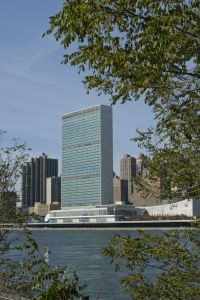
The United Nations Intergovernmental Panel on Climate Change is the driving force behind the global united-nations-building-1-1106992-mwarming hoax. It is holding a climate change summit on September 23. Guess who won’t be attending? Chinese president Xi Jinping, India’s prime minister, Narenda Modi, and for good measure, Germany’s chancellor, Angela Merkel. Others whose leaders will not be attending include Canada, Japan, and Russia.

In typical fashion, always predicting climate conditions decades from now, the United Nations, according to a report in The Guardian, “is warning of floods, storms and searing heat from Arizona to Zambia within four decades, as part of a series of imagined weather forecasts” to publicize the climate summit.

All of the forecasts made by a legion of climate charlatans in the 1980s and 1990s turned out to be WRONG.

You cannot trust the UN’s World Meteorological Organization which like the IPCC is just part of a vast matrix of groups that have been so severely corrupted by the global warming/climate change hoax that one must exercise caution when hearing its forecasts. If they are for anything beyond two weeks hence, you would be wise to be dubious.

Mr. Lazear is just one of many, often with distinguished careers in other fields than meteorology or climatology, who have bought into the hoax and who declaim the need to reduce carbon dioxide. He’s wrong. The others are wrong.

And you need to educate yourself to avoid being afflicted by various government policies intended to advance the hoax. To start with, do not vote for any politician who talks of global warming/climate change or uses the term “sustainability.”

– See more at: http://www.cfact.org/2014/09/07/an-economists-bad-climate-advice/#sthash.Pkjvx1cg.dpuf

If I Wanted America to Fail…. A Bone-Chilling Classic, becoming reality!

If I Wanted America to Fail

A new group has recently released a video advocating free-market policies from a whole new perspective, and the result is very compelling.

The group is called Free Market America, and its stated mission is to defend economic freedom, particularly from environmental extremism.

The video puts the viewer in the perspective of someone who wants to dismantle the country, and walks them though what they would do to accomplish it. Throughout the video, the viewer becomes aware of how many of today’s ideas match the destructive actions learned through this perspective.

What makes this argument compelling is that this sort of connection cannot be built from anything other than concrete evidence. Leaving the viewer to digest the sobering truth once the video ends.

After watching the video, feel free to read the transcript below if you would like a closer look at the video’s points.

If I wanted America to fail …

To follow, not lead; to suffer, not prosper; to despair, not dream — I’d start with energy.

I’d cut off America’s supply of cheap, abundant energy.  Of course, I couldn’t take it by force.  So, I’d make Americans feel guilty for using the energy that heats their homes, fuels their cars, runs their businesses, and powers their economy.

I’d make cheap energy expensive, so that expensive energy would seem cheap.

I would empower unelected bureaucrats to all-but-outlaw America’s most abundant sources of energy.  And after banning its use in America, I’d make it illegal for American companies to ship it overseas.

If I wanted America to fail …

I’d use our schools to teach one generation of Americans that our factories and our cars will cause a new Ice Age, and I’d muster a straight face so I could teach the next generation that they’re causing Global Warming.

And when it’s cold out, I’d call it Climate Change instead.

I’d imply that America’s cities and factories could run on wind power and wishes.  I’d teach children how to ignore the hypocrisy of condemning logging, mining and farming — while having roofs over their heads, heat in their homes and food on their tables.

I would never teach children that the free market is the only force in human history to uplift the poor, establish the middle class and create lasting prosperity. Instead, I’d demonize prosperity itself, so that they will not miss what they will never have.

If I wanted America to fail …

I would create countless new regulations and seldom cancel old ones. They would be so complicated that only bureaucrats, lawyers and lobbyists could understand them.  That way small businesses with big ideas wouldn’t stand a chance — and I would never have to worry about another Thomas Edison, Henry Ford or Steve Jobs.

I would ridicule as “Flat Earthers” those who urge us to lower energy costs by increasing supply.  And when the evangelists of commonsense try to remind people about the law of supply and demand, I’d enlist a sympathetic media to drown them out.

If I wanted America to fail …

I would empower unaccountable bureaucracies seated in a distant capitol to bully Americans out of their dreams and their property rights.  I’d send federal agents to raid guitar factories for using the wrong kind of wood; I’d force homeowners to tear down the homes they built on their own land.

I’d make it almost impossible for farmers to farm, miners to mine, loggers to log, and builders to build.  And because I don’t believe in free markets, I’d invent false ones.  I’d devise fictitious products — like carbon credits — and trade them in imaginary markets.  I’d convince people that this would create jobs and be good for the economy.

If I wanted America to fail …

For every concern, I’d invent a crisis; and for every crisis, I’d invent the cause.

Like shutting down entire industries and killing tens of thousands of jobs in the name of saving spotted owls.  When everyone learned the stunning irony that the owls were victims of their larger cousins — and not people — it would already be decades too late.

If I wanted America to fail …

I’d make it easier to stop commerce than start it — easier to kill jobs than create them — more fashionable to resent success than to seek it.  When industries seek to create jobs, I’d file lawsuits to stop them.  And then I’d make taxpayers pay for my lawyers.

If I wanted America to fail …

I would transform the environmental agenda from a document of conservation to an economic suicide pact.  I would concede entire industries to our economic rivals by imposing regulations that cost trillions.

I would celebrate those who preach environmental austerity in public while indulging a lavish lifestyle in private.  I’d convince Americans that Europe has it right, and America has it wrong.

If I wanted America to fail …

I would prey on the goodness and decency of ordinary Americans.  I would only need to convince them … that all of this is for the greater good.

If I wanted America to fail, I suppose I wouldn’t change a thing.


The Wind Turbine Scam is Destroying Our Economies, as Well as Our Communities!

Professor Ross McKitrick: Wind turbines don’t run on wind, they run on subsidies.

economics101

As STT followers are acutely aware, wind power is an economic and environmental fraud. Because wind power can only ever be delivered at crazy, random intervals – and, therefore, never “on-demand” – it will never be a substitute for those generation sources which are – ie hydro, nuclear, gas and coal (see our posts here and here and here and hereand here and here and here and here).

Were it not for government mandates – backed by a constant and colossal stream of subsidies (see our post here) – wind power generators would never dispatch a single spark to the grid, as they would never find a customer that would accept power delivered 30% of the time (at best) on terms where the vendor can never tell customers just when that power might be delivered – if at all (see our post here).

Ultimately, it’ll be the inherently flawed economics of wind power that will bring the greatest rort of all time to an end. The policies that created the wind industry are simply unsustainable and, inevitably, will either fail or be scrapped.

The Canadians are reeling under the ludicrous wind power policies of a hard-green-left Liberal government, clearly intent on committing economic suicide. Power prices – driven by exorbitant guaranteed rates to wind power outfits – have rocketed – tripling in less than a decade, driving energy intensive businesses – like manufacturing – out of business or offshore – stifling business investment – killing off or threatening thousands of sustainable (unsubsidised) jobs across Canada and otherwise creating economic chaos (see our post here).

The scale and scope of Canada’s wind power disaster hasn’t been lost on top energy market economists, like Ontario’s Professor Ross McKitrickfrom the University of Guelph.

Downwind - Ross McKitrick - Uni of Guelph (Time 0_06_00;22)

Ross was interviewed for the brilliant Sun News documentary ‘Down Wind’ by presenter, Rebecca Thompson, which has been extracted in the video below. The transcript appears below.

****

Downwind – Ross McKitrick – Uni of Guelph

Downwind – Ross McKitrick – Uni of Guelph


Rebecca Thompson: First we turn to Professor Ross McKitrick, an economist. He recently published a very scathing review of how economically unsound the Ontario Liberal government’s Green Energy Act is.

Professor Ross McKitrick: Well the important thing to understand about wind turbines is that they don’t run on wind, they run on subsidies.

Rebecca Thompson:  We went to see McKitrick at the University of Guelph.

Professor Ross McKitrick:  All the arguments that they’ve put forward for the Green Energy Act they really turned out to be phoney once we looked at them closely. They said that it would improve the economy, reduce air pollution emissions and it would replace coal fired power. And the problem is with the first one, it is not going to improve the economy because of what you are doing is replacing power that costs 3 to 5 cents per kilowatt hour to generate, and you’re replacing it with power that costs at least 13 1/2 cents per kilowatt hour to generate. So you’re raising the cost of doing business, it will drive down the rate of return in manufacturing and mining and that has to translate into job losses and reduced investment and shrinking the economy.

Rebecca Thompson: So you’ve pointed out that wind energy in fact, isn’t in the public interest in the short term but will it be in the long term?

Professor Ross McKitrick:  Nobody was building wind turbines in Ontario until the government started throwing money at it. It is not a profitable source of electricity, it’s not cost-effective. Wind turbines can’t compete on the wholesale market without a lot of government support.

Rebecca Thompson: The system used to fund wind energy in many places around the world is called a Feed-In-Tariff (FIT).

Professor Ross McKitrick:  And that means if you build a bank of wind turbines somewhere, and you get the contract that everyone is looking for you get a guarantee of 20 years being paid 13 1/2 cents per kilowatt-hour for the electricity that’s generated while the wholesale rate in Ontario is typically between 2 – 4 cents per kilowatt hour.

Rebecca Thompson: The Ontario government piggybacked off what is a European idea of a feed in tariff policy where the prices are locked in for 20 year contracts. And here’s another head scratcher …

Professor Ross McKitrick: The other provision of the contracts is that the system has to buy the power from you whenever you produce it. So the standard power plants, nuclear plants and hydro plants and so forth – there is no guarantee for them to buy their power, they have to compete on a wholesale market they have to price their product, in this case electricity, so that the system operator will buy it. With wind turbines, if the blades are running, the system operator has to buy it. Now they have adjusted that slightly in the last year because of this problem of the system operator being forced to buy tons and tons of power when it doesn’t need it, at 13 1/2 cents per kilowatt hour and sell it on the export market at one or two cents per kilowatt-hour – it was costing hundreds of millions of dollars a year for the system operator to do that. So the province now allows the system operator to reject some of the power that the wind turbines produce and instead the province will pay the wind turbine owners a benefit for what they call ‘deemed production’. So it’s really just transferred that same costs on to the taxpayer now.

Rebecca Thompson: The bottom line is pretty good for the wind energy sector.

Professor Ross McKitrick:  They get a 20 year contract to sell wind power at far above market rates and it doesn’t matter that they are generating power at times when the province absolutely doesn’t need it, and we can’t use it, and we just have to try to find some neighbouring jurisdiction to buy it from us. We used to have a few large power plants in Ontario and we had our grid that was optimised to source electricity from a few large central locations. We’re now shutting down the large central locations and replacing them with this proliferation of tiny little unreliable wind farms and you have to build a whole new grid to accommodate that. So that’s again an extra cost to get something that we already had.

Rebecca Thompson: What’s more is that the Green Energy Act hasn’t even come close to creating the number of jobs the Liberals claimed it would.

Professor Ross McKitrick: It turned out that the province had claimed that there were going to be 50,000 new jobs created from the Green Energy Act. When the Auditor General asks them to back that up because it doesn’t really make sense that this would create any jobs – what they admitted was they were really talking about were temporary construction jobs – as you put up wind turbines you need some workers in to do that. But then once the wind turbines are built, then those jobs disappear and there are no ongoing jobs. In economics, it’s an old fallacy, what’s called the broken window fallacy. If you go around breaking shopkeeper’s windows, since they have to hire repair people to fix the windows then you’ve somehow improved the economy. But, you haven’t. All you have done is increase the cost of having what you had before – which was windows in stores.

Rebecca Thompson: If the new shift to green power is so inefficient why hasn’t anyone working in the system spoken out?

Professor Ross McKitrick:  There are a couple of reasons. The power workers union has spent money on advertisements. They did try to fight against the closing of Lambton and Nanticoke – they understood that this was a bad deal for the workers in the province. But they did want they could. But it’s hard to be up against a government that is pushing so much propaganda on coal. There were people certainly in the power generating sector that understood that the government’s numbers weren’t correct and didn’t add up. But, they were effectively muzzled.

Rebecca Thompson: McKitrick speaks to people all the time about the changes in the system.

Professor Ross McKitrick:  I do find people working in the power sector, they know that this is a crazy system. These wind farms are displacing hydro electricity which is just a waste on every level because we have the hydroelectric facilities, they don’t generate any air pollution emissions. They give us reliable, predictable baseload power. And now we run wind turbines and let those hydro-facilities sit idle. So people who work in the sector, they can see what’s going on and they know that this is a waste. But, for understandable reasons they’re not about to make a big noise about it because they could lose their jobs if they do.

Rebecca Thompson: Whether any government would actually be able to get out of existing contracts is debatable. Ross McKitrick says it’s possible.

Professor Ross McKitrick: One option might be to buy out some of the wind turbine companies and take those wind turbines off the grid, or only use their power when they’re competitive. In Europe, what governments have started to do though is put on special new taxes on renewable sources, solar and wind, to try and recover some of these costs. Alternatively, the government may look to try and tear up the contracts and accept the legal liability that goes with it, but it’s not going to be easy.
Sun News: Down Wind

Down Wind, which runs for 96 minutes, can be purchased as a file and downloaded or as a DVD for those in the US and Canada (here’s the link). For those outside the US and Canada the file can be purchased and downloaded (using this link). If you’re in there fighting the great wind power fraud, Down Wind is essential viewing.

For a detailed synopsis of Down Wind – see our post here.

down wind

People of Oklahoma to Fight the Wind Industry….In Courts of Law!!!

Oklahomans Launch Pre-Emptive Legal Action to Prevent Wind Farm Construction

For most non-Okies, their appreciation of the glories of life on the great prairies of Oklahoma comes from Gordon Macrae (as Curly) – bathed in “a bright golden haze on the meadow” and crooning from a fine looking mount about what was clearly a very “beautiful morning”.

While Curly waxed lyrically about seeing stratospheric corn, his profound sensory enjoyment included being able to hear nature at its untrammelled best, in a place where “all the sounds of the earth are like music”.

Well, they used to be.

Oklahoma hasn’t escaped America’s great wind power fraud: turbines have sprung up like mushrooms all over the, once tranquil, State. And, like everywhere else, the locals are fighting back.

Not content to let wind power outfits turn their beautiful mornings into sonic torture events, a group of Oklahomans have just launched court action, seeking an injunction to prevent 300 giant fans from being speared into their peaceful patch of prairie paradise.

The action, filed by 6 plaintiffs, is being pursued in “nuisance”: the common law right attached to property to be able to enjoy it free from any unreasonable interference from the activities of neighbours, which includes unreasonable interference from noise – particularly where the noise in question interferes with sleep (see our post here).

The plaintiffs’ claim (available here) sets out the nature of their action as:

This action seeks to enjoin Defendants from creating a nuisance that will cause unreasonable inconvenience, interference, annoyance, adverse health effects, and loss of use and value of each Plaintiff and class member’s property.

Where the plaintiffs say they are seeking to “enjoin Defendants” they mean that they are asking the court for an injunction preventing the developers from constructing the turbines proposed.

The plaintiffs face the prospect of being left with properties that are worth a fraction of what they would be without turbines as neighbours – and ending up with homes that are uninhabitable due to incessant turbine generated low-frequency noise and infrasound (see our post here). So, their planning authorities having failed them, it’s off to court.

Here’s a run down on the plaintiffs’ action from the Oklahoma Wind Action Association.

Oklahoma citizens file class action lawsuit against wind energy companies
Oklahoma Wind Action Association
27 August 2014

Seeking reasonable placement of wind farms to protect health of nearby residents.

Citizens of Canadian and Kingfisher counties filed a class action lawsuit in United States District Court for the Western District of Oklahoma today to prohibit the placement of wind turbines that will harm residents.

After exhausting all local and state legislative and government resources, members of the lawsuit are seeking protection from adverse health effects, and loss of use and value of their property, by requiring wind turbines be placed a safe distance from their homes.

There are multiple wind farms planned for Kingfisher and Canadian counties consisting of more than 300 industrial wind turbines. From plaintiff Julie Harris’ land, there are 47 turbines targeted near her home with the closest planned less than one-half mile from her property. The turbines are almost 500 feet tall, equivalent to approximately five-eighths (5/8) the size of Devon Tower in downtown Oklahoma City, Okla.

“Despite working tirelessly with local officials and the wind company to request a reasonable setback of wind turbines from our property, our only recourse now is litigation,” said Terra Walker, a plaintiff and property owner in Okarche, Okla. “There are real health concerns when turbines are placed too close to homes. This is about requiring safe setbacks to protect the health and safety of our families.”

The plaintiffs are concerned about health impacts and interference in the use and enjoyment of their land. In the complaint, the plaintiffs note that wind turbines emit infra and low frequency sounds that are inaudible to the human ear, but have a long history of causing adverse effects to the human body and mind, including sleep loss, increased stress and cardiac issues. The plaintiffs are also concerned about how noise and shadow flicker emitted from rotating blades deteriorates the ability — in both children and adults — to properly think, remember, or concentrate.

“The wind farms located next to our house have ruined our health and property,” said Tammy and Rick Huffstutlar, living outside of Calumet, Okla. and in the middle of the Canadian Hills Wind Farm.

The Huffstutlars live adjacent to wind turbines and experience significant shadow flicker, noise and disruptions in air pressure, resulting in a worsening heart condition, severe headaches, and lack of sleep.

“Industrial wind energy in Oklahoma is unregulated, allowing companies to build wind farms wherever they can make deals with landowners without any required notice to those impacted,” said Brent Robinson, Oklahoma Wind Action Association (OWAA) president. “Research shows a negative impact to health for people within three miles of a turbine. Therefore, we believe a three-mile setback from property lines is necessary to protect our families.”

OWAA, along with other Oklahoma organizations such as Oklahoma Property Rights Association and Wind Waste, are combining forces to advocate for sensible laws to protect people and oversee future development in Oklahoma. The non-profit associations are concerned about the long-term impact this unregulated industry will have on property owners, and are fighting for oversight to ensure turbines are appropriately placed, operated safely, well-maintained and there is adequate funding to remove abandoned wind farms.

The plaintiffs in the lawsuit are Terra Walker, Cheyenne Ward, Julie Harris, Janelle Grellner, Elise Kochenower, Karri Parson, Cindy Shelley, and Oklahoma Wind Action Association. The defendants are APEX Wind Construction, LLC, APEX Clean Energy, Inc., APEX Clean Energy Holdings, LLC, Kingfisher Wind, LLC, Kingfisher Wind Land Holdings, LLC, Campbell Creek Wind, LLC, and Campbell Creek Wind Transmission, LLC.

Oklahoma Wind Action Association was founded in February 2014 to protect its members from negative affects of industrial wind turbines. The organization serves more than 150 citizens in Canadian and Kingfisher counties.
Oklahoma Wind Action Association
27 August 2014

Curly & Laurey

People of Oklahoma to Fight the Wind Industry….In Courts of Law!!!

Oklahomans Launch Pre-Emptive Legal Action to Prevent Wind Farm Construction

For most non-Okies, their appreciation of the glories of life on the great prairies of Oklahoma comes from Gordon Macrae (as Curly) – bathed in “a bright golden haze on the meadow” and crooning from a fine looking mount about what was clearly a very “beautiful morning”.

While Curly waxed lyrically about seeing stratospheric corn, his profound sensory enjoyment included being able to hear nature at its untrammelled best, in a place where “all the sounds of the earth are like music”.

Well, they used to be.

Oklahoma hasn’t escaped America’s great wind power fraud: turbines have sprung up like mushrooms all over the, once tranquil, State. And, like everywhere else, the locals are fighting back.

Not content to let wind power outfits turn their beautiful mornings into sonic torture events, a group of Oklahomans have just launched court action, seeking an injunction to prevent 300 giant fans from being speared into their peaceful patch of prairie paradise.

The action, filed by 6 plaintiffs, is being pursued in “nuisance”: the common law right attached to property to be able to enjoy it free from any unreasonable interference from the activities of neighbours, which includes unreasonable interference from noise – particularly where the noise in question interferes with sleep (see our post here).

The plaintiffs’ claim (available here) sets out the nature of their action as:

This action seeks to enjoin Defendants from creating a nuisance that will cause unreasonable inconvenience, interference, annoyance, adverse health effects, and loss of use and value of each Plaintiff and class member’s property.

Where the plaintiffs say they are seeking to “enjoin Defendants” they mean that they are asking the court for an injunction preventing the developers from constructing the turbines proposed.

The plaintiffs face the prospect of being left with properties that are worth a fraction of what they would be without turbines as neighbours – and ending up with homes that are uninhabitable due to incessant turbine generated low-frequency noise and infrasound (see our post here). So, their planning authorities having failed them, it’s off to court.

Here’s a run down on the plaintiffs’ action from the Oklahoma Wind Action Association.

Oklahoma citizens file class action lawsuit against wind energy companies
Oklahoma Wind Action Association
27 August 2014

Seeking reasonable placement of wind farms to protect health of nearby residents.

Citizens of Canadian and Kingfisher counties filed a class action lawsuit in United States District Court for the Western District of Oklahoma today to prohibit the placement of wind turbines that will harm residents.

After exhausting all local and state legislative and government resources, members of the lawsuit are seeking protection from adverse health effects, and loss of use and value of their property, by requiring wind turbines be placed a safe distance from their homes.

There are multiple wind farms planned for Kingfisher and Canadian counties consisting of more than 300 industrial wind turbines. From plaintiff Julie Harris’ land, there are 47 turbines targeted near her home with the closest planned less than one-half mile from her property. The turbines are almost 500 feet tall, equivalent to approximately five-eighths (5/8) the size of Devon Tower in downtown Oklahoma City, Okla.

“Despite working tirelessly with local officials and the wind company to request a reasonable setback of wind turbines from our property, our only recourse now is litigation,” said Terra Walker, a plaintiff and property owner in Okarche, Okla. “There are real health concerns when turbines are placed too close to homes. This is about requiring safe setbacks to protect the health and safety of our families.”

The plaintiffs are concerned about health impacts and interference in the use and enjoyment of their land. In the complaint, the plaintiffs note that wind turbines emit infra and low frequency sounds that are inaudible to the human ear, but have a long history of causing adverse effects to the human body and mind, including sleep loss, increased stress and cardiac issues. The plaintiffs are also concerned about how noise and shadow flicker emitted from rotating blades deteriorates the ability — in both children and adults — to properly think, remember, or concentrate.

“The wind farms located next to our house have ruined our health and property,” said Tammy and Rick Huffstutlar, living outside of Calumet, Okla. and in the middle of the Canadian Hills Wind Farm.

The Huffstutlars live adjacent to wind turbines and experience significant shadow flicker, noise and disruptions in air pressure, resulting in a worsening heart condition, severe headaches, and lack of sleep.

“Industrial wind energy in Oklahoma is unregulated, allowing companies to build wind farms wherever they can make deals with landowners without any required notice to those impacted,” said Brent Robinson, Oklahoma Wind Action Association (OWAA) president. “Research shows a negative impact to health for people within three miles of a turbine. Therefore, we believe a three-mile setback from property lines is necessary to protect our families.”

OWAA, along with other Oklahoma organizations such as Oklahoma Property Rights Association and Wind Waste, are combining forces to advocate for sensible laws to protect people and oversee future development in Oklahoma. The non-profit associations are concerned about the long-term impact this unregulated industry will have on property owners, and are fighting for oversight to ensure turbines are appropriately placed, operated safely, well-maintained and there is adequate funding to remove abandoned wind farms.

The plaintiffs in the lawsuit are Terra Walker, Cheyenne Ward, Julie Harris, Janelle Grellner, Elise Kochenower, Karri Parson, Cindy Shelley, and Oklahoma Wind Action Association. The defendants are APEX Wind Construction, LLC, APEX Clean Energy, Inc., APEX Clean Energy Holdings, LLC, Kingfisher Wind, LLC, Kingfisher Wind Land Holdings, LLC, Campbell Creek Wind, LLC, and Campbell Creek Wind Transmission, LLC.

Oklahoma Wind Action Association was founded in February 2014 to protect its members from negative affects of industrial wind turbines. The organization serves more than 150 citizens in Canadian and Kingfisher counties.
Oklahoma Wind Action Association
27 August 2014

Curly & Laurey

Faux-Green Terrorists, Want to Steal Our Property Rights! We Have to Fight Them!

Chemistry parable – Sustainability: The Universal Solvent of Private Property Rights

Guest essay by Charles Battig, MD | The alchemists of old were diligently ambitious in their goals. These antecedents of modern chemistry were not hindered by a lack of knowledge of atomic structure and physical chemistry when it came to setting priorities. Lacking a nuclear reactor and knowledge of atomic reactions, they postulated the existence of “The Philosopher’s Stone.” This mythical substance was thought to be able to turn base metals into gold, and endow eternal life and wisdom to its discoverer.

Another magical substance hypothesized was the “universal solvent.” Such a substance would be able to dissolve all other substances, including gold. Philosophical discussions over what container could hold this universal solvent must have been lively. Aqua regia, a mixture of concentrated nitric and hydrochloric acids, was eventually discovered, and comes close to the definition. This “royal water,” named by the alchemists because of its ability to dissolve gold and the noble metals, was also thought to have therapeutic healing properties as well.

Far from the realm of primitive physical sciences, another universal solvent has been created by the progressive social engineers. It is able to limit personal freedoms, diminish private property rights, destroy the useful products of civilization and their means of production, deprive humanity of natural resources and their access, and impose hardship on the least prosperous members of humanity. I term it “The Progressives’ Stone,” as it can do all this and more. Regrettably, it is real and not mythical. It permeates all levels of our government.

“Sustainability” is the embodiment of the planner’s “Progressives’ Stone,” a universal societal solvent… infinitely elastic and open-ended in its ability to justify most any action taken in the name of social and environmental justice. It is the societal equivalent of the ancient “royal water” in its corrosive properties when employed against our constitutionally mandated unalienable rights of ordinary free citizens.

sustainability_cloudDocumenting the origins of the “Philosopher’s Stone is a task for historians probing the Middle Ages. “The Progressives’ Stone” has a more recent and defined linage. British economist Barbara Ward’s 1966 book“Spaceship Earth” advocated for sustainable development and a new international economic order linking the global environment and social justice. Population control was an inherent part of the message.

On this side of the Atlantic, Rachel Carson’s 1962 book, “Silent Spring” laid the groundwork for a message that found a receptive audience in guilt prone readers. She put a human face on the claimed crimes against the environment. Misuse of insecticides was translated into a fear of all insecticides at any level. DDT was made the poster child for environmental destruction. Bird deaths and egg thinning were offered as evidence. Years later, many of the claims in her book were termed “lies,” once they were subject to scientific review. In the interim, millions of innocent children have suffered Malaria-related deaths in Africa from prohibition of DDT use, and the term “eco-imperialism” became a book title.

As a formalized political doctrine, “Sustainability” was introduced by the 1987 “Our Common Future” report of the United Nations World Commission on Environment and Development, authored by Gro Harlem Bruntland, VP of the World Socialist Party. The official U.N. website contains the “Sustainability” definition: “development that meets the needs of the present without compromising the ability of future generations to meet their own needs.” The capitalized “S” serves to distinguish the U.N. definition from the mundane usage indicating “lasting or continuing for a long time.” The U.N. pre-supposes an all-knowing ruling class that has unique knowledge of the present and of the future. In reality, the needs of the future are subject to change, and planning now for an unknowable future is the planner’s folly. Fredrick Hayek aptly described this as the “Fatal Conceit.” Who knew a century ago, that commonplace sand (silica) would become essential to our transistor and integrated-circuit world of today?

Much of the U.N.’s vision of “Sustainability” was eventually incorporated into official U.S. Federal policy by President Clinton. He established the “President’s Council on Sustainable Development” by executive Order No. 12852, dated June 29, 1993. It published the 1999 report “Towards A Sustainable America…Advancing Prosperity, Opportunity, and a Healthy Environment for the 21st Century.” Perhaps well intentioned in its Utopian vision of our future, it has become a weapon of mass destruction against many of the visions of our Founding Fathers, and our basic freedoms.

Professional planners have adopted these precepts, and their official organization, the American Planning Association, has a formalized policy guide. The Environmental Policy Agency has its own. Business has learned how to make a profit from it. Enthusiastic application of sustainability concepts has provided the commercial world with financial rewards. Do-more-with-less is the way to greater profits and positive public perception.

Like a Madison Avenue brainstormed advertising mantra, “Sustainability” now appears throughout the media and in governmental policy requirements. If it is not “Sustainable,” it must be stopped, altered, or mitigated, until the project has met prescribed guidelines. “Sustainability” has been elevated in governmental policy to a level higher than our Constitutional unalienable rights. Unlike the business model, “Sustainability” in the governmental sphere has uses beyond a more efficient government. Henry Lamb and others recognized the threat to personal property rights early on. Tom DeWeese has been sounding the alarm for decades.

A visit to your local governmental planning board or board of supervisors should convince you that “Sustainability” is the universal solvent able to shut down private property rights. Want to build a home on your dream location? No…it is not sustainable to the environment. Want to add on to your home…no, it imposes non-sustainable burdens on the wildlife. Nor are golf courses, ski resorts, livestock , soil tilling, fences, industry, septic fields, roads, logging, dams and reservoirs, power line and fiber optic projects “Sustainable,” if so designated by local or Federal government. Get out of “Sustainability” Jail cards are called proffers or mitigating off-sets; such extra costs make surviving projects more expensive for the increasingly poor taxpayer.

Increase your chances of living a sustainable life as envisioned by our Founding Fathers by challenging “Sustainability” as envisioned by government planners. Private property rights are an endangered species not protected by “Sustainability.”


Even Democrats Find Obama’s Climate Nonsense, Hard to Swallow!

LOL! Obama’s Climate Plan Spooks U.S. Democrats

Yesterday we mentioned Obama’s nuclear option event, and now the fallout begins. |

From Timothy Cama and Scott Wong, The Hill
keep-calm-and-run-for-your-life-66[1]President Obama’s election-year plan to win a new international climate change accord is making vulnerable Democrats nervous.

The administration is in talks at the United Nations about a deal that would seek to reduce global greenhouse gas emissions by “naming and shaming” governments that fail to take significant action.

The State Department on Wednesday denied a report in The New York Times that the plan is to come up with a treaty that would not require Senate confirmation, but that appeared to provide cold comfort to Democrats worried the issue will revive GOP cries about an imperial Obama presidency.

One Democratic strategist said the proposal would put swing-state candidates who are critical to the party keeping its Senate majority “in front of the firing squad.”

“You’re … making it more difficult for them to win and certainty putting them in a position to lose,” the strategist said.

Several vulnerable Senate Democrats kept mum on the issue.
 
Sens. Mark Begich (Alaska) and Mark Udall (Colo.), along with a handful of House Democrats, either declined to comment or didn’t respond to interview requests.
 
Senate Energy Committee Chairwoman Mary Landrieu (La.) cautiously signaled support for the oil and gas industry that is important to her state, without commenting on the plan to sidestep the Senate.
 
“It is important that all nations do what they can to reduce carbon in the atmosphere,” she said. “But the president should not take any action that undermines the American energy revolution currently underway that is creating thousands of high-paying jobs for middle class families in Louisiana and across the country.”
 
spokesman for Rep. Scott Peters (D-Calif.), who heads a House climate task force, said it was premature to comment on a plan with so few details.

Drew Hammill, a spokesman for House Minority Leader Nancy Pelosi (D-Calif.), who pushed a climate change bill through the House in 2009, said the Times story was inaccurate but had no further comment.

Other Democrats immediately distanced themselves from the proposal.

“This administration’s go it alone strategy is surely less about dysfunction in Congress than about the president’s own unwillingness to listen to our coal miners, steelworkers, farmers and working families,” Rep. Nick Rahall (W.Va.) said in a statement. Rahall is in a difficult reelection race.

Republicans in tight Senate contests, for their part, quickly seized on the issue.

Rep. Cory Gardner (R-Colo.), who’s trying to unseat Udall, called on the incumbent to denounce Obama’s “latest executive power grab.”

“Coloradans don’t elect Senators to watch them toss their power to the president, whether Republican or Democrat,” Gardner said.

Republicans have been seeking to make the 2014 elections all about Obama, whose approval numbers remain low. They’ve sought to tie candidates such as Udall and Landrieu to Obama, and the Democratic strategist said the climate change proposal gave them ammunition.

Republicans have also sought to portray Obama as a figure abusing his power with executive actions. House Republicans approved legislation in August that would allow Speaker John Boehner (R-Ohio) to file a lawsuit challenging Obama’s actions.

“Once again, the president is circumventing the wishes of the American people and their elected representatives, and doing so in a fashion that will destroy more jobs,” Boehner said Wednesday of the climate report.

Both the White House and State Department said the climate agreement is still being discussed, and they denied that it was a sure thing that the administration would seek to go around Congress.

Climate Alarmists Try to Go For the Heart….Cause our Brains Just Ain’t Buying It! LOL!

Gallery of Morose Moonbats Sulking About Collapse of Global Warming Hoax

Ever more desperate to get someone other than socialist journalists and bureaucrats to take the collapsing global warming hoax seriously, academics who make their living on it have resorted to releasing photographs of themselves wearing doleful expressions as they contemplate the hurt allegedly being inflicted on the earth by the highly beneficial CO2 that is produced by literally all human activity. The following is not a joke:

Photographer Nick Bowers, Art Director Celine Faledam and Copy Writer Rachel Guest have teamed up to bring attention to the issue of climate change in a completely novel and frankly terrifying way with their portrait/interview projectScared Scientists. …

Bowers takes moody, dark, black-and-white portraits of the scientists and those portraits are then put up on the Scares [sic] Scientists websitealongside a short interview with each of these climate experts — an interview headlined by their credentials and their greatest climate change fear.

Prominent among the woeful warmists on display is Tim Flannery:

tim-flannery_sad-moonbat

Readers may remember Flannery as the malevolent lunatic who called for fighting the nonexistent global warming menace by filling the sky with sulfur. Linking global warming to adecline in circumcision may be his most noteworthy scientific achievement.

Flannery was rattled by ClimateGate, which caused the wheels to start coming off the global warming hoax by proving that “scientific” research on the topic consists largely not just of extremely bad, politicized science, but of deliberate lies.

The triumph in his home country of Tony Abbott, who rose to Prime Minister largely on his promise to undo the damage to the economy inflicted by global warming zealots, must have hit Flannery even harder. No wonder he looks so blue.

Global warming propagandists who can foresee the end of the line for the government grant gravy train don’t just express their sadness with forlorn expressions. They also write sad notes:

Australian National University student Joe Duggan contacted scientists and asked them to write the letters about how they felt about climate change.

“What follows are the words of real scientists. Researchers that understand climate change,” states the Is This How You Feel website, where Duggan is publishing the letters.

This one from “climate change ecologist” Anthony Richardson of the University of Queensland tugs on the heartstrings when you consider the angst he must be enduring:

anthony-richardson-climate-moonbat-letter

Not to mention that he is fretful about people figuring out that climate change ecologists are about as useful as ice cubes in the arctic, and distraught about the possibility of having to find constructive employment.

Climate Alarmists Try to Go For the Heart….Cause our Brains Just Ain’t Buying It! LOL!

Gallery of Morose Moonbats Sulking About Collapse of Global Warming Hoax

Ever more desperate to get someone other than socialist journalists and bureaucrats to take the collapsing global warming hoax seriously, academics who make their living on it have resorted to releasing photographs of themselves wearing doleful expressions as they contemplate the hurt allegedly being inflicted on the earth by the highly beneficial CO2 that is produced by literally all human activity. The following is not a joke:

Photographer Nick Bowers, Art Director Celine Faledam and Copy Writer Rachel Guest have teamed up to bring attention to the issue of climate change in a completely novel and frankly terrifying way with their portrait/interview projectScared Scientists. …

Bowers takes moody, dark, black-and-white portraits of the scientists and those portraits are then put up on the Scares [sic] Scientists websitealongside a short interview with each of these climate experts — an interview headlined by their credentials and their greatest climate change fear.

Prominent among the woeful warmists on display is Tim Flannery:

tim-flannery_sad-moonbat

Readers may remember Flannery as the malevolent lunatic who called for fighting the nonexistent global warming menace by filling the sky with sulfur. Linking global warming to adecline in circumcision may be his most noteworthy scientific achievement.

Flannery was rattled by ClimateGate, which caused the wheels to start coming off the global warming hoax by proving that “scientific” research on the topic consists largely not just of extremely bad, politicized science, but of deliberate lies.

The triumph in his home country of Tony Abbott, who rose to Prime Minister largely on his promise to undo the damage to the economy inflicted by global warming zealots, must have hit Flannery even harder. No wonder he looks so blue.

Global warming propagandists who can foresee the end of the line for the government grant gravy train don’t just express their sadness with forlorn expressions. They also write sad notes:

Australian National University student Joe Duggan contacted scientists and asked them to write the letters about how they felt about climate change.

“What follows are the words of real scientists. Researchers that understand climate change,” states the Is This How You Feel website, where Duggan is publishing the letters.

This one from “climate change ecologist” Anthony Richardson of the University of Queensland tugs on the heartstrings when you consider the angst he must be enduring:

anthony-richardson-climate-moonbat-letter

Not to mention that he is fretful about people figuring out that climate change ecologists are about as useful as ice cubes in the arctic, and distraught about the possibility of having to find constructive employment.