Spain’s Failed Green Energy Experiment….Another Case Study from Institute for Energy Research

Spain’s Green Energy Experiment

AUGUST 27, 2014

The Institute for Energy Research released today a case study on Spain’s failed green energy policies. This is the second entry in a series of case studies on Europe’s green energy disaster (click here to read IER’s case study on Germany).

For years, President Obama has pointed to Europe’s energy policies as an example that the United States should follow. However, those policies have been disastrous for countries like Spain, where electricity prices have skyrocketed, unemployment is over 25 percent, and youth unemployment is over 50 percent

IER’s study found:

  • In 2000, Spain began a new program to subsidize renewable energy with the passage of its “Promotion Plan for Renewable Energies.”
  • Spain’s feed-in tariffs have created a “rate deficit” amounting to $41 billion (about $850 per person).
  • In 2011, Spain’s domestic electricity prices (including taxes) amounted to 29.46 U.S. ¢/kilowatt-hour (kWh), nearly 2.5 times more than U.S. prices.
  • Spain’s electricity prices increased by 92 percent from 2005 to 2011.
  • Rising energy costs hit low-income Spaniards the hardest–driving them into energy poverty
  • Despite myriad renewable subsidies and mandates, Spain’s CO2 emissions increased by 34.5% from 1994-2011.

Click here to read the full case study.

Click here to read IER’s previous study on Spain by Dr. Gabriel Calzada Alvarez.

You Cannot Trust the Climate Alarmists. They Have an Agenda & They’re Willing to Lie!

But….but….the truth won’t scare the masses!


Who’s going to be sacked for making-up global

warming at Rutherglen?

HEADS need to start rolling at the Australian Bureau of Meteorology. The senior management have tried to cover-up serious tampering that has occurred with the temperatures at an experimental farm near Rutherglen in Victoria. Retired scientist Dr Bill Johnston used to run experiments there. He, and many others, can vouch for the fact that the weather station at Rutherglen, providing data to the Bureau of Meteorology since November 1912, has never been moved.

Senior management at the Bureau are claiming the weather station could have been moved in 1966 and/or 1974 and that this could be a justification for artificially dropping the temperatures by 1.8 degree Celsius back in 1913.

Surely its time for heads to roll!

The temperature record at Rutherglen has been corrupted by managers at the Australian Bureau of Meteorology.


Some background: Near Rutherglen, a small town in a wine-growing region of NE Victoria, temperatures have been measured at a research station since November 1912. There are no documented site moves. An automatic weather station was installed on 29th January 1998.

Temperatures measured at the weather station form part of the ACORN-SAT network, so the information from this station is checked for discontinuities before inclusion into the official record that is used to calculate temperature trends for Victoria, Australia, and also the United Nation’s Intergovernmental Panel on Climate Change (IPCC).

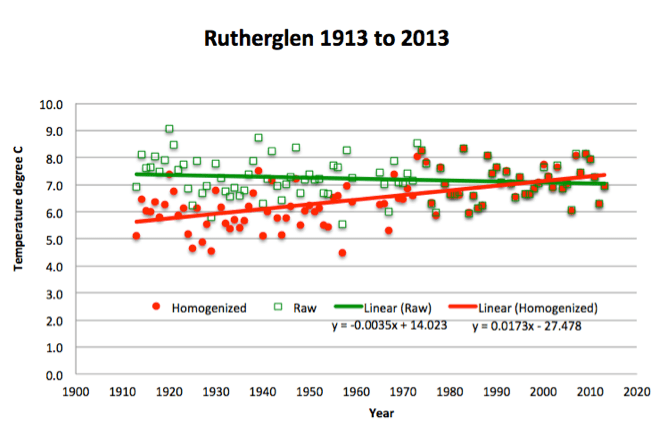
The unhomogenized/raw mean annual minimum temperature trend for Rutherglen for the 100-year period from January 1913 through to December 2013 shows a slight cooling trend of 0.35 degree C per 100 years. After homogenization there is a warming trend of 1.73 degree C per 100 years. This warming trend is essentially achieved by progressively dropping down the temperatures from 1973 back through to 1913. For the year of 1913 the difference between the raw temperature and the ACORN-SAT temperature is a massive 1.8 degree C.

There is absolutely no justification for doing this.

This cooling of past temperatures is a new trick* that the mainstream climate science community has endorsed over recent years to ensure next year is always hotter than last year – at least for Australia.

There is an extensive literature that provides reasons why homogenization is sometimes necessary, for example, to create continuous records when weather stations move locations within the same general area i.e. from a post office to an airport. But the way the method has been implemented at Rutherglen is not consistent with the original principle which is that changes should only be made to correct for non-climatic factors.

In the case of Rutherglen the Bureau has just let the algorithms keep jumping down the temperatures from 1973. To repeat the biggest change between the raw and the new values is in 1913 when the temperature has been jumped down a massive 1.8 degree C.

In doing this homogenization a warming trend is created when none previously existed.

The Bureau has tried to justify all of this to Graham Lloyd at The Australian newspaper by stating that there must have been a site move, its flagging the years 1966 and 1974. But the biggest adjustment was made in 1913! In fact as Bill Johnston explains in today’s newspaper, the site never has moved.

Surely someone should be sacked for this blatant corruption of what was a perfectly good temperature record.

———-

Climate records contradict Bureau of Meteorology by Graham Lloyd, 27th August
http://www.theaustralian.com.au/national-affairs/climate/climate-records-contradict-bureau-of-meteorology/story-e6frg6xf-1227037936046

The story is behind a paywall. But if you don’t already have a subscription perhaps its time… this could just be the biggest story of the year.

** There are a lot of tricks that climate science managers have implemented over the years to fix the temperature record; that is fix it so it shows global warming. “Trick” was the word Phil Jones, a leading United Nation’s Intergovernmental Panel on Climate Change (IPCC) scientist, used to explain to his peers that, when constructing very long global temperature series using proxy data based on tree ring measurements that can extend back thousands of years, it was best to substitute thermometer data for this proxy data from about 1960 because the proxy data started to show cooling from about then. Indeed from about 1960 until 2002 the thermometer data mostly did show warming. But now even this instrumental record is starting to show cooling. Enter the relatively new trick of homogenization.

The Global Warming Hoax is a Ploy to Push Agenda 21. It’s Got to Stop!

The Debate is Over!

Global Warming Fraud Exposed

al gore climate change

The first known video promoting the scam of “Man made global warming”  showing

how they demonized the life gas CO2 and make man earth’s enemy in the process….

is from 1958!

Environment was the chosen mechanism to bring about global gov. “They” need

a global problem that required a global solution… Enjoy some early Al Gore type hype

from 1958 in this video.

According to the Club of Rome: “The common enemy of humanity is man. “In searching

for a common enemy against whom we can unite, we came up with the idea that pollution,

the threat of global warming, water shortages, famine and the like, would fit the bill.

“we came up with the idea “

Not based on any facts! They just came up with the idea.  What is the Club of Rome?

A think tank created by men and women who want a global communist system that they

control.  Who are these people? Here is a list of present and notable members from the

Green Agenda (highly recommended you spend so time on this site) Members include

David Rockefeller, George Soros, Henry Kissinger, Bill Clinton, Jimmy Carter, Mikhail

Gorbachev, Kofi Annan, Maurice Strong, Bill Gates, Ted Turner, Tony Blair, Robert Muller,

The Dalai Lama, Hassan bin Talal, Javier Solana, Javier Perez de Cuellar, Gro Harlem Bruntland,

Garret Hardin, King Juan Carlos of Spain and his wife Queen Sophia, Queen Beatrix of the

Netherlands, Prince Philippe of Belgium, and about 80 other wealthy elites, new age cultists,

former and current U.N. figures, and political figures.

First earth day 1970

Stockholm 1972 – United Nations Environment Programme (UNEP)

The (false) oil crisis of 1973-1974

United Nations Conference on Human Settlements was held at Vancouver

from 31 May to 11 June 1976

Our Common Future 1987

Rio Earth Summit 1992 which brought the world Agenda 21

The fraud and deception started long ago and is being implemented by ever level

and faction of gov. including UN NGO’s

The fraud is well documented and the peoples of the world need to take action.

Not to save us from “climate change” but the people who “came up with the idea. 

They cause the environmental crisis, the wars, famines, depressions etc. 

They are the enemy, not you and I


Now for some truth about climate Change.

The Sea Around Us by Rachel Carson shows the effects of the ocean cycles. 

Those who constructed the MMGW fraud knew when the natural ocean and sun

cycles would produce the most natural warming. They used this information for the

basis of the fraud. Those natural cycles are now moving into the cooling cycle.

The global warming lie is used to bring about UN corporate world gov. by the same

people who created the UN, Israel, Wars, Depressions, Famines etc. Their disturbing

visions are laid out in Agenda 21.

As the global warming fraudsters like to say “the debate is over.”

I agree, the debate is over and the fraud exposed!

Check and Mate!

– We have now entered the cooling cycle.

Elected officials (who represent the corporation, not the voters), teachers,

preachers, media, health etc.  (bow to their corporate masters) and law

enforcement (Policy enforcers of the corporation)  are  the useful idiots used

to spread the propaganda and implement “their” evil plan.

Some know what they are doing …  most don’t. It is our job to inform all of them

and insist they STOP immediately! They’re involved in fraud, conspiracy to commit, 

genocide and breach of trust.


How Much Proof Do The Wind-Pushers Need, Before They Stop Harming Innocent People?

Vibroacoustic Disease, or VAD, is a chronic, progressive, cumulative, systemic disease. Exposure to high-intensity/low-frequency sound and infrasound can lead to Vibroacoustic Disease. Studies have shown that environments with high-intensity sound over 110 dB, coupled with low-frequency sounds below 100 Hz, place people at high risk for developing Vibroacoustic Disease. For example, Vibroacoustic Disease has been identified in disk jockeys, due to loud music exposure.
When exposed to high-intensity/low-frequency sound, which includes loud music, the body is subjected to powerful sound vibrations. This noise stressor leads to: homeostatic imbalance, disease, interference with behavior and performance, visual problems, epilepsy, stroke, neurological deficiencies, psychic disturbances, thromboembolism, central nervous system lesions, vascular lesions in most areas of the body, lung local fibrosis, mitral valve abnormalities, pericardial abnormalities, malignancy, gastrointestinal dysfunction, infections of the oropharynx, increased frequency of sister chromatid exchanges, immunological changes, cardiac infarcts, cancer, rage reactions, suicide, and altered coagulation parameters.

Infrasound exposure INCREASES the rate of development of Vibroacoustic Disease (VAD). “The evolution of VAD is classified by three stages based on years of noise exposure – mild (1-3 yr), moderate (4-9 yr) and severe (10-15 yr).”

“VAD is essentially characterized by a proliferation of extra-cellular matrix. This means that blood vessels can become thicker, thus impeding the normal blood flow. Within the cardiac structures, the parietal pericardium and the mitral and aortic valves also become thickened. The most recent VAD studies have been suggesting that infrasound exposure may be crucial to the rate of evolution of VAD. Occupational exposure to infrasound is suspected to cause an increase in the rate of thickening of the pericardium and cardiac valves in commercial airline pilots over that of flight attendants (Alves-Pereira et al, 1999).”
In addition, sources of low-frequency noise that place people at risk for developing Vibroacoustic Disease are rock concerts, dance clubs, “Powerful car audio equipment,” water jet skies, and motorcycles. (Source: VIBROACOUSTIC DISEASE: THE NEED FOR A NEW ATTITUDE TOWARDS NOISE, by Mariana Alves-Pereira and Nuno Castelo Branco).

“Among the most serious on-the-job consequences of untreated VAD are rage-reactions, epilepsy, and suicide. VAD patients do not have the usual suicidal profile: after the event, if unsuccessful, they remember nothing, and are confused about the entire episode (Castelo Branco et al, 1999). Similarly, patients who suffer rage-reactions also appear confused and seem to remember nothing (Castelo Branco et al, 1999). These events can have dire consequences if they occur on the job. Not only can other individuals be injured, but also costly sophisticated equipment could become irreparably damaged.” (Source – VIBROACOUSTIC DISEASE: THE NEED FOR A NEW ATTITUDE TOWARDS NOISE, by Mariana Alves-Pereira and Nuno Castelo Branco)

The stages of Vibroacoustic Disease are as follows:

Stage 1 – MILD (1-4 years) Slight mood swings, indigestion, heartburn, mouth/throat infections, bronchitis
Stage 2 – MODERATE (4-10 years) Chest pain, definite mood swings, back pain, fatigue, skin infections (fungal, viral, and parasitic), inflammation of stomach lining, pain and blood in urine, conjunctivitis, allergies.
Stage 3 – SEVERE (> 10 years) psychiatric disturbances, hemorrhages (nasal, digestive, conjunctive mucosa) varicose veins, hemorrhoids, duodenal ulcers, spastic colitis, decrease in visual acuity, headaches, severe joint pain, intense muscular pain, neurological disturbances. (Source – MONITORING VIBROACOUSTIC DISEASE, by Branco, Pimenta, Ferreira, and Alves -Pereira)

“After four years of exposure, the individual tends to recognize the existence of memory lapses, mood changes become more pronounced, and a variety of simultaneous ailments can appear. In the advanced stages, neurological disorders include epilepsy, balance disorders, and a marked increase in cognitive impairment. The palmo-mental reflex – a primitive reflex that is frequently present in several pathologies associated with cognitive deterioration – is a common feature in VAD patients. Facial dyskinesia triggered by auditory stimulus has also been identified in LFN-exposed workers.” (Note: LFN is low-frequency noise).

Psychiatric disorders, such as suicidal tendencies and rage-reactions, are some of the most tragic consequences of unmonitored LFN exposure. Respiratory disorders appear within the first four years of exposure, and can progress into shortness of breath, and focal pulmonary fibrosis. This is independent of smoking habits.” (Source – MONITORING VIBROACOUSTIC DISEASE, by Branco, Pimenta, Ferreira, and Alves-Pereira)

Studies have been done to see what effect vibrations have on the human body. As high-intensity/low-frequency sounds (extreme amplified bass) rattles a boom car, the occupants in it, secondary listeners, and structures surrounding it, this study is interesting to note. (WBV is Whole Body Vibration).

“Vibration is believed to cause a range of problems. These include:

· Disorders of the joints and muscles and especially the spine (WBV)
· Disorders of the circulation (hand-arm vibration)
· Cardiovascular, respiratory, endocrine, and metabolic changes (WBV)
· Problems in the digestive system (WBV)
· Reproductive damage in females (WBV)
· Impairment of vision and/or balance (WBV)
· Interference with activities
· Discomfort

The most frequently reported problem from all sources of WBV is low-back pain arising from early degeneration of the lumbar system and herniated lumbar disc. Muscular fatigue and stiffness have also been reported.” (Source – ATSB – ROAD SAFETY REPORTS: HEAVY VEHICLE SEAT VIBRATION AND DRIVER FATIGUE)

The SUN AND WEEKLY HERALD (Sun-Herald.com) recently interviewed Dr. Robert Fifer, the Director of Audiology and Speech Language Pathology, at the Mailman Center for Child Development at the University of Miami. He discussed Vibroacoustic Disease and its relation to infrasound and boom cars. The article states, “But the physical vibration so prized by car audio fanatics, and despised by their victims, is largely produced by sounds pitched too low to hear, called subsonic or infrasonic sounds. Medical research over the past four decades shows that exposure to infrasound can have devastating effects on the human body and mind that go far beyond mere hearing loss.”

The article goes on to discuss the fight-or-flight adrenaline response and how it is also triggered by LPALF (large pressure amplitude – low-frequency noise) or high-intensity/low-frequency sound. In other words, the fight-or-flight adrenaline response can be triggered by sounds you don’t even hear!
At loud enough volumes, infrasound can “shake an object o bits the same way a soprano’s high motes can shatter a wine class.” (Source – INFRASOUND: I’M ALL SHOOK UP! – Sun and Weekly Herald, Sun-Herald.com, 8/24/2003)

Listening to classical music, such as Mozart, can increase your IQ, heal the body, and increases brain development in babies. Classical music enhances abstract thinking. On the other hand, listening to loud, hard, grunge rock, rap, or new age music actually interferes with abstract thinking. Gansta/porno rap is a favorite choice for listeners addicted to loud, bass sounds. Gangsta/porno rap (for example, Eminem) and some acid or hard rock (Marilyn Manson) glorifies violence, suicide, illegal drug use, murder, killing police officers, rape, and promotes hatred against society, women, and the law.

Music AFFECTS and REFLECTS your state of mind. In addition, your behavior reflects your personality.

Faux-green Agenda is Not Healthy for People, or the Environment!

Climate-Cooling Policies threaten Food Supplies

A warmer, wetter climate with more carbon dioxide in the atmosphere would undoubtedly produce more plant growth and more food.
 
However climate-cooling policies that claim to prevent global warming by throttling the use of carbon fuels will definitely reduce food supply and increase food prices.
 
The promotion of ethanol for motor fuel is anti-food. This “food for fuel” program has absorbed significant quantities of corn, soy beans, sugar and palm oils. Consequently prices for ethanol crops are higher than they would otherwise be, encouraging farmers to convert land currently devoted to grazing animals and other food crops to growing more profitable crops for ethanol.

Extreme greens also practise plant discrimination, favouring more trees at the expense of natural grasslands and open forest that support many grazing animals. These polices take many forms including planting carbon credit forests, banning regrowth clearing, anti-development zoning and blanket tree protection reserves. All such policies reduce food production from grasslands.

Climate-cooling policies also aim to decrease demand for carbon fuels, including coal, oil, gas and refined motor fuels, by increasing their costs and prices. Modern food production is totally dependent on low-priced carbon fuels for all farming activities. Diesel fuels are needed for cultivation, planting, harvesting and transport; and coal/gas powered electricity for irrigation, processing and distribution. Higher prices for carbon fuels will send some marginal farms out of business. The same policies will reduce profits and production in the fishing industry. All of these policies are anti-food.
 
Modern food production needs nitrogen fertilizer, which is made from atmospheric nitrogen and natural gas, with carbon dioxide as a by-product. Extreme greens all over the world are delaying and opposing the exploration and production of natural gas, and their carbon taxes are increasing the costs of this key fertilizer.

Finally, climate-cooling policies favour silly schemes like carbon capture and burial, which aims to pump carbon dioxide underground. The promoters should be told that current levels of carbon dioxide in the atmosphere are below those that maximize plant growth and food production. The rise in atmospheric carbon dioxide levels was a major contributor to increased world food production over the last century. To bury this free plant food is not food-smart.
 
These unproven solutions to unproven problems are unlikely to change the climate. But there is a 50:50 chance that instead of warming, the globe may cool naturally, which will cause dramatic reduction in food production.
 
Food is not easily storable, and supply and demand are always finely balanced. If natural cooling comes on top of all these man-made anti-food policies, the world will see cascading food shortages.

For those who wish to read more:

The Ethanol Disaster:
http://reason.com/archives/2014/05/06/the-ethanol-disaster

The Unintended Consequences of Ethanol:
http://news.newsmax.com/?ZKORXYGhQIAlL8s41ytI6BaZUxleNLU1Z&ns_mail_uid=32310041&ns_mail_job=1566641_04272014
 
Ethanol from corn waste may release more greenhouse gases than petrol:
http://www.news.com.au/world/breaking-news/corn-waste-fuel-not-better-than-petrol/story-e6frfkui-1226890856876?from=public_js
 
The Ethanol Disaster:
http://carbon-sense.com/2013/11/25/the-ethanol-disaster/
 
World turns against Ethanol:
http://canadafreepress.com/index.php/article/63444

Current solar cycle may be the weakest in 200 years:
http://informthepundits.wordpress.com/2014/08/17/sunspots-2014-two-big-surprises/
 

 A warmer, wetter climate with more carbon dioxide in the atmosphere would undoubtedly produce more plant growth and more food.

 
However climate-cooling policies that claim to prevent global warming by throttling the use of carbon fuels will definitely reduce food supply and increase food prices.
 
The promotion of ethanol for motor fuel is anti-food. This “food for fuel” program has absorbed significant quantities of corn, soy beans, sugar and palm oils. Consequently prices for ethanol crops are higher than they would otherwise be, encouraging farmers to convert land currently devoted to grazing animals and other food crops to growing more profitable crops for ethanol.

Extreme greens also practise plant discrimination, favouring more trees at the expense of natural grasslands and open forest that support many grazing animals. These polices take many forms including planting carbon credit forests, banning regrowth clearing, anti-development zoning and blanket tree protection reserves. All such policies reduce food production from grasslands.

Climate-cooling policies also aim to decrease demand for carbon fuels, including coal, oil, gas and refined motor fuels, by increasing their costs and prices. Modern food production is totally dependent on low-priced carbon fuels for all farming activities. Diesel fuels are needed for cultivation, planting, harvesting and transport; and coal/gas powered electricity for irrigation, processing and distribution. Higher prices for carbon fuels will send some marginal farms out of business. The same policies will reduce profits and production in the fishing industry. All of these policies are anti-food.
 
Modern food production needs nitrogen fertilizer, which is made from atmospheric nitrogen and natural gas, with carbon dioxide as a by-product. Extreme greens all over the world are delaying and opposing the exploration and production of natural gas, and their carbon taxes are increasing the costs of this key fertilizer.

Finally, climate-cooling policies favour silly schemes like carbon capture and burial, which aims to pump carbon dioxide underground. The promoters should be told that current levels of carbon dioxide in the atmosphere are below those that maximize plant growth and food production. The rise in atmospheric carbon dioxide levels was a major contributor to increased world food production over the last century. To bury this free plant food is not food-smart.
 
These unproven solutions to unproven problems are unlikely to change the climate. But there is a 50:50 chance that instead of warming, the globe may cool naturally, which will cause dramatic reduction in food production.
 
Food is not easily storable, and supply and demand are always finely balanced. If natural cooling comes on top of all these man-made anti-food policies, the world will see cascading food shortages.

For those who wish to read more:

The Ethanol Disaster:
http://reason.com/archives/2014/05/06/the-ethanol-disaster

The Unintended Consequences of Ethanol:
http://news.newsmax.com/?ZKORXYGhQIAlL8s41ytI6BaZUxleNLU1Z&ns_mail_uid=32310041&ns_mail_job=1566641_04272014
 
Ethanol from corn waste may release more greenhouse gases than petrol:
http://www.news.com.au/world/breaking-news/corn-waste-fuel-not-better-than-petrol/story-e6frfkui-1226890856876?from=public_js
 
The Ethanol Disaster:
http://carbon-sense.com/2013/11/25/the-ethanol-disaster/
 
World turns against Ethanol:
http://canadafreepress.com/index.php/article/63444

Current solar cycle may be the weakest in 200 years:
http://informthepundits.wordpress.com/2014/08/17/sunspots-2014-two-big-surprises/

Read more: http://www.americanthinker.com/blog/2014/08/climatecooling_policies_threaten_food_supplies.html#ixzz3B01PWKKu
Follow us: @AmericanThinker on Twitter | AmericanThinker on Facebook

Governments the World Over, Try to Evade Responsibility for Harming Citizens with Wind Turbines!

From Scotland: Turbines and the health risk

by ashbee2

The Herald Scotland — 13 August 2014
I WAS interested in the Scottish Government’s response to the Winds for Justice concerns about the health implications of wind turbines on those living in close proximity to them (“Protesters fight wind farms on grounds of health”, The Herald, August 11) when it said there was “no clear evidence of a causal link between the operation of wind turbines and adverse health effects”.

I WAS interested in the Scottish Government’s response to the Winds for Justice concerns about the health implications of wind turbines on those living in close proximity to them (\”Protesters fight wind farms on grounds of health\”, The Herald, August 11) when it said there was \”no clear evidence of a causal link between the operation of wind turbines and adverse health effects\”.
Sorry, you must sign in before you can print full articles.

In April, 2012, The British Medical Journal reviewed the consequences of wind turbine noise and available evidence and concluded at that stage that “wind turbine noise seems to affect health adversely and an independent review of evidence is needed”.

With the thousands of wind turbines already in operation in Scotland and many thousands more planned, the health implications should be of concern to the Scottish Government and at least until further studies and review of the evidence, as suggested by the British Medical Journal, no more should be constructed within two kilometres of homes.

The Scottish Government was made aware at the time of the BMJ article but chose not to take it on board.

Dr James Weir,

Glenlora Cottage,

Lochwinnoch.

Aussies Know Renewable Energy Targets are a SCAM! Get rid of them!

Senator Matt Canavan: mandatory RET is an Enormous Wind Industry Protection Racket

abbott, hockey, cormann

With news that Tony Abbott, Joe Hockey and Mathias Cormann have teamed up to axe the mandatory RET (see our post here), the wind industry and its parasites have been reduced to a pitiful spectacle: drifting between pleading and begging for mercy, on the one hand, and foaming rage, on the other.

These desperados are like a band of teenage brats facing a little “parenting” for the first time in their lives: how dare anyone pull the plug on $50 billion worth of REC Tax/Subsidy that would have given me a delightful Point Piper view of Sydney Harbour, and kept me and my mates in Mercs and Beamers for life?!?!

And like spoilt infants facing a little discipline, these boys are looking for any hint that they might avoid punishment. Overblown reports put out by the ABC and Fairfax press that the Coalition isn’t really intent on scrapping the mandatory RET outright have been seized on by the wind industry and its parasites like shipwreck survivors clinging to floating wreckage.

But this is one occasion where the stricken will be denied any salvation.

STT hears that what was reported in the Australian Financial Review (and covered in this post) is just the beginning of the wind industry’s woes.

STT hears that Tony Abbott harbours a deep antipathy to the wind industry, which is only matched by his distaste for corporate welfare; we’ve covered a little of it in our posts here and here and here.  The PM is determined to bring the wind industry to an end; the only question is precisely how that objective is to be achieved. While the shortest route home is to simply scrap the Renewable Energy (Electricity) Act 2000, there are plenty of other ways of skinning the subsidy cat.

STT hears that the (current) preferred option is to leave the legislation in tact, but to gut it in such a way that the wind industry will be starved of subsidies by choking off the current and, more importantly, expected value of RECs.

The plan goes a little like this.

The Coalition has a policy aimed at achieving least-cost CO2 abatement, called “Direct Action” (a run down on the policy is available here). The policy has its critics on other scores, but it may well end up being the wind industry’s Armageddon.

Under the Direct Action policy, CO2 abatement is to be achieved at the lowest possible cost using “Australian Carbon Credit Units” (CCUs).

CCUs would be issued on audited proof of the abatement of 1 tonne of CO2. That could be by way of “carbon farming”: planting trees or restoring vegetation cover to over-grazed pastoral range-lands, say.

RECs, on the other hand, are issued on proof of renewable power dispatched to the grid: 1 REC for each and every MWh delivered. The deal has proceeded on the (wild) assumption that 1 MWh of wind power dispatched to the grid results in 1 tonne of CO2 emissions reduction in the electricity sector.

Under the PM’s brewing plan to kill the wind industry, RECs would be made redundant and, instead, wind power generators would be entitled to apply for CCUs. RECs and CCUs would be consolidated, with the former being phased out, and eventually replaced by the latter.

Now, here’s the clever part.

A CCU will only be issued on audited proof that the applicant has, in fact, reduced or abated 1 tonne of CO2 emissions. That will see wind power outfits struggle to jump the first hurdle: despite some “smoke and mirrors” modelling, the wind industry has never produced a shred of evidence to back its CO2 abatement claims.

The auditing of CCU applications will be done by way of certification and verification by a registered valuer. In the event that wind power outfits can satisfy the auditor and pocket a CCU, they then face the prospect of a far less generous subsidy stream.

(As an aside, one earlier variation of the plan was that the recipient of the CCU would not be able to cash it in, but would, rather, surrender the CCU to the Australian Tax Office and enjoy a reduction in their taxable income to the (pre-determined) value of the CCU: after auditing, the applicant would present their CCUs to a Certified Practicing Accountant to be submitted to the ATO with the applicant’s tax returns.)

The point of Direct Action and the CCU is to bring about the cheapest possible CO2 abatement, by whatever means. This means that the market for CCUs will be open to all comers and competitive in a way which the market for RECs isn’t.

The REC price is underpinned by the mandated shortfall charge of $65 per MWh: the effect of which comes into play from 2017, as the annual RET figure begins to climb from 27,200 GWh to the 41,000 GWh target, effective from 2020 to 2031. It’s that relationship that has wind power outfits salivating at the prospect of RECs being worth at least $65 and, by 2017, exceeding $100.

The CCU, however, is meant to be tradeable and interchangeable with carbon credits on international markets; such as those traded in Europe. Under Direct Action, certain CO2 emitters will be able to meet their obligations to surrender CCUs by purchasing European carbon credits at the going rate: the trading price of which has ranged between A$7-10.

The price for CCUs is, therefore, expected to top out at around $10.

And it’s on the issue of being able to trade CCU’s on the international market that the Coalition have been talking seriously to big Clive Palmer and, in this respect, may end up adopting parts of the PUP’s much reported plan for an ETS – starting with internationally tradeable CCUs. Of course, Palmer’s stated position is that the price for ETS credits must be set at ZERO, until such time as all of Australia’s major trading partners (like Europe, China, Japan, Canada and the US etc) sign up to an international ETS (see our post here).

For wind power outfits to survive, let alone build any new capacity, they need RECs to be trading at around $40, at a minimum. Anything less than $30, and wind power generators will never cover their operating costs, which run between $25-30 per MWh (see our post here).

Under Direct Action (assuming audited proof that 1 tonne of CO2 emissions has been abated) wind power generators would be issued with 1 CCU (instead of 1 REC).

By replacing RECs (currently trading around $30) with CCUs likely to trade around $8, the wind industry would disappear in a heartbeat. Although, we note that wind industry barrackers, the Climate Institute predicts that wind power outfits will soon be able to survive on subsidies of around $10 per MWh (see further below) – in which case, the wind industry will lap up CCUs at $8-10 and rub along just fine: but we doubt it … What’s that they say about being careful about what you wish for?

STT hears that over the last few months crack energy market economist, Danny Price has been working on the plan to rework the RET to bring it into line with the Direct Action policy; starting with the plan to replace the REC system with CCUs (see our post here).

So, if you hear the members of the Coalition talking about retaining the mandatory RET, don’t be too concerned. STT hears that Tony Abbott is absolutely committed to killing the wind industry; and how it’s done is a matter of substance, not form.

In the meantime, a growing number of Coalition members are going on the offensive; calling for the mandatory RET to be scrapped outright.

matt canavan

Another to join the queue is Queensland Nationals Senator, Matt Canavan (a former Director of the Productivity Commission) who penned this brilliant piece for The Australian.

Dodgy sums on renewables don’t add up
The Australian
Matt Canavan
19 August 2014

THE advocates of renewable energy would have you believe that they have discovered the economic equivalent of the fountain of youth. According to them, we can adopt more expensive ways of doing things, yet that will lead to cheaper prices.

That renewable energy is more expensive than fossil fuels should not be in dispute. If renewables were cheaper, they would not need the billions of dollars in subsidies they receive every year courtesy of taxpayers.

The most recent example of magic pudding economic modelling was released by the Climate Institute yesterday and purports to show that subsidising renewable energy will in fact reduce energy prices. The report concedes, at least in its graphs, that abolishing the renewable energy target will reduce power prices.

The Climate Institute claims that after a few years of falling prices, they will increase. This primarily occurs because the modelling assumes that renewable energy will get cheaper through learning by doing. Thanks to this miraculously rapid learning, it is assumed that subsidies to renewables will drop from more than $70 per megawatt hour in 2020 to just over $10 by 2030. The modelling refers to “international studies” to support this assumption without referencing any. So much for peer review.

Windmills have been around for centuries and despite massive investment from countries such as Denmark, they are still not economically viable without subsidies. But if the RET is about to solve the problem of affordable energy, why stop there?

For instance, Australia has long had a problem producing cheap and competitive cars but we have the solution. All we need is a domestic automobile target. The DAT will mandate that, say, 20 per cent of our cars should be produced domestically. Domestic manufacturers will receive domestic automobile certificates for every car they produce. Importers of cars will have to buy these DACs. We know this will work because it is a market-based solution. Just like the RET, it should magically reduce the price of cars for Australian consumers.

In reality, such a scheme would be nothing but a fancy form of tariff. Those who argued for tariffs argued that Australian industry needed protection when it was young, but one day it would grow up and would become cheaper and more competitive. Advocates of renewables use a version of this discredited infant industry argument today.

The models used to support this just confirm the old joke: ask an economist what two plus two equals and he will respond: “How much would you like it to equal?”

Some who can’t bear to defend wealthy companies asking for taxpayer handouts say the RET is cheap. It is true that credible economic modelling shows the RET probably costs consumers about $50 a year. Is that cheap?

Last week, the nation was gripped by the spectacle of a “regressive” fuel tax that would cost the average consumer $20 a year. The same people who pillory the Treasurer for indexing fuel excise argue for a RET more than twice as costly. At least fuel excise will help build roads, whereas the RET doesn’t make electricity more reliable or powerful, it just makes pensioners and the poor go without heating or airconditioning to subsidise the lucky few with the resources to invest in the latest fad: renewables.

The RET is an extremely expensive form of emission reductions, between double and six times the cost of the carbon tax.

And it doesn’t stop there. The big losers from the RET are those industries that use lots of energy, such as aluminium and fertiliser producers. Some economic modelling finds that the RET will lead to 5000 fewer jobs.

There are few supporters left of high car or other tariffs. The biggest protection racket left is renewable energy.

The final argument used to stop protection from being removed is that it introduces sovereign risk and would be unfair to those who have invested in an industry based on government policy. Even some who want to remove renewable subsidies argue that we should grandfather existing investments.

There is merit in this but it cuts both ways. When the 20 per cent RET was introduced five years ago it effectively devalued billions of dollars worth of coal and gas assets. Some estimates say the RET will transfer more than $5 billion from fossil fuel to renewable assets in the next 15 years. Such an expropriation also represents sovereign risk. It is fine to talk about grand­fathering renewables but we should also great-grandfather those who invested in coal, gas or aluminium before there was a prospect of a RET.

As an economically damaging protectionist policy, the RET should be removed. The adjustment should be done over time and the costs should be shared between fossil fuel, energy-intensive and renewable sectors alike.

Matt Canavan is a Nationals senator for Queensland. He was formerly a director of the Productivity Commission.
The Australian

The only quibble we have with Matt’s fine piece of analysis is the implicit concession that reducing or scrapping the mandatory RET amounts to “sovereign risk”.

In this post, WA Senator, Chris Back slammed that one straight over the long-boundary, based on Parliamentary advice which, funnily enough, reflects what STT has already said on the issue (see our posts here andhere). What the wind industry faces is “regulatory risk” – just like the risk realised by aluminium processors and conventional power generators when Labor increased the mandatory RET to 41,000 GWh in 2010: examples relied on by Matt when dealing with the claimed need for “grandfathering” wind industry investments.

Matt has a pretty fair crack at the “Magic Pudding” economics put up by wind industry cheer squad, the Climate Institute and its nonsensical claims that subsidies to wind power outfits will drop from $70 per MWh in 2020 to around $10 per MWh by 2030. That fiction dissolves with a cursory peek at the legislation that makes up the mandatory RET; and the application of plain old arithmetic to its terms.

By 2020, the RECs issued to wind power outfits (1 REC per MWh dispatched) will be worth at least $65 (equal to the cost of the mandated shortfall charge) – and are expected to trade at around $100 by then – which means the subsidy extracted from power consumers and directed to wind power outfits will be worth at least $65 per MWh and, more likely, $100 per MWh, right up until 2031. Between 2014 and 2031, the REC Tax/Subsidy will add between $36 billion and $50 billion to Australian power consumers’ bills (see our post here).

Not only is the Climate Institute’s claim about the cost of subsidies to wind power outfits utter bunkum, its “modelling”, of course, deliberately ignores the impact of the Power Purchase Agreements struck between wind power generators and retailers, which guarantee returns of between $90-120 per MWh (versus the wholesale price for conventional power of $30-40 per MWh). Sticking with its “Magic Pudding” approach to the cost of the mandatory RET, the Climate Institute tosses up the wind industry’s argument that wind power lowers wholesale prices: precisely how it does so on days when the entire wind power output of all wind farms connected to the Eastern Grid struggles to top 20 MW is anybody’s guess (see our post here). But, in any event, power consumers don’t pay the wholesale price (and couldn’t care less about it): it’s the price fixed by PPAs (which run from 15 to 25 years) that determines the price retailers charge their customers and the final cost of wind power; and, therefore, retail prices (see our posts here and here).

The Magic Pudding’s ability to return to his original form – no matter how many times he was eaten – is the stuff of delicious fantasy. However, slice $50 billion from Australian power consumers and our economy is unlikely to mimic the Magic Pudding’s most desirable quality and bounce back without a scratch. The mandatory RET is not only “the biggest protection racket left”, it is the single biggest (and perfectly avoidable) threat to sustainable Australian employment and prosperity there is. The mandatory RET must go now.

MagicPudding

Wynne Couldn’t make her Disrespect for Rural Ontario, Any Clearer.

Wynne’s rural outreach efforts could unravel in face of budget challenges

THE GLOBE AND MAIL

Ontario Premier Kathleen Wynne listens to remarks from Manitoba Premier Greg Selinger (not shown) at the opening of the Building Canada Up Summit in Toronto on Wednesday August 6, 2014. (Chris Young/THE CANADIAN PRESS)

In a year-and-a-half as premier, Kathleen Wynne has probably spent as much time visiting Ontario’s rural regions and its smaller cities as Dalton McGuinty did in nearly a decade. She has backtracked on policies, such as an end to financial support for horse racing, that rankled those communities. Somewhat dubiously, she served as her own agriculture minister.

In short, Ms. Wynne has made an effort to demonstrate that her Ontario includes more than just Toronto, Ottawa and a few other urban centres, and to ensure the rest of the province doesn’t feel as neglected under her watch as it did under her predecessor’s.

And yet as her government seeks to eliminate its $12.5-billion deficit in three years, there is reason to believe Ms. Wynne is on a collision course with the regions to which she has tried to reach out.

The biggest hint came last month in an interview with Treasury Board President Deb Matthews, the most powerful minister in Ms. Wynne’s cabinet and the one charged with leading the fight to get back to balance.

“I think across government, we’re more and more moving to a population-based system,” Ms. Matthews said on the subject of “rationalizing” program spending. What she meant, it was fairly clear, was that to meet the needs of fast-growing communities without significantly increasing the overall envelope, it would be necessary to reduce or at least freeze spending in areas where stagnant or shrinking populations are currently overserved by comparison.

She didn’t spell out which areas she was talking about, but it’s not difficult to figure that out.

During the past census period, from 2006 to 2011, municipalities in the Greater Toronto Area grew hugely. Milton was the most extreme example, going from 53,889 residents to 84,362 – an increase of 56.5 per cent. Much bigger Brampton increased by 20.8 per cent, bringing it up to 523,911. Those places are both still getting bigger, as are other suburbs.

Meanwhile, much of the province is shrinking. Down in the southwest, Chatham-Kent recorded one of the most significant population losses (4.2 per cent) in the country between censuses. Windsor went down, too, as did Thunder Bay in the north, Brockville in the east, and plenty more; many others flat-lined.

As long as economies of scale are duly taken into account, it’s difficult to argue in theory with the basic premise that funding needs to be reallocated. But that won’t make it any less bitter a pill to swallow for communities that might be asked to make do with less.

As Ms. Matthews noted, the shift is already happening with hospitals, and child care is on the radar. Education might be a particular flashpoint, with the merging of schools in which classrooms are filled partly with empty chairs.

In conversations since that interview, Ms. Wynne’s Liberals have acknowledged both the perceived need to make such adjustments, and the difficulty in acting upon it. While most of their seats are urban and suburban, their thin majority government still includes MPPs from eastern, southwestern and northern Ontario, and they could easily feel hung out to dry.

If the Liberals prove willing and able to withstand that sort of backlash, it may have something to do with another consequence of the population trends.

At some point before the next Ontario election, the province is likely to adopt the new federal riding map so that constituencies at the two levels continue to mirror each other. If so, 11 of 15 new seats will be in the GTA. Much of the rest of the province could see its smaller share of program spending accompanied by less political clout.

Ms. Wynne may not be inclined toward that sort of cold calculation; she appears genuinely concerned about the alienation of whole chunks of the province. But that may not be compatible with returning Ontario to balance, at least as she and her top minister intend to achieve it.

Follow on Twitter: @aradwanski

Agenda 21 Rears It’s Ugly Head! Do Not Let These People On Your Property!

The Curious Story of the MNR and the University of Waterloo by Shirley Dolan

Published August 1, 2014 

Last month Donna Burns wrote about a scheme cooked up by the Ministry of Natural Resources (MNR) that involved a company called Thunderhouse Forest Services (TFS) from Hearst Ontario whereby TFS, with the support of MNR, were studying trees and species habitat on private property – without the permission of the property owner. See the full story here. The study seemed to be taking place mostly in Renfrew County. We now have a similar story coming from Landowners in the Niagara Region – and it is very bizarre!

The MNR administers two programs for eligible landowners: Conservation Land Tax Incentive Program (CLTIP) and Managed Forest Tax Incentive Program (MFTIP). These two voluntary programs are available to landowners and offer 100% tax exception in the case of the CLTIP and 25% of the municipal tax rate for the MFTIP if the property owner is eligible and complies with the program’s land use restrictions.

Landowners in Ontario have been receiving letters from the University of Waterloo School of Planning, requesting their participation in a research project investigating landowners’ views on these two programs. According to a letter sent to the sampled landowners, the study has the support of the MNR, and according to information about the study, the participants’ names and addresses were drawn from the MNR’s database of CLTIP and MFTIP eligible landowners. Eligible appears to mean “could qualify for the program but not necessarily in the program”. Did you know the MNR keeps a list of landowners who might be eligible for these two programs?

The information sheet goes on to say that “It is anticipated that the results from the study will in time assist decision-making as well as design and administration of programs in order to promote successful environmental stewardship on private lands in Ontario”. This statement combined with the fact that the survey director is from the University of Waterloo School of Planning should set off warning bells with anyone who has received a request to participate in the study.

The story gets even more twisted. The study is funded by the Social Sciences and Humanities Research Council of Canada (SSHRC). Ever heard of them? I hadn’t, so I had a look at their website where it says: leading initiatives that reflect a commitment to ensuring a better future for Canada and the world.

Created by an act of Canada’s Parliament in 1977, SSHRC reports to Parliament through the Minister of Industry.”

Curiouser and curiouser! I’m not sure how the University of Waterloo’s study fits with this mandate, but part of the funding provided by SSHRC was distributed in the form of $5 bills included in the letter sent to the 1200 landowners selected to participate in the study. If this wasn’t bizarre enough, the letter goes on to say that “… because of the rules of the Revenue Canada Agency, we have to let you know that the amount received is taxable and that it is your responsibility to report this amount for income tax purposes.”

So let me get this straight: the University of Waterloo School of Planning is conducting a survey, with the support of the MNR, funded by a federal agency SSHRC, and part of the incentive to participate is an unsolicited gift of $5 of our tax money. And the objective is to learn how to better promote control of private property (my interpretation). Further, the landowner has to remember to claim that $5 bill on his income tax.

Stay tuned! This story warrants more research.