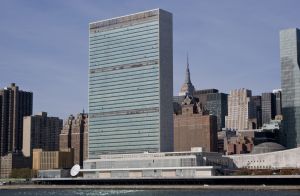
Global warming fear is used as a tool of coercion!

Global Warming’s Upside-Down Narrative

NEW YORK – When politicians around the world tell the story of global warming, they cast it as humanity’s greatest challenge. But they also promise that it is a challenge that they can meet at low cost, while improving the world in countless other ways. We now know that is nonsense.

Political heavyweights from US Secretary of State John Kerry to UN Secretary General Ban Ki-moon call climate change “the greatest challenge of our generation.” If we fail to address it, Kerry says, the costs will be “catastrophic.” Indeed, this has been the standard assertion of politicians since the so-called Stern Review commissioned by the British government in 2006.

That report famously valued the damage caused by global warming at 5-20% of GDP – a major disruption “on a scale similar to those associated with the great wars and the economic depression of the first half of the twentieth century.”

Tackling climate change, we are told, would carry a much lower cost. The president of the European Commission promised that while the European Union’s climate policies are “not cost-free,” they would amount to just 0.5% of GDP. Indeed, politicians of all stripes have reiterated the Stern Review’s finding that global warming can be curtailed by policies costing just 1% of world GDP.

Climate policies, moreover, are said to help in many other ways. US President Barack Obama promised that policies to combat global warming would create five million new green jobs. The EU claimed that green energy would help “improve the EU’s security of energy supply.”

With the completion of the latest report by the United Nations Intergovernmental Panel on Climate Change (IPCC), we can now see that this narrative is mostly wrong. The first installment of the IPCC report showed that there is indeed a climate problem – emissions of greenhouse gases, especially CO₂, lead to higher temperatures, which will eventually become a net problem for the world. This result was highly publicized.

But the report also showed that global warming has dramatically slowed or entirely stopped in the last decade and a half. Almost all climate models are running far too hot, meaning that the real challenge of global warming has been exaggerated. Germany and other governments called for the reference to the slowdown to be deleted.

The second IPCC installment showed that the temperature rise that we are expected to see sometime around 2055-2080 will create a net cost of 0.2-2% of GDP – the equivalent of less than one year of recession. So, while the IPCC clearly establishes that global warming is a problem, the cost is obviously much less than that of the twentieth century’s two world wars and the Great Depression.

Again, not surprisingly, politicians tried to have this finding deleted. British officials found the peer-reviewed estimate “completely meaningless,” and, along with Belgium, Norway, Japan, and the US, wanted it rewritten or stricken. One academic speculated that governments possibly felt “a little embarrassed” that their previous exaggerated claims would be undercut by the UN.

The third installment of the IPCC report showed that strong climate policies would be more expensive than claimed as well – costing upwards of 4% of GDP in 2030, 6% in 2050, and 11% by 2100. And the real cost will likely be much higher, because these numbers assume smart policies, instantly enacted, with key technologies magically available.

Again, politicians tried to delete or change references to these high costs. British officials explained that they wanted such cost estimates cut because they “would give a boost to those who doubt action is needed.”

Green jobs have been created only with heavy subsidies, costing a similar number of jobs elsewhere. Indeed, each extra job created cost more than $11 million in the US. And facile claims that renewable sources can boost energy security look a lot less convincing after the crisis in Ukraine; Europe now understands that only large and stable energy supplies matter.

CommentsView/Create comment on this paragraphClimate change has been portrayed as a huge catastrophe costing as much as 20% of world GDP, though brave politicians could counter it at a cost of just 1% of GDP. The reality is just the opposite: We now know that the damage cost will be perhaps 2% of world GDP, whereas climate policies can end up costing more than 11% of GDP.

What makes this story all the more amazing is that experts have known almost all of these facts for a long time. The Stern Review was produced by bureaucrats and never subjected to peer review. Economists knew that the damage costs had been extensively massaged, and that the estimates were outliers compared to the academic literature. The unfathomably low projections for policy costs were artifacts of ignoring most liabilities, again contradicting the academic literature.  The media, eager for breathless headlines, share the blame with politicians for this state of affairs. Following the release of the Stern Review, one British newspaper reportedly wrote: “Act now or the world we know will be lost forever.” Being accurate is less sexy, but much more informative.

We live in a world where one in six deaths are caused by easily curable infectious diseases; one in eight deaths stem from air pollution, mostly from cooking indoors with dung and twigs; and billions of people live in abject poverty, with no electricity and little food. We ought never to have entertained the notion that the world’s greatest challenge could be to reduce temperature rises in our generation by a fraction of a degree.

The solution is to stop applauding politicians who warn of catastrophe and promote poor policies. Instead of subsidizing inefficient solar and wind power with little benefit, we need to invest in long-term green innovation. And we need to give more attention to all of the other problems. This is perhaps less entertaining, but it will do much more good.


Read more at http://www.project-syndicate.org/commentary/bj-rn-lomborg-says-that-the-un-climate-panel-s-latest-report-tells-a-story-that-politicians-would-prefer-to-ignore#vvxpTx3ZVsFMGGOl.99

Climate change is a sales gimmick for the Faux-green enterprises.

WHEN AN AGW BELIEVER TELLS YOU THAT NO ONE IS MAKING MONEY OFF OF CLIMATE CHANGE…..

Here’s some more ammunition for you.  (Hint: They’re all Liberals)

Gore Pocketed ~$18 Million from Now-Defunct Chicago Climate Exchange

Although the Chicago Climate Exchange (CCX) collapsed and shut down this week, Al Gore’s Generation Investment Management LLP pocketed approximately $17.8 million on it’s 2.98% share of the exchange when it was sold to the publicly traded Intercontinental Exchange a mere 6 months ago.

According to news reports, the brainchild of the exchange, academic Richard Sandor, founded the exchange with a foundation gift of $1.1 million, and pocketed $98.5 million for his 16.5% share of the CCX. This would place the value of Gore’s firm’s stake at almost $18 million.

Note Gore is the founder, chairman, and largest shareholder in Generation Investment Management LLP. Barack Obama was on the Joyce Foundation Board when it provided the funding to establish the CCX. Maurice Strong, founding head of the United Nations Environmental Program (UNEP), precursor to the IPCC, was a CCX board member.

Ed Barnes — November 2010

Collapse of Chicago Climate Exchange Means a Strategy Shift on Global Warming Curbs

By Ed Barnes Published November 09, 2010 | FoxNews.com

The closing this week of the Chicago Climate Exchange, which was envisioned to be the key player in the trillion-dollar “cap and trade” market, was the final nail in the coffin of the Obama administration’s effort to pass the controversial program meant to combat global warming.

“It is dead for the foreseeable future,” said Myron Ebell, director of the Center for Energy and the Environment with the Competitive Energy Institute, which had fought the measure.

That assessment was echoed by environmentalists as well.

“Economy-wide cap and trade died of what amounts to natural causes in Washington,” said Fred Krupp, president of the Environmental Defense Fund, which had supported the plan.

The CCX was set up in 2000 in anticipation of the United States joining Europe and other countries around the world to create a market that would reduce the emission of greenhouse gases. Under the system, factories, utilities and other businesses would be given an emissions target. Those that emitted less fewer regulated gases than their target could sell the “excess” to someone who was above target. Each year, the target figures would be reset lower.  Continue reading here….

gore rich

Climate Alarmists don’t tell the Whole Story!

Ridley: IPCC & OECD reports are telling us clear as a bell that we cannot ruin the climate with CO2 unless we have a population explosion

Matt Ridley: The Richer We Get, The Greener We’ll Become

The world’s climate change experts are now saying that strong growth doesn’t hurt the environment, it protects it

Matt Ridley, The Times

In the past 50 years, world per capita income roughly trebled in real terms, corrected for inflation. If it continues at this rate (and globally the great recession of recent years was a mere blip) then it will be nine times as high in 2100 as it was in 2000, at which point the average person in the world will be earning three times as much as the average Briton earns today.

I make this point partly to cheer you up on Easter Monday about the prospects for your great-grandchildren, partly to start thinking about what that world will be like if it were to happen, and partly to challenge those who say with confidence that the future will be calamitous because of climate change or environmental degradation.


The curious thing is that they only predict disaster by assuming great enrichment. But perversely, the more enrichment they predict, the greater the chance (they also predict) that we will solve our environmental problems.

Past performance is no guide to future performance, of course, and a well aimed asteroid could derail any projection. But I am not the one doing the extrapolating. In 2012, the Intergovernmental Panel on Climate Change (IPCC) asked the Organisation for Economic Cooperation and Development (OECD) to generate five projections for the economy of the world, and of individual countries, in 2050 and 2100.

[I’ve inserted the graph Matt refers to, PDF here: ENV-EPOC-WPCID(2012)6  – Anthony]

OECD_SSP_projections_to2100

They make fascinating reading. The average per capita income of the world in 2100 is projected to be between three and 20 times what it is today in real terms. The OECD’s “medium” scenario, known as SSP2, also known as “middle of the road” or “muddling through”, sounds pretty dull. It is a world in which, in the OECD’s words, “trends typical of recent decades continue” with “slowly decreasing fossil fuel dependency”, uneven development of poor countries, delayed achievement of Millennium Development Goals, disappointing investment in education and “only intermediate success in addressing air pollution or improving energy access for the poor”.

And yet this is a world in which by 2100 the global average income per head has increased 13-fold to $100,000 (in 2005 dollars) compared with $7,800 today. Britain will be very slightly below that average by then, yet has still trebled its income per head. According to this middling scenario, the average citizen of the Democratic Republic of Congo, who today earns $300 a year, will then earn $42,000, or roughly what an American earns today. The average Indonesian, Brazilian or Chinese will be at least twice as rich as today’s American.

Remember this is in today’s money, corrected for inflation, but people will be spending it on tomorrow’s technologies, most of which will be cleverer, cleaner and kinder to the environment than today’s — and all for the same price. Despite its very modest assumptions, it is an almost unimaginable world: picture Beverly Hills suburbs in Kinshasa where pilotless planes taxi to a halt by gravel drives (or something equally futuristic). Moreover, the OECD reckons that inequality will have declined, because people in poor countries will have been getting rich faster than people in rich countries, as is happening now. All five storylines produce a convergence, though at different rates, between the incomes of poor and rich countries.

Can the planet survive this sort of utopian plutocracy? Actually, here it gets still more interesting. The IPCC has done its own projections to see what sort of greenhouse gas emissions these sorts of world would produce, and vice versa. The one that produces the lowest emissions is the one with the highest income per head in 2100 — a 16-fold increase in income but lower emissions than today: climate change averted. The one that produces the highest emissions is the one with the lowest GDP — a mere trebling of income per head. Economic growth and ecological improvement go together. And it is not mainly because environmental protection produces higher growth, but vice versa. More trade, more innovation and more wealth make possible greater investment in low-carbon energy and smarter adaptation to climate change. Next time you hear some green, doom-mongering Jeremiah insisting that the only way to avoid Armageddon is to go back to eating home-grown organic lentils cooked over wood fires, ask him why it is that the IPCC assumes the very opposite.

In the IPCC’s nightmare high-emissions scenario, with almost no cuts to emissions by 2100, they reckon there might be north of 4 degrees of warming. However, even this depends on models that assume much higher “climate sensitivity” to carbon dioxide than the consensus of science now thinks is reasonable, or indeed than their own expert assessment assumes for the period to 2035.

And in this storyline, by 2100 the world population has reached 12 billion, almost double what it was in 2000. This is unlikely, according to the United Nations: 10.9 billion is reckoned more probable. With sluggish economic growth, the average income per head has (only) trebled. The world economy is using a lot of energy, improvements in energy efficiency having stalled, and about half of it is supplied by coal, whose use has increased tenfold, because progress in other technologies such as shale gas, solar and nuclear has been disappointing.

These IPCC and OECD reports are telling us clear as a bell that we cannot ruin the climate with carbon dioxide unless we get a lot more numerous and richer. And they are also telling us that if we get an awful lot richer, we are likely to have invented the technologies to adapt, and to reduce our emissions, so we are then less likely to ruin the planet. Go figure.

The truth about Agenda 21!

Agenda 21? What is Agenda 21?

  • Agenda 21 kids book

Most people have never heard of Agenda 21. If they have heard of it, they likely believe it to be a vague United Nations program that will never see the light of day, or they believe it is imagined by conspiracy theorists. Yet, the principles contained in Agenda 21 are at the heart of many of our federal programs since the late 1990s. They reach every corner of the United States and impact millions of Americans who don’t even realize the document exists.

Although Agenda 21 was decades in the making, it was showcased to the world at the 1992 UN “Earth Summit” in Rio de Janeiro. It was there that President George H. Bush, along with leaders from 177 other nations, signed onto this “non-binding” UN action plan that was purportedly designed to assist governments at the local, national and international level implement the principles of so-called “sustainable development.” The “21” in the name refers to the 21st Century.

Agenda 21 made its way into the U.S. the following year when President Clinton quietly established the President’s Council on Sustainable Development (PCSD). The PCSD codified Agenda 21 into U.S. policy through a program called Sustainable America. Today, nearly all federal programs dealing with land management, education, environment and much more are linked to Agenda 21 through Sustainable America.

Because of grassroots pushback, the federal government today rarely uses the term Agenda 21 or Sustainable America anymore – especially with any program it is promoting. Instead, programs which administer Agenda 21’s sustainable development principles are given warm and fuzzy titles like the America’s Great Outdoors InitiativePartnership for Sustainable CommunitiesObama’s Climate Action Plan and many more. Even the newest education fad,Common Core, is linked to Agenda 21, as are the new Next Generation Science Standards.

Google has over 300 million referenUN buildingces to Agenda 21, yet it’s hard for most people to get the truth about Agenda 21 because of the truckloads of smoke and misinformation generated by government bureaucrats and the progressive media. This UN program is indeed real and it is an affront to our personal liberties.\Agenda 21 is supposedly designed to make the world “sustainable” by limiting human activities that environmental extremists believe are harming the planet. That may sound fine to many people – until they understand what it means in practice. In order to protect the environment, Agenda 21 instructs governments to micromanage virtually all human activity – which the governments either severely restrict, or regulate to the point that such activity can be minimalized.

A good case in point took place in California recently, which as has been widely reported, experienced a major three-year drought. In mid-March 2014, the Ninth U.S. Circuit Court of Appeals upheld federal guidelines that guaranteed minimal flow of the Sacramento River to benefit “endangered” Delta Smelt – totally neglecting the needs of local farmers. Most farmers are getting no water even though most of them have long-term contracts guaranteeing it to them.

Delta smeltIronically, the Delta Smelt have survived many severe droughts in the past when farmers got virtually all the available water from the Sacramento River. Yet today the smelt get the water and the farmers don’t – even though many of the farmers will not survive the cutbacks. Seeing the needs of nature as being in conflict with the needs of people is a principle that is at the very heart of Agenda 21.

This is no small matter. Thousands of workers are being put out of work in California, and up to 700,000 acres of prime farmland will be removed from production. Since one-third of America’s fruit and vegetables originate in California’s Central Valley, this means that food prices could jump as much as 3.5%. While that may not seem like much to the more affluent in our society, it could be devastating to seniors and the poor who may no longer be able buy essential fruits and vegetables.

Simply stated, the only way Agenda 21 can work is to deny private citizens their private property rights. This should surprise no one since the UN has maintained that “public control of land use is…indispensable” since the 1976 Habitat I Conference in Vancouver, British Columbia. Yet, recent research sponsored by the World Bank has shown that legally protected private property rights drastically reduce corruption, while establishing the foundation for wealth creation. This in turn also helps the environment as weathier nations spend more on environmental protection than poorer ones. The research stressed that “since these people do not have access to a comprehensive legal property system, they cannot leverage their assets to produce additional wealth.” The bottom line? “Nearly five billion people are legally and economically disenfranchised by their own governments,” reports the Bank.

The vast bulk of this is occurring, of course, in the developing world – but not all. The same thing is happening in the U.S. as Agenda 21 principles are adopted into policy. It has already had devastating effects. According to the Fraser Economic freedom wordsInstitute and CATO’s Economic Freedom of the World, the legal-system and-private-property-rights ranking for the U.S. plummeted from number one in 1980 to38th in 2011; which not unsurprisingly has occurred since Agenda 21 principles began to be implemented in the 1990s. The U.S. combined economic ranking in the world from 1980 to 2000 was second or third place behind Hong Kong and Singapore. It plummeted to 19th between 2000 and 2011—mostly due to federal spending, debt, skyrocketing regulations (especially from EPA) and, most importantly, loss of a stable legal system and property rights.

Is it any wonder the current “economic recovery” is so anemic. Certainly not all of the economic woes we have experienced since President Obama’s election can be blamed on Agenda 21 policy. But Agenda 21 is no doubt a big factor in ravaging the U.S. economy. Citizens can begin to restore America’s health by supporting rational candidates at every level of government that are committed to ridding this nation of Agenda 21’s “sustainable development” policy plague.

Mike Coffman

About the Author: Michael Coffman

Michael Coffman, PhD, is CEO of Sovereignty International and has worked to raise awareness about the UN Convention on Biological Diversity, one of the key goals of Agenda 21