The Hidden Agenda, Behind The Global Warming/Climate change scam!

Australia PM adviser says climate change is ‘UN-led ruse to establish new world order’

Tony Abbott’s business adviser says global warming a fallacy supported by United Nations to ‘create a new authoritarian world order under its control’

Maurice Newman, chairman of the Prime Minister's Business Advisory Council

Maurice Newman, chairman of the Prime Minister’s Business Advisory Council Photo: AP

Climate change is a hoax developed as part of a secret plot by the United Nations to undermine democracies and takeover the world, a top adviser toTony Abbott, Australia’s prime minister, has warned.

Maurice Newman, the chief business adviser to the prime minister, said the science showing links between human activity and the warming climate was wrong but was being used as a “hook” by the UN to expand its global control.

“This is not about facts or logic. It’s about a new world order under the control of the UN,” he wrote in The Australian.

“It is opposed to capitalism and freedom and has made environmental catastrophism a household topic to achieve its objective.” Born in Ilford, England, and educated in Australia, Mr Newman, a staunch conservative and former chairman of the Australian Stock Exchange, has long been an outspoken critic of climate change science.

He was appointed chairman of the government’s business advisory council by Mr Abbott, who himself is something of a climate change sceptic and once famously described climate change as “absolute cr**” – a comment he later recanted.

In his comment piece – described by critics as “whacko” – Mr Newman said the world has been “subjected to extravagance from climate catastrophists for close to 50 years”.

“It’s a well-kept secret, but 95 per cent of the climate models we are told prove the link between human CO2 emissions and catastrophic global warming have been found, after nearly two decades of temperature stasis, to be in error,” he wrote.

“The real agenda is concentrated political authority. Global warming is the hook. Eco-catastrophists [ …] have captured the UN and are extremely well funded. They have a hugely powerful ally in the White House.”

Environmental groups and scientists described Mr Newman as a ‘crazed’ conspiracy theorist and some called on him to resign.

“His anti-science, fringe views are indistinguishable from those made by angry trolls on conspiracy theory forums,” said the Climate Change Council.

Professor Will Steffen, a climate change scientist, told The Australian Financial Review: “These are bizarre comments that would be funny if they did not come from [Mr Abbott’s] chief business adviser.” Mr Abbott’s office did not respond but his environment minister said he did not agree with Mr Newman’s comments.

The article was written by Mr Newman to coincide with a visit by Christiana Figueres, the UN climate change negotiation, who has urged Australia to reduce its reliance on coal. Australia is one of the world’s biggest emitters of carbon emissions per capita.

Since his election in 2013, Mr Abbott has abolished Labor’s carbon tax, scaled back renewable energy targets and appointed sceptics to several significant government positions.

Climate Alarmists: They Hate Facts that Don’t Back Up Their Story, and the People Who Expose Them!

Climate Change | John Roskam
Australian Financial Review 1st May, 2015

In 1987, the American historian and philosopher Allan Bloom wrote a best-selling book, The Closing of the American Mind. It was about the mediocrity and intellectual conformity of American universities. Bloom died in 1992. If he was alive today and writing about Australian universities his book could be titled The Closed Australian Mind.

The reaction of university academics to the Abbott government’s decision to provide $1 million to fund a branch of Bjorn Lomborg’s Copenhagen Consensus Centre at the University of Western Australia demonstrates all that’s wrong with Australia’s universities. Their culture tends to be distrustful, insular and choked in unthinking intellectual uniformity. That’s why the number of Australian researchers who rival Lomborg’s global renown can be numbered on the fingers of one hand. Probably the closest any Australian comes to having anything like Lomborg’s international standing in the field of philosophy and policy is the ethicist Peter Singer now at Princeton University. (Singer who supports infanticide in some circumstances was voted one of Australia’s most outstanding public intellectuals. He’s also been awarded the Companion of the Order of Australia, the country’s second-highest honour.)

Instead of welcoming a world-class public policy thinker coming to Australia and to their university, academics and students at the University of Western Australia are outraged. The vice-president of the university’s staff association talked of having the funding revoked, while the student guild launched a ‘Say No to Bjorn Lomborg’ campaign.

Lomborg’s problem is he’s a climate “contrarian”. As the The Guardian newspaper has helpfully pointed out a climate “contrarian” is someone who is not a climate “denialist” but who nevertheless says things that “infuriate” people who believe climate change is the world’s most serious and urgent problem. And the reason we know Lomborg is not a “denialist” is because the university’s vice-chancellor says so. At a meeting last week of 150 angry academics the vice-chancellor attempted to placate his staff by reassuring them Lomborg most definitely wasn’t a “denialist” and his institution “had a history of defending its climate change research staff against the most extreme views of climate change deniers”. (There’s no record of the vice-chancellor defining what he meant by the term “denialist”. Presumably his university doesn’t employ any.)

LOMBORG’S BELIEFS

Lomborg believes humans are causing the climate to change and he believes it’s a problem. But he also believes that much of the money spent on fighting climate change would be better spent on overcoming malaria and HIV/Aids and assisting the 700 million people on the planet who don’t have clean water. These views apparently make Lomborg unfit to hold a position at the University of Western Australia. As yet it’s not clear what Lomborg would have to believe to satisfy the staff and students of the university.

In The Closing of the American Mind, Bloom examines how the teaching of humanities has been affected by postmodernism and moral relativism. For Bloom, what’s even worse is that so many academics think the same things and they won’t tolerate anyone disagreeing with them. He tells the story of what happened to him as a student.

“We are used to hearing the Founders charged with being racists, murderers of Indians, representatives of class interests. I asked my first history professor in the university, a very famous scholar, whether the picture he gave us of George Washington did not have the effect of making us despise our regime. ‘Not at all,’ he said, ‘it doesn’t depend on individuals but on our having good democratic values.’ To which I rejoined, ‘But you just showed us that Washington was only using those values to further the class interests of the Virginian squirearchy.’ He got angry, and that was the end of it.”

What Bloom said about the humanities in American universities 30 years ago is true of science in Australian universities today. Those who dare to question whether the science of climate change actually is “settled” provoke anger and name calling from many in Australia’s scientific community.

Australia’s Nobel Laureate Peter Doherty is a leader of that community. He’s another one angry Lomborg is coming to this country. Doherty’s attitude is disappointing but also perplexing. Without contrarian thinkers there wouldn’t be many Nobel Prizes to hand out.

Father of Green Communities Act, Convicted Under the RICO Act! Who’s Next?

Falmouth Wind Turbines – RICO Act

Prior to Wind Turbine Installations Falmouth had the Octave Band Data / Sound performance for the V82 turbine

Falmouth Wind Turbines & RICO Act

Did the Town of Falmouth violate the RICO Act ? They all knew the turbines would break state noise laws !

The Commonwealth of Massachusetts
Department of Environmental Protection (DEP)
Noise Control Regulation  310 CMR 7.10

310 CMR 7.10 Noise
(1) No person owning, leasing, or controlling a source of sound shall willfully, negligently, or through failure to provide necessary equipment, service, or maintenance or to take necessary precautions cause, suffer, allow, or permit unnecessary emissions from said source of sound that may cause noise.

Prior to the installations of the Falmouth wind turbines it appears Vestas Wind Company forewarned the Town of Falmouth, Town of Falmouth contract engineers and construction contractors. The manufacturer ( Vestas )also needs confirmation that the Town of

Falmouth understands they are fully responsible for the site selection of the turbine and bear all responsibilities to address any mitigation needs of the neighbors.

The turbines operated full time until May of 2012. State officials shut down the wind turbine in Falmouth after measurements showed the machine generating more than 10 decibels above ordinary background noise.

The turbines operate 12 hours a day during daylight now and are shut off on Sunday

Passed in 1970, the Racketeer Influenced and Corrupt Organizations Act (RICO) is a federal law designed to combat organized crime in the United States. It allows prosecution and civil penalties for racketeering activity performed as part of an ongoing criminal enterprise.

To convict a defendant under RICO, the government must prove that the defendant engaged in two or more instances of racketeering activity and that the defendant directly invested in, maintained an interest in, or participated in a criminal enterprise affecting interstate or foreign commerce.

Political Corruption

Politicians :
. UNITED STATES V. CIANCI
Providence Rhode Island
For twenty-one years, from 1975-1984 and from 1991-2002, Vincent A. “Buddy” Cianci was the mayor of Providence, Rhode Island.

Ultimately, Cianci was only convicted of one RICO conspiracy count.
The First Circuit notes—for a RICO conspiracy conviction, a defendant simply “must intend to further an endeavor which, if completed, would satisfy all of the elements of a substantive criminal offense, but it suffices that he adopted the goal of furthering or facilitating the criminal endeavor.”

Buddy Cianci was therefore found guilty of a §1962(d) RICO conspiracy violation and sentenced to five years and four months in prison.

Falmouth noise letter recently released through a Freedom of Information Request

August 3, 2010
Mr. Gerald Potamis
WasteWater Superintendent
Town of Falmouth Public Works
59 Town Hall Square
Falmouth, MA 02540

RE: Falmouth WWTF Wind Energy Facility II “Wind II”, Falmouth, MA
Contract No. #3297

Dear Mr. Potamis,

Due to the sound concerns regarding the first wind turbine installed at the wastewater treatment facility, the manufacturer of the turbines, Vestas, is keen for the Town of Falmouth to understand the possible noise and other risks associated with the installation of the second wind turbine.

The Town has previously been provided with the Octave Band Data / Sound performance for the V82 turbine. This shows that the turbine normally operates at 103.2dB but the manufacturer has also stated that it may produce up to 110dB under certain circumstances. These measurements are based on IEC standards for sound measurement which is calculated at a height of 10m above of the base of the turbine.

We understand that a sound study is being performed to determine what, if any, Impacts the second turbine will have to the nearest residences. Please be advised that should noise concerns arise with this turbine, the only option to mitigate normal operating sound from the V82 is to shut down the machine at certain wind speeds and directions. Naturally this would detrimentally affect power production.

The manufacturer also needs confirmation that the Town of Falmouth understands they are fully responsible for the site selection of the turbine and bear all responsibilities to address any mitigation needs of the neighbors.

Finally, the manufacturer has raised the possibility of ice throw concerns. Since Route 28 is relatively close to the turbine, precautions should be taken in weather that may cause icing.

To date on this project we have been unable to move forward with signing the contract with Vestas. The inability to release the turbine for shipment to the project site has caused significant [SIC] delays in our project schedule. In order to move forward the manufacturer requires your understanding and acknowledgement of these risks. We kindly request for this acknowledgement to be sent to us by August 4, 2010, as we have scheduled a coordination meeting with Vestas to discuss the project schedule and steps forward for completion of the project.

Please sign in the space provided below to indicate your understanding and acknowledgement of this letter. If you have any questions, please do not hesitate to call me.

Sincerely,

(Bruce Mabbott’s signature)
_____________________
Bruce Mabbott Gerald Potamis
Project Manager Town of Falmouth

CC: Sumul Shah, Lumus Construction, Inc.
(Town of Falmouth’s Wind-1 and Wind-2 Construction contractor)

Stephen Wiehe, Weston & Sampson
(Town of Falmouth’s contract engineers)

Brian Hopkins, Vestas
(Wind-1, Wind-2’s turbine manufacturer, and also Webb/NOTUS turbine)

John Middleton, from Scotland, Reports on the Windpushers Latest Tactics!

Thursday night, Ms Sturgeon on the TV looking relaxed in her home, life is good… Now, in the words o the great Max Bygraves.. “Let me tell you a story”… Most people on here know me, some don’t, some girls need a lot o loving an some girls don’t… Naw, only kidding (could not help it)… Having (this is the real story by the way) been up for several nights due to this horrendous noise and it’s effects, I stupidly pleaded with Ms Sturgeon to do something about WLC and NLC, things were pretty bad and the question had to be asked “are these turbines worth more than my sanity and my life”..? My response from Ms Sturgeon was sending two police officers to my door to check on my well being, when they realised I wanted to discuss why I’m being kept awake they did not want to know so said ” thanks very much and tried to close the door which they kicked open, handcuffed me and held me by my throat saying I was mentally ill and frogmarched me into a van and yes they said they had been contacted by Ms Sturgeons office… Well, I was taken to St Johns hospital where I was mentally assessed, they asked me why I had not slept and was contacting various organisations about wind turbines, I told them what I know as I have discussed with many of you here, they brought a guy in from WLC mental health who asked me (an this’ll crack ye up as it did me) “what do the turbines say to you”… Well you can imagine my response, I explained it’s a humming and that it was now widely known that the LFN does indeed effect certain people and does not effect others, I was then deemed “fixed delusional”, I was immediately seized and given certain drugs against my will, this was done first orally then by syringes thrust into my legs through my clothes, put in a wheelchair carted backwards to a secure mental health ward where I have been for over a week now, if you think that these places have changed since “one flew over the cuckoo’s nest” then be rest assured they ain’t…!!! Earlier today I had a top consultant come to see me and having had her assistant look into this “noise”, I was released with immediate effect, she said I should not have been put there as everything I said was indeed true.. The mental health order revoked, the whole time apart from when they forced me into the ward I had no drugs apart from painkillers due to the injuries inflicted by so called nurses… This is the length these people will go to to silence we sufferers of this god forsaken noise, I will continue this fight regardless of this blatant abuse of my civil liberties, let this story be told and never give in….

Climate Models Never Reflect Reality…..Reality Must be Wrong???

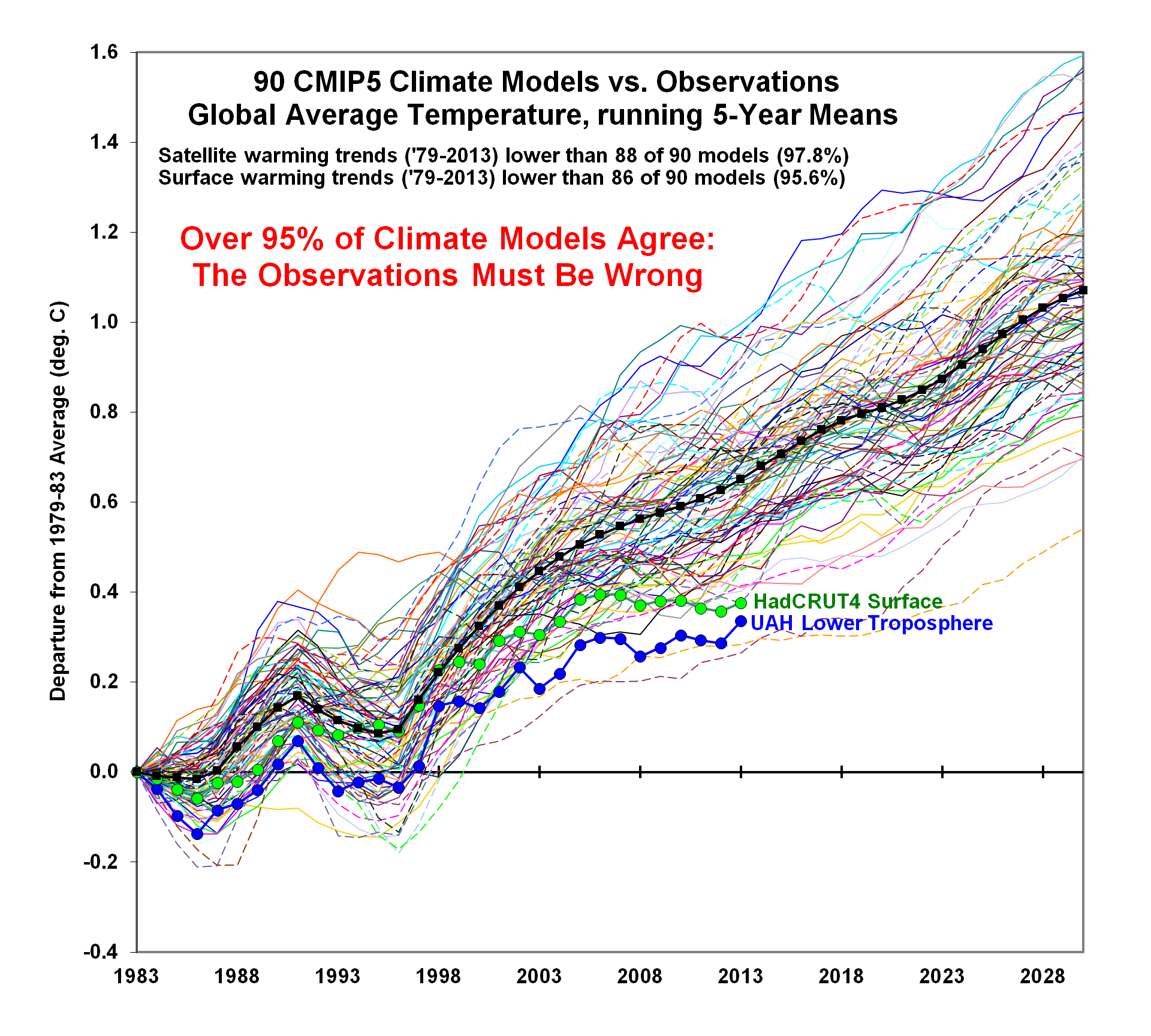
95% of Climate Models Agree: The Observations Must be Wrong

Roy W. Spencer, Ph. D.

I’m seeing a lot of wrangling over the recent (15+ year) pause in global average warming…when did it start, is it a full pause, shouldn’t we be taking the longer view, etc.

These are all interesting exercises, but they miss the most important point:the climate models that governments base policy decisions on have failed miserably.

I’ve updated our comparison of 90 climate models versus observations for global average surface temperatures through 2013, and we still see that >95% of the models have over-forecast the warming trend since 1979, whether we use their own surface temperature dataset (HadCRUT4), or our satellite dataset of lower tropospheric temperatures (UAH):

CMIP5-90-models-global-Tsfc-vs-obs-thru-2013

Whether humans are the cause of 100% of the observed warming or not, the conclusion is that global warming isn’t as bad as was predicted. That should have major policy implications…assuming policy is still informed by facts more than emotions and political aspirations.

And if humans are the cause of only, say, 50% of the warming (e.g. our published paper), then there is even less reason to force expensive and prosperity-destroying energy policies down our throats.

I am growing weary of the variety of emotional, misleading, and policy-useless statements like “most warming since the 1950s is human caused” or “97% of climate scientists agree humans are contributing to warming”, neither of which leads to the conclusion we need to substantially increase energy prices and freeze and starve more poor people to death for the greater good.

Yet, that is the direction we are heading.

And even if the extra energy is being stored in the deep ocean (if you have faith in long-term measured warming trends of thousandths or hundredths of a degree), I say “great!”. Because that extra heat is in the form of a tiny temperature change spread throughout an unimaginably large heat sink, which can never have an appreciable effect on future surface climate.

If the deep ocean ends up averaging 4.1 deg. C, rather than 4.0 deg. C, it won’t really matter.

Climate Change Fraud is Much Bigger Than it Seems!

The Great Wind Power Fraud: Just the Tip of the Climate Change Hysteria Spending Iceberg

turbine fire 6

****

The tip of the climate spending iceberg
CFACT
Paul Driessen
31 March 2015

Lockheed Martin, a recent Washington Post article notes, is getting into renewable energy, nuclear fusion, “sustainability” and even fish farming projects, to augment its reduced defense profits. The company plans to forge new ties with Defense Department and other Obama initiatives, based on a shared belief in manmade climate change as a critical security and planetary threat.

It is charging ahead where other defense contractors have failed, confident that its expertise, lobbying skills and “socially responsible” commitment to preventing climate chaos will land it plentiful contracts and subsidies.

As with its polar counterparts, 90% of the titanic climate funding iceberg is invisible to most citizens, businessmen and politicians. The Lockheed action is the mere tip of the icy mountaintop.

The multi-billion-dollar agenda reflects the Obama Administration’s commitment to using climate change to radically transform America. It reflects a determination to make the climate crisis industry so enormous that no one will be able to tear it down, even as computer models and disaster claims become less and less credible – and even if Republicans control Congress and the White House after 2016. Lockheed is merely the latest in a long list of regulators, researchers, universities, businesses, manufacturers, pressure groups, journalists and politicians with such strong monetary, reputational and authority interests in alarmism that they will defend its tenets and largesse tooth and nail.

Above all, it reflects a conviction that alarmists have a right to control our energy use, lives, livelihoods and living standards, with no transparency and no accountability for mistakes they make or damage they inflict on disfavored industries and families.

And they are pursuing this agenda despite global warming again beingdead last in the latest Gallup poll of 15 issues of greatest concern to Americans: only 25% say they worry about it “a great deal,” despite steady hysteria; 24% are “not at all” worried about the climate. By comparison, 46% percent worry a great deal about the size and power of the federal government.

But Climate Crisis, Inc. is using our tax and consumer dollars to advance six simultaneous strategies.

1) Climate research. The US government spends $2.5 billion per year on research that focuses on carbon dioxide, ignores powerful natural forces that have always driven climate change, and generates numerous reports and press releases warning of record high temperatures, melting icecaps, rising seas, stronger storms, more droughts and other “unprecedented” crises. The claims are erroneous and deceitful.

They are consistently contradicted by actual climate and weather records, and so alarmists increasingly emphasize computer models that reinvent and substitute for reality. Penn State modeler Michael Mann has collected millions for headline-grabbing work like his latest assertion that the Gulf Stream is slowing – contrary to 20 years of actual measurements that show no change. Former NASA astronomer James Hansen received a questionable $250,000 Heinz Award from Secretary of State John Kerry’s wife, for his climate crisis and anti-coal advocacy. Al Gore and350.org also rake in millions. Alarmist scientists and institutions seek billions more, while virtually no government money goes to research into natural forces.

2) Renewable energy research and implementation grants, loans, subsidies and mandates drive projects to replace hydrocarbons that are still abundant and still 82% of all US energy consumed. Many recipientswent bankrupt despite huge taxpayer grants and loan guarantees. Wind turbine installations butcher millions of birds and bats annually, but are exempt from Endangered Species Act fines and penalties.

Tesla Motors received $256 million to produce electric cars for wealthy elites who receive $2,500 to $7,500 in tax credits, plus free charging and express lane access. From 2007 to 2013, corn ethanol interests spent$158 million lobbying for more “green” mandates and subsidies – and $6 million in campaign contributions – for a fuel that reduces mileage, damages engines, requires enormous amounts of land, water and fertilizer, and from stalk to tailpipe emits more carbon dioxide than gasoline.

General Electric spends tens of millions lobbying for more taxpayer renewable energy dollars; so do many other companies. The payoffs add up to tens of billions of dollars, from taxpayers and consumers.

3) Regulatory fiats increasingly substitute for laws and carbon taxes thatCongress refuses to enact, due to concerns about economic and employment impacts, and because China, India and other countries’ CO2 emissions dwarf America’s. EPA’s war on coal has already claimed thousands of jobs, raised electricity costs for millions of businesses and families, and adversely affected living standards, health and welfare for millions of families. The White House and EPA are also targeting oil and gas drilling and fracking.

Now the Obama Administration is unleashing a host of new mandates and standards, based on arbitrary “social cost of carbon” calculations that assume fossil fuel use imposes numerous climate and other costs, but brings minimal or no economic or societal benefits. The rules will require onerous new energy efficiency and CO2 emission reduction standards that will send consumer costs skyrocketing, while channeling billions of dollars to retailers, installers, banks and mostly overseas manufacturers.

As analyst Roger Bezdek explains, water heaters that now cost $675-1,500 will soon cost $1,200-2,450 – with newfangled exhaust fans, vent pipes and condensate removal systems. Pickup trucks with more fuel efficiency and less power will nearly double in price. Microwaves, cell phones, vacuum cleaners, hair dryers, toasters, coffee pots, lawn mowers, photocopiers, televisions and almost everything else will cost far more. Poor and middle class families will get clobbered, to prevent perhaps 5% of the USA’s 15% of all human CO2 emissions toward 0.04% of atmospheric CO2, and maybe 0.00001 degrees of warming.

4) A new UN climate treaty would limit fossil fuel use by developed countries, place no binding limits or timetables on developing nations, and redistribute hundreds of billions of dollars to poor countries that claim they have been harmed by emissions and warming due to rich country hydrocarbon use. Even IPCC officials now openly brag that climate policy has “almost nothing” to do with protecting the environment – and everything to do with intentionally transforming the global economy and redistributing its wealth.

5) Vicious personal attacks continue on scientists, businessmen, politicians and others who disagree publicly with the catechism of climate cataclysm. Alarmist pressure groups and Democrat members of Congress are out to destroy the studies, funding, reputations and careers of all who dare challenge climate disaster tautologies. At President Obama’s behest, even disaster aid agencies are piling on.

New FEMA rules require that any state seeking disaster preparedness funds from the Federal Emergency Management Agency must first assess how climate change threatens their communities. This will mean relying on discredited, worthless alarmist models that routinely spew out predictions unrelated to reality. It likely means no federal funds will go to states that include or focus on natural causes, historical records or models that have better track records than those employed by the IPCC, EPA and President.

6) Thought control. In addition to vilifying climate chaos skeptics, alarmists are determined to control all thinking on the subject. They are terrified that people will find realist analyses and explanations far more persuasive. They refuse to debate skeptics, respond to NIPCC and other studies examining natural climate change and carbon dioxide benefits to wildlife and agriculture, or even admit there is no consensus.

They want the news media to ignore us but cannot put the internet genie back in the bottle. The White House is trying, though. It even sent picketers to FCC Chairman Tom Wheeler’s home, to demand that he knuckle under and apply 1930s’ telephone laws to the internet, as a first step in content control States must refuse to play the climate crisis game.

Through lawsuits, hearings, investigations and other actions, governors, legislators, AGs and other officials can delay EPA diktats, educate citizens about solar and other natural forces, and explain the huge costs and trifling benefits of these draconian regulations.

Congress should hold hearings, demand an accounting of agency expenditures, require solid evidence for every climate claim and regulation, and cross-examine Administration officials on details. It should slash EPA and other agency budgets, so they cannot keep giving billions to pressure groups, propagandists and attack dogs. Honesty, transparency, accountability and a much shorter leash are long overdue.
CFACT

Tip of the iceberg

Friend to Wind Turbine Victims, French Senator Jean Germain, Dies Mysterious Death

10

‘SUICIDE’ OF FRENCH SENATOR JEAN GERMAIN, FRIEND OF WINDFARM VICTIMS

Written by Mark Duchamp, World Council for Nature on 10 Apr 2015

French Senator Jean Germain, a friend of windfarm victims, has been found dead in what appears to be a suicide. He had made increasingly effective political opposition against ‘Big Green’ interests in recent times. His death may be considered suspicious. Jean Germain As UK national newspaper, The Guardiannoted:

“He is a martyr of the republic. He has been thrown to the dogs” said his lawyer (1).
Recently, Jean Germain had convinced his fellow Senators to propose an amendment doubling the setback between wind turbines and habitations to 1,000 meters. The French government, house of representatives and  wind industry are opposed to it.
In a country like France, a 1,000-meter buffer zone would make relatively few wind projects possible. But the majority of Senators thought the health of their constituents was more important.
Other French politicians who, according to the authorities, committed suicide:
 
 Pierre Bérégovoy in 1993, who “shot himself” – yet it turned out later that he had two bullets in his head (sic)  (2)
– Robert Boulin, who was found in a pond in 1979, with clear evidence of blows to the face – in other words, this Minister would have commited suicide by beating himself up (3).
– There may be more examples…
We are not implying that the death of Jean Germain is suspicious. We are just remembering that, in these matters, it may take years before the whole truth is known. Prudently, a number of media have been titling: French senator found dead in apparent suicide (4).
If you read French, see the moving letter from Pascale Hoffmeyer, WCFN’s Coordinator for Switzerland: “… the distress of giant turbines’ neighbours …” (5).
Contact:
Mark Duchamp      +34 693 643 736
Chairman
www.wcfn.org

Stop Blowing Our Money Into the Wind!

PSST! Want to Kill Prosperous Economies & Crush the Poorest? Then Keep Throwing $Billions at Wind Power

Josef Stalin

***

The so-called “Greens” are not just delusional, they’re dangerous. Full of hate for human beings, especially the poorest of them, their “policies” – if they can be called that? – are more like malign manifestos, of the kind that would have made the Generalissimo proud.

In a brilliant essay, first published in the Wall Street Journal, Matt Ridley lays “green” ideology to waste; and gives the nonsense of wind power special attention, observing that:

Wind power, for all the public money spent on its expansion, has inched up to — wait for it — 1 per cent of world energy consumption in 2013. Solar, for all the hype, has not even managed that: If we round to the nearest whole number, it accounts for 0 per cent of world energy consumption.

Matt goes on to dissect the greens’ favourite myth that economies can, somehow, rely on “hope and promises”; and ditch fossil fuels altogether.

Fossil fuels are here to stay
The Wall Street Journal
Matt Ridley
23 March 2015

THE environmental movement has advanced three arguments in recent years for giving up fossil fuels: (1) that we will soon run out of them anyway; (2) that alternative sources of energy will price them out of the marketplace; and (3) that we cannot afford the climate consequences of burning them.

These days, not one of the three arguments is looking very healthy. In fact, a more realistic assessment of our energy and environmental situation suggests that, for decades to come, we will continue to rely overwhelmingly on the fossil fuels that have contributed so dramatically to the world’s prosperity and progress.

In 2013, about 87 per cent of the energy that the world consumed came from fossil fuels, a figure that — remarkably — was unchanged from 10 years before. This roughly divides into three categories of fuel and three categories of use: oil used mainly for transport, gas used mainly for heating, and coal used mainly for electricity.

Over this period, the overall volume of fossil-fuel consumption has increased dramatically, but with an encouraging environmental trend: a diminishing amount of carbon-dioxide emissions per unit of energy produced. The biggest contribution to decarbonising the system has been the switch from high-carbon coal to lower-carbon gas in electricity generation.

On a global level, renewable energy sources such as wind and solar have contributed hardly at all to the drop in carbon emissions, and their modest growth has merely made up for a decline in the fortunes of zero-carbon nuclear energy. (The reader should know that I have an indirect interest in coal through the ownership of land in Northern England on which it is mined, but I nonetheless applaud the displacement of coal by gas in recent years.)

The argument that fossil fuels will soon run out is dead, at least for a while. The collapse of the price of oil over the past six months is the result of abundance: an inevitable consequence of the high oil prices of recent years, which stimulated innovation in hydraulic fracturing, horizontal drilling, seismology and information technology. The US — the country with the oldest and most developed hydrocarbon fields — has found itself once again, surprisingly, at the top of the energy-producing league, rivalling Saudi Arabia in oil and Russia in gas.

The shale genie is now out of the bottle. Even if the current low price drives out some high-cost oil producers — in the North Sea, Canada, Russia, Iran and offshore, as well as in America — shale drillers can step back in whenever the price rebounds. As Mark Hill of Allegro Development Corporation argued last week, the frackers are currently experiencing their own version of Moore’s law: a rapid fall in the cost and time it takes to drill a well, along with a rapid rise in the volume of hydrocarbons they are able to extract.

And the shale revolution has yet to go global. When it does, oil and gas in tight rock formations will give the world ample supplies of hydrocarbons for decades, if not centuries. Lurking in the wings for later technological breakthroughs is methane hydrate, a sea floor source of gas that exceeds in quantity all the world’s coal, oil and gas put together.

So those who predict the imminent exhaustion of fossil fuels are merely repeating the mistakes of the US presidential commission that opined in 1922 that “already the output of gas has begun to wane. Production of oil cannot long maintain its present rate.” Or president Jimmy Carter when he announced on television in 1977 that “we could use up all the proven reserves of oil in the entire world by the end of the next decade.”

That fossil fuels are finite is a red herring. The Atlantic Ocean is finite, but that does not mean that you risk bumping into France if you row out of a harbour in Maine. The buffalo of the American West were infinite, in the sense that they could breed, yet they came close to extinction. It is an ironic truth that no non-renewable resource has ever run dry, while renewable resources — whales, cod, forests, passenger pigeons — have frequently done so.

The second argument for giving up fossil fuels is that new rivals will shortly price them out of the market. But it is not happening. The great hope has long been nuclear energy, but even if there is a rush to build new nuclear power stations over the next few years, most will simply replace old ones due to close.

The world’s nuclear output is down from 6 per cent of world energy consumption in 2003 to 4 per cent today. It is forecast to inch back up to just 6.7 per cent by 2035, according the Energy Information Administration.

Nuclear’s problem is cost. In meeting the safety concerns of environmentalists, politicians and regulators added requirements for extra concrete, steel and pipework, and even more for extra lawyers, paperwork and time.

The effect was to make nuclear plants into huge boondoggles with no competition or experimentation to drive down costs. Nuclear is now able to compete with fossil fuels only when it is subsidised.

As for renewable energy, hydro-electric is the biggest and cheapest supplier, but it has the least capacity for expansion. Technologies that tap the energy of waves and tides remain unaffordable and impractical.

Geothermal is a minor player for now. And bioenergy — that is, wood, ethanol made from corn or sugar cane, or diesel made from palm oil — is proving an ecological disaster: It encourages deforestation and food-price hikes that cause devastation among the world’s poor, and per unit of energy produced, it creates even more carbon dioxide than coal.

Wind power, for all the public money spent on its expansion, has inched up to — wait for it — 1 per cent of world energy consumption in 2013. Solar, for all the hype, has not even managed that: If we round to the nearest whole number, it accounts for 0 per cent of world energy consumption.

Both wind and solar are entirely reliant on subsidies for such economic viability as they have. Worldwide, the subsidies given to renewable energy currently amount to roughly $10 per gigajoule: These sums are paid by consumers to producers, so they tend to go from the poor to the rich, often to landowners.

It is true that some countries subsidise the use of fossil fuels, but they do so at a much lower rate — the world average is about $1.20 per gigajoule — and these are mostly subsidies for consumers (not producers), so they tend to help the poor, for whom energy costs are a disproportionate share of spending.

The costs of renewable energy are coming down, especially in the case of solar. But even if solar panels were free, the power they produce would still struggle to compete with fossil fuel — except in some very sunny locations — because of all the capital equipment required to concentrate and deliver the energy.

This is to say nothing of the great expanses of land on which solar facilities must be built and the cost of retaining sufficient conventional generator capacity to guarantee supply on a dark, cold, windless evening.

The two fundamental problems that renewables face are that they take up too much space and produce too little energy.

To run the US economy entirely on wind would require a wind farm the size of Texas, California and New Mexico combined — backed up by gas on windless days. To power it on wood would require a forest covering two-thirds of the U.S., heavily and continually harvested.

John Constable, who will head a new Energy Institute at the University of Buckingham in Britain, points out that the trickle of energy that human beings managed to extract from wind, water and wood before the Industrial Revolution placed a great limit on development and progress.

The incessant toil of farm labourers generated so little surplus energy in the form of food for men and draft animals that the accumulation of capital, such as machinery, was painfully slow. Even as late as the 18th century, this energy-deprived economy was sufficient to enrich daily life for only a fraction of the population.

Our old enemy, the second law of thermodynamics, is the problem here. As a teenager’s bedroom generally illustrates, left to its own devices, everything in the world becomes less ordered, more chaotic, tending toward “entropy,” or thermodynamic equilibrium. To reverse this tendency and make something complex, ordered and functional requires work. It requires energy.

The more energy you have, the more intricate, powerful and complex you can make a system. Just as human bodies need energy to be ordered and functional, so do societies. In that sense, fossil fuels were a unique advance because they allowed human beings to create extraordinary patterns of order and complexity — machines and buildings — with which to improve their lives.

The result of this great boost in energy is what economic historian and philosopher Deirdre McCloskey calls the Great Enrichment. In the case of the US, there has been a roughly 9000 per cent increase in the value of goods and services available to the average American since 1800, almost all of which are made with, made of, powered by or propelled by fossil fuels.

Still, more than a billion people on the planet have yet to get access to electricity and to experience the leap in living standards that abundant energy brings. This is not just an inconvenience for them: Indoor air pollution from wood fires kills four million people a year. The next time that somebody at a rally against fossil fuels lectures you about her concern for the fate of her grandchildren, show her a picture of an African child dying today from inhaling the dense muck of a smoky fire.

Notice, too, the ways in which fossil fuels have contributed to preserving the planet. As the American author and fossil-fuels advocate Alex Epstein points out in a bravely unfashionable book, The Moral Case for Fossil Fuels, the use of coal halted and then reversed the deforestation of Europe and North America.

The turn to oil halted the slaughter of the world’s whales and seals for their blubber. Fertiliser manufactured with gas halved the amount of land needed to produce a given amount of food, thus feeding a growing population while sparing land for wild nature.

To throw away these immense economic, environmental and moral benefits, you would have to have a very good reason. The one most often invoked today is that we are wrecking the planet’s climate. But are we?

Although the world has certainly warmed since the 19th century, the rate of warming has been slow and erratic. There has been no increase in the frequency or severity of storms or droughts, no acceleration of sea-level rise. Arctic sea ice has decreased, but Antarctic sea ice has increased.

At the same time, scientists are agreed that the extra carbon dioxide in the air has contributed to an improvement in crop yields and a roughly 14 per cent increase in the amount of all types of green vegetation on the planet since 1980.

That carbon-dioxide emissions should cause warming is not a new idea. In 1938, the British scientist Guy Callender thought that he could already detect warming as a result of carbon-dioxide emissions. He reckoned, however, that this was “likely to prove beneficial to mankind” by shifting northward the climate where cultivation was possible.

Only in the 1970s and 80s did scientists begin to say that the mild warming expected as a direct result of burning fossil fuels — roughly a degree Celsius per doubling of carbon-dioxide concentrations in the atmosphere — might be greatly amplified by water vapour and result in dangerous warming of two to four degrees a century or more.

That “feedback” assumption of high “sensitivity” remains in virtually all of the mathematical models used to this day by the UN Intergovernmental Panel on Climate Change, or IPCC.

And yet it is increasingly possible that it is wrong. As Patrick Michaels of the libertarian Cato Institute has written, since 2000, 14 peer-reviewed papers, published by 42 authors, many of whom are key contributors to the reports of the IPCC, have concluded that climate sensitivity is low because net feedbacks are modest.

They arrive at this conclusion based on observed temperature changes, ocean-heat uptake and the balance between warming and cooling emissions (mainly sulfate aerosols). On average, they find sensitivity to be 40 per cent lower than the models on which the IPCC relies.

If these conclusions are right, they would explain the failure of the Earth’s surface to warm nearly as fast as predicted over the past 35 years, a time when — despite carbon-dioxide levels rising faster than expected — the warming rate has never reached even two-tenths of a degree per decade and has slowed down to virtually nothing in the past 15 to 20 years. This is one reason the latest IPCC report did not give a “best estimate” of sensitivity and why it lowered its estimate of near-term warming.

Most climate scientists remain reluctant to abandon the models and take the view that the current “hiatus” has merely delayed rapid warming. A turning point to dangerously rapid warming could be around the corner, even though it should have shown up by now. So it would be wise to do something to cut our emissions, so long as that something does not hurt the poor and those struggling to reach a modern standard of living.

We should encourage the switch from coal to gas in the generation of electricity, provide incentives for energy efficiency, get nuclear power back on track and keep developing solar power and electricity storage. We should also invest in research on ways to absorb carbon dioxide from the air, by fertilising the ocean or fixing it through carbon capture and storage. Those measures all make sense. And there is every reason to promote open-ended research to find some unexpected new energy technology.

The one thing that will not work is the one thing that the environmental movement insists upon: subsidising wealthy crony capitalists to build low-density, low-output, capital-intensive, land-hungry renewable energy schemes, while telling the poor to give up the dream of getting richer through fossil fuels.

Matt Ridley is the author of The Rational Optimist: How Prosperity Evolves, and a member of the British House of Lords.
The Wall Street Journal

Matt Ridley

Wind Power….A way to Make the Rich Richer, and the Rest of Us, Dirt Poor!

How Wind Power Subsidies Destroy Both Electricity Markets & Economies

industrial-decline-2

****

Around the globe, the wind industry behaves like an enormous, bloodsucking leech – latching onto power consumers and taxpayers; and ever ready to drain its hosts dry and leave nothing but empty shells behind.

In Australia, those soon to be empty shells will include what’s left of ourmanufacturing industries; mineral processors and the tens of thousands of families that cannot afford power now – and the thousands more who will soon join them sitting freezing (or boiling) in the dark (see our postshere and here).

Australian businesses and families are all set to be pounded by the entirely unsustainable Large-Scale Renewable Energy Target (LRET), which is designed to see more than $50 billion filched from power consumers (as a Federal Tax) and transferred to wind power generators (as a mandated subsidy) over the remaining life of the LRET (see our post here).

Under the LRET, from here on – as a simple arithmetical and legislated FACT – power retailers are meant to purchase and surrender 587 million RECs in order to avoid the shortfall charge: described recently by Environment Minister, Greg Hunt as a “massive penalty carbon tax of $93 per tonne which nobody wants to see.” (see our post here).

As the shortfall begins to bite (within the next few months) RECs will – due to the tax treatment of RECs – soon exceed the cost of the shortfall charge ($65 per MWh) and end up trading around $94 – at that price the cost to power punters would top $55 billion.

The fact the Australian electricity retailers have jacked up and are refusing to enter Power Purchase Agreements with wind power generators (the method by which retailers purchase RECs) means that the LRET is all set to implode, but that’s another story (see our posts here andhere).

One of the topics before the Senate Inquiry is whether the insane costs drawn in the form of the REC Tax/Subsidy can be justified on any level, the Inquiries terms of reference including:

(a) the effect on household power prices, particularly households which receive no benefit from rooftop solar panels, and the merits of consumer subsidies for operators;

(b) how effective the Clean Energy Regulator is in performing its legislative responsibilities and whether there is a need to broaden those responsibilities;

(h) the energy and emission input and output equations from whole-of-life operation of wind turbines; and

(i) any related matter.

STT thinks these little policy-posers simply highlight the fact that there has NEVER been any cost benefit analysis carried out in relation to Australia’s Renewable Energy Target, since it was thrown into the energy policy arena, over 15 years ago.

That a scheme, which has already added $9 billion to power bills (in the form of RECs) and which would see the transfer of a further $50 billion from the poorest to the richest, has never seen the slightest scrutiny from independent economists is, let’s just say, more than a little surprising.

But this outlandish policy predicament is not unique to Australia. Oh no, the Brits are well and truly in the same boat. The UK has seen power prices rocket out of control with its rush to plant thousands of giant fans all over Ol’ Blighty – its broad sunlit uplands, and as far as the eye can see, out to sea.

The fact that the UK’s political betters haven’t bothered themselves with the usual type of economic inquiry (ie is there any energy, or environmental, bang for the massive subsidy $bucks?) is one of the key points raised in a very recent, and truly brilliant, study by Rupert Darwall.

Rupert Darwall

****

Rupert has already shone the spotlight on the insane hidden costs of wind power (see our post here). But, now he has excelled himself, with a very detailed analysis of what is nothing short of an energy market debacle.

His study, “Central Planning with Market Features: How renewables subsidies destroyed the UK electricity market”, should be mandatory reading for any Australian politician purporting to support the unsustainable LRET. The full paper can be accessed here as a PDF. We’ve picked out the parts most relevant to Australia’s wind power debacle below.

Central Planning with Market Features: How renewable subsidies destroyed the UK electricity market
Rupert Darwall
March 2015

The story so far

Energy policy represents the biggest expansion of state power since the nationalisations of the 1940s and 1950s. It is on course to be the most expensive domestic policy disaster in modern British history. By committing the nation to high-cost, unreliable renewable energy, its consequences will be felt for decades.

Yet it wasn’t so long ago that Britain led the world with electricity privatisation and liberalisation – the last big policy achievement of the Thatcher years – cutting bills and driving huge gains in capital and labour productivity, gains which are now being reversed.

  • What went wrong?
  • What are the costs?
  • What can be done?

The re-imposition of state control is not because privatisation failed. As the Government concedes, ‘historically, our electricity market has delivered secure supplies, largely due to competitive markets underpinned by robust regulation.’ Instead, state control is the result of imposing an arbitrary form of decarbonisation involving an extremely costly European target for renewables generation (principally wind and solar energy) which Tony Blair negotiated at his farewell European Council in 2007. The result is that the privatised electricity sector is being transformed into a vast, ramshackle Public Private Partnership, an outcome that promises the worst of all worlds – state control of investment funded by high-cost private sector finance, with energy companies being set up as the fall guys to take the rap for higherelectricity bills.

The Government justifies the return of state control on the presumption that the price of fossil fuels will rise continuously, a view now rapidly overtaken by falling coal prices and the halving of oil prices in the space of five months.

What went wrong: Key errors in the decision-making process

….

Foundational Error. The turning point which led to the demise of the market was not proceeded by extensive policy appraisals or analysis of alternatives to the market, but from the adoption of the renewables target at a European Council meeting. Target-driven policy objectives are inflexible. They prevent exploration of trade-offs. The more compressed the deadline, the higher the costs. The overriding focus on meeting the target narrows the field of vision, so that emerging difficulties from other countries, notably Spain and Germany, were ignored as evidence for reappraising the target.

Policy Lesson #4

Setting a target before analysing the costs, operational implications and likely unintended consequences, without considering alternatives constitutes the foundational error in the entire process from which, in one way or another, subsequent errors flowed.

Target-driven policy-making. Cost, efficiency and affordability were subordinated to the goal of meeting an arbitrary target. Instead of seeing the market as a price discovery mechanism to reveal the lowest-cost producer, policy sought to disguise (socialise) the true costs and implications of renewables to minimise the apparent cost of the policy.

Policy Lesson #5

A policy framework to encourage renewables that systematically conceals their true costs will result in higher costs and higher electricity bills for the same quantum of renewable capacity.

Form over function. Having decided to adopt a renewables target, there has been no comprehensive analysis of its costs, benefits and implications for the market. In particular, decision-makers did not ask what exactly electricity consumers get in return for the use of high cost private sector capital and whether it represented value for money for them.

Policy Lesson #6

Before adopting EMR [Energy Market Reforms], policymakers should have evaluated it against a public sector comparator so that the net cost/benefit of using private sector capital is identified and quantified, rather than being implicitly assumed.

What are the costs: Renewables’ hidden costs

The costs of intermittent renewables are massively understated. In addition to their higher plant-level costs, renewables require massive amounts of extra generating capacity to provide cover for intermittent generation when the wind doesn’t blow and the sun doesn’t shine. Massively subsidised wind and solar capacity floods the market with near random amounts of zero marginal cost electricity. It is therefore impossible to integrate large amounts of intermittent renewables into a private sector system and still expect it to function as such.

To keep the lights on, everything ends up requiring subsidies, turning what was once a profitable sector into the energy equivalent of the Common Agricultural Policy. Worse still in a highly capital intensive sector, because prices and therefore revenues are dependent on government interventions, private investors end up having to price and manage political risk, imparting a further upwards twist to costs and prices.

Without renewables, the UK market would require 22GW of new capacity to replace old coal and nuclear. With renewables, 50GW is required, i.e. 28GW more to deal with the intermittency problem. Then there are extra grid costs to connect both remote onshore wind farms (£8 billion) and even more costly offshore capacity (£15 billion) – a near trebling of grid costs.

Including capacity to cover for intermittency and extra grid infrastructure, the annualised capital cost of renewables is approximately £9 billion. Against this needs to be set the saved fuel costs of generating electricity from conventional power stations. For gas, this would be around £3 billion a year at current wholesale prices, implying an annual net cost of renewables of around £6 billion a year. The cost of renewables is even higher compared to coal (which is being progressively outlawed).

What can be done: The worst of both worlds

Intermittent renewables destroy markets. You can have renewables. Or you can have the market. You cannot have both. The hybrid of state control and private ownership is far from optimal and inherently unstable. At no stage has there been any published analysis demonstrating that the use of private capital delivers better value for money than a public sector comparator.

There are two options to align ownership and control:

  • If renewables are a must-have – although no government has made a reasoned policy case for them – then nationalisation is the answer; or
  • the state cedes control, ditches the renewables target and returns the sector to the market.

THE PROBLEM WITH INTERMITTENT RENEWABLES

It is hard to understate the implications of the UK’s growing exposure to wind for its electricity. According to the Royal Academy of Engineering, which is sympathetic to renewables, it requires ‘a fundamental shift in society’s attitude to and use of energy.’ Success, the Academy says, depends on the ability to manage demand to reflect the output from wind, going on to note that despite increasing efforts to research demand management techniques (to match consumption to the variability of the weather), ‘there is still much uncertainty on how effective it will be and at what cost.’ So called ‘smart grids’ will be vital, the Academy says, but their potential and effectiveness at scale ‘are yet to be proven.’

Electricity has a set of uniquely demanding characteristics:

  • It cannot be stored, except to a limited extent, with batteries and pumped hydro, and that storage is limited and incurs a cost;
  • Supply must respond almost instantaneously to demand;
  • If too little is produced, there is a danger of degraded quality and, eventually, of power cuts, which are costly to users;
  • Too much production can damage the transmission system, leading to wires becoming deformed or even melting;
  • Failing to equalise demand and supply can also lead to changes in the frequency of the power supply – too high, and it can damage appliances; too low, equipment can underperform.

Wind and solar technologies pose huge integration challenges. They are difficult to predict, particularly wind, which is highly variable – on gusty days, wind speeds can vary enormously over a few minutes or even seconds. According to Malcolm Grimston of Imperial College, London, low wind speed tends to be weakly correlated with high power demand (cold, windless winter evenings and hot, windless summer days). Depending on how wind-generated electricity is connected to the grid, large amounts of wind power can reduce system inertia and make it less stable.

When renewables account for a significant proportion of generating capacity, the whole electricity system becomes exposed to weather risk as it has to cope with what an OECD/ Nuclear Energy Agency (NEA) report calls ‘random amounts of intermittent electricity.’ The uncertainty inherent in farming is one reason why governments end up heavily subsidising farmers.

The logic of exposing all electricity generators to weather risk implies that the Government subsidises all forms of electricity generation, something wholly unanticipated by policymakers. MIT professors John Deutsch and Ernest Moniz remarked in a 2011 report that policies to encourage renewables have been successful in promoting large-scale deployment, before observing:

‘It is becoming clear that the total costs and consequences of these policies were not fully understood.’

In other words, politicians adopted pro-renewables policies with their eyes wide shut. Britain’s target of deriving 15 per cent of its total energy consumption from renewables was agreed before the system-wide consequences had been analysed. Energy policy has been trying to play catch-up ever since. Renewables policy is truly a leap into the dark.

According to Project Discovery, the capital cost of onshore wind is double that of CCGT. For offshore wind, the capital cost per kW is nearly five times higher – before accounting for the thermal (gas and coal) capacity needed to cover wind intermittency. For Project Discovery, Ofgem applied de-rating factors to adjust the nameplate capacity of different generation types to reflect better the probable contribution each is likely to make to meet peak demand. Therefore, wind assets have a significant de-rating to reflect the lower average availability and risks of correlated periods of low output.

Table 2 below applies these to illustrate the capital cost for onshore and offshore wind compared to CCGT to meeting peak demand on the basis that CCGT is used as dispatchable capacity (i.e. which can be turned on and off when required). To derive the overall capital cost for each plant type, it applies Ofgem’s de-rating factors, assuming the balance is met with additional CCGTs.

Table 2: Capital Cost per kW adjusted for Ofgem 2009 De-rating Factors
Plant type Cost per kW (£) De-rating factor (%) Cost per kW of additional (dispatchable) capacity (£) Total cost per kW (£) Capital cost per kW as multiple of CCGT
CCGT 600 95 32 632 n/a
Onshore wind 1,200 15 510 1,710 2.7
Offshore wind 2,800 15 510 3,310 5.2
Source: Ofgem (2009), Project Discovery Energy Market Scenarios, p.90.

Cost and capacity implications

Since 2009, the relative cost of CCGTs to wind has fallen. DECC’s 2013 estimate of the ‘overnight’ capital costs of onshore wind (i.e. excluding capitalised interest) at £1,600 per kW compares to £610 per kW for CCGT. Thus the capital cost of onshore wind has risen from being twice as expensive as CCGT to 2.6 times in just five years. The costs of offshore wind have also worsened. Based on analysis of actual build costs in the US and adjusting for higher UK offshore construction costs, Edinburgh University’s Professor Gordon Hughes estimates 2013 prices would be at least £3,300 per kW compared to Ofgem’s 2009 assumption of £2,800 per kW – a rise of 17.9 per cent.

The need for intermittent renewable capacity to be twinned with dispatchable capacity drives a colossal investment requirement.

For the same peak electricity demand of 60GW as today, which was met by 85GW of capacity in 2011, the Government estimates the UK will need 113GW of capacity in 2025 – an increase of 28GW. Because the Government did not seek a derogation from the EU Large Combustion Plant Directive, 12GW of coal-fired capacity will also need to be replaced plus 10GW of time-expired nuclear capacity, implying a total requirement of 50GW of new capacity, of which two thirds (33GW) is planned to be renewables.

Thus meeting the UK’s renewable target requires 28GW more capacity than if peak demand was met conventionally. Assuming a 50:50 split between onshore and offshore wind, on the basis of Project Discovery’s numbers, this implies an additional capital cost of £56 billion. The additional cost of deploying the extra 5GW of renewables (33GW less 28GW) instead of CCGTs is £7 billion, implying a £63 billion extra cost of renewables to provide the same peak capacity as from conventional power stations.

Wind and solar also require heavy extra investment in transmission infrastructure. For onshore wind, proposed reinforcements of the transmission grid are of the order of £8 billion, which represents a doubling of the Regulatory Asset Value of National Grid’s existing transmission network. This extra capital cost has a material impact on the underlying (and disguised) economics of wind, particularly in remote, windy locations. According to electricity industry expert Alex Henney, the implication is the cost of transmission of Scottish wind power is of the order of £500 per kW – making the capital cost of onshore wind 3.7 times higher than that of CCGT.

THE CHOICE

Appearing before the House of Lords Select Committee on Economic Affairs in November 2013, Lord Lawson asked Dieter Helm: ‘So if you were Secretary of State for Energy, what would you do now?’ Helm replied,

‘I would probably emigrate as quickly as possible; I would hate to perform such a task. The obvious answer is that when you are in a hole, the first thing you do is stop digging. Many things are currently being pursued that would make things significantly worse.’

This dead-end has come about because policymakers ignored the likely effects of subsidising high fixed cost/near-zero variable cost intermittent energy on the functioning of the energy market before adopting the policy. Attempting to mitigate the damage by subsidising the provision of capacity, the Government is taking control of electricity generation, but not taking ownership of it.

The bottom line is if the state wants renewables, it should do it properly and get out its cheque book.

In reality, there are two choices:

(1) If meeting the UK’s renewables target is the over-riding policy goal, then the most efficient solution is using the Government’s balance sheet to directly finance investment in generating assets and buy out existing assets, i.e. full or partial renationalisation; or

(2) Abandoning the renewables target, isolating the market from the price-destructive effects of embedded renewable capacity and setting a clear path to return the sector to the market.

Either would result in substantially lower electricity bills than where they are heading under EMR and 2) would enhance the UK’s economic performance.

A DESCENT INTO POLICY INCOHERENCE

….

What of energy policy being ‘evidence-based, fair and just’? Assessed against the Government’s three objectives for energy policy, renewables policy is not remotely rational, fair of affordable:

  • Keeping the lights on. Weather-dependent renewables are inherently poor at reliably generating electricity to meet demand. Indeed, the Government has acknowledged the ‘significant challenge’ represented by ‘operational security (i.e. enough responsiveness to ensure real-time balancing of supply and demand)’, though DECC couldn’t bring itself to name the culprit.
  • Keeping energy bills affordable. Self-evidently, setting strike prices for renewables (and nuclear) that are double the current wholesale price of electricity puts upward pressure on energy bills – and that’s before taking account of the higher system grid level costs of renewables which the Government tends to ignore (Figure 3). If affordability really were a driver, nationalisation would provide a lower cost renewables route.
  • Decarbonising energy generation. A 2014 Brookings analysis quantified the avoided carbon emissions per MW from wind displacing baseload coal generation at $106,697 a year and $69,502 a year for solar, based on a value of at $50 per tonne of carbon. By contrast, CCGT-generated electricity saves $416,534 of carbon per MW a year – nearly four times that for wind and six times that of solar in the US, where solar capacity factors are nearly double those in the UK.

Overall, the Brookings analysis, which does not explicitly incorporate the extra grid infrastructure costs of renewables, found that wind and solar generated respectively annual net disbenefits of $25,333 and $188,820 per MW at a carbon price of $50 a tonne whereas CCGTs generated an annual net benefit of $535,382 per MW. The conclusion is inescapable: ditching renewables and encouraging shale fracking is better economics and more effective at reducing carbon dioxide emissions.

Despite all the energy white papers, official analyses and the Government conceding that renewables are on course to cost £48.3 billion (before extra grid and dispatchable capacity costs), the Government has yet to produce a document analysing the costs and benefits of intermittent renewables to justify its leap into the dark. Delay in changing course merely adds to wasteful spending on renewables capacity for which the Government has no objective policy case. Deciding to opt out of the EU’s renewables target would take Britain off the escalator of higher energy bills and enable electricity supply and demand to be determined by the market, not central planners in Whitehall.

A LESSON FROM THOMAS EDISON

At 3pm on 3 September 1882, Thomas Edison switched on the first incandescent bulbs powered by his Pearl Street generator several blocks away. It was a huge technical accomplishment. In Edison’s words:

‘It was not only necessary that the lamps should give light and the dynamos generate current, but the lamps must be adapted to the current of the dynamos, and the dynamos must be constructed to give the character of the current required by the lamps, and likewise all parts of the system must be constructed with reference to all other parts, since, in one sense, all the parts form one machine, and the connections between the parts being electrical instead of mechanical.’

Edison’s brilliance was not solely that of an inventor. He was an entrepreneur who changed the world. According to the economic historian Thomas Hughes, from the start, Edison realised his system would have to be economically competitive. Thus he conceived of the problem to be solved by invention as inseparably technical and economic. Every technical step was informed by the need to beat the economics of gaslight. An example of Edison’s understanding of the integrated nature of electrical production, transmission and consumption is opting for high resistance filament light bulbs, otherwise the current required such large copper wires for mains distribution as to make it uncommercial.

When politicians decided to impose renewables on the electricity system, they took the opposite approach to Edison. Renewables didn’t have to be cost competitive. They didn’t have to be reliable. The extra costs they impose on the system were ignored. Politicians did not want to think about the wholly predictable destruction of the electricity market from their policies. The world would have to fit around their preferred generating technology.

Edison’s approach ushered in the age of electricity. If central planning worked, the Berlin Wall would still be standing.

Rupert Darwall
March 2015

Thomas-Edison globe

Australians Falling Prey, to United Nations, Agenda 21?

Posted: 17 Mar 2015

Graham Williamson

Control of Australia’s environmental policies, including climate change, AG21 and sustainability is increasingly being exported to foreign countries, especially through the UN. Since this is all part of globalisation however, control of other policies, even including our human rights, is also being exported to the UN.

This exporting of control typically occurs gradually and involves various stages. Firstly, our government, on our behalf, signs various international treaties or agreements, which the instigators always rush to say are ‘soft law’ and ‘non-binding’. In reality however, although having no basis in law (and no justification democratically), our politicians, in their eagerness to invite the UN to interfere in Australian domestic affairs, effectively get around the law and democratic impediments by using the following means of ‘enforcement’.
  • International moral obligations and economic, or market mechanisms
  • Building reporting requirements and need for compliance reports into the agreement – Australia has agreed to send regular compliance reports to the UN to prove compliance with UN directives, not only in regard to AG21, but also human rights.
In reality there are many non-legal mechanisms to ensure compliance. These international agreements are however only the first step in a gradual process.
The next step in the process is to incorporate the UN’s directives into domestic laws. This process is ongoing, but already it is well advanced with hundreds of UN directives incorporated into local laws.
The end game in this process, is to incorporate UN requirements into enforceable international laws.  This process is intended to be accelerated in Paris this year.
The point must be made abundantly clear, that those who have been actively involved in this process, or those whose philosophy or ideology supports an abandonment of national sovereignty and democracy in support of globalisation, can be expected to strongly defend these changes.
For instance, In a personal communication Greg Hunt advised me that AG21 is a ‘non-binding’ international agreement which is therefore irrelevant. Similarly, Tim Wilson recently advised me, in regard to the exporting of control of human rights to the UN:

“UN treaties have no binding power. They are only binding to the extent that they are incorporated into Australian law. If it is not in law, it has no legal standing.”

The statements of both Greg and Tim are notable not for what they actually said, but rather for what they chose to exclude.
Greg of course, being both a politician and a lawyer, as well as having a background in the UN, is well aware of the international mechanisms which are used to ensure compliance with UN agreements. He is also aware that increasingly, Australian domestic legislation is based upon the dictates of the UN. He must also be aware that for two decades his political colleagues have been compiling expensive compliance reports to convince the UN we are complying with their requirements. And although he claimed the Commonwealth has nothing to do with local Councils, he must also be aware the Commonwealth has been funding AG21 implementation by Councils and has even produced a Local AG21 instruction manual.
Although he is aware of these facts he chose to exclude all this information when questioned. (bold added)
As noted above, Tim also tried to dismiss concerns about the UN controlling human rights on the basis that UN human rights agreements are non-binding. Like Greg though, Tim chose to exclude many pertinent facts from his answer.
But even as Tim was answering, the HRC has  submitted a report to the UN alleging a violation of the UN Convention against Torture by the Australian government. Although this referral to the UN, and the response of the UN, are claimed by Tim to be irrelevant and inconsequential, Australia has been criticised by the UN for an alleged breach of the convention. Even worse though, the HRC also recommended, in their submission:

That the government ensure domestic implementation of Australia’s international human rights obligations in law, policy and practice

So as Tim, a human rights Commissioner with the HRC, says there is no need to worry, UN human rights agreements are non-binding, at exactly the same time the HRC is lobbying the government to ensure UN human rights provisions are made even more enforceable by being enshrined into Australian law. Interestingly, according to Article 29(3) of the UN Declaration of Human Rights:

These rights and freedoms may in no case be exercised contrary to the purposes and principles of the United Nations.”

This is just one of the UN controlled human rights that the HRC is seeking to further enforce upon Australians, but when I questioned Tim to see if this is one of the ‘rights’ he supports for all Australians, he declined to answer.
One of the main human rights Australians need to protect our democracy is the right to make an informed vote for genuine alternatives. But the right to make a democratic vote, which includes the right to be correctly informed and the right to choose from genuine alternatives, is NOT protected in the Constitution. Clearly, a vote for bipartisan collusion, or a vote made in ignorance of the true covert agenda, is not a democratic vote. This right to make a democratic vote should surely receive top priority for Constitutional reform, but it seems it is not even part of the HRC’s agenda.
Interestingly, Tim Wilson would also be aware that, rather than consolidate our human rights as birthright or god given constitutionalised rights, the Australian government announced in 2010 that they will continue to export the control of the human rights of all Australians to the UN, requiring all legislation to be consistent with UN requirements. According to the Australian Human Rights Framework:

“Since its election, the Australian Government has acted to reinvigorate Australia’s engagement with the United Nations. We have issued a standing invitation to the UN to visit Australia to examine the protection of human rights here, sending a clear message that we are committed to our international  obligations and relationship with the United Nations. The Government is committed to restoring Australia’s reputation as a good international citizen……… 

The Government will introduce legislation requiring that each new Bill introduced into Parliament, and delegated legislation subject to disallowance, be accompanied by a statement which outlines its compatibility with the seven core UN human rights treaties to which Australia is a party.”

While this change was announced by the previous government, such changes are continuing, and are not reversed by successive governments. The general direction remains the same.
Interestingly, while the right to make an informed democratic vote is not part of the HRC’s agenda, recommended constitutional changes to support one particular race (aborigines) are part of the HRC report to government.
Now, as the OIC assumes the largest voting bloc in the UN, and attempts to control freedom of speech by outlawing criticism of Islam, we need to extremely vigilant  about who we are placing in charge of our human rights.
When fellow Australians, who we assume are on our side, glibly dismiss concerns by stating international agreements are non-binding, it is pertinent to request a more proactive response in support of Australia, and Australian values.
The direction in which Australia is going is perfectly clear. Australians deserve the truth, a genuine democratic choice. It is simply not the Aussie way to sell your friends and neighbours out behind their backs.
Any system built upon deception, disloyalty, and abandonment of democracy, will have dire consequences. (bold added)