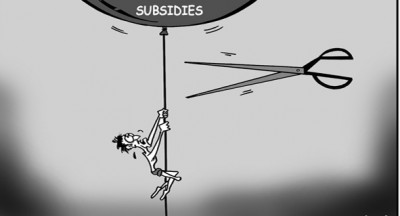
Scotlands Conservative Politicians, Step Up To The Plate, & Stop Wind Subsidies!

Rural Scotland’s delight at wind farm subsidy axe

Campaigners say the SNP should be ashamed that only a Tory Government listened to their warnings about the impact of turbines on Scotland’s countryside.

Whitelee Windfarm on the outskirts of Glasgow

Whitelee Windfarm on the outskirts of Glasgow Photo: PA

Rural communities have reacted with relief and delight after David Cameron called time on the SNP’s wind farm march across Scotland’s countryside.

Anti-turbine campaigners praised the UK Government’s decision to exclude new onshore wind farms from claiming a key subsidy from April next year, 12 months earlier than expected.

They said the move, which is expected to stop the construction of many developments not yet given planning permission, was a welcome respite for communities “besieged by subsidy chasers” taking advantage of the SNP’s “open door” policy.

But they said it was to the “eternal shame” of the Scottish Government that it was only the Conservatives who had heeded the concerns of rural Scots, with one prominent campaigner stating: “Thank God for Westminster.”

SNP ministers were furious with the decision, even claiming they may challenge it in the courts, with Nicola Sturgeon describing it as “wrong-headed”, “perverse” and “downright outrageous”.

In a letter to Mr Cameron, she warned the wind farm companies may sue the taxpayer for compensation for planned schemes “rendered useless by this decision.” The industry claimed the move would cost consumers up to £3 billion.

However, the John Muir Trust, the eminent environmental protection group, said it was the “right time” to work out an energy mix that is affordable “without damaging our wild and natural landscapes.”

The funding for the subsidy comes from the Renewable Obligation (RO), which is funded by levies added to household bills. The Department of Energy and Climate Change (DECC) said there will be grace period for projects already with planning permission.

Although energy policy is reserved to Westminster, the SNP government in Edinburgh has used its control over the planning system in Scotland to encourage the construction of thousands of turbines across the countryside.

Alex Salmond, the former First Minister, set a target of generating the equivalent of all Scotland’s electricity from renewable sources by 2020, with the vast majority coming from onshore wind.

Amid growing opposition from local communities, Scotland’s most senior planning officials even warned that the countryside risked becoming a “wind farm landscape”.

But the Scottish Government told council planners they had set aside too little land for wind farms and Scotland now hosts more than half the UK’s onshore turbines.

Nicola Sturgeon was outraged at the UK Government’s decision

Scotland Against Spin, a national alliance of groups and individuals which campaigns against turbines being built in unsuitable locations, said it was “delighted” the Tories had honoured an election manifesto promise to “end the ludicrously generous subsidies for onshore wind farms.”

Graham Lang, the group’s chairman, said: “ Speculative developers from across the world have flocked to Scotland because of the SNP’s open door policy to the wind industry. Scottish communities besieged by subsidy-chasers can at last look forward to some respite.

“Yet to its eternal shame the Scottish Government has ignored the clamour for reform from its own people. There is a terrible irony that the Conservatives at Westminster, not the nationalists at Holyrood, have finally stood up to the wind speculators and put the interests of communities and consumers first.”

Lyndsey Ward said she hoped the decision would stop the construction of 25 turbines near her home just outside of Beauly, in the Scottish Highlands.

She said she was “fairly disgusted” with the Scottish Government as Fergus Ewing, the SNP Energy Minister, had “parroted wind industry propaganda”. She added: “They should be thoroughly ashamed of themselves. Thank God for Westminster.”

Campaigners against a plan to erect 18 410ft-tall turbines in rural Angus, above the Blackwater Reservoir, also welcomed the announcement.

Sue Smith, a spokesman for the Friends of Backwater and Glenisla Against Turbines group, whose husband Maj Gen Martin Smith is Commandant General of the Royal Marines, said: “The removal of obscene levels of financial gain which these subsidies offer should discourage land owners and turbine developers from exploiting irresistible opportunities to make a fast buck, at the expense of local communities and their environments.”

She also praised the UK Government plans to give communities the final say on large wind farm developments south of the Border and attacked the SNP for failing to introduce this in Scotland.

But, speaking at First Minister’s Questions, Ms Sturgeon said the decision was “utterly wrong-headed” and her government would “do everything in our power” to get it changed.

Mr Ewing said repeated the wind farm companies’ claims the move could cost consumers £3 billion, adding: “We have warned the UK Government that the decision, which appears irrational, may well be the subject of a judicial review.”

But Murdo Fraser, Scottish Tory energy spokesman, said: “This is a Conservative Government standing up for communities that the central belt SNP couldn’t care less about.”

He added: “The latest figures show that, with all the wind projects already constructed, those under construction or given consent, we have already met the SNPs 100 per cent target for renewable electricity.”

A DECC spokesman said: “If we’d allowed the RO to stay open longer, we could have ended up with more projects than we can afford – which would have led to either higher bills, or other renewable technologies losing out on support.”

Shut Off the Subsidy Tap….and the Windweasels Scurry!

Brits’ Wind Power Nightmare to End Soon: Tories Set to Take the Axe to Subsidies

chop-wood-axe-downgrade

****

Contrasting with the delusions that continue to grip Australian’s political betters in Canberra (see our post here), sensible governments are rapidly retreating from the brink of energy market madness.

The Americans are pulling the plug on Federal and State based subsidies for wind power outfits. Its ‘wind power’ states have cut their state based subsidies to wind power outfits (or are well on the path of doing so); and Republicans are out to prevent the extension of the Federal government’s PTC wind power subsidy:

Texans Move to Slam Wind Power Subsidies

2015: the Wind Industry’s ‘Annus Horribilis’; or Time to Sink the Boots In

US Republicans Line Up to Can Subsidies for Wind Power

And David Cameron’s Tories strode to power on the back of a manifesto pledge to slam the door on wind power outfits eager to carpet Britain in 10s of thousands of giant fans, in terms that couldn’t be clearer:

“I want to make it clear that if there is a Conservative Government in place we will remove all subsidy for on-shore wind and local people should have a greater say.  Frankly I think we have got enough on-shore wind and we have enough to be going on with, almost 10 per cent of our electricity needs, and I think we should give local people a say if they want to block these sorts of projects.  The only way to stop more on-shore wind is to vote Conservative there is no other party with this policy. We are saying very clearly we would remove the subsidy and give local people the power to say yes or no. This would end the growth of on-shore wind and if that’s what you care about you must vote Conservative.”

Now, Cameron’s Tories are sharpening their axes ready to bring the lunacy to an end even faster than Brits could have dreamed of, even a month ago.

Wind farm subsidies facing the axe
The Telegraph
Emily Godsen
31 May 2015

Generous taxpayer subsidies will be cut off earlier than expected, effectively preventing thousands of turbines from being built, under plans being considered by Amber Rudd, the energy secretary

amberrudd

****

Subsidies that have fuelled the spread of onshore wind farms are to be dramatically curtailed, under Government plans to be unveiled within days.

The Telegraph has learnt that a generous subsidy scheme will be shut down earlier than expected, effectively preventing thousands of turbines from getting built, under plans being considered by Amber Rudd, the new energy secretary.

The proposals, which could be announced as soon as this week, will set out for the first time how the Conservatives will implement their manifesto pledge to end any new public subsidy for onshore wind farms – amid concerns that turbines are unpopular with local communities.

Under current policy, any big onshore wind turbines built before the end of March 2017 would automatically be able to qualify for generous payments through a scheme called the Renewables Obligation (RO), which is funded through green levies on consumer energy bills.

The Department of Energy and Climate Change has now confirmed it plans to “reform” the RO scheme. It is understood to be looking at ending the free-for-all by shutting the scheme down early – effectively preventing thousands of turbines getting built. The action follows similar moves taken to curb subsidies for solar farms last year.

After the RO shuts, the only possible subsidies for wind farms will be through a new scheme that is less generous and also much more strictly rationed, with ministers deciding how many projects – if any – are awarded subsidy contracts, enabling them to block further onshore wind if desired.

As well as big wind farms, subsidies for small individual wind turbines such as those popular with farmers – funded through a separate scheme called the Feed in Tariff – are expected to be limited under the plans.

A spokesman for the DECC said: “We are driving forward plans to end new public subsidy for onshore wind farms.

“We will shortly be publishing our plans to reform the Renewables Obligation and Feed in Tariff scheme to implement this commitment. With the cost of supplying onshore wind falling, government subsidy is no longer appropriate.

“We have supported new technologies when they’ve been a good deal for the consumer – providing start-up funding and certainty about future payments to help them become competitive. However, those subsidies won’t continue when costs come down – that’s not value for money for billpayers in the long run.”

Ms Rudd said: “We promised people clean, affordable and secure energy supplies and that’s what I’m going to deliver. We’ll focus support on renewables when they’re starting up – getting a good deal for billpayers is the top priority.”

Government plans to tackle climate change and hit EU renewable energy targets envisage that between 11 and 13 gigawatts (GW) of onshore wind power is needed by 2020.

More than 9.5 GW of projects – about 5,500 turbines – have either already been built or are under construction in the UK. At least 5.2 GW more wind farms – almost 3,000 more turbines – have already been granted planning permission.

Even if not all of these are built there would still be enough to hit the top end of Government plans.

On top of that, there are close to 3,000 more big new turbines with a combined capacity of more than 7GW seeking planning permission.

The DECC spokesman said: “Looking at what has already had planning permission, there is enough onshore wind to contribute what’s needed to reach the ambition set out in the Coalition Government’s renewables roadmap that 30 per cent of our electricity should come from renewables by 2020.”

Many of the projects that already have planning permission would have been expecting to secure subsidies under the RO scheme and it is not clear whether they will still be able to if the scheme shuts early. Ministers may consider offering a ‘grace period’, enabling some of those that already have permission to still get built while blocking off subsidies for those that do not.

One of the biggest factors determining the impact of the proposed changes will be whether or not they apply in Scotland, where the majority of proposed turbines are due to be built.

The Government said last week that it would “consult with the devolved administrations on changes to subsidy regimes for onshore wind farms”.

Nicola Sturgeon, the SNP Scottish First Minister, wants more onshore wind farms and has already demanded a veto on the Tory plans – raising the prospect that subsidies could continue to be paid to new projects in Scotland.

However the Conservatives will be under pressure from their own backbenches to ensure the subsidies are scrapped across the UK.

The Government also announced in the Queen’s Speech last week that it would bring forward legislation to give local communities “the final say” by ensuring large wind farm projects are decided at local rather than national level.

Ms Rudd said: “We need to make decisions on energy more democratic and give our communities a direct say into new onshore wind farms where they live. In future, I want planning decisions on onshore wind farms to be made by local people – not by politicians in Westminster.”

However those in the green energy industry had been most concerned about the pledge to end subsidies, amid uncertainty over the detail of the plans.

Critics of the Conservative pledge, including Tim Yeo, the former Tory head of the energy committee, and Ed Davey, the former Lib Dem energy secretary, have argued that it will actually push up bills as ministers instead offer subsidies to more offshore wind farms that are even more expensive.
The Telegraph

What’s spelt out above is just the accelerated passage of the inevitable.

Britain’s insane wind power policy has been accompanied with all the usual stuff: an unstable grid, with increased risk of widespread blackouts; subsidy-soaked, institutional corruption; spiralling power costs;splattered birds and bats; and divided and angry rural communities.

In those circumstances, David Cameron had little choice but to promise to end the madness. By answering the brewing rage among rural constituents about the adverse impacts of thousands of giant fans on home, hearth and health, he headed off an attack from the UKIP – which had run a solid pro-community stance against the wind power fraud.

And, by decoupling from the Lib-Dem’s deluded love of giant fans (an outfit peopled with wind industry shills like Ed Davey), Cameron dragged in votes from those hundreds of thousands of households and businesses being belted by escalating power bills (see our post here).

And the Conservatives have also seized on a report into the health complaints of those subjected to incessant turbine generated low-frequency noise and infrasound; promising to add adverse health effects as a basis to refuse planning approval, with local communities to have the final say, in any event (see this article from the Daily Mail).

Any policy that is unsustainable will either fail under its own steam; or its creators will eventually be forced to scrap it. Endless streams of massive subsidies for a meaningless power source fits the “unsustainable” tag to a T.

The wind industry has been telling the world it’s almost ready to stand on its own two feet for over 30 years (see our post here). Now, in Britain, David Cameron, Amber Rudd & Co will give it the chance to do so. We wish it the best of luck.

subsidies

Wind Turbine Fires Much More Common Than Previously Thought.

Wind turbine fire risk: Number that catch alight each year is ten times higher than the industry admits

  • Nearly 120 turbines catch fire each year – the reported industry figure is 12
  • Fire is second-largest cause of accidents after blade failure, research shows
  • Figures compiled by Imperial College and University of Edinburgh engineers

Nearly 120 wind turbines catch fire each year, according to new research – ten times the number reported by the industry.

The figures, compiled by engineers at Imperial College London and the University of Edinburgh, make fire the second-largest cause of accidents after blade failure.

The researchers claim that out of 200,000 turbines around the world, 117 fires take place annually – far more than the 12 reported by wind farm companies.

Scroll down for video

Engineers at Imperial College London and the University of Edinburgh say 120 wind turbines catch fire each year. Here, a turbine in Ardrossan, North Ayrshire, catches fire during severe weather

Engineers at Imperial College London and the University of Edinburgh say 120 wind turbines catch fire each year. Here, a turbine in Ardrossan, North Ayrshire, catches fire during severe weather

Fire has a huge financial impact on the industry, the researchers report in the journal Fire Safety Science.

Each wind turbine costs more than £2 million and generates an estimated income of more than £500,000 per year.

Any loss or downtime of these valuable assets makes the industry less viable and productive.

Dr Guillermo Rein of Imperial’s department of mechanical engineering, said: ‘Fires are a problem for the industry, impacting on energy production, economic output and emitting toxic fumes.

‘This could cast a shadow over the industry’s green credentials.

‘Worryingly our report shows that fire may be a bigger problem than what is currently reported. Our research outlines a number of strategies that can be adopted by the industry to make these turbines safer and more fire resistant in the future.’

Wind turbines catch fire because highly flammable materials such as hydraulic oil and plastics are in close proximity to machinery and electrical wires.

These can ignite a fire if they overheat or are faulty. Lots of oxygen, in the form of high winds, can quickly fan a fire inside a turbine, the paper found.

Wind turbine explodes

It contradicts the findings of a report into the wind industry, commissioned by the Health and Safety Executive in 2013, which concluded that the safety risks associated with wind turbines are very low.

The wind industry last night questioned the validity of the new research.

Chris Streatfeild, of Renewable UK which represents wind firms, said: ‘The industry would challenge a number of the assumptions made in the report, including the questionable reliability of the data sources and a failure to understand the safety and integrity standards for fire safety that are standard practice in any large wind turbine.

‘Wind turbines are designed to international standards to meet mandatory health and safety standards including fire safety risks.

‘The industry remains committed to promoting a safe environment for its workers and the public, and no member of the public has ever been injured by a wind turbine in the UK.

Read more: http://www.dailymail.co.uk/news/article-2695266/Wind-turbine-fire-risk-Number-catch-alight-year-ten-times-higher-industry-admits.html#ixzz3boBgvPZu

Turkish Court has the Decency to Protect Residents from Wind Turbine Noise!

Turkish Court Shuts Down 50 Turbines: Yaylaköy Residents Delighted at 1st Chance to Sleep in Years

turk1

****

One of the myths pedalled by Australia’s self-appointed wind farm noise, sleep and health ‘expert’ (a former tobacco advertising guru) is that the known and obvious adverse health impacts from incessant turbine generated low-frequency noise and infrasound are a cooked-up “phenomenon”, exclusive to the English speaking world. Trouble with that little tale is that’s been scotched by the Danes:

Vestas’ Danish Victims Lay Out the FACTS

Denmark Calls Halt to More Wind Farm Harm

And the Germans:

German Medicos Demand Moratorium on New Wind Farms

And the Tawainese:

Winning Taiwanese Hearts and Minds?

And, now the Turks. As this article lays out – in terms so simple, that even tobacco advertising gurus should be capable of understanding them.

50 operating wind turbines stopped by the court!
BurGün
18 May 2015

turk2

****

The Administrative Court in Ankara has ruled that fifty operating wind turbines in Karaburun be stopped. The locals of Yaylaköy, Karaburun are delighted with the court decision. It is 20 days since the wind turbines stopped working.

From the beginning of the struggle to protect their village from the adverse affects from the Wind Power Plants that are spreading all over the peninsula, the local people have finally received good news.

The Administrative Court, ruled in April that even if fifty wind turbines are already operating, the activities have to be halted since the environmental damage is irreversible. First an EIA report will have to be issued. The wind turbine company’s request to continue to run their turbines meanwhile, was also denied by the court.

‘THE FIRST DECISION’

The lawyer Cem Altiparmak said the decision would be a first in the country. Mr. Altiparmak states that there are very few court cases related to renewable energy.

In this area the law is insufficient, there are no precedents, so we have to live it to get experience. “A number of license revocation proceedings have started in our country. Our court ruling is one of the first and will have an impact on up-coming cases.

What has happened?

İzmir Governorship Provincial Directorate of Environment and Urban Development, had issued a “EIA Not Required” to install 166 MW in the Karaburun Peninsula.

8 years later when EMRA issued a new license for another 50 turbines to the same company leaning on the same “EIA Not Required” document, the residents of Yaylaköy and the environmental movement Karaburun City Council sued EMRA – The Energy Market Regulatory Authority.

The court ruled that this is against the law and if allowed to operate the damages will irreversible therefore all operations have to be stopped until an EIA investigation has been performed.

The court decision has given hope to the local people as well as other people in Cesme, Bodrum, Datca and Urla where wind turbines projects are being planned without any public consultation. All these projects have been issued with an EIA Not Required”.

Hopefully this Wind turbine project will not be able to operate again and for the first time in years the people in Yaylaköy are able to sleep comfortably and we will continue to work for that, says one man from the village.
BurGün

turk3

Good to See Sanity Returning to Britain….

UK’s Wind Industry in Meltdown: Cameron to Flush-Out DECC’s Detritus

SWITZERLAND-WEF-DAVOS-CAMERON

****

The wind industry’s current form reminds STT of Simon Pegg’s character in ‘How to Lose Friends and Alienate People‘, Sidney Young – blunt, gormless, and ready to pull out all stops to ensure every one who counts hates him.

Now that they’ve lost the grip on the game in countries where they thought they had things sewn up, they’ve been reduced to abusing those who have the ability to make or break them. STT thinks they’re just working through the 5 stages of grief: denial, anger, bargaining, depression and acceptance (see our post here).

David Cameron has just won an election promising to end all subsidies to on-shore wind power:

UK Elections: Brit’s Deliverance from its Wind Power Disaster

In the US, ‘wind power’ states have cut their state based subsidies to wind power outfits (or are well on the path of doing so); and Republicans are out to prevent the extension of the Federal government’s PTC wind power subsidy:

2015: the Wind Industry’s ‘Annus Horribilis’; or Time to Sink the Boots In

US Republicans Line Up to Can Subsidies for Wind Power

In Germany, consumers and industry are fed up with escalating power prices:

German’s Top Daily – Bild – says Time to Chop Massive Subsidies for Wind Power

And, on Vesta’s home turf, Denmark, the government’s brewing and massive legal liability to wind farm neighbours has resulted in a full-blown moratorium on planning permits for new wind farms:

Denmark Calls Halt to More Wind Farm Harm

brat

****

The response from the wind industry has been just what you’d expect from a bunch of immature brats, that couldn’t survive for a second without a massive and endless stream of subsidies filched from taxpayers and power consumers. Here’s yet another childish wind industry outburst – this time from Britain.

Cameron Puts Wind-Farm Opponent at Junior U.K. Energy Post
Bloomberg Business
Alex Morales
12 May 2015

Prime Minister David Cameron named a vocal opponent of onshore wind farms to a junior post in the U.K. energy department, reinforcing his Conservative government’s effort to halt the spread of turbines in rural areas.

Andrea Leadsom, who has campaigned against “intrusive wind farms” in South Northamptonshire constituency in central England, will report to Amber Rudd, who was named as the Cabinet minister in charge of energy on Monday.

The two will work to balance Britain’s growing energy needs and stricter pollution rules against the demands of rural voters who voted overwhelmingly for the Conservatives. Some of those voters have raised concerns about the spread of wind farms that they say blight the landscape under the previous two governments, which encouraged the technology as the cheapest way to generate low-carbon electricity at scale.

“Whilst renewable energy has an important part to play in providing energy for our 21st century needs, we have got to stop building incredible insensitive and intrusive wind farms on top of local communities,” Leadsom says on her website. “In the future, I want to see a proper consultation process and the opportunity for communities to say no.”

Rudd, who was promoted from a junior ministerial role to lead the Department of Energy & Climate Change, worked with the Liberal Democrats in the previous coalition government and stuck closely to the government script encouraging all forms of energy, especially renewables and nuclear power.

If Rudd’s appointment reassured the renewable energy industry about the continuity of government policy to cut carbon emissions, Leadsom’s elevation is a reminder of the manifesto promise Cameron’s party made to halt subsidies to wind developments on land.

Before the election, those promises prompted Ecotricity Group Ltd. Chief Executive Officer Dale Vince, a donor to the opposition Labour Party, to call the Conservatives “an existential threat to the renewable energy industry.”

Leadsom’s appointment was announced on the Twitter feed of Cameron’s office. Her role hasn’t yet been defined, and so far she’s the only junior minister to be named at DECC. Previously, two ministers Rudd and Matthew Hancock, served as junior ministers at the department.

Hancock was moved to a role at the Cabinet Office in charge of civil service reform.
Bloomberg Business

Just a tiny whiff of panic from the wind industry’s parasites there. And just what you’d expect from Ecotricity’s Dale Vince, when he wails about the Conservatives being “an existential threat to the renewable energy industry.” We’ve covered Dale Vince’s faux claims to be the environment’s best friend:

The Guardian Caught Out Pumping Dale Vince’s Bogus Wind Power Propaganda

Although, this time around, we can’t fault Vince’s analysis: Vince and his cronies are doomed.

Cameron’s Tory-Only line up gives him the chance to follow through on the clear-as-crystal promise to “halt subsidies to wind developments on land”.

It’s that humungous policy shift that spells the beginning of the end for the wind industry in Britain.

The promise to allow communities to reject wind farms adds nothing, in practical effect – a bit like stabbing a corpse, really. Without an endless stream of guaranteed subsidies, rent-seekers like Dale Vince will disappear in a heartbeat; the wind industry will die a natural death.

With Britain turning on the wind industry, pretty soon it’ll have no “friends” left to alienate anywhere at all.

Andrea Leadsom

Angry Locals Willing to Fight the Wind Scam!!!

Community Defenders Down MET Mast in Donegal, Ireland

1397574371-dublin-thousands-gather-to-protest-against-pylons-and-wind-turbines_4479876

****

There aren’t many guarantees in life – death and taxes spring to mind: to which can be added open community hostility to giant fans.

Wherever wind farms have appeared – or have been threatened – big numbers of locals take a set against the monsters being speared into their previously peaceful – and often idyllic – rural communities. Their anger extends to the goons that lied their way to development approval – and the bent officials that rubber-stamped their applications and who, thereafter, actively help the operators ride roughshod over locals’ rights to live in and enjoy the peace and comfort of their own homes and properties.

The Irish have already hit the streets to bring an end to the fraud: some 10,000 stormed Dublin back in April last year. The sense of anger in Ireland – as elsewhere – is palpable (see our post here). And they’re tooling up for a raft of litigation in order to prevent the construction of wind farms, wherever they’ve been threatened on the Emerald Isle (seeour post here).

Having seen their political betters co-opted by the wind industry and acquiesce – if not actively condone – the wanton and needless destruction of neighbours’ common law rights to live in and enjoy their own homes and properties, community defenders in Ireland are fighting back. And, as elsewhere, some of the tactics used have led to sanctimonious huffing and puffing from an industry devoid of any moral compass or human empathy, and always quick to ride roughshod over the living and the dead:

Wind Power Outfits – Thugs and Bullies the World Over

The Wind Industry Knows No Shame: Turbines to Desecrate the Unknown Graves of Thousands of Australian Soldiers in France

The MET masts used by hopeful wind power outfits to gauge wind speeds are the vanguard for every wind farm disaster: no MET mast data, no wind farm. As soon as they go up, the locals circle their wagons, marshal their forces and declare war on the proponent. No surprises there.

With the wind industry on the ropes in Australia, developers are quietly pulling down their MET masts at places like Robertstown and Hallett in South Australia – much to the delight of locals (see our post here).

In Ireland, and elsewhere, locals have sought to bring matters to a head by bringing MET masts plummeting back to earth, a little earlier than their wind weasel owners had planned.

Do you know who tore down this mast at Lismulladuff in Co Donegal?
Irish Mirror
Stephen Maguire
4 April 2015

MastJPG

****

This giant 250ft mast was found cut down today on the site of Ireland’s biggest wind farm.

The scene of the crime at Lismulladuff outside Killygordon is currently the subject of local protests.

Plans were lodged with with An Bord Pleanala (ABP) a number of weeks ago by Planree Ltd for the Carrickaduff Wind Farm.

The giant wind farm will stretch from the iconic Barnesmore Gap in Donegal, along the Tyrone border, to near Castlefin.

The plans include an application for 49 giant wind turbines, some of which will be 500ft in height.

A recent meeting organised by protest group Finn Valley Wind Action (FVWA) group, was held in the Parochial Hall in the tiny village of Crossroads and attracted more than 300 locals.

The test mast was erected in recent weeks to take wind readings in the area.

Now gardai believe the mast was attacked in recent days but only discovered yesterday.

The group who are protesting over the planned wind farm have condemned the attack.

A spokesperson for the FVWA protest group condemned the attack on the test mast.

“It’s down so other than that we don’t know what happened. We can’t understand why anyone would want to do that.

“It’s bad form because it wasn’t bothering anybody. We think it was better up – as a size guide being half the height of the proposed wind turbines.

“The FVWA condemns this act of vandalism any anyone with any information should contact Ballybofey Gardai,” said the spokesperson.

Gardai from Ballybofey were on site this morning and have launched a full investigation into the attack.
Irish Mirror

The FVWA “Goldilocks” position is ‘just right’; as an effort to distance themselves from the guerrilla tactics employed – and understandable from that political perspective.

However, the saboteurs’ actions are – given what they’re up against – perfectly understandable too; and not without precedent:

More MET Mast Mayhem: Community Defenders Drop Mast in Fight to Save Homes near Bangor, Maine

MET Mast Mayhem: Scots Use Guerrilla Tactics to Stop These Things

Wave of Destruction: Ontario Wind Farm Neighbours in Open Revolt

While the Gardai set off to investigate a crime scene, it’s clearly arguable – on moral, if not legal, grounds – that what is laid out in the story (and the posts linked above) is conduct aimed at preventing a series of greater – and wholly unnecessary – crimes.

Faced with the threat of sonic torture, smashed property values and the risk of death and injury from self-igniting turbines and “uncontrolled flying blades” – from the developer’s potential victims’ viewpoint – it could equally earn the tag of community “self-defence”. And self-defence is a complete defence, to all bar murder.

As the defenders in Donegal (and elsewhere) were ostensibly acting to protect their homes, families and businesses from an acoustic trespasser (see our post here) the “castle doctrine” clearly comes into play.

That doctrine is one of some force and antiquity – it’s been on the books for nearly 400 years, when lawyer and politician Sir Edward Coke (pronounced Cook), scratched it out in The Institutes of the Laws of England, 1628:

“For a man’s house is his castle, et domus sua cuique est tutissimum refugium [and each man’s home is his safest refuge].”

And so, if a few pro-family and pro-community activists have to drop a MET mast here and there to make their point in the active defence of their homes, and the health and safety of their families, it’s action that’s probably excusable and clearly understandable. And, all the more so, when those that are paid handsomely to protect the health and welfare of their citizens, do little more than spin propaganda on behalf of the wind industry – a form of malign indifference, at best.

Many a good revolution kicked off with a handful of hotheads out to make their point, with a few misdemeanors against the property of the powerful; acts quickly deemed ‘threats to civil order’, if not ‘crimes against the state’, by those under threat – with the actors just as quickly rounded up in chains.

In the main, efforts aimed at suppressing the outrage that led the offenders to act, and punishing them for their actions, only added to their fury, and encouraged other, less passionate souls, to eagerly join the fray; and, thereafter, the rest – as they say – “is history”.

storming_the_bastille1-e1318690559144

People Worldwide are Waking Up to the Reality of the Wind Scam!

Top US Energy Economist Takes the Scalpel to the Great Wind Power Fraud

surgeon-with-scalpel-page1

****

One of the great mysteries behind the lunacy that is the great wind power fraud is how and why so many governments launched into mandating massive and endless subsidies (filched from unwitting power consumers and/or taxpayers) for an utterly meaningless power generation source – WITHOUT ever having carried out a cost/benefit analysis?

You know, the kind of analysis that economists put together on a daily basis; and which are used to give the thumbs up (or down) to government policies BEFORE they’re set rolling like unstoppable locomotives; especially where, as here, they involve massive streams of corporate welfare.

runaway train lone ranger

****

In a better late than never move, economists the world over are now taking the scalpel to the wind industry and, especially, its wilder claims about being “competitive” with conventional generation sources. Of course, if there was a shred of truth in that ripping yarn, the wind industry and its parasites wouldn’t need to spend every waking hour on the rent-seeker trail; bleating about the need for Renewable Energy Targets (written in stone), and the need to keep the subsidy gravy train rolling, interminably.

As the myth, fantasy and fallacy gets sliced away to reveal the true costs of wind power, the number crunchers are finding that wind power simply doesn’t measure up, on any score. Here’s Newsweek with one such dissection.

What’s the True Cost of Wind Power?
Newsweek
Randy Simmons
11 April 2015

As consumers, we pay for electricity twice: once through our monthly electricity bill and a second time through taxes that finance massive subsidies for inefficient wind and other energy producers.

Most cost estimates for wind power disregard the heavy burden of these subsidies on US taxpayers. But if Americans realized the full cost of generating energy from wind power, they would be less willing to foot the bill – because it’s more than most people think.

Over the past 35 years, wind energy – which supplied just 4.4% of US electricity in 2014 – has received US$30 billion in federal subsidies and grants. These subsidies shield people from the uncomfortable truth of just how much wind power actually costs and transfer money from average taxpayers to wealthy wind farm owners, many of which are units of foreign companies.

Financial advisory firm Lazard puts the cost of generating a megawatt-hour of electricity from wind at a range of $37 to $81. In reality, the true price tag is significantly higher.

This represents a waste of resources that could be better spent by taxpayers themselves. Even the supposed environmental gains of relying more on wind power are dubious because of its unreliability – it doesn’t always blow – meaning a stable backup power source must always be online to take over during periods of calm.

But at the same time, the subsidies make the US energy infrastructure more tenuous because the artificially cheap electricity prices push more reliable producers – including those needed as backup – out of the market. As we rely more on wind for our power and its inherent unreliability, the risk of blackouts grows. If that happens, the costs will really soar.

NW1

Many government agencies are in the wind business these days. GAO

Where the subsidies go

Many people may be familiar with Warren Buffet’s claim that federal policies are the only reason to build wind farms in the US, but few realize how many of the companies that benefit most are foreign. The Investigative Reporting Workshop at American University found that, as of 2010, 84% of total clean-energy grants awarded by the federal government went to foreign-owned wind companies.

More generally, the beneficiaries of federal renewable energy policies tend to be large companies, not individual taxpayers or small businesses. The top five recipients of federal grants and tax credits since 2000 are: Iberdrola, NextEra Energy, NRG Energy, Southern Company and Summit Power, all of which have received more than $1 billion in federal benefits.

Iberdrola Renewables alone, a unit of a Spanish utility, has collected $2.2 billion in federal grants and allocated tax credits over the past 15 years. That’s equivalent to about 6.7% of the parent company’s 2014 revenue of $33 billion (in current US dollars).

President Obama’s proposed 2016 budget would permanently extend the biggest federal subsidy for wind power, the Production Tax Credit (PTC), ensuring that large foreign companies continue to reap most of the taxpayer-funded benefits for wind. The PTC is a federal subsidy that pays wind farm owners $23 per megawatt-hour through the first ten years of a turbine’s operation. The credit expired at the end of 2013, but Congress extended it so that all projects under construction by the end of 2014 are eligible.

In all, Congress has enacted 82 policies, overseen by nine different agencies, to support wind power.

I explained in December why Congress shouldn’t revive the PTC, which expired at the end of 2014. In this article, I’m adding up the true cost of wind power in the US, including the impact of the PTC and other subsidies and mandates. It’s part of a study I’m doing of other energy sources including solar, natural gas, and coal to determine how much each one actually cost us when all factors are considered.

NW2

As Warren Buffett has said, there wouldn’t be a wind industry without the PTC. UCS, DOE, AWEA

Tallying the true costs of wind

Depending on which factors are included, estimates for the cost of wind power vary wildly. Lazard claims the cost of wind power ranges from $37 to $81 per megawatt-hour, while Michael Giberson at the Center for Energy Commerce at Texas Tech University suggests it’s closer to $149. Our analysis in an upcoming report explores this wide gap in cost estimates, finding that most studies underestimate the genuine cost of wind because they overlook key factors.

All estimates for wind power include the cost of purchasing capital and paying for operations and maintenance (O&M) of wind turbines. For the studies we examined, capital costs ranged from $48 to $88 per megawatt-hour, while O&M costs ranged from $9.8 to $21 per megawatt-hour.

Many estimates, however, don’t include costs related to the inherent unreliability of wind power and government subsidies and mandates. Since we can’t ensure the wind always blows, or how strongly, coal and natural gas plants must be kept on as backup to compensate when it’s calm. This is known as baseload cycling, and its cost ranges from $2 to $23 per megawatt-hour.

This also reduces the environmental friendliness of wind power. Because a coal-fired or natural gas power plant must be kept online in case there’s no wind, two plants are running to do the job of one. These plants create carbon emissions, reducing the environmental benefits of wind. The amount by which emissions reductions are offset by baseload cycling ranges from 20% to 50%, according to a modeling study by two professors at Carnegie Mellon University.

While the backup plants are necessary to ensure the grid’s reliability, their ability to operate is threatened by wind subsidies. The federal dollars encourage wind farm owners to produce power even when prices are low, flooding the market with cheap electricity. That pushes prices down even further and makes it harder for more reliable producers, such as nuclear plants, that don’t get hefty subsidies to stay in business.

For example, the Kewaunee Nuclear Plant in Wisconsin and the Yankee Nuclear Plant in Vermont both switched off their reactors in 2013. Dominion Energy, which owned both plants, blamed the artificially low prices caused by the PTC as one of the reasons for the shutdown.

As more reliable sources drop off and wind power takes their place, consumers are left with an electrical infrastructure that is less reliable and less capable of meeting demand.

Lost in transmission

Another factor often overlooked is the extra cost of transmission. Many of America’s wind-rich areas are remote and the turbines are often planted in open fields, far from major cities. That means new transmission lines must be built to carry electricity to consumers. The cost of building new transmission lines ranges from $15 to $27 per megawatt-hour.

In 2013, Texas completed its Competitive Renewable Energy Zone project, adding over 3,600 miles of transmission lines to remote wind farms, costing state taxpayers $7 billion.

Although transmission infrastructure may be considered a fixed cost that will reduce future transmission costs for wind power, these costs will likely remain important. Today’s wind farms are built in areas with prime wind resources. If we continue to subsidize wind power, producers will eventually expand to sub-prime locations that may be even further from population centers. This would feed demand for additional transmission projects to transport electricity from remote wind farms to cities.

The final bill comes to…

Finally, federal subsidies and state mandates also add significantly to the cost, even as many estimates claim these incentives actually reduce the cost of wind energy. In fact, they add to it as American taxpayers are forced to foot the bill. According to Giberson, federal and state policiesadd an average of $23 per megawatt-hour to the cost of wind power.

That includes the impact of state mandates, which end up increasing the cost of electricity on consumer power bills. California is one of the most aggressive in pushing so-called Renewable Portfolio Standards (RPS), requiring the state to consume 33% of its electricity from renewables by 2020. Overall electricity prices in states with RPS are 38% higher than those without, according to the Institute for Energy Research, a non-profit research group that promotes free markets.

The best estimate available for the total cost of wind power is $149 per megawatt-hour, taken from Giberson’s 2013 report.

It is difficult to quantify some factors of the cost of wind power, such as the cost of state policies. Giberson’s estimate, however, includes the most relevant factors in attempting to measure the true cost of producing electricity from wind power. In future reports, Strata will explore the true cost of producing electricity from solar, coal, and natural gas. Until those reports are completed, it is difficult to accurately compare the true cost of wind to other technologies, as true cost studies have not yet been completed.

Blowing in the wind

The high costs of federal subsidies and state mandates for wind power have not paid off for the American public. According to the Mercatus Center at George Mason University, wind energy receives a higher percentage of federal subsidies than any other type of energy while generating a very small percentage of the nation’s electricity.

In 2010 the wind energy sector received 42% of total federal subsidies while producing only 2% of the nation’s total electricity. By comparison, coal receives 10% of all subsidies and generates 45% and nuclear is about even at about 20%.

NW3

Wind gobbles up the largest share of subsidies yet produces little power. EIA

But policymakers at the federal and state level, unfortunately, have decided that the American people will have renewable energy, no matter how high the costs. As a result, taxpayers will be stuck paying the cost of subsidies to wealthy wind producers.

Meanwhile, electricity consumers will be forced to purchase the more expensive power that results from state-level mandates for renewable energy production. Although such policies may be well intended, the real results will be limited freedom, reduced prosperity and an increasingly unreliable power supply.

Randy Simmons is professor of political economy at Utah State University. Megan Hansen, a Strata policy analyst, co-authored this article, which first appeared on The Conversation. Full disclosure: Randy Simmons receives funding from the U.S. Department of Energy (grant has been completed and there is no current funding) and Strata, a 501 (c)3 non-profit organization. Megan Hansen, a Strata policy analyst, co-authored this article.

Newsweek

randysimmons

Wonderful News! The Blanding’s Turtle Will Be Protected After All!

Turtle beats turbine

Mon, Apr 20th, ’15

Blandings-road-800x600

An endangered species has won the power struggle over Ostrander Point as Ontario’s top court has ruled in favour of the Blanding’s turtle over turbines.

In a historic ruling the Ontario Court of Appeal overturned a provincial court decision in relation to the Renewable Energy Approval of Gilead Power’s nine turbine project.

Prince Edward County Field Naturalist President Myrna Wood.

Lawyer Eric Gillespie says this case represents the first time ever that the Environmental Review Tribunal said that their would be serious and irreversible harm to the Blanding’s Turtle and the Ontario Court of Appeal chose appropriately to uphold that decision.

Gillespie says Gilead now has a couple of options going forward one of them being to ask the Supreme Court of Canada in Ottawa to hear the case. He says there’s no automatic right to do that you need leave or permission from the Supreme Court.

Gillespie says the other way that this is definitely going to play out is the Environmental Review Tribunal has been asked by the Ontario Court of Appeal to hear some further submissions on what the solution to this situation should be.

Gillespie chuckled anyone who has ever been to Ostrander Point knows there’s all kinds of ways to get into the point and a a simple gate across a road isn’t going to stop people visiting that site. He says unless there is something completely new that nobody has heard of yet it would be somewhat certainly surprising to our clients if the ERT does anything different than what they originally decided.

PECFN member Cheryl Anderson says the naturalists are more than willing to show the Tribunal how putting gates on the very access roads, which will cause the irreversible harm, is no remedy at all.

The Ministry of Environment says it hasn’t decided how to proceed as of yet.

Gilead Power hasn’t responded to our requests for comment on whether or not they plan to ask for permission to escalate this to the Supreme Court of Canada.

To read the full judgement click here.

Lucky Residents in Oregon Dodged a Wind Turbine Bullet!

Plans dropped for large wind farm project in north-central Oregon

By Associated Press

Published: March 27, 2015, 4:19 PM

BEND, Ore. — Plans for a big wind farm in north-central Oregon have been scrapped, state regulators say.

The Brush Canyon Wind Power Facility would have had as many as 223 turbines in Sherman and Wasco counties, The Bend Bulletin reported Friday.

It would have been in an area of 76,000 acres, or 119 square miles.

The turbines that have spread across the windy Columbia plateau in recent decades have benefited from two government initiatives: requirements by West Coast states that utilities include alternative energy among their energy sources and a federal tax credit based on turbine production.

But in December, the U.S. Congress let lapse the tax break enacted in 1992 to nurture the fledgling wind industry.

The Brush Canyon proposal had its origin, like many in the Northwest, proposed by the North American arm of a European or Scandinavian utility company, in this case the German firm E.ON AG.

“We don’t know why they pulled out, but it’s not unusual,” said spokesman Rachel Wray of the state Department of Energy. “We’ve had a number of projects pulled over the last couple of years. Some that had gone a ways through the process and others that were a lot less far along. It really varies.”

Calls and messages from The Associated Press to the company’s Chicago office and German headquarters were not immediately returned.

In Central Oregon, some were happy and relieved at the decision, saying the project was far too big and disruptive.

Residents of the high-desert town Antelope were anticipating that construction traffic would increase traffic by 600 percent, Mayor John Silvertooth said.

“It’s like a doctor telling a patient he’s in remission, or waking up from brain surgery and hearing everything was a success,” he said.

Antelope’s population is now about 50. It was larger in the 1980s, and got a lot of attention, when thousands of followers of the Indian guru Bhagwan Shree Rajneesh tried to establish a political power base on a commune that was eventually forced out.

Wind weasels Lose $700 Million in “Investors” money! Blown Into the Wind!

Pacific Hydro’s Ponzi Scheme Implodes: Wind Power Outfit Loses $700 Million of Mum & Dad Retirement Savings

wind chopping up money

****

Pacific Hydro is a name synonymous with wind industry skulduggery in Australia: the merciless treatment of its victims at Cape Bridgewater has been added to the annals of Australian corporate infamy, right up there with Aussie asbestos pedlar, James Hardie (see our post here).

Now, its slap-dash approach to management, and all-round corporate malfeasance, has caught up with it, with an almighty vengeance.

Pac Hydro is the bastard child of IFM Investors – born of the $billions that are collected from workers and thrown into what are called “Union Super Funds” – ie “superannuation”: compulsory retirement savings schemes – owned and controlled by union heavies, like Garry Weaven and/or Labor Party front men; like former Environment Minister, Greg Combet.

Combet, Weaven & Co are the driving force behind the great wind power fraud in Australia. It was Combet who lobbied for, and obtained, the massive increase in Australia’s Renewable Energy Target to 45,000 GWh (4,000 as “small-scale” solar; and 41,000 as “large-scale”, ie wind power).

But these boys set up the “rules” with only one real “target” in mind; and that was making fat piles of cash themselves, using bucket loads of other peoples’ money: being able to make massive profits without any personal risk is a rare and beautiful thing.

But the risk has just been realised; and it’s mums and dads who are paying, and will continue to pay, the ultimate price.

Pac Hydro has just clocked up one of the largest corporate losses ever seen in Australian corporate history: you need to think back to Alan Bond, Chris Skase and the massive corporate implosions that took place at the end of the crazy 80s, to find anything of the same scale.

Pac Hydro’s books apparently record a loss of $685 million – the Australian Financial Review says “$700 million” – but with losses of that magnitude a lazy $15 million is probably just a rounding error.

From what STT can glean, around half of that figure is attributable to losses incurred by Pac Hydro’s wind farm operations in Australia (it’s pretty hard to get a bead on the numbers when, as the AFR explains, the company is going to “extraordinary lengths to keep [its review into the losses] under wraps”.

Just how a wind power outfit enjoying the most ludicrously massive industry subsidies provided in the history of the Australian Commonwealth can “lose” $700 million of workers’ superannuation money is a riddle wrapped in an enigma, to which we shall return in a moment. Now, here’s a couple of wrap-ups on Pac Hydro’s Ponzi scheme implosion.

Governance scandal claims Garry Weaven and Brett Himbury
The Australian Financial Review
Tony Boyd
5 March 2015

Industry superannuation fund heavyweights Garry Weaven and Brett Himbury are under pressure to resign from the board of global fund manager IFM Investors after a secret report into $700 million in losses at Pacific Hydro was blamed on lapses in corporate governance.

Weaven and Himbury resigned from the board of Pacific Hydro on January 1 this year after a review of its corporate governance by an executive director of IFM Investors, Danny Elia made adverse findings in relation to corporate governance.

The pressure for Weaven and Himbury to also resign from the board of IFM Investors is coming from investors in the IFM Australia Infrastructure Fund, which owns 100 per cent of Pacific Hydro. The IFM Australia Infrastructure Fund is managed by IFM Investors.

Chanticleer understands several investors in the trust are angry about the lack of transparency about Elia’s review of governance at Pacific Hydro.

The losses incurred by Pacific Hydro have meant that its value in the IFM Australian Infrastructure Fund have shrunk from 40per cent of total assets to about 8 per cent.

IFM Investors said in October last year that it had taken a near $700 million write-down on Pacific Hydro due to the adverse impact of the Abbott government’s review into renewable energy, weaker electricity demand in Australia, and tax changes in Chile.

The Chilean investment, the $US450 million ($575 million) Chacayes run-of-river power plant halved in value as a result of the regulatory and tax changes.

However, IFM has said nothing about Elia’s review of the governance of Pacific Hydro.

His review, code named Project Primavera, has not only been kept secret, IFM Investors has gone to extraordinary lengths to keep it under wraps.

Any investors in the IFM Australia Infrastructure Fund or asset consultants wanted to look at the 200-page Project Primavera report must sign a confidentiality agreement.

No copies of the report are allowed to leave the IFM premises, no photocopies of the report are allowed and anyone reading the report must surrender their smartphones before entering a room where the report is available.

The findings of the report and the resignations of Weaven and Himbury from Pacific Hydro have not been reported either on the websites of IFM Investors or Pacific Hydro. Also, the story has not been reported by The New Daily, an online news site owned by industry super funds.

Pacific Hydro’s website does show that the company appointed three new directors this year.

John Harvey replaced Weaven as chairman of Pacific Hydro on February 15. He is a director of Australia Pacific Airports Corporation.

Peter Berry was appointed a director of Pacific Hydro on January 16. He is chairman of the state owned venture capital business, Victorian Clean Technology Fund.

Michael Hanna was appointed a director of Pacific Hydro on February 10. He is responsible for managing the IFM Australian Infrastructure Fund.

Those appointments are significant because it means that there are now more people on the board of Pacific Hydro with operational experience. There was clearly a lack of hands on infrastructure management experience before.

Apart from Weaven and Himbury, two other directors have resigned in the past few months. Anita Roper resigned on January 1 this year and Geoffrey Coffey resigned on December 31, 2014, according to records with the Australian Securities and Investments Commission.

The angst among investors about the governance failings at Pacific Hydro have prompted IFM Investors to launch its own internal review of governance, according to industry sources.

It is not known who is conducting this review or whether it will have the power to recommend changes in governance at IFM.

The departure of Weaven from the board of Pacific Hydro would have been deeply felt as he was one of the driving forces behind the industry super fund sector’s push into renewable energy.

The Pacific Hydro write-downs and subsequent board resignations draw attention to the conflicts of interest which can occur when shareholders of a funds management company are also investors in its various products.

The fact that an employee of IFM, Elia, was called on to conduct a review of an IFM managed entity suggests it was not a completely independent arm’s length project.

The $700 million in losses at Pacific Hydro raises questions about the quality of advice received by IFM Investors from its extensive team of global infrastructure advisers which includes former chief executives at global companies.

Weaven and Himbury did not respond to email requests for comment and a spokesperson for Pacific Hydro said all comment about corporate governance at the company should come from IFM Investors. The spokesperson failed to call back.
The Australian Financial Review

combetcrop-420x0

****

Pair step down after Hydro’s $685m loss
The Australian
Andrew White
6 March 2015

INDUSTRY superannuation fund godfather Garry Weaven and the chief executive of IFM Investors, Brett Himbury, resigned from the board of renewable energy investor Pacific Hydro last October following a $685 million loss.

Mr Weaven said he and Mr Himbury had resigned as directors to take responsibility for heavy writedowns on investments in Chilean and Australian energy assets that should have been anticipated.

“It was done on the basis that when you have a writedown like that there should be consequences. We should show that we take this very, very seriously.”

But he denied a report that there had been any pressure on him or Mr Himbury to resign from the IFM Investors board.

Mr Weaven said there had been no votes against him when he stood for re-election at the IFM Investors annual meeting in November. “There was absolutely no pressure on me or Brett Himbury to resign, none, zero.”

Pacific Hydro announced the $685m loss in October after the government abandoned its support for the Renewable Energy Target, which supported the value of wind and solar energy projects owned by the company, and changes to tax laws in Chile that halved the value of its investment in a hydro-electricity project. Mr Weaven said the Australian investments had also been cut in value following changes to the pricing rules from the Australian Energy Regulator at the end of June.

Mr Weaven “completely rejects” a report in a newspaper yesterday that there were any corporate governance issues that resulted in the losses.
The Australian

Garry Weaven

****

Hmmm. Losing $685 million of mums’ and dads’ superannuation money would, in most peoples’ eyes, involve some deliberate effort, beyond being simply “asleep at the corporate wheel”.

While Weaven protests his corporate “innocence”, just imagine the size of Pac Hydro’s losses if there had been “any corporate governance issues”!!

And it’s not just mum and dads with their hard-earned retirement savings being thrown to the wind by Weaven & Co. Oh no, all Australian taxpayers are going to take a whopping financial hit on this one. Pac Hydro pocketed over $70 million in taxpayer underwritten “loans” from the Clean Energy Finance Corporation (a $10 billion “renewable” scam slush fund set up by the Green/Labor Alliance) for its non-compliant Cape Bridgewater operation. Now that pile of taxpayers’ cash is at risk, along with hundreds of $millions more (see our post here).

The standard response from these corporate cowboys – that it was “uncertainty surrounding the Renewable Energy Target” that drove one of the largest losses in Australian corporate history – falls a little flat when it is understood that there has been NO change at all to the legislation underpinning the Large-Scale Renewable Energy Target (LRET), despite wind industry whingeing and wailing, as if it had been torched altogether.

The derisory list of “excuses” used by wind power outfits to explain their mounting losses grows by the day: near-bankrupt wind power outfit, Infigen (aka Babcock & Brown) continues to blame the vagaries of the weather on its abysmally poor financial performance – an $8.9 million loss for 2013/14, which follows a $55 million loss in 2011/12 and an $80 million loss for 2012/13 (see our posts here and here). After another laughable performance in the last half of 2014, it took to pointing the finger at – wait for it – “THE WIND” – for yet another failure to get anywhere near its “projected” revenues (see this lament from the eco-facists over at ruin-economy). Oh dear, how sad, never mind.

And it’s a theme used around the globe in a “hey, quick look over there” approach to avoid any scrutiny of the real hard numbers (or, rather, the lack of them) that continue to show the woeful reality of wind power outfits’ overblown revenue projections – and the mounting losses being suffered by duped investors when those breezy projections fail to materialize (see our post here).

STT always likes to plunge its cynical spade just a little deeper into the mire than most; and, in relation to the great wind power fraud, always relishes the opportunity to do so. Even a cursory dig reveals the parallels with some of the greatest scams in history.

In recent times, Australia has seen gullible (and, perhaps, “greedy”) mum and dad investors fleeced to the tune of $billions in Managed Investment Schemes.  Back in the late 1980s, the Commonwealth government amended tax legislation to provide huge tax benefits for investments in “Managed Investment Schemes”. During the late 1990s and 2000s, the tax change saw a flood of money pour into industrial scale vineyards; timber, olive and almond plantations. The MIS tax breaks were rightly considered a monstrous tax rort that allowed companies running Managed Investment Schemes to make obscene profits upfront at investors’ ultimate expense. In 2007, the government scrapped the tax breaks – a decision which led to enormous corporate collapses of MIS outfits – like Timbercorp and Great Southern Plantations – with MIS investors collectively losing 100s of $millions.

Then there are the earlier “corporate investment classics”, like the South-Sea Bubble and Dutch tulip mania.

The common theme in all of these rorts, is that those filching the money always tend to blame somebody else as the scam turns sour; and the investors’ money goes “missing”: albeit that in the case of the great wind power fraud, mum and dads’ “missing” $millions can be readily located in the form of Sydney Harbour-side mansions and fleets of Aston Martins, Beamers and Mercs – snapped up by the managers of super funds and wind power outfits, as fitting symbols of their financial “finesse”.

aston martin sydney

***

So, how do wind power outfits routinely end up with results that show their revenue projections to be little more than financial fantasy?

Wind power outfits routinely base their expected returns on pumped up wind forecasts – thereby way overstating their anticipated gross returns (see our posts here and here and here and here).

While, at the same time, lying about their true operating costs (see ourpost here), which start to tack up pretty quickly when it’s revealed that turbines last less than half the time claimed: with an ‘economic’ lifespan of 10-12 years, as opposed to the 25 years wildly claimed by fan makers and wind power outfits (see our posts here and here).

Or, in the case of top-flight German manufacturer, Siemens – less than 2 years – one of it’s latest batches required wholesale blade and bearing replacement, starting almost as soon as they cranked them into gear (seeour post here) – Siemens blaming “harsh weather conditions both onshore and offshore” – as if its fans had been designed to run inside aircraft hangars ….

In the Californian desert – where salty-sea-air is unlikely to be the “problem” often complained about for rusty off-shore turbines, as they grind to early “retirement” – an entire fleet of 2 year old Siemens fans are throwing their blades to the four-winds, spewing out oil like Saudi Arabia and spontaneously combusting – making a mockery of wind industry claims that turbines run on the smell of an oily rag for 25 years or more (see our post here).

The other key factor in the fraud, is the overly optimistic expectation that the value and longevity of government mandated subsidy schemes – like the LRET and the REC Tax/Subsidy drawn from retail power consumers’ bills and directed to wind power outfits – hold the same degree of permanence as the Egyptian Pyramids.

pyramids-22small

****

However, while they’re no guide to the permanence of taxpayer’ and power consumers’ (forced) largesse, the shape of the Pharaohs’ tombs informs another aspect of the great wind power fraud: the fact that, when it all boils down, this is a monumental pyramid scheme, that would have made Charles Ponzi green with envy.

Some might call it “high hopes”, others, “hubris”, but either way, when the corporate puff evaporates, it’s the investors that take the beating.

The dreadful “uncertainty” about the willingness of governments to continue fleecing power consumers and taxpayers – in order to keep throwing massive subsidies at the greatest rort of all time (which, on the wind industry’s pitch will be needed until kingdom come) – has resulted in the collapse of more than 120 wind industry suppliers in the past two years, “including 88 from Asia, 23 from Europe and 18 from North America” (see our post here).

In Germany – despite the fact the the wind industry there has pocketed the lion’s share of at “least half a trillion € in subsidies” – German investors are taking a flogging: “37 percent of wind farms are losing investors’ money” and “two thirds are in deficit or just about cover their running costs” (see our post here).

And American “farmer investors” have been fleeced for $millions, as breezy optimism hits revenue reality (see our post here).

Around the world, wind farm investors are being fleeced by the same types of hucksters and weasels that run outfits like Infigen and Pac Hydro; and the smarmy gits that set up so-called “community wind farms” – praying on greed and gullibility in their efforts to pocket $billions in REC Tax/Subsidies.

The scam is the same the world over: pitch numbers that show returns that are too good to be true (they are) and watch the suckers beat a path to your door: greed trumps common sense often enough.

As PT Barnum said: “every crowd has a silver lining” – an adage put to great effect by wholesale fraudsters like Bernie Madoff in scams often tagged “Ponzi” schemes; named after Charles Ponzi – who would have taken to the wind industry like a duck to water.

Madoff – who ended up with a 150 year stretch in stir for his share-market shenanigans – would, no doubt, be pleased to know that the wind industry has followed his “model” and is keeping the Ponzi “dream” alive.

For one of Australia’s biggest wind power outfits to lose $700 million in a single financial year is no small thing – it takes real effort. To rack up that kind of loss when the subsidy rules haven’t changed, simply begs the question: “what happens when those rules inevitably get changed, and result in the (currently) massive subsidies paid to wind power outfits being cut or scrapped?”

As STT has pointed out, just once or twice, the LRET is both politically and economically  unsustainable (see our posts here and here and here). The LRET will implode: it’s a matter of when, not if.

And the wind industry will collapse along with it; scorching $billions of gullible investors’ money as it does: Pac Hydro’s $700 million loss is just the beginning; and that occurred when the subsidy rules were all in its favour.

If you think you’ve got any of your hard-earned anywhere near wind power outfits, like Pac Hydro and Infigen – in the form of superannuation or shares – then grab it, and get out now.

Of course, if you’re a union member – and one of those whose super contributions get automatically channelled into a super fund “chosen” by your union leaders – it might be time to quiz them on just how safe your retirement nest egg is. With their trotters firmly in the great wind power fraud trough, we doubt you’ll get any straight answers; in which event, you might like to start howling for a Royal Commission.

please-take-a-moment-and-look-around-and-find-the-nearest-exit

Frauds, Crooks and Criminals

Demonstrating daily that diversity is not strength!

Family Hype

All Things Related To The Family

DeFrock

defrock.org's principal concern is the environmental and human damage of industrial wind turbines on rural communities

Gerold's Blog

The truth shall set you free but first it will make you miserable

Politisite

Breaking Political News, Election Results, Commentary and Analysis

Canadian Common Sense

Canadian Common Sense - A Unique Perspective from Grassroots Canadians

Falmouth's Firetower Wind

a wind energy debacle

The Law is my Oyster

The Law and its Place in Society

Illinois Leaks

Edgar County Watchdogs

stubbornlyme.

My thoughts...my life...my own way.

Oppose! Swanton Wind

Proposed Wind Project on Rocky Ridge

Climate Audit

by Steve McIntyre

4TimesAYear's Blog

Trying to stop climate change is like trying to stop the seasons from changing. We don't control the climate; IT controls US.

Wolsten

Wandering Words

Patti Kellar

WIND WARRIOR

John Coleman's Blog

Global Warming/Climate Change is not a problem

diaryofawindtravesty

bearing witness to the gov't sanctioned abuse of vulnerable children by wind developers