When the Wind Don’t Blow, the Turbine Don’t Go….(Or if it Blows Too Much) LOL!

Wind Turbines Totally Suck, When the Wind Really Blows & When It Doesn’t

turbine-2_3153749b

When the wind is “the thing”, that’s supposed to be your business – when it’s what makes the revenue (or, rather a massive pile of taxpayer and power consumer subsidies) flow – it seems a bit rich for wind power outfits to start whining about there being too much or too little.

goldilocks_1393092c

But, in shades of Goldilocks’ nitpicking about stolen porridge having to be “just right”, so it is amongst wind weasels.

Wind turbines don’t generate a single spark until the wind hits at least 5 m/s (18km/h); don’t hit ‘rated power’ (ie, maximum output) until wind speeds reach 11 m/s (40km/h); and get shut down automatically to protect blades and bearings when wind speeds hit 25 m/s (90km/h).

Despite wind being very much their ‘business’, around the globe windpower outfits have taken to blaming the ‘absence’ of it – as if it were one of Newton’s constants, you know, like gravity – for their financial, and other troubles, as detailed in these posts:

Here in Australia, near-bankrupt wind cowboys, Infigen (see our post here) have just pointed the finger at – you guessed it – THE WIND, for a massive drop in revenues (see this lament from the eco-facists over at ruin-economy). Oh dear, how sad, never mind.

For their myriad sins, it appears that wind power outfits have somehow drawn the opprobrium of the wind gods at both ends of the meteorological spectrum – with that great Greek huffer and puffer of old – Aeolus – really turning it on, and flattening fleets of fans with withering effect.

This time, the story’s about the Wind Gods going crazy in Brazil.

Eight Impsa turbines blown down in Brazil
Wind Power Monthly
Michael McGovern
26 January 2015

turbine impsaCollapse

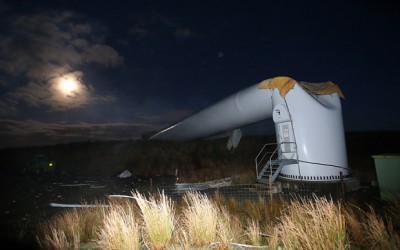
BRAZIL: Investigations are ongoing at utility Eletrobras’s 46MW Cerro Chato IV-VI wind complex in the Brazilian state of Rio Grande do Sul following the collapse of eight Impsa turbines.

The incident was caused by a freak storm hitting Santana do Livramento district on the afternoon of 22 December, with gusts reaching 250 kilometres per hour, according to an Eletrosul press statement, which appears to be its only public comment on the incident.

Neither Impsa nor Electrobras would respond to questions from Windpower Monthly while investigations are ongoing. The machines were Impsa 2MW machines with a 100-metre rotor.

Before the storm, Rio Grande do Sul’s meteorological office, MetSul, had issued an alert for winds of up to just 120km/h. Reported maximum gusts for the neighbouring town of Rivera in Uruguay, which shares the border with Santana do Livramento, were at just 130km/h.

Impsa, Argentina’s beleaguered turbine manufacturer currently tackling solvency problems, has made no public comment.

No damage was reported to Wobben turbines operating in the same district.

Local press sources state that Eletrosul’s insurers have concluded onsite investigations, although conclusions are yet to be delivered to its client.
Wind Power Monthly

Aeolus1

Interest in Wind Projects Wanes, and Prices Dropping Fast!

    • Wind auction sees low interest

      Only two of four offshore MA wind areas get bids; sale prices much lower than prior sales off other states
  • By Mike Lawrence

    Only two of four wind energy lease areas in federal waters south of Martha’s Vineyard received bids in an auction today and the sale prices were millions of dollars lower than previous auctions for leases of smaller sizes off other coastal states, according to statements by federal energy officials.

    Leaders of the Bureau of Ocean Energy Management (BOEM) expressed a sunny outlook, though, in a conference call to media following the sales.

    BOEM put four lease areas up for auction this morning. The areas are collectively known as the Massachusetts Wind Energy Area and cover more than 742,000 acres in federal waters about 12 miles south of Martha’s Vineyard.

    BOEM Deputy Director Walter Cruickshank said the 187,523-acre lease area closest to shore sold for $281,285 to Renewable Energy Systems (RES) Americas, and the adjacent 166,886-acre lease area sold for $166,886 to Offshore MW. The other two lease areas, farther from shore, were not bid on, he said.

    U.S. Wind paid $8.7 million in August for leases on two areas totaling 79,707 acres off the Maryland coast, according to BOEM data. In September 2013, Dominion Resources paid $1.6 million for a lease on 112,799 acres off the coast of Virginia.

    Deepwater Wind paid $3.8 million for two lease areas totaling 164,749 acres in the Rhode Island/Massachusetts Wind Area – adjacent to, and closer to shore than, the areas auctioned today – in BOEM’s first competitive auction of offshore wind development leases, in July 2013.

    BOEM Director Abby Ross Hopper said the bureau was “happy with the results of (today’s) auction” and set the minimum bids lower than in previous auctions because of water depth and other factors.

    “The Massachusetts Wind Energy Area is located in deeper water than some of our other wind energy areas in other states,” Hopper said. “We knew that developing…in this area was going to be more expensive.”

    Hopper said another factor was that, unlike Massachusetts, other states had offered offshore wind credits and other financial incentives to renewable energy developers.

    “That obviously has value,” Hopper said, adding that legislation has been introduced in Massachusetts to add incentives for offshore wind, but has not yet been approved.

    Cheap oil and gas prices this month also may have deflated interest in wind power ahead of today’s auction. Additionally, the regional wind industry recently took a separate hit to the jaw, when utility giants NStar and Northeast Utilities announced the termination of their contracts to buy wind power generated by Cape Wind in Nantucket Sound, saying Cape Wind failed to meet critical financing milestones.

    Hopper denied a connection between Cape Wind and the lack of bids on two lease areas today.

    “I think the recent activity at Cape Wind shouldn’t be read as any sort of indicator of what happened in today’s auction,” she said. “I am very encouraged by the fact that two experienced wind developers have won provisional leases in the state of Massachusetts.”

    The provisional leases bought today represent less than half of the 742,000 acres that were up for auction.

    Cruickshank said the two areas that did not receive bids “are still part of the Massachusetts Wind Energy Area” and the bureau will discuss future options for their use with state agencies.

    He said RES Americas and Offshore MW were the only companies that placed bids in today’s auction.

    Follow Mike Lawrence on Twitter: @MikeLawrenceSCT

Useless, Unreliable, and DANGEROUS! Wind Turbines Self Destruct!

Berserk Warriors: it’s the Dane’s Turn to Take Cover as (Yet) Another Turbine Self-Destructs

turbine-collapse-germany1

Remember all those stories about wind turbines lasting for 25 years – without so much as the need for an oil-change – and being “safe as houses”?

Well, as STT followers well-know those ‘stories’ are unraveling at a rocketing rate – with giant fans collapsing in crumpled heaps;spontaneously combusting; and throwing blades to the four-winds – all over the world.

We’ve just about covered the Globe now, with “events” from Ireland (see our posts here and here); Scotland (see our posts here and here); Devon (see our post here); Nicaragua (see our post here)  – BrazilKansasPennsylvaniaGermany and Scotland – where turbines have been going berserk like Viking Warriors.

berserkers

Now – if you’re nowhere near these things, you’re probably finding these events a bit boring and our posts a little repetitive?

But – if you’re within a bulls’ roar of these pyrotechnic-50m-blade-chuckers – your anxiety and blood-pressure levels could be excused for being a little on the high side.

However, we figure that we’re bound to keep them coming – forewarned is forearmed.

So here’s another about a turbine going “berserk” – this time, in Denmark.

Blades fly off runaway wind turbine
The Local Denmark
16 January 2015

turbine collapse denmark2

The blades and gearbox have been spun off a wind turbine in western Jutland after a malfunction allowed it to reach to dangerous speeds in high winds.

turbine collapse denmark 3

“There was a loud bang and then one of the blades span off, and shortly afterwards the the gearbox’s housing fell to the ground,” Henrik Nielsen, one of the officials at the scene, told Denmark’s TV Midvest. “The wings splintered, and fragments and smoke reached as far as 35 meters away from the turbine.”

No one was hurt due to a 100m safety zone which local police had enforced around the turbine ever since it first ran out of control on Thursday afternoon. Several turbine maintenance specialists had tried to bring the turbine under control, but in the end judged it too dangerous to approach.

turbine collapse denmark 4

“We cannot get close to it until the wind dies down,” Oluf Jakobsen, from the local Morsø municipality explained on Friday morning. “There’s nothing we can do but sit and wait for the outcome.”
The Local Denmark

Wind energy in Denmark : wind turbines in Holstebro , Westjutland

Little wonder then that the wind industry in Denmark has decided to bring in the bulldozers to flatten homes and whole villages (see our post here).

Creating vast-vacuums, devoid of all human life will, no doubt, help with their escalating public liability insurance premiums.

bulldozer-home

Why should anyone be exposed to the dangers of these machines?

Turbine safety concerns

Published: 16 Jan 2015 17:00

FOLLOWING the unexplained collapse of a wind turbine at a Northern Ireland windfarm last week, one local politician has raised concerns over safety at windfarms closer to home.

Turbine risks?

Dumfriesshire, Clydesdale and Tweeddale MP David Mundell is asking the Scottish Government, the Health & Safety Executive and Council Building Control to make them aware of the incident and asking if they are satisfied that all existing local developments are safe, with no likelihood of such a collapse.

Seven remaining wind turbines have been shut down at a wind farm near Fintona, County Tyrone, where a 100-metre high turbine collapsed last Friday night.

Mr Mundell has also expressed that new developments are being proposed with turbines closer to people’s homes and he has asked the Scottish Government and Council to confirm that minimum safe distances between housing and new Windfarms will be strictly enforced.

Mr Mundell said: “I was extremely concerned to learn about this incident at the Screggagh Windfarm in Co Tyronne. It is particularly troubling that there appears to be no obvious explanation such as very high winds at the time. The turbine involved is similar to many locally with a tower height of 60 metres, an 80 metres rotor diameter, and an overall base to blade tip height of 100 metres.

“I understand people in the area said the rotor blades were spinning out of control on the evening the turbine buckled. The sound of the failing mechanical structure was heard more than seven miles away and debris from the stricken turbine was scattered across the mountainside, with a large spike remaining impaled in the earth several hundred yards from the turbine site. I am pleased there were no injuries when the turbine collapsed.”

He added: “It’s now vitally important we get to the bottom of what happened and make sure there are no such incidents possible on local windfarms. That’s why I want to be clear that the Scottish Government, Health and Safety Executive and Building Control are all aware of this incident and the ongoing inquiry. I want to be reassured that all local turbines are completely safe and not in danger of collapse. We might not be so lucky next time to avoid injury or damage to property.

“I have been increasingly concerned about how close some proposed new developments are to people’s homes and this incident reinforces the need for regulation of that and for it to be enforced. So I am also raising those issues with the council and the Scottish Government. Of course, a better solution from my point of view would be to have no new windfarm developments locally at all.”

Local campaigner, Jerry Mulders added: “I share the concern that occasionally small mechanical equipment can fail.

“The concern I would have is with the developer promoting recreational and open areas for land on which windfarms are situated. I would be seeking reassurances from developers that windfarms are not open as recreational areas for things like horse riding as a safety precaution.”

– See more at: http://www.cumnockchronicle.com/news/roundup/articles/2015/01/16/521733-turbine-safety-concerns/#sthash.Zfm2OYG6.dpuf

Plans for Cape Wind, are Blowing Away, As We Speak!

Wind Energy’s Bluster Peters Out

untitledTouted as “America’s first offshore wind project,” Cape Wind became one of America’s most high-profile and most controversial wind-energy projects. Fourteen years in the making, estimated at $2.6 billion for 130 turbines, covering 25 square miles in Nantucket Sound off the coast of Massachusetts, the Cape Wind project has yet toinstall one turbine—let alone produce anyelectricity. Now, it may be “dead in the water.”

On January 6, the two power companies, National Grid and Northeast Utilities, that had agreed to purchase most of the electricity Cape Wind was to generate, terminated their contracts with the developers due to missed milestones. Under the terms of the contracts, Cape Wind had to secure financing and give notices to proceed to its suppliers to start work by December 31, 2014. Neither happened and both companies filed to cancel power purchase agreements. “The project is in cardiac arrest,” according to Amy Grace, a wind-industry analyst with Bloomberg New Energy Finance.

Cape Wind has faced stiff opposition since it was first proposed in 2001. Senator Edward Kennedy’s efforts, and those of his wealthy friends, to fight Cape Wind have been the most publicized, but Native Americans, fishermen, and local communities have also battled the industrialization of Nantucket Sound. The town of Barnstable has been particularly active in the fight. The Cape Cod Times reports that Charles McLaughlin, Barnstable’s assistant town attorney, said: “The town’s concerns include the possibility that a collision between a boat and the large electric service platform the project requires could spill thousands of gallons of oil into the sound.”

Massachusetts Governor Deval Patrick (D) positioned Cape Wind as the centerpiece of his renewable energy goals and invested significant political capital backing the proposal—including tying the NStar power purchase agreement to approval of the NStar and Northeast Utilities merger (given the unfavorable terms of the agreements, the companies may have been looking for any exit ramp). Yet, Ian Bowles, Patrick’s first energy and environment chief who, according to the Boston Globe, “helped shepherd the offshore project,” acknowledgesthat the loss of the power purchase agreements “may have spelled the end for Cape Wind.”

The announcement came two days before Patrick left office. While he claims: “We’ve done everything as a state government to get them over the regulatory lines,” Patrick concedes it is now “up to the market.” According to the Cape Cod Times, the former governor doesn’t know “if the project could survive without the contracts in place.”

Even the Department of Energy (DOE), which seems to indiscriminately throw money at any politically favored green-energy project, was tepid in its support for Cape Wind. DOE’s loan guarantees generally average about 60 percent of the project’s costs, but the $150 million offered to Cape Wind made up a mere 6 percent—and that, only after the project received commitments for about half of its financing. In most cases, the government guarantee comes before the private financing and signals a go-ahead for investors.

While both supporters and detractors believe the project is in jeopardy, environmentalists and Cape Wind Associates LLC have not yet waved the white flag. According to Kit Kennedy, director of the energy and transportation program at the Natural Resources research : “Cape Wind may be down, but it is not out.” The Boston Globe reports that Cape Wind’s president, James Gordon, believes the perpetual litigation “triggered a clause in the contracts that allows for more latitude in Cape Wind’s ability to meet the deadlines.” However, after the company already spent $50 to $70 million on the project, the fact that Gordon opted not to pay the utilities the mere $2 million needed for a six-month extension signals that he doesn’t have confidence that they can continue.

Additionally, the political winds have shifted. While Governor Patrick championed Cape Wind, Massachusetts’ new governor, Charlie Baker (R) is on record as being staunchly opposed to it—even calling it Patrick’s “personal pet project.” While campaigning, Baker “dropped his opposition to Cape Wind” because he believed it was a “done deal.” Now that the deal may well be undone, Baker says he “will not try to influence the outcome of the legal process surrounding the Cape Wind project.”

The cancellation of the contracts is “a near fatal blow” to Cape Wind according to Audra Parker, president of the Alliance to Protect Nantucket Sound, a Cape Cod based group which has led the fight against cape wind.

Wind energy’s future faces problems beyond Massachusetts.

While Massachusetts’ utility companies filed to cancel power purchase agreements, two Minnesota wind farms, operating as Minwind Companies, were filed for bankruptcy because the eleven turbines needed extensive repairs and the 360 farmers and landowners who invested in the projects can’t afford the maintenance. Minwind CEO Mark Willers explained: “Minwind Companies have enjoyed relative prosperity in recent years, but the April ice storm last year took a toll on equipment—and on the budget.” At a December 17 meeting, hetold shareholders: “We were 200 to 300 percent over budget to make those repairs.”

Minwind’s nine separate limited-liability companies allowed investors to take advantage of federal wind-energy credits, USDA grants, and the now-discontinued state assistance program for small wind projects. The Star Tribune reports: “The owners stand to lose their investment, and the wind farms eventually may have to shut down.”

On the national level, the American Wind Energy Association (AWEA) has continued to lobby for a retroactive extension of the Production Tax Credit (PTC) for wind energy that expired at the end of 2013. Disappointing AWEA, the lame-duck Congress did approve a ninth extension—but just through the end of 2014. AWEA’s CEO Tim Kiernan groused: “Unfortunately, the extension to the end of 2014 will only allow minimal new wind development and it will have expired again by the time the new Congress convenes.” In response to the “bare-minimum extension,” Luke Lewandowsi, Make Consulting research manager, said it “casts doubt on the willingness or ability of Congress to revisit the PTC in 2015.”

Adding insult to industrial wind’s injury, wind turbine installation placed number three in the list of 10 dying U.S. industries—following only computer and recordable media manufacturing.

All of this news doesn’t bode well for the wind energy business, but for ratepayers and those who believe in the free market and who believe that government shouldn’t pick winners and losers, current wind conditions are a breath of fresh air. Governments, both state and federal, have given wind energy every advantage, to quote Governor Patrick: “It’s now up to the market”—and even Warren Buffet admits the tax credits are the only reason to build wind farms.

Wind Turbines Have A Tendency to Tumble….Look Out Below!

Gravity Bringing Wind Power to its Knees: Blades Keep Flying, as Farmers & Schoolkids Learn to Run & Duck for Cover

turbine collapse 9

A little while back we covered a spate of turbine collapses across the UK – terrorising locals not used to the sky-falling in around them on a regular basis (see our post here).

And we’ve dealt with the increasing numbers of turbine blades that routinely unshackle themselves in bids for airborne freedom, troublesome events, which the wind industry euphemistically calls “component liberation” (see our posts here and here and here and here).

As one of Newton’s predicted constants, gravity seems to be working its frightening magic without relent in Britain. Here’s, yet another, tale of toppling turbines from the UK – this time it’s the Scottish Highlands where things are going bump in the night.

Wind turbine topples over near New Deer
pressandjournal.co.uk
14 November 2014

turbine toppled new deer

A homeowner near the north-east village of New Deer was left bewildered yesterday after a wind turbine crashed to the ground through the night.

The structure is one of three 72ft turbines near the former Cairnorrie Primary School on the B9170 Methlick to New Deer road.

David Richards, who lives in view of the toppled turbine, described last night how he had first noticed that it had fallen over in the early morning of yesterday.

He said: “I don’t know when it happened. It was there – fine – on Wednesday afternoon when I went out to feed the animals. Then I came downstairs this morning and looked out the window and saw it was lying flat and sort of bent. It was a bit of a shock.

“We’ve not had it too bad around here. In fact, for a windy place, it’s actually been quite calm.”

“The people who put it up came and chopped it up and took away the top.”

Mr Richards, who has lived at his property near the B-road for nine years, said that he had originally objected to the plans when they were first submitted to the local authority.

“I just don’t like wind turbines. I think they’re a blot on the landscape. When we came, there weren’t any turbines. Then a new power line was put up, then the application for those went in. There were quite a few objections.

“They’re closer to us than they should be, and they’re closer to us than we want them to be. Some people love them, some people can’t be bothered by them, and some people don’t like them very much at all. I fall into that last category.

“The place is becoming a bit like ‘turbine alley’,” he added.

The turbine’s owners, a nearby farmer, declined to comment last night when approached.
pressandjournal.co.uk

And it’s not just farmers dodging flying blades and collapsing towers.

Oh, no.

Thanks to eco-fascist efforts to indoctrinate the young and impressionable on the “wonders” of wind, it’s school kids that have to learn the finer points of how to successfully run, duck and take cover: wind weasels have planted hundreds of their whirling monsters in schoolyards across the UK, including dozens at schools in the Highlands of Scotland.

Wind power outfits in Scotland have engineered propaganda opportunities around forcing kids to name wind turbines.

And the same tactic of brainwashing captive audiences of impressionable youngsters is part-and-parcel of the wind industry wherever you go: Australia, no exception (see our post here).

Infigen windy & gusto

A while back we covered the story of turbine blades being flung around the schoolyard at Caithness in Scotland (see our post here). Fortunately, that unscheduled “component liberation” event, didn’t end with decapitated pupils – but, give it time, and the casualties of “green” zealotry will mount, as more and more turbines collapse or otherwise self-destruct (see this article from last week for yet another story on collapsing fans and flying blades – this time next door to a community hall).

caithness turbine

It’s a point not lost on Highlander, Brenda Herrick who penned this brilliant letter published by her local rag, The John O’Groats Journal, in response to the local Council’s malign indifference to the risks to little lives and limbs created by the, wholly unnecessary, eco-crucifixes being used by wind weasels to warp the minds of the young and innocent.

To the Editor
Sir,

It is interesting that the Council responded to your article on the safety of school turbines last week by emphasising that they are ensuring they get value for money. It is unlikely these turbines will ever pay for themselves but that’s not the point. The Council did not consider the risks of installing fast spinning machines where children at school are forced to play until I alerted councillors to the danger and others became involved. No risk assessments were carried out at individual schools prior to installation.

Following publicity the Council braked the turbines and engaged the Building Research Establishment to produce a risk assessment process. The actual assessments were carried out by Council personnel. At installation each turbine had been surrounded by a small wooden fence, easily climbed by children. Following the assessment these were replaced by higher metal fences, which prevent children climbing in but do not protect them from falling parts, and maintenance intervals were halved. I am not sure what the Council’s “robust risk assessments” are designed to achieve but they cannot guarantee the safety of children.

The BRE report recommended “turbine siting safety zones” consisting of a Fall zone, a wider Topple zone and a wider still Ejection zone (parts flying off).

When I asked the Council “What is the actual diameter of an ejection zone as referred to in the reports, say for a 15m tower turbine?” the reply was “The Council’s approach has been on prevention of risk, thereby negating the need for exclusion.” So having commissioned a report they decided to ignore parts of it, presumably because in most school playgrounds there is no room for an ejection zone.

A blade flying off at speed can travel a considerable distance. They have apparently forgotten the incident on Skye in 2009 when a Highland school turbine started shedding springs and had to be taken down by the Head Teacher. The Council’s own sensible recommendations in its report of that incident included “Ensure that there is an adequate buffer zone from the main pathways and occupied area, in schools this should include entrance and regularly used pathways and playground areas.” There are no “buffer zones”.

The following are examples of school turbine failures I am aware of from press reports, so by no means a complete record:

The school’s wind turbine collapsed December 8 about 7 a.m., knocking down a power line and causing school to be cancelled for the day.

Last month the revolutionary eco-friendly school lost its green energy supply after a damper, used to control the blades, came off when bolts broke. The three-inch-square part, weighing several kilos, plunged to the ground, luckily outside school hours when there were no children around. 

But soon after being installed the wind turbine became faulty and after a few months seized up – showering the school’s playing field with debris.

A wind turbine at a school in Flackwell Heath has been repaired after part of it fell off into the school playground.

School wind turbine at Akron-Westfield school reported to be running out of control, suspected braking failure. School Superintendent described it as “life threatening”.

The turbine then collapsed, landing in the school’s playground, although no one was hurt.

Stunned students watched as a 40ft wind turbine crashed to earth during its installation on Fakenham High School playing field this lunchtime.

Within two years after installation, one of the three Proven 35-2 Wind Turbines installed at our Local High School came loose and crashed to the ground. It landed outside of the fenced off “Fall-Zone” behind the school.

A wind turbine came crashing down near Western Reserve High School.

Blade on the turbine at Seascale School blown off and landed 200m away in a field.

A FAMILY were left traumatised after a 4ft blade broke from a wind turbine in the grounds of a Rowley Regis school and spun out of control narrowly missing their house.

It is only luck that no-one so far has been injured at school.

There is a general denial of risk, presumably based on ignorance of the number of turbine failures occurring world-wide. One reason for this is that Renewable UK, the industry body, guarantees confidentiality to its members when reporting incidents.

Even the Health & Safety Executive cannot access their records and stated recently: “Consequently the HSE do not currently have a database of wind turbine failures on which they can base judgements on the reliability and risk assessments for wind turbines.” This is a disgraceful situation when turbines are so frequently close to people and buildings. Parents have a right to believe their children are not exposed to unnecessary risk in school grounds.

Brenda Herrick
Castletown
THURSO

For a run-down on the potential for murder and mayhem being caused by flying turbine blades in Scottish school yards, check out this detailed paper here and this summary of the chaos being created in this link here.

dirtyrottenscoundrelsoriginal

News That is So Wonderful, I must Share It Again! Windweasel Goes Down in Flames!

Bye-Bye Barnyard: Mike Barnard’s Boss – IBM – Shuts Down the Wind Industry’s Most Rabid & Nasty Propaganda Parrot

2_77

Mike Barnard – “Barnyard”, as he’s affectionately known – is easily the most vicious, vile and virulent of the wind industry’s beleaguered band of propagandists, spruikers, parasites and media manipulators.

Along with other members of his dwindling pack of marauding-media-manipulators, Barnyard stalks internet sites and Twitter like a starving hyena – venting spleen; denigrating and ridiculing those unfortunates suffering from sleep deprivation caused by incessant low-frequency noise and infrasound – he sneeringly calls them “liars”, without a shred of first-hand evidence to support him, let alone relevant qualifications or experience relating to health or acoustics; slamming highly qualified health and acoustics professionals who’ve been working on the topic of noise and health their whole lives, while simultaneously trying to elevate his best mate – a former tobacco advertising guru – to the status of an acoustics/neuroscience “Einstein” on the health impacts of turbine noise; and otherwise doing his bit to perpetuate every lie, half-truth and myth about the “wonders” of wind.

Hyenas

For a taste of the delusion that grips the man, contrast this complete pile of piffle that Barnyard must have beamed in from the outer reaches of the Cosmos – with the detailed, factually based analysis produced by the Institute for Energy Research that came from good old Mother-ship, Earth (covered in our post here).

Barnyard, runs very close with the other “gold-pass” members of the hyena parasite-pack: “Enemies of the Earth’s”, eco-fascist-in-chief, Leigh Ewbank (aka FOE – a fully paid-up front for Danish fan maker, Vestas); Infigen’s in-house spin-master Ketan Joshi; and “Wind-Lord” Ken McAlpine, the struggling Danish fan maker’s front man in Oz.

But his days of pious pontification, rabid-hate-filled-rants, virulent attacks on highly respected academics, acoustics and health professionals and pedaling myths on the “wonders” of wind power are over.

Barnyard’s self-appointed “expert” status, nastiness and internet ubiquity was speared in a cracking open letter by none-other than STT Champion, Jackie Rovensky who, quite rightly, ripped into his reprehensible ranting with this fine piece of work, that hit pro-community websites back in September.

Mike Barnard’s disreputable wind industry propagandist role revealed
JA Rovensky

Vicious, grossly inaccurate and sometimes defamatory attacks on professionals and researchers are relentless from the wind industry and its vocal cheer squad. Their targets include individuals such as Dr Nina Pierpont, Professor Bob McMurtry, Dr Michael Nissenbaum, Dr Sarah Laurie, Mr Steven Cooper, Professor Colin Hansen, Mr Les Huson, Mr Rick James and numerous others, who work to uncover the truth of reported acoustic emission related adverse health impacts linked to Industrial Wind Turbines.

One of the most prolific and virulent is someone called Mike Barnard, an IBM employee. It seems he began his attacks when living in Canada, and is now physically located in Singapore. Whilst Barnard claims to be operating independently of his employer, IBM, the amount of time he spends blogging on wind power and smart grid related issues, and the business connections IBM have with the renewables industry with respect to smart grid technology and renewable energy, make his assertion that IBM are not involved and supporting his activities questionable.

When one of Barnard’s cyber bullying victims informed him what he’d written was libellous, Barnard’s comment in response was to the effect that he was laughing at them because he was untouchable by living in Singapore and utilising free blogging software in a “Cloud”? IBM has a strict policy on cyberbullying, and has been specifically made aware of Barnard’s activities. What action has IBM taken to discipline their vocal employee, who is bringing their organisation into considerable international disrepute with his behaviour?

So who is Mike Barnard, and what are his professional qualifications? On Barnard’s personal blog site he states he became interested in blogging on energy concerns several years ago, and this led:

to significant contacts, research and writing related to wind energy and its myriad societal and commercial interconnections, including the electrical grid, wind energy innovations, social license, health, noise and legal aspects. [1]

In a response to comment on one of his blogs he responded with:

For a little context on my background, I was the Business Architect responsible for delivery of the world’s first full public health surveillance system for communicable diseases, … funded by the Canadian government …

On his blog site introduction he states:

IBM was engaged to build the major technical solution which automated management of communicable disease and public health surveillance.

This related to Canada. He goes on to state he:

joined the program in the late 2000’s as the business architect, responsible for understanding policy, epidemiology and other business drivers and balancing them with what was pragmatically possible …

IBM was contracted in 2006 to design a system to be completed in 2007. They completed the design of the program in 2008, but in June 2013 the Canadian Medical Association Journal : Journal de l’Association medicale canadienne (CMAJ:JAMC) published an article which reported since then progress had been delayed because of numerous technical problems and confusion among provinces and little had been heard of the program since, “The concept has gone almost nowhere” [2].

Barnard continues to inform us how he has read through health studies and reviews related to wind power from around the world and claims:

constant and deep access and conversations related to public health management, epidemiology and the nature of medical evidence … That experience and on-the-job education has been invaluable as I’ve read through health studies and reviews related to wind power from around the world …

This has apparently also led to:

recognition of my expertise … I’m pleased to say that my material is helping to shape legal defences of wind energy, advocacy programs and investments in several countries.

In addition in 2013 he was assigning a blog “debate” relating to bird flight paths through a proposed Wind Turbine site, as being his impetus to start collecting material, and creating his own personal blog saying:

A few years ago I started down a road that has led to an unexpected place.

However, blogs can be found from him on energy from around 2010 [3], his voyage into health issues seems to have begun around 2012 when he attacked Dr Nina Pierpont and Dr Nissenbaum. Barnard has been involved in blogging on wind energy issues for some time, and he considers himself to be an integral part of the wind industry’s product defence strategy, which is certainly consistent with his behaviour. This is also consistent with how he is perceived by others who are also actively engaged in the same dishonest activities of denying the known adverse health impacts of wind turbine acoustic emissions; known to the wind industry and acousticians to cause damage to health via “annoyance” symptoms including sleep disturbance and body vibrations for nearly thirty years, since the work undertaken by Dr Neil Kelley et al in collaboration with NASA and a number of research organisations and wind turbine manufacturers.

The list of “publications” following these claims relate to blog sites and/or websites which are sites supporting Renewable Energy production and blogs which repeat the misinformation. They are not peer reviewed journal articles, nor has Mr Barnard been qualified to give expert evidence in any jurisdiction on wind turbine health and noise issues.

Barnard proudly displays a list of his 50 “Skills and Expertise” which includes “Wind Energy and Health”. None of the others cover any medical or health skill or expertise, and it hasn’t been possible to locate any medical or health related training or degree, or indeed any other relevant technical, professional or academic qualifications he has achieved with direct relevance to wind turbine noise or health, as he does not provide details of them. This suggests that Mr Barnard does not have that relevant professional background, academic training or expertise.

Just what is Mr Barnard’s specific expertise in this area?

Throughout Barnard’s blogging career he has concentrated on castigating, defaming and ridiculing those who do have qualifications, research and/or authorships, and who are demonstrably independent of the wind industry and from those who benefit financially from its operations.

One person in particular he’s taken aim at is Dr Sarah Laurie from South Australia, who is the CEO of the Waubra Foundation. The Waubra Foundation was established to facilitate independent multidisciplinary research into the impacts of infrasound and low frequency noise and vibration on human health. Wind turbine noise is just one source of noise the Foundation is concerned with.

Dr Sarah Laurie is a fully trained and qualified doctor, with clinical experience as a highly regarded rural General Practitioner, but she is not currently registered to practice medicine because of personal and family health issues and caring responsibilities. In Australia, it is a requirement that to practice medicine, you must be currently registered with the Australian Health Practitioners Regulatory Agency (AHPRA). Dr Laurie is not currently practising medicine with her current work as CEO of the Waubra Foundation. She is not seeing patients, she is not diagnosing conditions, and she is not prescribing medicine. She is listening carefully to what people adversely impacted by environmental noise tell her about their health problems, and the diagnoses their treating health practitioners have given them, if they choose to share that information with her.

Claims made by Mr Barnard (and others working with the wind industry such as Infigen Employee Laura Dunphy, and VESTAS employee Ken McAlpine) that she is deregistered are deliberately false. Implying that she has been “struck off” for professional misconduct is just one example of Barnard’s regular defamatory utterances, which are then repeated by others. Further his claims that she was “forced” to stop using the title of Doctor are also false. Mr Barnard continually deliberately misleads his readers with such comments and is clearly disinterested in the truth.

Because of a spurious complaint to the regulatory authority that she was “practising medicine whilst being unregistered” Dr Laurie voluntarily offered to AHPRA not to use the title “Dr” which retired or non-practising doctors are legally entitled to do in Australia, because she did not wish to mislead anyone about her current non registered status in her work with the Waubra Foundation. There had been no complaints to AHPRA from anyone who Sarah had interacted with that she had misled them as she had always been careful to ensure that anyone contacting her directly for information about their own circumstances was well aware of her current unregistered status. Indeed anyone with any awareness of this issue would be well aware of her current unregistered status because of the wide and frequent publicity this issue was given by the wind industry and its vocal supporters, particularly Professor Simon Chapman, the ABC and Fairfax media.

There is no restriction on anyone else referring to her as “Dr”, nor is there a restriction on her using the title if she was not performing her role as the Waubra Foundation CEO. AHPRA staff expressed their gratitude to her for this offer not to use the title “Dr”, which they accepted, with the proviso that when she reregistered to practice she would resume using the title “Dr”.

This issue was specifically clarified in the Environmental Review Tribunal Decision: Bovaird v. Director, Ministry of the Environment where the judgment stated the following:

The Tribunal finds that this evidence supports Ms. Laurie’s assertion that the AHPRA did not make any finding in respect of the complaint made against her.

Why did Mike Barnard ignore this finding of the Tribunal?

It is clear that he did not mention it because his intent was to deliberately smear Dr Laurie’s professional and personal reputation. It is also clear that the original widely publicised complaint to the NHMRC and AHPRA alleging professional and research misconduct, was done for precisely the same reasons by those within public health and wind industry circles in Australia who were unhappy with the attention the issue of health damage from wind turbine noise was attracting.

Those involved in this sordid episode include senior people in the ranks of public health bodies in Australia, including the Public Health Association of Australia, whose CEO, Michael Moore made the complaint, and whose computer created the defamatory “anonymous” allegation document. Mr Moore has since apologised to Dr Laurie, and the NHMRC CEO Professor Warwick Anderson has also apologised for the NHMRC’s behaviour towards Dr Laurie in a letter to the Chair of the Waubra Foundation, Peter Mitchell. The NHMRC unnamed “spokesperson” had leaked information about the allegations to crikey journalist Amber Jamieson, specifically naming Dr Laurie. Others such as Professor Simon Chapman have admitted they “saw a draft” of the defamatory allegations document, and Infigen Energy’s propagandist Ketan Joshi is uncharacteristically silent when challenged by others on various blog sites about his knowledge and involvement in the production and distribution of this defamatory document. The format of the document was remarkably similar to the way Infigen energy prepares their responses to issues raised by objectors to their environmental assessments.

Among Dr Laurie’s credentials are her positions as a former Examiner for the Australian College of General Practitioners, a former Mid-North Division of General Practice representative and former member of the regional Mental Health Advisory Committee. She was a provider of pro bono services to the local Aboriginal community and a cofounder of the regional Rape and Sexual Assault service. She also undertook emergency care work at the local rural hospital as a visiting medical officer, in addition to her role as an employee, associate and then partner in a local medical practice.

These credentials are not confidential, and are available to Mr Barnard and anyone else who wishes to ascertain her qualifications, just by looking at the Waubra Foundation website [4], and reading the speech given in the Australian Federal Parliament about this matter, by the former Member for Hume, Alby Schultz [5].

Dr Laurie states clearly she has no expertise in acoustics, but does consult regularly and collaborates closely with those who are acousticians, to help ensure she understands what she needs to in relation to exposure levels of infrasound, audible noise and vibration and correlations with reported health symptoms. She also repeats constantly she does not undertake and is not trained to do research in an academic manner, but is actively facilitating the research being conducted by others. What she goes to great pains to explain is that she listens very carefully to the symptoms people living near environmental noise experience themselves and then try and describe. This is a core skill required by rural general practitioners, something she was specifically trained to do and was particularly skilled at. Rural doctors need excellent diagnostic skills, most of which is dependent on taking a very careful clinical history, as they do not have the luxury of specialists “next door” and easy and rapid access to a range of diagnostic facilities which city counterparts take for granted.

Dr Laurie then collects and collates pieces of information given to her by people reporting changes to their health after wind turbines and other industrial noise sources begin operating in their vicinity, looking for similarities and patterns which give important clues as to direct causation. Occasionally people provide her with some of their medical records and other health data, which is kept confidential unless the person concerned gives their permission for the information to be out in the public domain, or the information has already been reported publicly in the media or in oral or written testimony to courts, tribunals, and parliamentary inquiries.

Dr Laurie always maintains confidentiality, even when under significant and very public pressure from others demanding she release information to them for their research. One example is the repeated private and public harassment from Professor Simon Chapman, Professor of Public Health at Sydney University, and Expert Adviser to the Climate and Health Alliance, to release the names of residents forced to leave their homes and other details such as locations of their abandoned homes [6]. Much of that information had been provided to her in confidence, and some of the information could have caused significant harm to the people concerned – for example because of non-disclosure clauses in legal documents signed by people providing the information, or by their close relations. Others requested privacy because of concerns about property damage, burglary or arson to unoccupied homes. It has subsequently emerged from inquiries made by Senator Madigan’s staff, that at the time Professor Chapman conducted his inquiries, he did not have in place prior ethics committee approvals from the Sydney University Ethics Committee. Requests for information were made directly to wind turbine noise affected residents, causing them considerable distress. [update:The Sydney University Ethics Committee has clarified that no approval was required, as the ‘research’ entailed only asking people to corroborate already public statements.]

Whatever the Bovaird ERT Tribunal said in Ontario, Dr Laurie cannot be objectively considered as having been “diagnosing” patients since she ceased practicing.

Examination of information consisting of health issues diagnosed by treating physicians and discussing this information with the informants does not constitute “making a diagnosis”, which is a process requiring a thorough clinical evaluation by a treating health practitioner. What Dr Laurie did in the Boviard case is no different to what she has done elsewhere, and can only be considered as evaluating the combination of specific individual clinical circumstances with respect to the available research evidence and clinical knowledge. That was precisely what Dr Laurie had been asked to do. She was not asked to diagnose patients, nor would she have done so, as she is well aware of the appropriate constraints on such activities for those who are not currently registered to practice medicine.

Irrespective of the Environment Review Tribunal’s questionable determination in the Boviard case, which is consistent with other questionable decisions made by the same Tribunal resulting in many rural Ontarians being harmed by wind turbine noise because of unsafe and continuing wind turbine development approvals, it is logically impossible for anyone to diagnose someone “before” they have symptoms.

Identifying that some people who have one or more acknowledged risk factors prior to Industrial Wind Turbines beginning to operate provides information about predictable health problems which may ensue with exposure to infrasound and low frequency noise. You don’t have to be a trained doctor or research academic to come to that conclusion, but clearly the knowledge attained from years of study and subsequent clinical practice does put a formerly registered practising medical practitioner in a position where her expertise can be utilised, as an expert witness in this field, without her currently “practising” medicine.

The complete lack of critical thinking used by members of the Ontario Environment Review Tribunal who used such irrational logic to determine whether someone has the ability to offer a hypothesis, is mind boggling at best and disturbingly suggestive of bias at worst.

There are constant references to Dr Laurie not being able to stipulate what distance she determines is a safe distance these turbines should be from people. Dr Laurie consistently states she cannot provide a fixed distance, as there are many variables to be considered and the multi-disciplinary research needs to be undertaken first. After all, not only are turbines becoming larger, and installed in greater numbers in individual projects or through extending existing project many other variables have to be taken into account, such as the geology, wind directions and speed, seasonal changes, temperatures to name some.

Professor Colin Hansen’s research group’s latest acoustic survey at Waterloo Wind Development in South Australia [7] is a good example of the sort of research Dr Laurie has been stating is required for the last four years. That acoustic survey demonstrated that there is indeed a low frequency noise problem for neighbours to Waterloo wind development, and that it can extend out even beyond 8km under certain circumstances.

This is precisely what Dr Laurie stated three years ago; when the Waubra Foundation’s explicit Cautionary Notice was issued on 29th June, 2011. The information which led to the distance of 10km being specified in that document came from adversely impacted residents at Waterloo. Professor Hansen’s team’s research findings have now supported Dr Laurie’s statement in 2011 about the distance of impact and are consistent with the residents’ consistent reports for nearly four years of a low frequency noise problem from the wind turbines at Waterloo, which severely disrupts their sleep.

Much is made by Mr Barnard and others of the “nocebo” effect, whilst they dismiss the existence of “wind turbine syndrome”. However Mr Barnard fails to disclose that British Acoustician Dr Geoff Leventhall specifically acknowledges the existence of the symptoms of wind turbine syndrome, indeed Leventhall stated in June 2011 in a presentation to the National Health and Medical Research Council [8] that he had been familiar with the identical symptoms to WTS which he calls “noise annoyance” for “years”. Leventhall further noted that Dr Nina Pierpont’s contribution to the field of environmental noise was to identify certain risk factors for developing “noise annoyance” symptoms.

For those interested, the presentation and the slide show are available on the NHMRC website, and also on www.wind-watch.org. The relevant slides are slides 42–44, and the footage is between 49 and 52 minutes of the video.

Mr Barnard has also failed to disclose that leading otologist, and Harvard Professor Steven Rauch has recently confirmed that he is seeing patients with the characteristic symptoms of “wind turbine syndrome”. Journalist Alex Halperin had this to say in a recent article [9]:

Dr Steven Rauch, an otologist at the Massachusetts Eye and Ear Infirmary and a professor at Harvard Medical School, believes WTS is real. Patients who have come to him to discuss WTS suffer from a “very consistent” collection of symptoms, he says. Rauch compares WTS to migraines, adding that people who suffer from migraines are among the most susceptible to turbines. There’s no existing test for either condition but “Nobody questions whether or not migraine is real.”

“The patients deserve the benefit of the doubt,” Rauch says. “It’s clear from the documents that come out of the industry that they’re trying very hard to suppress the notion of WTS and they’ve done it in a way that [involves] a lot of blaming the victim.”

Mr Barnard also fails to mention the opinions of rural family physicians such as Dr Sandy Reider, from Vermont, who is at the front line of clinical care for those affected by wind turbine noise, that “wind turbine syndrome” is a euphemistic description which does not sufficiently depict the clinical severity of the clinical cases he is seeing [10].

Mr Barnard fails to mention the opinion of Irish Deputy Chief Medical Officer, Dr Colette Bonner, who has also publicly acknowledged the existence of “wind turbine syndrome” and said that those affected need to be treated with understanding. A recent media report from Ireland stated the following [11]:

“The Department of Health’s Deputy Chief Medical Officer, Dr Colette Bonner, has said that older people, people who suffer from migraine, and others with a sensitivity to low-frequency vibration, are some of those who can be at risk of “wind turbine syndrome”.

“These people must be treated appropriately and sensitively as these symptoms can be very debilitating,” she commented in a report to the Department of the Environment last year.”

Mr Barnard, and those whose commercial interests he is working so hard to protect, is involved in a grubby, dishonest, misinformation and vilification campaign, as part of a global defence strategy for the global wind industry. This industry has been well aware of the problems directly caused by wind turbine noise since 1987, when Dr Neil Kelley’s research [12] establishing direct causation of annoyance symptoms from infrasound and low frequency noise was presented at the American Wind Energy Association conference.

Mr Barnard and his associates’ behaviour is further eroding the personal and professional reputations of all those involved, and eroding the reputations of the companies and organisations they work for, including in this instance IBM.

However, perhaps more importantly Mr Barnard’s behaviour is further eroding the public’s confidence in the global wind industry and its social licence to operate. Such tactics in Australia will only result in the lessening of political and public support for the large subsidies from electrical consumers which are required to keep the wind industry operating.

As Professor Ross McKitrick from the University of Guelph in Ontario, Canada, recently pointed out, the wind industry runs on subsidies [13]. Without the support of the public who are funding the wind industry via their mounting electricity bills, and the politicians responsible for the legislation which forces the subsidies to be collected directly from the public, the wind industry in Australia and elsewhere around the world is doomed – a fitting consequence for such a dishonest and health damaging industry which has shattered the lives of too many rural residents and their families for too long.

It’s time, as a growing number of professionals and researchers are openly saying, for the wind industry to accept the problem, and work to eliminate it. “Shooting the professional messengers” as the Energy and Policy Institute publication by Barnard [14] has tried to do, will not stop the litigation for noise nuisance, negligence against complicit acousticians, or applications for injunctions to cease the operation of turbines, and will only further reduce the diminishing social licence for the wind industry to operate.

JA Rovensky

CLAY LISTON

Nice work, Jackie!

To see the original, along with Jackie’s numerous footnotes and references – click here.

That link also contains a detailed comment from the documentary film maker, Andrew Greg – who put together the brilliant wind power fraud expose, Wind Rush for CBC.

For his fine, well-researched and documented efforts, Andrew was rewarded with one of wind-lunatic, Barnyard’s typically vehement, unhinged tirades: demanding that CBC never employ him ever again; personally attacking Andrew and his family; and anyone else that Barnyard could think of, that poses a threat to his maniacal world-view.

Barnyard’s “motive” for all that untamed malice?

Why, the mighty dollar, of course.

Barnyard works for American IT giant, IBM, developing the computer software that’s used in “smart” grid management systems and “smart” power meters – that are part and parcel of the chaos associated with Barnyard’s pet power generation “system”: a “system” centred on a wholly weather dependent power source, that will only ever deliver power at crazy, random intervals (if at all).

It’s that inherent chaos which provides the “market” for Barnyard’s “smart” grid software, among wind power outfits and grid managers.

And it’s the chaos inherent in the wind power “system” that sets up an increase in the opportunities for rampant gaming and rorting of the market for sparks – which is where Barnyard’s “smart” meter software comes into its own.

“Smart” meters are perfectly designed to allow power companies to make out like Mexican bandits on the hundreds of occasions each year when wind power collapses for hours each day, and for days on end. These inevitable and unpredictable wind power output collapses see the usual dispatch price for power, of around $40 per MWh, quickly rocket towards the regulated cap of $12,500 per MWh and, on plenty of occasions, hit it (see our posts here and here and here and here).

The only trouble for power companies is, that – in the absence of “smart” meters – they can’t hit power punters directly for the full costs of these wind power “outage” driven price spikes. With Barnyard’s smart meter systems in place, they can.

Clever stuff!

The inevitable result will be that – when demand for power to run fans and air-conditioners spikes on a hot, still summer’s day (or for heating during still, frosty weather) – coinciding with a (natural) total wind power output collapse – power punters will face being walloped with the full cost of the rort – being charged at the price prevailing at that very moment by peaking-power piranhas – ie not based on the average cost of power to the grid, but on the actual dispatch price, as it rockets its way from around $40 to $12,500 per MWh.

But – with 10s of thousands of Australians already struggling to afford power and 10s of thousands more being disconnected at unprecedented rates for failure to pay their bills now – adding “smart” meters simply means that more power-starved grannies will end up perishing in hot weather (or shivering to death in winter).

Now, that explains Barnyard’s mercenary motives, but trying to find some kind of explanation for his inherent nastiness requires an investigation to find out whether it’s because mummy didn’t love him, or if he was the fat kid that his schoolmates habitually and gleefully rolled down the hill just for fun?

And – returning to Jackie’s letter – don’t you just love it when self-appointed “experts”, like Barnyard – without a shred of qualification or experience relevant to the task at hand – launch vitriolic attacks on those who do? Barnyard’s style is an insidious phenomenon that’s pervasive among the wind industry’s parasites and spruikers: the less qualified they are, the nastier they are, the louder they shout, and the more lies they tell.

pinocchio

Jackie’s open letter was greeted with cheers among communities battling the great wind power fraud around the Globe; and the thrust of it was drawn to the attention of his boss, IBM, by the North American Platform Against Wind Power (NA-PAW) in a delightful and insightful letter (for a copy of NA-PAW’s thumping letter to IBM – click here).

Now IBM have responded in the only way a major corporation trying to protect an International reputation for ethical and socially responsible dealing could: it’s pulled Barnyard into gear – forcing him to: shut down his wind industry backed propaganda website, Barnardonwind; drop his self-appointed “role” as “Senior Fellow” for wind industry propaganda front, the Energy and Policy Institute; and to “no longer publish on wind energy”.

OUCH!

Here’s a rundown on IBM’s embarrassed response to Barnyard’s unauthorized, vitriolic and deranged extracurricular activities from NA-PAW.

Mike Barnard’s wind wings clipped by employer IBM
NA-PAW (North American Platform Against Wind Power)
12 December 2014

Barnard told to stop writing on wind power, resign fellowship from Energy and Policy Institute, and delete his blog: Barnard on Wind

Mike Barnard last month was taken to task by researcher Jackie Rovensky of AU and NA-PAW (North American Platform Against Wind Power) for a long-standing series of malicious attacks on trusted and respected professionals worldwide, who have variously documented and researched the now widely recognized devastating effects of industrial wind on human health.

This action by IBM is easily understood.

Barnard is best known for his self-proclaimed stance as a pro wind “expert”, who critiques others for their “lack of expertise.” He has zero qualifications for his writings on wind, yet “calls himself the lead researcher” in a study that calls wind victims “liars.”

Barnard has also falsely asserted that his “power reading” and “constant and deep access and conversations related to public health management, epidemiology and the nature of medical evidence … That experience and on-the-job education has been invaluable as I’ve read through health studies and reviews related to wind power from around the world” … which led to “recognition of my expertise … I’m pleased to say that my material is helping to shape legal defences of wind energy, advocacy programs and investments in several countries.”

This bravado has found its “religious” base with wind power developers and promoters, but Barnard now can only boast of a protracted vacation from writing on wind.

Others use his cyber bullying and “manufactured facts” to recreate their own smears.

IBM Corporate Officer (Brand Manager, Communications) Carrie Bendzsa, after numerous discussions with Lange of NA-PAW, wrote to NA-PAW, thanking the organization for bringing this matter to their attention, asserting that none of “these postings or comments (libel by Barnard) were IBM endorsed actions.”

The communique continues:

“We don’t have an advocacy position on energy and we have a number of social computing guidelines and policies in place that our employees are instructed and expected to follow. Furthermore, the individuals who are upset by the postings should be assured that IBM does not have any negative views about them personally or professionally.

“IBM has spent considerable time reviewing this matter internally and has taken several actions that our employee has agreed to comply with to resolve this matter. These include having the employee delete the Barnardonwind blog, terminate the Energy and Policy Institute Senior Fellow role and agree to no longer publish on wind energy.”

“We truly appreciate you stepping forward to bring this matter to our attention.”

Lange notes that the kind of serial cyber bullying that has occurred with Barnard on Wind, some of which has been subsumed into other pro wind sites, is of a serious nature: “It is regarded as irrational, unprovoked criticism,” based on the apparent, some would say obvious, intent to harm careers and cast doubt on the professional integrity of individuals. It has no basis in fact, and can be compared in a way to “hate” speech.

Notes Lange: “Cyber Bullying and defamation falls under the Criminal Code, and is punishable by up to 10 years in prison in Canada.” “Defamatory libel is likewise a crime under the Criminal Code, if the libelous statement is directed against a person in authority and could seriously harm his or her reputation.” (The persons affected by the Barnard libel are indeed persons in authority.) “This is punishable by up to five years in prison.” (While the US defamation laws are less plaintiff friendly, there are legal markers since 1964 for those knowingly harming by the power of innuendo and falsehoods.)

NA-PAW expresses thanks to IBM for its ethical leadership, and reserves the right to observe and facilitate the removal of all related and corollary defamation from satellite websites, if need be with the assistance of web expert libel/defamation lawyers.

One of several bullying notes to Dr. Sarah Laurie of the Waubra Foundation:

Ms. Laurie: You have not responded as of yet to my letter below. I await your confirmation that you will stop actively promoting health fears which cause illness near wind farms in light of the recent and historical research showing this to be the case.

Yours,
Mike Barnard
Singapore

CONTACT:
Sherri Lange

CEO NA-PAW (North American Platform Against Wind Power)
www.na-paw.org
kodaisl@rogers.com
416 567 5115

For the original with references – click here.

From NA-PAW’s piece above, it seems that those Barnyard’s attacked in Canada are keen to see him spend a little time in a Canadian “cooler”; although we’re not sure what the extradition rules are between Canada and Singapore?

In any event, Barnyard – who taunts his growing band of detractors from his bunker in Singapore – might like to hole up for a while with boys like Julian Assange, in the Ecuadorian Consulate in London; or Edward Snowden in Russia? That way he would get to compare notes with some other computer programmers, who turned opportunistic, self-righteous, narcissistic, media manipulators. We’re sure that he’d be amongst friends.

But, Barnyard’s clear and present danger isn’t a Canadian Clink, it’s his future tenure with IBM.

IBM’s edict that: Barnyard “no longer publish on wind energy” is going to have an utterly crippling effect on the rogue blogger and website-stalker.

What will he do with the thousands of hours that he would have otherwise spent vilifying and attacking those who don’t share his infantile love of giant fans? Take up golf? More time at Pilates?

Following his bosses’ orders will, no doubt, be a big challenge.

drinker struggling

But STT’s sure that our followers will be only too glad to help him stay on the “straight-and-narrow” with his employer. Think of it in the same vein as steering that struggling AA member away from the pub and otherwise keeping them off the booze.

To that end, we suggest that from here on in, wherever and whenever you see Mike Barnard (or Mike using any known or suspected nom de plume) “publish on wind energy” – whether posting or commenting on a blog or website, writing papers, journals, etc; or otherwise spreading his version of the “wonders” of wind energy – let Sherri Lange of NA-PAW know with an email to: kodaisl@rogers.com – so she can pass on the links to Barnard’s posts, comments, etc to IBM.

STT’s has no doubt that Sherri will be delighted to help Barnyard keep his future employment with IBM safe and secure.

Or, if you catch Barnyard breaching IBM’s edict about not publishing on wind energy, why not send his posts, comments and rants DIRECT to IBM?

Here’s the link to send an email to IBM:http://www.ibm.com/scripts/contact/contact/us/en

And here’s the postal addresses, if you think snail-mail would work better:

Chairman, President and CEO, Ginni Rometty
IBM Corporation
New Orchard Road
Armonk, New York 10504
C.c. Board of Directors

And

IBM Non-Management Directors
c/o Chair, IBM Directors and Corporate Governance Committee
International Business Machines Corporation
Mail Drop 390
New Orchard Road
Armonk, NY 10504

Think of it as noble work – you’ll be helping some-one who can’t help himself keep his well-paid job with IBM, while ridding the internet of one of its most rabid pests.

Oh, and if you see Barnyard commenting and/or blogging in relation to this post, be sure to let Sherri Lang and IBM know.

barnard400scooter

Shirley Wisconsin Wind Development Declared a “Hazard to Human Health”!

Duke Energy’s Shirley Wisconsin Wind Development a “Hazard to Human Health” Declares Brown County Board of Health

October 14, 2014.

The Brown County Board of Health voted tonight to declare the Shirley Wind Turbine Development a Human Health Hazard.

The decision was based on a report of a year-long study conducted by the Enz family with assistance from Mr Rick James to document acoustic emissions from the wind turbines including infrasound and low frequency noise, inside homes within a radius of 6 miles of the Shirley Wind turbines.

The wording of the motion was as follows:

“To declare the Industrial Wind Turbines in the Town of Glenmore, Brown County. WI. a Human Health Hazard for all people (residents, workers, visitors, and sensitive passersby) who are exposed to Infrasound/Low Frequency Noise and other emissions potentially harmful to human health.”

The context is in reference to Brown County Code 38.01 in the Brown County Ordinances, in Chapter 38, relating to Public Health Nuisance (section (b) Human Health Hazard).

“Human Health Hazard” means a substance, activity or condition that is known to have the potential to cause acute or chronic illness or death if exposure to the substance, activity or condition is not abated.

The vote to declare it a Human Health Hazard now puts Duke Energy’s Shirley Wind Development on the defensive to prove to the Board they are not the cause of the health complaints documented in the study, and could result in a shut down order.

Read the Brown County Ordinances – http://www.co.brown.wi.us/departments/page_c581ca2d560f/?department=e4cd9418781e&subdepartment=3810f83bcbd2

Additional Background Information

In January 2012, the Brown County Town Board of Health called for emergency state aid for families suffering near wind turbine developments.http://waubrafoundation.org.au/resources/emergency-aid-sought-for-families-suffering-around-wind-turbines/

The Duke Energy Shirley Wind Development was also the site of the December 2012 Cooperative Acoustic Survey by Acoustic consultants Schomer, Walker, Hessler, Hessler and Rand.http://waubrafoundation.org.au/resources/co-operative-measurement-survey-analysis-low-frequency-infrasound-at-shirley-wind-farm/

On 21st January, 2013, the Wisconsin Towns Association Board of Directors adopted a resolution that the Wisconsin State and the Wisconsin Public Service Commission should enact a moratorium to“stop the permitting and installation of industrial wind turbines until further studies are done, solutions are found, and the State’s wind siting rule (PSC 128) is modified to implement standards that address ultra-low-frequency sound and infrasound from wind turbines that will protect the health and safety of residents”. http://waubrafoundation.org.au/resources/wisconsin-towns-association-resolution-enact-moratorium-wind-farms/

As Dr Paul Schomer pointed out in his conference paper in August 2013, Duke Energy chose to refuse to cooperate with the request from the acoustic consultants conducting this groundbreaking cooperative acoustic survey to participate in “on off” testing.http://waubrafoundation.org.au/resources/schomer-et-al-wind-turbine-noise-conference-denver-august-2013/

Mr Rick James, Noise Engineer, gives some detail about some of the acoustic testing in Wisconsin which he has conducted in his opening statement of evidence to the Bull Creek appeal in Alberta Canada in November, 2013 http://waubrafoundation.org.au/resources/james-richard-r-opening-statement-nov-18–2013-bluearth-project-bull-creek-alberta/

Dr Jay Tibbetts is a local medical practitioner with first hand experience of treating wind turbine noise affected residents in Brown County, including from the Shirley Wind Development, and he shared his experiences in his letter to the Australian AMA in March 2014.http://waubrafoundation.org.au/resources/tibbetts-dr-jay-j-md-appalled-at-ama-statement/

Information from impacted residents

Wind turbine host Dick Koltz speaks candidly about what his experiences were as a wind turbine host in Brown County, Wisconsin and openly expresses his regrets to signing up with the wind developer. http://waubrafoundation.org.au/resources/video-brown-country-wisconsin-wind-turbine-host-speaks-out/

There is additional testimony about the experiences of numerous families in Brown county living near the Shirley Industrial Wind Development here:http://waubrafoundation.org.au/resources/video-shirley-wind-project-wisconsin-usa/

Congratulations to the Fighting Irish! Winning the War Against Windweasels!

Irish Wind Farm Victories Mount

1397574371-dublin-thousands-gather-to-protest-against-pylons-and-wind-turbines_4479876

There aren’t many guarantees in life – death and taxes spring to mind: to which can be added community opposition to giant fans.

Wherever wind farms have appeared – or have been threatened – big numbers of locals take a set against the monsters being speared into their previously peaceful – and often idyllic – rural communities. Their anger extends to the goons that lied their way to development approval – and the bent officials that rubber-stamped their applications and who, thereafter, help the operators ride roughshod over locals’ rights to live in and enjoy the peace and comfort of their own homes and properties.

The Irish have already hit the streets to bring an end to the fraud: some 10,000 stormed Dublin back in April. The sense of anger in Ireland – as elsewhere – is palpable (see our post here). And they’re tooling up for a raft of litigation in order to prevent the construction of wind farms, wherever they’ve been threatened on the Emerald Isle (see our post here).

Irish energy and activism is fast paying dividends as their wins against wind farm proposals start to mount. Here’s The Irish Examiner on some recent victories.

Kerry windfarm rejected as 1,000 voice opposition
The Irish Examiner
Gordon Deegan
10 October 2014

Kerry County Council has refused planning permission for a 10-turbine wind farm proposed for the Ballyhorgan area, near Listowel

More than 1,000 people signed a petition opposing plans, while objectors attended several public meetings locally as well as staging protests outside the council’s Tralee headquarters.

Around 250 objections were lodged against the planning application submitted by Stacks Mountain Windfarm Ltd.

Giving reasons yesterday for rejecting the application, the council said the development would seriously injure the amenities of the area and would be contrary to wind-energy guidelines for local authorities.

Had they been allowed to proceed, the 156.5m turbines would be highest in the State and taller than the Dublin Spire by 30m.

The North Kerry Wind Turbines Awareness Group, which led the opposition, claimed the sheer size of the turbines would dominate the rural community, would destroy the landscape, devalue homes, and cause disruption to local life through noise and shadow flicker.

The group maintained that there were already too many turbines in the region, which includes towns and villages such as Listowel, Ballyduff, and Ballybunion.

Several postings appeared on the group’s Facebook page welcoming the decision, with some posters saying it was a victory for common sense and logical thinking. The group had threatened to take its case to the EU.

Earlier this year, hundreds of signs were erected in the area saying homes would be offered for sale in the Ballyhorgan and Finuge areas if the windfarm was granted the green light.

In reaching its decision, the council said the windfarm on the scale proposed would create a “significant visual intrusion’’.

Enerco Energy, the parent of company of Stacks Mountain Windfarm Ltd, had argued the project would be in line with state policy to have 40% of our energy produced from renewable sources, chiefly wind, by 2020.

The company also said it carried out extensive studies of wildlife, archaeology, hydrology, and every aspect of natural life in the area as part of a comprehensive impact assessment. The company has four weeks to submit an appeal to An Bord Pleanála.

Planning refused

US billionaire Donald Trump has blown plans for a giant windfarm near his Irish golf resort off course — with a little help from a critical endangered pearl mussel.

Yesterday, Clare Co Council refused planning permission to Clare Coastal Wind Power Ltd to erect a nine-turbine 126ml windfarm within sight of Mr Trump’s Doonbeg Golf Resort on Clare’s coast.

Mr Trump had led the charge against the planned windfarm, which also attracted widespread local opposition groups and from Friends of the Irish Environment, while An Taisce and the Irish Peat Conservation Council also expressed concerns.

Twenty-three landowners in the area stood to receive an annual dividend from allowing the turbines be built on their lands.
The Irish Examiner

Ireland sign

Oil Companies Losing Interest In Investing In Renewables….Smart Move!

Why the oil majors are backing away from renewable energy

Chevron Corp.’s new solar and geothermal business seemed to be having a great year. In January, after just one year in operation, it had established projects with returns of 15 to 20 percent and had plans to build several geothermal plants in Europe.

Then Chevron changed its mind. In a series of transactions, it sold off the unit, as well as others that do smaller solar installations and energy efficiency upgrades, and canceled a pair of giant solar farms in Hawaii, according to reports fromBloomberg Businessweek. With that, the oil majors have beaten a near-final retreat from solar power.

Why? It is a puzzling question for those who have watched the oil majors bestow their dollars and attention on clean energy and a few years later abruptly walk out the door.

Three of the supermajors — BP PLC, Chevron and Royal Dutch Shell PLC — have since 2000 taken on ventures in wind, biofuels and geothermal. All took big positions in solar, sometimes more than once. They were positioned to compete or even dominate.

Now, as solar is gaining market momentum like never before, the oil majors are nowhere to be found.

Analysts who cover the industry say it isn’t that oil and gas companies want to kill their brood of adopted low-carbon children, or that they even perceive them as a threat. They have a straightforward answer: The oil business is changing, and times are tough. Projects that made sky-high profits are a little lower in the sky.

“It’s not their strong suit to be spending a lot of money and time on [renewables] when they are definitely challenged in their core industry,” said Lysle Brinker, an oil and gas equity analyst at IHS.

Even those depressed profits tower over the margins earned in renewables, where projects are slow, bureaucratic and hard-won. If there are any profits to be had, they are too meager to impress an oil executive.

But there is yet another explanation.

An executive who has worked with both Chevron and the solar industry says that although the oil company was happy to nurture solar power with seed money, it lost interest when the investment began to require real money — real money for a business that, at its heart, it didn’t understand.

It’s all about the core

When talking to experts about why the oil industry has turned away from renewables, the word “core” comes up a lot. An oil industry buffeted by change has needed to return to the basics, even though the basics are a lot more exotic than they used to be.

In recent years, the major oil players have been absorbed with searching for and extracting fuels from a bewildering array of new places.

A growing portion of oil companies’ portfolios these days is in the “unconventionals” — the oil sands of Alberta, the natural gas formations of the Marcellus Shale, the ultra-deep waters of the Gulf of Mexico, the frigid Arctic, and the tight oil reserves that underlie South and West Texas and western North Dakota.

They require new techniques that are extraordinarily risky and expensive, and so the companies have turned their venture dollars away from “clean” technology and toward innovations in drilling, subterranean mapping and hydraulic fracturing.

The supermajors were “caught quite unaware of the potential of shale,” said Chirag Rathi, an energy analyst at Frost & Sullivan. A flood of shale gas has upended America’s fuel markets in recent years, and it took a lot of investment to get there. “All those trends kind of meant that it was important to focus on the core again,” Rathi said.

Meanwhile, the big oil firms are finding themselves less welcome at the foreign oil fields that have been mainstays for decades. National oil companies like Aramco of Saudi Arabia and Petronas of Malaysia are renegotiating old contracts and exerting more control over their turf, Rathi added.

The Arctic Circle provides just one example of the difficulties. Shell has so far spent $6 billion on setting up drilling rigs in the Chukchi Sea between Alaska and Russia but has been beleaguered with safety and equipment problems (EnergyWire, July 18). Two weeks ago, Exxon announced it would scuttle plans to drill in Russia’s Kara Sea because of Western sanctions against Russia related to its aggressions in Ukraine.

Shell is in trouble with investors for stagnant production figures and rising exploration and development costs that are eating away at company revenues. In response, the company is in the midst of a major restructuring effort, vacating much of the U.S. shale oil business and focusing investments instead on offshore exploration and production and other projects that could help the company make major gains in its global oil and gas output figures.

Meanwhile, as venture dollars have become more precious, those earlier investments in renewable energy projects often struggled or floundered.

KiOR Inc., a once-promising maker of biofuel from wood chips and switchgrass, is in severe financial trouble. In general, biofuels have labored under uncertainly about how much the federal government will mandate to be blended into fuels. The renewable energy production tax credit expired at the end of 2013, depressing the profits of all future wind farms.

Since the tax credit expired, “there wasn’t much meat in the market,” Rathi said.

“I have this much money to spend,” said Daniel Choi, an energy analyst at Lux Research. “Am I going to use it to buy new plots of land, to develop this plot of land, or will I allot it to investing in a new renewable energy company?”

Investments in wind and solar shine, then fade

Remember a few years ago, when BP said it stood for “Beyond Petroleum” and Chevron’s ads declared, “It’s time oil companies get behind the development of renewable energy”?

A survey of the oil majors’ holdings reveals that the investments that gave those claims a ring of truth are now mostly stalled or sold. What momentum exists is near the oil majors’ core competencies: biofuels, geothermal and solar projects that make fossil fuel extraction more efficient.

Shell and BP still have significant holdings in wind but seem to hold them at arm’s length.

Shell WindEnergy Inc. pulled out of a major project in California two years ago but still operates eight U.S. wind farms that comprise 720 wind turbines, said Shell spokesman Ray Fisher. The corporate parent, Royal Dutch Shell, maintains a small wind energy branch, though its future is only vaguely defined. Investors are watching for signs that Shell may move out of the wind business in the coming years.

BP invested $3 billion in wind farms starting in 2005, eventually operating 16 of them in nine states, producing 2,600 megawatts of power. In 2013, as the company struggled to pay for the damage from its Gulf of Mexico oil spill, it was determined to sell them. Then, a few months later, it decided to hold onto wind after all because no one offered a good buying price.

“Despite receiving a number of bids, the company determined that it was not the right time to sell the business,” said Jason Ryan, a BP spokesman.

Investments in solar photovoltaics (PV), where the oil majors were once formidable, have vanished.

BP at one point boasted of having the most efficient thin-film solar panels in the world, and in 2001 hatched a plan to put solar on all new BP service stations. In 2009, it arranged to build solar plants on the roofs of Wal-Mart stores in California (ClimateWire, April 23, 2009). But BP shut down these operations in 2011.

“The continuing global economic challenges have significantly impacted the solar industry, making it difficult to sustain long term returns for the company, despite our best efforts,” BP said in an internal letter to staff.

Shell in 2002 bought a German solar company (from Siemens AG), established it as one of the leaders in the then-tiny U.S. solar market, and then sold it back to the Germans (to SolarWorld AG) in 2006.

Chevron’s exit has been the most recent. In the wake of its divestments this year, Chevron’s holdings are limited to a few solar photovoltaic projects in California and a small wind farm in Wyoming. It says it is experimenting in solar technology.

The one oil company that maintains a vital interest in solar panels is Total SA, the French petroleum giant. In 2011, it spent almost $1.4 billion to buy a controlling interest in SunPower Corp., one of the U.S.’s leading solar panel makers, which it runs as a semi-independent arm.

Clean, as long as it’s core

For the oil industry’s other big players, though, the remaining oomph in solar power is in what is called “enhanced oil recovery.” Mirrors are positioned to bounce sunbeams to a central point, where a fluid is superheated to create steam. The steam, in turn, is injected in the ground to increase the productivity of an existing oil well.

Chevron has a demonstration enhanced oil recovery plant in Coalinga, Calif., that has 7,600 mirrors, while Shell has allied with GlassPoint Solar Inc. on a project in Oman.

In geothermal power, which uses hot subterranean rocks to create steam that makes electricity, Chevron operates sizable plants in the Philippines and in Indonesia.

One vein that almost all the supermajors still pursue is biofuels, though often on a smaller scale than a few years ago, according to Bloomberg.

Chevron and Exxon Mobil Corp. both dabble in advanced biofuels research. By comparison, Shell and BP are more bullish. Shell has a deep history with biofuels that spans about three decades, said Shell’s Fisher, adding that Shell is one of the world’s largest distributors of biofuels and that capacity expansions are ongoing. BP’s green-fuels scope includes the largest bioethanol plant in the United Kingdom, operated with DuPont, and three mills in Brazil that help convert sugar cane into ethanol. In 2012, BP scrapped plans for a $300 million cellulosic ethanol refinery in Florida.

One name that rarely enters the conversation, when it comes to renewables, is Exxon Mobil.

America’s second-largest company by gross revenue showed relatively little enthusiasm for renewable energy projects and ventures in the past, even as interest in renewables grew prominently in 2008 and 2009, and the firm largely maintains this attitude today.

Exxon Mobil officials have also expressed deep skepticism of electric cars at past events, arguing that it was unlikely that advanced batteries would ever match the energy density that is contained in liquid petroleum fuels.

Exxon Mobil does, however, support renewable energy research indirectly, as a sponsor of the Global Climate and Energy Project, a research initiative at Stanford University that exists to “conduct fundamental research on technologies that will permit the development of global energy systems with significantly lower greenhouse gas emissions,” according to the GCEP website.

Chevron’s 2 flirtations with solar

When it comes to understanding why the big oil companies can’t seem to embrace clean energy, the experience of Robert Redlinger proves instructive.

Redlinger began at Chevron in 2003, when it bought the energy contracting company he worked for, Viron Energy Services. Redlinger headed up Viron’s distributed solar business and became a leader in Chevron’s clean energy subsidiary, Chevron Energy Services. By the mid-2000s, Chevron Energy Services had become the second-biggest solar integrator in California. It built ground-mount systems and solar canopies, and on rooftops.

But by 2007, Redlinger said in an interview, it was becoming clear to him that solar panels were becoming a commodity and that Chevron would make tiny profits.

So at his prodding, Chevron expanded into building utility-scale plants. Redlinger headed the team that secured attractive sites for solar farms. For a brief time, it appeared that a major oil company would have been in a leading position in what is now one of the world’s top utility-scale markets for solar.

Along with the budding projects came the need for letters of credit and deposits to create interconnections to the grid. It was when it began to require millions of dollars of capital investment that Redlinger’s bosses started having second thoughts. “In fact, my superiors at Chevron Energy Solutions never even took it to the corporation and never asked for the funds because they knew it would be rejected,” Redlinger said in an email.

By 2009, Chevron had sold its solar assets, and Redlinger left the company in 2010.

“There was always a disconnect,” Redlinger said of Chevron’s relationship with solar. “It never really had the buy-in of the corporation. It was always a bottom-up effort of the staff rather than a top-down strategy directed from above.”

Around 2012, after Redlinger’s departure, Chevron Energy Solutions again got an infusion of cash from its parent to pursue big geothermal and solar projects. And again, last month, the company got cold feet.

Do oil companies understand electrons?

Many aspects of the electricity business were unfamiliar and uncomfortable to an oil executive, Redlinger said.

One was debt. Like most equipment-intensive industries, the solar industry incurs lots of debt to build its projects. But Chevron’s leaders were allergic to incurring debt and employing other financing structures commonly used to build electric infrastructure. The oil industry, with its huge cash reserves and extraordinary appetite for risk, is used to paying costs from its own pocket. One loan on an oil field gone bad can bankrupt an entire company.

As a result, Redlinger said, he could never make the case that a solar project, despite its lower returns, in the end could be as profitable as an oil project if you structured it differently.

Furthermore, Chevron executives bristled at the relationship with a solar plant’s primary customer — the electric utility.

The oil companies are used to high risk and high reward. The utilities offered low risk, low reward — and an inferior bargaining position. Utilities are monopolies, and a monopoly defines the terms. Chevron does tango with the utilities as the operator of some big cogeneration electric stations. But when it came to building solar plants, Chevron was distressed by its lower status.

“The utility business is not a good one,” Redlinger said, “unless you’re a utility.”

Redlinger addressed a question that occurs to many when they think of the oil companies and renewable energy. The oil majors are better than anyone at energy. Solar, wind and geothermal power are all energy. So what’s the problem?

The problem, Redlinger said, is that the oil companies know molecules, and solar isn’t about molecules. It’s about electrons.

What the oil companies do, Redlinger said, is one part exploration — geology, geophysics, computer simulation of oil reserves, drilling and heavy earthwork. The other part is chemical engineering, massaging chemical bonds with treatment and heat to convert crude into usable fuels like diesel and gasoline.

What solar and other electricity-generation business do, by contrast, is electronics engineering and manufacturing. “The electrons business is just not core to what the oil majors do,” Redlinger said.

“It’s not that the oil companies can’t get good at it,” he said. “They’re very, very talented and have very good personnel. The question they have to ask themselves is why. If you have a business model that is profitable, and will remain profitable for 20 or 30 years, and that takes all your resources to remain profitable, why change it?”