Once again, I Must Defend My Name, and My Position, from Posers!

Once again,  I find myself in the regrettable position, of having to defend myself from false claims, made by the copycat group, that are operating, using my name.  The former co-chair, and treasurer of Mothers, verbally resigned, in front of witnesses, and a few days later, decided to illegally take the funds and try to pretend that they now had control of my group.  It was nonsense.  I had cheerfully accepted their resignations, and appointed a new co-chair, with whom I would share treasury responsibilities.     They never returned the money, or the paperwork, instead choosing to cut off all contact, forcing me to spend valuable time and energy in fighting them, instead of wind turbines.  There you have it.  The true story, instead of the nonsense those women have dreamed up.

So “Ladies”….Because you wish it, doesn’t make it so.  You are NOT Mothers Against Wind Turbines,  you are wannabes!  Stop publishing my name and my picture and making false claims, people.  I am not affiliated with your corporate fiction, in any way!   I am now, always have been, and always will be, the Director of Mothers Against Wind Turbines.      Shellie

Seneca Mountain Wind, Will Not Be Destroying Vermont Environment! Project Cancelled!!!

SENECA MOUNTAIN WIND PULLS THE PLUG

Editor’s note: This article is by James Jardine, of the Caledonian-Record, in which it was first published Sept. 27, 2014.

Seneca Mountain Wind has removed its MET wind measurement device from its Ferdinand location.

The company also confirmed it has not started construction or site preparation at any of the other three MET sites authorized under a certificate of public good (CPG) issued to Seneca Mountain Wind by the Vermont Public Service Board.

In a letter dated Thursday, Karen Tyler, an attorney with the Burlington law firm of Dunkiel Saunders Elliott Raubvogel and Hand PLLC states, “SMW (Seneca Mountain Wind) no longer plans to either pursue its MET Tower project at a later date, or seek permission from the Board to transfer the CPG to another person or entity.”

The letter continues, “In light of these developments, [SMW] now agrees with the Appellants that their appeal of the Board’s order in Docket No. 7867 is moot.”

The MET tower in Ferdinand cited by Seneca Mountain Wind was previously constructed by Matthew Rubin when Rubin was planning a wind farm in East Haven several years ago. When Rubin canceled his plans for a wind farm, he left the MET tower in place.

Previously, Seneca Mountain Wind has argued before the Vermont Supreme Court that the certificates of public good issued by the Vermont Public Service Board have value even if Seneca Mountain Wind has canceled leases it holds on the land on which the towers are to be located. Seneca Mountain canceled a lease on land in Newark owned by Scott and Sarah Williams, Guilford, Vt., according to Newark Town Clerk Joan Bicknell. Seneca Mountain Wind also canceled a lease on land in Ferdinand and Brighton owned by Daniel Ouimette, Colebrook, N.H.

The Vermont Supreme Court, on Aug. 12, remanded Seneca Mountain’s lawsuit back to the Public Service Board, telling the PSB, “to consider, given  the current circumstances whether appellant’s CPG should be revoked or declared void with respect to the towers located in the Town of Newark and the Town of Brighton.” The remand continues, “If the Board either revokes or declares void Seneca’s CPG for those towers, then the appeal will be dismissed.”

Now that Seneca Mountain Wind has confirmed it will no longer pursue its MET tower project at a later date and will not seek permission to transfer its authorizing certificate to another person or entity, anyone hoping to build a commercial wind farm in Newark, Brighton or Ferdinand will have to start from scratch.

Wind Turbine Troubles…..They’re Definitely NOT Safe!

The scandal of UK’s death-trap wind turbines: A turbine built for 115mph winds felled in 50mph gusts. Dozens more affected by cost-cutting. Why residents living in their shadow demand to know – are they safe?

  • Health and Safety Executive release reports on collapsed wind turbines
  • Causes were manufacturing faults and basic installation mistakes
  • Campaigners believe the risk of turbines collapsing will continue to grow

By SIMON TRUMP FOR THE MAIL ON SUNDAY

It was just before midnight on a winter’s night last  year. Outside in the gusting January wind it was freezing, but Bill Jarvis was sitting by the fire with his  wife Annie and a few relatives in their cottage on the North Devon moors.

And that’s when they heard it: a  tremendous ‘crack’, louder than  a thunderclap.

‘We rushed outside wondering what on earth had happened,’ recalls Bill. ‘We thought perhaps a plane had crashed it was such a loud  noise. ‘We couldn’t see flames or anything burning, even though we peered out in the direction it had come from. There was nothing  else though, no more noise or aftershocks.’

Collapsed: The turbine that fell at East Ash Farm, Bradworthy had been installed with the wrong configuration of nuts at its base, upsetting its balance

Collapsed: The turbine that fell at East Ash Farm, Bradworthy had been installed with the wrong configuration of nuts at its base, upsetting its balance

Deafeningly loud it might have been, but what the Jarvis family had heard – as they were to discover the following morning –  had taken place at Bradworthy, a mile away. It was the noise of  a 115ft-high wind turbine crashing  to the ground.

‘It’s pretty terrifying stuff,’ says Mr Jarvis. ‘I’m no fan of the things and this has just added to my worries. Just think what could have happened. It sends a shiver down your spine.’

He is not the only one feeling  nervous about the march of the  giant metal windmills across the British landscape.

This week, the Health and Safety Executive (HSE) produced two reports – one into the catastrophic failure of the Bradworthy turbine and another into the collapse of a turbine in the next county, Cornwall, just three nights later.

And its conclusions are not  merely unsettling, but have frightening implications for wind turbines and their safety right across the country.

Man down: The wind turbine at Winsdon Farm, North Petherwin, Cornwall, fell due to a fault with the components, resulting in a failure in the foundation rods concreted into its base

Man down: The wind turbine at Winsdon Farm, North Petherwin, Cornwall, fell due to a fault with the components, resulting in a failure in the foundation rods concreted into its base

The turbines in Devon and Cornwall came down when the wind  was blowing at barely 50mph,  despite the fact that they are supposed to withstand blasts of just over 115mph.

And, as the HSE concluded, the causes were manufacturing faults and basic mistakes in the way  they were installed. The errors  have already been replicated elsewhere in the country, as the two reports make clear, and could affect dozens – if not hundreds – more of the giant towers.

It is hardly encouraging to learn that the HSE reports were not published in a normal sense, but were available only on request.

They have come to light now only through Freedom of Information (FoI) requests lodged by a number of concerned residents.

Dr Philip Bratby, from CPRE Devon, believes the risk of collapse will continue to grow as long as the  wind industry is allowed to operate behind a wall of secrecy.

A retired physicist, who formerly worked in nuclear energy, he says: ‘Safety standards in my line of work were paramount. We constantly monitored, tested and maintained equipment but this does not seem the case with turbines.

‘These two failures were catastrophic. The towers came crashing down with great force from a  great height.

‘It was only down to luck it happened in the night and no people  or animals were injured or killed.

‘The wind industry is very secretive about everything it does.  It won’t publicise any definitive information about accidents so it is impossible to make an independent assessment of the risks.’

Dr Bratby lives at Rackenford, high on the edge of Exmoor, where  there has also been a proliferation  of turbines.

‘I am not convinced that we are learning from the bad experiences and feeding those lessons back  into the education of designers and constructors because the industry is growing so rapidly,’ he says.

‘The size of these turbines seems to keep on increasing and I believe the dangers will increase accordingly. The bigger the turbine that fails, the bigger the potential for disaster and death.’

Turbine towers are supposedly secured by lowering them on  to a series of foundation rods  that emerge vertically from a concrete foundation.

These are levelled by the adjustment of bottom nuts below a flange at the base and then fixed with another set of nuts above the base.

Campaigners believe the risk of turbines collapsing will continue to grow as long as the wind industry is allowed to operate behind a wall of secrecy

Campaigners believe the risk of turbines collapsing will continue to grow as long as the wind industry is allowed to operate behind a wall of secrecy

All the exposed metal, including the rods and the nuts, is then encased in grout which protects it and spreads the stresses from any movement in the turbine.

Yet as these groundbreaking HSE reports show, not only were some of the parts faulty, two different sets of sub-contractors made the same basic – possibly cost-cutting – errors. And the result was that the metal monsters were not secure at all.

In the incident at East Ash Farm, Bradworthy, on January 27, 2013 – the one heard by Mr Jarvis – an E3120 model, made by Canadian-based Endurance, was found to have been installed with the wrong configuration of nuts at its base.

This upset the ‘loadings’, or balance, of the tower. The implication is that it wasn’t level. To compound the problem, the contractors who installed it had failed to use structural-grade grout to seal the rods and bolts from the worst of the weather and had used a ‘cosmetic’ compound instead.

The HSE reports reveal that  the same faulty configuration of  nuts had been to blame at Wattlesborough, near Shrewsbury in Shropshire, the previous year when another E3120 collapsed.

To date, Endurance has erected 300 of the E3120s throughout the United Kingdom.

The UK arm of the company says it has inspected all of them and carried out urgent repairs on 29 of the towers.

A different type of turbine fell at Winsdon Farm, North Petherwin, Cornwall, on January 30. This was a G133, manufactured by Gaia-Wind, originally a Danish firm.

This time there was a fault with the components, resulting in a failure in the foundation rods concreted into its base. But again, it had been badly installed with a lack of grout. As the HSE inspector concluded, there was ‘a lack of resilience to the fatigue loading within the securing arrangement… and poor fatigue strength in the securing components’.

The collapse of another G133 turbine at Otley, near Leeds, in April 2013 occurred in identical circumstances. Again, the securing rods were substandard. Once again, they had not been properly grouted in place.

As Dr Bratby points out, the footings and securings, which are difficult to inspect when encased in concrete and grout, are critical because they are subject to such huge and varying forces.

‘Over time they clearly degrade  to the point of failure,’ he says. ‘We should be asking ourselves whether we are at a tipping point as the  first-generation technology is exposed and compromised.’

Green energy: Wind turbines and windfarms provide a renewable alternative

Green energy: Wind turbines and windfarms provide a renewable alternative

Dr Bratby is frustrated at the  lack of risk assessments undertaken when looking at sites.

He says: ‘I accept that the dangers from wind turbines located on farms without public access and remote from public rights of way are probably acceptable.

‘That is not always the case.  They have been located close  to roads and railways, at workplaces, in schools, hospitals and parks without any formal assessment of the dangers. I think that  is unacceptable.’

His views are shared by fellow campaigner Alan Dransfield, from Exeter, who helped to mastermind  the FoI application.

‘These reports took the best part of a year and several thousand pounds to compile, and the HSE decided to investigate because of the extensive media coverage and widespread public concern,’ Mr Dransfield says.

‘I’m delighted they did because look what they’ve found. Without doubt there is an urgent need for a more proactive stance with regard  to the wind-turbine industry. It clearly can’t police itself.’

Taken together, there are 380  E3120 and GI33 towers. Of these, four are known to have collapsed, while repairs were necessary in  39 others to prevent potential further collapses.

Meanwhile, an as yet undisclosed number have further problems  with the way they are bolted down, according to the HSE, and need repairing as soon as possible.

Revealing as they are, however,  the two new reports deal with only  a small minority of British  turbines: there are 6,500 of differing design and manufacture across  the country, and when it comes to problems with collapse or faulty installation, the public is wholly in the dark.

Figures from Caithness Windfarm Information Forum, a wind-turbine monitoring website, show that structural failure is the third most common major fault, behind blade failure and fire.

It has recorded an average of 149 accidents worldwide every year between 2009 and 2013 but believes this to be the ‘tip of the iceberg’ as  it relies on scanning the internet  for reports of such incidents.

‘The trend is as expected – as more turbines are built, more accidents occur,’ says a spokesman. ‘The numbers will continue upwards  until the HSE helps force significant change.

‘In particular, the public should be protected by declaring a minimum safe distance between new turbine developments and occupied houses and buildings.’

However, Chris Streatfeild, director of health and safety with Renewable UK, the industry trade association, believes that any fears of wind power are unfounded and the risks minimal  and acceptable.

‘Manufacturers, installers and  owners work hard to ensure that they meet extremely stringent health and safety standards,’ he says.

‘There’s a rigorous process, verified by independent bodies, to ensure strict installation standards and safe siting. That’s why problems are  so rare.’

He adds: ‘When incidents do occur, it’s important to learn from them  and implement any lessons fully and promptly. Any serious incident has to be reported to the HSE and we work closely with them to ensure high standards are maintained.

‘To put this into its proper context, no member of the public has ever been injured by a wind turbine. It’s unfortunate a handful of anti-wind campaigners are choosing to indulge in scaremongering.

‘Climate change is a real and pressing issue. When it comes to generating clean electricity, onshore wind is the most cost-effective way so we should be making the most of it.’

Meanwhile, at North Petherwin,  the fallen wind turbine has now  been resurrected. Indeed, landowner and Liberal Democrat councillor Adam Paynter has installed a second one alongside it. Mr Paynter declined to comment when contacted by The Mail on Sunday.

At Bradworthy, farmers Des  and Vera Ludwell were also staying quiet about their windmill. A  new turbine stands in the position  of its collapsed predecessor, about  50 yards from the road. A second  one is even closer, leaving little  safety margin.

Councillor David Tomlin revealed there are 50 turbines within a six-mile radius of Bradworthy, a quiet market town, and a further 20 have been approved.

‘We are not anti-wind power as such,’ he says. ‘But there is a visual intrusion and residents who live  close to turbines report a constant whooshing noise from blades. Most importantly, can we still be certain they are safe?

‘What happened here and in Cornwall and analysed in detail in these two reports should be a wake- up call. Perhaps we should halt  the erection of further turbines pending an investigation of the industry  as a whole.’

  • An earlier version of this article said the HSE reports had been published in redacted form. We would like to make clear this was incorrect and the full reports have been available.

Read more: http://www.dailymail.co.uk/news/article-2754679/The-scandal-UKs-death-trap-wind-turbines-A-turbine-built-115mph-winds-felled-50mph-gusts-Dozens-affected-cost-cutting-Why-residents-living-shadow-demanding-answers.html#ixzz3DZc8QQO6
Follow us: @MailOnline on Twitter | DailyMail on Facebook

Self-Destructing Wind Turbines…..a Brilliant Idea!

New Wave of Turbine Terror: Brits Brace as Giant Fans Keep Collapsing

TurbineBlade-OklahomaTornado

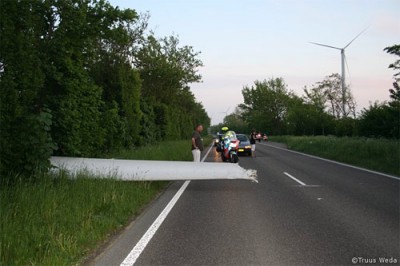
A while back we covered what the wind industry and its parasites call “component liberation” in our post – Life in the “throw zone” which included video of a Vestas’ turbine “liberating” its components.

That led to a retort from an employee from AGL’s Macarthur wind farm disaster – calling himself “Prowind” – about the exploding turbine – “that turbine in the video is not accident, they purposely let it self destruct.  That is NEVER going to happen at MacArthur.”

We dealt with “Prowind” in our post – Logic: not found on other planets?– which included a serious scientific study into the distances blades are likely to travel during “component liberation”.  The study dealt with over 37 “component liberation” events, recording blade throw distances of up to 1,600 m.
turbinedutchbladeaccident

And we covered a turbine liberating its components in a schoolyard at Caithness, Scotland in this post: Remember the days of the old school yard?

We also covered – yet another component liberation – in our spoof post –IWTs or WMDs?

The obvious irony and sarcasm in that post was lost on greentards – a humourless bunch at the best of times – which prompted us to explain the difference between the literal and the figurative – in this post – It’s all about the costs, stupid.

turbine blade donegal

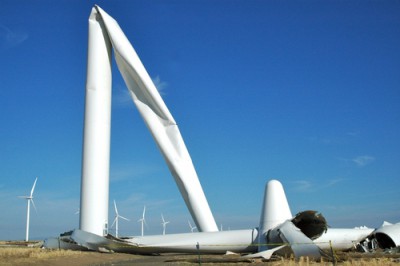
Not only are giant fans determined to “liberate” their blades all over the countryside, schools and homes, these friendly little puppies are just as keen to collapse, laying waste to anything in their path.

IMG_6772

Here’s a wrap up from the UK on the terror and havoc being caused by collapsing turbines.

The scandal of UK’s death-trap wind turbines:
The Mail on Sunday
Simon Trump
14 September 2014

A turbine built for 115mph winds felled in 50mph gusts. Dozens more affected by cost-cutting. Why residents living in their shadow demand to know – are they safe?

  • Health and Safety Executive release reports on collapsed wind turbines
  • Causes were manufacturing faults and basic installation mistakes
  • Campaigners believe the risk of turbines collapsing will continue to grow

It was just before midnight on a winter’s night last year. Outside in the gusting January wind it was freezing, but Bill Jarvis was sitting by the fire with his wife Annie and a few relatives in their cottage on the North Devon moors.

And that’s when they heard it: a tremendous ‘crack’, louder than a thunderclap.

‘We rushed outside wondering what on earth had happened,’ recalls Bill. ‘We thought perhaps a plane had crashed it was such a loud noise. ‘We couldn’t see flames or anything burning, even though we peered out in the direction it had come from. There was nothing else though, no more noise or aftershocks.’

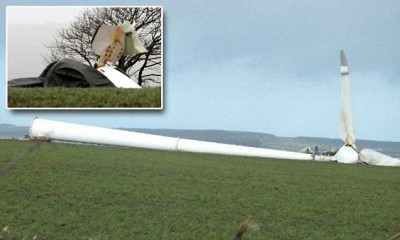
Deafeningly loud it might have been, but what the Jarvis family had heard – as they were to discover the following morning – had taken place at Bradworthy, a mile away. It was the noise of a 115ft-high wind turbine crashing to the ground.
turbine collapse devon

‘It’s pretty terrifying stuff,’ says Mr Jarvis. ‘I’m no fan of the things and this has just added to my worries. Just think what could have happened. It sends a shiver down your spine.’

He is not the only one feeling nervous about the march of the giant metal windmills across the British landscape.

This week, the Health and Safety Executive (HSE) produced two reports – one into the catastrophic failure of the Bradworthy turbine and another into the collapse of a turbine in the next county, Cornwall, just three nights later.

And its conclusions are not merely unsettling, but have frightening implications for wind turbines and their safety right across the country.

The turbines in Devon and Cornwall came down when the wind was blowing at barely 50mph, despite the fact that they are supposed to withstand blasts of just over 115mph.

And, as the HSE concluded, the causes were manufacturing faults and basic mistakes in the way they were installed. The errors have already been replicated elsewhere in the country, as the two reports make clear, and could affect dozens – if not hundreds – more of the giant towers.

It is hardly encouraging to learn that the HSE reports were not published in a normal sense, but were available only on request and in redacted form.

They have come to light now only through Freedom of Information (FoI) requests lodged by a number of concerned residents.

Dr Philip Bratby, from CPRE Devon, believes the risk of collapse will continue to grow as long as the wind industry is allowed to operate behind a wall of secrecy.

A retired physicist, who formerly worked in nuclear energy, he says: ‘Safety standards in my line of work were paramount. We constantly monitored, tested and maintained equipment but this does not seem the case with turbines.

‘These two failures were catastrophic. The towers came crashing down with great force from a great height.

‘It was only down to luck it happened in the night and no people or animals were injured or killed.

‘The wind industry is very secretive about everything it does. It won’t publicise any definitive information about accidents so it is impossible to make an independent assessment of the risks.’

Dr Bratby lives at Rackenford, high on the edge of Exmoor, where there has also been a proliferation of turbines.

‘I am not convinced that we are learning from the bad experiences and feeding those lessons back into the education of designers and constructors because the industry is growing so rapidly,’ he says.

‘The size of these turbines seems to keep on increasing and I believe the dangers will increase accordingly. The bigger the turbine that fails, the bigger the potential for disaster and death.’

Turbine towers are supposedly secured by lowering them on to a series of foundation rods that emerge vertically from a concrete foundation.

These are levelled by the adjustment of bottom nuts below a flange at the base and then fixed with another set of nuts above the base.

All the exposed metal, including the rods and the nuts, is then encased in grout which protects it and spreads the stresses from any movement in the turbine.

Yet as these groundbreaking HSE reports show, not only were some of the parts faulty, two different sets of sub-contractors made the same basic – possibly cost-cutting – errors. And the result was that the metal monsters were not secure at all.

In the incident at East Ash Farm, Bradworthy, on January 27, 2013 – the one heard by Mr Jarvis – an E3120 model, made by Canadian-based Endurance, was found to have been installed with the wrong configuration of nuts at its base.

This upset the ‘loadings’, or balance, of the tower. The implication is that it wasn’t level. To compound the problem, the contractors who installed it had failed to use structural-grade grout to seal the rods and bolts from the worst of the weather and had used a ‘cosmetic’ compound instead.

The HSE reports reveal that the same faulty configuration of nuts had been to blame at Wattlesborough, near Shrewsbury in Shropshire, the previous year when another E3120 collapsed.

To date, Endurance has erected 300 of the E3120s throughout the United Kingdom.

The UK arm of the company says it has inspected all of them and carried out urgent repairs on 29 of the towers.

A different type of turbine fell at Winsdon Farm, North Petherwin, Cornwall, on January 30. This was a G133, manufactured by Gaia-Wind, originally a Danish firm.

This time there was a fault with the components, resulting in a failure in the foundation rods concreted into its base. But again, it had been badly installed with a lack of grout. As the HSE inspector concluded, there was ‘a lack of resilience to the fatigue loading within the securing arrangement… and poor fatigue strength in the securing components’.

The collapse of another G133 turbine at Otley, near Leeds, in April 2013 occurred in identical circumstances. Again, the securing rods were substandard. Once again, they had not been properly grouted in place.

As Dr Bratby points out, the footings and securings, which are difficult to inspect when encased in concrete and grout, are critical because they are subject to such huge and varying forces.

‘Over time they clearly degrade to the point of failure,’ he says. ‘We should be asking ourselves whether we are at a tipping point as the first-generation technology is exposed and compromised.’

Dr Bratby is frustrated at the lack of risk assessments undertaken when looking at sites.

He says: ‘I accept that the dangers from wind turbines located on farms without public access and remote from public rights of way are probably acceptable.

‘That is not always the case. They have been located close to roads and railways, at workplaces, in schools, hospitals and parks without any formal assessment of the dangers. I think that is unacceptable.’

His views are shared by fellow campaigner Alan Dransfield, from Exeter, who helped to mastermind the FoI application.

‘These reports took the best part of a year and several thousand pounds to compile, and the HSE decided to investigate because of the extensive media coverage and widespread public concern,’ Mr Dransfield says.

‘I’m delighted they did because look what they’ve found. Without doubt there is an urgent need for a more proactive stance with regard to the wind-turbine industry. It clearly can’t police itself.’

Taken together, there are 380 E3120 and GI33 towers. Of these, four are known to have collapsed, while repairs were necessary in 39 others to prevent potential further collapses.

Meanwhile, an as yet undisclosed number have further problems with the way they are bolted down, according to the HSE, and need repairing as soon as possible.

Revealing as they are, however, the two new reports deal with only a small minority of British turbines: there are 6,500 of differing design and manufacture across the country, and when it comes to problems with collapse or faulty installation, the public is wholly in the dark.

Figures from Caithness Windfarm Information Forum, a wind-turbine monitoring website, show that structural failure is the third most common major fault, behind blade failure and fire.

It has recorded an average of 149 accidents worldwide every year between 2009 and 2013 but believes this to be the ‘tip of the iceberg’ as it relies on scanning the internet for reports of such incidents.

‘The trend is as expected – as more turbines are built, more accidents occur,’ says a spokesman. ‘The numbers will continue upwards until the HSE helps force significant change.

‘In particular, the public should be protected by declaring a minimum safe distance between new turbine developments and occupied houses and buildings.’

However, Chris Streatfeild, director of health and safety with Renewable UK, the industry trade association, believes that any fears of wind power are unfounded and the risks minimal and acceptable.

‘Manufacturers, installers and owners work hard to ensure that they meet extremely stringent health and safety standards,’ he says.

‘There’s a rigorous process, verified by independent bodies, to ensure strict installation standards and safe siting. That’s why problems are so rare.’

He adds: ‘When incidents do occur, it’s important to learn from them and implement any lessons fully and promptly. Any serious incident has to be reported to the HSE and we work closely with them to ensure high standards are maintained.

‘To put this into its proper context, no member of the public has ever been injured by a wind turbine. It’s unfortunate a handful of anti-wind campaigners are choosing to indulge in scaremongering.

‘Climate change is a real and pressing issue. When it comes to generating clean electricity, onshore wind is the most cost-effective way so we should be making the most of it.’

Meanwhile, at North Petherwin, the fallen wind turbine has now been resurrected. Indeed, landowner and Liberal Democrat councillor Adam Paynter has installed a second one alongside it. Mr Paynter declined to comment when contacted by The Mail on Sunday.
At Bradworthy, farmers Des and Vera Ludwell were also staying quiet about their windmill. A new turbine stands in the position of its collapsed predecessor, about 50 yards from the road. A second one is even closer, leaving little safety margin.

Councillor David Tomlin revealed there are 50 turbines within a six-mile radius of Bradworthy, a quiet market town, and a further 20 have been approved.

‘We are not anti-wind power as such,’ he says. ‘But there is a visual intrusion and residents who live close to turbines report a constant whooshing noise from blades. Most importantly, can we still be certain they are safe?

‘What happened here and in Cornwall and analysed in detail in these two reports should be a wake- up call. Perhaps we should halt the erection of further turbines pending an investigation of the industry as a whole.’
The Mail on Sunday

Wind power: ludicrously expensive; totally unreliable; utterly pointless and insanely dangerous – what’s not to like …
turbine collapse 9

Allegany Wind Project….Officially Dead! Wonderful news for the Community!

Allegany wind project officially dead! 

Posted: Wednesday, September 10, 2014 11:18 am

ALLEGANY — Close to eight years of legal battles, community upsets and neighbors bickering with neighbors over a proposed 29-turbine wind project in the town of Allegany came to an end Tuesday.

The final nail in the coffin of the proposed EverPower Wind LLC project in the Chipmonk and Knapp Creek areas was hammered when the Allegany Town Board unanimously voted to rescind the wind overlay district.

“It’s been a long time coming, and I’m glad this is over,” said Chipmonk resident Karen Mosman after the meeting. “But I’m in shock — is it real?”

The vote came at the beginning of Tuesday’s regular meeting in the Allegany Senior Center on Birch Run Road. The room was three-quarters full of residents who sat quietly as Town Supervisor John Hare read through a 25-page State Environmental Quality Review form and zoning map amendment to rescind the wind overlay district. The form listed a number of issues that will not be affected by rescinding the overlay district, such as geological features, air, plants and animals, agricultural resources, aesthetic resources, transportation, energy and human health. The board agreed with each of the 13 issues reviewed before voting unanimously on a “negative declaration regarding the removal of the wind overlay district.”

The action brought applause from the audience.

The board then voted unanimously on another motion to adopt an ordinance that rescinds the wind overlay district created by town board members on Aug. 29, 2011, which brought another round of applause.

When an older member of the audience asked Mr. Hare to explain exactly what had transpired the town supervisor replied, “Basically by the two actions we took tonight, this rolls back or eliminates the overlay district created approximately three years ago.”

“Thank you very much,” responded a woman in the audience before everyone got up to leave.

The board was asked to decide on the matter in June after the Allegany Town Planning Board recommended that the wind energy overlay district be rescinded. Their recommendation came three months after the New York State Supreme Court dismissed an appeal filed by EverPower against the planning board.

Following the dismissal, EverPower relinquished its rights to build a wind farm in the town of Allegany. The company had planned to build the $160 million wind farm after it was given the go-ahead for the project by the previous town board. The project fell through after three years of legal struggles with the town and Concerned Citizens of Cattaraugus County.

Residents who included Kathy Boser, president of Concerned Citizens, wanted to see the overlay district rescinded because the planning board had indicated that another developer could potentially step in and use the zoned parcel for a new wind-turbine project.

Following the meeting, Mrs. Boser said she and others in the community were grateful for the actions of the town and planning boards.

“Now that it’s rescinded, any (wind company) could come back in, but they’d have to start over again,” she said. “I think there were some lessons learned from this one and I think the boards will be better prepared.”

Concerned Citizens member Gary Abraham agreed with this thought and declared, “It’s over for any (proposed) wind farm in Allegany.”

Allegany resident and businessman Dennis Casey said he was “thrilled” with the outcome.

“We’ve had time to anticipate this,” he said in commenting on the relatively quiet response from the audience during the vote.

Others who commented included Mrs. Mosman’s husband, Ray, who said he hopes the action will help the community heal.

“I think this is done; it’s been a long haul and a heck of a burden off our shoulders,” Mr. Mosman said. “But I think now is a time of healing, because this made enemies out of friends.”


(Contact reporter Kate Day Sager at kates_th@yahoo.com)


All of the Negativities of Wind Turbines are Hidden or Denied…check this out!

Safety fears after faults found in toppled turbines

By Western Morning News  |  Posted: September 07, 2014

By Phil Goodwin

turbs

A collapsed turbine

Comments (2)

Safety concerns have been raised about the wind energy industry after reports showed two Westcountry turbines collapsed because of faults.

The giant masts crashed down on farmland amid initial rumours of sabotage and claims they had fallen victim to severe weather.

Documents obtained by the WMN on Sunday have revealed that the towers actually toppled over due to defects and mistakes in the construction process.

A 115ft (34 metre) mast at East Ash Farm, Bradworthy, in Devon, tumbled in January 2013, prompting claims of foul play from the local parish council.


Around the same time, a 60ft (18-metre) tower sited at Winsdon Farm, North Petherwin – the family farm of Liberal Democrat Cornwall Councillor Adam Paynter – also came loose from its moorings and fell.

Subsequent investigations by both manufacturers identified further defects and prompted warnings to other sites, including in Somerset, Devon and Cornwall.

Glasgow-based Gaia Wind wrote to owners and overhauled its entire first generation fleet.

Canadian firm Endurance Wind Power said it was also concerned about machines on dozens of locations.

Initial reports suggested high winds may have been responsible for the failures but restricted reports by the Healthy and Safety Executive (HSE), obtained under the Freedom of Information Act (FoI), have blamed the way the towers were secured.

Specialist inspector Darren Nash concluded that the first generation model of the turbine sited in Cornwall appeared “susceptible to fatigue failure” and said Gaia Wind had found “ten units with existing defects” out of the company’s 70 or 80 turbines.

“A plan of remedial actions is in place to address these units,” he wrote.

Endurance Wind Power, makers of the E3120 turbine which fell in Devon, identified a further 29 turbines that might have been affected by a problem with the foundations.

Mr Nash said it had fallen because Dulas – the installation company – had used “cosmetic grout” to cement the structure in place and not the “prescribed” substance.

On his visit to the site on May 8, more than three months later, he also noted that the turbine had already been “re-instated using the original anchor bolts and studs.

He added that “no evidence remained to assist investigation”, recommending that Edurance improve its quality assurance procedures.

Dr Philip Bratby, a retired nuclear scientist and spokesman for the Campaign to Protect Rural England, said several wind turbines in Devon were sited much too close to roads and factories and “pose a real threat to the public”.

“It is not the responsibility of the Health and Safety Executive at the planning stage – they can only get involved after an incident occurs,” he added.

“It has been apparent to me for a long time that most developers of wind turbines and wind farms do not do a proper assessment of safety and of the risks to the public from wind turbines and none of them have acceptable quality assurance procedures in place.”

Alan Dransfield, a campaigner based in Exeter, who visited the Devon site days after the incident and later secured the two reports, said he was “disappointed”.

He criticised the response from the HSE, which rather than publish their findings, said the documents were not available in electronic form then only released the papers after a formal FoI request.

“These wind turbines which collapsed were unsafe and unfit for purpose,” he added.

“We should not have to resort to Freedom of Information Act to find this out.

“The root causes were not high winds but poor design, inferior materials and a systemic failure through the chain of command.”

Martin Paterson, spokesman for Gaia-Wind, said:

the firm and its reselling agents inspected all “first generation” towers, which were designed to the “prevailing engineering standard of the time”.

“This standard was superseded in early 2011 and this tube tower design is no longer available for sale or installation,” he added.

“Our second generation towers are designed to current industry standards reflecting the development of more demanding design protocols in this field.”

Dulas declined to comment on the findings.

Read more: http://www.westernmorningnews.co.uk/Safety-fears-faults-toppled-turbines/story-22887067-detail/story.html#hTGPwKsugFcxR9xK.99#ixzz3Cdt98cM9

Oh My…Enercon Floundering? What a Shame! Subsidies end….Turbines NOT Sustainable!

Brazil Tax Exemption Removal Curbs Wobben’s Wind Turbine Orders

Enercon GmbH’s Wobben Windpower is losing contracts in Brazil after tax authorities canceled some exemptions for wind turbine manufacturers in the country, an official said.

The Brazil unit of Germany’s Enercon had a single customer so far this year, Mathias Moser, a vice president of Wobben, said in an interview yesterday in Rio de Janeiro. The company had considered leaving South America’s fastest-growing market after Brazilian tax authorities in April removed a tax incentive and required turbine makers such as Wobben, Spain’s Gamesa Corp., Tecnologica SA and Denmark’s Vestas Wind Systems A/S to pay back taxes for the exemption.

“This is definitely a restructuring year for us in Brazil,” said Mathias, who came to the country in April amid a management change.

Enercon, based in Aurich, Germany, decided to stay in Brazil last month after filing an appeal on the tax incentive ruling, according to Mathias. He didn’t disclose how much the company owes in back taxes. Brazil is seeking the previous five fiscal years of back taxes for the exemption.

“We have always produced in Brazil, so we have had the benefit for many years,” Mathias said. “It is a lot of money.”

Wobben started manufacturing turbines in Brazil in 1995, the first turbine maker to install a facility in the country. It has four facilities in the country, and has the capacity to produce as many as 200 turbines at its Sorocaba plant in Sao Paulo state. In its sole contract this year, the company delivered 23 turbines for Elecnor SA of Spain’s wind park in southern Brazil.

“It is a drop from last year’s,” Mathias said, without specifying 2013 deliveries.

Turbine Talks

Brazil’s Ministry of Finance is considering reinstating the tax exemption for turbine makers, according to Elbia Melo, president of the country’s wind power association known as Abeeolica.

“The wind industry is facing problems with the government’s special incentive plan for the equipment manufacturers and it is relevant to solve it,” Melo said in a phone interview from Sao Paulo. “We are in talks with the government.”

The Ministry of Finance’s press office said it does not comment on potential rule changes.

Wind energy in Brazil is among the cheapest sources of power. The country has the biggest capacity in Latin America, according to a Global Wind Energy Council report of 2013.

Wobben is optimistic about winning its appeal in court, according to Mathias.

“We are staying, given the good prospects for the Brazilian market,” said Mathias. “The size of the company’s business in the country can be affected if we don’t sign contracts in the future.”

To contact the reporter on this story: Vanessa Dezem in Sao Paulo at vdezem@bloomberg.net

To contact the editors responsible for this story: Reed Landberg at landberg@bloomberg.netRobin Saponar, Carlos Caminada

  • SSE and Centrica have Cancelled Economically Unfeasible Big Wind Projects! Check this out!

    Funding boost will help fuel SSE joint venture


    A JOINT venture between energy giant SSE and Intelligent Energy which is developing technology to change the way domestic energy is generated and consumed has received £800,000 in fresh funding.


    Bellshill-based IE-CHP will use the latest funds from its backers, which also include the Scottish Investment Bank, to develop its mini power station or smart power unit prototype.

    It says the fuel cell technology, which works alongside existing heating systems, has the potential to reduce the fuel bills of millions of home owners.

    The technology takes mains gas and converts it into hydrogen, which is then fed into a hydrogen fuel cell stack. The cell then acts like a mini power station by converting the hydrogen into low-cost electrical power and heat, which can be used in the home.

    IE-CHP technical director Mark Bugler, who hopes to start rolling out the technology in 18 months, said the latest funds will allow it “to finish some of the development work we are doing”.

    He noted: “We’ve got some political lobbying to do to get a fuller understanding really of the potential for fuel cells. Certainly on the technology side, it [the funding] helps.

    “This is really the start of the journey to get the whole of the UK excited about the potential for what ultimately is the best form of using a gas in a chemical process, rather than burning it.”

    The funding boost, which takes the total raised by IE-CHP to £5 million, coincides with research suggesting the installation of millions of mini power stations could transform the UK power market.

    A report by Ecuity, the energy analyst, claimed the roll out of five million fuel cell smart power units across the UK by 2030 would generate annual energy bill savings of £1000 for five million consumers.

    It is understood smart units are significantly more efficient than power stations, where energy is lost through production and transmission. More than 80,000 smart power units have been installed in Japan, which plans to roll out 5.3 million by 2030 as it replaces nuclear power with fuel cells.

    Mr Bugler said: “We see this as part of the UK energy mix for the future. At the moment you have got centralised power stations, which generate electricity at less than 50 per cent efficiency.

    “By decentralising power and putting power stations at the homes, rather than centrally in the country, you avoid all the emissions plus all the losses and extra cost of upgrading and maintaining the network.”

    He added: “SSE and Centrica have announced cancellation of their big wind farms because the economics don’t stack up. There will have to be some other low carbon technology which replaces that. We think fuel cells is probably that technology.”

    Industrial Wind Projects are Falling Out of Favour, and for Good Reasons!

    As the tide turns on wind farms in Northumberland, we look at what is causing the wind of change

    A growing number of wind farm proposals in Northumberland are being refused amid an apparent turning of the tide…

     
    Wingates in Northumberland where a wind farm community fund has not been set up as agreed with wind farm developers.

    You don’t have to go back too far to a time when you couldn’t open The Journal without reading about residents Northumberland begging for mercy from an onslaught of wind turbines.

    People in the county adopted a siege mentality as figures time and again proved that they were being made to live with more wind farms than elsewhere in the country. Planning application after planning application seemed to be nodded through despite their desperate pleas.

    Indeed new figures from Northumberland County Council show that the authority has approved 80 out of 98 wind related proposals in the last three years.

    In 2012, Dr James Lunn, who was involved in a fight to halt plans for generators near his Fenrother home, not far from Morpeth, said: “We need both a national and Northumberland policy to protect settlements, because we can’t rely on the county council planning department to protect us.

    “They seem to believe there is no upper limit for the number of wind farms that can be considered.”

    Back to the present and the wind of change seems to have blown through the whole vexed issue on onshore wind.

    Only recently proposals for wind turbines at Dr Lunn’s village, at a site close to the Duddo Stone Circle and Flodden battlefield have been rejected or approvals quashed.

    And the brakes are being applied by the Government, namely the Department of Communities and Local Government.

    Another scheme at Rayburn Lake has also been recommended for refusal by council officers although a decision has been deferred.

    But what is behind the turning tide? Is it a recognition that Northumberland has had enough as residents would argue?

    Or is it as a growing number of commentators in the industry believe, politics at play?

    Many believe that the DCLG and its boss Eric Pickles is acting out of a desire to appease rank and file Conservative voters, who rightly or wrongly are associated with an anti-wind stance.

    The minister created the new planning guidance, so sought by Dr Lunn, which decreed that the importance of renewable energy should not automatically override the views of communities.

    Mr Pickles himself issued the final say on appeal decisions – including Fenrother and the Flodden scheme – in order to ensure that guidance was being followed.

    Those behind the wind farms are becoming used to disappointment.

    Jennifer Webber, spokesman for RenewableUK, the self proclaimed voice of wind energy, said: “The vast majority of people in the North East support more onshore wind with polling last year finding that three quarters of people in the North East would support more wind farms in the area they live.

    “Polling consistently shows that people are in favour of onshore wind, so it’s unfortunate that the secretary of state for communities and local government is trying to block schemes, based on a misguided belief that such an approach will be popular with voters.

    “Each megawatt of installed onshore wind brings in £100,000 of income to the local community over its lifetime, and it’s a shame communities are missing out on this.”

    The organisation’s claims about the popularity of wind will no doubt surprise its opponents in the wide open spaces of the North East.

    The claim that Mr Pickles is seeking to appease his voters is disputed by one Conservative in Northumberland.

    Longhorsley Councillor Glen Sanderson at Wingates in Northumberland where a wind farm community fund has not been set up as agreed
    Longhorsley Councillor Glen Sanderson at Wingates in Northumberland


    County councillor for Longhorsley Glen Sanderson, who was a vocal opponent of the Fenrother scheme, said: “I think that would be far from the truth, it is not just Conservative voters who feel strongly about the impact that wind farms have on our very sensitive parts of the country.

    “It is not just Conservatives, it is visitors to our county and people who enjoy the beauty around them.

    “It is not a political point at all.”

    The councillor believes, not unsurprisingly, that his minister, has accepted the argument often made in Northumberland that the perceived desecration of the countryside must stop.

    “It is a question of getting to grips with reality and understanding we only have one beautiful countryside and that government has a duty of ensuring that natural beauty is preserved.

    “The government have listened to the people, not just Conservative voters.”

    Dr Lunn feels the government is partially motivated by the desire to “win votes.” Yet he also believes the wind of change is inspired by acknowledgement that turbines are not benefiting the environment or the economy.

    “I think there is a current nail in the coffin for large scale onshore wind farms both at local level and at national level.

    “Both for political reasons in winning votes but also for the sheer fact is it not helping the country’s economy.

    “Wind power was sold on the fact it was sustainable for the environment but it does not provide sustainable communities if not everyone likes it.

    “It does not provide a sustainable economy if not everyone can afford it.

    “It is no longer a sustainable green form of energy. Regardless of which political party is in power they can not argue it is a sustainable way to take the country forward.”

    Dr Lunn does not fear a revival in the wind industry under a different government.

    “I am not particularly concerned, it is seen as a vote winning policy. These things take five years from start to finish, regardless of who wins the next election you have got to look five years into the future.”

    The Labour party has indicated it would allow decisions on planning applications to be made at local level if elected, hitting out at the Conservatives for allowing so many decisions to be made by the government.

    The party believes this “reverse localism” could come back to bite Northumberland in the fracking debate.

    Councillor Scott Dickinson, the new County Council Business Chair for Northumberland, at County Hall, Morpeth


    Scott Dickinson, a party county councillor in Northumberland and parliamentary candidate for Berwick, said: “I’m uncomfortable that a Conservative secretary of state is making decisions about what’s best for North Northumberland rather than local people.

    “Northumberland Conservatives seem to be happy to allow ‘reverse localism’ but I’m worried that this is a precursor to the ‘fracking debate.’

    “If a secretary of state is intervening to halt planning applications for wind farms then what happens when communities want to stop ‘fracking’ in their backyard when its government policy to support ‘fracking’?

    “Will he intervene to overrule local concerns.”

    Coun Sanderson however argued the government has shown it will listen to local people on wind and would similarly do so with fracking.

    Villagers from Fenrother, near Morpeth, celebrate plans for a Wind Farm at the village being refused
    Villagers from Fenrother, near Morpeth, celebrate plans for a Wind Farm at the village being refused


    “You just need to go back to a recent one in Fenrother where thousands of people were prepared to put their names against that proposal.

    “If the same thing happened in Northumberland about fracking, I think the government would be forced to consider their position on that as well.

    “I am absolutely convinced that localism has a part to play in all planning matters and I think the government has shown they have listened in their change of line on onshore wind farms.

    “Otherwise they can not be a directly responsible government.”

    In addition to the potential for fracking, Dr Lunn believes the loss of momentum could see an increase in applications for solar power, with a preliminary application for 160 acres at Bellingham already lodged.

    Yet he believes wind will remain in the mix through small projects of one or two generators and domestic farm turbines, which he feels will became even more prevalent as doubts grow among landowners over large schemes.

    Spain’s Failed Green Energy Experiment….Another Case Study from Institute for Energy Research

    Spain’s Green Energy Experiment

    AUGUST 27, 2014

    The Institute for Energy Research released today a case study on Spain’s failed green energy policies. This is the second entry in a series of case studies on Europe’s green energy disaster (click here to read IER’s case study on Germany).

    For years, President Obama has pointed to Europe’s energy policies as an example that the United States should follow. However, those policies have been disastrous for countries like Spain, where electricity prices have skyrocketed, unemployment is over 25 percent, and youth unemployment is over 50 percent

    IER’s study found:

    • In 2000, Spain began a new program to subsidize renewable energy with the passage of its “Promotion Plan for Renewable Energies.”
    • Spain’s feed-in tariffs have created a “rate deficit” amounting to $41 billion (about $850 per person).
    • In 2011, Spain’s domestic electricity prices (including taxes) amounted to 29.46 U.S. ¢/kilowatt-hour (kWh), nearly 2.5 times more than U.S. prices.
    • Spain’s electricity prices increased by 92 percent from 2005 to 2011.
    • Rising energy costs hit low-income Spaniards the hardest–driving them into energy poverty
    • Despite myriad renewable subsidies and mandates, Spain’s CO2 emissions increased by 34.5% from 1994-2011.

    Click here to read the full case study.

    Click here to read IER’s previous study on Spain by Dr. Gabriel Calzada Alvarez.