Open Submission by Carmen Krogh, regarding the ERT for Niagara Region Wind Corp.

By Carmen Krogh, BScPharm
May 25, 2015
To Whom It May Concern
Re: ERT Case No. 14-096 ENVIRONMENTAL REVIEW TRIBUNAL IN THE
MATTER OF an appeal by Mothers Against Wind Turbines Inc and Renewable
Energy Approval No. 4353- 9HMP2R issued by the Director, Ministry of the
Environment, on November 6, 2014 to Niagara Region Wind Corporation.
This Commentary is public and may be shared.
I declare no potential conflicts of interest and have received no financial support with respect
to the research and authorship of this Commentary.
1. ERT Case No. 14-096 states the onus on the Appellant:
[8] Pursuant to s. 145.2.1 of the EPA, the onus is on the Appellant to establish that
engaging in the Project in accordance with the REA will cause serious harm to human
health and/or serious and irreversible harm to plant life, animal life or the natural
environment. (Page 4)
2. The ERT dismissed the Appeal:
[9] For the reasons that follow, the Tribunal finds that the Appellant has failed to meet
either the Health Test or the Environmental Test and has not established the necessary
elements of a s. 7 Charter violation and, therefore, the appeal is dismissed. (Page 4)
3. Ms. Shellie Correia, mother of Joey, testified during this ERT and provided a letter from
her son’s specialist, a Behavioral Pediatrician.
Joey has been under the specialist care for 8 years and is diagnosed with a “Sensory
Processing Disorder”.
Excessive, uncontrollable noise can lead to sensory overload and Joey’s specialist noted
that Joey “is exceptionally more vulnerable”.
With respect to his condition, the specialist states “Wind turbines concern me, given my
strong knowledge of neurobiology.”

4. Other members of the community testified regarding their concerns associated with
children being exposed to IWTs while at home, at school (or both), or while visiting.
5. Ms Correia provided additional citations such as Joey’s Individual Education Plan in
support of his risk factors and that of children in general. See the Appendix below.
6. Ms Correia has advised Premier Wynne, Energy Minister Chiarelli, the Approval Holder
and the project manager, and many others in an effort to protect her son and other
children from harm.
7. Several 3 MWatt IWTs will be in close proximity, with one of the turbines 550 metres
from the family home.
8. Joey and other children will have to travel past transmission lines while attending school
and for other purposes.
9. In its Decision, the ERT states:
[119] In response to Ms. Correia’s concerns about the impact of noise on her son who
has “developmental issues, including ADHD, anxiety and serious processing issues
(mainly, but not exclusively aural)”, Dr. McCunney said that he is unaware of any
scientific literature that suggests that wind turbine noise would adversely affect the
health of a child with these developmental disorders. (Page 28)
10. Dr. Robert McCunney testified on behalf of the Approval Holder. His qualification states:
[95] On agreement of the parties, Dr. McCunney was qualified by the Tribunal as a
medical doctor specializing in occupational and environmental medicine with
particular expertise in the health implications of noise exposure. He provided expert
opinion evidence on behalf of the Approval Holder. (Page 21)
11. Based on this qualification, indications are that Dr. McCunney was not appearing as a
Behavioral Pediatrician, specializing in assessment and care of children with
developmental and mental health problems.
12. Regarding noise in general, the World Health Organization has identified the fetus,
babies, children and youth including those with pre-existing medical conditions and
special needs as a vulnerable population group.
World Health Organization, Children and Noise, Children’s Health and the
Environment, WHO Training Package for the Health Sector, http://www.who.int/ceh

Commentary ERT Case No. 14-096
By Carmen Krogh, BScPharm, May 25, 2015
Any errors or omissions are unintended.
13.
Another WHO reference relating to children states:
Noise is an underestimated threat that can cause a number of short- and long-term
health problems, such as for example sleep disturbance, cardiovascular effects, poorer
work and school performance, hearing impairment, etc.
World Health Organization Noise Facts and Figures
health/noise/facts-and-figures
14.
Stansfeld and Matheson (2003) state:
It is likely that children represent a group which is particularly vulnerable to the non-
auditory health effects of noise. They have less cognitive capacity to understand and
anticipate stressors and lack well-developed coping strategies. Moreover, in view of
the fact that children are still developing both physically and cognitively, there is a
possible risk that exposure to an environmental stressor such as noise may have
irreversible negative consequences for this group…
Stephen A Stansfeld and Mark P Matheson (2003), Noise pollution: non-auditory
effects on health, British Medical Bulletin 2003; 68: 243–257 DOI:
10.1093/bmb/ldg033
Additional citations on children’s risk factors from exposure to noise in general are available.
Conclusion
Research indicates the fetus, babies, children and youth including those with pre-existing
medical conditions and special needs are a vulnerable population group to the effects of noise
exposure in general.
The specialist who has diagnosed and treats Joey states:
I, as a “normal brain” (or typical brain) individual would not want this risk to my
mental health (or my children’s) in my neighbourhood. The placement of these
devices must be thoughtful and, of course, “first, do no harm.”
And that:
In a developed society like Canada, we must advocate and protect the most vulnerable
members. Joey, and all our children deserve our thoughtful and ethical best.
Commentary ERT Case No. 14-096
By Carmen Krogh, BScPharm, May 25, 2015
Any errors or omissions are unintended
4
The World Health Organization comments it is not necessary to wait for full scientific proof
before taking action:
…where there is a reasonable possibility that public health will be damaged, action
should be taken to protect public health without awaiting full scientific proof.
World Health Organization, Guidelines for Community Noise, WHO (1999).
The Policy Interpretation Network on Children’s Health and Environment comments on the
precautionary principle:
Policies that may protect children’s health or may minimise irreversible health effects
should be implemented, and policies or measures should be applied based on the
precautionary principle, in accordance with the Declaration of the WHO Fourth
Ministerial Conference on Environment and Health in Budapest in 2004.
Report WP7 Summary PINCHE policy recommendations Policy Interpretation
Network on Children’s Health and Environment (PINCHE) Policy Interpretation
Network on Children’s Health and Environment QLK4-2002-02395
The Council of Canadian Academies Panel states in its assessment of IWT noise:
…that there is a paucity of research on sensitive populations, such as children and
infants and people affected by clinical conditions that may lead to an increased
sensitivity to sound.
Council of Canadian Academies (2015) Understanding the Evidence: Wind Turbine
Noise, The Expert Panel on Wind Turbine Noise and Human Health, Executive
Summary, Page xvii.
This raises the question whether Appellants and concerned families will be expected to wait
until children-based research demonstrates that “engaging in the Renewable Energy Project
in accordance with the Renewable Energy Approval “will cause serious harm to human
health” (“Health Test”).
If so, are there any potential legal-ethical concerns?
Respectfully,
Carmen Krogh, BScPharm
Ontario, Canada
Commentary ERT Case No. 14-096
By Carmen Krogh, BScPharm, May 25, 2015
Any errors or omissions are unintended
5
Appendix: documents provided to the ERT
1.Open Submission on Risk of Harm to Children May 15/2013
2 Open submission on Risk of Harm to Children Dec 27/2012
3 Letter from Carmen Krogh, requesting help from PM Harper and Peter Mckay Re: UN
Rights of the Child.
4 Arline L. Bronzaft, Noise from Wind Turbines: Potential health Effects on Children.
5 Welfare of Children at Risk, Due to Wind Turbines, Parents Reporting.
6 Joey Correia’s Individual Education Plan
7 Letter from Dr. Calvert, Joey’s Specialist, Regarding Sensory Processing Issues.
8 Information about Auditory Processing Disorder – From Website, KidsHealth from
Nemours
8a Letter from Retired Special Education teacher, Susan Smith, Re: Children & Wind turbines
8b Letter from School Superintendent, William C. Mulvaney
9 Brett Horner’s Open letter to health Canada, (Discontinue Ongoing Experiments)
10 Dr. Sarah Laurie’s Concerns Re: Health Canada Study
11 Ways to Improve Future Health Studies – Multi-Municipal Wind Turbine Working Group.
12 “Critique on Infrasound Study”, by Jerry Punch
13 Dr. Maria Alves-Pereira on Vibro-Acoustic Disease
14 Canadian Journal of Rural Medicine – Industrial Wind Turbines, and Health Effects.
15 Summary of 21 Peer-Reviewed Articles on Adverse Health Effects, on IWT’s.
16 Mothers Against Wind Turbines…Call for a Moratorium.
17 Open Letter/Press Release from N.A.P.A.W.
18 Victim’s Statement’s, from Wind Victims Ontario
19 Letter to PM Harper and Peter McKay, Minister of Justice
20 Letter to Dr. Murray, and Dr. Weiss.
21 Letter to Premier Kathleen Wynne, May 6
22 Letter to Premier Kathleen Wynne, Apr. 18
23 Letter to Steve Klose, M.O.E.
24 Letter to Ombudsman, Andre Marin
25 Attempts to Speak with NRWC.
26 Speeches Read at Local and Regional Councils, to Appeal for Help

Wind Turbines are a Scourge on any Community, and People are Becoming Aware!

Greenwich concerned about wind turbines

Greenwich Neighbors United is hosting an event to educate residents about proposed wind park and let them voice their concerns.
AARON KRAUSE
JAN 17, 2015

As members of the Greenwich community learn more about the proposed wind turbine park, they are voicing their concerns about its potential impact on this peaceful and tranquil community. The case is pending before the Ohio Power Siting Board (OPSB), docket #13-990-EL-BGN.

Kay VanScoy, a long-time resident of Greenwich who recently turned 100, said, “I think they will be too close to Greenwich. I’ve heard from big dairy farms that have turbines close to them that they have lost 20 percent of milk production because of them.”

Dean and Carol Sheldon, community members on Greenwich-Milan Townline Road, said, “We were impressed that the OPSB granted OMEGA the application for rehearing after reviewing the hundreds of comments filed by citizens and state and local officials. It would seem appropriate that an entire review of the Ohio Wind Farm siting criteria should be undertaken before a decision is made affecting submitted plans for the proposed Greenwich Wind Farm development.”

Other residents of the community, Heidi Johnson, and Tim Williams, voiced concerns about the impact on Greenwich.

Heidi said, “We have a geothermal heating/cooling system in our home, so we are not against alternative energy. Eight years ago we became interested in erecting a wind mill on our property. We had a company come and give us an estimate. The cost was going to be $25,000 and they told us that it would generate about $35 per month in electric. At that point, we realized that windpower was not a good investment in this area because the system would never pay for itself.

“We believe that putting 900 families within one-mile of a wind turbine is not a wise move. In Europe and Australia, they are moving wind turbines further and further away from private dwellings. Since wind turbines have been in these countries much longer than in the U.S., it seems that they have learned that placing them close to homes can cause problems for families.” Tim added, “If this project is pushed through, we as a community will be negatively impacted in many ways. Personally, there will be a negative visual impact which will ultimately lead to a larger and more destructive issue, the reduction of our property values.”

In addition, Ginnie Robson, life-long resident of Greenwich said, “In my mind I have been comparing the turbines coming to our area to the time before the indoor smoking ban was made law in Ohio in November of 2006. People’s choice to smoke directly infringed on non-smoker’s rights and health. Both sides of the issue were deeply affected but only one side had a choice. Again, the citizens neighboring the huge industrial complexes being created have no choice on a matter that will impact their health as well as their property values.”

The young, the old, life-long residents and those new to the area have great concerns about the proposed wind turbine development.

Greenwich Neighbors United is hosting an event on Feb. 22 to educate more citizens about the proposed wind park and provide an opportunity to voice their concerns. The event will be take place at South-Central (K-8) School, from 5 p.m. to 7 p.m.

Hey! Right here! We are all so worried about where our electricity is going to come from? A nuclear power plant, coal fired or oil fired power plants. A wind farm, a solar farm, a hydro electric dam, geothermal… If you are receiving your electrical power from the grid, a lot of power has been already wasted before it gets to your house. Wasted in heat loss. Come on! I can create a device that can power your house without being connected to the grid. Almost zero power lost in the form of heat. This device can be modified and put in an automobile. With an electric motor, drive non stop. You could drive an Abrams Tank and not have to worry about MPG. Or you could drive a riding lawnmower and not have to worry about MPG. It is not a battery where you are limited to hours or miles driven. But something you could pass on to your children. Oil is dropping in price pulling global currencies down with it. Rely on this, rely on that. Everything is going to work itself out. People it will not work itself out. We have rode power generation into the ground. We need a new way to power our future. I have found a few alternative ways to generate electricity. Combustion free, no external forces needed, green energy. A closet size device, that would fit INSIDE your home or automobile, no POWER GRID. I am not afraid to say I can build this. I have lost multiple jobs, because of greener pastures. I want to create jobs and forge a new future for life past my own. Where is this affirmative action committee?

Battle with an outside company that wants to degrade your standard of living. Or create a device that changes the game of how you receive electricity and power your OWN future. No need to rely on a wind farm, a nuclear power plant, coal, or oil.

Wynne Government is Destroying Ontario, Tells Us, It Is “Good” for Us!

How green energy subsidies work: the government makes stuff up, then wastes billions of dollars while the economy bleeds jobs

Two items in the Toronto Sun caught my eye earlier this month, both written by Lorrie Goldstein about what the paper calls “the Wynne Liberals’ mad obsession with expensive and unneeded green energy.”  The first column is about a recent report published by Parker Gallant and Scott Luft of Wind Concerns Ontario, agrassroots organization that opposes wind turbines.

According to Wind Concerns Ontario, last month the provincial government spent over $1 billionmore for electricity than its market value.  The organization blames the government’s “rush to incorporate ‘renewable’ energy in the form of wind, solar, biomass, etc. into the grid, without a cost-benefit analysis” as the reason for rapidly increasing energy prices in Ontario.  And as Lorrie noted in his column the following week, whenever the “Liberals are called on the carpet over skyrocketing electricity prices in Ontario, they go into their patented, ‘but we eliminated coal’ routine.  Meaning they eliminated coal-fired electricity and replaced it with ‘clean’ energy sources such as solar and wind power.”

This makes no sense, according to Goldstein, who points out that coal-fired electricity generating stations supplied 25% of Ontario’s power needs in 2007 but wind and solar provide only 4% today.

Furthermore, according to the Fraser Institute, the 4% solar and wind provides accounts “for about 20 percent of the average commodity cost,” even though the Ontario Energy Board said last year that solar and wind would provide 7% of Ontario’s power and “their direct costs would account for about the same fraction of the average commodity cost.”

This wouldn’t be the first time that the government’s estimates were wildly off.  Dalton McGuinty promised in 2009 that the Green Energy Act would create 50,000 jobs by the end of 2012, but as Lorrie Goldstein wrote in the Sun last year, as of mid-2013 only 31,000 jobs had materialized.  Most of them were temporary (lasting only one to three years) and were “indirect” jobs, so even the claim that 31,000 jobs were created is difficult to verify.

To make matters worse, the figure of 31,000 did not take into account the jobs that would be permanently lost as a result of increased electricity prices.  A Fraser Institute report published last year found that the Green Energy Act “will not create jobs or improve economic growth in Ontario.” Lorrie Goldstein wrote that the 31,000 new jobs cost the economy 62,000 to 124,000 jobs in other sectors, as a result of high energy prices.

Such dismal results for government investments in green energy are not unique to Ontario, of course.

Consider, for example, this paper published in 2009 by researchers from the King Juan Carlos University in Spain.  The researchers found that for every “green job” created by the government, 2.2 jobs were lost elsewhere in the economy (note that this number falls into the range of Lorrie’s estimate).
The researchers also found that every green energy job created by Spain since 2000 cost the government, on average, 571,138 Euros.  The final cost of the Spanish experience with renewable energy subsidies is massive.   Between subsidies and higher electricity prices, tens of billions of Euros were lost.  The researchers also found that these enormous costs “do not appear to be unique to Spain’s approach but instead are largely inherent in schemes to promote renewable energy sources.”

It is unclear to me, therefore, what the Ontario Government expects its residents to gain in return for all the time and money poured into green energy projects.  Ontarians are paying outrageous electricity prices, jobs have been lost, and billions of dollars have been wasted – and all we have appeared to gain is a few kind words from ‘Saint’ David Suzuki, which is of no value to anyone.

Once Again….I have reached out to the Gov’t, to help My Son, and all Children!

November 10, 2014

The Right Honourable Stephen Harper

Prime Minister of Canada

Dear Prime Minster Harper,

I am writing to you, as supporter and friend of the

Conservative party. I am hoping that you will be able to intervene to help protect

all Canadians from intrusive health damaging  noise from industrial wind projects.

As you know, I have a personal interest in this issue. The large Niagara wind

project near my home has just received approval. It is no coincidence that its

approval was announced immediately after Health Canada Issued its flawed,

fraudulent report which claims it’s research sows that “there are no health

problems” from wind turbines

.

This Health Canada report was funded to the tune of $2.1 million from the

Canadian taxpayers, and therefore as Prime Minster, you are ultimately

responsible for it, and the consequences which flow from it’s use in Canada.

It is inevitable that many MORE Canadians will be harmed from wind turbine

noise as result of this study which has been widely criticized for adopting

methodology designed to hide and deny the health problems, rather than

properly investigate them. It is telling that

x   Health Canada ignored the advice of professionals with expertise in this

are who are independent of the wind industry

x   Health Canada used various parties who have conflicts of interest

including commercial conflicts of interest with the wind industry, and did

not disclose them

x   Health Canada issued the report without the date, making it impossible for

others with extensive experience working directly in this area, to critique it

properly

x   The report gives very appearance of being “made to order” by the wind

industry and delivered by our government, in order to be able to continue

to knowingly harm vulnerable Canadian citizens, by pretending “there is

no problem”

With respect other project just approved near my home, the closest wind turbine

would be 550M from the center of our home. The wind developer has admitted

that it would be producing noise, at the maximum allowable levels. These

decibel levels were arbitrarily established, and only with healthy brains, in mind.

There is no evidence to demonstrate that the current levels of noise pollution

from wind turbines in Ontario are safe, and there are Ministry of Environment

Field Officers who have admitted these levels are not safe. No consideration has

been given to individuals, who suffer from sensory processing issues, such as

my son, Joey.

Joey’s specialist wrote a letter for me to share, which is enclosed, explaining that

the noise from a  wind turbine in close proximity our home would be very

harmful, for my son. The cyclical, and uncontrollable nature of wind turbine noise

is especially unbearable.

I also have realized, during my struggles with the Provincial government, and

their many branches, that there has been nothing put in place to protect anyone,

regardless of what problems may arise, as result of the industrial wind projects

being forced into areas where they are not appropriate. I have met, and spoken

personally, to Premier Wynne, Minister Chiarelli, Agatha Garcia ­Wright, from the

M.O. E., and many more gov’t branches, trying to get some sort of assistance,

in finding a solution to my problems, but to no avail. Getting help Federally, is my

only option, at this point, because the only suggestion they would give me, is

“get a lawyer”. Unfortunately, I live in Ontario, and we are struggling to pay our

ever­ growing electricity bills, on top of sky­rocketing prices for the basics that

families need. Paying fora lawyer is not something many families can afford,

and the Liberal government knows that.

As you can see, I desperately need help to protect my son. The recent Health

Study was woefully incomplete, and did not even mention children, or any type of

special needs individuals. Indeed children were explicitly excluded.

Please help us find a solution to this very serious problem – for Joey, as well as

for ALL Canadians.This Health Canada Report, needs to be withdrawn, and

immediately subjected to rigorous peer review, with all of the data made public

immediately, to professionals and researchers with expertise in this area.

Reviews of all the possible conflicts of interest of all involved with this report, need

to be conducted, and made public.

A failure to take these steps, and to allow the Health Canada study to escape

proper critical scrutiny and peer review could eventually lead to charges of public

officials being complicit with torture occurring, given the widespread occurrence

of serious prolonged sleep deprivation alone, That, along with all the other health

problems residents are experiencing and health practicioners such as Joey’s

paediatrician are warning about. Such possible legal action against public

officials is being seriously considered internationally.

Sincerely,

Shellie Correia, Founder and Director,

Mothers Against wind Turbines

Wind Project Gets Go-Ahead….In Spite of Objections….

Province gives greenlight to wind farm Niagara region Wind Corp’s turbines to be largest in North America

Credit:  Grimsby Lincoln News | November 06, 2014

The Province has given the go ahead for a 77-turbine wind energy project in Niagara and Haldimand.

The Ministry of the Environment has issued a Renewable Energy Approval to Niagara Region Wind Corporation to construct a wind farm within the Townships of West Lincoln and Wainfleet, and the Town of Lincoln in the Region of Niagara and Haldimand County.

The facility is known as the Niagara Region Wind Farm.

As a result of comments received by the municipality and local residents a condition of the approval requires Niagara Region Wind Corporation to:

•   not construct or operate more than seventy-seven out of the eighty wind turbine generators identified in the approval

•   comply with the ministry’s noise emission limits at all times

•   carry out an acoustic emission audit of the sound levels produced by the operation of the equipment at five receptors

•   carry out an acoustic emission audit of the acoustic emissions produced by the operation of two of the wind turbine generators

•   manage stormwater, and control sediment and erosion during and post construction

•   develop and implement a pre- and post-construction ground water monitoring program

•   carry out specific items if foundation dewatering or water takings by tanker exceed 50,000 L/day

•   apply the Department of Fisheries and Oceans Operational Statement, if during construction, waterbodies that were previously not identified are discovered

•   design, construct and operate a spill containment facility for each of the Transformer Substations

•   implement the pre and post construction Natural Heritage monitoring program, which includes bird and bat monitoring

•   undertake the supplementary monitoring program discussed with Environment Canada and determine next steps as part of the program including the implementation of mitigation measures in response to any potential unanticipated adverse effects

•   ensure that activities requiring authorizations under the Endangered Species Act are not commenced until authorizations are in place

•   create a Community Liaison Committee with members of the public and applicant

•   undertake ongoing Aboriginal consultation and fulfill all commitments made by it

•   prepare a Traffic Management Plan to be provided to the upper and lower tier municipalities, and

•   notify the ministry of complaints received alleging adverse effect caused by the construction, installation, operation, use or retirement of the facility.

 A release by the Province stated that Ontario’s Renewable Energy Approval process ensures that extensive municipal, Aboriginal and public consultation takes place. All comments the ministry received regarding the project were carefully considered before a decision was made to approve this project. The approval notice is posted on the Environmental Registry and a link can be found here:

Ontario Residents Forced to Go To Court, To Challenge Wind Turbine Approval…

WIND TURBINES

Aberarder family challenges Suncor wind turbine approval

By Paul Morden, Sarnia Observer

Ontario’s Environmental Review Tribunal may just be the first stop for opponents of a 46-turbine wind project Suncor Energy plans to build in Lambton County.

The provincial government’s approval of Suncor’s Cedar Point renewable energy project is being appealed to the tribunal by Lambton County, and Aberarder Line residents Kimberley and Richard Bryce.

The Town of Plympton-Wyoming is also seeking to participate in the hearings.

The tribunal’s hearings are scheduled to begin in early November at the Camlachie Community Hall, with a preliminary hearing set for October.

The Bryce family is being represented by the Toronto-based law firm headed by Julian Falconer.

“They have four young kids and they’re just concerned about the possible health effects associated with having their young children living in close proximity to these wind turbines,” said Asha James, an associate of Falconers LLP.

She added the family’s concern is heightened by the fact Health Canada is currently studying the health impacts of wind turbines, “because there are data gaps, and there just isn’t enough research to show how these will affect families, or residents living in close proximity to these turbines.”

A notice of appeal filed on behalf of the family says it will be surrounded by eight turbines within 2.5 kilometres of the Bryce home, and adds that they have young children with “pre-existing health concerns that will be adversely affected by the project.”

The notice also says the appeal will argue the province’s approval of the Suncor wind project violates the Canadian Charter of Rights and Freedoms.

Falconer spoke in Camlachie back in May at a meeting held by the group We’re Against Industrial Turbines, Plympton-Wyoming.

Since then, the group has been collecting donations to fund court challenges of Suncor’s wind project.

James said Falconer has described appeals to the provincial tribunal as “a long shot.” The tribunal has rejected nearly all of the wind project approval appeals it has heard.

“But, at this point, we don’t see another option that’s available to them,” James said.

She added the only way to preserve the right to raise issues with the courts is to first go through the tribunal process.

James said the law firm has been involved in three previous appeals to the tribunal, and has appealed its decisions to the divisional court in London. Those appeals are to be heard Nov. 17, 18 and 19.

Lambton County is expected to raise concerns at the tribunal hearings about the wind project’s electricity collection and transmission lines along road allowances creating traffic safety hazards for the travelling public.

Suncor has said the turbines it’s planning to build in Plympton-Wyoming, Lambton Shores and Warwick Township could be up and operating by late 2015.

paul.morden@sunmedia.ca​

Residents Back In Court, to Protect Their Families & Homes Against Industrial Wind Projects!

Court asked to stop construction of huge Ontario wind farm pending appeal

Published on September 21, 2014
TORONTO – The first court phase of a legal fight aimed at scuttling what would be one of Ontario’s largest wind-energy developments kicks off Monday with a farm family trying to force an immediate stop to its construction.

Documents filed in support of their request show Shawn and Tricia Drennan are concerned about the potential harm the 140-turbine K2 Wind project near Goderich, Ont., could cause them.

The Drennans are asking Divisional Court for an injunction against the ongoing construction of the facility pending resolution of an appeal against the project. They note Health Canada is currently doing a study to understand the impact industrial wind projects have on nearby residents.

“In effect, our government has relegated the appellants to guinea pigs in the name of green energy,” their factum states.

“The fear and anxiety with being a guinea pig is only further heightened by the knowledge that the Ontario Ministry of the Environment has placed a moratorium on off-shore wind turbines because the environmental impact on the fish is not known.”

Joining them in the construction stay application filed in London, Ont., are the Dixon and Ryan families, who are fighting the 15-turbine St. Columban wind project near Seaforth, Ont. The Dixons argue construction noise will hurt their eight-year-old daughter, who suffers from hearing hypersensitivity.

Both K2 Wind Ontario and St. Columban Energy argue their projects are safe, have the required permits, and that stopping construction now would have serious financial consequences. The say the projects underwent an extensive approval process that included two years of planning and various environmental studies.

In its factum, K2 Wind says the appeal will be heard long before the turbines are operational, so there is no immediate health threat warranting a stay.

“In contrast to the lack of harm the appellants will suffer if this motion is not granted,” the company argues, “K2 Wind could suffer serious financial consequences from even a minor delay in construction — consequences that could put the entire K2 project at risk.”

Ontario has seen several fights over wind farms. Some citizens are implacably opposed to them on the grounds they make area residents and animals ill, are an eyesore, lower property values, and are pushing up the price of electricity. Premier Kathleen Wynne and her Liberal caucus were heckled this past week at the International Plowing Match in the hamlet of Ivy, Ont, in part because of opposition to Liberal pro-wind policies.

Proponents argue wind turbines provide renewable energy, are environmentally friendly, create economic benefits, and are safe provided minimum distances to homes are maintained.

The provincial Environment Ministry approved the $850-million K2 — which would be able to power 100,000 homes — and the smaller St. Columban project, prompting the families to appeal to the Environmental Review Tribunal, which upheld the approvals.

In its decisions, the tribunal found no conclusive proof that wind turbines — a few of which are roughly 500 metres from homes — pose a health hazard to those living near them.

The three families, along with a fourth family opposed to the 92-turbine Armow wind farm near Kincardine, Ont., joined forces to appeal the tribunal decisions. The families argue the approvals process violates their constitutional rights given the potential impact on their physical and emotional health and want the project permits yanked.

The appeal itself is expected before Divisional Court in mid-November.

An unrelated battle involving a nine-turbine wind farm development south of Picton, Ont., is set to go before the province’s top court in December.

Self-Destructing Wind Turbines…..a Brilliant Idea!

New Wave of Turbine Terror: Brits Brace as Giant Fans Keep Collapsing

TurbineBlade-OklahomaTornado

A while back we covered what the wind industry and its parasites call “component liberation” in our post – Life in the “throw zone” which included video of a Vestas’ turbine “liberating” its components.

That led to a retort from an employee from AGL’s Macarthur wind farm disaster – calling himself “Prowind” – about the exploding turbine – “that turbine in the video is not accident, they purposely let it self destruct.  That is NEVER going to happen at MacArthur.”

We dealt with “Prowind” in our post – Logic: not found on other planets?– which included a serious scientific study into the distances blades are likely to travel during “component liberation”.  The study dealt with over 37 “component liberation” events, recording blade throw distances of up to 1,600 m.
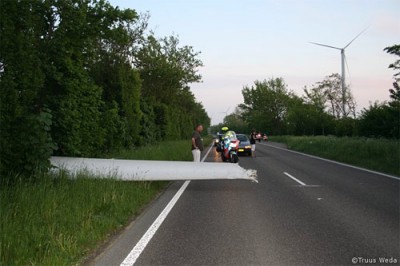
turbinedutchbladeaccident

And we covered a turbine liberating its components in a schoolyard at Caithness, Scotland in this post: Remember the days of the old school yard?

We also covered – yet another component liberation – in our spoof post –IWTs or WMDs?

The obvious irony and sarcasm in that post was lost on greentards – a humourless bunch at the best of times – which prompted us to explain the difference between the literal and the figurative – in this post – It’s all about the costs, stupid.

turbine blade donegal

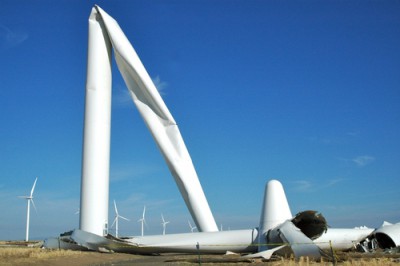
Not only are giant fans determined to “liberate” their blades all over the countryside, schools and homes, these friendly little puppies are just as keen to collapse, laying waste to anything in their path.

IMG_6772

Here’s a wrap up from the UK on the terror and havoc being caused by collapsing turbines.

The scandal of UK’s death-trap wind turbines:
The Mail on Sunday
Simon Trump
14 September 2014

A turbine built for 115mph winds felled in 50mph gusts. Dozens more affected by cost-cutting. Why residents living in their shadow demand to know – are they safe?

  • Health and Safety Executive release reports on collapsed wind turbines
  • Causes were manufacturing faults and basic installation mistakes
  • Campaigners believe the risk of turbines collapsing will continue to grow

It was just before midnight on a winter’s night last year. Outside in the gusting January wind it was freezing, but Bill Jarvis was sitting by the fire with his wife Annie and a few relatives in their cottage on the North Devon moors.

And that’s when they heard it: a tremendous ‘crack’, louder than a thunderclap.

‘We rushed outside wondering what on earth had happened,’ recalls Bill. ‘We thought perhaps a plane had crashed it was such a loud noise. ‘We couldn’t see flames or anything burning, even though we peered out in the direction it had come from. There was nothing else though, no more noise or aftershocks.’

Deafeningly loud it might have been, but what the Jarvis family had heard – as they were to discover the following morning – had taken place at Bradworthy, a mile away. It was the noise of a 115ft-high wind turbine crashing to the ground.
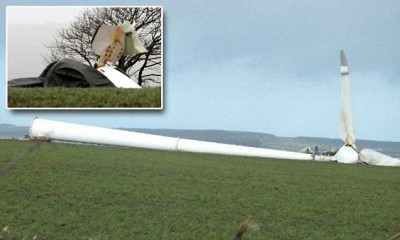
turbine collapse devon

‘It’s pretty terrifying stuff,’ says Mr Jarvis. ‘I’m no fan of the things and this has just added to my worries. Just think what could have happened. It sends a shiver down your spine.’

He is not the only one feeling nervous about the march of the giant metal windmills across the British landscape.

This week, the Health and Safety Executive (HSE) produced two reports – one into the catastrophic failure of the Bradworthy turbine and another into the collapse of a turbine in the next county, Cornwall, just three nights later.

And its conclusions are not merely unsettling, but have frightening implications for wind turbines and their safety right across the country.

The turbines in Devon and Cornwall came down when the wind was blowing at barely 50mph, despite the fact that they are supposed to withstand blasts of just over 115mph.

And, as the HSE concluded, the causes were manufacturing faults and basic mistakes in the way they were installed. The errors have already been replicated elsewhere in the country, as the two reports make clear, and could affect dozens – if not hundreds – more of the giant towers.

It is hardly encouraging to learn that the HSE reports were not published in a normal sense, but were available only on request and in redacted form.

They have come to light now only through Freedom of Information (FoI) requests lodged by a number of concerned residents.

Dr Philip Bratby, from CPRE Devon, believes the risk of collapse will continue to grow as long as the wind industry is allowed to operate behind a wall of secrecy.

A retired physicist, who formerly worked in nuclear energy, he says: ‘Safety standards in my line of work were paramount. We constantly monitored, tested and maintained equipment but this does not seem the case with turbines.

‘These two failures were catastrophic. The towers came crashing down with great force from a great height.

‘It was only down to luck it happened in the night and no people or animals were injured or killed.

‘The wind industry is very secretive about everything it does. It won’t publicise any definitive information about accidents so it is impossible to make an independent assessment of the risks.’

Dr Bratby lives at Rackenford, high on the edge of Exmoor, where there has also been a proliferation of turbines.

‘I am not convinced that we are learning from the bad experiences and feeding those lessons back into the education of designers and constructors because the industry is growing so rapidly,’ he says.

‘The size of these turbines seems to keep on increasing and I believe the dangers will increase accordingly. The bigger the turbine that fails, the bigger the potential for disaster and death.’

Turbine towers are supposedly secured by lowering them on to a series of foundation rods that emerge vertically from a concrete foundation.

These are levelled by the adjustment of bottom nuts below a flange at the base and then fixed with another set of nuts above the base.

All the exposed metal, including the rods and the nuts, is then encased in grout which protects it and spreads the stresses from any movement in the turbine.

Yet as these groundbreaking HSE reports show, not only were some of the parts faulty, two different sets of sub-contractors made the same basic – possibly cost-cutting – errors. And the result was that the metal monsters were not secure at all.

In the incident at East Ash Farm, Bradworthy, on January 27, 2013 – the one heard by Mr Jarvis – an E3120 model, made by Canadian-based Endurance, was found to have been installed with the wrong configuration of nuts at its base.

This upset the ‘loadings’, or balance, of the tower. The implication is that it wasn’t level. To compound the problem, the contractors who installed it had failed to use structural-grade grout to seal the rods and bolts from the worst of the weather and had used a ‘cosmetic’ compound instead.

The HSE reports reveal that the same faulty configuration of nuts had been to blame at Wattlesborough, near Shrewsbury in Shropshire, the previous year when another E3120 collapsed.

To date, Endurance has erected 300 of the E3120s throughout the United Kingdom.

The UK arm of the company says it has inspected all of them and carried out urgent repairs on 29 of the towers.

A different type of turbine fell at Winsdon Farm, North Petherwin, Cornwall, on January 30. This was a G133, manufactured by Gaia-Wind, originally a Danish firm.

This time there was a fault with the components, resulting in a failure in the foundation rods concreted into its base. But again, it had been badly installed with a lack of grout. As the HSE inspector concluded, there was ‘a lack of resilience to the fatigue loading within the securing arrangement… and poor fatigue strength in the securing components’.

The collapse of another G133 turbine at Otley, near Leeds, in April 2013 occurred in identical circumstances. Again, the securing rods were substandard. Once again, they had not been properly grouted in place.

As Dr Bratby points out, the footings and securings, which are difficult to inspect when encased in concrete and grout, are critical because they are subject to such huge and varying forces.

‘Over time they clearly degrade to the point of failure,’ he says. ‘We should be asking ourselves whether we are at a tipping point as the first-generation technology is exposed and compromised.’

Dr Bratby is frustrated at the lack of risk assessments undertaken when looking at sites.

He says: ‘I accept that the dangers from wind turbines located on farms without public access and remote from public rights of way are probably acceptable.

‘That is not always the case. They have been located close to roads and railways, at workplaces, in schools, hospitals and parks without any formal assessment of the dangers. I think that is unacceptable.’

His views are shared by fellow campaigner Alan Dransfield, from Exeter, who helped to mastermind the FoI application.

‘These reports took the best part of a year and several thousand pounds to compile, and the HSE decided to investigate because of the extensive media coverage and widespread public concern,’ Mr Dransfield says.

‘I’m delighted they did because look what they’ve found. Without doubt there is an urgent need for a more proactive stance with regard to the wind-turbine industry. It clearly can’t police itself.’

Taken together, there are 380 E3120 and GI33 towers. Of these, four are known to have collapsed, while repairs were necessary in 39 others to prevent potential further collapses.

Meanwhile, an as yet undisclosed number have further problems with the way they are bolted down, according to the HSE, and need repairing as soon as possible.

Revealing as they are, however, the two new reports deal with only a small minority of British turbines: there are 6,500 of differing design and manufacture across the country, and when it comes to problems with collapse or faulty installation, the public is wholly in the dark.

Figures from Caithness Windfarm Information Forum, a wind-turbine monitoring website, show that structural failure is the third most common major fault, behind blade failure and fire.

It has recorded an average of 149 accidents worldwide every year between 2009 and 2013 but believes this to be the ‘tip of the iceberg’ as it relies on scanning the internet for reports of such incidents.

‘The trend is as expected – as more turbines are built, more accidents occur,’ says a spokesman. ‘The numbers will continue upwards until the HSE helps force significant change.

‘In particular, the public should be protected by declaring a minimum safe distance between new turbine developments and occupied houses and buildings.’

However, Chris Streatfeild, director of health and safety with Renewable UK, the industry trade association, believes that any fears of wind power are unfounded and the risks minimal and acceptable.

‘Manufacturers, installers and owners work hard to ensure that they meet extremely stringent health and safety standards,’ he says.

‘There’s a rigorous process, verified by independent bodies, to ensure strict installation standards and safe siting. That’s why problems are so rare.’

He adds: ‘When incidents do occur, it’s important to learn from them and implement any lessons fully and promptly. Any serious incident has to be reported to the HSE and we work closely with them to ensure high standards are maintained.

‘To put this into its proper context, no member of the public has ever been injured by a wind turbine. It’s unfortunate a handful of anti-wind campaigners are choosing to indulge in scaremongering.

‘Climate change is a real and pressing issue. When it comes to generating clean electricity, onshore wind is the most cost-effective way so we should be making the most of it.’

Meanwhile, at North Petherwin, the fallen wind turbine has now been resurrected. Indeed, landowner and Liberal Democrat councillor Adam Paynter has installed a second one alongside it. Mr Paynter declined to comment when contacted by The Mail on Sunday.
At Bradworthy, farmers Des and Vera Ludwell were also staying quiet about their windmill. A new turbine stands in the position of its collapsed predecessor, about 50 yards from the road. A second one is even closer, leaving little safety margin.

Councillor David Tomlin revealed there are 50 turbines within a six-mile radius of Bradworthy, a quiet market town, and a further 20 have been approved.

‘We are not anti-wind power as such,’ he says. ‘But there is a visual intrusion and residents who live close to turbines report a constant whooshing noise from blades. Most importantly, can we still be certain they are safe?

‘What happened here and in Cornwall and analysed in detail in these two reports should be a wake- up call. Perhaps we should halt the erection of further turbines pending an investigation of the industry as a whole.’
The Mail on Sunday

Wind power: ludicrously expensive; totally unreliable; utterly pointless and insanely dangerous – what’s not to like …
turbine collapse 9

Investing in the Wind Turbine Scam, is a Risky Business!

Australia’s wind turbines may stop spinning as banks foreclose


Australian analysts have warned that some of the country’s wind farms could be forced to close down under proposals made by the Abbott government’s RET Review panel.

Insiders are aghast at the assumptions made by the panel about the possibility of closing the scheme to new entrants and providing “grandfathering” arrangements for existing assets.

They say the proposals – and the assumption that LGCs, the certificates that are the currency of the scheme – will hold value are flawed, and the panel has not considered the basic refinancing risks of all projects under any scenario.

“I’m amazed at how flawed this document is,” said one close observer. “It is internally inconsistent, it is intellectually flawed … and it doesn’t even try to cover up its bias. It is 160 pages of self-serving logic.”

Another noted that almost every wind farm in the country will be up for refinancing for next 3 years. “They will be in major financial distress, and they are all at risk of falling over.”

While wind farms in Australia can have long term power purchase agreements out to 2030, the financing arrangements are much shorter, usually around 5 years.

This means that most, if not all, wind farms, will be up for refinancing in the next few years. When that happens, the major banks will review the state of the market, and are either likely to raise the price of debt, or do an “equity sweep” – calling on project owners to invest more cash.

None are likely to do so.

And in some cases – because the value of the LGCs will be effectively zero – as Bloomberg New Energy Finance has pointed out – and the price of wholesale electricity has fallen due to the removal of the carbon price and over-capacity brought about by the construction of thousands of megawatts of gas-fired generation – many wind farms will struggle to make debt obligations under current terms.

In its report, BNEF warned that a “whole host of Australian and foreign companies and lenders could be exposed to asset impairments, and almost all will suffer significant write-downs in the mark-to-market value of their investments.”

This dire situation was confirmed last week by Infigen Energy, which warned of potential bankruptcieslast week (an extraordinary enough statement for a listed company). Infigen Energy head Miles George – who doubles as the chair of the Clean Energy Council – warned that many other companies are in a similar situation.

Those wind farms on merchant contracts are most at risk, but even those with PPAs have clauses which allow bankers to review the financing arrangements.

Analysts suggest that Australian banks will be mortified when they understand the full implications of the review panel’s recommendations.

“Every time there is a refinancing, banks redo the base case model for the project. As the situation gets worse – with a lower LGC price – they will have to squeeze all of their parameters to make sure they get repaid,” one said.

“When they pull all those levers – a shorter amortisation period, a higher debt-equity ratio, then the equity holders are going to have to tip in additional capital to keep the projects going. The project owners are not in position to do that.

“And if the equity holders start falling over, banks might be left with wind farms to run and operate. But there will be no real market left, and no real market value in those projects. It may be that they have to turn them (the wind turbines) off.”

Even the other scenario recommended by the RET Review panel – that of downgrading the target from its current level of 41,000GWh to a “real” 20 per cent target of around 25,000GWh with targets set annually, would not be practical.

Analysts warn that there would unlikely be any new entrants because of the price uncertainty with rolling targets and – as a result – the higher cost of capital.  It is highly unlikely that any Australian bank would provide debt finance in these circumstances.

All of Australia’s big four banks are at risk, but particularly NAB and ANZ, who have project financed most wind farms in Australia.

bnef debt

Wind Power Does Nothing to Help Our Environment! Faux-green…

How Much CO2 Gets Emitted to Build a Wind Turbine?

turbine base

The ONLY justification for wind power – the massive subsidies upon which it entirely depends (see our post here); spiralling power prices (seeour post here); and the suffering caused to neighbours by incessant low-frequency noise and infrasound (see our post here) – is the claim that it reduces CO2 emissions in the electricity sector.

STT has pointed out – just once or twice – that that claim is nothing more than a central, endlessly repeated lie. Because wind power fails to deliver at all hundreds of times each year, 100% of its capacity has to be backed up 100% of the time by fossil fuel generation sources – which run constantly in the background to balance the grid and prevent blackouts when wind power output collapses – as it does on a routine, but unpredictable, basis (see our posts here and here and here and here andhere and here and here and here).

But – even before the blades start spinning – the average wind farm clocks up thousands of tonnes of CO2 emissions: “embedded” in thousands of tonnes of steel and concrete. So, every wind farm starts with its CO2 abatement ledger in the negative.  Here’s Andy’s Rant with a breakdown of just how much CO2 goes to build a giant fan.

So what’s the carbon foot print of a wind turbine with 45 tons of rebar & 481m3 of concrete?
Andy’s Rant
4 August 2014

Its carbon footprint is massive – try 241.85 tons of CO2.

Here’s the breakdown of the CO2 numbers.

To create a 1,000 Kg of pig iron, you start with 1,800 Kg of iron ore, 900 Kg of coking coal 450 Kg of limestone. The blast furnace consumes 4,500 Kg of air. The temperature at the core of the blast furnace reaches nearly 1,600 degrees C (about 3,000 degrees F).

The pig iron is then transferred to the basic oxygen furnace to make steel.

1,350 Kg of CO2 is emitted per 1,000 Kg pig iron produced.

A further 1,460 Kg CO2 is emitted per 1,000 Kg of Steel produced so all up 2,810 Kg CO2 is emitted.

45 tons of rebar (steel) are required so that equals 126.45 tons of CO2 are emitted.

To create a 1,000 Kg of Portland cement, calcium carbonate (60%), silicon (20%), aluminium (10%), iron (10%) and very small amounts of other ingredients are heated in a large kiln to over 1,500 degrees C to convert the raw materials into clinker. The clinker is then interground with other ingredients to produce the final cement product. When cement is mixed with water, sand and gravel forms the rock-like mass know as concrete.

An average of 927 Kg of CO2 is emitted per 1,000 Kg of Portland cement. On average, concrete has 10% cement, with the balance being gravel (41%), sand (25%), water (18%) and air (6%). One cubic metre of concrete weighs approx. 2,400 Kg so approx. 240 Kg of CO2 is emitted for every cubic metre.

481m3 of concrete are required so that equals 115.4 tons of CO2 are emitted.

Now I have not included the emissions of the mining of the raw materials or the transportation of the fabricated materials to the turbine site so the emission calculation above would be on the low end at best.

Extra stats about wind turbines you may not know about:

The average towering wind turbine being installed around beautiful Australia right now is over 80 metres in height (nearly the same height as the pylons on the Sydney Harbour Bridge). The rotor assembly for one turbine – that’s the blades and hub – weighs over 22,000 Kg and the nacelle, which contains the generator components, weighs over 52,000 Kg.

All this stands on a concrete base constructed from 45,000 Kg of reinforcing rebar which also contains over 481 cubic metres of concrete (that’s over 481,000 litres of concrete – about 20% of the volume of an Olympic swimming pool).

Each turbine blade is made of glass fibre reinforced plastics, (GRP), i.e. glass fibre reinforced polyester or epoxy and on average each turbine blade weighs around 7,000 Kg each.

Each turbine has three blades so there’s 21,000 Kgs of GRP and each blade can be as long as 50 metres.

A typical wind farm of 20 turbines can extend over 101 hectares of land (1.01 Km2).

Each and every wind turbine has a magnet made of a metal called neodymium. There are 2,500 Kg of it in each of the behemoths that have just gone up around Australia.

The mining and refining of neodymium is so dirty and toxic – involving repeated boiling in acid, with radioactive thorium as a waste product – that only one country does it – China. (See our posts here and here).

All this for an intermittent highly unreliable energy source.

And I haven’t even considered the manufacture of the thousands of pylons and tens of thousands of kilometres of transmission wire needed to get the power to the grid. And what about the land space needed to house thousands of these bird chomping death machines?

You see, renewables like wind turbines will incur far more carbon dioxide emissions in their manufacture and installation than what their operational life will ever save.

Maybe it’s just me, but doesn’t the “cure” of using wind turbines sound worse than the problem? A bit like amputating your leg to “cure” your in-growing toe nail?

Metal emission stats from page 25 from the 2006 IPCC Chapter 4 Metal Industry Emissions report.

Cement and concrete stats from page 6 & 7 from the 2012 NRMCA Concrete CO2 Fact Sheet.
Andy’s Rant

light-in-darkness