Stop the Outrageous Subsidies, and the Wind Scam Dies!

US Wind Industry Under Siege: Congress Set to Cut Subsidies as Communities Boil Over

turbine collapse 9

Wind power opponents seek repeal of tax credit
The Seattle Times
Hal Bernton and Erin Heffernan
21 September 2014

FOREST, Wisconsin — When wind-power developers prospected the rolling hills around this small dairy town, they found plenty of gusty sites for turbines. In 2011, they proposed a $250 million project with up to 44 turbines that could produce enough energy to power thousands of homes.

Since then, nothing has come easy for the developer in a state that has emerged as a stronghold of resistance to the spread of wind power.

In Forest, opponents gained enough votes to take over the town government, sued in state court to try to block the project, and added their support to a national movement that seeks to end the federal tax credit for the wind-power industry.

“We are here to protect our property values, our eagles, our health and our town,” said Brenda Salseg, spokeswoman for the Forest Voice, the local opposition group, which posted online a form letter urging the Wisconsin congressional delegation to oppose the tax credit.

The tax credit was passed by Congress in 1992 and has been periodically extended. It is currently set at 2.4 cents per kilowatt hour, and, during times of glutted electricity markets, can be worth more than the wholesale price of power.

This tax credit has helped catapult wind power to the front of the U.S. efforts to launch a renewable-energy industry.

By the end of 2012, wind power represented 43 percent of all new U.S. electric generation installed that year and was hailed by the Obama administration as a key in the global effort to combat climate change.

Wind power also has been bolstered by state mandates that require utilities to acquire a certain percentage of the power from renewable-energy sources.

The turbines operate in more than three dozen states, from Washington’s Columbia River Plateau to the Allegheny Mountains of Maryland, and in 2013 provided more than 4 percent of the nation’s power, according to a Lawrence Berkeley National Laboratory report.

In many areas, wind turbines have been welcomed as an economic boon to landowners who are paid for leasing acreage.

But as wind power has grown, so, too, has the opposition.

In some communities, such as Forest, developers have faced a backlash from residents concerned about the noise and health effects of living near wind-power projects.

The toll on birds and bats killed by turbine blades has drawn scrutiny.

Critics have attacked wind power as a fickle source of electricity that ebbs whenever the wind dies down. They fault the tax credit for encouraging new projects when many utilities have plenty of power.

Over time, the politics of wind power have become more partisan.

Most of the wind-power capacity is within Republican congressional districts, but many politicians in the party have made ending the tax credit part of their agenda. This year, efforts to extend the tax credit have made little headway in the Republican-controlled House.

Some House Republicans such as Rep. Dave Reichert, R-Wash., still back the tax credit, according to Reichert’s spokeswoman. But some former supporters have turned against it.

Rep. Kevin McCarthy, the House majority leader, once advocated the tax credit that helped spur investment in wind farms in his California district. But before his June election to his leadership position, he told the Wall Street Journal he thinks wind companies no longer need the tax credit.

“My feeling is the current situation is as bad as it has ever been,” said Robert Kahn, a Seattle consultant who represents wind-power developers. “Congress is so polarized about so many things that if some people are for it, other people are going to have to be against it.”

The fight against the tax credit also has been championed by Americans for Prosperity. One of the nation’s most prominent conservative advocacy groups, it was co-founded by billionaire David Koch, who has extensive interests in the fossil-fuels industry.

The organization last fall sent an open letter to Congress signed by more than 100 groups, including many smaller groups formed to fight wind power.

Wind-power advocates note that fossil-fuel industries have received federal subsidies for decades, such as a tax provision that allows favorable write-offs of oil-drilling costs. They say the government should put a price on carbon, or continue offering incentives for technologies that produce energy without carbon emissions. “We don’t want to lower or eliminate our tax credit when everyone else gets to keep theirs,” said Jim Reilly, a senior vice president of the American Wind Energy Association.

The wind-power tax credit extends over the first 10 years of a project’s operation. Congress has typically extended the credit a few years at a time, creating financial uncertainties for the wind-power industry.

In 2013, installations of wind farms declined by more than 90 percent from the previous year, reflecting concerns that the credit would not be extended.

Congress did extend the credit that year, eventually prompting many companies to break ground on projects.

Many are going in this year, putting the industry on a record pace for construction, according to the American Wind Energy Association.

The cost of new power has plummeted to record lows. The average price of about $25 per megawatt hour for power-purchase agreements in 2013 was nearly a third less than in 2009, according to a study by the Lawrence Berkeley lab.

What would happen if the tax credit dies?

Ryan Wiser, a co-author of the Berkeley report, said that would push the price of wind power past $40 a megawatt hour, and cool investor interest.

“The number of projects would be much less, but there is no doubt there would be some,” Wiser said.

Even without a tax credit, wind power also would receive a boost from President Barack Obama’s proposed rule to limit emissions from existing power plants. It could prompt the closing of some coal plants and open up more demand for turbine power.

But the proposed rule is opposed by many Republicans, and already is facing court challenges.

Conflict still rages Wisconsin once was swept up in the wind-power boom. But it’s now an example of how a state, even with federal incentives in place, can put the brakes on turbines. Many wind-power projects in Wisconsin are on relatively small properties, increasing the potential for conflicts with neighbors who don’t receive any lease payments but find themselves living next to turbines.

“The first day the turbines came on, I thought it was a jet plane taking off,” said Gerry Meyer, a retired mail carrier who complains of health effects from living near turbines in rural southeast Wisconsin.

Meyer has testified at state legislative hearings and also networked with Forest activists seeking to block the wind-power project proposed there by Emerging Energies.

These opponents have found some powerful allies among state Republican politicians.

“Wind turbines have proved to be an expensive, inefficient source of electricity, and thus any future construction of turbines simply is not a policy goal or object that should be pursued further,” Gov. Scott Walker wrote in a 2010 campaign memo obtained by the Milwaukee Journal Sentinel.

Walker, once in office, backed a legislative effort to increase setbacks for turbines by increasing the distance they must be located from a neighbor, and measuring that setback from the neighbor’s house rather than property line. That 2011 effort failed.

But a legislative committee voted to suspend the state’s wind-siting rule to study the health effects of wind turbines.

By the time the rule was reinstated a year later, five Wisconsin wind projects had been suspended or canceled, according to Clean Wisconsin, a wind-power advocacy group. New installations of turbines plummeted in the state.

In the months ahead, developers’ attorneys will argue in court for the right to finally move ahead on the Forest project.

Meanwhile, an emotional battle over the project continues to rage within the community. “It’s been devastating for the town,” said Carol Johnson, a Forest resident who supports the project. “Many family members will never speak again … It’s just torn the town apart.”
The Seattle Times

As it goes in Wisconsin, it goes all around the globe: spear giant fans into closely settled rural communities and the only thing guaranteed to be generated isn’t meaningful power, but a constant source of anger, hostility and community division. What makes these people so wild is that all their suffering has done nothing for the economy or the environment, leaving them feeling like dupes in the greatest fraud of all time (see our post here).

We love the line about how closing coal plants would “open up more demand for turbine power”. We think that’s a form of flattery best reserved for first dates. There is no “demand for turbine power”. In the absence of mandated targets (shortfall charges, penalties and the like) or massive subsidies there is NO demand for an unreliable and intermittent power source that can only ever be delivered at crazy, random intervals (see our post here). Wind power is not an alternative energy source (unless you’re prepared to sit in the dark for hours and days on end?) and will never be a substitute for conventional generation sources available on demand (see our post here).

We note a lot of “brave” talk about the wind industry being able to survive if the US Congress does away with the Production Tax Credit (PTC).

If the tax credit dies, the US wind industry dies – it will not be a case – as Ryan Wiser asserts – that: “The number of projects would be much less, but there is no doubt there would be some”.

What utter piffle. Cut the subsidies and there will never be another wind turbine erected anywhere, ever again.

The massive stream of subsidies – like the REC and PTC – provide the ONLY explanation for the wind industry – as recognised by the “Sage of Omaha”, billionaire Warren Buffett – whose company Berkshire Hathaway has invested $billions in wind power in order to get at federal subsidies – namely the PTC – which is worth US$23 per MW/h for the first 10 years of operation.

A subsidiary of the Buffett-owned MidAmerican Energy Holdings owns 1,267 turbines in the US with a capacity of 2,285 MW – eventually when the company’s Wind VIII expansion is finished, MidAmerican will own 1,715 turbines with a capacity of 3,335 MW. Buffett has piled into giant fans for one reason only: to lower the tax rate paid by Berkshire Hathaway.

As Buffett put it earlier this year at his annual investor jamboree in Omaha, Nebraska:

“I will do anything that is basically covered by the law to reduce Berkshire’s tax rate. For example, on wind energy, we get a tax credit if we build a lot of wind farms. That’s the only reason to build them. They don’t make sense without the tax credit.”

There, Warren Buffett said it, not us.

At least he had the honesty and integrity to explain the only conceivable basis for the greatest rort of all time. And isn’t it so much better when those that profit from it choose not to speak with “forked tongue”. Maybe Ryan Wiser, the CEC and AWEA can take a leaf out of Warren’s book?
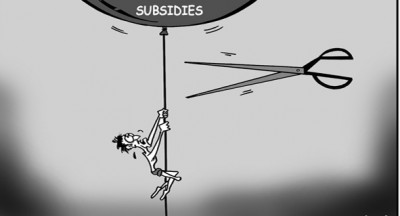
subsidies

Angus Taylor…..An Australian Hero! Putting Windweasels on Notice!

The Wind Industry’s Worst Nightmare – Angus Taylor – says: time to kill the LRET

Nightmare (1962) Jerry wakes up

Member for Hume, Angus “the Enforcer” Taylor has taken the lead on behalf of the Coalition in Tony Abbott’s quest to bring the wind industry to its knees. While there’s been a lot of huff and puff emanating from Ian “Macca” Macfarlane and his faithful ward, young Gregory Hunt about saving the mandatory RET with magical “third ways”, STT says keep your eyes focused on Taylor and the PM.

To give you some idea of where Taylor is coming from – and where the wind industry is headed – here’s an interview he gave last week (9 September 2014) on Sky News (transcript follows).

*****

http://blob:https%3A//www.youtube.com/fe2546b4-a7de-461e-8946-528eaf70770e

*****

Graham Richardson: Angus Taylor is the member for Hume, and he’s in our Canberra studio. G’day Angus how are you?

Angus Taylor: G’day Graham.

Graham Richardson: Now I’ve got to say that if I was a minister, I’d be looking behind me and saying there’s a Rhodes scholar on the backbench, we can’t have him there for long. I mean, you’d have to get, you’d have be promoted – I don’t see how they can keep a Rhodes scholar on the backbench.

Alan Jones:  He is a patient man, he’s a farmer’s son. He’s a patient man. Angus, just explain to us would you, in layman’s language, what is the Renewable Energy Target.

Angus Taylor:  Alan, it’s a scheme designed to increase the level of renewable electricity in Australia. And the way it works in practice is it gives big subsidies to renewable projects and it builds those subsidies into our electricity prices ….

Alan Jones:  Sorry to interrupt you – go even simpler – the Renewable, Angus, a renewable project – just explain what a renewable project is.

Angus Taylor:  Well, so there are two schemes, the large scale scheme, which is essentially wind – there is a bit of hydro in there but no new hydro. So that’s the large-scale scheme and that is the majority of it. That’s about 90% of the total. And then there is the small scale scheme which is largely rooftop solar. So they’re the two schemes, and we pay for those big subsidies in our electricity prices, in our bills – they’re not transparent.

Alan Jones:  And that energy is infinitely dearer to produce than coal-fired power so isn’t it fair to say that without massive subsidies, these outfits couldn’t survive. Now if the government is not going to give money to the motor vehicle industry, and it’s not going to give money to SPC Ardmona, why is it giving billions of dollars to Qatari owned wind turbines?

Angus Taylor:  Well that’s a good question. I mean we’ve just had a review of this, led by Dick Warburton, and what the review concluded was that these are expensive schemes, very expensive schemes, but as importantly they’re very expensive ways to reduce carbon emissions. They did come to different conclusions on solar and the large-scale, the wind subsidies, and what we know is rooftop solar in remote areas can be economic, but large-scale wind it’s very clear that it’s not economic on any grounds.

Graham Richardson: If it is not economic, tell me how uneconomic is it? How much dearer? You know, is it 50%, is it 80% dearer than coal-fired power? How much?

Angus Taylor:  Well, put it in perspective. A wind project to get investment will probably need a price somewhere in their long-term contract of somewhere close to $100. And we’re buying electricity now, wholesale electricity at about $30 a megawatt hour. So say three times is a good rule of thumb … What we also know is the cost of reducing carbon emissions this way – it’s something like $60-70 and of course the carbon tax was far less that and we think still way too high.

Alan Jones:   Let’s just go  … just go to where our viewers are involved in all of this. Let me just ask you a simple question, right, I’m a big Qatari investor, because I know that Australians are suckers, we know the Australian government is just shelling out money, now I come from Qatar and I want to build wind turbines and I’ve found this farmer, Angus Taylor in Goulburn and he’s got this a big hill out there – and I think this would be a good place to build wind turbines, so go to Angus Taylor and I say to him I want to put 70 wind turbines on your property. Just basically rule of thumb, how much would you expect to get from me, the big Qatari Guru, how much would you expect to get from me per wind turbine? And I want 70 of them on your farm.

Angus Taylor:  You’d get about 10 to 12 thousand dollars so if you going to have

Alan Jones:  So I kick in $700,000 to you, that’s right. So I build the 70 wind turbines. Enter the taxpayer. So I’m from Qatar, I’m a big wind power man, what’s the taxpayer going to fork out to me in order that I so-called ‘produce’ this wind power?

Angus Taylor:  Look on average you’d expect it to be about $400,000 per year, per turbine.

Alan Jones:  For 30 years.

Angus Taylor: In fact in the next few years – yes for 30 years (GR Wow). 400,000 per turbine.

Alan Jones: Start again

Angus Taylor: So if you had 70 turbines, that’s $28 million a year.

Alan Jones:   28 million on his farm – on his farm – 28 million – so the people watching you – say it again – I’m a Qatari I’m not even an Australian – $28 million a year for one farm. How the hell can this be sustainable?

Angus Taylor: For 70 turbines – and of course we are all paying for that in our electricity bills that’s how it’s coming through.

Graham Richardson:  Can I ask you Angus – at the moment what is the energy target and how close have we got to it?

Angus Taylor:  Right so the energy target is supposed to be 20% of total demand. It’s turning out that it is way above that. The unit is 41 terawatt hours – but what’s important is we’re overshooting the 20% target by a long way. Now the problem with that, the problem with that is from here on in, we would have to build a Snowy Mountains Scheme every year for the next 5 years to reach the target. That’s a Snowy Mountain every year, for the next 5 years to reach the target. And the target will take us well over the 20% mark. The reason it’s going to take us way over the 20% mark, which was the original target, we were originally set ourselves a target of 20%, the reason we’re going way over is that electricity demand has actually been going backwards in Australia and the expectation was it would keep growing. So we’ve got this very high target, huge amount of renewable capacity to be built to reach it, and it’s going to take us way over what we originally expected to do.

Alan Jones:   And Angus isn’t t fair to say that written into the budget there is an expenditure figure of $17 billion – 17 thousand million dollars, to build between 700 and 10,000 of these. Now can I just ask this? If the Abbott Government is not going to give money to SPC Ardmona, and if it’s not going to give money to the car industry – and out there is tax payer land they say, nor should they, why the hell are we subsidising Chinese and Qatari wind farmers jacking up the price of energy, pushing manufacturing out of business? Why are we doing it?

Angus Taylor:  Well, look this is the good question. We are paying these massive subsidies out in our electricity bills we are going way over the target we originally set ourselves and really what this is becoming now is just industry assistance, it’s becoming industry assistance and primarily for the wind industry.

Alan Jones:   It’s industry welfare on steroids.

Graham Richardson: How much investment goes into it? How much private investment goes into it?

Angus Taylor:  Well look, you know, it depends on what’s being built Graham but it is a big number, 17 billion is probably not a bad number to go with, which is the number that Alan mentioned earlier. So there’s a lot of investment- but remember what’s happening here – it’s not creating jobs, we’re actually taking jobs away from other places. In fact, Deloitte tells us that we’re actually going to lose in total 5000 jobs as a result of this – now we gain some in one place and lose them in the other, but the net, we are going to lose 5000 jobs and the reason for that is that it is inefficient investment – we are actually replacing electricity generation we don’t need to replace because demand is going backwards, not forwards. So this is costing us a lot.

Alan Jones:   Yes, it is costing us. Isn’t it valid to say – and it may be an oversimplification, you can either have a manufacturing industry, or a Renewable Energy Target – you can’t have both.

Angus Taylor:  Well, the other part of this, of course, is if it’s pushing electricity prices up, and in the next 5 years it’s likely to push them up quite a lot, if it’s pushing electricity prices up, not only is that hurting households, it’s hurting businesses in exactly the same way that the Carbon tax was hurting businesses. There’s no difference. It’s pushing up electricity prices and that’s hurting all of us.

Alan Jones:  But you said …

Angus Taylor: We’ve gone from being a low cost energy country to a high cost energy country and this is continuing to be one of the contributors. So if all of this was for a good purpose, if it was a cheap way to reduce carbon emissions, depending on your view on whether that’s a good thing to do, then you might be able to justify it. But it’s not and the Review Panel told us that very clearly.

Alan Jones:   Terry McCrann, the very experienced economist said many many years ago, if you want to de-carbonise the Australian economy, your writing yourself a national suicide note. Now here we are forcing manufacturing overseas, forcing jobs, Deloitte said that, up to 6000 jobs. Now at what point do we say to Macfarlane, you said it in the party room, Macfarlane is the Energy Minister, he said this week, there’d be no changes, there’ll be no changes, we’ll make no changes that damage or end the Renewable Energy Target. This is the Energy Minister. You’ve got a Rhode scholar here saying – hang on – this is an inefficient use of resources, this is welfare on steroids and you’ve got the Minister – don’t ask me what I think of that bloke – but you’ve got this Minister saying the exact opposite. What is the party room saying about this?

Angus Taylor: Look, there’s clearly some concerns about solar in the party room, but the overwhelming view of the party room has always been that we have got to contain electricity prices. There’s no question about that. I think, to be fair to the Minister, in the last 48 hours he’s made it very clear that he’s concerned about the rise in electricity prices we’re likely to see in the next few years. He’s made that very clear. You know, look if there’s one cause that we took to the last election, aside from stopping the boats, it was that we needed to contain electricity price increases. That was a view that the party room held…

Graham Richardson:  But the argument was … Angus , the trouble is you ran the argument about the Carbon tax being the cause and it was only a small part of the cause, so you actually didn’t really tell the truth about the Carbon tax, because I think it was about 9% and everybody tried to make it sound like it was a great deal more.

Angus Taylor:  Well, 10% on someone’s electricity bill Graham is a big number for the average Australian and remember the people who are hit hardest here are those are least well off, and energy-intensive businesses which have been the core of Australia’s strength over the years. So 10% impact on electricity bills, and we are seeing that come off now, now that the Carbon tax is gone, that’s a big deal, it’s a big deal for your average Australian and it’s a big deal for Australian businesses.

Graham Richardson:  If we dropped these massive subsidies, which by the way are far greater than I’d ever believed, what would be the effect on electricity prices then?

Angus Taylor:  Well look, it depends but it will be 3-5% over the next few years, but the real problem is this, over the next 5 years, we are not likely to reach the target that was set. We’re not likely to reach it. Now when that happens, the price of these subsidies, they’re caught up in these certificates, the price of those certificates, which goes into your electricity bills, will go sky rocketing.

Alan Jones:  Correct.

Angus Taylor:  And this is the worry – and to be fair to the Minister – he has voiced this concern in the last 48 hours – the real worry is that the sky rocketing price of these subsidies because we can’t get enough of this large scale renewable capacity coming on, the wind turbines, we can’t get them on fast enough, the cost of this scheme is going to go right up in the next few years. And that’s the real concern and it’s a concern that I think the Labor party should share too, I mean they know. You only have to go door knocking in the less well off parts of my electorate or in any other electorate, to know that electricity prices and cost of living are right at the top of the list – so anything that’s pushing that up they’re concerned about.

Alan Jones:   But manufacturing is moving offshore. Jobs are being lost all over the place. Deloitte said that. But you talked at the beginning of this program Graham ‘what’s this bloke doing on the back bench?’ What kind of an Energy Minister would he make? You’re being very charitable to Macfarlane – I will tell you what Macfarlane said about the Renewable Energy Target. These are his exact words. ‘Anything the government does, will not effect any existing investment in renewable energy’. ‘Any existing investment’. I mean, is this bloke off his head? Manufacturing is closing down, jobs are being lost people out there can’t turn on their electric blanket because of the escalating cost of electricity and there should be a comprehensive movement by the Abbott government to reverse all of that.

Angus Taylor:  Look the concern the Minister voiced there is that people have invested to this point in good faith and we should respect investments they’ve made in good faith. I think what he has also said in the last 48 hours is the real issue is here is do we want more of this investment, accelerating over the next 5 years and costing us all a great deal and I think that is the real concern – I mean, do we want to just keep going – and do we want to miss this target.

Alan Jones:  But the real concern, just finally, Angus, isn’t the real concern if there is no money for Holden in the car industry, and no money for SPC Ardmona, why are there billions and billions of dollars for this industry?

Angus Taylor:  I think that’s a good question. I think unfortunately a lot of these schemes set out with the best of intentions and end up being industry assistance, industry pork-barrelling on steroids, as you say, and that’s the concern here. And it’s why there is a legitimate debate – a very legitimate debate in my view, about scaling it back. The Review Panel has said to us that that’s its preferred option. It gave us 2 options on the large scale, on the wind subsidies, and you know, I have made no secret of the fact that I think that we should scale it back. I think, as I say, to be fair to the Minister, he knows that if we don’t scale it back, we have a very serious risk of big increases in electricity prices and escalating subsidies.

Graham Richardson:  I’ve really got to say we have to leave it here. Now I am not concerned about being fair to the Minister. If the Minister is fair dinkum, then he’ll do something about it, and he will do it quickly. Because this is a debacle. And it is just something that you can’t wait. You can’t sit and look at it. It’s got to be addressed immediately. And I don’t understand why he doesn’t. I can’t get it. But we have got to leave it there. Well go on have one last word, very quickly…

Angus Taylor: I was just going say we need the Labor party to help us, we’ve got to get this through the Senate. Either the Labor party or the cross-benchers have got to help us as it needs legislative change so it is incredibly important.

Graham Richardson: Well we will see what we can do.

Alan Jones: good on you Angus

Graham Richardson: I don’t actually hold out a great deal of hope on that front – but I will see what I can do because I think you are right.

Alan Jones:  Hope of the side – this bloke.

Graham Richardson: Certainly is – as I said if I was a Minister looking behind, I’d be on my toes. Angus Taylor, a pleasure to have you on the show. I hope to talk to you again soon.

Alan Jones:  Thanks Angus.

Angus Taylor: Thanks Graham.

Angus Taylor

Scrap Renewable Energy Targets! It’s all a big scam!

Terry McCrann: The Mandatory RET – It’s Only a RORT When You’re Not In On It

terry_mcrann

Follow the money trail, and RET spells rort not power
Herald Sun
Terry McCrann
8 September 2014

TWO eternal pieces of advice emerged from the Watergate saga that kneecapped Richard Nixon’s presidency and then the president himself.

The first was the observation that it’s not the crime that gets you but the cover-up; the second was the instruction to follow the money.

While we’ve seen dozens if not indeed hundreds of examples of the former in the subsequent four decades, arguably it’s the latter that has proved more absolutely durable.

That’s been the case, if for no other reason than that, all too often, neither the crime nor the cover-up gets the — usually, political — “criminal”, with or without the quotation marks.

But “the money” always, always, leads somewhere. Throw in the great and piercingly accurate quote from Australia’s larrikin entrepreneur John Singleton that it’s only a rort when you are not in on it, and we arrive at the RET.

More specifically, we arrive at the long overdue and fundamentally necessary review of the RET — Renewable Energy Target — by businessman and both economic and climate realist Dick Warburton.

Somewhere along the line, as I’ve previously noted, it lost the “M” from its original acronym of M (for mandatory) RET, even though it remained just as punitively obligatory.

Well, the release of Warburton’s punishingly rational and even-handed review has unleashed a primeval scream across the renewable energy sector as if torn from Munch’s famous painting.

Follow the money, your money — and the screams. They lead directly to all those who have been sucking on the taxpayer and consumer teat: so far, as Warburton detailed, to the tune of over $9 billion (of your money) with another $22 billion (still, of your money) to come, if the scheme is left untouched.

Those figures are in NPV (net present value) terms — which mean the total of actual dollars wasted every year through until at least 2030 will be much, much bigger.

We have seen the usual campaign of misrepresentation and outright lies to scare the Federal Government out of turning off the money flows to all the renewable energy main-chancers.

This has been done in the context of a vicious campaign to demonise Warburton as a climate sceptic, by deliberately mischaracterising and indeed simply ignoring what he recommended. If anything Warburton went too lightly on the extraordinary fraud that is so-called renewable energy.

Extraordinary, but so obvious. What part of: when the wind don’t blow the power don’t flow; and when the moon comes out the glass doesn’t glow, do assorted otherwise intelligent people and useful idiots find impossible to comprehend?

That, on a more substantive level, every single MW of installed (sic) wind and solar capacity (sic) has to be backed up by real sources of power generation, otherwise known as carbon-based coal or gas?

Even in the country which is the poster boy for wind power — Denmark — which gets close to a third of its total power from wind, there are times when it gets zero, nothing, nada, from that source.

It then has to use its own coal-fired generators or tap into the power generation of its neighbours — mostly Norway, Sweden and Germany.

That means it gets access to a mix of hydro — when the water’s flowing; nuclear; and coal, with “green” Germany building more Hazlewood-style brown coal stations because, ahem, even in Germany some times the winds don’t blow.

The bottom line with wind so-called power — for all the lazy allure of solar panels on rooftops and even massive solar “farms”, almost all future RET-imposed renewable spending will be on wind — is that its actual cost of production is two-to-three times that of coal.

We have seen an innovative form of deception with the claim that massive increases in wind will work to reduce future power prices.

The claim is true, in terms of potential prices to the power buyer, because the RET would swamp energy supply with compulsory wind. Generators of real and reliable (coal-fired) power would cut prices to buy a slice of the lower non-RET available demand.

To understand why it’s a fraud, imagine if we’d done that to “save” the car industry. The government could have mandated 20 per cent of cars bought had to be locally made. It might well have sparked a cut in prices by importers fighting over the remaining 80 per cent, but it would not be sustainable.

Whether cars or power, the market would correct. In the case of power, generators of (actual) cheap power would be forced to close, leaving us with mandatory (actual) expensive wind power.

Somebody, somewhere, would have to pay the bill for producing wildly expensive wind power.

Warburton didn’t actually go near any of these core absurdities; there wasn’t an ounce of climate scepticism in his analysis, far less the recommendations.

All he did was to arrive at the inescapable conclusion that using the RET to try to reduce emissions of carbon dioxide was grossly wasteful and inefficient. He was also very mindful of the legitimate point that, whether sane or not (my comment, not), people had invested money on the basis of the RET, and to simply scrap it would be unfair.

So he offered two alternatives. The first was to continue the scheme until 2030, but freeze it at its current level of investment, including projects that had just only been committed.

As he noted: this would “provide investors in existing renewable generation with continued access to certificates so as to avoid substantial asset value loss and retain the CO2 emissions reductions that have been achieved so far.

“Importantly, this approach avoids the costs to the community associated with subsidising additional generation capacity that is not required to meet electricity demand.”

Alternatively, to grow the RET in line with growth in electricity demand; and indeed, allocate it 50 per cent of that growth.

That is hardly the recommendation of a so-called sceptic, but of a businessman — who doesn’t think you can simply ignore both arithmetic and reality — doing the job he was asked to do.

But no, no, that was not enough for the reality-deniers sucking on the renewable target teat. They don’t want us to follow the money, just to keep it coming.
Herald Sun

dirtyrottenscoundrelsoriginal

Gotta Love Those Aussies…..Bringing the Wind Scam, to it’s Knees!

Politicians & Business Finally Waking Up to the Massive Costs of the LRET

Sleep-deprived

In this post we highlighted the political distinction between the small scale renewable energy scheme (SRES) – which doles out subsidies for rooftop solar – and the Large-Scale RET (LRET) – upon which the debacle that is the wind industry depends.

While Greg Hunt and Ian “Macca” Macfarlane have been running around talking up ways of saving the RET – and their mates in the wind industry – STT hears that Tony Abbott is as determined as ever to kill the RET outright: no “grandfathering”, no “ifs”, no “buts”.

STT hears that – while Tony Abbott wants to kill both the SRES and LRET – the PM is ready to leave the SRES in place, in order to avoid a political bun-fight with the solar industry that has little upside and plenty of downside.

But the LRET is in a different class. Tony Abbott has made no secret of his desire to can the fans (see our posts here and here and here.) And his Treasurer, Joe Hockey and Finance Minister, Mathias Cormann are singing from the same hymn sheet when it comes to axing the RET and bringing the wind industry to a well-earned demise (see our posts hereand here and here). And – to the horror of the wind industry – this hard-hitting trio have emerged as Natural Born RET Killers (see our post here).

Now, after over 13 years of operation, Coalition MPs – including lightweights like young Greg Hunt and Ian “Macca” Macfarlane – have finally dusted off their copies of the Renewable Energy (Electricity) Act 2000 to learn, apparently for the first time, that the LRET contains a mighty sting in the tail.

The “sting” is the mandated shortfall charge of $65 per MWh which – under the current 41,000 GWh target – starts to impact from 2017. There is no way that the annual target set from 2017 (that escalates to 41,000 GWh in 2020, where it stays until 2031) will be met. Wind farm construction is almost at a standstill: “investment” in the construction of wind farms went from $2.69 billion in 2013 to a piddling $40 million this year (see this article).

And, from here on, no retailer is going to sign a Power Purchase Agreement with a wind power outfit; which means hopeful wind farm developers will never get the finance needed to build any new wind farms (see our post here).

In our earlier posts (here and here) we outlined the fact that – under the LRET – retailers are fined $65 per MWh for every MW they fall below the mandated annual targets – follow the links here and here.

With less than 23,000 GWh coming from renewable sources annually at present – and no likelihood of any significant wind power capacity being added between now and 2020 – Australia will fall short of the fixed target by a figure in the order of 18,000 GWh. When the target hits 41,000 GWh in 2020 – the fine will apply to that figure until 2031.

The fines paid by retailers will be collected by the Commonwealth and be directed into general revenue.

The cost of the fine compares with the average wholesale price of between $35-40 per MWh. Therefore, at a minimum, retailers will be paying $100-105 per MWh (the average wholesale price plus the fine). Retailers have already announced that they will simply recover the cost of the fine from their retail customers (see our posts here and here).

Retailers will add a margin to that in the order of 10% (or more) which means Australian power consumers will be paying upwards of $115 per MWh: 3 times the average wholesale price.

The Australian Energy Market Commission, EnergyAustralia and AGL have all united to declare that meeting the 41,000 GWh annual target will be impossible; and that, as a consequence, power punters will simply be lumbered with an enormous new electricity tax.

Given current renewable capacity of 23,000 GWh – under the legislation – the shortfall charge (fine) starts to bite from 2017.

Year Target GWh Shortfall GWh Penalty Cost
2017 27,200 4,200 $273 million
2018 31,800 8,800 $572 million
2019 36,400 13,400 $871 million
2020 41,000 18,000 $1.17 billion
    Total $2.886 billion

The mandatory RET continues until 2031; and the $65 per MWh fine with it. That means power consumers will be paying around $1.17 billion every year from 2020 until the RET expires in 2031. In addition to the $2.886 billion in fines added to power bills (up to and including 2020) – between 2021 and 2031 – fines of almost $12 billion will be issued to retailers, recovered from power consumers and the proceeds pocketed by the Commonwealth.

Remember that the policy justification for the insane cost of the mandatory RET is that it would: “encourage the additional generation of electricity from renewable sources”; and “reduce emissions of greenhouse gases in the electricity sector”; and “ensure that renewable energy sources are ecologically sustainable”.

On the scenario outlined above, the Federal government will collect close to $15 billion from power consumers by way of the shortfall charge levied on retailers. However, there will be: NO additional renewable energy; NO “break-through” on-demand renewable energy technologies; and NO reduction in CO2 emissions. An outrageous outcome, confirmed by Australian Energy Market Commission, EnergyAustralia and AGL (seeour post here).

Here’s the Australian Financial Review reporting on how the obscene cost and pointlessness of the LRET has just dawned on some of our political betters and business leaders.

Election power price surge fear forcing new clean energy plan
Australian Financial Review
Joanna Heath
8 September 2014

The fear of spiralling electricity prices around the time of the next federal election is driving the government to consider a deal with Labor on the Renewable Energy Target to avoid deadlock in the Senate.

A potential “third way” for the RET that would lower the 41,000-gigawatt-hour target but fix prices of renewable energy certificates is being actively considered as a way to match falling electricity demand but provide certainty to the industry, and provide a palatable option for Labor.

In an opinion piece published in The Australian Financial Review today Business Council of Australia chief executive Jennifer Westacott warns of “an effective $93 tax” that would be triggered under legislation if there were a political impasse on the RET.

“Under this circumstance community sympathy for the RET is likely to quickly dissipate and the pressure will come on the government to do more than just amend the existing scheme,” Ms Westacott writes.

“If people are really concerned about renewable energy then they should be encouraging an agreement across political parties so as to guarantee a moderate amount of future investment, while reducing the cost burden on consumers.”

Without the support of Labor, the government must rely on the Palmer United Party to pass any changes to the RET through the Senate, something leader Clive Palmer has vowed it will not do.

According to Bloomberg New Energy Finance modelling, if this political impasse were not resolved by 2015, so-called “penalty” prices within the RET would be triggered which the government fears would drive up retail power prices in about eighteen months’ time.

Industry minister Ian Macfarlane is understood to be using this pre-election nightmare scenario to build support for finding a compromise position that could be taken to Labor.

One coalition party source said the penalty scenario was “a nasty train wreck waiting to happen” which will focus minds on finding a solution.

“There is potentially some room to come to an arrangement,” the source said.

Senior Labor sources said the party’s default position was not to allow any changes to the RET, but a sensible approach from the government could open doors.

“We need to see quite what their bona fides are before we were to sit down with them,” a source said.

“We’ve always taken the view that a bipartisan policy around renewables is the only way to guarantee strong levels of investment. So if there was a way to restore that . . . it’s a question of how far off the reservation they have wandered.”

New analysis published by Bloomberg on Monday estimates a continued political impasse on the RET would freeze investment until 2016, which would mean renewable energy production would start to fall short of its target around 2018.

In this scenario, renewable energy certificates would surge to a legislated “penalty” price of about $93/MWh, compared to the current price of around $20.

Market anticipation of that scenario could drive up prices far earlier, however, creating political tensions around the next election.

Bloomberg analyst Kobad Bhavnagri described this as the “worst case outcome for consumers”.

“To prevent this outcome, the political uncertainty will need to be resolved by 2015, or early 2016 at the latest,” Mr Bhavnagri writes.

No approaches have yet been made by the government to Labor over a potential compromise, with the coalition party room expected to meet first to decide on a position.

Lowering the target but fixing certificate prices is an option that it is hoped would address industry concerns by providing some investor certainty.

But accepting it would mean ignoring the two key recommendations of the Warburton review to either close the large-scale RET to new entrants or scale the target back to 50 per cent of new demand every year. It would also require several influential members of cabinet – including the Prime Minister and Treasurer – to soften their position on keeping the RET.

The search for a bipartisan deal is not likely to be helped by the renewable energy lobby, who are refusing to budge from their opposition to any change in the target.

“We don’t think there is any rationale whatsoever for changing the policy. While we’re always open to talking at the end of the day we certainly don’t have a proposal on the table worthy of any meaningful discussion,” Clean Energy Council chief executive Kane Thornton said.

Mr Thornton also cast doubt on the viability of the floated “third way” option, arguing fixing certificate prices was a highly interventionist, anti-market approach.

“There are a whole lot more questions than answers.”

The Solar Council is continuing to rev up its campaign against the Warburton review recommendation to scrap the small-scale renewable energy target.

Its “Save Solar” campaign in marginal coalition electorates is gaining some traction, according to government insiders, and political impetus to attack solar is waning.

In coming weeks the Solar Council will launch advertisements on commercial television in Victoria and Queensland with the tagline “don’t vote for anyone who will cut the renewable energy target”.

Solar Council chief executive John Grimes said his organisation was not interested in compromise.

“The government is rattled, backbenchers are nervous, they understand solar is enormously popular in the electorates. I think our pointed marginal seat campaigns have been working,” Mr Grimes said.

“[The advertisements are] a big escalation in the campaign. We are furious about the way the government has handled the entire thing.”

According to the Bloomberg modelling, however, solar would be less badly affected in the long term by an abolition of the small-scale RET than larger projects would be under changes proposed to the large-scale RET.

“Our residential and commercial market modelling suggests that the total amount of behind-the-metre solar capacity installed by 2030 will vary only slightly in response to policy decisions stemming from the current review,” the report reads.
Australian Financial Review

You’ve just got to love the Clean Energy Council and the irony dripping from Kane Thornton’s statement that: “fixing certificate prices was a highly interventionist, anti-market approach”.

It seems irony is a subtlety lost on the wind industry and its highly paid spruikers; neither of which would exist in the absence of the mandatory RET: which the more economically literate might point out is easily the most “highly interventionist, anti-market approach” developed since Jo Stalin decided to help himself to the Kulaks’ grain and “collectivize” their farms.

Apparently, setting up legislation that threatens to whack retailers with $billions in penalties for not purchasing wind power in order to make them enter PPAs with wind power outfits, so as to purchase $billions worth of RECs and avoid the penalty, is not “interventionist” or “anti-market”?

And we pause to notice the CEC’s uncompromising, all-or-nothing approach to changing the 41,000 GWh target set by the LRET. With Tony Abbott sharpening his axe, we think it a little like keeping the band playing as the Titantic started to founder: a noble gesture, despite the inevitable outcome.

The gripes from John Grimes will soon die down as Tony Abbott makes plain the Coalition’s plan to leave the SRES alone; thereby avoiding a fight over the solar panels that mums and dads are dying to own; and Grime’s clients are itching to install.

But expect the wind industry’s whining to continue unabated, as its merry band of rent seekers watch their lives flash before their eyes.

Here’s the opinion piece by Jennifer Westacott referred to above.

Take the third path on renewable energy target
Australian Financial Review
Jennifer Westacott
8 September 2014

Reaching the original RE target now presents considerable political risks. So why not cut it to a true 20 per cent?

When circumstances and the evidence changes, policies too need to change. This is the case with the Renewable Energy Target (RET) scheme.

The RET was meant to ensure 20 per cent of our energy supply comes from renewable sources, but because it was not designed to be adjusted if demand for energy falls – as it has – it now accounts for almost 30 per cent of energy supplies.

The best outcome for the community, business and the renewable energy industry would be bipartisan support for a form of a true 20 per cent RET that doesn’t risk falling short of its megawatt target at a huge cost to consumers.

The risk is that while reaching the existing megawatt target might be technically possible, it is unlikely to be commercially possible.

The commercial risks in the electricity and renewable energy certificate market are just too great to pull through large-scale renewable energy (predominately wind) investments in the coming years.

First, the price of renewable energy certificates is suppressed to a point which is too low to finance new wind projects due to an oversupply of certificates that are expected to hang in the market until 2017.

Second, because of the decline in energy demand, the wholesale price of electricity is suppressed which isn’t conducive to attracting further investment in any form of energy generation.

Third, because of the lack of bipartisan support on the design of the RET, it makes it very difficult for any investor to allay the commercial risks of regulatory change.

Even after 2017, once the oversupply of certificates is eventually soaked up by the market, it leaves only three years to build a massive amount of wind energy, some 8000 megawatts (MW) in three years.

This compares to 3800 MW of wind energy that the RET, in its various guises, has pulled through over the past 13 years.

To deliver wind on this scale and this quickly would require shorter community consultation on proposed wind farms than has historically occurred and would likely lead to added cost pressures as projects compete for limited resources.

Add all these risks together and it presents a grim investment environment – a market frozen until there is political consensus on the policy of the RET.

Certificate oversupply problem

What is becoming clear is that unless all parties to this debate are willing to compromise, investment in wind will be stymied, creating the risk of higher electricity prices for consumers. This is because, without new wind investment, the price of certificates will spike.

What is not well understood is that if the certificate price hits the level of what is called the penalty price, electricity consumers will be paying an effective $93 tax with no additional investment in renewable energy.

Under this circumstance, community sympathy for the RET is likely to quickly dissipate and the pressure will come on the government to do more than just amend the existing scheme.

What needs to be recognised is that unwavering support for the existing target will not lead to greater wind investment unless the current issue of certificate oversupply is dealt with and there is a stable and bipartisan policy and investment environment.

If people are really concerned about renewable energy then they should be encouraging an agreement across political parties so as to guarantee a moderate amount of future investment, while reducing the cost burden on consumers.

The fact remains that the RET is an expensive way of reducing Australia’s greenhouse gas emissions.

According to the government’s own modelling by ACIL Allen Consulting, the cost of reducing emissions under the RET is estimated to be between $35 and $68 per tonne – which is significantly more expensive than the uncompetitively high $23 carbon tax.

Saving the furniture on a second-best policy tool to reduce emissions, such as the existing flawed design of the RET, will not create an environment for bipartisanship on climate change policy – it will just push up prices. Instead we are better to have a well-designed market mechanism that reduces emissions on a least-cost basis that does not add to the oversupply in our electricity markets.

All sides of politics need to recognise the consequences of sticking with the existing RET, and seek out the middle ground on a form of a true 20 per cent RET that minimises the risk of higher costs being lumped on consumers.

Jennifer Westacott is chief executive of the Business Council of Australia.
Australian Financial Review

STT is very keen to see the evidence on which Jennifer bases her “wonderful” claim that wind power reduces CO2 emissions in the electricity sector. No doubt, WA Senator Chris Back would be keen to see it too (see our post here).

Jennifer gets 10/10 for identifying “that if the certificate price hits the level of what is called the penalty price, electricity consumers will be paying an effective $93 tax with no additional investment in renewable energy”. It’s a point STT has made once or twice, but has been lost on our political betters, business leaders and commentators, until now (see above and our posts here and here and here).

Jennifer’s figure of $93 for RECs is based on the shortfall charge of $65 per MWh. As the shortfall charge is not a deductible business expense (it is treated as a fine), the effective pre-tax penalty is therefore $92.86/REC ($65/(1-30%), assuming a 30% marginal tax rate.

However, Jennifer gets an “F” for her “third way” argument, which is a little like Goldilocks breaking into houses to look for porridge at just the right temperature.

Setting up a “true 20%” target begs the question: “20% of what?” With spiralling power prices driving minerals processors to the wall and manufacturers offshore, demand for power will continue to fall (see our posts here and here). The AEMO demand forecasts (on which the current target was set) have been woefully inaccurate, so far. So just when does Jennifer suggest we should lock-in this “true 20%” target? Now, say? Or in 2020, when our vision will be 20/20?

And just what does Jennifer propose as a solution to the “problem” of an oversupply of RECs? Government “intervention” in the REC market, perhaps?

To STT, Jennifer’s magical “third way” simply sounds like more of the “highly interventionist, anti-market approach” (which gave us the RET in the first place) of the kind that Jo Stalin loved and that the CEC now purports to loathe.

The LRET is simply unsustainable – even with magical “third way” approaches. Any policy that is unsustainable will fail under its own steam; or its creators will be forced to scrap it. It’s a matter of when; not if.

abbott, hockey, cormann

Renewable Energy Targets Force Consumers to Use Inefficient, Unreliable, Overpriced Products!

The crazy world of Renewable Energy Targets

Nothing makes sense about Renewable Energy Targets, except at a “Bumper-Sticker” level. Today the AFR front page suggests* the federal government is shifting to remove the scheme (by closing it to new entrants) rather than just scaling it back. It can’t come a day too soon. Right now, the Greens who care about CO2 emissions should be cheering too. The scheme was designed to promote an  industry, not to cut CO2.

UPDATE: Mathias Cormann later says “that the government’s position was to “keep the renewable energy target in place” SMH.  Mixed messages indeed.

We’ve been sold the idea that if we subsidize “renewable” energy (which produces less CO2) we’d get a world with lower CO2 emissions. But it ain’t so. The fake “free” market in renewables does not remotely achieve what it was advertised to do — the perverse incentives make the RET good for increasing “renewables” but bad for reducing CO2, and, worse, the more wind power you have, the less CO2 you save. Coal fired electricity is so cheap that doing anything other than making it more efficient is a wildly expensive and inefficient way to reduce CO2. But the Greens hate coal more than they want to reduce carbon dioxide. The dilemma!

The RET scheme in Australian pays a subsidy to wind farms and solar installations. Below, Tom Quirk shows that this is effectively a carbon tax (but a lousy one), and it shifts supply — perversely taxing brown coal at $27/ton, black coal at $40/ton and gas at up to $100/ton. Because it’s applied to renewables rather than CO2 directly, it’s effectively a higher tax rate for the non-renewable but lower CO2 emitters.

Calculating the true cost of electricity is fiendishly difficult. “Levelized costs” is the simple idea that we can add up the entire lifecycle cost of each energy type, but it’s almost impossible to calculate meaningful numbers. Because wind power is fickle, yet electricity demand is most definitely not, the real cost of wind power is not just the construction, maintenance and final disposal, but also the cost of having a gas back-up or expensive battery (give-us-your-gold) storage. It’s just inefficient every which way. Coal and nuclear stations are cheaper when run constantly rather than in a stop-start fashion (just like your car is). So the cost of renewables also includes the cost of shifting these “base load” suppliers from efficient to inefficient use — and in the case of coal it means producing more CO2 for the same megawatts. South Australia is the most renewable-dependent state in mainland Australia, and it’s a basketcase (look at the cost stack below). Real costs only come with modeling, and we all know how difficult that is.

If the aim is really the research and development of renewables (and not “low CO2″) then I’ve long said that we should pay for the research and development directly, not pay companies to put up inefficient and fairly useless versions in the hope that companies might earn enough to pay for the research out of the profits. Tom Quirk points out that it’s all frightfully perverse again, because most innovations come from industry, not government funded research, but in Australia we hardly have any industry making parts used in power generation — we don’t have the teams of electrical engineers working on the problem anymore. I suppose the theory is that Chinese companies will profit from solar panels and do the R&D for us (keeping “our” patents too)? It would be cheaper just to gift them the money direct wouldn’t it — rather than pay an industry to produce and install a product that no one would buy, which doesn’t work, and hope that the “profits” translate into discoveries that will produce royalties and jobs for people overseas. I’m sure Chinese workers and entrepreneurs will be grateful. Yay.

Meanwhile, Green fans have suddenly discovered the idea of sovereign risk (where were they while the Rudd-Gillard team blitzed Australia’s reputation for stable, predictable policy?). According to the AFR, the government is scornful (and rightly so):

The government source said the market was oversupplied with energy and there was no longer any cause for a mandated use of any specific type of power. The source said while there would be investment losses if the RET was abolished, or even scaled back, investors “would have to have been blind to know this wasn’t coming’’.

On Catalaxy files, Judith Sloan mocks the Fin for pushing a press release from a rent-seeking firm, and guesses the Abbott government will be too “gutless” to ditch this economic and environmental dog of a policy.

—   Jo


Renewable Energy Targets Force Consumers to Use Inefficient, Unreliable, Overpriced Products!

The crazy world of Renewable Energy Targets

Nothing makes sense about Renewable Energy Targets, except at a “Bumper-Sticker” level. Today the AFR front page suggests* the federal government is shifting to remove the scheme (by closing it to new entrants) rather than just scaling it back. It can’t come a day too soon. Right now, the Greens who care about CO2 emissions should be cheering too. The scheme was designed to promote an  industry, not to cut CO2.

UPDATE: Mathias Cormann later says “that the government’s position was to “keep the renewable energy target in place” SMH.  Mixed messages indeed.

We’ve been sold the idea that if we subsidize “renewable” energy (which produces less CO2) we’d get a world with lower CO2 emissions. But it ain’t so. The fake “free” market in renewables does not remotely achieve what it was advertised to do — the perverse incentives make the RET good for increasing “renewables” but bad for reducing CO2, and, worse, the more wind power you have, the less CO2 you save. Coal fired electricity is so cheap that doing anything other than making it more efficient is a wildly expensive and inefficient way to reduce CO2. But the Greens hate coal more than they want to reduce carbon dioxide. The dilemma!

The RET scheme in Australian pays a subsidy to wind farms and solar installations. Below, Tom Quirk shows that this is effectively a carbon tax (but a lousy one), and it shifts supply — perversely taxing brown coal at $27/ton, black coal at $40/ton and gas at up to $100/ton. Because it’s applied to renewables rather than CO2 directly, it’s effectively a higher tax rate for the non-renewable but lower CO2 emitters.

Calculating the true cost of electricity is fiendishly difficult. “Levelized costs” is the simple idea that we can add up the entire lifecycle cost of each energy type, but it’s almost impossible to calculate meaningful numbers. Because wind power is fickle, yet electricity demand is most definitely not, the real cost of wind power is not just the construction, maintenance and final disposal, but also the cost of having a gas back-up or expensive battery (give-us-your-gold) storage. It’s just inefficient every which way. Coal and nuclear stations are cheaper when run constantly rather than in a stop-start fashion (just like your car is). So the cost of renewables also includes the cost of shifting these “base load” suppliers from efficient to inefficient use — and in the case of coal it means producing more CO2 for the same megawatts. South Australia is the most renewable-dependent state in mainland Australia, and it’s a basketcase (look at the cost stack below). Real costs only come with modeling, and we all know how difficult that is.

If the aim is really the research and development of renewables (and not “low CO2″) then I’ve long said that we should pay for the research and development directly, not pay companies to put up inefficient and fairly useless versions in the hope that companies might earn enough to pay for the research out of the profits. Tom Quirk points out that it’s all frightfully perverse again, because most innovations come from industry, not government funded research, but in Australia we hardly have any industry making parts used in power generation — we don’t have the teams of electrical engineers working on the problem anymore. I suppose the theory is that Chinese companies will profit from solar panels and do the R&D for us (keeping “our” patents too)? It would be cheaper just to gift them the money direct wouldn’t it — rather than pay an industry to produce and install a product that no one would buy, which doesn’t work, and hope that the “profits” translate into discoveries that will produce royalties and jobs for people overseas. I’m sure Chinese workers and entrepreneurs will be grateful. Yay.

Meanwhile, Green fans have suddenly discovered the idea of sovereign risk (where were they while the Rudd-Gillard team blitzed Australia’s reputation for stable, predictable policy?). According to the AFR, the government is scornful (and rightly so):

The government source said the market was oversupplied with energy and there was no longer any cause for a mandated use of any specific type of power. The source said while there would be investment losses if the RET was abolished, or even scaled back, investors “would have to have been blind to know this wasn’t coming’’.

On Catalaxy files, Judith Sloan mocks the Fin for pushing a press release from a rent-seeking firm, and guesses the Abbott government will be too “gutless” to ditch this economic and environmental dog of a policy.

—   Jo


Aussies Determined to Scrap the Renewable Energy Targets to Save the Poor!

Senator David Leyonhjelm: “Wake Up Clive!” – It’s Time to Kill the RET & Save the Poor

clive palmer sleeping

STT hears that Tony Abbott is hard at work on his mission to kill off the mandatory RET – with the aim of bringing an end to the most expensive and pointless policy of all time. One of the cross-bench Senators the PM needs to help demolish it during this parliament is David Leyonhjelm – the Liberal Democrats Senator for NSW – and he gets it.

David has come out with a cracking piece published by The Australian – which is pitched squarely at Clive Palmer and his PUPs. The Palmer United Party’s 3 Senators – Glenn Lazarus (QLD), Dio Wang (WA) and Jacqui Lambie (Tasmania) – are the only obstacle that stands in the way of scrapping the mandatory RET during the life of this parliament. Big Clive and his Senators should consider David’s article a timely “wake up” call.

Ditch RET to set economy free
The Australian
David Leyonhjelm
27 August 2014

If Labor and Clive Palmer care about the poor they will stop subsidies for windmills.

ELECTRICITY bills are a huge worry for many Australians. In coming months a lot of people will receive the biggest household utility bills they have seen.

The latest figures from the Australian Bureau of Statistics show that in the five years to June 2012, Australia’s retail electricity prices rose by 72 per cent with even higher increases in Melbourne and Sydney.

The Queensland Competition Authority’s annual report revealed recently that 344 households were disconnected every week in the Sunshine State because of non-payment of electricity bills.

Senators and MPs, however, don’t need to worry about whether staying warm in chilly Canberra may send them broke. Perhaps if they had to pay for their own heating and airconditioning in Parliament House, it would concentrate their minds on the important discussion we need to have on the future of the renewable energy target.

The repeal of the carbon tax will help, but studies show that the RET has an even greater impact on the bottom line, reducing our living standards and the competitiveness of our entire economy.

The dramatic surge in power bills has been a major factor in the decline of our manufacturing sector and the loss of thousands of jobs. In a little more than 10 years the RET has rocketed Australia from almost the cheapest to almost the most expensive electricity in the world: Australian states occupy four of the top six spots beaten only by Denmark and Germany. These countries also are sapped pointlessly with punishing renewable energy policies producing small amounts of extremely expensive, intermittent power that has to be backed up by fossil fuel power anyway.

Contrary to claims by industry lobby groups and consultants representing Big Wind producers and merchant bankers, it is no coincidence that power prices went up so steeply when mandatory renewable energy targets were introduced. A report from the accounting firm Deloitte shows the RET will stifle the economy, cost jobs and drive up prices, and is a very inefficient means of reducing greenhouse gas emissions. It concludes that abolishing the RET would increase real GDP by $29 billion in net present terms relative to the RET continuation.

The chief beneficiary of the RET is the wind industry, which receives Renewable Energy Certificates worth about $30 for every megawatt of electricity it produces, on top of the price paid to it for electricity generated by wind turbines. The certificates are funded by electricity customers as a hidden charge on their bills. The net effect of this subsidy is to hand an additional $17bn of our money to these companies over 15 years for no measurable environmental benefit.

It is undisputed that despite being a mature technology the wind generation industry is not viable anywhere in the world without government or customer subsidies. It is just government mandated corporate welfare.

Grant King, chief executive of Origin Energy, one of Australia’s largest electricity retailers with extensive interests in gas and wind energy generation, has said that the RET would be the main driver of electricity price rises by 2020 and that renewable energy costs now accounted for 14 per cent of electricity bills, up from 2 per cent five years ago; for larger users it is 30 per cent of their bills.

If Labor, the Greens and Clive Palmer really care for social justice they will not allow working families, pensioners and the disadvantaged to be ripped off by wealthy wind generators and will back the abolition of the RET.

David Leyonhjelm is the Liberal Democrats senator for NSW.
The Australian

david leyonhjelm

When David talks about handing wind power outfits “$17bn of our money … over 15 years for no measurable environmental benefit”, he bases that figure on a REC price of $30.

While RECs are currently trading at $30, from 2017 – when the annual figure for the RET starts to increase dramatically – RECs will be worth at least as much as the mandated shortfall charge of $65 per MWh.

The total renewable energy target between 2014 and 2031 is 603,100 GWh, which converts to 603.1 million MWh (1 GW = 1,000 MW). In order for the target to be met, 603.1 million RECs have be purchased and surrendered over the next 17 years: 1 REC is issued for every MWh of renewable energy dispatched to the grid. The REC is a Federal Tax on all Australian electricity consumers.

The cost of subsiding the wind industry through the REC Tax is born entirely by Australian power consumers. As Origin Energy chief executive Grant King correctly put it earlier this week:

“[T]he subsidy is the REC, and the REC certificate is acquitted at the retail level and is included in the retail price of electricity”.

It’s power consumers that get lumped with the “retail price of electricity” and, therefore, the cost of the REC subsidy to wind power outfits.

Even at the current REC price of $30, the amount to be added to power consumers’ bills will hit $18 billion (David gets pretty close with his figure of $17 billion). However, beyond 2017 (when the target ratchets up from 27.2 million MWh to 41 million MWh and the $65 per MWh shortfall charge starts to bite) the REC price will almost certainly reach $65 and, due to the tax benefit attached to RECs, is likely to exceed $90.

Between 2014 and 2031, with a REC price of $65, the cost of the REC Tax to power consumers (and the value of the subsidy to wind power outfits) will approach $40 billion – with RECs at $90, the cost of the REC Tax/Subsidy balloons to over $54 billion (see our post here).

This massive stream of subsidies for wind power stands as the greatest wealth transfer in the history of the Commonwealth.

That transfer comes at the expense of the poorest and most vulnerable; struggling businesses; and cash-strapped families.

If Clive Palmer is serious when he says he is out to represent the poorest in society, he has a golden opportunity to put his money where his mouth is.

With thousands of Australian households living without power – having been chopped from the grid simply because they can no longer afford what used to be a basic necessity of life – and thousands more suffering “energy poverty” as they find themselves forced to choose between heating (or cooling) and eating – Australia risks the creation of an entrenched energy underclass, dividing Australian society into energy “haves” and “have-nots”.

For a taste of the scale (so far) of a – perfectly avoidable – social welfare disaster, here are articles from Queensland (click here); Victoria (click here); South Australia (click here); and New South Wales (click here).

Slapping a further $50 billion on top of already spiralling Australian power bills over the next 17 years can only add to household misery. So Clive, if you really do care about the poor? – then it’s time to muscle up and help kill the mandatory RET now.

Beyond the RET’s perverse impact on the poorest and most vulnerable is its wealth and job destroying impact on the economy as a whole.

The Australian Chamber of Commerce and Industry (ACCI) – the top body representing Australian business – came out with this press release in full support of the position taken by David Leyonhjelm – calling for the mandatory RET to be scrapped outright.

Australian Chamber of Commerce and Industry
MEDIA RELEASE
WEDNESDAY, August 27, 2014

BUSINESS WELCOMES LEADERSHIP ON RENEWABLE ENERGY TARGET

The Australian Chamber of Commerce and Industry (ACCI), Australia’s largest and most representative business organisation, welcomes the leadership of Independent Senator David Leyonhjelm in calling for the abolition of the Renewable Energy Target (RET).

The RET is a major policy failure that drives up electricity prices and is a highly inefficient means of emissions abatement. Economic modelling by Deloitte Access Economics commissioned by ACCI makes a powerful policy case for the abolition of the RET. The modelling shows that persisting with the policy in its current form will cost the economy $29bn in lost economic output and more than 5,000 jobs.

“It is a matter of deep regret that a policy with such appalling economic foundations has remained uncontested for so long”, remarked Chief Economist Burchell Wilson.

“This insidious tax needs to be taken off energy users and is important step toward restoring the competitiveness of Australian industry.”

“The business community remains hopeful that the Palmer United Party after examining the findings of the Deloitte Access Economics modelling will reconsider their support for a policy that is driving up electricity prices, sending businesses to the wall and destroying jobs”.

While options for appropriate compensation for sunk investment under the scheme will need to be considered, it is clear that abolition of the RET is the best outcome for energy users and the economy.

At the very least the target should be wound back to a level consistent with 20 per cent of demand in the wake of the collapse in actual and projected electricity consumption over the past five years.

A robust Parliamentary debate in which all the facts are on the table is the first step in achieving that objective.
Australian Chamber of Commerce and Industry
27 August 2014

kate carnell

Renewable Energy Targets…the Smart Thing to do, is Get Rid of Them! It’s a scam!

Mandatory RET: An Expensive (and Unsustainable) Economic Burden

Donkey HeavyLoad

The RET is an expensive burden on the economy
Australian Financial Review
Alan Moran
19 August 2014

People and firms should be free to choose how they trade off their sources of energy and price preferences.

With the carbon tax repealed, the focus has shifted to the renewable requirements. A key component of these, the renewable energy target (RET), is under review by a panel headed by former Caltex chief Dick Warburton. The RET forces electricity retailers to buy certificates to ensure they incorporate at least 20 per cent of renewable energy within their total supply. Few other countries have renewable schemes as ambitious as Australia’s.

Compared with $40 per megawatt hour, the price of unsubsidised electricity, the cheapest source of additional renewable energy is from wind and is about $110 per megawatt hour. The renewable energy certificates are intended to fill the gap but they have been trading at low prices of around $35 due to the subsidy from the carbon tax, very attractive subsidies to roof-top installations and the fact that the build-up of renewable requirements is gradual. The subsidy price, in after-tax terms, is capped at $93 per certificate (or per megawatt hour).

Two external analyses have been undertaken as part of the RET review process. While both of them adopted conservative assumptions about the required renewable subsidy, they each arrived at very high aggregate costs to the economy as a result of the existing scheme.

The review itself commissioned ACIL Allen to estimate the future costs of the present scheme in 2014 prices. ACIL Allen put this cost at $37 billion or $6 billion if the scheme were to be closed to new entrants but existing installations continued to receive the subsidy.

The ACIL Allen estimate is based on the renewable subsidy at $70 per megawatt hour. This is equivalent to providing renewables a carbon tax subsidy of about $60 per tonne of carbon dioxide compared with the now defunct broader carbon tax at about $25 per tonne.

The other study undertaken by Deloitte was funded in part by the government’s Consumer Advocacy Panel and estimated the overall cost to the economy from maintaining the scheme is $29 billion. If it were to be immediately closed to new entrants that cost would remain in excess of $16 billion. These two cost estimates of the RET ($29 billion to $37 billion) approach the combined value of the Australian electricity transmission network.

Gains to coal-fired generators

An analysis for the Climate Institute estimates the abolition of the RET would bring gains to coal-fired generators of $25 billion by 2030. Although coal would regain market share from not facing subsidised renewables, electricity supply is highly competitive and increased revenues to coal-fired generators would not involve any form of super-profit.

In terms of the direct impact on electricity consumers, the burden of renewable requirements this year is estimated by the energy regulator to add 12 per cent to the average household’s electricity costs. That’s about $260 per year.

On current policies, these costs will rise considerably over the next six years. The annual renewable energy certificates requirements will increase from 17,000 this year to 41,000 by 2020. In addition, the price of these certificates will need to rise sharply to allow incentives for the construction of new windfarms.

As a result, the cost of renewable programs for typical households could rise as much as fourfold.

In research IPA commissioned last week from Galaxy, people were asked whether they favoured retaining the present level of support, increasing support in line with current policy or scrapping all assistance to renewable energy. Only 14 per cent favoured increasing support along the lines of current policy. Twenty-three per cent favoured scrapping the scheme entirely.

While 62 per cent said they would be content to see the subsidy costs kept at present levels, people are rarely as profligate as they say they would be when it comes to their actual spending decisions. This is readily seen in the small take-up of consumers’ voluntary top-up sales of green energy at premium prices, which amount to only 0.7 per cent of the annual sales of electricity.

Moreover, the direct costs of renewable energy through electricity prices is only half of the costs that consumers bear – the rest come about through consequent higher costs of goods and services. And for businesses, the renewable requirements are much greater, as a share of total energy costs, than they are for consumers.

The renewable energy subsidies fail all tests. Consumers resent paying for them and they represent a dead weight on industry competitiveness and economic growth.

Restoring consumer sovereignty and allowing people and firms to make their own choices about trading off their sources of energy and price preferences is the appropriate course.

Alan Moran is director of the Institute of Public Affairs’ deregulation unit.
Australian Financial Review

Alan Moran is alive to the scale and scope of the wind power fraud (see our posts here and here and here). But we think his calculator must have flat batteries in order to explain his observation in the piece above that:

“The annual renewable energy certificates requirements will increase from 17,000 this year to 41,000 by 2020.”

In fact, the “renewable energy certificate requirement” referred to by Alan will increase from 16.1 million RECs this year to 41 million RECs each and every year from 2020 to 2031.

The target figures in the legislation are set in GWh (1 GW = 1,000 MW): 16,100 GWh for 2014 (which converts to 16,100,000 MWh); rising to 41,000 GWh in 2020 through to 2031 (which converts to 41,000,000 MWh) (here’s the relevant section).

The “renewable energy certificate requirement” is that retailers purchase renewable energy (with which they receive RECs) and surrender RECs sufficient to satisfy the mandated target: 1 REC has to be surrendered for each MWh set by the target. If they fail to surrender enough RECs, they will be hit with the mandated shortfall charge of $65 per MWh for every MWh below the mandated target (see our post here).

Wind power generators are issued 1 REC for every MWh of power dispatched to the grid – and this deal continues until 2031: the operator of a turbine erected in 2005 will receive RECs (1 per MWh dispatched) each and every year for 26 years.  Retailers aiming to satisfy the target purchase RECs through a Power Purchase Agreement with a wind power generator. The rates set by PPAs see wind power generators receive guaranteed prices of $90-120 per MWh (versus $30-40 for conventional power). PPAs run from 15 and up to 25 years.

As part of the PPA deal, whenever a MWh of wind power is dispatched to the grid, the generator claims a supply under the PPA; and recovers the guaranteed price from the retailer. For the same supply, the wind power generator is issued RECs (1 REC per MWh) by the Clean Energy Regulator. In accordance with the PPA, the wind power generator transfers the REC to the retailer which can cash it in, thereby reducing the net cost of the power supplied under the PPA (RECs are currently trading around $30).

For example, if the price set under the PPA is $110 per MWh, the retailer sells the REC that comes with it – pocketing $30 – and reducing the net cost to $80 per MWh (which is still double the rate for conventional power). In this example, the retailer pays, and the wind power generator gets, $110 per MWh (or, in reality, whatever the PPA price is) irrespective of the REC price. In that respect, the value of the REC operates as a direct subsidy, designed to support the inflated (fixed) price received by wind power generators under their PPAs.

In practice, the full cost of wind power supplied to retailers (as set by PPAs) is recovered from retail customers (with a retail margin of 7-10% on top of that). As such, the REC is a Federal Tax on all Australian power consumers (see our post here). On the other side of the equation, the RECs issued to wind power generators operate as a direct subsidy for wind power; the value of which allows wind power generators to charge retailers prices under PPAs 3-4 times the cost of conventional power.

While the RECs transferred to retailers act as a “sweeteners”, the failure to purchase RECs leaves retailers liable for the $65 per MWh shortfall charge – and it was the threat of being whacked with a whopping fine (bear in mind the conventional power retailers purchase costs less than $40 per MWh) that provided “encouragement” to retailers to sign up to PPAs. Although, a number of the big retailers – like Origin and EnergyAustralia – have said they would rather pay the shortfall charge than purchase unreliable wind power and pass the full cost of the fine on to their customers.

Between now and 2031, the cost of the REC Tax/Subsidy will range between $40 billion to $60 billion; depending on the price for RECs.

The total renewable energy target between 2014 and 2031 is 603,100 GWh, which converts to 603.1 million MWh. In order for the target to be met, 603.1 million RECs have be purchased and surrendered over the next 17 years.

Even at the current REC price of $30, the amount to be added to power consumers’ bills will hit $18 billion. However, beyond 2017 (when the target ratchets up from 27.2 million MWh to 41 million MWh and the $65 per MWh shortfall charge starts to bite) the REC price will almost certainly reach $65 and, due to the tax benefit attached to RECs, is likely to exceed $90.

Between 2014 and 2031, with a REC price of $65, the cost of the REC Tax to power consumers (and the value of the subsidy to wind power outfits) will approach $40 billion – with RECs at $90, the cost of the REC Tax/Subsidy balloons to over $54 billion (see our post here).

As Liberal member for Hume, Angus Taylor – in his attacks on the cost of the subsidies directed to wind power outfits under the mandatory RET – puts it: “this is corporate welfare on steroids” (see our posts here andhere). STT thinks Angus is the master of understatement. In Australia’s history, there has never been an industry subsidy scheme that gets anywhere near the cost of the mandatory RET.

In the same edition, the AFR’s Editor chimed in with this eminently sensible piece of analysis.

Renewable target is not sustainable
Australian Financial Review
19 August 2014

The Abbott government’s moves to wind back or even scrap the Renewable Energy Target, as reported exclusively in this newspaper, would reduce a major distortion of the electricity market that has produced only a limited and expensive reduction in carbon emissions. How the RET affects the electricity market and prices is subject to much argument, including contradictory findings by computer modelling groups. But it clearly has forced considerable additional electricity supply – intermittently generated by windmills – into the market at a time of static electricity demand.

That extra capacity is pushing down wholesale prices at the expense of the margins of conventional electricity producers, as some modelling efforts have suggested. But force-feeding high-cost supply into a market of stagnating demand is likely to have some unintended consequences. One has been to short-circuit the hoped-for shift to less emissions-intensive gas plants. They have been squeezed out by the mandated high-cost windpower at one end and the sunk cost of the dirtier coal-fired power stations at the other. So the RET has restricted the expansion of an important transition fuel.

The RET scheme was conceived by the Howard government with a small initial target of 5 per cent of electricity consumption. But it took on a new life in 2010 when the Rudd government lifted the target to 20 per cent of estimated electricity consumption by 2020. That renewables target of 45 terawatt hours by 2020 assumed that the demand for electricity would continue to grow. Instead, demand has stalled due to soaring power prices and the decline of power-hungry manufacturing plants. So the absolute mandated target may amount to as much as 30 per cent of electricity consumption by 2020. That leaves the nation’s power grid heavily reliant on whether the wind blows.

Informed by a review by business leader Dick Warburton, the Abbott government is set to decide whether to wind the renewables mandate back to a “real 20 per cent” or even to end the scheme. In a world of a general carbon price, of course, a renewables target would become redundant. But, without a carbon price, Australia has been left in the worst of worlds. We have abandoned the lowest-cost mechanism for reducing emissions, adopted a budget-sapping “Direct Action” scheme that is surely no long-term answer and, so far, retained a high-cost renewables target. The government does need to be careful about the sovereign risk of changing its investment incentives. But mandating 30 per cent of our energy to come from high-cost renewables is not a sustainable energy policy.
Australian Financial Review

The mandatory RET is the most expensive and utterly ineffective policy ever devised.

As the AFR points out, the RET is simply not sustainable. Any policy that is unsustainable will either fail under its own steam; or its creators will eventually be forced to scrap it. European governments are responding to their unsustainable renewables policies by winding back subsidies and tearing up wind power contracts (see our posts here and here). And Australia won’t be far behind them.

STT hears that Tony Abbott is acutely aware that the mandatory RET is an entirely flawed piece of public policy; and is nothing more than an out of control industry subsidy scheme.

As such, it represents a ticking political time-bomb for a government that doesn’t need anymore grief from an angry proletariat. And boy, the proletariat are going to be angry when they find out that under the mandatory RET they’re being lined up to pay $50 billion in REC Tax – to be transferred as a direct subsidy to wind power outfits and added to their power bills – over the next 17 years.

For Tony Abbott to have any hope of a second term in government, the mandatory RET must go now.

abbottcover

Aussie Politicians, We Can ALL Be Proud Of!!!

Tony Abbott, Joe Hockey & Mathias Cormann: Natural Born RET Killers

abbott, hockey, cormann

Tony Abbott has made no secret of his eagerness to do away with the most colossal corporate welfare scheme in the history of the Commonwealth (see our posts here and here and here).

And his Treasurer, Joe Hockey has pinned his colours to the mast as someone who can’t stand wind farms – and whose political mission is to bring the “age of entitlement” to an end, which includes the stream of subsidies directed at wind power outfits (see our posts here and here).

The Finance Minister, Mathias Cormann made his disdain for the great wind power fraud known by joining Hockey to prevent the Clean Energy Finance Corporation signing up anymore unsecured loans to wind power outfits (see our post here).

So it comes as no surprise that Abbott, Hockey and Cormann would team up as Natural Born RET Killers. Here’s the Australian Financial Review heralding the beginning of the end for the mandatory RET and, with it, the end of the great Australian wind power fraud.

Abbott’s plan to axe RET
Australian Financial Review
Phillip Coorey
18 August 2014

The federal government is moving towards abolishing the Renewable Energy Target rather than scaling it back in a move that will cost almost $11 billion in proposed investment and which is at odds with the views of its own Environment Minister.

The Australian Financial Review understands Prime Minister Tony Abbott has asked businessman Dick Warburton, whom he handpicked after the election to review the RET, to do more work on the option of terminating the target altogether. This was after Mr Warburton’s review leant towards scaling back the RET.

Sources said Environment Minister Greg Hunt, who advocated scaling back the RET as a compromise, has been sidelined from the process and is understood to be unhappy. They said Mr Abbott, Treasurer Joe Hockey and Finance Minister Mathias Cormann are pushing the issue now.

A government source said when the government announced its decision, possibly before the end of this month, it was now “more likely” the RET will be abolished under a so-called “closed to new entrants scenario” in which existing contracts only would be honoured.

Given Clive Palmer has vowed to block any change to the RET until after the 2016 election, it remains unclear when the government could declare the RET terminated.

Independent modelling commissioned by the Climate Institute and other environmental groups, and which will be released Monday, found that under the termination scenario, coal-fired power generators would reap an extra $25 billion in profits between 2015 and 2030.

There would be no reduction to household power prices and carbon emissions would climb by 15 million tonnes a year on the back of a 9 percent increase in coal-fired power.

Diminished investments

Abolishing the RET would diminish investment in renewable energy by $10.6 billion, said the modelling, conducted by consulting firm Jacobs.

Conceived under the Howard government, the RET mandated that 20 per cent of Australia’s electricity be generated from renewable sources by 2020. The Abbott government has been lobbied heavily by the business and energy sectors to abolish or water it down as renewable energy gained a larger than expected share of the electricity market.

When the RET was first conceived, it was envisaged 20 per cent of total power production by 2020 would equate to 41,000 gigawatt/hours of renewable energy produced each year.

Under the scaleback favoured by Mr Hunt, annual production of renewable energy in 2020 would be reduced to 27,000GWh. But this would still amount to 20 per cent of total energy production because forecast total energy production for 2020 had been downgraded due to the decline in manufacturing, especially the collapse of the car industry and the closure of two aluminium smelters. This is known as the “real 20 per cent” option.

The abolition proposal would reduce renewable energy production in 2020 to 16,000GWh.

It is understood Mr Abbott’s office was briefed on the recommendations of the Warburton review in late July. The review found the RET did not add significantly to household and commercial power bills, as its critics, including Mr Abbott, had argued, and that it should be scaled back to the real 20 per cent model as advocated by Mr Hunt.

With the government favouring ­termination, Mr Warburton was asked to give the option more consideration and his report is expected this week.

Energy oversupply

The government source said the market was oversupplied with energy and there was no longer any cause for a mandated use of any specific type of power. The source said while there would be investment losses if the RET was abolished, or even scaled back, investors “would have to have been blind to know this wasn’t coming”.

Miles George, managing director of renewable company Infigen Energy, said either scaling back or terminating the RET “would be devastating”.

He said the creation of sovereign risk would be significant and the very issue had been raised by prospective foreign investors, including Canadian pension funds which Mr Abbott sought to woo when abroad in June.

“Infigen’s shareholder base of over 20,000 investors has invested in renewable energy in Australia on the basis of a fixed target of 41,000 GWh by 2020,” Mr George said. “This is no different to investors in private public partnerships acquiring a toll road concession, or a port lease.

“If the Government pulls the rug from under institutional investors in renewable energy we shouldn’t expect those investors to come back to buy other infrastructure assets here, including the electricity networks and generation assets that the governments of NSW and Queensland are proposing to sell or lease.”
Australian Financial Review

The AFR touts the wind industry line about “diminished investments”, as if wind power outfits are lining up to make an outright, “no-strings-attached” gift of $10.6 billion to Australian power consumers.

On that spin, Australia’s power punters are meant to fear the “loss” and shed a tear for cowboys like Infigen (aka Babcock & Brown) who are, apparently, just itching to give their investors’ money away.

Of course, like every investment, those stumping up the capital will only do so where a juicy return is on offer; and, under the current 41,000 GWh target set by the mandatory RET, the returns promised to be very “juicy”, indeed. Until now.

So let’s have a look at just who ends up paying for the promised (or, rather, threatened) $billions in wind power investment: we’ll call it $10 billion for ease of reference.

Before we kick off, there are a few things to note.

First, is that around 50% of the value of the threatened “investment” will go to foreign turbine manufacturers in China, India and Denmark. So that sends at least $5 billion offshore; adding to Australia’s current account deficit.

Next, is the fact that the great bulk of any wind power “investment” is underwritten by all Australian power consumers via the mandatory RET – as detailed below.

And it needs to borne in mind that any “investment” in wind power generation capacity has to be matched with an equal investment in fossil fuel generation capacity (principally fast-start-up Open Cycle Gas Turbines) to provide power to balance the grid (the need for which increases – along with the need for additional spinning reserve held by base-load thermal generators – due to the wild fluctuations in wind power output – see our post here) and to accommodate routine, but unpredictable, collapses in wind power output (our posts here and hereand here and here and here and here and here and here).

The greater the amount of installed wind power capacity, the greater the need for highly inefficient OCGTs – the installation of which needs to be financed, allowing for returns to those providing the capital: a cost that is never included in calculations accounting for the costs attached to wind power generation (see our post here).

As noted by the AFR, the Australian energy market is oversupplied, which means any further investment in an unpredictable and unreliable source like wind power will simply cause further and substantial increases in retail power prices, additional grid instability and energy market chaos – precisely the circumstances the Germans now find themselves in, after years of runaway renewable energy policy (see our post here).

An “investment” NOT a “gift”

Any investor naturally looks for a return on a capital investment. Ideally, that return exceeds bank interest and – if there is any risk involved – accounts for that risk by way of higher returns. Investors in wind farm projects aim for a gross return on the capital invested in the order of 20% per annum.

That means that the investors stumping up $10 billion to build new wind power capacity will be looking to recover $2 billion from power consumers each and every year to achieve that level of return: returns on wind power investments can only be recouped via income received from power sales – there is NO other source of revenue.

So, rather than being the objects of $10 billion in wind industry largesse, power consumers are being lined up for an enormous, additional and – because there is already ample generating capacity to meet (declining) demand well into the future – completely unnecessary $2 billion hit in the hip pocket each and every year.

A fair slice of the $2 billion annual return on investment required by investors would be recouped via power bills in the form of Renewable Energy Certificates (RECs): a Federal Tax on all Australian electricity consumers. RECs are issued to wind power generators and transferred to retailers under the Power Purchase Agreements signed between them (see our post here).

Which brings us to another furphy trotted out in the AFR piece – based on “modelling” by wind industry cheer squad, the Climate Institute – that the mandatory RET hasn’t had any significant effect on retail power prices; and that scrapping it would not result in any decrease in power bills.

As we’ve just pointed out, the $10 billion in threatened wind power investment would, alone, add $2 billion to Australian power bills each and every year: no return, no “investment” – simple as that.

The true cost of the mandatory RET

As is the style of the wind industry and its parasites, whenever they’re pitching about the “wonders” of wind it’s all done with “modelling” and never with real numbers. Smoke and mirrors stuff, using assumptions that never hold water – and always ignoring the terms of the legislation upon which the whole rort depends.

So – let’s forget about “models” – based on nonsensical and unjustified assumptions – and simply apply a little old fashioned arithmetic to the provisions that make up the mandatory RET.

Putting aside the hidden costs of providing fossil fuel back up to cover the occasions when wind power output plummets every day – and for days on end (see our post here); putting aside the need for a duplicated network to carry wind power from the back blocks to urban markets (seeour post here); putting aside the cost of running highly inefficient Open Cycle Gas Turbines to cover wind power “outages” (see our post here), for the purpose of this argument let’s just focus on the cost of Renewable Energy Certificates and their bedmate – the mandated shortfall charge.

Under the mandatory RET – retailers are fined $65 per MWh for every MW they fall below the mandated annual target: what’s called the “shortfall charge” – follow the links here and here. The shortfall charge is directed straight to the Commonwealth, ending up as general revenue.

The alternative is to buy RECs (which is done via the retailer’s PPA with the wind power generator) and surrender them as proof that the retailer has purchased a MWh of renewable energy.

Wind power generators are issued 1 REC for every MWh of power dispatched to the grid – and this deal continues until 2031: the operator of a turbine erected in 2005 will receive RECs (1 per MWh dispatched) each and every year for 26 years.

Since the RET began in April 2001, over 195 million RECs have been created – worth more than $8 billion – the cost of which has all been added to our power bills.

The cost of the REC is ultimately borne by retail customers and, therefore, constitutes a Federal Tax on all Australian electricity consumers (see our post here).

Time for a little arithmetic.

If no RECs were purchased, retailers would simply be hit with the $65 per MWh shortfall charge on the entire figure set by the mandatory RET legislation (see the link here).

That cost alone would add $2.665 billion to power bills annually from 2020 to 2031.

Alternatively, if sufficient RECs to satisfy the target were purchased at $100, say, the cost rises to $4.1 billion a year from 2020 through to 2031.

Year RET in MWh (millions) Shortfall Charge
(or RECs) @ $65
RECs @ $100
2014 16.1 $1,046,500,000 $1,610,000,000
2015 18 $1,117,000,000 $1,800,000,000
2016 22.6 $1,469,000,000 $2,260,000,000
2017 27.2 $1,768,000,000 $2,720,000,000
2018 31.8 $2,067,000,000 $3,180,000,000
2019 36.4 $2,366,000,000 $3,640,000,000
2020 41 $2,665,000,000 $4,100,000,000
2021 41 $2,665,000,000 $4,100,000,000
2022 41 $2,665,000,000 $4,100,000,000
2023 41 $2,665,000,000 $4,100,000,000
2024 41 $2,665,000,000 $4,100,000,000
2025 41 $2,665,000,000 $4,100,000,000
2026 41 $2,665,000,000 $4,100,000,000
2027 41 $2,665,000,000 $4,100,000,000
2028 41 $2,665,000,000 $4,100,000,000
2029 41 $2,665,000,000 $4,100,000,000
2030 41 $2,665,000,000 $4,100,000,000
  Total $36,483,500,000 $56,210,000,000


RECs are currently trading around $30, but, as the target starts to bite from 2017, the price is expected to reach $90 and is tipped to reach $100 beyond that.

The shortfall charge (as a fine) is a cost that the retailer can’t claim as a legitimate tax deduction, whereas the REC is – this places an added value on the REC to the extent that its face value can reduce the retailer’s taxable income. At a minimum then, RECs can be expected to trade at a figure at least equal to the shortfall charge. But with the tax benefit attached, RECs would be worth at least $94 – based on a shortfall charge of $65.

At the bottom end, this means the value of RECs surrendered (and/or the shortfall charge applied) will add over $36 billion to power bills over the next 17 years. At the top end, the figure (assuming RECs hit $100 by 2017) will exceed $50 billion.

These figures represent the greatest transfer of wealth in the history of the Commonwealth: a transfer that comes at the expense of the poorest and most vulnerable in society; struggling manufacturing businesses, real jobs and families. To call the mandatory RET obscene is pure understatement. No single policy has ever threatened to cost so much for nothing in return.

It’s these hard and fast facts that have united the PM, his Treasurer and Finance Minister with the intention of killing the mandatory RET outright; and the vast majority of the Coalition are right behind them. The sooner the Coalition axe it, the better. The mandatory RET must go now.

chop-wood-axe-downgrade

Aussies Axe the Carbon Tax! Finally! It’s Gone!

Carbontax_tombstoneAn ill-fated foray that never made much sense

Guest opinion by Phillip Hutchings

With perhaps a few more grandstanding shenanigans in our Federal Senate this week, Australia’s two-year experiment with a Carbon Tax will soon end. Legislation to kill the tax, which was brought in by the left-leaning Labor-Greens coalition in mid-2012, is now being finalised by our one year-old conservative Government.


That carbon tax has cost three prime ministerships, confused the voting population, and achieved pretty much nothing. Other market dynamics have been far more important in changing Australia’s greenhouse emissions, yet it’s politically insensitive to mention them.

The sanctimoniousness of such a tax in Australia is breathtaking. We are an energy heavy-weight, the world’s largest exporter of coal. Soon we will also be the world’s largest exporter of liquefied natural gas. At the same time as our Labor prime ministers were being successively culled by infighting over the carbon tax, the world’s biggest oil & gas companies were directing more than two-thirds of global investment in LNG production into Australia, the biggest investment boom ever in this country.

We are an economy built on the world’s hunger for fossil fuels. Yet with our gas and coal sources being either offshore or in remote locations, these vital export industries are mostly hidden from Australian voters.

The carbon tax itself was a lightweight. The theory underlying a carbon tax is to provide a long term price signal to drive a change in the industrial and consumer behaviour. On this score, the Australian tax was doomed to failure. After all, politically it had to appeal to the latte-sipping lefties, but without affecting their wallets.

The outcome – a watered-down policy that was all noise and no effect.

To minimise the economic fall-out, the Labor-Green Government limited the carbon tax to large industrial emitters (more than 25,000 CO2e/yr). Road transport and agriculture was exempt. Put together, that meant only about 185 companies in Australia’s US$ 1.5 trillion economy had to comply. And even those few were only lightly touched.

Industries which are “trade exposed” such as cement or aluminium smelting were mostly excused. They got either 66% or 94.5% of their carbon cost covered by the award of free units.

Just over one-third of Australia’s carbon emissions come from coal-fired electricity generators. And the dirtiest electricity comes from the aging brown-coal plants in Victoria – with almost double the emissions of modern gas-fired plants. Yet being located in a Labor-voting union heartland, they too got off lightly with the first half of their emissions effectively carbon- tax free. Nice.

None of which gave much incentive at all for carbon reduction. It’s hard to see any evidence at all of industries making long term investments in lower carbon-emitting factories or generating plants.

The domestic airlines got slugged with an extra 6 c/litre fuel excise, surely as crude a carbon tax as you can get. How was that supposed to reduce emissions? Yep, sure, aircraft fleets get renewed over time, and you bet, fuel efficiency is a factor when selecting alternative aircraft. But a surcharge on fuel itself was not going to change Qantas’ emissions.

So as a policy instrument, Australia’s carbon tax was never going to change emissions itself. It was a neutered program, raising Government revenue but not effective in changing behaviour.

https://wattsupwiththat.files.wordpress.com/2014/07/clip_image0024.png?w=640

Source – Quarterly Update of Australia’s National Greenhouse Gas Inventory: December 2013 Australia’s National Greenhouse Account

Yet, Australia’s greenhouse emissions have been declining for almost eight years. After decades of steady increase, that pause in carbon emissions since 2007 is striking. And it started six years before the carbon tax was implemented. It’s pretty easy to find the main reason for that – a steady fall in national electricity consumption. Latest figures show that Australia’s electricity use is at the lowest level since 2006. And with three-quarters of Australia’s electricity coming from carbon-intensive coal-fired sources, the fall in electricity use has led directly to a pause in carbon emissions.

But what caused Australian consumers to wind back their power use over the past eight years? Simple price elasticity, that’s what. There’s been huge investment in the network, the poles and wires to deliver (as opposed to generate) electricity. In most states, that led to a doubling of retail electricity prices. And yes, consumers did respond to that price signal, changing from electrical profligacy to parsimony. Nothing to do with the carbon tax, it was the regulated electricity supply industry recouping their capital investment.

What did we learn from this? The theory behind a carbon tax works fine – provide a price signal, and the consumer responds. It’s just that in this case, it was nothing to do with the carbon tax and all to do with regulated utilities doubling power prices as they caught up on network investment.

Here’s another little perverse change. Some years ago, I helped a fledgling gas producer negotiate a long term gas sales contract for electricity generation. The customer was a state Government-owned electricity generator, then setting up a new flagship and clean gas-fired generation plant. That helped shift the state’s generation sources ten years ago away from dirty coal, and into cleaner gas.

Yet earlier this year, that generator announced the closure of its gas generation in favour of dirtier coal generation. The reason? With three large export LNG plants now being commissioned for export, that gas is worth more for sale to China than for powering my fridge. In effect, a state Government snubbed its nose at the intent, let alone the price signal, from the Federal carbon tax.

So as a policy instrument, Australia’s carbon tax has been a failure. It never could have worked. And politically, it’s been a graveyard. Let’s hope politicians and bureaucrats from more enlightened jurisdictions study it and learn.

Australia’s carbon tax – no wonder it’s about to be buried.