Some People Are Very Slow to see the Truth! Wind Energy is USELESS!

‘Silly’ Sarah Henderson joins ‘Disappointing’ Dan Tehan, as another ‘Green’ in Conservative Clothing

Sonia Trist

****

In recent weeks, with the wind industry copping it from all sides, the battle lines have been drawn, with politicians choosing sides. Although, not always the side one might expect. Old guard Labor men – like Gary Johns have rumbled the fraud:

The Wind Industry’s “Fossil-Fuel-Free” Fantasy Scotched

And the PM, Tony Abbott – as a Liberal should be – is no lover of “these things”; and, true to his Conservative roots, is on record as being keen to further R.E.D.U.C.E the staggering LRET subsidy paid to wind power outfits:

Australia’s PM – Tony Abbott – Out to STOP THESE THINGS

Among his team of Liberals and Nationals, there are plenty who get it; and who are quick to call out the greatest economic and environmental fraud of all time – such as Craig Kelly, Keith Pitt, Angus Taylor, Matt Canavan and Chris Back:

STT Champions in Coalition Ranks – Craig Kelly & Keith Pitt – Turn on $46 Billion LRET Debacle

The Wind Industry’s Worst Nightmare – Angus Taylor – says: time to kill the LRET

Senator Matt Canavan: Australia’s RET Policy: “Robin Hood visits Bizarro World”

Chris Back meets Alan Jones & Graham Richardson on Sky News

However, lurking amongst Conservative ranks are a handful of characters, whose recent wailings about the inevitable demise of the wind industry, sound more like the kind of hysterics we’ve come to expect from the lunatics that front up for the Australian Greens.

Separating what comes out of Environment Minister, young Gregory Hunt’s office from the 100% renewable-rantings of Christine Milne or Bill Shorten’s 50% flight of fan-tasy – and their endless tirades about the wonders of wind power – is like trying to pick fly shit out of pepper while wearing boxing gloves:

Australian Wind Industry’s ‘Armageddon’: PM Chops Public Finance for Wind Power

Having a pair of wind industry plants as his advisers, doesn’t help Greg come to grips with the most expensive and pointless policy ever designed. And, barely visible Liberal back-bencher, Dan Tehan suffers from the same lack of common sense and knowledge of basic economics – ‘attributes’ that would qualify him perfectly for Greens pre-selection:

Disappointing Dan: Liberal MP becomes Wind Industry Spruiker

Adding to the list of “Greens” in Conservative clothing is Victorian ‘Liberal’, Sarah Henderson – who in the last few weeks has been out helping to salvage the great wind power fraud with a zeal that would make Christine Milne proud.

Sarah Henderson

****

Greg Hunt, Dan Tehan and Sarah Henderson all seem to believe (and publicly claim) that the cost of the massive subsidies directed to wind power outfits under the LRET is magically picked up by fairies and pixies; and that the policy is a no-cost, family and business friendly vote winner. And these policy lightweights also seem to think that treating the honest, hard-working country people, who have to suffer these things, with high-handed contempt will earn them a badge of “green” honour. Contempt for power consumers of all shades is a given – hell, why not simply follow the Green power model and condemn your constituents to freezing or boiling in the dark:

Victoria’s Wind Rush sees 34,000 Households Chopped from the Power Grid

Casualties of South Australia’s Wind Power Debacle Mount: Thousands Can’t Afford Power

As STT followers are well aware, the mandatory Large-Scale Renewable Energy Target (LRET) and the Renewable Energy Certificates (RECs) issued to wind power generators under it amount to a Federal Tax on all Australian power consumers. The value of the REC Tax is then transferred to wind power outfits – like Union Super Fund backed, Pacific Hydro.  Under Greg Hunt’s current formula, the REC Tax/Subsidy will add $45 billion to power bills from hereon.

As a direct consequence of the Federal government’s LRET policy, Pac Hydro speared 29 of these things into the heart of the peaceful Victorian coastal community of Cape Bridgewater back in 2008: no LRET, no RECs, no wind farm – pure and simple.

Pac Hydro’s Cape Bridgewater wind farm does not – and will never – comply with the noise conditions of its planning permit. The Victorian government are well aware of that fact but – in a form of malign acquiescence – aid and abet the offender, by doing nothing.

Some time ago, Sonia Trist – one of Pac Hydro’s numerous Cape Bridgewater victims – decided her ability to sleep and be healthy was more important than staying in her beautiful seaside home. Sonia’s decision to vacate it was made for no other reason than to escape the incessant low-frequency noise and infrasound generated by Pac Hydro’s turbines – and the impact that noise has on her ability to sleep, to use and enjoy her (otherwise) perfectly comfortable home.

Here is Sonia talking a while back about the merciless nature of the noise generated by Pac Hydro’s non-compliant wind farm.

****

****

Now, Sonia has launched into ‘Silly’ Sarah Henderson for running a line that the Clean Energy Finance Corporation – a Green/Labor renewables slush fund – should keep throwing $millions at losers like Pac Hydro – despite her own party’s direction to the contrary.

Subject: CEFC comment on ABC radio national Monday 27/07. 

Sarah Henderson, I woke this morning to hear you speaking with Fran Kelly on ABC National Radio.Over the past 6/7 years, living closeby wind turbines, I have learned to listen intently, on hearing mention of renewable energy. In particular wind energy, and matters concerning proposals, commissioning, operations and machinations of this careless industry.

Many people I know listen for any item of news which might bring a ray of hope to our domestic circumstances, living and working as we do, in the all pervasive shadow of the wind industry.

My personal definition of closeby is 620 metres from the kitchen area of my home at Cape Bridgewater.

A very old cypress tree on my fence line, partially shields me, visually, from the revolutions of Pacific Hydro’s number three turbine. Further to the right of the tree I can see five 110m high turbines, each under a kilometre from the kitchen window. 29 wind generators in total, constitute Pacific Hydro’s Cape Bridgewater energy facility. All visible on the approach to my home.

Proximity, and the sanctioning of this proximity, is culpable.

For some reason, known only to themselves and speculated on by others, Pacific Hydro agreed, and negotiated with Steven Cooper, to participate with six residents, of whom I was one, in acoustic testing for a period of eight weeks mid 2014.  Pacific Hydro’s acknowledged plan was to ‘restore our lives to those we had had prior to the wind farm.’

Just why this was undergone, only to be reneged upon so brutally by CEO Lane Crockett, at the public presentation of the Cooper Report in PORTLAND in February this year, is beyond words. The company’s reasons can only be suspect.

Now Pacific Hydro’s complaints service has been thoroughly degraded. The  24 hour complaints phone line can ring out when we phone to complain of grotesque noises emanating from the turbines at midnight and the early hours of morning.

Recently we recorded a previously unheard noise from the turbine behind our house. This was sent to Pacific Hydro, only to be asked by them in a brusque, accusatory email, what equipment we had used to capture the noise, alleging falsification.

The family member who resides here with me, has professional photographic and recording equipment and has no need to tamper with the recording process, having been woken by the noise, and not being able to ‘get through’ on the 24 hour complaints service.

I am tired.  I did not plan to spend precious years in “the pervasive shadow of this careless wind industry.” It is a nightmare situation, and seems to intensify each time we seek to resolve it.

I simply ask you, why? Why do you want us to cradle this industry, which has already been overfed by subsidies, pampered to our destruction, exposing the wilful emanations of the industry’s influence and power play.

If this industry is so mature, dependable and productive, why does it need to bleed our coffers?

We know the reason and so do you, if you reflect on the process in an informed way.

Wind turbines are not the ‘be all’ of renewables. They can never be, whilst dependent on gas and coal fired back up, intermittent wind, causing health issues of various symptoms, harmful sleep deprivation, anxiety attacks. The effects roll on. The pressure fluctuations in my home last evening caused punchy ear and head aches and breathlessness. Infrasound … well known by the industry for years and years.

Be humanely professional. Let your informed coalition colleagues get on with the job of directing the financing of innovative and reliable renewables. The CEFC was set up for precisely that reason.

In a fragmented world let’s be caring adults.  Divisive commentary concerning your Party, to a media saturated in pro-wind propaganda, belatedly destabilising Senator Mathias Cormann’s progress in putting the CEFC back on track, is exceedingly questionable.

It exposes an insensitivity to afflicted residents, struggling to maintain some balance, in conditions knowingly imposed upon them, which suspend and threaten their productivity and lives, in uninhabitable and unsaleable homes.

Loyalty to your electorate and considered respect for your political advocacy, should be paramount.

Why was your position on this matter not discussed within the party at the appropriate time? What is your disruptive agenda?

You have recreated doubt in the minds of people, struggling to understand how they can survive a parliamentary process which permits an out of control industry to control that very process,  just when they had taken a breath at the realigning of process by Senator Mathias Cormann and colleagues in the Coalition, regarding the CEFC.

Why?

Sincerely,

Sonia Trist
Corkhill
Cape Bridgewater
Victoria

To give some idea of what Pac Hydro has done to destroy the lives of those – like Sonia – trying to live at Cape Bridgewater, cop an earful of this:

****

****

The “screech” heard in the video is a “special” feature that was added in 2011 to the “Psychopath’s Symphony” that Pac Hydro has faithfully rendered, whenever the wind is blowing, since 2008 (see our post here). In the result, a law-abiding Australian citizen is driven from her own home.

The offender was only placed in the position to ruin Sonia Trist’s life (andmany other citizens’ lives) by virtue of a perverse Federal government industry subsidy scheme, that has added $billions to power consumers’ bills – lining the pockets of outfits like Pac Hydro – and which has done nothing at all to reduce CO2 emissions in the electricity sector (its stated aim).

In substance, the mandatory LRET/REC scheme is financing outfits like Pac Hydro to take peoples’ homes (some 40, so far) without paying any valuable consideration – or, in simpler terms again, Pac Hydro and other wind power outfits are literally stealing Australian citizens’ homes with Commonwealth government assistance (see our post here). Call us old fashioned, but in STT’s view there’s something very wrong with that picture.

The fact that so-called Conservatives, like Greg Hunt, Dan Tehan and Sarah Henderson have chosen to side with the offenders is nothing short of a disgrace.

thief

Corrupt Wind Industry Treats People Like Trash!

The Wind Industry: Always and Everywhere the Result of Massive & Endless Subsidies (Part 1)

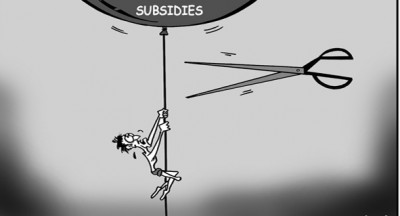
subsidies

****

In Australia, the wind industry exists – and ONLY exists – to wallow in a subsidy stream which will hit $3 billion annually in 2019; and continue at that colossal rate until 2031. The cost of the greatest subsidy rort in the history of the Commonwealth will exceed $45 billion – every last cent of which will be recovered from Australian power consumers through retail power bills:

Wind Power Fraud Finally Exposed: Senator John Madigan Details LRET’s Astronomical 45 Billion Dollar Cost to Power Consumers

Out to Save their Wind Industry Mates, Macfarlane & Hunt Lock-in $46 billion LRET Retail Power Tax

True it is, that the PM is keen to R.E.D.U.C.E the LRET subsidy for these things, but plenty of other Coalition lightweights and wind industry shills – like Dan Tehan, Sarah Henderson and young Gregory Hunt (and two wind industry plants that work in his office) believe (or publicly claim) that the cost of the massive subsidies directed to wind power outfits under the LRET is magically picked up by fairies and pixies; and that the policy is a no-cost, family and business friendly vote winner.

However, the Senators on the Inquiry into the great wind power fraud – including Coalition Members, Chris Back and Matt Canavan – have worked out that the truth is all the other way – which has led to the recommendation of a 5 year limit to the rort:

Senate Recommendations Spell ‘DOOM’ for the Australian Wind Industry

The response from the wind industry, its parasites and spruikers – like the Clean Energy Council – is as galling as it is pathetic; predictably pathetic.

You see, we’re consistently told how wind power is getting cheaper all the time – so cheap, in fact, that it’s cheaper than the cheapest of them all: coal-fired power (for a trip to a parallel universe see this piece of twaddle from ruin-economy).

The Clean Energy Council would have us believe that its clients – although now that it’s headed up by Miles George from near-bankrupt wind power outfit, Infigen (aka Babcock and Brown), it’s hard to tell who’s servant and who’s master – are blessed with a kind of ‘divine altruism’, under which their only objective is to power the world for free, while saving the planet from the ‘dreaded’ CO2 gas; and otherwise spreading health, wealth and happiness all over the planet.

Infigen windy & gusto

****

But all of that benevolent bonhomie seems to melt away, like snow in summer, with the merest hint that the massive stream of power consumer and/or taxpayer subsidies are under threat.

Here’s STT Champion, Graham Lloyd with the parasites’ response to the Senate recommendations.

Subsidy limits ‘a wind farm body blow’
The Australian
Graham Lloyd
1 August 2015

Limiting subsidy payments for new wind farms to five years would destroy the future of renewable energy, says the industry’s peak lobby group, the Clean Energy Council.

A Senate committee will next week recommend the winding back of billions of dollars in subsidy support for wind farms. It will also recommend renewable energy certificates not be issued to projects in states which do not comply with federal guidelines on low frequency noise.

The final Senate report is due to be tabled in federal parliament on Monday.

Federal Environment Minister Greg Hunt said the government presently had no plans to amend the Clean Energy Act but would consider the Senate inquiry recommendations after the report had been tabled.

The government accepted interim recommendations from the Senate committee to establish an independent scientific panel to oversee research into the impact of infrasound and low frequency noise.

It agreed to appoint a wind farm commissioner to receive complaints. And the government also instructed the $10 billion Clean Energy Finance Corporation to concentrate future funding on large-scale solar projects and emerging technologies rather than wind.

The final report of the Senate committee will call for new wind farm projects to be given renewable energy certificates for a maximum of five years, rather than 20. Clean Energy Council chief executive Kane Thornton said this would damage Australia’s international investment reputation.

“Business needs stability and confidence to invest, and this has only recently been restored to the renewable energy sector after 18 months of uncertainty,” he said. “Adopting the headline recommendation of this report would be economically reckless, and shows some of the senators are out of touch with the business community and the Australian people.”

Mr Thornton said the wind industry remained open to scrutiny, provided that the scrutiny was objective and based on evidence. “The wind industry remains committed to constant improvement in the way it interacts with the local communities surrounding wind farms, and to treating all community members with respect,” he said.

Mr Hunt said he would consider the Senate report. “We’ve recently passed Renewable Energy Target legislation that gives certainty to the industry and will see 23.5 per cent of Australia’s energy come from renewable sources by 2020,” he said. “We are not proposing and have no plans to make any changes to RET legislation.”
The Australian

Kane Thornton’s whining is not just pathetic; it’s embarrassing.

Running counter to the CEC’s repeated claims about wind power being competitive and becoming cheaper all the time, Kane tells us that limiting the flow of renewable energy certificates (RECs) to a period of five years, spells the end of the wind industry.

What Kane won’t tell you, is that the amount of subsidy available for a single 3 MW turbine operating 35% of the time (with RECs trading at their expected value of $93) will top $855,000 annually. That single turbine – if planted in 2015 will keep raking in that same amount of subsidy until 2031; allowing its owner to pocket a total in the order of $13,686,624 over the remaining life of the LRET: all at power consumers’ expense.

So, Kane’s complaint breaks down to this: if the subsidy scam is limited to 5 years, his client’s turbines will only get to rack up RECs worth a mere $4,275,000.

And that’s just the federal government’s mandated subsidy: wind power outfits receive guaranteed rates of around $120 per MWh under power purchase agreements, which run for 10-15 years – a price which takes account of the assumed value of the REC received for the MWh dispatched. That figure compares, somewhat unfavourably, with the average wholesale price of around $35 per MWh.

Bear in mind, that a 3MW machine and its installation costs less than $3 million; and that being able to spear it into some dimwit’s back paddock under a landholder agreement costs a piddling $10-15,000 per year. Oh, and as the CEC and its clients keep telling us, the “wind is free”; and that these things run on the smell of an oily rag for over 25 years:

Australia’s Most Notorious Wind Power Outfit – Infigen – says “Move Over Pinocchio, Here We Come”

So, Kane? Where’s the problem?

Under the Senate’s recommendation, your clients would get to pocket RECs worth over $4 million per turbine, at power consumers’ expense – more than the price of the turbine – where, on your case, the “fuel” is “free”; and the power produced is so cheap, retailers are just chafing at the bit to take it (although the fact that commercial retailers haven’t signed a PPA with a wind power outfit since November 2012, suggests otherwise). So, 5 years of RECs should be seen as money for jam, Kane?

The CEC, and the wind power outfits that it’s paid handsomely to represent, are starting to sound like a bunch of spoiled brats being disciplined for the very first time.

brat

****

The other Kane ‘cracker’ – that we just can’t let go – is his throwaway that the “wind industry remains committed to constant improvement in the way it interacts with the local communities surrounding wind farms, and to treating all community members with respect”.

Either Kane has been living under a rock, and remains blissfully unaware of just how his clients “interact” with rural communities and the kind of “respect” that they mete out; or his idea of community “interaction” and “respect” is drawn from the pages of the old GDR’s Stasi Handbook on community relations.

stasi-9

****

As noted above, Kane’s boss, Miles George runs Infigen – an outfit that has had many “interactions” with rural communities; and has, apparently, created its own definition of “respect”.

Back in June, three farmers told the Senate Inquiry about how Infigen managed to force them to enter land holder contracts with it, through a combination of threats, bullying and deceit. One of them, Robert Griffin, told the Senate:

It is hard for us to generalise because we have one man, Jonathan Upson, from one company, Infigen. I must say he was really shocking. He was an incredibly arrogant man. He was arrogant about everyone. All the protesters were just idiots. You could never have any discussion. They were just idiots. The department of planning were dopey. When we raised problems, we were the troublemakers.

We never got anywhere with him at all, except to get threats. Even when the department of planning first said that they would have to get our written signature on a document after the date of approval we never got any consultation. We read in the local newspaper that we were going to be made to come into line. For six months we did not get one bit of consultation from them. They could not come around and try and sweet talk us—’What’s your problem?’- none of that. We just got threats straight away, right from the word go. We were told, ‘They will be made to step into line.’ That was the thing in the local newspaper and that was the attitude.

Funnily enough, the farmers in question have resolved to get out of their contracts with Infigen; and wish to have nothing more to do with goons like Jonathan Upson:

Unwilling Turbine Hosts Tell Senate: Australia’s Most Notorious Wind Power Outfit – Infigen – a Team of Bullies, Liars & Thugs

Then there’s that paragon of community relations, Pac Hydro. The union super fund backed Pac Hydro has destroyed the ability of the Cape Bridgwater community to sleep, live in and otherwise enjoy their homes for over 7 years:

Federal Government’s Mandatory RET pays Pac Hydro to Steal Sonia Trist’s Home

After receiving hundreds of complaints over that time – largely ignoring and dismissing them – Pac Hydro was eventually forced by residents to engage Steven Cooper to carry out some proper acoustic testing. Cooper’s work – properly described as groundbreaking by qualified acoustic experts, including America’s best – demonstrated that the terrible effects being suffered – including constant sleep deprivation – were clearly related to the operation of Pac Hydro’s turbines:

The Smoking Gun: Top US Noise Experts – Paul Schomer & George Hessler – Endorse Steven Cooper’s Wind Farm Study

NHMRC Fails Science 101 in Continued Wind Farm Health Cover Up

After Cooper’s smoking gun research was made public, Pac Hydro was faced with a community and media backlash. True to form, Pac Hydro responded with its own brand of community “respect”. During a “community relations” meeting in February its then head-spruiker, Lane Crocket accepted Cooper’s work, and then practically told its numerous and long-suffering victims to “get stuffed”:

Pacific Hydro’s Cape Bridgewater Wind Farm Public Relations Disaster: Video of a Corporate Calamity Unfolding

After that effort, wind industry corporate relations were never sunnier – well, not since James Hardie spent $millions trying to cover up and avoid its liability for thousands of asbestos-related deaths and illnesses – all with the help of the same class of so-called “academics”, that help run cover for the wind industry today (see our post here).

STT can only endorse the CEC’s brand of “community interaction”; and the type of “respect” dished up by Infigen, Pac Hydro & Co. If there was anything that was guaranteed to result in the demise of the wind industry, it’s treating honest, decent hard-working country people with condescending contempt, of the kind usually reserved for bitter and sworn enemies.

Australians – especially rural Australians – aren’t so gullible and guileless to tolerate the lies, treachery and deceit doled out by the likes of the CEC and its clients. Under the current LRET, the Coalition is expecting rural communities to cosy up alongside another 2,500 of these things; Labor’s 50% renewable energy target lunacy requires more than 10,000.

There is no way that rural Australians will take this rubbish lying down. Not anymore.

STT hears that hundreds of people, in dozens of communities are already organising the mother of all counter-attacks. And it’s the high-handed arrogance of outfits like the CEC, Infigen and Pac Hydro that’s driving them to revolt. Thanks Kane.

storming_the_bastille1-e1318690559144

The Beginning of the End, for Australia’s Wind Weasels!

Senate Recommendations Spell ‘DOOM’ for the Australian Wind Industry

atomic-bomb-e1355417893840

****

The wind industry in Australia, already belted, battered and bruised, has just been delivered what STT considers the fatal blow.

On Friday just gone, the front page of The Australian carried the headline “Call to curb wind subsidies” in an “exclusive” penned by STT Champion, Graham Lloyd – the full report appeared on page 7 – in which Graham provides a sneak preview of the recommendations made in the final report of the Senate Inquiry into the great wind power fraud, due out next week.

Canberra urged to strip billions from windfarm subsidies
The Australian
Graham Lloyd
31 July 2015

A Senate committee says renewable energy subsidies for new wind farms should be limited to five years from more than 20.

The Abbott government is being urged to strip billions more from subsidies to wind farms in the final report of a Senate committee that has already pushed renewable energy investment to favour solar.

In its recommendations, the committee says renewable energy subsidies for new wind farms should be limited to five years from more than 20.

It also wants the issue of renewable energy certificates restricted to projects in states that adopt federal regulations on infrasound and low frequency noise.

The final report of the Senate investigation into wind farms and their possible health effects will be tabled in parliament on Monday.

The report has been circulated and details have been provided to The Australian.

The call for time limits on subsidies and federal noise oversight is likely to provoke a backlash from the wind industry, already reeling from a federal government directive to the $10 billion Clean Energy Finance Corporation that it stop lending to wind projects.

The lending freeze was agreed with crossbench senators after the federal government adopted the committee’s interim report recommendations.

The deal included crossbench support to include forest waste in the revised renewable energy target legislation.

In a letter tabled in the Senate, Environment Minister Greg Hunt said the federal government would respond “actively and in good faith” to the Senate committee findings.

The final report says a five-year limit on renewable energy certificates, down from more than 20 years, recognised that wind turbine technology was well developed and a “mature” industry.

A ban on issuing RECS to wind farms in states that do not adopt federal guidelines on infrasound is designed to force the hand of governments that rejected a national approach at the last Council of Australian Governments meeting.

At present, noise guidelines are administered by the states, but renewable energy certificates are issued by the commonwealth.

Renewable energy companies are issued RECS for the amount of power they generate.

The RECS are sold to power authorities, which must secure a set portion of their supply from renewable sources under the RET.

The cost of buying RECS is added to consumer electricity bills as a subsidy for renewable energy over other sources of power.

Crossbench senators are confident the federal government will accept the recommendations and the measures can be passed through both houses. Adoption will require legislative changes to the Clean Energy Act.

Legislation would require the support of six non-government senators in the upper house.

The Senate committee has been particularly concerned by complaints from people living near wind farms who believe low-frequency noise and infrasound is having an impact on their health.

The existence of health impacts from wind turbines has been rejected as unproven by health authorities, but as the number of complaints increases the issue is being investigated worldwide.

The final Senate report recommends the scientific committee have the power to provide “guidance, advice and oversight” to bodies funding and undertaking research into infrasound.
The Australian

Nice work, Graham!

As an aside, it’s the Renewable Energy (Electricity) Act 2000 that would be amended (not the Clean Energy Act) – s40 of which sets the target.

However, no doubt due to his desire to be seen as objective, Graham slips a little when he suggests that the health impacts of low-frequency noise and infrasound are somehow a matter of “belief”.

When the next-door neighbour’s rooster fires up at 5 o’clock in the morning (every morning) – and wakes up the entire household, the interruption to decent sleep is viewed pretty dimly by those deprived of it: tempers start to fray over bleary-eyed breakfasts; and forced weariness takes its toll on the functional ability of Foghorn Leghorn’s victims as the day rolls on.

foghorn

****

The same goes for those with neighbours who love cranking up AC/DC at two in the morning – or the early rising gardener, who whips his lawn mower into action well before sun-up on Sunday.

The accepted right to unbroken sleep is the reason why there are strict rules to prohibit rowdy roosters residing in cities and towns; the curbs placed on firing up mowers and leaf blowers before breakfast; and shutting down live music venues in built up areas after midnight – sleep is sacrosanct – the consequences of depriving people of routine sleep are so obvious it goes without saying:

Wind Turbine Noise Deprives Farmers and Truckers of Essential Sleep & Creates Unnecessary Danger for All

As a contrast to the merciless, around-the-clock cacophony dished out by wind power outfits on their neighbours – which all levels of government expect them to tolerate without so much as a whimper – STT noticed this story from Western Australia a while back, where an argument between neighbours over late-night festivities resulted in the (alleged) murder of the party complaining about the noise interfering with his family’s right to a decent night’s sleep: Man, 45, dies after disturbance in Perth suburb of Seville Grove

If someone is complaining about losing sleep due to night-time noise – that complaint is taken as an accepted fact – and their “belief” in the cause has got nothing to do with it: prove that the noise was being generated and the rest follows.

For every other kind of noise source, the authorities take those complaints seriously – roosters get the chop; police get the noisy-neighbour to wind down their stereos; pubs allowing rock bands to rock-on past their curfews, face licensing penalties; and eager-beaver gardeners are told by EPAs or Councils to leave the lawn mowers and leaf blowers in the shed, until the neighbourhood has had a chance of a leisurely weekend lie in – or to expect to get whacked with fines if they don’t: for a few of the rules, see the Victorian EPA’s site here.

But, for some strange reason wind power outfits are permitted (or, rather, encouraged) to operate these things around the clock, with noise ‘rules’ so lax as to be risible.

The impact of incessant turbine generated low-frequency noise and infrasound is well-known to the wind industry – its direct causal impact on sleep deprivation was documented in a decade’s worth of research by NASA – top-tier research that has been ignored by regulators and health authorities – like the disgraced NHMRC – and covered up by the wind industry ever since:

Three Decades of Wind Industry Deception: A Chronology of a Global Conspiracy of Silence and Subterfuge

When farmers being paid $200,000 a year to host these things complain bitterly about sleep deprivation as a regular event, then STT is pretty much satisfied that the noise and vibration generated by turbines is causing what the World Health Organisation has considered to be an adverse health effect in and of itself (for over 60 years):

SA Farmers Paid $1 Million to Host 19 Turbines Tell Senate they “Would Never Do it Again” due to “Unbearable” Sleep-Destroying Noise

Which brings us to the Senate’s recommendation to prevent Renewable Energy Certificates (RECs aka LGCs) being issued to wind power outfits operating in States that refuse to adopt federal regulations on infrasound and low-frequency noise – regulations that will be drawn up as another of the Senate’s recommendations.

The Federal Government has always taken the line that noise regulation is a matter for the States. A position which rudely ignores the fact that the wind industry would not exist in the absence of the massive federally mandated subsidies set up by the Large-Scale Renewable Energy Target (LRET).

It’s a line that’s been spun by PM Tony Abbott who says that the “sites of these things is a matter for the state governments”.

STT has likened that pitch to the ‘defence’ run by the bloke who sells the sawn-off shotgun to an armed robber.

armed robber

****

Sure, the illegal firearm vendor didn’t actually pull the trigger and send a bank teller for an unscheduled trip to the morgue. However, in the absence of the weapon supplied, there may have been no robbery – certainly not an “armed” one – and no harm done to bank tellers, in any event.

In the criminal law, the concept of liability for those who provide the arms to known bandits is picked up in the concepts of accessorial liability – the ol’ chestnuts about aiding and abetting, accessory before the fact and all that.

In this case, though, the Coalition is not only providing the weapon, from now until 2031 it will be supplying the offenders with an endless stream of ammunition – in the form of around 500 million Renewable Energy Certificates; designed to be worth over $90 – as young Gregory Hunt calls them: “a massive $93 per tonne carbon tax” – the $46 billion cost of which will be borne by all Australian power consumers (as we detail below).

The Senators on the Inquiry have worked out that the only way to prevent wind power outfits from stealing any more Australian homes is to disarm the bandits by tying the ‘entitlement’ to wallow in millions of RECs to a meaningful noise standard.

The other “killer” recommendation is that the REC Tax/Subsidy paid to wind power outfits be limited to a period of five years.

There aren’t many people – outside of the parrots profiting from it – who actually understand the fact that the REC is designed as a perpetual subsidy to wind power outfits – recouped through retail power bills as a TAX on all Australian power consumers.

Outside of those engaged in the rort – or keen to aid and abet those involved – hardly anybody understands the quantum of the subsidy; who pays it; and its longevity. And that, until recently, included the Senators involved in the Inquiry.

STT hears that – at the very first hearing in Portland in Victoria on 30 March this year – a number of them were gobsmacked to learn that the REC subsidy is not limited to last for 2 or 3 years, say – but is designed to run for more than a generation – from 2001 to 2031.

STT has set it out before, and for the uninitiated, we’ll set out again.

A REC is issued for every MWh of wind power dispatched to the grid; and a shortfall penalty of $65 per MWh applies to a retailer for every MWh that they fall short of the LRET target – the target is meant to be met by retailers purchasing and surrendering RECs in an effort to avoid the penalty.

Under the latest 33,000 GWh ultimate annual target, assuming that RECs hit $93, as the penalty inevitably begins to apply (RECs are currently trading around $52), the total cost added to power consumers’ bills will top $46 billion (495,600,000 x $93).

The LRET ‘system’ was designed around RECs being worth $93, with the $65 per MWh shortfall charge setting the ‘floor price’ for RECs, and the tax treatment of RECs taking their value to over $90.

Power consumers pay the full cost of the RECs issued to wind power outfits – on top of the wholesale price paid by retailers – in relation to collecting the cost of the REC Subsidy from power consumers in what can only be described as a TAX on retail power bills, Origin Energy’s Grant King correctly puts it:

[T]he subsidy is the REC, and the REC certificate is acquitted at the retail level and is included in the retail price of electricity”.

It’s power consumers that get lumped with the “retail price of electricity” and, therefore, the cost of the REC Subsidy paid to wind power outfits. To call that arrangement anything other than a TAX is pure political and PR nonsense.

To give some idea of how ludicrously generous the REC Subsidy is, consider a single 3 MW turbine. If it operated 24 hours a day, 365 days a year – its owner would receive 26,280 RECs (24 x 365 x 3). Assuming, generously, a capacity factor of 35% (the cowboys from wind power outfits often wildly claim more than that) that single turbine will receive 9,198 RECs annually. At $93 per REC, that single turbine will, in 12 months, rake in $855,414 in REC Subsidy.

turbine collapse 9

****

But wait, there’s more: that subsidy doesn’t last for a single year. Oh no.

A turbine that started operating this year will continue to receive the REC subsidy for 16 years, until 2031 – such that a single 3 MW turbine spinning today can pocket a total of $13,686,624 over the remaining life of the LRET.

Not a bad little rort – considering the machine and its installation costs less than $3 million; and that being able to spear it into some dimwit’s back paddock under a landholder agreement costs a piddling $10-15,000 per year. State-sponsored theft never looked easier or more lucrative! For a more detailed analysis on the impact of the shortfall penalty and the REC Tax/Subsidy see:

Out to Save their Wind Industry Mates, Macfarlane & Hunt Lock-in $46 billion LRET Retail Power Tax

There has never been a subsidy scam like it in the history of the Commonwealth.

When General Motors Holden found itself in financial trouble a couple of years back, the Coalition – railing about ‘corporate welfare’ – decided to stump up a mere $100 million as a ‘rescue package’ – nowhere near enough to have salvaged the troubled carmaker, its 2,000 workers and the tens of thousands more working for the components manufacturers that supported it: Tony Abbott announces $100 million package for Holden workers

Starved of Federal support, and done in by over-generous Union ‘won’ wages and conditions, the last Holden will dribble off the production line early next year – and 10-20,000 South Australians will end up scrambling for manufacturing or mining jobs that simply do not exist:

SA – Australia’s ‘Wind Power Capital’ – Pays the World’s Highest Power Prices and Wonders Why it’s an Economic Basket Case

Now, consider the contrast with the Coalition’s Croesus-like corporate welfare directed at the wind industry.

The wind industry exists – and ONLY exists – to wallow in a subsidy stream which will hit $3 billion annually in 2019; and which continues at that colossal rate until 2031.

True it is, the PM is keen to R.E.D.U.C.E the LRET subsidy for these things, but plenty of other Coalition lightweights and wind industry shills – like Dan Tehan, Sarah Henderson and young Gregory Hunt (and the wind industry plants that work in his office) believe that the cost of the massive subsidies directed to wind power outfits under the LRET is magically picked up by fairies and pixies; and that the policy is a no-cost, family and business friendly vote winner.

However, the Senators on the Inquiry – including Coalition Members,Chris Back and Matt Canavan – have worked out that the truth is all the other way – which has led to the recommendation of a 5 year limit to the rort. That limit will kill the wind industry stone-dead: no ‘investor’ will stump up a penny from here-on, unless the subsidies are written in stone, to last indefinitely.

The wind industry, its parasites and spruikers didn’t see it coming – and have been reduced to wailing about their imminent demise. Oh dear, how sad, never mind.

senate review

Aussies Call to Slash Wind Turbine Subsidies! Can’t be too soon!

Call to slash wind farm subsidies

A Senate committee says renewable energy subsidies for new wind farms should be limited to five years from more than 20.
It also wants the issue of renewable energy certificates restricted to projects in states that adopt federal regulations on infrasound and low frequency noise.

A Senate committee says renewable energy subsidies for new wind farms should be limited to five years from more than 20. Source: Supplied
The AustralianJuly 31, 2015Australia

Canberra urged to strip billions from windfarm subsidies

By Graham Lloyd, Environment Editor, Sydney

The Abbott government is being urged to strip billions more from subsidies to wind farms in the final report of a Senate committee that has already pushed renewable ­energy investment to favour solar.

In its recommendations, the committee says renewable energy subsidies for new wind farms should be limited to five years from more than 20.

It also wants the issue of renewable energy certificates restricted to projects in states that adopt federal regulations on infrasound and low frequency noise.

The final report of the Senate investigation into wind farms and their possible health effects will be tabled in parliament on Monday.

The report has been circulated and details have been provided to The ­Australian.

The call for time limits on sub­sidies and federal noise oversight is likely to provoke a backlash from the wind industry, already reeling from a federal government directive to the $10 billion Clean Energy Finance Corporation that it stop lending to wind projects.

The lending freeze was agreed with crossbench senators after the federal government adopted the committee’s interim report recommendations.

The deal included crossbench support to include forest waste in the revised renewable energy ­target legislation.

In a letter tabled in the Senate, Environment Minister Greg Hunt said the federal government would respond “actively and in good faith” to the Senate committee findings.

The final report says a five-year limit on renewable energy certificates, down from more than 20 years, recognised that wind turbine technology was well developed and a “mature” industry.

A ban on issuing RECS to wind farms in states that do not adopt federal guidelines on infrasound is designed to force the hand of governments that rejected a nat­ional approach at the last Council of Australian Governments meeting.

At present, noise guidelines are administered by the states, but ­renewable energy certificates are ­issued by the commonwealth.

Renewable energy companies are issued RECS for the amount of power they generate.

The RECS are sold to power authorities, which must secure a set portion of their supply from ­renewable sources under the RET.

The cost of buying RECS is added to consumer electricity bills as a subsidy for renewable energy over other sources of power.

Crossbench senators are confident the federal government will accept the recommendations and the measures can be passed through both houses. Adoption will require legislative changes to the Clean Energy Act.

Legislation would require the support of six non-government senators in the upper house.

The Senate committee has been particularly concerned by complaints from people living near wind farms who believe low- frequency noise and infrasound is having an impact on their health.

The existence of health impacts from wind turbines has been ­rejected as unproven by health authorities, but as the number of complaints increases the issue is being investigated worldwide.

The final Senate report recommends the scientific committee have the power to provide “guidance, advice and oversight” to ­bodies funding and undertaking research into infrasound.

Exposing Another Wind Weasel Lie….

Wind turbine syndrome is not confined to English-speaking countries!

Lilli-Ann Green gives evidence that wind turbines cause adverse health impacts for some people who live nearby in France, Germany, Holland, Denmark and Sweden.

SENATE SELECT COMMITTEE ON WIND TURBINES
Monday, 29 June 2015

Extract from Official Committee Hansard (page 1 to 6):

Lilli-Ann Green
Lilli-Ann Green
(Cape Cod Times/Ron Schloerb)

Ms Green: I am CEO of a healthcare consulting firm with a national reach in the United States. My company works in all sectors of the healthcare industry. One of the core competencies of the firm is to develop educational programs to help doctors, nurses and other healthcare workers better communicate with their patients around various disease states. Currently, as a volunteer in my town, I am secretary of our energy committee and a delegate to the Cape Cod National Seashore Advisory Commission as an alternate. Cape Cod National Seashore is part of the United States National Park Service. In the late 1970s, I built a passive solar superinsulated home. I directed an environmental education school for several years. I work seasonally as a naturalist interpretive ranger for the National Park Service. I have been interested and active in the environmental movement since the early seventies. Today, I speak as a private citizen.

CHAIR (Senator Madigan): Thank you. Could you please confirm that information on parliamentary privilege and the protection of witnesses and evidence has been provided to you?

Ms Green: It has.

CHAIR: Thank you. The committee has your submission and we now invite you to make a brief opening statement and at the conclusion of your remarks, I will invite members of the committee to put questions to you.

Ms Green: Thank you. Until the beginning of 2010, I believed wind turbines were good and green. My town was interested in constructing wind turbines and a friend visited my office in early March 2010 to provide my husband and business partner and me with new information. Following the visit, I spent the next 10 hours researching wind turbines. That very day, after concluding my research, I was saddened but I became convinced there was credible evidence that wind turbines cause adverse health impacts for some people who live nearby. In the past, over five years, I have learned it is a global phenomenon that wind turbines make some people who live nearby sick and it is a dose response so these people become more ill over time.

My husband, who is now deceased, and I travelled to Australia and New Zealand in 2010-11 and subsequently created a film called Pandora’s Pinwheels: The Reality of Living with Wind Turbines. We then travelled around the world in 2012 and conducted interviews in 15 different countries. Most of the people we interviewed expressed that they were in favour of wind energy prior to wind turbine construction nearby. There are some common symptoms people the world over report who live and work too close to wind turbines. A good summary is found in the book Wind Turbine Syndrome: A Report on a Natural Experiment by Nina Pierpont, MD, PhD.

It does not matter whether people live in English-speaking countries or in countries where people do not speak English. People reported to us they are made sick when they live too close to wind turbines, no matter what country they live in. We interviewed people in both English-speaking countries and non-English-speaking countries alike who reported to us they were not ill prior to wind turbine construction nearby and after the wind turbines were operational nearby they were made sick.

We interviewed people in five countries—France, Germany, Holland, Denmark and Sweden—who either needed an interpreter to speak with us or who spoke broken English. Some locations were quite rural with little or no internet connection. Still, the people we interviewed through interpreters expressed the same symptoms, others the world over described to us. These people with no or limited internet connection even used similar phrases, analogies and gestures, as others did globally to describe their symptoms. What we actually found is most people are reluctant to speak about their health problems.

In the United States, there are privacy laws regarding medical information. Culturally, people do not openly discuss their health problems with strangers. We found this to be the case in the countries we visited around the world. It was a brave person who opened up to us about their health problems. Usually, the people we interviewed expressed they wanted to help others. If anything, people tended to minimise their symptoms or try to attribute the symptoms to other circumstances. Even when they acknowledged a common symptom such as sleep deprivation, many people who experienced additional common symptoms were reluctant to attribute these other symptoms to the wind turbines nearby. Furthermore, people the world over reported that they and their healthcare providers puzzled over health problems that appeared after wind turbines were constructed near their homes.

Many endured a huge battery of medical tests to try to determine what the cause of their health problems were. The medical tests, at a huge cost to the healthcare system, only ruled out various diseases. Typically, the cause of their sickness was not diagnosed by their healthcare professional. Frequently, we heard that the patients would be in a social situation with others in their neighbourhood and eventually people they knew well confided they had similar health problems that recently appeared, or after research online about a different topic these people reported stumbling upon the cause of their health problems, which were the wind turbines constructed nearby.

We even interviewed people who lived for 11 years near wind turbines in a non-English speaking country—and that was in 2012. Several people came to an interview to talk about their property devaluation. It was only during the interviews when they heard others speak about health problems that the people realised they had been suffering because they lived too close to wind turbines. One man in his 80s sobbed during his interview. He had been visiting his doctor for 11 years trying to figure out what was wrong with his health.

The woman who invited us to interview her and her neighbours learned about health problems from wind turbines when she saw the film I produced Pandora’s Pinwheels, with interviews conducted in Australia and New Zealand, that was translated into her language. These people needed an interpreter; they did not speak English. She told me that her husband had passed away in the not too distant past due to heart problems. Before he died, he had complained quite frequently of common health symptoms people living near wind turbines experience. Although they visited their doctor frequently, no-one could figure out why he was so sick. She thanked us because, in seeing our film, it helped her to understand what her husband had been going through and why. It gave her closure that she did not have prior to viewing our film.

Another person at the interview told us she had to hold on to the walls of her house some days in order to walk from room to room and felt nauseous frequently. She knew she was unwell in her home and abandoned it. She did not know why until she saw our film. She came back to the area for the interview because she wanted to tell the world that wind turbines made her so ill that she sold her home at a huge loss.

One of the people I have known for the past five years lives in Falmouth, Massachusetts, which is very close to where I live—it is an hour and a half away. In 2010, he had recently retired to his dream home of many years. He was in great physical health, very fit and has over a 20-year record of normal to low to blood pressure. Since the wind turbines have been constructed in Falmouth, Massachusetts, he has reported that his blood pressure skyrockets to heart attack and stroke levels when the wind is coming in the wrong direction for him.

In Falmouth there are three wind turbines that are 1.65 megawatts near this person’s home. This person’s doctor, whom he has seen over the past 20 years, is in the Boston area and his doctor has been quite blunt. The doctor has told the patient that his life is in danger and he must move. Unfortunately, the Falmouth resident is crushed and cannot bear to leave his dream home at this point in time. He goes to other locations when the wind is predicted to be coming from the wrong direction. Others we interviewed in many different countries told us similar stories. Many reported they have abandoned their homes, sold their homes at a huge loss, purchased other homes to live in when the wind is coming from the wrong direction or in order to sleep in, and others spend time away from their homes at a huge and unexpected expense. People considered their homes as sanctuaries prior to the construction of wind turbines nearby. Now their opinion is not the same.

We have interviewed people on three continents who live more than five miles from the nearest wind turbine and are sick since wind turbine construction. I contend that we need honest research to determine how far wind turbines need to be sited from people in order to do no harm. People report to us that over time their symptoms become more severe. Many report not experiencing ill effects for some time following wind turbine construction, meanwhile their spouse became ill the day the wind turbines nearby became operational. They speak of thinking they were one of the lucky ones at first, but after a number of months or years they become as ill as their spouse. Not one person who stayed near wind turbines reported to us that they got used to it or got better; they all became more ill over time.

Since we are dealing with a dose response, we do not know over the projected lifetime of a wind turbine—say, 20 to 25 years—how far from people it is necessary to site wind turbines. To me, it is just wrong to knowingly harm the health and safety of people. There are responsible solutions to environmental issues that do not impact the health and safety of people nearby. Our humanity is in question when we continue to knowingly harm others. I thank you for your time today. I sincerely hope that you do take active steps to help the people in your country who are suffering due to living and working too close to wind turbines, and I am glad to answer questions you may have.

CHAIR: Thank you.

Senator LEYONHJELM: Good morning, Ms Green—I suppose it is not morning there. Thank you for your submission—

Ms Green: No, it is Sunday evening here.

Senator LEYONHJELM: Sunday evening? I am sorry to being interrupting your evening.

Ms Green: I am glad to speak with you.

Senator LEYONHJELM: You have interviewed people in 15 countries, I think you said, under all different circumstances and so on. I appreciate we are not pretending this is a gold-plated, statistical survey, but I am interested in your impressions because I think you have more experience of this than any other witness we have heard from. What do you think, based on your experience, are the common factors in the people you have interviewed in different communities living near wind turbines? What are the common factors to all of them?

Ms Green: I think we seriously do not have enough research to understand this problem fully. We saw the same symptoms. Slide 17 that I submitted has a listing of the common symptoms that Dr Pierpont lists in her book. I really believe that we just do not have enough information yet. But throughout the interviews, country by country, people described the same symptoms. Many times they used the same phrases to describe them and the same gestures—even if they were not speaking English. There is a common thread here.

Senator LEYONHJELM: Do you get the impression that not everybody exposed to wind turbines is affected the same? Have you seen evidence of substantial individual variation?

Ms Green: I have, indeed. Just as some people are more prone to asthma and some people are more prone to lung cancer, let’s say, or any disease, we did see a variation. It appeared that if there were people who were, say, prone to migraine headaches, they were severely affected. But, again, there were people who did not seem to have the symptoms who were living either in the same house or nearby. I do not know whether it is a question of time, if over 20 years people become more sensitised and they will become sick. Very frequently we did hear the same theme running through the stories of the people we interviewed, where, say, the husband thought he was one of the lucky ones and six months later he could not sleep, he was experiencing ear pressure, ear pain and severe headaches or other symptoms.

Senator LEYONHJELM: We are aware of community groups in English-speaking countries who have expressed opposition to wind turbines, but we are not aware of that sort of phenomenon in non-English speaking countries. Have you encountered that?

Ms Green: Yes, indeed. We travelled around the world. It was a 10-year goal. We had it very well planned out and we thought it was for pleasure. But people kept emailing us and asking us to come and interview them. So we met people in a lot of non-English speaking countries, and they were such nice people, I have to say. They had just about any profession you would like to mention. They just wanted to tell their story. Many times these people wanted to talk to us for other reasons such as their house had been devalued because the wind turbines were nearby. As they were listening to other people in the room talking about their health problems, these people realised that they had been struggling with the same illness since the wind turbines were constructed nearby. They had never made that correlation before; in fact, they were quite frustrated. They told us that they would go back and back continually to their healthcare provider and talk about these symptoms, and they could not find a resolution or a reason. As I said, there is one man I recall quite vividly just sobbing—and that was in 2012; he was in his 80s. He had realised that since the wind turbines had been constructed nearby he was experiencing these symptoms that were the common symptoms.

Senator LEYONHJELM: Some witnesses have suggested to us that there is a relationship between not only the distance their residence is from the turbine but also the power of the turbine, the size of the turbine. Have you been able to come to any conclusions on that or is that outside your interest area?

Ms Green: No, it is not outside my interest area. In fact, it is quite alarming to me, because I have interviewed people who live near wind turbines that you in Australia would probably consider to be quite small and solitary—wind turbines that are 100 kilowatts, even—and they are experiencing health problems, even people living near a 10-kilowatt wind turbine. Frankly, it is the nearest wind turbine to where I live, and a number of neighbours are having problems, and not just with the audible noise but with the infrasound and low-frequency noise, based upon the symptoms they are reporting to me. It really is quite alarming. In my state, Massachusetts, there is a woman who has told me she lives more than five miles from the nearest wind turbine and she is quite ill. The onset of her symptoms was when the wind turbine was constructed. When she went on trips she was fine; when she came back she was ill, and it has only become worse over time. That wind turbine is not as powerful as wind turbines in Australia, and it is a solitary wind turbine.

Again, we travelled quite a distance in France—mid-south-eastern France—over a number of days at the invitation of the people in the area and visited several different communities where there were wind turbines. One of the situations is that the wind turbine is 10 kilometres from one of the neighbours who is very ill and 12 kilometres from the other neighbour. The person who lives 12 kilometres away reported to us that she had been very supportive of the wind turbines. She is very well known as an environmentalist in the area, has quite a reputation as an environmentalist and is highly regarded. But she is quite ill, and it was very difficult for her to speak with us.

The other person related a story of trying to detect what the problem was because he could not sleep and was becoming so frustrated that he would go in his car to try to find the source of what was keeping him awake. He talked about going night after night until he went into the wilderness. He could not imagine what was there, and then he found the wind turbines. They were creating a humming noise in his head at that point. He could actually hear this frequency. In our discussions with researchers, medical professionals and scientists, one of the scientists told us that what people hear is mostly a bell curve—that is the way it was described to us. Most people hear audible noise within a certain range, but there are people who are more sensitive to noise, and they hear sounds that most people would consider inaudible.

Senator URQUHART: I have a lot of questions. I am not going to get through them all, so I am wondering whether you are able to take some on notice at the end.

Ms Green: I will try. I am very busy, but I will try.

Senator URQUHART: In your submission you say you run a healthcare consultancy. Do you have any qualifications in health care or medicine?

Ms Green: I have a background in education.

Senator URQUHART: What is the name of your company?

Ms Green: I do not want that on the record.

Senator URQUHART: Can I ask why?

Ms Green: I am speaking today as a private citizen. I would be glad to give you that information if it is held as in-confidence.

Senator URQUHART: Okay. How many employees do you have?

Ms Green: My husband has passed away. He was my business partner, and I have scaled back the business. I am the only employee at this point in time. However, I will tell you that I have created in our company, with teams of people, educational programs that have been implemented throughout the United States. One of the oncology programs that was created by my team, which was quite a large team, interviewed over 100 oncology patients throughout the United States and numerous doctors and nurses and was mandatory for all of the oncology nurses in the Kaiser health system in California.

Senator URQUHART: In your submission you say that 300,000 physicians and healthcare professionals have undertaken training through your company.

Ms Green: That is correct.

Senator URQUHART: What are the products or services? Is it communication? What is it that you actually sell?

Ms Green: There is a number of different core competencies in our company. One is developing educational programs around different disease states, such as oncology, diabetes, heart disease and various other disease states. Another path we have taken is to develop a service quality initiative. My husband was an extraordinary speaker and was often the keynote speaker for national conferences in all sectors of the healthcare industry.

Senator URQUHART: In your opening statement you talked about how you had interviewed many people from various countries. I could not find any of the transcripts, either in your submission or online. I am sorry if I have missed them.

Ms Green: You have not missed them. In the company we are still in the process of editing the films. It was a huge undertaking of many months, at huge expense. There is a lot of information that is still being edited.

Senator URQUHART: Are you able to provide copies of the transcripts and the full names of the people you interviewed?

Ms Green: No. It is on film; it is videotaped interviews, and the film is being edited.

Senator URQUHART: You talked about how you undertook the research after you had new information from people within your area who were concerned about wind farms. Was that the purpose of the interviews?

Ms Green: No. In my town, one month after we learned that our energy committee wanted to put one 1.65 wind turbine in our town—and we had conducted the research and people in our town were quite concerned—our board of selectmen, which is like your town councils, decided to not move forward with the project. I am now on my energy committee, as secretary, and we are devising a plan to become 100 per cent electrical energy efficient without wind energy but using other alternative methods. Are you asking me what propels me to do the interviews?

Senator URQUHART: Yes. I guess my real reasoning was whether the purpose of the interviews was to inform the body of research on international attitudes to wind farms. Is that why—

Ms Green: No. It is not an attitude; it is to understand the realities of living near wind turbines—living, working, attending school, being incarcerated near wind turbines.

What happened was that my stepson was living in Australia and we went to Australia at the end of 2010. I knew there was a location called Waubra and I had seen the Dean report that had been recently published. I put out one little email asking ‘We will be in the Melbourne area and is it possible to meet some of the people that are living near the wind turbines at Waubra? Is it possible to see the Waubra area?’

It was amazing that I was connected with the people in that area of Australia. My husband and I drove to the area and we interviewed over 17 people in one day. They welcomed us into their homes. We did not know what to expect. We turned the camera on and we asked them questions, and they told us their story. We had no idea what we were going to find. We went to New Zealand and people emailed us after they had heard we had been to Waubra. They asked us if we would come and visit them and interview them. We did that in two different locations in New Zealand. When we came home we put together this film called Pandora’s Pinwheels

Senator URQUHART: You interviewed people—

Ms Green: During our 2012 travels we just thought we would go back to Waubra and talk to the people at Waubra because we had been emailing them over the year. But people around the world kept on emailing us and asking us to come and interview them.

Senator URQUHART: So you conducted interviews in 15 countries, as I understand it from your submission. Is that how you got the contact information on the people you interviewed?

Ms Green: I do not understand your question. Everywhere we were travelling people kept on emailing us and contacting us and asking if we would come and interview them and talk with them. They wanted to go on camera and tell their story. We had no agenda; we had no plan. We work in the healthcare industry; we talk about various illnesses and disease states, and we educate doctors and nurses about disease states. I am sorry; I want to retract that: we find a cross-section where patients are having issues with the communication around their disease state, and the doctors and nurses are having issues around communicating with their patients. We find those intersections and help doctors and nurses better communicate with the patients. So we are trying to improve patient care. That is what we do as one of the core competencies of our business.

When we found the health problems with the wind turbines and when we saw in every country we visited that people were saying the same thing, we wanted to get that word out to people like you who are hearing from your constituents that they are having health problems. That is all I want to do—to provide you with the truth.

Senator DAY: Ms Green, as you might imagine, we have received submissions from hundreds of people who have reported adverse health impacts and yet we are being accused of trying to destroy the wind industry. We are being accused of rigging this inquiry and of being engaged in a political stitch up. What has been your experience with such hostility towards genuine inquiry?

Ms Green: I really do not have a response for you, Senator. I have heard a lot of stories from people and I have experiences myself, but I really do not have a response on that topic.

Senator DAY: Okay. I will follow up then: you say that a number of governments around the world are realising there is a need for more or better regulation surrounding the wind energy industry. Which governments are doing better in this area, in your opinion?

Ms Green: I know that in my state, I have a new governor and my governor has a background in health care, and I am expecting that my governor understands that people do have health problems when they live and work too close to wind turbines in my state.

Senator BACK: Ms Green, I have just one quick question; I know that we are over time. In Australia, we are proceeding to have independent medical research undertaken for the first time. One of the proposals put to us is that they try and simulate this effect of either noise or infrasound, and do so in a one-off exposure in a clinically sterile circumstance for exposure times of somewhere between 10 to 30 minutes and an hour. From what you have learned and heard—and from interviewing people—do you think there would be anything to be learned in exposing somebody for a very limited period of time, and once only, in a sort of laboratory-type circumstance? Do you believe that is likely to lead to any reasonable outcome or result that we might be able to use?

Ms Green: Senator, I am not a researcher or a doctor. But given what I have heard from people and what people have reported to me, I find it highly unlikely that that would have any results that would have any validity.

Senator BACK: Thank you.

CHAIR: Thank you for evidence today to the committee, Ms Green. You will receive questions on notice and if you are able to come back to us with answers to those, that would be appreciated.

Ms Green: Absolutely. I would like to thank the committee; the chair, Senator Madigan, and the members of the committee, and also to thank you, Graham.

CHAIR: Thank you, Ms Green.

Lilli-Ann Green’s evidence

The complete Hansard is available at ParlInfo:
Senate Select Committee on Wind Turbines – 29/06/2015

Lilli-Ann Green’s evidence

Lilli-Ann Green’s submission to the Australian Senate Select Committee on Wind Turbines:

Presentation by Lilli-Ann Green

Pandora’s Pinwheels: The Reality of Life with Wind Turbines
Australia and New Zealand

Introduction and Background of those interviewed – experts, journalist, people who live in three separate areas too close to wind turbines

INDEX:

  • 10:46 – Prior Attitudes
  • 13:14 – People felt lied to
  • 28:03 – Noise, the many facets of wind turbine noise and how it is different from other industrial noise
  • 53:37 – Health impacts and how close is too close; some people live over 2 miles from the nearest turbine
  • 1:18:51 – Shadow, blade flint, flicker, red flashing lights
  • 1:23:00 – Property values
  • 1:31:34 – Community fracture
  • 1:37:48 – Quality of Life; Amenity
  • 1:45:44 – What would you tell others if a wind developer comes to a community
  • 1:49:09 – Conclusion

Death Knell for the Wind Industry! Subsidies being slashed!

Rocketing Power Prices see Subsidies Slashed, Bringing Europe’s Wind Industry to its Knees

9

****

The Australian wind industry is copping a belting from all sides at the moment.

With the Senate Inquiry about to release its final report on the great wind power fraud; retailers flatly refusing to enter long-term Power Purchase Agreements – essential to obtain finance for new wind farms; and with an increasing number of farmers refusing to host these things and/or hell-bent on getting out of their contracts to do so, its parasites and spruikers have been reduced to making wild and unsubstantiated claims about the continued growth of wind power in European countries such as Germany, Denmark, Spain and the UK.

The only trouble with that story is the fact that all of them have slammed the bag on further subsidies; some of them have, in effect, set upmoratoriums against any more new wind farms; and all of them are facing a furious backlash from power consumers (read ‘voters’) fed up with escalating power bills.

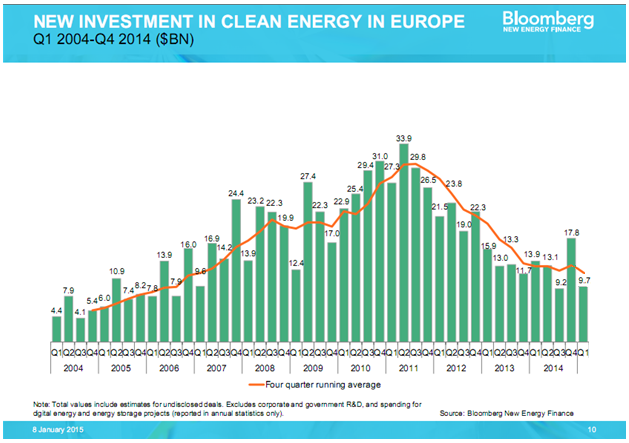
The consequence of the European’s retreat from their respective wind power disasters is that investment in wind power has dropped off a cliff (see the graph above – which tends to suggest a little trend) – in the UK, with David Cameron’s election win, subsidies have been pulled to a halt and, as an inevitable result, hundreds of threatened projects have been blown to the four winds.

The unvarnished truth about the European wind power debacle isn’t something you’re likely to read in any of the struggling Fairfax mastheads; or hear about on your ABC. No, as has often been the case with the mainstream press, it’s down to Graham Lloyd from The Australian, to throw a little light on the subject.

Europe slashes subsidies for renewables as energy prices rise
The Australian
Graham Lloyd
25 July 2015

Shorten’s vow on green energy comes just as other governments scale back

More than three million people a week watch the heute-show, Germany’s answer to The Chaser, which cuts through the pretence to slaughter society’s holy cows.

Last year heute-show host, comedian and journalist Oliver Welke, sacrificed the holiest of them all, Germany’s multi-billion-euro renewable energy transformation that routinely is held up as green-friendly world’s best practice. “Could it be that the Grand Coalition has gone nuts?” Welke said.

His comments followed release of an expert panel report commissioned by the Merkel government that found the much lauded Renewable Energy Act (EEG) a failure.

“So she (Merkel) pays these academic eggheads and as a thank you they give her in writing that she’s dumber than a box of hair!” said Welke. “Her own experts write ‘the green energy policy makes energy prices go up up up … and leads to less climate protection’,” he said.

Cue the canned laughter. Increasingly, however, it is not funny. Particularly not for German electricity consumers whose power bills have risen to become the second highest in Europe, behind Denmark.

And not for German industry, which has threatened to shift manufacturing offshore because it cannot compete with lower energy prices in the US.

Proving that Welke’s quips were not all jest, the German government has since slashed subsidy support for new wind and solar projects after it was forced to face the economic reality of what had been promised.

The German experience is relevant for Australia given the ALP’s pledge this week to boost Australia’s renewable energy target to 50 per cent by 2030 without any real details on how this would be achieved and the possible cost.

Also relevant is the green energy subsidy train wreck unfolding in Britain since the national election. This week, the Cameron government’s Energy and Climate Change Secretary, Amber Rudd, cut the subsidies to small-scale solar projects following earlier cuts to subsidies for onshore wind, large-scale solar and energy efficiency schemes.

The newly re-elected government also has angered the renewable energy industry with the introduction of a tax on producers of green power.

But Britain and Germany are not alone.

Since the global financial crisis, renewable energy subsidies have been slashed across Europe including Spain, Italy, The Netherlands, Denmark and elsewhere.

The lesson around the world is that while projections for future investment in renewables remain high, the free ride from electricity users in developed nations is coming to an end.

Britain’s Department of Energy and Climate Change has estimated the cost of renewables in Britain could reach £9.1 billion ($19.3bn) a year by the 2020-21 tax year compared with a proposed budget of £7.6 bn.

“We can’t have the situation where industry has a blank cheque and that cheque is paid for by people’s bills,” Rudd told BBC radio.

“My priorities are clear,” she told the Financial Times. “We need to keep bills as low as possible for hardworking families and businesses while reducing our emissions in the most cost-effective way. Our support has driven down the cost of renewable energy significantly. As costs continue to fall it becomes easier for parts of the renewables industry to survive without subsidies.”

After all, isn’t that what the renewables industry had promised?

But Jim Watson, from the UK Energy Research Centre, has warned that if solar subsidies disappeared completely the government risks the industry “dropping off a cliff”.

The change of approach to renewables does not suggest that governments in Europe have weakened their concerns about climate change or resolve to cut carbon dioxide emissions as part of a grand compact due to be declared in Paris in December.

But the more tough-love approach being adopted reflects public anger at rising power prices and concerns that public support may stifle innovation rather than promote it.

This is one reading of the report at the centre of the German comedy skit.

The report was prepared by the Commission for Research and Innovation (EFI) and recommended the Merkel government abolish all subsidies for green energy. The EFI report concluded that the system of feed-in-tariffs, under which the green power producers were paid guaranteed above market prices, was fundamentally flawed.

Subsidy support was neither a cost-effective way to address climate change nor was it producing a measurable effect on innovation, when assessed by the registration of patents.

“For both these reasons, there is no justification for a continuation of the EEG,” the report said.

The findings were seized on by German industry, including the BDI Industry Association, which represents about one-quarter of the German economy.

BDI managing director Markus Kerber told Reuters all support for renewable technologies must be designed in a way to “help companies be competitive and to innovate”.

But the EFI report findings were rejected by Germany’s economy ministry and environment groups.

Since the report was released, however, the German government has radically overhauled its feed-in tariff structure and renewable energy subsidy schemes.

Caps have been put on the amount of new onshore wind and solar that can be added to supply and the rates paid for renewable energy supply have been cut.

Support for renewables continues to be granted for a 20-year period but at much lower rates after the first five years.

Except for small plants, most renewables power sales will be sold by “direct marketing”, with payments supplemented by premiums similar to the support rates. The new scheme replaces feed-in tariffs, which the EC has ordered to be phased out over 2016 to 2020.

The government also has pulled back from placing a promised levy on coal-fired power plants and baulked at ordering the immediate shutdown of the most highly polluting.

Coal producers also have been told they will be compensated if they participate in a new “capacity reserve” system where coal-fired plants are kept in reserve and brought online when needed.

The reserve system again highlights a key weakness of the renewables revolution to date, intermittency.

Despite expanding its coal-fired industry to help replace baseload power surrendered through the closure of nuclear plants in the wake of the Fuku­shima disaster in Japan, Germany is still forced to draw heavily on nuclear power from neighbouring countries to back up renewables when the wind fails to blow or sun to shine.

Supporters of the renewable transformation say these pur­chases are balanced by the sale of surplus renewable energy to neighbouring markets at other times.

But this misses the fundamental point that, unlike coal, gas and nuclear, exactly when renewable energy will be available cannot be guaranteed to match when it is needed.

The proof of intermittency in Australia is the extent to which South Australia draws on brown-coal fired generators in Victoria to secure its electricity supply during times of low wind.

The EU is pushing to greatly expand the trade of electricity between states to mirror Australia’s National Electricity Market.

In addition to guaranteed above-markets rates, intermittency helps explain why the addition of large scale renewables can lead to higher prices for electricity consumers.

“When you study the states of Australia that have had dramatic increases in their household power bills in recent years you will find a direct correlation to the number of wind turbines that have been connected to the grid in those states,” independent senator John Madigan told the Senate last month. “You will find the same correlation in European countries.

This is irrespective of whether wholesale electricity prices fall as a result of additional renewable energy forcing its way into an already oversupplied market.

Indeed, Germany has some of the lowest wholesale electricity prices in Europe but some of the highest retail prices.

This is because any money received on the spot market is of only secondary consideration for renewable energy suppliers who receive additional subsidy payments.

But an oversupply of electricity from renewables — and the depressing effect it has on spot prices — is potentially devastating for the economics of traditional generators.

This is why Germany is being forced to consider paying subsidies for coal and gas plants to keep them on standby.

Supporters of renewable energy argue many of these problems will be overcome as electricity grids develop through the take-up of new battery storage technology and more sophisticated monitoring and control systems.

The big generators, in Europe and Australia, are anticipating the change.

In a recent interview, former World Energy Council European chairman Johannes Teyssen said the energy world was diverging.

“On the one hand, the energy world of the future — characterised by renewables, intelligent networks and tailor-made customer-orientated energy solutions — is taking shape rapidly,” he said.

“On the other hand, the classical energy world — of the backbone systems characterised by high-volume production and trading structures for electricity, gas and other commodities — remains irreplaceable for the public good.”

But renewables will not simply replace conventional energy ­sources and, poorly handled, the transition carries grave risks to the security of once-stable electricity supplies.

More than anything, governments are learning that electricity consumers all around the world are becoming more wary of paying twice for power.

With the pullback of government subsidies, the renewable energy industry is challenged to innovate, both on cost of production and security of supply, and prove it is capable of standing on its own.
The Australian

Another solid effort from Graham Lloyd, but – as we’ve pointed out before – the wind industry’s claims about cost-effective storage of bulk electricity is little more than patent nonsense:

The Patent Nonsense of ‘Storing’ Wind Power Smashed

Even Bill Gates has pointed to the bleeding obvious:

“There’s no battery technology that’s even close to allowing us to take all of our energy from renewables,” he said, pointing out – aswe’ve noted on these pages before – that it’s necessary “to deal not only with the 24-hour cycle but also with long periods of time where it’s cloudy and you don’t have sun or you don’t have wind.”

And we’ve dealt with the ludicrous concept of an electricity grid somehow reaching a state of ‘Zen consciousness’ that will overcome the chaotic and only occasional delivery of wind power – on that score, the video of Andrew Dodson at the end of this post is well worth watching:

Germany’s Wind Power Debacle Escalates: Nation’s Grid on the Brink of Collapse

The video of the German skit Graham refers to appears in this post:

Friday Funnies: German Satirical Take on Renewables Disaster

And, for a properly detailed insight into the cost of Australia’s wind power debacle, here’s the speech by Senator John Madigan, referred to by Graham:

Wind Power Fraud Finally Exposed: Senator John Madigan Details LRET’s Astronomical 45 Billion Dollar Cost to Power Consumers

Slowly, but surely – thanks to efforts by journos like Graham – Australians are waking up to the fact that the wind power fraud is precisely the same, the world over.

Nightmare (1962) Jerry wakes up

Dr. Robert McMurtry Tells Australian Senate Inquiry About Adverse Health Effects From Wind Turbines!

Dr Robert McMurty tells Senate: ‘Annoyance’ caused by Wind Turbine Noise includes ‘Sleep disturbance’ & is Adverse to Health

senate review

****

The Senate Inquiry has had to wade through a fairly pungent cesspit of ‘material’ dropped on it by the wind industry, its parasites and spruikers. No doubt to their great relief (or, in the case of wind industry stooge, Anne Urquhart, infuriation) the Senators have heard from a raft of genuine and highly qualified people, who are clearly dedicated to protecting their fellow human beings – rather than ridiculing, denigrating or deriding them as “anti-wind farm wing-nuts” or “Dick Brains”.

One voice of common sense and compassion – to the contrary of the nasty nonsense pitched up by the shills that run interference for their wind industry clients – came from Dr Bob McMurty – a highly (and relevantly) qualified Professor from Ontario. Here’s what Bob told the Australian Senate.

Senate Select Committee on Wind Turbines – 29 May 2015

CHAIR: I now welcome Dr Bob McMurtry by teleconference. For the Hansard record, will you please state your name and the capacity in which you appear.

Dr McMurtry: My name is Robert Younghusband McMurtry. The capacity in which I appear today is as an independent witness: I am Professor Emeritus of Western University in London, Ontario, and I have been researching and reviewing this topic for the past eight years; I probably have put in over 10,000 hours over those years. In addition, I have been in communication with or—more to the point—people have been in communication with me who are suffering adverse health effects. I have detailed my curriculum vitae and its summary. I will stop there.

CHAIR: Thank you. Could you please confirm that information on parliamentary privilege and the protection of witnesses and evidence has been provided to you?

Dr McMurtry: I can confirm it has.

CHAIR: The committee has your submission. I now invite you to make a brief opening statement. At the conclusion of your remarks, I will invite members of the committee to put questions to you.

Dr McMurtry: Thank you for the privilege of presenting to this committee. I will make 10 points that are in my executive summary on the assumption that the material has been read. First, adverse health effects have been reported globally in the environs of wind turbines for more than 30 years with the old design and the new. Second, the wind energy industry has denied adverse health effects, preferring to call it ‘annoyance’ even though annoyance, however, is an adverse health effect. Certainly it is a non-trivial effect when sustained because it results in ‘sleep disruption’, ‘stress’ and ‘psychological distress’—those are direct quotes from others’ research. Third, annoyance is recognised and was treated by the World Health Organization as an adverse health effect, which is a risk factor for serious chronic disease including cardiovascular and cancer.

Fourth, experts retained by the wind energy industry have preferred the diagnosis of nocebo effect to explain the adverse health effects, but the claim does not withstand critical scrutiny as there is a dose-response effect and nocebo does not have a dose-response effect. And there is a clear correlation between exposure and adverse health effects. Researchers have talked about dose-response. I should also comment that making that diagnosis without a comprehensive evaluation of a person or patient would qualify as non-practice, and I know that has been said in this committee before.

Fifth, the regulations surrounding noise exposure are based upon out-of-date standards ETSU-97, which fail to evaluate infrasound and low-frequency noise, preferring instead to use DBA. The issue of ILFN is a problem and it has been confirmed by numerous acousticians including Paul Schomer, a leading international acoustician. Sixth, the setbacks for wind turbines are highly variable across jurisdictions and here is the key point: there is no evidence base in human health research for the setbacks. The turbines have gone ahead without an evidence base.

Seven, there is an urgent need for human health research to provide evidence based guidelines for noise exposure. Eight, the call for third-party research and evaluation has been made by many including in France by the Academy of Medicine of France in 2006 and many times since. As I detailed to you, I made it before government bodies in Canada. Nine, there is an urgent need to monitor the health effects of people exposed to turbines over time and that has been missing virtually in all jurisdictions. Tenth, third-party evaluations of the economic and social benefits of wind energy are needed as suggested by the findings of the Auditor-General of Ontario—I sent his reports to you including highlights—and more recently by the Northern Ireland Assembly committee, and I understand that is part of the charge of this committee. With that, I would be very happy to answer questions.

CHAIR: Is it correct to say that in your experience there are different streams of opposition to wind turbines in the wider public? For example, one stream opposes the technology outright but another supports the use of technologies as long as they are appropriately regulated to safeguard people and the environment. Which stream are you in, Dr McMurtry?

Dr McMurtry: I am in the stream that says positioned safely and on an evidence base with, as I mentioned, guidelines. I think that is fine. There are clear applications for wind turbines when they are appropriately deployed, which is not happening currently.

CHAIR: There is a growing community of medical experts, doctors and acoustic engineers questioning the adverse health impacts of wind turbines and inadequate regulatory standards. On the basis of your knowledge on an international level, how are the opinions and standing of these professionals treated publicly by the wind energy industry?

Dr McMurtry: I am afraid there is a routine strategy that proponents of wind turbines, including the industry, on websites will name people and pillory them basically, assail their reputations. That is something that has been seen internationally, most specifically towards Dr Nina Pierpont from the United States, and towards Dr Sarah Laurie in Australia. But I have certainly experienced it personally to a lesser extent. It seems to be: if you do stick-up and say something or you have concerns about the wind industry then you can expect to be attacked.

Senator BACK: We know that.

CHAIR: Your submission comments on researchers in the Department of Biological Engineering at MIT undertaking research for the Canadian Wind Energy Association and also providing expert testimony to wind farm developers in its planning tribunals. I note you say here, however, they did not declare an interest when the research was published. You describe this behaviour as ‘odd’ in your submission. From a professional perspective, what does ‘odd’ mean? What are the professional requirements or etiquette when publishing research and declaring an interest?

Dr McMurtry: The key is to declare a conflict and that was done in the sense that they described their engagements with the wind turbine industry, especially Dr McCunney the lead author, and Dr David Colby. So that was done. But it is only a first step when you declare a conflict. There are many other things you should do to manage the potential conflict of interest, in particular take special care to control for bias. There are various ways of doing that.

I do not want to say negative things about Dr McCunney; I am sure he is a very capable person does good work in this field. The wind industry put the money before MIT and it was from that funding that the research was carried out. It was from funding of the wind industry an earlier part he participated in with the Canadian Wind Energy Association. He appears frequently on behalf of the wind industry and he references his work in both the papers I have cited. I view that as stretching things. I think some better management of the conflicts ought to be carried out. Two points, for example, could be: bring it before an ethics committee or at least get that kind of advice.

CHAIR: Finally, later in your submission I note you discuss the origins of nocebo. I presume from that discussion, you are aware of Prof. Simon Chapman and his work?

Dr McMurtry: I am aware of Prof. Simon Chapman, yes.

CHAIR: Prof. Chapman has also provided expert testimony to a wind farm developer in a planning tribunal but does not declare his interest in subsequent publications. Is there some sort of professional amnesty that allows researchers to withhold disclosure of their interest? How do researchers and practitioners like yourself perceive that kind of behaviour amongst your peers? And what impact does this have on the professional standing of researchers more generally and the tenor of the debate and understanding in the industrial wind turbine area?

Dr McMurtry: There are a lot of elements to that question. The key consideration is that you should always declare a conflict of interest and manage it appropriately so that there is no discomfort being experienced by colleagues from whom you want to seek their opinions. As I said, an ethics committee would be included in that consideration. More importantly, the WHO and many other bodies have found that research sponsored by industry does not have the objectivity that characterises independent research. That has been described time and again with industry. I believe Dr Chris Hanning spoke to that in some detail at his presentation, the sorts of difficulties that you get into. As far as peers are concerned, when you are receiving money and it is a substantial amount for each appearance then I think ought to be extremely cautious about declaring and making a statement as he did in this most recent paper, ‘I declare no conflict of interest.’ That was what I found to be particularly odd. That quotation is included in my submission.

Senator LEYONHJELM: Thank you for your submission. I found it extremely illuminating, very thorough and you addressed many questions that I had in my mind so I really do appreciate it. What I am curious about though is you are a very experienced medical doctor. You have come down fairly clearly in support of annoyance as being the source of the adverse complaints that people have about wind turbines. We have heard from other witnesses who have suggested a vestibular effect, an effect on the vestibular mechanism and others who have suggested either the middle ear or perhaps inner ear. Why have you nominated annoyance as the source? Have you discounted the others? Or is there something else?

Dr McMurtry: Not at all. I do not mean to discount the other symptoms. I have referenced the diagnostic criteria for being exposed to wind turbines and suffering adverse effects. It was most recently in the Journal of the Royal Society of Medicine in the fall of 2014. Those sorts of additional symptoms are listed. What I have made clear, and this was first done by Pederson in her many papers, is that annoyance in the context of wind turbines translates to ‘stress, psychological distress, difficulty initiating sleep and sleep disruption’—I believe those words, although from memory, are a direct quote—so it is a very serious business. The most common problems without question we find are sleep disturbance and stress. Those two are always there. Vestibular disturbance we are also finding. There is no question though when the vestibular gets perturbed, it can make you uneasy, make you feel unwell or nauseated, for example. It may be the mechanism. I am in no way discounting it and it is considered in my diagnostic criteria.

Senator LEYONHJELM: Do you have a feel for what proportion of the community that lives within a nominated distance of wind turbines or a wind farm actually experiences any symptoms?

Dr McMurtry: The lowest number I have ever seen is five per cent. The highest number I have seen is over 30 per cent. There is a range. Firstly, with ongoing exposure, the people I have seen who have been adversely affected become worse. Secondly, increasing numbers of people become adversely affected. What is missing in the research is longitudinal studies. Dr McCunney and I agree on this in terms of his paper that I was talking about earlier. What is needed is something more than cross-sectional epidemiological studies, which are studies at one point in time. They do not follow people longitudinally. Following people longitudinally—that is, over time—is crucial to understand the adverse effects. That has not been done. I agree that we should have cohort studies—that means a group exposed, a group not exposed—and compare them over time, and then you will have some notion of incidence. Anecdotally, when dealing with people, I have found that some do not start experiencing symptoms until a year or two out. I think the incidence might very well go up, and that is a concern.

In relation to the other research, if I may say before stopping again, there has been a missed opportunity. We absolutely should be doing the sort of work that has been done by Steven Cooper, where he looked at six people in three homes. They were adversely affected. You have to study those folks to understand the mechanism better. That is research that is really needed. It is only when that research is done, when we can hone down on the mechanism of the problem, that we can then inform the prospectus for the longitudinal studies of cohorts of people. I hope that is clear. You need research on adversely affected people to understand the mechanism and, secondly, of course, that you confirm that they meet the diagnostic criteria and that their adverse effects are reproducible when they are blinded. You want to do that to be sure. You have that group. Then you want to know exactly what is occurring. Steven Cooper moved things ahead great deal. Then you are well put up for the place to do the cohort studies or the longitudinal studies.

Senator LEYONHJELM: That does raise a question though. These sorts of questions have been asked; there have been complaints about wind turbines. You have been studying this now for six or seven years. Why is it that no definitive, independent research into this has been conducted over those years? It is quite a long time.

Dr McMurtry: I agree with you. I am dismayed by that, especially when it has been asked for nine years. It is coming back to the Academy of Medicine of France. I have pointed out many times in my publications and in my government presentations that there are two opinions and both cannot be right. One is that adverse effects are genuinely occurring and people are being harmed. The other opinion is that that is not the case and that it is in the news, a nocebo effect, or some other manageable problem. Both cannot be right. Always, I have heard calls for research from those concerned about adverse health effects. I have not heard them from those who are proponents—and certainly not from the industry.

To give you a very specific example, Paul Schomer, previously cited, is a leading acoustician internationally known for his standards for noise. He asked Duke Energy—and he has published this—to turn the turbines off and on, and they said they would not. That is pretty much the response you do get. There have been offers to do that. The Steven Cooper work was exceptional because the person who was responsible for that turbine installation in fact did turn off the turbines to enable him to do that research. I believe it was Cape Bridgewater.

CHAIR: Thank you, Senator Leyonhjelm. Senator Urquhart?

Dr McMurtry: By the way, I have debated publicly with proponents, including David Colby. I have always challenged, ‘Why don’t we do the research. Let’s settle this’, and the response has been: ‘There is no need.’ That is the response I have heard in debates, for example.

CHAIR: Thank you, Dr McMurtry. Senator Urquhart?

Senator URQUHART: Thanks, Dr McMurtry. I was just picking up the point that you talked about where the lowest number of people affected by wind farms was five per cent—I think I understood you correctly there—and the highest was 30 per cent. Did I understand you correctly?

Dr McMurtry: Yes you did. That has been the studies to date. As I mentioned, longitudinal studies may reveal a higher number.

Senator URQUHART: Can you just explain to me why the majority of wind farms in Australia do not have any complaints at all.

Dr McMurtry: I think I have heard Simon Chapman make that complaint, if that is who you are quoting. What I noticed about his research is that he was going to the wind farm people themselves and asking them if there were adverse health reports. That does not withstand critical appraisal. You must have an independent determination to determine if in fact there was a problem. That to me undermines this facility, substantially. So I think that claim is dubious. I will stop there.

Senator URQUHART: I did not hear that last point.

Dr McMurtry: The point I made is that when you are trying to glean information from the industry, whose interest is harmed by acknowledging problems, then you are not likely to get as accurate an answer than if you had independent determination of people’s complaints. I am speaking specifically about Simon Chapman’s work, and looking at his methodology.

Senator URQUHART: Do you live or have you lived near an existing or proposed wind farm?

Dr McMurtry: Yes. I do not live near a proposed wind farm. I live near one that is going to be built something in the neighbourhood of 1½ kilometres away. At the moment it is before the courts.

Senator URQUHART: I understand that you are a founder of the Society for Wind Vigilance. Is that right?

Dr McMurtry: Yes, in 2010. I was the founding chair, from 2010 to 2012, at which point I resigned.

Senator URQUHART: The status of the proposal is before the courts, I think you indicated?

Dr McMurtry: That is correct. There is always more than one proposal on the go, but the one that is most proximate to me is still in review legally, through a judicial process.

Senator URQUHART: How is the Society for Wind Vigilance funded?

Dr McMurtry: Just by donations from members.

Senator URQUHART: Who are the major donors?

Dr McMurtry: There is no major donor. The only income the Society for Wind Vigilance ever received was when they held a first conference in adverse health effects, which is described in my submission. We charged people $100 to come, as I recall. We realised some income from that. There was no surplus, I can assure you, because we had to cover the cost of the food and all the usual things you do with a conference. We have received no money whatsoever from any energy-related industry. Not ever.

Senator URQUHART: What about from other companies or organisations?

Dr McMurtry: No private enterprise company, no for-profit company, no agency and no charitable agency. Nothing. That has been suggested before. It is disturbing to me, because we are recurrently having to repeat what to me is obvious: there has simply been no financial support coming from outside. None.

Senator URQUHART: I think it is good to get that on the record. Thank you. Have you ever published any work in a peer-reviewed academic journal about the possible impacts of wind farms.

Dr McMurtry: Yes, probably several times. That is included in my submission. For example, I published two papers on the criteria for diagnosis: one in 2011 in the Bulletin of Science, Technology and Society, and the second one in the Journal of the Royal Society of Medicine, in either October or November of 2014. I have also submitted the peer-reviewed blogs from the Canadian Medical Association Journal, which is the lead journal in Canada, where I comment on the Health Canada study. That was peer-reviewed. We have also had something accepted that I submitted in confidence for the Journal of Occupational and Environmental Medicine. In addition, I have presented before the Acoustical Society of America. I have presented before government at three levels: municipal, provincial and federal.

Senator URQUHART: I wanted to pick up on the point about the Bulletin of Science, Technology and Society. I understand that this publication was de-indexed in 1995.

Dr McMurtry: SAGE Publications have since resurrected it. It now is appearing in the Index Medicus. More significantly, the Journal of the Royal Society of Medicine has been a recognised journal for over 100 years. The Index Medicus did not come along until later, or the similar indices. It is a progression from towards the diagnostic criteria, which is in the Bulletin of Science, Technology and Society to the second paper on diagnostic criteria, which was in 2014. That is a journal that is well recognised.

Senator BACK: In the PowerPoint presentation you sent us, you comment on biological gradients: that greater exposure should generally lead to greater incidence of the effect. It causes me to ask about the proposal with the independent medical research that has been commissioned now by the Abbott government her in Australia. One witness has proposed to our inquiry that a one-off, laboratory-based test for audible and infrasound could be undertaken with people who participate for periods of somewhere around about 10 to 30 minutes, or maybe up to an hour, once only. From your experience do you believe that the results of a study of that type would be of any value in determining possible adverse health effects?

Dr McMurtry: I think it would have value, but not in and of itself. It is perhaps a necessary but insufficient condition. There are features of industrial wind turbine noise that, when people are in their homes, are very different from in the laboratory setting, and capturing all that in the laboratory setting is virtually impossible. This is basically unwanted noise and unpredictable noise. It occurs at night. It pulses and it also has the quality of resonating within the home. The sound energy comes out—it may be low-frequency or infrasound—and there can be resonance in the home. That cannot be captured in the laboratory. Some people, for example, are being disturbed at night and go outside and they are less disturbed. I would cite in particular Malcolm Swinbanks, a well-known acoustician, who described that very thing and presented it in Glasgow two or there months ago. That has been reported by many people. It has been sound for as long as 30 years ago.

Senator BACK: People have put to us that infrasound can occur from waves crashing on the beach and trucks going along highways, and therefore there is nothing special about infrasound from industrial wind turbines, so why all the fuss. Could you comment on the different sources of infrasound and how they might affect people?

Dr McMurtry: What is very important here is to realise that my background is not as an acoustician. You might be better to direct that question to an acoustician. To answer as best as I am able, the acousticians have pointed out that there is a unique signature to wind turbine noise that has not be found elsewhere. I cite, for example, Steven Cooper, whom you have heard. There is also the recent work of Paul Schomer, as well as the 2012 publication with Walker, Hessler, Hessler, Rand and himself, in which they made clear that there were non-auditory and non-visual queues that disturbed people. The other sources of infrasound that people are talking about do not mimic, are not the same as, the signature that is coming from wind turbines. It is unprecedented, so it is crucial that any research captures exactly what people are experiencing.

Senator BACK: You made a comment a moment ago in response to a question from a colleague that you had commented on the Health Canada study. Briefly, could you point us to what your comments were on the Health Canada study?

Dr McMurtry: Yes. You have a copy of that in my submission. It is the CMAJ submission and, I think, appendix 7. Ms Carmen Krogh and I did it. I recently was on the same panel with David Michaud and I pointed out some of the shortcomings, but the single most important one is that it is a cross-sectional study. There are other important problems. They started out with 2,004 houses and some 400 were ruled out of scope—424, as I recall; I am going by memory—and then, when they sent out the questionnaires, another 322 dropped out, which left 766 out of the original group. I wish there had been an analysis of the abandoned or non-eligible homes. I think an opportunity was lost there. Another opportunity lost is that the people most often affected—and I certainly know this from my own experience—are people who are over 79 and under 18. Children are more vulnerable than, say, young adults or middle-aged adults. The Health Canada study looked at people from 18 to 79 and then excluded the rest. They are leaving out the most vulnerable groups.

Senator BACK: Thank you very much. I appreciate that advice.

CHAIR: Thank you, Dr McMurtry, for your appearance before the committee today.

Dr McMurtry: I thank you very much for this opportunity.

Hansard, 29 May June 2015

Dr McMurtry’s evidence is available from the Parliament’s website here. And his submission is available here in a Zip file: documents

bob mcmurtry

Wind Industry Shills want More Money Wasted on Useless Wind Energy…Aussies say NO!

Adam Creighton: Labor’s Ludicrous Wind Power Policy to Squander more than $100 Billion

Money Wasted

****

In Sunday’s post, we detailed Labor’s descent into wind power madness – with its impossible push for a 50% renewable energy target.

One of the immediate responses has come from the press-pack; who have now turned on the great wind power fraud with a vengeance.

Journalists with a modicum of common sense have woken up to the fact that they’ve been lied to and taken for fools by the wind industry, its parasites and spruikers for years now.

The backlash amongst journos to Labor’s lurch to the infantile left, has caused an ‘awakening’, which has been swift and scathing. The Australian’s Adam Creighton – a lad with a solid economics background – is among those who have caught on to the scale and scope of the fraud.

In this thumping little piece, Adam slams “rent-seeking global turbine manufacturers” – which we take to mean struggling Danish fan maker, Vestas – and otherwise clobbers the pointlessness and insane cost of trying to rely on a power generation source that means future power “supply would depend on the weather” – rather than on that silly old economic chestnut: power consumers’ actual ‘demand’. Over to Adam.

Labor’s renewable energy target policy would waste $100bn
The Australian
Adam Creighton
24 July 2015

To make sure we have enough electricity over the next 15 years we can either spend $100 billion on new generating capacity, or we can spend next to nothing.

Both strategies will meet our electricity needs. Labor has decided the former makes a lot more sense, given its new policy to require 50 per cent of electricity to be generated by renewable energy by 2030. In practice this would require tripling the Renewable Energy Target to about 100 terawatt hours by 2030.

This is bizarre policy, not least because Labor agreed with the government to lower the RET to 33 by 2020, only last month. It reflects an almost religious and increasingly pervasive devotion to wind and solar power, whatever the cost.

Hiking the RET so dramatically would divert massive resources into construction of unreliable and costly generating capacity with limited environmental benefits.

ACIL-Allen reckons the cost of new wind, geothermal and solar capacity would come to about $100bn. The extra 11,000 wind turbines alone — 10 times the present number — would cost $65bn.

This is money that could have been used for projects that don’t require government compulsion to make them viable. Or it could have used to research ways to curb carbon emissions rather than enrich rent-seeking global turbine manufacturers.

Australia doesn’t need to invest in any new electricity supply; spending billions to get zero extra output is economic vandalism. In fact, electricity demand has been steadily falling (from 198 TwH in 2009 to 184 in 2014) because of higher network prices, our dwindling industrial base and popular energy-efficiency initiatives.

Current estimates see modest increases to 2030, which could be accommodated by existing capacity. Gas and coal-fired power stations are already being mothballed or closed, Alinta’s Port Augusta plants being recent examples.

Yet an axis of ignorance and self-interest is trying to argue Labor’s 50 per cent mandate will ultimately lower prices for households and create jobs. They seized on initial modelling by Frontier Economics this week that showed typical electricity bills under Labor’s plan would fall by $30 a year from 2016 to 2022 and then rise by $4 a year will 2030.

This occurs because existing fossil-fuel generators are assumed to bear heavy losses. The policy-induced glut of new supply pushes wholesale electricity prices down (especially in a market where demand was falling anyway), in some cases by more than the cost of the renewable energy certificates that the RET compels retailers to buy. The RET, as the government’s 2014 review found, “transfers wealth from electricity consumers and other participants in the electricity market to renewable generators”.

Existing generators might put up with this for a while — shutting a coal power station can cost more than running it at a loss — but in the longer run Alfred Marshal’s basic principle that the prices we pay for goods and services must ultimately cover their costs will begin to kick in.

“We might see a serious backlash from consumers in the medium to long run as fossil fuel generators leave the market, and retail costs start to reflect the cost and fundamentals of renewable energy,” says Tony Wood, an impartial energy expert at the Grattan Institute.

Consider a 100 per cent RET. Without base-load, conventional power sources — be they nuclear, coal or gas — supply would depend on the weather, and prices would reflect the far greater actual costs of production.

Large-scale wind and solar-powered electricity is two to four times more expensive than coal-power electricity, a discrepancy that could grow if the sunniest and windiest sites have been used up already. Whenever in doubt, ask: if renewable energy were so much more efficient and cost-effective than fossil fuels, why do we need to force people to buy it, by law?

Of course, wind and sunshine are free, so the marginal costs of renewable energy can be lower than those for fossil fuels once the turbines and solar grids are built. But it is irrational to ignore their upfront costs and junk perfectly satisfactory power stations unless other benefits were truly massive.

But they aren’t. Yes, the RET will create jobs, but so would deliberately complicating the tax system and hiring 10,000 public servants to enforce it.

Furthermore, the RET, along with the government’s Emissions Reduction Fund, is a terribly inefficient way to reduce greenhouse emissions. Large-scale solar, for instance, does so at about $200 a tonne or 10 times the cost of a simple carbon tax or emissions trading scheme, which both Labor and Coalition now spurn. Wind is about $100 a tonne.

Surely $100bn could be better spent on developing Australia’s rich uranium reserves to create a base-load power industry that can replace fossil fuel generators when they naturally expire.

But when renewable energy is seen as a religion, the case is far stronger. Certain religious observances might appear irrational but if they make people happy they serve a valid purpose. This is the best argument for a $65bn wind turbine building program.
The Australian

adam-creighton

****

A very solid wrap-up from Adam – who, based on that effort, is likely to end up in STT’s Hall of Fame. However, Adam needs to drill a little deeper on the true costs of the greatest economic and environmental fraud of all time; and – given his apparent antipathy to the wind power rort – we fully expect him to.

As we detailed in Sunday’s post, contrary to Matt Harris’ musings, the impact of momentary spurts of wind power on power prices is limited to the dispatch price (when the wind is actually blowing).

When the wind is blowing – the impact on retail prices (the price that troubles households and businesses) has retailers paying up to $120 per MWh (AGL pays $112) for every MWh of wind power dispatched to the grid – irrespective of the dispatch or wholesale price – which at night time will often be close to – or less than – zero. The rates retailers pay are set by long-term Power Purchase Agreements.

Wind power outfits steadfastly refuse to disclose their PPAs, for obvious political reasons. Infigen and the like aren’t going to win many hearts and minds if they revealed the fact that – in order to remain profitable over the long-term – they need a guaranteed price of around 4 times the average wholesale price of $35 – which doesn’t quite gel with their PR spruiker’s endless nonsense about the ‘wind being free‘.

The other critical detail that Adam needs to expand on, is the actual operating costs of wind turbines – such as operating and maintenance costs (recurring and increasing over time as these things grind their way to a halt): costs that – at $25 per MWh for every MWh dispatched – compare, not so favourably, with the ability of Victorian coal fired power generators to profitably deliver power to the grid, at less than $25 per MWh.

The operation of PPAs and their effect on retail power prices is covered in detail here – as is the actual operating costs of turbines:

When will the Wind Industry Stop Lying?

Australia’s Most Notorious Wind Power Outfit – Infigen – says “Move Over Pinocchio, Here We Come”

Then there’s the way in which the REC Subsidy paid to wind power outfits operates as an additive tax on all Australian power consumers – under the current LRET – a figure that runs to more than $45 billion:

Out to Save their Wind Industry Mates, Macfarlane & Hunt Lock-in $46 billion LRET Retail Power Tax

The other misconception – arising from guff pitched up by Tony Wood from the Grattan Institute – is that increasing wind power capacity will see “fossil fuel generators leave the market”. In terms of the fossil fuel generating capacity required to meet total consumer demand – no it won’t.

Fossil fuel generators – with a capacity at least equal to 100% of any installed wind power capacity – will be required to be available and online as ‘spinning reserve’ – 100% of the time – to account for total (and totally) unpredictable collapses in wind power output.

It does not matter whether there are 2,000, 5,000 or 10,000 turbines spread out across the Eastern Grid, as a natural, meteorological phenomenon the wind will stop blowing across that entire area, such that wind power output will drop to a doughnut hundreds of times every year. And that’s a FACT:

The Wind Power Fraud (in pictures): Part 2 – The Whole Eastern Grid Debacle

June 2015 National

The cost of building and maintaining – what is now referred to as ‘redundant’ capacity – essential to provide back-up ‘cover’ for a further 11,000 3MW turbines – would be astronomical:

Lessons from Germany’s Wind Power Disaster

Not to mention the need to pay fossil fuel generators millions upon millions of dollars in ‘capacity payments’ to ensure sufficient ‘spinning reserve’ and/or fast start up peaking power plants such as Open Cycle Gas Turbines and diesel generators to cover wind power output collapses, almost every day:

Power Punters to Pay Double for Wind Power “FAILS” – REAL Power Generators Paid to Cover Wind Power Fraud

Labor’s latest move has simply magnified the costs of the current LRET debacle by a factor of two or more. However, with journalists like Adam Creighton on the trail it won’t be long before Australians work out just why their power bills are going through the roof, now. And when they do, it will be a matter of when, not if, the LRET policy meets its political doom.

CPI and electricity

As the Green Scam Implodes, the Wind Weasels Scream Louder!

‘Greens’ Gamble on Your Future; while PM Stops CEFC from Laying Wind Power Bets

kenny-rogers-420x0

****

A little while back, that great philosopher, Kenny Rogers spelt out the rules for Gamblers in clear and simple terms:

You got to know when to hold ‘em, know when to fold ‘em,

Know when to walk away and know when to run.

You never count your money when you’re sittin’ at the table.

There’ll be time enough for countin’ when the dealin’s done.

That sound and sage advice is ignored in the breach by the wind industry, its parasites and spruikers.

Every time there’s a ‘little blow’ – and wind power output registers more than the usual piddling fraction of its ‘installed capacity’, there’s a flurry of Tweets and blog posts about the ‘monumental’ (but always ‘momentary’) energy effort. All laced with the kind of tear-filled joy that accompanies cheers for a disabled athlete, who’s just won Olympic Gold.

But, when it comes to cheering on the ‘disabled’ energy runner, wind power fans are always in breach of the Gambler’s 3rd rule, about counting their money while sittin’ at the table – they always count too loud and too soon.

And, just like the Gambler, the greentard is always quick and ready to tell you about their “wins”, but never about their “losses”.  When he’s down on his luck, the Gambler will happily lie to himself, friends and family about his failing fortunes – the greentard Gambler is no different.

In the last two posts (here and here) we popped up the some of the “track results” for wind power and, as laid out in dozens of pictures, its shameful ‘form’ would have had it “scratched” from the book, long ago – but for the gullible and naive (not to mention corrupt) among our political betters that control the field.

We’ll start with another example of how the “Gambling Bug” has displaced common sense, with greentards cock-a-hoop about “a single windy NIGHT in Denmark” – said to herald a ‘new dawn’ in our wind powered ‘future’.

GetUp! striving for an Australia where wind power meets 3am demand
Freedom Watch
Brett Hogan
14 July 2015

The hearts of climate change lobbyists were aflutter recently with news that wind farms had generated 140 per cent of Denmark’s electricity demand, and local advocates contrasting this with the Abbott Government’s supposed ‘war on wind’.

What this story is really saying is that in a country with a population the size of Victoria (around 5.6 million) and less than half the geographical area of Tasmania (at 43,000 square kilometres), wind power is able at 3am in the morning, when very few people are using electricity, to generate electricity in excess of demand.

Great work!

To get a sense of what 3am demand for electricity looks like, here it is this morning in Victoria:

400Energy_demand

****

Denmark is of course famous for having the most expensive electricity prices in the world and enjoys the luxury of being close enough to Germany, Sweden and Norway to buy their excess electricity (in part supplied by significant nuclear and hydroelectric facilities) when the wind isn’t blowing.

Wind farms turn the economics of energy markets upside down. Traditional power plants, like any other commodity, generate a product (power) that is sold in a market competing with other providers, and charging a price that is set balancing demand and supply.

However, wind farms, which are typically only economical in the first place due to significant government subsidies, which often include fixed tariffs (so much for the free market) actually rob the market of price signals when the wind blows. It can destroy the economics of electricity providers that need to stay in the market as backup for the 70 per cent of the time that the wind doesn’t blow.

Every country needs cheap and affordable electricity to build and sustain a modern economy and for its people to enjoy quality of life.

Australia has a population of almost 24 million people spread over 7 million square kilometres with an electricity demand more than 6 times that of Denmark, and no neighbouring country’s electricity to fall back on. Denmark offers no lessons for Australia other than “Don’t do this.”

Chris Berg in The Drum today wrote about the history of the Clean Energy Finance Corporation and its political genesis. The Abbott government was right to follow the lead of the United Kingdom and instruction to the Clean Energy Finance Corporation to no longer invest in wind or small-scale solar facilities.
Freedom Watch

roulette-table-2

****

Now, while the wind industry and its greentard-gamblers are ready to keep rolling the dice with our energy future, thankfully, the PM, Tony Abbott and his Vice-Squad, Treasurer “Smokin’” Joe Hockey and Mathias “The Terminator” Cormann have tipped the gaming tables and prevented the Clean Energy Finance Corporation from laying anymore high-risk bets, with taxpayers’ money. Here’s a little piece on the Vice-Squad’s raid.

There’s no ‘war on wind’, just MPs doing their job
Chris Berg
14 July 2015
The Drum

There are a lot of objectionable things in Australian politics, but Government ministers directing the Clean Energy Finance Corporation to stop funding new wind farm projects doesn’t rate, writes Chris Berg.

There was a lot of heat in the debate about the Clean Energy Finance Corporation over the weekend, but not much light.

On Sunday, Fairfax papers reported the Abbott Government had directed the CEFC to stop funding new wind farm projects.

Social media was livid. Tony Abbott was waging a “war on wind power”. How dare the Abbott Government presume to interfere with such a virtuous independent market program to tackle climate change?

That reaction was, to put it mildly, a load of nonsense. The Government’s direction to the CEFC is not unprecedented interference in an independent body. Nor is the CEFC a “market” mechanism. The CEFC is a government program whose funding policies are set by the executive.

Yes, the Coalition wants to abolish the CEFC outright. But it can’t. So the Government says it would rather the CEFC focus on funding innovation rather than established technology. There are a lot of objectionable things in Australian politics. This doesn’t rate.

The CEFC’s enabling legislation – which was written and introduced by the Gillard government and passed without Coalition support – allows the sitting government to do exactly what the Coalition is doing now. Asnoted in an explanatory memorandum authored by the Gillard government:

It is appropriate that the Government, as manager of the economy and owner of the Corporation, have a mechanism for articulating its broad expectations for how the Corporation’s funds will be invested and managed by the Board.

So each year the government is required to provide the CEFC with an investment mandate direction.

The memorandum specifically nominated “allocation of investments between different types of clean energy technologies” as one of the areas in which ministers might issue a direction.

What independence is provided by the CEFC Act is a requirement that ministerial directions not be contrary to the CEFC’s statutory obligations, and that ministers must not direct or prevent CEFC investments in specific companies. All fair enough.

With these provisions, the Gillard government gave itself the statutory leeway to direct the CEFC’s investment direction. If it didn’t want an Abbott Government to have the same leeway, it should have written the legislation differently. It knew the Coalition was opposed to the CEFC.

Anyway, that discretion is entirely proper. The CEFC is not an ethereal, non-political part of the Australian social fabric. It is the result of a four-year-old political compromise, designed to funnel money into one particular sector of the economy as part of the quid pro quo for theGreens’ carbon tax support.

So it’s a little bit silly to hear (as we did over the weekend) that by changing the CEFC’s mandate the Abbott Government is “picking winners”. That’s exactly what the CEFC was designed to do. The CEFC was designed to pick winners. It was designed to choose investments that it felt were not being adequately funded by open capital markets.

And the CEFC legislation already favours specific technologies. The body is not allowed to invest in carbon capture and storage or nuclear power. Nor can it invest in non-Australian projects. This last constraint seems a little peculiar if you think the CEFC’s ultimate goal is to reduce carbon emissions – a global, not a national, problem. But foreigners can’t vote.

Because it is not driven by the profit motive in a competitive market, the CEFC has to rely on non-market criteria on which to evaluate alternative investments. Right now that is done by these folk – the board of the CEFC. All the Abbott Government’s no-wind mandate does is constrain their criteria some more.

The idea that the CEFC is a “commercial” operation is nonsense. If it makes a profit consistently then it is a good candidate for privatisation. Why should the government own a profit-making financier? Why would it need to?

The CEFC got upset earlier this year when the Abbott Government asked it to lift its investment returns, asking it to “consistently outperform the market by a large margin”. But if the CEFC can’t beat the market with its government support, then the case for its continued existence is pretty weak.

Australia has a long history of government-owned banks like the CEFC – banks designed to push money into politically favoured sectors.

Who now remembers the Commonwealth Development Bank or the Australian Industry Development Corporation? Or the Commonwealth Bank’s Mortgage Bank Department and Industrial Finance Department? Or the joint public-private ventures of the Australian Resources Development Bank, the Primary Industry Bank of Australia, or the Australian Banks’ Export Refinance Corporation?

These banks were abolished or privatised because Australia came to recognise that markets allocate capital better than bureaucrats.

Right now there is a majority in the Senate preventing the abolition of the CEFC.

But it is almost inevitable that one day parliament will end the CEFC. Just as it ended all its other special development banks.
The Drum

abbott, hockey, cormann