Wind Pushers Try to Discourage Studies, Claiming they’ll Blame it on “Nocebo Effect”, Regardless of Findings!

A $2.5m investment in wind farms and health won’t solve anything

In even the best of studies, it will be impossible to separate out ‘nocebo’ effects from direct effects. reynermedia/Flickr, CC BY

The out-going head of the National Health and Medical Research Council (NHMRC) Warwick Anderson confirmed in Senate Estimates recently that calls for research proposals for up to a total of A$2.5 million over five years will soon be made to investigate questions about wind farms and health.

Under questioning from Greens Senator Richard Di Natale, Anderson told the committee A$2.5m was a paltry fraction of the agency’s total research budget, which in 2014 stood at A$802.42m. So A$2.5m is the equivalent of less than 0.06% of a projected five-year research budget on today’s allocations.

But researchers’ success obtaining grants has never been lower in Australia, with many strong grants falling below the cut-off score, which is ultimately budget determined. In 2014, researchers submitted 3,700 applications for project grants, with only one in 6.7 of these (14.9%) being funded. In the health services research field, 91.8% if applications were not funded.

Anderson has been emphatic that research standards will not be compromised in all this, and that only high-quality applications from suitably experienced researchers will be funded. It is not clear yet whether only one or more applications will be funded, if indeed any are.

The main debate in this area is between those who are adamant that wind turbines emit sounds and vibrations that upset and harm some of those exposed, and those who argue that the available evidence points strongly to health problems and complaints being psychogenic.

Nocebo phenomena – the idea that fear about wind turbines will cause some people to get symptoms – seem to be at the heart of both complaints and claims of illness.

I have documented an Old Testament-length list of 244 different symptoms and diseases alleged by wind farm opponents to be caused by the pestilence of wind farm exposure. The most bizarre of these include herpes, haemorrhoids, lung skin cancer and disoriented echidnas.

Study limitations

In even the best of studies, it will be impossible to separate out nocebo effects from putative direct effects. Here’s why. Ideally, researchers could select a location where a wind farm was being planned and conduct symptom- and illness-prevalence studies well before the wind farm was constructed and operational.

They would then repeat those measures at different times after the turbines began, analysing the influence of variables such as noise levels, economic benefit, pre-existing levels of antipathy to wind farms and “negatively oriented personality”. They could also request the production of medical records to see whether reported health problems long preceded the commencement of the turbines.

But this sort of research design will always be corrupted by wind farm opponents who, at the first hint of any wind farm development, move into a local area with the express purpose of alarming and frightening as many local residents as possible about what’s down the track.

No wind farm developer could ever commence construction without a long and open period of community consultation. These trigger the alarmists to turn on their best efforts to worry residents sick. This nocebo-priming case study I published recently describes in detail how they operate.

Residents fully sworn against wind farms are highly biased and can game such studies where self-reports of symptoms are central.

Lessons from Canada

Canada has already conducted the sort of study that might be proposed in Australia. In response to agitation from anti-wind groups, starting in 2012, it undertook the largest study of wind turbines and health ever attempted.

The study involved 1,235 houses in Ontario and Prince Edward Island, where randomly selected residents of all houses within 600m of 399 turbines on 18 wind farms were compared with those living 600m to 10km away.

In October 2014, Health Canada published the top-line results from the $CAN2.2 million study of the very sort that the NHMRC might well be asked to replicate.

It found the following were not associated with wind turbine noise:

  • self-reported sleep (such as general disturbance, use of sleep medication, diagnosed sleep disorders)
  • self-reported illnesses (such as dizziness, tinnitus, prevalence of frequent migraines and headaches) and chronic health conditions (such as heart disease, high blood pressure and diabetes)
  • self-reported perceived stress and quality of life.

It did find that “annoyance” was related to wind turbine noise, with 16.5% of houses in Ontario and 6.3% on Prince Edward Island being annoyed.

Ontario is the epicentre of Canadian anti-wind farm activism, while Price Edward Island has seen little of this. So this major difference in the prevalence of annoyance lends support to the idea that wind farm annoyance is a “communicated disease” spread by anti-wind farm agitators.

The Canadian study also found that:

annoyance was significantly lower among the 110 participants who received personal benefit, which could include rent, payments or other indirect benefits of having wind turbines in the area e.g., community improvements. However, there were other factors that were found to be more strongly associated with annoyance, such as the visual appearance, concern for physical safety due to the presence of wind turbines and reporting to be sensitive to noise in general.

These findings are consistent with conclusions reached in what is now 24 reviews of the evidence.

Predictably, anti-wind farm groups in Canada rejected the Canadian study’s conclusions. It seems obvious that the only reports that such groups will ever accept are those which confirm their agenda. This is not a debate which will ever be resolved by research.

Political interests

Disturbingly, the NHMRC has allowed itself to be influenced by what reported internal email described as “the macro policy environment” – bureaucratic code for sensitivity to political interests.

Instead, Warwick Anderson and the Council should have stated clearly and emphatically to the parliament and the public that any researcher wanting to investigate wind farms and health was at perfect liberty to submit such a proposal to compete with all those being submitted by researchers considering any other topic. Such proposals would stand or fall on their competitiveness as determined by peer review.

There is no dedicated research funding being set aside by the NHMRC to further investigate the known massive risks to human health from fossil fuel extraction and burning. And it would be unimaginable for the NHMRC to quarantine money for any other non-disease like wifi sensitivity, smart electricity meter dangers or “fan death”. But this is what it has done here.

The money allocated is not much. But the real damage will be that in having this issue thus elevated to privileged research status, its political apostles will be greatly encouraged.


The World-Wide Wind Scam gets more Ridiculous, every day!

James Delingpole: UK’s Wind Power Debacle Reaches “High Farce”

ed davey DECC

The great wind farm farce
The Telegraph
James Delingpole
22 February 2015

Ed Davey’s plan for 400 turbines to be erected off the Yorkshire coast will be a heinous burden on the taxpayer

If ever there’s a competition for the most spectacularly pointless and wasteful project in engineering history, you’d be hard pressed to find amore promising candidate than the one announced this week, with great fanfare, by Energy Secretary Ed Davey.

Dogger Bank Creyke Beck is its name – and though it may seem a bit of an unfamiliar mouthful now, in future years it will trip off the tongue very nicely as the answer to any number of trivia questions.

As well as being the world’s largest offshore wind farm (covering 430 square miles), it will be the most expensive to build (£6-£8 billion), the most heavily subsidised (by as much as £900 million a year) and the one that does the most lasting damage to the UK economy.

But before we examine the downsides in more detail, let’s first see how Davey’s Department of Energy and Climate Change is trying to spin this misbegotten venture.

It will, according to DECC, generate enough electricity to power almost two million homes; it is expected to support “up to 900 green jobs in Yorkshire and Humberside and millions of pounds’ worth of investment to the UK’s economy”; and it will, of course, make a key contribution to Britain’s EU-mandated carbon emissions reduction target, whereby 32 per cent of all the electricity we need must come from renewable sources by 2020.

All this sounds superficially impressive. You can understand why a spokesman for industry lobbyist RenewableUK describes it as an “awesome” project. Each of its 400 turbines, when completed will be 600ft tall – one and a half times the height of Salisbury Cathedral spire.

The area they cover, 80 miles off the Yorkshire coast, will be bigger than Dartmoor National Park. And as a profit-maximising exercise it is almost without peer: the consortium building it, Forewind, will probably have covered its costs within the first 10 years. After that it can expect to generate well over £1 billion a year in profit.

These financial details, according to John Constable, director of wind industry analysts the Renewable Energy Foundation, are the project’s most troubling aspect.

“Not since British Leyland has the government awarded this much public subsidy to a single industry – and look how badly that ended,” he says. “It represents an experiment on such a scale that it could seriously disrupt the UK economy.”

To appreciate his concerns, you first need to understand the fundamental flaw of wind energy: being intermittent and unreliable (obviously, because it’s only available when the wind is blowing), it is a poor substitute for those other forms of energy (derived from fossil fuel or nuclear), which can be generated on demand according to consumer need.

This is why wind energy has to be so heavily subsidised. In a free market, no business would want to invest in a wind farm because no customer would want to buy its unreliable produce. So to make wind (and other renewables, like solar) more attractive to big business, the Government has rigged the market with a number of incentives.

Not only are renewables companies paid significantly above the going rate for what little energy they manage to produce when the wind is blowing, but also customers are forced to buy their product whether they like it or not.

Hence the involvement of Forewind (an international consortium ofenergy companies SSE, RWE, Statkraft and Statoil) in this massive capital project. Like sharks to blood, they have been lured by the eye-wateringly generous sweetener being offered by the Government.

For every megawatt (MW) of electricity their turbines produce, they will be paid the special offshore wind rate of £155 – more than three times what generators of fossil fuel electricity receive. In other words, a third of that money represents the market rate; the other two thirds is guaranteed, index-linked subsidy, created by government fiat and slapped on the bills of the hapless consumer.

If you asked DECC to justify this extraordinary £105 per MW surcharge it would give two main reasons. First, like all EU member states, Britain is obliged to fulfil its carbon emissions reduction targets. Second, it is a vital measure in the war to “combat climate change”.

Neither argument, unfortunately, holds much water. So many wind projects have either been built or approved by DECC that Britain has already overshot its carbon emissions reduction target. And, increasingly, most of the evidence suggests that the “climate change” threat is both woefully misunderstood and dangerously overstated.

And even if we take at face value official claims that anthropogenic carbon dioxide emissions are contributing to dangerous and unprecedented “global warming” there is little evidence that giant wind farms like the one proposed at Dogger Bank Creyke Beck could prevent it.

This is because, owing to its unreliable nature, wind power doesn’t actually displace any of the fossil fuel stations that need to remain on standby, continuing to supply the vast bulk of Britain’s energy needs. And also because, since wind turbines are so painfully inefficient it’s quite likely that in their brief lifetime what little “carbon” they save is more than offset by the greater quantities of “carbon” that have been exhausted manufacturing the turbines in the first place.

There are other problems, too. For a supposedly green, clean source of energy, turbines are remarkably eco-unfriendly. They are known to destroy wildlife on an industrial scale: according to the Spanish conservation charity SEO/Birdlife, a typical wind turbine kills between 110 and 330 birds per year. (Taking the lower estimate, that would see Creyke Beck slicing and dicing over 40,000 migratory and sea birds a year.)

On land, especially, they are also notorious for blighting cherished views, and for causing noise pollution, which research suggests can cause not just sleep disturbance but also a range of serious health issues in vulnerable people.

It’s because onshore wind farms are so unpopular with voters that Cameron’s “greenest government ever” now prefers to champion offshore wind. But in many ways, this is even more disastrous. It simply transfers all the environmental damage to equally sensitive marine environments (with wind projects being proposed off Dorset’s beautiful Jurassic Coast and the nature reserve off Lundy Island in the Bristol Channel). And it means ramping up costs to even more prohibitive levels because the sea, by nature, is such a hostile environment in which to erect 600ft-tall towers with bases big enough to anchor them to the seabed.

Research for the Renewable Energy Foundation by Prof Gordon Hughes, a former senior energy adviser for the World Bank, has shown that these structures have a working life considerably shorter than the optimistic official estimates.

Over 15 years, he calculated, the effects of weather and salt corrosion reduce their output from 45 per cent of capacity to barely 12 per cent. So inevitably, they will have to be expensively refitted much sooner than anticipated – or, more likely, left to rot.

Nor can supporters of Dogger Bank Creyke Beck draw much comfort from the experience of Germany where a similar but smaller offshore wind farm has been delayed for well over year with massive, unresolved technical difficulties which have cost it millions in lost revenue.

Given that these issues are in the public domain you might wonder why Davey gave the go-ahead to such a risky, costly and entirely unnecessary experiment. The answer is that for Davey – and the environmental zealots who dominate DECC – the interests of energy users (ie all of us) must always take second place to green ideology.

No doubt when David Cameron first handed the Liberal Democrats the keys to DECC as part of his Coalition sweetener deal, he imagined it was a harmless gesture that would burnish his eco credentials. But in reality, by granting green ideologues such as Davey (and his predecessor Chris Huhne) the power to authorise projects like Creyke Beck, he has caused untold damage to the UK economy.

If and when it is completed, Creyke Beck will cost energy users around £900  million a year in subsidies that will serve no purpose other to enrich shareholders in the Forewind consortium – among them the company’s chairman Charles Hendry who, as a former energy minister, appears to have done very well out of DECC’s ongoing close relationship with the renewables industry.

But this is a drop in the ocean, when you consider how much, in total, we are all being forced to pay to indulge DECC’s renewable energy fantasy. Between 2002 and 2040, the total cost to the UK economy of renewables (subsidies and system costs) will amount to £250 billion.

This expenditure – roughly a third of the Government’s total annual spending – will not have made one iota of difference to “climate change” or the health of the environment generally, let alone made any meaningful contribution to the UK economy. It will simply have enabled a few misguided green ideologues to feel smug; and an even smaller number of cynical, crony capitalists disgustingly rich.
The Telegraph

james-delingpole_3334

Much Like WindPushers, Climate Alarmists Will Personally Slander Anyone Who Dissents!

Greenpeace enlists Justin Gillis &John Schwartz of the NY Times in Journalistic Terrorist Attack on Willie Soon – Miss Target, Hit Smithsonian Instead

Guest Essay by Kip Hansen

I cannot bring myself to quote from this unconscionable piece of journalistic malfeasance:

Deeper Ties to Corporate Cash for Doubtful Climate Researcher

By JUSTIN GILLIS and JOHN SCHWARTZ FEB. 21, 2015

Instead, I simply let my title and the following excerpts from the so-called “supporting” documents offered by Greenpeace speak for themselves. Their [non-]journalist lackeys: Justin Gillis and John Schwartz of the NY Times, apparently didn’t actually read them – or they might have noticed that the contracts are between the Smithsonian (not Soon) and Southern and if they had stretched themselves, might have uncovered the definition of “deliverables”….I can’t believe Gillis and Schwartz allowed themselves to be duped again.

clip_image002*****

clip_image004

*****

clip_image006

*****

clip_image002[1]

*****

clip_image008
*****

clip_image010

*****

clip_image012

*****

clip_image014

“Agenda 21” The Reason for the “War on Carbon Fuels”!

Strange Allies in the War on Carbon Fuels

big-oilGuest opinion by Viv Forbes

What great cause could unite Prince Charles, President Obama, the Pope, the Arab Oil sheiks, the United Nations, the European Union, the Russians, the Chinese, Pacific Island Nations, most undeveloped countries, the glitterati of Hollywood, left-wing politicians, unrepentant reds, government media, the climate research industry, Big Oil, Big Gas and the Green Blob. It must be something posing a clear and urgent danger to all humanity?

No, the crusade that unites them all is the War on Carbon Fuels, focussed mainly on that most vilified target, coal.

The biggest group, and the generals in this war on carbon, have no real interest in the facts or science of global climate change – they see climate alarmism as a great opportunity to achieve their goal of creating an unelected global government. They have even laid out their plans in a document called Agenda 21.

This group naturally includes the United Nations and all of its subsidiaries, the EU, and left wing politicians and media everywhere. At a news conference in Brussels recently, Christiana Figueres, executive secretary of U.N.’s Framework Convention on Climate Change, admitted that the goal of environmental activists is not to save the world from ecological calamity, but “to change the economic development model” ie destroy what is left of free enterprise and private property. See:
http://news.investors.com/ibd-editorials/021015-738779-climate-change-scare-tool-to-destroy-capitalism.htm
http://www.breitbart.com/london/2014/10/10/shell-oil-lego-greenpeace-and-the-environmental-movement-s-war-on-capitalism/
The next big group of carbon warriors is the anti-western failed states who see this as their big chance to enrich and entrench their ruling classes with “climate reparations”.
Then there are the enviro-entrepreneurs forever seeking new crusades to energise their supporters and get the donations rolling in – Greenpeace, WWF, Get Up etc…
In the dark corner are the anti-human Malthusians and the Deep Greens who want to get rid of most of us other people – personified by the rich and powerful such as Prince Charles and Maurice Strong. They know that carbon fuels support millions of people by cultivating, harvesting, transporting, processing and storing most of the food that supports the cities of the world. Killing the use of carbon fuels will certainly achieve their goal of reduced world population.

See:
http://explosivereports.com/2013/01/12/prince-charles-openly-endorses-draconian-conclusions-of-new-population-study/

Naturally, government media usually support a bigger role for government, and all media like a scare story. Truth or logic does not matter greatly for most of them – just so long as they can coax a looming disaster story from someone. The daily diet of natural calamities soon heightens climate anxiety, which then motivates politicians to be seen to be “doing something”.
And then there are those who see that fighting carbon fuels also suits their pockets. As someone said “When placing a bet, the best horse to back is the one called ‘Self-interest’ – at least you know he is trying”.

For example, Shell, with its massive gas interests, was caught campaigning against coal fired power, the main competitor of gas in electricity generation. See:
http://www.theaustralian.com.au/innovationchallenge/shell-admits-campaigning-against-coal-fired-power-plants/story-fn9dkrp5-1226770855004

Arab Oil interests were caught funding a film attacking their competitors – shale oil fracking in America. See:
http://dailysignal.com/2012/09/28/matt-damons-anti-fracking-movie-financed-by-oil-rich-arab-nation/

And a Russian oil company was exposed funding US anti-carbon green groups. See:
http://freebeacon.com/issues/foreign-firm-funding-u-s-green-groups-tied-to-state-owned-russian-oil-company/

The Chinese of course are great supporters of green energy as long as it is installed elsewhere – eg they supply the machines and solar panels and then welcome the factories forced from the host country by soaring electricity prices.
Gas, nuclear and hydro power will be the greatest long term beneficiaries of the war on coal. Initially they will be needed to provide base load and back up for intermittent green power like wind and solar. Then as green subsidies are withdrawn to appease angry taxpayers, the green play-toys will fail and grown-up generators will step easily into full time electricity production.

Finally, the government bureaucracy and the research grants industry justify their existence by “solving community crises”. They love “The Climate Crisis” because it can be blamed for any weather event anytime, anywhere. It is unlikely to be solved, no matter how many dollars are thrown at it – a problem that does not exist can never be “solved”. And the sinister “Greenhouse Effect”, like any good ghost, is invisible, mysterious in operation, debatable, and allows anyone to produce their own scare story.

Opposing this coalition of climate alarmists and opportunists is a rag-tag army of stressed tax payers and electricity consumers and a scattering of sceptical scientists and media researchers.
But the imposing alarmist empire has a hollow heart – the globe has refused to warm, the alarmist “science” is crumbling, their climate models are discredited, some researchers have been caught manipulating records and results, and the costs of green electricity are becoming obvious and onerous. The public is growing restive, governments can no longer afford the climate industry cuckoo in the public nest and the ranks of sceptics grow. Groups like UKIP in UK and the Tea Party in US have abandoned the war on carbon.

The climate revolt is spreading.


Disclosure: Viv Forbes is a shareholder and non-executive director of a small Australian coal exploration company. His views are not shared or supported by most Big Coal CEO’s.

We are being Misled by Many of the World’s Climate Scientists….Here’s Why!

Global Temperatures

January 18th, 2015 by Roy W. Spencer, Ph. D.

OR: Why I Should Have Been an Engineer Rather than a Climate Scientist

I’ve been inundated with requests this past week to comment on the NOAA and NASA reports that 2014 was the “hottest” year on record. Since I was busy with a Japan space agency meeting in Tokyo, it has been difficult for me to formulate a quick response.

Of course, I’ve addressed the “hottest year” claim before it ever came out, both here on October 21, and here on Dec. 4.

In the three decades I’ve been in the climate research business, it’s been clear that politics have been driving the global warming movement. I knew this from the politically-savvy scientists who helped organize the U.N.’s process for determining what to do about human-caused climate change. (The IPCC wasn’t formed to determine whether it exists or whether is was even a threat, that was a given.)

I will admit the science has always supported the view that slowly increasing carbon dioxide levels in the atmosphere from burning of fossil fuels should cause some warming, but the view that this would is any way be a bad thing for humans or for Nature has been a politically (and even religiously) driven urban legend.

I am embarrassed by the scientific community’s behavior on the subject. I went into science with the misguided belief that science provides answers. Too often, it doesn’t. Some physical problems are simply too difficult. Two scientists can examine the same data and come to exactly opposite conclusions about causation.

We still don’t understand what causes natural climate change to occur, so we simply assume it doesn’t exist. This despite abundant evidence that it was just as warm 1,000 and 2,000 years ago as it is today. Forty years ago, “climate change” necessarily implied natural causation; now it only implies human causation.

What changed? Not the science…our estimates of climate sensitivity are about the same as they were 40 years ago.

What changed is the politics. And not just among the politicians. At AMS or AGU scientific conferences, political correctness and advocacy are now just as pervasive as as they have become in journalism school. Many (mostly older) scientists no longer participate and many have even resigned in protest.

Science as a methodology for getting closer to the truth has been all but abandoned. It is now just one more tool to achieve political ends.

Reports that 2014 was the “hottest” year on record feed the insatiable appetite the public has for definitive, alarming headlines. It doesn’t matter that even in the thermometer record, 2014 wasn’t the warmest within the margin of error. Who wants to bother with “margin of error”? Journalists went into journalism so they wouldn’t have to deal with such technical mumbo-jumbo. I said this six weeks ago, as did others, but no one cares unless a mainstream news source stumbles upon it and is objective enough to report it.

In what universe does a temperature change that is too small for anyone to feel over a 50 year period become globally significant? Where we don’t know if the global average temperature is 58 or 59 or 60 deg. F, but we are sure that if it increases by 1 or 2 deg. F, that would be a catastrophe?

Where our only truly global temperature measurements, the satellites, are ignored because they don’t show a record warm year in 2014?

In what universe do the climate models built to guide energy policy are not even adjusted to reflect reality, when they over-forecast past warming by a factor of 2 or 3?

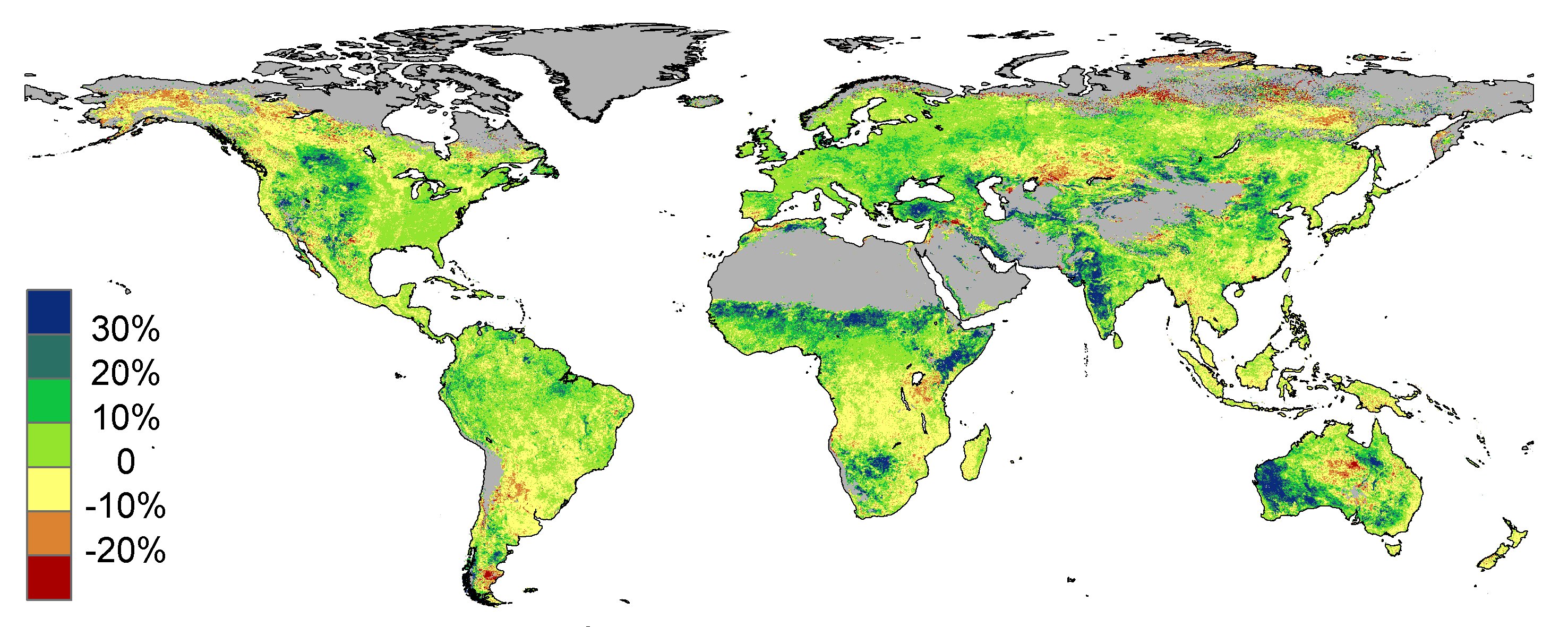
And where people have to lie about severe weather getting worse (it hasn’t)? Or where we have totally forgotten that more CO2 is actually good for life on Earth, leading to increased agricultural productivity, and global greening?:

Estimated changes in vegetative cover due to CO2 fertilization between 1982 and 2010 (Donohue et al., 2013 GRL).

It’s the universe where political power and the desire to redistribute wealth have taken control of the public discourse. It’s a global society where people believe we can replace fossil fuels with unicorn farts and antigravity-based energy.

Feelings now trump facts.

At least engineers have to prove their ideas work. The widgets and cell phonesand cars and jets and bridges they build either work or they don’t.

In climate science, whichever side is favored by politicians and journalism graduates is the side that wins.

And what about those 97% of scientists who agree? Well, what they all agree on is that if their government climate funding goes away, their careers will end.

The Truth Has Been Out There a Long time…Why Won’t the Gov’t Listen?

Unreliables cannot provide energy security or enhance natural environment

My new word for the energy sources popularly known as “renewables” is “unreliables”. Though there may be some tiny exceptions, the general characteristic is that they are all diffuse sources that cannot actually be controlled by humans or automated control systems.

One of the main reasons that energy has been a huge political topic since about World War I is that it plays a major role in the economic security posture of any nation. With accessible sources of energy that can be focused and exploited in a short period of time, a nation literally has the “power” to do great things for its population or to do very nasty things to others. It is a matter of choice as to how that power (energy per unit time) is deployed.

One of the issues that caused Japan to attack Pearl Harbor was a desire to protect sea lines of communication to secure sources of energy in the South Pacific. One of the main reasons that Hitler pressed into Russia was a desire to access energy sources in the Caspian region. A primary purpose of Rommel’s move through North Africa was gaining access to oil. Though there were other factors, America’s secure Texas, California, Oklahoma and Louisiana oil fields were a major factor in our ability to deploy sufficient power to defeat the Axis nations.

Throughout my military career, which lasted 33 years from the time I first entered the Naval Academy, I studied the importance of energy in our foreign policy actions. When I learned about Henry Kissenger’s famous statement “America doesn’t have friends. America only has interests.” it was in the context learning about efforts to secure access to energy resources that could supply our economy, ships, aircraft, trucks and tanks.

In the name of energy security, there are some people, like T. Boone Pickens, who try to sell the idea that unreliables like wind and solar energy can make a contribution. As a trained military man, that whole concept makes no sense. A diffuse source of energy that cannot be called on when needed is not a source of power; it is a source of impotency. It turns people into passive recipients of nature’s largess instead of being able to establish control and decision making authority.

Ready for Appalachian Trail
Please do not get me wrong; I like the natural environment. I simply do not agree with the notion that building massive collecting systems to harness energy from nature has anything to do with improving national security or providing power to the people. It does not enable development, but forces a reduction in living standards that is often portrayed as some kind of admirable “conservation”. The act of “doing without” might bring some kind of inner pleasure to some, but for a nation it brings poverty vice economic prosperity.Finally, I want to point out that many advocates of unreliables will attempt to point out that nuclear energy does not replace oil since we do not use oil in the continental United States to operate our power grid anymore. My response is multidimensional.

  • The operative word regarding oil on the electrical grid is “anymore”. Until nuclear pushed oil out of the market, it provided as much as 17% of our power. We burned it at the rate of a million barrels of oil per day in 1978.
  • Solar, wind, geothermal, waves, and ocean thermal energy cannot directly power cars and trucks either.
  • We do use a lot of oil for process heat. Nuclear energy can provide reliable heat as well as electricity.
  • Nuclear energy can push natural gas out of the electricity market and force well capitalized oil and natural gas companies to invest in compressed natural gas infrastructure to open up a new market in vehicles.

Most of the time, unreliables advocates get impatient with me before I finish the first bullet.

A contact suggested that blogging on Atomic Insights and engaging in discussions in a group called Nuclear Safety might be limiting the conversation to those who already agree with me. At his advice, I joined the “Sierra Club” group on LinkedIn. (The group is not affiliated or sponsored by the Sierra Club, but it includes individual members and other people who are interested in the Sierra Club.)

Some views can only be accessed by walking
That contact had started a conversation thread about nuclear energy and attracted some rather pointed commentary. Here is my first contribution to that discussion, which had already included almost two dozen comments.

Please allow me to politely join the conversation.

I am not a Sierra Club member, but I wish I could be one. I respect the organization’s long record of wilderness preservation achievements and agree with about 90% of the organization’s goals. I have studied its history in the roots of Ansel Adams (no relation) and John Muir and its epic struggles to prevent filling priceless canyons with water held back by enormous hydroelectric and flood control dams.

Though I am a life-long suburban dweller, I have spent many of the best hours of my life practicing “no trace” camping and hiking in eastern mountains in Georgia, North Carolina, Virginia, Maryland and Pennsylvania. I have been driving a 40+ MPG car since 2001, but even before that I always bought cars with as high a gas mileage as possible.

The reason I cannot join the Club is that I cannot come to terms with the illogic of its shift, dating back more than 30 years, from an official policy of “Atoms Not Dams” to a strong and inflexible antinuclear stance. I call myself a hard headed BHL; I learned that from my dad, the guy who taught me to appreciate camping in National Forests as being a lot more fun than the trips to Disney World that most of our neighbors took during their vacations.

Dad was an electrical engineer who was firmly rooted in rational approaches to problem solving. When I was about 8 years old, he came home from work and told me about the amazing new power plants that his company was building at Turkey Point, Florida that did not even need any smoke stacks.

We talked a lot more about nuclear power and by the time I was ready to go to college, I had decided I would become a nuclear engineer. I got detoured slightly; I actually majored in English, but I did it at a school where English majors were still required to take 4 semesters of calculus and post calculus math, 2 semesters of physics, 2 semesters of chemistry, 2 semesters of thermodynamics, a semester of basic propulsion systems and 2 semesters of electrical engineering.

When I graduated, I entered into the Navy nuclear power training pipeline and eventually served as the Engineer Officer on a submarine. When you have lived in a completely closed environment with a nuclear reactor as your sole source of power, it becomes very difficult to see why there is so much concern about the technology. We had clean air, all the clean fresh water we could want, air conditioning, and refrigeration. Our computers did not contribute to global warming.

The 9,000 ton ship I was on operated for about 14 years on a quantity of fuel that weighed just a little bit more than I do. Every used core that the Navy has produced since starting to operate the USS Nautilus is stored in a single, modestly sized building with an indoor pool in Idaho.

That almost magical technology is built on an incredible gift from god (mother nature if you prefer) that packs as much energy into a pound of uranium as it packed into 2 MILLION pounds of oil. I cannot understand why an organization that was founded on protecting as much of the natural environment and heritage as possible would prefer to cover vast quantities of it with industrial scale wind turbines built by some of the world’s largest and least admirable corporations. I do not understand why the Club supports projects like the Abengoa solar project that will cover hundreds to thousands of acres in the Mohave desert with shiny mirrors aimed at hazardous heat transfer liquids for no more than 50% of the day and predictably become idle monstrosities every single night.

Finally, and most illogically, I cannot understand why the national club, supported by Carl Pope’s strong statements over a number of years, is ignoring the feedback from local chapters in Pennsylvania who have seen first hand the full scale of the environmental destruction that comes with the industrial process of extracting methane gas using horizontal drilling and hydraulic fracturing.

(Note: BHL – Bleeding Heart Liberal)

I’ll let you know if any interesting conversation develops. During my twenty years of Internet conversations – dating back to Prodigy, USENET and AOL – I have had the sometimes disheartening experience of making the last comment in an interesting thread.

Tom Harris, executive director of ICSC, talks about Suffering People Deserving Priority over Alleged Climate Problems.

ICSC: IPCC focus on stopping global warming and extreme weather is unscientific and immoral

Ottawa, Canada, November 2, 2014: “IPCC Chairman Dr. Rajendra Pachauri was right toadvocate “a global agreement to finally reverse course on climate change” when he spoke to delegates tasked with approving the IPCC Synthesis Report, released on Sunday,” saidTom Harris, executive director of the Ottawa, Canada-based International Climate Science Coalition (ICSC). “The new direction governments should follow must be one in which the known needs of people suffering today are given priority over problems that might someday be faced by those yet to be born.”

“Yet, exactly the opposite is happening,” continued Harris. “Of the roughly one billion U.S. dollars spent every day across the world on climate finance, only 6% of it is devoted to helping people adapt to climate change in the present. The rest is wasted trying to stop improbable future climatic events. That is immoral.”

ICSC chief science advisor, Professor Bob Carter, former Head of the Department of Earth Sciences at James Cook University in Australia and author of Taxing Air explained, “Science has yet to provide unambiguous evidence that problematic, or even measurable, human-caused global warming is occurring. The hypothesis of dangerous man-made climate change is based solely on computerized models that have repeatedly failed in practice in the real world.”

New Zealand-based Terry Dunleavy, ICSC founding chairman and strategic advisor remarked, “U.N. Secretary General Ban Ki-moon often makes unjustified statements about climate change and extreme weather. However, in their still unansweredNovember 29, 2012 open letter to the Secretary General, 134 scientists from across the world asserted, ‘The U.K. Met Office recently released data showing that there has been no statistically significant global warming for almost 16 [now 18] years. During this period…carbon dioxide concentrations rose by nearly 9%…The NOAA “State of the Climate in 2008” report asserted that 15 years or more without any statistically-significant warming would indicate a discrepancy between observation and prediction. Sixteen years without warming have therefore now proven that the models are wrong by their creators’ own criterion.”

“Although today’s climate and extreme weather are well within the bounds of natural variability and the intensity and magnitude of extreme events is not increasing, there is, most definitely, a climate problem,” said Carter. “Natural climate change brings with it very real human and environmental costs. Therefore, we must carefully prepare for and adapt to climate hazards as and when they happen. Spending billions of dollars on expensive and ineffectual carbon dioxide controls in a futile attempt to stop natural climate change impoverishes societies and reduces our capacity to address these and other real world problems.”

“The heavily referenced reports of the Nongovernmental International Panel on Climate Change demonstrate that, scientifically speaking, the global warming scare is over,” concluded Harris. “It is time to defund the IPCC and dedicate our resources to helping solve today’s genuine humanitarian problems.”


The ICSC is a non-partisan group of scientists, economists and energy and policy experts who are working to promote better understanding of climate science and related policy worldwide. We aim to help create an environment in which a more rational, open discussion about climate issues emerges, thereby moving the debate away from implementation of costly and ineffectual “climate control” measures. Instead, ICSC encourages effective planning for, and adaptation to, inevitable natural climate variability, and continuing scientific research into the causes and impacts of climate change. 

ICSC also focuses on publicizing the repercussions of misguided plans to “solve the climate crisis”. This includes, but is not limited to, “carbon” sequestration as well as the dangerous impacts of attempts to replace conventional energy supplies with wind turbines, solar power, most biofuels and other ineffective and expensive energy sources.


For more information about this announcement or ICSC in general, visithttp://www.climatescienceinternational.org,

Climate Change is a Natural Phenomenon. Humans are NOT to Blame!

Climate Is Changing, And Some Parks Are Endangered, But Humans Aren’t The Cause

Editor’s note: The climate is changing, but is it humankind’s fault? Daniel B. Botkin, professor Emeritus in the Department of Ecology, Evolution, and Marine Biology at University of California Santa Barbara, doesn’t believe so. In the following column, he dissects the conclusions reached by the Union of Concerned Scientists in its report,National Landmarks at Risk, How Rising Seas, Floods, and Wildfires Are Threatening the United States’ Most Cherished Historic Sites.

Alternate Text
Jamaica Bay National Wildlife Refuge The only wildlife refuge in the National Park System lies within New York City, and is not on the Union of Concerned Scientists List. The refuge is the largest bird migration stop in the Northeast, and serves as a buffer protecting urban development from major storms. Its well-developed paths among birds and flowering plants and along inland wetlands and waterways are available by public transportation to the 8.6 million residents of New York City. (Photo by the author)

For those of us who love our national parks and are confronted daily with media, politicians, and pundits warning us of a coming global-warming disaster, it’s only natural to ask what that warming will mean for our national parks. This is exactly what the well-known Union of Concerned Scientists discuss in their recent report, National Landmarks at Risk: How Rising Seas, Floods, and Wildfires Are Threatening the United States’ Most Cherished Historic Sites.

I’ve done research since 1968 on the possibility of human-caused global warming and its possible ecological effects, and have published widely on this topic, discussing possible effects on biodiversity and on specific endangered species as well as on forests, cities, and historical evidence of Arctic sea ice change. I’ve also been involved in the development of some aspects of some climate models, and having developed a computer model of forests that is one of the principal methods used to forecast global warming effects on vegetation, I sought out the UCS report with great interest.

The approach the Union has taken is to have the report written by four staff members: Debra Holtz, a journalist; Kate Cell, a fund-raiser for the organization; Adam Markham, with a B.S. in zoology, who was the founder of Clean Air-Cool Planet, a nonprofit organization “to promote innovative community-based solutions to climate change in the Northeast”; and Brenda Ekwurzel, the Union’s Senior Climate Scientist. She is the only author with research experience on the subject, has a Ph.D. in isotope geochemistry from the Department of Earth Sciences at Columbia University’s Lamont-Doherty Earth Observatory and has been on the faculty of the University of Arizona Department of Hydrology and Water Resources.

These four authors took the standard reports from such organizations as the United National Intergovernmental Panel on Climate Change, treating them as accurate and true, and then discussed the implications for 16 American historic sites. As shown in the accompanying table, they write that 11 of the sites are threatened by rising sea levels and their consequences (coastal erosion and flooding); two by inland flooding; two by wildfires; and one by “extreme heat and drought” (table 1).

The report opens with a bold assertion: “Many of the United States’ iconic landmarks and heritage sites are at risk as never before. Sea level rise, coastal erosion, increased flooding, heavy rains, and more frequent large wildfires are damaging archaeological resources, historic buildings, and cultural landscapes across the nation.” The report later goes on to add, “All of the case studies in this report draw on observations of impacts that are either consistent with, or attributable to, human-induced climate change based on multiple lines of scientific evidence.” To which the authors add, “This report sounds a wake-up call: as the impacts of climate change continue, we must protect these sites and reduce the risks.”

The point of the report, its opening theme and its major conclusion, is that these historic places are in trouble and it’s our fault, we have been the bad guys interfering with nature and therefore damaging places we value. This is consistent with the IPCC 2014 report and the 2014 White House Climate Change Assessment, for both of which I acted as an expert reviewer and testified before the House and Senate about.

TABLE 1. HISTORIC SITES AND CLAIMED THREATS TO THEM

Threatened by Sea Level Rise and Accompanying Flooding

  1. Boston’s Faneuil Hall and surroundings
  2. Statue of Liberty and Ellis Island
  3. Harriet Tubman National Monument Monument
  4. Historic Jamestown, VA
  5. NASA’s coastal facilities
  6. Annapolis, MD
  7. Fort Monroe National Monument
  8. Cape Hatteras Lighthouse
  9. Bering Land Bridge National Monument & Shishmaref; Cape Krusenstern National Monument, including Kivalina Native Villages and Ancestral Lands
  10. Pu’uhonua O Honaunau & Kaloko-Honokhau National Historical Parks
  11. Prehistoric Florida shell structures

Threatened by Future Floods

  1. Charleston, SC; Historic St. Augustine, Fl and Castillo De San Marcos

Threatened by Wildfires (and perhaps also flooding)

  1. Mesa Verde National Park and Bandelier National Monument & Santa Clara Pueblo
  2. Groveland, CA and other California Gold Rush era towns

Threatened by Extreme Heat and Drought

  1. Cesar Chavez National Monument, California

Back Bay Fens Park and Jamaica Bay National Wildlife Refuge

Reading the dire forecasts of the UCS report, I thought immediately about two seaside places familiar to me: Back Bay Fens Park in Boston and Jamaica Bay National Wildlife Refuge in New York City. Back Bay Fens park was designed by Frederick Law Olmsted, the famous landscape architect known especially for designing New York City’s Central Park. Back Bay was a problem because it was a landfill on Boston’s shore that flooded frequently, which caused various problems.

To understand what Olmsted did in designing Back Bay, one has to step back and consider Boston’s original site, which had certain advantages for a major city: a narrow peninsula with several hills that could be easily defended, a good harbor, and a good water supply. But as the city grew, demand increased for more land for buildings, a larger area for docking ships, and a better water supply. The need to control ocean floods and to dispose of solid and liquid wastes grew as well. Much of the original tidal flats area, which had been too wet to build on and too shallow to navigate, had been converted, before Olmsted got involved, to flat land — hills cut away and the marshes filled with their soil. The filling of Back Bay began in 1858 and continued for decades.

Olmsted’s solution to the flooding and sewage pollution was a water-control project he called the “fens.” His goal was to “abate existing nuisances” by keeping sewage out of the streams and ponds and building artificial banks for the streams to prevent flooding—and to do this in a natural-looking way. His solution included creating artificial watercourses by digging shallow depressions in the tidal flats, following meandering patterns like natural streams; setting aside other artificial depressions as holding ponds for tidal flooding; restoring a natural salt marsh planted with vegetation tolerant of brackish water; and planting the entire area to serve as a recreational park when not in flood. He put a tidal gate on the Charles River—Boston’s major river—and had two major streams diverted directly through culverts into the Charles so that they flooded the fens only during flood periods. He reconstructed the Muddy River primarily to create new, accessible landscape.

The result of Olmsted’s vision was that control of water became an aesthetic addition to the city. The blending of several goals made the development of the fens a landmark in city planning. Although to the casual stroller it appears to be simply a park for recreation, the area serves an important environmental function in flood and sewage control. Confronted with the combined problems of ocean surges and flooding from river runoff inland, Olmsted did not waste his time complaining about whether or not people have caused the problem. He just set out and solved it.

Jamaica Bay National Wildlife Refuge, although not directly planned to solve flooding problems, does so in much the same way that the Boston Back Bay Fens does. The Refuge has become one of my favorite places in New York City. It is the largest migratory bird sanctuary in the northeastern United States. It is the only wildlife sanctuary that is part of the National Park System, and it lies within the city of New York, in view of the Empire State Building, as my accompanying photograph shows. New York City residents wanting contact with nature can get there by public transportation.

The Refuge faces onto Long Island Sound and includes inlets and wetlands directly connected to the Sound. The refuge was damaged during tropical storm Sandy, but it served the same multiple functions that Back Bay does in Boston — it acted as a buffer between that major ocean storm and city structures inland.

As I read the UCS report, Back Bay Fens and Jamaica Bay Refuge were in mind as what to do about coastal flooding along cities. Then I went to the scientific evidence that should be forming the basis for the UCS report, and which I will turn to now.

The Scientific Evidence

What is the evidence that sea level is rising, that wildfires, drought, and episodes of very high temperatures are increasing, and what is the evidence that such changes are our fault? Let’s take them one by one.

As is well-known, we are blamed for causing a global warming mainly because our burning of fossil fuels is increasing the carbon dioxide (CO2) concentration in the atmosphere. Since this is a greenhouse gas, we must be warming the climate.

Yes, carbon dioxide, the greenhouse gas that gets so much attention, has increased greatly and rapidly, from 280 parts per million to 400, and as this graph shows, it is continuing that rapid rise.

Alternate Text

Has Earth been warming?

Climate has always changed and is always changing. The last Ice Age, which covered places like what is now New York City with ice two miles deep, ended between 17,000 and 12,500 years ago, with overall but highly variable warming since then. Among the variations during the last thousand or so years, there was a warming period lasting approximately 300 years, from A.D. 950 to 1250, known as the Medieval Warm Period (warming compared to what climatologists today call “normal,” taken in general by today’s climatologists to mean the average surface temperature during the past century between 1960-1980 or between 1960–1990). This is the time when Vikings settled Greenland and reached North America, and when in the southern Pacific the Polynesians did a lot of their expansion among far-flung Pacific islands.

The Medieval Warming was followed by the “Little Ice Age,” which lasted from approximately mid-1400 to 1700 A.D and somewhat later. Crop failures occurred in western Europe, and some mountain glaciers in the Swiss Alps advanced to the extent that they filled valleys and destroyed villages. Areas to the north that had enjoyed abundant crop production were under ice. This was the time when the human population was devastated by the Black Plague, whose effects may have been exacerbated by poor nutrition as a result of crop failures, and by the damp and cold that reached out across Europe and even to Iceland by about 1400. It was also the time of the early European settlement of the United States. As I have written elsewhere, when the Pilgrims said it was a cold winter, it was a very cold winter.

A warming trend started in the mid-nineteenth century. This was interrupted from about 1940 to 1960 by a cooling, and then the temperature rose until about 20 years ago. An important scientific paper published September 1 this year states that Earth’s surface temperature has not changed for the past 19 years, and 16-26 years for the lower atmosphere. That’s the conclusion of University of Guelph statistician and Professor of Economics Ross R. McKitrick, who used a novel kind of statistical analysis. He points out that this lack of warming is of “particular note because climate models project continuing warming over the period. Since 1990, atmospheric carbon dioxide levels rose from 354 ppm to just under 400 ppm, a 13% increase.”

Carbon dioxide is definitely continuing to increase in the atmosphere, but Earth’s surface and atmospheric temperatures aren’t tracking it. Even though our activities are adding carbon dioxide rapidly to the atmosphere, it seems to be having no effect right now on Earth’s average surface and lower atmosphere temperature.

However, the UCS report blithely comments, “Climate models show that if our emissions of carbon dioxide and other heat-trapping gases remain high, Bakersfield could have almost 50 days of extreme heat, with temperatures reaching 104°F or more, by 2050—up from four days a year on average between 1961 and 1990.”

But if the temperature has not changed in 19 to 26 years, then how much credence can we give to this assertion? We must ask whether the climate models have been accurate predictors of recent climate change.

John Christy, the climatologist who is said to be the primary person responsible for the development of satellites that measure Earth’s temperature, compared the combined forecasts of major global climate models with observed temperature change since 1980. As you can see in his graph, there is no correspondence. The climate models do not even come close to forecasting actual temperature change; they forecast a huge, steady increase. In contrast, as you can see in the graph, the temperature has varied a little, as it always does, but as the new paper that I mentioned earlier asserts, it has not changed.

John Christy’s Comparison of Global Warming Model Forecasts

Actual Temperature Change since 1980 (Courtesy of John Christy, Alabama State Climatologist)

Alternate Text

Thus the climate models cannot be considered reliable bases for forecasting the future. Indeed, other experts on model validation say that the climate models have never been sufficiently validated in any other ways as well, and therefore are not an accurate representation of the real world we live in. Conclusion: our addition of carbon dioxide to the atmosphere does not appear to be increasing Earth’s temperature.

Whatever is happening to Earth’s climate does not seem to be our fault.

Sea Level Rise

What about the claim that sea level rise is another factor “damaging archaeological resources, historic buildings, and cultural landscapes across the nation? Well, the sea level has been rising since the end of the last Ice Age, starting about 14,000 years ago as the continental and mountain glaciers have melted and sea water has expanded with the overall warming. The average rate has been about a foot or two a century (about 23-46 cm per century). Data suggest that the rate was much greater until about 8,000 years ago.

Alternate Text

Yes, sea-level rise is definitely a problem, but it is not a problem simply because it is our fault. It is a problem that we just haven’t bothered to face up to in any serious way until the global warming issue captured our attention. Whether or not we are adding to the rate of sea level rise, this is causing problems and will continue to cause problems. It would be a mistake to focus on it only if we were convinced it was our fault. For many years past, we should have been planning for sea level rise, and we need to make this an important environmental priority.

Frequency of Severe Storms

The main concern often expressed about sea levels is that severe ocean storms do greater damage than indicated by the simple rise in the water level. Therefore, it is necessary for us to look at how the frequency of severe storms has changed over time. Underlying the claim by the UCS report that 12 of the 16 sites are in danger of flooding is the assumption that the frequency of severe storms has increased, as have their landfalls. But the graphs below of severe storm frequency, show variation over time but no overall increase. Therefore, during the recent past the claim by the UCS report is contradicted. And since the climate models don’t even come close to forecasting temperature change, we cannot trust them to forecast changes in storm frequency.

Number of Severe Storms affecting the United States since 1970

(Courtesy of Roger Pielke Jr., Professor in the Environmental Studies Program, University of Colorado, from his House of Representatives Testimony 11 December 2013)

Alternate Text

Frequency of Extremely Hot Days

This is controversial, because it is difficult to get information that summarizes these trends for the entire United States, and there are a variety of opinions and discussions about these data, so I put this into the article with some caution to the reader. But several graphs indicate that there has not been an increase in the average number of very hot days. For example, this graph shows days with temperatures above 95° F. This graph is based on the summary from all United States Historical Climatology Network weather stations that have been in operation since 1930.

Alternate Text

Wildfire Frequency in the U.S. Has Not Increased

The UCS report claims that two historic sites within the National Park System are being, and will be, damaged by increases in wildfire frequency. But once again, a graph from the U.S. government agencies involved, of number of wildfires, shows no increase.

Furthermore, it is well-established that most major wildfires that occur these days are from the failure to allow much more frequent, and therefore light fires, to burn. The 20th century policy dominated by Smokey Bear — “only you can prevent forest fires” — and the belief, ill-founded, that all forest and grassland fires are bad and must be prevented — have had a damaging effect.

Alternate Text

Wildfire Frequency

(Source EPA http://www.epa.gov/climatechange/)

As I wrote in my latest book, The Moon in the Nautilus Shell, this Smokey Bear policy also caused the extinction of Kirtland’s warbler, which nests in young jack pine, a tree species that regenerates only after fire. It was only when ornithologists realized the population had dropped in half in a decade and that fire suppression was the cause that the Audubon Society, the U. S. Fish and Wildlife Service, and the state of Michigan began prescribed burning programs.

As I also discuss in that book, excellent work by Professor Wallace Covington of Northern Arizona University, involving careful historical analysis of the pre-European ponderosa pine forests of that state, followed by careful removal of excess fuel and trees, followed by prescribed burns every 3 to 5 years, as was the natural rate—restored some of these forests to their beautiful and natural condition: large pines widely spaced with grasses filling the land between. In contrast, next door to his experimental forests is one of The Nature Conservancy ponderosa pine protected, no-touch areas, which does not resemble the pre-European ponderosa pine forests at all, but instead forms a very dense stand of young, small trees and a lot of fuel on the ground, just waiting for a wildfire.

Carefully managed Ponderosa Pine Forest, with excess fuel built up over more than a century removed and light fires every 3 to 5 years (Photo by the author)

Alternate Text

Next to the strongly managed forest is a Nature Conservancy no-touch Ponderosa Pine Preserve. (Photo by the author)

Alternate Text

What Should be Done About Sea Level Rise and Wildfires and Our National Parks?

As I have shown, observations do not support the claim that our activities are currently warming the globe. Does this mean that we should stop worrying about climate change? Of course not. Because sea level has been rising for thousands of years, the encroachment of ocean waters and damage from ocean storms have been problems for coastal structures, which we have just ignored. We have to face up to these. But arguing about whether this is our fault or not is beside the point and detracts us away from doing anything useful, as we focus instead of what can best be called a fairy-tale debate. The same must be said about wildfires. For decades, experts on wildfires have been calling for improved management of America’s forests, and the need remains important. We must remember Frederick Law Olmsted’s approach to designing the Back Bay Fens— solve the problem, do not waste your time arguing if we are to blame.

However, global warming has become the sole focus of so much environmental discussion that it risks eclipsing much more pressing and demonstrable environmental problems. The major damage that we as a species are doing here and now to the environment is not getting the attention it deserves.

We need to keep in mind the reality of Nature, which I have portrayed in a replacement for Smokey Bear: Morph the Moose (Copyright and trademarked by the author).

Alternate Text

Comments

Interesting article. These points caught my eye:

On topics such as climate change and sea level rise, he notes, “….arguing about whether this is our fault or not is beside the point and detracts us away from doing anything useful.”

“…global warming has become the sole focus of so much environmental discussion that it risks eclipsing much more pressing and demonstrable environmental problems. The major damage that we as a species are doing here and now to the environment is not getting the attention it deserves.”

He makes some valid comments about wildfire policy, but his summary of recent wildfire statistics needs a little closer look. While he notes that “Wildfire Frequency in the U.S. Has Not Increased” since 1980, statistics from the National Interagency Fire Center (NIFC) offers some other key data.

For example, the number of acres burned has been considerably larger since the year 2000. Between 1969 through 2013 (23 years) a total of 6 million acres or more were burned in only 3 years; between 2000 and 2013, that threshold was reached 8 times.

Federal costs for wildfire suppression? Prior to 2000, that total never reached $1 billion; since 2000, those costs have exceeded $1 billion for 12 of the 14 years.

NIFC has compiled a table summarizing Historically Significant Wildland Fires(between 1803 and Aug 2013). That table lists 78 wildfires over a 210 year span; 25 of those listed (nearly 1/3 have occurred since the year 2000).

Whether or not wildfire policy or climate change are the cause, the fact is we’ve had a significant increase in the impacts of wildfires, based on several measures, in the past decade or so.

Wising Up to the Great Wind Power Fraud!

Jay Lehr: Sooner or Later the World will Wise-up to the Great Wind Power Fraud

Definition of fraud

The Rationale for Wind Power Won’t Fly
Heartland.org
Jay Lehr PhD
21 October 2014

To understand the folly that drives too much of the nation’s energy policies, consider these basic facts about wind energy.

After decades of federal subsidies – almost $24 billion according to a recent estimate by former U.S. Sen. Phil Gramm – nowhere in the United States, or anywhere else, has an array of wind turbines replaced a single conventional power plant. Nowhere.

But wind farms do take up space. The available data from wind-power companies, with which the Environmental Protection Agency agrees, show that the most effective of them can generate about five kilowatts per acre. This means 300 square miles of land – 192,000 acres – are necessary to generate the 1,000 megawatts (a billion watts) of electricity that a conventional power plant using coal, nuclear energy or natural gas can generate on a few hundred acres. A billion watts fulfills the average annual power demand of a city of 700,000.

Taxpayer support for wind energy will eventually come to an end, I optimistically predict. The only question is how soon. My pessimistic guess is it will take another decade – by which time the number of wind turbines, currently about 45,000 according to the American Wind Energy Association, could more than double.

It is unclear whether very many wind-energy firms have sufficient monetary reserves to cover dismantling these behemoth lawn sculptures once the tax credits wind down or disappear. If not, the result will be a scene from a science fiction movie – as though giant aliens descended onto our planet only to freeze in place.

tehachapi-wind-turbines-p1

The promise that wind and solar power could replace conventional electricity production never really made sense. It’s known to everybody in the industry that a wind turbine will generate electricity 30% of the time – but it’s impossible to predict when that time will be. A true believer might be willing to do without electricity when the wind is not blowing, but most people will not. And so, during the 30% of the time the blades are spinning, conventional power plants are also spinning on low, waiting to operate during the other 70% of the time.

JULY22

Importantly, the amount of electricity the wind can generate per acre of land is unrelated to the size of the turbines. Yes, by doubling the turbine’s blade length you quadruple the turbine’s power output. The problem? If the turbines are big and tall you need fewer of them, but they must be more widely separated. If they’re smaller you need more of them, closer together.

Another inescapable problem for electricity grids: The power generated by a wind turbine varies with the cube of the wind speed. When the wind speed doubles – say from 10 miles per hour to 20 miles per hour – the energy output increases eightfold (2 x 2 x 2). Someone, or some computer, has to balance these huge variations on the grid by calling on standby generators to produce more or less power to maintain the stability essential to the grid.

So, you might wonder, do high winds make turbines really hum? No. Turbines must be shut down in high winds because centrifugal force would begin to tear the blades apart. Also, the world has learned from experience in Europe – whose wind sculpture gardens may one day dwarf ours – that a one-millimeter buildup of bugs on the blades reduces their power output by as much as 25%.

There are other problems. Thousands of turbine breakdowns and accidents have been reported in recent years. The basic concrete foundations are suffering from strains, as reported by industry sources and on the wind-farm construction website windfarmbop.com.

turbine collapse devon

And there are environmental factors. Annoying, low-frequency noise produced by wind turbines, particularly large turbines, is driving some people away from their homes, according to numerous press reports. (Low-frequency noise regulations are already in place in Denmark while the phenomenon is the subject of continuing research.) The Audubon Society now estimates bird deaths from turbines exceed a million per year.

eagle 1

Wind is at best a niche player in energy. Grandiose claims made on behalf of wind-generated electricity are rubbish, whether or not renewable-energy advocates admit it. Wind-power developers will milk taxpayers across the world out of a few billion more dollars, euros or pounds in subsidies, tax credits and the like, but sooner or later the public will wise up.
Heartland.org

Lehr, Jay

Corruption and Collusion….Pillars of the Faux-Green Blob!

EXPOSED: How a shadowy network funded by foreign millions is making our household energy bills soar – for a low-carbon Britain

  • Shadowy pro-green lobbyists working at every level of the Establishment
  • Organisations are channelling tens of millions of pounds into green policies
  • Elite lobby group linked to Friends of the Earth, Greenpeace and the WWF
  • Current energy policies shaped by the Green Blob will cost up to £400billion
  • If continued, there will be further eye-watering energy bill rises for Britons
The 'Green Blob', a phrase first coined by former Environment Secretary Owen Paterson, is a group of pro-green lobbyists working at every level of the British Establishment

The ‘Green Blob’, a phrase first coined by former Environment Secretary Owen Paterson, is a group of pro-green lobbyists working at every level of the British Establishment

The Mail on Sunday today exposes how a ‘Green Blob’ financed by a shadowy group of hugely wealthy foreign donors is driving Britain towards economically ruinous eco targets.

The phrase the ‘Green Blob’ was coined by former Environment Secretary Owen Paterson after he was sacked from the Cabinet in July.

He was referring to a network of pro-green lobbyists working at every level of the British Establishment, who have helped shape the eco policies sending household energy bills soaring.

But investigations by this newspaper reveal the Blob is not just an abstract concept.

We have found that innocuous-sounding bodies such as the Dutch National Postcode Lottery, the American William and Flora Hewlett Foundation and the Swiss Oak Foundation are channelling tens of millions of pounds each year to climate change lobbyists in Britain, including Greenpeace and Friends of the Earth.

They have publicly congratulated themselves on their ability to create green Government policy in the UK – most notably after Ed Miliband steered through aggressive CO2 reduction targets in his 2008 Climate Change Act, and announced there would be no more coal power stations.

Yet the consequences of their continuing success are certain: further eye-watering rises in energy costs for millions of Britons and an increasing risk of blackouts.

According to leading energy analyst Peter Atherton of Liberum Capital, current UK energy policies shaped by the Blob will cost between £360 billion and £400 billion to implement by 2030. He said this will see bills rise by at least a third in real terms – on top of the increases already seen over the past ten years.

This bill dwarfs the EU’s £1.7 billion demand from Britain last week.

Scroll down for video 

Lobbying by the Blob helped lead to a new European Union emissions deal announced on Friday, when EU leaders including the Prime Minister agreed to triple the current pace of emissions cuts.

Following earlier deals, EU-wide emissions of CO2 are supposed to fall 20 per cent over the 30-year period 1990 to 2020.

Under the new agreement, this reduction must be doubled in just a decade, reaching ‘at least’ 40 per cent by 2030 – a goal that could only be accomplished through further massive investment in wind and nuclear energy.

At the heart of the Blob is a single institution – the European Climate Foundation (ECF) – which has offices in London, Brussels, The Hague, Berlin and Warsaw.

Every year it receives about £20 million from ‘philanthropic’ foundations in America, Holland and Switzerland, and channels most of it to green campaign and lobby groups.

Overview of the EU’s climate and energy policy architecture

An investigation has found the 'Green Blob' is working at every level of the British Establishment and Westminster (pictured)

An investigation has found the ‘Green Blob’ is working at every level of the British Establishment and Westminster (pictured)

It refuses to disclose how much it gives to each recipient, and does not publish its accounts. But it admits that the purpose of these grants is to influence British and EU climate and energy policy across a broad front.

Many more millions are fed directly to British and European lobby groups from the same overseas foundations which also fund ECF.

In its last annual report, ECF said working towards a 2030 deal was ‘a big focus area for ECF as a whole’.

ECF managing director Tom Brookes told The Mail on Sunday he provides ‘a fact-base’ to help policy-makers make the ‘many complex decisions that are necessary to move towards a high-innovation, prosperous and low-carbon future’. He added: ‘The UK is a leader in many of these fields.’

The Blob and Red Ed

Friday’s EU deal contains a get-out clause: if the rest of the world fails to agree a binding global emissions treaty at a UN conference in Paris next year, then Europe’s targets can be ‘reviewed’ – or in other words, abandoned.

Giants such as China, India and Australia have insisted they will not sign such a treaty. It is also unlikely to be approved by the US Congress, which is Republican-controlled.

However, thanks to Ed Miliband and his 2008 Climate Change Act, the get-out will make no difference for Britain. The UK is the only country which already has a binding target for 2050. By then, the law says, UK emissions must be 80 per cent down on 1990.

Mr Miliband’s Act also created a mechanism for ensuring the country sticks to a path that achieves this target – the so-called ‘carbon budget’. The scale of the challenge that its latest version poses is not widely realised.

Over the next 15 years, the electricity industry has to cut the CO2 it emits for every kilowatt it generates by 90 per cent – an unprecedented transformation.

An EU deal contains a climate change get-out clause - but thanks to Miliband's 2008 Climate Change Act - this makes no difference to Britain

An EU deal contains a climate change get-out clause – but thanks to Miliband’s 2008 Climate Change Act – this makes no difference to Britain

But the carbon budget also means the total amount of power generating capacity has to more than double. In order to meet the 2050 target, there has to be a massive shift towards electric vehicles and heating. While fossil fuel power plants will close, both their replacements and this vast additional capacity will have to be wind or nuclear – by far the most expensive types of power.

Remarkably, green lobby group Friends of the Earth not only conceived the Climate Change Act, but Bryony Worthington, the FoE official who came up with the idea and lobbied MPs to support it, later actually drafted it.

‘When you’re on the outside lobbying, you kind of hope that you are going to have an impact, [but] you’re never really very sure,’ she told a green seminar three years ago.

But she hit the jackpot. Her proposal was taken up first by the new Tory leader, David Cameron, and followed by the then-Labour Government. Worthington, who was seconded into the civil service, was asked to rewrite her lobbyist’s memo, this time as a law.

Once it was safely on the statute book, she left the civil service to form a new green campaign group, Sandbag, which presses the Government to adopt more stringent forms of carbon taxes. Like her previous employer FoE, it is now funded by ECF. Ed Miliband made her a Labour peer in 2011.

While the Act was going through Parliament, the ECF, which was launched in 2007-8, was giving money to Greenpeace UK, FoE, Christian Aid and the WWF to mount a campaign against coal-fired power plants. Also funded was Client Earth, a group of lawyers who secured court acquittals for ‘direct action’ protesters who broke into the Kingsnorth plant in Kent, climbed its chimneys and occupied it.

The campaign persuaded Mr Miliband to announce the cancellation of a planned new generating unit at Kingsnorth – and that there would be no new coal plants built in Britain.

Afterwards, the ECF president, Jules Kortenhorst, boasted that Miliband had acted in response to ‘a complex, multifaceted effort over a year and a half, with grass-roots mobilisation campaigns [and] behind the scenes lobbying’.

He added: ‘All of this work, backed by substantial philanthropic investment, resulted in UK Climate Change Secretary Ed Miliband announcing that no new coal-fired power plants would be built… This is an example of a policy that can be replicated, increasing its impact.’

Follow the money

The most significant source for the ECF’s millions is a body called Climate Works – a private foundation which channels colossal sums to climate campaigners worldwide.

The Climate Works manifesto was set out in 2007 in a document entitled ‘Design to Win: Philanthropy’s Role in the Fight Against Global Warming’. It said that to be effective, a campaign to change government policies on energy and emissions would need at least $600 million from donors.

Generous grants have been given to campaigners in countries such as Britain who have detailed knowledge of their local political systems. Their brief is to 'promote renewables and low emission alternatives'. Pictured is Drax  Power Station near Selby

Generous grants have been given to campaigners in countries such as Britain who have detailed knowledge of their local political systems. Their brief is to ‘promote renewables and low emission alternatives’. Pictured is Drax Power Station near Selby

It was driven by the belief that without radical action, ‘we could lose the fight against global warming over the next ten years’.

It advocated the giving of generous grants to local campaigners in countries such as Britain who had detailed knowledge of the way their political systems operated.

As well as better energy efficiency, carbon taxes and emissions caps, they must ‘promote renewables and low emission alternatives’. Utility companies must be given ‘financial incentives’ – in other words, enormous subsidies from tax and bill payers – to make this happen.

Climate Works soon achieved its ambitious fundraising target, with a grant in 2008 of $500 million from the William and Flora Hewlett Foundation, which spends the fortune amassed by the co-founder of the Hewlett-Packard computer firm. This was followed by further grants of up to $100 million, and donations of $60 million from the sister Packard foundation. In July, a report by a US Senate committee named the Hewlett foundation as a key element in a ‘billionaires’ club’ which effectively controlled the environmental movement, pumping more than half a billion dollars a year into green groups around the world.

It claimed these ‘wealthy liberals fully exploit the benefits of a generous tax code meant to promote genuine philanthropy and charitable acts’, but instead were transferring money to ‘activists’ to ‘promote shared political goals’.

One of the US-based Climate Works’s first acts was to set up and fund ECF as its European regional office. All ECF’s main funders are represented on ECF’s board, including Charlotte Pera, who is also Climate Works’s CEO. Susan Bell, ECF’s vice-chairman, was formerly the Hewlett foundation’s vice-president.

Another director is Kate Hampton, an executive director at the Children’s Investment Fund, a UK charity with assets worth £324 million.Others come from finance and business. ECF’s chairman is Caio Koch-Weser, vice-chairman of Deutsche Bank, whose contacts in Brussels could not be better: from 2003–5, he chaired the EU’s Economic and Financial committee. Yet another director is Mary Robinson, the former president of Ireland.

No transparency 

It is hard to assess the ECF’s full impact for a simple reason – although it publishes the names of some of the organisations it funds, it does not state how much it gives, nor exactly how this money is used.

The ECF’s Tom Brookes said: ‘The projects we fund all fall within the overall mission of the Foundation to support the development of a prosperous low-carbon economy in Europe.’

He would not explain why no amounts were stated, saying only that ECF’s annual report ‘describes the objectives of each ECF programme area and its significant grantees.

‘We are confident that this is a sufficient level of detail to provide insight into the work of the Foundation… Our policy on the information we publish reflects our responsibilities to our grantees and donors.’

Nevertheless, it is clear from the information that is available that the list of ECF funding recipients is a Who’s Who of the green movement, including Friends of the Earth, Greenpeace, the WWF, Client Earth, Carbon Brief, the Green Alliance, and E3G, the elite lobby group that persuaded the Government to set up the £3 billion Green Investment Bank.

The 2013 ECF report sets out its priorities for Britain, praising its ‘leadership on the climate front’ – thanks to the Climate Change Act.

It also boasts that its grants had an impact on this year’s Energy Act: ‘ECF grantees such as Green Alliance, E3G, and Greenpeace helped secure important milestones such as an emissions performance standard for new power stations.’

The 2013 ECF report boasts of gains made in emissions performance standards for new power stations. File image used

The 2013 ECF report boasts of gains made in emissions performance standards for new power stations. File image used

To ECF’s dismay, however, the supposed UK ‘consensus’ on climate and energy is now in jeopardy: ‘Household energy bills have shot to the top of the political agenda, and progress on decarbonisation is tangled in competing visions of the country’s energy future… A growing number of media and political voices are casting doubt on the climate science and the economic case for action.’

Against this opposition, ECF’s 2013 report says it intends to work with British greens to ‘rebuild confidence in the low-carbon transition’, by ‘fact-checking the UK media’s coverage of climate and energy issues’.

It says it will ‘establish a new unit that will promote evidence-based discussions in the media and mobilise authoritative voices on the low-carbon economy’.

Since the report was published, this unit has come into being, run by former BBC environment correspondent Richard Black. How effective it will be remains to be seen.

Meanwhile, it is clear that the sheer scale of this lavishly funded lobbying effort dwarfs that of its opponents.

The Global Warming Policy Forum in London, Europe’s only think-tank which is sceptical about climate science and energy policy, has an annual budget of £300,000 and employs just three people.

Its director, Dr Benny Peiser, said yesterday: ‘At the end of the day, someone will have to be held accountable for us committing economic suicide. We are the only organisation that does what we do – against hundreds on the other side, all saying the same thing.’