Climate Change is a Natural Phenomenon. Humans are NOT to Blame!

Climate Is Changing, And Some Parks Are Endangered, But Humans Aren’t The Cause

Editor’s note: The climate is changing, but is it humankind’s fault? Daniel B. Botkin, professor Emeritus in the Department of Ecology, Evolution, and Marine Biology at University of California Santa Barbara, doesn’t believe so. In the following column, he dissects the conclusions reached by the Union of Concerned Scientists in its report,National Landmarks at Risk, How Rising Seas, Floods, and Wildfires Are Threatening the United States’ Most Cherished Historic Sites.

Alternate Text
Jamaica Bay National Wildlife Refuge The only wildlife refuge in the National Park System lies within New York City, and is not on the Union of Concerned Scientists List. The refuge is the largest bird migration stop in the Northeast, and serves as a buffer protecting urban development from major storms. Its well-developed paths among birds and flowering plants and along inland wetlands and waterways are available by public transportation to the 8.6 million residents of New York City. (Photo by the author)

For those of us who love our national parks and are confronted daily with media, politicians, and pundits warning us of a coming global-warming disaster, it’s only natural to ask what that warming will mean for our national parks. This is exactly what the well-known Union of Concerned Scientists discuss in their recent report, National Landmarks at Risk: How Rising Seas, Floods, and Wildfires Are Threatening the United States’ Most Cherished Historic Sites.

I’ve done research since 1968 on the possibility of human-caused global warming and its possible ecological effects, and have published widely on this topic, discussing possible effects on biodiversity and on specific endangered species as well as on forests, cities, and historical evidence of Arctic sea ice change. I’ve also been involved in the development of some aspects of some climate models, and having developed a computer model of forests that is one of the principal methods used to forecast global warming effects on vegetation, I sought out the UCS report with great interest.

The approach the Union has taken is to have the report written by four staff members: Debra Holtz, a journalist; Kate Cell, a fund-raiser for the organization; Adam Markham, with a B.S. in zoology, who was the founder of Clean Air-Cool Planet, a nonprofit organization “to promote innovative community-based solutions to climate change in the Northeast”; and Brenda Ekwurzel, the Union’s Senior Climate Scientist. She is the only author with research experience on the subject, has a Ph.D. in isotope geochemistry from the Department of Earth Sciences at Columbia University’s Lamont-Doherty Earth Observatory and has been on the faculty of the University of Arizona Department of Hydrology and Water Resources.

These four authors took the standard reports from such organizations as the United National Intergovernmental Panel on Climate Change, treating them as accurate and true, and then discussed the implications for 16 American historic sites. As shown in the accompanying table, they write that 11 of the sites are threatened by rising sea levels and their consequences (coastal erosion and flooding); two by inland flooding; two by wildfires; and one by “extreme heat and drought” (table 1).

The report opens with a bold assertion: “Many of the United States’ iconic landmarks and heritage sites are at risk as never before. Sea level rise, coastal erosion, increased flooding, heavy rains, and more frequent large wildfires are damaging archaeological resources, historic buildings, and cultural landscapes across the nation.” The report later goes on to add, “All of the case studies in this report draw on observations of impacts that are either consistent with, or attributable to, human-induced climate change based on multiple lines of scientific evidence.” To which the authors add, “This report sounds a wake-up call: as the impacts of climate change continue, we must protect these sites and reduce the risks.”

The point of the report, its opening theme and its major conclusion, is that these historic places are in trouble and it’s our fault, we have been the bad guys interfering with nature and therefore damaging places we value. This is consistent with the IPCC 2014 report and the 2014 White House Climate Change Assessment, for both of which I acted as an expert reviewer and testified before the House and Senate about.

TABLE 1. HISTORIC SITES AND CLAIMED THREATS TO THEM

Threatened by Sea Level Rise and Accompanying Flooding

  1. Boston’s Faneuil Hall and surroundings
  2. Statue of Liberty and Ellis Island
  3. Harriet Tubman National Monument Monument
  4. Historic Jamestown, VA
  5. NASA’s coastal facilities
  6. Annapolis, MD
  7. Fort Monroe National Monument
  8. Cape Hatteras Lighthouse
  9. Bering Land Bridge National Monument & Shishmaref; Cape Krusenstern National Monument, including Kivalina Native Villages and Ancestral Lands
  10. Pu’uhonua O Honaunau & Kaloko-Honokhau National Historical Parks
  11. Prehistoric Florida shell structures

Threatened by Future Floods

  1. Charleston, SC; Historic St. Augustine, Fl and Castillo De San Marcos

Threatened by Wildfires (and perhaps also flooding)

  1. Mesa Verde National Park and Bandelier National Monument & Santa Clara Pueblo
  2. Groveland, CA and other California Gold Rush era towns

Threatened by Extreme Heat and Drought

  1. Cesar Chavez National Monument, California

Back Bay Fens Park and Jamaica Bay National Wildlife Refuge

Reading the dire forecasts of the UCS report, I thought immediately about two seaside places familiar to me: Back Bay Fens Park in Boston and Jamaica Bay National Wildlife Refuge in New York City. Back Bay Fens park was designed by Frederick Law Olmsted, the famous landscape architect known especially for designing New York City’s Central Park. Back Bay was a problem because it was a landfill on Boston’s shore that flooded frequently, which caused various problems.

To understand what Olmsted did in designing Back Bay, one has to step back and consider Boston’s original site, which had certain advantages for a major city: a narrow peninsula with several hills that could be easily defended, a good harbor, and a good water supply. But as the city grew, demand increased for more land for buildings, a larger area for docking ships, and a better water supply. The need to control ocean floods and to dispose of solid and liquid wastes grew as well. Much of the original tidal flats area, which had been too wet to build on and too shallow to navigate, had been converted, before Olmsted got involved, to flat land — hills cut away and the marshes filled with their soil. The filling of Back Bay began in 1858 and continued for decades.

Olmsted’s solution to the flooding and sewage pollution was a water-control project he called the “fens.” His goal was to “abate existing nuisances” by keeping sewage out of the streams and ponds and building artificial banks for the streams to prevent flooding—and to do this in a natural-looking way. His solution included creating artificial watercourses by digging shallow depressions in the tidal flats, following meandering patterns like natural streams; setting aside other artificial depressions as holding ponds for tidal flooding; restoring a natural salt marsh planted with vegetation tolerant of brackish water; and planting the entire area to serve as a recreational park when not in flood. He put a tidal gate on the Charles River—Boston’s major river—and had two major streams diverted directly through culverts into the Charles so that they flooded the fens only during flood periods. He reconstructed the Muddy River primarily to create new, accessible landscape.

The result of Olmsted’s vision was that control of water became an aesthetic addition to the city. The blending of several goals made the development of the fens a landmark in city planning. Although to the casual stroller it appears to be simply a park for recreation, the area serves an important environmental function in flood and sewage control. Confronted with the combined problems of ocean surges and flooding from river runoff inland, Olmsted did not waste his time complaining about whether or not people have caused the problem. He just set out and solved it.

Jamaica Bay National Wildlife Refuge, although not directly planned to solve flooding problems, does so in much the same way that the Boston Back Bay Fens does. The Refuge has become one of my favorite places in New York City. It is the largest migratory bird sanctuary in the northeastern United States. It is the only wildlife sanctuary that is part of the National Park System, and it lies within the city of New York, in view of the Empire State Building, as my accompanying photograph shows. New York City residents wanting contact with nature can get there by public transportation.

The Refuge faces onto Long Island Sound and includes inlets and wetlands directly connected to the Sound. The refuge was damaged during tropical storm Sandy, but it served the same multiple functions that Back Bay does in Boston — it acted as a buffer between that major ocean storm and city structures inland.

As I read the UCS report, Back Bay Fens and Jamaica Bay Refuge were in mind as what to do about coastal flooding along cities. Then I went to the scientific evidence that should be forming the basis for the UCS report, and which I will turn to now.

The Scientific Evidence

What is the evidence that sea level is rising, that wildfires, drought, and episodes of very high temperatures are increasing, and what is the evidence that such changes are our fault? Let’s take them one by one.

As is well-known, we are blamed for causing a global warming mainly because our burning of fossil fuels is increasing the carbon dioxide (CO2) concentration in the atmosphere. Since this is a greenhouse gas, we must be warming the climate.

Yes, carbon dioxide, the greenhouse gas that gets so much attention, has increased greatly and rapidly, from 280 parts per million to 400, and as this graph shows, it is continuing that rapid rise.

Alternate Text

Has Earth been warming?

Climate has always changed and is always changing. The last Ice Age, which covered places like what is now New York City with ice two miles deep, ended between 17,000 and 12,500 years ago, with overall but highly variable warming since then. Among the variations during the last thousand or so years, there was a warming period lasting approximately 300 years, from A.D. 950 to 1250, known as the Medieval Warm Period (warming compared to what climatologists today call “normal,” taken in general by today’s climatologists to mean the average surface temperature during the past century between 1960-1980 or between 1960–1990). This is the time when Vikings settled Greenland and reached North America, and when in the southern Pacific the Polynesians did a lot of their expansion among far-flung Pacific islands.

The Medieval Warming was followed by the “Little Ice Age,” which lasted from approximately mid-1400 to 1700 A.D and somewhat later. Crop failures occurred in western Europe, and some mountain glaciers in the Swiss Alps advanced to the extent that they filled valleys and destroyed villages. Areas to the north that had enjoyed abundant crop production were under ice. This was the time when the human population was devastated by the Black Plague, whose effects may have been exacerbated by poor nutrition as a result of crop failures, and by the damp and cold that reached out across Europe and even to Iceland by about 1400. It was also the time of the early European settlement of the United States. As I have written elsewhere, when the Pilgrims said it was a cold winter, it was a very cold winter.

A warming trend started in the mid-nineteenth century. This was interrupted from about 1940 to 1960 by a cooling, and then the temperature rose until about 20 years ago. An important scientific paper published September 1 this year states that Earth’s surface temperature has not changed for the past 19 years, and 16-26 years for the lower atmosphere. That’s the conclusion of University of Guelph statistician and Professor of Economics Ross R. McKitrick, who used a novel kind of statistical analysis. He points out that this lack of warming is of “particular note because climate models project continuing warming over the period. Since 1990, atmospheric carbon dioxide levels rose from 354 ppm to just under 400 ppm, a 13% increase.”

Carbon dioxide is definitely continuing to increase in the atmosphere, but Earth’s surface and atmospheric temperatures aren’t tracking it. Even though our activities are adding carbon dioxide rapidly to the atmosphere, it seems to be having no effect right now on Earth’s average surface and lower atmosphere temperature.

However, the UCS report blithely comments, “Climate models show that if our emissions of carbon dioxide and other heat-trapping gases remain high, Bakersfield could have almost 50 days of extreme heat, with temperatures reaching 104°F or more, by 2050—up from four days a year on average between 1961 and 1990.”

But if the temperature has not changed in 19 to 26 years, then how much credence can we give to this assertion? We must ask whether the climate models have been accurate predictors of recent climate change.

John Christy, the climatologist who is said to be the primary person responsible for the development of satellites that measure Earth’s temperature, compared the combined forecasts of major global climate models with observed temperature change since 1980. As you can see in his graph, there is no correspondence. The climate models do not even come close to forecasting actual temperature change; they forecast a huge, steady increase. In contrast, as you can see in the graph, the temperature has varied a little, as it always does, but as the new paper that I mentioned earlier asserts, it has not changed.

John Christy’s Comparison of Global Warming Model Forecasts

Actual Temperature Change since 1980 (Courtesy of John Christy, Alabama State Climatologist)

Alternate Text

Thus the climate models cannot be considered reliable bases for forecasting the future. Indeed, other experts on model validation say that the climate models have never been sufficiently validated in any other ways as well, and therefore are not an accurate representation of the real world we live in. Conclusion: our addition of carbon dioxide to the atmosphere does not appear to be increasing Earth’s temperature.

Whatever is happening to Earth’s climate does not seem to be our fault.

Sea Level Rise

What about the claim that sea level rise is another factor “damaging archaeological resources, historic buildings, and cultural landscapes across the nation? Well, the sea level has been rising since the end of the last Ice Age, starting about 14,000 years ago as the continental and mountain glaciers have melted and sea water has expanded with the overall warming. The average rate has been about a foot or two a century (about 23-46 cm per century). Data suggest that the rate was much greater until about 8,000 years ago.

Alternate Text

Yes, sea-level rise is definitely a problem, but it is not a problem simply because it is our fault. It is a problem that we just haven’t bothered to face up to in any serious way until the global warming issue captured our attention. Whether or not we are adding to the rate of sea level rise, this is causing problems and will continue to cause problems. It would be a mistake to focus on it only if we were convinced it was our fault. For many years past, we should have been planning for sea level rise, and we need to make this an important environmental priority.

Frequency of Severe Storms

The main concern often expressed about sea levels is that severe ocean storms do greater damage than indicated by the simple rise in the water level. Therefore, it is necessary for us to look at how the frequency of severe storms has changed over time. Underlying the claim by the UCS report that 12 of the 16 sites are in danger of flooding is the assumption that the frequency of severe storms has increased, as have their landfalls. But the graphs below of severe storm frequency, show variation over time but no overall increase. Therefore, during the recent past the claim by the UCS report is contradicted. And since the climate models don’t even come close to forecasting temperature change, we cannot trust them to forecast changes in storm frequency.

Number of Severe Storms affecting the United States since 1970

(Courtesy of Roger Pielke Jr., Professor in the Environmental Studies Program, University of Colorado, from his House of Representatives Testimony 11 December 2013)

Alternate Text

Frequency of Extremely Hot Days

This is controversial, because it is difficult to get information that summarizes these trends for the entire United States, and there are a variety of opinions and discussions about these data, so I put this into the article with some caution to the reader. But several graphs indicate that there has not been an increase in the average number of very hot days. For example, this graph shows days with temperatures above 95° F. This graph is based on the summary from all United States Historical Climatology Network weather stations that have been in operation since 1930.

Alternate Text

Wildfire Frequency in the U.S. Has Not Increased

The UCS report claims that two historic sites within the National Park System are being, and will be, damaged by increases in wildfire frequency. But once again, a graph from the U.S. government agencies involved, of number of wildfires, shows no increase.

Furthermore, it is well-established that most major wildfires that occur these days are from the failure to allow much more frequent, and therefore light fires, to burn. The 20th century policy dominated by Smokey Bear — “only you can prevent forest fires” — and the belief, ill-founded, that all forest and grassland fires are bad and must be prevented — have had a damaging effect.

Alternate Text

Wildfire Frequency

(Source EPA http://www.epa.gov/climatechange/)

As I wrote in my latest book, The Moon in the Nautilus Shell, this Smokey Bear policy also caused the extinction of Kirtland’s warbler, which nests in young jack pine, a tree species that regenerates only after fire. It was only when ornithologists realized the population had dropped in half in a decade and that fire suppression was the cause that the Audubon Society, the U. S. Fish and Wildlife Service, and the state of Michigan began prescribed burning programs.

As I also discuss in that book, excellent work by Professor Wallace Covington of Northern Arizona University, involving careful historical analysis of the pre-European ponderosa pine forests of that state, followed by careful removal of excess fuel and trees, followed by prescribed burns every 3 to 5 years, as was the natural rate—restored some of these forests to their beautiful and natural condition: large pines widely spaced with grasses filling the land between. In contrast, next door to his experimental forests is one of The Nature Conservancy ponderosa pine protected, no-touch areas, which does not resemble the pre-European ponderosa pine forests at all, but instead forms a very dense stand of young, small trees and a lot of fuel on the ground, just waiting for a wildfire.

Carefully managed Ponderosa Pine Forest, with excess fuel built up over more than a century removed and light fires every 3 to 5 years (Photo by the author)

Alternate Text

Next to the strongly managed forest is a Nature Conservancy no-touch Ponderosa Pine Preserve. (Photo by the author)

Alternate Text

What Should be Done About Sea Level Rise and Wildfires and Our National Parks?

As I have shown, observations do not support the claim that our activities are currently warming the globe. Does this mean that we should stop worrying about climate change? Of course not. Because sea level has been rising for thousands of years, the encroachment of ocean waters and damage from ocean storms have been problems for coastal structures, which we have just ignored. We have to face up to these. But arguing about whether this is our fault or not is beside the point and detracts us away from doing anything useful, as we focus instead of what can best be called a fairy-tale debate. The same must be said about wildfires. For decades, experts on wildfires have been calling for improved management of America’s forests, and the need remains important. We must remember Frederick Law Olmsted’s approach to designing the Back Bay Fens— solve the problem, do not waste your time arguing if we are to blame.

However, global warming has become the sole focus of so much environmental discussion that it risks eclipsing much more pressing and demonstrable environmental problems. The major damage that we as a species are doing here and now to the environment is not getting the attention it deserves.

We need to keep in mind the reality of Nature, which I have portrayed in a replacement for Smokey Bear: Morph the Moose (Copyright and trademarked by the author).

Alternate Text

Comments

Interesting article. These points caught my eye:

On topics such as climate change and sea level rise, he notes, “….arguing about whether this is our fault or not is beside the point and detracts us away from doing anything useful.”

“…global warming has become the sole focus of so much environmental discussion that it risks eclipsing much more pressing and demonstrable environmental problems. The major damage that we as a species are doing here and now to the environment is not getting the attention it deserves.”

He makes some valid comments about wildfire policy, but his summary of recent wildfire statistics needs a little closer look. While he notes that “Wildfire Frequency in the U.S. Has Not Increased” since 1980, statistics from the National Interagency Fire Center (NIFC) offers some other key data.

For example, the number of acres burned has been considerably larger since the year 2000. Between 1969 through 2013 (23 years) a total of 6 million acres or more were burned in only 3 years; between 2000 and 2013, that threshold was reached 8 times.

Federal costs for wildfire suppression? Prior to 2000, that total never reached $1 billion; since 2000, those costs have exceeded $1 billion for 12 of the 14 years.

NIFC has compiled a table summarizing Historically Significant Wildland Fires(between 1803 and Aug 2013). That table lists 78 wildfires over a 210 year span; 25 of those listed (nearly 1/3 have occurred since the year 2000).

Whether or not wildfire policy or climate change are the cause, the fact is we’ve had a significant increase in the impacts of wildfires, based on several measures, in the past decade or so.

Wind Turbines Do NOT Get The Credit For Reducing CO2….It is Fracking!!!

Fracking Could Save the Planet

By Stephen Moore · Oct. 6, 2014

President Barack Obama raised a lot of eyebrows last week when he declared in his United Nations climate change speech: “Over the past eight years, the United States has reduced our total carbon pollution by more than any other nation on Earth.”

That’s absolutely true. And it’s remarkable because we as a nation didn’t ratify the Kyoto Treaty, pass a carbon tax, or enact Mr. Obama’s cap and trade agenda.

It’s all the more remarkable because Americans have been scolded nearly every day for being a major source of all these satanic gases that are allegedly burning up the planet. Instead, since 2005, our emissions are down by roughly 10 percent and almost twice that amount on a per capita basis. Not bad.

How did that happen? If you think the answer is that we’ve transitioned to green energy, you are completely wrong.

The game-changer for the U.S. has been the shale oil and gas revolution over the past six years brought about through new smart drilling technologies. The U.S. is now the largest natural gas producer in the world. And as America has produced more natural gas, we have shifted away from coal.

This, according to the Energy Information Administration, accounts for more than 60 percent of the carbon emission reductions in the United States. Mr. Obama never mentioned that.

Here’s the real stunner: if we want to reduce carbon emissions further, investing in natural gas is a far more efficient strategy than going all in for so-called “green renewable energy” sources.

Over the last seven years, the U.S. government has spent almost $70 billion in tax, regulatory, and spending subsidies to the renewable energy sector. But wind and solar energy after this avalanche of government support account for only about three percent of electricity production.

By contrast, the shale gas explosion has been almost entirely devoid of subsidies – yet its output has exploded.

That’s great news for the environment because natural gas emits only about half the carbon as coal, even though coal is much cleaner than it once was.

So one would think the climate change marchers who descended on Washington last week and all their green allies would be beating the drum for shale gas and hydraulic fracturing as an environmental godsend. No.

The one common theme of the green marchers these days is they hate fracking, even though it has done more to reduce greenhouse gases than all the government subsidies to wind and solar power combined.

The Sierra Club and other environmental groups which once saw natural gas as a valuable “bridge” fuel to the future, now denounce this wonder fuel. A new study making the rounds on the Internet says natural gas “won’t do much to reduce U.S. greenhouse gas emissions and might even raise them slightly.”

This is bad economic and environmental advice. Shale gas is a wonder fuel because it is clean-burning, abundant, domestically produced, and cheap. The price of natural gas has fallen by more than half over the last six years and we have at least 150 years of supply in the Marcellus Shale and elsewhere.

The Left’s unhinged objections to natural gas exposes their real aspirations. They aren’t fighting to stop global warming or the rise of the oceans; they’re fighting to stop growth itself.

Americans better wake up to that reality, before the greens actually succeed.


Republished from The Heritage Foundation.*

New York Climate Alarmist Convention……Epic Fail!

NY Climate Spin: Putting on a brave face

We met to talk about CO2, and got a forest agreement –

Eric Worrall writes:

Now that its all over, the climate spinners are already hard at work, desperately trying to reframe the New York climate shambles as a win for the environment.

According to “The Australian”, a major Aussie daily newspaper;

“Yet this year’s summit seemed different. UN Secretary-General Ban Ki-moon brought together heads of state, NGOs and business leaders from major global companies such as Unilever, Coca-Cola and Asia Pulp & Paper to sign a declaration to safeguard the world’s forests. … The declaration is a commitment to act, not just to speak. Action on this scale will, though, require collaboration on an unprecedented level. A crucial phrase in the New York Declaration is: “We commit to doing our part to achieve the following outcomes in partnership.”

http://www.theaustralian.com.au/business/opinion/climate-change-talk-is-over-its-time-to-act/story-e6frg9if-1227073204287

However, a declaration to save forests is truly an empty, painless piece of spin. Forests are already recovering worldwide, thanks to globalisation, cheap energy and economic development. In a mirror of our own economic history, large scale urbanisation of countries such as Brazil and Panama, driven by the creation of new jobs in the cities, is luring the younger generation to abandon subsistence farms hacked out of the jungle.

The abandoned farms, contrary to green propaganda, very quickly revert back to a state almost indistinguishable from the original virgin forest.

http://www.spiegel.de/international/world/tropical-comeback-can-new-growth-save-the-amazon-rainforest-a-642199.html

In fact, the only places where forests are not recovering, are places where perverse incentives are encouraging an increase in agriculture.

One of the biggest of these perverse incentives is biofuel subsidies, which are motivating global corporations to clear fell large plots of tropical forest, to make way for palm oil plantations.

http://www.worldwildlife.org/stories/illegal-palm-oil-plantations-threaten-protected-forests

Stepping back from the forest non issue, there is another aspect of the NY climate conference spin which I find disturbing – the continuous emphasis on the need for “widespread collaboration” and “unprecedented cooperation”. Every time I see a reference to how everyone has to allegedly strive to sacrifice their own interests, and work together for a common eco-goal, to save the world, I remember something the famous author Terry Pratchett once said;

“Pulling together is the aim of despotism and tyranny. Free men pull in all kinds of directions.”

Thankfully, for now at least, people appear to be following Pratchett’s sage advice.

Climate Scientist Calls For Common Sense, Not Alarmism, in the Handling of the Environment.

Richard Lindzen–MIT hot shot on climate–declaims on the issues and warns us

Who am I to even comment on the eloquence of Richard Lindzen, who has tried–lord how he’s tried, to educate people on climate science done by real scientists.

Here he provides some wisdom on the mess that is the debate on Anthropogenic Warming.

I would add, as a humble physician–warm is better, what’s the damn panic about a few degrees of warming?

Dr. Lindzen:

Reflections on Rapid Response to Unjustified Climate Alarm
The Cato Institute’s Center for the Study of Science today kicks off its rapid response center that
will identify and correct inappropriate and generally bizarre claims on behalf of climate alarm. I
wish them luck in this worthy enterprise, but more will surely be needed to deal with this issue.
To be sure, there is an important role for such a center. It is not to convince the ‘believers.’ Nor
do I think that there is any longer a significant body of sincere and intelligent individuals who
are simply trying to assess the evidence. As far as I can tell, the issue has largely polarized that
relatively small portion of the population that has chosen to care about the issue. The remainder
quite reasonably have chosen to remain outside the polarization. Thus the purpose of a rapid
response Center will be to reassure those who realize that this is a fishy issue, that there remain
scientists who are still concerned with the integrity of science. There is also a crucial role in
informing those who wish to avoid the conflict as to what is at stake. While these are important
functions, there are other issues that I feel a think tank ought to consider. Moreover, there is a
danger that rapid response to trivial claims lends unwarranted seriousness to these claims.
Climate alarm belongs to a class of issues characterized by a claim for which there is no
evidence, that nonetheless appeals strongly to one or more interests or prejudices. Once the
issue is adopted, evidence becomes irrelevant. Instead, the believer sees what he believes.
Anything can serve as a supporting omen. Three very different previous examples come to mind
(though there are many more examples that could be cited): Malthus’ theory of overpopulation,
social Darwinism and the Dreyfus Affair. Although each of these issues engendered opposition,
only the Dreyfus Affair led to widespread societal polarization. More commonly, only the
‘believers’ are sufficiently driven to form a movement. We will briefly review these examples
(though each has been subject to book length analyses), but the issue of climate alarm is
somewhat special in that it appeals to a sizeable number of interests, and has strong claims on the
scientific community. It also has the potential to cause exceptional harm to an unprecedented
number of people. This has led to persistent opposition amidst widespread lack of interest.
However, all these issues are characterized by profound immorality pretending to virtue.
Malthus’ peculiar theory wherein the claimed linear growth of food loses out to the exponential
growth of population has maintained continuous popularity in the faculty lounge for about two
centuries. It is, therefore, worth noting that Malthus had no evidence that food supply would
increase only linearly. Nor did he have evidence for exponential population growth. Malthus
initially went so far as to estimate an e-folding time for population of 25 years, based on the
population of North America, and ignoring the role of immigration. Although Malthus, himself,
eventually acknowledged these problems, the enthusiasm for his anti-human conclusions remains
strong. Neither the green revolution nor the diminution of famine amidst increasing population
dissuades them. The fact that Chad is poor and the Netherlands is rich never strikes the believer
as odd. Apparently, the growth of cities, the movement of workers from the farm to the city,
and, for much of the developed world, immigration, all served to convince people of means that
there were too many other people around, and Malthusian theory formed a framework for
something they were (and are) eager to believe.
Social Darwinism and its corollary, eugenics, represents another case of a theory without support
that was widely accepted with, at times, horrid consequences. Darwin’s “The Origin of the
Species” had immense influence. It presented a theory whereby natural selection and what were
essentially mutations could account for biological evolution. While it offered valuable insights
into the development of finch beaks, it was hardly meant to describe societal evolution.
Nevertheless, the notion of ‘survival of the fittest’ applied to society had obvious appeal to those
who perceived themselves to be the fittest and who naturally regarded the application as
scientifically justified. It was a small step to eugenics which was the counterpart of modern day
environmentalism during the first third of the twentieth century, and was supported by all the
‘best’ people (including George Bernard Shaw, Margaret Sanger, Alexander Graham Bell, and
Theodore Roosevelt) despite the fact that there actually was a mathematical theorem (the Hardy-
Weinberg Theorem) that showed that the impact of eugenics on the gene pool would be
negligible. Needless to add, mathematics is of no importance to the ‘best’ people. Malthusian
population fears continue to the present, but eugenics was rendered unfashionable by the obvious
implications presented by the Nazis.
While science is a common vehicle for such misuse, the Dreyfus Affair shows that other vehicles
exist. In 1894, Captain Alfred Dreyfus was accused of passing secret French military
information to the Germans. There was, in fact, no evidence to support this accusation.
Nevertheless, there was again a strong desire on the part of many people in France to believe the
accusation. To be sure, there was the endemic anti-Semitism in France. However, there was
also the humiliation of France’s loss in the Franco-Prussian War, and the desire to blame such
loss not on the army, but on the perfidy of a group that some considered to be ‘outside’. (The
Nazis’ ‘stab in the back’ theory for the German loss in WW1 represents a similar instinct).
Dreyfus was tried (several times) and sentenced to Devil’s Island. Prominent Frenchmen (Emile
Zola in particular) , incensed by the obvious injustice campaigned for Dreyfus, and the issue
literally split France in half (partly because the conflict between Catholics and Secularists also
entered the Affair). Dreyfus was eventually exonerated after the identification of the actual spy
became undeniable.
The current issue of global warming/climate change is extreme in terms of the number of special
interests that opportunistically have strong interests in believing in the claims of catastrophe
despite the lack of evidence. In no particular order, there are the leftist economists for whom
global warming represents a market failure, there are the UN apparatchiks for whom global
warming is the route to global governance, there are third world dictators who see guilt over
global warming as providing a convenient claim on aid (ie, the transfer of wealth from the poor
in rich countries to the wealthy in poor countries), there are the environmental activists who love
any issue that has the capacity to frighten the gullible into making hefty contributions to their
numerous NGOs, there are the crony capitalists who see the opportunity to cash in on the
immense sums being made available for ‘sustainable’ energy, there are the government
regulators for whom the control of a natural product of breathing is a dream come true, there are
newly minted billionaires who find the issue of ‘saving the planet’ appropriately suitable to their
grandiose pretensions, etc., etc. Strange as it may seem, even the fossil fuel industry is generally
willing to go along. After all, they realize better than most, that there is no current replacement
for fossil fuels. The closest possibilities, nuclear and hydro, are despised by the
environmentalists. As long as fossil fuel companies have a level playing field, and can pass
expenses to the consumers, they are satisfied. Given the nature of corporate overhead, the latter
can even form a profit center. The situation within science itself is equally grim. Huge sums of
government and private funding have become available to what was initially a small backwater
field. Science becomes easy when emphasis is on malleable models supported by hugely
uncertain data that can be readily found ‘consistent’ with the models supplemented by fervidly
imagined catastrophic ‘implications.’ Indeed, uncertainty is often exaggerated for just this
purpose. Opposition within the scientific community is immediately met with ad hominem
attacks, loss of funding, and difficulty in publishing.
Of course, science is not the only victim of this situation. Affordable energy has been the
primary vehicle for the greatest advance in human welfare in human history. This issue
promises to deny this to the over 1 billion humans who still lack electricity. For billions more
energy will be much less affordable leading to increased poverty. Poverty, itself, is a major
factor in reduced life expectancy. It requires a peculiarly ugly obtuseness to ignore the
fundamental immorality of this issue.
Although all these issues have strong political consequences, it is by no means clear that their
origin is, itself, political. I would suggest that a more likely situation is that politics is always
opportunistically seeking some cause that fits its needs. However, once an illusional issue
becomes a passionate belief, it becomes impervious to argument. Given how dangerous some
illusional positions are, it is an important problem to know how to avoid them. This is a problem
that is truly worthy of Cato’s attention. Rapid response can only do so much; belief seems to
inevitably trump objective reality when one is free to choose ones narrative.
Richard S. Lindzen
Sloan Professor of Atmospheric Sciences, Emeritus, MIT
Distinguished Senior Fellow, Cato Institute
September 14, 2014

What a Relief…..We are Not to Blame! (Climate Alarmists will deny anyway!)

Surprising PNAS paper: CO2 emissions not the cause of U.S. West Coast warming

pdo warm and cold phases

The rise in temperatures along the U.S. West Coast during the past century is almost entirely the result of natural forces — not human emissions of greenhouse gases, according to a major new study released today in the Proceedings of the National Academy of Sciences.

Northeast Pacific coastal warming since 1900 is often ascribed to anthropogenic greenhouse forcing, whereas multidecadal temperature changes are widely interpreted in the framework of the Pacific Decadal Oscillation (PDO), which responds to regional atmospheric dynamics. This study uses several independent data sources to demonstrate that century-long warming around the northeast Pacific margins, like multidecadal variability, can be primarily attributed to changes in atmospheric circulation. It presents a significant reinterpretation of the region’s recent climate change origins, showing that atmospheric conditions have changed substantially over the last century, that these changes are not likely related to historical anthropogenic and natural radiative forcing, and that dynamical mechanisms of interannual and multidecadal temperature variability can also apply to observed century-long trends.

From a Seattle Times newspaper story: (h/t Dale Hartz)

The vast majority of coastal temperature increases since 1900 are the result of changes in winds over the eastern Pacific Ocean, the authors found. But they could find no evidence that those weather patterns were themselves being influenced by the human burning of fossil fuels.

Since the ocean is the biggest driver of temperature changes along the coast, the authors tracked land and sea surface temperatures there going back 113 years. They found that virtually all of the roughly 1 degree Celsius average temperature increase could be explained by changes in air circulation.

“It’s a simple story, but the results are very surprising: We do not see a human hand in the warming of the West Coast,” said co-author Nate Mantua, with NOAA Fisheries Southwest Fisheries Science Center. “That is taking people by surprise, and may generate some blowback.”

Source: http://seattletimes.com/html/localnews/2024601865_climateweatherstudyxml.html

The paper:

Atmospheric controls on northeast Pacific temperature variability and change, 1900–2012

James A. Johnstone and Nathan J. Mantua

Abstract

Over the last century, northeast Pacific coastal sea surface temperatures (SSTs) and land-based surface air temperatures (SATs) display multidecadal variations associated with the Pacific Decadal Oscillation, in addition to a warming trend of ∼0.5–1 °C. Using independent records of sea-level pressure (SLP), SST, and SAT, this study investigates northeast (NE) Pacific coupled atmosphere–ocean variability from 1900 to 2012, with emphasis on the coastal areas around North America. We use a linear stochastic time series model to show that the SST evolution around the NE Pacific coast can be explained by a combination of regional atmospheric forcing and ocean persistence, accounting for 63% of nonseasonal monthly SST variance (r = 0.79) and 73% of variance in annual means (r = 0.86). We show that SLP reductions and related atmospheric forcing led to century-long warming around the NE Pacific margins, with the strongest trends observed from 1910–1920 to 1940. NE Pacific circulation changes are estimated to account for more than 80% of the 1900–2012 linear warming in coastal NE Pacific SST and US Pacific northwest (Washington, Oregon, and northern California) SAT. An ensemble of climate model simulations run under the same historical radiative forcings fails to reproduce the observed regional circulation trends. These results suggest that natural internally generated changes in atmospheric circulation were the primary cause of coastal NE Pacific warming from 1900 to 2012 and demonstrate more generally that regional mechanisms of interannual and multidecadal temperature variability can also extend to century time scales.

http://www.pnas.org/content/early/2014/09/16/1318371111.abstract

Why Have So Many People Gone Enviro-Mental? It’s a Scam!

FULL-FRONTAL ENVIRONMENTALISM: WE KNEW IT ALL ALONG

There’s an old line that environmentalists are “watermelons”—green on the outside, red on the inside. A lot of environmentalists will take great offense if you say this: No no! We like economic growth and capitalism just fine! We just want it to be “sustainable,” whatever that means. And don’t ask for specificity about what “sustainability” means in detail, unless you have a lot of time and a full bottle of hootch handy. Before long you’ll figure out that “sustainable” is just a code word for green things we like, and that it has no rigor whatsoever aside from old-fashioned factor-efficiency, which economists figured out over a century ago at least.

No it doesn't.

But anyway, environmentalists resist being called socialists. But next week Naomi Klein is coming out with a book called This Changes Everything. In case you’ve forgotten your show notes, Klein is the author of The Shock Doctrine, a book ragingly popular with the far left that is so far gone into absurd conspiracizing and looney renderings of “neoliberalism” that it makes Lyndon LaRouche look positively staid by comparison.

What is the “this” that “changes everything” in her title? Why climate change, don’t you know? And what does it “change”? Why capitalism, of course. The argument of the book in one sentence is that only overthrowing capitalism can solve climate change. Don’t take my word for it. Here’s how the progressive lefty site CommonDreams described it today: “Forget everything you think you know about global warming. The really inconvenient truth is that it’s not about carbon—it’s about capitalism.” For this bit of candor about what we’ve long suspected of the climate campaign, we owe Klein and her followers a debt of thanks. I’m going to send her a bouquet of (sustainably-raised) flowers.

Climate change is just the ultimate in “late capitalism” I guess but what’s really getting late is the odor of this badly decayed Marxism. (Klein still uses the uproariously hilarious term “late capitalism” without a trace of irony in her pre-publications articles.) Talk about trying to sell something past its “use by” date! Wasn’t World War I the crisis that “changed everything”? Then the Great Depression? Then the Cold War? The panic and crash of 2008? “This changes everything,” as G.K. Chesterton probably said somewhere, is the refrain of the lunatic in the asylum who thinks he’s Napoleon. It’s always something.

The book unwittingly reveals that none of this crusading and posturing is about the environment at all. Bill McKibben’s dust jacket blurb gives the game away: “This is the best book about climate change in a very long time—in large part because it’s about much more.” Silly me: I thought it was about greenhouse gas emissions.Thought experiment: if we wave a magic wand, will Klein, McKibben, et al suddenly say, “Oh, I guess capitalism is okay after all”? Anyone want to buy some sustainable swampland in Florida?

It will be interesting to see whether “mainstream” environmental groups will distance themselves from Klein’s book. I intend to ask them about her argument at every opportunity. I expect every kind of weasel excuse imaginable. So I guess I better put in for a large order of free-range, gluten-free, sustainably-raised Green Weenies.

Corrupt and Inaccurate Research, Hides Negative Effects from Wind Turbines!

Biology professor blows the whistle on wind farms

The biggest danger: corrupt research


corruption

Infrasound and other problems recognized


In an interview published in Truthout, Dr Patricia Mora casts doubts about the way in which environmental studies are conducted.


What happens is absolute corruption. I have to admit that generally there are “agreements” behind closed doors between the consultants or research centers and the government offices before the studies are conducted. They fill out forms with copied information (and sometimes badly copied), lies or half truths in order to divert attention from the real project while at the same time complying with requirements on paper. Unfortunately, consultants sometimes take advantage of high unemployment and hire inexperienced people or unemployed career professionals without proper titles. Sometimes the consultants even coerce them into modifying the data.


“Research centers, pressured by a lack of funding, accept these studies. It is well known that scientists recognized by CONACYT (National Counsel on Science and Technology)accept gifts from these companies, given that they need money to buy equipment for their laboratories and to fill their pocketbooks to maintain their lifestyles. This is the extent of the corruption. Upon reviewing these studies, it is clear that the findings are trash, sometimes even directly copied from other sources online. These studies tend to focus on the “benefits of the project” and do not include rigorous analysis.


“The Secretary of Environment and Natural Resources (SEMARNAT) does follow-up to the studies, but everything can be negotiated. The bureaucrats have the last word.”


Patricia Mora is a research professor in coastal ecology and fisheries science at the Interdisciplinary Research Center for Comprehensive Regional Development, Oaxaca Unit (CIIDIR Oaxaca), at the National Institute of Technology.


She also raises other issues: the thorough destruction of biotopes by wind farms…


“… we find ourselves at the meeting point of various intimately related aquatic and terrestrial ecosystems, known as “ecotones.” What occurs in each distinct ecosystem affects the dynamic on a larger scale, placing the existence of the adjoining ecosystems in danger.”


… the issues of low frequency sound, infrasound, and electromagnetic fields…


“There is abundant information about the harm caused by the sound waves produced by wind turbines. These sound waves are not perceptible to the human ear, which makes them all the more dangerous. They are also low frequency sound waves and act upon the pineal and nervous systems, causing anxiety, depression (there is a study from the United States that found an elevated suicide rate in regions with wind farms), migraines, dizziness and vomiting, among other symptoms. Western science has given very little weight to electromagnetic and sound waves. In contrast, Eastern science, which gives greater importance to the flow of energy through the body, links the origin of many illnesses to the pollution we generate through the emission of human-made energy flows. The harm caused by this pollution has only recently begun to be accepted.”


… the adverse effects on the population…


“The inhabitants would have to leave behind their traditional activities. Migration and misery would be their future. You can see how this has happened in other areas of the country. They would lose their culture and a lifestyle that has a deep respect for nature. For example, in the northwest coastal region of the country, the arrival of these projects has displaced the fishing communities and farmers. Today, many of these people and their children have migrated. In the worst cases, they have joined the drug trafficking business.”


“The only benefit has been for the companies. The carbon credits they have received have allowed them to avoid taxes and have permitted them to continue polluting.”


Read more: http://truth-out.org/news/item/26244-mexico-researcher-raises-alert-about-environmental-risks-in-region-with-highest-concentration-of-wind-farms-in-latin-america

Climate Change Alarmists are “Confused”….Reality doesn’t match their “Predictions”! No kidding!

When the Intergovernmental Panel on Climate Change recently requested a figure for its annual report, to show global temperature trends over the last 10,000 years, the University of Wisconsin-Madison’s Zhengyu Liu knew that was going to be a problem.

“We have been building models and there are now robust contradictions,” says Liu, a professor in the UW-Madison Center for Climatic Research. “Data from observation says global cooling. The physical model says it has to be warming.”

Writing in the journal Proceedings of the National Academy of Sciences today, Liu and colleagues from Rutgers University, the National Center for Atmospheric Research, the Alfred Wegener Institute for Polar and Marine Research, the University of Hawaii, the University of Reading, the Chinese Academy of Sciences, and the University of Albany describe a consistent trend over the course of the Holocene, our current geological epoch, counter to a study published last year that described a period of global cooling before human influence.

The scientists call this problem the Holocene temperature conundrum. It has important implications for understanding and evaluating climate models, as well as for the benchmarks used to create for the future. It does not, the authors emphasize, change the evidence of human impact on global climate beginning in the 20th century.

“The question is, ‘Who is right?'” says Liu. “Or, maybe none of us is completely right. It could be partly a data problem, since some of the data in last year’s study contradicts itself. It could partly be a model problem because of some missing physical mechanisms.”

Over the last 10,000 years, Liu says, we know atmospheric carbon dioxide rose by 20 parts per million before the 20th century, and the massive ice sheet of the Last Glacial Maximum has been retreating. These physical changes suggest that, globally, the annual mean should have continued to warm, even as regions of the world experienced cooling, such as during the Little Ice Age in Europe between the 16th and 19th centuries.

The three models Liu and colleagues generated took two years to complete. They ran simulations of climate influences that spanned from the intensity of sunlight on Earth to global greenhouse gases, ice sheet cover and meltwater changes. Each shows global warming over the last 10,000 years.

Yet, the bio- and geo-thermometers used last year in a study in the journal Science suggest a period of beginning about 7,000 years ago and continuing until humans began to leave a mark, the so-called “hockey stick” on the current climate model graph, which reflects a profound global warming trend.

In that study, the authors looked at data collected by other scientists from ice core samples, phytoplankton sediments and more at 73 sites around the world. The data they gathered sometimes conflicted, particularly in the Northern Hemisphere.

Because interpretation of these proxies is complicated, Liu and colleagues believe they may not adequately address the bigger picture. For instance, biological samples taken from a core deposited in the summer may be different from samples at the exact same site had they been taken from a winter sediment. It’s a limitation the authors of last year’s study recognize.

“In the Northern Atlantic, there is cooling and warming data the (climate change) community hasn’t been able to figure out,” says Liu.

With their current knowledge, Liu and colleagues don’t believe any physical forces over the last 10,000 years could have been strong enough to overwhelm the warming indicated by the increase in global greenhouse gases and the melting, nor do the physical models in the study show that it’s possible.

“The fundamental laws of physics say that as the temperature goes up, it has to get warmer,” Liu says.

Caveats in the latest study include a lack of influence from volcanic activity in the models, which could lead to cooling—though the authors point out there is no evidence to suggest significant volcanic activity during the Holocene—and no dust or vegetation contributions, which could also cause cooling.

Liu says scientists plan to meet this fall to discuss the conundrum.

“Both communities have to look back critically and see what is missing,” he says. “I think it is a puzzle.”

More information: The Holocene temperature conundrum, PNAS, http://www.pnas.org/cgi/doi/10.1073/pnas.1407229111

Provided by University of Wisconsin-Madison

Climate Alarmism has been going on for a Very Long Time! (It’s never true!)

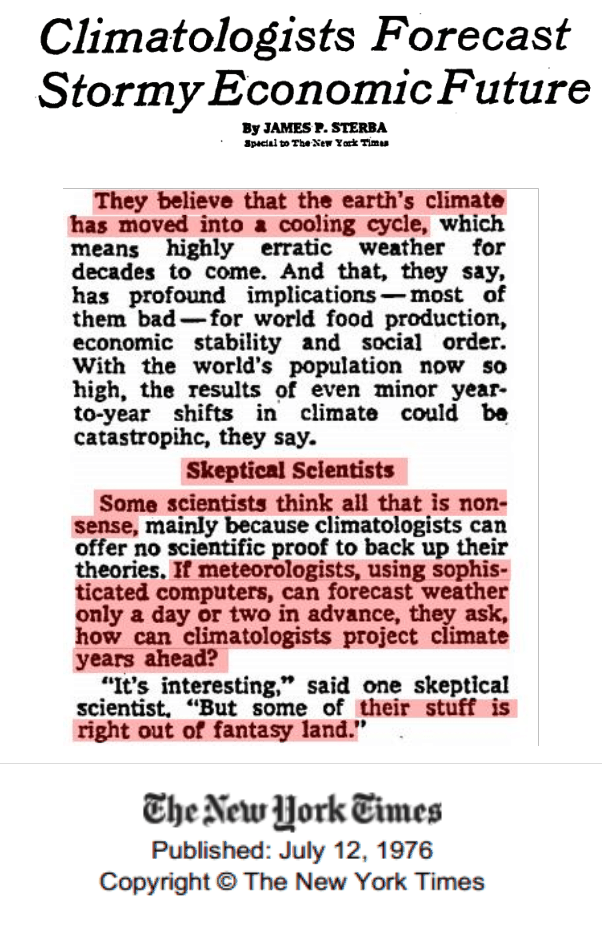
Time To Silence The Skeptics

In 1976, foolish skeptics didn’t trust official forecasts of catastrophic global cooling – doubting the ability of climate models to predict the weather years ahead. Forty years later, these same evil skeptics are blocking global warming acceptance for the same reason. Don’t the skeptics ever learn?

ScreenHunter_242 Feb. 06 08.11

Climatologists Forecast Stormy Economic Future – Climatologists Forecasting Dire Effects of Weather on World Economy and Social Order – View Article – NYTimes.com

It’s time for the Wind Industry to PROVE that they are reducing CO2, or Go Away!

Senator Chris Back: Wind Industry must prove its CO2 abatement claims

Chris Back

In our last post we tipped a bucket on the central, endlessly repeated lie trotted out by the wind industry and its parasites, that Australia’s great wind rush has resulted in substantial reductions of CO2 emissions in the electricity sector.

In Australia, the central object of the Renewable Energy (Electricity) Act 2000 is for “renewable” energy to “reduce emissions of greenhouse gases in the electricity sector” (see s3). The legislation provides that wind power outfits receive 1 Renewable Energy Certificate (REC) for each MWh dispatched to the grid. That relationship proceeded on the mammoth assumption that – for each MWh of wind power dispatched to the grid – there will be a 1 tonne reduction of CO2 emissions in the electricity sector.

Were the mandatory RET retained in its current form, Australian power consumers will see some $50 billion added to their powers bills and transferred to wind power outfits over the next 17 years (see our post here). With that amount at stake, it would be fair to assume that there was some measurable benefit attached – of the kind envisaged by the legislation (ie substantial reductions of CO2 emissions in the electricity sector) – to what will be the biggest wealth transfer in the history of the Commonwealth.

And, with that amount in play, it would also be reasonable to assume that our political betters had already satisfied themselves that the benefit in question is, in fact, being delivered – and that they are sitting on hard evidence quantifying that benefit – especially since the mandatory RET has been in operation for over 13 years.

A few starry-eyed, policy-pygmies seek comfort in a report by ACIL Allenthat’s been used to pump up wind industry CO2 abatement claims. But that document is nothing more than a desktop study, based on Alice in Wonderland assumptions that: uses irrelevant annual averages for wind power output; bases its conclusions about CO2 emissions intensity from conventional generators on assumed (not actual) thermal efficiencies; and, critically, ignores the actual figures from coal/gas fired generators – in particular, the actual coal/gas use data from conventional generators (which ACIL Allen never bothered to ask for) against which power output comparisons can be made to determine actual (not assumed) CO2 emissions intensity; and, therefore, whether wind power has, in fact, reduced CO2 emissions in the electricity sector.

At no point since that legislation took effect over 13 years ago has the wind industry provided any actual proof that it has in fact reduced CO2 emissions in the electricity sector. In what might come as a rude shock, none of our political representatives on the Federal stage has ever had the temerity to ask for any hard evidence to substantiate the wind industry’s mantra; and have seemed content to oversee the wholesale punishment of power consumers on nothing more than blind faith.

Until now.

Chris Back is a Liberal Senator from Western Australia – and he gets it (see our posts here and here and here).

Chris has thrown down the gauntlet, challenging the wind industry to stump up concrete proof to back its wild claims about reducing CO2 emissions in the electricity sector. Here’s a speech Chris delivered in the Senate last Wednesday.

THE SENATE
PROOF
MATTERS OF PUBLIC INTEREST
Renewable Energy Target
SPEECH
Wednesday, 3 September 2014

Senator BACK (Western Australia) (13:36):

I wish to discuss the renewable energy target review and its report, now that it has actually been handed to the government by the independent panel, chaired by Mr Dick Warburton. I want to make some comments about the review itself.

The first point I want to put to bed is around some allegations that have been bandied about in this place during the week to do with the apparent incompetence of the panellists to review the RET.

I just want to point out that, in addition to Mr Warburton, the other panellists include the eminent Mr Brian Fisher AO PSM, a previous executive director of the Australian Bureau of Agricultural and Resource Economics and Sciences. He is a renowned economist.

Another panellist is Ms Shirley Int’t Veld. As a Western Australian, she was the managing director of Verve Energy in WA from 2007 to 2012. Verve was the energy instrumentality that used more renewable energy sources than any other in Western Australia, so I do not know how she could not be regarded as credible.

The other panellist is Mr Matt Zema, managing director of the Australian Energy Market Operator. So I want to dispel the myth that this group was not competent to undertake the work.

For those who might be interested, I will review what the RET is all about. The RET is a government intervention designed to mandate the proportion of electricity generated from selected sources. It is designed to support a policy of at least 20 per cent of Australia’s energy coming from renewable sources by 2020; as such, the policy taxes electricity users and, in some cases, non-renewable generators.

How does it work?

The renewable energy certificate market emerges from the energy targets. Renewable energy certificates, or RECs, are issued to power station generators classified as renewable under the act. They are a form of energy currency as electricity retailers must purchase the RECs to cover their liability. Costs are passed on to consumers through purchase of mandatory certificates by electricity retailers. That, of course, is where it becomes a tax on energy consumers.

The first point I make about the target is that the objectives of the act have not been met, principally because there has not been to any extent a reduction of greenhouse gases in the time the target has been in place.

The second point is that whatever achievements the renewable energy sector has made have largely come from hydroelectricity. Hydroelectricity, as we all know, was around for a long time before the renewable energy target was formed. Having lived and worked in Tasmania and having even had to declare an interest because a company of which I was the managing director actually supplied lubricants and fuels to the hydroelectricity scheme in Tasmania, I place on record that it is a wonderful scheme.

Senator Singh interjecting –

Senator BACK: I want to place on record that I, for one, want to make sure that – whatever outcome is eventually decided by government – the hydroelectricity scheme is enhanced, protected and encouraged independent of the RET system, because it preceded RETs by so many years, as Senator Singh herself indeed knows.

At the time it was suggested that to achieve a 20 per cent contribution of renewable energy by 2020 would require some 41 gigawatt hours to be generated by renewable sources. We know that two things have happened. First of all, there has been a drop in demand –

Senator Singh: Mr Acting Deputy President, I rise on a point of order. I offer a correction to Senator Back; it is 41,000 gigawatt hours, not 41 gigawatt hours.

The ACTING DEPUTY PRESIDENT (Senator Seselja): Order! Senator Singh, there is no point of order.

Senator BACK: Senator Singh’s contribution is quite right, for which I thank her. It is 41,000 gigawatt hours. I will check the Hansard to see what I did say.

Indeed, as a result of a reduction in demand, we now realise that to achieve that 20 per cent target the figure is probably closer to 23,000 gigawatt hours. I do appreciate Senator Singh’s keen attention in listening to my contribution. That is the background of the RET.

The RET comes under two broad categories: the small-scale renewable energy target and large-scale renewable energy targets.

The small renewable targets, which are probably 10 per cent or less, are mainly to do with photovoltaics and solar hot water systems. In relation to the small-scale RETs, the recommendation of the panel is that there is probably little if any need for further support at this time. This is because power charges have gone up – somewhat because of the carbon tax, which has now been repealed through the excellent work of Senator Cormann and others – and costs in the solar sector have come down considerably.

Nevertheless, power charges have gone up while the costs of putting photovoltaics on roofs have come down. It is arguable that photovoltaics are now cost neutral. I was the chief executive of an organisation that introduced seven or eight different forms of solar energy many years ago on an island that I had the pleasure of being responsible for and I am a great supporter of solar energy. If indeed there needs to be some continued support for a limited period of time then I would not violently object to that. However, market forces have applied and the costs of photovoltaic installations have come down while electricity charges have come up, and I hope that we are now at the point of cost-neutrality. The panel has said that we are probably already at that point and that, if we are not there currently, we will probably be there reasonably soon.

I want to move to the issue of the large-scale renewable energy targets.

I have spoken in this place before of how concerned I am with regard to the wind energy sector. This report and others support the fact that there is an enormous amount of misinformation out there in the wider community about the large-scale RETs, particularly those relating to the wind industry.

The industry have employed very effective tricks to – I believe – mislead the public into believing that paying them billions of dollars in subsidies will lower power prices. Of course, it will not; there is no evidence to say that it will. The reason that the public is not outraged about this, as I said earlier, is that the public do not pay this money in taxes; rather, they pay it as part of their energy consumption. The modelling has shown that it is possible that some $37 billion over the next 15 years – or $2.5 billion per year – may be wasted on wind farms. Again, because the costs are concealed, they will not be picked up.

Comment was made that currently the RET is responsible for only around four per cent of household electricity bills. I have to say to you that other evidence refutes that. I will quote this document from AGL Energy and then seek the authorisation of the chamber to table it. I have passed the document to others in the chamber seeking authorisation.

The interesting point in the document is that AGL estimate that, in their commitment to buy 1.3 terawatt hours per year through the various wind associated organisations, it will cost them some $32 per megawatt hour above the 2015 wholesale market. They say that as a headline figure that will cost them some $40 million a year more for electricity than would have been the case without the wind strategy in place. I seek leave to table the document.

Leave granted.

Senator BACK: We are seeing the possibility that the estimated cost of the REC scheme could add some $50 billion to power bills over the next 17 years, with some 600 million renewable energy certificates being issued at a unit cost of about $90. So, in other words, we are looking at having $50 billion added to consumers’ power bills, transferred to wind-power companies. I think this is unacceptable.

I know that Senator Polley wishes to follow me and I am anxious to make sure that she is given adequate time to do so, but first I would like to comment on emissions reductions, because I think this is important.

The arguments regarding the long-term effect of the RET on price are fundamentally flawed, simply because the energy generated by wind farms does not reduce greenhouse gas emissions in the electricity sector.

I challenge the wind energy sector to produce the evidence relied upon to assert that wind power has reduced GHG emissions in the electricity sector.

Wind power is delivered intermittently, on repeated occasions not at all, meaning of course that the entire installed capacity from wind power has to be matched with equal capacity of fossil fuel generation. I challenge that industry to produce evidence to this chamber to say that what I am indicating is not correct.

Once awareness of the existence of the RET, let alone the magnitude of its cost impact, becomes more widespread in the public arena, support for it will evaporate. Renewable energy is not free. It is high cost compared to alternative forms of generation. It is not commercially viable without large subsidies, which ultimately come out of the consumer’s pocket.
Senator BACK (WA)  

Clearly on a roll, Chris followed up his speech in the Senate with this media release.

Dr Christopher Back
Liberal Senator for Western Australia
MEDIA RELEASE
3 September 2014 

Can the wind industry meet my Emissions Reductions Challenge?

In the Senate today, Senator Back said that the RET acts as a tax on energy consumers and conventional energy suppliers to fund a subsidy to selected renewable energy generators.

“But – and this is the big issue that the Coalition Government is now addressing – after 13 years of operation it has become clear that the objectives of the Act have not been reflected in the outcomes. While the investment in renewable energy sources has increased, from a carbon abatement perspective, the Act has been all but totally ineffective in its objective to reduce greenhouse gas emissions in the electricity sector.”

Arguments regarding the long-term effects of the RET on price are fundamentally flawed. This is because energy generated by wind farms does not reduce greenhouse gas emissions in the electricity sector. In fact, there is some evidence that the addition of wind energy onto the grid actually increases carbon emissions. This is the great tragedy of the scheme.

“My challenge to the wind industry is to produce the evidence relied upon to assert that wind power has reduced greenhouse gas emissions in the electricity sector at all. Wind power is delivered intermittently and, on repeated occasions, not at all, which means that an entire installed capacity from wind power has to be matched with an equal capacity of fossil fuel generation at all times.”

Grid managers are required to keep fossil fuel generating plants constantly running in the background to maintain balance within the grid in order to account for dramatic fluctuations in wind power output which occur on a minute by minute basis and base-load generators are required to maintain spinning reserve for occasions when wind power output collapses as it does on a routine but unpredictable basis. The requirement to maintain spinning reserve means that base-load generators are burning coal and gas at a constant rate even though no power is being dispatched to the grid.

“The case to abolish the RET is driven by its cost to electricity consumers compared to the corresponding reduction (or lack of reduction) in greenhouse gas emissions achieved through its 13 year lifespan. This cost comparison, extending the RET tax to 2031 for no measurable reduction in greenhouse gas emissions in the electricity sector is completely futile. It becomes a drag on the Australian economy and an insidious impost on every electricity consumer in the nation – large and small businesses, families and individuals.”

The wind industry is trumpeting two issues in the media: one is that wind is dropping the wholesale price of electricity; and the second is that the RET will cause the retail price of electricity to fall. Put simply, if wind is causing the wholesale price of electricity to fall, then the renewables industry no longer requires the billions of dollars in subsidy it receives through the large-scale RET scheme, as renewable energy is therefore cost competitive in the market.

In reality, the RET is causing electricity prices to rise significantly as it is the Power Purchase Agreement (PPA) that is and always has been the fundamental relationship between the power generator and the retailer.

These PPAs lock in prices of up to $120/MWh compared to the average wholesale price of between $30-$40/MWh. The price set by the PPA is paid by the retailer irrespective of the wholesale price. This PPA price is passed on to retail customers along with the retail margin over the life of the PPA which is usually 15 and up to 25 years. I have tabled a confidential document showing proof of this in the Senate chamber today to ensure transparency for the Australian public.

It is a legislated requirement that 600 million RECs will be issued between now and 2031, adding a cost of at least $50 billion to power bills over the next 17 years. This represents a significant wealth transfer to wind power companies from Australian power consumers and achieves no measurable benefit to the environment.

The RET scheme was never intended to act as an unchecked subsidy. “Once awareness of the existence of the RET, let alone the magnitude of its cost impact, becomes more widespread, public support for the scheme will evaporate. Renewable energy is not free; it is high cost compared to alternative forms of generation and commercially unviable without large subsidies. What people need to understand is that they pay these costs in their electricity bills and not through their taxes. It hurts everyone.”
Senator Chris Back (WA).

Proof