Wind Turbines Don’t Make Sense…..Anywhere!

There’s NO place for Wind Farms: Even Where the Streets Have No Name

Australian Desert - A fragile ecosystem

Talk about “safe” setback distances for wind turbines is nonsense that only panders to the wind industry and its well-oiled and highly paid propaganda machine.

There is NO place for giant wind turbines ANYWHERE.

They are NOT fit for purpose ANYWHERE.

Because wind power can’t be delivered “on-demand” (can’t be stored) and is only “available” at crazy, random intervals (if at all) wind power will never be a substitute for conventional generation sources (see our post here). Accordingly, wind power is simply incapable of reducing CO2 emissions in the electricity sector (see our post here).

The wind industry has never produced a shred of evidence to show that wind power has reduced CO2 emissions in Australia’s electricity sector (or anywhere, for that matter). To the contrary of wind industry claims, the result of trying to incorporate wind power into a coal/gas fired grid is increased CO2 emissions (see this European paper here; this Irish paper here; this English paper here; this American article and this Dutch study here).

So far, so pointless.

Break down the terms on which wind power is “supplied”, and the “deal” reduces to this:

  • we (“the wind power generator”) will supply and you (“the hopeful punter at the end of the line”) will take every single watt we produce, whenever that might be;
  • except that this will occur less than 30% of the time; and, no, we can’t tell you when that might be – although it will probably be in the middle of the night when you don’t need it;
  • around 70% of the time – when the wind stops blowing altogether – we won’t be supplying anything at all;
  • in which event, it’s a case of “tough luck” sucker, you’re on your own, but you can try your luck with dreaded coal or gas-fired generators, they’re burning mountains of coal and gas anyway to cover our little daily output “hiccups” – so they’ll probably help you keep your home and business running; and
  • the price for the pleasure of our chaotic, unpredictable power “supply” will be fixed for 25 years at 4 times the price charged by those “evil” fossil fuel generators.

It’s little wonder that – in the absence of fines and penalties that force retailers to sign up to take wind power (see our post here) and/or massive subsidies (see our post here) – no retailer would ever bother to purchase wind power on the standard “irresistible” terms above.

ICU Respiratory_therapist

With those facts laid out, talk about “safe” setbacks brings with is an admission that wind farms are somehow okay if they’re in the “right” place.

Wind power is nothing more than an ideological fantasy, that feeds the vanities of the gullible and the ignorant for the benefit of a shrewd and cunning few (see our post here).

Because wind power will never provide a meaningful power supply – and can only increase CO2 emissions – there can be NO justification for the harm caused to neighbours, the slaughter of millions of birds and bats; and the destruction of the environment associated with the manufacture of turbines and in and surrounding wind farms.

As to the latter, here’s a take on how “green” hypocrites are hell-bent on destroying the fragile deserts of the American South-West written by an environmentalist, Jim Mattern, aka “Death Valley Jim.”

Jim has watched in horror as a “green” energy invasion of wind and solar power generators has turned the desert ecosystems he’s worked a life-time to preserve and protect into industrial wastelands.

Destroying our Desert in the name of “Green” Energy
Jim Mattern
Death Valley Jim
28 September 2014

I’m not passionate about a lot of things – but those things that I am, are closely related to the desert, whether it be historical or cultural elements, biological, or environmental. It hasn’t always been this way, as a teenager I was passionate about music; in a period of my twenties (after 9/11) it was politics. In my late twenties and now into my mid-thirties, I’ve grown into finding the love of my life – the deserts of the American Southwest.

I would have at one time called people like me “Tree hugger” or “Libtard” – today I wear the “Tree hugger” badge with pride, I’m not so sure on “Libtard” – I don’t find that I fall within the boundaries of any political agenda; I tend to sway in many different directions depending on the subject at hand. What I do know is that I will never vote for a political candidate with either an “R” or a “D” beside their names – both parties are essentially the same thing, they pull at people’s heartstrings for votes based on agendas that shouldn’t be political in the first place.

Enough on that – I honestly don’t have a political agenda, and besides the political lines are so blurred in the case of renewable energy, or “green” energy that the line is pretty much obsolete. When it comes down to it, we have two groups of people – people with a sincere love of the desert, as well as folks that see these solar facilities as the removal of public lands and access. Then there are those that don’t understand the desert, they see it is nothing more than open space – an opportunity for a quick money grab, or they have fallen into the spoon-fed agenda that this is the only way for renewable energy to be successful.

Bulldozers clear an intact desert ecosystem, including hundreds of old Joshua Trees to make way for the Alta Wind facility in the western Mojave Desert. Google is again an investor in this project.

To those that don’t live in the desert, or only drive through it in haste from one place to the next – it can be easy to see why they think so little of the desert. From a majority of the highways, the desert can look boring, dead, and uninteresting. A place of horror films, serial killers, and just in general bad people who are hiding from society. It is unfortunate, because the opportunity for these people to see it any differently is more than likely never going to happen.

This line of thinking doesn’t end with big city people, it also trickles into our desert communities. For instance, I have been spending more time in the vicinity of Palm Springs, and the Coachella Valley as a whole. A large percent of these people think that they are living in the desert, but in reality their communities are a manufactured oasis, made to look as little “desert like” as possible. For a majority – their only “real” experience with the desert is driving the 10, hiking the Bump and Grind, or a visit to The Living Desert. It is all manufactured bullshit, in order to give them the “desert experience”, it’s no wonder that they see undeveloped desert land as expendable.

In the meanwhile, small desert communities across the Mojave and beyond are experiencing real problems – it started several years ago with wind power farms, and it is now escalating at an enormous pace with the new “green” energy solar explosion. Just ask many of the residents of the rural community of Mojave, CA – they were one of the first desert communities to be effected by the wind power craze. Those that own property along the seldom driven Backus Road, thought that they were living the life, property backed up against pristine BLM desert lands, only to now have wind turbines within a few hundred feet of their backyards. Their scenic views of the Tehachapi Mountains forever gone, and their property values sinking up to 50%.

Backyard view in Mojave, CA.

These same people are now being attacked by the solar initiative – with a new facility recently opening at Silver Queen. It isn’t going to end there either, a look at the recently released “Desert Renewable Energy Conservation Plan,” shows that this entire corridor of the Mojave desert is designated as a renewable energy wasteland.

In the Eastern Mojave, there is the highly touted Ivanpah Solar Power Facility; owned by NRG Energy, Google, and BrightSource Energy. Ivanpah has literally whipped out 3,500 acres of previously untouched desert. This land was the home of the endangered desert tortoise as well as other reptiles, that have now been displaced. Since going online, there have been countless bird deaths – when birds fly over the facility, they are cooked mid-air due to the extreme temperatures caused by the mirrors that the plant utilizes.

What people are missing is that our desert is very fragile – is a thriving ecosystem, but it can easily and quickly be killed. The plants that grow in our desert have spent thousands of years perfecting desert living. I had the opportunity to discuss desert plant life with Jim André, biologist, and the director of the Sweeney Granite Mountain Desert Research Center, and was surprised to learn that every year, there are still new species of plants being found in the Mojave Desert.

Along the California and Arizona boarder in the Colorado Desert, there is the town of Blythe. In the desert outside of the town of 21,000 people, there are dozens of intaglios – these giant designs made by removing a layer of stones from the land are sacred to the Colorado River Indian Tribes. Much like petroglyphs, these designs were placed here hundreds if not thousands of years ago by their ancestors. Today they are under attack, with several already having been removed from the landscape during the construction of Blythe Solar.

“No Solar on Sacred Sites” – The fight to save the Blythe Intaglios.

What is very interesting is that these intaglios as well as other Native American sites are coming under attack by these projects, yet they are protected under the The Antiquities Act of 1906, and the Archaeological Resources Protection Act of 1979. The Bureau of Land Management (BLM), which is the same agency that is supposed to enforce these laws, are the ones green lighting projects that are in direct violation.

None of this destruction benefits the communities that are directly impacted. Much like the Owen’s Valley water and land grab of the early 1900’s, the land grab for renewable energy is only benefiting large cities like Los Angeles, who have plenty of open roof-tops that could be plastered with solar panels. This is not a new concept, it has been embraced by several countries.

There is also the ability to place solar panels over the aqueduct, it would utilize already disturbed ground, and help with the loss of water from evaporation. In India, this concept has already been successfully implemented. It is baffling that we are not taking a serious look at this option, considering the state-wide water crisis that we are in.

Solar Panels over the Narmada Canal in India.

What it all really comes down to is greed – it has nothing to do with being “green”, or saving us money on our electric bills. Has anyone’s electric bill actually decreased since wind and solar exploded onto our desert? Despite these promises of lower generating costs, SCE has increased rates over the past three years, with an 8% increase in 2014.

The only people reaping the benefit of the rape of our desert are the companies that are buildings them – our government is giving huge incentives and grants to build these plants, and build them fast.

Public comment is being ignored, undocumented, and undermined. Mass media is ignoring the outcry – only praising the “green” initiative, likely with one hand in the pocket of the initiative.

What is yet to be seen in the long-term effects of this mass rape – and yet we aren’t taking it slow to find out either. By 2040 – there are a planned 40 projects the size of Ivanpah in the works for the Mojave Desert.

When Interior Secretary Sally Jewell announced the road map of the Desert Renewable Conservation Plan, she told reporters that she went for a hike, “We went out into the Big Morongo Preserve … fifteen, 20 minutes from here, there are wetlands. Wetlands. And 254 different bird species. Who knew?”

Well Sally, a lot know – now pack your shit up and go back to your office in Washington DC, and stop planning a conservation plan for a land that you are unfamiliar with. What you have done, is the equivalent of me planning a road system in Washington DC, without having visited it, studying it, and having no concept of how Washington DC or a road system works.

For more information on the impact of these projects on the desert, I recommend reading and following these websites:

Jim Mattern

joshua trees

Wind Turbines are NO Benefit to Anyone But the Rich Investors…

Massive Subsidies for Wind Power a Crony Capitalist “Gift”

dirtyrottenscoundrelsoriginal

Ex-Rep. Istook: Wind Energy a Crony Capitalist Gift
Newsfront
Sean Piccoli
23 October 2014

Wealthy investors in wind power are reaping profits from an expensive — and subsidized — form of green energy that is driving up the electricity bills of ordinary Americans, a former Oklahoma congressman told Newsmax TV on Thursday.

Under the guise of saving the planet from global warming, wind power has become a taxpayer ripoff and a boon to investors claiming massive federal subsidies for an industry that cannot compete on price with traditional energy sources, former Republican Rep. Ernest Istook told “MidPoint” host Ed Berliner.

Of the $40 billion annually doled out to various green energy incentives, grants and loans, one of the biggest magnets for public funds is a wind energy tax credit first enacted in 1992, said Istook.

“For every megawatt hour that [producers] generate through wind energy, they get $23 from the U.S. Treasury,” he said, “and of course you multiply that by the many thousands of megawatt hours that are generated — which is still a small fraction of what the country uses — and they’re talking about an $18 billion renewal of this.”

“Now, this was supposed to be a temporary tax credit back in 1992 to help the industry get on its feet,” said Istook. “Well, the problem is wind power is such an expensive way to generate electricity, that even with these major subsidies — plus all sorts of subsidies from different states — it still is one of the costliest forms of power. And it makes people’s electric bills skyrocket.”

Istook said a new study from the Energy Information Administration — the U.S. Department of Energy’s statistical service — finds electric ratesrising four times faster in the states that use the most wind power.

He said the arrangement continues year in and year out thanks to a classic “vicious cycle,” in which subsidy recipients use their profits to secure more subsidies.

“I want to give you a quote, though, from one individual who was a major wind energy investor and getting a lot of these tax benefits: Warren Buffett,” said Istook, citing the Nebraska-based billionaire investment guru.

“These are his words, not mine: ‘We get a tax credit if we build a lot of wind farms. That’s the only reason to build them. They don’t make sense without the tax credit.’ Those are Warren Buffett’s words,” said Istook.

“The people that are making this investment recognize that unless they can get these crony capitalism dollars, it’s a bad investment,” he said. “But government is paying them to do that. It’s paying some people to get rich at our expense while our utility bills go up.”

Istook said the public has a chance to put a stop to the tax credit, which expired last December, but is being pushed for retroactive renewal by the administration during the lame-duck congressional session that begins after the Nov. 4 midterm elections.

“They’ve got the skids greased in the U.S. Senate to do it,” said Istook.

And they will, too, he said, “unless people call their member of Congress and say, ‘Don’t vote for anything that renews this $18 billion giveaway, no matter what it’s packaged with. Don’t vote for it.’ That’s the only way we’re going to put a stop to this crony capitalism.”
Newsfront

ernest istook

Wonderful News! Powerful (Faux) Green Lobby defeated in US Mid-term Elections!

The day ‘climate change’ became irrelevant in politics – Powerful Green Lobby Defeated In US Midterm Elections

Republicans Win Control Of US Senate

For Tom Steyer and other environmentalists, $85 million wasn’t enough to help Democrats keep the Senate blue or win more than a single governor’s mansion in Tuesday’s toughest races. The billionaire’s super PAC and other green groups saw the vast majority of their favored candidates in the battleground states go down to defeat, despite spending an unprecedented amount of money to help climate-friendly Democrats in the midterm elections. The outcome brought gloating from Republicans and fossil-fuel supporters even before the results rolled in — and raised questions about whether greens can fulfill their pledge to make climate change a decisive campaign issue in 2016. –Andrew Restuccia, Politico, 5 November 2015

Climate Change: This was one of the dogs that didn’t bark in the 2014 election, even after liberal billionaire Tom Steyer spent an estimated $70 million to promote the issue and a new U.N. report Sunday warned of “severe, pervasive, and irreversible” global warming that will worsen without environmental policy changes. Robert Brulle, professor of sociology and environmental science at Drexel University, said a GOP-led Congress is more likely to try to stop Obama’s Environmental Protection Agency from imposing new regulations on power plants than endorsing any additional steps to reduce U.S. carbon pollution. Said Brulle: “I am not an optimist about us doing anything – I think it looks bad for political action on climate change in any way.” –Will Bunsch, Philadelphia Daily News, 5 November 2014

The $12 million that the United States Senate has allocated to UN climate agencies is expected to be among the first casualties [after] Republican take control of the chamber following Tuesday’s midterm elections. The current Senate bill on funding for state and foreign operations includes $11,700,000 for the Intergovernmental Panel on Climate Control (IPCC) and the UN Framework Convention on Climate Change (UNFCC). However, the House version of the bill passed by a Republican-controlled sub-committee, states that “none of the funds in this Act may be made available for the Intergovernmental Panel on Climate Change/United Nations Framework Convention on Climate Change.” –Denis Fitzgerald, UN Tribune, 4 November 2014

The Keystone XL pipeline won big Tuesday night. Following an election night that saw anti-Keystone Democrats replaced by pro-Keystone Republicans, the oil-sands pipeline project now appears to have at least 60 supporting votes. That means legislation forcing approval of the long-delayed project may be headed to President Obama. Before the election, at least 57 senators could be counted on to support pro-Keystone legislation, but that was never enough to beat a filibuster from the project’s opponents. Tuesday night’s results appear to change that. –Clare Foran, National Journal, 5 November 2014

The expected Republican majority in the U.S. Senate after Tuesday’s mid-term elections is likely to seek to roll back federal regulations on power-plant emissions, approve the Keystone XL pipeline, expand oil and gas development on federal lands and work toward ending the 40-year ban on U.S. crude oil exports, energy experts said. “The Republicans will go to Obama and say, look, ‘We’ve got to get this done; your own government is saying this is fine. The election is over so you don’t have to worry,’” Lynch said. –Jon Hurdle, The Street, 4 November 2014

President Obama will continue to take action on policies to fight climate change whether or not Republicans take control of the Senate, the White House said. White House press secretary Josh Earnest told reporters Tuesday that Obama plans to keep using his executive powers to mitigate greenhouse gas emissions that cause climate change. “The president will use his executive action to take some additional steps.” –Timothy Cama,The Hill, 4 November 2014

soon-politicians-wont-be-able-to-avoid-the-issue

Thanks to Dr. Benny Peiser and The GWPF for this summary

World Council for Nature Shares Info. On Wind Turbines!

Note: Infrasound & Low Frequency Noise is often referred to as “ILFN”

infrasound - www.bgr.bund.de
Simulation of infrasound waves propagating in the atmosphere
Source: BGR http://www.bgr.bund.de


IMPORTANT NEWS Nº 1:

Health Board: wind turbines are a hazard to human health

October 17th, 2014
GLENMORE, WISCONSIN, USA: “This week the Brown County Health Board went on record declaring that wind turbines “are a human health hazard“.


Folks living in the Glenmore area near the Shirley Wind Project have been saying this for years though, and now they have the health department on their side. By state statute wind turbines can be within 1250 feet of a home. The Brown County Board of Health says that’s too close for comfort.”

Read more: windfarm a health hazard  — don’t miss the video


The wording of the motion was as follows:


To Declare The Industrial Wind Turbines In The Town Of Glenmore, Brown County. WI. A Human Health Hazard For All People (Residents, Workers, Visitors, And Sensitive Passersby) Who Are Exposed To Infrasound/Low Frequency Noise And Other Emissions Potentially Harmful To Human Health.”

Read more: ILFN potentially harmful

wind turbine effects on the inner ear


IMPORTANT NEWS Nº 2


Windfarm victims worldwide will feel vincicated by this:


In Plympton Wyoming, Ontario, Canada, complaints from windfarm victims “will lead to investigations and hefty fines. This is the first bylaw directly referencing ILFN and demanding fines of between $500 to $10,000 per day, and which may be, the bylaw states, in excess of $100,000.


The bylaw references charging fees to developers if ILFN causes residents problems. Common effects are, from chronic unrelenting noise: sleep disorders, hormone level disruption, increased risk of disease, diabetes, hypertension, depression, heart arrhythmias, and possibly even cancer.”


Read more: a groundbreaking Wind Turbine Noise bylaw


BACK IN 2013, STEPHEN AMBROSE, Board Certified Member of the Institute of Noise Control Engineering and a Full Member of the Acoustical Society of America, testified in front of the Vermont Senate Natural Resources Committee:


Regulatory boards are now unable to protect public health and wellbeing because the wind turbine industry has substituted their own measurement and assessment procedures through international committees.


The wind turbine acoustic standards differ dramatically from other noise sources. Wind turbines are evaluated using A- weighted sound levels by removing all low frequency and infrasound from consideration. A-weighting lowers infrasound levels by 50 dB at 20 Hz and 70 dB at 10 Hz. This promotes false statements that wind turbines do not produce infrasound.


“I have measured infrasound using a sound level meter and a microbarograph. I have experienced the adverse health effects caused by infrasound. Again, I felt miserable with a headache, nausea, loss of cognitive ability, sleep interference and interruption.


“I felt better when only a few miles away from the wind turbines’ influence.”


“I recommend that anyone who thinks wind turbines are good acoustic neighbors to do what I did. Go to a wind turbine site, live as a neighbor, and sleep in their bed when the wind blows strong.


Read more: Testimony from an acoustician with 35 years’ experience


THE BIBLE of WINDFARM EFFECTS on NEIGHBOURS:


This is just the concluding paragraph, but there is plenty more:


A compliant project may still cause damage to neighbours for numerous reasons:


– first, the standard only refers to dBA and thereby omits reference to ILFN;


– secondly, even with regard to audible noise, the standard refers to a maximum of 40 dBA outdoors, whereas every other form of industrial or other noise in country and city is limited to 35 dBA maximum. There is no technical basis for such an aberration, and it is clearly, (intended or not), discriminatory;


– thirdly, in quiet rural environments, even 35 dBA will be intrusive and loud, if the background level is below 25dBA, which is not uncommon.


The ear responds to the peaks of sound levels, not the averages. The wind turbine noise standards all refer only to averages, and exclude ILFN, and do not account for the human response, so cannot protect people from predictable serious harm to their health.”


The definitive document on wind turbine noise

Wind Turbines….The Facts Blow Them Out of the Water…..Useless Machines!

Wind Turbine Campaign

People often ask me to explain ’ What have I got against wind turbines?’

Here are a few of their problems:

    1 They exacerbate flooding due to the massive concrete bases being built on our hills for turbines which cause faster run-off during periods of heavy rain. Old wind farms, such as at Llandinam, have passed their sell-by date much earlier than expected and are being replaced by larger turbines, each of which requires a new concrete base. They old bases are left in the ground. As you will appreciate, the mountain will eventually be covered in concrete, a highly-polluting process itself, and this will increase flooding many-fold.

    2 Proximity to wind turbines can cause high blood pressure, tinitus, sleeplessness and many other health problems, due to infra-sound – there is now much evidence of this in many countries, with massed chronic examples in the US, Canada and Australia. (many reports, including Wind Turbines Make Waves: Why Some Residents Near Wind Turbines Become Ill, contained in the Bulletin of Science, Technology & Society, 30th September 2011; Wind Turbine Syndrome, A Report on a Natural Experiment, by Dr Nina Pierpont, published 2009 by K-Selected Books, Santa Fe). The UK government insists on using a system called ETSU-97 for monitoring wind noise, but this is 16 years old, produced when turbines were far smaller, and there is much more sensitive equipment available now, which they refuse to use because it will reveal the shortcomings of the industry. Unbelievably, the Health & Safety Executive are kept well away from wind turbine developments, when every other form of activity in the UK is subject to their investigations, even harmless bookshops in Brecon.

    3 Despite what government and the wind industry say, turbines devalue property and in many cases destroy any chance of selling the property – there is a lot of evidence from estate agents all over the UK.

    4 In extreme cases people such as Jane and Julian Davis in Lincolnshire even had to abandon their property. There is no provision for compensation for such people.

    5 Wind energy destroys local jobs: according to a report commissioned by the Scottish government 3.7 jobs in the UK are lost for every 1 wind one produced (Verso Economics: The Economic Impact of Renewable Energy Policy in Scotland and the UK 2011).

    6 The Mid-Wales economy relies heavily on tourism, and many businesses will have to close and the economy devastated if hundreds more turbines are erected. It is completely unfair that Powys should bear such massive numbers of these alien, out-of-scale objects and have to pay some £3m to fight it through the public inquiries – that is why we have the highest hike in council tax in the country. See the PCC Red Kite newsletter.

    7 Industrialising much of our finest natural landscapes that are vital for people’s wellbeing, tourism, etc, is totally unacceptable in a civilised society. We need natural landscapes unadulterated by monstrous metal structures, for our well-being.

    8 Introducing gridlock into Mid-Wales highways over 7 years or more as is forecast by Powys CC (comment by Dale Boyington, Director of Highways, PCC in 2012) if current proposals go ahead will inevitably destroy much of the fabric of our society and culture, but this matters not a jot to those in Cardiff or Westminster.

    9 This is leading to the disintegration of local communities, many of whom will be virtually imprisoned when surrounded by monstrous metal turbines nearly 500 feet high.

   10 Billions of our money going abroad to foreign energy corporations (who form some 70% of our energy companies), furthering problems with our balance of payments.

    11 Energy bills are rising alarmingly, mainly because of subsidies to wind energy, thus creating fuel poverty for so many in Mid-Wales, with consequent increase in deaths in winter.

    12 Turbines kill birds (particular raptors) and bats, also spook many domestic animals. Horses are especially vulnerable.

    13 Turbine bases destroy vast areas of peat blanket, the British equivalent of a rain forest and thus releasing vast tonnes of CO2.

    14 The intermittency of wind energy makes it a pretty useless source of energy, leading to brown-outs, grid destabilisation and costly backup from traditional power stations which are forced to operate at inefficient levels, and thus creating more CO2 than if they operated normally without the turbines.

    15 People regard nuclear power as being dangerous, yet more people have died from wind turbine accidents over the last five years than from nuclear ones. During the 5 years up to December 2011 there were 1,500 accidents and incidents on UK wind farms, with four deaths, according to Renewable UK.

    16 During periods when the grid cannot cope with input from wind turbines the latter are told to shut down, yet are given hundreds of thousands of pounds for not producing any power.

    17 Wind turbines each have a magnet as part of their structure, and some of the content for this comes from rare earth minerals mined exclusively in China. This process is dirty and dangerous, with waste products, including radioactive thorium apparently allowed to leech into the waterways. See  http://www.pbs.org/newshour/bb/asia/july-dec09/china_12-14.html

This book explains much of the above in greater detail:
  The Wind Farm Scam by Dr John Etherington, £9.99 Stacey International publishers

 David Bellamy

Watch this excellent film by Godfrey Bloom explaining the economics and the threats to our energy supply that will result from our government’s obsession with wind energy

mynyydygwairsmall.jpg

Mynydd y Gwair, Watercolour by David Bellamy

There is a proposal to built a large Wind Turbine development on this beautiful unspoilt common land, with views across Swansea Bay, the Bristol Channel and the Decon coastline. The local people will loose their peace and serenity, and walkers will loose the sense of isolation and solitude so vital to restore well-being in many of us. And all for the sake of a small supply of intermittent electricity

We are both very concerned about the impact of proposed Wind Turbine developments in the Welsh Uplands. Numerous developments of large Wind Turbines are currently being proposed for many of the country’s most beautiful hilltops. Sixteen wind turbine developments already exist in Wales creating an unacceptable visual intrustion. Some turbine developments are currently being built such as Cefn Croes in Ceredigion where huge tracts of land are being devastated in order to install access roads. Visit Cefn Croeswebsite to see the damage. All this destruction in order to produce a very small and intermittent supply of electricity.

‘We are both working to bring about more awareness of the issues’

twodbssmall.jpg

The two David Bellamys have met on two protest marches against wind turbine developments in Wales.

David and Jenny passionately believe in the principle of renewable energy but wind turbines are the least reliable or productive, and the most intrusive of all the renewable options.

Far from being a ‘green’ option, there are many arguments against them. For example – here are just two of the many facts

1. Their unreliability means that conventional coal, gas or oil fired power stations will still have to be kept running on standby in case the wind stops blowing, or blows too fast, thus any perceived saving of carbon emissions is a myth.

2. 1,000 tons of concrete is required to install each individual turbine. Concrete production is the second most polluting industrial process in the world.

Please take the time to educate yourself on this subject as we are being told by our government that this is the solution to reducing our carbon emissions but wind tubines cannot help to solve the problem of global warming in fact they may even be adding to it.

The only people to benefit from this industrialisation of our countryside will be the developers.

Ridiculous Faux-green Energy Policies Wrecking Economies and Hurting the Poor!

The Hard-“Green”-Left Promote Energy Policies that Wreck Economies & Smash the Poor

USSR

A little while back, the good Senator from Victoria, John “Marshall” Madigan launched an Exocet missile at the seedy world of hard-green-left politics and the wind power outfits that fund the Australian Greens (seeour post here).

The Greens have been particularly coy about where the hundreds of thousands of dollars used to fund their last Federal election campaign (including the rerun of the West Australian Senate election) came from. The Greens set out to crush SA’s favourite Greek, Nick Xenophon due to his efforts to bring the wind power fraud to an end: the Green vote went backwards, but Nick (a true STT Champion) – who ran as an independent candidate – polled a snicker under 25% in the South Australian Senate race (beating the Labor Party’s vote of 22.7%) – an all-time record for an independent Senator.

But, we digress. Since the launch of Vestas’ “Act on Facts” campaign in June last year it was evident that the Vestas were throwing mountains of cash at the Greens (see this article and see our post here).

With Vestas as their new paymaster, the Greens have completely abandoned any claim to be friends of the environment and have instead become rabid spruikers for the wind industry: ignoring the millions of birds and bats being slaughtered (see our posts here and here) and lambasting and ridiculing wind farm neighbours suffering from turbine noise generated sleep deprivation – bending over backwards to prevent any research into the problem, in a naked effort to protect their financial backers (see our post here).

Recently, it’s come to light that the billionaire founder of wotif.com, Graeme Wood has poured hundreds of thousands of dollars into the Green’s coffers. And, just like Vestas, is using the Greens to advance his wind farm interests, proving that the Greens truly are the best party money can buy.

Paying $millions to so-called “green” politicians and astro-turfing propaganda outfits like the WWF (see our post here), Getup! and 350.org (see our post here) has become a central wind industry strategy: if you’re a foreign owned company worth $billions, with no political credibility and rolling in mountains of (other peoples’) cash, why not pay a bunch of slick little political manipulators to plead and beg to governments on your behalf?

But the purpose of all this propaganda and political manipulation goes way beyond promoting wind power; and ensuring it has unobstructed access to an overflowing subsidy trough.

Piglets-Snout-2270058

Still bitter about the fact that their team lost the ideological battle when the Berlin Wall succumbed to sledgehammers back in 1989, the hard-green-left have redoubled their efforts to command and control the economic fortunes of countries around the Globe; both rich and poor alike.

The shortest route to wrecking an economy is to deprive it of cheap, reliable power. By portraying fossil fuel generators as evil; and nuclear generators, more so, the new Trotsky-ites aim to hammer energy intensive industry (which they hate) and the poor (who they couldn’t care less about).

Heat or Eat?

If you’ve ever wondered about the motivation of so-called “green” groups – and how their hysterical propaganda manages to garner so much attention – then take your time and enjoy this detailed analysis from the Daily Mail.

EXPOSED: How a shadowy network funded by foreign millions is making our household energy bills soar – for a low-carbon Britain
Daily Mail
David Rose
26 October 2014

  • Shadowy pro-green lobbyists working at every level of the Establishment
  • Organisations are channelling tens of millions of pounds into green policies
  • Elite lobby group linked to Friends of the Earth, Greenpeace and the WWF
  • Current energy policies shaped by the Green Blob will cost up to £400 billion
  • If continued, there will be further eye-watering energy bill rises for Britons

The Mail on Sunday today exposes how a ‘Green Blob’ financed by a shadowy group of hugely wealthy foreign donors is driving Britain towards economically ruinous eco targets.

The phrase the ‘Green Blob’ was coined by former Environment Secretary Owen Paterson after he was sacked from the Cabinet in July.

He was referring to a network of pro-green lobbyists working at every level of the British Establishment, who have helped shape the eco policies sending household energy bills soaring.

But investigations by this newspaper reveal the Blob is not just an abstract concept.

We have found that innocuous-sounding bodies such as the Dutch National Postcode Lottery, the American William and Flora Hewlett Foundation and the Swiss Oak Foundation are channelling tens of millions of pounds each year to climate change lobbyists in Britain, including Greenpeace and Friends of the Earth.

They have publicly congratulated themselves on their ability to create green Government policy in the UK – most notably after Ed Miliband steered through aggressive CO2 reduction targets in his 2008 Climate Change Act, and announced there would be no more coal power stations.

Yet the consequences of their continuing success are certain: further eye-watering rises in energy costs for millions of Britons and an increasing risk of blackouts.

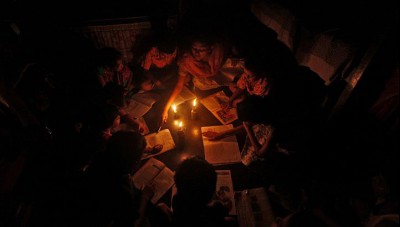
studying candle

According to leading energy analyst Peter Atherton of Liberum Capital, current UK energy policies shaped by the Blob will cost between £360 billion and £400 billion to implement by 2030. He said this will see bills rise by at least a third in real terms – on top of the increases already seen over the past ten years.

This bill dwarfs the EU’s £1.7 billion demand from Britain last week.

Lobbying by the Blob helped lead to a new European Union emissions deal announced on Friday, when EU leaders including the Prime Minister agreed to triple the current pace of emissions cuts.

Following earlier deals, EU-wide emissions of CO2 are supposed to fall 20 per cent over the 30-year period 1990 to 2020.

Under the new agreement, this reduction must be doubled in just a decade, reaching ‘at least’ 40 per cent by 2030 – a goal that could only be accomplished through further massive investment in wind and nuclear energy.

At the heart of the Blob is a single institution – the European Climate Foundation (ECF) – which has offices in London, Brussels, The Hague, Berlin and Warsaw.

Every year it receives about £20 million from ‘philanthropic’ foundations in America, Holland and Switzerland, and channels most of it to green campaign and lobby groups.

It refuses to disclose how much it gives to each recipient, and does not publish its accounts. But it admits that the purpose of these grants is to influence British and EU climate and energy policy across a broad front.

Many more millions are fed directly to British and European lobby groups from the same overseas foundations which also fund ECF.

In its last annual report, ECF said working towards a 2030 deal was ‘a big focus area for ECF as a whole’.

ECF managing director Tom Brookes told The Mail on Sunday he provides ‘a fact-base’ to help policy-makers make the ‘many complex decisions that are necessary to move towards a high-innovation, prosperous and low-carbon future’. He added: ‘The UK is a leader in many of these fields.’

The Blob and Red Ed

Friday’s EU deal contains a get-out clause: if the rest of the world fails to agree a binding global emissions treaty at a UN conference in Paris next year, then Europe’s targets can be ‘reviewed’ – or in other words, abandoned.

Giants such as China, India and Australia have insisted they will not sign such a treaty. It is also unlikely to be approved by the US Congress, which is Republican-controlled.

However, thanks to Ed Miliband and his 2008 Climate Change Act, the get-out will make no difference for Britain. The UK is the only country which already has a binding target for 2050. By then, the law says, UK emissions must be 80 per cent down on 1990.

ed milliband

Mr Miliband’s Act also created a mechanism for ensuring the country sticks to a path that achieves this target – the so-called ‘carbon budget’. The scale of the challenge that its latest version poses is not widely realised.

Over the next 15 years, the electricity industry has to cut the CO2 it emits for every kilowatt it generates by 90 per cent – an unprecedented transformation.

But the carbon budget also means the total amount of power generating capacity has to more than double. In order to meet the 2050 target, there has to be a massive shift towards electric vehicles and heating. While fossil fuel power plants will close, both their replacements and this vast additional capacity will have to be wind or nuclear – by far the most expensive types of power.

Remarkably, green lobby group Friends of the Earth not only conceived the Climate Change Act, but Bryony Worthington, the FoE official who came up with the idea and lobbied MPs to support it, later actually drafted it.

‘When you’re on the outside lobbying, you kind of hope that you are going to have an impact, [but] you’re never really very sure,’ she told a green seminar three years ago.

But she hit the jackpot. Her proposal was taken up first by the new Tory leader, David Cameron, and followed by the then-Labour Government. Worthington, who was seconded into the civil service, was asked to rewrite her lobbyist’s memo, this time as a law.

Once it was safely on the statute book, she left the civil service to form a new green campaign group, Sandbag, which presses the Government to adopt more stringent forms of carbon taxes. Like her previous employer FoE, it is now funded by ECF. Ed Miliband made her a Labour peer in 2011.

While the Act was going through Parliament, the ECF, which was launched in 2007-8, was giving money to Greenpeace UK, FoE, Christian Aid and the WWF to mount a campaign against coal-fired power plants. Also funded was Client Earth, a group of lawyers who secured court acquittals for ‘direct action’ protesters who broke into the Kingsnorth plant in Kent, climbed its chimneys and occupied it.

The campaign persuaded Mr Miliband to announce the cancellation of a planned new generating unit at Kingsnorth – and that there would be no new coal plants built in Britain.

Afterwards, the ECF president, Jules Kortenhorst, boasted that Miliband had acted in response to ‘a complex, multifaceted effort over a year and a half, with grass-roots mobilisation campaigns [and] behind the scenes lobbying’.

He added: ‘All of this work, backed by substantial philanthropic investment, resulted in UK Climate Change Secretary Ed Miliband announcing that no new coal-fired power plants would be built… This is an example of a policy that can be replicated, increasing its impact.’

Follow the money

The most significant source for the ECF’s millions is a body called Climate Works – a private foundation which channels colossal sums to climate campaigners worldwide.

The Climate Works manifesto was set out in 2007 in a document entitled ‘Design to Win: Philanthropy’s Role in the Fight Against Global Warming’. It said that to be effective, a campaign to change government policies on energy and emissions would need at least $600 million from donors.

It was driven by the belief that without radical action, ‘we could lose the fight against global warming over the next ten years’.

It advocated the giving of generous grants to local campaigners in countries such as Britain who had detailed knowledge of the way their political systems operated.

As well as better energy efficiency, carbon taxes and emissions caps, they must ‘promote renewables and low emission alternatives’. Utility companies must be given ‘financial incentives’ – in other words, enormous subsidies from tax and bill payers – to make this happen.

Climate Works soon achieved its ambitious fundraising target, with a grant in 2008 of $500 million from the William and Flora Hewlett Foundation, which spends the fortune amassed by the co-founder of the Hewlett-Packard computer firm. This was followed by further grants of up to $100 million, and donations of $60 million from the sister Packard foundation. In July, a report by a US Senate committee named the Hewlett foundation as a key element in a ‘billionaires’ club’ which effectively controlled the environmental movement, pumping more than half a billion dollars a year into green groups around the world.

It claimed these ‘wealthy liberals fully exploit the benefits of a generous tax code meant to promote genuine philanthropy and charitable acts’, but instead were transferring money to ‘activists’ to ‘promote shared political goals’.

One of the US-based Climate Works’s first acts was to set up and fund ECF as its European regional office. All ECF’s main funders are represented on ECF’s board, including Charlotte Pera, who is also Climate Works’s CEO. Susan Bell, ECF’s vice-chairman, was formerly the Hewlett foundation’s vice-president.

Another director is Kate Hampton, an executive director at the Children’s Investment Fund, a UK charity with assets worth £324 million.Others come from finance and business. ECF’s chairman is Caio Koch-Weser, vice-chairman of Deutsche Bank, whose contacts in Brussels could not be better: from 2003–5, he chaired the EU’s Economic and Financial committee. Yet another director is Mary Robinson, the former president of Ireland.

No transparency

It is hard to assess the ECF’s full impact for a simple reason – although it publishes the names of some of the organisations it funds, it does not state how much it gives, nor exactly how this money is used.

The ECF’s Tom Brookes said: ‘The projects we fund all fall within the overall mission of the Foundation to support the development of a prosperous low-carbon economy in Europe.’

He would not explain why no amounts were stated, saying only that ECF’s annual report ‘describes the objectives of each ECF programme area and its significant grantees.

‘We are confident that this is a sufficient level of detail to provide insight into the work of the Foundation… Our policy on the information we publish reflects our responsibilities to our grantees and donors.’

Nevertheless, it is clear from the information that is available that the list of ECF funding recipients is a Who’s Who of the green movement, including Friends of the Earth, Greenpeace, the WWF, Client Earth, Carbon Brief, the Green Alliance, and E3G, the elite lobby group that persuaded the Government to set up the £3 billion Green Investment Bank.

The 2013 ECF report sets out its priorities for Britain, praising its ‘leadership on the climate front’ – thanks to the Climate Change Act.

It also boasts that its grants had an impact on this year’s Energy Act: ‘ECF grantees such as Green Alliance, E3G, and Greenpeace helped secure important milestones such as an emissions performance standard for new power stations.’

To ECF’s dismay, however, the supposed UK ‘consensus’ on climate and energy is now in jeopardy: ‘Household energy bills have shot to the top of the political agenda, and progress on decarbonisation is tangled in competing visions of the country’s energy future… A growing number of media and political voices are casting doubt on the climate science and the economic case for action.’

Against this opposition, ECF’s 2013 report says it intends to work with British greens to ‘rebuild confidence in the low-carbon transition’, by ‘fact-checking the UK media’s coverage of climate and energy issues’.

It says it will ‘establish a new unit that will promote evidence-based discussions in the media and mobilise authoritative voices on the low-carbon economy’.

Since the report was published, this unit has come into being, run by former BBC environment correspondent Richard Black. How effective it will be remains to be seen.

Meanwhile, it is clear that the sheer scale of this lavishly funded lobbying effort dwarfs that of its opponents.

The Global Warming Policy Forum in London, Europe’s only think-tank which is sceptical about climate science and energy policy, has an annual budget of £300,000 and employs just three people.

Its director, Dr Benny Peiser, said yesterday: ‘At the end of the day, someone will have to be held accountable for us committing economic suicide. We are the only organisation that does what we do – against hundreds on the other side, all saying the same thing.’
Daily Mail

Josef Stalin

If We Had More Politicians Like This One, We Could Have True Democracy

New post on lsarc

No Challenge, No Democracy

by lsarc

Herewith a statement by Terry Mokriy, formerly a council candidate and now a Grey Highlands Council member who got top votes out of all 14 candidates running.

We feel it is well worth sharing as his comments are particularly appropriate given what many have all felt and experienced over the past 10 to 12 years.

Please share.

Below is Terry’s statement in full:

“Years of experience in government and public service arenas have left an indelible mark on my world view and psyche.

Federally, I was the Youth, Education, and Ontario Chair for a cross Canada national council dealing with Multiculturalism. We reported directly, and made recommendations, to the Federal Minister of Multiculturalism. I had the opportunity to travel across Canada and meet, conference with, and listen to many groups and individuals. Our mandate was to make recommendations to the Minister and Cabinet. I also wrote and delivered speeches for, and on behalf of, the Minister. That was my first foray into political and bureaucratic frustration.

I have also served as a Federal Riding Association President, Canvass Chair, Campaign Chair, and Treasurer of a GTA wide political association comprised of some 63 ridings. I had the chance to work with, support and meet a wide range of politicians and politicos, some who were movers and shakers and some not.

At the provincial level, I was actively involved as a Campaign Chair, advisor to elected politicians, campaign strategist, and speech and pamphlet writer.

That being said these experiences have led me to my present state. I consider myself to be philosophically and politically a realist with, what could be considered, strong populist tendencies. That is why I volunteered to help establish and Chair the South East Grey Community Health Centre in Markdale. I believe in, what the Americans refer to as, “government for the people”. That is not what the current trends appear to be.

Today’s governments, especially at the political party levels, often times seem to serve, not the electorate, but their own interests. This trend has been years in its development. I witnessed it in Ottawa when bureaucratic and party priorities took precedence over the obvious needs, concerns and wishes of the people.

The past provincial government of Ontario took this self interest to its zenith. We need not discuss the examples for they are obvious.

It is now even harder not to become more cynical vis a vis political institutions which are increasingly less interested in the “common good” and more in political and party expedience. Government is supposed to be for the people and is supposed to aid, provide for and assist. It is to expedite a common quality of life and ease the experience of the community. Instead, it has become more and more intrusive, invasive and dictatorial, taking into account vested interests and hidden political and personal agendas.

The Municipal level of government has, willingly or not, become the last bastion of true democracy. It is the place where people can directly interact with government. It is the arena in which the democratic principals of “what is right for the people” can still hold sway.

We can and must continue to involve ourselves and participate. We must not fall into apathy or complacency for that will be the death knell of democracy. That apathy can take the form of simply agreeing to, ignoring, or accepting without question. We need to stop simply shrugging our shoulders saying, “What can I do about it? The decision has already been made”.

I have witnessed government, both political and bureaucratic, in action. I have seen how decisions are made and what influence personal, party and political agendas have in the process and the outcomes. People, individuals and groups, make decisions and people, individuals and groups, must continue to question and challenge those decisions.

We must continue to ask the question, “Why?” If there is no reasonable answer forthcoming then we should not simply acquiesce because, “They said so!”.

If there is no one to question and to challenge then there truly is no democracy.”

Climate Change is a Natural Phenomenon. Humans are NOT to Blame!

Climate Is Changing, And Some Parks Are Endangered, But Humans Aren’t The Cause

Editor’s note: The climate is changing, but is it humankind’s fault? Daniel B. Botkin, professor Emeritus in the Department of Ecology, Evolution, and Marine Biology at University of California Santa Barbara, doesn’t believe so. In the following column, he dissects the conclusions reached by the Union of Concerned Scientists in its report,National Landmarks at Risk, How Rising Seas, Floods, and Wildfires Are Threatening the United States’ Most Cherished Historic Sites.

Alternate Text
Jamaica Bay National Wildlife Refuge The only wildlife refuge in the National Park System lies within New York City, and is not on the Union of Concerned Scientists List. The refuge is the largest bird migration stop in the Northeast, and serves as a buffer protecting urban development from major storms. Its well-developed paths among birds and flowering plants and along inland wetlands and waterways are available by public transportation to the 8.6 million residents of New York City. (Photo by the author)

For those of us who love our national parks and are confronted daily with media, politicians, and pundits warning us of a coming global-warming disaster, it’s only natural to ask what that warming will mean for our national parks. This is exactly what the well-known Union of Concerned Scientists discuss in their recent report, National Landmarks at Risk: How Rising Seas, Floods, and Wildfires Are Threatening the United States’ Most Cherished Historic Sites.

I’ve done research since 1968 on the possibility of human-caused global warming and its possible ecological effects, and have published widely on this topic, discussing possible effects on biodiversity and on specific endangered species as well as on forests, cities, and historical evidence of Arctic sea ice change. I’ve also been involved in the development of some aspects of some climate models, and having developed a computer model of forests that is one of the principal methods used to forecast global warming effects on vegetation, I sought out the UCS report with great interest.

The approach the Union has taken is to have the report written by four staff members: Debra Holtz, a journalist; Kate Cell, a fund-raiser for the organization; Adam Markham, with a B.S. in zoology, who was the founder of Clean Air-Cool Planet, a nonprofit organization “to promote innovative community-based solutions to climate change in the Northeast”; and Brenda Ekwurzel, the Union’s Senior Climate Scientist. She is the only author with research experience on the subject, has a Ph.D. in isotope geochemistry from the Department of Earth Sciences at Columbia University’s Lamont-Doherty Earth Observatory and has been on the faculty of the University of Arizona Department of Hydrology and Water Resources.

These four authors took the standard reports from such organizations as the United National Intergovernmental Panel on Climate Change, treating them as accurate and true, and then discussed the implications for 16 American historic sites. As shown in the accompanying table, they write that 11 of the sites are threatened by rising sea levels and their consequences (coastal erosion and flooding); two by inland flooding; two by wildfires; and one by “extreme heat and drought” (table 1).

The report opens with a bold assertion: “Many of the United States’ iconic landmarks and heritage sites are at risk as never before. Sea level rise, coastal erosion, increased flooding, heavy rains, and more frequent large wildfires are damaging archaeological resources, historic buildings, and cultural landscapes across the nation.” The report later goes on to add, “All of the case studies in this report draw on observations of impacts that are either consistent with, or attributable to, human-induced climate change based on multiple lines of scientific evidence.” To which the authors add, “This report sounds a wake-up call: as the impacts of climate change continue, we must protect these sites and reduce the risks.”

The point of the report, its opening theme and its major conclusion, is that these historic places are in trouble and it’s our fault, we have been the bad guys interfering with nature and therefore damaging places we value. This is consistent with the IPCC 2014 report and the 2014 White House Climate Change Assessment, for both of which I acted as an expert reviewer and testified before the House and Senate about.

TABLE 1. HISTORIC SITES AND CLAIMED THREATS TO THEM

Threatened by Sea Level Rise and Accompanying Flooding

  1. Boston’s Faneuil Hall and surroundings
  2. Statue of Liberty and Ellis Island
  3. Harriet Tubman National Monument Monument
  4. Historic Jamestown, VA
  5. NASA’s coastal facilities
  6. Annapolis, MD
  7. Fort Monroe National Monument
  8. Cape Hatteras Lighthouse
  9. Bering Land Bridge National Monument & Shishmaref; Cape Krusenstern National Monument, including Kivalina Native Villages and Ancestral Lands
  10. Pu’uhonua O Honaunau & Kaloko-Honokhau National Historical Parks
  11. Prehistoric Florida shell structures

Threatened by Future Floods

  1. Charleston, SC; Historic St. Augustine, Fl and Castillo De San Marcos

Threatened by Wildfires (and perhaps also flooding)

  1. Mesa Verde National Park and Bandelier National Monument & Santa Clara Pueblo
  2. Groveland, CA and other California Gold Rush era towns

Threatened by Extreme Heat and Drought

  1. Cesar Chavez National Monument, California

Back Bay Fens Park and Jamaica Bay National Wildlife Refuge

Reading the dire forecasts of the UCS report, I thought immediately about two seaside places familiar to me: Back Bay Fens Park in Boston and Jamaica Bay National Wildlife Refuge in New York City. Back Bay Fens park was designed by Frederick Law Olmsted, the famous landscape architect known especially for designing New York City’s Central Park. Back Bay was a problem because it was a landfill on Boston’s shore that flooded frequently, which caused various problems.

To understand what Olmsted did in designing Back Bay, one has to step back and consider Boston’s original site, which had certain advantages for a major city: a narrow peninsula with several hills that could be easily defended, a good harbor, and a good water supply. But as the city grew, demand increased for more land for buildings, a larger area for docking ships, and a better water supply. The need to control ocean floods and to dispose of solid and liquid wastes grew as well. Much of the original tidal flats area, which had been too wet to build on and too shallow to navigate, had been converted, before Olmsted got involved, to flat land — hills cut away and the marshes filled with their soil. The filling of Back Bay began in 1858 and continued for decades.

Olmsted’s solution to the flooding and sewage pollution was a water-control project he called the “fens.” His goal was to “abate existing nuisances” by keeping sewage out of the streams and ponds and building artificial banks for the streams to prevent flooding—and to do this in a natural-looking way. His solution included creating artificial watercourses by digging shallow depressions in the tidal flats, following meandering patterns like natural streams; setting aside other artificial depressions as holding ponds for tidal flooding; restoring a natural salt marsh planted with vegetation tolerant of brackish water; and planting the entire area to serve as a recreational park when not in flood. He put a tidal gate on the Charles River—Boston’s major river—and had two major streams diverted directly through culverts into the Charles so that they flooded the fens only during flood periods. He reconstructed the Muddy River primarily to create new, accessible landscape.

The result of Olmsted’s vision was that control of water became an aesthetic addition to the city. The blending of several goals made the development of the fens a landmark in city planning. Although to the casual stroller it appears to be simply a park for recreation, the area serves an important environmental function in flood and sewage control. Confronted with the combined problems of ocean surges and flooding from river runoff inland, Olmsted did not waste his time complaining about whether or not people have caused the problem. He just set out and solved it.

Jamaica Bay National Wildlife Refuge, although not directly planned to solve flooding problems, does so in much the same way that the Boston Back Bay Fens does. The Refuge has become one of my favorite places in New York City. It is the largest migratory bird sanctuary in the northeastern United States. It is the only wildlife sanctuary that is part of the National Park System, and it lies within the city of New York, in view of the Empire State Building, as my accompanying photograph shows. New York City residents wanting contact with nature can get there by public transportation.

The Refuge faces onto Long Island Sound and includes inlets and wetlands directly connected to the Sound. The refuge was damaged during tropical storm Sandy, but it served the same multiple functions that Back Bay does in Boston — it acted as a buffer between that major ocean storm and city structures inland.

As I read the UCS report, Back Bay Fens and Jamaica Bay Refuge were in mind as what to do about coastal flooding along cities. Then I went to the scientific evidence that should be forming the basis for the UCS report, and which I will turn to now.

The Scientific Evidence

What is the evidence that sea level is rising, that wildfires, drought, and episodes of very high temperatures are increasing, and what is the evidence that such changes are our fault? Let’s take them one by one.

As is well-known, we are blamed for causing a global warming mainly because our burning of fossil fuels is increasing the carbon dioxide (CO2) concentration in the atmosphere. Since this is a greenhouse gas, we must be warming the climate.

Yes, carbon dioxide, the greenhouse gas that gets so much attention, has increased greatly and rapidly, from 280 parts per million to 400, and as this graph shows, it is continuing that rapid rise.

Alternate Text

Has Earth been warming?

Climate has always changed and is always changing. The last Ice Age, which covered places like what is now New York City with ice two miles deep, ended between 17,000 and 12,500 years ago, with overall but highly variable warming since then. Among the variations during the last thousand or so years, there was a warming period lasting approximately 300 years, from A.D. 950 to 1250, known as the Medieval Warm Period (warming compared to what climatologists today call “normal,” taken in general by today’s climatologists to mean the average surface temperature during the past century between 1960-1980 or between 1960–1990). This is the time when Vikings settled Greenland and reached North America, and when in the southern Pacific the Polynesians did a lot of their expansion among far-flung Pacific islands.

The Medieval Warming was followed by the “Little Ice Age,” which lasted from approximately mid-1400 to 1700 A.D and somewhat later. Crop failures occurred in western Europe, and some mountain glaciers in the Swiss Alps advanced to the extent that they filled valleys and destroyed villages. Areas to the north that had enjoyed abundant crop production were under ice. This was the time when the human population was devastated by the Black Plague, whose effects may have been exacerbated by poor nutrition as a result of crop failures, and by the damp and cold that reached out across Europe and even to Iceland by about 1400. It was also the time of the early European settlement of the United States. As I have written elsewhere, when the Pilgrims said it was a cold winter, it was a very cold winter.

A warming trend started in the mid-nineteenth century. This was interrupted from about 1940 to 1960 by a cooling, and then the temperature rose until about 20 years ago. An important scientific paper published September 1 this year states that Earth’s surface temperature has not changed for the past 19 years, and 16-26 years for the lower atmosphere. That’s the conclusion of University of Guelph statistician and Professor of Economics Ross R. McKitrick, who used a novel kind of statistical analysis. He points out that this lack of warming is of “particular note because climate models project continuing warming over the period. Since 1990, atmospheric carbon dioxide levels rose from 354 ppm to just under 400 ppm, a 13% increase.”

Carbon dioxide is definitely continuing to increase in the atmosphere, but Earth’s surface and atmospheric temperatures aren’t tracking it. Even though our activities are adding carbon dioxide rapidly to the atmosphere, it seems to be having no effect right now on Earth’s average surface and lower atmosphere temperature.

However, the UCS report blithely comments, “Climate models show that if our emissions of carbon dioxide and other heat-trapping gases remain high, Bakersfield could have almost 50 days of extreme heat, with temperatures reaching 104°F or more, by 2050—up from four days a year on average between 1961 and 1990.”

But if the temperature has not changed in 19 to 26 years, then how much credence can we give to this assertion? We must ask whether the climate models have been accurate predictors of recent climate change.

John Christy, the climatologist who is said to be the primary person responsible for the development of satellites that measure Earth’s temperature, compared the combined forecasts of major global climate models with observed temperature change since 1980. As you can see in his graph, there is no correspondence. The climate models do not even come close to forecasting actual temperature change; they forecast a huge, steady increase. In contrast, as you can see in the graph, the temperature has varied a little, as it always does, but as the new paper that I mentioned earlier asserts, it has not changed.

John Christy’s Comparison of Global Warming Model Forecasts

Actual Temperature Change since 1980 (Courtesy of John Christy, Alabama State Climatologist)

Alternate Text

Thus the climate models cannot be considered reliable bases for forecasting the future. Indeed, other experts on model validation say that the climate models have never been sufficiently validated in any other ways as well, and therefore are not an accurate representation of the real world we live in. Conclusion: our addition of carbon dioxide to the atmosphere does not appear to be increasing Earth’s temperature.

Whatever is happening to Earth’s climate does not seem to be our fault.

Sea Level Rise

What about the claim that sea level rise is another factor “damaging archaeological resources, historic buildings, and cultural landscapes across the nation? Well, the sea level has been rising since the end of the last Ice Age, starting about 14,000 years ago as the continental and mountain glaciers have melted and sea water has expanded with the overall warming. The average rate has been about a foot or two a century (about 23-46 cm per century). Data suggest that the rate was much greater until about 8,000 years ago.

Alternate Text

Yes, sea-level rise is definitely a problem, but it is not a problem simply because it is our fault. It is a problem that we just haven’t bothered to face up to in any serious way until the global warming issue captured our attention. Whether or not we are adding to the rate of sea level rise, this is causing problems and will continue to cause problems. It would be a mistake to focus on it only if we were convinced it was our fault. For many years past, we should have been planning for sea level rise, and we need to make this an important environmental priority.

Frequency of Severe Storms

The main concern often expressed about sea levels is that severe ocean storms do greater damage than indicated by the simple rise in the water level. Therefore, it is necessary for us to look at how the frequency of severe storms has changed over time. Underlying the claim by the UCS report that 12 of the 16 sites are in danger of flooding is the assumption that the frequency of severe storms has increased, as have their landfalls. But the graphs below of severe storm frequency, show variation over time but no overall increase. Therefore, during the recent past the claim by the UCS report is contradicted. And since the climate models don’t even come close to forecasting temperature change, we cannot trust them to forecast changes in storm frequency.

Number of Severe Storms affecting the United States since 1970

(Courtesy of Roger Pielke Jr., Professor in the Environmental Studies Program, University of Colorado, from his House of Representatives Testimony 11 December 2013)

Alternate Text

Frequency of Extremely Hot Days

This is controversial, because it is difficult to get information that summarizes these trends for the entire United States, and there are a variety of opinions and discussions about these data, so I put this into the article with some caution to the reader. But several graphs indicate that there has not been an increase in the average number of very hot days. For example, this graph shows days with temperatures above 95° F. This graph is based on the summary from all United States Historical Climatology Network weather stations that have been in operation since 1930.

Alternate Text

Wildfire Frequency in the U.S. Has Not Increased

The UCS report claims that two historic sites within the National Park System are being, and will be, damaged by increases in wildfire frequency. But once again, a graph from the U.S. government agencies involved, of number of wildfires, shows no increase.

Furthermore, it is well-established that most major wildfires that occur these days are from the failure to allow much more frequent, and therefore light fires, to burn. The 20th century policy dominated by Smokey Bear — “only you can prevent forest fires” — and the belief, ill-founded, that all forest and grassland fires are bad and must be prevented — have had a damaging effect.

Alternate Text

Wildfire Frequency

(Source EPA http://www.epa.gov/climatechange/)

As I wrote in my latest book, The Moon in the Nautilus Shell, this Smokey Bear policy also caused the extinction of Kirtland’s warbler, which nests in young jack pine, a tree species that regenerates only after fire. It was only when ornithologists realized the population had dropped in half in a decade and that fire suppression was the cause that the Audubon Society, the U. S. Fish and Wildlife Service, and the state of Michigan began prescribed burning programs.

As I also discuss in that book, excellent work by Professor Wallace Covington of Northern Arizona University, involving careful historical analysis of the pre-European ponderosa pine forests of that state, followed by careful removal of excess fuel and trees, followed by prescribed burns every 3 to 5 years, as was the natural rate—restored some of these forests to their beautiful and natural condition: large pines widely spaced with grasses filling the land between. In contrast, next door to his experimental forests is one of The Nature Conservancy ponderosa pine protected, no-touch areas, which does not resemble the pre-European ponderosa pine forests at all, but instead forms a very dense stand of young, small trees and a lot of fuel on the ground, just waiting for a wildfire.

Carefully managed Ponderosa Pine Forest, with excess fuel built up over more than a century removed and light fires every 3 to 5 years (Photo by the author)

Alternate Text

Next to the strongly managed forest is a Nature Conservancy no-touch Ponderosa Pine Preserve. (Photo by the author)

Alternate Text

What Should be Done About Sea Level Rise and Wildfires and Our National Parks?

As I have shown, observations do not support the claim that our activities are currently warming the globe. Does this mean that we should stop worrying about climate change? Of course not. Because sea level has been rising for thousands of years, the encroachment of ocean waters and damage from ocean storms have been problems for coastal structures, which we have just ignored. We have to face up to these. But arguing about whether this is our fault or not is beside the point and detracts us away from doing anything useful, as we focus instead of what can best be called a fairy-tale debate. The same must be said about wildfires. For decades, experts on wildfires have been calling for improved management of America’s forests, and the need remains important. We must remember Frederick Law Olmsted’s approach to designing the Back Bay Fens— solve the problem, do not waste your time arguing if we are to blame.

However, global warming has become the sole focus of so much environmental discussion that it risks eclipsing much more pressing and demonstrable environmental problems. The major damage that we as a species are doing here and now to the environment is not getting the attention it deserves.

We need to keep in mind the reality of Nature, which I have portrayed in a replacement for Smokey Bear: Morph the Moose (Copyright and trademarked by the author).

Alternate Text

Comments

Interesting article. These points caught my eye:

On topics such as climate change and sea level rise, he notes, “….arguing about whether this is our fault or not is beside the point and detracts us away from doing anything useful.”

“…global warming has become the sole focus of so much environmental discussion that it risks eclipsing much more pressing and demonstrable environmental problems. The major damage that we as a species are doing here and now to the environment is not getting the attention it deserves.”

He makes some valid comments about wildfire policy, but his summary of recent wildfire statistics needs a little closer look. While he notes that “Wildfire Frequency in the U.S. Has Not Increased” since 1980, statistics from the National Interagency Fire Center (NIFC) offers some other key data.

For example, the number of acres burned has been considerably larger since the year 2000. Between 1969 through 2013 (23 years) a total of 6 million acres or more were burned in only 3 years; between 2000 and 2013, that threshold was reached 8 times.

Federal costs for wildfire suppression? Prior to 2000, that total never reached $1 billion; since 2000, those costs have exceeded $1 billion for 12 of the 14 years.

NIFC has compiled a table summarizing Historically Significant Wildland Fires(between 1803 and Aug 2013). That table lists 78 wildfires over a 210 year span; 25 of those listed (nearly 1/3 have occurred since the year 2000).

Whether or not wildfire policy or climate change are the cause, the fact is we’ve had a significant increase in the impacts of wildfires, based on several measures, in the past decade or so.

More Proof, of the Futility of Wind Turbines….

SONY DSC
  • A new study has found that wind farms generate below 20% of their supposed output for 20 weeks a year, and generate below 10% for 9 weeks a year.
  • Wind farms, on average, only exceed 90% of their rated output for 17 hours a year.
  • Though the government acknowledges that wind farms produce much less energy than their sticker capacity would suggest, the report shows that even the average production (of around a quarter of capacity) is extremely misleading about the amount of power wind farms can be relied up to provide.

Wind farms are extremely volatile, with outputs fluctuating by five percentage points over short periods of time, a report based on new data by the Adam Smith Institute and Scientific Alliance has found. These findings suggest the UK’s energy infrastructure can never be reliant on them in any significant way.

Specifically, the study found that wind farms generate below 20% of their supposed output for 20 weeks a year, and generate below 10% for 9 weeks a year. Wind farms, on average, only exceed 90% of their rated output for 17 hours a year.

The paper, “Wind Power Reassessed: A review of the UK wind resource for electricity generation”, (http://www.adamsmith.org/wp-content/uploads/2014/10/Assessment7.pdf) looks at previously unexamined wind speed data reported by anemometers located at various airfields, used as a proxy for nearby wind farms, and concludes that UK wind farms, on average, exceed 80% of their supposed output for less than one week every year.

The study also looks at the short-term (30 – 90 minute) variability of wind generation and reveals swings in output are far higher than is normal from conventional energy generation, such as from gas or nuclear plants. Swings of five percentage points of output are not uncommon, which contradicts the claim that a widespread wind fleet installation will smooth variability. There are frequent but unpredictable periods where wind energy generation fails for days on end.

The report will severely undermine the case for a move towards yet more wind generation because it suggests that wind can never be a major, reliable source of energy for the UK. It also suggests that the UK’s drive to reduce its carbon footprint through expanding wind power is misguided. Wind power is so unreliable and intermittent that it makes much more sense to look to nuclear and gas as better low emission alternatives to the status quo.

In his research, the report’s author Dr. Capell Aris looked at 6.5m individual recordings from 22 sites in the UK and 21 from Ireland and the continent.

Commenting on the report, Dr Aris said:

The current reliance on wind energy to reduce carbon dioxide emissions is inefficient and compromises energy security. Power output of the studied system is below 20% of nominal capacity for over 20 weeks of the year, and below 10% for 9 weeks.

When we study those periods when production falls below 20% of rated capacity, more than three quarters of this occurs in periods longer than 12 hours. Each winter has periods where wind generation is negligible for several days.

The situation across the whole of northern Europe is much the same, so a Europe-wide power grid would provide no extra security; the study demonstrates that interconnectors will not solve wind’s intermittency problem.

Head of Policy at the Adam Smith Institute, Ben Southwood, said:

Wind farms are a bad way of reducing emissions and a bad way of producing power. They are expensive and deeply inefficient and it seems like they reduce the value of housing enormously in nearby areas. We probably do want to reduce carbon emissions, because according to the IPCC global warming will begin to slow economic growth in one hundred years, but nuclear and gas power are our best ways of doing that until cheap and efficient energy storage options are available on a vast scale to smooth the highly variable output of renewables.

Director of the Scientific Alliance, Martin Livermore, said:

This study is a graphic illustration that wind turbines cannot provide a secure supply of electricity, no matter how large the distribution grid.

Notes to editors:

For further comments or to arrange an interview, contact Kate Andrews, Communications Manager, at kate@adamsmith.org / 07584 778207.

The Adam Smith Institute is an independent libertarian think tank based in London. It advocates classically liberal public policies to create a richer, freer world.

The Scientific Alliance was formed in 2001 to encourage politicians to make policy on the basis of scientific evidence rather than lobbying by vested interests.

Wising Up to the Great Wind Power Fraud!

Jay Lehr: Sooner or Later the World will Wise-up to the Great Wind Power Fraud

Definition of fraud

The Rationale for Wind Power Won’t Fly
Heartland.org
Jay Lehr PhD
21 October 2014

To understand the folly that drives too much of the nation’s energy policies, consider these basic facts about wind energy.

After decades of federal subsidies – almost $24 billion according to a recent estimate by former U.S. Sen. Phil Gramm – nowhere in the United States, or anywhere else, has an array of wind turbines replaced a single conventional power plant. Nowhere.

But wind farms do take up space. The available data from wind-power companies, with which the Environmental Protection Agency agrees, show that the most effective of them can generate about five kilowatts per acre. This means 300 square miles of land – 192,000 acres – are necessary to generate the 1,000 megawatts (a billion watts) of electricity that a conventional power plant using coal, nuclear energy or natural gas can generate on a few hundred acres. A billion watts fulfills the average annual power demand of a city of 700,000.

Taxpayer support for wind energy will eventually come to an end, I optimistically predict. The only question is how soon. My pessimistic guess is it will take another decade – by which time the number of wind turbines, currently about 45,000 according to the American Wind Energy Association, could more than double.

It is unclear whether very many wind-energy firms have sufficient monetary reserves to cover dismantling these behemoth lawn sculptures once the tax credits wind down or disappear. If not, the result will be a scene from a science fiction movie – as though giant aliens descended onto our planet only to freeze in place.

tehachapi-wind-turbines-p1

The promise that wind and solar power could replace conventional electricity production never really made sense. It’s known to everybody in the industry that a wind turbine will generate electricity 30% of the time – but it’s impossible to predict when that time will be. A true believer might be willing to do without electricity when the wind is not blowing, but most people will not. And so, during the 30% of the time the blades are spinning, conventional power plants are also spinning on low, waiting to operate during the other 70% of the time.

JULY22

Importantly, the amount of electricity the wind can generate per acre of land is unrelated to the size of the turbines. Yes, by doubling the turbine’s blade length you quadruple the turbine’s power output. The problem? If the turbines are big and tall you need fewer of them, but they must be more widely separated. If they’re smaller you need more of them, closer together.

Another inescapable problem for electricity grids: The power generated by a wind turbine varies with the cube of the wind speed. When the wind speed doubles – say from 10 miles per hour to 20 miles per hour – the energy output increases eightfold (2 x 2 x 2). Someone, or some computer, has to balance these huge variations on the grid by calling on standby generators to produce more or less power to maintain the stability essential to the grid.

So, you might wonder, do high winds make turbines really hum? No. Turbines must be shut down in high winds because centrifugal force would begin to tear the blades apart. Also, the world has learned from experience in Europe – whose wind sculpture gardens may one day dwarf ours – that a one-millimeter buildup of bugs on the blades reduces their power output by as much as 25%.

There are other problems. Thousands of turbine breakdowns and accidents have been reported in recent years. The basic concrete foundations are suffering from strains, as reported by industry sources and on the wind-farm construction website windfarmbop.com.

turbine collapse devon

And there are environmental factors. Annoying, low-frequency noise produced by wind turbines, particularly large turbines, is driving some people away from their homes, according to numerous press reports. (Low-frequency noise regulations are already in place in Denmark while the phenomenon is the subject of continuing research.) The Audubon Society now estimates bird deaths from turbines exceed a million per year.

eagle 1

Wind is at best a niche player in energy. Grandiose claims made on behalf of wind-generated electricity are rubbish, whether or not renewable-energy advocates admit it. Wind-power developers will milk taxpayers across the world out of a few billion more dollars, euros or pounds in subsidies, tax credits and the like, but sooner or later the public will wise up.
Heartland.org

Lehr, Jay

Frauds, Crooks and Criminals

Demonstrating daily that diversity is not strength!

Family Hype

All Things Related To The Family

DeFrock

defrock.org's principal concern is the environmental and human damage of industrial wind turbines on rural communities

Gerold's Blog

The truth shall set you free but first it will make you miserable

Politisite

Breaking Political News, Election Results, Commentary and Analysis

Canadian Common Sense

Canadian Common Sense - A Unique Perspective from Grassroots Canadians

Falmouth's Firetower Wind

a wind energy debacle

The Law is my Oyster

The Law and its Place in Society

Illinois Leaks

Edgar County Watchdogs

stubbornlyme.

My thoughts...my life...my own way.

Oppose! Swanton Wind

Proposed Wind Project on Rocky Ridge

Climate Audit

by Steve McIntyre

4TimesAYear's Blog

Trying to stop climate change is like trying to stop the seasons from changing. We don't control the climate; IT controls US.

Wolsten

Wandering Words

Patti Kellar

WIND WARRIOR

John Coleman's Blog

Global Warming/Climate Change is not a problem