French Doctor Talks about Health Effects From Wind Turbines…..No More Denial!

Chevallier: wind turbines, eco sham and new drama Public Health

The Point – Published 10/24/2014 at 15:34

We swear by these symbols of environmental cleanliness. Yet the myth to reality, there is an abyss, and maybe even a scandal!

Avignonet Lauragais Midi-Pyrenees.  Studies show a link between these giant industrial facilities and health problems.
Avignonet Lauragais Midi-Pyrenees. Studies show a link between these giant industrial facilities and health problems.Gabalda © Remy / AFP 
By DR.

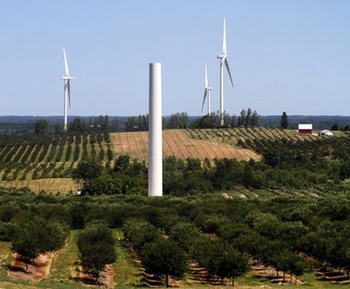
Ecology is still good. European companies seeking by all means to implement giant wind (we approach the 200 m high) in the French countryside, close to the houses. It is clear that wind turbines do not have anything green with the thousands of tons of concrete needed to support these steel monsters; about the energy, it is far from the account feedback from those already established.

My concern, as a physician and member of the European Association Physicians for a healthier environment being created, focus on health. A report by the National Academy of Medicine, published in 2006, concluded that the need to suspend (or prohibit) the construction of wind turbines with a capacity greater than 2.5 megawatts located within 1500 meters of housing. These are actually real industrial plants inducing nuisance, including noise.

Industrial wind turbines are in fact classified as ICPE: installations and plants that generate risks or dangers. Several scientific studies are being published, the results recommend that wind turbines are not located within 2.5 kilometers of homes. Thus, clinical observations of Dr. Michael Nissenbaum two wind farms in the state of Maine to the United States indicate that there is a correlation between the distance residential wind turbines and health problems for residents.

The responsibility of prefects engaged

A number of doctors have already identified multiple health problems related to ownership with these industrial machines. A medically defined the “wind syndrome” which includes increasing headache (noise and turbulence as triggers of migraines), ringing in the ears like tinnitus, sleep disorders, an increase of anxiety and depressive disorders, sometimes the appearance as Dr. Jean-François FERRIEU of “nausea, dizziness, palpitations, all of these chronic conditions can promote authentic depressions” said.

This dimension is not taken into account, or insufficiently, by the government, probably through lack of information. During this time, various local businesses, which more often then sell the exploitation rights to legally well structured international companies continue to put pressure on municipalities to accelerate Starts at times 500 meters of housing, wind farms, as they are never isolated wind turbines are located but the groups multiplied effects. The responsibility of prefects is committed to this day, since it is they who issue building permits.

Gel ongoing projects

On the evidence currently available, it would seem sensible in principle of responsibility to recommend minimum distances of 5 km between industrial wind turbines and homes. Ideally, it would be desirable to freeze all ongoing projects now and deepen health dimension not induce new diseases on a large scale.

It may also come to the conclusion that, for the health of humans and animals such as birds, farm animals or bats, precious “insecticides” natural which have been the subject of a report of the American Academy of Sciences (PNAS, September 29, 2014), it is sufficient to ban industrial wind turbines on land.

As noted by Nicolas Hulot , “initially, wind energy is a great idea, but upon arrival, it is a tragic realization. If we were told that at least it would close plants, but this is not the case. ”

Corruption and Collusion….Pillars of the Faux-Green Blob!

EXPOSED: How a shadowy network funded by foreign millions is making our household energy bills soar – for a low-carbon Britain

  • Shadowy pro-green lobbyists working at every level of the Establishment
  • Organisations are channelling tens of millions of pounds into green policies
  • Elite lobby group linked to Friends of the Earth, Greenpeace and the WWF
  • Current energy policies shaped by the Green Blob will cost up to £400billion
  • If continued, there will be further eye-watering energy bill rises for Britons
The 'Green Blob', a phrase first coined by former Environment Secretary Owen Paterson, is a group of pro-green lobbyists working at every level of the British Establishment

The ‘Green Blob’, a phrase first coined by former Environment Secretary Owen Paterson, is a group of pro-green lobbyists working at every level of the British Establishment

The Mail on Sunday today exposes how a ‘Green Blob’ financed by a shadowy group of hugely wealthy foreign donors is driving Britain towards economically ruinous eco targets.

The phrase the ‘Green Blob’ was coined by former Environment Secretary Owen Paterson after he was sacked from the Cabinet in July.

He was referring to a network of pro-green lobbyists working at every level of the British Establishment, who have helped shape the eco policies sending household energy bills soaring.

But investigations by this newspaper reveal the Blob is not just an abstract concept.

We have found that innocuous-sounding bodies such as the Dutch National Postcode Lottery, the American William and Flora Hewlett Foundation and the Swiss Oak Foundation are channelling tens of millions of pounds each year to climate change lobbyists in Britain, including Greenpeace and Friends of the Earth.

They have publicly congratulated themselves on their ability to create green Government policy in the UK – most notably after Ed Miliband steered through aggressive CO2 reduction targets in his 2008 Climate Change Act, and announced there would be no more coal power stations.

Yet the consequences of their continuing success are certain: further eye-watering rises in energy costs for millions of Britons and an increasing risk of blackouts.

According to leading energy analyst Peter Atherton of Liberum Capital, current UK energy policies shaped by the Blob will cost between £360 billion and £400 billion to implement by 2030. He said this will see bills rise by at least a third in real terms – on top of the increases already seen over the past ten years.

This bill dwarfs the EU’s £1.7 billion demand from Britain last week.

Scroll down for video 

Lobbying by the Blob helped lead to a new European Union emissions deal announced on Friday, when EU leaders including the Prime Minister agreed to triple the current pace of emissions cuts.

Following earlier deals, EU-wide emissions of CO2 are supposed to fall 20 per cent over the 30-year period 1990 to 2020.

Under the new agreement, this reduction must be doubled in just a decade, reaching ‘at least’ 40 per cent by 2030 – a goal that could only be accomplished through further massive investment in wind and nuclear energy.

At the heart of the Blob is a single institution – the European Climate Foundation (ECF) – which has offices in London, Brussels, The Hague, Berlin and Warsaw.

Every year it receives about £20 million from ‘philanthropic’ foundations in America, Holland and Switzerland, and channels most of it to green campaign and lobby groups.

Overview of the EU’s climate and energy policy architecture

An investigation has found the 'Green Blob' is working at every level of the British Establishment and Westminster (pictured)

An investigation has found the ‘Green Blob’ is working at every level of the British Establishment and Westminster (pictured)

It refuses to disclose how much it gives to each recipient, and does not publish its accounts. But it admits that the purpose of these grants is to influence British and EU climate and energy policy across a broad front.

Many more millions are fed directly to British and European lobby groups from the same overseas foundations which also fund ECF.

In its last annual report, ECF said working towards a 2030 deal was ‘a big focus area for ECF as a whole’.

ECF managing director Tom Brookes told The Mail on Sunday he provides ‘a fact-base’ to help policy-makers make the ‘many complex decisions that are necessary to move towards a high-innovation, prosperous and low-carbon future’. He added: ‘The UK is a leader in many of these fields.’

The Blob and Red Ed

Friday’s EU deal contains a get-out clause: if the rest of the world fails to agree a binding global emissions treaty at a UN conference in Paris next year, then Europe’s targets can be ‘reviewed’ – or in other words, abandoned.

Giants such as China, India and Australia have insisted they will not sign such a treaty. It is also unlikely to be approved by the US Congress, which is Republican-controlled.

However, thanks to Ed Miliband and his 2008 Climate Change Act, the get-out will make no difference for Britain. The UK is the only country which already has a binding target for 2050. By then, the law says, UK emissions must be 80 per cent down on 1990.

Mr Miliband’s Act also created a mechanism for ensuring the country sticks to a path that achieves this target – the so-called ‘carbon budget’. The scale of the challenge that its latest version poses is not widely realised.

Over the next 15 years, the electricity industry has to cut the CO2 it emits for every kilowatt it generates by 90 per cent – an unprecedented transformation.

An EU deal contains a climate change get-out clause - but thanks to Miliband's 2008 Climate Change Act - this makes no difference to Britain

An EU deal contains a climate change get-out clause – but thanks to Miliband’s 2008 Climate Change Act – this makes no difference to Britain

But the carbon budget also means the total amount of power generating capacity has to more than double. In order to meet the 2050 target, there has to be a massive shift towards electric vehicles and heating. While fossil fuel power plants will close, both their replacements and this vast additional capacity will have to be wind or nuclear – by far the most expensive types of power.

Remarkably, green lobby group Friends of the Earth not only conceived the Climate Change Act, but Bryony Worthington, the FoE official who came up with the idea and lobbied MPs to support it, later actually drafted it.

‘When you’re on the outside lobbying, you kind of hope that you are going to have an impact, [but] you’re never really very sure,’ she told a green seminar three years ago.

But she hit the jackpot. Her proposal was taken up first by the new Tory leader, David Cameron, and followed by the then-Labour Government. Worthington, who was seconded into the civil service, was asked to rewrite her lobbyist’s memo, this time as a law.

Once it was safely on the statute book, she left the civil service to form a new green campaign group, Sandbag, which presses the Government to adopt more stringent forms of carbon taxes. Like her previous employer FoE, it is now funded by ECF. Ed Miliband made her a Labour peer in 2011.

While the Act was going through Parliament, the ECF, which was launched in 2007-8, was giving money to Greenpeace UK, FoE, Christian Aid and the WWF to mount a campaign against coal-fired power plants. Also funded was Client Earth, a group of lawyers who secured court acquittals for ‘direct action’ protesters who broke into the Kingsnorth plant in Kent, climbed its chimneys and occupied it.

The campaign persuaded Mr Miliband to announce the cancellation of a planned new generating unit at Kingsnorth – and that there would be no new coal plants built in Britain.

Afterwards, the ECF president, Jules Kortenhorst, boasted that Miliband had acted in response to ‘a complex, multifaceted effort over a year and a half, with grass-roots mobilisation campaigns [and] behind the scenes lobbying’.

He added: ‘All of this work, backed by substantial philanthropic investment, resulted in UK Climate Change Secretary Ed Miliband announcing that no new coal-fired power plants would be built… This is an example of a policy that can be replicated, increasing its impact.’

Follow the money

The most significant source for the ECF’s millions is a body called Climate Works – a private foundation which channels colossal sums to climate campaigners worldwide.

The Climate Works manifesto was set out in 2007 in a document entitled ‘Design to Win: Philanthropy’s Role in the Fight Against Global Warming’. It said that to be effective, a campaign to change government policies on energy and emissions would need at least $600 million from donors.

Generous grants have been given to campaigners in countries such as Britain who have detailed knowledge of their local political systems. Their brief is to 'promote renewables and low emission alternatives'. Pictured is Drax  Power Station near Selby

Generous grants have been given to campaigners in countries such as Britain who have detailed knowledge of their local political systems. Their brief is to ‘promote renewables and low emission alternatives’. Pictured is Drax Power Station near Selby

It was driven by the belief that without radical action, ‘we could lose the fight against global warming over the next ten years’.

It advocated the giving of generous grants to local campaigners in countries such as Britain who had detailed knowledge of the way their political systems operated.

As well as better energy efficiency, carbon taxes and emissions caps, they must ‘promote renewables and low emission alternatives’. Utility companies must be given ‘financial incentives’ – in other words, enormous subsidies from tax and bill payers – to make this happen.

Climate Works soon achieved its ambitious fundraising target, with a grant in 2008 of $500 million from the William and Flora Hewlett Foundation, which spends the fortune amassed by the co-founder of the Hewlett-Packard computer firm. This was followed by further grants of up to $100 million, and donations of $60 million from the sister Packard foundation. In July, a report by a US Senate committee named the Hewlett foundation as a key element in a ‘billionaires’ club’ which effectively controlled the environmental movement, pumping more than half a billion dollars a year into green groups around the world.

It claimed these ‘wealthy liberals fully exploit the benefits of a generous tax code meant to promote genuine philanthropy and charitable acts’, but instead were transferring money to ‘activists’ to ‘promote shared political goals’.

One of the US-based Climate Works’s first acts was to set up and fund ECF as its European regional office. All ECF’s main funders are represented on ECF’s board, including Charlotte Pera, who is also Climate Works’s CEO. Susan Bell, ECF’s vice-chairman, was formerly the Hewlett foundation’s vice-president.

Another director is Kate Hampton, an executive director at the Children’s Investment Fund, a UK charity with assets worth £324 million.Others come from finance and business. ECF’s chairman is Caio Koch-Weser, vice-chairman of Deutsche Bank, whose contacts in Brussels could not be better: from 2003–5, he chaired the EU’s Economic and Financial committee. Yet another director is Mary Robinson, the former president of Ireland.

No transparency 

It is hard to assess the ECF’s full impact for a simple reason – although it publishes the names of some of the organisations it funds, it does not state how much it gives, nor exactly how this money is used.

The ECF’s Tom Brookes said: ‘The projects we fund all fall within the overall mission of the Foundation to support the development of a prosperous low-carbon economy in Europe.’

He would not explain why no amounts were stated, saying only that ECF’s annual report ‘describes the objectives of each ECF programme area and its significant grantees.

‘We are confident that this is a sufficient level of detail to provide insight into the work of the Foundation… Our policy on the information we publish reflects our responsibilities to our grantees and donors.’

Nevertheless, it is clear from the information that is available that the list of ECF funding recipients is a Who’s Who of the green movement, including Friends of the Earth, Greenpeace, the WWF, Client Earth, Carbon Brief, the Green Alliance, and E3G, the elite lobby group that persuaded the Government to set up the £3 billion Green Investment Bank.

The 2013 ECF report sets out its priorities for Britain, praising its ‘leadership on the climate front’ – thanks to the Climate Change Act.

It also boasts that its grants had an impact on this year’s Energy Act: ‘ECF grantees such as Green Alliance, E3G, and Greenpeace helped secure important milestones such as an emissions performance standard for new power stations.’

The 2013 ECF report boasts of gains made in emissions performance standards for new power stations. File image used

The 2013 ECF report boasts of gains made in emissions performance standards for new power stations. File image used

To ECF’s dismay, however, the supposed UK ‘consensus’ on climate and energy is now in jeopardy: ‘Household energy bills have shot to the top of the political agenda, and progress on decarbonisation is tangled in competing visions of the country’s energy future… A growing number of media and political voices are casting doubt on the climate science and the economic case for action.’

Against this opposition, ECF’s 2013 report says it intends to work with British greens to ‘rebuild confidence in the low-carbon transition’, by ‘fact-checking the UK media’s coverage of climate and energy issues’.

It says it will ‘establish a new unit that will promote evidence-based discussions in the media and mobilise authoritative voices on the low-carbon economy’.

Since the report was published, this unit has come into being, run by former BBC environment correspondent Richard Black. How effective it will be remains to be seen.

Meanwhile, it is clear that the sheer scale of this lavishly funded lobbying effort dwarfs that of its opponents.

The Global Warming Policy Forum in London, Europe’s only think-tank which is sceptical about climate science and energy policy, has an annual budget of £300,000 and employs just three people.

Its director, Dr Benny Peiser, said yesterday: ‘At the end of the day, someone will have to be held accountable for us committing economic suicide. We are the only organisation that does what we do – against hundreds on the other side, all saying the same thing.’

People Fed Up With Climate Change Scam…Reality is Gaining Popularity!

The age of climate alarmism is coming to an end

JIM LAKELY| OCTOBER 19, 2013 | 12:00 AM

You can be forgiven for not noticing that the United Nations’ Intergovernmental Panel on Climate Change released a summary of its Fifth Assessment Report late last month.

The report landed with a thud, criticized and even mocked by many leading climate scientists. The distinguished science journal Nature editorialized that this should be the last report issued by the UN body.

This is just the latest signal that the age of climate alarmism is over. Given five tries to convince the world that human activity is causing catastrophic warming of the planet, runaway sea-level rise and various weather disasters, the public still doesn’t buy it.

We’re all skeptics now because the science simply does not back up the hypothesis. For starters, there’s been no rise in global temperatures for 15 years.

The IPCC’s Fifth Assessment Report concedes for the first time that global temperatures have not risen since 1998, despite a 7 percent rise in carbon dioxide (CO2) emissions.

To put that into perspective, global human CO2 emissions in the last 15 years represent about one-third of all human CO2 emissions since the start of the Industrial Revolution, and yet temperatures didn’t budge.

Nearly all of the UN-approved climate computer models were wrong. The IPCC finally admitted as much.

The IPCC also admits that the “hockey stick” it used to feature in past reports wasn’t accurate. Penn State professor Michael Mann has been dining out for years on his infamous “hockey stick,” a dread graph featured by Al Gore in his Oscar-winning documentary “An Inconvenient Truth.”

The graph looked so dramatic — like a hockey stick — only because it ignored the Medieval Warm Period, a time about a thousand years ago when temperatures were warmer than today — when wine grapes grew in England and Greenland was green.

The “hockey stick” is missing from the Fifth Assessment Report, and the IPCC admits the Medieval Warm Period was warmer and more global than it claimed in the past.

A third major admission by the IPCC: No increases in droughts, hurricanes, typhoons and other extreme weather. Every time severe weather hits the United States, you could count on IPCC-related scientists, professional climate alarmists and the media to attribute it all to man-made global warming. No more.

The latest IPCC report admits to having “low confidence” in predictions of more frequent or more extreme droughts and tropical cyclones.

While the IPCC is taking its lumps for being wrong on these and other matters, a new kid on the block of climate science is taking a victory lap: The Nongovernmental International Panel on Climate Change released its own report, Climate Change Reconsidered II: Physical Science. Packed with 1,000 pages of peer-reviewed literature — and then peer-reviewed again by NIPCC’s team of some 50 scientists from around the world — Climate Change Reconsidered II comes to the conclusions the United Nations is only now and reluctantly admitting.

The NIPCC report concludes that human impact on climate is very modest, especially when compared to natural cycles. Future warming due to human greenhouse gases is likely to be only 1-2 degrees Celsius, and be a boon for flora and fauna alike.

Higher levels of carbon dioxide will not cause weather to become more extreme, seas level rise isn’t accelerating and polar ice caps aren’t melting at alarming rates.

Global warming isn’t the crisis many people said it was a few years ago. That’s bad news for the IPCC and the many environmental groups and politicians that hooked their wagon to it. But it’s good news for the rest of us.

Jim Lakely (jlakely@heartland.org) is director of communications at The Heartland Institute, which published Climate Change Reconsidered II: Physical Science on behalf of the Nongovernmental International Panel on Climate Change. For more information, visit ClimateChangeReconsidered.org.

Unaffordable, Unreliable, Impractical, Unwanted Wind Turbines

October 23, 2014

Of the 10 states most reliant on wind power, nine of them have seen their electricity prices rise at least five times faster than the national average, writes James Taylor, senior fellow at the Heartland Institute. While wind advocates claim that wind power reduces costs, on-the-ground evidence suggests the opposite is true.

Taylor cites a recent report from the Texas Comptroller, which found that Texas were paying higher prices due to wind power, despite an overall drop in electricity prices. According to the report:

  • Not only is wind power more costly than traditional power, but it is unpredictable, as it only generates power when the wind blows. As a result, conventional power plants must stand ready to fill in when wind power fails, requiring additional output on short notice and making wind power far less efficient.
  • Electricity demand in Texas in Texas is at its highest on hot summer days; wind power is at its lowest production point on hot summer days.
  • Delivering wind power to residents requires the construction of new transmission lines, costing Texas households an average of $70 to $100 annually. Expanding the power grid further for more wind power will cost $2 billion in additional funds.

While Texas electricity prices have fallen, Taylor says the drop is due to deregulation and a fall in price of other energy sources. It is not, however, due to wind power, which has only slowed a drop in electricity prices.

Source: James M. Taylor, “Texas Comptroller Report Destroys Wind Industry Claims,” Heartland Institute, October 21, 2014.

MI Wind Turbine Lawsuit Settled….Operating out of Compliance!

aeinews.org


MI turbine suit settled; another lesson in operating too close to already-generous noise limits

Posted: 22 Oct 2014 03:22 PM PDT

MI Lake Winds under constructionFor the past couple of years the Lake Winds Energy Park in Mason County, Michigan has been embroiled in a contentious dispute about its noise levels (image to left is the “Park” under construction).  In April 2013, five months after the 56 turbines began operating, 17 neighbors filed suit, claiming that wind farm noise, vibrations and flickering lights were adversely affecting their health. After commissioning an independent sound study, the Mason County Planning Commission formally declared the wind farm out of compliance and demanded a mitigation plan; the developer, Consumers Energy, disputed the findings yet lost two appeals, one at the Zoning Board of Appeals and one in Circuit Court. During that series of challenges, Consumers developed a plan to modify turbine operations for 7 turbines closest to the four sites where they were found to be marginally too loud.

Marginal is indeed the word: the sound study found 4 locations where the sound level peaked at 0.3 to 1.2 decibels over the 45dBA noise limit (it takes 3dB for a difference between two sounds to be audible); when using 10-minute averages, there were no violations.  The various explanations by the consultant, Brian Howe, illustrated the fine line that the turbine operations were walking.  His report stressed “general compliance with sound level criteria,” and noted that the brief violations “do not represent a statistically significant portion of time and do not indicate a systemic exceedance.” In his initial testimony at an August Planning Commission meeting, he said that there are no recommendations to correct for these times because “there is not a situation where they are predictably going over 45.”  Later, in a November letter to the Commission, after learning that the county had previously decided NOT to allow for occasional exceedances, he stressed that “I can assure the County that competent, material and substantive evidence supports the conclusion that the turbines are not in compliance at certain residences on occasion” and elaborated:

Excursions over 45 dBA should have been anticipated since, as outlined in the acoustic study by Tech Environmental prepared in June 2011, the wind energy park was designed with sound levels identically equal to the 45 dBA criteria at some key receptors with no factor of safety to address the fact that the prediction methodology has a stated accuracy worse than +/- 3 dBA. If Tech Environmental was aware that achieving the criteria even 95% of the time was unacceptable to the County, it would have been prudent to incorporate a suitable safety margin to account for the statistical variation in sound levels.

And this the first half of the central lesson here: it’s essential that enough of a safety factor is built in to the sound models to account for known variability in sound production (how loud the blades are in various unsteady wind conditions) and sound propagation (how far sound travels as it gradually loses power).  Regular readers will know that variability is indeed, as Howe mentioned, often more than the simplified 3dB margin of error that was neglected here (see AEI’s 2012 report). The second half the lesson is related: when noise limits—for the sound of the turbines when it reaches nearby homes—are set as high as 45dBA, they will be regularly audible at these homes, and likely well above night-time ambient sound levels.  As many acousticians have stressed for years, these situations are very apt to trigger a significant number of complaints, especially if there are dozens of homes in that nearby range.  Here, we had the worst of both worlds: turbine siting plans that pushed sound right at the limit into nearby homes, and a limit that was on the high end of tolerability for many neighbors.  Indeed, after one such cautionary report was presented to the Mason County Planning Board, it decided to lower the limit to 40dB, but that change was revoked after push-back from Consumers Energy.

With this backdrop, this week the 17 original plaintiffs in the noise nuisance lawsuit agreed to a settlement offer from Consumers;
the financial and possible operational details are confidential (2 later additional litigants are yet to settle, but negotiations are ongoing).  While many such lawsuits languish, as it can be very hard to prove causality of health effects or to prove nuisance, it is always notable when a company decides it’s more advantageous to settle than to push through a court hearing (which was set to begin, with the jury already seated).  This is the latest of several such suits that were settled behind closed doors—other high profile compensation cases include Mars Hill, Maine and the Davis family in the UK, while property buy-outs of people who’ve either moved from their homes or become vocal about their issues are widespread, if not common, including a recent buy-out settlement with a family in Vermont, and purchases of multiple homes in Ontario’s Bruce and DufferinCounties.  It’s unfortunate that confidentiality clauses leave the rest of us in the dark, for one of the ways forward is for the wind industry to more willingly compensate those most impacted by their operations, and these cases could offer some guidance as to what level of compensation may be mutually agreeable.

Meanwhile, to the best of my knowledge, Consumers Energy’s challenge to the Mason County demand for mitigation is ongoing; the latest report I’ve found is that the company filed an appeal in July after its loss in Circuit Court.  The implications of how that plays out could be far-reaching.  The challenge consists of two related technical points: whether instantaneous exceedances should be considered violations, and  whether unattended sound monitoring can reliably identify violations. The latter question gets down into the technical weeds, including accounting for the presence of other ambient noise as well as turbine sounds, and the choice of measurement metric (L90 or Leq, as well as strict adherence to other sound measurement standards identified in the ordinance, which, like many local ordinances, is not necessarily savvy about all the implications and options for measurement).  As reported by Michigan Capital Confidential, a good source for coverage of this issue:

Arguing that the County’s decision was an “erroneous ruling,” the utility filed a 38-page appeal with the Michigan Court of Appeals on July 18. In addition, Consumers Energy is saying that if the ruling by 51st Circuit Court Judge Richard Cooper were allowed to stand, it could have an impact on many other wind turbine plants across the state.

“This has implications beyond just Mason County,” Dennis Marvin, spokesman for Consumers Energy told Capitol Confidential. “We believe the study the county based its decision on was flawed. We took this decision (to appeal) very seriously, but ultimately our legal staff determined this was in the best interest of our customers and the landowners at the wind park.”

Rick James, of East Lansing-based E-Coustic Solutions, is an acoustician specializing in the production, control, transmission, reception and effects of sound. According to James, Consumers Energy is not exaggerating when it talks about the potential impact of the Lake Winds case.

“Consumers’ appeal has less to do with the supposed 1 decibel error, the topic of the appeal, and more to do with the wind industry’s broader concerns,” James said. “A decision by the Appeals Court in favor of Mason County would make it easier for other counties and townships with wind energy utility noise regulations to prove non-compliance.”

“Consumers would have been better advised if they had not accepted the conclusions of their acoustical consultant that the proposed project could be fit into the host community without causing problems,” James continued.

Owen Paterson No Longer Silent. Willing to Tell the Truth About the Faux-Green Scam!!!

A Green Mess

With the Right of the Tory party mutinous, and clear signs that the Conservatives’ support in their rural hinterland is drifting away, the decision by David Cameron to fire environment minister Owen Paterson, a leading figure on the Conservative right who also appeared to “get “ the countryside, earlier this year made little political sense.

Predictably enough, Paterson has taken advantage of the freedom that his firing has brought him, proclaiming a series of inconvenient truths about Britain’s environmental policy and, for that matter, environmental-policy-making.

EUReferendum’s Richard North discusses this here and here at some length, noting Paterson’s opposition to the wind turbines that are so loathed in the countryside:

In the Global Warming Policy Foundation lecture on Wednesday, Mr Paterson said of wind farms that “this paltry supply of onshore wind, nowhere near enough to hit the 2050 targets, has devastated landscapes, blighted views, divided communities, killed eagles” . . .

He went on to say that wind turbines had devastated ‘the very wilderness that the ‘green blob’ claims to love, with new access tracks cut deep into peat, boosted production of carbon-intensive cement, and driven up fuel poverty, while richly rewarding landowners”.

This, Mr Paterson also said, is “the single most regressive policy we have seen in this country since the Sheriff of Nottingham” . . .

North continues:

Readers here do not need to rehearse Mr Paterson’s arguments, but it can never be said too many times that the current energy policy is unattainable – and at a cost of £1.3 trillion, which is roughly the size of the national debt….

We hear quite a bit — and rightly so — about what the current Conservative-led coalition has done to fix the British economy, but the ever-increasing costs of its climate-change policy ought not to be left out of the equation.

Back to North:

Even if Britain and the whole of the EU were to stick to our emissions targets (which we surely won’t), and to hit them (which, actually, we can’t), we would still not come anywhere close to what we are told is needed to save the planet. This is for a very simple reason: the rest of the world won’t do it. Last year, carbon emissions per head in China exceeded those of Britain for the first time, and China has more than 20 times as many heads as we do. The EU is responsible for less than 10 percent of global emissions, so when we set our targets we knew – and said – that we were in no position to stop global warming. The point was to set a lead which others would follow.

They haven’t…

Isn’t it rather extraordinary, [British journalist Charles] Moore concludes, that no mainstream party has dared to point any of this out? Don’t they know there’s an election on? Is it surprising that voters think: “They’re all the same?”

When it comes to orthodoxies of contemporary environmentalism there’s quite a bit to that: There’s a reason that UKIP is winning the support that it is.

Britts Will Suffer, Because of The Insane Energy Practices of their Government!

Brits Belted by Insanely Expensive and Utterly Unreliable Wind Power

ed-davey_885751c

Britain’s political betters have set it up for one enormous gamble.  Britain is wagering its entire economic future on its – out of control – wind power boondoggle.

Back in January, The Economist reported on the INSANE cost of delivering offshore wind power – where generators are guaranteed obscene returns – being able to charge “three times the current wholesale price of electricity and about 60% more than is promised to onshore turbines.”

The Economist reported that “offshore wind power is staggeringly expensive” and “among the most expensive ways of marginally reducing carbon emissions known to man”.  But that is merely to compare the insane costs of onshore wind power with the completely insane costs of offshore wind power (see our post here).

Now Britain’s House of Lords has weighed in with an inquiry into their runaway wind power policy – a policy which promises to not only put them in the poor house, but to leave them in the dark. Here’s the Daily Express with the latest on Britain’s wind power debacle.

UK’s wind farm ‘folly’: Electric bills to soar by £1000 thanks to reliance on wind power
Daily Express
John Ingham
15 October 2014

HOUSEHOLDERS are facing soaring energy bills and winter power cuts thanks to the “folly” of relying on wind power, experts said last night.

The green crusade of successive governments is set to double electricity bills for households and cost homes £26billion a year by 2030, it was claimed yesterday.

The cost of renewable energy and carbon taxes will put an extra £983 a year on household bills by then, compared to relying on a mix of nuclear and new gas-fired power stations, three experts told a Lords committee.

They also said the “foolhardy” green policy will do little to cut emissions of the greenhouse gases blamed for global warming.

The Scientific Alliance report highlights warnings by the regulator Ofgem that the margin for electricity production for the 2015-16 winter will be at an all-time low of 2 per cent compared to the pre-privatisation requirement of at least 20 per cent.

It means that in times of high demand, such as during very cold weather, Britain would be at risk of power cuts.

The alliance argues that wind power – which is the main renewable energy source depended on by Government – is unreliable.

One of the experts, Sir Donald Miller, former chairman of Scottish Power, said: “The blind reliance by successive governments on unreliable, intermittent renewable energy has reduced the margin of safety to a critical level.

“This has brought the country to a position where power cuts could become a regular feature of cold winters for several years.”

The written report has been submitted to the Lords Science and Technology Committee’s inquiry into the nation’s electricity infrastructure.

At the inquiry’s launch its chairman, the Earl of Selborne, said: “We are set to see our safety cushion between demand and supply drop to particularly low levels over the next two winters.”

And yesterday’s report stated: “The foolhardy policy of replacing reliable and efficient gas, nuclear and coal power stations by expensive and inefficient wind turbines and solar farms has raised energy prices while doing little to cut emissions of carbon dioxide.

“The total costs are some £12billion per year more in 2020 than an optimum programme of gas turbines and nuclear, and almost £26billion per year more by 2030.”

The alliance calls for new nuclear power plants to help plug shortfalls caused by the closure of ageing coal-fuelled power stations and rising demand.

The report was released as former Environment Secretary Owen Paterson prepares to deliver a lecture tonight urging the Government to stand up to green bullies and go nuclear.

Last night Dr Benny Peiser of the Global Warming Policy Forum said: “The irony is that energy prices around the world are falling, particularly for oil and gas. But households are not profiting because Government policies are making energy more expensive.”

The wind energy body RenewableUK said the study was “out of line” with other research.

The Department of Energy and Climate Change said onshore wind is cheaper than coal, gas or nuclear energy when the costs of factors like air quality, toxicity and climate change are taken into account.

“Our policies are designed to keep the lights on, cut energy use and reduce polluting emissions, at the lowest possible cost to gas and electricity customers.”
Daily Express

Predictably deluded ramblings coming from RenewableUK and the Department of Energy and Climate Change. We’d love to see the evidence to support the story about wind power reducing CO2 emissions.

DECC’s wild claims about wind power reducing “polluting emissions, at the lowest possible cost” is, well, nothing more than hot air.

Nowhere in the world has the wind industry produced a shred of evidence to support its – long on emotion and short on facts – claims about cutting emissions in the electricity sector. Probably because all of the evidence that’s been properly gathered points in the opposite direction – ie, that trying to incorporate wildly intermittent wind power into a gas and coal-fired grid results in an increase in CO2 emissions (seeour post here).

If DECC was serious about reducing CO2 emissions in the electricity sector, it would be pushing for massive investment in nuclear power plants: nuclear power plants, which run at about 90% of capacity, avoid almost four times as much CO2 per unit of capacity as do wind turbines, which run at about 25% (although they can’t tell you just which 25% of the time that might be) and at a fraction of the cost (see our post here).

As DECC says it’s all about reducing “pollution” (although we’re pretty sure they’re talking about CO2 gas – an odourless, colourless, beneficial trace gas essential for life on earth – plants are lapping it up, right now) – but their perverted ideology means they can’t see the gas for the trees.

STT has long held the view that if governments were seriously committed to reducing CO2 emissions to avert “climate change” (formerly known as “global warming”), they would have started building nuclear power plants at a cracking pace 20 years ago, when the alarmists started wailing “climate catastrophe” at every available opportunity.

But, no. Instead they’ve redirected $billions of subsidies to wind power outfits – filched from unwitting taxpayers and power consumers – to support a “technology” that will never be any kind of sensible alternative to anything (unless freezing or boiling in the dark are your kind of thing) – let alone a substitute for coal, gas, hydro or nuclear power (see our post here).

Luckily for Brits, the House of Lord’s inquiry is being presented with some of these (unavoidable) facts about the cost and pointlessness of wind power.

As the second leg of a ripping “Daily Double”, here’s the Editor.

Costly, ineffective and ugly: It is time to confront wind power
Daily Express
15 October 2014

ENERGY sources should be cheap and reliable but wind power is neither.

A Lords committee was told by energy experts yesterday that our “foolhardy” reliance on wind energy will double electricity bills for households by 2030 so it cannot be considered cheap.

And because they do not work when there is too much or too little wind they cannot be considered reliable.

The experts say this unreliability has left us at risk of power cuts.

In fact wind power does not even have a significant impact on reducing greenhouse gas emissions.

Due to their extreme unreliability, conventional power stations have to be kept on standby, burning coal or oil all the while to make up for when wind turbines are out of action.

Hitting us in the pocket may be bad enough but wind farms have also ruined huge swathes of our most picturesque countryside as well as being deafeningly loud and presenting a significant danger to various forms of wildlife.

These facts mean nothing to the green lobby who will continue to forcefully oppose shale gas exploration and the building of nuclear power plants even though these sources could provide us with reliable energy at a fraction of the cost of wind power.

The Government needs to stand up to environmentalists, stop listening to their misleading claims and start putting our energy security first.
Daily Express

Hear, hear!!

house of lords

Nothing Good About wind Turbines….Inefficient, Unreliable & Unaffordable.

Ex-minister attacks green obession at heart of Whitehall: Owen Paterson accuses ministers of raising energy prices for the poor

  • Former Environment Secretary said support for flawed wind and solar power cost billions and made electricity and gas needlessly expensive
  • He called on Whitehall to was to scrap the Climate Change Act
  • Warned claims of impending environmental disaster were ‘exaggerated’
Owen Paterson said  support for flawed wind and solar power cost billions and made electricity and gas needlessly expensive

Owen Paterson said  support for flawed wind and solar power cost billions and made electricity and gas needlessly expensive

The former Environment Secretary attacked a so-called ‘green blob’ at the heart of Government yesterday – accusing Whitehall officials and ministers of raising energy prices for the poor.

Owen Paterson said their support for flawed wind and solar power cost billions and made electricity and gas needlessly expensive.

He said the ‘green blob’ included civil servants and quangos in thrall to the climate change and environmental lobby. He claimed it had blocked him from prioritising shale gas exploration as a more efficient way to secure energy for the future.

Mr Paterson, who was removed as Environment Secretary in July, said the only way to ‘keep the lights on’ was to scrap the Climate Change Act, which requires the UK to use more renewable energy and is backed by civil servants.

He warned claims of impending environmental disaster were ‘widely exaggerated’, and accused a series of energy secretaries – including the Lib Dem incumbent Ed Davey – of being ‘Sheriffs of Nottingham’ by taking from the poor.

He said: ‘It amazes me that our last three energy secretaries, Ed Miliband, Chris Huhne and Ed Davey, have merrily presided over the single most regressive policy we have seen in this country since the Sheriff of Nottingham: the coerced increase of electricity bills for people on low incomes to pay huge subsidies to wealthy landowners and rich investors.’

The former minister also said he was disgusted by rich film stars who fly to Africa to preach against the burning of fossil fuels there. His reference to the ‘green blob’ follows former Education Secretary Michael Gove’s description of the teaching establishment as the ‘blob’.

Read more: http://www.dailymail.co.uk/news/article-2794803/ex-minister-attacks-green-obession-heart-whitehall-owen-paterson-accuses-ministers-raising-energy-prices-poor.html#ixzz3GGxIjatq
Follow us: @MailOnline on Twitter | DailyMail on Facebook

In Spite of Propaganda, Bribes, and Outright Lies, Wind’s Favourability is dying!

Commentary by Mark Whitworth, Executive Director of 

Energize Vermont.

Big Wind has a big public relations problem. A new WCAX poll shows public support for wind plummeting from 66 percent in 2013 to 50 percent now.

Wind developers may search for clues about this reversal of fortune in a UVM honors undergraduate thesis written by Neil Brandt. Mr. Brandt says that media coverage of ridgeline wind in Vermont dropped in favorability from 47 percent in 2003 to a measly 26 percent in 2012.

One of Gov. Shumlin’s aides didn’t need a university study to see this: “We are losing the water cooler debate about wind.” This may be why the governor’s talk of renewable energy now emphasizes solar, not wind.

(Of course, if Mr. Brandt were to conduct a similar study of solar, he’d find that poor siting choices are creating a backlash against solar that’s reflected in the state’s media. How long before that shows up in statewide polls?)

In carrying out his ridgeline wind study, Brandt collected 10 years’ worth of relevant news stories from the Caledonian Record, Burlington Free Press and the Associated Press’ Vermont bureau. He broke each of the stories down into individual statements and classified each statement in a variety of ways: who made the statement, what issue it addressed, and did it support or oppose wind.

He identified trends in Big Wind’s media messaging as well as trends in public attitudes.

For example, between 2003 and 2012, Big Wind stopped emphasizing energy independence. The argument must not have been working. Were Vermonters skeptical of the claim that small amounts of electricity produced at random times would make them independent? Was it David Blittersdorf’s pronouncement that he needed 200 miles of ridgeline wind in Vermont?

Brandt says that local economic gain was once the dominant pro-wind theme. Not anymore. Now we know that the wind jobs were temporary. And the good ones went to out-of-state specialists. Heck, even the driver that tipped over his tractor-trailer on his way to Lowell was a specialist from Texas. Any of my neighbors could have driven that truck off the road. I would have been proud to do it myself.

Brandt analyzed coverage of aesthetics. For years, Big Wind has tried to ridicule opponents by calling them NIMBYs (Not in My Back Yard) who selfishly imperil the planet in order to preserve scenery. Brandt dismisses the NIMBY characterization: “…local opposition to renewable energy development is multi-faceted and based on more than a knee-jerk NIMBY reaction.” Brandt says that aesthetics arguments were prevalent in 2003, but in 2012, only 12 percent of anti-wind statements related to aesthetics.

While aesthetics arguments were falling, human health arguments were rising. By 2012, 33 percent of anti-wind statements involved human health impacts. Interestingly, he found no statements about health impacts from state government. This is not surprising—both the governor and the Department of Health have been missing in action on wind’s health impacts. The department has met with neither turbine neighbors nor the doctors who treat them. But, that hasn’t deterred the department from announcing that negative health impacts result from bad attitudes and are thus the fault of the sufferers themselves.

Big Wind knows that their turbines create ill health because the U.S. Department of Energy told them so. A study conducted for the DoE from 1979 to 1985 investigated complaints of families living near a single 200-foot tall wind turbine. (Picture this pathetic little turbine amidst Lowell’s 459-footers.) The cause of the complaints was found to be infrasound.

Vermont turbines are not monitored for infrasound; only audible noise is monitored. And it’s not monitored continuously. Turbine operators can choose who does the monitoring; they only hire firms that will swear everything is ok. In Vermont, this is easy because the standards are so lax.

Big Wind uses audible noise as a red herring to divert attention away from infrasound. They compare turbine noise to rustling leaves. But neighbors describe turbine effects that cut right through rustling leaves — concussive, more felt than heard. That’s how it is with infrasound.

Brandt found that Big Wind has latched on to climate change in a big way and it now dominates their sales pitch.

Brandt found that Big Wind has latched on to climate change in a big way and it now dominates their sales pitch. It’s used in conjunction with a technique called “the fallacy of the excluded middle” – the oldest advertising gimmick in the book: Chew Clorets and have lots of fabulous lovers. Don’t chew Clorets and watch Gilligan’s Island — alone.

It’s the same technique that Texas Gov. Rick Perry uses to talk about immigration, terrorism, and Ebola.

Here’s how it goes: If we don’t convert our ridgelines into wind power plants, we’re going to get wiped out by another tropical storm Irene.

Whoa. This proposition excludes more than the middle:

1. We cannot reverse climate change just by reducing our carbon emissions.

2. Climate change or not, next big storm will come; industrializing our ridgelines will only worsen storm damage.

3. Healthy ridgelines are crucial for enabling climate adaptation and survival for a wide range of species. Our best response to climate change is to preserve essential wildlife habitat.

4. If we’re serious about reducing carbon emissions, we should first focus our limited resources on weatherization: bigger payoff, less cost, no environmental destruction, no disasters. No big money for Big Wind.

Do industrial wind turbines reduce carbon emissions? Can they even erase their own carbon footprints? During the last legislative session, one Senate committee entertained a bill that would have required developers to account for carbon emissions over the life of a wind project—from manufacture to decommissioning. Vermont’s leading faux-environmental group opposed the bill, calling it “anti-renewable.” I guess it wouldn’t serve the public interest to question industry propaganda.

Big Wind probably won’t just pack its bags and leave—there’s too much money to be made off Vermonters. The energy independence and economic growth arguments haven’t worked, so Big Wind will make its last stand in Vermont by turning up the heat on climate change.

Be on the lookout for the excluded middle — that’s where Big Wind hides its inconvenient truths.

Windweasels Using “Faux-green Shills”, to Scream for Subsidies….Useful Idiots!

The Wind Industry Pays “Green” Groups $millions to Chant for More Subsidies

Pied_Piper

A little while back, the good Senator from Victoria, John “Marshall” Madigan launched an Exocet missile at the seedy world of hard-green-left politics and the wind power outfits that fund the Australian Greens (seeour post here).

The Greens have been particularly coy about where the hundreds of thousands of dollars used to fund their last Federal election campaign (including the rerun of the West Australian Senate election) came from. The key beneficiaries of that fat pile of corporate cash have been lunatics like Sarah Hanson-Young, Senator from South Australia. Sarah set out to crush SA’s favourite Greek, Nick Xenophon but, in the result, she was lucky to sneak over the line herself. Nick (a true STT Champion) – who ran as an independent candidate – polled a snicker under 25% in the South Australian Senate race (beating the Labor Party’s vote of 22.7%) – an all-time record for an independent Senator.

But, we digress. Since the launch of Vestas’ “Act on Facts” campaign in June last year it was evident that the Greens “fortunes” had – mysteriously – improved (see this article and see our post here). Since then the Greens have been very keen to “sing” for their supper. Recently, it’s come to light that the billionaire founder of wotif.com, Graeme Wood has poured hundreds of thousands of dollars into the Green’s coffers. And, just like Vestas, is looking to use the Greens to advance his wind farm interests, proving that the Greens truly are the best party money can buy.

Paying $millions to so-called “green” politicians and astro-turfing propaganda outfits like the WWF (see our post here), Getup! and 350.org (see our post here) has become a central wind industry strategy: if you’re a foreign owned company worth $billions, with no political credibility and rolling in mountains of (other peoples’) cash, why not pay a bunch of slick little political manipulators to plead and beg to governments on your behalf?

It’s a strategy employed around the globe: the US providing just another example of the tangled web woven by wind industry rent-seekers. Here’s an American take on the mother of all scams.

Wind Cronies Funding Anti-GOP Attack Ads Through LCV: Seeking Tax Subsidies as Their Reward
Daily Surge
Roberto Escoban
8 October 2014

Republicans in targeted Senate races are finding themselves under attack from millions of dollars in attack ads from the League of Conservation Voters (LVC). Seen as anti-business, the LVC has a new ally that has opened their pocketbooks in a big way to support their efforts — the wind energy industry.

Wind power is inefficient, kills endangered birds at alarming rates and relies on taxpayer handouts and subsidies to survive. One of the subsidies is a tax credit that has been described as a “Wall Street wolf in green clothing.” Most of the tax benefits goes to big investors to offset tax liabilities on their other investments. Warren Buffet, for instance, admitted he invested in wind farms to lower his tax rates. “That’s the only reason to build them,” he said.

The tax credit expired in the last Congress but the Democrat Senate is prepared to renew it. That’s why the wind power industry has become tight allies with LCV. For instance, Tom Kiernan, the CEO of the American Wind Energy Association (AWEA) sits on the board of LCV and currently serves as Treasurer.

Peter Mandelstam also sits on the board of LCV. Mandelstam served for 13 years on the Board of American Wind Energy Association (AWEA) and chaired AWEA’s Offshore Group for 7 years. Mendelson even founded his own wind energy company, Green Sail Energy in 2012.

The incestuous relationship between wind power industry and the LCV doesn’t end there.

Theodore Roosevelt IV, the Managing Director at Barclays Capital for Investment Banking and Chairman of their CleanTech Initiative sits on the board of LCV too. Barcalys provided the financing for the Cape Wind offshore wind farm.

Flush with cash and the help of the cronies who rely on the tax credit to profit, LCV and AWEA have launched ads in the Iowa and Colorado Senate races attacking Republican candidates and supporting Democrat candidates eager to keep the flow of taxpayer funds moving to these enterprises.

It should be noted that when Tom Kiernan became the CEO of the American Wind Energy Association (AWEA) saying he wanted to strengthen ties between conservationists and the business community.

Kiernan wrote in The Huffington Post, “For my entire career, I’ve sought to strengthen the ties between conservation and the American business community, because a strong environment and a strong economy go hand in hand. Wind power has enormous potential to reduce humanity’s overall footprint on the environment and the planet.”

Kiernan does not talk about how LCV has become a front for the corporate effort to extend a tax benefit that does little to help the environment and a lot to help Wall Street investors pocket more money. AWEA’s top priority is “keeping the production tax credit” because “the political climate in Washington is getting tougher.” He has spent nearly $3 million so far lobbying to get the job done.

If you live in a state with a targeted Senate seat and see one of these LCV attack ads, it would be prudent to remember the cronies priming the pump to put these ads on the air.
Daily Surge

dirtyrottenscoundrelsoriginal

Frauds, Crooks and Criminals

Demonstrating daily that diversity is not strength!

Family Hype

All Things Related To The Family

DeFrock

defrock.org's principal concern is the environmental and human damage of industrial wind turbines on rural communities

Gerold's Blog

The truth shall set you free but first it will make you miserable

Politisite

Breaking Political News, Election Results, Commentary and Analysis

Canadian Common Sense

Canadian Common Sense - A Unique Perspective from Grassroots Canadians

Falmouth's Firetower Wind

a wind energy debacle

The Law is my Oyster

The Law and its Place in Society

Illinois Leaks

Edgar County Watchdogs

stubbornlyme.

My thoughts...my life...my own way.

Oppose! Swanton Wind

Proposed Wind Project on Rocky Ridge

Climate Audit

by Steve McIntyre

4TimesAYear's Blog

Trying to stop climate change is like trying to stop the seasons from changing. We don't control the climate; IT controls US.

Wolsten

Wandering Words

Patti Kellar

WIND WARRIOR

John Coleman's Blog

Global Warming/Climate Change is not a problem