Renewable Energy Targets Force Consumers to Use Inefficient, Unreliable, Overpriced Products!

The crazy world of Renewable Energy Targets

Nothing makes sense about Renewable Energy Targets, except at a “Bumper-Sticker” level. Today the AFR front page suggests* the federal government is shifting to remove the scheme (by closing it to new entrants) rather than just scaling it back. It can’t come a day too soon. Right now, the Greens who care about CO2 emissions should be cheering too. The scheme was designed to promote an  industry, not to cut CO2.

UPDATE: Mathias Cormann later says “that the government’s position was to “keep the renewable energy target in place” SMH.  Mixed messages indeed.

We’ve been sold the idea that if we subsidize “renewable” energy (which produces less CO2) we’d get a world with lower CO2 emissions. But it ain’t so. The fake “free” market in renewables does not remotely achieve what it was advertised to do — the perverse incentives make the RET good for increasing “renewables” but bad for reducing CO2, and, worse, the more wind power you have, the less CO2 you save. Coal fired electricity is so cheap that doing anything other than making it more efficient is a wildly expensive and inefficient way to reduce CO2. But the Greens hate coal more than they want to reduce carbon dioxide. The dilemma!

The RET scheme in Australian pays a subsidy to wind farms and solar installations. Below, Tom Quirk shows that this is effectively a carbon tax (but a lousy one), and it shifts supply — perversely taxing brown coal at $27/ton, black coal at $40/ton and gas at up to $100/ton. Because it’s applied to renewables rather than CO2 directly, it’s effectively a higher tax rate for the non-renewable but lower CO2 emitters.

Calculating the true cost of electricity is fiendishly difficult. “Levelized costs” is the simple idea that we can add up the entire lifecycle cost of each energy type, but it’s almost impossible to calculate meaningful numbers. Because wind power is fickle, yet electricity demand is most definitely not, the real cost of wind power is not just the construction, maintenance and final disposal, but also the cost of having a gas back-up or expensive battery (give-us-your-gold) storage. It’s just inefficient every which way. Coal and nuclear stations are cheaper when run constantly rather than in a stop-start fashion (just like your car is). So the cost of renewables also includes the cost of shifting these “base load” suppliers from efficient to inefficient use — and in the case of coal it means producing more CO2 for the same megawatts. South Australia is the most renewable-dependent state in mainland Australia, and it’s a basketcase (look at the cost stack below). Real costs only come with modeling, and we all know how difficult that is.

If the aim is really the research and development of renewables (and not “low CO2″) then I’ve long said that we should pay for the research and development directly, not pay companies to put up inefficient and fairly useless versions in the hope that companies might earn enough to pay for the research out of the profits. Tom Quirk points out that it’s all frightfully perverse again, because most innovations come from industry, not government funded research, but in Australia we hardly have any industry making parts used in power generation — we don’t have the teams of electrical engineers working on the problem anymore. I suppose the theory is that Chinese companies will profit from solar panels and do the R&D for us (keeping “our” patents too)? It would be cheaper just to gift them the money direct wouldn’t it — rather than pay an industry to produce and install a product that no one would buy, which doesn’t work, and hope that the “profits” translate into discoveries that will produce royalties and jobs for people overseas. I’m sure Chinese workers and entrepreneurs will be grateful. Yay.

Meanwhile, Green fans have suddenly discovered the idea of sovereign risk (where were they while the Rudd-Gillard team blitzed Australia’s reputation for stable, predictable policy?). According to the AFR, the government is scornful (and rightly so):

The government source said the market was oversupplied with energy and there was no longer any cause for a mandated use of any specific type of power. The source said while there would be investment losses if the RET was abolished, or even scaled back, investors “would have to have been blind to know this wasn’t coming’’.

On Catalaxy files, Judith Sloan mocks the Fin for pushing a press release from a rent-seeking firm, and guesses the Abbott government will be too “gutless” to ditch this economic and environmental dog of a policy.

—   Jo


Even Democrats Find Obama’s Climate Nonsense, Hard to Swallow!

LOL! Obama’s Climate Plan Spooks U.S. Democrats

Yesterday we mentioned Obama’s nuclear option event, and now the fallout begins. |

From Timothy Cama and Scott Wong, The Hill
keep-calm-and-run-for-your-life-66[1]President Obama’s election-year plan to win a new international climate change accord is making vulnerable Democrats nervous.

The administration is in talks at the United Nations about a deal that would seek to reduce global greenhouse gas emissions by “naming and shaming” governments that fail to take significant action.

The State Department on Wednesday denied a report in The New York Times that the plan is to come up with a treaty that would not require Senate confirmation, but that appeared to provide cold comfort to Democrats worried the issue will revive GOP cries about an imperial Obama presidency.

One Democratic strategist said the proposal would put swing-state candidates who are critical to the party keeping its Senate majority “in front of the firing squad.”

“You’re … making it more difficult for them to win and certainty putting them in a position to lose,” the strategist said.

Several vulnerable Senate Democrats kept mum on the issue.
 
Sens. Mark Begich (Alaska) and Mark Udall (Colo.), along with a handful of House Democrats, either declined to comment or didn’t respond to interview requests.
 
Senate Energy Committee Chairwoman Mary Landrieu (La.) cautiously signaled support for the oil and gas industry that is important to her state, without commenting on the plan to sidestep the Senate.
 
“It is important that all nations do what they can to reduce carbon in the atmosphere,” she said. “But the president should not take any action that undermines the American energy revolution currently underway that is creating thousands of high-paying jobs for middle class families in Louisiana and across the country.”
 
spokesman for Rep. Scott Peters (D-Calif.), who heads a House climate task force, said it was premature to comment on a plan with so few details.

Drew Hammill, a spokesman for House Minority Leader Nancy Pelosi (D-Calif.), who pushed a climate change bill through the House in 2009, said the Times story was inaccurate but had no further comment.

Other Democrats immediately distanced themselves from the proposal.

“This administration’s go it alone strategy is surely less about dysfunction in Congress than about the president’s own unwillingness to listen to our coal miners, steelworkers, farmers and working families,” Rep. Nick Rahall (W.Va.) said in a statement. Rahall is in a difficult reelection race.

Republicans in tight Senate contests, for their part, quickly seized on the issue.

Rep. Cory Gardner (R-Colo.), who’s trying to unseat Udall, called on the incumbent to denounce Obama’s “latest executive power grab.”

“Coloradans don’t elect Senators to watch them toss their power to the president, whether Republican or Democrat,” Gardner said.

Republicans have been seeking to make the 2014 elections all about Obama, whose approval numbers remain low. They’ve sought to tie candidates such as Udall and Landrieu to Obama, and the Democratic strategist said the climate change proposal gave them ammunition.

Republicans have also sought to portray Obama as a figure abusing his power with executive actions. House Republicans approved legislation in August that would allow Speaker John Boehner (R-Ohio) to file a lawsuit challenging Obama’s actions.

“Once again, the president is circumventing the wishes of the American people and their elected representatives, and doing so in a fashion that will destroy more jobs,” Boehner said Wednesday of the climate report.

Both the White House and State Department said the climate agreement is still being discussed, and they denied that it was a sure thing that the administration would seek to go around Congress.

Climate Alarmists Never Let the Truth Stand in Their Way!

Nothing To See Here – Move Along

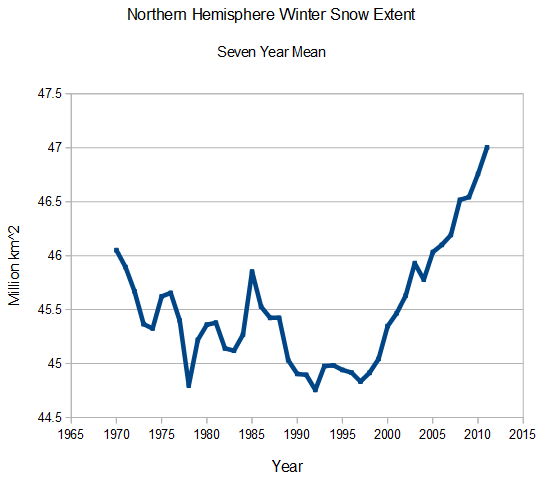
Northern Hemisphere winter snow extent is going through the roof, due to Arctic air pushing further south.

BvElMTCCAAAfGr6Rutgers University Climate Lab :: Global Snow Lab

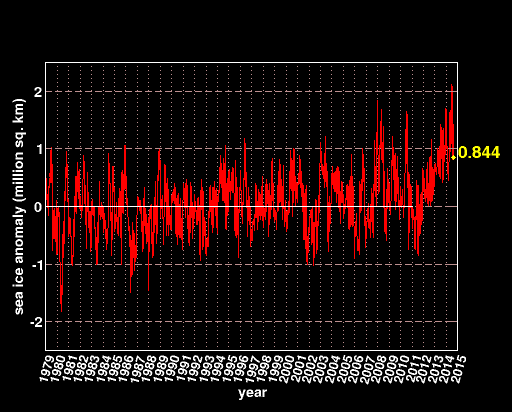
Antarctic sea ice extent is going through the roof

iphone.anomaly.antarctic (1)

iphone.anomaly.antarctic.png (512×412)

US summer temperatures are plummeting

ScreenHunter_2311 Aug. 26 05.44

Pay no attention to all this. Just keep believing the mindless propaganda being spewed by the White House and their minions.

All This Faux-Green Nonsense does Nothing to Help our Environment!

Right argument, wrong argument

Opinions and arguments against the Clean Power Plan all stick to economics, they fail to include any opinion on whether the rule will meet it’s goals.A case in point is an opinion piece in the Durham Herald Sun, Stop the EPA’s war on North Carolina. The article stresses the potential economic damage to the state from the proposed rule.  It never mentions the doubtful benefits from the rule:  no measurable decrease in global temperatures and no evidence that the health benefits will be realized.  In fact, the air pollution data and asthma incidence data show no correlation.  People might support something that saves the planet and lives.  How much would they be willing to pay for something that does neither of these?  We now have McCarthy saying this monstrosity is a jobs plan and ignoring the supposed benefits.

Why not attack the plan on it’s merits?

Even the “Slower” Aussies, are catching on, to the fact that Wind Turbines are Useless!

How the Public Are Deceived About the True Cost of the Mandatory RET

sprinter_2248190b

The Australian Financial Review – as one of the lefty Fairfax stable – “drank the Kool Aid” early and happily ran with the wind industry’s narrative that having Australia bristle with giant fans is a sure-fire way of cooling mother Earth; that wind power is free; and that the mandatory RET is public policy at its best.

In short, the AFR has been a faithful outlet for wind industry spin and propaganda. Regurgitating an endless stream of Clean Energy Council (CEC) press releases; and giving the likes of Infigen (aka Babcock & Brown) free rein to spruik about the “wonders” of wind – never questioning, let alone challenging, the wild and fantastic claims made about lowering retail power prices (all while “saving” the planet, of course) – it’s been a serious media outlet of choice for the wind industry and its parasites.

Until now.

In the last few weeks there’s been a seismic shift in the AFR’s approach to the imminent demise of the mandatory RET. Faced with an increasing barrage of hysterical claims about the world ending if the RET gets the axe (by the likes of the CEC and Infigen’s Miles George) the AFR’s journos and editor have finally opened their eyes to the greatest rort of all time. And, to the horror of the CEC and its taskmasters, they’ve stopped buying the myths and mis-information pitched up by Infigen & Co.

Phil Coorey’s piece on how Tony Abbott, Joe Hockey and Mathias Cormann have joined forces to bring an end to most ludicrous policy ever devised sent the wind industry into a state of panic (see our post here).

Since then, the AFR has followed up with a terrific piece from Alan Moran and an editorial calling the mandatory RET flawed and unsustainable (seeour post here) – and a detailed analysis of the inherent flaws and failings of the RET by crack energy market economist Danny Price (see our post here).

With the AFR turning on it, the wind industry must know its days are numbered.

The AFR continues its recent trend with this fine piece of work by Ben Potter and another terrific editorial that strip away the myth that the mandatory RET is a benign piece of “climate change” policy which won’t cost power consumers a thing.

Renewable energy lobby’s shell game
Australian Financial Review
Ben Potter
25 August 2014

shell-game2009Mar06

The renewable energy lobby employs a neat trick to show that billions in subsidies for the costliest forms of electricity can lower power prices.

Wind and solar power costs between 1½ and 10 times as much to produce as power from coal and gas. But the vagaries of the National Electricity Market allow the renewables sector to claim that it lowers prices – even if it imposes costs on consumers elsewhere.

In a shell game, a conman quickly moves around three shells on a table or mat and his buddies pressure passers-by to bet which one contains a pea.

The pea under the shell is $37 billion of renewable energy certificates (RECs) that electricity retailers will buy from renewable energy generators or generate themselves between now and 2030 if the renewable energy target scheme isn’t changed.

“It’s misleading, because the subsidy is the REC, and the REC certificate is acquitted at the retail level and is included in the retail price of electricity,” Origin Energy chief executive Grant King says.

The renewable energy target has helped drive installations of 52 wind farms and 1.3 million solar roof-top systems – about one-eighth of total capacity – since 2001, Bloomberg New Energy Finance says.

The NSW Independent Pricing and Regulatory Tribunal estimated the cost of the renewable energy target to the average household in 2013-14 at $107 – about 5.3 per cent of a typical $2012 bill.

It is now under review by a panel headed by businessman Richard Warburton, who is sceptical that human activity is causing global warming.

Because the price of RECs is about the same as the electricity price per megawatt/hour, renewables generators are deriving as much revenue from selling RECs as they are from selling power to the National Electricity Market.

“All it is is a tax on existing producers which is passed onto existing consumers,” says Tony Wood, head of the energy program at the Grattan Institute.

“No one denies, when they are asked the right question, that renewable energy costs more than fossil energy.

“The only question is who pays for it? And right now it’s a combination of consumers and fossil generators who are paying for it, and you’ve got to question is that the right policy?”

The RET’s costs are buried in ACIL Allens’ modelling for the RET review and a report issued by the Climate Institute last week.

Most of the costs are REC costs. Deloitte Access Economics in a report for business groups estimates the net present value of REC transfers to the renewables industry over 2015-30 at $17 billion, compared with $8 billion to $9 billion if the RET is closed or the target is wound back to a true 20 per cent of energy supplied.

When REC costs are included, retail bills are higher until at least 2020, after which opinions diverge.

ACIL Allen and the Climate Institute find that continuing the RET on its current path lowers household power bills by as much as $80 a year from now to 2030, despite swelling bills between now and 2020. Deloitte, using different assumptions about capital costs, falling demand and market responses, finds retail bills higher after 2020 as well.

The Climate Institute report shows the high long-run marginal production costs of solar and wind power – which include capital costs – relative to coal and gas. Coal and gas power come in at about $60 to $80 a megawatt hour in the eastern states, wind at $88 to $544 a megawatt hour and solar at $128 to $1533 megawatt hour.

But when it comes to bidding in the National Electricity Market, wind and solar clean up because they have zero short-term marginal costs (in the short term, capital costs are less important). Wood argues they even have negative short-term marginal costs because they need to produce energy to sell RECs.

The rising RET target forces renewables into the NEM, even though electricity demand is shrinking and no more capacity is required. Those factors combine to suppress wholesale prices, which have dipped below $40 a megawatt hour.

That in turn squeezes profits and market share for coal and gas generators, which have to cover their fuel costs, at peak times when they used to make their profits. Retailers then have to buy or generate renewable energy certificates to cover the renewable energy target – currently about 10 per cent, rising to about 28 per cent by 2020. The REC cost goes into the retail price.

If that cost is less than the wholesale price suppression, the consumer wins. But it’s a fine call, says Wood.

The RECs subsidy costs about $29 billion in net present value economic activity, 5000 jobs and $1260 in average annual earnings. This comes from more costly investments in renewables, which Deloitte says raise power prices and suppress resources, jobs and demand in other sectors.

Erwin Jackson, deputy chief executive of the Climate Institute, says such losses are more than offset by the benefits of emissions reductions under the RET.

A Climate Institute report released last week puts a much lower $2.7 billion economic cost on the RET. It finds it lowers household power bills after 2020. It values the social benefits of emissions cuts at $19 billion, based on a $24 to $50 a tonne social cost of carbon. Mr Jackson said this was almost certainly an under-estimate but “you have to factor it in, otherwise it’s a one-sided model and you are assuming climate change doesn’t exist.”

He admitted it was only an estimate of the RET’s contribution to global climate change efforts – offset by emissions increases in large emerging economies such as China and India – rather than any quantifiable benefit to Australia.

But it was the “best tool we have” to “open up the conversation” to considering the benefits of reducing emissions.

“What they’ll talk about very carefully is the cost to consumers, and they’ll show the cost to consumers is either slightly favourable or not much different – therefore ‘isn’t this a reasonable price to pay for renewable energy?’” Wood says.

“What they are very careful not to say [is] ‘what’s the cost to the Australian economy?’ because the cost to the economy includes the negative cost to the existing generators.

“To say that the renewable energy target is a small impost to consumers is the right answer but it’s the wrong question. The right question is ‘what’s the economic impact of the RET?’ and the economic impact of the RET is negative.”

The RET is a costly way to cut greenhouse gas emissions. Its price of abatement is $54 to $186 a tonne, up to eight times the recently abolished carbon price, ACIL Allen modelling for the RET review finds.

A cheaper – but politically tricky – way to reduce emissions to would be to return to a technology neutral carbon price signal.

The difference between Deloitte’s estimate of the REC cost savings from winding back the RET to a true 20 per cent and closing it – $9 billion – is similar to the $10 billion “additional profit” for coal and gas generators – such as Origin and EnergyAustralia – claimed by the Climate Institute report.

“It’s not that they’re better off because the RET was removed. It’s that they’re worse off because the RET was introduced,” Wood says.

Tim Sonnreich, strategic policy manager at the Clean Energy Council, an industry body, accepts that there’s a substantial wealth transfer from incumbent generators to renewables generators.

“We are not denying that,” Sonnreich says. “But it’s a wealth transfer that’s in favour of consumers so we would have thought in a political sense that’s a pretty popular one.”
Australian Financial Review

A valiant effort there from the CEC, as its spin master plays the shell game and otherwise attempts to turn night into day.

The mandatory RET sets up the greatest wealth transfer in the history of the Commonwealth. However, it’s not – as the CEC asserts – one that power consumers are going to thank their political betters for. That transfer – which comes at the expense of the poorest and most vulnerable; struggling businesses; and cash-strapped families – is effected by the issue, sale and surrender of RECs. As Origin Energy chief executive Grant King correctly puts it:

“[T]he subsidy is the REC, and the REC certificate is acquitted at the retail level and is included in the retail price of electricity”.

It’s power consumers that get lumped with the “retail price of electricity” and, therefore, the cost of the REC subsidy to wind power outfits. Between 2014 and 2031, the mandatory RET requires power consumers to pay the cost of issuing 603.1 million RECs to wind power generators. With the REC price likely be at least $65 (by 2017) – and tipped to exceed $90 – the wealth transfer from power consumers to the wind industry will be somewhere between $40 billion and $60 billion, over the next 17 years (see our posts here and here).

Here’s the AFR’s editor in response to the wind industry’s latest efforts to spin its way out of trouble.

Models can’t hide true RET cost
Australian Financial Review
Editorial
25 August 2014

Studies relied on by the renewable energy lobby to justify the continuation of the Renewable Energy Target make a lot about noise about the RET’s effect on the wholesale price of energy. But as shown in this newspaper today, force feeding up to 30 per cent renewables such as wind and sun-generated electricity into the power grid may put downward pressure on wholesale prices amid weak demand by artificially boosting supply. But the effect of forcing more power into the system will then show up in other ways: by increasing retail prices through the cost of renewable energy certificates. Those increased prices will reduce gross domestic product, by depressing productivity and by pushing up prices and costs elsewhere in the economy. That is, it is a highly expensive way to reduce emissions.

As previously discussed in this newspaper, an ongoing review of the RET led by Dick Warburton to make recommendations about winding back or even ending the scheme has resulted in considerable argument over the scheme’s effect on the electricity markets. These arguments include contradictory findings by computer modelling groups, with the RET lobby relying on studies pointing to the effect of dumping a lot of additional capacity into the wholesale market at a time of stagnating demand. However, as the coverage in today’s Financial Review notes, retailers still have to buy the Renewable Energy Certificates required to meet their obligations under the RET from the renewable generators, and that is expected to cost $37 billion between now and 2030, or as much as the electricity itself. That is $37 billion that must be reflected in higher prices elsewhere.

The arguments over the Renewable Energy Target show just how deftly skilled lobbyists can distort the debate, but we should not lose sight of the fact that the RET in any form will cost many billions of dollars in return for an hypothetical social benefit of the carbon emissions being offset.
Australian Financial Review

dirtyrottenscoundrelsoriginal

Joe Bastardi. A Meteorologist, that Has Not Been Tainted by the Alarmists!

A Single Meteorologist Explains What $165 Billion In Government-Funded Climate Science Couldn’t

By P Gosselin on 24. August 2014

Large scale oceanic oscillations responsible for most of the post 1980 “warming”

By Joe Bastardi

I think global warming is a misnomer.

There is a distortion of the temperature pattern on the globe, brought about by the natural cyclical warming events of the warm PDO and warm AMO together. I spoke about this at Heartland a couple of years ago – how the sea ice increase in the south and the decrease in the north were the hidden message that here is no “warming” just a distortion.

http://notrickszone.com/2014/08/24/a-single-meteorologist-explains-what-165-billion-in-government-funded-climate-science-couldnt/

A combination of human identified patterns forming a greater pattern, no surprise.

I’ve been watching the north/south change for a long time, making a coherent whole of this from data eluded me, in part from the unreliable nature of older data.

Quite what Talkshop opinion will make of it given various views will I hope be good reading.

World-wide Climate Scam is the Result of Corruption and Collusion!

AUSTRALIAN BUREAU OF METEOROLOGY ACCUSED OF CRIMINALLY ADJUSTED GLOBAL WARMING


The Australian Bureau of Meteorology has been caught red-handed manipulating temperature data to show “global warming” where none actually exists.

At Amberley, Queensland, for example, the data at a weather station showing 1 degree Celsius cooling per century was “homogenized” (adjusted) by the Bureau so that it instead showed a 2.5 degrees warming per century.

At Rutherglen, Victoria, a cooling trend of -0.35 degrees C per century was magically transformed at the stroke of an Australian meteorologist’s pen into a warming trend of 1.73 degrees C per century.

Last year, the Australian Bureau of Meteorology made headlines in the liberal media by claiming that 2013 was Australia’s hottest year on record. This prompted Australia’s alarmist-in-chief Tim Flannery – an English literature graduate who later went on to earn his scientific credentials with a PhD in palaeontology, digging up ancient kangaroo bones – to observe that global warming in Australia was “like climate change on steroids.”

But we now know, thanks to research by Australian scientist Jennifer Marohasy, that the hysteria this story generated was based on fabrications and lies.

Though the Bureau of Meteorology has insisted its data adjustments are “robust”, it has been unable to come up with a credible explanation as to why it translated real-world data showing a cooling trend into homogenized data showing a warming trend.

She wrote:

“Repetition is a propaganda technique. The deletion of information from records, and the use of exaggeration and half-truths, are �others. The Bureau of Meteorology uses all these techniques, while wilfully ignoring evidence that contradicts its own propaganda.’’

This is a global problem. Earlier this year, Breitbart reported that similarly dishonest adjustments had been made to temperature records by NASA and NOAA. Similarly implicated are the UK temperature records of the Met Office Hadley Centre and at Phil “Climategate” Jones’s disgraced Climatic Research Unit at the University of East Anglia.

One of the many disingenuous arguments used by climate alarmists against sceptics is mockingly to accuse them of being conspiracy theorists. “How could global warming possibly not be a problem when all the world’s temperature data sets from Australia to the US to the UK clearly show that it is? Are you seriously suggesting that so many different scientists and so many distinguished institutions from across the globe would collude in such a massive lie?” their argument runs.

Our answer: yes we bloody well are.

Global Warming Alarmists Being Less Than Honest With The Public! Not Surprised….

This article ties in nicely, with the previous one

posted, telling Why they Lie


Are scientists cooking the books?

Warming scientists accused of adjusting temperature data to show warming

 Australian cooling turns to warming z

Can there be a valid discussion about the climate if warmist scientists are cooking the books?

The failure of climate computer models to accurately project recent temperatures is a major embarrassment for warming campaigners.   The models nearly universally call for more warming than has actually occurred.  This has left the warming crowd scrambling to explain the missing warming.  The folks who publish the Hockey Schtick blog are now up to 38 excuses for the missing warming.  Marc Morano has details at Climate Depot.

Meteorologist Anthony Watts has been documenting accusations of researchers placing their thumbs on the scale to create warming for years.

Now comes reports that the Australian Met Office has been adjusting temperature data to cool the past and create a warming trend that does not appear in the raw data.

The escalating row goes to heart of the climate change debate — in particular, whether computer models are better than real data and whether temperature records are being manipulated in a bid to make each year hotter than the last. Marohasy’s research has put her in dispute with BoM over a paper she published with John Abbot at Central Queensland University in the journal Atmospheric Research concerning the best data to use for rainfall forecasting. BoM challenged the findings of the Marohasy-Abbot paper, but the international journal rejected the BoM rebuttal, which had been prepared by some of the bureau’s top scientists. This has led to an escalating dispute over the way in which ­Australia’s historical temperature records are “improved” through homogenisation, which is proving more difficult to resolve.  (The Australian, h/t Benny Peiser).

Marc Morano is also featuring reports that NASA is erasing past Arctic warming from its records.

Nothing is more fundamental to the scientific method than the rule that we must adjust our hypotheses to fit the data.  Adjusting the data to fit the hypothesis is an academic/scientific crime no matter how plush the funding.

Accusations of global warming data manipulation demand full and unbiased investigations.

Political correctness has no place in science.  Only scientifically correct will do.

– See more at: http://www.cfact.org/2014/08/23/are-scientists-cooking-the-books/#sthash.b5UY1NzA.dpuf

The Real Truth Behind the Global Warming/Climate Change Agenda!

It’s about the money, not the climate

  • Who wants to be a millionaire

Oscar Wilde (1854-1900), the Irish poet and dramatist, wrote “Pray don’t talk to me about the weather. Whenever people talk to me about the weather, I always feel quite certain that they mean something else.”

These days, when some world leader or politician speaks of the climate—the weather is what is happening right now wherever you are—they are not talking about sunshine or rain. They are talking about a devilishly obscene way of raising money by claiming that it is humans that are threatening the climate with everything they do, from turning on the lights to driving anywhere.

That’s why “global warming” was invented in the late 1980s as an immense threat to the Earth and to mankind. Never mind that Earth has routinely passed through warmer and cooler cycles for billions of years; much of which occurred before mankind emerged. And never mind that the Earth has been a distinct cooling cycle for the past seventeen years and likely to stay in it for a while. If the history of ice ages is any guide, we could literally be on the cusp of a new one.

If, however, a government can tax the use of energy, it stands to make a lot of money. That is why carbon taxes have been introduced in some nations and why the nearly useless “clean energy” options of wind and solar have been introduced even though they both require the backup of traditional coal, natural gas and nuclear energy plants because they cannot produce electricity if the wind isn’t blowing and the sun is obscured by clouds.

Taxing energy use means taxing “greenhouse gas” emissions; primarily carbon dioxide (C02) so that every ton of it added to the atmosphere by a power plant and any other commercial activity becomes a source of income for the nation. The Australians went through this and rapidly discovered it drove up their cost of electricity and negatively affected their economy so much that they rid themselves of a prime minister and the tax within the past year.

Fortunately, every effort to introduce a carbon tax has been defeated by the U.S. Congress, but that it has shelled out billions for

Rep. Henry Waxman

“climate research” over the years. That doesn’t mean, however, that 41 demented Democrats in the House of Representatives haven’t gotten together in a “Safe Climate Caucus” led by Rep. Henry A. Waxman. The Washington Post reported that when it was launched in February 2013, the members promised to talk every day on the House floor about “the urgent need to address climate change.”

Check out the caucus and, if your Representative is a member, vote to replace him or her with someone less idiotic.

When you hear the President or a member of Congress talk about the climate, they are really talking about the scheme to generate revenue from it through taxation or to raise money from those who will personally benefit from any scheme related to the climate such as “clean energy.”

The need of governments to frighten their citizens about the climate in order to raise money is international in scope. A United States that has a $17 trillion debt is a prime example, much of it due to a government grown so large it wastes taxpayer’s money in the millions with every passing day whether it is sunny or rainy, warm or cold.

In late July, Reuters reported that Christine Lagarde, the chair of theInternational Monetary Fund, (IMF) opined in her new book that “energy taxes in much of the world are far below what they should be to reflect the harmful environmental and health impact of fossil fuels use.”

Please pay no attention to the billions of dollars that coal, oil and natural gas already generate for the nations in which they are found. Nations such as India and China are building coal-fired plants as fast as possible to provide the electricity every modern nation needs to expand its economy, provide more employment, and improve their citizen’s lives in every way imaginable.

“For the first time,” Reuters reported, “the IMF laid out exactly what it views as appropriate taxes on coal, natural gas, gasoline, and diesel in 156 countries to factor in the fuel’s overall costs, which include carbon dioxide emissions, air pollution, congestion and traffic accidents.” The problem with this is that the costs cited are bogus.

Christine Lagarde

“Nations,” said Lagarde, “are now working on a United Nations deal for late 2015 to rein in greenhouse gas emissions that have hit repeated highs this century, but progress has been slow as nations fret about the impact any measures may have on economic growth.” As in bad impacts!

Ignore the claims that carbon dioxide affects the climate. Its role is so small it can barely be measured because CO2 represents 380 parts per million. When our primate ancestors began to climb down out of the trees, CO2 levels were about 1,000 parts per million. More CO2 means more crops, healthy growing forests, and all the other benefits that every form of vegetation provides. The breath we humans exhale contains about 4% of CO2.

The fact is that the United States and other nations are being run by politicians who are incapable of reducing spending or borrowing more in order to spend more. Venezuela just defaulted again on the payment of bonds it issued to raise money. They did this in 2001 and one must wonder why any financial institution purchases them.

There are eleven other nations whose credit ratings are flirting with big trouble. They include Greece, Ukraine, Pakistan, Cypress, and in the Americas Argentina, Venezuela, Cuba, Ecuador and Belize. Borrowing by such nations is very expensive. A U.S. Treasury Note pays an annual coupon of just 2.5%, but the yields on 10-year bonds issue by Greece reached 29% in early 2012, just before it defaulted.

Adding to problems in the U.S. is the Obama agenda being acted upon by the Environmental Protection Agency whose “war on coal” has shuttered several hundred plants that produce the electricity needed to maintain the economy. In coal producing states this is playing havoc and it is driving up the cost of electricity in others.

The growth of oil and natural gas production in the U.S. is almost entirely on privately owned land as opposed to that controlled by the government. Supporting the attack on energy are the multi-million dollar environmental organizations like Friends of the Earth and the Sierra Club.

The world has not warmed since the nineties and many factors influence the climate other than CO2, the Sun, the oceans, clouds, and volcanic activity. Nothing any government does, here and worldwide, has any meaningful impact on it, but if nations can demonize the use of energy and tax the CO2 it produces, they can generate more money to spend and waste.

The lies that governments, the United Nations, and the International Monetary Fund tell about the climate are about the money they can extract from citizens who must be kept frightened enough to pay taxes on their use of energy.


– See more at: http://www.cfact.org/2014/08/22/its-about-the-money-not-the-climate/#sthash.2UXTRUgG.dpuf

If the Ontario Liberal Gov’t was Smart, They Would Cancel These Wind Contracts!


Prospects of negative governmental

action in Ontario’s energy sector

When investments are made in the private sector sophisticated financial models are developed, complete with multiple inputs, all designed to predict a range of best and worst case scenarios. If a significant model input strays beyond its originally anticipated value range for example, if customer demand for a business’s products collapses then the financial model for the business may fail. If so, stakeholders in the business will likely face a restructuring of their investments. 

The chances of a restructuring are far less likely when government is the main customer of the business, not only because governments are presumed to have deep pockets, but also because, in those businesses where government acts as an intermediary between the business and the ultimate consumers of the business’s products, the government’s intermediation tends to insulate the business from model failure and its usual consequences. Nevertheless, if model failure is severe and persistent enough, history in Canada suggests that governments may be tempted to impose a restructuring even on these sorts of businesses. 

In the years leading up to Ontario’s Feed-in-Tariff (FIT) program, it was generally accepted that Ontario was approaching a near-term shortage of electricity as surging demand threatened massive brownouts.  Government financial models, no doubt, assumed that the cost of developing renewable energy infrastructure involving long-term power purchases at prices significantly above market could be recouped by steadily increasing electricity rates over time, all without unduly reducing customer demand.1 However, subsequent experience seems to suggest that Ontario’s electricity demand may have been more elastic than anticipated, especially as many urban and rural electricity consumers have reacted to increasing prices by switching some of their electricity needs to lower-priced natural gas and propane. Moreover, as price increases in the Province have outpaced those in neighbouring jurisdictions (leaving Ontario’s electricity prices 30-60% higher than in those jurisdictions), some large commercial users have reacted by moving their operations out of Ontario, further depressing overall demand.2  In fact, far from remaining steady, electricity demand in the Province is now projected to decline until at least 2021.3

Even as electricity demand has declined, Ontario’s generating capacity has increased.  Overall generating capacity in Ontario has increased by 13% since 2003, while demand has decreased by 10% since 2005.4 The end result has been a large and continuing surplus of generating capacity, with Ontario’s generating capacity expected to exceed forecast (normal weather peak) demand this summer by 25-50%.5  Partly as a consequence, electricity spot prices in the Province have plummeted, sometimes falling to $0.025/kWh.6  Higher-priced, surplus Ontario electricity is sometimes resold to neighbouring jurisdictions at a substantial discount7 and the Global Adjustment amount charged to Ontario consumers has now risen to record levels.8

In summation, some of the model inputs in the Province’s original financial models may already have strayed beyond their initially anticipated value ranges, suggesting at least the possibility that model failure has occurred in the sector or that it may be imminent.  If so, then recent entrants into Ontario’s energy sector, otherwise dependent on the continuance of long-term government purchases, are quite right to be concerned about the possibility of a government-imposed restructuring in their sector.

Unlike private sector restructurings which typically involve a court process, government-imposed restructurings generally take the form of confiscatory legislation or some other form of negative governmental action.  It should come as no surprise that governments in Canada have from time to time engaged in various sorts of negative governmental action, invariably with the intent of modifying (or even abrogating altogether) undesirable government obligations.  Such action has even occurred previously in Ontario’s utility sector.9 For example, in the 1930’s, successive Ontario governments enacted several pieces of legislation abrogating various contractual commitments to private sector power producers, all with the intent of assisting the then-fledgling, and government-owned Ontario Hydro to become the dominant power producer and distributor in the Province.  Indeed, overall, scholarly research suggests that negative governmental action usually occurs (if it occurs at all): (a) when technological change in a given industry sector is occurring rapidly, (b) when pricing, demand or other important financial variables cannot be perfectly forecast, and (c) when governments have entered into long-term contracts that cannot easily be altered.10 In other words, the restructuring risk increases on model failure occurring within this context.  

Negative governmental action can take many forms, including specifically, the passage of legislation modifying government payables, authorizing or curing contract breaches, limiting court access, amending or cancelling contract commitments, and even expropriating completed projects. A recent, well publicized, example of negative governmental action in Canada occurred in the early 1990s when the federal government summarily cancelled several long-term contracts with private sector participants for the redevelopment of Toronto’s Pearson Airport.11 Bill C-22, passed by the House of Commons provided that: (a) all contracts relating to the redevelopment were declared not to have come into existence or to have had any legal effect, (b) all obligations, rights and interests arising out of the contracts were declared not to have come into existence, (c) no action or proceeding, including for damages for breach of contract, could be brought against the government, and (d) every action against the federal government was summarily dismissed.  Bill C-22 also authorized the relevant federal Minister, for a period of 30 days, to enter into agreements with aggrieved stakeholders to pay compensation in such amounts as the Minister considered appropriate.  Notably, compensation for lost profits was expressly prohibited under the legislation. 

Using Bill C-22 as an example, it may appear at first blush that governments in Canada hold all the cards when it comes to negative governmental action. However, stakeholders should note that there are various countervailing influences that will moderate the actual exercise of such extraordinary power. For example, government will be mindful of reputational concerns.12 Specifically, international credit rating agencies may react to negative governmental action by downgrading the subject government’s public debt due to increased “country risk”, thereby increasing future borrowing costs for the subject government. Foreign governments may impose “tit-for-tat” sanctions on projects in their jurisdictions that are intended to hurt nationals of the expropriating state. Judgments rendered by sympathetic foreign courts may be executable against the subject government’s assets located in foreign jurisdictions. And finally, equity investors in non-related sectors may avoid investment in the jurisdiction altogether for fear of falling victim to similar governmental action.

Aside from reputational concerns, some jurisdictions offer constitutional safeguards against negative governmental action without due process. The Fifth and Fourteenth Amendments to the US Constitution are good examples.  Unfortunately, no such constitutional protection currently exists in Canada.13 Specifically, Canada’s Charter of Rights and Freedoms contains no express provision for the protection of property, economic, or even contract rights.14 And based on a string of Charter cases decided by the Supreme Court of Canada, it is unlikely that any general protection of this nature will be implied any time soon.15 Instead, stakeholders in Canada will have to derive comfort from the fact that Canadian courts will generally construe confiscatory legislation very strictly against the subject government, straining if at all possible to find that the legislation does not exclude the payment of appropriate levels of compensation or review by the judiciary. Nevertheless, if the legislation is sufficiently precise, even a strict constructionist approach will be of little use to an aggrieved stakeholder.

In such circumstances, Canada’s free trade agreements may assist, but only if the stakeholder is a national of a treaty-protected country. As is well known, Canada is a signatory to a number of free-trade and foreign investment protection agreements, some of which prohibit confiscatory action without payment of appropriate compensation.  For example, under Article 1110 of the North American Free Trade Agreement (NAFTA), no federal or provincial government is permitted to “nationalize or expropriate an investment of a [US or Mexican] investor…or take a measure tantamount to nationalization or expropriation”, unless such action is: (a) for a public purpose, (b) effected on a non-discriminatory basis, (c) effected in accordance with due process, and (d) carried out upon payment of compensation equivalent to the fair market value of the expropriated investment.  

Particularly instructive here is the case of Metalclad Corporation v. Mexico16, a NAFTA case brought by an American company against the state of Mexico in 2000.  In that case, an arbitral tribunal ruled that, as a result of numerous laws and other negative governmental actions passed and undertaken by Mexican state and municipal authorities, Mexico had effectively expropriated Metalclad’s newly-constructed waste facility in Guadalcaza. The tribunal awarded Metalclad US$16,685,000 in damages representing Metalclad’s sunk costs of the investment.17 While damages awarded against Mexico did not include an amount on account of discounted lost profits, such damages are thought to be sustainable under NAFTA in certain circumstances.

Equally instructive is a 2012 NAFTA case brought against Canada by the Abitibi-Bowater group and involving certain confiscatory legislation passed by the Province of Newfoundland. In this case, the provincial legislation provided for: (a) the expropriation of significant Abitibi-Bowater properties used for hydroelectric generation and transmission, (b) the cancellation of various hydroelectric contracts between the Abitibi-Bowater group and the Province, and (c) the termination of certain timber and water rights. While the legislation provided for compensation for the expropriated properties, no compensation was to be forthcoming for the terminated timber and water rights. The Abitibi-Bowater group brought a NAFTA claim asserting that the Newfoundland legislation constituted an expropriation of its assets without appropriate compensation contrary to NAFTA Article 1110. Faced with the prospect of an uphill fight, the Canadian government opted to settle the claim for $140 million.  

Besides NAFTA, and as indicated above, several bilateral trade arrangements exist which contain similar foreign investor protection.18 Importantly, the proposed multilateral Trans-Pacific Partnership currently being negotiated with several Asia-Pacific countries and the proposed Canada-European Union Comprehensive Economic and Trade Agreement (not yet in force) will also contain similar investor protection. Once implemented, these new trade arrangements will significantly expand the list of treaty-protected countries and the range of foreign stakeholders that will be able to benefit from investor protection.  Notably however Canada’s trade agreements cannot be used by Canadian nationals to protect themselves against negative governmental action occurring within Canada in relation to their domestic investments.   

With the recent re-election of Ontario’s Liberal government, stakeholders in Ontario’s energy sector are, no doubt, breathing a little easier, as putative threats to tear up the Province’s FIT contracts are now much more clearly off the table.19 Most assuredly, the restructuring risk has subsided.  Still, the issues here are as much financial as they are political, and history in Canada suggests that negative governmental action can never truly be ruled out.  If financial model failure occurs and is considered severe and persistent enough, then negative governmental action will remain a distinct (even if remote) possibility. 


1 The comprehensiveness of the Government’s original financial models has been questioned by Ontario Auditor General in the Annual Report of the Office of the Auditor-General of Ontario.

2 Remarks of Greg Abel, Chairman, President and CEO of Spectra Energy, to Economic Club of Canada, June 24, 2014.  See also “Environmental and Economic Consequences of Ontario’s Green Energy Act”, R. R. McKitrick, Report prepared for Fraser Institute, 2013, and also “High Ontario Electricity Prices Hamper Ring of Fire Processing and Other Industry”, L. Di Matteo, February 6, 2011.

3 Ontario’s Electricity Surplus: An Opportunity to Reduce Costs”(the “Ontario Surplus”), a publication of the Ontario Clean Air Alliance Research Inc., July 2012.

4 See Ontario Surplus, supra.  See also “Eighteen Month Outlook: From March 2014 to August 2015” (the “18 Month Outlook”), a publication of the IESO, p. 4.

5 Based on 18 Month Outlook, Tables 3.1, 4.3-4.5.
 
6 See Ontario Surplus, p.3.
 
7Ontario’s Power Trip: Power Dumping, Gallant, P., Financial Post, July 20, 2011, and “Ontario’s Power Trip: Province lost $1.2-billion this year exporting power”, Gallant, P., Financial Post, December 2, 2013.
 
8 “Ontario power fee sets new record: The global adjustment — a fee added to the market price of electricity in Ontario — has reached a record high”, Walton, T., The Toronto Star, September 3, 2013.
 
9Regulatory Failure and Renewal: The Evolution of the Natural Monopoly Contract”,  J. Baldwin, Ottawa: Economic Council of Canada 1989.
 
10 See Baldwin, Chaps. 3, 10 and 12, for example.  See also “Public Accountability in the Age of Contracting Out”, E. Atwood and M.J. Trebilcock, (1996) 27 Can. Bus. L.J., v. 27, n. 1, p. 1, at p. 38.
 
11 A more recent instance occurred when in 2008 the Government of Newfoundland expropriated various power generating and transmission assets of the Abitibi-Bowater group (discussed further below in this article) pursuant to the Abitibi-Consolidated Rights And Assets Act (Newfoundland).
 
12 See for example “A Constant Recontracting Model of Sovereign Debt”,  J. Bulow & K. Rogoff (1989) Journal of Political Economy, 155.
 
13 For a contrary view regarding the government’s right to implement negative governmental action, see “Is the Pearson Airport Legislation Unconstitutional?: The Rule of Law as a Limit on Contract Repudiation by Government”, P. Monahan, (1996) Osgoode H.L.J., v. 33, n. 3, p. 411, where the author argues that where legislation like Bill C-22 purports to deny access to the courts, the legislation breaches the rule of law implicitly enshrined in the Charter of Rights and Freedoms, and therefore is unconstitutional.
 
14 While the Canadian Bill of Rights provides an explicit right to the “enjoyment of property” and the right not to be deprived thereof without due process, the Canadian Bill of Rights only applies to federal laws, may not entitle the aggrieved party to compensation if the confiscatory legislation provides otherwise, and creates rights that do not have the same status as Charter rights. 
 
15 Siemens v. Manitoba (Attorney General), 2003 SCC 3; The Attorney General of Quebecv. Irwin Toy Limited, [1989] 1 S.C.R. 927; Whitbread v. Walley [1991] 2 W.W.R. 195 (SCC);Olympia Interiors Ltd. v. R. (1999), 167 F.T.R. 165 (Fed. T.D.), affirmed (1999), 1999 CarswellNat 1978 (Fed. C.A.), leave to appeal refused (2000), 252 N.R. 393 (S.C.C.);Energy Probe et al. v. The Attorney General Of Canada et al., (1994) 17 O.R. (3d) 717 (Ont. C.J.); and Shaw v. Stein, 2004 SKQB 194. 
 
16 See Metalclad Corporation v. Mexico, ICSID Case No. ARB(AF)/97/1 (NAFTA), Award. For an unsuccessful appeal of the NAFTA award to British Columbia Supreme Court, seeUnited Mexican States v. Metalclad Corp., 2001 BCSC 664.
 
17 Damages were based on the claimant’s actual investment in the property because the facility had not been operational long enough, and thus had not established a sufficient record of profitability, such that damages for lost profits could be proven.  The tribunal suggested that a “fair market value” award of damages for a going concern with a history of profitable operations would usually be based on an estimate of future profits, subject to a discounted cash flow analysis.  See  also Biloune, et al. v. Ghana Investment Centre, et al., 95 I.L.R.183, 207-10 (1993).
 
18 See, for example, Article 9.1 of the Canada-Panama Free Trade Agreement, Article G-10 of the Canada-Chile Free Trade Agreement, and Article 8.11 of the Canada-Korea Free Trade Agreement (not yet in force), all of which provide compensation for expropriatory measures taken by the federal or any provincial government.
 
19 See, for example, the Alliance for Renewable Energy’s view of the threat in: “June 12 Provincial Election will determine the Future of Ontario FIT Programs”,  June 3, 2014.
 
 
NOT LEGAL ADVICE. Information made available on the Web site in any form is for information purposes only. It is not, and should not be taken as legal advice. You should not rely on, or take or fail to take any action, based upon this information. Never disregard professional legal advice or delay in seeking legal advice because of something you have read on this Web site. Gowlings professionals will be pleased to discuss resolutions to specific legal concerns you may have.