This New Book Will Have the Greenie’s Head’s Spinning!

ABOUT FACE!’ NEW BOOK PROMOTES INCREASING ATMOSPHERIC CO2

Written by PSI Staff

As ever-more scientists denounce misguided attempts to reduce carbon dioxide emissions, the evidence grows that more CO2 in the atmosphere, not less, is best. About Face

A new book ‘About Face!’ by two respected scientists and an economist makes the case for adding more CO2 to earth’s atmosphere.

The scientists are Madhav Khandekar in Canada and Cliff Ollier in Australia, plus economist Arthur Middleton Hughes in the USA. They show us why CO2 is essential to all life on earth. It is plant food.

The authors say, “We believe that the more CO2 there is in the atmosphere the bigger and better plants will grow all over the world. Three million people die each year because the prices of food are too high for them. We want to increase CO2 in the atmosphere and reduce world malnutrition.”

The Authors’ Synopsis

This book is highly controversial as billions of dollars are involved in ethanol and climate control. The Obama Administration is planning to shut down all coal fired electric plants because they emit CO2 in amounts more than the EPA permits. This will cost more than $300 billion dollars and result in more than 100,000 unemployed. We say that such actions are unnecessary and wrong.

The UN Intergovernmental Panel on Climate Change (IPCC) issues periodic reports that predict the warming of the earth and that the warming will raise the level of the oceans, and bring on wild weather such as hurricanes, droughts, floods, tornadoes, etc. None of this is true. It has no scientific basis.

Today, more than one million people die from malaria in Africa and other less developed areas. None die from malaria in the US, Europe, Australia or other developed countries where the mosquitos that spread malaria have been wiped out using DDT.

The US and UN have forbidden these less developed areas to use DDT. This must be changed. More than three million people die from malnutrition because of the high price of food partly due to 14% of the world corn crop being converted to ethanol.  We cite studies that show that increasing CO2 in the atmosphere by 300 ppm will increase food production by 36% in every country in the world on all continents.

This increase can result from abandoning the thousands of laws and regulations that inhibit emission of CO2. Carbon dioxide is a harmless, odorless, tasteless gas that is essential to photosynthesis – the basis of plant growth – without which life on earth would end.

Copies of ‘About Face!’ are available to buy securely online now at secure.mybookorders.com

Climate Change Alarmists are “Confused”….Reality doesn’t match their “Predictions”! No kidding!

When the Intergovernmental Panel on Climate Change recently requested a figure for its annual report, to show global temperature trends over the last 10,000 years, the University of Wisconsin-Madison’s Zhengyu Liu knew that was going to be a problem.

“We have been building models and there are now robust contradictions,” says Liu, a professor in the UW-Madison Center for Climatic Research. “Data from observation says global cooling. The physical model says it has to be warming.”

Writing in the journal Proceedings of the National Academy of Sciences today, Liu and colleagues from Rutgers University, the National Center for Atmospheric Research, the Alfred Wegener Institute for Polar and Marine Research, the University of Hawaii, the University of Reading, the Chinese Academy of Sciences, and the University of Albany describe a consistent trend over the course of the Holocene, our current geological epoch, counter to a study published last year that described a period of global cooling before human influence.

The scientists call this problem the Holocene temperature conundrum. It has important implications for understanding and evaluating climate models, as well as for the benchmarks used to create for the future. It does not, the authors emphasize, change the evidence of human impact on global climate beginning in the 20th century.

“The question is, ‘Who is right?'” says Liu. “Or, maybe none of us is completely right. It could be partly a data problem, since some of the data in last year’s study contradicts itself. It could partly be a model problem because of some missing physical mechanisms.”

Over the last 10,000 years, Liu says, we know atmospheric carbon dioxide rose by 20 parts per million before the 20th century, and the massive ice sheet of the Last Glacial Maximum has been retreating. These physical changes suggest that, globally, the annual mean should have continued to warm, even as regions of the world experienced cooling, such as during the Little Ice Age in Europe between the 16th and 19th centuries.

The three models Liu and colleagues generated took two years to complete. They ran simulations of climate influences that spanned from the intensity of sunlight on Earth to global greenhouse gases, ice sheet cover and meltwater changes. Each shows global warming over the last 10,000 years.

Yet, the bio- and geo-thermometers used last year in a study in the journal Science suggest a period of beginning about 7,000 years ago and continuing until humans began to leave a mark, the so-called “hockey stick” on the current climate model graph, which reflects a profound global warming trend.

In that study, the authors looked at data collected by other scientists from ice core samples, phytoplankton sediments and more at 73 sites around the world. The data they gathered sometimes conflicted, particularly in the Northern Hemisphere.

Because interpretation of these proxies is complicated, Liu and colleagues believe they may not adequately address the bigger picture. For instance, biological samples taken from a core deposited in the summer may be different from samples at the exact same site had they been taken from a winter sediment. It’s a limitation the authors of last year’s study recognize.

“In the Northern Atlantic, there is cooling and warming data the (climate change) community hasn’t been able to figure out,” says Liu.

With their current knowledge, Liu and colleagues don’t believe any physical forces over the last 10,000 years could have been strong enough to overwhelm the warming indicated by the increase in global greenhouse gases and the melting, nor do the physical models in the study show that it’s possible.

“The fundamental laws of physics say that as the temperature goes up, it has to get warmer,” Liu says.

Caveats in the latest study include a lack of influence from volcanic activity in the models, which could lead to cooling—though the authors point out there is no evidence to suggest significant volcanic activity during the Holocene—and no dust or vegetation contributions, which could also cause cooling.

Liu says scientists plan to meet this fall to discuss the conundrum.

“Both communities have to look back critically and see what is missing,” he says. “I think it is a puzzle.”

More information: The Holocene temperature conundrum, PNAS, http://www.pnas.org/cgi/doi/10.1073/pnas.1407229111

Provided by University of Wisconsin-Madison

Climate Alarmists are Not to be Taken Seriously! They are Scammers!

An economist’s bad climate advice


You are here: HomeAll PostsAn economist’s bad climate advice

  • CO2_fraud

If I need my car repaired, I do not take it to a dentist. If I am seeking advice about the climate I check out what climatologists and meteorologists are saying, at least those who have not sold their souls to the global warming/climate change hoax.

On September 3rd,  The Wall Street Journal published a commentary by Edward P. Lazeartitled “The Climate Change Agenda Needs to Adapt to Reality: Limiting carbon emissions won’t work. Better to begin adjusting to a warming world.”

Wrong! Wrong! Wrong! It’s cooling, not warming.

Apparently Mr. Lazear is unaware that the Earth has been in a cooling cycle for seventeen years. A visit to

Edward P. Lazear

www.climatedepot.com or a subscription to the Heartland Institute’s monthly Climate & Environmental News or a copy of its policy studies, “Climate Change Reconsidered”, would help him understand why he’s wrong. Check out www.climatechangedispatch.com as well for the latest commentaries.

Perhaps his error should be forgiven because Mr. Lazear is an economist. He was the chairman of the President’s Council of Economic Advisors (2006-09) and head of the White House Committee on the Economics of Climate Change (2007-08). Presently he is a professor at Stanford University’s Graduate School of Business and a Hoover Institution fellow.

He’s not a fool, but like a lot of academics who lack a background in science, he has been fooled by the legion of global warming/climate change charlatans from Al Gore through the ranks of organizations such as the United Nations Intergovernmental Panel on Climate Change that depend on maintaining the hoax.

Mr. Lazear has fallen for the greatest lie ever; the assertion that greenhouse gases, especially carbon dioxide, are warming the Earth. The hoaxers are calling the past seventeen years “a pause” in warming, but it is actually an indicator that the Earth is on the cusp of the next ice age. The period in between ice ages is calculated at 11,500 years and we are at the end of the current interglacial period.

“The Obama administration is instituting a variety of far-reaching policies to reduce carbon emissions and mitigate climate change. Are any of these capable of making a difference?” asked Mr. Lazear. “Simple arithmetic suggests not.” Up to this point I was very pleased with his conclusion, but then he wrote “Given this reality, we would be wise to consider strategies that complement and may be more effective than mitigation—namely, adaptation.”

Humans have been adapting to the climate—the weather—since they emerged as homo sapiens about 195,000 years ago.

What Mr. Lazear wants the U.S, to do is limit “carbon emissions” but admits that “The economics also work against a major transformation in the technology of producing power, either mobile or stationary. Coal is cheap. Natural gas is becoming even cheaper.”

The primary flaw in his commentary is simply that more carbon dioxide is a good thing. As the primary gas utilized by all vegetation, more means greater crop yields and healthier forests. What carbon dioxide doesn’t do is “trap” heat long enough to lower the Earth’s temperature. It represents a mere 0.04% of the atmosphere.

The Earth is not a greenhouse with a glass roof. The amount of heat in the atmosphere is totally dependent on the amount of heat the Sun produces. In its current cycle, it is producing less.

“Carbon math,” wrote Mr. Lazear, “makes clear that without major effort and a good bit of luck, we are unlikely to control the growth of emissions enough to meet the standards that many climate scientists suggest are necessary.” Those scientists are usually on college or university faculties where securing federal and other grants to study a warming that is not occurring leads to urging limits on carbon dioxide. Others are just huge liars who, like Al Gore, have been making predictions of warming that have not and are not coming true.

There’s another reason why there will be more carbon dioxide in the atmosphere. It involves two of the most swiftly developing nations in the world, China and India, both of whom are building coal-fired plants to generate electricity as fast as they can. This is happening while the Environmental Protection Agency has been engaged in an all-out war on coal that has closed several hundred U.S. plants. If an especially cold winter occurs, the demand for electricity to warm homes and other facilities may overload a system that has been diminished in scope.

The United Nations Intergovernmental Panel on Climate Change is the driving force behind the global united-nations-building-1-1106992-mwarming hoax. It is holding a climate change summit on September 23. Guess who won’t be attending? Chinese president Xi Jinping, India’s prime minister, Narenda Modi, and for good measure, Germany’s chancellor, Angela Merkel. Others whose leaders will not be attending include Canada, Japan, and Russia.

In typical fashion, always predicting climate conditions decades from now, the United Nations, according to a report in The Guardian, “is warning of floods, storms and searing heat from Arizona to Zambia within four decades, as part of a series of imagined weather forecasts” to publicize the climate summit.

All of the forecasts made by a legion of climate charlatans in the 1980s and 1990s turned out to be WRONG.

You cannot trust the UN’s World Meteorological Organization which like the IPCC is just part of a vast matrix of groups that have been so severely corrupted by the global warming/climate change hoax that one must exercise caution when hearing its forecasts. If they are for anything beyond two weeks hence, you would be wise to be dubious.

Mr. Lazear is just one of many, often with distinguished careers in other fields than meteorology or climatology, who have bought into the hoax and who declaim the need to reduce carbon dioxide. He’s wrong. The others are wrong.

And you need to educate yourself to avoid being afflicted by various government policies intended to advance the hoax. To start with, do not vote for any politician who talks of global warming/climate change or uses the term “sustainability.”

– See more at: http://www.cfact.org/2014/09/07/an-economists-bad-climate-advice/#sthash.Pkjvx1cg.dpuf

All This Faux-Green Nonsense does Nothing to Help our Environment!

Right argument, wrong argument

Opinions and arguments against the Clean Power Plan all stick to economics, they fail to include any opinion on whether the rule will meet it’s goals.A case in point is an opinion piece in the Durham Herald Sun, Stop the EPA’s war on North Carolina. The article stresses the potential economic damage to the state from the proposed rule.  It never mentions the doubtful benefits from the rule:  no measurable decrease in global temperatures and no evidence that the health benefits will be realized.  In fact, the air pollution data and asthma incidence data show no correlation.  People might support something that saves the planet and lives.  How much would they be willing to pay for something that does neither of these?  We now have McCarthy saying this monstrosity is a jobs plan and ignoring the supposed benefits.

Why not attack the plan on it’s merits?

The Real Truth Behind the Global Warming/Climate Change Agenda!

It’s about the money, not the climate

  • Who wants to be a millionaire

Oscar Wilde (1854-1900), the Irish poet and dramatist, wrote “Pray don’t talk to me about the weather. Whenever people talk to me about the weather, I always feel quite certain that they mean something else.”

These days, when some world leader or politician speaks of the climate—the weather is what is happening right now wherever you are—they are not talking about sunshine or rain. They are talking about a devilishly obscene way of raising money by claiming that it is humans that are threatening the climate with everything they do, from turning on the lights to driving anywhere.

That’s why “global warming” was invented in the late 1980s as an immense threat to the Earth and to mankind. Never mind that Earth has routinely passed through warmer and cooler cycles for billions of years; much of which occurred before mankind emerged. And never mind that the Earth has been a distinct cooling cycle for the past seventeen years and likely to stay in it for a while. If the history of ice ages is any guide, we could literally be on the cusp of a new one.

If, however, a government can tax the use of energy, it stands to make a lot of money. That is why carbon taxes have been introduced in some nations and why the nearly useless “clean energy” options of wind and solar have been introduced even though they both require the backup of traditional coal, natural gas and nuclear energy plants because they cannot produce electricity if the wind isn’t blowing and the sun is obscured by clouds.

Taxing energy use means taxing “greenhouse gas” emissions; primarily carbon dioxide (C02) so that every ton of it added to the atmosphere by a power plant and any other commercial activity becomes a source of income for the nation. The Australians went through this and rapidly discovered it drove up their cost of electricity and negatively affected their economy so much that they rid themselves of a prime minister and the tax within the past year.

Fortunately, every effort to introduce a carbon tax has been defeated by the U.S. Congress, but that it has shelled out billions for

Rep. Henry Waxman

“climate research” over the years. That doesn’t mean, however, that 41 demented Democrats in the House of Representatives haven’t gotten together in a “Safe Climate Caucus” led by Rep. Henry A. Waxman. The Washington Post reported that when it was launched in February 2013, the members promised to talk every day on the House floor about “the urgent need to address climate change.”

Check out the caucus and, if your Representative is a member, vote to replace him or her with someone less idiotic.

When you hear the President or a member of Congress talk about the climate, they are really talking about the scheme to generate revenue from it through taxation or to raise money from those who will personally benefit from any scheme related to the climate such as “clean energy.”

The need of governments to frighten their citizens about the climate in order to raise money is international in scope. A United States that has a $17 trillion debt is a prime example, much of it due to a government grown so large it wastes taxpayer’s money in the millions with every passing day whether it is sunny or rainy, warm or cold.

In late July, Reuters reported that Christine Lagarde, the chair of theInternational Monetary Fund, (IMF) opined in her new book that “energy taxes in much of the world are far below what they should be to reflect the harmful environmental and health impact of fossil fuels use.”

Please pay no attention to the billions of dollars that coal, oil and natural gas already generate for the nations in which they are found. Nations such as India and China are building coal-fired plants as fast as possible to provide the electricity every modern nation needs to expand its economy, provide more employment, and improve their citizen’s lives in every way imaginable.

“For the first time,” Reuters reported, “the IMF laid out exactly what it views as appropriate taxes on coal, natural gas, gasoline, and diesel in 156 countries to factor in the fuel’s overall costs, which include carbon dioxide emissions, air pollution, congestion and traffic accidents.” The problem with this is that the costs cited are bogus.

Christine Lagarde

“Nations,” said Lagarde, “are now working on a United Nations deal for late 2015 to rein in greenhouse gas emissions that have hit repeated highs this century, but progress has been slow as nations fret about the impact any measures may have on economic growth.” As in bad impacts!

Ignore the claims that carbon dioxide affects the climate. Its role is so small it can barely be measured because CO2 represents 380 parts per million. When our primate ancestors began to climb down out of the trees, CO2 levels were about 1,000 parts per million. More CO2 means more crops, healthy growing forests, and all the other benefits that every form of vegetation provides. The breath we humans exhale contains about 4% of CO2.

The fact is that the United States and other nations are being run by politicians who are incapable of reducing spending or borrowing more in order to spend more. Venezuela just defaulted again on the payment of bonds it issued to raise money. They did this in 2001 and one must wonder why any financial institution purchases them.

There are eleven other nations whose credit ratings are flirting with big trouble. They include Greece, Ukraine, Pakistan, Cypress, and in the Americas Argentina, Venezuela, Cuba, Ecuador and Belize. Borrowing by such nations is very expensive. A U.S. Treasury Note pays an annual coupon of just 2.5%, but the yields on 10-year bonds issue by Greece reached 29% in early 2012, just before it defaulted.

Adding to problems in the U.S. is the Obama agenda being acted upon by the Environmental Protection Agency whose “war on coal” has shuttered several hundred plants that produce the electricity needed to maintain the economy. In coal producing states this is playing havoc and it is driving up the cost of electricity in others.

The growth of oil and natural gas production in the U.S. is almost entirely on privately owned land as opposed to that controlled by the government. Supporting the attack on energy are the multi-million dollar environmental organizations like Friends of the Earth and the Sierra Club.

The world has not warmed since the nineties and many factors influence the climate other than CO2, the Sun, the oceans, clouds, and volcanic activity. Nothing any government does, here and worldwide, has any meaningful impact on it, but if nations can demonize the use of energy and tax the CO2 it produces, they can generate more money to spend and waste.

The lies that governments, the United Nations, and the International Monetary Fund tell about the climate are about the money they can extract from citizens who must be kept frightened enough to pay taxes on their use of energy.


– See more at: http://www.cfact.org/2014/08/22/its-about-the-money-not-the-climate/#sthash.2UXTRUgG.dpuf

Will the Liberal gov’t in Ontario, smarten up, and do the right thing? Let’s hope so!

Prospects of negative governmental action in Ontario’s energy sector

August 2014
 

By James J. Shanks

When investments are made in the private sector sophisticated financial models are developed, complete with multiple inputs, all designed to predict a range of best and worst case scenarios. If a significant model input strays beyond its originally anticipated value range for example, if customer demand for a business’s products collapses then the financial model for the business may fail. If so, stakeholders in the business will likely face a restructuring of their investments. 

The chances of a restructuring are far less likely when government is the main customer of the business, not only because governments are presumed to have deep pockets, but also because, in those businesses where government acts as an intermediary between the business and the ultimate consumers of the business’s products, the government’s intermediation tends to insulate the business from model failure and its usual consequences. Nevertheless, if model failure is severe and persistent enough, history in Canada suggests that governments may be tempted to impose a restructuring even on these sorts of businesses. 

In the years leading up to Ontario’s Feed-in-Tariff (FIT) program, it was generally accepted that Ontario was approaching a near-term shortage of electricity as surging demand threatened massive brownouts.  Government financial models, no doubt, assumed that the cost of developing renewable energy infrastructure involving long-term power purchases at prices significantly above market could be recouped by steadily increasing electricity rates over time, all without unduly reducing customer demand.1 However, subsequent experience seems to suggest that Ontario’s electricity demand may have been more elastic than anticipated, especially as many urban and rural electricity consumers have reacted to increasing prices by switching some of their electricity needs to lower-priced natural gas and propane. Moreover, as price increases in the Province have outpaced those in neighbouring jurisdictions (leaving Ontario’s electricity prices 30-60% higher than in those jurisdictions), some large commercial users have reacted by moving their operations out of Ontario, further depressing overall demand.2  In fact, far from remaining steady, electricity demand in the Province is now projected to decline until at least 2021.3

Even as electricity demand has declined, Ontario’s generating capacity has increased.  Overall generating capacity in Ontario has increased by 13% since 2003, while demand has decreased by 10% since 2005.4 The end result has been a large and continuing surplus of generating capacity, with Ontario’s generating capacity expected to exceed forecast (normal weather peak) demand this summer by 25-50%.5  Partly as a consequence, electricity spot prices in the Province have plummeted, sometimes falling to $0.025/kWh.6  Higher-priced, surplus Ontario electricity is sometimes resold to neighbouring jurisdictions at a substantial discount7 and the Global Adjustment amount charged to Ontario consumers has now risen to record levels.8

In summation, some of the model inputs in the Province’s original financial models may already have strayed beyond their initially anticipated value ranges, suggesting at least the possibility that model failure has occurred in the sector or that it may be imminent.  If so, then recent entrants into Ontario’s energy sector, otherwise dependent on the continuance of long-term government purchases, are quite right to be concerned about the possibility of a government-imposed restructuring in their sector.

Unlike private sector restructurings which typically involve a court process, government-imposed restructurings generally take the form of confiscatory legislation or some other form of negative governmental action.  It should come as no surprise that governments in Canada have from time to time engaged in various sorts of negative governmental action, invariably with the intent of modifying (or even abrogating altogether) undesirable government obligations.  Such action has even occurred previously in Ontario’s utility sector.9 For example, in the 1930’s, successive Ontario governments enacted several pieces of legislation abrogating various contractual commitments to private sector power producers, all with the intent of assisting the then-fledgling, and government-owned Ontario Hydro to become the dominant power producer and distributor in the Province.  Indeed, overall, scholarly research suggests that negative governmental action usually occurs (if it occurs at all): (a) when technological change in a given industry sector is occurring rapidly, (b) when pricing, demand or other important financial variables cannot be perfectly forecast, and (c) when governments have entered into long-term contracts that cannot easily be altered.10 In other words, the restructuring risk increases on model failure occurring within this context.  

Negative governmental action can take many forms, including specifically, the passage of legislation modifying government payables, authorizing or curing contract breaches, limiting court access, amending or cancelling contract commitments, and even expropriating completed projects. A recent, well publicized, example of negative governmental action in Canada occurred in the early 1990s when the federal government summarily cancelled several long-term contracts with private sector participants for the redevelopment of Toronto’s Pearson Airport.11 Bill C-22, passed by the House of Commons provided that: (a) all contracts relating to the redevelopment were declared not to have come into existence or to have had any legal effect, (b) all obligations, rights and interests arising out of the contracts were declared not to have come into existence, (c) no action or proceeding, including for damages for breach of contract, could be brought against the government, and (d) every action against the federal government was summarily dismissed.  Bill C-22 also authorized the relevant federal Minister, for a period of 30 days, to enter into agreements with aggrieved stakeholders to pay compensation in such amounts as the Minister considered appropriate.  Notably, compensation for lost profits was expressly prohibited under the legislation. 

Using Bill C-22 as an example, it may appear at first blush that governments in Canada hold all the cards when it comes to negative governmental action. However, stakeholders should note that there are various countervailing influences that will moderate the actual exercise of such extraordinary power. For example, government will be mindful of reputational concerns.12 Specifically, international credit rating agencies may react to negative governmental action by downgrading the subject government’s public debt due to increased “country risk”, thereby increasing future borrowing costs for the subject government. Foreign governments may impose “tit-for-tat” sanctions on projects in their jurisdictions that are intended to hurt nationals of the expropriating state. Judgments rendered by sympathetic foreign courts may be executable against the subject government’s assets located in foreign jurisdictions. And finally, equity investors in non-related sectors may avoid investment in the jurisdiction altogether for fear of falling victim to similar governmental action.

Aside from reputational concerns, some jurisdictions offer constitutional safeguards against negative governmental action without due process. The Fifth and Fourteenth Amendments to the US Constitution are good examples.  Unfortunately, no such constitutional protection currently exists in Canada.13 Specifically, Canada’s Charter of Rights and Freedoms contains no express provision for the protection of property, economic, or even contract rights.14 And based on a string of Charter cases decided by the Supreme Court of Canada, it is unlikely that any general protection of this nature will be implied any time soon.15 Instead, stakeholders in Canada will have to derive comfort from the fact that Canadian courts will generally construe confiscatory legislation very strictly against the subject government, straining if at all possible to find that the legislation does not exclude the payment of appropriate levels of compensation or review by the judiciary. Nevertheless, if the legislation is sufficiently precise, even a strict constructionist approach will be of little use to an aggrieved stakeholder.

In such circumstances, Canada’s free trade agreements may assist, but only if the stakeholder is a national of a treaty-protected country. As is well known, Canada is a signatory to a number of free-trade and foreign investment protection agreements, some of which prohibit confiscatory action without payment of appropriate compensation.  For example, under Article 1110 of the North American Free Trade Agreement (NAFTA), no federal or provincial government is permitted to “nationalize or expropriate an investment of a [US or Mexican] investor…or take a measure tantamount to nationalization or expropriation”, unless such action is: (a) for a public purpose, (b) effected on a non-discriminatory basis, (c) effected in accordance with due process, and (d) carried out upon payment of compensation equivalent to the fair market value of the expropriated investment.  

Particularly instructive here is the case of Metalclad Corporation v. Mexico16, a NAFTA case brought by an American company against the state of Mexico in 2000.  In that case, an arbitral tribunal ruled that, as a result of numerous laws and other negative governmental actions passed and undertaken by Mexican state and municipal authorities, Mexico had effectively expropriated Metalclad’s newly-constructed waste facility in Guadalcaza. The tribunal awarded Metalclad US$16,685,000 in damages representing Metalclad’s sunk costs of the investment.17 While damages awarded against Mexico did not include an amount on account of discounted lost profits, such damages are thought to be sustainable under NAFTA in certain circumstances.

Equally instructive is a 2012 NAFTA case brought against Canada by the Abitibi-Bowater group and involving certain confiscatory legislation passed by the Province of Newfoundland. In this case, the provincial legislation provided for: (a) the expropriation of significant Abitibi-Bowater properties used for hydroelectric generation and transmission, (b) the cancellation of various hydroelectric contracts between the Abitibi-Bowater group and the Province, and (c) the termination of certain timber and water rights. While the legislation provided for compensation for the expropriated properties, no compensation was to be forthcoming for the terminated timber and water rights. The Abitibi-Bowater group brought a NAFTA claim asserting that the Newfoundland legislation constituted an expropriation of its assets without appropriate compensation contrary to NAFTA Article 1110. Faced with the prospect of an uphill fight, the Canadian government opted to settle the claim for $140 million.  

Besides NAFTA, and as indicated above, several bilateral trade arrangements exist which contain similar foreign investor protection.18 Importantly, the proposed multilateral Trans-Pacific Partnership currently being negotiated with several Asia-Pacific countries and the proposed Canada-European Union Comprehensive Economic and Trade Agreement (not yet in force) will also contain similar investor protection. Once implemented, these new trade arrangements will significantly expand the list of treaty-protected countries and the range of foreign stakeholders that will be able to benefit from investor protection.  Notably however Canada’s trade agreements cannot be used by Canadian nationals to protect themselves against negative governmental action occurring within Canada in relation to their domestic investments.   

With the recent re-election of Ontario’s Liberal government, stakeholders in Ontario’s energy sector are, no doubt, breathing a little easier, as putative threats to tear up the Province’s FIT contracts are now much more clearly off the table.19 Most assuredly, the restructuring risk has subsided.  Still, the issues here are as much financial as they are political, and history in Canada suggests that negative governmental action can never truly be ruled out.  If financial model failure occurs and is considered severe and persistent enough, then negative governmental action will remain a distinct (even if remote) possibility. 


1 The comprehensiveness of the Government’s original financial models has been questioned by Ontario Auditor General in the Annual Report of the Office of the Auditor-General of Ontario.

2 Remarks of Greg Abel, Chairman, President and CEO of Spectra Energy, to Economic Club of Canada, June 24, 2014.  See also “Environmental and Economic Consequences of Ontario’s Green Energy Act”, R. R. McKitrick, Report prepared for Fraser Institute, 2013, and also “High Ontario Electricity Prices Hamper Ring of Fire Processing and Other Industry”, L. Di Matteo, February 6, 2011.

3 Ontario’s Electricity Surplus: An Opportunity to Reduce Costs”(the “Ontario Surplus”), a publication of the Ontario Clean Air Alliance Research Inc., July 2012.

4 See Ontario Surplus, supra.  See also “Eighteen Month Outlook: From March 2014 to August 2015” (the “18 Month Outlook”), a publication of the IESO, p. 4.

5 Based on 18 Month Outlook, Tables 3.1, 4.3-4.5.
 
6 See Ontario Surplus, p.3.
 
7Ontario’s Power Trip: Power Dumping, Gallant, P., Financial Post, July 20, 2011, and “Ontario’s Power Trip: Province lost $1.2-billion this year exporting power”, Gallant, P., Financial Post, December 2, 2013.
 
8 “Ontario power fee sets new record: The global adjustment — a fee added to the market price of electricity in Ontario — has reached a record high”, Walton, T., The Toronto Star, September 3, 2013.
 
9Regulatory Failure and Renewal: The Evolution of the Natural Monopoly Contract”,  J. Baldwin, Ottawa: Economic Council of Canada 1989.
 
10 See Baldwin, Chaps. 3, 10 and 12, for example.  See also “Public Accountability in the Age of Contracting Out”, E. Atwood and M.J. Trebilcock, (1996) 27 Can. Bus. L.J., v. 27, n. 1, p. 1, at p. 38.
 
11 A more recent instance occurred when in 2008 the Government of Newfoundland expropriated various power generating and transmission assets of the Abitibi-Bowater group (discussed further below in this article) pursuant to the Abitibi-Consolidated Rights And Assets Act (Newfoundland).
 
12 See for example “A Constant Recontracting Model of Sovereign Debt”,  J. Bulow & K. Rogoff (1989) Journal of Political Economy, 155.
 
13 For a contrary view regarding the government’s right to implement negative governmental action, see “Is the Pearson Airport Legislation Unconstitutional?: The Rule of Law as a Limit on Contract Repudiation by Government”, P. Monahan, (1996) Osgoode H.L.J., v. 33, n. 3, p. 411, where the author argues that where legislation like Bill C-22 purports to deny access to the courts, the legislation breaches the rule of law implicitly enshrined in the Charter of Rights and Freedoms, and therefore is unconstitutional.
 
14 While the Canadian Bill of Rights provides an explicit right to the “enjoyment of property” and the right not to be deprived thereof without due process, the Canadian Bill of Rights only applies to federal laws, may not entitle the aggrieved party to compensation if the confiscatory legislation provides otherwise, and creates rights that do not have the same status as Charter rights. 
 
15 Siemens v. Manitoba (Attorney General), 2003 SCC 3; The Attorney General of Quebecv. Irwin Toy Limited, [1989] 1 S.C.R. 927; Whitbread v. Walley [1991] 2 W.W.R. 195 (SCC);Olympia Interiors Ltd. v. R. (1999), 167 F.T.R. 165 (Fed. T.D.), affirmed (1999), 1999 CarswellNat 1978 (Fed. C.A.), leave to appeal refused (2000), 252 N.R. 393 (S.C.C.);Energy Probe et al. v. The Attorney General Of Canada et al., (1994) 17 O.R. (3d) 717 (Ont. C.J.); and Shaw v. Stein, 2004 SKQB 194. 
 
16 See Metalclad Corporation v. Mexico, ICSID Case No. ARB(AF)/97/1 (NAFTA), Award. For an unsuccessful appeal of the NAFTA award to British Columbia Supreme Court, seeUnited Mexican States v. Metalclad Corp., 2001 BCSC 664.
 
17 Damages were based on the claimant’s actual investment in the property because the facility had not been operational long enough, and thus had not established a sufficient record of profitability, such that damages for lost profits could be proven.  The tribunal suggested that a “fair market value” award of damages for a going concern with a history of profitable operations would usually be based on an estimate of future profits, subject to a discounted cash flow analysis.  See  also Biloune, et al. v. Ghana Investment Centre, et al., 95 I.L.R.183, 207-10 (1993).
 
18 See, for example, Article 9.1 of the Canada-Panama Free Trade Agreement, Article G-10 of the Canada-Chile Free Trade Agreement, and Article 8.11 of the Canada-Korea Free Trade Agreement (not yet in force), all of which provide compensation for expropriatory measures taken by the federal or any provincial government.
 
19 See, for example, the Alliance for Renewable Energy’s view of the threat in: “June 12 Provincial Election will determine the Future of Ontario FIT Programs”,  June 3, 2014.

Al Gore is Determined to Look Like a Complete Moron, and it’s Working!

Arctic Alarmist Disaster – Much Worse Than It Seems

As bad as this year has been for Arctic alarmists, their pain is just beginning. Melt has been extremely slow in August, in fact area has not changed for about a week, and is now larger than 2006

ScreenHunter_2078 Aug. 18 21.11

The ice has been getting compacted close to the pole, where it is too cold to melt. But the high pressure system which has been compacting the ice is breaking down, and in a week or so, the open water close to the pole in the Laptev Sea will begin to freeze, likely leading to an early minimum.

As I mentioned earlier, ice area is the highest in ten years, and may be higher than 1971.

ScreenHunter_2065 Aug. 18 07.24

Nobel Laureate Al Gore says there is a 75% chance the Arctic will be ice-free this summer.


Aussie Politicians, We Can ALL Be Proud Of!!!

Tony Abbott, Joe Hockey & Mathias Cormann: Natural Born RET Killers

abbott, hockey, cormann

Tony Abbott has made no secret of his eagerness to do away with the most colossal corporate welfare scheme in the history of the Commonwealth (see our posts here and here and here).

And his Treasurer, Joe Hockey has pinned his colours to the mast as someone who can’t stand wind farms – and whose political mission is to bring the “age of entitlement” to an end, which includes the stream of subsidies directed at wind power outfits (see our posts here and here).

The Finance Minister, Mathias Cormann made his disdain for the great wind power fraud known by joining Hockey to prevent the Clean Energy Finance Corporation signing up anymore unsecured loans to wind power outfits (see our post here).

So it comes as no surprise that Abbott, Hockey and Cormann would team up as Natural Born RET Killers. Here’s the Australian Financial Review heralding the beginning of the end for the mandatory RET and, with it, the end of the great Australian wind power fraud.

Abbott’s plan to axe RET
Australian Financial Review
Phillip Coorey
18 August 2014

The federal government is moving towards abolishing the Renewable Energy Target rather than scaling it back in a move that will cost almost $11 billion in proposed investment and which is at odds with the views of its own Environment Minister.

The Australian Financial Review understands Prime Minister Tony Abbott has asked businessman Dick Warburton, whom he handpicked after the election to review the RET, to do more work on the option of terminating the target altogether. This was after Mr Warburton’s review leant towards scaling back the RET.

Sources said Environment Minister Greg Hunt, who advocated scaling back the RET as a compromise, has been sidelined from the process and is understood to be unhappy. They said Mr Abbott, Treasurer Joe Hockey and Finance Minister Mathias Cormann are pushing the issue now.

A government source said when the government announced its decision, possibly before the end of this month, it was now “more likely” the RET will be abolished under a so-called “closed to new entrants scenario” in which existing contracts only would be honoured.

Given Clive Palmer has vowed to block any change to the RET until after the 2016 election, it remains unclear when the government could declare the RET terminated.

Independent modelling commissioned by the Climate Institute and other environmental groups, and which will be released Monday, found that under the termination scenario, coal-fired power generators would reap an extra $25 billion in profits between 2015 and 2030.

There would be no reduction to household power prices and carbon emissions would climb by 15 million tonnes a year on the back of a 9 percent increase in coal-fired power.

Diminished investments

Abolishing the RET would diminish investment in renewable energy by $10.6 billion, said the modelling, conducted by consulting firm Jacobs.

Conceived under the Howard government, the RET mandated that 20 per cent of Australia’s electricity be generated from renewable sources by 2020. The Abbott government has been lobbied heavily by the business and energy sectors to abolish or water it down as renewable energy gained a larger than expected share of the electricity market.

When the RET was first conceived, it was envisaged 20 per cent of total power production by 2020 would equate to 41,000 gigawatt/hours of renewable energy produced each year.

Under the scaleback favoured by Mr Hunt, annual production of renewable energy in 2020 would be reduced to 27,000GWh. But this would still amount to 20 per cent of total energy production because forecast total energy production for 2020 had been downgraded due to the decline in manufacturing, especially the collapse of the car industry and the closure of two aluminium smelters. This is known as the “real 20 per cent” option.

The abolition proposal would reduce renewable energy production in 2020 to 16,000GWh.

It is understood Mr Abbott’s office was briefed on the recommendations of the Warburton review in late July. The review found the RET did not add significantly to household and commercial power bills, as its critics, including Mr Abbott, had argued, and that it should be scaled back to the real 20 per cent model as advocated by Mr Hunt.

With the government favouring ­termination, Mr Warburton was asked to give the option more consideration and his report is expected this week.

Energy oversupply

The government source said the market was oversupplied with energy and there was no longer any cause for a mandated use of any specific type of power. The source said while there would be investment losses if the RET was abolished, or even scaled back, investors “would have to have been blind to know this wasn’t coming”.

Miles George, managing director of renewable company Infigen Energy, said either scaling back or terminating the RET “would be devastating”.

He said the creation of sovereign risk would be significant and the very issue had been raised by prospective foreign investors, including Canadian pension funds which Mr Abbott sought to woo when abroad in June.

“Infigen’s shareholder base of over 20,000 investors has invested in renewable energy in Australia on the basis of a fixed target of 41,000 GWh by 2020,” Mr George said. “This is no different to investors in private public partnerships acquiring a toll road concession, or a port lease.

“If the Government pulls the rug from under institutional investors in renewable energy we shouldn’t expect those investors to come back to buy other infrastructure assets here, including the electricity networks and generation assets that the governments of NSW and Queensland are proposing to sell or lease.”
Australian Financial Review

The AFR touts the wind industry line about “diminished investments”, as if wind power outfits are lining up to make an outright, “no-strings-attached” gift of $10.6 billion to Australian power consumers.

On that spin, Australia’s power punters are meant to fear the “loss” and shed a tear for cowboys like Infigen (aka Babcock & Brown) who are, apparently, just itching to give their investors’ money away.

Of course, like every investment, those stumping up the capital will only do so where a juicy return is on offer; and, under the current 41,000 GWh target set by the mandatory RET, the returns promised to be very “juicy”, indeed. Until now.

So let’s have a look at just who ends up paying for the promised (or, rather, threatened) $billions in wind power investment: we’ll call it $10 billion for ease of reference.

Before we kick off, there are a few things to note.

First, is that around 50% of the value of the threatened “investment” will go to foreign turbine manufacturers in China, India and Denmark. So that sends at least $5 billion offshore; adding to Australia’s current account deficit.

Next, is the fact that the great bulk of any wind power “investment” is underwritten by all Australian power consumers via the mandatory RET – as detailed below.

And it needs to borne in mind that any “investment” in wind power generation capacity has to be matched with an equal investment in fossil fuel generation capacity (principally fast-start-up Open Cycle Gas Turbines) to provide power to balance the grid (the need for which increases – along with the need for additional spinning reserve held by base-load thermal generators – due to the wild fluctuations in wind power output – see our post here) and to accommodate routine, but unpredictable, collapses in wind power output (our posts here and hereand here and here and here and here and here and here).

The greater the amount of installed wind power capacity, the greater the need for highly inefficient OCGTs – the installation of which needs to be financed, allowing for returns to those providing the capital: a cost that is never included in calculations accounting for the costs attached to wind power generation (see our post here).

As noted by the AFR, the Australian energy market is oversupplied, which means any further investment in an unpredictable and unreliable source like wind power will simply cause further and substantial increases in retail power prices, additional grid instability and energy market chaos – precisely the circumstances the Germans now find themselves in, after years of runaway renewable energy policy (see our post here).

An “investment” NOT a “gift”

Any investor naturally looks for a return on a capital investment. Ideally, that return exceeds bank interest and – if there is any risk involved – accounts for that risk by way of higher returns. Investors in wind farm projects aim for a gross return on the capital invested in the order of 20% per annum.

That means that the investors stumping up $10 billion to build new wind power capacity will be looking to recover $2 billion from power consumers each and every year to achieve that level of return: returns on wind power investments can only be recouped via income received from power sales – there is NO other source of revenue.

So, rather than being the objects of $10 billion in wind industry largesse, power consumers are being lined up for an enormous, additional and – because there is already ample generating capacity to meet (declining) demand well into the future – completely unnecessary $2 billion hit in the hip pocket each and every year.

A fair slice of the $2 billion annual return on investment required by investors would be recouped via power bills in the form of Renewable Energy Certificates (RECs): a Federal Tax on all Australian electricity consumers. RECs are issued to wind power generators and transferred to retailers under the Power Purchase Agreements signed between them (see our post here).

Which brings us to another furphy trotted out in the AFR piece – based on “modelling” by wind industry cheer squad, the Climate Institute – that the mandatory RET hasn’t had any significant effect on retail power prices; and that scrapping it would not result in any decrease in power bills.

As we’ve just pointed out, the $10 billion in threatened wind power investment would, alone, add $2 billion to Australian power bills each and every year: no return, no “investment” – simple as that.

The true cost of the mandatory RET

As is the style of the wind industry and its parasites, whenever they’re pitching about the “wonders” of wind it’s all done with “modelling” and never with real numbers. Smoke and mirrors stuff, using assumptions that never hold water – and always ignoring the terms of the legislation upon which the whole rort depends.

So – let’s forget about “models” – based on nonsensical and unjustified assumptions – and simply apply a little old fashioned arithmetic to the provisions that make up the mandatory RET.

Putting aside the hidden costs of providing fossil fuel back up to cover the occasions when wind power output plummets every day – and for days on end (see our post here); putting aside the need for a duplicated network to carry wind power from the back blocks to urban markets (seeour post here); putting aside the cost of running highly inefficient Open Cycle Gas Turbines to cover wind power “outages” (see our post here), for the purpose of this argument let’s just focus on the cost of Renewable Energy Certificates and their bedmate – the mandated shortfall charge.

Under the mandatory RET – retailers are fined $65 per MWh for every MW they fall below the mandated annual target: what’s called the “shortfall charge” – follow the links here and here. The shortfall charge is directed straight to the Commonwealth, ending up as general revenue.

The alternative is to buy RECs (which is done via the retailer’s PPA with the wind power generator) and surrender them as proof that the retailer has purchased a MWh of renewable energy.

Wind power generators are issued 1 REC for every MWh of power dispatched to the grid – and this deal continues until 2031: the operator of a turbine erected in 2005 will receive RECs (1 per MWh dispatched) each and every year for 26 years.

Since the RET began in April 2001, over 195 million RECs have been created – worth more than $8 billion – the cost of which has all been added to our power bills.

The cost of the REC is ultimately borne by retail customers and, therefore, constitutes a Federal Tax on all Australian electricity consumers (see our post here).

Time for a little arithmetic.

If no RECs were purchased, retailers would simply be hit with the $65 per MWh shortfall charge on the entire figure set by the mandatory RET legislation (see the link here).

That cost alone would add $2.665 billion to power bills annually from 2020 to 2031.

Alternatively, if sufficient RECs to satisfy the target were purchased at $100, say, the cost rises to $4.1 billion a year from 2020 through to 2031.

Year RET in MWh (millions) Shortfall Charge
(or RECs) @ $65
RECs @ $100
2014 16.1 $1,046,500,000 $1,610,000,000
2015 18 $1,117,000,000 $1,800,000,000
2016 22.6 $1,469,000,000 $2,260,000,000
2017 27.2 $1,768,000,000 $2,720,000,000
2018 31.8 $2,067,000,000 $3,180,000,000
2019 36.4 $2,366,000,000 $3,640,000,000
2020 41 $2,665,000,000 $4,100,000,000
2021 41 $2,665,000,000 $4,100,000,000
2022 41 $2,665,000,000 $4,100,000,000
2023 41 $2,665,000,000 $4,100,000,000
2024 41 $2,665,000,000 $4,100,000,000
2025 41 $2,665,000,000 $4,100,000,000
2026 41 $2,665,000,000 $4,100,000,000
2027 41 $2,665,000,000 $4,100,000,000
2028 41 $2,665,000,000 $4,100,000,000
2029 41 $2,665,000,000 $4,100,000,000
2030 41 $2,665,000,000 $4,100,000,000
  Total $36,483,500,000 $56,210,000,000


RECs are currently trading around $30, but, as the target starts to bite from 2017, the price is expected to reach $90 and is tipped to reach $100 beyond that.

The shortfall charge (as a fine) is a cost that the retailer can’t claim as a legitimate tax deduction, whereas the REC is – this places an added value on the REC to the extent that its face value can reduce the retailer’s taxable income. At a minimum then, RECs can be expected to trade at a figure at least equal to the shortfall charge. But with the tax benefit attached, RECs would be worth at least $94 – based on a shortfall charge of $65.

At the bottom end, this means the value of RECs surrendered (and/or the shortfall charge applied) will add over $36 billion to power bills over the next 17 years. At the top end, the figure (assuming RECs hit $100 by 2017) will exceed $50 billion.

These figures represent the greatest transfer of wealth in the history of the Commonwealth: a transfer that comes at the expense of the poorest and most vulnerable in society; struggling manufacturing businesses, real jobs and families. To call the mandatory RET obscene is pure understatement. No single policy has ever threatened to cost so much for nothing in return.

It’s these hard and fast facts that have united the PM, his Treasurer and Finance Minister with the intention of killing the mandatory RET outright; and the vast majority of the Coalition are right behind them. The sooner the Coalition axe it, the better. The mandatory RET must go now.

chop-wood-axe-downgrade

A Scientist’s Point of View, on CO2….A Must-Read!

Earth’s Response to Increasing CO2: An Example of Hormesis?

August 11th, 2014 by Roy W. Spencer, Ph. D.

One of the dubious assumptions undergirding the environmental movement is that the Earth was in an optimum state of health before humans arrived on the scene and screwed everything up.

But this is a religious assumption…which I don’t have a problem with, until it is foisted on the masses as “science”.

The idea that everything humans do to the environment is bad is an emotional one, not scientific, especially when the “pollution” we are talking about (CO2) is necessary for life on Earth.

There is a concept in toxicology called “hormesis”, around since at least the late 1800s, which states that for many chemicals the biological response is actually positive at low doses, before it becomes negative at high doses. I spent some time last week with Ed Calabrese, who has published extensively on the hormesis concept (here is a review paper by him, which includes a discussion of how the hormesis concept got unfairly grouped in with the homeopathy movement).

For a very simple example, there is a wide variety of minerals necessary for human health in low doses, but which are toxic at high doses. Food and water are also necessary in low doses…but will kill you in high doses.

More generally, there is also evidence that even for chemicals which are notnecessary in the human body, low doses can actually make a person healthier because some level of environmental stress on the body makes the body more resilient. For example, some non-zero level of bacteria and virus exposure helps keep us healthier. I’m told there has been some research that suggests that inhaling low levels of radon is beneficial..or at least benign. Physical exercise tears apart human tissue…but helps build more muscle as a response to the demands placed on the body.

The hormesis concept is anathema to regulatory organizations such as the EPA, which want to regulate “pollution” to infinitesimally small values, no matter how many people those regulations might kill in the process. The supposed justification is linear dose-response curves which basically assume that there is no beneficial level of a “pollutant”, and even that the smallest level of exposure will cause harm.

Needless to say, the possibility that low doses of many pollutants might actually be beneficial to human health would be a real paradigm changer in the regulatory community.

This is the basis of statistical epidemiological studies which claim thousands of deaths each year from exposure to benign things like Justin Bieber’s music.

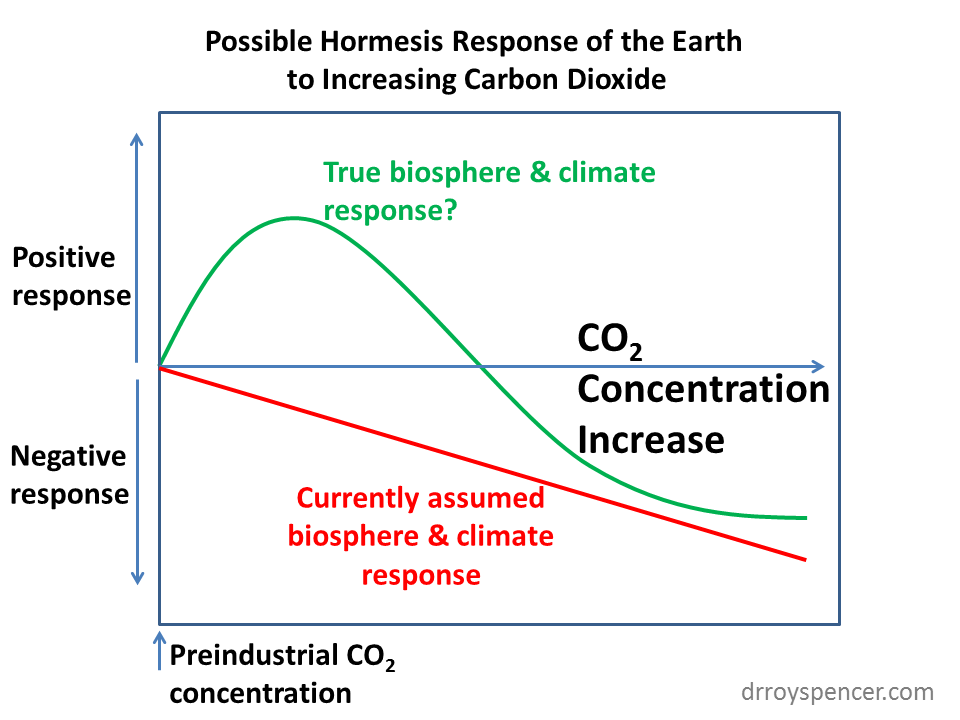
For those who like graphs, the following cartoon shows what I’m suggesting in qualitative functional form for carbon dioxide:

Hormesis-and-CO2

An Earth scientist who has not already sold his soul to the government regulation bureaucracy might legitimately ask, “I wonder if some level of enrichment of atmospheric CO2 is actually a good thing for life on Earth?”, as suggested by the green curve in the above graph.

The straight red line (linear dose response) is, in contrast, what is usually assumed…that any increase beyond that believed to exist before humans arrived is necessarily bad for Mother Earth.

But atmospheric carbon dioxide is necessary for life on Earth, and has risen from a pre-industrial concentration of only 3 parts per 10,000, to (still only) 4 parts per 10,000 today. The result has been global greening and a moderation of global temperatures (at least partly due to more CO2, in my opinion). Theoretically expected negative impacts on severe weather and marine life have, so far, failed to reach any believable level of cause-and-effect, beyond normal natural variability.

(And if you are tempted to cite statistics of a record number of whatever events, I will ask whether humans are also responsible for the recent “grand maximum” record high sunspot activity out of the last 3,000 years? Was that Bieber’s fault, too? Or maybe Manbearpig’s fault?).

I’ve had plant physiologists tell me it’s almost as if nature has been sucking as hard as it can on atmospheric CO2, and has depleted it to the point where only the hardiest life forms can exist. But as we add more CO2 to the atmosphere, nature quickly gobbles up 50% of the extra, leading to a more luxurious and robust biosphere.

So, it is reasonable from an unbiased scientific perspective to examine the possibility that more CO2 is actually good for life on Earth…not just the biosphere, but atmospheric effects as well. After all, we’re not talking about X-rays here…we’re talking about the elixir of life, CO2.

Is there a level beyond which more carbon dioxide would be bad? Probably…but I don’t think we know what that level would be. And, just to be on the safe side, if there was a way to stop producing CO2 without killing millions (if not billions) of people in the process, I might be in favor of that.

But that’s simply not possible with today’s energy technologies. Renewable energy sources cannot contribute to more than 15-20% of total energy demand in the coming decades, so we are stuck with fossil fuels for the time being.

I really don’t care where our energy comes from, as long as it is abundant and affordable for the world’s poor. In the meantime, we need to stop thinking in simple linear dose-response terms which is contrary to so much real world experience and exists mainly to make jobs for regulators and companies that are made rich through subsides rather than through free choice by the public.


This is What We Need. More People to Stand Up, and Speak the Truth!

Though Scorned by Colleagues, a Climate-ChangeSkeptic Is Unbowed


John Christy, a professor of atmospheric science at the University of Alabama, Huntsville, with the weather data he recorded daily while growing up in Fresno, Calif., in the 1960s.
ROB CULPEPPER FOR THE NEW YORK TIMES
 
By MICHAEL WINES

HUNTSVILLE, Ala. — John Christy, a professor of atmospheric science at the University of Alabama in Huntsville, says he remembers the morning he spotted a well-known colleague at a gathering of climate experts.

“I walked over and held out my hand to greet him,” Dr. Christy recalled. “He looked me in the eye, and he said, ‘No.’ I said, ‘Come on, shake hands with me.’ And he said, ‘No.’ ”

Dr. Christy is an outlier on what the vast majority of his colleagues consider to be a matter of consensus: that global warming is both settled science and a dire threat. He regards it as neither. Not that the earth is not heating up. It is, he says, and carbon dioxide spewed from power plants, automobiles and other sources is at least partly responsible.

But in speeches, congressional testimony and peer-reviewed articles in scientific journals, he argues that predictions of future warming have been greatly overstated and that humans have weathered warmer stretches without perishing. Dr. Christy’s willingness to publicize his views, often strongly, has also hurt his standing among scientists who tend to be suspicious of those with high profiles. His frequent appearances on Capitol Hill have almost always been at the request of Republican legislators opposed to addressing climate change.

“I detest words like ‘contrarian’ and ‘denier,’ ” he said. “I’m a data-driven climate scientist. Every time I hear that phrase, ‘The science is settled,’ I say I can easily demonstrate that that is false, because this is the climate — right here. The science is not settled.”

Dr. Christy was pointing to a chart comparing seven computer projections of global atmospheric temperatures based on measurements taken by satellites and weather balloons. The projections traced a sharp upward slope; the actual measurements, however, ticked up only slightly.

Such charts — there are others, sometimes less dramatic but more or less accepted by the large majority of climate scientists — are the essence of the divide between that group on one side and Dr. Christy and a handful of other respected scientists on the other.

“Almost anyone would say the temperature rise seen over the last 35 years is less than the latest round of models suggests should have happened,” said Carl Mears, the senior research scientist at Remote Sensing Systems, a California firm that analyzes satellite climate readings.

“Where the disagreement comes is that Dr. Christy says the climate models are worthless and that there must be something wrong with the basic model, whereas there are actually a lot of other possibilities,” Dr. Mears said. Among them, he said, are natural variations in the climate and rising trade winds that have helped funnel atmospheric heat into the ocean.

Dr. Christy has drawn the scorn of his colleagues partly because they believe that so much is at stake and that he is providing legitimacy to those who refuse to acknowledge that. If the models are imprecise, they argue, the science behind them is compelling, and it is very likely that the world has only a few decades to stave off potentially catastrophic warming.

And if he is wrong, there is no redo.

“It’s kind of like telling a little girl who’s trying to run across a busy street to catch a school bus to go for it, knowing there’s a substantial chance that she’ll be killed,” said Kerry Emanuel, a professor of atmospheric science at the Massachusetts Institute of Technology. “She might make it. But it’s a big gamble to take.”

By contrast, Dr. Christy argues that reining in carbon emissions is both futile and unnecessary, and that money is better spent adapting to what he says will be moderately higher temperatures. Among other initiatives, he said, the authorities could limit development in coastal and hurricane-prone areas, expand flood plains, make manufactured housing more resistant to tornadoes and high winds, and make farms in arid regions less dependent on imported water — or move production to rainier places.

Dr. Christy’s scenario is not completely out of the realm of possibility, his critics say, but it is highly unlikely.

In interviews, prominent scientists, while disagreeing with Dr. Christy, took pains to acknowledge his credentials. They are substantial: Dr. Christy, 63, has researched climate issues for 27 years and was a lead author — in essence, an editor — of a section of the 2001 report of the United Nations Intergovernmental Panel on Climate Change, the definitive assessment of the state of global warming. With a colleague at the University of Alabama in Huntsville, Dr. Roy Spencer, he received NASA’s medal for exceptional scientific achievement in 1991 for building a global temperature database.

That model, which concluded that a layer of the atmosphere was unexpectedly cooling, was revised to show slight warming after other scientists documented flaws in its methodology. It has become something of a scientific tit for tat. Dr. Christy and Dr. Spencer’s own recalculations scaled back the amount of warming, leading to further assaults on their methodology.

Dr. Christy’s response sits on his bookshelf: a thick stack of yellowed paper with the daily weather data he began recording in Fresno, Calif., in the 1960s. It was his first data set, he said, the foundation of a conviction that “you have to know what’s happening before you know why it’s happening, and that comes back to data.”

Dr. Christy says he became fascinated with weather as a fifth grader when a snowstorm hit Fresno in 1961. By his high school junior year, he had taught himself Fortran, the first widely used programming language, and had programmed a school computer to make weather predictions. After earning a degree in mathematics at California State University, Fresno, he became an evangelical Christian missionary in Kenya, married and returned as pastor of a mission church in South Dakota.

There, as a part-time college math teacher, he found his true calling. He left the pastoral position, earned a doctorate in atmospheric sciences at the University of Illinois and moved to Alabama.

And while his work has been widely published, he has often been vilified by his peers. Dr. Christy is mentioned, usually critically, in dozens of the so-called Climategate emails that were hacked from the computers of the University of East Anglia’s Climatic Research Center, the British keeper of global temperature records, in 2009.

“John Christy has made a scientific career out of being wrong,” one prominent climate scientist, Benjamin D. Santer of the Lawrence Livermore National Laboratory, wrote in one 2008 email. “He’s not even a third-rate scientist.”

Another email included a photographic collage showing Dr. Christy and other scientists who question the extent of global warming, some stranded on a tiny ice floe labeled “North Pole” and others buoyed in the sea by a life jacket and a yellow rubber ducky. A cartoon balloon depicts three of them saying, “Global warming is a hoax.”

Some, including those who disagree with Dr. Christy, are dismayed by the treatment.

“Show me two scientists who agree on everything,” said Peter Thorne, a senior researcher at Norway’s Nansen Environmental and Remote Sensing Center who wrote a 2005 research article on climate change with Dr. Christy. “We may disagree over what we are finding, but we should be playing the ball and not the man.”

Dr. Christy has been dismissed in environmental circles as a pawn of the fossil-fuel industry who distorts science to fit his own ideology. (“I don’t take money from industries,” he said.)

He says he worries that his climate stances are affecting his chances of publishing future research and winning grants. The largest of them, a four-year Department of Energy stipend to investigate discrepancies between climate models and real-world data, expires in September.

“There’s a climate establishment,” Dr. Christy said. “And I’m not in it.”

Frauds, Crooks and Criminals

Demonstrating daily that diversity is not strength!

Family Hype

All Things Related To The Family

DeFrock

defrock.org's principal concern is the environmental and human damage of industrial wind turbines on rural communities

Gerold's Blog

The truth shall set you free but first it will make you miserable

Politisite

Breaking Political News, Election Results, Commentary and Analysis

Canadian Common Sense

Canadian Common Sense - A Unique Perspective from Grassroots Canadians

Falmouth's Firetower Wind

a wind energy debacle

The Law is my Oyster

The Law and its Place in Society

Illinois Leaks

Edgar County Watchdogs

stubbornlyme.

My thoughts...my life...my own way.

Oppose! Swanton Wind

Proposed Wind Project on Rocky Ridge

Climate Audit

by Steve McIntyre

4TimesAYear's Blog

Trying to stop climate change is like trying to stop the seasons from changing. We don't control the climate; IT controls US.

Wolsten

Wandering Words

Patti Kellar

WIND WARRIOR

John Coleman's Blog

Global Warming/Climate Change is not a problem