Stop the Climate Insanity….It’s a HUGE Scam!

Bjørn Lomborg: Wind Power ‘Tree’ Symbolises Futility of Paris Climate Jamboree

wind tree paris

****

As a baggage train of some 40,000 climate-cultists get set to jet their way home from Paris – burning up a gazillion gallons of (what they normally rail about as being atmosphere incinerating) kerosene – the fair question has to be asked: ‘and all for what?’

The belief that China and India were going to sign up to terms guaranteed to keep more than a billion people (between them) locked in permanent Stone Age poverty was pure infantile nonsense.

Pragmatist, Narendra Modi is quite right to care a whole lot less about Western anti-humanity, eco-zealots, and a whole lot more about the 300 million or so of his constituents who subsist in world of dirt-floored shanties, without so much as the hope of enjoying an affordable supply of around-the-clock electricity.

poverty india

****

The cultists fumed in Paris, as India and China put the needs of their people ahead of demands from selfish lunatics; equipped with little more than ideology, Macbook Airs and Twitter, as an outlet for their self-possessed rantings. So much easier to pontificate about how the poorest in the world should live (now and forever) with a belly full of Veuve Clicquot and Foie Gras while sitting in 5 star, centrally-heated comfort.

China and India aren’t about to deprive their people of an opportunity to have light at the flick of a switch; and they aren’t about to entertain the insane costs of solar and wind power to get there (save at the symbolic margins): between them, India and China are building, and planning to build, hundreds of new coal and nuclear power plants; designed to drag their people out of the darkness and into well-lit homes and bustling new factories (see this article).

Back in reality land, the childish symbolism that is wind power, copped a spray from the wind industry’s loudest critic, Bjørn Lomborg.

STT takes a different view to Bjørn about the ‘connection’ made between wind power and CO2 emissions:

Bjørn Lomborg: Believe in the Easter Bunny and Tooth Fairy? Then You’ll Probably Believe Wind Power Replaces Fossil Fuels, Too

He also falls for the lazy-language trap of referring to CO2 gas (a naturally occurring trace gas essential for life on Earth) as ‘carbon’: the black sooty stuff that makes a mess of white linen.

But Lomborg is right on the money where he points out the ludicrous costs and pointlessness of a wholly weather dependent power source.

Blowing a chance to help the planet
The Australian
Bjørn Lomborg
5 December 2015

‘Wind tree’ sums up the futility of the Paris climate talks

Outside the Paris climate conference centre, organisers have erected a “wind tree” (arbre a vent), which produces electricity using the power of the breeze. In doing so, they have summed up exactly what is wrong with the conference.

The tree will only produce 3500 kWh a year and it costs about $37,100. So, at a production price of about 11c a year, it will take 89 years to make up just the capital cost. Or, put differently, the cost is 300 per cent more expensive than even traditional wind power, which still struggles without subsidies.

The Conference of Parties (COP21) is about feeling good: spending a lot of money to do very little good, and not about making the choices that will make any difference.

This summit is “the last chance” to avert dangerous temperature rises, if we listen to the Earth League or a bunch of others. It’s going to be “too late” if a meaningful treaty isn’t negotiated here in the next few days, says the French President. It’s a familiar script. Doom-laden warnings about the “last chance to save the planet” date as far back as the earliest climate summits 20 years ago. Time magazine declared 2001 “a global warming treaty’s last chance”, and in 1989 the UN Environment Programme’s executive director warned that the planet faced an ecological disaster “as final as nuclear war” by the turn of the century.

Amid this alarmism, for 20 years well-intentioned climate negotiators have tried to do the same thing over and over and over again: negotiate a treaty that makes an impact on temperature rises. The result? Twenty years of failure with no significant effect on climate change.

These summits have failed for a pretty simple reason. Solar and wind power are still too expensive and inefficient to replace fossil fuels. The Copenhagen-Paris approach requires us to force immature green technologies on the world even though they are not ready or competitive. That’s hugely expensive and inefficient.

Thanks to campaigning non-governmental organisations, politicians and self-interested green energy companies that benefit from huge subsidies, many people believe that solar and wind energy are already major sources of energy.

The reality is that even after two decades of climate talks, they account for a meagre 0.5 per cent of total global energy consumption, according to the International Energy Agency.

And 25 years from now, even envisioning everyone doing all that they promise in Paris, the IEA expects we will get just 2.4 per cent from solar and wind. That tells us that the innovation that’s required to wean the planet off reliance on fossil fuels is not taking place.

That’s why the one glimmer of hope in Paris has been the announcement by Bill Gates, along with Australia, China, India and the US, of a multi-billion-dollar fund for green R&D.

The $27 billion fund is just a first step, but it’s a vitally important one. Just as massive support for research and development got us to the moon, the aim is for a massive focus on green research and development to make climate-friendly forms of energy competitive. This is precisely what the Copenhagen Consensus Centre and I have been arguing for more than eight years.

In a recent peer-reviewed research paper, I looked at all the carbon-cutting promises countries committed to ahead of Paris (their so-called intended nationally determined contributions, or INDCs) for the years 2016-30.

These are what the Paris global treaty will be based on (along with a lot of claims about what might happen outside those dates — something that’s easy for politicians of today to talk about, but that we just can’t take seriously).

What I found when I looked at the national promises was that they would cut global temperatures by just 0.05C by 2100.

And even if every government on the planet not only keeps every Paris promise, reduces all emissions by 2030 and shifts no emissions to other countries, but also keeps these emission reductions throughout the rest of the century, temperatures will be reduced by just 0.17C by the year 2100.

And let’s be clear, that is incredibly — probably even ridiculously — optimistic. Consider the Kyoto Protocol, signed in 1997, never ratified by the US, and eventually abandoned by Canada and Russia and Japan. After several renegotiations, the Kyoto Protocol had been weakened to the point that the hot air left from the collapse of the Soviet Union exceeded the entire promised reductions, leaving the treaty essentially toothless.

The cost of these policies? Extraordinarily, UN officials provide no official estimated costs for the likely treaty. So we are left to make an unofficial tally, which we can do easily enough by adding up the costs of Paris promises submitted by the US, European Union, Mexico and China, which together account for about 80 per cent of the globe’s pledged emissions reductions.

In total, the Paris promises of these four countries/groupings will diminish the global economy by at least $1 trillion a year by 2030 — and that is in an ideal world, where politicians consistently reduce emissions in the most effective, smartest possible ways.

But that won’t happen. It never has in history.

Politicians have a habit of wasting money on phenomenally inefficient subsidies for solar and biofuels. And based on the EU experience, such waste can double the costs of carbon-cutting policies to $2 trillion. That’s $1 to $2 trillion that won’t be spent on global challenges such as malnutrition, poverty and communicable diseases.

We are spending a fortune to make ourselves feel like we are saving the planet. The “wind tree” is an excellent symbol of what’s wrong with Paris.

Bjorn Lomborg is an adjunct professor at the Copenhagen Business School and directs the Copenhagen Consensus Centre.
The Australian

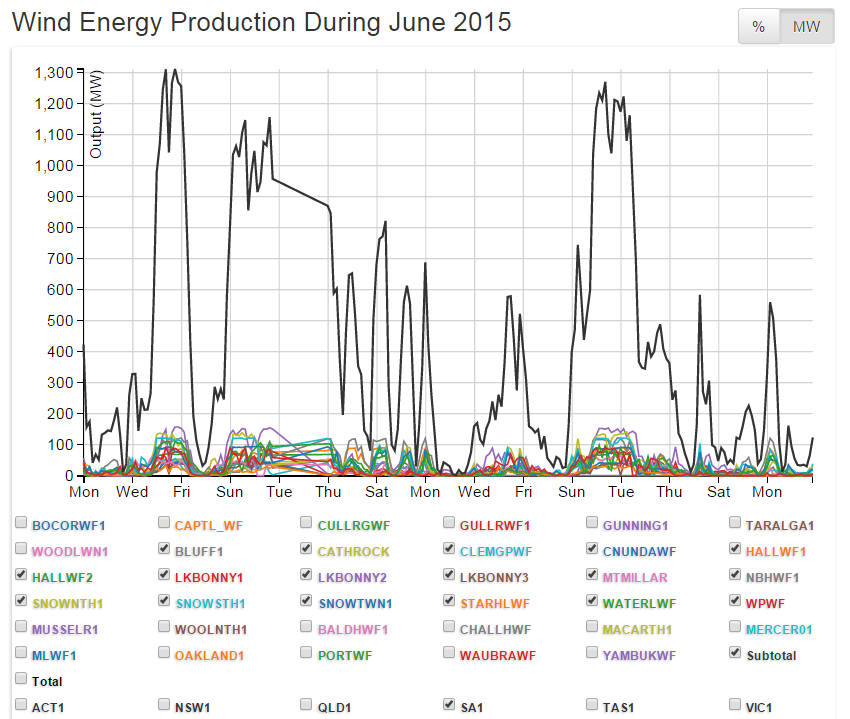
Earlier in the week, The Australian’s Editor had the following take on Lomborg’s message on energy innovation; a message that makes it fairly clear: wind power is an abject failure – for fairly obvious reasons – here’s the output from all wind farms connected to the Eastern Grid (installed capacity of 3,669MW – spread over NSW, VIC, TAS & SA) during June:

June 2015 National

And, if there is to be a true alternative to fossil fuel power generation sources, then we should stop praying to the Wind Gods, and find something that’s recognizable as a ‘system’, rather than a lesson in total ‘chaos’.

Climate change demands innovation, not subsidy
The Australian
2 December 2015

Faith in clean energy technology has a long pedigree

No need to get hot under the collar — Malcolm Turnbull’s climate policy is fundamentally the same as Tony Abbott’s. The targets that the Prime Minister took to Paris — emission reductions of 26-28 per cent by 2030 — are those adopted by Mr Abbott in August.

These targets are proportionate to Australia’s economic weight and our small contribution to the world’s greenhouse gases. They are consistent with the precautionary principle that Australia should not get ahead of the northern hemisphere’s big polluters. It’s true that Mr Turnbull has left open the possibility in the future that Australia would concur in a collective agreement to pursue deeper cuts. By definition, this would not involve Australia going it alone.

There is a pseudo controversy over climate mitigation and foreign aid. In Paris, Mr Turnbull announced a five-year diversion of at least $1 billion from the foreign aid budget to climate mitigation projects in the Pacific. Labor’s complaints ring hollow. Only last month Bill Shorten toured the Pacific (remember the prophesied climate refugees?) to talk up the threat of climate change.

Now, in consultation with Pacific nations, Australia is dedicating funds to climate mitigation projects in the region. As for the effect on foreign aid spending more generally, it was Labor that inflated the budget to win a seat on the UN Security Council.

On climate change Mr Turnbull’s point of difference with Mr Abbott is his emphasis on innovation as a tool for mitigation and adaptation. Innovation is a theme of the Turnbull government but it takes on special significance at the Paris climate meeting. Australia has promised to double its clean energy research and development as part of the 20-nation project known as Mission Innovation.

In his Paris speech, Mr Turnbull said: “We firmly believe that it is innovation and technology which will enable us both to drive stronger economic growth and a cleaner environment. We are a highly social and innovative species and so the more we share innovative technologies, the better they will become.” This commitment coincides with the unveiling in Paris of the Breakthrough Energy Coalition spearheaded by Bill Gates, Mark Zuckerberg and other entrepreneurs. They will invest in clean energy projects in sectors such as electricity generation and storage.

As Macquarie University’s Jonathan Symons says, the impetus to innovate sometimes has been misrepresented by environmentalists as a manifesto for inaction. “It is true that the cost of wind and solar are falling rapidly and both can now be competitive at low levels of grid penetration,” Dr Symons says. “However, associated system costs and technical challenges increase with the market share of intermittent energy. Without accelerated innovation, it is clear that existing renewable technologies will not support deep decarbonisation of the global economy.”

He also points out that notwithstanding Mr Turnbull’s timely gospel of climate innovation, this has been a faith subscribed to by figures as diverse as John Howard, Barack Obama, British economist Nicholas Stern and commentator Bjorn Lomborg.

In 2005 Mr Howard joined the Asia-Pacific Partnership on Clean Development and Climate. Known as AP6, this was an initiative of George W. Bush and one that emphasised voluntary climate mitigation through the sharing of clean energy technology. It shows that the conservative side of politics has long recognised the need for climate mitigation by innovation.

Dr Lomborg’s championing of innovation is central to his view that the Paris meeting, like the meetings before it, is likely to generate alarmist rhetoric (anyone like another last chance to save the planet?) but fail to advance the cause of climate mitigation.

“For twenty years, we have insisted on trying to solve climate change by supporting production of mainly solar and wind power,” he says in a blog for this newspaper. “The problem with this approach is that it puts the cart in front of the horse.

Green technologies are not yet mature and not yet competitive, but we insist on pushing them out to the world. Instead of production subsidies, governments should focus on making renewable energy cheaper and competitive through research and development. Once the price of green energy has been innovated down below the price of fossil fuels, everyone will switch.”

Dr Lomborg greeted the Mr Gates-led coalition as a positive sign confirming innovation as the key to climate mitigation. But he points out that today’s favoured subsidies do not encourage innovation, instead making companies stick to inefficient but subsidised technologies such as solar and wind power.

After two decades of climate talks, solar and wind account for just 0.5 per cent of global energy. “And 25 years from now, even with a very optimistic scenario, envisioning everyone doing all that they promise in Paris, the International Energy Agency expects that we will get just 2.4 per cent from solar and wind,” Dr Lomborg says.
The Australian

wind turbines

Speaking of the Paris Climate Conference…Spain’s Largest Solar Company goes Bankrupt!

Inconvenient timing: On eve of Paris Climate Conference, Spain’s Abengoa Solar goes bankrupt

EZRA LEVANT REBEL COMMANDER

All the fancy people are about to hop on jets and fly to the Paris Climate Conference so they can express how much they don’t like things like, uh, jet fuel.

http://cdn.embedly.com/widgets/media.html?src=http%3A%2F%2Fwww.youtube.com%2Fembed%2FA3h9BrDFsz4%3Fwmode%3Dtransparent&wmode=transparent&url=https%3A%2F%2Fwww.youtube.com%2Fwatch%3Fv%3DA3h9BrDFsz4&key=e1208cbfb854483e8443b1ed081912ee&type=text%2Fhtml&schema=youtube

And one of the things we’re going to hear is how we need to be more like Europeans when it comes to green energy.

Here’s one headline:

“Spain Got 47 Percent Of Its Electricity From Renewables In March”

There’s more:

“People visit the Santa Coloma cemetery, outside Barcelona, Spain,  The city council has installed 462 solar panels on top of the grave niches.”

Gross, right?

But they’re all getting rich off it! Abengoa, one of Spain’s wealthiest companies, has solar plants all around the world.

Yeah, why can’t we be more like them?

Except today, this is the number one news item in Spain: Abengoa is bankrupt.

Nine billion Euros in debt — that’s about $14 billion. 27,000 employees.

The largest bankruptcy in Spanish history.

And because Spain has amongst the highest power prices in Europe — about triple what we pay here in Canada — driven out a lot of manufacturing.

Do you know what the unemployment rate is in Spain now? 22%. And that’s the lowest it’s been in years.

So, yeah, Spain. That’s you’re role model.

Especially for Ontario’s Kathleen Wynne — and now Alberta’s Rachel Notley


Wind Energy…..Much Less Power, for MUCH MORE money!!!

Rocketing Prices AND Blackouts: South Australians Lament Their Dark & Dismal Wind ‘Powered’ Future

waterloo

SA’s media digs into its wind power debacle: spiralling
power prices AND mass blackouts, who would have thought?

****

A week back we covered the unfolding calamity in South Australia – where a sudden wind power output collapse plunged 110,000 homes into darkness, across most of the State, without warning:

Wind Industry’s Armageddon: Wind Farm Output Collapse Leaves 110,000 South Australian Homes & Businesses Powerless

What’s become painfully clear to the general populace (although probably at times when they’re without the aid of electric light) is that attempting to ‘rely’ on a wholly weather dependent generation ‘system’ is a seriously dangerous fantasy.

In the aftermath of one of the worst blackouts in recent history, politicians of all persuasions copped a grilling on radio stations; from people like ABC’s Matt and Dave; and 5AA’s, Leon Byner.

Byner is to South Australian airwaves what Alan Jones is to national radio broadcasting; sharp and to the point – and with a “take no prisoners” attitude. As the interview below attests.

First, a little background on the protagonists. Christopher Pyne is a Liberal member of Federal Parliament, steeped in South Australian Liberal politics.

Tom Koutsantonis, Industry Minister in the State Labor government, has been top head kicker and part of Labor’s squad; going back to Premier Mike Rann – the principal offender in South Australia’s unfolding wind power disaster.

Danny Price, energy market expert with Frontier Economics, hates wind power with a burning passion; and has been pointing out the ludicrous costs of subsidising wind power, as well as the insanity of trying to rely upon a wholly weather dependent generation source, for years now.

What follows is a very telling exchange amongst them.

SA’s State power outage and Renewable Energy
Leon Byner with Tom Koutsantonis
5AA
2 November 2015

LEON BYNER: The Industry Minister joining us, Christopher what do you say?

CHRISTOPHER PYNE: Good morning Leon, well the point that I wanted to make was that South Australians pay the highest energy prices in Australia.

We have one of the most unreliable supplies of energy. We’ve been obsessed for some years with renewable energy, which in itself is not a bad thing. But I think the public, it always surprises me how they don’t understand that they are subsidising wind and solar power to such an enormous extent.

They seem to think when I talk to people in the supermarkets in my electorate for example, that this is all coming without a cost. But the truth is the only reason wind power is viable in South Australia is because of the massive subsidies being paid by the taxpayer and the same goes for solar power.

And even more concerning to me, to have solar power in years gone by you needed to stump up the several thousands of dollars to get the solar energy and then you got the subsidy. Which means the poorest South Australians were subsidising some of the most well off South Australians, who have got much lower energy costs as a result of solar power.

So, I just think that in the debate the public need to know the facts, which are that these things don’t come without a cost.

LEON BYNER: What would you be suggesting the Government do, Chris?

CHRISTOPHER PYNE: Well obviously the Government has made some bad decisions and bad choices over the years because of an ideological obsession with renewable energy and I wouldn’t discourage renewable energy. But they also made it harder for Alinta to stay in business.

When Alinta said that they were closing Leigh Creek and Port Augusta, one of the factors they stated was because of the subsidies for wind and solar power. Now how they produce those subsidies is something that the State Government needs to look at, because it’s a question whether they are sustainable at the level that they are into the future, especially if they are not delivering, as we saw last night, reliable power to South Australia. Or maybe the South Australian Government needs to invest in another way of connecting with interstate energy rather than the one we have through Hayward at the moment.

LEON BYNER: Ok what do you say Tom?

TOM KOUTSANTONIS: Well I think a lot of what Christopher says is right. There is only one problem, it’s not the State Government that’s subsidising Leon, it’s the Commonwealth Government. They are the ones that give the subsidies to the wind generators, but the reality is, is that we needs to be a national solution to this problem because coal is not sustainable. The world is not going to keep burning coal to generate electricity; the world is going to look to other sources…

LEON BYNER: Yes but we have an immediate need and I don’t think you were…

TOM KOUTSANTONIS: Yes I understand that. We have an abundant transitional energy source here in South Australia, which is gas. Now we should be doing as much as we can to incentivise gas. We are in this perverse position where the Commonwealth Government are incentivising renewables as has the state in the past with the solar feeding tariffs off peoples rooves and then coal is given preferential treatment and the transitional fuel in the middle, gas and which is probably the solution to our energy needs gets almost nothing.

Now the reality is we need to be looking at what our natural abundant resources are, especially in this state and we have two of them: uranium and gas. So we should be doing as much as we can to support and incentivise the export of uranium out of the state for the world’s power needs and doing as much as we possibly can to incentivise the extraction of gas for generations to come in South Australia.

LEON BYNER: Yes but you see you can do all the extraction you like, it’s still got to be viable. Chris, what do you say to that?

CHRISTOPHER PYNE: Well I think it’s hard for Tom Koutsantonis to claim that the Rann-Weatherill Government didn’t do a great deal to encourage wind generators to be set up in South Australia.

I mean they provided a great deal of support for wind power and Mike Rann trumpeted South Australia’s growing reliance on wind power as has Jay Weatherill.

Now I agree however with Tom that what we do need to do is get our uranium moving out of Australia and that’s why the current Federal Government is trying to settle a deal with India to sell them uranium and I’d encourage him to encourage his federal colleagues to make that easier rather than harder, because that well help us get the revenue he needs and the Commonwealth needs and particularly the South Australian Government needs to invest in energy.

This is something that needs to have a bipartisan approach between Labor and Liberal and he can help us with his federal colleagues to make that treaty with India around uranium sales sail smoothly through the Parliament.

LEON BYNER: Now Tom so let me get this right, you’re going to make an announcement sooner rather than later on incentivising some kind of, either other interconnection or indeed base load power, because as Danny Price pointed out with the upgrade of the interconnector, lightening or other problems aren’t going to be much use to us.

TOM KOUTSANTONIS: Yes that’s right; we need to incentivise the existing base load energy that we already have…

LEON BYNER: And you’ll be making an announcement about that when?

TOM KOUTSANTONIS: I will very, very soon and I’ll come on your programme and I can talk to your listeners, I’m quite happy to do that with you Leon. But I’ll just point out this, the Howard Government, the Rudd-Gillard-Rudd-Abbott-Turnbull Governments all subsidise wind.

The support we give them is planning approval and the actual subsidy for the power generated comes from the Commonwealth Government. So I don’t want to get into a he-said, she-said with Christopher other than to say this is a national problem and we need national solutions and this State Labor Government, especially me as Energy Minister and Treasurer, I am very keen to work with Christopher to come up with a solution that benefits South Australia and the nation.

LEON BYNER: Alright just quickly, Danny Price is what you’re hearing today is that ‘hey they get it’ yet or what?

DANNY PRICE: Nothing else has this ability to concentrate with this level of political interest and I’m kind of pleased to see this, because this has been a long time coming. I think what the Minister’s saying about wind farms is exactly right. I think it’s disingenuous to say that this is just a Commonwealth problem. But I also agree with the Treasurer that it has to be a national solution. South Australia is just part of what we call the national electricity market. It has to be a national…

LEON BYNER: One question, we got nothing up the connector and there are those who say why didn’t the other states that have got electricity feel any pain? Or was it just because of our reliance on wind that failed?

DANNY PRICE: Well the market is basically designed to as much as possible cut the cost consequences of local problems to that local region and that’s precisely why the market is set up that way.

Now in South Australia people are now looking for solutions for supply in South Australia, that’s what the market is designed to do.

My only concern with what the Treasurer seems to be hinting at is that it may be that he’s thinking about contracting directly with the Pelican Point power station, but the problem with that of course is that you have to think about the consequences down the line and so if these primary generators suddenly think that they’ve got the Government over the barrel and the Government is prepared to directly contract with these generators, you might find them offering less on the market than they would otherwise which forces the Government’s hand. So you’ve got to be careful about starting that game.

LEON BYNER: Danny Price thank you. Well know you’ve got the full story about what happened last night and the fact that it won’t be the end.
5AA

DannyPrice_banner1

Of Byner’s line up, only Danny Price really gets it.

****

Despite Koutsantonis being an entrenched member of the team that created the wind power debacle in South Australia, he was remarkably quick off the mark to throw responsibility back at the Federal Government when he (rightly) says: “the actual subsidy for the power generated comes from the Commonwealth Government”.

Indeed it does; soon to be a figure in the order of $3 billion a year – all added on top of already rocketing Australian retail power bills:

Out to Save their Wind Industry Mates, Macfarlane & Hunt Lock-in $46 billion LRET Retail Power Tax

But Koutsantonis’ line that his State Government merely facilitated the rollout of 1,477MW of wind power capacity with SA’s 17 wind farms is kind of glib – reminiscent of war criminals who, when thrown in the dock by the victors, claimed they were “only following orders”.

All too cute, for STT’s liking. His former boss, Mike Rann saw to it that SA went harder and faster into the wind power fraud, than any other State; for his (and his relatives) own selfish, pecuniary interests; and did so without ever even considering the costs or putative benefits of a subsidy-scam loaded with the former; and bereft of the latter.

But, precisely the same can be said of the successive Federal governments that set up and have maintained the Large-Scale RET – the largest, single industry subsidy scheme in the history of the Commonwealth by a country mile (see the link above).

Although, as things are turning out, the accusatory finger-pointing between State and Federal governments, over just who’s responsible for South Australia’s calamitous energy mess, is of no real concern to South Australians.

Among the 110,000 homes and businesses that were plunged into darkness, two weeks ago, when wind power disappeared in the blink of an eye, there isn’t a whole lot of interest in whether it’s State or Federal policy to blame. These people are already sick and tired of paying the highest power prices in the Nation (if not, on a purchasing power parity basis, the highest in the world).

Plunging them into darkness without warning (placing them and their families at unnecessary mortal risk – think people at home on life support systems; and unlit intersections without functioning traffic lights) simply because wind power output collapsed is, for most, a bridge way too far.

Despite the best efforts of the wind industry’s top propaganda merchants, South Australians are a wake up to the fact that it wasn’t the fault of the interconnectors – that are designed to merely transport power (when available) from Victoria and New South Wales – but, rather, the fact that the 40% of SA’s generating capacity (said to always come from wind power) collapsed, because the wind stopped blowing that fateful Sunday night. Funny about that.

SA 1 Nov 15

It’s a little hard for the wind industry and its spruikers to blame something else; when, for more than six years, they’ve been ramming the ‘wonders’ of wind power down South Australian throats, with maniacal zeal.

If you’re continually talking up SA’s brilliant “wind resource”; and bragging out loud via every media outlet about those (few) occasions when wind power output registers a half-decent proportion of its actual capacity, you’re going to have trouble explaining away those occasions when total (and totally unpredictable) collapses in wind power output coincide with mass blackouts. As this one, most certainly did.

No, this time around the cat is well and truly out of the bag.

In the hierarchy of media, when an issue becomes the top story on Channel 7’s Today Tonight, you can guarantee you’ve reached not only a substantial audience by number; but that you’ve also hit political dead-centre – in terms of reaching voters capable of deciding elections; and policies on the way to them.

The Today Tonight viewer mightn’t be a Twitter jockey, but he or she is a first-class talker; whether it’s at work or backyard barbecues, whatever they’ve seen soon becomes the topic of the day (or the week). When the topic is their spiralling power bills and, despite paying through the nose for the stuff, suffering statewide blackouts to boot, you can guarantee plenty of fist-waving fury being added to tea room and backyard debates on just who, or what’s to blame.

Just how dire things are for the wind industry, is laid out in just such a barbecue-stopper of a Today Tonight broadcast; one that has snapped South Australians out of their complacency about energy policy, in general; and their wind power debacle, in particular.

The only trick that Today Tonight missed, was the fact that the blackout wasn’t the interconnectors’ fault. As detailed in last week’s post (and the graph above), the interconnectors ‘failed’ because they became overloaded, as wind power output plummeted that night. The ‘load’ being drawn by SA over the interconnectors rose exponentially (and inversely with the wind power output collapse) until they hit the limit of their capacity and ‘tripped’, plunging SA into pre-historic gloom for hours.

STT hears that Today Tonight has been directed to our blackout post; and is keen to follow up with a story that sets the record straight, laying the blame – where it belongs – fair-and-square on SA’s ludicrous ‘reliance’ on the vagaries of the wind.

(Click on the image below to reach Today Tonight’s video of the broadcast – transcript appears below)

****
today tonight

Transcript:

Rosanna Mangiarelli (Presenter): Good evening and welcome to the program. First tonight the price we’re all likely to pay for South Australia’s renewable energy experiment. Now as power stations close and we rely more and more on wind and solar power, the outlook, according to some experts is dim. Job losses, skyrocketing prices, and ongoing blackouts and as Hendrik Gout reports, they’re just some of the risks the state’s taking as we enter the untested and the unknown.

Hendrik Gout (Reporter): We South Australians are living in an experiment, a world first. We’re the white mice in this state-sized laboratory.

Mathew Warren (CEO, Energy Supply Association of Australia): South Australia is an accidental experiment in the deploy of renewables at scale in a large grid around the world.

Danny Price (Managing Director, Frontier Economics Australia): South Australia is the canary down the mine as it were. It’s more likely that there’s going to be blackouts because of the combination of your reliance on the interconnector, but particularly because of the large reliance on wind.

Mathew Warren: When we look around the world the problem is no one is doing it as aggressively as South Australia.

Hendrik Gout: Sometimes this experiment goes catastrophically wrong. On the night of Sunday the 1st of November 2015, Adelaide went black. It was lights out at 10 PM. 100,000 homes, businesses, service stations, all the streetlights, all dead, because of this – the interconnector. Think of it as a heavy-duty extension cord, taking electricity from Victoria’s Latrobe Valley power stations to energy dependant South Australia. And when it fails…

Danny Price: Unless those interconnectors are running it’s extremely difficult to reliably meet supply in South Australia.

Hendrik Gout: Danny Price from Frontier economics has shocking news for South Australia.

Danny Price: South Australia is an experimentation in systems control, power systems control and I think people are struggling to work out how it’s going work.

Hendrik Gout: Thomas Playford, Premier from the 30s to the 60s, decided South Australia should be electrically self-sufficient. His government developed the Leigh Creek coal fields to fuel this, South Australia’s huge Port Augusta plant. 800 million watts, for thoroughly modern living.

Narrator: You will envy this little lady, and say to yourselves, I would like an electric range myself.

Hendrik Gout: Here on Torrens Island, locally produced thermal electricity.  And then ten years ago we cast our fate to the wind.

Mike Rann (Former SA Premier): Bit by bits we’ve started the process of making South Australia the leader in wind energy in Australia.

Pat Conlon (Former Labor Minster for Energy in SA Government): The truth is, green energy isn’t any cheaper in terms of dollar price than conventional energy but it is much, much cheaper for the environment.

Hendrik Gout: But from Starfish Hill to Snowtown, Waterloo to Wattle Point, Waymouth to Woakwine, it was new dawn for some and the end of an era for others. Fuelled by easy State Government approval, often overriding local objections, wind farms grew exponentially. Yet they produce power only intermittently.  They’re unreliable, and sometimes they have their share of itty-bitty problems.

How many windfarms do we have, installed, planned, approved, or under construction? This many – 39.

Mathew Warren: Certainly the numbers that we are at now, around 40% of generation coming from solar and wind is incredibly high by global standards. And the world’s watching. The world is interested in how South Australia manages this.

Hendrik Gout: Australia’s Energy Supply Association is the industry’s peak national body.  Its boss is Mathew Warren.

Mathew Warren: Clearly we need to pay very close attention to South Australia. It’s really at the cutting edge of integrating renewables in the world and that brings with it both, you know challenges but also risks.

Hendrik Gout: And those risks, well somebody accidentally unplugging this extension cord.

Mathew Warren: Sunday night was an event that no one planned when there was a fault, and the interconnector was out, and the consequences were an outage.

Hendrik Gout: The potential problems, says Danny Price, will get worse when the Northern Power station at Port Augusta closes early next year.

Danny Price: That’s the largest, single largest power station in the state and one that provides large quantities of reliable cheap energy.

Hendrik Gout: And South Australia has the most expensive electricity in the country. You probably pay more than $2,500 a year for electricity. People who live in the ACT pay not even $1500. In 2010 an 18% hike, 17% the next year, nearly 13% in 2012. Down by 1.8% (somebody probably got sacked for that) and then up again in 2014.

Hendrik Gout: So how much are your electricity bills a quarter?

Robert Bell: They’re up to around 3 grand.

Hendrik Gout: And what were they when you started?

Robert Bell: They were about $800-$900.

Hendrik Gout: Robert Bell sells fish from his Glynde aquarium. His tanks have heaters, pumps, bubblers.

Robert Bell: It’s now the second biggest bill that we have here, behind rent. It’s tripled in the last 6 years. It’s got a double edge sword effect for us. The customers are closing down their tanks and all the while, our overheads are going up here, with electricity.

Hendrik Gout:  So fewer people are buying and your own costs are going up.

Robert Bell: Exactly.

Hendrik Gout: Compounding the problem –these -Solar PV systems.

Mathew Warren: South Australia has around 25% of its housing stocked now with solar panels on their roofs. This is the highest rate of roof-top solar PV penetration in the world.

Hendrik Gout: And that’s also pushing up prices through generous State government subsidies.

Mathew Warren: The renewable technologies, once they displace conventional generators are more expensive. If they were cheaper it would be a lot easier to manage this challenge.

Hendrik Gout: The closure of the Port Augusta power station also comes at a cost. A human cost – hundreds of South Australian jobs disappear as we switch to Victorian power, made by Victorian labour. According to Danny Price, wind power isn’t filling the vacuum.

Danny Price: We don’t actually develop any wind technology here, we buy it all. We just simply assemble and that technology and it doesn’t take much labour to run it.

Hendrik Gout: An increased risk of blackouts, crippling power prices and the country’s highest unemployment.

Robert Bell: The economy is in a bad state and Adelaide, itself, is in a really bad state.

Hendrik Gout: The perfect storm.

Robert Bell: It really is for business owners in South Australia at the moment.

Danny Price: Some of the largest employers are those who use quite a lot of electricity. I am extremely doubtful that any new business would set up in South Australia. I think that they would be mad to, simply because of the high cost of electricity, which is set to get higher and unfortunately, more unreliable.
Today Tonight

blackout

That Today Tonight story hit the nail on the head.
Now, has anyone got any matches and candles?

Not Often CNBC Allows an Article Like This….”How Mother Nature Helps prevent Climate Change!”

How Mother Nature helps prevent climate change

1 Hour Ago

Large floating contraptions, used by scientists to predict the acidity in the oceans, sit offshore the scientific outpost of Ny-Alesund. The cold water at the poles is able to absorb more carbon dioxide than tropical waters and therefore increases acidity quicker. Though it is a relatively small amount, the effects on the ocean's chemistry can be dramatic.

Martin Bureau | AFP | Getty Images
Large floating contraptions, used by scientists to predict the acidity in the oceans, sit offshore the scientific outpost of Ny-Alesund. The cold water at the poles is able to absorb more carbon dioxide than tropical waters and therefore increases acidity quicker. Though it is a relatively small amount, the effects on the ocean’s chemistry can be dramatic.

Humans worried about climate change are getting some help from Earth — for now.

Earth’s land and ocean currently absorb about half of all carbon dioxide emissions from the burning of fossil fuels and other sources. But the amount of carbon entering the atmosphere may be changing nature in ways that leave scientists uncertain whether the planet can keep absorbing even that amount of carbon in the future.

Since the Industrial Revolution, carbon levels have increased 2.5 times to more than 400 parts per million at present, said Michael Freilich, director of NASA’s Earth Science Division, in a call with reporters Thursday. That is higher than it has been in the last 400,000 years.

He added that scientists know, from ice cores and other information, that carbon levels in the atmosphere hovered between 180 and 280 parts per million until about the 1800s.

Freilich and his colleagues at NASA and other institutions discussed the need for more research into how the planet absorbs greenhouse gases, such as carbon dioxide. They also discussed new evidence taken from Orbiting Carbon Observatory-2 — NASA’s first satellite designed to measure carbon dioxide “from the top of Earth’s atmosphere to its surface,” according to a NASA press release.

The data from space gives a significant advantage in getting an idea of the total carbon cycle around the entire planet, said Annmarie Eldering, OCO-2 deputy project scientist at NASA‘s jet propulsion laboratory in Pasadena, California.

On average about half of all of the carbon that enters the atmosphere is absorbed by the ocean or by forests — though that can vary, and some evidence suggests the increased levels of carbon in the ocean may be creating conditions — such as raised acidity levels in seawater — that are making it more difficult to absorb carbon, said Scott Doney, chair of the Marine Chemistry and Geochemistry Department of the Woods Hole Oceanographic Institute.

“The land and the ocean are really doing us a big favor,” said Lesley Ott, an atmospheric scientist in the Global Modeling and Assimilation Office at NASA‘s Goddard Space Flight Center in Greenbelt, Maryland, in a press release. “Otherwise you would have carbon building up in the atmosphere twice as fast as it does now.”

Forests on land — increasingly prone to wildfires — may be emitting more carbon than they take in, as well. Wildfires were rampant across much of the western United States in 2015. Research released this year said wildfire seasons are lasting longer almost everywhere on the planet. Even Alaska saw an unusually high number of wildfires this year.

Warming is also causing permafrost on the world’s tundras to thaw, which is releasing greenhouse gases into the atmosphere as well, according to research.

Even natural gas harvesting is leaking small amounts of methane into the air, and there are questions about whether that could be making any contribution to the total amounts of gases in the air, Doney said.

And natural processes — including weather patterns and periodic climate phenomena such as El Niño — have been seen to have some kind of effect on atmospheric carbon levels, but scientists need to study this further.

Added together, these factors may have considerable effects on the natural processes that absorb carbon, and on the effects of higher carbon levels in the atmosphere.

NASA has been working on several projects that are attempting to get an accurate assessment of the carbon cycle around the globe. They hope they will be able to provide policymakers with more accurate data in the future. Atmospheric carbon levels will be a major topic of discussion at the United Nations climate conference scheduled for Paris in a few weeks.

Unreliable, Impractical Wind Turbines – When the Wind Don’t Blow, the Lights Don’t Glow!

Another Wind Power Collapse has Britain Scrambling to Keep its Lights On (Again)

turbines pylons

Nowhere near as ‘useful’ as they look …

****

There’s an old adage about ‘bad luck’ coming in threes. For the wind industry its rotten ‘luck’ seems to run in endless crashing waves. Here’s another board-snapping set from the UK.

National Grid uses ‘last resort’ measures to keep UK lights on
The Telegraph
Emily Gosden
4 November 2015

Coal plant breakdowns and low wind power output force National Grid to pay dozens of businesses to reduce their energy usage

Britain was forced to rely on new “last resort” measures to keep the lights on for the first time on Wednesday after coal power plants broke down and wind farms produced less than one per cent of required electricity.

National Grid used a new emergency scheme to pay large businesses to cut their electricity usage, resulting in dozens of large office buildings powering down their air conditioning and ventilation systems between 5pm and 6pm.

The scheme, which is paid for through levies on consumer energy bills, was introduced last year but had never been called upon before.

National Grid blamed the power crunch on “multiple plant break downs”. Several ageing coal-fired power plants had unexpected maintenance issues and temporarily shut down, experts said, reducing available supplies.

The problem was compounded by low wind speeds meaning most of Britain’s 6,500 onshore and offshore wind turbines were barely generating any power just as demand hit its highest.

UK wind farms have a theoretical maximum capacity of more than 13,000 megawatts, but produced less than 400 megawatts of power for much of the peak demand period – meeting less than one per cent of the UK’s electricity needs, published data suggests.

T1

Britain’s 8,000 megawatts of solar panel capacity would also have produced no power during the peak, because it was dark at the time.

National Grid first intervened in the market yesterday lunchtime, issuing an alert to power plants that more generation would needed between 4.30pm and 6.30pm.

T2

The alert, called a Notification of Inadequate System Margin, (NISM), was the first to have been issued since 2012.

Short-term electricity prices spiked as a result, with analysts reporting that one power plant was paid £2,500 per megawatt-hour – about 50 times average power prices.

T3

National Grid later announced that it had also had to use a scheme called “demand side balancing reserve” (DSBR) to reduce demand on the Grid by about 40 MW.

The scheme was one of two emergency schemes first introduced last year to help cope with Britain’s tightening power margins, as old coal plants are closed down and not replaced.

T4

The second emergency measure, which has so far not been used, would see a reserve of old power plants fired up.

Businesses that volunteer to take part in the DSBR scheme are paid a retainer, in return for agreeing that they will receive additional payments to cut their demand if needed. National Grid has estimated the scheme will cost consumers about 50p a year.

National Grid had previously said that the schemes would only be used “as a last resort in the event that there is insufficient supply available in the market to meet demand”. Until Wednesday it had never actually asked businesses taking part to cut their usage.

Flexitricity, one of the companies coordinating businesses to take part in the scheme, said commercial energy users had reduced power at 46 sites, mostly by “turning down building ventilation”. This was primarily air conditioning at offices, it said.

A spokesman for National Grid insisted that the measures taken on Wednesday did “not mean we were at risk of blackouts”, only that “we needed the safety cushion of power in reserve to be higher”.

Lisa Nandy, Labour’s shadow energy secretary, blamed Government policy for “creating an energy security crisis” while the GMB Union said Britain was in the “bonkers position… where National Grid is using consumer’s money to pay firms to stop work in order to avoid blackouts”.

The Department of Energy and Climate Change declined to comment.

T5

The Telegraph

Good to see the DECC – willing accomplices in implementing Britain’s energy disaster – quick to front up with reassuring words for British power punters! Maybe they were just busy rounding up truckloads of candles and blankets to secure Britons’ winter energy needs?

Earlier in the week we covered the unfolding calamity in South Australia – where a sudden wind power output collapse plunged 110,000 homes into darkness, across most of the State, without warning:

Wind Industry’s Armageddon: Wind Farm Output Collapse Leaves 110,000 South Australian Homes & Businesses Powerless

What’s become painfully clear to the general populace (although probably at times when they’re without the aid of electric light) is that attempting to ‘rely’ on a wholly weather dependent generation ‘system’ is not only fantasy, it brings with it a host of unnecessary risks to life and limb.

STT can’t wait to hear the cynical efforts from wind worshippers to explain and spin away the hundreds of avoidable deaths, that will inevitably occur, during Britain’s fast looming, dark and bitter winter – when wind power output collapses; the grid along with it; and little old ladies freeze to death in their unlit homes.

What started out as sell-able idea about ‘harnessing’ the power of the wind, has turned into an unmitigated disaster. Welcome to your wind ‘powered’ future.

blackout

Has anyone seen or heard anything from the
boys from the DECC or the Wind Energy Association?

Wind Industry Thugs….Destroying Lives, With Impunity. (Gov’t sanctioned)

Fighting a Monstrous & Cruel Industry: Ireland Declares War on the Great Wind Power Fraud

1397574371-dublin-thousands-gather-to-protest-against-pylons-and-wind-turbines_4479876

****

What kills the wind industry is facts; including the fact that rural communities are fighting back, simply because THESE THINGS DON’T WORK at any level. Here’s a tale from the Emerald Isle that combines just about every pertinent fact, of the kind that spells inevitable doom for the wind industry and its parasites, everywhere.

Families forced to move out of homes due to industrial monster wind turbines
Irish Mirror
Henry Fingleton
9 October 2015

Prolonged exposure to this low frequency noise causes insomnia, headaches, nosebleeds, anxiety and a general inability to function normally

turbines pylons

****

A war is taking place in rural Ireland. Not one with guns, bullets or bombs but with wind turbines and pylons.

Families are being forced to move out of their homes due to the negative health impacts of these giant industrial monsters.

The enormous turbines make so much noise, people who live near them cannot sleep.

Prolonged exposure to this low frequency noise causes insomnia, headaches, nosebleeds, anxiety and a general inability to function normally. Children are especially vulnerable.

Were you ever in the toilets of a night club and noticed how you could feel the base drum in your chest – that’s low frequency noise.

Imagine your children trying to sleep with that sensation.

Shortly after a turbine was built 1.6km from their home, one Co Cork family noticed their kids falling asleep at breakfast. This quickly became a rush to hospital with severe headaches and nosebleeds.

This family was forced to move from their home.

Thankfully, once at a safe distance away, they eventually returned to full health.

The wind developers denied liability and are facing legal action.

Meanwhile, this family can’t live in their home and can’t sell it because once a windfarm is built near a home, the value plummets.

Families are effectively being evicted by these developers.

But who can they turn to for help? Who is protecting our families, our children?

Alan Kelly is Environment Minister and it is his department’s job to make sure proper guidelines are in place to protect us.

But the wind industry is a cruel business and is forcing the Government to ignore the problem.

These turbines are so big – up to 185m. If you laid this out flat in Croke Park it wouldn’t fit in the stadium.

Labour Minister Alex White certainly isn’t helping.

He has been heavily lobbied by the wind industry not to publish guidelines so they have effectively blocked any measures that would help prevent this terrible situation where families all over the country are being made so sick they have to leave their homes.

Mr White says we can’t put anything in place that might impinge on wind developers because it’s the only way to meet renewable energy targets.

But opponents point to a fully-costed and assessed plan to convert Moneypoint power station in Co Clare from coal to sustainable biomass as a viable alternative.

If this was done, there would be no need for the massive grid upgrade with towering pylons snaking through the countryside to carry the power from the wind farms.

And we would save the country almost €3.5billion.

That’s almost €2,000 for every single worker in Ireland – €2,000 of your taxes wasted on pylons we don’t need.

But it gets worse. You also have to pay for the expensive electricity created by all these wind farms.

Look at your next ESB bill, see the PSO levy – most of it is meant for the wind developers.

Another way of taking money out of your pocket.

Converting Moneypoint could be done for a tenth of the cost of the Government’s plans for all the turbines and pylons.

Mr White admits, incredibly, they’ve never even looked at this alternative.

Besides the tragedy of families having to move from their homes, all of us have to pay huge electricity prices.

We have the third highest in Europe, mainly because of the cost of wind energy.

Contrary to popular belief, it turns out wind farms are not even good for the environment, giving us tiny CO2 savings.

So much for the “green, clean” image – turns out it’s a marketing slogan churned out by public relations gurus.

If there’s one thing this country can be really proud of is our truly world-class racehorses and stud farms.

Ann Marie O’Brien of world-renowned Ballydoyle racing stables says: “Wind turbines and pylons are incompatible with racehorses.”

This energy policy will destroy our bloodstock industry which directly employs 15,000 people.

That would be a devastating loss for our country.

Government energy policy is to turn our beautiful country into a pin cushion of massive industrial wind turbines, pylons and power lines.

And ALL for what?

No benefit for the economy, no benefit for the environment, and definitely no benefit for the ordinary working people.

It’s time this Government called a halt to the marching terror these wind farms and pylons are bringing to all corners of the country.

Time to stop the war that is being waged on our landscape.

Until that happens, nowhere is safe.
Irish Mirror

armed robber

There’s Much Going On, That Government’s Are Covering Up! We Have the Right To Know!

#NOAAgate latest – gag order by Obama on NOAA staff

It’s too late for me to check this news from geoengineering in detail, but it looks like #NOAAgate is just the tip of the iceberg with growing discontent in various agency staff, which has got to end up in a leak somewhere by a real scientist fed up with the Climate Extremists who seem to run these agencies under Obama:

The power structure is beginning to panic as the public wakes up to the criminal climate engineering insanity. The growing police state is completely out of control and becoming unimaginably blatant with their actions. In recent weeks Washington has placed “gag orders” on the following agency employees, “The National Weather Service”, the “National Oceanic and Atmospheric Administration”, and the “US Department of Commerce”. This is a massive red flag that should trigger alarm bells everywhere.

Bill Hopkins, the executive vice president for the National Weather Service employees organization (NWSEO) said this:

“As a taxpayer, I find it highly disturbing that a government agency continues to push gag orders to hide how they operate. This is the work of the American government, owned by the American public, and should be open to the American public.”

Jeff Ruch, the executive director “PEER” (Public Employees for Environmental Responsibility) said this about the “gag orders”.

“The National Weather Service is about the last place where national security-style secrecy rules need to be enforced,” Ruch noted that the broad scope of the gag orders put much of what goes on inside the agency under wraps.  “Everyone is free to talk about the weather except for the people working inside the National Weather Service. Go figure.”

Some time ago I personally spoke to an NOAA scientist that said “we all know it is going on (climate engineering) but we are afraid to speak out, we have no first amendment protection”. The new “gag order” is a further muzzling of the NWS and NOAA. It is likely there are many in the National Weather Service and NOAA that have had enough of lying about what is really going on in our skies.

Southern Australians Suffering Due to Foolish Adoption of Wind Turbine Agenda…

Wind Power Disaster Unfolds: SA Facing Total Blackouts, Rocketing Power Prices & Thousands More Chopped from the Grid

jay weatherill

****

To call what South Australia’s Labor government has ‘gifted’ their constituents an energy ‘policy’, is to flatter it as involving some kind of genuine ‘design’. It’s an economic debacle, pure and simple.

The current mess started under former Premier, Mike Rann –  a former spin-doctor, whose relatives lined up at the wind power subsidy trough from the get-go.

Under its current vapid leader, Jay Weatherill, SA’s Labor government has been talking up a wind powered future for months now; swanning off to Labor’s fantasy world, where the wind blows and the sun shines 24 x 365; and the power is, of course, totally “free” – with his claims that SA can ‘enjoy’ more than 50% of its power from the sun and the wind, with just a little (more) government “help”.

Back in ‘harsh reality land’, however, Jay’s presiding over the worst unemployment in the Nation, at 8% – and soon to rocket – worse still than perpetual basket case, Tasmania. Here’s In Daily on the latest dole queue figures.

SA jobless down but still worst in nation
In Daily
15 October 2015

sa unemployment

South Australia unemployment figures experienced a slight drop of 0.2 per cent in September, but the state still has the highest jobless rate in Australia.

Date released by the Australian Bureau of Statistics on Thursday morning show the SA jobless rate fell from 7.9 to 7.7 per cent, seasonally adjusted, the second biggest fall after Tasmania (down 0.4 per cent).

However, more South Australians are also leaving the job search.

SA had the largest decrease in the seasonally adjusted participation rate (down 0.8 percentage points), followed by Western Australia (down 0.6 percentage points) and Tasmania (down 0.5 percentage points).

Seasonally adjusted figures for September show SA had 864,200 people in jobs, with 66,400 people looking for work.

Victoria was the only state with an increase in the seasonally adjusted unemployment rate, up 0.1 per cent.

The trend rate for South Australia increased to 8 per cent.

National unemployment figures remained at 6.2 per cent (seasonally adjusted).

Employment, Higher Education and Skills Minister Gail Gago said the State Government had directed its focus on struggling South Australians.

“We recognise the difficult road ahead for many workers as we transition from the old economy to the new economy.

“Last week, we saw Alinta announce it will close its coal-fired power station by March next year.

“We are also seeing a downturn in resources jobs across the nation as a result of a global collapse in commodity prices.”

Gago said diversifying the economy while investing in new and growing industries were part of the government’s long-term structural reform.
In Daily

With economics ‘maestros’ like Gail Gago focusing on ‘struggling South Australians’, they’re in for a bumpy ride on her “difficult road”; to be sure. That the road was laid by megalomaniacs like Mike Rann and ‘serviced’ by the completely ‘Clueless’ Jay Weatherill, seems to be lost on Gail Gago, much to the miserable disadvantage of those they pretend to govern.

You see, most with the slightest grip on the basics of economics pick up on the fact that producers of widgets (and the like) are driven by profits (a motive lost on Labor/Green apparatchiks), which, in turn depend upon input costs. For widget makers, butchers, bakers and the like, drive up input costs and, all things equal, their profits will fall; and their ability to invest in their business and employ people will drop off, too.

Where the item is high on the list of inputs, a jump in its cost may see that business, or even whole industries, collapse; as they end up insolvent.

As just the most glaring example, where the input is electricity, industries that use stacks of it – like manufacturers, miners and mineral processors – have been literally crushed, as power prices have skyrocketed; thanks to wind power subsidies and the additional and unnecessary costs of peaking power to back it up when it disappears every day:

Britain’s Economic Nightmare Unfolds: Wind Power Costs Killing Thousands of REAL Jobs

South Australia’s economic debacle is, in no small part, due to its diabolical wind power policy; that’s led to South Australians paying the highest power costs in the Nation – if not (on a purchasing power parity basis) the highest in the world.

The fact that SA is an economic train wreck (see our posts here and here) is clearly lost on the likes of Gail Gago, when she talks about a “transition from the old economy to the new economy” – a place where, apparently, the rules of economics are permanently suspended, with skyrocketing power prices having no effect on investment, growth in incomes or employment. Maybe Weatherill & Co’s heralded “new economy” runs on moonbeams and fairy dust?

It’s going to need to – SA ‘relies’ on 17 wind farms and their ‘notional’ installed capacity of 1,477MW. However, its faith in the Wind Gods, pixies and the like seems to disappoint more than deliver:

May 2015 SA

We covered the dismal data from SA depicted above and more besides here:

The Wind Power Fraud (in pictures): Part 1 – the South Australian Wind Farm Fiasco

That woeful missive drew focus on the pathetic performance of the 17 wind farms that have led to SA being known as ‘Australia’s wind farm capital’: it has the greatest number of turbines per capita of all States – and the highest proportion of its generating capacity in wind power by a country mile. But that tag is far more a curse than a blessing, as the following pieces attest.

SA renewables use may lead to blackouts
Australian Financial Review
Ben Potter
29 October 2015

South Australia’s rising share of renewable power could cause blackouts if the Australian Energy Market Operator doesn’t intervene, the agency’s chief executive, Matt Zema, said.

SA’s rooftop solar panels could meet electricity demands during the middle of some days by 2024-25 if uptake continued at the current rate, he said, but this would lead to more volatility and less reliability, and a greater reliance on the interconnector, with the large eastern state generators to keep power flowing on some days.

The warning is relevant for the federal Labor opposition, which has called for 50 per cent of Australia’s electricity to come from renewable sources by 2030. An interconnector is a high-capacity transmission line connecting two electricity markets.

Mr Zema said prices are becoming more volatile in SA because of the withdrawal of coal power plants and the strong uptake in solar energy.

Prices have hit the National Electricity Market limit of $13,800 a megawatt hour several times in the state in recent months. That makes industrial users uneasy and has led to speculation the government may have to pay thermal-coal generators to provide standby capacity. “The signal in that market is you actually need more thermals in reserve,” Mr Zema told a Committee for Economic Development of Australia lunch in Melbourne.

He said rather than Germany, which has a large share of renewable generation and is fretting over security of supply, SA is “more like Portugal – it’s at the end of the grid”. “So if they are going to go completely renewable, they are going to rely more and more on the interconnectors for system security.”

Mr Zema said the Energy Market Operator was intervening to balance the market to avoid blackouts in SA while the interconnector is upgraded, causing outages and complaints.

Peter Dobney, the head of energy and resources at packaging company Orora, told the lunch SA “has become a basket case for large industry energy users” and the outages were costing industry millions of dollars.

But Mr Zema said the upgrade had to be completed before the summer of 2016-17 because Alinta will close its Northern and Playford B thermal power stations in 2016, dropping 15 per cent of current capacity in SA.

He said the Energy Market Operator was purchasing frequency controlled ancillary services or FCAS “to stop SA actually going black if the interconnector drops out”. “How much do you want to pay for system security in SA? Because that’s what we are buying,” Mr Zema asked. “If we don’t buy FCAS and the system trips, we lose the whole state.”

Mr Zema said Germany, Spain and Italy were dealing with a similar problem by relying on interconnectors with France, which has a large surplus of nuclear power.
Australian Financial Review

elephant-in-the-room1

****

Hmmm… Not a single mention of SA’s wind farm fleet from the Fin Review. How curious? Could it just be the result of a little ‘group-think’ over at Fairfax?

True it is that the struggling Fairfax rags run with a maniacal cult-like veneration of wind power (see our post here).

But to head up an article as ‘SA renewables use may lead to blackouts’; and to avoid mention of wind power altogether (especially where wind power capacity in SA ‘outshines’ solar capacity by a whopping margin), smells like Ben Potter was deliberately directed to avert his eyes from the enormous, economy-destroying ‘elephant in the room’.

No, revealing that pesky-pachyderm was left to The Australian which, funnily enough, while covering exactly the same AEMO report, managed to draw reference to SA’s woefully wanting wind farms (or ‘wind’/’wind generation’) no less than 6 times (8, including the headline and the caption to its photo of a turbine: “The AEMO report will reignite debate about wind farms”); and referred to solar panels, just once.

SA ‘risks power shortfalls’ because of wind farm dependence
The Australian
Annabel Hepworth
26 October 2015

South Australia could experience electricity supply shortfalls as it becomes more reliant on wind farms and imports from Victoria, a new report finds.

The report by the Australian Energy Market Operator finds the closure of Alinta’s Northern Power Station by the end of March next year could have an impact in “extreme” conditions over the next three years.

The document, to be released today, is likely to reignite debate over wind farms just as the renewables industry hopes for more support after the change of prime minister.

Malcolm Turnbull’s backing for a carbon trading scheme contributed to him being toppled as opposition leader in 2009, while Environment Minister Greg Hunt has recently suggested that criticism of wind farms was confined to “views expressed by particular individuals”.

Under Tony Abbott the Coalition scaled back the renewable energy target, directed the $10 billion Clean Energy Finance Corporation not to invest in wind farms, and axed the carbon tax.

According to the new AEMO report, the planned closure of the Northern Power station will impact the balance of demand and supply in South Australia over the next three years, increasing the state’s reliance on wind and on imports from Victoria.

“When high demand coincides with low wind generation, plant outages, or low levels of imports, South Australia may experience supply shortfalls,” the report says.

In July, Alinta said it would close its Flinders operation in South Australia’s Port Augusta, which comprises the Northern and Playford B power stations and the nearby Leigh Creek mine, by March 2018, if not as early as March 2016.

Alinta boss Jeff Dimmery attributed the decision to policies aimed at supporting renewables and falling power demand that had led to a glut of power in South Australia. Earlier this month, the company confirmed the closure would be next year.

AEMO has produced its new report on the impacts of the Northern closure because it is considered significant enough for AEMO to update its yearly ­guidance on the adequacy of power generation in the National Electricity Market for the next decade.

Overall, the report finds the earlier withdrawal of Northern would not impact the point at which South Australia could breach the “reliability standard”, which says that just 0.02 per cent of power can go unserved in an area in a year.

AEMO has previously forecast that South Australia could breach the standard in 2019-20 and 2024-25, with the potential uptake of solar rooftop panels alleviating the situation in the years between.
The Australian

Could it be that Fairfax hacks have been engaged in a little ‘cherry-picking’, in order to keep spinning its ‘wonders-of-wind’ editorial line? Same AEMO report being covered, but an entirely different story. George Orwell generated a whole lingua franca – including terms such as “newspeak”; “doublespeak”; and “doublethink”- to capture what Fairfax considers should pass for ‘journalism’, these days (see our post here).

When the AEMO report talks about times when: “high demand coincides with low wind generation, plant outages, or low levels of imports, South Australia may experience supply shortfalls” it’s referring to data like this from June this year (the graph above is from May), showing the chaos that is wind power generation in South Australia:

June 2015 SA

In the AFR piece it talks about occasions when: “Prices have hit the National Electricity Market limit of $13,800 a megawatt hour several times in the state in recent months”.

But, for some strange reason, the AFR fails (or refuses) to join the dots: those occasions – when the spot price paid to generators goes from around $70 per MWh to the market cap of $13,800 per MWh perfectly coincide with sudden (and often, complete) wind power output collapses, as detailed here:

South Australia’s Unbridled Wind Power Insanity: Wind Power Collapses see Spot Prices Rocket from $70 to $13,800 per MWh

The cost of SA’s insane wind power policy is borne, of course, by its beleaguered (remaining) businesses; and struggling households (think old-age pensioners and the thousands of unemployed).

This is a State where some 50,000 homes have been disconnected from the grid – families simply no longer able to pay their power bills; who’ve been reduced to lighting their homes with candles, and, unable to power a fridge, using Eskies (coolers) to keep their perishables – cooking on wood stoves and trying to keep warm using barbeques.

With the fall-out from its wind power fiasco unfolding fast, hundreds of businesses will hit the wall; and thousands more households will soon get to join the tens-of-thousands, already sitting freezing (or boiling) in the dark.

SA power prices to surge by $150 a year, report warns
The Advertiser
David Nankervis
22 October 2015

POWER prices will surge up to $150 a year for hundreds of thousands of householders under controversial changes to electricity charges, an investigative report warns.

The SA Council of Social Services report also says small businesses face a 50 per cent rise in power costs and that this could force some to close.

The findings are based on a SACOSS investigation into the impact of rule changes by the Australian Electricity Market Commission.

The change is designed to shift the demand for power away from peak periods to take pressure off the network.

In response to the new rules, SA Power Networks has proposed introducing a monthly network charge calculated on a customer’s highest half-hour of energy use between 4pm and 9pm on any given day.

This will provide a “pricing signal” to customers to ration the use of appliances, SAPN spokesman Paul Roberts said.

“That means not turning on all major appliances at once during peak periods such as tea time on a hot day, instead delaying using the dishwasher or washing machine until later,” he said.

But SACOSS executive director Ross Womersley said the changes, beginning as early as 2017, would see half of all householders worse off.

“It would be madness for this to proceed and any changes should be deferred for at least a few years,” he said.

“And this new system should be introduced only on a voluntary basis, which would allow people to opt in only if they believe they will be better off.

“This is because people on low income and many other householders would be worse off.”

According to the SACOSS report, which will be submitted to SAPN as part of the network company’s consultation process:

APPROXIMATELY 50 per cent of householders would be worse off

THE biggest bill increases could reach $150 a year

THE biggest savings could be just $10 a year

HALF of small businesses would be worse off

ALMOST one-in-five small business would face a 50 per cent increase in energy costs

The report also said there was “limited (public) support” for the changes to the billing system.

SACOSS research revealed consumers were concerned about big variation in bills amounts, making it more difficult to budget for electricity costs.

The report said this would have a serious impact on low-income households over summer.

Mr Roberts said SAPN invited “consultation” on its proposed billing changes earlier this month because “we know people care about electricity prices”.

“We’re not only consulting on the detail of the changes, but also an appropriate transition that protects the interests of customers and gives them time to adjust to the changes.
The Advertiser

studying candle

Sleep Deprivation, and The Effects! (Wynne Gov’t Torturing Rural Residents Near Wind Turbines!)

The Spooky Effects of Sleep Deprivation
by Sara G. Miller, Staff Writer | October 27, 2015
It’s no surprise that a night without enough Zzzs can lead to a groggy morning. But bleary eyes and gaping yawns aren’t the only things that can happen when your body needs more shut-eye.

Indeed, there are more nightmarish side effects to sleep deprivation.

If a person is deprived of sleep, it can lead to “tremendous emotional problems,” said Dr. Steven Feinsilver, the director of the Center for Sleep Medicine at Icahn School of Medicine at Mount Sinai in New York City. “Sleep deprivation has been used as a form of torture,” he said. [7 Strange Facts About Insomnia]
There isn’t a clear definition of exactly how long a person must go without sleep, or how little sleep a person has to get to be considered sleep-deprived, and different people need different amounts of sleep, so there may be no universal definition of “sleep deprivation.” Rather, a person is considered sleep-deprived if they get less sleep than they need to feel awake and alert, researchers say.

But still, research over the years has shown that people can be physically and psychologically damaged from not getting enough sleep, said David Dinges, a professor of psychology and the director of the Unit for Experimental Psychiatry at the University of Pennsylvania.

In fact, the damage is so apparent that it is unethical to coercively deprive someone of sleep, Dinges said. In the studies of sleep deprivation that Dinges and his colleagues conduct in their lab, healthy volunteers are placed in medically safe environments and constantly monitored.

But studying sleep deprivation is important, according to these researchers and others who study the condition. They say that learning what happens in people who are deprived of sleep can help researchers better understand the function of sleep and its importance for both physical and emotional health.

Emotions askew

The problems can start on a somewhat minor scale.

“Clearly, your brain doesn’t work very well when you’re sleep-deprived,” Feinsilver said. Even a low level of sleep deprivation has an impact on cognitive and emotional function, he said.

Dinges explained that some of the first emotional impacts of sleep deprivation involve positive emotions. “When people get sleep-deprived, they don’t show positive emotion in their faces,” Dinges said. A sleep-deprived person may say they’re happy, but they still have a neutral face, he said.

And they won’t recognize other people as happy, either. A positive look on someone’s face can appear neutral to a sleep-deprived person, and neutral look is often interpreted as a negative look, Dinges said. The sleep-deprived brain may not be as capable of detecting positive emotions as a more rested brain, he said.

And sleep-deprived people also don’t tolerate disappointment very well, Dinges added.

Microsleeps

As little as a single night of sleep deprivation can result in a person having a phenomenon called “microsleeps,” the next day, Feinsilver said.

A person begins to fall into mini-snooze sessions, which last up to 30 seconds. Some people’s eyes remain open during microsleeps, but the disturbing thing about microsleeps is that during sleep, the person is essentially blind, even if their eyes are open, Feinsilver said. They’re not processing information, he said.

Studies show that during microsleeps, the brain goes into a sleep state rapidly and uncontrollably, Dinges said. People can force themselves awake, but they will soon fall into another microsleep, he said.

Both Dinges and Feinsilver said that this condition can be incredibly dangerous, especially if you’re behind the wheel.

Delirium

People often say they feel loopy after a night of no sleep. But in more extreme cases, losing sleep may cause delirium.

True delirium occurs when a person becomes completely disoriented, Feinsilver said. “Sleep can play a role in that,” he said. [5 Things You Must Know About Sleep]

Patients who have been hospitalized in intensive care units — where lights and sounds may continue all day and night — can develop a condition that doctors call “ICU delirium,” he said. And while it’s unclear if sleep deprivation is the cause of this delirium, doctors do think that loss of sleep is one reason people in the hospital for extended periods develop bizarre behavior, he said.

The worst thing you can do for sleep is put someone is a hospital, Feinsilver added. It’s fairly common for for hospitalized patients to develop insomnia, he said.

Hallucinations

Seeing things that aren’t there can be a side effect of chronic sleep deprivation, but whether sleep deprivations can induce true hallucinations may be up for debate.

Feinsilver said he personally experienced hallucinations due to sleep deprivation, in October of his first year out of medical school. A newly minted medical resident, Feinsilver said he had been chronically sleep-deprived for several months.

“I [knew] it was October, because I was in the ICU after a night on call,” and there was pumpkin by the nurses’ station, he said. “I had a very vivid feeling of the pumpkin talking to me,” he said.

But Dinges was more skeptical about hallucinations.

“There’s no question that misperceptions can occur,” Dinges said. When people are very sleepy and performing a task, they may see something flicker in their peripheral vision, or they may think they see blinking lights, but not be sure, he said. All of these are indications that the brain isn’t interpreting information clearly, he said.

Can you die of sleep deprivation?

In a famous series of animal experiments, researcher found that total sleep deprivation could kill lab rats.

In 2012, a Chinese man reportedly died after going 11 days without sleep. However, it’s unlikely that lack of sleep alone caused his death (other factors likely played a role, such as drinking and smoking).

Of course, studying this phenomenon in humans is difficult – even when you put aside the clear ethical dilemmas.

“Can you die of sleep deprivation? It’s not easy,” Feinsilver said. “Because you’ll fall asleep,” he added.

Dinges agreed.

“I don’t believe that people can keep themselves awake until they succumb to death,” because the drive to sleep turns on, and then continues to turn on, he said. “You can’t will yourself to stay awake that long,” he said.

Still, there’s no question that sleep deprivation has “serious adverse health effects,” Dinges said.

“Everything we know about sleep loss is harmful,” he said. But — on a more positive note — most of the effects of sleep deprivation dissipate after you sleep, he added.

Follow Sara G. Miller on Twitter @SaraGMiller. Follow Live Science @livescience, Facebook & Google+. Originally published on Live Science.