Dr. Sarah Laurie sticks up for Victims of Bad Gov’t Policies, re: Wind Turbines!

Senate Wind Farm Inquiry – Dr Sarah Laurie says: “Kill the Noise & give Neighbours a Fair Go”

senate review

****

The Senate Inquiry has had to wade through a fairly pungent cesspit of ‘material’ dropped on it by the wind industry, its parasites and spruikers. No doubt to their great relief (or, in the case of wind industry stooge, Anne Urquhart, infuriation) the Senators have heard from a raft of genuine and highly qualified people, who are clearly dedicated to protecting their fellow human beings – rather than ridiculing, denigrating or deriding them as “anti-wind farm wing-nuts” or “Dick Brains“.

One of those rare breaths of empathetic fresh air arrived before the Committee in the form of Dr Sarah Laurie (one of STT’s ‘Australians of the Year); and a Champion for human health and human rights.

Sarah has been out to protect people from all manner of excessive industrial noise since she pitched up with the Waubra Foundation in 2010.

In the finest tradition of what made (and STT would like to think still makes) Australia a decent place for all comers, Sarah has thrown everything she’s got at getting a solid set of truly relevant noise regulations – that will actually be enforced – with one thing in mind: a “fair go” for all.

STT’s covered the concept of a National Noise Regulator, with the sort of teeth needed to prevent industries of all descriptions – not just wind power outfits –  from destroying peoples’ rights to sleep, live in and otherwise enjoy their homes, a couple of times:

Top Acoustics Professor Calls for Full Compensation for Wind Farm Victims, as Council Calls for “National Noise Cops”

Alan Moran: on the Insane & Pointless Cost of Wind Power

Here’s Dr Laurie detailing to the Inquiry the common-sense-concept of having one noise rule for all.

Senate Select Committee on Wind Turbines – 29 May 2015

LAURIE, Ms Sarah, Chief Executive Officer, Waubra Foundation

CHAIR: Welcome. Could you please confirm that information on parliamentary privilege and the protection of witnesses in evidence has been provided to you?

Ms Laurie: Yes, it has.

CHAIR: Thank you. I now invite you to make a brief opening statement. At the conclusion of your remarks I will invite members of the committee to put questions to you.

Ms Laurie: Thank you, Senators, for the invitation to attend this Senate inquiry into regulatory issues relating to industrial wind turbines.

The systemic regulatory failure with respect to the way industrial and environmental noise pollution is regulated in Australia is not confined to wind turbine noise. As you would have seen from the submissions of the Wollar Progress Association; and residents living near the coalmines in the Upper Hunter region and residents of Lithgow impacted by coal fired power stations and extractor fan noise and vibration. Their stories, both with respect to the range and severity of symptoms and the way they are treated by the noise polluters and the government regulatory authorities, are all too familiar to the growing numbers of rural residents living near industrial wind power generators.

Once sensitised, residents affected by infrasound and low-frequency noise from coal fired power stations find they also react to wind turbines in the same way. The body and the brain do not care about the source of the sound and vibration. The reactions are involuntary and hardwired, and part of our physiological fight/flight response.

At the heart of this systemic regulatory failure of environmental noise pollution is the failure of the planning and noise pollution regulations, because they all fail to varying degrees to predict, measure and regulate the excessive noise and vibration in the lower frequencies—in the infrasound and low-frequency noise regions, specifically between 0.1 and 200 hertz. These regulations also permit levels of audible noise which are guaranteed to cause adverse impacts because they are so much higher than the very quiet background noise environments in rural areas. These rules are not fit for purpose, and guarantee that some residents will be seriously harmed.

There has been pretence that there is no evidence of harm at the levels of infrasound and low-frequency noise being emitted. This is untrue. There is an extensive body of research conducted by NASA and the US Department of Energy 30 years ago, which: established direct causation of sleep disturbance and a range of physiological effects euphemistically called ‘annoyance’; acknowledged that people became sensitised or conditioned to the noise with ongoing exposure; and recommended exposure thresholds in order to ensure residents were protected from harm directly caused by this pulsing infrasound and low-frequency noise.

This research was conducted in residents living with sound and vibration from military aircraft, from gas and from wind turbines. Small rooms facing onto the noise source were described as being the worst. Residents described feeling unpleasant sensations at levels where the sound could not be heard but could still be perceived. These recommended exposure limits and the evidence of direct causation were widely known at the time but appeared to be ignored by noise pollution regulatory authorities and acousticians ever since and have never been adopted. This is a serious failure of the professional and ethical responsibilities of the acoustics profession.

Many medical practitioners remain completely ignorant of the effects of excessive noise in the lower frequencies, other than acknowledging that excessive night time noise could cause sleep disturbance which, if prolonged, could cause serious harm to physical and mental health. They do not realise that the neurophysiological stress, the cardiovascular pathology, the mental health pathology, and the cancers and chronic infections resulting from immunosuppression are all related to chronic sleep deprivation and chronic stress. Both these are designated as indirect effects from noise pollution by some, including the NHMRC in their 2010 rapid review.

However, the effects of chronic sleep deprivation are anything but indirect, as the UN committee against torture and cruel, inhuman and degrading treatment has specifically acknowledged. In addition, there is a substantial body of research which has established a disease complex called vibroacoustic disease, also caused by excessive infrasound and low-frequency noise. Most of that research has been done in an occupational setting. This disease causes permanent damage to a variety of organs and tissues including, for example, damage to cardiac valves from thickened collagen, which is now being reported in residents living near industrial wind turbines in Germany and in Australia. It is concerning that in Portugal this pathology has been identified in a child exposed to excessive infrasound and low-frequency noise in utero and in his early years. People living near coalmines in the Upper Hunter have also started to report pathology consistent with vibroacoustic disease.

Also of concern are the unexplained and life-threatening adrenaline surge pathologies being reported by residents living near coalmines and industrial-scale wind turbines in Canada and Australia: takotsubo heart attacks and acute adrenal crises with reported blood pressures well over 200 millimetres of mercury systolic. There is a concern among some cardiologists with an interest in takotsubo cardiomyopathies that excessive lower frequency sound energy could be causing some of these cases. At the moment we have minimal information about the exposure doses when these events occur but it is hoped that portable dosimeters which can accurately measure these exposures to infrasound will expand our knowledge.

In summary, there has been a fundamental failure of the health, planning and noise pollution regulatory authorities to listen, investigate and act decisively to stop the predictable and serious damage to the health of vulnerable rural community members. The systemic regulatory failure is not confined to rural areas, however. The culture of silence—the use of gag agreements to silence both sick people and independent acoustic consultants—has meant that important scientific knowledge is kept out of the public domain. This problem is increasing in scale because of the increasing industrialisation of our quiet rural areas and because machines are getting bigger, so there is a shift in frequencies generated down to the lower part of the spectrum. This problem is not going to go away. Planning and noise pollution regulatory authorities are invariably physically located hundreds of kilometres away from where the adverse impacts are experienced and are not held accountable to anyone for the public health disasters in rural communities which their decisions are creating.

The National Health and Medical Research Council has gravely failed the Australian public and the governments it advises by failing to ensure that serious conflicts of interest were not prevented with their choice of experts for their literature reviews. These have had a material impact on the quality of the advice from the NHMRC and have led to dangerously optimistic predictions about the safe distance of impact from wind turbine noise, for example. This has been achieved by cherry-picking data, ensuring the goalposts for the inclusion of studies were extremely narrow, and even resorting to misclassification of studies. The only possible reason for it was to ensure these studies were never included because they would damage the commercial interests of the wind industry. Incompetence is another, perhaps less likely, explanation.

The human cost of the failure to protect people from excessive noise pollution, especially at night, is terrible. I have personally helped to prevent a number of suicides of people who were utterly desperate because of the consequences of excessive noise pollution and who reached out for help. It was just lucky that I was available by phone or email and could help them find the help that they needed at the time. However, I am aware of others who did not receive such help and who did take their own lives. Sadly I have good reason to suspect that they are the tip of the iceberg and there will be more.

We need systemic regulatory reform and we need it now across all noise and vibration sources. The current system, where the noise polluters pay the acousticians handsomely to investigate, is not working to protect public health. He who pays the piper calls the tune. We also need tightly targeted research to accurately measure the exposure doses of people reporting adverse impacts inside their homes and to measure objectively their reactions to that noise as well as their reports of their symptoms. We need a commitment from the federal and state ministers of health and the chief medical officers in each state that this health-damaging excessive industrial noise pollution will be dealt with to protect people from further harm. A national noise pollution regulatory authority with strong powers to investigate, regulate, conduct targeted research and set standards free from commercial conflicts of interest, which are then actively and transparently enforced, is required right now.

Finally, there is the matter of which ministers are the most appropriate to have responsibility for this issue. It is the World Health Organization, not the world environment organisation, that has issued major reports over the last 10 or 15 years, such as the 2009 Night noise guidelines for Europe. It is our strong view that this is a public health issue and therefore should be under the direct and regulatory control of ministers for health, not ministers for the environment. Ministers for health have a stronger direct incentive to help prevent disease.

Senator DAY: Thank you, Ms Laurie. You have been here all day today and have heard evidence from a number of witnesses. For me, being on this inquiry has been a bit like living in a parallel universe. We have had people citing evidence from all over the world about the adverse health effects of wind turbines and then we have had evidence from people completely dismissing any connection whatsoever. He who pays the piper calls the tune. I accept that that could explain some, but it would not explain all of it. Can you shed any light on the rest? Why are so many people—public servants and others—so dismissive of there being any health impacts at all?

Ms Laurie: I think there are a variety of motivations. I am quite shocked that even now not one health authority has gone and directly investigated for themselves—not one. I think that says it all, really, in terms of the responsibility of health departments. I think there is enormous ignorance, as I have said, amongst the medical profession. There is a bias against believing that there is a problem with wind turbine noise.

I think people come at it from a variety of different standpoints. I know I myself was very reluctant to accept that there could be anything wrong. I used to take my children to go and watch wind turbines being built locally near our home. I had no idea about any adverse health impacts from wind turbines. I have a lot of friends who are Green-voting environmentalists, very concerned about the planet, very concerned about their children’s futures. I wonder if that has something to do with it.

But, when you listen to the stories of people affected by noise when they are trying to sleep in their beds at night, it does not matter what the source of the noise is if they cannot sleep and they are having these other very distressing symptoms and deteriorating health. The people I speak to do not mind what the source of the noise is; they just want it to stop.

Senator LEYONHJELM: Ms Laurie, I have read your submission and I have heard your comments at various times. I am interested in your thoughts on this because you have spent a lot of time working on this. You are a medical doctor, aren’t you?

Ms Laurie: That is correct.

Senator LEYONHJELM: It seems to me that it is a well-established scientific fact that infrasound can cause human harm.

Ms Laurie: That is correct.

Senator LEYONHJELM: I do not think anybody disputes that, do they?

Ms Laurie: Some do. It depends on the dose and it depends on the exposure time.

Senator LEYONHJELM: Yes. That is where I am going. So infrasound can cause harm. It is also not disputed by anybody that wind turbines emit infrasound. Have you heard anybody deny that, apart from the South Australian government?

Ms Laurie: No. Increasingly now I think the comments are that there is evidence proving that it is in fact emitted.

Senator LEYONHJELM: It seems to me the issue is whether enough infrasound is emitted from wind farms, under some circumstances if not all circumstances, to cause human harm. Would that be the proposition?

Ms Laurie: I think that is right. It is certainly a dose response relationship. However, people living near sources of industrial noise talk at various times about audible noise that is clearly disturbing to them if it is above the level of their television. I think Clive and Petrina Gare talked about that in their evidence. For some it is the pulsating, radiating quality of the sound that penetrates into their home and for some it is the sensations that they feel, which might be correlated to vibrations. Steven Cooper’s work down at Cape Bridgewater went into that in the most considerable detail of anyone in the world.

There is still a lot we do not know, but it is the combination of the frequency that people are exposed to and the features of the house, the acoustic resonance that might happen in certain rooms. Even the position in the a room can have an impact, together with the individual’s susceptibility. But until we measure what people are actually exposed to inside their homes—the sound and the pressure pulsations together with the vibration coming up through the ground—we will not know what their exposures are.

Senator LEYONHJELM: You mentioned chronic sleep deprivation and chronic stress as being key elements in this.

Ms Laurie: Yes.

Senator LEYONHJELM: Is there any particular reason for that? The reason for my question is that we have had other witnesses mention the Canadian health study, which focused on annoyance, which may not include those things. We have also had people suggest it involves the middle ear. I think somebody suggested it relates to the inner ear. We are hearing from a witness this afternoon who thinks it has a relationship to the vestibular mechanism. So why do you think chronic sleep deprivation is the key to it?

Ms Laurie: I think there are four key areas. Chronic sleep deprivation is the most widely reported symptom, and that seems to be the thing that really undoes people. Chronic stress can be associated with that. If you are chronically sleep deprived, that in itself can cause a chronic stress response. However, the chronic physiological stress is also part of what we are hearing from people.

The Japanese study, the Inagaki study, which measured the brain responses of Japanese wind turbine workers when exposed to reproduced wind turbine sound, showed clearly and objectively that the brain could not attain a relaxed state. Those EEG studies are precisely the sorts of studies I believe we need to do inside people’s homes to measure what their brains are responding to, because the clinical stories that they are giving are very consistent—that they are getting a physiological response.

Sometimes it can be that they are waking up in a very anxious, frightened, panicked state, and that can happen repeatedly. One of my colleagues from America, Dr Sandy Reider, has talked about a patient of his who woke up repeatedly in that state 30 to 40 times a night. It did not take long for that combination of sleep deprivation and repeated stress to wear this person down. He left and came back repeatedly. He was fine when he was away. He came back and got the same symptoms. He eventually moved away and his health is now improving. So the two are linked but separate.

However, I believe the vestibular system is actually the mechanism by which the brain is being affected by the sound energy. So it is via the vestibular system. Professor Salt’s work has shown that, if you stimulate the outer hair cells in the inner ear, some of the afferent fibres will take that sound energy and translate it into pulses into the brain that stimulate the alerting response in the brain. I think that is really the crux of the physiological response in what we are seeing.

Senator LEYONHJELM: But we have heard evidence that obviously not everybody—in fact, not even a majority—of people exposed to wind turbine noise or sound are adversely affected. Dr McMurtry suggested it was somewhere between five and 30 per cent of people. If that were the case, it would tend to suggest that there is a source of individual variation and that something like the motion sickness mechanism, a middle ear or vestibular mechanism, might explain it. If chronic sleep deprivation was the explanation, I think you would expect—and I am interested in your thoughts on this—people to be broadly affected the same way, wouldn’t you?

Ms Laurie: No, because everybody is impacted to different levels by the sound. Perhaps some examples will help. There are some couples where one partner was affected immediately when the turbines started operating and for the other partner it was months or years before they noticed an impact. I believe David Mortimer has given evidence to the inquiry. David and Alida are a good example. David was impacted very early on, within days to weeks of being exposed. Alida was fine for four years, and now she is quite badly impacted. Everybody is different, and everybody has different susceptibilities. Malcolm Swinbanks has shared with me some research from the 1970s related to the size of the helicotrema, which is a little hole in the inner ear. The smaller the hole, the greater the sensitivity to low-frequency sound. Alec Salt’s work with guinea pig models has provided some confirmatory evidence of that. Apparently when that hole is blocked the sensitivity to infrasound and low-frequency noise increases markedly. I also have heard from pharmacologists, pharmacists, that if people are on narcotic medication for pain relief then that can increase their sensitivity to sound.

So, a wide variety of individual factors can influence that. From my experience there is a subset of people who are terribly impacted very early on. Those people are the ones who tend to present with acute vestibular disorder type of symptoms—dizziness and motion sickness, which can be accompanied by extreme anxiety. Those people often just cannot last very long, and they move if they can. Trish Godfrey is one who has given evidence; Mrs Stepnell is another. They would fit in that category. However, for people in the same house, exposed to the same levels, like Carl Stepnell, it took a lot longer. Eventually he was impacted but in a different way.

In understanding the public health consequences, when you look at the population surveys that have been done, just looking at the sleep issue, a number have been done in Australia, one by an Adelaide University master’s student called Frank Wang. It was a population survey out to five kilometres, and 50 per cent of the people reported moderate to severe impacts from the turbine noise at Waterloo. From that, Mary Morris repeated his survey out to 10 kilometres—a smaller percentage, because it is a bigger area, so you get the dilution effect, but nevertheless she found that people were adversely impacted in terms of their sleep. Some of those people have subsequently had acoustic measurements done inside their house, which has confirmed that they are being subjected to excessive levels of low-frequency noise and that infrasound from the turbines is present. These people cannot see the turbines. Sometimes they can hear them. But they are being reliably and predictably disturbed—for example, when the wind is blowing towards them or when there is a cold, frosty night, because that cold air acts as a blanket to keep the sound energy down and stop the refraction up. That was something that Kelley and the NASA research showed 30 years ago. So, we have a lot of knowledge about what the impacts are and the distance of impacts.

Senator LEYONHJELM: But I have one final question: you mentioned this distance out to 10 kilometres; I have asked Steven Cooper what he thinks is an appropriate distance for wind turbines currently being constructed, and he says that 10 kilometres is probably about right. What is your view on that?

Ms Laurie: It depends on the size of the turbines and the power-generating capacity.

Senator LEYONHJELM: I mean the ones currently being constructed—three megawatts—

Ms Laurie: Yes, for three megawatts, 10, just based on the reports from the residents.

Senator LEYONHJELM: So, 10 kilometres for three megawatts?

Ms Laurie: Yes.

Senator URQUHART: There has been some controversy over your qualifications and professional standing so, for the record, could you let us know what your standing and professional qualifications are now?

Ms Laurie: Certainly. I am a medical graduate. I graduated from Flinders University with a bachelor of medicine, a bachelor of surgery, in 1995. I subsequently did postgraduate training in rural general practice. I attained my fellowship of the Royal Australian College of General Practitioners in 1998, I think it was, and subsequently was invited to become a clinical examiner for that college, which I did for a couple of years, until I became unwell. I attained my fellowship for the Australian College of Rural and Remote Medicine just after that, and I was one of the councillors on the South Australian Medical Association branch for a period of time, but that was prematurely cut short when I was diagnosed with an illness. I took time off and then subsequently had children, and I had intended to go back to work professionally as a country GP. A few other things got in the way, including finding out about what low-frequency noise is doing to people.

Senator URQUHART: So, currently you are not registered as a—

Ms Laurie: I am not currently registered to practise; that is correct. However, I am very keen to return. I really want to see some progress on this issue, because I do not want to abandon people who have invested a fair amount of trust and hope that things will change.

CHAIR: Just for the record: you have never been deregistered, have you?

Ms Laurie: I have never been deregistered, and apart from the defamatory complaint that was publicised and circulated from the Public Health Association of Australia, in which I believe the wind industry had a fair hand, I have never had any disciplinary complaints against me whatsoever.

Senator URQUHART: Thank you.

Senator BACK: Dr David Iser appeared before the committee in Melbourne. When did Dr Iser first report on what he believed to be the impacts and their causing of adverse health effects to people in the vicinity of industrial wind turbines?

Ms Laurie: May 2004 was when he wrote to Premier Bracks, Minister Brumby, Minister Delahunty and Minister Thwaites about the results of his population survey at Toora in Victoria. That was a world first. To my knowledge nobody else had ever done a population survey which demonstrated that not everybody was impacted but, of the people who were impacted, three were severely impacted, and I think five were moderately impacted.

Senator BACK: Did he report the actual clinical signs he was observing and did he validate medically the symptoms people were reporting to him?

Ms Laurie: He did in the sense that for some of them he was their treating doctor. In fact, that was why he became concerned about what was going on, because these people were presenting. People he had treated and known for a long time were presenting with these new problems, and some of them were very unwell, and that was why he did his research.

Senator BACK: That was the original work done. Can you tell me when the Waubra Foundation formed?

Ms Laurie: The foundation was established by Peter Mitchell in March or April 2010. I was invited to join in July or August 2010. I can give you the exact date, but I cannot remember it off the top of my head.

Senator BACK: We are actually talking about a six-year time gap between when Dr Iser first presented the population survey to the ministers of the Victorian government and when the Waubra Foundation was formed.

Ms Laurie: That is correct.

Senator BACK: Can you explain to me then why it is the Waubra Foundation that has been the butt of so many allegations and accusations of the spreading of fear if indeed Iser’s work was out in the public arena for six years?

Ms Laurie: I think there are a whole lot of reasons for that. I think it is a case of shooting the messenger—clinical whistleblowers—particularly if there are significant sums of money involved, as well as some ideology and concern about the environment. I think there are a whole lot of reasons that the message of the foundation has not been well received. And I should say that from the inception Peter Mitchell, as an engineer, was well aware that large rotating fans could generate noise, some of which was subaudible, so could therefore potentially have an impact on human health. So, from the beginning the foundation has been concerned about a variety of noise sources. We are concerned about the interface of the sound energy on people and promoting research that will help protect people. The source of the noise is a secondary consideration. We have been targeted particularly by the wind industry. If the coal industry and the gas industry were more aware of what we do, helping people directly impacted in communities like Tara in Queensland, up in the Hunter, in Lithgow, in Wellington and at some other sites, perhaps we would generate the same heat from them.

There is clearly a problem. The industry itself has admitted there is a problem. It is time that the facts were faced and we got some hard, objective evidence of what people are exposed to inside their homes, worked out exactly what thresholds are triggering this response and made sure that the noise pollution levels and vibration levels inside homes, no matter the noise source, do not exceed those thresholds.

Senator BACK: As a person with medical degrees and having been a fellow, as you have explained, of the college of rural practice and related areas, can you explain to me the circumstance of why you believe the Australian Medical Association has come out with its statement to the effect that there are no adverse health effects from industrial wind turbines in the face of evidence presented by peers within the medical profession refuting that.

Ms Laurie: I really cannot explain—I really do not understand—why they have come out and said that in the face of the clinical evidence that we know already about what sleep deprivation and chronic stress do to people. That position is not based on scientific evidence. The AMA have been repeatedly asked by people impacted by wind turbine noise to come and visit them, listen to their stories and listen to their own doctors. There are a number of doctors who have been prepared to stick their heads up above the parapet and say, ‘I believe my patient is impacted by wind turbine noise.’ Many of the people I speak to say that their doctors are not prepared to put that opinion in writing because they have seen what has happened to me and they are very concerned that they will be attacked, denigrated and publicly vilified and have their reputations smashed in the media. I can understand why the treating doctors are reluctant to put some of this in writing. For the Australian Medical Association to have come out with that position statement, in the face of the evidence that it was subsequently presented with, and refuse to either change it or investigate it, I think it reflects very poorly on the organisation.

Senator BACK: I have been nonplussed about it, but I just thought you might have had a more recent explanation, particularly given the history of some in the medical profession over time. Thank you very much and thank you for the work you do.

Ms Laurie: It is a pleasure. I should add that I have written on a number of occasions to the AMA and I am yet to receive any response whatsoever from them.

CHAIR: Ms Laurie, could you tell us when it was first known that people exposed to chronic excessive infrasound and low-frequency noise did not get used to that sound?

Ms Laurie: The first reference I can find is in Dr Kelley’s work, the extensive acoustic survey that was conducted in Boone County in America with NASA and, I think, 15 or so American research institutions—General Electric were part of it; there were quite a number of aero-acoustics and mechanical engineering university faculties involved. I was very interested to read that because on, I think, page 199 of that 1985 acoustic survey they specifically say that there are residents who have become conditioned to the sound—the later terminology is ‘sensitised’ to it. What that means is that they do not become used to it and they get progressively more sensitive as time goes on. The reason this is important is that, if you do not have sufficiently low thresholds set to protect people, over time they are going to get worse and we are going to have more and more people in our communities who are chronically sensitised to the sound. That really is a terrible thing for the people concerned because then they can pick up very low-frequency sound energy from other sources. They end up in a situation where they find it often very hard to sleep—they are perpetually sleep deprived—and they have a physiological stress response. They do not do well. They can become profoundly depressed and acutely suicidal.

One of the interesting pieces of research which a marine biologist and acoustician sent to me the other day—and I believe Geoff McPherson gave evidence to the inquiring in Cairns on this—was done into wild seal populations in Scotland. The researchers subjected the seals to different sorts of sound energy but at the same levels. There was sound energy that had a rapid acceleration, so it was very impulsive. And there was sound energy which was at the same level but had a much slower rise of the impulse. They found that the seals that were exposed to the rapidly impulsive sound did really badly. They showed signs of being conditioned and sensitised to the sound. But the seals that were exposed to the slower rising sound energy at the same peak level became used to the noise. They were habituated to it; it just did not worry them. I think there is something very profoundly important about the rate of acceleration.

There is actually one paper—although, I have not managed to track it down—that was cited by Dr Norm Broner, who you will be hearing from this afternoon, and also Dr Leventhall. It was in Dr Broner’s fairly major review from 1978 of infrasound and low-frequency noise. This was a paper by a man called Bryan. It specifically talked about the rate of rise in acceleration of the sound impulse being important with annoyance for this particular case that he was reporting on. I do think there are scientific clues from a long time ago that help us to understand that, perhaps, it is not just the level but the rate of acceleration as well.

CHAIR: Going back to the AMA’s position statement, why does the AMA’s position statement not address audible noise concerns? Do you know?

Ms Laurie: Again, I do not know. You would have to ask the AMA. I think audible noise is reported by the residents to be a major problem. As I said in my opening address, if you have loud levels of audible noise pollution way above the background level, acoustic experts say that anything that is background plus five you are going to start to notice it. Background plus 10 is excessive and is going to cause an impact. Background noise levels in Australia might be 18, 20 dB—maybe 25. You have allowable levels in South Australia of 40 or 35. That is going to cause an impact, a significant adverse impact, particularly because this sound energy is being transmitted especially at night when people are trying to sleep. Quite apart from low-frequency noise or infrasound, if you have excessive audible noise then you have regulations that are not protecting people.

Senator LEYONHJELM: I would be interested in your thoughts again. You have spent so much time on this. In light of the fact there is a paucity of research, I think your investigations are as good as we are likely to get on some of these areas, so I appreciate your thoughts. You can get used to loud noises without becoming sensitised when they are not infrasound. I am a living example. I live under the flight path of Sydney airport. I have done so for 30 odd years. Unless it blocks out the TV, I sort of tune it out. Yet we are not hearing that people, or some people at least, are capable of doing that with very low-frequency sound. Do you have any thoughts on whether anyone can do it? And if they cannot, why not?

Ms Laurie: Professor Salt has done some interesting work looking at this. He uses an analogy which, I think, is a useful one. If you think of the cochlea as being a little bit like the pupil in the eye that regulates the amount of light that gets into your eye, then, in an environment with a lot of light, your pupil constricts, and so less light gets in. And the converse happens. In quiet country environments at night, when people are asleep, because there is not a lot of loud background noise in their environment, the cochlea opens wide open. What happens, according to Professor Salt, is that a higher proportion of the low-frequency sound gets through to the afferent fibres, which are stimulated and send a message to the brain, and that, we believe, is the basis for this waking at night in a panic state, or the disturbed sleep. As to the evidence that supports this, you might remember Mrs Gare talking about how she sleeps with a radio on and ear plugs in her ears. Having some additional noise helps to close the cochlea down, if you like, in terms of the amount of the very-low-frequency sound and infrasound energy that gets transmitted through the brain.

That is where I think EEG studies inside people’s homes would help. We cannot do to the people what Professor Salt did to the guinea pigs, but I think if you have the EEGs you have objective evidence of what is going on. If you have concurrent full-spectrum acoustic monitoring at the same time, then you can see what people are exposed to and see what the brain response is.

Senator LEYONHJELM: Full spectrum, and do you have any thoughts on this argument amongst the acousticians that every 10 minutes is all right—and averages and so forth?

Ms Laurie: It is rubbish. We are talking millisecond responses. We are talking of a stimulus response. So, no, 10-minute averages will not cover it. It hides the peaks. The ear and the brain respond to the peaks.

Senator LEYONHJELM: I have no better idea than you, but I wonder whether it is the peaks we are talking about, rather than anything else, that are responsible for these adverse reactions?

Ms Laurie: My hypothesis is that it is these sudden peaks. That is why I am so interested in this idea that where you have more than one wind turbine generator and you have the synergy of the different frequencies from a number of towers, and the pressure bolt effects that people are describing, I actually think that that is a very, very important point. People are reporting being dropped to their knees suddenly with pressure waves—big, burly farmers being dropped to their knees. That is not happening at developments where there is only one wind turbine, in my experience. This is happening where there are multiple wind turbines. I suspect there is a cumulative impact from the forces.

CHAIR: Thank you for attending and for your evidence.

Hansard, 29 May June 2015

Dr Laurie’s evidence is available from the Parliament’s website here.

sarah laurie

More About the Lies the Windpushers Tell….

WIND FAIL: 20 QUOTES FOR 30 YEARS OF FALSE HOPES

Last week, news reports indicated the Senate Finance Committee will soon mark up legislation to retroactively extend a number of tax provisions that expired at the end of last year. Of note in this package is the wind Production Tax Credit (PTC). This would be the 10thextension of the PTC since it became law in 1992.

Senator Charles Grassley of Iowa, one of the original authors of the wind PTC, made clear last week in a letter to Chairman Hatch that despite his past statements, he wants yet another extension of this damaging provision. He stated:

“But, I also know this credit won’t go on forever. It was never meant to, and it shouldn’t. In 2012, the wind industry was the only industry to put forward a phase out plan. I have expressed support in the past for a responsible, multi-year phase out of the wind tax credit. But, I believe any phase out should be done in the context of comprehensive tax reform, where all energy tax provisions are on the table.” Senator Grassley letter to Chairman Hatch, 7/7/15

Sen. Grassley admits the wind PTC should not last forever and indicated he supports a phase out. It is clear that today Sen. Grassley does not want to see the wind PTC expire on his watch. Of course, this is significantly different than what he said 12 years ago:

“I’d say we’re going to have to do it [keep the PTC] for at least another five years, maybe for 10 years. Sometime we’re going to reach that point where it’s competitive (with other forms of energy). I think the argument for any tax credit is to make the new source of energy economically competitive.” (“Wind Energy Rides Roller Coaster Year.” Electrical Wholesaling, 4/1/03)

Sen. Grassley now appears not to believe what he said in 2003. Not only has more than 10 years passed, but the American Wind Energy Association claims that wind is not only competitive, but cheaper than other sources. In fact, AWEA claims that “the current cost of wind energy of under $50/MWh.” To put that in perspective, the Energy Information Administration explains that new combined cycle natural gas plants will produce electricity for $72/MWh. It appears that Sen. Grassley either does not believe the wind lobbyists or he was not being truthful in 2003 when he spoke about the PTC.

It turns out that wind promoters like Sen. Grassley and AWEA have long made claims that wind would soon be cost competitive and that the PTC would not be needed forever. Here are of some of their claims over the years:

1983 – Booz, Allen & Hamilton did a study for the Solar Energy Industries Association, American Wind Energy Association, and Renewable Energy Institute. It stated: “The private sector can be expected to develop improved solar and wind technologies which will begin to become competitive and self-supporting on a national level by the end of the decade [i.e. by 1990] if assisted by tax credits and augmented by federally sponsored R&D.”(Renewable Energy Industry, Joint Hearing before the Subcommittees of the Committee on Energy and Commerce et al., House of Representatives, 98th Cong., 1st sess. 1983)

1984 – Christopher Flavin of the Worldwatch Institute: “Tax credits have been essential to the economic viability of wind farms so far, but will not be needed within a few years.” (Christopher Flavin, “Electricity’s Future: The Shift to Efficiency and Small-Scale Power,” Worldwatch Paper 61, Worldwatch Institute, 11/84)

1985 – Christopher Flavin of the Worldwatch Institute: “Although wind farms still depend on tax credits, they are likely to be economical without this support within a few years.” (Christopher Flavin and Cynthia Pollock, “Harnessing Renewable Energy,” in Worldwatch Institute, State of the World 1985)

1985 – “Wind Energy Cannot Only Become Competitive, But Will In The 1990’s Be One Of The Cheapest Sources Of New Power.” “While wind power cannot yet deliver electricity at costs competitive with other energy sources – some experts estimate that it may cost anywhere from 9 to 12 cents a kilowatt-hour, as opposed to the 7-cents-a-kilowatt-hour cost of oil and gas -proponents point to a recent study by the Electric Power Research Institute of Palo Alto, Calif., a research group financed by electric utilities. That study indicated that wind energy cannot only become competitive, but will in the 1990’s be one of the cheapest sources of new power.” (Barry Fisher, “The Threat To Wind Energy,” The New York Times, 10/26/85)

1986 – Christopher Flavin of the Worldwatch Institute: “Early evidence indicates that wind power will soon take its place as a decentralized power source that is economical in many areas…. Utility-sponsored studies show that the better wind farms can produce power at a cost of about 7¢ per kilowatt-hour, which is competitive with conventional power sources in the United States.” (Christopher Flavin, “Electricity for a Developing World: New Directions,”Worldwatch Paper 70, Worldwatch Institute, 6/86)

1986 – Amory Lovins of the Rocky Mountain Institute lamented the untimely scale-back of tax breaks for renewable energy, since the competitive viability of wind and solar technologies was “one to three years away.” (Lovins, K. Wells, “As a National Goal, Renewable Energy Has An Uncertain Future.” Wall Street Journal, 2/13/86)

1986 – A representative of the American Wind Energy Association testified: “The U.S. wind industry has … demonstrated reliability and performance levels that make them very competitive. It has come to the point that the California Energy Commission has predicted windpower will be that State’s lowest cost source of energy in the 1990s, beating out even large-scale hydro.”(Statement of Michael L.S. Bergey, American Wind Energy Association inRenewable Energy Industries, Hearing before the Subcommittee on Energy Conservation and Power of the Committee on Energy and Commerce, House of Representatives, 99th Cong., 2nd sess. 1986)

1990 – In 1990, two energy analysts at the Worldwatch Institute predicted an almost complete displacement of fossil fuels in the electric generation market within a couple decades [i.e. 2010]: “Within a few decades, a geographically diverse country such as the United States might get 30 percent of its electricity from sunshine, 20 percent from hydropower, 20 percent from wind power, 10 percent from biomass, 10 percent from geothermal energy, and 10 percent from natural-gas-fired cogeneration.” (Christopher Flavin and Nicholas Lenssen, Beyond the Petroleum Age: Designing a Solar Economy, Worldwatch Institute, 1990)

1991 – Dale Osborn, Former AWEA President: “The Wind Industry Could Produce, At Competitive Prices, Up To One-Third Of The Nation’s Electricity Needs Within The Next 30 Years.” “‘Here we go again. Nuclear, coal and oil appear to be receiving all the benefits, while clean, proven energy technologies like wind are receiving little serious attention,’ said Dale Osborn, president of the California-based company, U.S. Windpower, and president of the American Wind Energy Association. ‘Given an equal opportunity to compete fairly, the wind industry could produce, at competitive prices, up to one-third of the nation’s electricity needs within the next 30 years.’” (“Bush Administration’s Energy Plan Represents Another Missed Opportunity For America, Says U.S. Windpower,” PR Newswire, 2/20/91)

1991 – “Wind Power Will Be Cheaper Than Conventional Power By 2000.” “’Wind power will be cheaper than conventional power by 2000 when strides in engineering will have made windmills even more economically competitive,’ said Paulus Soullie, a windmills engineer at Holland’s Energy Research Centre in Petten. A windmill with a record 1.3Mw output will be built later this year in Holland.” (Peter Spinks, “Charm Of The Farm Goes With The Wind,” The Observer, 1/13/91)

1996 – Christopher Flavin, President of WorldWatch Institute. “Following the laws of technological progress and large-scale manufacturing, the cost of wind-generated electricity has fallen by more than two-thirds over the past decade, to the point where it is lower than that of new coal plants in many regions. Within the next decade, it is projected to fall to 3 to 4 cents per kilowatt-hour, making wind the least expensive power source that can be developed on a large scale worldwide.” (“Power Shock: The Next Energy Revolution.”WorldWatch, January/February 1996)

1998 – Ken Lay, former CEO of Enron, to Gov. Bush in 1998. “The bill, H.R. 1401 (Thomas R-CA), extends for five years the existing wind production tax credit (PTC), which was passed by the Bush Administration in the Energy Policy Act of 1992. Wind is the fastest growing new electrical generation technology in the world today and has rapidly decreased its production costs until it is close to being competitive with conventional generation technologies.” (“Enron’s Ken Lay asks for Texas Gov. Bush’s help in securing tax credits for wind.” National Wind Watch, 9/10/2008)

1999 – A DOE Assistant Secretary Said Wind Power Is Getting Close To Being Competitive With Wholesale Power. ‘”Although wind power is not yet competitive with wholesale power, it’s getting close… ‘Of all the renewable technologies, wind power is the closest to market competitiveness today. When you consider the improved technology the opportunity for consumers to choose green power, and the concerns over climate change, it all adds up to a strong potential for wind to really take off over the next 20 years.’” (Taylor Moore, “Wind Power: Gaining Momentum,” EPRI Journal, 12/22/99)

2001 – Robert Boyd, Enron Wind Corp. VP: “With Additional R & D Funding And The Continuation Of The Production Tax Credit For The Next Five Years Wind Should Become Price Competitive With Conventional Generation Technologies.” “Wind energy is close to becoming competitive with conventional fuels. With additional R & D funding and the continuation of the Production Tax Credit for the next five years wind should become price competitive with conventional generation technologies.” (Robert T. Boyd, Committee On Finance, U.S. Senate, Testimony, 7/19/01)

2003 – Senator Chuck Grassley (R-IA) on the PTC. “I’d say we’re going to have to do it for at least another five years, maybe for 10 years. Sometime we’re going to reach that point where it’s competitive (with other forms of energy). I think the argument for any tax credit is to make the new source of energy economically competitive.” (“Wind Energy Rides Roller Coaster Year.” Electrical Wholesaling, 4/1/03)

2004 – Experts Said in 2004 Wind Was “Getting Close” To Viability And “Very Nearly Competitive.” “Not long ago wind power was the domain of fringe scientists and environmentalists…. But the industry is maturing and growing quickly–and is beginning to find its place as one viable element in the energy puzzle. … Still, says Bob Thresher of the Department of Energy’s National Renewable Energy Lab, ‘wind is the first renewable technology that is very nearly competitive in the market for bulk power generation.’ … [Wind pioneer Jim] Dehlsen says the cost of wind needs to fall below three cents per kilowatt hour–without tax credits–to truly break society’s addiction to fossil fuels. “It’s still not there, but we’re getting close,” he says.” (Brad Stone, “The Master of Wind,” Newsweek, 9/20/2004)

2004 – Edward Berkel, Senior VP Shell WindEnergy: “Cost Reductions Will Eventually Make Wind Fully Competitive With CCTG Power.” “Cost reductions will eventually make wind fully competitive with CCTG power. If PTCs are not replaced other mechanism might be used, i.e. green certificates. Driven by customer needs, overall world pressure to reduce GGEs.” (“Where’s The Bill?” Project Finance, 3/2004)

2006 – A Former FERC Chairman Said The Wind Industry Will Be Eventually Be Able To Survive Without Subsidies. “[Pat Wood, former chairman of the Federal Energy Regulatory Commission (FERC)] said that the high price of fossil fuels make it a ‘pretty safe bet’ that the wind energy industry will eventually be able to survive without government subsidies in the form of the wind production tax credit.” (Suzanna Strangmeier, “Former FERC Chairman Pat Wood Sees Bright Future for Wind Power,” Oil Daily, 5/2/06)

2012 – Denise Bode, Former AWEA CEO on PTC Phase-out. “In coordination with any phase down of the credit, we would urge Congress to consider additional policy mechanisms to encourage a diverse portfolio that includes renewable energy. With the policy certainty that accompanies a stable extension, the industry believes it can achieve the greater economies of scale and technology improvements that it needs to become cost competitive without the PTC.” (AWEA letter to Congress. 12/12/12)

2012 – Secretary of Energy Steven Chu: “I think it’s something the wind industry sees: “As the technology gets better, there’s no need to be subsidizing a competitive industry once it’s competitive.” “So over a period of time, especially as — and no dates were discussed — but over a period of time, a road map of phasing out, you see where the prices are going and you can see” how to eliminate the credit…. Just as eventually VEETC and other things were eventually phased out, I think it’s something the wind industry sees: As the technology gets better, there’s no need to be subsidizing a competitive industry once it’s competitive,” (“Chu opens the door to phaseout of wind incentive.” Governors’ Wind Energy Coalition, 3/15/12)

2014 – Warren Buffett on how wind isn’t profitable without subsidies. “I will do anything that is basically covered by the law to reduce Berkshire’s tax rate,” Buffet told an audience in Omaha, Nebraska recently. “For example, on wind energy, we get a tax credit if we build a lot of wind farms. That’s the only reason to build them. They don’t make sense without the tax credit.” (U.S. News & World Report, 5/12/14)

2015 – Senator Chuck Grassley on (yet another) PTC extension. “But, I also know this credit won’t go on forever. It was never meant to, and it shouldn’t. In 2012, the wind industry was the only industry to put forward a phase out plan. I have expressed support in the past for a responsible, multi-year phase out of the wind tax credit. But, I believe any phase out should be done in the context of comprehensive tax reform, where all energy tax provisions are on the table.” (Senator Grassley letter to Chairman Hatch, 7/7/15)

The definition of insanity is doing the same thing over and over again and expecting a different result. For more than 30 years, wind promoters have claimed that wind would soon not need subsidies because it would be cost-competitive. But here we are in 2015, and despite claims from AWEA that wind is cost competitive, their actions suggest they don’t believe their own talking points. After all, if wind were competitive, the wind lobby would be greedy to insist on $6 billion from the taxpayer for the PTC.

AWEA certainly knows that their claims about wind truly being cost competitive are not true. New research by the Institute for Energy Research found that electricity from new wind is three times as expensive as electricity for the existing fleet of coal units. This is the real reason wind supporters need the wind PTC to be continually extended. Without the PTC, no one would build wind turbines. As Warren Buffet said, “On wind energy, we get a tax credit if we build a lot of wind farms. That’s the only reason to build them. They don’t make sense without the tax credit.”

Instead of looking towards Senator Grassley, Congress should heed the advice of another author of the wind PTC, former Rep. Phil Sharp from Indiana. He said in 2013 that the tax credit should have “a sunset provision to ensure that the temporary incentive does not become a permanent subsidy.”  (“Extending the wind tax credit.” Washington Times, 12/5/13)

Members like Senator Grassley want the wind PTC to be a permanent subsidy. It is time to break this cycle and allow this subsidy to phase out. Congress should embrace HR 1901, the PTC Elimination Act by Reps. Marchant and Pompeo, to accomplish this goal.

Wind Turbines….Useless, Inefficient, Unreliable. Just Giant “Bird Blenders”.

Wind Power: ‘Shredding Birds and Mincing Logic’

eagle 1

****

Shredding Birds and Mincing Logic
Quadrant Online
Peter O’Brien
1 July 2015

That wind farms are ugly is the least of the problems their heavily subsidised, rent-seeking promoters are inflicting on the rest of us. Quite apart from their damage to avian populations, the very process of manufacturing them generates a vast tonnage of toxic waste.

Recently, Tony Abbott caused a stir with his entirely rational and reasonable observation that wind turbines are ugly — an opinion that further disturbed Fairfax opinion-page fixture Elizabeth Farelly, who countered that she likes ‘their whiteness and grandeur, and how they catch the morning light like so many celestial beings beamed across the landscape’.  The obvious response, once one has recovered from exposure to such fly-blown prose, is that, while beauty will always be in the eye of the beholder, the bottom-line cost of extracting volts from zephyrs presents an irredeemably ugly mess of red ink.

Simply put, when the outrageously expensive hilltop turbines are judged against the cost of electricity from coal- and gas-fired power plants they make no economic sense whatsoever. As to their alleged environmental benefits, no amount of ‘whiteness and grandeur’ can blind the rational observer — a category which would not, on almost any topic, include Farrelly –  to turbines’ disastrous environmental and ecological impacts.

Let’s have a look at one of the largest wind farms in the world, Roscoe in Texas.  It is rated at 782MW, but its actual output is closer to 230MW.  It cost $1 billion to construct.  It requires a back-up capacity that is not included in this cost.

But these wind turbines, which so many environmentalists find charming, are very resource-intensive creations.  Each turbine requires about 250 to 350 tonnes of raw materials to construct, not including the thousand-or-so tonnes of reinforced concrete that form the base of each tower. At Roscoe, there are 782 turbines spread over 400 square miles and, generally, they’re spaced about 300 metres apart.

So we’re talking about 200,000 tonnes of raw materials, mainly metal, and 782,000 tonnes of concrete.  The CO2 emissions from the manufacture of the concrete bases alone is in the order of 800,000 tonnes.  To that must be added the CO2 emissions from the back-up generator.  Suddenly, the CO2 abatement provided by Roscoe doesn’t look like a very significant number.

Australia currently has an installed power generation capacity of just over 40,000MW.  A Roscoe equivalent could provide, say, 200MW.  Therefore, to replace all our existing power with wind would require 200 Roscoes.  That is 80,000 square miles of Australian landscape, roughly the area of Victoria, covered with 150,000 towers at a cost of $200 billion.  Add to that the cost of back-up generation, thousands of kilometres of new roads, transmission lines, substations and so on.  A simplistic comparison, I grant you, because we would, of course, add solar to the mix as well.  Less raw materials and land coverage,  but at a much higher price per megawatt.

But it doesn’t end there.   We haven’t talked about the human factor.  The effect that wind power on this scale has on land values, scenic beauty or people’s health.  Or on wildlife.

dead_white-tailed_eagle-500

The Spanish Ornithological Society estimates that Spain’s 18,000 wind turbines kill between six million and 18 million birds and bats per year.  That estimate may be on the high side, but even the lower estimatereported by the Smithsonian Institution for avian casualties in the US alone — between 140,000 and 328,000 birds every year — is deeply shocking.

****

****

As an example closer to home, the endangered Tasmanian wedgetail eagle is one species identified as being impacted by the Woolnorth wind farm, operating a grand total of just 62 turbines. Worth noting is that, in 2005, a report based on models and conjecture noted that eagles are intelligent birds and, therefore, would be unlikely to be brought down in significant numbers by whirling rotors. Ten years later, according to the World Council for Nature,  casualties have been such that Tasmania wedgetails’ survival as a sub-species is in grave doubt.

****

****

But wait.  There’s more!

The heart of any wind turbines, the permanent magnet, is made from rare earth minerals, most of which are mined in China.  (As an aside, is it any wonder that China is promoting wind power?)

To put it bluntly, mining and refining of rare earth minerals is far from an environmentally friendly process.  Here are some figures that might will more likely horrify.  Each ton of refined rare earth products produces about 10,000 cubic metres of gas contaminated with flue dust, hydrochloric and sulphuric acid and sulphur dioxide.  There are also 75 cubic metres of acidic waste water,  one ton of radioactive waste residue and, finally, 2,000 tons of tailings, which also contain radioactive elements.

Each modern wind turbine requires two tons of refined rare earth elements, so for each turbine we double the amount of these contaminants.  To put that in perspective, there are currently 200,000 wind turbines worldwide.  That is 400,000 tons of rare earths.  A simple mathematical calculation shows us that, worldwide, the production of these machines has resulted in 400,000 tons of radioactive waste residue, 4,000,000 cubic metres of contaminated gas and 40,000,000 tons of radioactive tailings.  All this environmental damage to produce a mere 1% of the world’s electricity, and that piddling amount not even a reliable supply.

Ninety-five per cent of these rare earth minerals are produced in China and a large percentage of these waste products find their way into the environment.  The Chinese government has estimated that production of rare earths in Baotou region alone results in 10,000,000 tons of contaminated waste water every year, most of which is discharged, untreated, into waterways.

china rare earth toxic lake

All of this leads me to put a question to Ms Farelly: Suppose, just for a minute, that CO2 were not the villain you’ve been told it is.  If that were the case, would wind power seem like a proposition that a passionate environmentalist like yourself would rush to embrace?
Quadrant Online

eagle 2

Global Warming Alarmists….Government-induced climaphobia…The Grand Hoax!

JULY 2015 RELEASE — NOBEL LAUREATE SMASHES THE GLOBAL WARMING HOAX

Nobel laureate Ivar Giaever’s speech at the Nobel Laureates meeting 1st July 2015.  In the video, he points out not-well known facts about the climate.

Copyright is owned by 2015 Council for the Lindau Nobel Laureate Meetings.

(From Donna — Just as a side note, the next time you’re in a debate with one of the faithful members of the Church of Global Warming, see if they can answer all of these questions.  Find out how well they truly ‘know’ the science.  I’ve been asking people these questions for a while now, and they never have the answer.  I found it funny that this gentleman asks one of the same questions.  You’ll notice which one it is.)

So to all of those devout members of the Church of Global Warming, answer these questions for me.
What is the optimum temperature, for all species, including man, to thrive?
What is the maximum population of humans that is acceptable?
What is the perfect combination of GHGs in the atmosphere??
What is the perfect level of humidity?
What is the optimum amount of annual rainfall, globally? For extra bonus points,
break it down by continent.
What is the perfect size for both polar ice caps?
What’s the optimum size for a glacier….at what point should it stop growing or shrinking?
What is the perfect ph level for every ocean, for all marine life, for all coral, for all marine algae and plant life to flourish?
What’s the optimum perfect sea level?
What is the maximum amount of volcanic ash and soot that can be shot into the atmosphere before it starts to affect the climate?
What is the maximum number of severe storms — hurricanes, typhoons, tornadoes — that you feel are acceptable? What’s the highest category allowed?
Tell all of us deniers what the absolute perfect climate is, so that no species ever goes extinct again, so that all flora and fauna flourish, so that we can tell the earth to stop changing her climate….something she’s done naturally for billions of years…..and stay at exactly the levels that you have decreed to be perfect for all life on planet earth.)

Climate Alarmism as an Excuse for Useless Wind Turbines….

STT’s Take on the ‘Global Warming’ Story

earth-globe

****

Now and again, STT gets a comment that seeks to pin us down as “anti-wind”, “climate deniers”. Here’s one from Enough Already:

I agree with your specific arguments against wind turbines, but even hosting AGW-denial articles puts me off. It perpetuates stereotypes of dumb bogans when we need all possible intelligence on this side!

I consider the wind turbine industry as greedy environmentalism armed with slick propaganda. You can’t effectively fight articulate propaganda with conspiracy theories like AGW-denial. We anti-wind folk need to stick to science.

CO2 is well understood as the main source of radiative forcing; it moderates the more powerful water vapor that cycles in and out. The Earth would be mostly frozen without that “trace gas,” CO2, but most denial arguments dumb that down by saying there’s just not enough CO2 to matter (sip a glass of water with “just” 400 ppm of cyanide and see how it goes). Denying AGW is like denying the whole CO2 greenhouse effect.

While Enough Already doesn’t appear to level that charge fairly and squarely against STT, his or her comment is worthy of dissection and defence on our part.

Dear Enough Already,

We apologise if some of those who appear on our pages with views contrary to your own concerning “AGW”, as you put it, offend your sensibilities.

We agree that “intelligence” is a useful weapon in any public or political discourse; hence our own particular choice of language. For example we do not claim to be “anti-wind folk”; nor do we accept such a tag.

The guff about STT (or any other repository of common sense, for that matter) being “anti-wind” is … well … just plain silly.

yacht

****

STT loves a summer breeze just as much as the next family sweating on the beach – we’re partial to a ‘winter-stormy’ when jumping into the surf for a little ‘board action’ – and we’re pretty fond of the howl of wind, mixed with heavy rain drumming on an iron roof in June. And sailing just wouldn’t be the same without a little puff of the stuff, to fill the jib.

No, it’s the nonsense that is wind power that’s the target for STT – for obvious reasons:

There’s Only One Problem with Claims that Wind Power ‘Kills Coal’: and that’s the Wind

Language matters.

As George Orwell – a bloke who knew a thing or two about the way words are employed by the powerful and corrupt – put it:

If thought corrupts language, language can also corrupt thought. A bad usage can spread by tradition and imitation even among people who should and do know better.

The use of words and phrases such as “anti-wind”, “denier”, “denial”, “belief” and “believer” have no place in science, politics or economics. The latest hysterical abuse of our mother tongue is the phrase “climate denier”.

No one at STT, well actually no one anywhere, denies that there is such a thing as the “climate”.

That word, by definition, incorporates within it the concept of “change”; for if the climate had not changed over the 4.6 billion years that our Earth has been lapping around the Sun, it would have probably remained a solid frozen lump of ice; and we would not be here arguing the toss about a few degrees, one way or the other.

ice age earth

****

The nonsense peddled by climate hysterics is premised on some ‘Goldilocks fantasy’ that, at some point in the recent past (we can’t quite pin down when) the climate was “just right”. Ever since, apparently, we’ve been lurching towards a man-made climate catastrophe. STT grew up in the 1970s and was terrorised in school with forecasts of a looming ice age. 20 years on and the reign of terror was reversed: global incineration was next on the menu.

While we note your use of the term AGW, we understand that to incorporate “global warming” as an irrefutable fact. It is, however, a theory with which there is only one problem: and that’s the evidence. Even the most hysterical have been forced to accept the fact that global surface temperatures have not budged for 18 years, despite human generated CO2 emissions increasing at a rollicking rate: generally referred to as “the pause”. The last piece STT read on the topic takes us back to our childhood with warnings about, wait for it, another looming ice age:

http://www.theaustralian.com.au/national-affairs/climate/chances-of-little-ice-age-on-rise/story-e6frg6xf-1227415254811

And it’s the lack of evidence for global warming that appears to have shifted the terminology to “climate change”: a tautology if ever there was one.

Of course, the climate “changes” – change is endogenous to the model. Whether that change is significant or “dangerous”, as the most strident hysterics would have us believe, is yet to be seen. Humans have tolerated severe ice ages and, somehow, miraculously managed to survive. If the planet warms, as we’ve been lately warned, STT is pretty confident we will survive that too: it’s called “adaptation” – a feature of humanity, oft referred to as “ingenuity”.

However, in the main, we leave the topic of global warming or climate change (whichever is your poison) to others.

STT takes the position that man-made emissions of CO2 may increase atmospheric temperatures. But we don’t concede that wind power has made – or is even capable of making – one jot of difference to CO2 emissions in the electricity sector; principally because it is NOT – and will never be – an ‘alternative’ to conventional generation systems, which are always and everywhere available on demand:

South Australia – Australia’s ‘Wind Power Capital’ – Pays the Highest Power Prices in the World and Wonders Why it’s an Economic Basket Case

Let’s assume, as we do, that man-made CO2 emissions in the electricity sector are a problem. Then the only presently available solution is nuclear power; unless, of course, you’re prepared to live in Stone Age darkness.

Our attack is directed at a meaningless power source; that is insanely expensive, and utterly pointless, on every level. For those on both sides of the argument (including “AGW deniers” as you refer to them) that foolishly connect industrial wind turbines with global warming (or climate change) they, in effect, box themselves into a logical corner.

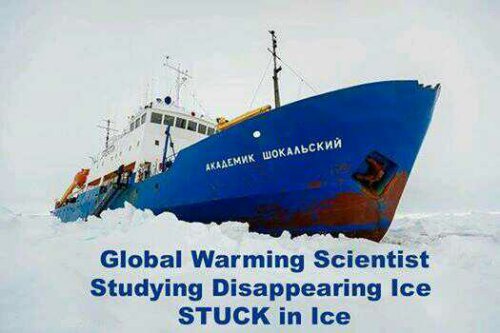
On the one hand, if the AGW hysterics are wrong (and icebergs start turning up in Port Phillip Bay), then, applying their (by then failed) man-made CO2/warming argument, we should scrap every last (planet cooling) wind turbine and start burning coal and gas as fast as humanly possible to warm the joint up, in order to prevent the ‘big freeze’.

chris turney stuck in ice

****

On the other hand, if the AGW “deniers” are wrong, temperatures start to rise, and Australia looks set to become a boiling desert devoid of all life forms (save card-carrying “Greens”, of course), then the hysterics will claim absolute licence (if not high moral imperative) to carpet this, and every other country, in an endless sea of giant industrial wind turbines. Having pinned their arguments against wind power on the basis that CO2 caused AGW is a furphy, the “deniers” would be forced to logically concede their opponents’ case; and, with it, to also concede the need for a completely wind powered electricity system.

Hence, STT seeks to completely disconnect claims for and against global warming, and wind power generation.

As wind power can only ever be delivered (if at all) at crazy, random intervals it will never amount to a meaningful power source and will always require 100% of its capacity to be backed up 100% of the time with fossil fuel generation sources; in Australia, principally coal-fired plant. As a result, wind power generation will never “displace”, let alone “replace” fossil fuel generation sources.

Contrary to the anti-fossil fuel squad’s ranting, there isn’t a ‘choice’ between wind power and fossil fuel power generation: there’s a ‘choice’ between wind power (with fossil fuel powered back-up equal to 100% of its capacity) and relying on wind power alone. If you’re ready to ‘pick’ the latter, expect to be sitting freezing (or boiling) in the dark more than 60% of the time.

Wind power isn’t a ‘system’, it’s ‘chaos’ – the pictures tell the story: this is the ‘output’ from every wind farm connected to the Eastern Grid (based in NSW, VIC, TAS & SA – and with a combined installed capacity of 3,669MW) during May.

May 2015 National

Consider a country where its electricity supply was exclusively based on wind power generation; a place where businesses would attempt to run around the vagaries of the wind; where houses would be well-stocked with candles and their occupants left to keep food cold with kero-fridges or iceboxes – and those homes otherwise run on wood, sticks or dung, used for cooking or heating. Sounds like fun, doesn’t it?

As soon as that country had the chance (due to the availability of technology and/or as a process of economic development) it would build a system based on power generation sources available “on-demand” (ie coal, gas, hydro, nuclear, geo-thermal).

Its people would then be able to enjoy around the clock illumination; factories could run to the clock, and not the weather; homes would be heated and cooled according their occupants’ needs, making life safer and more comfortable (no-one need be frozen to death or expire from the heat because the wind stopped blowing); economic development and prosperity would follow, as night follows day.

Placed in the practical context of the needs of a functioning society, wind power can be seen as the patent nonsense that it clearly is. If a country didn’t have a conventional power system (as we have), it would build one, anyway.

Once people grasp that fact, the rest of the wind industry’s ‘case’ falls away.

Talk about “wind farms being in the right place” just sounds silly; ergo, with arguments about distances from homes; separation from bird nesting sites or migration routes etc, etc.

All of these other considerations – while legitimate – simply jump to the periphery and dilute the strength of the key argument.

Keep hitting our political betters with the pointlessness of wind power as a generation source and the rest falls away.

What reasonable decision maker would back policies that favour something that has no economic benefit? Moreover, as the central claim that wind power reduces CO2 emissions in the electricity is a complete falsehood, the justification for the hundreds of $billions in subsidies directed to wind power looks like pure lunacy, at best; or graft and corruption (aka ‘crony’ capitalism), at worst.

What the wind industry hates most are facts.

STT dishes them up on a daily basis. The facts outlined above – and which we’ve detailed many times before – are unassailable.

Wind power is a fraud, pure and simple.

Australia has just locked in a $45 billion electricity tax which will be directed as subsidies to wind power outfits to generate power which has NO commercial value.

Were that same amount to be applied to building state-of-the-art nuclear power plants, Australia would enjoy cheap, dependable power for a century to come. Moreover, anyone concerned about AGW, as you clearly are, should be pleased as Punch knowing that the power being generated will not add a single gram of the CO2 gas to the atmosphere. And, who knows? Maybe, just maybe, the Earth’s climate will remain constant – forevermore fixed in a “just right” Goldilocks state.

goldilocks_1393092c

Realistic View Of Government-induced Climaphobia, & the Unintended Consequences”.

Editorial by Tom Harris
July 8, 2015
‘Marching with the enemy’
Imagine pro-tobacco groups wanted to participate in fund raising marches for cancer research. ‘We want to help defeat cancer too,’ the tobacco advocates announce.
Anti-cancer campaigners would never march in solidarity with tobacco promoters. They know that if smoking increased, cancer rates would undoubtedly rise as well. Marching arm in arm with those working against one’s interests is irrational.
This logic does not seem to have occurred to the groups concerned with social justice and wildlife protection who participated in the July 5 “March for Jobs, Justice, and the Climate” in Toronto. They were, in effect, marching with the enemy, groups such as  and Citizens’ Climate Lobby which unwittingly encourage outcomes that are harming the poor and disadvantaged, biodiversity, and endangered species.
For example, by promoting the idea that carbon dioxide (CO2) emissions must be reduced to prevent dangerous climate change, climate mitigation activists support the expanded use of biofuels. This is resulting in 6.5% of the world’s grain being diverted to fuel instead of food, causing food price spikes that are a disaster for the world’s most vulnerable people.
The growing demand for biofuels is also creating serious problems for indigenous land owners in developing countries. In a February 2015 open letter to the European Parliament endorsed by 197 civil society organisations from Asia, Africa, and Latin America, it was asserted:
“The destruction of forests and fertile agricultural land to make way for oil palm plantations is jeopardising the food sovereignty and cultural integrity of entire communities who depend on the land as their source of food and livelihoods.”
Replacing virgin forests with monoculture plantations to provide palm oil for biodiesel greatly reduces biodiversity over vast regions.
In another attempt to reduce CO2 emissions, hundreds of thousands of industrial wind turbines (IWT) are being constructed worldwide. For example, the Ontario government is erecting 6,736 IWTs across the province, the most recent as tall as a 61 story building.
Only 4% of the province’s power came from wind energy in 2013 and 1% from solar, yet together they accounted for 20% of the commodity cost paid by Ontarians. Despite massive government subsidies for wind power, electricity rates in Ontario have soared, mostly affecting the poor and seniors on fixed incomes.
IWTs kill millions of birds and bats across the world. Ontario’s situation has drawn the attention of the Spain-based group, Save the Eagles International, which, on May 23, issued the news release “Migrating golden eagles to be slaughtered in Ontario.” They showed that some of the turbines planned for Ontario are being placed directly in the path of migrating golden eagles, which are already an endangered species.
The consequences for people living near IWTs can be severe as well. Besides a significant loss in property value, health concerns abound.
A particularly tragic example is occurring in the West Lincoln and surrounding regions of Southern Ontario.  There, despite the objections of local residents, wind developers have received approval to install at least seventy-seven 3 Megawatt IWTs, each up to 609 ft. tall, the largest such machines in North America.
One resident, Shellie Correia of Wellandport has a particular reason to be concerned.
Her 12 year old son Joey has been diagnosed with Sensory Processing Disorder and it is crucial that he live in an environment free from excessive noise. But as a result of Ontario’s Green Energy Act, the primary focus of which is climate change mitigation, an IWT will be sited only 550 metres from their home.
Correia explained in her January 2015 presentation before the government’s Environmental Review Tribunal, “On top of the incessant, cyclical noise, there is light flicker, and infrasound. This is not something that my son will be able to tolerate.”
But the approvals go ahead anyways. As Correia told the Tribunal, “No one was able to help, because of the Green Energy Act.”
The drive to reduce CO2 emissions makes it difficult for developing countries to finance the construction of vitally-needed hydrocarbon-fueled power plants. For example, in 2010 South Africa secured a $3.9 billion loan to build the Medupi coal-fired power station only because developing country representatives on the World Bank board voted for approval. The U.S. and four European nation members abstained from approval because of their concerns about climate change. They apparently wanted South Africans to use wind and solar power instead, sources too expensive for widespread use even in wealthy nations.
Finally, because of the belief that humans control climate, only 6% of the one billion dollars spent every day across the world on climate finance goes to helping vulnerable people cope with climate change today. The rest is spent trying to stop phenomena that might someday happen.  This is immoral, effectively valuing the lives of people yet to be born more than those in need today.
In all of these cases, climate mitigation takes precedence over the needs of the present. Groups such as Ontario Coalition Against Poverty, Oxfam Canada, and Great Lakes Commons, all of which participated in Sunday’s event, must distance themselves from climate activists, not march with them.
Tom Harris is Executive Director of the Ottawa-based International Climate Science Coalition.

Nobel Prize-Winner Speaks Out Against “Gov’t-Induced Climaphobia”!

Climate Depot Exclusive

Dr. Ivar Giaever, a Nobel Prize-Winner for physics in 1973, declared his dissent on man-made global warming claims at a Nobel forum on July 1, 2015.

“I would say that basically global warming is a non-problem,” Dr. Giaever announced during his speech titled “Global Warming Revisited.

Image result for ivar giaever

Giaever, a former professor at the School of Engineering and School of Science Rensselaer Polytechnic Institute, received the 1973 physics Nobel for his work on quantum tunneling. Giaever delivered his remarks at the 65th Nobel Laureate Conference in Lindau, Germany, which drew 65 recipients of the prize. Giaever is also featured in the new documentary “Climate Hustle”, set for release in Fall 2015.

Giaever was one of President Obama’s key scientific supporters in 2008 when he joined over 70 Nobel Science Laureates in endorsing Obama in an October 29, 2008 open letter. Giaever signed his name to the letter which read in part: “The country urgently needs a visionary leader…We are convinced that Senator Barack Obama is such a leader, and we urge you to join us in supporting him.”

But seven years after signing the letter, Giaever now mocks President Obama for warning that “no challenge poses a greater threat to future generations than climate change”. Giaever called it a “ridiculous statement.”

“That is what he said. That is a ridiculous statement,” Giaever explained.

“I say this to Obama: Excuse me, Mr. President, but you’re wrong. Dead wrong,” Giaever said. (Watch Giaever’s full 30-minute July 1 speech here.)

“How can he say that? I think Obama is a clever person, but he gets bad advice. Global warming is all wet,” he added.

“Obama said last year that 2014 is hottest year ever. But it’s not true. It’s not the hottest,” Giaever noted. [Note: Other scientists have reversed themselves on climate change. See: Politically Left Scientist Dissents – Calls President Obama ‘delusional’ on global warming]

The Nobel physicist questioned the basis for rising carbon dioxide fears.

“When you have a theory and the theory does not agree with the experiment then you have to cut out the theory. You were wrong with the theory,” Giaever explained.

Global Warming ‘a new religion’

Giaever said his climate research was eye opening. “I was horrified by what I found” after researching the issue in 2012, he noted.

“Global warming really has become a new religion. Because you cannot discuss it. It’s not proper. It is like the Catholic Church.”

Concern Over ‘Successful’ UN Climate Treaty

“I am worried very much about the [UN] conference in Paris in November. I really worry about that. Because the [2009 UN] conference was in Copenhagen and that almost became a disaster but nothing got decided. But now I think that the people who are alarmist are in a very strong position,” Giaever said.

“The facts are that in the last 100 years we have measured the temperatures it has gone up .8 degrees and everything in the world has gotten better. So how can they say it’s going to get worse when we have the evidence? We live longer, better health, and better everything. But if it goes up another .8 degrees we are going to die I guess,” he noted.

“I would say that the global warming is basically a non-problem. Just leave it alone and it will take care of itself. It is almost very hard for me to understand why almost every government in Europe — except for Polish government — is worried about global warming. It must be politics.”

“So far we have left the world in better shape than when we arrived, and this will continue with one exception — we have to stop wasting huge, I mean huge amounts of money on global warming. We have to do that or that may take us backwards. People think that is sustainable but it is not sustainable.

On Global Temperatures & CO2

Giaever noted that global temperatures have halted for the past 18 plus years. [Editor’s Note: Climate Depot is honored that Giaever used an exclusive Climate Depot graph showing the RSS satellite data of an 18 year plus standstill in temperatures at 8:48 min. into video.]

The Great Pause lengthens again: Global temperature update: The Pause is now 18 years 3 months (219 months)

Giaever accused NASA and federal scientists of “fiddling” with temperatures.

“They can fiddle with the data. That is what NASA does.”

“You cannot believe the people — the alarmists — who say CO2 is a terrible thing. Its not true, its absolutely not true,” Giaever continued while showing a slide asking: ‘Do you believe CO2 is a major climate gas?’

“I think the temperature has been amazingly stable. What is the optimum temperature of the earth? Is that the temperature we have right now? That would be a miracle. No one has told me what the optimal temperature of the earth should be,” he said.

“How can you possibly measure the average temperature for the whole earth and come up with a fraction of a degree. I think the average temperature of earth is equal to the emperor’s new clothes. How can you think it can measure this to a fraction of a degree? It’s ridiculous,” he added.

Silencing Debate

Giaever accused Nature Magazine of “wanting to cash in on the [climate] fad.”

“My friends said I should not make fun of Nature because then they won’t publish my papers,” he explained.

“No one mentions how important CO2 is for plant growth. It’s a wonderful thing. Plants are really starving. They don’t talk about how good it is for agriculture that CO2 is increasing,” he added.

Extreme Weather claims

“The other thing that amazes me is that when you talk about climate change it is always going to be the worst. It’s got to be better someplace for heaven’s sake. It can’t always be to the worse,” he said.

“Then comes the clincher. If climate change does not scare people we can scare people talking about the extreme weather,” Giaever said.

“For the last hundred years, the ocean has risen 20 cm — but for the previous hundred years the ocean also has risen 20 cm and for the last 300 years, the ocean has also risen 20 cm per 100 years. So there is no unusual rise in sea level. And to be sure you understand that I will repeat it. There is no unusual rise in sea level,” Giaever said.

“If anything we have entered period of low hurricanes. These are the facts,” he continued.

“You don’t’ have to even be a scientist to look at these figures and you understand what it says,” he added.

“Same thing is for tornadoes. We are in a low period on in U.S.” (See: Extreme weather failing to follow ‘global warming’ predictions: Hurricanes, Tornadoes, Droughts, Floods, Wildfires, all see no trend or declining trends)

“What people say is not true. I spoke to a journalist with [German newspaper Die Welt yesterday…and I asked how many articles he published that says global warming is a good thing. He said I probably don’t publish them at all. Its always a negative. Always,” Giever said.

Energy Poverty

“They say refugees are trying to cross the Mediterranean. These people are not fleeing global warming, they are fleeing poverty,” he noted.

“If you want to help Africa, help them out of poverty, do not try to build solar cells and windmills,” he added.

“Are you wasting money on solar cells and windmills rather than helping people? These people have been misled. It costs money in the end to that. Windmills cost money.”

“Cheap energy is what made us so rich and now suddenly people don’t want it anymore.”

“People say oil companies are the big bad people. I don’t understand why they are worse than the windmill companies. General Electric makes windmills. They don’t tell you that they are not economical because they make money on it. But nobody protests GE, but they protest Exxon who makes oil,” he noted.

#

Dr. Ivar Giaever resigned as a Fellow from the American Physical Society (APS) on September 13, 2011 in disgust over the group’s promotion of man-made global warming fears.

In addition to Giaever, other prominent scientists have resigned from APS over its stance on man-made global warming. See: Prominent Physicist Hal Lewis Resigns from APS: ‘Climategate was a fraud on a scale I have never seen…Effect on APS position: None. None at all. This is not science’

Other prominent scientists are speaking up skeptically about man-made global warming claims. See: Prominent Scientist Dissents: Renowned glaciologist declares global warming is ‘going to be a big plus’ – Fears ‘Frightening’ Cooling – Warns scientists are ‘prostituting their science’

Giaever was also one of more than 100 co-signers in a March 30, 2009 letter to President Obama that was critical of his stance on global warming. See: More than 100 scientists rebuke Obama as ‘simply incorrect’ on global warming: ‘We, the undersigned scientists, maintain that the case for alarm regarding climate change is grossly overstated’

Giaever is featured on page 89 of the 321 page of Climate Depot’s more than 1000 dissenting scientist report (updated from U.S. Senate Report). Dr. Giaever was quoted declaring himself a man-made global warming dissenter. “I am a skeptic…Global warming has become a new religion,” Giaever declared.I am Norwegian, should I really worry about a little bit of warming? I am unfortunately becoming an old man. We have heard many similar warnings about the acid rain 30 years ago and the ozone hole 10 years ago or deforestation but the humanity is still around,” Giaever explained. “Global warming has become a new religion. We frequently hear about the number of scientists who support it. But the number is not important: only whether they are correct is important. We don’t really know what the actual effect on the global temperature is. There are better ways to spend the money,” he concluded.

Giaever also told the New York Times in 2010 that global warming “can’t be discussed — just like religion…there is NO unusual rise in the ocean level, so what where and what is the big problem?”

Related Links:

Exclusive: Nobel Prize-Winning Physicist Who Endorsed Obama Dissents! Resigns from American Physical Society Over Group’s Promotion of Man-Made Global Warming – Nobel Laureate Dr. Ivar Giaever: ‘The temperature (of the Earth) has been amazingly stable, and both human health and happiness have definitely improved in this ‘warming’ period.’

Nobel Prize Winning Physicist Ivar Giaever: ‘Is climate change pseudoscience?…the answer is: absolutely’ — Derides global warming as a ‘religion’

2012: Nobel Prize Winning Physicist Ivar Giaever: ‘Is climate change pseudoscience?…the answer is: absolutely’ — Derides global warming as a ‘religion’ – ‘He derided the Nobel committees for awarding Al Gore and R.K. Pachauri a peace prize, and called agreement with the evidence of climate change a ‘religion’… the measurement of the global average temperature rise of 0.8 degrees over 150 years remarkably unlikely to be accurate, because of the difficulties with precision for such measurements—and small enough not to matter in any case: “What does it mean that the temperature has gone up 0.8 degrees? Probably nothing.”

When Science IS Fiction: Nobel Physics laureate Ivar Giaever has called global warming (aka. climate change) a ‘new religion’ -When scientists emulate spiritual prophets, they overstep all ethical bounds. In doing so, they forfeit our confidence’

American Physical Society Statement on Climate Change: No Longer ‘Incontrovertible,’ But Still Unacceptable

Read more: http://www.climatedepot.com/2015/07/06/nobel-prize-winning-scientist-who-endorsed-obama-now-says-prez-is-ridiculous-dead-wrong-on-global-warming/#ixzz3fDoFYSSF

Wind Will Never Be More Than “Novelty Energy”. Investors are Waking Up to Reality!

Global Investment Collapses: Investors Wake Up to the Wind Power Delusion

delusion

***

The wind industry is in meltdown around the globe, simply because investors have woken up to the monumental RISKS.

Risks like: – turbines falling apart in less than 2 years; under pressure from voters, governments pulling the plug on the massive subsidies essential to keep the scam rolling; neighbours suing the operators toobtain compensation and/or to have turbines shut down or removed.

In response to these pretty obvious risks, the amount being stumped up by investors to build more of these things has plummeted.

The scam is little more than the latest Ponzi scheme – with Australia’s best and brightest at Union Super Fund backed Pacific Hydro losing $700 million of mum and dad retirement savings; with its parent – IFM Investors – deciding to ditch Pac Hydro and Pac Hydro deciding to ditch its Cape Bridgewater wind farm disaster.

While the wind industry’s parasites and spruikers try hard to pin their woes in Australia on dreaded policy “uncertainty”, the situation in Europe – held up by eco-fascists as the wind power Super Model – is just as dire.

The amount being thrown by investors at wind power has dropped off a cliff; in the UK, with David Cameron’s election win, subsidies have been pulled to a halt and, as an inevitable result, hundreds of threatened projects have been blown to the four winds.

Behind it all is the simple fact that wind power is not, and will never be, a meaningful power generation source. Here’s a solid analysis, that exposes the delusion and details the imminent collapse of the greatest economic and environmental fraud of all time.

The Difficulties Of Powering The Modern World With Renewables
Roger Andrews
10 June 2015
Energy Matters

In the May 12, 2015 “G7 Hamburg Initiative for Sustainable Energy Security”, the energy ministers of Canada, France, Germany, Italy, Japan, the United Kingdom and the United States, plus the European Commissioner for Climate Action and Energy, said this:

An increasing number of countries are following the path of a rapid expansion of renewable energy. There (are) a number of challenges as energy systems change and related greenhouse gas emissions are reduced, one of which is how to integrate growing shares of variable renewable energy into electricity systems.

The G7 energy ministers are correct in their assessment. Integrating growing shares of variable renewable energy into electricity systems is indeed a challenge – and so far one without a good solution.

A few quick facts before proceeding. In 2013 renewables supplied the world with 21.7% of its electricity, according to BP. Take out hydro and they supplied the world with only 5.3% of its electricity. Then take out “other” renewables such as biomass and geothermal and the percentage falls to 3.3%.

Why take out hydro and “others”? Because their growth potential is limited by resource availability – too few good hydro sites, too few high-temperature geothermal fields, not enough wood to make biomass pellets etc. – and for these reasons they may never make a significant contribution to future global energy needs. Their growth performance since 1997, the year the Kyoto Protocol set the renewables bandwagon rolling, has certainly been less than impressive, as illustrated in Figure 1. “Others” have gained market share, but at a painfully slow rate, and hydro has actually lost ground:

1-400

****

Not so, however, for wind and solar, which aren’t resource-limited (the amount of solar energy hitting the earth in a year, for example, vastly exceeds annual global energy consumption). They show rapid growth since 1997, although from small beginnings. Clearly they are the energy sources the world must concentrate on developing if it is ever to “go green”.

And why shouldn’t continued rapid growth in wind and solar allow the world to go green? I’ve discussed the reasons piecemeal before. Here I summarize them all in the same post:

Intermittency

Intermittency, or non-dispatchability, is the Achilles heel of wind and solar. So far it hasn’t caused widespread problems because wind and solar still contribute only a small fraction of total power generation in most countries. Integrating wind power into the UK grid in February 2013, for example, was not difficult because wind only supplied 5% of the UK’s electricity in that month:

2-400

***

But if in February 2013 the UK had had enough installed wind capacity to generate 50% of its electricity from wind Figure 2 would have looked like this:

3-400

***

Now it’s a different ball game. How do we match a generation curve like that to demand, or at least smooth it out to the point where it becomes manageable? There is in fact a way of doing it, but we’ll get to it later. First we will discuss the options that won’t work.

Energy Storage

This is the obvious solution; store intermittent renewable energy during periods of surplus generation and release it during deficit periods. But the only existing technology that can do this at the scale necessary is pumped hydro, and as discussed at length in previous posts here,here and here the amount of pumped hydro storage needed is enormous. At only moderate levels of solar & wind penetration the UK would need several terawatt-hours of storage, maybe as much as a hundred times the capacity of its existing pumped hydro plants, while Europe and the US would need tens of TWh each and the world proportionately more. There is no realistic prospect of bringing this much new pumped hydro – or even conventional hydro, which can also function in an energy-storage mode – into service in the foreseeable future even if enough suitable hydro sites could be found.

The alternative is battery (or flywheel, or compressed air, or thermal) storage. These technologies are so far from deployment on the multi-terawatt-hour scale that they can be discounted. (According toWikipedia total world battery + CAES + flywheel + thermal storage capacity still amounts to only about 12GWh, enough to fill global electricity demand for all of fifteen seconds.)

Another option that’s been mooted as a potential solution to the storage problem is electric vehicle batteries, which can be charged from the grid during periods of generation surplus and discharged back into the grid during periods of deficit. But this option also founders on the rock of scale. Assuming a 100% charge/discharge capability and no energy losses during the charge/discharge process we would still need 12 million 85kWh Teslas (or 42 million 24kWh Nissan Leafs) to get a single terawatt-hour of storage.

Grid Interconnections

It’s frequently assumed that a smart grid covering a large enough area, like the proposed European supergrid, will be able to smooth out local spikes and troughs in renewables generation and provide “reliable electricity” to all. Unfortunately it won’t. Figure 4, reproduced from Wind Blowing Nowhere compares 2013 wind generation in Spain, the largest producer, with combined wind generation in Belgium, the Czech Republic, Denmark, Finland, France, Ireland, Germany, Spain and the UK. Combining wind generation from all nine countries doesn’t flatten out the Spanish spikes or fill in the Spanish troughs. It just moves them around:

4-400

***

What about solar? Seasonal and diurnal variations in solar generation can be smoothed out by combining output from different areas, but the European supergrid would have to link up with New Zealand to do it.

Combining Generation from Different Renewable Sources

It’s also been claimed that because the wind and the sun blow and shine at different times we will get smoother power output when we combine them. That doesn’t work either. Figure 5 re-plots the Figure 2 case with the UK getting 40% of its electricity from wind and 10% from solar instead of 50% from wind. Adding the midday solar spikes, which lead evening peak demand by about five hours in the winter, if anything makes things worse:

5-400

***

Demand-side management

A lot of faith is pinned on the potential of DSM, which instead of matching generation to demand seeks to match demand to generation, or at least to match it as closely as possible. But there’s no way demand could be matched to the generation curves shown in Figures 3 or 5. The best that could be hoped for is an incremental improvement, maybe a flattening of the daily demand curve and/or a reduction in total demand, but the larger problem of how to smooth out bursts of intermittent power into a manageable form would remain unresolved.

And then there’s the great unexploited renewable resource:

Tide Power

It’s predictable, infinitely renewable and has near-unlimited potential. What’s not to like about it? As discussed in the Swansea Bay post (link above), quite a lot. Arguably the best indicator of tide power’s lack of potential, however, is that almost fifty years after the world’s first tide power plant went in at La Rance in France it still supplies less than 0.005% of the world’s electricity.

So if energy storage, supergrids, combining output from different sources, demand-side management and tide power won’t work, what will? Only one thing:

Fossil Fuel Backup

The concept is simple: use load-following fossil fuel capacity – I’m going to assume gas turbines – to generate the electricity needed to meet demand whenever renewable energy can’t generate enough. The approach requires no storage and imposes no theoretical limits on the level of wind & solar penetration, as discussed in How much windpower can the UK grid handle and Wind power and the island of Denmark. Figure 6 illustrates how it would apply to the 50% wind penetration case shown in Figure 2:

6-400

***

Inevitably, however, there are problems. One is that there are times when wind generation exceeds demand and has to be curtailed, and as a result the UK gets only about 47% of its electricity from wind instead of 50% in the above case. Another is the generation curve the gas turbines would have to follow to fill demand when wind generation can’t, which looks like this:

7-400

***

Tracking this erratic generation curve would severely stress the gas turbines (and probably the grid operators too). Wear, tear, downtime and generation costs would all increase, as would fuel consumption because of the constant start-up and shutdown, thereby offsetting some of the CO2 emissions reductions generated by the wind energy.

And that’s with 47% wind penetration. At higher levels the system becomes progressively more inefficient until at 80-90% penetration it’s running at load factors as low as 10% and well over half of the wind generation has to be curtailed (more details in the tables in the How much windpower post linked to above). We can therefore anticipate that this approach will also eventually run up against the hard wall of reality, if only because sooner or later it will occur to someone that it would be a lot easier to keep the dispatchable gas generation and do away with the non-dispatchable wind generation altogether.

But the way things are going there’s a good chance that this point will never be reached. Why? Because of a problem that’s rarely taken into consideration:

Lack of Investment

Every year UNEP publishes a chart of annual global investment in renewable energy, the lion’s share of which (92% in 2014) goes to wind and solar. Here’s the latest version:

8-400

***

Total investment in renewables since 2004 now exceeds $2 trillion – a lot of money, but it’s still far short of what’s needed to stimulate growth to the point where renewable energy, assuming it can be made to work, eventually powers the world. The $232 billion invested in renewables in 2013 was dwarfed by the $1.6 trillion total global energy investment in that year reported by IEA, and of the 235GW of new generation capacity installed globally in 2012 only 76GW was wind or solar, according to EIAand BP. If investments in conventional generation continue to dominate to this extent then wind and solar are doomed to remain also-rans. A very substantial transfer of investment from conventional generation to wind and solar will be needed if they are ever to become the dominant players, but the investment climate needed to achieve this just isn’t there.

Another question is whether global renewables investment might not already have peaked (as shown in Figure 8, it’s certainly flattened out). Renewables investment is still increasing in the developing countries – notably China – but it’s been essentially flat in the US since 2008 and in Europe it’s been declining since 2011. Europe in particular bears watching because if the decline continues at the rate shown in the Bloomberg New Energy Finance chart below it won’t be long before Europe will have had all the clean energy it’s going to get:

9-400

***

And finally the big problem. Even if the world succeeds in developing wind and solar to the point where they supply 100% of its electricity the job is still less than half-done because electricity supplies the world with only about 40% of its energy. The remaining ~60% comes from the oil, gas and coal consumed in transportation, heating etc. How to decarbonize that? Again no solution is presently in sight.
Energy Matters  

mirror-delusion-deluded

Institute for Energy Research Tells the Truth About Renewables…

One more time–fossil fuel based (coal fired) energy is the most affordable/efficient and it is clean

You say could evil coal be clean enough–well it is.

And there is no air pollution risk that justifies the economic and human welfare damage that attaches to stupid renewables.

Nuke, Hydro, gas fired, coal in rank for emissions.

For affordable the ranks are hydro, coal, gas fired coal, gas, then the silly renewables like biomass, wind, with solar a dead last.

http://instituteforenergyresearch.org/wp-content/uploads/2015/06/ier_lcoe_2015.pdf

Bill Gates Admits that Wind & Solar are Not Suitable As An Energy Source… Spend $ On R&D!

Switch green subsidies into R&D

It is interesting that there is no US media coverage of this perspective from Bill Gates.  This article comes from the UK.  The UK doesn’t utilize direct taxpayer subsidies like the USA, but instead has forced a “Feed-in Tariff” on the grid, forcing electricity costs to skyrocket.  This, in turn, has led to poor and working class people to endure what has been termed “energy poverty” such that they must sacrifice heavily on other things to try to keep the lights on.

Excerpts from the article:

“Retired software kingpin and richest man in the world Bill Gates has given his opinion that today’s renewable-energy technologies aren’t a viable solution for reducing CO2 levels, and governments should divert their green subsidies into R&D aimed at better answers.”

Gates refers to the cost of meeting electricity needs on renewables as “beyond astronomical”

“In Bill Gates’ view, the answer is for governments to divert the massive sums of money which are currently funneled to renewables owners to R&D instead. This would offer a chance of developing low-carbon technologies which actually can keep the lights on in the real world.”

Bill Gates scorns those ideologues who want to end all fossil fuels and run the world on wind & solar power in this interesting article.  Here is the link:

http://www.theregister.co.uk/2015/06/26/gates_renewable_energy_cant…