Unaffordable, Unreliable Wind Turbines, Create Energy Poverty

Bjørn Lomborg: Wind Power – The Rich Man’s Curse on the Poor

Bjorn-Lomborg-wsj

When it comes to assessing the costs, risks and benefits of environmental policy Bjørn Lomborg has always tried to provide balanced, detailed analysis supported by facts and evidence. The economic choices we make – about allocating scarce resources to unlimited wants – should – as Lomborg consistently points out – be made taking into account all of the costs weighed against properly measured benefits (see our post here).

Bjørn Lomborg has become one of the most high profile critics of insanely expensive and utterly pointless renewable energy policies across the globe (see our posts here and here).

Bjørn’s back –  in this piece published by The Australian – in which he hammers the insane cost and utter pointlessness of tying our energy futures to unreliable and intermittent renewables, like wind power.

Poverty Must Be the World’s Top Priority
The Australian
Bjørn Lomborg
1 October 2014

Ban Ki-Moon overstates the case while renewables kill millions in poor countries 

LAST week, UN Secretary-General Ban Ki-moon gathered the heads of government from more than 120 countries for a climate summit “to make climate change a top priority for all leaders”. Of the world’s many ills, he unequivocally finds that “top of the priority list is climate change”.

Yes, global warming is a real problem, but it makes no sense to claim it is the world’s first priority.

And the UN knows it. Its outreach program, The World We Want, asked more than five million people from every nation to name their top priorities: better education and healthcare, less corruption, more jobs and affordable food. And they placed global warming as priority No 17.

This is no surprise when you consider the poorest half of our world. If your kids are at risk of dying from malaria or malnutrition, those are your first priorities. Even Europe, with the world’s strongest climate policies, ranks global warming 10th.

Yet politicians use catastrophic alarmism to bolster the claim that climate is our “generational mission”. Britain’s winter floods predictably were held up as a “wake-up call for climate change”, although study after study has shown that so far more flooding is due entirely to more houses being built on more flood plains. In the long run, climate also likely will make a smaller contribution, but blaming global warming simply takes away attention from political failure to focus on the real game changers: building better levies and setting aside some flood plains for floods.

An analysis of climate communication by the University College London found that appeals to fear are ineffective and often lead to a suspicion that “they are trying to manipulate me”. Remember when Al Gore told us in his Nobel speech in 2007 that the north polar ice cap is “falling off a cliff” and it could be gone in “as little as seven years. Seven years from now”.

That is now. Arctic ice definitely shows a long-term decline, but from the low point in 2012 it has actually increased 47 per cent.

Ban declared that climate posed “sweeping risks” while we’re heading towards a “cataclysm”. Yet the UN climate panel finds the total cost of climate change by the 2070s is less than 2 per cent of gross domestic product. This is a problem, but not the end of the world. Weigh the 2 per cent loss against the fact the UN expects the world to be 800 per cent richer in 2070.

Compare it to the very real challenges the world faces right now. There are still 1.2 billion people living in abject poverty, and they need economic growth. In the past 30 years China has lifted 680 million people out of poverty, the greatest poverty reduction ever, and it did it with lots of cheap, if polluting, coal.

Yet well-meaning Western leaders (including Barack Obama, Francois Hollande and David Cameron, but not Tony Abbott) descended on New York to reiterate the solution to global warming that has failed for more than two decades: we must switch to renewables. But look how that is going. The EU’s climate policies cost an unaffordable €209 billion ($303bn) a year, yet at the end of the century, after costing more than €18 trillion, they will have reduced temperature rises by 0.05C.

Moreover, pushing renewables is hypocritical: according to the International Energy Agency, Europe gets just 12 per cent of its energy from renewables and just 1.5 per cent from solar and wind. Africa gets almost 50 per cent from renewables — because it is poor — and the renewable source is mostly wood, which kills more than half a million a year as a result of indoor air pollution and contributes to deforestation.

Not surprisingly, when African leaders went to Washington last month, they said they wanted to use more coal. Even the climate-worried World Bank president accepted that “there’s never been a country that has developed with intermittent power”.

A new study from Washington-based Centre for Global Development starkly shows the cost of pushing renewables. Spending $US10bn ($11.4bn) on renewables in Africa can lift 20 million out of darkness and poverty. But spending $US10bn on gas would lift 90 million. Insisting on renewables means deliberately leaving 70 million people in darkness.

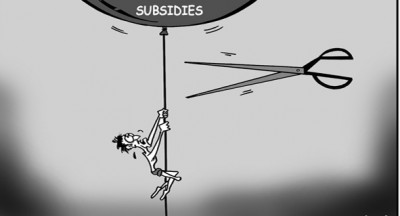
This does not mean we shouldn’t tackle global warming. But as long as renewables are much more expensive than fossil fuels, rich countries may spend a couple of hundred billion to make themselves feel virtuous, but it won’t make a difference to the climate. Right now, the world pays more than $60bn a year in subsidies to solar and wind, yet they supply less than 0.6 per cent of its energy. Even in its extremely ­optimistic scenario, the IEA estimates solar and wind will supply just 3.5 per cent of our energy by 2035 — and the bill for subsidies will run to about $US100bn a year.

Some campaigners claim that renewables are already competitive. But this is wishful thinking — if they were, they wouldn’t need subsidies. Look at Spain: with lower but still substantial wind subsidies, Spain has this year put up just one wind turbine.

Instead of wasting billions in current subsidies, we should invest much more in green innovation to reduce the cost to future generations of clean energy. When innovation takes the price of green energy below fossil fuels, everyone will switch.

But in a world where four million die each year from burning wood and dung in open fires inside, while poverty, lack of clean water, infectious diseases, poor education and too little food afflict billions, we cannot with a straight face claim that climate should be our top priority.
The Australian

Bjørn doesn’t limit his criticism of the impact of ludicrously expensive intermittent renewables on the poor in the developing world; he makes the same point in relation to poorest in, supposedly, first world economies like Australia (see our post here).

With $50 billion to be transferred from power consumers to wind power outfits over the next 17 under the Large-Scale RET (see our post here) – and that cost added to already spiralling power bills – there will be many more households who will be unable to afford power; adding to the tens of thousands of homes already deprived of what was once a basic necessity of (a decent) life. And thousands more destined to suffer “energy poverty” as they find themselves forced to choose between heating (or cooling) and eating.

If our political betters in Canberra don’t line up to kill the LRET very soon – in less than a decade – Australia will have created an entrenched energy underclass, dividing Australian society into energy “haves” and “have-nots”.

For a taste of an escalating social welfare disaster, here are articles from Queensland (click here); Victoria (click here); South Australia (click here); and New South Wales (click here).

There’s something deeply troubling about thousands of Australian households descending into gloom after dark – unable to afford the power needed for electric lighting; or troubling, at least, for those with a social conscience.

Beyond the LRET’s perverse impact on the poorest and most vulnerable there is, of course, its wealth and job destroying impact on the economy as a whole (see our post here).

For those that claim to be “friends of the poor” there’s no time like the present to prevent a mere disaster from becoming an all-out catastrophe. How about it Clive? It’s time to scrap the LRET and give the poor a truly bright (ie “well-lit”) future.

clive palmer sleeping

Rebecca Thompson is Wise to the Windweasels!

A Lesson in Journalism: Rebecca Thompson Exposes the Great Wind Power Fraud

Rebeca Thompson Sun
Rebecca Thompson is the brilliant young journo behind the recent Sun News documentary, Down Wind – that tipped a bucket on the great wind power fraud in Canada (see our post here).

Down Wind, which runs for 96 minutes, can be purchased as a file and downloaded or as a DVD for those in the US and Canada (here’s the link). For those outside the US and Canada the file can be purchased and downloaded (using this link). If you’re in there fighting the great wind power fraud, Down Wind is essential viewing. For a detailed synopsis of Down Wind – see our post here.

Rebecca is a stand-out not simply because she exhibits the proper temerity to challenge the lunacy of wind power and those behind the fraud (it’s what journalists are supposed to do), but because she has taken the time and trouble to understand every aspect of the most destructive government sanctioned rort of all time: be it the infantile pointlessness of throwing $billions at an intermittent and unreliable power source; spiralling power prices; the utterly flawed economics; the slaughter of thousands of birds and bats; and the harm caused to thousands of hard-working rural people through incessant turbine generated low-frequency noise and infrasound – Rebecca has a complete grip on the facts.

It’s almost incredible what happens when journalists open their eyes, ears and minds – instead of knocking out endless streams of drivel from the wind industry and its highly paid spin-masters – readers and viewers are gifted with a real insight into the insane costs and non-existent benefits of wind power. It’s a pity there aren’t more journos like Rebecca.

Here she is being interviewed by Alex Pierson on Sun News (22 September 2014) (transcript follows):

Straight Talk – Alex Pierson with Rebecca Thompson

Alex Pierson: Well call it the latest David verses Goliath kind of fight – as an Ontario farming family begs the court to help them stop an enormous wind farm that’s going to go up in their farming town, just in a little tiny farming community called Goderich, which is about an hour outside of Toronto.

And it’s bringing Rebecca Thompson to talk about the realities facing this particular family. What are we talking as far as this latest wind farm v turbine …

Rebecca Thompson: So interestingly, Downwind, which is a documentary that Sun News network aired a couple months ago, that featured this family that is asking the Divisional Court in Ontario, the Ontario Divisional Court to review their appeal to not have this 140 wind turbine project put up. And essentially the Divisional Court has never – this would be precedent-setting – if in fact this family among other families who are part of this appeal would be able to win this on the grounds that this would cause problems for their health.

So right now Health Canada, which is at the Federal level, is reviewing whether or not wind turbines cause health concerns. Given the fact that in Ontario the setbacks of wind turbines are only 500 feet. This is a concern because it’s too close to people’s homes.

Alex Pierson: You did a lot of work of on this in your documentary, and I urge any of you who haven’t yet seen Downwind – watch it. I don’t care if you are living in the city of Toronto. I don’t care if you’re living in a big urban centre – watch it because until you’ve seen what Rebecca exposes you don’t really truly get an understanding. And you made some really a valid points in the documentary that – what absolutely confounds me is that there are so many questions about health issues that are being looked into, and nobody seems to know what the long-term implications are. But yet the province is forging full steam ahead building these things.

Rebecca Thompson: The province is forging full steam ahead and they have indicated that there are no health concerns even though they haven’t done sufficient research into whether the or not there are health concerns. Look at places like Alberta. There are wind turbines set up, but they’re 2 miles away from anyone’s home. And in Ontario there was a theory that the reason why the wind turbines were admitted to be put up 500 foot away was because farms in Ontario are only an acre. So basically if the Ontario government can get away with putting wind turbines along a transmission line which is you know, a few turbines every other farm, then they could get away with a 500 foot setback.

The challenge with this that Health Canada is currently researching. I interviewed them – they said absolutely we’re seeing evidence that families have health issues, specifically …

Alex Pierson: sleeping issues, depression issues …

Rebecca Thompson: Sleeping, tinnitus, headaches, feeling faint, having stomach issues. There’s all sorts of issues.

Alex Pierson: So why wouldn’t the Courts then be listening to this and saying well hold on we don’t have enough conclusive evidence to say that there are no health problems, we have to rule in favour, there is doubt?

Rebecca Thompson: Well so far, the Provincial government has written its laws and its rules to be heavily in favour of the companies. And so essentially when any family, and there have been more than 20 appeals that have gone to Environmental review tribunals in Ontario, when any – and by the way these families they dip into their RSPs, they have to take it from their own small farming business, or whatever kind of businesses they have. They have to take it from the profits to pay for these appeals. Hire lawyers all the rest and they essentially lose the appeals because the Ontario government has written the regulations in a way where the wind turbine companies, often foreign companies, win time and time and again.

Alex Pierson: But when it comes to the bigger picture because all I’m hearing right now is massive lawsuits. Maybe not tomorrow, but in the next 5 or 6 years, when Health Canada finally comes out and says yes there are long-term health implications. So does the Ontario government not want to look at the bigger picture?

Rebecca Thompson: I don’t think they do. You know, I asked Kathleen Wynne, the Premier of Ontario point-blank will you put a moratorium on wind turbine projects that have not yet been built, given the fact that they’re causing endless amounts of communities serious concerns? Not only with health, but also property values. And also the fact that we pay through the nose for electricity now as a result of wind turbines, wind farms and wind power. And she said no we’re not going to put a stop to this.

Essentially they’ve offered the opportunity for wind turbine companies, often foreign based, to come in and have a 20 year contract to provide a source of wind power which is often intermittent. So the issue with these farmers – and you know I went out for the documentary and had an opportunity to meet with a ton of families. Thinking, you know what are the health issues?

Alex Pierson: What are they complaining about?

Rebecca Thompson: And I spoke with doctors, I spoke with researchers and experts and what they indicated is that yes, when it comes to the average person, it does effects to them – not everybody is affected – but children are seriously affected. Senior citizens are affected. You know it’s a concern that has driven these families to actually get a lawyer to fight at Divisional Court for them.

Alex Pierson: And I should point out one of the best lawyers in the country so I’m hoping that at least, under his guidance, they can get this seen – because I think it’s going to be one of these issues that ends up going to the Supreme Court and finally you’ll have someone ruling in on behalf of them.

You know it was interesting over the weekend I was reading an article by a Mexican ecologist who has opened the door, he’s blown the whistle on the corruption, the lies and what he calls the incompetence of the wind industry. And he talked about a whole bunch of countries – whether it be the United States, Australia and Canada – talking about the massive environmental damage these windmills are creating. And he talks about – it doesn’t seem that the environmentalists care about the clear cutting, they don’t care about the birds, they don’t care about the bees, they don’t care about the environmental ecosystems that are destroyed by these stupid windmills. But they’re aren’t doing anything. They’re just all about optics and there are people behind-the-scenes making billions of dollars. So it’s such a hypocritical hype.

Rebecca Thompson: Absolutely. You know what’s interesting is that these individuals – there’s a mass movement, not only in Ontario but across Canada to try to stop, to try to curtail wind power, or at least stop to research it before it goes up. And they reached out to a number of environmental groups. Specifically when it came to the mutilation of migratory birds by these wind turbine blades.

And the bird organisations in Ontario, sorry in Canada, said you know, we’re not interested. It’s partially because, you know Sierra is …

Alex Pierson: Are they getting funding from someone?

Rebecca Thompson: Well, they certainly rely on government funding. And essentially you have the Ontario government or the Canadian government or whoever offering these groups funding for in return they’re going to stay silent on these major issues.

Alex Pierson: It’s such an incestuous industry. You know we make a big stink about birds flying into buildings within city centres. And we do all sorts of things to protect birds by asking people ‘turn off your lights’ or do whatever, don’t seem to care about the birds. Don’t seem to care about the bees.

Rebecca Thompson: No, you know it’s interesting.

Alex Pierson: Certainly don’t care about bats.

Rebecca Thompson: They certainly don’t – and it’s the bats in fact, which are an endangered species in Ontario. You know, there’s evidence that in Northern Ontario, the bats that are an endangered species, could be obliterated as a result of wind turbines and you know maybe the Ministry of Natural Resources has stood by idly and said ‘Oh well’.

Alex Pierson: So where is David Suzuki? Because I would think that this is something he should care about. Because he should know. I’m no scientist. I’m no bat expert. But I do know that when you take out one species from the ecosystem, you unbalance the whole infrastructure of it. So if you take out the bats, that means other birds and bugs and all the rest of it, it unbalances the systems, and you get big problems.

Rebecca Thompson: Yes, and David Suzuki was out over few months ago saying what’s the big deal? Everybody should endorse wind power. You know this is the big question. It’s not only the environmental lies. It’s not only the major health concerns that right now are being researched and we don’t know the extent of the health problems. But it’s also the fact that our wallets and pocket books are being heavily hit because of the fact that electricity prices have gone through the roof. And I’m not just saying that. The Auditor General researched this. There have been countless studies researching and identifying the fact that wind power all around is just bad economics.

Alex Pierson: I think the Green Energy Act, maybe not this year but in the next few years is going to be exposed as the biggest, biggest failure, fraud and sham that we’ve ever seen. So we’ll continue watching it. Rebecca Thompson joining us here this morning. Thank you Ma’am.
Sun News

Definition of fraud

Wind Turbines are an Overpriced, Novelty Energy Form…..Not Suitable for Prime Time!

The Fantasy of 100% Renewable Energy

Renewable energy is all the rage at the moment. Fears of global warming are ever present (and well-justified, I might add). Tax benefits for solar panels and wind turbines are at an all-time high. On Harvard’s campus, chants and rallies for divestment urge a shift away from fossil fuels toward renewables.

With Denmark’s wind power production exceeding its consumption on certain days last year, there have been calls for the United States to go completely fossil-free and become solely renewable-powered by 2050. After all, if Denmark can do it, why can’t we?

This is the point where I want to grab these 100-percent-renewable-promoting people and scream, “That’s not how it works! That’s not how any of this works!” (Oh, and Denmark isn’t entirely wind powered, that’s a misunderstanding—the true number is around 40 percent of electricity generation.)

Regardless of political pressure (which many have blamed for our lack of renewables), having a fully renewable-powered United States is physically impossible—and you can blame the sorry state of the U.S. energy grid.

Very few people know how the electricity is transmitted from, say, a wind turbine to their light bulb. We are lucky to live in a developed country where electricity can be taken for granted and blackouts are extraordinarily rare. This makes the electric grid appear to be a stable, ever-present figure that quietly and efficiently powers the country. In reality, the electric grid is less a perfectly fine-tuned blanket of distribution and more an ever-evolving patchwork quilt of relatively inefficient power lines.

There are two massive problems that currently plague the electric grid: We can’t store the electricity we produce, and we can’t transmit the electricity far from where it was generated.

There have been times when, in the Midwest on particularly windy days, there is so much energy generated by massive wind farms that there isn’t enough demand in the local area to use up all the electricity. When that happens, it would be fantastic if we could just put aside the excess electricity for another time when we need it. But we can’t. In fact, because there is absolutely no way to efficiently store this excess energy, the wind farm owners must sometimes pay money to offload their electricity.

Not being able to store it wouldn’t be an issue if we could just send all the excess electricity somewhere else though. After all, even if Wyoming’s five residents don’t need the energy at that moment, New York City is always hungry for more electricity. So what would happen if Wyoming’s wind farms generated the only energy available in the country, Wyoming had excess electricity, and a man in the Big Apple turned on his lights in an attempt to increase demand?

Nothing. Absolutely nothing. The light wouldn’t even go on. Due to the structure of our power grid, electricity cannot travel from Wyoming to New York.

In fact, the electric grid in the United States is actually three electric “interconnections”—the Western Interconnection, the Eastern Interconnection, and the Electrical Reliability Council of Texas. Electricity is hardly transferred between the interconnections—not out of choice, mind you. We physically cannot due to the difference between grid structures and a lack of infrastructure. And even within an interconnection, electricity struggles to travel distances of greater than 400 miles.

Now we return to the feasibility of a 100 percent renewable energy United States.

It’s true that if we covered just five percent of Arizona with solar photovoltaic panels, we would have more than enough energy to cover the four trillion kilowatt-hours of electricity consumed annually in the United States. However, if we actually built this massive solar farm, the consequence wouldn’t be a green United States. It would just mean that the Southwest would have massively negative energy prices (assuming the grid in the area could even handle the load) while the rest of the United States would be in a perpetual blackout. No storage, and no long-distance or cross-interconnection transmission, remember? And what happens if it gets cloudy?

Wind power suffers from the same problems—even worse, actually, since wind is less predictable than the sun.

We’ve tapped all the hydropower sources in the country and it only accounts for seven percent of our nation’s electricity production.

Geothermal sites are unlikely to have a production capacity of more than 20 percent of total U.S. consumption (and are currently sitting at 0.41 percent).

Despite the environmental benefits, the fact simply remains that renewable energy—wind and solar in particular—is simply too volatile from minute to minute to produce the steady power we need. And we don’t yet have the storage or transmission technology to address these issues.

Sadly, for the time being, we will simply have to accept that the vast majority of our electricity must come from fossil fuel and nuclear plants.

Sorry, Earth.

Alan Y. Wayne ’16, a Crimson editorial writer, is an economics concentrator in Kirkland House.

One More Reason Why Industrial Wind Turbines are a Dismal Failure….

GCube Scrutinizes Blade Breakages: Specialist renewable energy insurer analyses causes & frequency of wind turbine blade failure in new report

Specialist renewable energy underwriter GCube Underwriting Ltd has authored a detailed report to examine the problem of blade failure and breakage throughout the wind industry.

Entitled “Breaking Blades: Global Trends in Wind Turbine Downtime Events,” the report draws on a combination of GCube’s extensive proprietary claims database and publicly available market news to identify the root causes of common types of blade failure and suggests proactive mitigation measures to counter this inherent risk to wind energy assets and investment.

As wind power continues a high-profile migration from traditional growth markets to newer, often highly remote locations in Asia Pacific, Africa and Latin America and turbine manufacturers find themselves under increasing pressure to deliver cost competitive electricity generation through larger turbines with minimum unscheduled downtime and longer, lighter rotor blades, the overall integrity of wind turbines and, specifically, the performance and reliability of their blades, appears to have suffered.

With an estimated 700,000 blades in operation globally, there are, on average, 3,800 incidents of blade failure each year. While the frequency of such incidents and their severity varies significantly from country to country, blade incidents can cost in the order of $1 million to resolve and there is a clear industry imperative to ensure that these failures are kept to a minimum.

In the Breaking Blades report, GCube categorises the common causes of blade failure, ranging from lightning damage to human error and manufacturing defect, before explaining the factors influencing the cost of blade claims. The report then goes on to look in detail at the individual components of a standard blade and outlines a range of inspection criteria that should help to mitigate the risk of blade failure and loss.

This advice is followed by in-depth interviews with representatives from key industry stakeholders RES, IM FutuRe and Renewable Energy Loss Adjusters (RELA), highlighting the most frequent origins of blade damage and its wider effects on industry investment.

The launch of the report marks the first time that an insurer has shared this level of data with its client base in the renewables sector. Breaking Blades forms part of a wider knowledge sharing initiative as the first of four reports on wind turbine failure to be released by GCube between September this year and June 2015.

“As the wind industry looks to attract secondary investment from the pension and fund management communities, blade failure and the associated business interruption costs – exacerbated by the shift into emerging markets and growing pressure on manufacturers – can be an unwelcome deterrent,” said Jatin Sharma, Business Development Leader, GCube.

“Ultimately it’s in the interests of all parties to minimise unscheduled downtime and the frequency and severity of turbine failure. The Breaking Blades report is by no means an answer to the problem, but should serve to raise further questions and create opportunities for greater industry-wide collaboration.”

To request a copy of Breaking Blades: Global Trends in Wind Turbine Downtime Events, please email info@gcube-insurance.com.

GCube
http://www.gcube-insurance.com

Waiting on Word About a Moratorium on the K2 Wind Project!

ACW Resident Waits For Word On K2 Moratorium Request

Wind Turbine

An Ashfield-Colborne-Wawanosh resident says he is hoping to hear within the next couple of weeks whether his legal request to stop Phase 2 of the wind energy project in the Kingsbridge area has been successful.

Shawn Drennan had a hearing in London earlier this week but says realistically he doubts this will be the last one.  Drennan wants the K-2 project, which will place an additional 140 turbines in the Kingsbridge area north of Goderich and around his house, stopped until several studies into health impact have been completed

He argues the province is asking for extensive research on the impact on marine life before proceeding with off-shore turbines, so the same concerns should be addressed regarding the impact of turbines on residents of A-C-W.

Drennan says at the hearing this week the request for a stay was based on concern for people but the wind company’s main argument was they should be allowed to proceed because they have already spent a lot of money.

Drennan points out this is a precedent-setting constitutional challenge so he expects both sides will appeal to the highest court before it is ultimately settled.

Jihadis and Warmunists….Both want to Destroy Our Way of Life!

September 28, 2014
Jihadis and Warmunists: Brothers Under the Skin
By Clarice Feldman
Watching the parade of the naïve, the far left, and their energy-hogging celebrity manipulators marching in New York City this week, I was struck by how much these true believers had in common with jihadis, a notion reinforced by Purdue Professor Louis Rene Beres’ description of jihadis in Gatestone Institute and my friend “Ignatz’s’” comment at Just One Minute.

Both movements seem to these authors to be a means of denying death and change and making the mortal, immortal and the insignificant individual life, a significant force when massed with others.

If this is true — and I think it is — we cannot defeat these irrational movements in the ordinary ways. New strategies are called for.

Jihadis

Beres’ argument (and you should read it all to fully understand it) is, in sum, that the bloody depredations of jihadism provide its adherents with a “delusion of immortality” and a “religious justification” for erotic satisfaction.

If this is the case, he says, we cannot stifle its advance by treating terrorism simply as a normal striving for land or politics or strategy. It’s a different kind of enemy.

Among more “normal” conflict scenarios, America, Europe and Israel now need to consider mega-threats of both unconventional war and unconventional terrorism. Faced with determined adversaries — who are not only willing to die, but who actively seek their own “deaths” in order to live forever — Washington and Jerusalem should finally address the what needs to be done in addition to military remediation.

Sustained and selective armed force against IS and related Jihadist targets is certainly necessary and appropriate. However, it is also important to remind our leaders that force always needs to be combined with reinforcing efforts to convince these terrorists that their expected martyrdom is ultimately just an elaborate fiction.

Jihadists, in killing Americans, Israelis, and all other “unbelievers,” may not even intend to commit evil, so much as to do themselves and Allah good — and to do so with an absolute purity of heart. In their view, waging Holy War can never be shameful; it can only be heroic.

Going forward, our main task should be to systematically undermine these fantasies and doctrinal “underpinnings.” In conjunction with the recommended nuanced persuasions of military firepower, it can be done.

Warmunists

The New York demonstration, full as it was of communist organizers and sympathizers, inspired one wag to argue the marchers really were warmunists — that is, far left-wingers posing as environmentalists. (Any question respecting their commitment to environmentalism and keeping the planet clean were resolved by shots of the mounds of trash they left behind while purporting to save the planet.)

Ignatz made observations about the marchers which strike me as related to Beres’ comments about jihadis:

Lefties love to talk about revolution, “cause change” fundamental transformations, progress, etc., but they are the most retrograde reactionaries imaginable. They want a one-time revolution to cement and codify utter stasis.

People who talk about change are scared to death of the creative destruction of free markets. People who worship Darwinian progress, which after all implies millions of extinctions, want to save every single evolutionary cul-de-sac of a species they can find living in some pothole or cave somewhere. Their desire to somehow fix our climate to an optimum they have arbitrarily decided is in all our interests is obvious. Less obvious is their desire for the tranquility and stultifying sameness of socialism, not because it’s fair but because it’s predictable and controllable and therefore not as disruptive and scary. They seek the perennial childlike state of someone else supplying their security while they indulge their pleasures, presumably because they regret ever having to grow up.

These fools of all ages are on a children’s crusade to compel the adults of the world to create an actual real-world Neverland for them where nothing ever changes, they’ll never age and they can pretend they’re somehow going to be the magical ones picked by fate to cheat death.

The jihadis’ “heresy” charges against those who oppose their tyranny is simply another version of the warmunists’ “treason”. If you had any doubt about that, here’s Robert F Kennedy, Jr, who disproves his existential claims about climate warming by flying in private planes to warn us we will perish if we don’t stop using conventional energy.

Kennedy lamented in an interview with Climate Depot, [he]is not permitted by law to “punish” or to imprison those who disagree with him — and this, he proposed, is a problem of existential proportions. Were he to have his way, Kennedy admitted, he would cheer the prosecution of a host of “treasonous” figures — among them a number of unspecified “politicians”; those bêtes noires of the global Left, Kansas’s own Koch Brothers; “the oil industry and the Republican echo chamber”; and, for good measure, anybody else whose estimation of the threat posed by fossil fuels has provoked them into “selling out the public trust.” Those who contend that global warming “does not exist,” Kennedy claimed, are guilty of “a criminal offense — and they ought to be serving time for it.”
Just as Eric Hoffer warned us a half century ago about all mass movements in his book The True Believer: Thoughts On The Nature Of Mass Movements such movements thrive in climates where individual opportunities are limited. He said then that they had not had much purchase in the United States because capitalism and our Constitution permitted so much advancement and freedom. Don’t the warmunists and the jihadis imperviousness to reality and fact share a common root? Doesn’t the drive of both to convert us all to their way of thinking echo Hoffer’s belief that the death denier “strengthen[s] his own faith by converting others”? Can you think of a better explanation, for example, of Kennedy’s tyrannical wish?

As anti-capitalist laws and regulations cooked up by this administration impoverish the middle class and shrink it while expanding the numbers now on the dole and pc restrictions of free speech in the workplace and colleges strangle us, do you suppose the climate for pernicious mass movements will grow or will it shrink?

I think we need to redouble our efforts to separate fact from fiction here and abroad even as we undertake warfare in the Middle East and to strengthen free markets and free speech rights here even though to do so means challenging in every available forum the ridiculous notions of the adherents of both of these mass movements.

Read more: http://www.americanthinker.com/2014/09/9_27_2014_18_33.html##ixzz3Ef1vqfKg
Follow us: @AmericanThinker on Twitter | AmericanThinker on Facebook

Climate Change Alarmists Cannot Handle the Truth! We Are Not In Control of the Climate!!!

Federal Study Confirms Climate Change is Natural, Not Caused by Humans

Obama-Climate-Change
New federal study confirms that climate change is caused by nature, not by man. Released even while President Obama was saying the opposite at the United Nations.
What is the the world’s biggest problem?
President Obama told the United Nations that it’s not terrorism, poverty or disease, but global warming and climate change that he claims will have the most dramatic impact on our future.
On the same day, the National Academy of Science published a new study that shows 80% of climate change on the West Coast is due to natural causes and is not caused by humans.
The official study is by the National Oceanic and Atmospheric Administration, working with the University of Washington,
Plus global temperatures have been cooling for 18 years now.
Obama promotes billions in crony capitalism for green energy, higher electric rates, and raising costs of autos and appliances , all based on scaring us into thinking there’s no other way to save the planet.
Thankfully, despite efforts to silence them, now some brave scientists are promoting truth rather than propaganda.
With insights, I’m Ernest Istook.

What d’ya Mean….It’s the wind’s Fault? You depend Upon the Weather? That’s Dumb!

Germans Blame “Missing Wind” for their Wind Power Debacle

yacht

Germany’s Debacle: 2/3 Of Wind Projects “Running Badly To Very Badly”… Case Of The “Missing Wind”
NoTricksZone
P Gosselin
20 September 2014

Germany-based European Institute for Climate and Energy (EIKE) here brings up a television report on the disappointing returns from wind parks, recently appearing on SWR South German public television.

The days of the media not questioning green energy are over.

Wind parks experienced a gold rush atmosphere, with thousands of turbines being erected over the last 15 years. Now the data are coming in on their real performance, and it looks bad. The German SWR TV report (can be viewed at Youtube) first presents the background on wind energy development in Germany and tells the story of “disappointed investors”, especially in the western German state of Rhineland Palantinate.

Initially investors’ expectations of getting rich on wind were high, the report says. Big returns were promised (between 400 and 800% in 2006). But for a wide majority that dream has shattered violently as losses mount.

“2/3 of all projects are running badly to very badly”

The SWR report at the 1:20 mark says the promises of huge returns were based on overly optimistic wind model forecasts. Werner Haldorf of the pro-wind-energy German Association of Wind Energy analyzed wind park performance and sums up the “surprising” results at the 1:38 mark:

We can say that one third of all projects have pleased the investors, or at least have been satisfactory – depending on how high or low the subjective expectations were, satisfied also with respect to the planning results. And two thirds of all projects are running somewhat badly to very badly.”

In his summary report he concludes:

SWF wind report

The origin of the plight for commercial windparks in Germany is the excessive “planning optimism” (Garrad Hassan) that was created among investors.”

Unexpectedly high repair, maintenance and insurance costs

At the 2:06 mark Daldorf tells SWF that the cause is “the missing wind, too much wind was planned, shoddy planning, improper planning, and unexpected (or falsely expected) high repair, maintenance, and insurance costs“.

These are the results of Daldorf’s nationwide windpark analysis. More and more it is becoming obvious that many of the investors were conned to some extent by Big Wind.

The missing wind

The report then focusses on the wind parks in the German state of Rhineland Palatinate. There the picture is even worse. The problem is that the necessary amount of wind needed to make the projects profitable there often just does not materialize. At the 2:51 mark economist Uwe Pilgram tells viewers that a turbine must run a minimum of 1700 hrs at full capacity each year in order to make a profit. But Pilgram says the average in 2013 was barely over 1400 hours.

Mainz Public Utility Director Detlev Höhner sullenly says that his community’s 20 wind plants put into operation between 2005 and 2010 so far have not made any profit and has made a “light loss”.

In the city of Trier (3:55) the result for its public utility is also disappointing. Public utility manager Rudolf Schöller:

We planned for average wind conditions, but in the first years we had relatively weak winds, and that’s why the wind yields were not so high.”

The reporter tells viewers that some years saw as little as 80% of the expected wind. The reporter adds: “That’s a disaster, experts tells us. A privately run company would certainly have gone bankrupt.”

The problem, the SWR reporter says (5:15), lies in false wind projections. Often times the planning goes out of control and is thus too costly. For the city of Mainz the new wisdom has become: “Don’t trust any planning office“.

Wind index adjusted downward three times!

At the 6:30 mark SWF brings in a wind energy expert Prof. Uwe Leprich, who warns that wind turbines “are not money printing machines” and says that the last years have seen weak wind conditions, yet hopes that will change in the years ahead. Interestingly he says that future wind conditions are based on data from the past and from these data a wind-index is computed for future planning. Here he admits (7:00 mark) that the wind index has been “adjusted three times” downward. Leprich blames the unpredictable weather conditions specifically in Rhineland Palatinate for the wind park profit problems.

The moderator then asks why that had not been foreseen (7:27 mark). Leprich replies that data from the previous decades were used, and blames “changes in wind conditions over the last few years”, adding that the wind index had to be adjusted nationwide. He repeats that especially in Rhineland Palatinate the wind conditions are especially difficult.

Skeptics’ warnings were ignored

Later Leprich says that “new framework conditions” have since been drawn up for planning future projects and that planners will need to be extra careful when siting wind projects. Readers here need to know that wind-park opponents and skeptics provided plenty of warnings on the poor profitability of wind parks, but in the mad and blind gold rush, no one heeded the warnings. Skeptics were branded crackpots, naysayers and complainers.

And what about the communities that have already falsely speculated (8:40) and lost money? Who pays for the losses, asks the moderator? Leprich doesn’t answer the question, making a huge circle around it. It was a rhetorical question anyway.

German green energy companies collapsing

The SWR report also looks at how Germany’s recent cut in subsidies for green energies and on how renewable energy companies are really feeling the pain. At the 9:30 mark the report features German renewable energy company Juwi., which years earlier had boomed mightily in the wind and solar businesses. In 2012 the company even broke the €1 billion mark in sales. But the report continues: “However 2 years later, everything is different“. Today the mood at Juwi is especially bleak as the company lays off its workers: Every third worker is getting a pink slip – 400 in all.

Government to blame…CEO drives expensive sports car

Without the subsidy nipple, the orders disappear and green energy companies die off. At the 12:20 mark the reporter says that the Juwi managing director Matthias Willenbacher blames the government for the misery, just before he is shown cruising in his ultra-high-priced sports car.

Back in the studio at the 14:00 mark, Leprich says the industry grew too fast and was led by inexperienced managers. He says the move into green energies was too rash and uncontrolled. He calls the massive investment in solar energy a mistake and concedes that the industry was too dependent on politics. At the end Leprich still thinks that solar and wind energy are the energies of the future – a seemingly obstinate position in view of the monumental debacle they are turning out to be. Leprich keeps clinging.

Historic industrial debacle

In reality, however, what we are actually seeing is the unfolding of one of history’s greatest industrial debacles, all driven by a fraudulent climate science and a deceptive industry. Slowly realizing they’ve been bamboozled, the German media, government and the numerous green energy promoters are scrambling to save face.

USA poised to follow same ruinous path

With the debacle now clear to the rest of the world, one would think other countries would sober up and be more cautious about following a similar path. They aren’t. Indeed it is truly astonishing that other countries, like the USA for example, are ignoring it all and are now attempting to put themselves on the very same ruinous path to repeat the German debacle, and to do so on an even grander scale.

If there ever was a definition for madness, this is it.
NoTricksZone

After pouring billions of euros into wind power, the Germans are left with spiralling power prices, energy market chaos (see our post here) and, now, collapsing wind power outfits. In concert with wind industry whining everywhere, German wind power outfits moan that their failing fortunes are all the government’s fault. Never mind that the wind industry circus would have never hit the road without a fat pile of government subsidies and mandated targets.

Irony is a subtle art; and one that the wind industry and its parasites struggle to identify, let alone master. After years of telling us how competitive wind power is with conventional generators, when the subsidies are pulled they yelp and do what any (inherently) unprofitable venture does: sack their workers.

And if the irony of biting the hand that feeds them isn’t enough, why not blame the vagaries of the wind?

STT loves the breezy optimism of Prof. Uwe Leprich, who says that “the last years have seen weak wind conditions“, but hangs on the hope that this “will change in the years ahead“. Although, unless the weather turns on consistently solid blows, the German wind industry could be in more trouble than Ned Kelly.

As Prof Leprich points out “wind park profit problems” are all about “unpredictable weather conditions” and goes on to blame: “changes in wind conditions over the last few years”.

Well fancy that! Who would have thought that wind power output – and, therefore, wind power outfits’ profits – might have a teensy weensy relationship with – ahem, ur – the wind?

That the fortunes of wind power outfits might wane a little when the wind doesn’t blow seems fairly obvious to an adult of moderate intelligence.

STT thinks seeing wind power outfits being done in by the vagaries of the wind is simply the inevitable result of an intellectual mismatch – of the kind that occurs when parents let toddlers play with sharp objects.

kites

Anyone Who Believes We Are In A Climate Catastrophe, I Think Is Deluding Themselves”…Dr. Caleb Rossiter

Politically Left Scientist Dissents – Calls President Obama ‘delusional’ on global warming

By: Climate DepotSeptember 23, 2014 12:29 AM with 8 comments

Climate Depot Exclusive

As President Obama attends the UN Summit climate summit in New York City, a fellow member of his Democratic Party, who is also a scientist, is publicity renouncing the Presidents climate change claims as “delusional.” Rossiter reversed his view on man-made climate change and now says belief in a climate catastrophe is “simply not logical.”

Climate Statistics Professor Dr. Caleb Rossiter of American University, is an outspoken anti-war activist, has a flawless progressive record on a range of political issues – and he is a climate skeptic.  Rossiter is a former Democratic congressional candidate and he campaigned against U.S. backed wars in Central America and Southern Africa.

In an exclusive interview for the upcoming documentary Climate Hustle, Rossiter, an adjunct professor in American University’s Department of Mathematics and Statistics, explained how he converted his views from accepting to challenging the so-called “consensus” on climate change after examining the scientific evidence.  Rossiter has taught courses in climate statistics and holds a PhD in policy analysis and a masters degree in mathematics. (Note: The upcoming climate documentary will reveal how politically progressive scientists and other former warmists are now challenging the “consensus” claims of man-made global warming. See: Watch Now: Morano on TV (humbly) promotes new climate film: ‘We are going to have the greatest climate documentary of al-l-l-l-l ti-i-i-ime!’)

“If we had this interview ten years ago, I would have said I never thought about climate and I assumed all the scientist’s reporting and telling a president and a prime minister in England are right,” Rossiter explained. (Note: Rossiter was joined this week by one of President Obama’s own scientists in expressing skepticism on global warming. See: Obama’s Own Scientist Runs Cold on Warming – Outs Himself as a Skeptic! – Physicist Dr. Steven E. Koonin, Undersecretary for Science during Obama’s first term and former professor of theoretical physics at Caltech)

Fired for ‘Diverging’ on Climate: Progressive Professor’s fellowship ‘terminated’ after WSJ OpEd calling global warming ‘unproved science’

When Rossiter called global warming “unproved science” in a Wall Street Journal OpEd in May 2014, he found that his credentials as a long-time progressive could not trump his climate skepticism. He was immediately terminated due to his ‘diverging’ climate views from his 23 year fellowship at the liberal group Institute for Policy Studies. See: Fired for ‘Diverging’ on Climate: Progressive Professor’s fellowship ‘terminated’ after WSJ OpEd calling global warming ‘unproved science’

Rossiter, whose research has focused on the construction of climate models and the statistical evidence of extreme weather,  started to suspect that climate-change data was what he termed “dubious” 10 years ago while teaching statistics at American University.

“So, doubling carbon dioxide, the higher you get, the less effect you get.  So logically, in a complex system, like atmosphere, you’re going lot of feedbacks that you don’t have much forcing at a certain point.  We really don’t know. It’s very hard to model, models are run way past their usefulness, because they are tuned,” Rossiter explained.

As a progress anti-war Democrat, Rossiter has found his climate skepticism ostracized him.

“I would say since 2004 I’ve been very lonely. I’ve been lonely working on the Hill for the Democratic Party. I thought I was the only person in the room with all my colleagues and all the members of Congress on our foreign affairs committee who held these views about the weakness of the data on climate change and the need to keep Africa developing,” he said.

Obama is ‘delusional’ on climate change

Rossiter has declared: “My blood simply boils too hot when I read the blather, daily, about climate catastrophe.”

“Obama has long been delusional on this issue,” Rossiter declared.

“Anyone who believes we are in a climate catastrophe I think is deluding themselves,” he explained.

He mocked President Obama’s claim that his Presidency will slow the rise of the oceans.

“So when President Obama says, ‘this will be the time that the water started to recede because I’m elected’, that reminds me of King Canute — who took all his advisers to the shores of England and said ‘see how powerful I am? Tell the waters to go out’ and the tides were coming in,” Rossiter said.

Rossiter is disgusted by the way political leaders have portrayed climate science.

“I find it irresponsible, but I find that’s what politicians do, try to seize onto one cause and show the other effect without looking at the other possible intervening variables that’s what we do all the time,” Rossiter said.

Excerpts of Rossiter’s interview adapted from the upcoming Climate Hustle documentary (set for early 2015 release):

As a man of the political Left, Rossiter has felt lonely with his climate skepticism.

“You are very isolated on the Democratic Party on the left — one is, I am — for having this conclusion of analysis — I don’t call it a belief because I feel that I am analyzing — and you’re very isolated in the conservative circles if you believe as Newt Gingrich did for a very brief period that you need to have carbon trading to control this threat,” Rossiter told Climate Depot’s Marc Morano in the interview.

Rossiter bristles when asked about Al Gore and his film “An Inconvenient Truth.”

“Worst Nobel Prize for peace since Henry Kissinger,” Rossiter declared.

Rossiter gives Gore’s film a failing grade in science.

“I think it’s a wonderful teaching tool because it shows how we don’t do science,” he explained.

“Gore’s irresponsible. He pretends carbon dioxide is driving temperature when temperature is driving carbon dioxide. He does all these crazy things, he vilifies people. He does nothing different, from what the president of our country, president Obama, advised by John Holden, the top scientist in the county does every day,” he said.

Rossiter sees Al Gore as a political centrist.

“I had battled Mr. Gore so much in the 1980’s. He is a Dixie — he is part of the Democratic Leadership Council, conservative on foreign policy, as proved by his opposition to us in all these issues,” Rossiter explained.

Rossiter chastised his colleagues on the political Left for “hopping into bed” with Gore when it comes to climate change.

“I know why the left is supporting Al Gore on this when they didn’t on anything else, it’s because it give them the lever to move away from an industrial society to what they call a postindustrial society,” he said.

Progressive using global warming issue to ‘dismember the carbon-driven capitalism’

Rossiter says the political Left in the U.S. is using climate fears to achieve a “welcome license to dismember the carbon-driven capitalism.”

“They want to use the concern about the climate catastrophe is what they called Archimedes  giant lever to move away from industrialization toward this postindustrial non-fossil fuel, non-corporate world,” he said.

Rossiter dismisses CO2 as the climate control knob.

“We always, as humans, are looking for cause-and-effect but it’s extremely difficult to find a complex system like the Earth’s climate of over thousands years,” he explained.

“It boggles the mind that I could be certain that I know what caused a half degree rise in the last hundred fifty years. It’s simply not large enough to find a physical cause,” he said. (Note: Other scientists agree. See: Top Swedish Climate Scientist Says Warming Not Noticeable: ‘The warming we have had last a 100 years is so small that if we didn’t have climatologists to measure it we wouldn’t have noticed it at all’)

Rossiter had harsh words for the UN’s climate panel, the IPCC and its claim that they were 95% certainty of human caused climate change.

“When the IPCC uses words like very likely, like 95% likely or somewhat like, about 90% — that’s an alarm bell for people who know statistics. We never use those words — 95% certainty — unless we have a standard deviation and we are estimating how often we get within two standard deviations of the mean. That’s the nature of statistics,” he explained.

When Rossiter called global warming “unproved science” in a Wall Street Journal OpEd, he found that his credentials as a long-time progressive could not trump his climate skepticism. He was immediately terminated due to his ‘diverging’ climate views from his 23 year fellowship at the liberal group Institute for Policy Studies. See: Fired for ‘Diverging’ on Climate: Progressive Professor’s fellowship ‘terminated’ after WSJ OpEd calling global warming ‘unproved science’

“At the Institute of Policy Studies I was obviously very lonely because nobody would debate me and finally fired me for having an article in Wall Street Journal,” Rossiter said.

“Two days later I was handed my walking papers from 23 years association with that think tank,” he added.

“They felt that it was best that I’ve been terminated because my views on African development and climate change and climate justice were divergent from theirs. So I’m willing to express my opinions and have them come out. This is the first time I’ve expressed an opinion that was alien to the left,” he said.

Rossiter says the left has a zero tolerance policy when it comes to dissent on global warming.

“One item out of everything that is the agenda for the institute policy studies I’ve expressed disagreement with and I’m gone,” he noted.

Rossiter’s failure to follow his colleagues on the Left on the claims of global warming has left him isolated.

“What we are supposed to do as professors is follow the data to our conclusion, and then put it out there to be debated,” he explained.

But his colleagues refuse to debate global warming.

“I have been invited the Union of concerned scientists, Greenpeace, Institute for policy studies, random members of Congress who I knew I worked up there on the Hill, to come to my classes to A.U. to debate — they simply refused,” he said.

Rossiter says refusal to debate is part of a strategy.

“There was an agreement among the groups who believe strongly that there’s the catastrophic climate change not to debate, and not to engage in a debate because it gives a credit to those of us who have questions about the certainty which they operate,” he said.

“It is absolutely true that the money available for global warming statements and research is driving academia right now and people line up to get it. I know it from scientists. I know it’s absolutely true,” he noted.

“But it’s nothing new. If you were here 100 years ago and I was in the psychology department, I’d be telling you about the science of craniology – that black people are stupider than white people, that West Europeans are smarter and more creative than Eastern Europeans — and this is called phrenology,” he said.

“And all the data and statistics that they could line up supported it, and everybody believed it. And anybody outside phrenology didn’t believe it. Academia is no different from anywhere else. We wimp out when we are under pressure; we do,” Rossiter said.

More Rossiter quotes appearing in Climate Hustle:

Rossiter pressure in academia to conform on global warming: “It is deadly to your career to be a young dissenter. But a young person, I can tell you by being here on the campus, if you’re in the sciences and environmental studies you are going to be seen as such a kook (if you are a climate skeptic). It will definitely hurt you. See, I don’t care! I don’t give a monkey’s uncle. I’m old enough that I’m just going to say what’s on my mind. I’ll get by, but if I were early in my career, I know that I would be tagged as a kind of crazy, extremist, denialist, and it would hurt my academic career; there’s no question about it.

Rossiter on IPCC: For the IPCC to say nothing else can explain (global warming except mankind’s CO2) is the opposite of what we do in science. We are trying to test the known hypothesis that there is no effect to anthropogenic warming. And in order to do that, you have to have data that removes all the other causes — factors out all the other elements, and isolate yours. It is simply not true; it is simply not true that you can only model how temperature has changed from 1850 to today using a doubling of carbon dioxide levels.  I can model it for you with baseball statistics from that same period, if you give me enough time to scrub the models.

Related Links: 

Another Prominent Scientist Dissents! Fmr. NASA Scientist Dr. Les Woodcock ‘Laughs’ at Global Warming – ‘Global warming is nonsense’ Top Prof. Declares

More Than 1000 International Scientists Dissent Over Man-Made Global Warming Claims – Challenge UN IPCC & Gore

Top Swedish Climate Scientist Says Warming Not Noticeable: ‘The warming we have had last a 100 years is so small that if we didn’t have climatologists to measure it we wouldn’t have noticed it at all’ – Award-Winning Dr. Lennart Bengtsson, formerly of UN IPCC: ‘We Are Creating Great Anxiety Without It Being Justified’

‘High Priestess of Global Warming’ No More! Former Warmist Climate Scientist Judith Curry Admits To Being ‘Duped Into Supporting IPCC’ – ‘If the IPCC is dogma, then count me in as a heretic’

German Meteorologist reverses belief in man-made global warming: Now calls idea that CO2 Can Regulate Climate ‘Sheer Absurdity’ — ‘Ten years ago I simply parroted what the IPCC told us’

UN Scientists Who Have Turned on the UN IPCC & Man-Made Climate Fears — A Climate Depot Flashback Report – Warming fears are the “worst scientific scandal in the history…When people come to know what the truth is, they will feel deceived by science and scientists.” – UN IPCC Japanese Scientist Dr. Kiminori Itoh, an award-winning PhD environmental physical chemist.

‘Some of the most formidable opponents of climate hysteria include politically liberal physics Nobel laureate, Ivar Giaever; Freeman Dyson; father of the Gaia Hypothesis, James Lovelock — ‘Left-center chemist, Fritz Vahrenholt, one of the fathers of the German environmental movement’

Flashback: Left-wing Env. Scientist Bails Out Of Global Warming Movement: Declares it a ‘corrupt social phenomenon…strictly an imaginary problem of the 1st World middleclass’

Stop the Outrageous Subsidies, and the Wind Scam Dies!

US Wind Industry Under Siege: Congress Set to Cut Subsidies as Communities Boil Over

turbine collapse 9

Wind power opponents seek repeal of tax credit
The Seattle Times
Hal Bernton and Erin Heffernan
21 September 2014

FOREST, Wisconsin — When wind-power developers prospected the rolling hills around this small dairy town, they found plenty of gusty sites for turbines. In 2011, they proposed a $250 million project with up to 44 turbines that could produce enough energy to power thousands of homes.

Since then, nothing has come easy for the developer in a state that has emerged as a stronghold of resistance to the spread of wind power.

In Forest, opponents gained enough votes to take over the town government, sued in state court to try to block the project, and added their support to a national movement that seeks to end the federal tax credit for the wind-power industry.

“We are here to protect our property values, our eagles, our health and our town,” said Brenda Salseg, spokeswoman for the Forest Voice, the local opposition group, which posted online a form letter urging the Wisconsin congressional delegation to oppose the tax credit.

The tax credit was passed by Congress in 1992 and has been periodically extended. It is currently set at 2.4 cents per kilowatt hour, and, during times of glutted electricity markets, can be worth more than the wholesale price of power.

This tax credit has helped catapult wind power to the front of the U.S. efforts to launch a renewable-energy industry.

By the end of 2012, wind power represented 43 percent of all new U.S. electric generation installed that year and was hailed by the Obama administration as a key in the global effort to combat climate change.

Wind power also has been bolstered by state mandates that require utilities to acquire a certain percentage of the power from renewable-energy sources.

The turbines operate in more than three dozen states, from Washington’s Columbia River Plateau to the Allegheny Mountains of Maryland, and in 2013 provided more than 4 percent of the nation’s power, according to a Lawrence Berkeley National Laboratory report.

In many areas, wind turbines have been welcomed as an economic boon to landowners who are paid for leasing acreage.

But as wind power has grown, so, too, has the opposition.

In some communities, such as Forest, developers have faced a backlash from residents concerned about the noise and health effects of living near wind-power projects.

The toll on birds and bats killed by turbine blades has drawn scrutiny.

Critics have attacked wind power as a fickle source of electricity that ebbs whenever the wind dies down. They fault the tax credit for encouraging new projects when many utilities have plenty of power.

Over time, the politics of wind power have become more partisan.

Most of the wind-power capacity is within Republican congressional districts, but many politicians in the party have made ending the tax credit part of their agenda. This year, efforts to extend the tax credit have made little headway in the Republican-controlled House.

Some House Republicans such as Rep. Dave Reichert, R-Wash., still back the tax credit, according to Reichert’s spokeswoman. But some former supporters have turned against it.

Rep. Kevin McCarthy, the House majority leader, once advocated the tax credit that helped spur investment in wind farms in his California district. But before his June election to his leadership position, he told the Wall Street Journal he thinks wind companies no longer need the tax credit.

“My feeling is the current situation is as bad as it has ever been,” said Robert Kahn, a Seattle consultant who represents wind-power developers. “Congress is so polarized about so many things that if some people are for it, other people are going to have to be against it.”

The fight against the tax credit also has been championed by Americans for Prosperity. One of the nation’s most prominent conservative advocacy groups, it was co-founded by billionaire David Koch, who has extensive interests in the fossil-fuels industry.

The organization last fall sent an open letter to Congress signed by more than 100 groups, including many smaller groups formed to fight wind power.

Wind-power advocates note that fossil-fuel industries have received federal subsidies for decades, such as a tax provision that allows favorable write-offs of oil-drilling costs. They say the government should put a price on carbon, or continue offering incentives for technologies that produce energy without carbon emissions. “We don’t want to lower or eliminate our tax credit when everyone else gets to keep theirs,” said Jim Reilly, a senior vice president of the American Wind Energy Association.

The wind-power tax credit extends over the first 10 years of a project’s operation. Congress has typically extended the credit a few years at a time, creating financial uncertainties for the wind-power industry.

In 2013, installations of wind farms declined by more than 90 percent from the previous year, reflecting concerns that the credit would not be extended.

Congress did extend the credit that year, eventually prompting many companies to break ground on projects.

Many are going in this year, putting the industry on a record pace for construction, according to the American Wind Energy Association.

The cost of new power has plummeted to record lows. The average price of about $25 per megawatt hour for power-purchase agreements in 2013 was nearly a third less than in 2009, according to a study by the Lawrence Berkeley lab.

What would happen if the tax credit dies?

Ryan Wiser, a co-author of the Berkeley report, said that would push the price of wind power past $40 a megawatt hour, and cool investor interest.

“The number of projects would be much less, but there is no doubt there would be some,” Wiser said.

Even without a tax credit, wind power also would receive a boost from President Barack Obama’s proposed rule to limit emissions from existing power plants. It could prompt the closing of some coal plants and open up more demand for turbine power.

But the proposed rule is opposed by many Republicans, and already is facing court challenges.

Conflict still rages Wisconsin once was swept up in the wind-power boom. But it’s now an example of how a state, even with federal incentives in place, can put the brakes on turbines. Many wind-power projects in Wisconsin are on relatively small properties, increasing the potential for conflicts with neighbors who don’t receive any lease payments but find themselves living next to turbines.

“The first day the turbines came on, I thought it was a jet plane taking off,” said Gerry Meyer, a retired mail carrier who complains of health effects from living near turbines in rural southeast Wisconsin.

Meyer has testified at state legislative hearings and also networked with Forest activists seeking to block the wind-power project proposed there by Emerging Energies.

These opponents have found some powerful allies among state Republican politicians.

“Wind turbines have proved to be an expensive, inefficient source of electricity, and thus any future construction of turbines simply is not a policy goal or object that should be pursued further,” Gov. Scott Walker wrote in a 2010 campaign memo obtained by the Milwaukee Journal Sentinel.

Walker, once in office, backed a legislative effort to increase setbacks for turbines by increasing the distance they must be located from a neighbor, and measuring that setback from the neighbor’s house rather than property line. That 2011 effort failed.

But a legislative committee voted to suspend the state’s wind-siting rule to study the health effects of wind turbines.

By the time the rule was reinstated a year later, five Wisconsin wind projects had been suspended or canceled, according to Clean Wisconsin, a wind-power advocacy group. New installations of turbines plummeted in the state.

In the months ahead, developers’ attorneys will argue in court for the right to finally move ahead on the Forest project.

Meanwhile, an emotional battle over the project continues to rage within the community. “It’s been devastating for the town,” said Carol Johnson, a Forest resident who supports the project. “Many family members will never speak again … It’s just torn the town apart.”
The Seattle Times

As it goes in Wisconsin, it goes all around the globe: spear giant fans into closely settled rural communities and the only thing guaranteed to be generated isn’t meaningful power, but a constant source of anger, hostility and community division. What makes these people so wild is that all their suffering has done nothing for the economy or the environment, leaving them feeling like dupes in the greatest fraud of all time (see our post here).

We love the line about how closing coal plants would “open up more demand for turbine power”. We think that’s a form of flattery best reserved for first dates. There is no “demand for turbine power”. In the absence of mandated targets (shortfall charges, penalties and the like) or massive subsidies there is NO demand for an unreliable and intermittent power source that can only ever be delivered at crazy, random intervals (see our post here). Wind power is not an alternative energy source (unless you’re prepared to sit in the dark for hours and days on end?) and will never be a substitute for conventional generation sources available on demand (see our post here).

We note a lot of “brave” talk about the wind industry being able to survive if the US Congress does away with the Production Tax Credit (PTC).

If the tax credit dies, the US wind industry dies – it will not be a case – as Ryan Wiser asserts – that: “The number of projects would be much less, but there is no doubt there would be some”.

What utter piffle. Cut the subsidies and there will never be another wind turbine erected anywhere, ever again.

The massive stream of subsidies – like the REC and PTC – provide the ONLY explanation for the wind industry – as recognised by the “Sage of Omaha”, billionaire Warren Buffett – whose company Berkshire Hathaway has invested $billions in wind power in order to get at federal subsidies – namely the PTC – which is worth US$23 per MW/h for the first 10 years of operation.

A subsidiary of the Buffett-owned MidAmerican Energy Holdings owns 1,267 turbines in the US with a capacity of 2,285 MW – eventually when the company’s Wind VIII expansion is finished, MidAmerican will own 1,715 turbines with a capacity of 3,335 MW. Buffett has piled into giant fans for one reason only: to lower the tax rate paid by Berkshire Hathaway.

As Buffett put it earlier this year at his annual investor jamboree in Omaha, Nebraska:

“I will do anything that is basically covered by the law to reduce Berkshire’s tax rate. For example, on wind energy, we get a tax credit if we build a lot of wind farms. That’s the only reason to build them. They don’t make sense without the tax credit.”

There, Warren Buffett said it, not us.

At least he had the honesty and integrity to explain the only conceivable basis for the greatest rort of all time. And isn’t it so much better when those that profit from it choose not to speak with “forked tongue”. Maybe Ryan Wiser, the CEC and AWEA can take a leaf out of Warren’s book?

subsidies