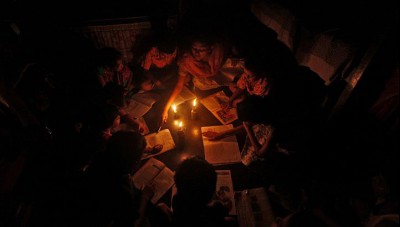
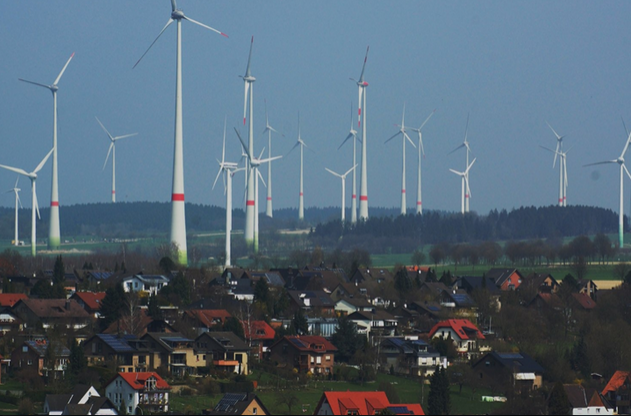
“Load-shedding”. As Countries Lose More Reliable Power Sources….this will result.

Rolling blackout

From Wikipedia, the free encyclopedia

Rolling blackouts are a common or even a normal daily event in many developing countries where electricity generation capacity is underfunded or infrastructure is poorly managed. Rolling blackouts in developed countries are rare because demand is accurately forecasted, adequate infrastructure investment is scheduled and networks are well managed; such events are considered an unacceptable failure of planning and can cause significant political damage to responsible governments. In well managed under-capacity systems blackouts are scheduled in advance and advertised to allow people to work around them but in most cases they happen without warning, typically whenever the transmission frequency falls below the ‘safe’ limit. Rolling blackouts are also used as a response strategy to cope with reduced output beyond reserve capacity from power stations taken offline unexpectedly such as through an extreme weather event.

Canada

In January 2014, the Canadian province of Newfoundland & Labrador renewed rolling blackouts to compensate for the cascading failure of the Holyrood generating station after a fire at the Sunnyside substation on Jan 4 following a blizzard. The rolling blackouts started before the storm on the 4th, rather were caused by extreme cold weather and a high demand for power at the time.[1]

On 9 July 2012, the Alberta Electric System Operator ordered power companies in the province of Alberta to institute rolling blackouts during a heat wave as six generating plants failed during peak demand in the heat of the afternoon. Because the shortage increased the amount consumers paid to generators, Members of the Alberta Legislative Assembly voiced concerns that price manipulation might have been involved[2]

In both cases the blackouts were rolled fairly rapidly, so that no area had to spend more than one hour without power.[1][2]

Egypt

Summer blackouts have been common in Egypt since 2010 but became more severe and widespread after the 2011 revolution. In April 2014, the Minister of Electricity and Renewable Energy said that the problem would take a few years to resolve.[3] The government is blaming on the unrest the country is experiencing for the blackouts. However, blame between the different ministries reveals their poor organization. Some also point to the fact that the infrastructure is old and lacks maintenance.[4]

Ghana

See main article at dumsor

In Ghana, rolling blackouts occurred in 2007-2008 and again after 2012. At the beginning of 2015, the dumsor schedule went from 24 hours with light and 12 without to 12 hours with light and 24 without.[5]

Italy

After the great 2003 blackout in Italy, a rolling blackout program PESSE (it:Piano di Emergenza per la Sicurezza del Sistema Electrico en: Emergency plan for national grid safety) was issued. It has 5 degrees of severity, any controlled blackout can’t exceed 90 minutes.

India

Due to a chronic shortage of electricity, power-cuts are common throughout India, adversely affecting the country’s potential for economic growth.[6][7] Even in the country’s capital of New Delhi, rolling blackouts are common, especially during the hot summer season when demand far outstrips supply capacity. Rural areas are the most severely affected; it is common for the 44% of rural households having access to electricity to lose power for more than 12 hours each day.[8] The states periodically and chronically affected by load-shedding are Delhi, Uttar Pradesh, Tamil Nadu, Bihar, Odisha, Assam, Maharashtra, Madhya Pradesh,Rajasthan and Andhra Pradesh. The states of Punjab, Goa, Gujarat and Kerala are largely free of any load-shedding due to surplus power. Karnataka still occasionally experiences power cuts.[9]

Japan

Rolling blackout in Japan after the 2011 Tohoku Earthquake.

South Africa

There is a long history of rolling blackouts in South Africa, with multiple causes. In South Africa the major producer and distributor of electricity is Eskom, which provides over 95% of the country’s energy usage. During the 1980s Eskom mothballed three of their coal-fired power stations, as there was an excess of generation capacity at the time. With the demise of Apartheid in the 1990s came massive investment and economic growth. At the same time the government tried to deregulate the electricity supply industry by inviting the private sector to build new power stations to meet the rapidly growing demand for electricity. Eskom was at the time prevented from building new power stations (including de-mothballing the three existing power stations) or from strengthening the transmission network. The transmission network is especially important in delivering power from Mpumalanga, where the majority of the power stations are located, to other parts of the country such as KwaZulu-Natal and the Western Cape. With no bidders coming forward to construct new power stations, there was effectively no investment into new generation plants during the early 1990s, which eventually led to the shortage of capacity that was experienced in the 2000s.

In 1998, the Department of Minerals and Energy released a detailed energy review in which it explicitly warned that unless “timely steps were taken to ensure that demand does not exceed available supply capacity”, generating capacity would reach its limit by 2007.[15]

Country-wide blackouts 2007–2008

With the freeze on any new developments being placed on Eskom during the early 1990s, South Africa was faced with a situation where for the next few years the electricity demand kept rising, without any new power stations being built to keep up the necessary supply. By October 2007 the situation had deteriorated to such an extent that Eskom implemented rolling blackouts throughout the country. Blackouts occurred in most suburbs throughout the country for a period of two hours at a time.

The situation came to a head on 24 January 2008 when the national grid was brought to near collapse. Multiple trips at a number of different power stations rapidly reduced the available supply, resulting in Eskom declaring force majeure[16] and instructing its largest industrial customers (mainly gold and platinum mining companies) to shut down their operations and reduce consumption to “minimal levels”, just sufficient to evacuate workers that were still in the mines.[17]

In January 2008, with no short- or medium-term relief available to ease the power shortages, Eskom warned the public that the country’s electricity demand would exceed the supply until 2013 (when the first new power stations would be brought online).

Eskom also began recommissioning older power stations which had been mothballed in earlier decades.[18]

Country-wide blackouts 2014-2015

Load shedding was reintroduced in early November 2014. The Majuba power plant lost its capacity to generate power after a collapse of one of its coal storage silos on 1 November 2014. The Majuba power plant delivered approximately 10% of the country’s entire capacity and the collapse halted the delivery of coal to the plant.[19] A second silo developed a major crack on 20 November causing the shut down of the plant again. This was after temporary measures were instated to deliver coal to the plant.[20]

On 5 December, Eskom launched a major stage three load shedding in South Africa after the shut down of two power plants on Thursday 4 November 2014 due to diesel shortages. It was also reported that the Palmiet and Drakenburg stations were also experiencing difficulties due to a depletion of water reserve to the Hydro plants.[21] On Thursday 4 November, Eskom fell 4,000MW short of the electricity countries demand of 28,000MW. The power utility has the ability to produce 45,583MW, but could only supply 24,000MW due to “planned and unplanned” maintenance. One turbine at Eskom’s Duvha Power Station is also currently out of commission due to an “unexplained incident” in March 2014.[22]

Tajikistan

In January 2008 Tajikistan faced its coldest winter in 50 years, and the country’s energy grid began to fail. By February 2008 Tajikstan’s energy grid was near collapse and there were blackouts in most of the country. Hospitals throughout the country were on limited electricity use, and nurses and doctors were forced to keep newborn babies warm with hot water bottles. There were reports of newborns freezing to death. The UN reported that with so much energy required to keep warm there was a danger of people starving to death.[23][24]

Ukraine

Lack of coal for Ukraine’s coal-fired power stations due to the War in Donbass and a shut down one of the six reactors of the Zaporizhia Nuclear Power Plant lead to rolling blackouts throughout Ukraine from early till late December 2014.[25]

United States

Texas

In February 2011, North and Central Texas experienced rolling blackouts due to 50 power plants tripping offline.[26] Temperatures ranged between 8 °F and 19 °F, the coldest in 15 years. The time of the power outages ranged from twenty minutes to over eight hours. Areas affected included Bell, Bexar, Brazos, Collin, Comal, Dallas, Delta, Denton, El Paso, Fort Bend, Guadalupe, Harris, Hays, Hill, Hidalgo, Hunt, McLennan, Montgomery, Navarro, Palacios, Smith, Tarrant, Travis, Webb and Williamson counties, as well as some counties in New Mexico, including Doña Ana, Otero, and Eddy Counties.[27]

The 2006 and 2011 blackouts were the only two to occur in two decades.[28]

California

Though the term did not enter popular use in the U.S. until the California electricity crisis of the early 2000s, outages had indeed occurred previously. The outages were almost always triggered by unusually hot temperatures during the summer, which causes a surge in demand due to heavy use of air conditioning. However, in 2004, taped conversations of Enron traders became public, showing that traders were purposely manipulating the supply of electricity to raise energy prices.[29]

On 13 December 2003, shortly before leaving office, Governor Gray Davis officially brought the energy crisis to an end by issuing a proclamation ending the state of emergency he declared on 17 January 2001. The state of emergency allowed the state to buy electricity for the financially strapped utility companies. The emergency authority allowed Davis to order the California Energy Commission to streamline the application process for new power plants. During that time, California issued licenses to 38 new power plants, amounting to the addition of 14,365 megawatts of electricity production when completed.

References

  1. Jump up to:a b “Newfoundland outages worsen amid sudden ‘generation problems'”. January 5, 2014.
  2. Jump up to:a b Gerein, Keith (9 July 2012). “Rolling electricity blackouts strike Edmonton and across the province”The Vancouver Sun. Archived from the original on 18 July 2012.
  3. Jump up^ “Preventing summer blackouts in Egypt is ‘impossible’: Minister”.Daily Egypt News. April 13, 2014.
  4. Jump up^ “Egypt to see blackouts for three years at least: Experts”Ahram Online. June 12, 2013.
  5. Jump up^http://www.ghanaweb.com/GhanaHomePage/NewsArchive/artikel.php?ID=344788
  6. Jump up^ “Electricity and power shortage holding India back”. Free-press-release.com.
  7. Jump up^ Range, Jackie (28 October 2008). “India Faulted for Failure to Improve Power Supply”The Wall Street Journal.
  8. Jump up^ [1][dead link]
  9. Jump up^ “Serving Mangaloreans Around The World!”. Mangalorean.Com.
  10. Jump up^ [2] – Tokyo Electric Power Company
  11. Jump up^ [3] – nikkansports.com
  12. Jump up^ “India offers Pakistan electricity to curb load-shedding”The Express Tribune.
  13. Jump up^ “Unscheduled loadshedding irks people in Punjab”The Nation. 2 October 2011.
  14. Jump up^ “Another day of outrage at outages across Punjab”Dawn (Karachi, Pakistan). 18 June 2012. Archived from the original on 18 June 2012. Retrieved 18 June 2012.
  15. Jump up^ “Mail and Guardian – Govt chose guns over power stations”. Mg.co.za.
  16. Jump up^ “Eskom declares force majeure”Moneyweb. 25 January 2008. Retrieved 12 February 2009.[dead link]
  17. Jump up^ McGreal, Chris (26 January 2008). “Gold mines shut as South Africa forced to ration power supply”The Guardian (London). Retrieved12 February 2009.
  18. Jump up^ Old Eskom power stations revived, Fin 24, 2 February 2011
  19. Jump up^ “http://citizen.co.za/269093/video-majuba-power-station-seconds-silo-collapse/”The citizen. 4 November 2014. Retrieved 6 December2014.
  20. Jump up^ “Eskom admits another coal-storage silo at Majuba is cracked”.Business day live. 21 November 2014. Retrieved 6 December 2014.
  21. Jump up^ “Tripped coal stations add to load shedding burden”Business day live. 5 December 2014. Retrieved 6 December 2014.
  22. Jump up^ “This is a catastrophe: electricity expert”Moneyweb. 6 December 2014. Retrieved 6 December 2014.
  23. Jump up^ Farangis Najibullah (13 January 2008). “Tajikistan: Energy shortages, extreme cold create crisis situation”EurasiaNet. Retrieved2008-02-08.
  24. Jump up^ Situation Report No. 4 – Tajikistan – Cold Wave/C

The Absolute Futility of Wind Turbines for Electricity! Unreliable, Unaffordable, Unnecessary!

SA – Australia’s ‘Wind Power Capital’ – Pays the World’s Highest Power Prices and Wonders Why it’s an Economic Basket Case

tom playford-anzac-parade

****

Once upon a time, in a land far, far away there was a veritable manufacturing and industrial nirvana. Post WWII, its population grew at a phenomenal rate; and so too did the level of prosperity enjoyed by thousands of migrants fleeing to it from war ravaged Europe – cheap and abundant food, decent, affordable housing, motor cars, televisions – all within reach for the first time for this aspiring class of people; it soon became a paradise for the working class: it was called South Australia.

And it got that way through the efforts of a legendary political performer, Sir Tom Playford.

In the 1940s, Playford (Premier for 26 years from 1938 to 1965) had a gift in the form of vast untapped reserves of brown coal located at Leigh Creek, about 260 km north of Port Augusta which sits at the top of the Spencer Gulf.

Through Tom’s tireless efforts he coupled that resource with his own creation, the Electricity Trust of South Australia (ETSA), which went on to provide cheap reliable power to almost every home, farm and business in very short order: from 1946 to 1965, the proportion of South Australians connected to electricity increased from 70% to 96%.

Port Augusta Power Station

***

Central to his efforts to populate and industrialise South Australia, was the power station at Port Augusta – for a detailed rundown on Tom Playford’s pragmatic political genius see our essay here:

ETSA: Sir Tom Playford’s Ghost

News last week that Alinta Energy will shut down the Port Augusta power station (which carries Tom Playford’s name), was greeted by the economics lightweights that write for The Australian (and others) with seemingly jubilant headlines such as “Jobs blown away as turbines kill coal”. We’ll return to the nonsense contained in that type of infantile journalistic hubris in a moment.

We have no doubt that the closure of the Port Augusta power station will have Sir Tom turning in his grave.

Kicking off in a big way from 2009, South Australia led Australia’s ludicrous “wind rush”: it currently has over 40% of the installed wind power capacity connected to the Eastern Grid (1,477MW out of the 3,669MW total).

Since then, power prices have skyrocketed – and its unemployment rate with it. Last week, South Australia received the dubious honour of having the highest unemployment rate in the Nation: at 7.6% and rising, it’s even worse than moribund Tasmania, which usually tops that list with ease.

Now, those with some sense of economics – like STT Champion, Danny Price – have chimed in to warn that South Australia’s dismal economic situation can only get worse from here –  given that the closure of the Port Augusta power station can only “drive up [power] prices”.

Coal shutdown ‘will drive up power price’
The Australian
Michael Owen, Meredith Booth
13 June 2015

The federal government and economic forecasters are warning South Australia that the closure of coal-fired power stations by April will push up power prices in the state, which has the highest electricity bills in the nation.

South Australia has pursued the rise of green energy since 2002 and generates 37 per cent of its power through solar and wind.

Frontier Economics managing director Danny Price yesterday said it was unusual “so much wind is going into such a market”.

This was raising prices and ­reducing demand for coal power.

“There’s no doubt in my mind that the closure of Alinta’s plant will drive up prices,” he said.

“In the last 10 years, new coal-fired power stations (globally) outstrip new renewable generation by five times,” he said.

He said the Alinta power stations at Port Augusta, 310km north of Adelaide, that were slated for closure supplied 16 per cent of the state’s power and their loss would leave it short of cheap base­load electricity.

On Thursday Alinta Energy announced its two power stations, one already mothballed, and an associated coalmine at Leigh Creek, 260km north of Port Augusta, would close 12 years early because they were unviable. Alinta blamed the rise in renewable power, much of it government subsidised.

Federal Liberal MP Rowan Ramsey, whose seat of Grey takes in Port Augusta and Leigh Creek, yesterday called on Alinta Energy to delay closure until at least 2018.

“Their absence will create a lot of issues about baseline power supply and will lead to price rises across South Australia and difficulties for businesses and other parts of the community,” he said.

Experts say the cheapest solution for the state to deal with a shortage of baseload power was to enlarge the interconnector between South Australia, NSW and Victoria, allowing the state to tap into an excess national supply.

The Australian Energy Regulator last year approved funding to upgrade the interconnector linking South Australia and Victoria, with the $47 million project expected to be commissioned by July next year.

State Treasurer Tom Koutsantonis insisted electricity prices would not rise.

He said coalmining was a dying industry and suggested workers affected by Alinta’s closure were highly skilled and would either take redundancies or find work elsewhere.

South Australia posted its worst unemployment figures in 14 years on Thursday, the rate rising to 7.6 per cent last month, up from 7.2 per cent in April. It was the worst result since July 2001.

Mr Koutsantonis said Thursday’s state budget “would be focused on creating jobs”.

University of Adelaide workforce academic John Spoehr warned the state faced a return to double-digit unemployment.

“Unless we can fill the void, unemployment will rise to 10 per cent over the next two years,” Associate Professor Spoehr said.

“We need to boost infrastructure and the capacity of the public sector with a combination of debt and direct-funded infrastructure. Let’s not be deficit fetishists.”

Alinta chief executive Jeff Dimery said South Australia would have no problems with securing baseload electricity supply.

Additional reporting: Verity Edwards
The Australian

Now, we promised earlier that we would skewer the naive nonsense about wind power “killing coal”.

STT just loves it when a case can be made simply – and even more so when it can be done in pictures.

Aneroid Energy (formerly windfarmperformance.info) tosses up the facts that the wind industry loves to hate; on a daily basis. It’s the very stuff that scotches wind industry bunkum – such as, “the wind is always blowing somewhere”; and “if you build enough turbines and spread them out far enough you’ll have baseload wind power coming out of your ears”:

Wind Power Myths BUSTED

We’ll start with a quick look at Australia’s wind power May-hem. Here’s the chaos delivered by all of the Australian wind farms connected to the Eastern Grid (which covers the ACT, Tasmania, South Australia, Victoria, NSW and Queensland) for the month of May (oh, and if the graphs appear fuzzy, click on them and they’ll pop up crystal clear in a new window).

May 2015 National

Looking a bit like the meanderings of a drunken spider that had dipped one leg in the ink-well and staggered over the page, that’s the nonsense that wind farms can deliver power as an “alternative” to on-demand power generation sources such as hydro, gas and coal belted, yet again.

With 31 ‘chances’ to make a meaningful contribution to lighting up the 1.4 million homes said by wind power outfits to be ‘powered’ by their wind farms – output collapses 7 times to less than 250MW – or less than 6.8% of the total installed capacity of 3,669MW.

Now, let’s have a look at what SA’s 1,477MW of installed capacity was up (or, rather down) to during May.

May 2015 SA

Hmmm …

Instead of ‘blowing coal away’ as the wind industry, its parasites and spruikers would have us believe, wind power managed to produce 5 complete ‘doughnuts’ during May – ie complete collapses in wind power output. So much for the pitch about ‘powering’ all those homes with ‘wonderful, FREE wind energy’ …

And – on 7 other occasions – collapsed to less than 200MW – or less than 13.5% of SA’s the total installed capacity of 1,477MW.

Those inconvenient pics and numbers are more than enough to skewer the typical line spread by fawning and gullible journos, about the contribution from wind power – such as the drivel in the piece above where it gushes that SA “generates 37 per cent of its power through solar and wind”. No it doesn’t.

ICU Respiratory_therapist

****

The demand for power is a ‘here and now kind’ of thing; and from the graphs above (and below), with wind power it’s a case of here for a few hours today; and gone for the day, tomorrow.

But, STT, never afraid to kick a wind industry myth when it’s down, thinks it’s worth drilling a little deeper into the numbers for this month.

Here’s the total output from all wind farms on the Eastern Grid for 2 June 2015.

2 June 2015 National

Thumping stuff – if chaos is your thing: a whopping collapse of 380MW – from 450MW to 70MW in less than 6 hours; with 70MW being around 1.9% of the total installed capacity of 3,669MW.

Now, let’s have a look at SA alone.

2 June 2015 SA

Another phenomenal effort – a 250MW collapse – taking less than 6 hours to bottom out with a big fat ZERO. And struggling to top 20MW (or 1.3% of capacity) for 4 hours – 1pm to 5pm – right at the point when demand hits its straps.

Sure, everyone is entitled to a little down time, so let’s have a look at the situation on the Eastern Grid on 5 June 2015, to see if wind power was able to benefit from its unscheduled R&R two days earlier.

5 June 2015 National

No, apparently the rest didn’t help much. From 10am to midnight total output bubbles along between 200-400MW (or between 5% and 10% of capacity) – with more than 90% of Australia’s wind power capacity taking most of the day off (yet, again).

And, to see if SA’s wind farms were pulling any of what little weight was being pulled by wind power, here’s the numbers from the same day for SA.

5 June 2015 SA

Looking more like the profile of a Swiss ski run, another coal ‘crushing’ effort there from SA’s finest.

Over the day, there’s an almost total collapse of 1,200MW or 81% of capacity going missing. By lunchtime, wind power is off for a well-earned siesta, with output sliding from 200MW (or 13.5% of capacity) to less than 50MW (or less than 3% of capacity) – a whole lot less than the 37% contribution to SA’s power output touted by the gullible young pups from The Australian (solar’s contribution to total output in SA is a pittance, and is, of course, ZERO when the sun sets).

Wind power hasn’t ‘killed coal’ in SA – it hasn’t anywhere.

On the dozens of occasions outlined above – where wind power output struggled to top 10% of its capacity – the balance of the power being chewed up in SA (and elsewhere on the Eastern Grid) ALL came from conventional, on-demand generation sources, predominantly coal, gas and hydro – in that order.

When SA’s wind watts go AWOL for hours – and even days at a time – South Australia imports huge volumes of cheap coal-fired power from Victoria’s La Trobe Valley and NSW, using the Heywood and Murraylink Interconnectors (with a combined notional capacity of 680 MW).

It also has 1,280MW of gas-steam capacity with AGL’s Torrens Island plant near Port Adelaide (see this article).

And – when demand outstrips those base-load sources – SA has a fleet of highly inefficient (and therefore costly to run) Open Cycle Gas Turbines and diesel generators to cover the shortfall.

Peaking power at Hallett

****

The cost of providing power using OCGTs and diesel generators to provide back-up for unpredictable but inevitable wind power collapses is astronomical: the dispatch price has to hit $300 per MWh before OCGT owners even begin to think about firing them up.

In this Wattclarity post on 9 June (on a typically cold SA winter evening) as wind power output collapsed (again) – heading in the opposite direction to demand – OCGTs were cranked into gear, as were diesel generators (referred to as liquid fuel generators in the Wattclarity article). The cost of wind power’s disappearance and the use of OCGTs and diesel generators to meet demand saw the dispatch price zoom from its usual $30-40 per MWh mark to $589.50 per MWh in order to keep the grid up and lights burning (see the NEM data here).

On plenty of other similar occasions the dispatch price in SA hits or gets close to the regulated cap of $12,500 per MWh (see our posts here andhere).

South Australians are already lamenting the fact that they pay the highest power prices in the world:

Why South Australians Pay the World’s Highest Power Prices

And that there are 50,000 homes (in a state with a population of around 1.6 million) that have no electricity whatsoever – and thousands more having their power cut every year – simply because they can no longer afford it:

Casualties of South Australia’s Wind Power Debacle Mount: Thousands Can’t Afford Power

What Danny Price points out is that – with the closure of the cheapest generator in the State – the Port Augusta power station – things can only get worse from here.

The furphy that ‘turbines kill coal’ is covered by the pictures above – how on earth could SA’s wind power be ‘killing’ anything on 2 and 5 June – and on 5 occasions in May – when it was struggling to produce anything at all, let alone enough to boil a kettle?

In truth, what led to Alinta Energy’s decision to ditch its Port Augusta plant is the monstrous market distortion generated by the Large-Scale Renewable Energy Target – a Federally mandated $50 billion wind industry subsidy scheme paid for by all Australian power consumers as a hidden tax on retail power bills (see our post here).

On the rare occasions when wind power is able to deliver meaningful output to the grid – which is usually at night-time – wind power outfits are more than happy for the dispatch price (the price paid by the grid operator to generators) to hit zero – and often pay the grid operator to take their output.

The LRET effectively forces retailers to take wind power output ahead of every other generation source. Failure to take wind power and the Renewable Energy Certificates (RECs) that go with it, leaves the retailer liable to pay a fine (the “shortfall charge”) of $65 for each MW/h the retailer falls short of the LRET’s mandated target.

The REC that is issued to wind power generators for each MWh of wind power dispatched (currently worth around $50) forms part of the bargain struck under the Power Purchase Agreements wind power generators hold with retailers, containing fixed and guaranteed minimum prices of between $90-120 per MW/h (3-4 times the cost of conventional power). The wind power outfit collects the REC, which passes to the retailer who then surrenders it to the Clean Energy Regulator, thereby, avoiding the “shortfall charge”. The price fixed by the PPA is tied to the expected value of the REC, the wind power outfit gets the price fixed by the PPA, irrespective of the dispatch price; and the power consumer pays the price fixed by the PPA, plus a retail margin on top.

As a result of the above, when they’re delivering to the grid, wind power outfits are happy to watch the dispatch price plummet, punishing base-load generators – like Alinta Energy, while having no impact on their own returns. It’s what’s called “predatory pricing”:

Perverse Renewables Policy turns Wind Power into Super-Predator

What SA’s turbines have ‘killed’ is meaningful employment.

While the article talks of unemployment at 7.6%, that masks the pockets of regional and youth unemployment: Adelaide’s northern suburbs, like Elizabeth have youth unemployment rates in the order of 40% – and, with the imminent closure of big employers, like motor manufacturer, General Motors Holden (with another 1,300 jobs on the chopping block) SA can only look forward to a generation of even more despair (see this Advertiser article).

And that brings us to another well-worn wind industry myth: the yarn about wind power creating thousands of ‘groovy-green’ jobs – lately used by wind industry spruikers to garner support for the retention of the LRET.

SA has more wind turbines per head than any other state – its great ‘wind rush’ took off in earnest in 2010. Since then, its power prices have surged to be among the highest in the world (with the closure of the Port Augusta power station they’re about to rocket again). Over the same time scale, its unemployment rate has jumped to be the worst in the Nation; and – with escalating power prices – can only worsen from here.

Unemployment-Rate-SA-line-2fromGFC

So, with $billions ‘invested’ in wind power in SA, STT puts the poser: what happened to all of the lasting, well-paid jobs promised by wind power outfits during their nauseating community ‘consultations’?  Maybe the answer is found by taking a look at Germany, which, like SA, was beguiled with the self-same same pitch:

Germany’s Unsustainable “Green” Jobs “Miracle” Collapses

Will the last South Australian to leave, please turn out the lights – if anyone can still afford to keep them going, that is?

studying candle

Global Warming Alarmists use Fear, to Extort Money. We need to say NO!

By: Climate DepotJune 11, 2015 

WASHINGTON DC – Award winning Princeton University Physicist Dr. Will Happer declared man-made global warming fears to be “a house of cards” and a “truly a mad issue.”

“This is truly a mad issue,” Happer told the crowd of several hundred at the global warming skeptic conference in Washington DC on Thursday night. The event was sponsored by the Heartland Institute. Happer has authored more than 200 peer-reviewed scientific studies.

“Carbon dioxide is not a pollutant, nor will it cause catastrophic global warming,” Happer explained to the audience at the The Tenth International Conference on Climate Change (#ICCC10).

“This whole climate scare is a house of cards,” Happer said.

“The social cost of carbon is probably negative. There is no social cost of carbon,” he added. Happer has previously testified to the U.S. Congress. See:Flashback 2009: Will Happer Tells Congress: Earth in ‘CO2 Famine’ — ‘The increase of CO2 is not a cause for alarm and will be good for mankind’ — ‘Children should not be force-fed propaganda, masquerading as science’

Earlier in the day, Atmospheric Physicist Dr. Fred Singer told the summit that the effect of CO2 emissions on climate is “negligible, not important” but very beneficial for agriculture.

Also attending the summit was U.S. Senate Environment & Public Works Committee chairman Senator James Inhofe (R-OK). Inhofe advised Pope Francis to stay out of the climate debate.

“Everyone is going to ride the pope now. Isn’t that wonderful,” Inhofe told reporters. “The pope ought to stay with his job, and we’ll stay with ours.”

Related Links:

Princeton Physicist Dr. Will Happer on AGW: ‘Data has been manipulated, honest scientific debate has been stifled, educational institutions have been turned into brain-washing centers for the cause’

Princeton Physicist Dr. Will Happer: ‘The incredible list of supposed horrors that increasing CO2 will bring the world is pure belief disguised as science’

‘In Defense of Carbon Dioxide’ — Princeton Physicist Dr. Will Happer & NASA Moonwalker Harrison H. Schmitt: ‘The incredible list of supposed horrors that increasing CO2 will bring the world is pure belief disguised as science’

Global Wind Day….Let this be the Day to Ramp Up Education and Discussion of the Windscam!

WORLD COUNCIL FOR NATURE

PRESS RELEASE
14 June 2015

GLOBAL WIND SCAM DAY

Tomorrow June 15th, the wind lobby will be celebrating Global Wind Day.
Its choice of day coincides with the WORLD ELDER ABUSE AWARENESS DAY, as
per United Nations’ resolution A/RES/66/127. This evidences a lack of
respect for the elders, especially those that are victims of abuse. Is
it surprising? – Not really. Wind farm victims are also treated with
contempt. They are ignored, or even accused of imagining their
insomnias, headaches, nauseas, tachycardias,  etc.

On June 15th, abused elders will take a second seat as they watch the
hundreds of events organised worldwide to convince people that wind
farms are useful, cheap, harmless to birds and people, good for property
values and great for tourism and the economy.

But are wind farms useful, they might ask?
– Not in the least, say independent engineers. The following cartoon
explains why:

On this special occasion, copyrights to the cartoon are waived by the
author, http://www.cartoonsbyjosh.com [1]  We are grateful to him for
this attention.

Wind turbines have been operating since the eighties, yet the problem of
their intermittency hasn’t been solved. Nor has their cost, which
makes their electricity three times more expensive than that generated
by conventional power. This, and other unsolved problems listed below,
make many windfarm opponents claim that WIND TURBINES ARE A SCAM. Their
real purpose would be threefold:
– finance political parties (part of the subsidies are returned through
the famous “revolving door”);
– provide large, guaranteed profits to a new class of “green” crony
capitalists;
– hurt the economies of entire countries or states (starting with Spain,
California, Ontario, etc.), as a prelude to the political takeover by
“anti-establishment” political parties (e.g. “Podemos” in Spain).

Hence the nickname given by some to the Global Wind Day:

GLOBAL WIND SCAM DAY

OTHER UNRESOLVED ISSUES RELATED TO WIND TURBINES:
– infrasound emitted by these machines make some residents seriously
ill,
– allowed noise limits are frequently exceeded,

– shadow flicker at certain hours of the day causes added stress to
residents,

– properties within view of the turbines suffer losses in value ranging
from roughly 10% to 50%,

– turbine blades kill birds and bats by the million every year;

– wind turbines depreciate landscapes and heritage sites, and horrify
most tourists;

– subsidies and other financial advantages granted by governments to
support unprofitable and unreliable wind energy cause budget deficits to
soar;

– taxpayers, then consumers foot the bill – fuel poverty soars;

– the high price of electricity causes companies to relocate abroad;

– investors prefer states or countries where energy is cheaper;

– states or countries relying on renewable energy become less
competitive, therefore poorer.

CONTACT:

Mark Duchamp    +34 693 643 736 [2]

Chairman
www.wcfn.org [3]

References available here:
http://wcfn.org/2015/06/04/global-wind-day-2/ [4]

Germany Realizing the Truth, About the Wind Scam!

Germany’s Wind Power ‘Dream’ Becomes a Living Nightmare

claudia schiffer

****

The wind industry, its parasites and spruikers, around the globe, hail Germany as THE wind power ‘Super Model’. Trouble is, in Germany – as elsewhere – the ‘gloss’ has well-and-truly worn off – and the ‘Model’ is looking more than just a little worse for wear.

The Germans went into wind power harder and faster than anyone else – and the cost of doing so is catching up with a vengeance. The subsidies have been colossal, the impacts on the electricity market chaotic and – contrary to the environmental purpose of the policy – CO2 emissions are rising fast: if “saving” the planet is – as we are repeatedly told – all about reducing man-made emissions of an odourless, colourless, naturally occurring trace gas, essential for all life on earth – then German energy/environmental policy has manifestly failed (see our post here).

Some 800,000 German homes have been disconnected from the grid – victims of what is euphemistically called “fuel poverty”. In response, Germans have picked up their axes and have headed to their forests in order to improve their sense of energy security – although foresters apparently take the view that this self-help measure is nothing more than blatant timber theft (see our post here).

German manufacturers – and other energy intensive industries – faced with escalating power bills are packing up and heading to the USA – where power prices are 1/3 of Germany’s (see our posts here and hereand here). And the “green” dream of creating thousands of jobs in the wind industry has to turned out to be just that: a dream (see our post here).

In response to mounting health complaints, German Medicos have called for an outright halt to wind farm construction, in order to protect their fellow citizens; and to stave off medical malpractice suits:

German Medicos Demand Moratorium on New Wind Farms

Now, apart from unnecessary wind farm harm, Germans are fast waking up the unassailable fact that wind power is not only insanely expensive, it’s utterly meaningless as a power source.

Here’s a couple of recent pieces from Deutschland, that detail the scale of the disaster and the German’s brewing hostility to it.

The Madness Of Germany’s Energy Socialism
GWPF
Wolfram Weimer, Handelblatt
1 May 15

Germany’s energy revolution is getting more and more absurd. After nuclear power and gas, coal power is about to be phased out. The madness is reaching new proportions.

Thirty years ago, he would have certainly been honored as “Master Architect of Socialism” or “Chief Activist of Socialist Labour” – east of the Elbe. Sigmar Gabriel is doing everything possible to re-establish a comprehensive planned economy in Germany: the green energy transition pushes the gates to energy-socialism far open.

His latest coup: the German coal mining industry should be subjected to a national climate change regime and should submit to bureaucratic CO2-tonnes planning and arbitrary special levies. The German economy, the coal-states of North Rhine-Westphalia and Brandenburg, and the unions are up in arms. Verdi boss Frank Bsirske sees up to 100,000 jobs at risk and calls for mass demonstrations. The unfortunate RWE CEO Peter Terium warns desperately: “The levy would mean the immediate end for much of lignite mines and coal-fired plants.” And the Christian Democrat’s Armin Laschet warns:” With its special tax on coal the Minister of Economy purges the last subsidy-free, economic and import-independent domestic energy source from the German electricity market.”

In fact, the new coal plan is just another step in the great socialist power master plan that Sigmar Gabriel is rolling out all over Germany. Already a whole republic of Green electricity councils establishes determined plan-prices, solar and wind comrades produce arbitrary amounts of power, the population pays compulsory levies, supply and demand are suspended and party politics determine plan fulfillment figures. In this eco-socialism, everybody who produces electricity from renewable sources receives a nationally defined “energy feed-in tariff” (the very word sounds like it comes from East Berlin) according to plan specifications. This has as much to do with free market prices for electricity as Stasi boss Erich Mielke had to do with the freedom to travel – nothing.

What was once launched as a – well-intentioned – green energy revolution has now mutated into a giant VEB [i.e. East German state company]. In Gabriel’s system electricity production is no longer determined by demand – as is usual in a market economy. It is not demand that determines supply – but the subsidy billions. Produced is only what wind and solar power and feed-in tariffs expensively allow, not what the public and the economy need – cheap energy. In Gabriel’s national energy system there is an ideological distinction between “good” (green) and “evil” (traditional) energy. Therefore, even profitable and clean gas power plants are switched off – as just happened to Europe’s most modern gas-fired power plant in Irsching. Instead, new subsidy-fed projects are connected to the grid without the necessary network capacity and without the necessary storage technology. For these intermittent power plants, coal power plants have to be kept running as backups, which in turn emit a lot more CO2, which now are also extra-taxed. It all feels like socialist self-perpetuating: this energy revolution cannot be stopped.

Environmental Destruction

The eco-guaranteed prices already lead to all sorts of classic features of a planned economy all of which are well known from the Soviet bloc economies: unprofitable excess capacity, for example. Meanwhile, 1.4 million photovoltaic panels have been installed in the rather shady Germany.

No other country in the world has built up such a tremendous and wholly unprofitable contingent. With around 25,000 wind turbines as well as thousands of biogas plants we are world leader. Like in the five-year plans of the socialist German Democratic Republic, quotas, objectives, and targets are prescribed by central ministries.

The new eco-planned economy devours vast billions in subsidies, not less than 22 billion euros total EEG feed-in tariff per year – and yet electricity from renewable sources, even after more than ten years of continuous subsidies, is more expensive than that from coal, oil, nuclear energy and gas. Rather than terminate the subsidy socialism, however, a parasitic mix of funding application experts, investors, plant manufacturers and subsidy distributers continues to drive the industry forward.

They have created an eco-industrial complex, which performs perfect lobbying in Berlin, but which also ruins the country with windmills and fleeces it with collective money, because on top of that the Kreditanstalt für Wiederaufbau (Credit Bank for Rebuilding) grants the green lobby subsidised loans to ensure that the planned economy is also financially rounded.

The wrong-headed system is so expensive that only a very rich country like Germany can afford this large-scale experiment. Around 100 billion euros have already been burnt by this subsidy socialism. Currently the green energy levy costs 56 million euros every day. The expanding eco-socialism has turned energy providers to state combines of the Federal Grid Agency. Because this agency determines which prices may be charged for electricity transmission, it allows subsidies and authorised returns on investments. Because the industrial electricity prices are the second highest in Europe, energy-intensive businesses are gradually saying good-bye to Gabriel’s energy-socialism.

The fact that the colossal construction of wind turbines and solar installations also causes dramatic landscape blight is the sad irony of this green story. A journey through Gabriel-Germany is now like a green tunnel of horror, a roller-coaster ride through vast tracks of destroyed nature, a subsidy-grave filled with turbines and panels.

That’s why – rather than chasing coal off the market too – the green command and control economy needs to be reformed fundamentally. It has set in motion the biggest rip-off subsidy of recent history and has damaged the environment, it burdens the economy and forces all consumers to suffer from rising electricity prices. The worst distortions of the market have to be balanced by more and more new regulations. In this way, one government intervention justifies the next. Germany’s ‘real existing socialism’ has been history since 1989, thank God. The energy-existing Gabriel-socialism, however, is on the rise.
Translation Phillip Mueller
Wirtschaftswoche, 24 April 2015

German wind farm

****

Part of what’s got Germans up in arms is what the wind industry has done to their beloved towns and country-side (for a pictorial taste of the aesthetic destruction – see this article).

And the Germans are not taking what the wind industry has dished up, lying down: they’re getting angrier and more organised by the day.

Germany’s Anti-Wind Energy Elements Morph Into A Massive Network Of Protest Groups… Call Wind Energy “A Lie”
NoTricksZone
4 June 2015

Resistance to the junk green energy is growing in Germany.

Last month a print edition of Germany’s Braunschweiger Nachrichtenfeatured a commentary by the head of a German wind protest organization, Dr. Thomas Carl Stiller. The title: “Madness With Wind Turbines”

Braunschweiger-Zeitung1

Hat-tip K.E. Puls, European Institute for Climate and Energy (EIKE).

In the commentary Stiller says that Germany’s once highly ballyhooed Energiewende (transition to renewable energies) “cannot and will not function“, and what was once only a few single protesters voicing opposition to wind parks, is now an entire nationwide umbrella organization of protest groups against the “subsidy-robbing empire” of wind energy industry.

Stiller describes a technology whose produced energy cannot be stored and which depends on random, unpredictable winds. The technology is so inefficient that builders are now forced to erect 800-foot tall monster size machines in a desperate effort to extract real power. He also writes that “wind energy has done nothing to combat climate change”.

“Despite increased wind energy installation, CO2 emissions in Germany have risen. […] Climate protection and reliable power supply by wind turbines installed on the land is thus a lie.”

Stiller also writes that the maximum output of a wind turbine “is far below its rated capacity” and that the German citizenry is paying 20 billion euros annually for a “misconception“. To illustrate the folly of wind energy, Stiller writes that Germans are paying 20 billion euros a year for a commodity that gets sold on the power exchange for only around 2 billion euros.

What’s encouraging is that Stiller writes:

“German citizens are waking up to this insanity”. He comments that “wind energy would not be able to supply the country even if the entire country were covered with wind turbines”.

Stiller also calls for more research for the health impacts that wind turbines are having and that the energy source has got to be for the good of the public and not profit a few opportunists. He adds:

“Us organized citizens are demanding independent feasibility studies and calling for more transparency during the planning process and that man and nature be put back in the focus.”

NoTricksZone

divine

The Left Uses “Climate Change”, as their “New Religion”!

Why The Left Needs Climate Change

Try this out as a thought experiment: what would happen if, tomorrow morning, we had definitive proof that catastrophic climate change was impossible, wasn’t happening, and would never happen. Would Al Gore breathe a big sigh of relief and say—“Well good; now we can go back to worrying about smoking, or bad inner city schools, or other persistent, immediate problems.”

Of course not. The general reaction from environmentalists and the left would be a combination of outrage and despair. The need to believe in oneself as part of the agency of human salvation runs deep for leftists and environmentalists who have made their obsessions a secular religion. And humanity doesn’t need salvation if there is no sin in the first place. Hence human must be sinners—somehow—in need of redemption from the left.

I got to thinking about this when reading a short passage from an old book by Canadian philosopher George Grant, Philosophy in the Mass Age:

“During the excitement over Sputnik, it was suggested that the Americans were deeply depressed by Russian success. I thought this was a wrong interpretation. Rather, there was a great sigh of relief from the American elites, for now there was an immediate practical objective to be achieved, a new frontier to be conquered—outer space.”

This tracks closely with Kenneth Minogue’s diagnosis of liberalism in his classic The Liberal Mind.  Minogue compared liberals to medieval dragon hunters, who sought after dragons to slay even after it was clear they didn’t exist. The liberal, like the dragon hunter, “needed his dragons. He could only live by fighting for causes—the people, the poor, the exploited, the colonially oppressed, the underprivileged and the underdeveloped. As an ageing warrior, he grew breathless in pursuit of smaller and smaller dragons—for the big dragons were now harder to come by.”

Hence on college campuses today the liberal mind is relentlessly hunting after “microaggressions,” which is pretty pathetic as dragons of injustice go. Environmentalists are still after the fire-breathing dragon of climate change, now that previous dragons like the population bomb have disappeared into the medieval mists—so much so that even the New York Times recently declared the population bomb to have been completely wrongheaded.

Or perhaps a better metaphor for true-believing environmentalism is drug addiction: the addictive need for another rush of euphoria, followed by the crash or pains of withdrawal, and the diminishing returns of the next fix. For there’s always a next fix for environmentalists: fracking, bee colony collapse disorder, de-forestation, drought, floods, plastic bags . . . the list is endless.

The political scientist Anthony Downs diagnosed this aspect of environmentalism in a famous 1972 essay in The Public Interest entitled “Up and Down with Ecology—The Issue-Attention Cycle.”  In analyzing the then fairly new public enthusiasm over environmentalism (though it tended to go by the term “ecology” back then), Downs laid out a five-step cycle for most public policy issues. A group of experts and interest groups begin promoting a problem or crisis, which is soon followed by the alarmed discovery of the problem by the news media and broader political class. This second stage typically includes a large amount of euphoric enthusiasm—you might call this the dopamine stage—as activists conceive the issue in terms of global salvation and redemption.

But then reality starts to intrude. The third stage is the hinge. As Downs explains, there comes “a gradually spreading realization that the cost of ‘solving’ the problem is very high indeed.” This is where we have been since the Kyoto process proposed completely implausible near-term reductions in fossil fuel energy—a fanatical monomania the climate campaign has been unable to shake.

“The previous stage,” Downs continued, “becomes almost imperceptibly transformed into the fourth stage: a gradual decline in the intensity of public interest in the problem.” Despite the relentless media and activist drumbeat and millions of dollars in paid advertising, public concern for climate change has been steadily waning for the last several years.

“In the final [post-problem] stage,” Downs concluded, “an issue that has been replaced at the center of public concern moves into a prolonged limbo—a twilight realm of lesser attention or spasmodic recurrences of interest.”

Activist liberal elites always need a Grand Cause to satisfy their messianic needs, or for the political equivalent of a dopamine rush. For such people, the only thing worse that catastrophic climate change is the catastrophe of not having a catastrophe to obsess over—and use as an excuse to extend political control over people and resources, which is the one-side-fits-all answer for every new crisis that starts through the issue-attention cycle.

Downs did think that the issue-attention cycle would be longer for environmental issues that other kinds of issues like civil rights and crime, for a variety of reasons.  So environmental junkies should chill. They’ll find new ways to get their fix. They always do.

Aussie Governments Pandering to the Wind Industry, and Enraging Their Own Constituents!

Time to Tune-In Tony: Coalition’s $46 Billion Wind Industry Rescue Package has Liberal Voters Seething

Tony Abbott macfarlane 18.12.13

****

A week or so back, Tony Abbott’s Coalition struck a deal with Labor involving a $46 billion electricity tax aimed at salvaging what’s left of Australia’s wind industry (see our post here).

The ‘deal’ – which has passed the House of Reps – and is on its way to the Senate – is seen by thousands of people in rural communities spread out across the country as a betrayal, not only of their interests, but of the interests of the Nation as a whole (see our posts here and here).

One line from within the ranks is that the Coalition are playing for votes by backing “renewables”. However, there’s a mighty big distinction between the shiny solar panels on a suburban rooftop, and endless seas of bat-chomping, bird slicing, blade-chucking, pyrotechnic, sonic-torturedevices. The former don’t bother anyone much; the latter drive those equipped with the full-range of earthly senses to a state just below (and sometimes above) white-hot fury:

Angry Wind Farm Victims Pull the Trigger: Turbines Shot-Up in Montana and Victoria

What Tony Abbott & Co need to pick up on (real fast) is the fact that it’s ONLY the lunatics of the hard-‘green’-left that are ready to die in a ditch to ‘save’ the wind industry – pumped up by astroturfing outfits like GetUp! – people that will never, ever vote for the Coalition.

Meanwhile – thanks to wind industry front men, Ian “Macca” Macfarlane and his youthful ward, Greg Hunt – the Coalition is pandering to a crowd they can never hope to win; and forsaking those who have – till now – loyally thrown their votes at the Liberals and Nationals.

That loyalty is being sorely tested, as this cracking little piece from STT Champion, Patina Schneider spells out. Patina quite rightly lays into the Liberal’s ‘Disappointing’ Dan Tehan (as have many others – see our postshere and here) for his switch to the dark-side.

Alarmed and Disappointed
Hamilton Spectator
Opinion
Patina Schneider
30 May 2015

I wish to relay my alarm and disappointment with Dan Tehan’s recent appearance on the ABC’s 7.30 report on Thursday 30th April, where he appeared in conjunction with Keppel Prince, Portland Aluminium and Committee of Portland representatives.

Dan Tehan broke ranks with his Coalition members, and urged that the Renewable Energy Target should be higher than the 32,000 gigawatt hours proposed by the Coalition.

He claimed he was “putting jobs before politics”. However he was putting JOBS before the HEALTH of hundreds of his constituents in the electorate of Wannon.

On behalf of the Australian Industrial Wind turbine Awareness Network I ask of Mr. Tehan, member for Wannon, what “hold” does the wind turbine industry have over you, to have steered you so far to the left?

I ask of Mr. Tehan, please declare your interests. They must be significant, given that you are the member responsible for representing the residents harmed and nuisanced by the Cape Bridgewater, Macarthur, Glenthompson and Waubra wind power stations, on a daily basis?

Are these constituents collateral damage?

No one wants to see jobs leave Portland but is the solution to blindly advocate for a Renewable Energy Target which would sanction further harm and misery in the south-west of Victoria, opening the flood gates for the construction of so many additional monster wind farms in your electorate?

The wind industry and its intermittent and acoustically toxic technology have failed Victorians, as I’m afraid, has Dan Tehan. It is simplifying matters to the point of embarrassing, that Dan Tehan is doing the bidding of the Labour Opposition, and continues to blame Keppel Prince’s woes on the Renewable Energy Target’s uncertainty.

The Australian government’s Anti-dumping Commission’s ‘Investigation 221’ tells the real Keppel Prince story. It appears to be one of the wind industry’s abject failure to support local manufacture of wind turbine and tower components.

Keppel Prince is well aware of the dumping of wind towers from China and Korea. In 2007, Keppel Prince had 182 staff employed in the production of wind towers. But in 3.6 ‘Employment numbers’, the Commission’s report reveals; ‘Keppel Prince had a total workforce of 362 at December 2012 of which 71 were employed in the production of wind towers, the number of employees in the production of wind towers had reduced to 64 by June 2013’.

Inflated numbers in tower production were gradually whittled down while the RET enjoyed bipartisan support. Only 20% or so of Keppel Prince’s employees were making wind towers in 2012 while the other 298 employees – the majority of Keppel Prince’s jobs – were largely servicing the aluminium industry which, incidentally, was also being devastated by the same RET, which resulted in exorbitant electricity prices, which Dan was advocating for!

In 2013, as a result of reported dumping and price cutting, it appears that only 64 staff remained employed at Keppel Prince in wind tower manufacture.

There were no further wind tower orders taken after the wind farm at Taralga in N.S.W. But Keppel Prince and its Clean Energy Council associates told the media that RET uncertainty had “made 100 workers redundant today, in direct response to the Abbott government’s move to lower the Renewable Energy Target”.

If Anita Rank from the Committee for Portland (appearing on the same 7.30 report with Dan Tehan) thinks that 80 jobs are the equivalent of 40,000 jobs in Melbourne, Keppel Prince, it would appear just overstated the 60 or so Portland jobs by 20,000 in Melbourne’s terms!!

‘Move to lower renewable energy target claims 100 jobs at Keppel Prince’ was published in The Australian on October 23, 2014. It reported a statement from Keppel Prince: “The continuing uncertainty over large-scale renewables (including the Renewable Energy Target) and related wind tower fabrication projects, TOGETHER with the SIGNIFICANT LOSSES SUSTAINED FROM SUCH ACTIVITIES over the PAST SEVERAL YEARS, have forced Keppel Prince Engineering to review this aspect of its business”.

The real situation is that Keppel Prince had experienced hardships as a consequence of wind tower dumping, and price cutting of wind towers, over a number of years. These hardships, significant losses and resulting job losses, occurred independent of, and irrespective of what was going on with the RET.

Portland has been dudded by the wind industry and its greedy apologists. The former Brack’s government failed to legislate laws that would protect Portland’s interests and didn’t bother to task the wind industry to hold them to their empty claims.

After your appalling display on ABC’s 7.30 Report on Thursday 14th May, we can add you to that list of disappointment, Mr. Tehan.

How about representing those loyal conservative voters who put you in office, the hundreds of your constituents whose health is severely impacted by wind farms in your electorate?

You have turned your back on your traditional Liberal voters.

By promoting Labour party policy, maintaining the Renewable Energy Target at 33,000 gigawatt hours, and putting jobs (I question accuracy of the figures) before HEALTH, you are sentencing thousands of rural Australian families to a life of ongoing pain and suffering, due to infrasound emitted by wind turbines.

You, and your government’s capitulation to the Labor party policy, are also committing millions of Australian power consumers to skyrocketing power prices in the near future.

Last year 34,000 Victorian households were cut off power, due to inability to pay their electricity bills.

What will this figure of “power poor” families, denied the basic necessity of electricity to their homes, skyrocket to as a result of the Coalition’s support for Labor’s higher figure of 33,000 gigawatt hours?
Hamilton Spectator

dan tehan2

****

Nice work Patina! We couldn’t have said it better ourselves. But it’s this observation that deserves a little further notice:

You have turned your back on your traditional Liberal voters“.

life organic

****

The Coalition are setting themselves up for a monumental electoral backlash by pumping a policy that plays well with the inner-city skinny-soy-latte crowd, but which is going to drive power prices through the roof – alienating small business owners and struggling families (see our postshere and here) – and which leaves rural communities broken, bitter and divided:

Unwilling Turbine Hosts Set to Revolt, as NSW Planning Minister – Pru Goward – Slams Spanish Fan Plans at Yass

To continue to pander to urban trendsetters (who will never vote for your team) at the expense of your natural constituents is political suicide.

Tony, keep alienating the previously faithful and they’ll turn to micro parties; or start running independent candidates of their own.  STT hears that plans are afoot to do just that in an effort to unseat Disappointing Dan Tehan. Loyalty doesn’t last so long in the face of political arrogance and contempt.

The Coalition were gifted with the perfect weaponry to bring the LRET debacle, and the great wind power fraud, to an end – in the form of the recommendations made by their own RET Review Panel (see our post here).

Instead, at the beckoning of their wind industry mates and backers, Ian Macfarlane and Greg Hunt cooked up a wind industry rescue package that will cost all Australian power consumers $46 billion: half of which will be directed to wind power outfits – like near-bankrupt Infigen (akaBabcock and Brown); with the balance being recovered as a $65 per MWh fine (aka “the shortfall charge”) – and directed to general revenue (ie a ‘stealth tax’):

Out to Save their Wind Industry Mates, Macfarlane & Hunt Lock-in $46 billion LRET Retail Power Tax

The stench attached to Hunt and Macca’s efforts to save their mates in the wind industry will easily outlast religion (see our post here); and, for their thousands of rural victims, will never be forgiven; or forgotten.

hunt macfarlane

****

Meanwhile, one of Pac Hydro’s Cape Bridgewater victims, Crispin Trist let fly with this cracking riposte to plans by Synergy Wind to spear dozens of blade-chucking monsters in the flight-path of Portland’s airport.

Collision course!
Warrnambool Standard
Letters
30 May 2015

I refer to the article in the Portland Observer dated 22nd May 2015, “New wind tower hope”.

I read with concern the proposal by wind developer Synergy Wind to build a wind facility at the Bridgewater Lakes. It is my understanding that to do so would present a clear conflict of interest to the safe operations of aircraft movements into and out of Portland airport. A quick search of any aerial satellite imagery shows that the Bridgewater Lakes are located directly under the flightpath to the western approach of runway 08, this being the main runway at Portland airport.

Wind turbines can present a real risk to aviation. Inflow turbulence up to 200 metres in front of an operating industrial scale wind turbine can suck light aircraft or microlights into the blades. Wake turbulence of up to 500 metres or more behind the spinning blades could throw an aircraft to the ground! One pilot nearly discovered this in NSW when attempting to fly a light plane behind an operating wind turbine. Fortunately in that instance the land dropped away and they were able to recover the aircraft out of the dive and fly to safety. There have even been recorded instances around the world of aircraft crashing into wind turbine infrastructure with fatalities!

Any proposal to erect wind turbines in alignment with runway 08 only 2-3 kilometres from the runway threshold would to my mind be completely irresponsible and could present a high risk of collision to approaching or departing aircraft. Add to this the risks of bad weather with reduced visibility, high winds and driving rains or flying at night and you have a recipe for disaster.

Does the Glenelg Shire Council intend to close Portland airport? The airport has already been moved once to make way for the Aluminium Smelter. To do so again would be an extremely costly exercise and many funds have already been spent upgrading the existing airport. The current operations at the airport that I am aware of include regular scheduled passenger operations, the Flying Doctor, the CFA fire fighting operations, crop dusting, the Coastguard, various light aircraft movements, and the RAAF for touch and goes, the Roulettes and runway approach practise by Orion and Globemaster aircraft. This states to me that the airport is serving its purpose well and should not be interfered with. If anything the facility should be expanded to cater for future requirements.

It has been explained to me that the current maximum aircraft type able to use the facility is the DC-9 (or Boeing 717) passenger or freighter jet. Surely upgrading to Boeing 737 or Airbus A320 standards might be a more sensible option in future. These are the most popular jets flying in the world today. Indeed the Prime Minister`s VIP transport is a Boeing 737!

Wind operator Pacific Hydro are also on record as stating to a packed community meeting at the Cape Bridgewater Kiosk back in 2008/09 that no further wind towers could be developed any further north of the current wind facility site as they would interfere with operations at the airport. Danny Halstead stated this clearly to the assembled community. So how has this proposal by Synergy Wind been allowed to progress to this stage?

A similar wind facility development has been proposed under the western flightpath into Warrnambool airport. The site is located approximately 2 kilometres to the north of Koroit on the Woolsthorpe Road. A MET mast has been erected and is visible from the road on the left when driving north. And yet the Warrnambool Council in a positive move is spending money to upgrade the airport.

Why undermine this investment by allowing a wind facility to be built under the flightpath? What is going on here? Who is in charge of these absurd and downright dangerous planning conflicts in the South West? There is a worrying trend that is occurring here in the rush to develop industrial scale wind turbines. The lives of both pilots and passengers could be put at risk if these two wind developments are built. And what do CASA the Civil Aviation Safety Authority have to say about this?
Crispin Trist
Cape Bridgewater

As Crispin points out, planes and giant fans just don’t mix:

4 killed as Plane slams into Giant Fans in South Dakota

plane_new_crop_t607-665x385

Wind Refugee, Barb Ashbee, Speaks Out About the Trauma She Has Been Forced to Endure!

A Short Essay on Misguided Environmentalism, Bullies and Losing One’s Home

You were able to move. Now you have to forgive and carry on. Move on with your life and find the path back to happiness you enjoyed before it all happened.
This is what my mind tells my heart. That is what some of my friends are thinking, I can feel it. A gentle sort of ‘get over it’. And some days I feel like that is what I need to do.
But the heart still feels the pain. The heart feels the injustice for an event that wasn’t an accident, or being in the wrong place at the wrong time, or brought on by our own actions, or a natural disaster or single tragedy that all our families suffer throughout our lives. No, this tragedy has been intense, life changing; trust destroying, personality maiming and spirit crushing because it simply did not have to happen.
Why am I still angry?
I am angry that our perfectly healthy bodies were pummeled into illness by infrasound and relentless noise. That we were no longer allowed the right to get sleep in our home. That with thumping noise on too many nights over 60 decibels at times and a house that vibrated almost every day we were unable to thrive. Headaches, heart palpitations, chest pressure, sleep deprivation, and eventually hyper- thyroidism, nosebleeds requiring treatment, anxiety in pets with some crying and vomiting at the same time we felt the worst effects. I am angry that our government leaders knew all this from our very first letter asking for help and they lied to us, let us continue on for months and months until we just couldn’t take it anymore and hired a lawyer with money we really didn’t have to spare. And I am really angry that our awful experience was not enough, piled on top of all of the others we found out about, not enough to make it stop.
Instead new projects forged ahead and more families are sick.

And what of the non- physical impacts?
My husband fretted because there was one last piece of board that needed to go on to finish the inside of the dream shop he had just built and he didn’t have the energy or desire to do it. The perfect shop to house his classic car, with the fully insulated walls, painted floor and housing his collection of car memorabilia was barely used when he had to give it up.
He stressed over our future.
We lived in uncertainty, wondering how we were going to be able to stay there yet knowing we could never sell and if we did we could never pass this on to some innocent family. I thank the stars that we had even bought the house so that the previous family who had 6 children didn’t have this set upon them. What would they have done?

While most friends and family are sympathetic others ask why we are complaining so much when obviously, according to government research, there are no ties between the turbines and what has happened to us. How do we explain these erroneous and deceitful government statements on a complicated issue in a sentence or two without sounding nuts?
I want people to be angry; I want them to write letters to our leaders asking how they can treat people so bad but would I do that if I were on the periphery? I’m not so sure. In fact, when I first heard about the earliest families in phase one having problems, I felt sure they would be resolved. After all, is that not the role of government? To put the citizens foremost, to protect our health and home and look after people in harm? That’s what I thought.
People not connected to this issue are not sure. It’s hard to explain the impacts when you don’t have anything more to show but exhausted faces that can be caused by anything. The rest is hidden. The headaches are hidden, the sleep deprivation is debilitating but you can’t see it. The heart palpitations, head and chest pressure, incredible frustration trying to sleep in a vibrating home is hidden.

What do you do when you do get up the courage to speak with your doctor about it and they stare stone faced with no comment, so unworthy are you that they don’t even bother to note the symptoms in your records. Or when they do finally speak they offer a condescending comment that leaves you in tears? Nobody sees that either.

I could go on and on about the injustice and the long term effects but until this government takes a stand to stop this industry and turns their help to those suffering instead of funding the perpetrators then I am severely overpowered. If only people knew the real story.

There are
those who are involved in perpetrating and covering up the harm;
those who know and are fighting with every breath, some loudly, some quietly;
those who know but don’t know what to do;
those who know but don’t care;
and thanks to an impressive 5 star cover-up,
those who don’t know and will never know.
Unfortunately for all, the last two hold the majority of the population.
And so it continues….

“Unbiased Scientists” Fight Back Against Gov’t Induced Climaphobia….

To Whom It May Concern What follows is a letter that we sent to the current President of the American Physical Society (APS) with a copy to members of the Society’s Presidential-Line Officers. Because of the serious issues pertaining to the integrity of APS — one of the world’s premier scientific societies (with upwards of 50,000 members) — we have decided to make the letter public. SIGNATORIES (2 June 2015)— Roger Cohen Fellow, American Physical Society Laurence I. Gould Past Chair (2004) New England Section of the American Physical Society William Happer Cyrus Fogg Professor of Physics, Emeritus Princeton University May 8, 2015 Samuel Aronson President, American Physical Society One Physics Ellipse College Park, MD 20740-3844 Dear Dr. Aronson, As three members of the American Physical Society, we are writing on behalf of the nearly 300 other members who signed our 2009 and 2010 petitions to the APS taking strong exception to the 2007 Statement on Climate Change. Those petitions called for an objective assessment of the underlying science, leading to a more scientifically defensible Statement. We wish to call attention to important issues relating to the processes that led to the 2007 Statement and the Draft 2015 Statement. In developing both the 2007 Statement and the current Draft, the Panel on Public Affairs (POPA) failed to follow traditional APS Bylaws. In particular, regarding APS statements the Bylaws state: “The Chair of POPA has the responsibility for ensuring that the statement draft incorporates appropriate APS member expertise” (XVI.B.2), and, “Anyone, particularly POPA and Council members, who can reasonably be perceived to have a conflict of interest, shall recuse themselves from all aspects of the Statement process, including drafting, commentary, and voting. The President of the APS shall be the final arbiter of potential conflicts of interest” (XVI.E). Examples of relevant process exceptions include: 1. APS email records show that the original 2007 Statement was rewritten “on the fly, over lunch” by a small group of firebrands who arbitrarily inserted themselves in the process, thereby overruling the prerogatives of POPA and the APS Council. Thus, in “reaffirming” the 2007 Statement, the current Draft is referring to one that was produced by a bogus process and led to much ridicule of the APS, especially for its use of the infamous “incontrovertible.” In an attempt to disown this public relations fiasco, in 2012 APS (presumably POPA) quietly introduced a new paragraph break in the 2007 Statement so as to alter the original intent of the passage. Thus, the description of the Statement presented today as “Adopted by Council on November 18, 2007” is untrue and a violation of APS Guidelines for Professional Conduct (http://www.aps.org/policy/statements/02_2.cfm, paragraph two). 2. In the process of developing a Draft 2015 Statement, APS failed to consult any of at least 300 members, including Nobel Laureates, NAS members, and many Fellows, who were deeply dissatisfied with the 2007 Statement. Thus POPA deliberately failed to seek and incorporate interested and appropriate member input, as required in the Bylaws. 3. In the process of developing a Draft 2015 Statement, POPA failed to take into account the findings of the broad-based workshop, chaired by Steve Koonin, which faithfully and expertly executed its charge to assess the state of the science in global warming. The Koonin committee did the APS proud, conducting the only serious review of global warming science by a major American scientific society that we know of, while simultaneously realizing the objectives of our 2009 and 2010 petitions. Having thus advanced the interests of physics and the Society, POPA subsequently ignored the Koonin workshop and its product. POPA once again returned to the Intergovernmental Panel on Climate Change (IPCC) as its sole source of authority on the science, thereby abrogating its responsibility to the membership to properly conduct independent scientific assessments. 4. The Chair of the POPA committee has failed to identify serious conflicts of interests by its members. For example, a few years ago, one member of POPA, representing himself as an agent of a politically active nongovernmental organization, demanded that a Cleveland-area television station fire its meteorologist for expressing some doubt about IPCC statements on global warming. On every scientific point, the meteorologist was right, and we are glad to say that he retained his job. These process exceptions by POPA cloud the legitimacy, objectivity, and content of the current Draft. In considering this, along with the strong basis for continuing investigations of unresolved key scientific questions in the global warming issue, it is clear that the best course of APS action is simply to archive the 2007 Statement without further attempts to replace it. We ask that you take this step in the interests of the Society and its membership. We trust that you will share this letter with the APS Council. This is a very serious matter, and we intend to pursue it. We look forward to your response. Please respond to Roger Cohen, rogerwcohen@gmail.com; P.O. Box 2042, Durango, CO 81302. Sincerely, Roger W. Cohen Laurence I. Gould William Happer c. Presidential-Line Officers: Malcolm R. Beasley, Past President Laura Greene, Vice President Homer Neal, President Elect