Germany Buckling Under the Weight of the Wind Scam!

German Climate Physicist says: Time for Germans to Sober Up, kill their Wind Power Debacle & Save Millions of REAL Jobs

Horst_Ludecke-567x410

****

The Germans went into wind power harder and faster than anyone else – and the cost of doing so is catching up with a vengeance. The subsidies have been colossal, the impacts on the electricity market chaotic and – contrary to the environmental purpose of the policy – CO2 emissions are rising fast: if “saving” the planet is – as we are repeatedly told – all about reducing man-made emissions of an odourless, colourless, naturally occurring trace gas, essential for all life on earth – then German energy/environmental policy has manifestly failed (see our post here).

Some 800,000 German homes have been disconnected from the grid – victims of what is euphemistically called “fuel poverty”. In response, Germans have picked up their axes and have headed to their forests in order to improve their sense of energy security – although foresters apparently take the view that this self-help measure is nothing more than blatant timber theft (see our post here).

German manufacturers – and other energy intensive industries – faced with escalating power bills are packing up and heading to the USA – where power prices are 1/3 of Germany’s (see our posts here and hereand here). And the “green” dream of creating thousands of jobs in the wind industry has to turned out to be just that: a dream (see our post here).

Now, with Germany’s wind powered energy debacle clearly running completely out of control, a few sober individuals – like German physicist, climate scientist and spokesman for the European Institute for Climate and Energy (EIKE), Prof. Dr. Horst-Joachim Lüdecke – have weighed in. Prof Lüdecke has ripped into his country’s insane renewables policy; in an effort to get his compatriots to sober up, before they’re all left without a job, living on welfare and sitting freezing, in the dark.

German Climate Physicist: Alternative Energy, Climate Are A “Religious Creed”… “Miles Away” From Openness
NoTricksZone
P Gosselin
26 April 2015

german miners protest

****

Yesterday approximately 15,000 coal miners turned out to protest the German government’s energy policy.

German Economics Minister Sigmar Gabriel announced earlier he intended to levy a CO2 surcharge on older coal power plants with the aim of shutting them down.

Before yesterday’s demonstration, German physicist and climate scientist and spokesman for the European Institute for Climate and Energy (EIKE), Prof. Dr. Horst-Joachim Lüdecke, published a sharply-worded commentary here on the government’s anti-fossil fuel/nuclear power policy. As the introduction Lüdecke wrote:

“Climate protection and the switch over to renewable energies were instilled in German citizens by state propaganda, green brainwashing and with the help of all of Germany’s mainstream media. The unconditional necessity to advance into alternative energies has become a religious creed. By historical and global comparison, such a thing happens the most easily here, time after time. The logic used by the politically interested parties every time appears to be infallible. [..]

The argument goes as follows: The rescue of the planet from a death by heat and the immediate shutdown of the irresponsible German nuclear power plants are essential. The question of whether this is really true is not to be asked, let alone discussed.”

Lüdecke says, however, that public awareness over the madness of Germany’s energy policy is beginning to dawn and that he believes “now is the phase of sobering up, but unfortunately not yet one of reason.” Leading print media are beginning to soften their support for the so-called Energiewende as it now stands, he writes. As angry coal miners take to the street, and thousands of industrial jobs become threatened, it is becoming increasingly apparent something has gone awry.

Lüdecke thinks that the sobering-up process will take time because every political party has made green issues part of its platform. “Green is a very difficult color to wash away,” the German physicist writes.

Lüdecke then explains the primary disadvantage of renewable energy: their low energy density, i.e. meaning they require vast areas and that the major ones are weather-dependent. The German EIKE professor does not know how long the sobering-up process will take, citing the immense power of an array of lobbies behind the green movement.

Lüdecke also aims harsh words at Germany’s pompous and one-sided media:

“Finally a word for the German media, here especially for the public TV and radio networks. They are rightly being compared by the current contemporaries to the conditions of former East Germany or even earlier times.”

At the political level, Lüdecke blasts the atmosphere of intimidation against people who have alternative views, who often are threatened with physical violence from radical leftists groups.

When it comes to openness, such as that proclaimed by French philosopher Voltaire, the German climatologist writes “in the dark media of Germany, we are miles away.” He adds:

“Factual discourse, connected with polite listening and taking the arguments from opponents seriously, is definitely not in fashion.”

Lüdecke describes Germany as a desert when it comes to independent reporting and expression of opinions.
NoTricksZone

There, as here, a gullible and pliant media has aided and abetted the greatest environmental and economic fraud of all time. Whether it’s bone laziness, or intellectual dishonesty, modern journos have a lot to answer for.

sherlock-holmes

****

Once upon a time, the ambitious young hack was inquisitive, suspicious and had the kind of forensic zeal that would have teamed up well with Sherlock Holmes and his side-kick, Watson. Not any more.

Sadly, save for a few remarkable examples – like Graham Lloyd, Alan Jones, James Delingpole, Emily Godsen, Christopher Booker and Rodney Lohse – the press-pack simply parrot the drivel tossed out as “media releases” by the Clean Energy Council, and its wind industry funded equivalents around the globe.

But, thanks to the likes of NoTricksZone, and a few other dedicated bloggers, the unassailable facts are seeing the light of day; much to the horror and annoyance of the wind industry, its parasites and spruikers.

As the scale and scope of the fraud is steadily being revealed – despite the wind industry’s best efforts to keep a lid on it – those who are in a position to have called it a long time ago – and failed or refused to do so – are going to end up looking like either gullible dupes; or willing worshippers, in an insidious, quasi-religious cult.

remember-jonestown-small-jpg

Climate “Fiction -“They are no longer Climate Scientists…they are Fiction writers….

151 Degrees Of Fudging…Energy Physicist Unveils NOAA’s “Massive Rewrite” Of Maine Climate History

Fellow New Englander, engineering physicist and energy expert, Mike Brakey has sent a summary analysis of NOAA past temperature “adjustments” for Lewiston-Auburn, Maine.
=====================================

Black Swan Climate Theory
By Mike Brakey

Here in the U.S. I have documented manipulations similar to those in Switzerland and other locations worldwide that NTZ wrote about yesterday.

Over the last months I have discovered that between 2013 and 2015 some government bureaucrats have rewritten Maine climate history between 2013 and 2015 (and New England’s and of the U.S.). This statement is not based on my opinion, but on facts drawn from NOAA 2013 climate data vs NOAA 2015 climate data after when they re-wrote it.

We need only compare the data. They cooked their own books (see numbers below).

Brakey_1

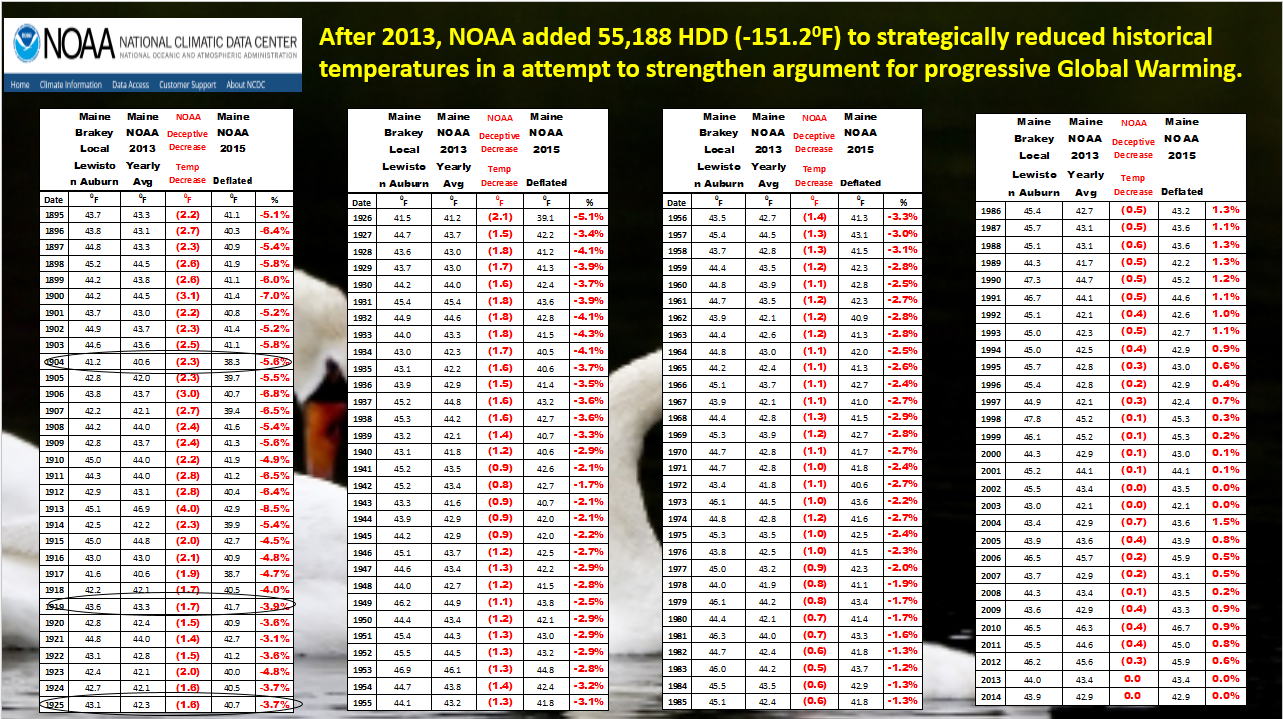
NOAA cooled the years of Lewiston-Auburn Maine’s past by an accumulated 151°F! (55,188 heating degree day units).

The last four months have been some of the coldest you might ever recall in our lifetime. So far 2015 is the fourth coldest in Maine’s history over the last 120 years. Data from 2013 confirm that so far – from January 1 to April 29 – 2015 has required 4249 heating degree days.

That rivals 1904, 1918 and 1923 over the last 120 years.

But when I recently looked at NOAA’s revised 2015 data, these last four months now would not even put us in the top twenty of coldest months. The federal government went into the historical data and lowered those earlier years – and other years in the earlier decades – so that they can keep spending $27 billion a year on pushing global warming.

They assumed no one would archive temperature data. But I did. My research indicated they used the same algorithm across the United States at the same time. Fortunately I had archived their data from 2013 for Maine and recently compared it to their 2015 data (see above table).

As an engineering physicist and heat transfer specialist, I have worked with heating and cooling degree days for forty years. It is alarming when one discovers multi-million dollar websites have been corrupted with bogus data because the facts do not match up with agendas.

It tremendously harms the industry you and I both work in. Worse, it harms the public. If the public knew the climate data facts indicated it was not getting warmer locally, and that it might actually be getting cooler, it would have all the more reason to insulate and become more energy-efficient in their homes.

I have put together a Maine history of climate temperatures in a narrated PowerPoint Presentation placed on YouTube titled, Black Swan Climate Theory.

Below is a brief sampling of my findings:

Brakey_3

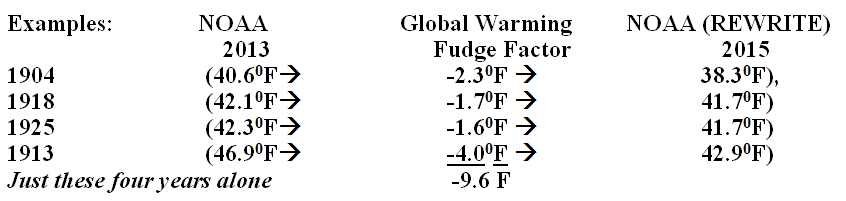
So far 2015 Maine temperatures, as of April, are running neck-and-neck with the coldest years in Maine’s history: 1904 (40.6°F), 1918 (42.1°F) and 1925 (42.3°F). These temperatures cited come right from the federal government’s own NOAA climate data (from 2013). I archived them on my computer for future reference.

2015 so far among coldest on record

A BLACK SWAN event is forming in 2015 (see chart to right). Based on the first four months of 2015, there is an excellent chance 2015 Maine temperature might average, on an annual basis, well under 43.0°F. Not only have Maine temperatures been on a decline since 1998, we are now seeing temperatures reminiscent of the bitter turn of the early 1900s.

Massive rewrite

It appears NOAA panicked and did a massive rewrite of Maine temperature history (they used the same algorithm for U.S. in general). The new official temperatures from Maine between 1895 and present were LOWERED by an accumulated 151.2°F between 1895 and 2012.

“Out-and-out fraud”

In my opinion, this is out-and-out fraud. Why did they corrupt national climate data? Global warming is a $27 billion business on an annual basis in the U.S alone.

Brakey_4

Now NOAA data revised in 2015 indicate that 1904, 1919 and 1925 in Maine were much colder than anything we experience today. (See the scorecard above comparing the NOAA data that are 18 months apart). Note how for 1913 the NOAA lowered the annual temperature a whole 4°F!

For the balance of the years, as they get closer to the present, the NOAA tweaks less and less. They have corrupted Maine climate data between 1895 and present by a whopping accumulated 151.2°F.

Unfortunately NOAA is remaining true to that old saying, “Figures don’t lie but liars figure.”

A multi-million dollar website has been corrupted. I can no longer rely on the tax-payer funded NOAA for clean, unfiltered, climate data for my ongoing research.

Conclusion

I can no longer trust the climate data and energy information ultimately drawn from the U.S. government. Locally, I now have to determine if they got their data from NOAA.

This makes research a lot tougher.

Mike Brakey

– See more at: http://notrickszone.com/2015/05/02/151-degrees-of-fudging-energy-physicist-unveils-noaas-massive-rewrite-of-maine-climate-history/#sthash.BBzJYpeL.gdGB9urs.dpuf

Windweasels Live Up to Their Reputation as….. Gangsters!

Noose Tightens on Spain’s Wind Farm Fraudsters: Tax Inspectors Uncover €110 million Paid as Bribes & Backhanders

clint863

The wind industry seems to attract a particular class of bloke, in much the same way that the Prohibition era drew lots of heavy-set Italians to the Mob.

Maybe that seemingly endless stream of massive subsidies filched from taxpayers and power consumers generates the same allure as festering dung does for swarms of flies?

Whatever it is, the whiff that surrounds the wind industry has attracted (and continues to attract) a class that has no hesitation lying, cheating, stealing and even bonking their way to the easy loot on offer.

The Italian Mob were in on the wind power fraud from the get-go: applying their considerable (and perfectly applicable) skills – leading the European wind power fraud, with what economists call “first-mover-advantage” (see our post here).

We’ve reported on just how rotten the wind industry is – from top to bottom – and whether it’s bribery and fraud; vote rigging scandals; tax fraud; investor fraud or REC fraud – wind weasels set a uniform standard that would make most businessmen blush.

The crooks involved – and the corruption, lies thuggery and deceit that follow them – are uniform across the globe.

Wind power outfits in Taiwan – faced with a pesky community backlash – sent the muscle in and beat the protesters to a bloody pulp (see our posts here and here).

The Thais aren’t much better.

In Australia, Thai outfit RATCH has been lying to, bullying and threatening communities far and wide for years (see our posts here and here andhere).

In previous posts we’ve looked at how the goons that work for RATCH didn’t hesitate to invent a character – Frank Bestic – in a half-cunning attempt to infiltrate their opponents at Collector and elsewhere – see our posts here and here and here.

RATCH also teamed up with one of Queensland’s property developer, “white-shoe-brigade“, John Morris – in a joint plan to destroy the Atherton Tablelands, by spearing 60 odd turbines into a patch of pristine, tropical wilderness on top of Mt Emerald – a move, quite rightly, opposed by 92% of locals (see our post here).

Morris is a five-star resort owner, who generously wined, dined and otherwise accommodated his mate, LNP pollie, David Kempton. Kempton got rolled at the last election, but while in power, held a rabid interest in getting the project approved, despite the fact that his own electorate was miles away, and pulled out all stops to ‘smooth’ the way to development approval (see our post here).

RATCH and Morris have shown all the care and restraint we’ve come to expect from the wind industry and its parasites: an “industry” that has absolutely no interest in producing meaningful power or “saving” the planet. Take away the promise of $50 billion in subsidies from the REC Tax on power consumers (see our post here) and this lot will disappear in a heartbeat (see our post here).

RATCH shares its Thai roots with another Thai wind power outfit that owes its existence to the Thai Military Junta – “Wind Energy Holdings”.

Wind Energy Holdings hit the news a while back when its hitherto-hot-shot head, Nopporn Suppipat was caught with his fingers in the till. Having been caught – he acted with all the honour we’ve come to expect from wind weasels, wherever they ply their trade: he bolted! (see our post here)

Now, it’s the turn of Spanish Wind Conquistadors to feel the heat.

That the wind industry is the product of institutional corruption – fuelled by back-slaps, and $millions in back-handers to planning officers, local councils and others in charge of the rubber stamps needed to start and keep the wind power fraud rolling – is no secret.

However, as these boys have bought the sanction of governments, rooting out the recipients of that crooked cash – when it’s sprinkled all the way to the top – presents investigators with more than the usual forensic challenges. Here’s Spain’s El País on España’s errant wind fraudsters’ trail.

Regional officials and businessmen may have received €110 million, say auditors
El País
F.Garea; R. Méndez
20 April 2015

Private renewable energy firms may have paid more than €110 million in commissions to government officials and local businessmen in Castilla y León to help them obtain licenses and push through paperwork to install wind farms across the region between 2004 and 2007, tax inspectors said.

In a December 30 report obtained by EL PAÍS, seven transactions detail how energy firms paid local businessmen and people connected to the regional Popular Party (PP) government either directly or through stocks in companies created to build and operate wind farms.

The Spanish AEAT tax agency has turned over the 94-page report to anti-corruption prosecutors to investigate if money laundering or other crimes may have been committed.

Those suspected of taking part in the commission deals are public officials in Castilla y León; go-betweens who negotiated on behalf of the energy firms and were able to obtain administrative approvals; and companies belonging to local businessmen who, “without any valid economic motives, received the transfer of funds and stock for an amount superior to €110 million,” inspectors said.

In some cases, the firms transferred stock in the businesses set up in such a way so as to multiply the initial capital invested by hundreds, even thousands, of times.

Among those who may have benefited from this alleged scheme were officials from Castilla y León’s economy department, which authorized the wind farms.

EL PAÍS was unable to reach Rafael Delgado Núñez, who was the deputy chief of the economy department at the time and the official responsible for signing the administrative permits.

In some cases, the firms multiplied the initial capital invested by hundreds, even thousands, of times

Along with other officials, Delgado Núñez was called in to give a statement before tax inspectors. According to his testimony, which was included in the audit, he said the procedure in the region was “very efficient” because there was hardly any legal framework supporting these operations at the time and the government wanted to ensure that “the companies that applied had regional interests.”

One of the main figures in the report is Alberto Esgueva, who until 2006 was CEO of Excal – a public entity formed by the Castilla y León government to promote regional exports. His own firm, according to inspectors, received the most commissions from the operations. Since September Esgueva has been living in Poland, where he runs a real estate business.

He declined to be interviewed for this article despite various attempts to contact him through his secretary.

A spokesman for the region’s economy department said he had no knowledge about the report but added that all the transactions were legally carried out and there was no evidence that commissions were paid.

Tomás Villanueva, who has headed up Castilla y León’s economy department since 2003 and is considered a close aide to PP regional premier Juan Vicente Herrera, on Monday stated that, after carrying out a “first check,” the paperwork authorizing the wind farms under question by the Tax Agency “was correct and in line with the law.”

Villanueva’s name surfaces in one part of the audit where tax inspectors mentioned that Delgado Núñez “played an important role” in both the economic and education departments.

In their report, inspectors alleged that numerous payments helped pave the way for the regional government to make quick decisions about the installation of wind farms. In one case, the money helped overcome the bureaucracy that had been blocking the project for six years.

Utility companies that wanted to install wind farms allegedly set up joint venture vehicles with local businesses and officials who had government ties to the region, the report said.

The association with the local businessman or government official would allegedly help push through the paperwork and, once the electric companies had received authorization to build the wind farm, they would pay back the investors more than what they had initially put into the joint venture.

One of the renewable energy companies that paid out a large amount to install a wind farm was Preneal, owned by Eduardo Merigó, the former president of Visa in Spain and an ex-secretary of state in former Spanish Prime Minister Adolfo Suarez’s Union of the Democratic Centre (UCD) administration (1977-1982). He told tax inspectors that he “felt like a victim of the system.”

Merigó also declined to speak to EL PAÍS for this article.

Preneal paid €6 million to San Cayetano Wind, which belonged to Esgueva, without “any obligation or compensation,” the report states.

Another €7 million was paid to Cronos Global, which was half owned by Esgueva. Last December, a Preneal representative told tax inspectors that Cronos had nothing to do with obtaining permits or building wind farms.

The projects have still not been approved, but Cronos Global received €7 million after putting down a €1.5 million initial investment.

Tax inspectors have also discovered suspicious bank transfers by Cronos Global at the beginning of the recession of up to €100 million to Poland and the United States while around €38 million was transferred to Spain.

The other partners in Cronos Global was Luis María García Clerigó and his family.

Clerigó is the president of the now-defunct Parqueolid, a construction firm in Valladolid. When contacted by EL PAÍS, Clerigó said he had difficulty remembering anything because he suffered a stroke seven years ago.

Parqueolid is under investigation in another case for allegedly receiving €50 million from the Castilla y León regional government to build new offices for the economic department. A judge investigating this case has targeted Delgado Núñez, who served as deputy chief of the regional economy department for eight years, and is also sifting through his bank accounts.
El País

good, bad ugly

Educating the Pope on Climate Alarmism, and How to Avoid It!

Scientists’ Message to Pope: Be Skeptical of Climate Change Alarm

Written by 

Scientists' Message to Pope: Be Skeptical of Climate Change Alarm

A team of independent climate scientists and public policy experts is traveling to Rome to enlighten Pope Francis about climate science in advance of the Vatican’s April 28environmental conference. They plan to host two public workshops to explain that there is no global warming crisis and to discourage the pontiff from relying on faulty information from climate alarmists within the United Nations’ Intergovernmental Panel on Climate Change.

“Sadly, the pope is aligning himself with a U.N. agenda that will limit development for billions of the world’s desperately poor residents,” says Marc Morano, former communications director for the Senate Environment and Public Works Committee and founder of the watchdog website Climate Depot. Morano is one of the policy experts slated to speak at the workshops scheduled on Monday, April 27 and Tuesday, April 28 in Rome. He explains, “The pope has been misled on climate science, and his promotion of the U.N. agenda will only mean the poor will be the biggest victims of climate change policies.”

Scientists with The Heartland Institute, a think tank promoting scientific skepticism about man-made global warming, will join Morano to promote the same message. “Humans are not causing a climate crisis on God’s Green Earth — in fact, they are fulfilling their Biblical duty to protect and use it for the benefit of humanity,” said Heartland Institute President Joseph Bast. “The world’s poor will suffer horribly if reliable energy — the engine of prosperity and a better life — is made more expensive and less reliable by the decree of global planners.

Among other climate experts scheduled to address the skeptic conferences are:

• Dr. Thomas Sheahen, director of the Institute for Theological Encounter with Science and Technology, which is headquartered at the Catholic Archdiocese of St. Louis and funded largely by the Catholic publishing company, Our Sunday Visitor;

• Dr. Richard Keen of the Department of Atmospheric and Oceanic Sciences at the University of Colorado;

• Lord Christopher Monckton, chief policy advisor to the Science and Public Policy Institute and former special advisor to Margaret Thatcher when she served as U.K. prime minister from 1982 to 1986;

• Retired physicist/engineer and current NASA consultant Harold Doiron;

• Jim Lakely, director of communications at the Heartland Institute and former White House correspondent for The Washington Times; and

• Dr. E. Calvin Beisner, founder and national spokesman for the Cornwall Alliance, a Biblically-based public policy network of inter-faith religious leaders and scholars dedicated to free-market solutions to economic, social, and environmental challenges.

Beisner issued a press release about the upcoming events in Rome. “Adding carbon dioxide to the atmosphere isn’t going to cause dangerous global warming,” he noted. “But it sure will enhance all life on earth — including human life, especially among the poor.”

Both media and public are invited to attend the conferences. For those who cannot be there, the Heartland Institute provides an action plan here and encourages everyone to contact the pope by postal mail (His Holiness, Pope Francis PP., 00120 Via del Pellegrino, Citta del Vaticano) or email: cdf@cfaith.va. The Heartland website also includes links to valuable research and commentary about the pressing importance of the climate change debate.

“If Pope Francis embraces the Climate Change agenda, he will be aligning himself with the biggest enemies of the Church and of Catholic moral principles,” warns Morano. “These activists are pro-population control and have bought into ‘population bomb’ hype.”

Photo of Pope Francis: AP Images

Wind Energy….NOT clean, NOT green, NOT affordable!

Wind Power’s Toxic Embrace

china rare earth toxic lake

Our Toxic Relationship with Wind Power
The Valley Patriot
Christine Morabito
February, 2015

If clean, safe and efficient energy is to be our standard, then why use wind power at all?

When we examine the entire process, the construction and operation of wind turbines is a dangerous and toxic affair. It begins with the mining of rare earth minerals, a collection of chemical elements manufactured mostly in China. The ill-protected workers are exposed to hazardous materials like hydrofluoric acid and radioactive particles. These substances are then exported worldwide, for use in wind turbines as well as computers, cell phones, hybrid cars and energy saving light bulbs.

The process of refining of these elements leaves death and destruction in its wake, polluting farmland, killing livestock, seeping into waterways and poisoning drinking water. Besides the devastation to the environment, nearby villagers report significant health problems, like bone, respiratory and heart diseases. Some residents suffer helplessly while their teeth fall out. But, since all this is occurring in the Far East, Western environmentalists don’t seem particularly concerned.

Meanwhile, in the United States, the massive windmills gobble up valuable habitat, as do the roads needed to access them. These eyesores ruin otherwise picturesque landscapes, and are built with little regard for the migratory paths of protected wildlife. The deadly blades can reach speeds up to 170 mph, often chopping birds into pieces. Most recent data estimates that 600,000 birds and hundreds of thousands of bats fall prey to this “green” technology every year.

Just east of San Francisco lies a 58 square mile wind farm called theAltamont Pass. The turbines have reportedly killed some 3,000 golden eagles, putting their population in serious jeopardy.

In the 30-odd years that wind energy has existed, only 2 companies have been prosecuted for illegally killing protected birds. The first was in 2013, when the U.S. Department of Justice and Duke Energy, of Wyoming, announced a $1 million settlement related to the deaths of 14 golden eagles and 149 hawks, blackbirds, larks, wrens and sparrows.

In January, 2015, Pacific Corp, also in Wyoming, was ordered to pay $2.5 million for killing 38 golden eagles and 336 other protected birds.

Under the auspices of fighting climate change, the Obama Administration is awarding wind-power companies a 30-year amnesty in the form of “take permits,” which allow the killing of endangered species. It’s ironic that our tax dollars are being used to study and protect endangered species, while simultaneously subsidizing an industry that is killing the aforementioned animals.

By working with the U.S. Fish and Wildlife Service, wind producers can avoid creating killing fields. The key is to bypass well-known migration routes.

I spoke to Bob Johns, Public Relations Director at the American Bird Conservancy. When holding energy companies accountable, Johns says, “green energy is held to a different standard.” The problem is one of selective enforcement. Fish and Wildlife Service guidelines are voluntaryand not enforced via regulation like those governing oil and electric companies. Johns stressed that “wind producers are not ‘mom and pop’ businesses, but large corporations,” with little incentive to follow mere guidelines. He believes regulations are needed to stop the egregious killing of birds and level the playing field. Deadly turbines are a worldwide problem, with wind farms in Spain, Belgium, Sweden, Germany and the Netherlands, among others.

What exactly is the up-side? Wind energy is expensive, costing about twice as much as conventional power sources. And, since wind is heavily subsidized, taxpayers fund it before and after it is produced, as evidenced by the infamous Cape Wind project in Massachusetts, which is already $10 million over budget. Wind energy is not particularly efficient, producing only between 3 to 4 percent of our country’s electricity. Like other alternative energy sources, turbines must be backed-up by fossil fuels when the wind isn’t blowing.

Like all fledgling energy sources, new technologies, combined with regulations, will make wind energy safer, cleaner and more efficient. Through innovative filtration systems, we have made great strides inremoving pollutants from fossil fuel emissions. The plastics we have come to rely on were once discarded waste products from oil refining, proving that the human race will continue to innovate – because that’s what we do.

While there is risk in producing every type of energy, the risks of using fossil fuels are greatly exaggerated; the benefits rarely mentioned. The well-funded, well-connected environmental lobby has an ideological, knee-jerk reaction to energy. In their world, fossil fuels = bad, alternative energy = good.

Massachusetts State Senator, Kathleen O’Connor Ives plans to introduce legislation to ban the practice of hydraulic fracturing (fracking) in Massachusetts. While carrying some hypothetical risk, fracking has the phenomenal ability to make America energy independent. Lower energy costs make us all richer, and we are sending billions less to our oil producing enemies – who, as we speak, are plotting our demise.

I know Senator Ives to be a reasonable legislator, and I’m hoping she and others will consider the pros and cons of every energy source at our disposal. In our quest for energy alternatives, facts should trump ideology. The earth and all its inhabitants deserve nothing less.
The Valley Patriot

christine morabito1

John Middleton, from Scotland, Reports on the Windpushers Latest Tactics!

Thursday night, Ms Sturgeon on the TV looking relaxed in her home, life is good… Now, in the words o the great Max Bygraves.. “Let me tell you a story”… Most people on here know me, some don’t, some girls need a lot o loving an some girls don’t… Naw, only kidding (could not help it)… Having (this is the real story by the way) been up for several nights due to this horrendous noise and it’s effects, I stupidly pleaded with Ms Sturgeon to do something about WLC and NLC, things were pretty bad and the question had to be asked “are these turbines worth more than my sanity and my life”..? My response from Ms Sturgeon was sending two police officers to my door to check on my well being, when they realised I wanted to discuss why I’m being kept awake they did not want to know so said ” thanks very much and tried to close the door which they kicked open, handcuffed me and held me by my throat saying I was mentally ill and frogmarched me into a van and yes they said they had been contacted by Ms Sturgeons office… Well, I was taken to St Johns hospital where I was mentally assessed, they asked me why I had not slept and was contacting various organisations about wind turbines, I told them what I know as I have discussed with many of you here, they brought a guy in from WLC mental health who asked me (an this’ll crack ye up as it did me) “what do the turbines say to you”… Well you can imagine my response, I explained it’s a humming and that it was now widely known that the LFN does indeed effect certain people and does not effect others, I was then deemed “fixed delusional”, I was immediately seized and given certain drugs against my will, this was done first orally then by syringes thrust into my legs through my clothes, put in a wheelchair carted backwards to a secure mental health ward where I have been for over a week now, if you think that these places have changed since “one flew over the cuckoo’s nest” then be rest assured they ain’t…!!! Earlier today I had a top consultant come to see me and having had her assistant look into this “noise”, I was released with immediate effect, she said I should not have been put there as everything I said was indeed true.. The mental health order revoked, the whole time apart from when they forced me into the ward I had no drugs apart from painkillers due to the injuries inflicted by so called nurses… This is the length these people will go to to silence we sufferers of this god forsaken noise, I will continue this fight regardless of this blatant abuse of my civil liberties, let this story be told and never give in….

Climate Change Fraud is Much Bigger Than it Seems!

The Great Wind Power Fraud: Just the Tip of the Climate Change Hysteria Spending Iceberg

turbine fire 6

****

The tip of the climate spending iceberg
CFACT
Paul Driessen
31 March 2015

Lockheed Martin, a recent Washington Post article notes, is getting into renewable energy, nuclear fusion, “sustainability” and even fish farming projects, to augment its reduced defense profits. The company plans to forge new ties with Defense Department and other Obama initiatives, based on a shared belief in manmade climate change as a critical security and planetary threat.

It is charging ahead where other defense contractors have failed, confident that its expertise, lobbying skills and “socially responsible” commitment to preventing climate chaos will land it plentiful contracts and subsidies.

As with its polar counterparts, 90% of the titanic climate funding iceberg is invisible to most citizens, businessmen and politicians. The Lockheed action is the mere tip of the icy mountaintop.

The multi-billion-dollar agenda reflects the Obama Administration’s commitment to using climate change to radically transform America. It reflects a determination to make the climate crisis industry so enormous that no one will be able to tear it down, even as computer models and disaster claims become less and less credible – and even if Republicans control Congress and the White House after 2016. Lockheed is merely the latest in a long list of regulators, researchers, universities, businesses, manufacturers, pressure groups, journalists and politicians with such strong monetary, reputational and authority interests in alarmism that they will defend its tenets and largesse tooth and nail.

Above all, it reflects a conviction that alarmists have a right to control our energy use, lives, livelihoods and living standards, with no transparency and no accountability for mistakes they make or damage they inflict on disfavored industries and families.

And they are pursuing this agenda despite global warming again beingdead last in the latest Gallup poll of 15 issues of greatest concern to Americans: only 25% say they worry about it “a great deal,” despite steady hysteria; 24% are “not at all” worried about the climate. By comparison, 46% percent worry a great deal about the size and power of the federal government.

But Climate Crisis, Inc. is using our tax and consumer dollars to advance six simultaneous strategies.

1) Climate research. The US government spends $2.5 billion per year on research that focuses on carbon dioxide, ignores powerful natural forces that have always driven climate change, and generates numerous reports and press releases warning of record high temperatures, melting icecaps, rising seas, stronger storms, more droughts and other “unprecedented” crises. The claims are erroneous and deceitful.

They are consistently contradicted by actual climate and weather records, and so alarmists increasingly emphasize computer models that reinvent and substitute for reality. Penn State modeler Michael Mann has collected millions for headline-grabbing work like his latest assertion that the Gulf Stream is slowing – contrary to 20 years of actual measurements that show no change. Former NASA astronomer James Hansen received a questionable $250,000 Heinz Award from Secretary of State John Kerry’s wife, for his climate crisis and anti-coal advocacy. Al Gore and350.org also rake in millions. Alarmist scientists and institutions seek billions more, while virtually no government money goes to research into natural forces.

2) Renewable energy research and implementation grants, loans, subsidies and mandates drive projects to replace hydrocarbons that are still abundant and still 82% of all US energy consumed. Many recipientswent bankrupt despite huge taxpayer grants and loan guarantees. Wind turbine installations butcher millions of birds and bats annually, but are exempt from Endangered Species Act fines and penalties.

Tesla Motors received $256 million to produce electric cars for wealthy elites who receive $2,500 to $7,500 in tax credits, plus free charging and express lane access. From 2007 to 2013, corn ethanol interests spent$158 million lobbying for more “green” mandates and subsidies – and $6 million in campaign contributions – for a fuel that reduces mileage, damages engines, requires enormous amounts of land, water and fertilizer, and from stalk to tailpipe emits more carbon dioxide than gasoline.

General Electric spends tens of millions lobbying for more taxpayer renewable energy dollars; so do many other companies. The payoffs add up to tens of billions of dollars, from taxpayers and consumers.

3) Regulatory fiats increasingly substitute for laws and carbon taxes thatCongress refuses to enact, due to concerns about economic and employment impacts, and because China, India and other countries’ CO2 emissions dwarf America’s. EPA’s war on coal has already claimed thousands of jobs, raised electricity costs for millions of businesses and families, and adversely affected living standards, health and welfare for millions of families. The White House and EPA are also targeting oil and gas drilling and fracking.

Now the Obama Administration is unleashing a host of new mandates and standards, based on arbitrary “social cost of carbon” calculations that assume fossil fuel use imposes numerous climate and other costs, but brings minimal or no economic or societal benefits. The rules will require onerous new energy efficiency and CO2 emission reduction standards that will send consumer costs skyrocketing, while channeling billions of dollars to retailers, installers, banks and mostly overseas manufacturers.

As analyst Roger Bezdek explains, water heaters that now cost $675-1,500 will soon cost $1,200-2,450 – with newfangled exhaust fans, vent pipes and condensate removal systems. Pickup trucks with more fuel efficiency and less power will nearly double in price. Microwaves, cell phones, vacuum cleaners, hair dryers, toasters, coffee pots, lawn mowers, photocopiers, televisions and almost everything else will cost far more. Poor and middle class families will get clobbered, to prevent perhaps 5% of the USA’s 15% of all human CO2 emissions toward 0.04% of atmospheric CO2, and maybe 0.00001 degrees of warming.

4) A new UN climate treaty would limit fossil fuel use by developed countries, place no binding limits or timetables on developing nations, and redistribute hundreds of billions of dollars to poor countries that claim they have been harmed by emissions and warming due to rich country hydrocarbon use. Even IPCC officials now openly brag that climate policy has “almost nothing” to do with protecting the environment – and everything to do with intentionally transforming the global economy and redistributing its wealth.

5) Vicious personal attacks continue on scientists, businessmen, politicians and others who disagree publicly with the catechism of climate cataclysm. Alarmist pressure groups and Democrat members of Congress are out to destroy the studies, funding, reputations and careers of all who dare challenge climate disaster tautologies. At President Obama’s behest, even disaster aid agencies are piling on.

New FEMA rules require that any state seeking disaster preparedness funds from the Federal Emergency Management Agency must first assess how climate change threatens their communities. This will mean relying on discredited, worthless alarmist models that routinely spew out predictions unrelated to reality. It likely means no federal funds will go to states that include or focus on natural causes, historical records or models that have better track records than those employed by the IPCC, EPA and President.

6) Thought control. In addition to vilifying climate chaos skeptics, alarmists are determined to control all thinking on the subject. They are terrified that people will find realist analyses and explanations far more persuasive. They refuse to debate skeptics, respond to NIPCC and other studies examining natural climate change and carbon dioxide benefits to wildlife and agriculture, or even admit there is no consensus.

They want the news media to ignore us but cannot put the internet genie back in the bottle. The White House is trying, though. It even sent picketers to FCC Chairman Tom Wheeler’s home, to demand that he knuckle under and apply 1930s’ telephone laws to the internet, as a first step in content control States must refuse to play the climate crisis game.

Through lawsuits, hearings, investigations and other actions, governors, legislators, AGs and other officials can delay EPA diktats, educate citizens about solar and other natural forces, and explain the huge costs and trifling benefits of these draconian regulations.

Congress should hold hearings, demand an accounting of agency expenditures, require solid evidence for every climate claim and regulation, and cross-examine Administration officials on details. It should slash EPA and other agency budgets, so they cannot keep giving billions to pressure groups, propagandists and attack dogs. Honesty, transparency, accountability and a much shorter leash are long overdue.
CFACT

Tip of the iceberg

EU’s Green Policies. An Example That No One Should Follow!

EU’s green energy debacle shows the futility of climate change policies

A wind turbine spins at a wind farm on February 19, 2015 near Zaragoza, Spain.

David Ramos/Getty ImagesA wind turbine spins at a wind farm on February 19, 2015 near Zaragoza, Spain.

Ontario will follow the EU at its peril — power rates will soar while industries depart

As the Ontario government announces new unilateral climate policies, Canadian policymakers would be well advised to heed the lessons of Europe’s self-defeating green energy debacle.

The European Union has long been committed to unilateral efforts to tackle climate change. For the last 20 years, Europe has felt a duty to set an example through radical climate policy-making at home. Political leaders were convinced that the development of a low-carbon economy based on renewables would give Europe a competitive advantage.

European governments have advanced the most expensive forms of energy generation at the expense of the least expensive kinds. No other major emitter has followed the EU’s aggressive climate policy and targets. As a result, electricity prices in Europe are now more than double those in North America and Europe’s remaining and struggling manufacturers are rapidly losing ground to international competition. European companies and investors are pouring money into the U.S., where energy prices have fallen to less than half those in the EU, thanks to the shale gas revolution.

Although EU policy has managed to reduce CO2 emissions domestically, this was only achieved by shifting energy-intensive industries to overseas locations without stringent emission limits, where energy and labour is cheap and which are now growing much faster than the EU.

Most products consumed in the EU today are imported from countries without binding CO2 targets. While the EU’s domestic CO2 emissions have fallen, if you factor in CO2 emissions embedded in goods imported into EU, the figure remains substantially higher.

Of all the unintended consequences of EU climate policy perhaps the most bizarre is the detrimental effect of wind and solar schemes on the price of electricity generated by natural gas. Many gas power plants can no longer operate enough hours. They incur big costs as they have to be switched on and off to back-up renewables.

Most products consumed in the EU today are imported from countries without binding CO2 targets

This week, Germany’s energy industry association warned that more than half of all power plants in planning are about to fold: Even the most efficient gas-fired power plants can no longer be operated profitably.

Every 10 new units worth of wind power installation has to be backed up with some eight units worth of fossil fuel generation. This is because fossil fuel plants have to power up suddenly to meet the deficiencies of intermittent renewables. In short, renewables do not provide an escape route from fossil fuel use without which they are unsustainable.

Gas-fired power generation has become uneconomic in the EU, even for some of the most efficient and least carbon-intensive plants. At the end of 2013, 14 per cent of the EU’s installed gas-fired plants stood still, had closed or were at risk of closure. If all gas plants currently under review were to close, this would amount to 28 per cent of current capacity by 2016. Almost 20 per cent of gas power plants in Germany have already become unprofitable and face shutdown as renewables flood the electricity grid with preferential energy.

To avoid blackouts, the government has to subsidize uneconomic gas and coal power plants. Already half of the 28 EU countries have in place or are planning to subsidize fossil fuel power plants to keep the lights on.

Germany’s renewable energy levy, which subsidizes green energy production, rose from 14 billion euros to 20 billion euros in just one year as a result of the fierce expansion of wind and solar power projects. Since the introduction of the levy in 2000, the electricity bill of the typical German consumer has doubled.

As wealthy homeowners and business owners install wind turbines on their land and solar panels on their homes and commercial buildings, low-income families all over Europe have had to foot the skyrocketing electric bills. Many can no longer afford to pay, so the utilities are cutting off their power. The German Association of Energy Consumers estimates that up to 800,000 Germans have had their power cut off because they were unable to pay the country’s rising electricity bills.

The EU’s unilateral climate policy is absurd. First consumers are forced to pay ever increasing subsidies for wind and solar energy; secondly they are asked to subsidize nuclear energy too; thirdly, they are forced to pay for increasingly uneconomic coal and gas plants to back up power needed by intermittent wind and solar energy; fourthly, consumers are additionally hit by multi-billion subsidies that become necessary to upgrade the national grids; fifthly, the cost of power is made even more expensive by adding a unilateral Emissions Trading Scheme. Finally, because Europe has created such a foolish scheme that is crippling its heavy industries, consumers are forced to pay even more billions in subsidizing almost the entire manufacturing sector.

In the last few years, major economies such as Canada, Australia and Japan have begun to realize the futility of going it alone and have retreated from unilateral policies and targets. Now even the EU has decided to walk away and has adopted a conditional climate pledge. It has burdened European taxpayers and businesses with astronomical costs while shifting its heavy industry and CO2 emissions to other parts of the world. Europe’s climate policy failure demonstrates beyond doubt that its unilateralism has been a complete fiasco. The lessons of this self-defeating debacle are clear: Don’t make the same mistakes or you will face the same fiasco.

Benny Peiser is the director of the London-based Global Warming Policy Forum. The text is based on written evidence he gave to the Committee on Environment and Public Works of the U.S. Senate.

Stop Blowing Our Money Into the Wind!

PSST! Want to Kill Prosperous Economies & Crush the Poorest? Then Keep Throwing $Billions at Wind Power

Josef Stalin

***

The so-called “Greens” are not just delusional, they’re dangerous. Full of hate for human beings, especially the poorest of them, their “policies” – if they can be called that? – are more like malign manifestos, of the kind that would have made the Generalissimo proud.

In a brilliant essay, first published in the Wall Street Journal, Matt Ridley lays “green” ideology to waste; and gives the nonsense of wind power special attention, observing that:

Wind power, for all the public money spent on its expansion, has inched up to — wait for it — 1 per cent of world energy consumption in 2013. Solar, for all the hype, has not even managed that: If we round to the nearest whole number, it accounts for 0 per cent of world energy consumption.

Matt goes on to dissect the greens’ favourite myth that economies can, somehow, rely on “hope and promises”; and ditch fossil fuels altogether.

Fossil fuels are here to stay
The Wall Street Journal
Matt Ridley
23 March 2015

THE environmental movement has advanced three arguments in recent years for giving up fossil fuels: (1) that we will soon run out of them anyway; (2) that alternative sources of energy will price them out of the marketplace; and (3) that we cannot afford the climate consequences of burning them.

These days, not one of the three arguments is looking very healthy. In fact, a more realistic assessment of our energy and environmental situation suggests that, for decades to come, we will continue to rely overwhelmingly on the fossil fuels that have contributed so dramatically to the world’s prosperity and progress.

In 2013, about 87 per cent of the energy that the world consumed came from fossil fuels, a figure that — remarkably — was unchanged from 10 years before. This roughly divides into three categories of fuel and three categories of use: oil used mainly for transport, gas used mainly for heating, and coal used mainly for electricity.

Over this period, the overall volume of fossil-fuel consumption has increased dramatically, but with an encouraging environmental trend: a diminishing amount of carbon-dioxide emissions per unit of energy produced. The biggest contribution to decarbonising the system has been the switch from high-carbon coal to lower-carbon gas in electricity generation.

On a global level, renewable energy sources such as wind and solar have contributed hardly at all to the drop in carbon emissions, and their modest growth has merely made up for a decline in the fortunes of zero-carbon nuclear energy. (The reader should know that I have an indirect interest in coal through the ownership of land in Northern England on which it is mined, but I nonetheless applaud the displacement of coal by gas in recent years.)

The argument that fossil fuels will soon run out is dead, at least for a while. The collapse of the price of oil over the past six months is the result of abundance: an inevitable consequence of the high oil prices of recent years, which stimulated innovation in hydraulic fracturing, horizontal drilling, seismology and information technology. The US — the country with the oldest and most developed hydrocarbon fields — has found itself once again, surprisingly, at the top of the energy-producing league, rivalling Saudi Arabia in oil and Russia in gas.

The shale genie is now out of the bottle. Even if the current low price drives out some high-cost oil producers — in the North Sea, Canada, Russia, Iran and offshore, as well as in America — shale drillers can step back in whenever the price rebounds. As Mark Hill of Allegro Development Corporation argued last week, the frackers are currently experiencing their own version of Moore’s law: a rapid fall in the cost and time it takes to drill a well, along with a rapid rise in the volume of hydrocarbons they are able to extract.

And the shale revolution has yet to go global. When it does, oil and gas in tight rock formations will give the world ample supplies of hydrocarbons for decades, if not centuries. Lurking in the wings for later technological breakthroughs is methane hydrate, a sea floor source of gas that exceeds in quantity all the world’s coal, oil and gas put together.

So those who predict the imminent exhaustion of fossil fuels are merely repeating the mistakes of the US presidential commission that opined in 1922 that “already the output of gas has begun to wane. Production of oil cannot long maintain its present rate.” Or president Jimmy Carter when he announced on television in 1977 that “we could use up all the proven reserves of oil in the entire world by the end of the next decade.”

That fossil fuels are finite is a red herring. The Atlantic Ocean is finite, but that does not mean that you risk bumping into France if you row out of a harbour in Maine. The buffalo of the American West were infinite, in the sense that they could breed, yet they came close to extinction. It is an ironic truth that no non-renewable resource has ever run dry, while renewable resources — whales, cod, forests, passenger pigeons — have frequently done so.

The second argument for giving up fossil fuels is that new rivals will shortly price them out of the market. But it is not happening. The great hope has long been nuclear energy, but even if there is a rush to build new nuclear power stations over the next few years, most will simply replace old ones due to close.

The world’s nuclear output is down from 6 per cent of world energy consumption in 2003 to 4 per cent today. It is forecast to inch back up to just 6.7 per cent by 2035, according the Energy Information Administration.

Nuclear’s problem is cost. In meeting the safety concerns of environmentalists, politicians and regulators added requirements for extra concrete, steel and pipework, and even more for extra lawyers, paperwork and time.

The effect was to make nuclear plants into huge boondoggles with no competition or experimentation to drive down costs. Nuclear is now able to compete with fossil fuels only when it is subsidised.

As for renewable energy, hydro-electric is the biggest and cheapest supplier, but it has the least capacity for expansion. Technologies that tap the energy of waves and tides remain unaffordable and impractical.

Geothermal is a minor player for now. And bioenergy — that is, wood, ethanol made from corn or sugar cane, or diesel made from palm oil — is proving an ecological disaster: It encourages deforestation and food-price hikes that cause devastation among the world’s poor, and per unit of energy produced, it creates even more carbon dioxide than coal.

Wind power, for all the public money spent on its expansion, has inched up to — wait for it — 1 per cent of world energy consumption in 2013. Solar, for all the hype, has not even managed that: If we round to the nearest whole number, it accounts for 0 per cent of world energy consumption.

Both wind and solar are entirely reliant on subsidies for such economic viability as they have. Worldwide, the subsidies given to renewable energy currently amount to roughly $10 per gigajoule: These sums are paid by consumers to producers, so they tend to go from the poor to the rich, often to landowners.

It is true that some countries subsidise the use of fossil fuels, but they do so at a much lower rate — the world average is about $1.20 per gigajoule — and these are mostly subsidies for consumers (not producers), so they tend to help the poor, for whom energy costs are a disproportionate share of spending.

The costs of renewable energy are coming down, especially in the case of solar. But even if solar panels were free, the power they produce would still struggle to compete with fossil fuel — except in some very sunny locations — because of all the capital equipment required to concentrate and deliver the energy.

This is to say nothing of the great expanses of land on which solar facilities must be built and the cost of retaining sufficient conventional generator capacity to guarantee supply on a dark, cold, windless evening.

The two fundamental problems that renewables face are that they take up too much space and produce too little energy.

To run the US economy entirely on wind would require a wind farm the size of Texas, California and New Mexico combined — backed up by gas on windless days. To power it on wood would require a forest covering two-thirds of the U.S., heavily and continually harvested.

John Constable, who will head a new Energy Institute at the University of Buckingham in Britain, points out that the trickle of energy that human beings managed to extract from wind, water and wood before the Industrial Revolution placed a great limit on development and progress.

The incessant toil of farm labourers generated so little surplus energy in the form of food for men and draft animals that the accumulation of capital, such as machinery, was painfully slow. Even as late as the 18th century, this energy-deprived economy was sufficient to enrich daily life for only a fraction of the population.

Our old enemy, the second law of thermodynamics, is the problem here. As a teenager’s bedroom generally illustrates, left to its own devices, everything in the world becomes less ordered, more chaotic, tending toward “entropy,” or thermodynamic equilibrium. To reverse this tendency and make something complex, ordered and functional requires work. It requires energy.

The more energy you have, the more intricate, powerful and complex you can make a system. Just as human bodies need energy to be ordered and functional, so do societies. In that sense, fossil fuels were a unique advance because they allowed human beings to create extraordinary patterns of order and complexity — machines and buildings — with which to improve their lives.

The result of this great boost in energy is what economic historian and philosopher Deirdre McCloskey calls the Great Enrichment. In the case of the US, there has been a roughly 9000 per cent increase in the value of goods and services available to the average American since 1800, almost all of which are made with, made of, powered by or propelled by fossil fuels.

Still, more than a billion people on the planet have yet to get access to electricity and to experience the leap in living standards that abundant energy brings. This is not just an inconvenience for them: Indoor air pollution from wood fires kills four million people a year. The next time that somebody at a rally against fossil fuels lectures you about her concern for the fate of her grandchildren, show her a picture of an African child dying today from inhaling the dense muck of a smoky fire.

Notice, too, the ways in which fossil fuels have contributed to preserving the planet. As the American author and fossil-fuels advocate Alex Epstein points out in a bravely unfashionable book, The Moral Case for Fossil Fuels, the use of coal halted and then reversed the deforestation of Europe and North America.

The turn to oil halted the slaughter of the world’s whales and seals for their blubber. Fertiliser manufactured with gas halved the amount of land needed to produce a given amount of food, thus feeding a growing population while sparing land for wild nature.

To throw away these immense economic, environmental and moral benefits, you would have to have a very good reason. The one most often invoked today is that we are wrecking the planet’s climate. But are we?

Although the world has certainly warmed since the 19th century, the rate of warming has been slow and erratic. There has been no increase in the frequency or severity of storms or droughts, no acceleration of sea-level rise. Arctic sea ice has decreased, but Antarctic sea ice has increased.

At the same time, scientists are agreed that the extra carbon dioxide in the air has contributed to an improvement in crop yields and a roughly 14 per cent increase in the amount of all types of green vegetation on the planet since 1980.

That carbon-dioxide emissions should cause warming is not a new idea. In 1938, the British scientist Guy Callender thought that he could already detect warming as a result of carbon-dioxide emissions. He reckoned, however, that this was “likely to prove beneficial to mankind” by shifting northward the climate where cultivation was possible.

Only in the 1970s and 80s did scientists begin to say that the mild warming expected as a direct result of burning fossil fuels — roughly a degree Celsius per doubling of carbon-dioxide concentrations in the atmosphere — might be greatly amplified by water vapour and result in dangerous warming of two to four degrees a century or more.

That “feedback” assumption of high “sensitivity” remains in virtually all of the mathematical models used to this day by the UN Intergovernmental Panel on Climate Change, or IPCC.

And yet it is increasingly possible that it is wrong. As Patrick Michaels of the libertarian Cato Institute has written, since 2000, 14 peer-reviewed papers, published by 42 authors, many of whom are key contributors to the reports of the IPCC, have concluded that climate sensitivity is low because net feedbacks are modest.

They arrive at this conclusion based on observed temperature changes, ocean-heat uptake and the balance between warming and cooling emissions (mainly sulfate aerosols). On average, they find sensitivity to be 40 per cent lower than the models on which the IPCC relies.

If these conclusions are right, they would explain the failure of the Earth’s surface to warm nearly as fast as predicted over the past 35 years, a time when — despite carbon-dioxide levels rising faster than expected — the warming rate has never reached even two-tenths of a degree per decade and has slowed down to virtually nothing in the past 15 to 20 years. This is one reason the latest IPCC report did not give a “best estimate” of sensitivity and why it lowered its estimate of near-term warming.

Most climate scientists remain reluctant to abandon the models and take the view that the current “hiatus” has merely delayed rapid warming. A turning point to dangerously rapid warming could be around the corner, even though it should have shown up by now. So it would be wise to do something to cut our emissions, so long as that something does not hurt the poor and those struggling to reach a modern standard of living.

We should encourage the switch from coal to gas in the generation of electricity, provide incentives for energy efficiency, get nuclear power back on track and keep developing solar power and electricity storage. We should also invest in research on ways to absorb carbon dioxide from the air, by fertilising the ocean or fixing it through carbon capture and storage. Those measures all make sense. And there is every reason to promote open-ended research to find some unexpected new energy technology.

The one thing that will not work is the one thing that the environmental movement insists upon: subsidising wealthy crony capitalists to build low-density, low-output, capital-intensive, land-hungry renewable energy schemes, while telling the poor to give up the dream of getting richer through fossil fuels.

Matt Ridley is the author of The Rational Optimist: How Prosperity Evolves, and a member of the British House of Lords.
The Wall Street Journal

Matt Ridley

Wind Power….A way to Make the Rich Richer, and the Rest of Us, Dirt Poor!

How Wind Power Subsidies Destroy Both Electricity Markets & Economies

industrial-decline-2

****

Around the globe, the wind industry behaves like an enormous, bloodsucking leech – latching onto power consumers and taxpayers; and ever ready to drain its hosts dry and leave nothing but empty shells behind.

In Australia, those soon to be empty shells will include what’s left of ourmanufacturing industries; mineral processors and the tens of thousands of families that cannot afford power now – and the thousands more who will soon join them sitting freezing (or boiling) in the dark (see our postshere and here).

Australian businesses and families are all set to be pounded by the entirely unsustainable Large-Scale Renewable Energy Target (LRET), which is designed to see more than $50 billion filched from power consumers (as a Federal Tax) and transferred to wind power generators (as a mandated subsidy) over the remaining life of the LRET (see our post here).

Under the LRET, from here on – as a simple arithmetical and legislated FACT – power retailers are meant to purchase and surrender 587 million RECs in order to avoid the shortfall charge: described recently by Environment Minister, Greg Hunt as a “massive penalty carbon tax of $93 per tonne which nobody wants to see.” (see our post here).

As the shortfall begins to bite (within the next few months) RECs will – due to the tax treatment of RECs – soon exceed the cost of the shortfall charge ($65 per MWh) and end up trading around $94 – at that price the cost to power punters would top $55 billion.

The fact the Australian electricity retailers have jacked up and are refusing to enter Power Purchase Agreements with wind power generators (the method by which retailers purchase RECs) means that the LRET is all set to implode, but that’s another story (see our posts here andhere).

One of the topics before the Senate Inquiry is whether the insane costs drawn in the form of the REC Tax/Subsidy can be justified on any level, the Inquiries terms of reference including:

(a) the effect on household power prices, particularly households which receive no benefit from rooftop solar panels, and the merits of consumer subsidies for operators;

(b) how effective the Clean Energy Regulator is in performing its legislative responsibilities and whether there is a need to broaden those responsibilities;

(h) the energy and emission input and output equations from whole-of-life operation of wind turbines; and

(i) any related matter.

STT thinks these little policy-posers simply highlight the fact that there has NEVER been any cost benefit analysis carried out in relation to Australia’s Renewable Energy Target, since it was thrown into the energy policy arena, over 15 years ago.

That a scheme, which has already added $9 billion to power bills (in the form of RECs) and which would see the transfer of a further $50 billion from the poorest to the richest, has never seen the slightest scrutiny from independent economists is, let’s just say, more than a little surprising.

But this outlandish policy predicament is not unique to Australia. Oh no, the Brits are well and truly in the same boat. The UK has seen power prices rocket out of control with its rush to plant thousands of giant fans all over Ol’ Blighty – its broad sunlit uplands, and as far as the eye can see, out to sea.

The fact that the UK’s political betters haven’t bothered themselves with the usual type of economic inquiry (ie is there any energy, or environmental, bang for the massive subsidy $bucks?) is one of the key points raised in a very recent, and truly brilliant, study by Rupert Darwall.

Rupert Darwall

****

Rupert has already shone the spotlight on the insane hidden costs of wind power (see our post here). But, now he has excelled himself, with a very detailed analysis of what is nothing short of an energy market debacle.

His study, “Central Planning with Market Features: How renewables subsidies destroyed the UK electricity market”, should be mandatory reading for any Australian politician purporting to support the unsustainable LRET. The full paper can be accessed here as a PDF. We’ve picked out the parts most relevant to Australia’s wind power debacle below.

Central Planning with Market Features: How renewable subsidies destroyed the UK electricity market
Rupert Darwall
March 2015

The story so far

Energy policy represents the biggest expansion of state power since the nationalisations of the 1940s and 1950s. It is on course to be the most expensive domestic policy disaster in modern British history. By committing the nation to high-cost, unreliable renewable energy, its consequences will be felt for decades.

Yet it wasn’t so long ago that Britain led the world with electricity privatisation and liberalisation – the last big policy achievement of the Thatcher years – cutting bills and driving huge gains in capital and labour productivity, gains which are now being reversed.

  • What went wrong?
  • What are the costs?
  • What can be done?

The re-imposition of state control is not because privatisation failed. As the Government concedes, ‘historically, our electricity market has delivered secure supplies, largely due to competitive markets underpinned by robust regulation.’ Instead, state control is the result of imposing an arbitrary form of decarbonisation involving an extremely costly European target for renewables generation (principally wind and solar energy) which Tony Blair negotiated at his farewell European Council in 2007. The result is that the privatised electricity sector is being transformed into a vast, ramshackle Public Private Partnership, an outcome that promises the worst of all worlds – state control of investment funded by high-cost private sector finance, with energy companies being set up as the fall guys to take the rap for higherelectricity bills.

The Government justifies the return of state control on the presumption that the price of fossil fuels will rise continuously, a view now rapidly overtaken by falling coal prices and the halving of oil prices in the space of five months.

What went wrong: Key errors in the decision-making process

….

Foundational Error. The turning point which led to the demise of the market was not proceeded by extensive policy appraisals or analysis of alternatives to the market, but from the adoption of the renewables target at a European Council meeting. Target-driven policy objectives are inflexible. They prevent exploration of trade-offs. The more compressed the deadline, the higher the costs. The overriding focus on meeting the target narrows the field of vision, so that emerging difficulties from other countries, notably Spain and Germany, were ignored as evidence for reappraising the target.

Policy Lesson #4

Setting a target before analysing the costs, operational implications and likely unintended consequences, without considering alternatives constitutes the foundational error in the entire process from which, in one way or another, subsequent errors flowed.

Target-driven policy-making. Cost, efficiency and affordability were subordinated to the goal of meeting an arbitrary target. Instead of seeing the market as a price discovery mechanism to reveal the lowest-cost producer, policy sought to disguise (socialise) the true costs and implications of renewables to minimise the apparent cost of the policy.

Policy Lesson #5

A policy framework to encourage renewables that systematically conceals their true costs will result in higher costs and higher electricity bills for the same quantum of renewable capacity.

Form over function. Having decided to adopt a renewables target, there has been no comprehensive analysis of its costs, benefits and implications for the market. In particular, decision-makers did not ask what exactly electricity consumers get in return for the use of high cost private sector capital and whether it represented value for money for them.

Policy Lesson #6

Before adopting EMR [Energy Market Reforms], policymakers should have evaluated it against a public sector comparator so that the net cost/benefit of using private sector capital is identified and quantified, rather than being implicitly assumed.

What are the costs: Renewables’ hidden costs

The costs of intermittent renewables are massively understated. In addition to their higher plant-level costs, renewables require massive amounts of extra generating capacity to provide cover for intermittent generation when the wind doesn’t blow and the sun doesn’t shine. Massively subsidised wind and solar capacity floods the market with near random amounts of zero marginal cost electricity. It is therefore impossible to integrate large amounts of intermittent renewables into a private sector system and still expect it to function as such.

To keep the lights on, everything ends up requiring subsidies, turning what was once a profitable sector into the energy equivalent of the Common Agricultural Policy. Worse still in a highly capital intensive sector, because prices and therefore revenues are dependent on government interventions, private investors end up having to price and manage political risk, imparting a further upwards twist to costs and prices.

Without renewables, the UK market would require 22GW of new capacity to replace old coal and nuclear. With renewables, 50GW is required, i.e. 28GW more to deal with the intermittency problem. Then there are extra grid costs to connect both remote onshore wind farms (£8 billion) and even more costly offshore capacity (£15 billion) – a near trebling of grid costs.

Including capacity to cover for intermittency and extra grid infrastructure, the annualised capital cost of renewables is approximately £9 billion. Against this needs to be set the saved fuel costs of generating electricity from conventional power stations. For gas, this would be around £3 billion a year at current wholesale prices, implying an annual net cost of renewables of around £6 billion a year. The cost of renewables is even higher compared to coal (which is being progressively outlawed).

What can be done: The worst of both worlds

Intermittent renewables destroy markets. You can have renewables. Or you can have the market. You cannot have both. The hybrid of state control and private ownership is far from optimal and inherently unstable. At no stage has there been any published analysis demonstrating that the use of private capital delivers better value for money than a public sector comparator.

There are two options to align ownership and control:

  • If renewables are a must-have – although no government has made a reasoned policy case for them – then nationalisation is the answer; or
  • the state cedes control, ditches the renewables target and returns the sector to the market.

THE PROBLEM WITH INTERMITTENT RENEWABLES

It is hard to understate the implications of the UK’s growing exposure to wind for its electricity. According to the Royal Academy of Engineering, which is sympathetic to renewables, it requires ‘a fundamental shift in society’s attitude to and use of energy.’ Success, the Academy says, depends on the ability to manage demand to reflect the output from wind, going on to note that despite increasing efforts to research demand management techniques (to match consumption to the variability of the weather), ‘there is still much uncertainty on how effective it will be and at what cost.’ So called ‘smart grids’ will be vital, the Academy says, but their potential and effectiveness at scale ‘are yet to be proven.’

Electricity has a set of uniquely demanding characteristics:

  • It cannot be stored, except to a limited extent, with batteries and pumped hydro, and that storage is limited and incurs a cost;
  • Supply must respond almost instantaneously to demand;
  • If too little is produced, there is a danger of degraded quality and, eventually, of power cuts, which are costly to users;
  • Too much production can damage the transmission system, leading to wires becoming deformed or even melting;
  • Failing to equalise demand and supply can also lead to changes in the frequency of the power supply – too high, and it can damage appliances; too low, equipment can underperform.

Wind and solar technologies pose huge integration challenges. They are difficult to predict, particularly wind, which is highly variable – on gusty days, wind speeds can vary enormously over a few minutes or even seconds. According to Malcolm Grimston of Imperial College, London, low wind speed tends to be weakly correlated with high power demand (cold, windless winter evenings and hot, windless summer days). Depending on how wind-generated electricity is connected to the grid, large amounts of wind power can reduce system inertia and make it less stable.

When renewables account for a significant proportion of generating capacity, the whole electricity system becomes exposed to weather risk as it has to cope with what an OECD/ Nuclear Energy Agency (NEA) report calls ‘random amounts of intermittent electricity.’ The uncertainty inherent in farming is one reason why governments end up heavily subsidising farmers.

The logic of exposing all electricity generators to weather risk implies that the Government subsidises all forms of electricity generation, something wholly unanticipated by policymakers. MIT professors John Deutsch and Ernest Moniz remarked in a 2011 report that policies to encourage renewables have been successful in promoting large-scale deployment, before observing:

‘It is becoming clear that the total costs and consequences of these policies were not fully understood.’

In other words, politicians adopted pro-renewables policies with their eyes wide shut. Britain’s target of deriving 15 per cent of its total energy consumption from renewables was agreed before the system-wide consequences had been analysed. Energy policy has been trying to play catch-up ever since. Renewables policy is truly a leap into the dark.

According to Project Discovery, the capital cost of onshore wind is double that of CCGT. For offshore wind, the capital cost per kW is nearly five times higher – before accounting for the thermal (gas and coal) capacity needed to cover wind intermittency. For Project Discovery, Ofgem applied de-rating factors to adjust the nameplate capacity of different generation types to reflect better the probable contribution each is likely to make to meet peak demand. Therefore, wind assets have a significant de-rating to reflect the lower average availability and risks of correlated periods of low output.

Table 2 below applies these to illustrate the capital cost for onshore and offshore wind compared to CCGT to meeting peak demand on the basis that CCGT is used as dispatchable capacity (i.e. which can be turned on and off when required). To derive the overall capital cost for each plant type, it applies Ofgem’s de-rating factors, assuming the balance is met with additional CCGTs.

Table 2: Capital Cost per kW adjusted for Ofgem 2009 De-rating Factors
Plant type Cost per kW (£) De-rating factor (%) Cost per kW of additional (dispatchable) capacity (£) Total cost per kW (£) Capital cost per kW as multiple of CCGT
CCGT 600 95 32 632 n/a
Onshore wind 1,200 15 510 1,710 2.7
Offshore wind 2,800 15 510 3,310 5.2
Source: Ofgem (2009), Project Discovery Energy Market Scenarios, p.90.

Cost and capacity implications

Since 2009, the relative cost of CCGTs to wind has fallen. DECC’s 2013 estimate of the ‘overnight’ capital costs of onshore wind (i.e. excluding capitalised interest) at £1,600 per kW compares to £610 per kW for CCGT. Thus the capital cost of onshore wind has risen from being twice as expensive as CCGT to 2.6 times in just five years. The costs of offshore wind have also worsened. Based on analysis of actual build costs in the US and adjusting for higher UK offshore construction costs, Edinburgh University’s Professor Gordon Hughes estimates 2013 prices would be at least £3,300 per kW compared to Ofgem’s 2009 assumption of £2,800 per kW – a rise of 17.9 per cent.

The need for intermittent renewable capacity to be twinned with dispatchable capacity drives a colossal investment requirement.

For the same peak electricity demand of 60GW as today, which was met by 85GW of capacity in 2011, the Government estimates the UK will need 113GW of capacity in 2025 – an increase of 28GW. Because the Government did not seek a derogation from the EU Large Combustion Plant Directive, 12GW of coal-fired capacity will also need to be replaced plus 10GW of time-expired nuclear capacity, implying a total requirement of 50GW of new capacity, of which two thirds (33GW) is planned to be renewables.

Thus meeting the UK’s renewable target requires 28GW more capacity than if peak demand was met conventionally. Assuming a 50:50 split between onshore and offshore wind, on the basis of Project Discovery’s numbers, this implies an additional capital cost of £56 billion. The additional cost of deploying the extra 5GW of renewables (33GW less 28GW) instead of CCGTs is £7 billion, implying a £63 billion extra cost of renewables to provide the same peak capacity as from conventional power stations.

Wind and solar also require heavy extra investment in transmission infrastructure. For onshore wind, proposed reinforcements of the transmission grid are of the order of £8 billion, which represents a doubling of the Regulatory Asset Value of National Grid’s existing transmission network. This extra capital cost has a material impact on the underlying (and disguised) economics of wind, particularly in remote, windy locations. According to electricity industry expert Alex Henney, the implication is the cost of transmission of Scottish wind power is of the order of £500 per kW – making the capital cost of onshore wind 3.7 times higher than that of CCGT.

THE CHOICE

Appearing before the House of Lords Select Committee on Economic Affairs in November 2013, Lord Lawson asked Dieter Helm: ‘So if you were Secretary of State for Energy, what would you do now?’ Helm replied,

‘I would probably emigrate as quickly as possible; I would hate to perform such a task. The obvious answer is that when you are in a hole, the first thing you do is stop digging. Many things are currently being pursued that would make things significantly worse.’

This dead-end has come about because policymakers ignored the likely effects of subsidising high fixed cost/near-zero variable cost intermittent energy on the functioning of the energy market before adopting the policy. Attempting to mitigate the damage by subsidising the provision of capacity, the Government is taking control of electricity generation, but not taking ownership of it.

The bottom line is if the state wants renewables, it should do it properly and get out its cheque book.

In reality, there are two choices:

(1) If meeting the UK’s renewables target is the over-riding policy goal, then the most efficient solution is using the Government’s balance sheet to directly finance investment in generating assets and buy out existing assets, i.e. full or partial renationalisation; or

(2) Abandoning the renewables target, isolating the market from the price-destructive effects of embedded renewable capacity and setting a clear path to return the sector to the market.

Either would result in substantially lower electricity bills than where they are heading under EMR and 2) would enhance the UK’s economic performance.

A DESCENT INTO POLICY INCOHERENCE

….

What of energy policy being ‘evidence-based, fair and just’? Assessed against the Government’s three objectives for energy policy, renewables policy is not remotely rational, fair of affordable:

  • Keeping the lights on. Weather-dependent renewables are inherently poor at reliably generating electricity to meet demand. Indeed, the Government has acknowledged the ‘significant challenge’ represented by ‘operational security (i.e. enough responsiveness to ensure real-time balancing of supply and demand)’, though DECC couldn’t bring itself to name the culprit.
  • Keeping energy bills affordable. Self-evidently, setting strike prices for renewables (and nuclear) that are double the current wholesale price of electricity puts upward pressure on energy bills – and that’s before taking account of the higher system grid level costs of renewables which the Government tends to ignore (Figure 3). If affordability really were a driver, nationalisation would provide a lower cost renewables route.
  • Decarbonising energy generation. A 2014 Brookings analysis quantified the avoided carbon emissions per MW from wind displacing baseload coal generation at $106,697 a year and $69,502 a year for solar, based on a value of at $50 per tonne of carbon. By contrast, CCGT-generated electricity saves $416,534 of carbon per MW a year – nearly four times that for wind and six times that of solar in the US, where solar capacity factors are nearly double those in the UK.

Overall, the Brookings analysis, which does not explicitly incorporate the extra grid infrastructure costs of renewables, found that wind and solar generated respectively annual net disbenefits of $25,333 and $188,820 per MW at a carbon price of $50 a tonne whereas CCGTs generated an annual net benefit of $535,382 per MW. The conclusion is inescapable: ditching renewables and encouraging shale fracking is better economics and more effective at reducing carbon dioxide emissions.

Despite all the energy white papers, official analyses and the Government conceding that renewables are on course to cost £48.3 billion (before extra grid and dispatchable capacity costs), the Government has yet to produce a document analysing the costs and benefits of intermittent renewables to justify its leap into the dark. Delay in changing course merely adds to wasteful spending on renewables capacity for which the Government has no objective policy case. Deciding to opt out of the EU’s renewables target would take Britain off the escalator of higher energy bills and enable electricity supply and demand to be determined by the market, not central planners in Whitehall.

A LESSON FROM THOMAS EDISON

At 3pm on 3 September 1882, Thomas Edison switched on the first incandescent bulbs powered by his Pearl Street generator several blocks away. It was a huge technical accomplishment. In Edison’s words:

‘It was not only necessary that the lamps should give light and the dynamos generate current, but the lamps must be adapted to the current of the dynamos, and the dynamos must be constructed to give the character of the current required by the lamps, and likewise all parts of the system must be constructed with reference to all other parts, since, in one sense, all the parts form one machine, and the connections between the parts being electrical instead of mechanical.’

Edison’s brilliance was not solely that of an inventor. He was an entrepreneur who changed the world. According to the economic historian Thomas Hughes, from the start, Edison realised his system would have to be economically competitive. Thus he conceived of the problem to be solved by invention as inseparably technical and economic. Every technical step was informed by the need to beat the economics of gaslight. An example of Edison’s understanding of the integrated nature of electrical production, transmission and consumption is opting for high resistance filament light bulbs, otherwise the current required such large copper wires for mains distribution as to make it uncommercial.

When politicians decided to impose renewables on the electricity system, they took the opposite approach to Edison. Renewables didn’t have to be cost competitive. They didn’t have to be reliable. The extra costs they impose on the system were ignored. Politicians did not want to think about the wholly predictable destruction of the electricity market from their policies. The world would have to fit around their preferred generating technology.

Edison’s approach ushered in the age of electricity. If central planning worked, the Berlin Wall would still be standing.

Rupert Darwall
March 2015

Thomas-Edison globe