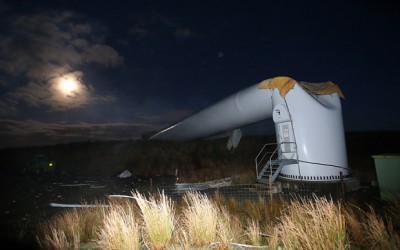
Wind Turbines are a Huge Disaster….the Whole World Over!

More on Germany’s Wind Power Fiasco

turbine-collapse-germany1

The Germans went into wind power harder and faster than anyone else – and the cost of doing so is catching up with a vengeance. The subsidies have been colossal, the impacts on the electricity market chaotic and – contrary to the environmental purpose of the policy – CO2 emissions are rising fast: if “saving” the planet is – as we are repeatedly told – all about reducing man-made emissions of an odourless, colourless, naturally occurring trace gas, essential for all life on earth – then German energy/environmental policy has manifestly failed (see our post here).

Some 800,000 German homes have been disconnected from the grid – victims of what is euphemistically called “fuel poverty”. In response, Germans have picked up their axes and have headed to their forests in order to improve their sense of energy security – although foresters apparently take the view that this self-help measure is nothing more than blatant timber theft (see our post here).

German manufacturers – and other energy intensive industries – faced with escalating power bills are packing up and heading to the USA – where power prices are 1/3 of Germany’s (see our posts here and hereand here). And the “green” dream of creating thousands of jobs in the wind industry has to turned out to be just that: a dream (see our post here).

Now, Germans are fast waking up the unassailable fact that wind power is not only insanely expensive, it’s utterly meaningless as a power source.

Here’s a couple of no-nonsense pieces from NoTricksZone spelling it out in pictures, of the kind that the wind industry bends over backwards to ensure that you’ll never see.

THE CHART Wind Energy Proponents Fear You’ll See … Offshore Wind Turbines Stay In Bed 4 Of Every 5 Workdays!
NoTricksZone
P Gosselin
5 February 2015

Yesterday I published a piece by Fred F. Mueller on Germany’s out-of-control renewable energy transition and how it is in fact transitioning over to a disaster.

What follows below is a graphic that proponents of the offshore wind energy industry don’t want anyone to see. It tells the whole story about how (in)efficient and (un)reliable German offshore wind energy really is (Hat-tip: www.achgut.com) (for a clear look at the graph, click on it and it will open in a new window):

Wind-Energy-AWOL_R-Schuster

Chart shows the installed nameplate offshore wind capacity (shaded green) and the actual output (blue shaded area) since 2009. Wind’s poor performance and unreliable, wildly fluctuating supply disappoint and risk sinking Germany’s “Energiewende”. Chart source: R. Schuster.

The above chart was prepared by Rolf Schuster, an industrial engineering designer, who during his free time has started a wind power databank in order to check the rosy claims being made by the wind power lobby. The results are not something any fast-talking salesman would want any potential buyer to see. The power that was input (blue) is a mere fraction of the rated capacity (green).

Schuster writes:

“If you divide the power fed in (blue) by the rated capacity (green) you get the percent of the rated capacity that actually gets fed into the grid. The linear trend shows a negative tendency – towards 20 percent of the rated capacity. That means: Despite the massively increased capacity in 2014, hardly more power has ended up getting delivered compared to the start of the year. Only one fifth of the rated capacity actually gets fed in.”

Many proponents used to argue that the wind is always blowing at the North Sea, and so a steady supply was a sure thing. Now we have real results coming in. That “steady” wind is only delivering 20% of the installed rated capacity. A fiasco.

Schuster also says that offshore turbines have serious technical problems as well. Foundations are being washed out from underneath; there’s corrosion, and overloads that lead to turbine shutdowns. The harsh conditions of the North Sea a proving much tougher to handle.

There are also major problems with the high-voltage direct currentsystems that have yet to be solved, Schuster writes. One entire North Sea wind park has been disconnected from the grid as a result. This, Schuster says, “makes one ask if the installation of a major power transmission line from North Germany to South Germany would be a high risk gamble for the German energy supply”.

Green power goes AWOL again!

Also a look at online energy portal Agora here also tracks renewable energy that gets fed into the German power grid. A look at today’s graphic for the last 31 days tells us that once again wind and solar have gone AWOL, and so conventional fuels such as gas, nuclear and coal have to jump in to bail out.

Agora-5-Feb-14_25h

The above chart shows German energy supply and consumption for the last 31 days. Solar power that was fed into the grid is shown in yellow. Wind power is shown in blue. Cropped from Agora. (for a clear look at the graph, click on it and it will open in a new window)

Yesterday, February 4, we saw very little wind power getting fed into the grid, less than a gigawatt from a nameplate capacity of some 55 gigawatts of installed capacity – less than 2%! On February 4 wind and solar together virtually fed in almost nothing into the grid. If it had not been for coal, gas and nuclear, the country would have gone dark.
NoTricksZone

studying candle

Germany’s “Energiewende” Leading To Suicide By Cannibalism. Huge Oversupply Risks Destabilization
NoTricksZone
P Gosselin
4 February 2015

The coming age of power cannibalism…Germany on the verge of committing energy suicide
By Fred F. Mueller

German politicians see themselves as the saviors of our climate. In the early 1990s German politicians started the policies that ultimately culminated in the “Energiewende”, which aims to eliminate nuclear power generation and some 76% of the fossil fuel power generation. By 2050 some 80% of power generation should come from “renewable” green sources such as wind, solar, biomass, waste incineration and hydro. Since the volatile sources of wind and solar power will have to contribute the lion’s share, politicians reluctantly concede 20% of the energy coming from reliable fossil power sources.

Germany’s endeavor is indeed breathtaking. A look at Figure 1 shows in detail how massively Germany had once relied upon fossil and nuclear power sources to secure a highly reliable power supply. These sources were controllable and highly reliable. And because Germany’s topology offers only limited possibilities for hydropower, that renewable source is minimal.

Mueller_1

Figure 1: In 1990 the German grid was able to count on conventional power sources which were controllable and highly reliable. Renewable hydropower accounted for only 3.6 %.

Today, after some two decades of massive green energy policy, the situation has changed dramatically. Wind, solar, biomass and waste incineration plants have been promoted to such an extent that together with hydropower, the share of “green energy” today has reached 25.8 % of the country’s total electric power production. This resulted from Germany’s EEG renewable energy feed-in act which guarantees producers fixed rates for 20 years and forces power companies to buy up all the renewable power produced, regardless of the market conditions. The result has been a massive oversupply which has led to steep price drops on power trading floors, which in turn have pushed fossil fuel utilities to and beyond their profitability limits. Surplus production has been repeatedly dumped onto neighboring markets and resulted in massive disturbances for the respective national power grids. Readers interested in a more detailed description of the policy might have a look at the article of Marita Noon [NOON].

Capacity without control

The problem with the “renewable” power sources of wind and solar is their intrinsic volatility coupled with their poor capacity utilization rates of only 17.4% for wind and 8.3% for solar (average values for Germany).

That poor utilization rate means one has to build up huge overcapacities in order to achieve a certain amount of power production. Worse, the power source fluctuates wildly according to weather conditions. As a consequence, Germany has to maintain a dual power generation infrastructure that comprises a grossly overinflated capacity of “renewable” wind and solar power plants shadowed by a full scale backup set of conventional plants. These conventional power sources must always be on standby, ready to take over when weather conditions aren’t favorable. The production-fluctuation range of the “renewables” wind and solar is incredibly wide and volatile. For example in Germany there is an installed nameplate capacity of nearly 73,000 MW. Yet the minimum power output in Germany in 2014 from both sources was a meager 29 MW (only 0.04% of installed capacity) while the maximum value was 38,000 MW (48%).

The massive buildup in wind and solar power has already resulted in a considerable nominal overcapacity of “renewable” power sources.

The combined rated capacity of all “renewable” power sources already reaches about 87,000 MW, which is the maximum power consumption the grid has been designed to secure. Additionally, a minimum conventional power station capacity of some 28,000 MW has to be constantly connected to the grid in order to secure supply stability. As a result the risk of the grid reaching an oversupply situation if weather conditions are favorable for both wind and solar power plants is growing with every additional “renewable” plant that comes online. Currently 5,000 – 6,000 MW are getting added each year. That situation is aggravated by the fact that there exists no technology to absorb and store any noticeable quantities of oversupply. Neighboring countries are already taking measures to fend off surplus-power-dumping that could destabilize their grids.

Power cannibalism has already started

The result is a grid which at times is so oversupplied with power that something will have to give. Fossil fuel power plants have been throttled to the point where they are no longer profitable and many power companies have started mothballing them, so quickly in fact that Germany had to pass legislation forcing producers to keep their fossil plants on stand-by, and to do so even if they lost money. Even the reliable “classic” renewable power sources – e.g. hydropower – are starting to suffer because most are not supported by government schemes.

As the build-up in renewable capacity continues, even the subsidized “renewable” power sources will sooner rather than later be forced into fierce competition for access to the grid whenever the weather conditions turn favorable. One can speculate that within just a couple of years, the first “renewable” energy sources will slowly be driven out of the market because of oversupply. Eventually the renewable power producers will be forced to cannibalize each other in an increasingly fierce competition for privileged access to the power grid as the unwanted events of over-supply become increasingly more frequent.

Things are set to get much worse

Normally, one would think that a government confronted with such a situation would stop at this point and wait for a technically and commercially viable solution for storing the increasing amounts of produced surplus electric energy – for use during times when weather conditions are less favorable. Unfortunately no such storage solution is currently available at the required scale, and anything being proposed so far is either much too expensive or has efficiency factors that are not worth discussing.

Yet Germany has a unique peculiarity: its leaders sometimes exhibit a stunning inability to recognize when the time has come to abandon a lost cause. So far €500 billion has already been invested in the “Energiewende”, which is clearly emerging as a failure. Yet all political parties continue to throw their full weight behind the policy rather than admitting it is a failure (which would be tantamount to political suicide). Instead, the current government coalition has even decided to shift into an even higher gear on the path to achieving its objective of generating 80% of German electric power from “renewable” sources by 2050. If the situation is practically unmanageable now with 25% renewable energy, it’ll be an uncontrollable disaster when (if) it reaches 80%.

If the government sticks to its targets, the share of the different power sources will probably appear as in Figure 2. Currently just 26% has been achieved so far, and the existing biomass share of some 7% is more or less doomed and thus will also have to be replaced by wind and solar. One can easily see how daunting the task that still lies ahead really is.

Mueller_2

Figure 2. The official goal of achieving 80% power supply from “renewable” sources by 2050 requires further massive investments in wind and solar power technologies. Imagine the huge power supply fluctuations one can expect to see from wind and sun.

Waiting for the grand finale

The real risks that lie ahead for the German power generating infrastructure become more recognizable if one looks at the nameplate capacity buildup that has taken place, e.g. just over the past five years, and compares it to what will additionally be needed by 2050, see Figure 2. Keeping in mind that €500 billion have already been contracted and will have to be paid by the consumer, one gets an idea of the proportions of the task still to be tackled in the coming years.

Mueller_3

Figure 3. The installed nameplate power production capacities for wind, solar and biomass as of 2014 has already severely burdened the German consumer with costs of about €500 billion. That will dwarfed by what lies ahead, if politicians don’t change course. Note how 376,000 MW of wind and sun capacity may be installed to ensure meeting the country’s roughly 70,000 MW of demand.

Apart from the sheer dimensions of the costs that lie ahead, the additional cannibalism aspect will grow to enormous proportions. Since an installed wind and solar capacity of some 73,000 MW in 2014 yielded a combined maximum power output of 38,000 MW, the 376,000 MW that are to be installed by 2050 will generate a peak output of 196,000 MW to a grid that might just be able to take up between 40,000 and 90,000 MW. That means, depending on the weather, between 106,000 and 156,000 MW will have to be dumped somewhere else.

In the fight to get power into an often times severely overloaded grid, that’s when cannibalism amongst “renewable” power sources will really become intense. Will wind farmers sabotage solar plantations? Will solar owners sabotage wind turbines? Time will tell, maybe much sooner than we think.
Fred F. Mueller

Sources: [NOON] Marita Noon: Germany’s “energy transformation:” unsustainable subsidies and an unstable systemwww.cfact.org/2014/12/16/germanys-unsustainable-subsidies-and-an-unstable-system/

NoTricksZone

angry german kid

An Engineer from Energy Industry, in Scotland Tells Truth About Renewable Energy!

Why do the politicians listen to

Greenpeace, WWF and FoE,

but not to Engineers?

by Dougal Quixote

We recalled the name D B Watson. He has written several excellent letters and, as this letter reproduced below states, he is a chartered engineer with experience in the energy industry. As we’ve said many times before, all the engineers state the same thing in the same way; there is little if any variation. So why are the politicians not listening? As Helen McDade asked at a meeting a couple of years ago – why is there no engineering-based study? – GL
Renewables cannot supply the energy that is provided by gas
Tuesday 26 February 2013
I NOTE with interest Iain Macwhirter’s article on energy (“The rise and rise of the energy production racket”, The Herald, February 21).
As a chartered electrical engineer with around 35 years’ experience in the energy industry I feel compelled to take issue with the emergence of a new energy unit called, apparently, the “home”.
I refer to the often-heard statistic that a new wind farm or renewable energy device will power or provide enough energy for many hundreds or thousands of homes.
The data, promulgated by power companies and repeated by bodies such as the Scottish Parliament, local councils, equipment manufacturers, and countless quangos without challenge are, at best, misleading and, conveniently, support the impression that the energy being generated from renewables is considerably more than the reality.
Most power-generating companies adopt the RenewableUK assessment of average household usage of 4266 kilowatt hours per year when calculating the average number of homes that can be supplied from the output of a new renewables project.
This annual total is equivalent to less than 12 kilowatt hours per day per average home – that is, a one-bar 1kW electric fire operating for less than 12 hours each day, so includes next to nothing for electrical heating.
However, half of the energy consumed in Scotland is in the form of heat, with approximately half of that being consumed in our homes. Ofgem’s detailed statistical 2011 assessment for the (median) dual fuel needs of an average UK home is 4000 kilowatt hours per year of electricity plus 16,900 kilowatt hours of gas for heating/cooking . It also calculated typical high usage figures of 5100 kilowatt hours of electricity and 23,000 kilowatt hours of gas depending on the size and location of your home and the calorific value of your supplied gas (the equivalent amount of energy you get from burning the gas).
Scotland is of course at the high end of these figures given our cooler climate.
Domestic gas energy consumption for the typical home is therefore in addition to and between four and six times higher than the household electrical energy usage and much cheaper, at a cost of around one third per kilowatt hour of electricity at standard tariffs.
So the actual total average energy requirements for a UK home is approximately 20000 kilowatt hours per year whether you are all-electric or have both gas and electricity and not 4266 kilowatt hours. So wind farms provide around one-fifth of the actual energy requirements of the number of homes they claim to provide for.
The fallacy of the home claim is further apparent when you consider that in Scotland around one-third of domestic properties are not connected to the national gas network, compared to only one in 10 in the rest of the UK and this means there are more than 800,000 homes in Scotland that have to use electricity (the vast majority) and/or solid fuel or bottled gas for heating and cooking. Ironically, this includes all the island communities and much of the Highlands, where several of the wind farms are located.
It is of little surprise therefore that more than 120,000 Scottish families are officially in fuel poverty.
Almost every major wind farm generates into the nationwide electrical network and is distributed throughout the country, so the power companies’ claims that 4266kW hours per year provides enough electricity for a certain number of homes does not apply to at least 800,000 homes in Scotland.
Similarly, all claims that 4266kW hours powers a home are wrong as they do not include the heat energy we require and this applies equally to the rest of the UK.
This is important because the renewable industry also claims it is the future with gas supplies due to run out, by which argument it will then have to supply all the energy presently provided by gas. Then its current misleading claims will be shown to be wrong.
The renewables industry’s marketing people can’t have it both ways.
All in the industry and the politicians and the quangos need to start playing it straight with the public.
D B Watson,
********,
***********,
Cumbernauld

Wind-weasels Run, when the Truth Begins to Surface!

US Wind Farm Operator Settles to Shut Down Neighbours’ Dynamite Damages Case


****

A telling-scene there, from the film A Civil Action; which is pretty much how things panned out for a US wind farm operator in Michigan recently.

STT has been following a monumental piece of litigation that blew up over the Lake Winds wind farm in Mason County, for a while now (see our posts here and here and here).

Now, finally, and as predicted by STT, the wind power outfit concerned has been forced to open its cheque book, in order to cut a settlement with the long-suffering neighbours.

Back in 2013, 17 plaintiffs sued the operator, seeking substantial damages for the health impacts, property value losses and the loss of the enjoyment and use of their properties, caused by wind turbine generated noise and vibration.

With the jury panel taking their seats – and clearly acting under the adage about discretion being the better part of valour – the wind power outfit involved, Consumers Energy threw in the towel, just as the first of their (numerous) victims, Cary Shineldecker was about to go into the witness box.

Nothing like a credible witness, heading off to tell a sympathetic jury of his peers (ie, law-abiding American citizens) about his years’ of suffering, to focus the minds of lawyers representing a wind power outfit that has shamelessly visited a sea of sonic of misery upon him (and his young family); and which has otherwise destroyed the lives of a dozen or moreinnocent young families.

The wind industry operates under a pact that its members must never, ever allow one of these cases to go to a final decision and judgment.

The usual course is to cut a deal behind closed doors; well away from the glare of the media.

Faced with mounting damages claims in Denmark (see our post here), the Danish wind industry has taken to buying up its actual and potential victims’ homes – and even whole villages – calling in the bulldozers, and flattening the lot (see our post here).

The wind industry in Australia – which is also a signatory to the “never let‘em get to judgment pact” – quietly buys out its victims’ properties, bulldozes them (see our post here) and makes damn sure they stitch up the unfortunate (soon to be homeless) family with bullet proof gag clauses (see our posts here and here) – that their lawyers enforce with the zeal and vigour of the Old GDR’s Stasi (see our post here).

worried lawyer

STT hears that – as you might expect in a situation where the operator’s lawyers would have been working in a pool of cold sweat – the settlement in the Lake Wind’s case was very favourable to the plaintiffs.

The wind power outfit didn’t have a legal leg to stand on: along the way, it had lost every step in, and associated with, the plaintiffs’ primary action, with a judge twice declaring that the wind farm was in clear breach of its noise criteria.

It was – as they in betting circles – “on a hiding to nothing”.

So, in reality, it had no other option than to throw money at the problem and attempt to bury it. However, in full credit to the victims, they at least managed to avoid the full extent of the standard gag clause, that prevents victims from ever talking about the health impacts caused by the defendant’s operations.

Here’s Michigan Capitol Confidential with a round-up on what happened.

One Lawsuit Settled, But No Truce in Wind Energy Debate
Michigan Capitol Confidential
Jack Spencer
31 January 2015

A lawsuit in which residents living near the Lake Winds wind plant south of Ludington claimed the facility was making people sick has been settled out of court. Cary Shineldecker, one of the plaintiffs in the case, isn’t allowed to discuss details of the settlement, but is still allowed to talk about the alleged negative health effects that can be suffered by those who live near such facilities.

“What I think is different about this settlement is that, although the details of the settlement are confidential, I’m not gagged from speaking out about the problems with wind energy,” Shineldecker said. “I think everything we’ve done here has helped the community and residents. For too long, supporters of wind energy have been able to silence and discredit those who have to live with the effects of it.

“We saw how they silenced Jerry Punch and his group,” Shineldecker continued. “When his group was working on a study that refuted what wind energy supporters wanted to be reported about the health impacts of wind turbines, they (the wind energy supporters) shut them up.”

On April 1, 2013, a group of 17 residents who lived near the Lake Winds wind plant – others joined the group later – filed a lawsuit against Consumers Energy in Mason County Circuit Court.

The lawsuit alleged that people were experiencing dizziness, sleeplessness, headaches and other physical symptoms primarily due to noise generated by the wind plant’s 56 giant wind turbines, which the plaintiffs claimed had been erected too close to homes.

“We filed the lawsuit based on health impact, property value loss and loss of enjoyment and use of our property,” Shineldecker said.

Lake Winds is the first wind plant developed by Consumers Energy. The $250 million facility was constructed as part of the utility’s efforts to meet the state’s renewable energy (wind) mandate.

The lawsuit brought by Shineldecker and his co-plaintiffs was only the first one involving the Lake Winds plant. Before the end of 2013, Mason County had declared that the wind plant was not in compliance with its noise ordinance. Consumers Energy took the county to court over that determination. It lost at the Circuit Court, and that case is currently under appeal.

According to Shineldecker, the residents’ lawsuit was resolved during the late summer and autumn of 2014.

“It was just about to go to trial; in fact I was in court waiting to be the first to testify, when we were told a settlement had been reached,” Shineldecker said. “It took about two months to work out the wording; then ours was actually finalized the week of Dec. 17.

“To me, we were helping others by being willing to take a stand,” Shineldecker added. “One of these days the facts are going to come out. Twenty years from now the health impacts of living with these industrial wind turbines will be common knowledge. It will be like the way it happened with cigarettes. But right now those who know the truth are a minority.

The talking points used by AWEA (American Wind Energy Association) haven’t changed from what they were saying five years ago. I believe that in our democracy, right will win in the end, but only after a lot of sacrifices have been made.”

Shineldecker also said that his family’s property, which he is selling off in portions, is now going for 78 percent of its appraised value.

David Wand, deputy director of strategic communications for AWEA, did not respond when offered the opportunity to comment. Consumers Energy declined to comment as well.
Michigan Capitol Confidential

Just when the going was about to get a little tougher than usual for America’s highly paid wind industry spruikers, the AWEA, it’s good to see David Wand waving his namesake and disappearing into the ether; very “Harry Potter”!

harry potter invisibility cloak

Perhaps these boys should give Harry Potter a call, so they can have an invisibility cloak on stand-by, from here on in?

With a pack of jubilant plaintiffs ready to crow long and loud about just what Consumers Energy (one of the AWEA’s clients) has done to their lives, their health, their well-being and the value of their homes – no wonder Consumers Energy and the AWEA went AWOL. Funny about that.

STT predicts that the wind industry’s “run and hide” tactic (for a taste of it in action – see our post here) will fast become de rigueur for the wind industry and its parasites, as the tide finally turns on an industry that – when it comes to moral turpitude, and a general callous disregard for its victims – only has the tobacco and asbestos industries to beat.

Fine company, indeed.

dirtyrottenscoundrelsoriginal

When the Wind Don’t Blow, the Turbine Don’t Go….(Or if it Blows Too Much) LOL!

Wind Turbines Totally Suck, When the Wind Really Blows & When It Doesn’t

turbine-2_3153749b

When the wind is “the thing”, that’s supposed to be your business – when it’s what makes the revenue (or, rather a massive pile of taxpayer and power consumer subsidies) flow – it seems a bit rich for wind power outfits to start whining about there being too much or too little.

goldilocks_1393092c

But, in shades of Goldilocks’ nitpicking about stolen porridge having to be “just right”, so it is amongst wind weasels.

Wind turbines don’t generate a single spark until the wind hits at least 5 m/s (18km/h); don’t hit ‘rated power’ (ie, maximum output) until wind speeds reach 11 m/s (40km/h); and get shut down automatically to protect blades and bearings when wind speeds hit 25 m/s (90km/h).

Despite wind being very much their ‘business’, around the globe windpower outfits have taken to blaming the ‘absence’ of it – as if it were one of Newton’s constants, you know, like gravity – for their financial, and other troubles, as detailed in these posts:

Here in Australia, near-bankrupt wind cowboys, Infigen (see our post here) have just pointed the finger at – you guessed it – THE WIND, for a massive drop in revenues (see this lament from the eco-facists over at ruin-economy). Oh dear, how sad, never mind.

For their myriad sins, it appears that wind power outfits have somehow drawn the opprobrium of the wind gods at both ends of the meteorological spectrum – with that great Greek huffer and puffer of old – Aeolus – really turning it on, and flattening fleets of fans with withering effect.

This time, the story’s about the Wind Gods going crazy in Brazil.

Eight Impsa turbines blown down in Brazil
Wind Power Monthly
Michael McGovern
26 January 2015

turbine impsaCollapse

BRAZIL: Investigations are ongoing at utility Eletrobras’s 46MW Cerro Chato IV-VI wind complex in the Brazilian state of Rio Grande do Sul following the collapse of eight Impsa turbines.

The incident was caused by a freak storm hitting Santana do Livramento district on the afternoon of 22 December, with gusts reaching 250 kilometres per hour, according to an Eletrosul press statement, which appears to be its only public comment on the incident.

Neither Impsa nor Electrobras would respond to questions from Windpower Monthly while investigations are ongoing. The machines were Impsa 2MW machines with a 100-metre rotor.

Before the storm, Rio Grande do Sul’s meteorological office, MetSul, had issued an alert for winds of up to just 120km/h. Reported maximum gusts for the neighbouring town of Rivera in Uruguay, which shares the border with Santana do Livramento, were at just 130km/h.

Impsa, Argentina’s beleaguered turbine manufacturer currently tackling solvency problems, has made no public comment.

No damage was reported to Wobben turbines operating in the same district.

Local press sources state that Eletrosul’s insurers have concluded onsite investigations, although conclusions are yet to be delivered to its client.
Wind Power Monthly

Aeolus1

Wind Power will NOT Keep the Lights, or the Heat, ON!

Wind Power Goes AWOL Right When Freezing Brits Need It Most

cold lady

The hackneyed myth that wind power “powers” millions of homes with wonderful “free” wind energy is taking a beating around the globe (seeour post here).

The idea that a wholly weather dependent power generation source can ever be – as is touted endlessly by the wind industry and it parasites – an “alternative” to conventional generation is, of course, patent nonsense.

If there wasn’t already a complete power generation system built around on-demand sources, such as gas, coal, nuclear or hydro – then a country trying to run on wind power would – unless it was keen to revisit (or remain in) the stone age – would inevitably need to build one (see our post here). So far, so insanely costly, and utterly pointless.

Now, just when winter starts to bite, and the Brits are looking for some extra sparks to toast their crumpets, brew their tea, to warm their homes and keep the icicles from their noses and toes, their massive fleet ofblade-chucking, pyrotechnic, sonic-torture devices has completely downed tools – proving once and for all that wind power is the greatest fraud of all time.

Here’s The Telegraph with, yet another tale of just why it is so.

Electricity demand hits highest this winter – as wind power slumps to its lowest
The Telegraph
Emily Gosden
20 January 2015

UK electricity demand hit its highest level this winter on Monday – while wind turbines generated their lowest output, official figures show.

Cold weather saw UK demand hit 52.54 gigawatts (GW) between 5pm and 5.30pm, according to National Grid.

At the same time, low wind speeds meant the UK’s wind turbines were producing just 573 megawatts of power, enough to meet only one per cent of demand – the lowest of any peak period this winter, Telegraph analysis of official data shows.

Earlier on Monday wind output had dropped even lower, generating just 354 megawatts at 2pm, or 0.75 per cent of Britain’s needs – the lowest seen during any period this winter.

ukgrid_19jan_2015

The analysis will fuel concerns that despite receiving billions of pounds in subsidies, Britain’s wind farms cannot be relied upon to keep the lights on when they are needed the most.

Britain now has about 12 GW of wind capacity installed on and offshore – meaning during Monday’s peak demand period, wind farms were generating less than five per cent of their theoretical maximum output.

Gas, coal and nuclear power plants instead provided the vast majority of the UK’s electricity needs.

A spokesman for National Grid said that Britain’s spare margins – the safety buffer between supply and demand – had remained “adequate”.

On average, UK wind farms produce about 28 per cent of their theoretical maximum power output.

But critics warn that cold snaps when demand soars can often coincide with periods when the wind doesn’t blow.

They argue that Britain’s energy security will become ever moreprecarious as old coal and gas power plants are closed and the country becomes more reliant on intermittent wind farms.

Dr Lee Moroney of the Renewable Energy Foundation, a think tank critical of wind farms, said: “Low wind speeds frequently accompany low temperatures as happened yesterday.

“The proliferation of wind farms encouraged by Government policy is misguided because a reliance on wind energy in these conditions leads to inevitable extra costs for consumers.

“Either reliable backup electricity supply from conventional sources must be provided when the wind does not blow, or extra costs in the form of constraint payments are incurred when there is too much wind on the system. It is a lose-lose situation for consumers.”

National Grid’s data, which covers the period since December 1, shows that the second highest peak demand – 50.9GW on December 4 – also coincided with the second lowest peak wind contribution, at just 1.5 per cent.

However other periods of particularly high peak demand, such as the evenings of December 9 and 10, coincided with much higher wind power output, with turbines meeting 18 per cent of demand.

The data also shows that Christmas Day was the only day when solar panels contributed anything at all to peak demand – because it was the only day when peak demand fell in daylight hours.

Demand on December 25 peaked after 12.30pm as families cooked their Christmas dinners.

On all other days demand peaked after it got dark – the vast majority between 5pm and 5.30pm.

Ministers were last year forced to approve a series of emergency powers to help prevent blackouts this winter, by firing up old power plants or paying factories to switch off.

National Grid said it had not yet needed to use any of the emergency powers.

Jennifer Webber, director of external affairs for wind industry body RenewableUK, said: “It’s wrong to cherry-pick statistics for short periods when the wind didn’t blow, as they’re unrepresentative of the full picture of the benefits wind provides for the UK.

“To get a proper idea of how well wind is performing as a vital part of our energy mix, you have to look at National Grid’s official figures over a meaningful period. In December, wind energy provided a record monthly high of 14 per cent of all the UK’s electricity needs.

“As a whole, 2014 was wind energy’s most productive year so far in this country, generating nearly 10 per cent of Britain’s electricity – equivalent to the annual demands of a quarter of all British homes.”

A spokesman for the Department of Energy and Climate Change said: “We need a diverse energy mix to reduce our reliance on imported fossil fuels and renewables, including wind, are helping us to achieve this.

“Over £10bn was invested in clean energy in 2014 and the sector could also support up to 200,000 jobs by 2020.”
The Telegraph

Another fine piece of “doublethink” and “doublespeak” from wind industry spin-kings, Renewable UK and DECCs – in the other-worldly, Orwellian tradition under which they operate; and which they deploy in their efforts to control the energy ‘game’ (see our post here).

When the hard numbers see it pressed on its central claim about “powering” millions of homes, the wind industry and its parasites start back-pedalling at a full pelt, whine about “cherry-picking data” and resort to waffle about ‘averages’, ‘overall benefits’ etc, etc (that’s if they haven’t already run off and hidden from their interlocutors – see our post here).

And, in this case – resorting to their classic “hey, quick look over there” tactic – the spinners pitch up the well-worn lie about wind power ‘investment’ creating hundreds of thousands of new jobs (see our post here); as if that will be some kind of consolation when Brits are all left freezing in the dark.

STT just loves their exhortation about the need to measure wind power output “over a meaningful period”, which, apparently, means “averaging” wind power output over a month or more.

Funny, you know, that power punters – selfish lot that they are – tend to consider having power available when they need it, as a “here and now” kind of thing. So let’s see how things are “averaging” out over at the ICU:

ICU Respiratory_therapist

DECCs and Renewable UK are obsessed with the ultimate (nonsense) goal of Britain running exclusively on wind power – and every malicious move they make is aimed at seeing wind power totally ‘displace’ fossil fuel generation sources.

If their (impossible) ‘dreams’ were ever realised, it would be interesting to see how the (few) remaining businesses would manage to operate without power for hours on end, every other day; and how householders might toast their crumpets, and keep warm and well-lit homes whenever the wind does what it’s done since the dawn of time.

STT buffed up the crystal ball and conjured up this forlorn image, that might be somewhere near the mark:

studying candle

Open Letter Regarding Low Frequency Noise Due to Wind Turbines

Australian Breastfeeding Association head office

1818-1822 Malvern Road
MALVERN EAST VIC 3145

Email: info@breastfeeding.asn.au


OPEN LETTER


The article below has recently been published in the Portland Observer by Bill Meldrum “Wind Alliance rejects health claims”; I object to the incorrect statements made within it by Ms Angela McFeeters, an ABA representative at Portland and spokesperson for the Victorian/Australian Wind Alliance. I draw it to your attention for discussion, review and management of.


As one of the six resident participants in the Steven Cooper Acoustic Testing Program at Cape Bridgewater of Nov 2014, I have firsthand knowledge of impacts and conditions living in proximity to the industrial wind energy plant of 29, 2MW turbines at Cape Bridgewater causing health impacts and disturbance to us and to many others exposed to infrasound and other disturbing industrial ‘noise’ emissions around Australia.


I suggest the ABA has a duty to become more fully informed of these public health impacts to assist new mothers and babies; to become informed of the issues by reading the links below and further extensive information compiled and available at; wind.watch.org, the Waubra foundation or Stop These Things websites.


Ms McFeeters would not have the medical expertise to publically declare any conclusions on the status of my health, only my GP or Specialist have the comprehensive understanding of and authority to make any statements regarding health or impacts to it.   Ms McFeeters has over the past 12 months anonymously attended community consultation meetings related to the acoustic study being conducted by the owners of the wind farm, Pacific Hydro and has heard the impacting conditions we have reported to the company and the Government Authorities over the past six years.


This is not the first biased public statement or comment Ms McFeeters has aired whilst representing the Wind Alliance and the wind industry.


Her assumptions and implied accusations in this article are based without visiting my house, nor noting medical conditions first hand, as my GP’s, Specialists or the Acoustic Engineers that have conducted studies inside my home.   The study undertaken by Mr Cooper is groundbreaking and assists with the resolve of problems of noise, vibration and sensation through greater understanding and knowledge gleaned by cooperatively working together.   Cooperation was undertaken for the first time ever by residents, a wind farm and an independent acoustician working with the goal of getting to the bottom of the problems.  I doubt Ms McFeeters has read or understands the importance of the research or the publically released conclusions.


The most damaging impact of wind farms to public health, including my own is the serious issue of sleep deprivation.  As a representative of the ABA, dismissal of the very real health impact of sleep deprivation caused by wind farm disturbance is unfeeling and callous in its disregard.  Dismissing disturbances documented within the Acoustic study could damage mothers and infants living near and impacted by wind farms, not only in the Portland region but around the nation.


Sleep disturbance and post natal depression go hand in hand; her biased public opinions and her obligation to abide by the code of ethics of the ABA do not.    I ask which qualifications, expertise and knowledge allows her to refute health impacts that have been well documented and confirmed as far back as 1985 in the US Kelley report and do you endorse the opinions of this Alliance?

Disturbed fertility and menstrual cycles in women living near wind turbines in Denmark, Canada and Australia are being reported from both residents and by health professionals.

Health professionals, medical practitioners, acoustic experts and researchers who have firsthand knowledge of the severity of reported health problems call for urgent multidisciplinary research in this area and include:

Professor Bob McMurtry, Dr Roy Jeffery, Associate Professor Jeff Aramini, Carmen Krogh and Mr William Palmer from Canada; Dr Alan Watts, Dr Wayne Spring, Dr David Iser, Dr Gary Hopkins, Dr Andja Mitric Andjic, Dr Sarah Laurie, Mr Les Huson, Mr Steven Cooper, Emeritus Professor Colin Hansen and Dr Bob Thorne from Australia; and Associate Professor Rick James, Mr Rob Rand, Mr Stephen Ambrose, Emeritus Professor Jerry Punch, Dr Jay Tibbetts, Dr Sandy Reider, Dr Nina Pierpont, Dr David Lawrence, Dr Paul Schomer, Mr George Hessler, and Dr Bruce Walker from the USA with others from Europe.   Wind turbines are increasing in size and are being placed closer to larger human populations and justifiably, there is growing concern all over the world.


For any breastfeeding counsellor or representative within the ABA to be ignoring the serious issue of sleep deprivation is a very real concern.  Evidence about sleep deprivation and its role in post natal depression is well accepted.  Is this evidence being ignored by the ABA counsellors in the Portland region?  Does the ABA disagree with the concerns of the Health and Acoustic Professionals and Researchers listed above?


As a concerned mother and advocate of breastfeeding I ask you to investigate.  Impacts of infrasound on breastfeeding cannot be dismissed out of hand by someone without the authority or proper and independent knowledge to do so.


http://waubrafoundation.org.au/resources/acoustic-engineering-investigation-at-cape-bridgewater-wind-facility/


http://www.pacifichydro.com.au/files/2015/01/Cape-Bridgewater-Acoustic-Report.pdf


http://waubrafoundation.org.au/2015/steven-coopers-cape-bridgewater-acoustic-research-commissioned-by-pacific-hydro-released/


https://www.wind-watch.org/documents/letter-to-the-ama-re-its-recent-paper-concerning-wind-turbines/


Read the above, acknowledge the depths of this issue and release a public apology.  Proper and independent health studies are going to be conducted in the homes of impacted people near these energy plants and until this further study is undertaken and released by the Australian Government then no-one should conclude there are no impacts on residents’ health and quality of life.

Melissa Ware

A Simplifies View of the Recent “Cooper Acoustic Investigation”…. by the Waubra Foundation.

Acoustic Engineering Investigation into Airborne and Ground-Borne Pressure Pulses from Pacific Hydro’s Wind Turbines at Cape Bridgewater

A Simplified Explanation of the Findings, Previous Research, and the Consequences

Cape Bridgewater wind turbines

Waubra Foundation – 1st February, 2015

1. Background

  • Turbines create “waste energy” in the form of airborne pressure waves (sound) and ground-borne pressure waves (vibration).
  • Noise is that part of the sound frequency spectrum which is audible, but “noise” is also defined by psychoacousticians as “unwanted sound”.
  • The strength (sometimes expressed as a loudness in the case of noise) of the sound is measured in decibels (“dB”).
  • The wavelength of individual sound waves is a measure of the distance between the peaks of the pressure waves. The speed of sound divided by the wavelength gives the frequency of the sound and is expressed in hertz (Hz).
  • Where the frequency of the sound waves is below 20 Hz, the distance between the waves is relatively long, and the general term for this portion of the frequency spectrum is known as infrasound. Infrasound is only audible at very high levels (dB). However it can be damaging to the human body at levels well below audibility.
  • Impulsive infrasound from a variety of industrial sources has long been known to have the potential to be harmful to humans, especially with chronic exposure. For example, human and animal studies have shown infrasound directly causes both physiological stress,i and collagen thickening in a variety of tissues including cardiac valves, arteries, and pericardium which themselves lead to a variety of cardiovascular diseases.ii
  • Infrasound persists for much greater distances than audible sound and, unlike audible sound, penetrates well insulated building structures (including double glazing) with ease; and often increases the impact by resonating within the house, like a drum.iii iv This occurs, regardless of the source of sound & vibration energy. Penetration of buildings and amplification via resonance can also occur from sound and vibration from natural sources such as earthquakes and thunder.
  • Standards for wind turbine noise pollution in Australia are set in audible decibels (“dBA”) outside houses.v Use of dBA excludes accurate measurement of frequencies below 200 Hz, including both infrasound (0 – 20 Hz) and low frequency noise (20 – 200 Hz). These Standards do not require infrasound (either within or outside homes) to be predicted in planning submissions nor to be measured in the required compliance testing to the planning permit noise conditions. Most jurisdictions do not require wind turbine generated low frequency noise to be predicted or measured either (unlike other sources of industrial noise). In fact most noise measuring instruments and microphones are unable to measure accurately in the infrasound range, especially below 8 Hz, and some Standards explicitly specify the use of equipment which cannot measure infrasound.
  • Wind turbines produce infrasound along with audible noise. The morepowerful the wind turbine the greater the proportion of infrasound and low frequency noise emitted,vi which then increases significantly if the turbines are sited too close together, now common practice in Australia.vii Most newer wind turbines are now 3 MW or 3.5 MW, compared to 2MW at Cape Bridgewater.
  • By the use of different sound meters and microphones, and in narrow (frequency) bands it is quite possible to identify and measure infrasound specifically from wind turbines, in the field. This unique “wind turbine signature” has now been demonstrated by the acoustic consultants involved in the Health Canada Studyviii and by Professor Colin Hansen’s team at Waterloo,ix in addition to Mr Cooper’s measurements at a number of locations in Australia prior to, and including, the Cape Bridgewater Acoustic Investigation.
  • Increasing numbers of residents living within 10km of wind turbines have suffered, and are still suffering, severe adverse health impacts since the wind turbines started operating.x xi Many have left their homes repeatedly, and eventually permanently, to live in greatly diminished financial circumstances, as their homes are no longer habitable or saleable. Some residents become too unwell to work. Wind turbines are not the only source of impulsive infrasound and low frequency noise causing severe health damage. The same pattern of identical serious adverse health effects, sleep deprivation and home abandonments, sometimes out to similar distances are being reported by neighbours to other known sources of infrasound and low frequency noise, at open cut coal mining (eg Hunter Valley in New South Wales), underground mines with large extractor fans (eg Lithgow, in New South Wales), gas turbinepower stations (eg Uranquinty, in New South Wales, Port Campbell in Victoria) and numerous other sources (eg Tara gas field in Queensland).xii
  • Wind power projects and other energy generating noise polluting industrial developments involve very large sums of money in construction, in revenues and in the case of industrial wind turbines – public subsidies. It is not uncommon to find companies with large investments and large cash flows going to great and improper lengths to maintain their cash flows.
  • The wind industry has never been asked to prove that their machines are safe, unlike other products on the market. When queries are raised about impacts on neighbours, the industry and its supporters trigger the “Four Ds” of denial, dissemble, delay and destroy the messenger, despite the wind industry being well aware of the seminal research by Dr Neil Kelley and NASA which established direct causation of symptoms from impulsive infrasound and low frequency noise from wind turbines and other sources in the 1980s, by both field and laboratory research.xiii

2. The Purpose of the Cape Bridgewater Acoustic Investigation

The purpose of the investigation was simply to find out what was causing the symptoms and sensations, resulting in sleep disturbance and health damage, reported to Pacific Hydro between 2009 and 2014 by the residents of three homes sited between 600 – 1600 metres from wind turbines sited at the Cape Bridgewater Wind Project in Victoria, Australia.xiv

3. What Are the Key Findings of the Cooper Acoustic Investigation?

The findings include:

Please read on

Village Destroyed to Accommodate Wind Turbines.

Company’s extreme wind strategy: “Recently we bought most of a village to make a windpark.”

Kølby in northern Jutland is being bought up by the Swedish energycompany Vattenfall.

We solve the problem of unsellable properties in peripheral regions. We solve the problem of neighbours being critical of wind farms.”

Farm in Bollerup
Farmhouse purchased by Vattenfall for demolition.(photo: René Schütze)
The Copenhagen Post

Company’s extreme wind strategy: Towns today, turbines tomorrow

By Philip Tees

Swedish energy company Vattenfall is going to extreme lengths for the sake of its Danish windfarms – buying up whole villages in rural Denmark, razing them to the ground and replacing the buildings with wind turbines, Børsen reports.

Mette Korsager, who is responsible for Vattenfall’s onshore wind projects in Denmark, told the business newspaper that the strategy was to make it easier for the company to achieve the goal of installing 250 MW of wind turbines in Denmark by 2018-2019. “We typically buy up farms in bad condition and demolish the farmhouse,” she said.

Recently we bought most of a village to make a windpark.

Helps the region, according to Vattenfall

That village is Kølby in northern Jutland, and Vattenfall plans to acquire a total of 20 properties.

Korsager told Børsen the strategy served a number of purposes. “We solve the problem of unsellable properties in peripheral regions,” she said.

We solve the problem of neighbours being critical of wind farms, and we make it easier to reach agreements about the installation of wind turbines at the municipalities because we go in and help them by developing problem areas.

Kølby in northern Jutland
Kølby in northern Jutland.(photo: Google Street View

Windpushers Do Not Protect the Health of Vulnerable Children, (or anyone else)

West Norfolk mother tells of blindness fears for son over wind farm scheme

Karen Robinson with her son Ronnie Robinson (9) in the garden at Clenchwarton Hall, showing the current view. ANL-150129-112536009

Karen Robinson with her son Ronnie Robinson (9) in the garden at Clenchwarton Hall, showing the current view. ANL-150129-112536009

Ronnie Robinson suffers from primary congenital glaucoma, a severe visual impairment in which his eyes cannot cope with changing light conditions.

Developers of the Ongarhill wind farm, which is due to be debated by the West Norfolk Council planning committee next week, say conditions attached to any permission, and technology on the turbines themselves, will prevent shadow flicker from affecting residents.

But Ronnie’s mum Karen says she has been warned by doctors that she will have to leave her home on Hall Road, Clenchwarton if the plan goes ahead, in order to save his sight.

She said any flicker would leave Ronnie at risk of becoming disorientated and banging his head.

The slightest knock could mean he loses all his remaining vision.

Mrs Robinson, who moved to the area from Hertfordshire five years ago, said: “The whole reason we moved here was because it was off the road and it was safe for him to live.

“Why should we suffer just because they want to put turbines there? We moved here for a better life.”

A planning report, published last week, recommended that councillors approve the wind farm proposal, subject to the completion of a legal agreement for an ecological improvement plan within three months.

But opponents are unhappy with what they claim will be the unacceptable impact on localresidents and wildlife.

Mrs Robinson, who will be addressing Monday’s planning meeting, also fears the noise of the turbines would affect Ronnie, as he relies on his more sensitive hearing due to his eye problems.

But Cath Ibbotson, project manager for developers Coriolis Energy, yesterday said they had discussed Mrs Robinson’s concerns with her and were taking them seriously.

She said: “Tried and tested technology exists to switch off turbines at appropriate times and therefore prevent any shadow flicker occurring at the property or in the grounds for those few hours a year when it might otherwise do so.

“The council has proposed that a planning condition would be attached to any planning permission to ensure this.

“In respect of noise, anyone who has visited a wind farm for themselves will know how quiet turbines are in operation. However, national noise limits exist to protect residents.

The council have proposed in this case that the Ongarhill wind farm would have to operate to even more stringent limits, and we have agreed that we would do so. Again, this would be secured through planning conditions.”

Monday’s planning committee meeting will take place at the Lynn town hall, starting at 10am.

Eric Jelinski – Canadian Energy Engineer, Tells the Truth about the Wind Fraud!

Top Canadian Energy Engineer – Eric Jelinski – Slams the Great Wind Power Fraud

engineering-image-4

Provided they haven’t got their trotters in the wind industry subsidy trough, engineers are quicker than most, when it comes to rumbling the great wind power fraud.

Practically minded, and with heads for real numbers, engineers are able to pick apart the complete pointlessness of trying to rely on an energy source that will NEVER be available on demand (can’t be stored) – is entirely dependent upon the weather – and is, therefore, not a generation “system” at all: “chaos” and “system” are words that come from completely different paddocks; and which mean completely different things (see our post here).

And engineers, who build “systems”, don’t like “chaos”.

Google’s top engineers – Stanford PhDs, Ross Koningstein and David Fork – came out and recently tipped a bucket on the nonsense of attempting to run 21st Century economies using a ‘technology’ that was dumped way back in the 19th Century (see our post here).

Now, one of Canada’s leading energy engineers, Eric Jelinski has come out swinging too.

An Engineer Speaks
Windfarm Action
27 January 2015

The following was written by Eric Jelinski, P. Eng., a Canadian engineer who specializes in energy production. Gas plants. Nuclear plants. Wind &solar energy. He explains to his township (Clearview Township, Ontario) why wind energy is folly.

Jelinski

I am writing to express my objections to the installation of Industrial Wind Turbines in Clearview Township, Ontario, Canada.

My wife and I moved here to retire on 50 acres, building a house, market garden, as well as taking many other initiatives to become part of the vital social fabric.

It is bad enough that under Ontario Premier McGuinty, the social fabric in big cities like Toronto is in need of repair, as it happens, in part because those “50,000 jobs” in renewable energy have not materialized, and there is little productive activity for many of the youth in the cities. Guns and drugs are very much part of the social fabric in some neighbourhoods.

What gives McGuinty, with his Toronto constituent Members of the Provincial Parliament (MPP’s), the moral right to tell us in Clearview that we must accept wind turbines “or else”?

One way to stop the wasted energy and environmental impact of urban sprawl is for big city MPP’s to clean up their own yard and make cities safer and more habitable. While they listen to those who object to new gas plants, and cook up a new “plan of the month” for public transport, why do they ignore the issues with wind turbines?

My background is nuclear and chemical engineering, with over 30 years combined working at each of the nuclear plants in Ontario. I teach nuclear engineering at University of Toronto and Georgian College (Power Engineering) in Owen Sound for the purpose of training the next generation of staff who will design plants and work them safely.

I know nuclear reactors and how e=mc2 gets us the energy. I know chemical reactors, e.g. to make gasoline from crude oil, and refining metals. I know solar and wind energy going back to the 1970’s, as energy and exergy are my major fields of study.

The application of Ontario’s “Green Energy Act” is in violation of principles in engineering, where we teach engineers to anticipate unintended consequences and not proceed with implementation until consequences and risks are taken into account.

The Green Energy Act is an abomination that is creating a living hell for almost everybody in rural Ontario, and the provincial government is ignoring the data of emerging health issues, property value issues, setbacks and zoning, impacts on fowl, fauna, and fish, impacts on local weather such as the dew point and foliar uptake by plants that is important in particular to alleviate heat stress on biota.

I have seen firsthand one of my neighbours from the 1980’s near Ripley forced out of his farm home due to wind turbines in Huron Township. Others are putting up with the impacts.

The energy available from wind in Ontario is borderline minimal compared to other countries and areas of the world. 25% to 30% is the capacity factor.

The wind is not available when we need energy the most, i.e. summer air-conditioning and winter heating. The shoulder seasons have the most wind here, yet this is when air-conditioning and heating demands are minimal.

The power equation for wind results in 8 times the energy for a doubling of wind speed, and the excess energy has to be “dumped.” Storage systems are available, but prohibitively expensive. Hythanation is possible, but wind turbines are not economic for hydrogen production given the added infrastructure relative to the cost of natural gas.

Wind turbines use 5 to 7 times the amount of concrete and steel vs. say a nuclear plant on a per Megawatt basis. It will require some 10,000 wind turbines to replace the ~ 6000 MW of coal generation at 25% CF (capacity factor). Back-up gas fired plants have to be added like plug-ins everywhere because the wind is not reliable.

The pastoral scene of a field of wind turbines slowly turning in almost still air has environmentalists dreaming in technicolour.

The truth is that these wind turbines need about 8 km/hour of wind before they will start generating electricity. Any rotation of the blades at wind speeds below 8 km/hour is accomplished by taking power from the grid to get the wind turbine started in anticipation that the wind may pick up.

The economy of scale that has historically brought competitive energy prices in Ontario is not available, given the thousands of wind turbines, and that will also become a maintenance nightmare as machines and contracts approach end of life. Why do we not refuel Nanticoke, Lakeview, Lambton, Lennox and complete Wesleyville to run on natural gas?

What makes McGuinty et al. think they can impose industrial wind turbines on Clearview and all of rural Ontario? Is Clearview thinking of becoming part of this scheme of waste?

This scheme of waste is happening not just by government order, but it is happening because of the salacious relationship between government and the developers.

The most telling example is the head of the Federal Liberal Party is a wind developer. The activity surrounding the recent cancelled “gas plant” in order to preserve seats, and thus preserve the Green Energy Act, is also telling.

We also have the government using engineers from wind developers making recommendations on health impacts. As a P. Eng. I can say that engineers are not the authority on health. The conflict of interest between the engineer being paid for engineering work, vs. the same engineer as proponent and key advisor to the government is quite apparent.

The set-back of 550 meters has no scientific basis. Noise from wind turbines has been measured up to 10 kilometers away in some locations. Medical doctors have noted the health impacts, yet they are being ignored by the Ontario government.

The Feed-in Tariff takes billions of dollars out of communities, out of the province, and out of the country. This is money that is very much needed for healthcare, for schools and teachers, and to replace aging infrastructure and to build much needed new infrastructure such as public transit.

For the first time in decades (I don’t think it ever took place), Ontario is taking equalization payments from the Federal Government, and this points to not only the unsustainability of Ontario as an economy, it is dragging down the rest of the country. It would be different if we owned everything, did local planning, and used a process that garnered respect.

The Ontario government is following the advice of foreign countries and foreign companies to give our money away to them irrespective of the advice of many MP’s. It is most interesting to note that one of the political parties with a labour platform appears in complete agreement with giving away the work and the money and the surplus electricity.

Japan is restarting its nuclear fleet. Russia, China, India, Britain, the US, and even the United Arab Emirates are building or planning to nuclear reactors for electric generation. What is the purpose and value of Ontario energy policy? Every product we buy in Ontario that is made someplace else (most items, can you name one thing that is made here?) has a nuclear energy component in that product.

It is time to stop being altruistic or hypocritical about our energy. There is no rational reason for the 50% cap on nuclear in Ontario. Are we on some unwitting “race to the bottom” being orchestrated by some competitor countries wanting to control us? Having ample low cost energy is crucial to sovereignty, internal peace, and security.

As such, there is no respecting McGuinty, Bentley et al. for this indictment. There is also no need to respect any wind developers as they have already indicated their respect for us. I commented last year on WPD, and sent comments to their consultant as requested, and they have not replied, and their silence speaks volumes. I have sent many an e-mail to the government recommending a moratorium and have not been given the courtesy of any reply.

The purpose of the developer is to make money, i.e. take our money as allowed for by the government, and with minimum effort on their part. This speaks to the quality of the public meetings and their answers to our concerns. The public meetings are a sham.

There are quite a number of lawsuits already taking place and others pending. I thank the Federal government for the recent announcement on the health study. It is also pivotal to learn today that the Ministry of Health is being forced to testify.

My recommendation is for Clearview to take the high road and avoid complicity in matters that are before the courts, and who knows, but it is quite possible (I hope) that the renewed call for a moratorium may take hold for good reasons posted here.

A moratorium in Clearview is very appropriate.

While the WPD wind turbines west of Stayner are quite a few km from our place, they are likely the thin edge of the wedge planned for coming into Clearview. Let me remind you, we came here because this is a good place to live with good opportunities for business. All of that changes if wind turbines are allowed to disrupt the neighbourhood. And 10,000 wind turbines and solar farms are not the answer to Ontario’s energy needs.

As I said before, a province-wide moratorium is needed, and I believe this will come as a matter of time because the inconvenient truth about wind turbines is too big for McGuinty’s carpet. The track record for dictatorial governments throughout history is that all dictatorships eventually capitulate. A moratorium in Clearview would be a “made in Clearview” solution to stop the waste sooner than later.

Eric Jelinski, P. Eng.

What is interesting is that this is not only a UK or European problem and the US and Canada predates much of our wind fleet. But the problems are endemic in the industry and the political myopia of the issues and problems of wind a mystery to the other 97% of the population!
Windfarmaction