News That is So Wonderful, I must Share It Again! Windweasel Goes Down in Flames!

Bye-Bye Barnyard: Mike Barnard’s Boss – IBM – Shuts Down the Wind Industry’s Most Rabid & Nasty Propaganda Parrot

2_77

Mike Barnard – “Barnyard”, as he’s affectionately known – is easily the most vicious, vile and virulent of the wind industry’s beleaguered band of propagandists, spruikers, parasites and media manipulators.

Along with other members of his dwindling pack of marauding-media-manipulators, Barnyard stalks internet sites and Twitter like a starving hyena – venting spleen; denigrating and ridiculing those unfortunates suffering from sleep deprivation caused by incessant low-frequency noise and infrasound – he sneeringly calls them “liars”, without a shred of first-hand evidence to support him, let alone relevant qualifications or experience relating to health or acoustics; slamming highly qualified health and acoustics professionals who’ve been working on the topic of noise and health their whole lives, while simultaneously trying to elevate his best mate – a former tobacco advertising guru – to the status of an acoustics/neuroscience “Einstein” on the health impacts of turbine noise; and otherwise doing his bit to perpetuate every lie, half-truth and myth about the “wonders” of wind.

Hyenas

For a taste of the delusion that grips the man, contrast this complete pile of piffle that Barnyard must have beamed in from the outer reaches of the Cosmos – with the detailed, factually based analysis produced by the Institute for Energy Research that came from good old Mother-ship, Earth (covered in our post here).

Barnyard, runs very close with the other “gold-pass” members of the hyena parasite-pack: “Enemies of the Earth’s”, eco-fascist-in-chief, Leigh Ewbank (aka FOE – a fully paid-up front for Danish fan maker, Vestas); Infigen’s in-house spin-master Ketan Joshi; and “Wind-Lord” Ken McAlpine, the struggling Danish fan maker’s front man in Oz.

But his days of pious pontification, rabid-hate-filled-rants, virulent attacks on highly respected academics, acoustics and health professionals and pedaling myths on the “wonders” of wind power are over.

Barnyard’s self-appointed “expert” status, nastiness and internet ubiquity was speared in a cracking open letter by none-other than STT Champion, Jackie Rovensky who, quite rightly, ripped into his reprehensible ranting with this fine piece of work, that hit pro-community websites back in September.

Mike Barnard’s disreputable wind industry propagandist role revealed
JA Rovensky

Vicious, grossly inaccurate and sometimes defamatory attacks on professionals and researchers are relentless from the wind industry and its vocal cheer squad. Their targets include individuals such as Dr Nina Pierpont, Professor Bob McMurtry, Dr Michael Nissenbaum, Dr Sarah Laurie, Mr Steven Cooper, Professor Colin Hansen, Mr Les Huson, Mr Rick James and numerous others, who work to uncover the truth of reported acoustic emission related adverse health impacts linked to Industrial Wind Turbines.

One of the most prolific and virulent is someone called Mike Barnard, an IBM employee. It seems he began his attacks when living in Canada, and is now physically located in Singapore. Whilst Barnard claims to be operating independently of his employer, IBM, the amount of time he spends blogging on wind power and smart grid related issues, and the business connections IBM have with the renewables industry with respect to smart grid technology and renewable energy, make his assertion that IBM are not involved and supporting his activities questionable.

When one of Barnard’s cyber bullying victims informed him what he’d written was libellous, Barnard’s comment in response was to the effect that he was laughing at them because he was untouchable by living in Singapore and utilising free blogging software in a “Cloud”? IBM has a strict policy on cyberbullying, and has been specifically made aware of Barnard’s activities. What action has IBM taken to discipline their vocal employee, who is bringing their organisation into considerable international disrepute with his behaviour?

So who is Mike Barnard, and what are his professional qualifications? On Barnard’s personal blog site he states he became interested in blogging on energy concerns several years ago, and this led:

to significant contacts, research and writing related to wind energy and its myriad societal and commercial interconnections, including the electrical grid, wind energy innovations, social license, health, noise and legal aspects. [1]

In a response to comment on one of his blogs he responded with:

For a little context on my background, I was the Business Architect responsible for delivery of the world’s first full public health surveillance system for communicable diseases, … funded by the Canadian government …

On his blog site introduction he states:

IBM was engaged to build the major technical solution which automated management of communicable disease and public health surveillance.

This related to Canada. He goes on to state he:

joined the program in the late 2000’s as the business architect, responsible for understanding policy, epidemiology and other business drivers and balancing them with what was pragmatically possible …

IBM was contracted in 2006 to design a system to be completed in 2007. They completed the design of the program in 2008, but in June 2013 the Canadian Medical Association Journal : Journal de l’Association medicale canadienne (CMAJ:JAMC) published an article which reported since then progress had been delayed because of numerous technical problems and confusion among provinces and little had been heard of the program since, “The concept has gone almost nowhere” [2].

Barnard continues to inform us how he has read through health studies and reviews related to wind power from around the world and claims:

constant and deep access and conversations related to public health management, epidemiology and the nature of medical evidence … That experience and on-the-job education has been invaluable as I’ve read through health studies and reviews related to wind power from around the world …

This has apparently also led to:

recognition of my expertise … I’m pleased to say that my material is helping to shape legal defences of wind energy, advocacy programs and investments in several countries.

In addition in 2013 he was assigning a blog “debate” relating to bird flight paths through a proposed Wind Turbine site, as being his impetus to start collecting material, and creating his own personal blog saying:

A few years ago I started down a road that has led to an unexpected place.

However, blogs can be found from him on energy from around 2010 [3], his voyage into health issues seems to have begun around 2012 when he attacked Dr Nina Pierpont and Dr Nissenbaum. Barnard has been involved in blogging on wind energy issues for some time, and he considers himself to be an integral part of the wind industry’s product defence strategy, which is certainly consistent with his behaviour. This is also consistent with how he is perceived by others who are also actively engaged in the same dishonest activities of denying the known adverse health impacts of wind turbine acoustic emissions; known to the wind industry and acousticians to cause damage to health via “annoyance” symptoms including sleep disturbance and body vibrations for nearly thirty years, since the work undertaken by Dr Neil Kelley et al in collaboration with NASA and a number of research organisations and wind turbine manufacturers.

The list of “publications” following these claims relate to blog sites and/or websites which are sites supporting Renewable Energy production and blogs which repeat the misinformation. They are not peer reviewed journal articles, nor has Mr Barnard been qualified to give expert evidence in any jurisdiction on wind turbine health and noise issues.

Barnard proudly displays a list of his 50 “Skills and Expertise” which includes “Wind Energy and Health”. None of the others cover any medical or health skill or expertise, and it hasn’t been possible to locate any medical or health related training or degree, or indeed any other relevant technical, professional or academic qualifications he has achieved with direct relevance to wind turbine noise or health, as he does not provide details of them. This suggests that Mr Barnard does not have that relevant professional background, academic training or expertise.

Just what is Mr Barnard’s specific expertise in this area?

Throughout Barnard’s blogging career he has concentrated on castigating, defaming and ridiculing those who do have qualifications, research and/or authorships, and who are demonstrably independent of the wind industry and from those who benefit financially from its operations.

One person in particular he’s taken aim at is Dr Sarah Laurie from South Australia, who is the CEO of the Waubra Foundation. The Waubra Foundation was established to facilitate independent multidisciplinary research into the impacts of infrasound and low frequency noise and vibration on human health. Wind turbine noise is just one source of noise the Foundation is concerned with.

Dr Sarah Laurie is a fully trained and qualified doctor, with clinical experience as a highly regarded rural General Practitioner, but she is not currently registered to practice medicine because of personal and family health issues and caring responsibilities. In Australia, it is a requirement that to practice medicine, you must be currently registered with the Australian Health Practitioners Regulatory Agency (AHPRA). Dr Laurie is not currently practising medicine with her current work as CEO of the Waubra Foundation. She is not seeing patients, she is not diagnosing conditions, and she is not prescribing medicine. She is listening carefully to what people adversely impacted by environmental noise tell her about their health problems, and the diagnoses their treating health practitioners have given them, if they choose to share that information with her.

Claims made by Mr Barnard (and others working with the wind industry such as Infigen Employee Laura Dunphy, and VESTAS employee Ken McAlpine) that she is deregistered are deliberately false. Implying that she has been “struck off” for professional misconduct is just one example of Barnard’s regular defamatory utterances, which are then repeated by others. Further his claims that she was “forced” to stop using the title of Doctor are also false. Mr Barnard continually deliberately misleads his readers with such comments and is clearly disinterested in the truth.

Because of a spurious complaint to the regulatory authority that she was “practising medicine whilst being unregistered” Dr Laurie voluntarily offered to AHPRA not to use the title “Dr” which retired or non-practising doctors are legally entitled to do in Australia, because she did not wish to mislead anyone about her current non registered status in her work with the Waubra Foundation. There had been no complaints to AHPRA from anyone who Sarah had interacted with that she had misled them as she had always been careful to ensure that anyone contacting her directly for information about their own circumstances was well aware of her current unregistered status. Indeed anyone with any awareness of this issue would be well aware of her current unregistered status because of the wide and frequent publicity this issue was given by the wind industry and its vocal supporters, particularly Professor Simon Chapman, the ABC and Fairfax media.

There is no restriction on anyone else referring to her as “Dr”, nor is there a restriction on her using the title if she was not performing her role as the Waubra Foundation CEO. AHPRA staff expressed their gratitude to her for this offer not to use the title “Dr”, which they accepted, with the proviso that when she reregistered to practice she would resume using the title “Dr”.

This issue was specifically clarified in the Environmental Review Tribunal Decision: Bovaird v. Director, Ministry of the Environment where the judgment stated the following:

The Tribunal finds that this evidence supports Ms. Laurie’s assertion that the AHPRA did not make any finding in respect of the complaint made against her.

Why did Mike Barnard ignore this finding of the Tribunal?

It is clear that he did not mention it because his intent was to deliberately smear Dr Laurie’s professional and personal reputation. It is also clear that the original widely publicised complaint to the NHMRC and AHPRA alleging professional and research misconduct, was done for precisely the same reasons by those within public health and wind industry circles in Australia who were unhappy with the attention the issue of health damage from wind turbine noise was attracting.

Those involved in this sordid episode include senior people in the ranks of public health bodies in Australia, including the Public Health Association of Australia, whose CEO, Michael Moore made the complaint, and whose computer created the defamatory “anonymous” allegation document. Mr Moore has since apologised to Dr Laurie, and the NHMRC CEO Professor Warwick Anderson has also apologised for the NHMRC’s behaviour towards Dr Laurie in a letter to the Chair of the Waubra Foundation, Peter Mitchell. The NHMRC unnamed “spokesperson” had leaked information about the allegations to crikey journalist Amber Jamieson, specifically naming Dr Laurie. Others such as Professor Simon Chapman have admitted they “saw a draft” of the defamatory allegations document, and Infigen Energy’s propagandist Ketan Joshi is uncharacteristically silent when challenged by others on various blog sites about his knowledge and involvement in the production and distribution of this defamatory document. The format of the document was remarkably similar to the way Infigen energy prepares their responses to issues raised by objectors to their environmental assessments.

Among Dr Laurie’s credentials are her positions as a former Examiner for the Australian College of General Practitioners, a former Mid-North Division of General Practice representative and former member of the regional Mental Health Advisory Committee. She was a provider of pro bono services to the local Aboriginal community and a cofounder of the regional Rape and Sexual Assault service. She also undertook emergency care work at the local rural hospital as a visiting medical officer, in addition to her role as an employee, associate and then partner in a local medical practice.

These credentials are not confidential, and are available to Mr Barnard and anyone else who wishes to ascertain her qualifications, just by looking at the Waubra Foundation website [4], and reading the speech given in the Australian Federal Parliament about this matter, by the former Member for Hume, Alby Schultz [5].

Dr Laurie states clearly she has no expertise in acoustics, but does consult regularly and collaborates closely with those who are acousticians, to help ensure she understands what she needs to in relation to exposure levels of infrasound, audible noise and vibration and correlations with reported health symptoms. She also repeats constantly she does not undertake and is not trained to do research in an academic manner, but is actively facilitating the research being conducted by others. What she goes to great pains to explain is that she listens very carefully to the symptoms people living near environmental noise experience themselves and then try and describe. This is a core skill required by rural general practitioners, something she was specifically trained to do and was particularly skilled at. Rural doctors need excellent diagnostic skills, most of which is dependent on taking a very careful clinical history, as they do not have the luxury of specialists “next door” and easy and rapid access to a range of diagnostic facilities which city counterparts take for granted.

Dr Laurie then collects and collates pieces of information given to her by people reporting changes to their health after wind turbines and other industrial noise sources begin operating in their vicinity, looking for similarities and patterns which give important clues as to direct causation. Occasionally people provide her with some of their medical records and other health data, which is kept confidential unless the person concerned gives their permission for the information to be out in the public domain, or the information has already been reported publicly in the media or in oral or written testimony to courts, tribunals, and parliamentary inquiries.

Dr Laurie always maintains confidentiality, even when under significant and very public pressure from others demanding she release information to them for their research. One example is the repeated private and public harassment from Professor Simon Chapman, Professor of Public Health at Sydney University, and Expert Adviser to the Climate and Health Alliance, to release the names of residents forced to leave their homes and other details such as locations of their abandoned homes [6]. Much of that information had been provided to her in confidence, and some of the information could have caused significant harm to the people concerned – for example because of non-disclosure clauses in legal documents signed by people providing the information, or by their close relations. Others requested privacy because of concerns about property damage, burglary or arson to unoccupied homes. It has subsequently emerged from inquiries made by Senator Madigan’s staff, that at the time Professor Chapman conducted his inquiries, he did not have in place prior ethics committee approvals from the Sydney University Ethics Committee. Requests for information were made directly to wind turbine noise affected residents, causing them considerable distress. [update:The Sydney University Ethics Committee has clarified that no approval was required, as the ‘research’ entailed only asking people to corroborate already public statements.]

Whatever the Bovaird ERT Tribunal said in Ontario, Dr Laurie cannot be objectively considered as having been “diagnosing” patients since she ceased practicing.

Examination of information consisting of health issues diagnosed by treating physicians and discussing this information with the informants does not constitute “making a diagnosis”, which is a process requiring a thorough clinical evaluation by a treating health practitioner. What Dr Laurie did in the Boviard case is no different to what she has done elsewhere, and can only be considered as evaluating the combination of specific individual clinical circumstances with respect to the available research evidence and clinical knowledge. That was precisely what Dr Laurie had been asked to do. She was not asked to diagnose patients, nor would she have done so, as she is well aware of the appropriate constraints on such activities for those who are not currently registered to practice medicine.

Irrespective of the Environment Review Tribunal’s questionable determination in the Boviard case, which is consistent with other questionable decisions made by the same Tribunal resulting in many rural Ontarians being harmed by wind turbine noise because of unsafe and continuing wind turbine development approvals, it is logically impossible for anyone to diagnose someone “before” they have symptoms.

Identifying that some people who have one or more acknowledged risk factors prior to Industrial Wind Turbines beginning to operate provides information about predictable health problems which may ensue with exposure to infrasound and low frequency noise. You don’t have to be a trained doctor or research academic to come to that conclusion, but clearly the knowledge attained from years of study and subsequent clinical practice does put a formerly registered practising medical practitioner in a position where her expertise can be utilised, as an expert witness in this field, without her currently “practising” medicine.

The complete lack of critical thinking used by members of the Ontario Environment Review Tribunal who used such irrational logic to determine whether someone has the ability to offer a hypothesis, is mind boggling at best and disturbingly suggestive of bias at worst.

There are constant references to Dr Laurie not being able to stipulate what distance she determines is a safe distance these turbines should be from people. Dr Laurie consistently states she cannot provide a fixed distance, as there are many variables to be considered and the multi-disciplinary research needs to be undertaken first. After all, not only are turbines becoming larger, and installed in greater numbers in individual projects or through extending existing project many other variables have to be taken into account, such as the geology, wind directions and speed, seasonal changes, temperatures to name some.

Professor Colin Hansen’s research group’s latest acoustic survey at Waterloo Wind Development in South Australia [7] is a good example of the sort of research Dr Laurie has been stating is required for the last four years. That acoustic survey demonstrated that there is indeed a low frequency noise problem for neighbours to Waterloo wind development, and that it can extend out even beyond 8km under certain circumstances.

This is precisely what Dr Laurie stated three years ago; when the Waubra Foundation’s explicit Cautionary Notice was issued on 29th June, 2011. The information which led to the distance of 10km being specified in that document came from adversely impacted residents at Waterloo. Professor Hansen’s team’s research findings have now supported Dr Laurie’s statement in 2011 about the distance of impact and are consistent with the residents’ consistent reports for nearly four years of a low frequency noise problem from the wind turbines at Waterloo, which severely disrupts their sleep.

Much is made by Mr Barnard and others of the “nocebo” effect, whilst they dismiss the existence of “wind turbine syndrome”. However Mr Barnard fails to disclose that British Acoustician Dr Geoff Leventhall specifically acknowledges the existence of the symptoms of wind turbine syndrome, indeed Leventhall stated in June 2011 in a presentation to the National Health and Medical Research Council [8] that he had been familiar with the identical symptoms to WTS which he calls “noise annoyance” for “years”. Leventhall further noted that Dr Nina Pierpont’s contribution to the field of environmental noise was to identify certain risk factors for developing “noise annoyance” symptoms.

For those interested, the presentation and the slide show are available on the NHMRC website, and also on www.wind-watch.org. The relevant slides are slides 42–44, and the footage is between 49 and 52 minutes of the video.

Mr Barnard has also failed to disclose that leading otologist, and Harvard Professor Steven Rauch has recently confirmed that he is seeing patients with the characteristic symptoms of “wind turbine syndrome”. Journalist Alex Halperin had this to say in a recent article [9]:

Dr Steven Rauch, an otologist at the Massachusetts Eye and Ear Infirmary and a professor at Harvard Medical School, believes WTS is real. Patients who have come to him to discuss WTS suffer from a “very consistent” collection of symptoms, he says. Rauch compares WTS to migraines, adding that people who suffer from migraines are among the most susceptible to turbines. There’s no existing test for either condition but “Nobody questions whether or not migraine is real.”

“The patients deserve the benefit of the doubt,” Rauch says. “It’s clear from the documents that come out of the industry that they’re trying very hard to suppress the notion of WTS and they’ve done it in a way that [involves] a lot of blaming the victim.”

Mr Barnard also fails to mention the opinions of rural family physicians such as Dr Sandy Reider, from Vermont, who is at the front line of clinical care for those affected by wind turbine noise, that “wind turbine syndrome” is a euphemistic description which does not sufficiently depict the clinical severity of the clinical cases he is seeing [10].

Mr Barnard fails to mention the opinion of Irish Deputy Chief Medical Officer, Dr Colette Bonner, who has also publicly acknowledged the existence of “wind turbine syndrome” and said that those affected need to be treated with understanding. A recent media report from Ireland stated the following [11]:

“The Department of Health’s Deputy Chief Medical Officer, Dr Colette Bonner, has said that older people, people who suffer from migraine, and others with a sensitivity to low-frequency vibration, are some of those who can be at risk of “wind turbine syndrome”.

“These people must be treated appropriately and sensitively as these symptoms can be very debilitating,” she commented in a report to the Department of the Environment last year.”

Mr Barnard, and those whose commercial interests he is working so hard to protect, is involved in a grubby, dishonest, misinformation and vilification campaign, as part of a global defence strategy for the global wind industry. This industry has been well aware of the problems directly caused by wind turbine noise since 1987, when Dr Neil Kelley’s research [12] establishing direct causation of annoyance symptoms from infrasound and low frequency noise was presented at the American Wind Energy Association conference.

Mr Barnard and his associates’ behaviour is further eroding the personal and professional reputations of all those involved, and eroding the reputations of the companies and organisations they work for, including in this instance IBM.

However, perhaps more importantly Mr Barnard’s behaviour is further eroding the public’s confidence in the global wind industry and its social licence to operate. Such tactics in Australia will only result in the lessening of political and public support for the large subsidies from electrical consumers which are required to keep the wind industry operating.

As Professor Ross McKitrick from the University of Guelph in Ontario, Canada, recently pointed out, the wind industry runs on subsidies [13]. Without the support of the public who are funding the wind industry via their mounting electricity bills, and the politicians responsible for the legislation which forces the subsidies to be collected directly from the public, the wind industry in Australia and elsewhere around the world is doomed – a fitting consequence for such a dishonest and health damaging industry which has shattered the lives of too many rural residents and their families for too long.

It’s time, as a growing number of professionals and researchers are openly saying, for the wind industry to accept the problem, and work to eliminate it. “Shooting the professional messengers” as the Energy and Policy Institute publication by Barnard [14] has tried to do, will not stop the litigation for noise nuisance, negligence against complicit acousticians, or applications for injunctions to cease the operation of turbines, and will only further reduce the diminishing social licence for the wind industry to operate.

JA Rovensky

CLAY LISTON

Nice work, Jackie!

To see the original, along with Jackie’s numerous footnotes and references – click here.

That link also contains a detailed comment from the documentary film maker, Andrew Greg – who put together the brilliant wind power fraud expose, Wind Rush for CBC.

For his fine, well-researched and documented efforts, Andrew was rewarded with one of wind-lunatic, Barnyard’s typically vehement, unhinged tirades: demanding that CBC never employ him ever again; personally attacking Andrew and his family; and anyone else that Barnyard could think of, that poses a threat to his maniacal world-view.

Barnyard’s “motive” for all that untamed malice?

Why, the mighty dollar, of course.

Barnyard works for American IT giant, IBM, developing the computer software that’s used in “smart” grid management systems and “smart” power meters – that are part and parcel of the chaos associated with Barnyard’s pet power generation “system”: a “system” centred on a wholly weather dependent power source, that will only ever deliver power at crazy, random intervals (if at all).

It’s that inherent chaos which provides the “market” for Barnyard’s “smart” grid software, among wind power outfits and grid managers.

And it’s the chaos inherent in the wind power “system” that sets up an increase in the opportunities for rampant gaming and rorting of the market for sparks – which is where Barnyard’s “smart” meter software comes into its own.

“Smart” meters are perfectly designed to allow power companies to make out like Mexican bandits on the hundreds of occasions each year when wind power collapses for hours each day, and for days on end. These inevitable and unpredictable wind power output collapses see the usual dispatch price for power, of around $40 per MWh, quickly rocket towards the regulated cap of $12,500 per MWh and, on plenty of occasions, hit it (see our posts here and here and here and here).

The only trouble for power companies is, that – in the absence of “smart” meters – they can’t hit power punters directly for the full costs of these wind power “outage” driven price spikes. With Barnyard’s smart meter systems in place, they can.

Clever stuff!

The inevitable result will be that – when demand for power to run fans and air-conditioners spikes on a hot, still summer’s day (or for heating during still, frosty weather) – coinciding with a (natural) total wind power output collapse – power punters will face being walloped with the full cost of the rort – being charged at the price prevailing at that very moment by peaking-power piranhas – ie not based on the average cost of power to the grid, but on the actual dispatch price, as it rockets its way from around $40 to $12,500 per MWh.

But – with 10s of thousands of Australians already struggling to afford power and 10s of thousands more being disconnected at unprecedented rates for failure to pay their bills now – adding “smart” meters simply means that more power-starved grannies will end up perishing in hot weather (or shivering to death in winter).

Now, that explains Barnyard’s mercenary motives, but trying to find some kind of explanation for his inherent nastiness requires an investigation to find out whether it’s because mummy didn’t love him, or if he was the fat kid that his schoolmates habitually and gleefully rolled down the hill just for fun?

And – returning to Jackie’s letter – don’t you just love it when self-appointed “experts”, like Barnyard – without a shred of qualification or experience relevant to the task at hand – launch vitriolic attacks on those who do? Barnyard’s style is an insidious phenomenon that’s pervasive among the wind industry’s parasites and spruikers: the less qualified they are, the nastier they are, the louder they shout, and the more lies they tell.

pinocchio

Jackie’s open letter was greeted with cheers among communities battling the great wind power fraud around the Globe; and the thrust of it was drawn to the attention of his boss, IBM, by the North American Platform Against Wind Power (NA-PAW) in a delightful and insightful letter (for a copy of NA-PAW’s thumping letter to IBM – click here).

Now IBM have responded in the only way a major corporation trying to protect an International reputation for ethical and socially responsible dealing could: it’s pulled Barnyard into gear – forcing him to: shut down his wind industry backed propaganda website, Barnardonwind; drop his self-appointed “role” as “Senior Fellow” for wind industry propaganda front, the Energy and Policy Institute; and to “no longer publish on wind energy”.

OUCH!

Here’s a rundown on IBM’s embarrassed response to Barnyard’s unauthorized, vitriolic and deranged extracurricular activities from NA-PAW.

Mike Barnard’s wind wings clipped by employer IBM
NA-PAW (North American Platform Against Wind Power)
12 December 2014

Barnard told to stop writing on wind power, resign fellowship from Energy and Policy Institute, and delete his blog: Barnard on Wind

Mike Barnard last month was taken to task by researcher Jackie Rovensky of AU and NA-PAW (North American Platform Against Wind Power) for a long-standing series of malicious attacks on trusted and respected professionals worldwide, who have variously documented and researched the now widely recognized devastating effects of industrial wind on human health.

This action by IBM is easily understood.

Barnard is best known for his self-proclaimed stance as a pro wind “expert”, who critiques others for their “lack of expertise.” He has zero qualifications for his writings on wind, yet “calls himself the lead researcher” in a study that calls wind victims “liars.”

Barnard has also falsely asserted that his “power reading” and “constant and deep access and conversations related to public health management, epidemiology and the nature of medical evidence … That experience and on-the-job education has been invaluable as I’ve read through health studies and reviews related to wind power from around the world” … which led to “recognition of my expertise … I’m pleased to say that my material is helping to shape legal defences of wind energy, advocacy programs and investments in several countries.”

This bravado has found its “religious” base with wind power developers and promoters, but Barnard now can only boast of a protracted vacation from writing on wind.

Others use his cyber bullying and “manufactured facts” to recreate their own smears.

IBM Corporate Officer (Brand Manager, Communications) Carrie Bendzsa, after numerous discussions with Lange of NA-PAW, wrote to NA-PAW, thanking the organization for bringing this matter to their attention, asserting that none of “these postings or comments (libel by Barnard) were IBM endorsed actions.”

The communique continues:

“We don’t have an advocacy position on energy and we have a number of social computing guidelines and policies in place that our employees are instructed and expected to follow. Furthermore, the individuals who are upset by the postings should be assured that IBM does not have any negative views about them personally or professionally.

“IBM has spent considerable time reviewing this matter internally and has taken several actions that our employee has agreed to comply with to resolve this matter. These include having the employee delete the Barnardonwind blog, terminate the Energy and Policy Institute Senior Fellow role and agree to no longer publish on wind energy.”

“We truly appreciate you stepping forward to bring this matter to our attention.”

Lange notes that the kind of serial cyber bullying that has occurred with Barnard on Wind, some of which has been subsumed into other pro wind sites, is of a serious nature: “It is regarded as irrational, unprovoked criticism,” based on the apparent, some would say obvious, intent to harm careers and cast doubt on the professional integrity of individuals. It has no basis in fact, and can be compared in a way to “hate” speech.

Notes Lange: “Cyber Bullying and defamation falls under the Criminal Code, and is punishable by up to 10 years in prison in Canada.” “Defamatory libel is likewise a crime under the Criminal Code, if the libelous statement is directed against a person in authority and could seriously harm his or her reputation.” (The persons affected by the Barnard libel are indeed persons in authority.) “This is punishable by up to five years in prison.” (While the US defamation laws are less plaintiff friendly, there are legal markers since 1964 for those knowingly harming by the power of innuendo and falsehoods.)

NA-PAW expresses thanks to IBM for its ethical leadership, and reserves the right to observe and facilitate the removal of all related and corollary defamation from satellite websites, if need be with the assistance of web expert libel/defamation lawyers.

One of several bullying notes to Dr. Sarah Laurie of the Waubra Foundation:

Ms. Laurie: You have not responded as of yet to my letter below. I await your confirmation that you will stop actively promoting health fears which cause illness near wind farms in light of the recent and historical research showing this to be the case.

Yours,
Mike Barnard
Singapore

CONTACT:
Sherri Lange

CEO NA-PAW (North American Platform Against Wind Power)
www.na-paw.org
kodaisl@rogers.com
416 567 5115

For the original with references – click here.

From NA-PAW’s piece above, it seems that those Barnyard’s attacked in Canada are keen to see him spend a little time in a Canadian “cooler”; although we’re not sure what the extradition rules are between Canada and Singapore?

In any event, Barnyard – who taunts his growing band of detractors from his bunker in Singapore – might like to hole up for a while with boys like Julian Assange, in the Ecuadorian Consulate in London; or Edward Snowden in Russia? That way he would get to compare notes with some other computer programmers, who turned opportunistic, self-righteous, narcissistic, media manipulators. We’re sure that he’d be amongst friends.

But, Barnyard’s clear and present danger isn’t a Canadian Clink, it’s his future tenure with IBM.

IBM’s edict that: Barnyard “no longer publish on wind energy” is going to have an utterly crippling effect on the rogue blogger and website-stalker.

What will he do with the thousands of hours that he would have otherwise spent vilifying and attacking those who don’t share his infantile love of giant fans? Take up golf? More time at Pilates?

Following his bosses’ orders will, no doubt, be a big challenge.

drinker struggling

But STT’s sure that our followers will be only too glad to help him stay on the “straight-and-narrow” with his employer. Think of it in the same vein as steering that struggling AA member away from the pub and otherwise keeping them off the booze.

To that end, we suggest that from here on in, wherever and whenever you see Mike Barnard (or Mike using any known or suspected nom de plume) “publish on wind energy” – whether posting or commenting on a blog or website, writing papers, journals, etc; or otherwise spreading his version of the “wonders” of wind energy – let Sherri Lange of NA-PAW know with an email to: kodaisl@rogers.com – so she can pass on the links to Barnard’s posts, comments, etc to IBM.

STT’s has no doubt that Sherri will be delighted to help Barnyard keep his future employment with IBM safe and secure.

Or, if you catch Barnyard breaching IBM’s edict about not publishing on wind energy, why not send his posts, comments and rants DIRECT to IBM?

Here’s the link to send an email to IBM:http://www.ibm.com/scripts/contact/contact/us/en

And here’s the postal addresses, if you think snail-mail would work better:

Chairman, President and CEO, Ginni Rometty
IBM Corporation
New Orchard Road
Armonk, New York 10504
C.c. Board of Directors

And

IBM Non-Management Directors
c/o Chair, IBM Directors and Corporate Governance Committee
International Business Machines Corporation
Mail Drop 390
New Orchard Road
Armonk, NY 10504

Think of it as noble work – you’ll be helping some-one who can’t help himself keep his well-paid job with IBM, while ridding the internet of one of its most rabid pests.

Oh, and if you see Barnyard commenting and/or blogging in relation to this post, be sure to let Sherri Lang and IBM know.

barnard400scooter

Ohio Citizens Band Together to Fight The Industrial Wind Scourge!

Ohio Joins Global Effort to Slam the Door on Big Wind

Broken_Door_Lock

Around the world, rural communities are fighting back hard against the great wind power fraud.

Wherever wind farms have appeared – or have been threatened – big numbers of locals take a set against the monsters being speared into their previously peaceful – and often idyllic – rural communities. Their anger extends to the goons that lied their way to development approval – and the bent officials that rubber-stamped their applications and who, thereafter, help the operators ride roughshod over locals’ rights to live in and enjoy the peace and comfort of their own homes and properties.

Australians are in there fighting hard – with the numbers solidly against wind power outfits that cause nothing more than community division and open hostility where ever they go (see our posts here and here and here)

The Irish have already hit the streets to bring an end to the fraud: some 10,000 stormed Dublin back in April. The sense of anger in Ireland – as elsewhere – is palpable (see our post here).

Rural Ontario is seething, with locals taking the law into their own hands – sabotaging turbines and construction equipment in order to defend their (once) peaceful and prosperous communities (see our post here).

And the Scots have joined in – tearing down MET masts in order to prevent wind power outfits from gaining a foothold and, thereafter, violating their right to live free from turbine terror (see our post here).

The back-lash against wind power outfits has been mirrored in the US – with communities rallying to shut down projects before they begin; and a raft of litigation launched by neighbours (see our post here).

In the US, even turbine hosts – who we’re repeatedly told by the wind industry’s pseudo-scientist advocates NEVER complain about turbine noise impacts on their homes and health – have issued civil actions against the companies that pay them handsomely to let them plant their giant fans in the top paddock. In Texas, 23 of them are suing 2 wind power outfits for damages caused by excessive noise – which has led to health problems and homes being abandoned – true to form, the companies involved had lied to the farmers concerned about the noise their turbines would generate from the very beginning (see our post here).

Now, farmers in Ohio have taken up the battle to defend their homes, properties and families from turbine tyranny.

Fighting Big Wind
Telegraph-Forum
Todd Hill
7 November 2014

“Stop the wind turbines!” “Say no to wind turbines!” “Wind turbines, go away!”

Drive around rural Ohio long enough, particularly the parts of the state that are flat and dominated by large, agricultural fields, and you’re bound to see signs voicing these sentiments in the front yards of property owners.

Fifteen miles north of Mansfield, just north of the Richland County line near the Huron County village of Greenwich, red and white anti-wind farm signs have sprouted like weeds. A subsidiary of Windlab Developments USA Ltd. wants to build a 25-turbine wind farm on 4,600 acres of leased land just south and east of the village.

The Greenwich Wind Park was approved by the Ohio Power Siting Board in late August.

“We first identified the site and approached landowners to discuss the project concept in 2010. Since that time, the project has benefited from significant community support throughout an extensive development and OPSB process,” Monica Jensen, vice president of Windlab Developments USA, said.

“Now that the project has been approved, Windlab looks forward to completing this project for the benefit of both involved landowners and the neighboring community.”

Well, not so fast.

Kevin and Marcia Ledet live on Omega Road, square in the middle of where the Greenwich Wind Park is supposed to go. They, along with about 27 other local residents, have formed Greenwich Neighbors United, and they’re not taking this wind park lying down. They have their reasons.

“My parents aren’t in their home anymore and we were going to sell their home,” Marcia Ledet said. “The guy called up and said, ‘Well, what about the wind situation?’ He’s backed out, he doesn’t want to buy it now because he doesn’t think it will be a good selling thing to have turbines in the neighborhood.”

The Ledets’ home sits less than a mile north of a busy CSX railroad track, with two even busier CSX tracks a couple miles south of that, typical for northern Ohio. And a variety of pungent smells waft on the breeze.

“They’ll say the railroads make noise and you have all these chicken and hog farms. Hey, this is agriculture,” Kevin Ledet said.

Dennis Alvert and Marcia and Kevin Ledet of Greenwich, Ohio, are unhappy with the environmental effects of a wind turbine farm proposed for their area.

“I love that they call this a wind farm, because what are you farming here? You’re making an industrial power-generating facility superimposed on a community, and it will alter it forever. Our property rights are being infringed upon.”

Ledet said he’s not against wind turbines, although like most opposed to these projects, he certainly sounds as if he is. He complains about federal subsidies “throwing a lot of good tax money” at wind farms, although a federal tax credit for turbines expired last year, with no signs that Congress intends to rejuvenate it any time soon.

Still, the Ledets probably wouldn’t be opposed to wind energy if it were coming from Texas or Oklahoma, where the wind power industry has really taken off. Here in Ohio, only two wind farms are in operation, in Van Wert and Paulding counties. Several more have been either approved by the OPSB or are in pre-application status with the state agency, including two in Richland and Crawford counties, the much larger Black Fork Wind Farm west of the city of Shelby and near the village of Tiro, and the Honey Creek Wind Farm in Crawford and Seneca counties.

Within just the past year, the legislative environment for wind energy in Ohio has grown progressively more unfavorable.

Gov. John Kasich has frozen the state’s renewable portfolio standard, which had stipulated that 25 percent of the electricity sold in Ohio must be generated from alternative energy sources, such as wind, located here by 2025. That mandate is now stuck at a much lower 2014 level, although the freeze is temporary.

Dennis Alvert discusses the environmental effects of a wind turbine farm that is proposed for the Greenwich, Ohio, community.

“It’s not a freeze at all, because if they don’t give us something that works we go back to the old rules, the old standards, which I don’t think fit the state,” Kasich said.

“The numbers that got set were pulled out of thin air. You don’t want to put burdens on companies in this state where they can’t possibly meet the rules, and we don’t want to burden the consumers where we’re costing them a fortune, so we’re going to do a reset.”

In addition, the governor signed over the summer legislation, which never received any public testimony, revising the setback provisions for wind farms from the outer wall of the nearest habitable structure to the edge of a property line, essentially rendering these projects impossible in a heavily populated state like Ohio.

“Look, here’s the issue. Private property rights are important. People choose to live somewhere, and you don’t just go in there and disrupt their life. The idea that you have a setback from your property line rather than your personal home I think makes a lot of sense,” Kasich said.

Will the new setbacks be the death knell for wind projects like Greenwich and Black Fork?

“That question is up in the air,” Dayna Baird Payne, a Columbus-based lobbyist for the American Wind Energy Association, said.

“There is language in the statute, House Bill 483, that projects certified as of early September (again, Greenwich Wind Park was approved in late August) will be grandfathered in. But some of the language in the statute suggests that if a project files an amendment, that kicks it out of grandfathering. There may be a rule coming soon from the OPSB explaining a little about the process.”

“There are not any immediate plans to do that,” Matt Butler, public outreach manager for the OPSB, said.

“The setback change has a number of legal issues that are subject to further interpretation before we can issue any additional clarification on that in a case that comes before the board.”

Kevin and Marcia Ledet of Greenwich, Ohio, discuss the negative effects not often addressed by the wind turbine farm advocates.

The energy marketplace also is challenging for the wind industry right now, given the abundance of natural gas being extracted from the Marcellus and Utica shale plays, along with a general decline in energy demand that’s persisted since the 2007-09 recession.

Still, the members of Greenwich Neighbors United aren’t taking any chances. They’re hoping to litigate the wind park to death before it gets off the ground, a strategy that’s so far been working for the opponents of the Black Fork Wind Farm.

“Windlab had an informational meeting, and just prior to that they took out a big, color advertisement in the newspapers that says how marvelous this is. It shows a little girl with these pinwheels on a prairie with some turbines,” Kevin Ledet said.

“It was an amicable meeting, but I told them we would fight them tooth and nail, take them all the way to the Supreme Court, whatever we have to do.”

Dennis Alvert, another opponent, questioned why Windlab has chosen Huron County, where the wind can be calm for days on end during the summer. There are, however, several power transmission lines stretched across the Buckeye State.

“The alarm for us is the way they have done business so covertly. They spend three to four years in an area getting their ducks in a row before they make an announcement,” he said.

Indeed, a flow chart showing the approval process for a wind project, provided by Windlab, has the first public mention (a legal notice in a local newspaper) more than halfway down the page.

“These people, they know the game we’re playing, and we don’t. By the time we got on board with this, the bus was already over the hill, we never even saw the taillights,” Ledet said.

“Everyone we talked to, they thought it was a done deal, there’s no sense in fighting, forget about it. And half didn’t even know what was going on,” Marcia Ledet said, adding Greenwich Neighbors United is $30,000 in debt.

The group is having its first fundraiser, a community chili rally, Friday from 5 to 8 p.m. at the South Central K-8 School, 3305 Greenwich Angling Road.

“And we’re selling hats,” she said. “Five dollars if you wear them, $10 if you don’t. If you think they’re ugly, you should see the wind turbines.”
Telegraph-Forum

Industrialisation

Liberals Downplay the Auditor General’s Report…..As Usual.

Auditor’s look at the Province’s books: 

by lsarc

Another year, another Auditor, another Ontario Auditor General’s report – same findings of waste, mismanagement and incompetence.

Once again the Ontario Auditor General, a different one this time, in her 2013 Annual Report, looks at Ontario’s electricity sector and reveals the incompetence and lunacy of the Liberal government’s managing of the sector and the incoherence of their policies.

Unfortunately their mismanagement is not confined to the electricity sector. The Auditor found that the government has continued to spend public money on programs without setting in place any metrics to judge the effectiveness of those programs, nor at times even to ensure that the services we have paid for are even delivered. Cost/benefit analyses are still a foreign concept to this government and its bureaucrats.

This does not come as a surprise to those of us who have been pointing out (here, hereand here) that these policies are universally based on nothing more substantive than ideology, never on a cost/benefit analysis or factual data.

The costs to the Province’s ratepayers and taxpayers documented in the Auditor General’s Report 2013 are no surprise to those of us that have been decrying the lack of good government in Ontario.

According the the Ontario Auditor General, Infrastructure Ontario is an $8-billion mess and the electricity sector $50 billion dollar mess includes the $2 billion wasted on thosenot-so-smart “smart meters.”

“The total Global Adjustment charged to ratepayers has grown from $654 million in 2006 to $7.7 billion in 2013, as shown in Figure 10. With more new contracted generators, especially of renewable energy, expected to begin producing energy at higher contract prices, the total Global Adjustment is expected to grow further, to $8.5 billion in 2014 and $9.4 billion in 2015. From 2006 to 2015, the 10-year cumulative actual and projected Global Adjustment is about $50 billion—an extra charge to ratepayers over and above the market price of electricity.”

The Auditor General does not speculate on what this waste and the inflated costs means to Ontario’s economy, society and people.

As we have said in previous posts, the damage done to our economy and society is not only the needless additional cost for electricity, nor the wasted billions, which in many cases have bought us nothing more than additional liabilities.

Certainly these costs are important, but they pale in comparison with the opportunity costs incurred. What wealth and jobs for Ontario would $5 billion a year have created if invested by individuals in the economy? How many nurses and doctors, long term care facilities and other social benefits would $5 billion a year allow? How many billions in lost Gross Provincial Product from companies that leave the Province or go out of business?

Almost everyone blames Tim Hudak for losing the last election by telling people the truth. The Liberals lied and were rewarded with a majority. OPSEU’s Smokey Thomasbelieved Kathleen Wynne was lying and will cut at least 30,000 public sector jobs; he said at least Hudak is “honest and straightforward”.

The Mainstream Media helped by misrepresenting Hudak’s position and allowing the Liberals to misstate it.

The lesson our politicians learn has been re-enforced – never tell the electorate the truth. Next time we complain about politicians lying we have only ourselves to blame.

The unassailable fact remains, Ontario has an enormous debt and deficit, given the size of our population and shrinking economy. At some point in the very near future the Liberals will be forced to make much more drastic cuts and layoffs than Hudak would have because, beholden to the special interests that elected them, they will continue to ignore the problem and continue to increase spending and their trademark waste.

The longer they put the inevitable corrections off, the worse it will be for Ontario’s people. The smug belief that Ontario is too big and too important, and, being part of Canada, cannot meet the fate of Greece and Cyprus, is sadly misplaced.

The longer they wait, the greater the debt. Tax revenues will continue to decrease as the Ontario economy continues to contract, the result of uncompetitive energy prices and a corporate welfare strategy that discourages innovation and competitiveness. Inevitably they will have to increase taxes and further ‘monetize’ services to a tax base reduced by those who can moving to other Provinces for work, with more unemployed, and with a population struggling to pay ever higher electricity bills that has seen its disposable income reduced, the result of wages driven down by the competition for fewer jobs and from the cost of goods driven higher by unaffordable energy.

The problem with ideologues is that sooner or later they run out of other people’s money.

Looking at Ontario over the past 11 years of Liberal ‘government’ and being familiar with UN Agenda 21 one cannot help but think this has been a deliberate course of action chosen by ideologues believe that a socialist totalitarian state is in the best interests of Ontario’s citizens – or at least those that will rule them.

Maurice Strong, former Director of the UN Environment Program and the moving force behind the Rio Declaration and the UN’s Agenda 21 said:

“It is clear that current lifestyles and consumption patterns of the affluent middle class—involving high meat intake, consumption of large amounts of frozen and convenience foods, use of fossil fuels, appliances, home and work-place air-conditioning, and suburban housing—are not sustainable. A shift is necessary towards lifestyles less geared to environmentally damaging consumption patterns.”

“Isn’t the only hope for this planet the total collapse of industrial civilization? Is it not our responsibility to ensure that this collapse happens?”

Mr. Strong, a multi-millionaire who made his fortune from that same capitalist industrial civilization and took asylum in China as a result of his alleged links to the UN Oil-for-Food scandal, will not suffer from any collapse of industrial civilization given his wealth.

Most citizens of Ontario will though.

“Of all tyrannies, a tyranny sincerely exercised for the good of its victims may be the most oppressive. It would be better to live under robber barons than under omnipotent moral busybodies. The robber baron’s cruelty may sometimes sleep, his cupidity may at some point be satiated; but those who torment us for our own good will torment us without end for they do so with the approval of their own conscience.” – C. S. Lewis

Wind Turbines, and The Problems Caused by Their Nasty Habit of Burning Up!

BUSHFIRE RED ALERT: Wind Power Really Is Setting the World on FIRE

vestas_turbine_chabanet_burns

As the Australian countryside turns to the golden hues of summer, the attentions of its farming and rural communities also turn: hundreds of eager eyes become fixed on the horizon for tell-tale signs of the smoke that heralds the bushfires that cast fear amongst those that live and work in the bush.

Rules are set to avoid bushfires on high fire danger days – when a Total Fire Ban is called:

You cannot light, maintain or use a fire in the open, or to carry out any activity in the open that causes, or is likely to cause, a fire. No general purpose hot works such as using tractors, slashers and/or welding, grinding or gas cutting can be done in the open either, and this includes incinerators and barbecues which burn solid fuel, eg. wood or charcoal.

Farmers engaged in crop harvesting operations think twice about operating harvesters when the northerly winds pick up and send temperatures into the 40s – the safety conscious leave their headers parked in the shed or the corner of the paddock and spend the day in front of the A/C enjoying the cricket on TV – ready to respond in a heartbeat to the call if a fire does break out. Better to miss a day’s reaping than set the country ablaze.

grain_harvesting_06

All sensible stuff.

But such is the seriousness with which country people take the ever-present threat of a bushfire, that can turn a swathe of country black; destroy homes, sheds, equipment, livestock, fences, generations of hard work; and, most savage of all – lives.

bushfires

The approach taken to the threat of the savagery of an Australian bushfire is about the common sense management of RISK – and, wherever possible, taking steps to minimise or prevent that risk altogether.

But one massive – and utterly unjustified – RISK is the one created by the roll-out of hundreds of giant fans across WA, SA, NSW, Tasmania and Victoria – all in areas highly prone to bushfires.

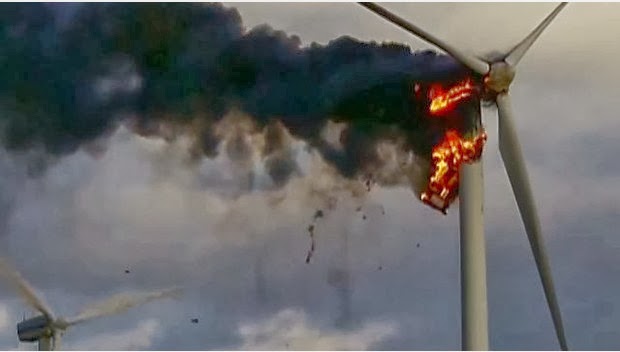
Turbines represent the perfect bushfire incendiary: around the world, hundreds have blown up in balls of flame – in the process – each one raining molten metal and hundreds of litres of flaming hydraulic oil and burning plastic earthwards. Here’s a few pics showing these plucky ‘green’ fire-starters in action:

turbine fire 1

turbine fire Trent-Wind-Farm

turbine fire 6

windturbine-exploding

Vestas turbine on fire

wind_turbine_fire

Feuer in Windkraftanlage

turbine fire 3

turbine fire 4.jpeg

turbine fire 5

turbine fire 7

Wind turbine fires are ten times more common than the wind industry and its parasites claim (see our post here and check out this website:http://turbinesonfire.org).

Here’s a report on, yet more, turbines bursting into fireballs.

One Suzlon turbine destroyed and two badly damaged
Wind Power Monthly
Mike McGovern
8 December 2014

wind turbine suzlon s88 amayo

NICARAGUA: A Suzlon 2.1MW turbine nacelle caught fire and later crashed to the ground on Sunday in an incident involving three damaged turbines at the 63MW Amayo complex in Nicaragua, the country’s first wind project.

“There were no injuries and the site has been secured,” Suzlon told Windpower Monthly in a written statement, confirming the affected turbines to be S88-2.1MW machines.

Suzlon declined to comment on the possible cause, pending further investigation. Nobody at the US-based owner company, AEI Energy, was available for comment.

Local press reports, citing ground staff and fire fighters, said all three machines at the 23MW Amayo II plant — in service since 2010 — suffered failure in their emergency braking systems, leaving them helpless against high gusts of wind. No other turbines were affected, claimed Suzlon.

The turbines caught ablaze at 5.15am, just under an hour after a blackout hit the Rivas municipality, where the wind farm is located.

All three machines reportedly spun uncontrollably. Turbine 28 finally fell and all three blades of turbine 25 were flung off. A blade on turbine 29 was left broken.
Wind Power Monthly

If the story has an upside, it’s the successful bid for “freedom” made by the blades during yet another “component liberation” event (see our posts here and here and here and here and here).

And glad to see our favourite Indian fan maker, Suzlon making the news! But they weren’t overly keen to let much slip – its spin-masters quickly switching to “radio silence” when quizzed about the cause. And – in typical wind weasel fashion – the wind power outfit concerned went into complete media lock-down. No surprises there.

Suzlon – aka Suzlon REPower, aka Senvion – have planted hundreds of its S88s all over the Australian countryside: near-bankrupt wind power outfit, Infigen operate a stack of them in NSW; Trustpower planted 47 at Snowtown, in South Australia’s Mid-North; and AGL speared a hundred or so into SA’s Mid-North, around Jamestown and Hallett.

Senvion are the crowd behind the ridiculous CERES project – which aims to spear 197 of its whirling, pryro-technic devices into SA’s agricultural Heartland, the Yorke Peninsula. Thankfully for farmers and fire-fighters, the chances of that debacle eventuating are slimmer than a German supermodel.

There have been at least 4 bushfires started by wind turbines in Australia, so far:

  • Ten Mile Lagoon in Western Australia in the mid-1990s;
  • Lake Bonney, Millicent (SA) in January 2006 (see the photo below);
  • Cathedral Rocks Wind Farm, Port Lincoln (SA) in February 2009 (see The Advertiser article below); and
  • Starfish Hill (SA) in November 2010 (see this link for more detail).

wind turbine fire Lake_Bonney_windfarm

When it comes to talking about the exceedingly “hot” topic of bushfires started by turbines, Australian wind power outfits exhibit the same well-drilled, reticence shown by American outfit, AEI Energy in the article above, about its flaming little Suzlon beauties.

As a result, the media rarely report on the bushfires that are started by turbines. On the rare occasions that the media do – as in this Advertiser article – wind power outfits never comment, keep their heads well below the PR parapet and hope that the flames die down quickly.

Cathedral Rocks Wind Farm turbine fire
The Advertiser
2 February 2009

A $6 MILLION wind turbine has caught fire near Port Lincoln, starting blazes on the ground as embers fall.

The fire, at the Cathedral Rocks Wind Farm about 30km southwest of the town, was first noticed by a boat about 1am.

The turbine is alight halfway up its 60m structure, making it difficult for the 14 Country Fire Service firefighters trying to deal with it to extinguish the blaze.

They are also busy controlling the spotfires, but consider the situation to be safe.

The cause of the blaze is as yet unknown.
The Advertiser

water bombing

Not only do wind turbines act as the perfect bushfire-starters, their presence precludes the best and safest method of fire-fighting from controlling them: aerial water bombers won’t fly within cooee of these things – experienced pilots have declared that they won’t fly within 3km of a wind turbine, even without the country around them on fire. For a rundown on pilots’ attitudes to flying anywhere near wind farms – see our posts here and here and here.

water bombing elvis

Aircraft and wind turbines – standing 160m tall, with a whirling wing-span of over 100m – don’t mix at the best of times (see our post here). Add billowing smoke, 50m flames and scorching heat and no-one could blame fire-fighting pilots for giving wind farms a very wide berth when the country around them is ablaze.

Fitting it is then, that the Senate Select Committee has the clearly obvious fire risk created by giant fans, and the ability to fight those fires, squarely in its sights – its terms of reference include scrutiny of: “the effect that wind towers have on fauna and aerial operations around turbines, including firefighting and crop management” (see our post here).

For those in the country keen to avoid the very real threat of incineration that comes hand-in-glove with having wind turbines speared all over it – note that the opportunity to make submissions to the Committee ends on 27 February 2015. See the link here.

It’s high time our political betters brought this insanity under control.

bushfire aftermath 2

Institute for Energy Research Exposes the Wind Power Fraud!

Institute for Energy Research Takes the Scalpel to the Great Wind Power Fraud

surgeon-with-scalpel-page1

As time goes by, the number of crack energy market experts joining the effort to bring the great wind power fraud to its inevitable denouement – and the quality of their work directed at that fine and noble task – has increased exponentially.

The American “Institute for Energy Research” has just released a brilliant piece of analysis (pdf available here) that tips an enormous bucket on each and every one of the vacuous claims made by the wind industry, its parasites and spruikers about the “merits” of wind power.

We’ve picked the eyes out of the (very substantial) paper and summarised its key points below – but we recommend you take time to digest the whole study for the range of topics covered, its attention to detail and carefully crafted arguments – all thoroughly supported and well referenced.

The study also includes a solid section on the adverse effects of wind turbines on human health, the slaughter of millions of birds and bats and the toxic mountains of sludge generated during the manufacture of turbines, which we haven’t included in our summary below – providing another good reason to read the whole study.

The study has direct application to the wind industry rort in Australia: just substitute “Canberra” for “Washington”; the “Clean Energy Council” for the “American Wind Energy Association (AWEA)”; and substitute “Large-Scale Renewable Energy Target (LRET) and Renewable Energy Certificate (REC)” for “Renewable Portfolio Standards (RPS) and the Production Tax Credit (PTC)”.

The Case Against the Wind Production Tax Credit
Institute for Energy Research
November 2014

Executive Summary

The federal wind Production Tax Credit (PTC) is a substantial subsidy that has provided the wind industry billions of taxpayer dollars and is working to harm reliable, affordable sources of electricity generation such as natural gas, coal, and nuclear power. The PTC was first enacted in 1992 as a temporary measure to bolster the wind industry. From 1992 through today, it has been extended seven times. In its current form, the PTC provides owners of wind facilities a subsidy of $23 per megawatt-hour of electricity generated for the facility’s first 10 years of operation.

The PTC technically expired at the end of calendar year 2013, but new facilities will still qualify through 2015 under new, expanded conditions. A new two-year extension, as is contemplated in a bill passed by the Senate Finance Committee, would cost American taxpayers more than $13 billion. For context, that amounts to 4.8 million families’ entire federal tax bill in a single year – or enough to buy the entire Mongolian economy and still have more than a billion dollars left over.

This report offers hard facts about the PTC. Another extension of the PTC would:

  • Give tax breaks to politically well-connected investors at the expense of taxpayers
  • Increase the overall cost of electricity
  • Threaten the reliability of America’s power grid
  • Destroy more jobs than it creates
  • Stifle innovation in energy technologies
  • Provide a handout to a large, mature industry
  • Add to a tangled web of over 80 different federal programs supporting wind power
  • Do nothing to advance the environmental goals it was designed to address

In sum, the PTC is one of the most egregious subsidies that the federal government provides.

Introduction

The wind industry in the U.S. benefits from many federal programs intended to make wind-generated electricity competitive with other sources. Chief among these federal programs is the wind Production Tax Credit (PTC). The PTC was first enacted in 1992 and has since been extended seven times. In its current form, the PTC provides owners of wind facilities a subsidy of $23 per megawatt-hour of electricity generated for the facility’s first 10 years of operation. To put the size of the subsidy in perspective, prices in wholesale electricity markets typically hover around $50 per megawatt-hour.

Most recently, the PTC was extended in January 2013 and expired at the end of that year. In the last extension bill, however, Congress expanded the qualification criteria to include facilities that had commenced construction by the end of 2013 instead of requiring that facilities be complete.

The change in language enabled the Internal Revenue Service (IRS) to expand eligibility to projects that had not initiated physical construction but had merely secured financing, including many facilities that began or will begin operation between January 1, 2014 and January 1, 2016.

As a result, taxpayers will be on the hook for PTC payments through the year 2025.

In April 2014, the Senate Finance Committee approved an $85 billion extension of roughly 60 expired tax provisions commonly referred to as “tax extenders.” The bill includes a two-year extension of the PTC — a retroactive extension for 2014 and a new extension through 2015. The PTC extension in the Senate bill would cost American taxpayers more than $13 billion over the next ten years.

The House has taken a piecemeal approach to the expiring tax provisions and has not put forward an extension of the PTC. During the current lame-duck session to close out the 113th Congress, passing a tax extenderspackage will be a top priority.

In a final push to include the PTC in the coming tax legislation, wind industry lobbyists such as the American Wind Energy Association (AWEA) will likely repeat a variety of well-worn arguments about why the PTC should be extended for the eighth time.

The PTC was never intended to be permanent, and even AWEA has recognized that the PTC should end soon.

If Congress chooses not to extend the PTC during the lame-duck session, the result will be a gradual 10-year phase-out of PTC payments, and new eligibility for the PTC will likely remain closed after 2015.

The Case Against the PTC

The PTC Puts Wealthy, Politically-Connected Investors Before American Families and Taxpayers

Average Taxpayers Shoulder the Burden of the PTC

The Senate Finance Committee estimates that a two-year extension of the wind PTC would constitute a tax expenditure of $13.35 billion, an enormous implicit transfer from the general taxpayers to the wind industry and its financial partners over ten years.

For scale, that’s enough to pay 124 million Americans’ average monthly electricity bill for a whole month. Alternatively, this is the same as the total tax bill of 4.8 million families with median incomes for a single year.

The PTC Raises the Cost of Electricity 

Supporters of the wind PTC argue that new wind turbines are the cheapest way to generate electricity and to replace the rapidly retiring fleet of coal-fired power plants.

However, adding wind power to the grid raises the total cost of delivering electricity in two important ways. First, wind is a more expensive source of electricity than new natural gas-fired power plants, or existing coal plants, nuclear facilities, and hydroelectric plants.

Second, the unreliable nature of wind power imposes new costs on the grid and hurts current sources of electricity generation.

The High Cost of Wind Power 

PTC advocates often cite the levelized cost of energy (LCOE) to argue that wind energy is cheaper than alternatives. LCOE is an estimate of the cost of electricity from new electricity generators produced by both the Energy Information Administration (EIA) and the National Renewable Energy Laboratory (NREL).

This method, however, fails to measure the true cost of wind energy on the grid for three main reasons: 1) Comparing the levelized cost of electricity from natural gas, coal, or nuclear to wind is an apples to oranges comparison, 2) LCOE ignores the low cost of existing sources of generation, and 3) the LCOE for wind power is based on unrealistic assumptions.

Comparing the cost of electricity from intermittent wind (a non-dispatchable source) to sources that can be controlled (dispatchable sources) is an apples-to-oranges comparison because there is a lot of value to being able to rely on electricity sources to help keep the lights on. Here’s how EIA explains this issue:

Since load must be balanced on a continuous basis, units whose output can be varied to follow demand (dispatchable technologies) generally have more value to a system than less flexible units (non-dispatchable technologies), or those whose operation is tied to the availability of an intermittent resource. The LCOE values for dispatchable and non-dispatchable technologies are listed separately in the tables, because caution should be used when comparing them to one another.

Despite EIA’s words of caution about directly comparing reliable sources and intermittent sources, frequently people make the comparison. The way to make an apples to apples comparison between wind and natural gas, coal, or nuclear would be to include the cost of backup power with other wind costs to make a valid direct comparison.

To the second point, most levelized cost calculations focus on the costs of new generation.  It does not provide a useful comparison of the cost of existing coal, gas, and nuclear plants against wind power. Even if the EIA’s estimate of wind power’s LCOE — around $80 per MWh — is assumed to be accurate, wind cannot supply electricity as cheaply as current wholesale electricity prices, which hover around $50 per MWh.

These low wholesale prices reflect the low cost of providing electricity using the existing infrastructure of natural gas, coal, and nuclear plants.

Further, a recent IER study shows that the EIA makes many questionable assumptions in formulating its LCOE for wind power. Using more realistic assumptions, the IER study found the following:

While expenses faced by wind project developers are an important element of the overall cost of wind power, addition of wind power to the power grid involves a number of other costs. If a more reasonable estimate of the installed cost of capital is $88 per MWh and operating costs are $21 per MWh, we can estimate a reasonable LCOE for wind power near $109 per MWh rather than NREL’s estimate of $72 — a more than 50 percent increase. [emphasis added]

A study by George Taylor and Tom Tanton found that, when factoring in a 20-year lifespan for wind turbines and a lack of subsidies, wind power costs $101 per MWh. When backup generation is accounted for, the cost goes up to $149-$153.

Levelized cost estimates don’t incorporate the full costs of long-distance transmission associated with wind power.

Because high-quality wind resources are often located far away from places where people use electricity, wind power is more expensive to transmit than conventional sources that can be sited closer to demand. The costly transmission investments needed to bring wind power to the grid factor into electricity rates and frequently translate into higher rates for customers.

According to Berkeley Labs researchers, transmission expenses range from $0 to $79 per MWh — the median cost being around $15 per MWh.

One example of the high cost of new transmission projects is the Competitive Renewable Energy Zone in Texas (CREZ). This electricity transmission project linked the large wind facilities in west Texas to the population centers in east Texas. The CREZ project cost nearly $7 billion.

Lastly, the cost of building new wind facilities and new transmission lines to get the electricity from the windy areas to the population centers of the United States also creates additional costs because total U.S. electricity generation has not increased in nearly 10 years.

This lack of an increase in electricity generation means that adding new sources to the generation system is duplicative in many cases.

The PTC Imposes New Costs on the Grid 

In Germany, despite more than two decades of subsidies, solar and wind power only accounted for 11 percent of overall electricity generation in 2011. As the German government began pursuing aggressive green energy targets by closing reliable power plants, electricity costs dramatically increased.

The levelized cost of electricity focuses on each source of electricity on its own (one at a time). As such, it fails to reflect the costs that wind imposes on other components of the power grid, including other sources of generation. In addition to the long distance between the best wind resources and population centers, the inherent variability and unpredictability of wind power necessitates additional (backup) generation resources.

We can see how adding more and more wind power to the energy mix has played out in the real world. Electricity prices are high and rising in countries that have aggressive policies subsidizing wind, like Germany, Spain, and Canada. It’s the same story in many of the largest wind-producing states in the U.S.

In Germany, despite more than two decades of subsidies, solar and wind power only accounted for 11 percent of overall electricity generation in 2011. As the German government began pursuing aggressive green energy targets by closing reliable power plants, electricity costs dramatically increased. According to the Wall Street Journal:

Average electricity prices for companies have jumped 60% over the past five years because of costs passed along as part of government subsidies of renewable energy producers. Prices are now more than double those in the U.S.

Due to theses price increases, as many as 800,000 citizens have been unable to pay their electricity bills and have had their power cut off. The situation has gotten so out of hand that the International Energy Agency (IEA) has warned of consumer backlash if the government fails to contain energy costs.

Also, German industries such as BASF are curtailing investments in Germany as a result of the country’s energy policies.

In the U.S., many states that have seen the greatest increases in wind power have also seen prices rise. In fact, with the exception of Oklahoma, every one of the top ten wind power states has had electricity prices increase by at least 14 percent. Given that this rise is five times faster than the national average, it is a trend that cannot be ignored by policymakers.

The chart below from the U.S. EIA highlights the rapidly increasing electricity prices in Europe as compared to the U.S. The EIA explains that regulatory structures, taxes, and investment in renewable energy technologies influence electricity price.

European power prices vs US

In Spain, a program to subsidize renewable energy began in 2000 and was expanded in 2008. One consequence of these policies has been a large increase in rates — electricity prices have risen by more than 90 percent in the last 6 years.

A similar story has unfolded in Canada, where government-subsidized wind power provides just under 4 percent of Ontario’s power, but accounts for about 20 percent of the cost of electricity.

In the U.S., many states that have seen the greatest increases in wind power have also seen prices rise. In fact, with the exception of Oklahoma, every one of the top ten wind power states has had electricity prices increase by at least 14 percent.

Given that this rise is five times faster than the national average, it is a trend that cannot be ignored by policymakers.

Simply put, the framework used by wind PTC proponents to demonstrate the “low” price of wind power does not reflect reality. While we can see how wind power increases electricity prices, perhaps more concerning are its effects on grid reliability.

The PTC Threatens Power Grid Reliability

Subsidizing wind power on a per-megawatt basis threatens the reliability of our electric grid. The stability of the U.S. power system depends on the ability of electricity suppliers to match demand second by second, every day. Because wind power depends on the weather (and there is still no cost-effective way to store electricity for times when the wind isn’t blowing), wind energy is not capable of continuously meeting demand.

Wind power also tends to be more available at night, when demand is low. Despite the low value of electricity overnight, the PTC gives wind developers the same tax credit to produce electricity at night as it does to produce it during times when electricity is the most valuable.

This means that wind generators are not concerned about trying to produce electricity when demand is high and electricity is available, but rather to produce as much electricity as possible whenever the wind is blowing regardless of whether the electricity is needed or not. The unreliable nature of wind power, fueled by the PTC, threatens the reliability of our electric grid because it makes it more difficult to balance supply and demand. The PTC also makes affordable and reliable electricity sources less economical by allowing wind producers to pay utilities to take their power.

Wind production tends to peak in the spring and the fall, when the need for energy is at its lowest, and it decreases in the winter and summer when heating and cooling needs drive up electricity use. The same problem occurs on a day-to-day basis: more wind energy is produced at night, when power demand is down, than during peak hours during the day. This directly threatens grid reliability: at times when demand for power is low, the grid is flooded with excess of wind generated power which forces base load plants running on coal and natural gas to operate at inefficient levels. Plants running at these inefficient levels produce far more CO2 emissions than they normally do, which offsets much of the reduction in CO2 emissions to which wind power might lead.

A 2011 report from BENTEK Energy revealed that any decreases in CO2 levels resulting from wind power were negligible in size or economically impractical.

Wind Energy Cannot Keep the Lights On

In order to supply electricity when people demand it, some power plants have to be ready to quickly increase and decrease production to match consumer demand in real time. To accomplish this feat, different plants provide varying amounts of power at different times of the day. Wind power does not fill any of the roles below because it is not “dispatchable” (a grid operator cannot “turn on” a wind facility because its output depends entirely on weather conditions).

There are three types of power plants:

  • Baseload plants are those which provide consistent power in an efficient and cost-effective manner, handling electricity demand at all times of the day or night. These plants are usually coal-fired or nuclear-powered.
  • Intermediate load plants, such as combined cycle natural gas facilities, can ramp up and down in a relatively efficient way depending on electricity demand, but they are most efficient when they operate for extended periods.
  • Peak load plants, which are usually simple cycle natural gas or oil-burning plants, are even more flexible and can increase or decrease output very quickly, but they operate less efficiently than baseload or intermediate generators.

Wind power only produces electricity when the wind is blowing, so these other sources of electricity have to back it up to satisfy demand. When demand is low and winds are high, reliable power plants are sometimes forced to back off, as wind turbines generate unneeded power. It is inefficient for any plant to ramp up and down more than is needed to meet demand.

Instead of helping utilities match supply and demand, wind makes it more difficult to operate the grid reliably.

The PTC Destroys More Jobs than it Creates

The question isn’t whether the PTC “creates jobs” — it’s whether it creates more jobs than it takes away from the rest of the economy.

The wind PTC does not create jobs on net, compared to an alternative policy in which the federal government refrains from using the tax code to pick winners and losers.

Although the American Wind Energy Association claims that failing to reauthorize the tax credit would “kill jobs,” the money used to subsidize those jobs comes from taxpayers, not from thin air.

Rather than arbitrarily limiting tax credits to wind producers, generally returning the money to taxpayers would have “created jobs” as well — jobs that produce goods and services that Americans actually want. As we have pointed out:

At the end of last year [2012], the federal wind production tax credit was extended for another year. According to the Joint Committee on Taxation, this one-year extension of the PTC would cost $12.1 billion. The American Wind Energy Association, the lobby for the wind industry, claims that 37,000 jobs would have been lost if the PTC was not extended. This means that each job “saved” cost the U.S. Treasury $327,000. While the PTC…might “create” some identifiable jobs, they do not create jobs “on net.” The money to pay for the…PTC, has to come from somewhere. In other words, if taxpayers had been able to keep the money instead of it going to subsidies, the taxpayers would have spent the money and that spending would have created other jobs. [Emphasis added]

The question isn’t whether the PTC “creates jobs” — it’s whether it creates more jobs than it takes away from the rest of the economy.

In Spain, for example, where the government pushed “green energy subsidies” aggressively, 2.2 jobs were lost for every “green job” that the subsidies supported.

For the reasons above, it is completely disingenuous for AWEA to sell the PTC as a job creator.

The PTC Never Protected an “Infant” Industry

Modern wind turbines have been used for electricity generation more than 125 years, and the wind PTC has existed since 1992. In 1995, wind expert Paul Gipe wrote about the wind industry’s maturity in his book Wind Energy Comes of Age:

Although wind energy suffered severe growing pains and struggled through a stormy adolescence during the 1980s, it has matured. Wind energy is now ready to take its place alongside fossil and nuclear fuels as a conventional source of electricity.

Gipe is not alone in arguing that the wind industry is mature. Senator Chuck Grassley, the original author of the PTC, stated in 2003 that “we’re going to have to [subsidize wind] for at least another five years, maybe for 10 years. Sometime we’re going to reach that point where it’s competitive.” Senator Grassley’s statement was eleven years after the PTC was enacted. Now, eleven years after that, the Senate is grappling over Grassley’s recent addition of a two-year extension of the PTC to a broader tax extenders package.

According to data from the BP Statistical Review of World Energy 2014, installed wind turbine capacity increased 3,705 percent from 1997 to 2013, jumping from 1,611 MW to 61,292 MW. If the wind industry was mature before it saw such rapid growth, why does it still need the PTC now?

A 2012 study by David Dismukes, professor, associate executive director, and director of Policy Analysis at the Center for Energy Studies at Louisiana State University, notes that wind energy is far from an “infant industry”:

Contrary to popular rhetoric, the wind industry is not an “infant industry” in need of continued training wheels, but one that is comprised of 50,000 megawatts (“MWs”) of nameplate capacity, representing close to a five-fold increase since 2006 and a 1,300 percent increase in riskier merchant wind over the last ten years. [Emphasis added]

The “infant industry” rationale for supporting wind power thus has little basis in reality.

According to data from the BP Statistical Review of World Energy 2014, installed wind turbine capacity increased 3,705 percent from 1997 to 2013, jumping from 1,611 MW to 61,292 MW. If the wind industry was mature before it saw such rapid growth, why does it still need the PTC now?

If AWEA is correct when it says, “Wind power in good wind resource areas is now very cost-competitive with any other new generating plant,” then there is no need to continue propping up the wind industry with taxpayer subsidies. If AWEA is wrong, and the wind industry still isn’t competitive after twenty-two years of heavy subsidies, then the PTC amounts to a failed experiment and a waste of taxpayer funds.

Federal Support for Renewables Increased through “Stimulus” Package

The Energy Information Administration conducted a renewable energy subsidy analysis for FY2007 to FY2011 and found that federal support for renewables increased by 108 percent. This increase was mainly because of the passage of the American Recovery and Reinvestment Act (ARRA) of 2009, which was meant to “stimulate” the economy during the worst part of the recession.  Specifically, the amount of federal subsidy money available to the wind industry skyrocketed to $4.99 billion.

Rather than replace other federal and state subsidies for wind power, this surge in the amount of federal financing available merely added to the total. Much of the ARRA stimulus money for wind came from the Treasury through Section 1603 of the law.

The Section 1603 program provided grants equal to 30 per cent of the cost of a renewable energy project to developers. The program expired on December 31, 2011. Today, no new projects can take advantage of this subsidy, but projects that were initiated before 2011 can still garner funding from this program, if the project is completed by December 31, 2016.

In FY 2010, wind was subsidized more heavily per unit of energy production than coal, natural gas, nuclear power, geothermal, and hydropower. Only solar energy received more subsidies than wind.

In FY 2010, wind received $52.68 per MWh. Despite generating the majority of U.S. electricity for that year, coal only received $0.64 per MWh, and natural gas and petroleum liquids received only $0.63 per MWh.

Carbon Dioxide Emissions

Wind is frequently promoted as a way to reduce carbon dioxide emissions from power plants. But wind does not generate much in the way of carbon dioxide emission reductions. Energy expert Robert Bryce explained:

The American Wind Energy Association claims that wind energy reduced U.S. carbon dioxide emissions by 80 million tons in 2012. That sounds significant. But consider this: global emissions of that gas totaled 34.5 billion tons in 2012. Thus, the 60,000 megawatts of installed wind-generation capacity in the United States reduced global carbon dioxide emissions by about two-tenths of 1 percent. That’s a fart in a hurricane. [Emphasis added]

Thus, even if AWEA is correct in its CO2 reduction estimates, wind power has no appreciable impact on global CO2 emissions. In fact, contrary to AWEA’s claims, wind can also actually increase emissions. A study by the United Kingdom-based research group Civitas, for example, explains:

Wind-power … requires conventional back-up plants to provide electricity when the wind is either blowing at very low speeds (or not at all) or with uncontrolled variability (intermittency) … This is all the more relevant given the relatively high CO2 emissions from conventional plants when they are used in a back-up capacity. In a comprehensive quantitative analysis of CO2 emissions and wind-power, Dutch physicist C. le Pair has recently shown that deploying wind turbines on “normal windy days” in the Netherlands actually increased fuel (gas) consumption, rather than saving it, when compared to electricity generation with modern high-efficiency gas turbines. Ironically and paradoxically the use of wind farms therefore actually increased CO2 emissions, compared with using efficient gas-fired combined cycle gas turbines (CCGTs) at full power. [Emphasis added]

That is, because wind power relies on backup electricity from coal-fired or natural gas-fired plants when the wind isn’t blowing, we have to take into account CO2 emissions from the backup generation. The Civitas study reveals that CO2 emissions from these plants are especially high when used in a backup capacity — combined cycle natural gas plants operating without wind on the grid would emit less CO2.

Conclusion

We can do better. We shouldn’t pursue an energy strategy that subsidizes unreliable sources of power while simultaneously cracking down on reliable sources with new regulations from the EPA.

It is well past time for Washington to take the training wheels off of the wind industry and let it chart its own course. The federal wind production tax credit has propped up the wind industry for 22 years — on top of dozens of other federal and state policies designed to support wind — yet industry lobbyists claim it still needs help.

Two decades after the PTC was first enacted, wind-generated electricity comprises less than 5 percent of our total supply. At the same time, wind power has contributed little to the environmental and energy security goals it was meant to address. Unfortunately, the PTC is a very effective way to accomplish at least one thing: wasting American taxpayers’ money.

We can do better. We shouldn’t pursue an energy strategy that subsidizes unreliable sources of power while simultaneously cracking down on reliable sources with new regulations from the EPA. Wind energy can’t deliver reliable power because, even after two decades of a tax credit, it still relies on random weather patterns to generate electricity. Subsidizing today’s wind industry does nothing to solve wind power’s fundamental reliability problem.

Furthermore, far from being a “job creator,” the PTC is a net jobs loser. Even if the industry does add some jobs to the economy, those jobs come at the expense of other jobs in industries that would create new value for customers. We should not follow the example of Spain, where 2.2 jobs were lost for every “green job” created.

The PTC cannot be justified on environmental grounds, either. The U.S. is already outpacing the rest of the world in terms of CO2 reductions, largely because of innovations in natural gas rather than because of wind power. Wind turbines also kill a staggering amount of protected birds and bats and have negative health effects on nearby residents.

The costs of the PTC overwhelmingly outweigh the benefits. Lawmakers should prioritize American households over wind industry lobbyists.

Institute for Energy Research
November 2014

The cost of the PTC to American taxpayers – at a mere US$23 (currently AUD$27.65) per MWh – is a modest snip compared to the expected cost to all Australian power consumers of its Australian equivalent – the Renewable Energy Certificate (the “REC” aka the “LGC”).

While RECs are currently trading at $32, from 2017 – when the annual figure for the LRET starts to increase dramatically – RECs will be worth at least as much as the mandated shortfall charge of $65 per MWh.

The total renewable energy target between 2014 and 2031 is 603,100 GWh, which converts to 603.1 million MWh (1 GW = 1,000 MW). In order for the target to be met, 603.1 million RECs have be purchased and surrendered over the next 17 years: 1 REC is issued for every MWh of renewable energy dispatched to the grid. The REC is a Federal Tax on all Australian electricity consumers.

The cost of subsiding the wind industry through the REC Tax is born entirely by Australian power consumers. As Origin Energy chief executive Grant King correctly put it earlier this year:

“[T]he subsidy is the REC, and the REC certificate is acquitted at the retail level and is included in the retail price of electricity”.

It’s power consumers that get lumped with the “retail price of electricity” and, therefore, the cost of the REC subsidy to wind power outfits.

Even at the current REC price of $32, the amount to be added to power consumers’ bills will hit $18 billion. However, beyond 2017 (when the annual LRET target ratchets up from 27.2 million MWh to 41 million MWh and the $65 per MWh shortfall charge starts to bite) the REC price will almost certainly reach $65 and, due to the tax benefit attached to purchasing RECs, is likely to exceed $90.

Between 2014 and 2031, with a REC price of $65, the cost of the REC Tax to power consumers (and the value of the subsidy to wind power outfits) will approach $40 billion – with RECs at $90, the cost of the REC Tax/Subsidy balloons to over $54 billion (see our post here).

This massive stream of subsidies for wind power is the greatest wealth transfer in the history of the Commonwealth; and stands as a regressive tax/subsidy grab by stealth, which hits the poorest and most vulnerable; struggling businesses; energy intensive industries; and cash-strapped families the hardest – with absolutely NO measurable economic or environmental benefit in return.

Precisely as the Institute for Energy Research concludes: “The costs of the PTC overwhelmingly outweigh the benefits. Lawmakers should prioritize American households over wind industry lobbyists.”

Adapted for Australian circumstances that conclusion reads:

“The costs of the mandatory LRET overwhelmingly outweigh the benefits. The Coalition and the Senate Cross-Benchers should prioritize Australian households over Infigen, Pac Hydro, et al; wind industry lobbyists, like the Clean Energy Council, the Australia Institute, Union Super Funds; and every other parasite and rent-seeker out to profit from the greatest rort of all time.”

The insane and pointless costs of the mandatory LRET are little more than a form of economic and social self-flagellation.

The LRET (like the PTC) is simply unsustainable. Any policy that is unsustainable will either fail under its own steam; or its creators will eventually be forced to scrap it.

STT hears that Tony Abbott is acutely aware that the mandatory LRET is an entirely flawed piece of public policy; and is nothing more than an out of control industry subsidy scheme.

As such, it represents a ticking political time-bomb for a government that doesn’t need anymore grief from an angry proletariat. And boy, the proletariat are going to be angry when they find out that under the mandatory LRET they’re being lined up to pay $50 billion in REC Tax – to be transferred as a direct subsidy to wind power outfits and added to their power bills – over the next 17 years.

For Tony Abbott to have any hope of a second term in government, the mandatory LRET must go now.

abbottcover

Wind Turbines DO Destroy Property Values….

Wind farm property value study should not have been published: Queens prof

by ottawawindconcerns

You may have seen the Canadian Press story that surfaced on Sunday and Mondayabout a study done by a University of Guelph agricultural economics teacher, which was published in the Journal of Agricultural Economics. While the headlines said wind turbines caused NO effect on property value, the real study said otherwise: the co-authors noted that they had very little data, that expired listings (houses listed for sale that never sold) were not included, and neither were sales not on the open market, such as the properties purchased by wind power developers.

So the situation was: very few sales, houses not selling at all, and some houses that did sell changed hands many times. What’s wrong with that picture?

Well, plenty. Here’s a letter to the editor of the journal that published the study, released today. Too bad the damage has been done by the headline writers.

Letter to the Editors of Canadian Journal of Agricultural Economics:

The paper by Vyn and McCullough (2014) should not have been published in its current form as the results are being misinterpreted and highly publicized in the press and in radio broadcasts. The core issue is the lack of power in the statistical tests, a problem partially acknowledged by the authors but then dismissed by their focusing attention on tests for the sensitivity of their model specification. The article appears to encourage the misinterpretation of its statistical findings.

Out of the 5414 sales, only 79 post-turbine sales are of properties within a 5 kilometer radius and the rest are within a 50 kilometer radius. The diversity of the houses in the sample is very large as indicated by their price range of ten thousand to two million dollars and by the relatively low R-squares (0.57) in the hedonic regressions. Given the small number of properties that may have been adversely affected and the great diversity of properties in the sample, it is not at all surprising that the regressions yield no ‘statistically significant’ results. The shortage of observations on properties close to the turbines cannot be overcome by extensive sensitivity testing of model form. The problem is with the lack of data not with model form and focusing on the form tends to obfuscate the issue.

The authors do recognize the data problem: “Unfortunately, there are relatively few observations in the post-turbine periods that are in close proximity to turbines” (p 375) and “Hence, these numbers of observations are likely too few to detect significant effects, which represents a major limitation of this analysis” (p 387). But there are three problems that should have been picked up and corrected through the peer review and editorial decision process.

First, the authors conclude:

“The empirical results generated by the hedonic models, using three different measures to account for disamenity effects, suggest that these turbines have not impacted the value of surrounding properties” (p 388). This is wrong for two reasons. First they could not discern an impact which is different from not having an impact. Second, they misuse the term ‘value’. If you have a choice between two identical properties, identical in all respects except that one is close to a turbine while the other is not and if you choose the far one, then the turbine has an effect on the value of the property. This hypothetical example tests the paper’s hypothesis using common sense rather than a statistical measure.

Second, the authors claim:

“The findings of this paper will provide evidence that may help to resolve the controversy that exists in Ontario regarding the impacts of wind turbines on property values” (p 369) and then proceed to do all they can to make a non-finding appear important and repeat the general statement that they found no significant impact. They correctly said in the CBC interview this morning that their study did not find a statistically significant price effect but the public and reporters, not being familiar with statistical terms interpret this as saying that there was no price effect. Not finding a statistically significant impact due to a data shortage does not mean that there was no significant (i.e. important) impact. This distinction was not made clear enough in the paper nor in the follow up interviews and newspaper articles.

Third, the reviewers and finally the editors should have insisted on the power of the statistical tests to be calculated and reported. I understand that editors in the major health science journals insist on this as their readers, doctors and other clinicians, are not always aware of statistical fine-points but they need to be fully aware of the qualifications before using the results to change their practice. Given the potential impact a misinterpretation of the findings could generate, the test of the power should be reported even in the abstract. The reader should be told how big an impact would have to be before it can be detected by a statistical test with this number of observations. Had the price of properties near the turbines been 10 percent lower than they actually were, would the model have yielded a statistically significant finding of a price decrease at say the 0.05 probability level? What about a 20 percent decrease, would it have been ‘statistically significant’? Answers to this type of question would have been easy to produce and far more relevant that sensitivity tests of the model form.

The paper deals with an important issue that can have serious policy implications affecting the wellbeing of many people. The results can affect the location of wind turbine farms and the compensation claims of affected parties. Incorrect information or interpretations can be very hard to correct. In such cases, it is the journal editors’ responsibility to ensure that results are presented in a manner that, at the very least, does not encourage the misinterpretation of the findings.

Sincerely,

Andrejs Skaburskis, Professor Emeritus

North American Editor: Urban Studies,

School of Urban and Regional Planning,

Queen’s University,

Kingston Ontario, Canada

Torturing Residents With Wind Turbine Noise!

UK Plan to Ban Noisy Wind Farms

when-is-wind-energy-noise-pollutionNoisy wind farms face ban as ministers launch review into ‘annoying’sound levels
The Telegraph
Emily Godsen
30 November 2014

Exclusive: Energy department commissions review into disturbance from turbine noise in order to decide when annoyance becomes unacceptable 

Noisy wind farms that disturb local communities could be banned, after ministers launched an unprecedented review into the annoyance they cause.

In the first official admission that wind turbine noise can adversely affect local residents, the Department of Energy and Climate Change (DECC) has commissioned an independent investigation to assess the levels of sound wind farms produce and the extent of disturbance caused as a result.

Experts from the Institute of Acoustics will conduct the research next year, the Telegraph has learnt, and ministers across Government will then use the data to decide at which point the annoyance officially becomes “unacceptable”.

The review is likely to lead to tighter planning guidance for new wind farms and could force existing wind farm operators to restrict their turbines’ operation to stay within the limits.

It is also likely to open the door to claims for compensation by residents subjected to noise above the official nuisance threshold.

Many residents living near wind farms have complained of noise disturbance, while studies have linked wind turbine noise to poor sleep and mental health.

As well as the routine “swishing” noise of the blades spinning, turbines can sometimes produce “thumping” noises when sudden variations in the wind speed cause the blades to stall.

Current planning guidance limits the swishing noise to 43 decibels at night-time for the nearest property but does not deal with the thumping noises, which are a deeper pitch and can be heard at 40 decibels a kilometre away from the turbine.

Residents near some wind farms have likened the noise to a cement-mixer or a shoe stuck in a tumble-dryer.

A source said the new review would consider all types of turbine noise. “Everything is on the table,” they said.

Developers could be forced to use software to adjust the angle of the blades to prevent the thumping being caused at an unacceptably annoying level.

A spokesman for the DECC said: “This review should empower local people to stop disruptive wind farms and make sure local authorities have all the information they need before giving a planning application the green light.”

The review is expected to be completed by June. While the Institute of Acoustics will independently draw up the index of noise annoyance, the decision over what will be deemed an acceptable threshold will be a political decision for the next Government.

The Conservatives have already pledged an effective ban on new onshore wind farms if they win the election, by ending subsidies for those projects that do not already have planning permission. They have also pledged that all future onshore wind farm planning decisions would be determined by local authorities, instead of large projects being deemed nationally significant.

Matthew Hancock, the Conservative energy minister, said: “It’s important that we maximize the potential of domestic energy resources but we must do this in a responsible way. We cannot jeopardize our green and pleasant land.”

Ed Davey, the Lib Dem energy secretary, has heavily criticized the Conservative plan to ban onshore wind, arguing it would push up consumer bills by forcing the UK to build more expensive types of renewable technologies such as offshore turbines to hit green targets.

Wind industry body Renewable UK said it had already conducted extensive research into the extent of the thumping problem – known as Other Amplitude Modulation – and had devised the ways of tackling it.

Independent research published by the lobby group late last year had helped “to pinpoint when, where and how this sound varies”, Gemma Grimes, the group’s Director of Onshore Renewables said.

“We found that this can be addressed by using computer software to adjust the way turbines operate, changing the angle of the blades to minimize the sound levels.

“We’re hoping that this will now be incorporated within the Institute of Acoustics’ existing Good Practice Guidance document,” she said.

But she said she did not believe the existing guidance on swishing noises would or should be changed. “In this [Institute of Acoustics] guidance, which they published last summer, there was no question of changing the current noise limits, which are rightly very stringent, so we wouldn’t expect any alteration in that when they update the current document,” she said.
The Telegraph

Ever noticed how it’s only the wind industry, its parasites and spin-masters that use the terms “swoosh” and “swishing” to describe the noise produced by their giant fans?

Language abuse like that goes hand-in-glove with the same kind of corporate subterfuge that has given us lines about the noise from turbines being quieter than a refrigerator 500m away and as soothing as waves lapping on a moonlit beach (see our post here).

Funny, though, that those forced to live anywhere near these things never talk about “swishing” and, instead, use a raft of terms pulled from the darker reaches of our lexicon: “roaring”; “thumping”; “grinding”; “whining” – and phrases like “a truck rumbling down the road but never arriving”; “a jet plane overhead that never lands”; and – as appears in the piece above: “a cement-mixer” or “a shoe stuck in a tumble-dryer”.

It’s like the wind industry’s spruikers have never spent a night trying desperately to sleep anywhere near their masters’ monsters. Funny about that, too.

To give them a clue – and to help you decide on whether it’s the impacted neighbours’ choice of language that better describes the racket – here’s a couple of videos of these things in action. Take a listen and see what you think:

blob:https%3A//www.youtube.com/2189e6d8-9736-44e1-9d8f-c2b41473d799

STT particularly loves the second video – where a wind power outfit’s lawyer is telling a planning panel that “noise isn’t going to be an issue of concern” and compares the noise that would be produced by his client’s turbines with “a quiet library” and “an average home”. Hmmm …

STT also loves the claims by wind industry spin kings, Renewable UK that – when it comes to the thumping noise complained of by neighbours – like the Bob the Builder – it can fix most everything. Which begs the question, why is the “thumping” noise a problem at all?

bob the builder

But the argument about “fixing” the “thumping” noise is a typical red-herring response to the real and underlying problem: the incessant (and, therefore, grindingly annoying) nature of the low-frequency noise and infrasound emitted – where the former is audible and the latter isn’t, but operates on the auditory and other sensory systems to disturb sleep; with both combining to cause long-term sleep deprivation and other adverse health effects, as crack Professor Alec Salt explains in simple terms in this video – and as covered in our post here.

blob:https%3A//www.youtube.com/2679c3be-4b60-49cb-9923-fd24e9a26627

turbine collapse 9

Windweasels Will Resort to Bribery, When All Else Fails….

UK Wind Industry Turns to Bribery as it Fails to “Win Brit’s Hearts & Minds”

dirtyrottenscoundrelsoriginal

Ministers accused of trying to ‘buy off’ local discontent on wind farms
Western Morning News
Phil Goodwin
12 October 2014

Landscape campaigners have described the latest Government moves tohelp communities obtain financial benefits from wind farms as a guide to bribery.

The Department of Energy and Climate Change (DECC) has set out new standards for wind energy schemes to work with local communities.

The guidance, written by the industry body Regen South West, focuses on how communities can best obtain and use cash funds of up to £5,000 per megawatt (MW).

Opponents of turbines say windfalls under the new rules – worth £1.1 million over the life cycle of a large project up for decision in Cornwall later this month – are simply designed to “buy off” local discontent.

Campaign group Cornwall Protect said the only way the Government can achieve its renewable energy targets is to “extend the gravy train beyond developers and landowners to communities”.

Spokesman Danny Mageean said there was a danger that so-called community leaders may be keen to win “brownie points” even if they live “at the other end of the village”.

“I live five hundred metres from a 77-metre turbine so I know the problems, and I don’t think giving our parish council a few thousand would compensate for the devaluing of our property and the noise,” he added.

Ministers unveiled a raft of measures last year in response to growing anger in the rural Conservative heartlands at turbines and solar farms.

The new guidance was billed as giving more protection to the landscape and a stronger voice to locals who opposed unpopular renewable energy schemes.

In addition, the recommended community benefit package in England was increased fivefold from £1,000 per MW of installed capacity to £5,000 per MW.

DECC has published the guidance on how wind schemes should work with communities, calling for partnerships between the two.

It gives examples of different ways in which funds and other investments by developers have been used by local groups, from the provision of care services to mountain bike trails.

The guidance is expected to be followed shortly be a community “right to invest” in new renewable energy projects that will also apply to solar schemes.

Jodie Giles, communities project manager at Regen South West, authors of the document, said “We are delighted that more communities are getting involved with sustainable energy, and in particular onshore wind projects – one of the most efficient and cost effective renewables technologies available.”

Examples of how benefits have been used will soon be recorded on DECC’s new community benefits register for England.

This month, a decision will be made on plans for one of the biggest wind farms in the region – 11 turbines producing 25MW at Week St Mary in Cornwall.

Developers Good Energy are proposing a fund of £2,000 per MW, totalling more than £44,000 a year for the life of the project, available to people living within three miles of the plant.

A local electricity tariff scheme is also proposed, offering discount for locals living within the three-mile radius who sign up to receive electricity from the scheme.

The firm is also exploring the possibility of the community owning one of the turbines.

Bob Barfoot, a member of the CPRE in Devon and a planning expert who has helped prepare a report from the group Communities Against Rural Exploitation (CARE) for the planning meeting on October 23, said community benefits cannot be taken into account by councillors.

He says this point has been made by a number of planning inspectors in recent appeals, including a decision this June to uphold the refusal of a 77-metre turbine at Ladock.

In dismissing the appeal, planning inspector Paul Jackson said plans to generate about a third of the parish’s annual electricity demand were “a laudable aim”

“However, as planning permission for the scheme was refused on landscape and visual amenity grounds, which remain the main concerns, it is unclear how the intended community benefits could make it acceptable,” he added.

Environment campaigner Jeremy Varcoe, of North Cornwall, said it was wrong to lavish cash on the girl guides rather than affected locals.

“What’s so unfair is the money goes to people not affected – rather than those whose lives are blighted by the turbines – it is little more than a bribe to the local parish or town council,” he added.

“It is a dishonest device to buy off the increasing resentment among people who are against these developments. Strictly speaking community benefits are not a material planning consideration but there is no doubt that the promise of large amounts of money has affected the decision of committees and council case officers.”
Western Morning News

As community and political opposition to the great wind power fraud rolls and builds across the world, the charge that opponents are red-necked climate change deniers, infected with a dose of Not In My Backyard syndrome, starts to ring hollow.

Sprinkling a little cash – like confetti at a wedding – isn’t going to overcome the fact that anyone with an interest in the roll-out of giant fans – which obviously includes those in impacted and threatened communities – is alive to the scale and scope of the greatest economic and environmental fraud of all time (see our post here).

The level of anger is palpable and has already erupted with community defenders toppling MET masts in Scotland (see our post here); and sabotaging turbines and construction equipment in Ontario (see our post here).

True it is that everyone has a “price”. But not everyone is ready to sell their souls.

not-for-sale

Aussies Determined to Expose the Great Wind Power Fraud! Go Senator Leyonhjelm!

Alan Jones interviews David Leyonhjelm on the Senate’s Inquiry Into the Great Wind Power Fraud & Cross-Bench LRET Plan

263977-alan-jones

The wind industry in Australia is in full-scale panic because the Senate’s cross-benchers (who hold the balance of power in the Upper House) have won Coalition support for their Inquiry into the great wind power fraud: which will turn a (long-overdue) blowtorch on the biggest rort in Australian history (see our post here).

Adding to the wind industry’s mounting woes is the fact that the cross-benchers have also put together a plan that will put the wind industry out of its misery, by elevating the place of “old” hydro power and small-scale solar – especially “stand alone solar” in remote locations – under the Large-Scale Renewable Energy Target (LRET): both “old” hydro and small-scale solar are perversely excluded from the LRET  (the plan is available here).

The vast bulk of hydro capacity was built pre-1998 and is, therefore, ineligible to participate – a matter that has Tasmanian Senator, Jacqui Lambie seeing red (see our posts here and here). For a run down on the Inquiry and the cross-benchers’ plan see our post here.

STT hears that the cross-bench plan is with Tony Abbott’s office and has already won the PM’s tick of approval.

The Inquiry and the plan has been pushed along by cross-bench Senator, David Leyonhelm, who appears in this recent interview with Alan Jones on 2GB.

Alan has a little radio show that more than just a few Australians tune into each morning. Syndicated through over 77 Stations and with close to 2 million listeners Countrywide – AJ as he’s known – is one of those people that leads the political charge on many issues that really affect ordinary Australians and which the rest of the press ignore.

Alan Jones AO: A couple of weeks ago I interviewed Dr Jay Tibbetts – you might recall is an American. A medicical adviser to the Brown County Health Department in Wisconsin. He attacked the Australian Medical Association, who quite disgracefully, but not surprisingly given that the leadership of that mob now is hopelessly of the left. And the AMA virtually arguing that there was no problem with these sub-audibleinfra-sound emitted by wind turbines. And Doctor Tibbetts cited endless international evidence in relation to the health risks posed by the low-frequency noise that wind turbines generate.

Well that interview lead to an email that I received this week from eastern Europe.  Amazingly they had heard my interview, on the Internet with Doctor Tibbetts in relation to what I call the lunacy of wind farms and the sleep deprivation that they cause and my email correspondent said “I just wanted to tell you how much we appreciated your excellent interview and your courage to do it. I know how risky this is.  My emailer said he posted the interview on his website and it went ballistic. And I’m told, he says it’s spreading from Austria to Germany, and Finland and Ireland and Poland and many other countries. My emailer said ‘I can guarantee you that all people in Europe, especially in Germany were like crazy and spread your interview like crazy when they got it on my Facebook page.

Well people are waking up to the lies and deceit peddled by governments and renewable energy companies all over the world. There is a report this week by AGL energy of all outfits who found that non-solar households are paying hidden subsidies and more than $200 million a year, here in Australia to households who have solar roofing panels.  Now we know that this wind power-solar power are driving up the cost of what you pay for electricity and what business pays. And the AGL Chief economist Paul Simshauser, said the problem of wealth transfers to renewable energy sources was increasing. In other words to prop up renewable energy, you the taxpayer have money taken out of your pocket and that, in billions of dollars, goes to renewable energy companies. Most of them foreign companies.

Now people increasingly can’t hack this. We’re told 650 electricity customers are complaining to their retailer every day about electricity prices. The Australian Energy Regulator’s annual report found disconnections have surged and more than 237,000 New South Wales households, one in seven customers, has complained to their provider about pricing in the financial year ended 30 June this year.

Now we are spending billions of dollars on wind energy. It accounts for less than 2% of power generation in China, 3% in America. And this whole renewable energy thing is completely out of control. Wind power costs up to $214 per megawatt hour, coal $78 to $91. If the renewable energy mob want a set of rules that would be simple – then go ahead with your wind farm but don’t ask for taxpayers’ money. How can wind turbine companies buy off a farmer for $10,000 a turbine and then that same company be subsidised by the taxpayers? Who are you.

I have spoken to so many people, but one of them is Andrew Gardiner in Napthine’s electorate. He’s running for election this Saturday, the Premier of Victoria. Next to 140 turbines, 150 metres high, 56m blades – the biggest monsters in the southern hemisphere, some are 90 m from his property. Eight of them, 1.7 km from his home. And he’s been bullied and intimidated by AGL. I repeat – coal-fired power $78-91 a megawatt hour wind power, up to $214 per megawatt hour and solar power, over $400 a megawatt hour.

And here you’ve got this Gullen Range wind farm near Goulburn, which breaks nearly every rule that governed its application to operate. But don’t worry, it’s foreign owned. Would you believe Canberra, were meant to be spending 17,000 million dollars (17 billion), erecting between 7000 and 10,000 of these wind turbines. Yet Germany are pushing ahead with new coal-fired electricity plants because political and public concern there is increasing over the cost of energy. China is building a new coal fired power station every 10 days every year. And remember when I spoke to Angus Taylor, the new member for Hume, turbines in his electorate enjoys subsidies to $500,000,000 to a $billion a year.

Well David Leyonhjelm is a New South Wales Senator, representing the Liberal Democrats and along with Senators Madigan, Day, Xenophon and Back, David Leyonhjelm succeeded in establishing, has succeeded in establishing – and this will put a few noses out of joint – a Senate inquiry into wind turbines. This will blow the whole show open. It was a narrow vote. Because you see people like Mcfarlane, the Energy Minister, they’re in bed with wind companies. 33 to 32. The inquiry will be known as The Select Committee on Wind Turbines. It will investigate regulatory governance, or lack of it, over wind turbines, their economic impact, which can only be negative. It will examine on household power prices of wind power, we know that. The implementation of planning processes which as you can see with Gullen Range, are ignored. The integrity of national wind farm guidelines – they have none. The impact of wind turbines on firefighting – that’s another story altogether – and crop management. And the committee will have the power to send for and examine people and documents. And it will report its proceedings from time to time and make interim recommendations and it will report by June 24 next year. This is a very pioneering and important initiative and not before time.

Senator David Leyonhjelm is on the line. Senator, good morning.

Senator David Leyonhjelm: Good morning Alan.

Alan Jones AO:  Just before we go down to the guts of this, I note the notice paper and it tells us that the inquiry will look into ‘the role and capacity of the National Health & Medical Research Council in providing guidance to state and territory authorities’ and ‘the effect that wind towers have on fauna and aerial operations around wind turbines’. I couldn’t find any where in the terms of reference of the inquiry an investigation into the health impact of these wind turbines. Is that on your agenda?

Senator David Leyonhjelm:  It’s on our agenda and there is another item there that says ‘Any related matter’. So it certainly we’ll be taking that into account. The only thing is we – the emphasis of this inquiry is towards the other matters, more than health, because there have been two inquiries into health already. The problem with it is they’ve been ignored pretty much.

Alan Jones AO:   Absolutely.

Senator David Leyonhjelm:   We didn’t think – we will be going over that ground, we will be looking at that again – but there are a lot of additional complaints about wind farms. They are, I don’t know where they all are, all but certainly some of them are extremely noxious neighbours. And we are receiving just so many complaints about them.

Alan Jones AO:   Absolutely, I am to. I have a file that I couldn’t jump over here too. Incidentally, as you would be aware there is an election here on Saturday, this opposition leader, fellow, Andrews, the Labor leader, is promising to reduce the mandatory buffer zone between properties and wind farms if he wins the election. I mean it is currently 2 km the exclusion zone, which is not enough, he’s promised to reduce it to 1 km.

Senator David Leyonhjelm:   It’s amazing. And, you know that reflects the way we did this committee. We knew that there’s significant support for wind farms on both sides of the house. And what we did was a little bit sneaky to be quite frank. We’ve called it a ‘select committee’, so it’s not a reference to an existing standing committee, which are dominated by Labor and the government, so this is basically a cross-bench inquiry. There are seven official members of the committee, plus we can co-opt more, other participating members. It’s only two from the government one from Labor, one from the Greens, and three from the cross-bench. And plus, we can bring in other participating cross-bench members if if we wish to.

Alan Jones AO:  But see you’re raising a very valid point here because the public feel that they’ve got nowhere to turn because both Labor and the Coalition are in bed with this mob.

Senator David Leyonhjelm:   Yes, well that’s the point. That’s why we said this that it’s not going to be appropriate for it to go to an existing committee, because the cross-bench doesn’t have much say on those.

Alan Jones AO:   Absolutely. You see I have said many times – I am talking to Senator David Leyonhjelm from New South Wales – I’ve said many times David, that you can’t release a drug onto the market unless all the likely consequences from the drug are subjected to rigourous scrutiny. So how could you build wind farmers, or approve coal seam gas extraction, without providing the answers to the very legitimate questions about health and the impact on individuals that these things have.

Senator David Leyonhjelm:   Yes. You can never answer every single question and science is an endless pursuit, but there are some just glaring questions why, for example, does the Gullen Range wind farm, where they have put these things almost 200m away from where they’re supposed to be, and then said ‘well, we’re a renewable energy company we can do whatever we like’. And then the Clean Energy Regulator hands over money to them with no accounting.

Alan Jones AO:   Thank God for you. Thank God for you. They should be stopped in their tracks now. They are in breach of the consent application, they should be stopped, shouldn’t they?

Senator David Leyonhjelm:  We hear lots of stories, where because they are renewable energy, they think they’re above the law. They don’t think they have to comply with planning guidelines and directions and so forth.

Alan Jones AO:   This bloke’s a breath of fresh air.

Senator David Leyonhjelm:   We are not even satisfied those guidelines are particularly comprehensive and thorough anyway.

Alan Jones AO:   Or stringent, no. You have said, just for the benefit of my listeners, and I’ll just get you to comment on some of the quotes that you’re on the record as having uttered. “The dramatic surge in power bills has been major factor in the decline of our manufacturing sector and the loss of thousands of jobs. In little more than 10 years, the Renewable Energy Target has rocketed Australia from almost the cheapest to the most expensive electricity in the world”. They are your words.

Senator David Leyonhjelm:   Yes. Well in fact that brings me to another subject where also the cross-bench is also are trying to do something constructive with the government on this Renewable Energy Target. As you probably know, Labor and the government stopped negotiating a week or so back and now, it’s in our court. We are working on a plan – there’s been some media reports on it in the last couple of days. We are working on a plan in whcih we will address this issue of high prices of electricity, unachievable energy target, the penalty rates kicking in, all that sort of nonsense.

Alan Jones AO:  Well you said in August, ‘The latest figures from the Australian Bureau of Statistics show in the five years to June 2012, Australian retail electricity prices rose by 72%, with even higher increases in Melbourne and Sydney’. You said, ‘Senators and MPs, however, don’t need to worry about whether staying warm in chilly Canberra may send them broke. Perhaps if they had to pay for their own heating and air-conditioning in Parliament House it would concentrate their minds on the important discussion we need to have about the future of the Renewable Energy Target’. Good on you.

Senator David Leyonhjelm:   Well, it’s tragic. You know there are people who are suffering, genuinely suffering from energy poverty. They cannot turn on their heaters during the winter. They suffer in the cold just because they cannot afford their electricity bills. So they’re frightened of receiving a bill that they can’t afford to pay.

Alan Jones AO:  Absolutely. You … yes it is tragic. You quote a report from the accounting firm Deloittes, showing the Renewable Energy Target will “stifle the economy, cost jobs, and drive up prices and is a very inefficient means of reducing greenhouse gas emissions”. Now Terry McCrann years ago told me David, on this program, if you want to decarbonise the Australian economy, you’re writing a national suicide note. And I mean that you’re the only people focusing on this issue.

Senator David Leyonhjelm:   Yes, well somebody has to. I’m really encouraged, that the government acknowledges the problem, I just don’t like the solution, or the politics of the solution. The renewable energy industry has an awful lot of supporters. And it’s a nice warm thing motherhood type stuff to support renewable energy.

Alan Jones AO:  And have you ever noticed, when any of the MPs retires from Parliament they go and get jobs with them. Hey hey? Oh, Mr Mcfarlane will be lining one up right now. He won’t be standing at the next election don’t worry. I mean you said, and this is true, ‘the net effect of this subsidy, renewable energy subsidies, is to hand an additional 17 billion dollars of our money to these companies over 15 years for no measurable environmental benefit.

Senator David Leyonhjelm:   Yes that’s right. And it’s worse than that, I mean it’s having negative effects. In fact one of the aspects of the inquiry is to actually determine what is the energy and emission output – input and output from a whole of life. So, from the point when these turbines are made and they run, through to the other end when they are dismantled and thrown on the scrap heap – what’s the net energy and emission output.

Alan Jones AO:  Absolutely

Senator David Leyonhjelm:   I have a sneaky suspicion that a bit like the Prius car it’s not the right direction.

Alan Jones AO:  Absolutely. Finally – and we could go on forever on the things that you’ve said. And it’s very encouraging that someone at least is taking this cause up. But you’ve said, “It is undisputed that the wind generation industry is not viable anywhere in the world without government or customer subsidies”, you said “It’s just government-mandated corporate welfare”.

Senator David Leyonhjelm:   That’s exactly right – they’re just not viable without subsidies.

Alan Jones AO:  Keep at it – keep at it my friend. Keep at it. You’re the hope of the side.

Senator David Leyonhjelm:   Alright – thanks Alan.

Alan Jones AO:   Well done, there he is. Senator David Leyonhjelm. A major senate inquiry into this whole rubbish of renewable energy and wind power.
2GB

david leyonhjelm

What the Global Warming Alarmists Don’t Want You To Know!

ATMOSPHERIC CONCENTRATION OF CARBON DIOXIDE

Written by Dr Vincent Gray on 29 Nov 2014

Early chemical measurements of the concentration of carbon dioxide in the earth’s atmosphere have been suppressed by the Intergovernmental Panel on Climate Change. Mauna Loa Observatory

Chapter 1 of the IPCC Fourth Report (1), entitled “Historical overview of Climate Change Science” makes no mention of any early measurements.

Weart (2) in his “History of the Carbon Dioxide Greenhouse Effect” also makes no mention of them.

Yet Beck (3) has provided an annotated list with links to internet access of almost 200 references to peer reviewed academic scientific journal articles containing some 40,000 measurements of atmospheric carbon dioxide by chemical methods between 1800 and 1960. Comprehensive data sets in more than 390 papers were ignored despite contributions from prominent scientists like Robert Bunsen, Konrad Roentgen, and J S Haldane or the Nobel Prize winners August Krogh and Otto Warburg.

The earliest listed publication in 1800, and others from 1809-1816, are by Theodore de Saussure. He was the son of Horace-Benedict de Saussure, who invented the Hot Box (which resembled a greenhouse) which was the basis of the theory of the climate developed by Jean Baptiste Joseph Fourier in 1822 and 1824 which is claimed to have originated the greenhouse effect. Yet the measurements of atmospheric carbon dioxide by de Saussure’s son are completely ignored.

Other early references by Letts and Blake 1802 and 1719-15 from The Royal Dublin Society give an additional list of early measurements.

Beck (4-5) has published several summaries and commentaries on the early measurements and include an argument with Ralph Keeling (6).

Most of the early measurements were from Northern Europe. Beck considered that the earliest measurements were subject to various errors but the widespread use of more reliable equipment, particularly the Pettenkoffer titrimetric method in 1812 led to high accuracy, with a maximum 3% error reducing to 1% for the data of Henrik Lundegardh (1920–26).

The measurements selected by Beck were from rural areas or the periphery of towns, under comparable conditions of a height of approx. 2 m above ground at a site distant from potential industrial contamination. They showed a variation with time of day, of season, and of wind speed and direction, making it difficult to derive a local average, There were frequent measurements of concentrations higher than those reported as background concentrations by NOAA at present.

These measurements were carried out by real people with proper instruments in a large number of localities. They give a much better appreciation of variability and change in atmospheric carbon dioxide concentration over the period than the deductions from gas trapped in ice cores which are from unrepresentative locations and subject to much uncertainty (7).

In 1958 Charles Keeling, introduced a new technique for the accurate measurement of atmospheric CO2 using cryogenic condensation of air samples followed by NDIR spectroscopic analysis against a reference gas, using manometric calibration. Subsequently, this technique was adopted as an analytical standard for CO2 determination throughout the world, including by the World Meteorological Association.

The climate models sponsored by the Intergovernmental Panel on Climate Change are based on the belief that the global climate has a “balanced“ energy which is only changed by increasing concentrations of carbon dioxide and other greenhouse gases. These gases are assumed to be well-mixed so that their concentration, all over the world, is a constant at any one particular time, increasing only with human emissions.

In order to support this theory Keeling at the Scripps Institution of Oceanography,“discovered” that there was an almost consistent “background” concentration of carbon dioxide which could be identified from suitable sites and shown to increase with carbon dioxide emissions, which could be considered to apply globally.

The procedure required to identify this background is described in some detail by Tans and Thoning (8)  for the observatory at Mauna Loa.

Measurements whose standard deviation fell below a specified minimum were rejected. On average, over the entire record, there are 13.6 retained hours per day with background CO2. The rest were rejected as “noise”.

Beck (9) has discussed the Mauna Loa measurements. Comparison between old wet chemical and new physical methods in 1958 and 1967 on sea and land give a difference of about +10 ppm for the new procedure.

A similar procedure has been described for New Zealand (10).

At Baring Head maritime well mixed air masses come from the Southerly direction, and a baseline event is normally defined as one in which the local wind direction is from the South and the standard deviation of minute-by-minute CO2 concentrations is <<0 .1=”” 6=”” font=”” for=”” hours.=”” more=”” or=”” ppmv=””>

This “background” concentration is supposed to be well-mixed and to be unaffected by sources and sinks.

Yet the oceans are themselves contaminated with sources and sinks. (11)

Gray 1
The region around Mauna Loa includes areas with CO2 emissions, and much of the rest is a sink. It is understandable how difficult it is to get a sufficiently constant sample.

In order to claim that there is such a thing as a background CO2 it has been necessary to ensure that all measurements everywhere in the world are made from samples from over the oceans. Measurements over land surfaces have been comprehensively discouraged.

Yet the greenhouse effect is about emissions, namely “contamination” It is crazy, to take all this trouble to make measurements which do not involve the emitted gases themselves, but only a small fraction that is considered to be well-mixed, then to claim that it is these background figures which apply to the entire atmosphere.

Gray 2
This map shows that actual local concentrations of carbon dioxide are greatest over the
three large industrial areas. Since the supposed greenhouse effect is dependent on the logarithm of the carbon dioxide concentration, this means that above these areas the effect of increases is negligible or zero and the main supposed effects are on the areas with low current concentrations.

But this map does not tell the whole story.

Satellite measurements of carbon dioxide levels in the atmosphere have recently improved with the Atmospheric Infra Red Sounder (AIRS) on NASA’s Aqua level 3 satellite, which is able to provide monthly figures for mid troposphere concentrations.

Gray 3
The AIRS NASA map14 for July 2009 which shows average CO2 concentration in the mid troposphere for July 2009 is in Figure 3.

This shows that for the mid troposphere regions the high emissions from the industrial countries are circulated, by the atmosphere, so that they are no longer above the regions of emission. Since this is a time as well as a column average the actual carbon dioxide concentration at any small region in the atmosphere is changing all the time and an overall figure above a particular place on the earth is continuously varying and currently unpredictable.

It also means that measurements taken just above the earth’s surface do not provide a fair guide to the influence of carbon dioxide at that place on the surface.

So carbon dioxide is not well-mixed in the atmosphere and the overall global models are no longer relevant.

NASA has even provided an animated video (14) based on a model of what they think happens. It shows that actual carbon dioxide concentrations vary with time and level everywhere in the atmosphere. The new OC-2 satellite promises to make individual time- and level-based measurements. (15)  A global model is no longer relevant.

At least carbon dioxide can be shown to be beneficial. (16)

Gray 4
It is worth quoting the abstract of the paper by Randall et al 2013:

Satellite observations reveal a greening of the globe over recent decades. The role in this greening of the “CO2 fertilization” effect—the enhancement of photosynthesis due to rising CO2 levels—is yet to be established. The direct CO2 effect on vegetation should be most clearly expressed in warm, arid environments where water is the dominant limit to vegetation growth. Using gas exchange theory, we predict that the 14% increase in atmospheric CO2 (1982–2010) led to a 5 to 10% increase in green foliage cover in warm, arid environments. Satellite observations, analyzed to remove the effect of variations in precipitation, show that cover across these environments has increased by 11%. Our results confirm that the anticipated CO2 fertilization effect is occurring alongside ongoing anthropogenic perturbations to the carbon cycle and that the fertilization effect is now a significant land surface process.

REFERENCES: 

1 .Le Treut, H., R. Somerville, U. Cubasch, Y. Ding, C. Mauritzen, A. Mokssit, T. Peterson and M. Prather, 2007: Historical Overview of Climate Change. In:Climate Change 2007: The Physical Science Basis. Contribution of Working Group I to the Fourth Assessment Report of the Intergovernmental Panel on Climate Change [Solomon, S., D. Qin, M. Manning, Z. Chen, M. Marquis, K.B. Averyt, M. Tignor and H.L. Miller (eds.)]. Cambridge University Press, Cambridge, United Kingdom and New York, NY, USA.

2 Weart S 2011, The Carbon Dioxide Greenhouse Effect.http://www.aip.org/history/climate/co2.htm#S1.http://www.aip.org/history/climate/co2.htm

3. Beck, E-G, CO2 1800-1960 Historical References, Chemical Methodshttp://www.biomind.de/realCO2/literature/CO2literature1800-1960.pdf

4 Beck, E-G, 2007.180 Years of Atmospheric Gas Analysis by Chemical Methods, Energy and Environment 18 259-281.

5 Beck E-G Evidence of variability of atmospheric CO2 concentration during the 20th century http://www.biomind.de/realCO2/literature/evidence-var-corrRSCb.pdf

6 Keeling R. Comment + reply from author on “180 Years of atmospheric CO2gas analysis by chemical methods by”by Ernst-Georg Beck,Energy and Environment, Vol. 18(2), 259-282, 2007.

7 Jaworowski, Z. 2007. CO2: The Greatest Scientific Swindle of Our Time. EIR Science (March), 38-55.

8 Pieter Tans and Kirk Thoning. How we measure background CO2 at Mauna Loa http://www.esrl.noaa.gov/gmd/ccgg/about/co2_measurements.pdf9 Beck E-G 50 Years of Continuous Measurement of CO2 on Mauna Loa. Energy and Environment 19 No. 7 2008.

10 Manning M R, A.J. Gomez, and K.P. Pohl Trendshttp://cdiac.ornl.gov/trends/co2/baring.html.

11 Takahashi T et al., 1999 Deep-Sea Research II 49 (2002) 1601–1622 Global sea–air CO2 flux based on climatological surface ocean pCO2, and seasonal biological and temperature effectshttp://www.ldeo.columbia.edu/~csweeney/papers/taka2002.pdf

12 EDGAR Emission Database for Global Atmospheric Researchhttp://edgar.jrc.ec.europa.eu/part_CO2.php.
13 Climate Change Indicators http://scentofpine.org/indicators/
14 NASA | A Year in the Life of Earth’s CO2 https://www.youtube.com/watch?v=x1SgmFa0r04
15 Orbiting Carbon Observatory OCO-2 http://oco.jpl.nasa.gov/
16 Randall J. Donohue, Michael L. Roderick, Tim R. McVicar, Graham D. Farquhar. Impact of CO2 fertilization on maximum foliage cover across the globe’s warm, arid environments. Geophysical Research Letters, 2013; DOI:10.1002/grl.50563