Climate Alarmists are Not to be Taken Seriously! They are Scammers!

An economist’s bad climate advice


You are here: HomeAll PostsAn economist’s bad climate advice

  • CO2_fraud

If I need my car repaired, I do not take it to a dentist. If I am seeking advice about the climate I check out what climatologists and meteorologists are saying, at least those who have not sold their souls to the global warming/climate change hoax.

On September 3rd,  The Wall Street Journal published a commentary by Edward P. Lazeartitled “The Climate Change Agenda Needs to Adapt to Reality: Limiting carbon emissions won’t work. Better to begin adjusting to a warming world.”

Wrong! Wrong! Wrong! It’s cooling, not warming.

Apparently Mr. Lazear is unaware that the Earth has been in a cooling cycle for seventeen years. A visit to

Edward P. Lazear

www.climatedepot.com or a subscription to the Heartland Institute’s monthly Climate & Environmental News or a copy of its policy studies, “Climate Change Reconsidered”, would help him understand why he’s wrong. Check out www.climatechangedispatch.com as well for the latest commentaries.

Perhaps his error should be forgiven because Mr. Lazear is an economist. He was the chairman of the President’s Council of Economic Advisors (2006-09) and head of the White House Committee on the Economics of Climate Change (2007-08). Presently he is a professor at Stanford University’s Graduate School of Business and a Hoover Institution fellow.

He’s not a fool, but like a lot of academics who lack a background in science, he has been fooled by the legion of global warming/climate change charlatans from Al Gore through the ranks of organizations such as the United Nations Intergovernmental Panel on Climate Change that depend on maintaining the hoax.

Mr. Lazear has fallen for the greatest lie ever; the assertion that greenhouse gases, especially carbon dioxide, are warming the Earth. The hoaxers are calling the past seventeen years “a pause” in warming, but it is actually an indicator that the Earth is on the cusp of the next ice age. The period in between ice ages is calculated at 11,500 years and we are at the end of the current interglacial period.

“The Obama administration is instituting a variety of far-reaching policies to reduce carbon emissions and mitigate climate change. Are any of these capable of making a difference?” asked Mr. Lazear. “Simple arithmetic suggests not.” Up to this point I was very pleased with his conclusion, but then he wrote “Given this reality, we would be wise to consider strategies that complement and may be more effective than mitigation—namely, adaptation.”

Humans have been adapting to the climate—the weather—since they emerged as homo sapiens about 195,000 years ago.

What Mr. Lazear wants the U.S, to do is limit “carbon emissions” but admits that “The economics also work against a major transformation in the technology of producing power, either mobile or stationary. Coal is cheap. Natural gas is becoming even cheaper.”

The primary flaw in his commentary is simply that more carbon dioxide is a good thing. As the primary gas utilized by all vegetation, more means greater crop yields and healthier forests. What carbon dioxide doesn’t do is “trap” heat long enough to lower the Earth’s temperature. It represents a mere 0.04% of the atmosphere.

The Earth is not a greenhouse with a glass roof. The amount of heat in the atmosphere is totally dependent on the amount of heat the Sun produces. In its current cycle, it is producing less.

“Carbon math,” wrote Mr. Lazear, “makes clear that without major effort and a good bit of luck, we are unlikely to control the growth of emissions enough to meet the standards that many climate scientists suggest are necessary.” Those scientists are usually on college or university faculties where securing federal and other grants to study a warming that is not occurring leads to urging limits on carbon dioxide. Others are just huge liars who, like Al Gore, have been making predictions of warming that have not and are not coming true.

There’s another reason why there will be more carbon dioxide in the atmosphere. It involves two of the most swiftly developing nations in the world, China and India, both of whom are building coal-fired plants to generate electricity as fast as they can. This is happening while the Environmental Protection Agency has been engaged in an all-out war on coal that has closed several hundred U.S. plants. If an especially cold winter occurs, the demand for electricity to warm homes and other facilities may overload a system that has been diminished in scope.

The United Nations Intergovernmental Panel on Climate Change is the driving force behind the global united-nations-building-1-1106992-mwarming hoax. It is holding a climate change summit on September 23. Guess who won’t be attending? Chinese president Xi Jinping, India’s prime minister, Narenda Modi, and for good measure, Germany’s chancellor, Angela Merkel. Others whose leaders will not be attending include Canada, Japan, and Russia.

In typical fashion, always predicting climate conditions decades from now, the United Nations, according to a report in The Guardian, “is warning of floods, storms and searing heat from Arizona to Zambia within four decades, as part of a series of imagined weather forecasts” to publicize the climate summit.

All of the forecasts made by a legion of climate charlatans in the 1980s and 1990s turned out to be WRONG.

You cannot trust the UN’s World Meteorological Organization which like the IPCC is just part of a vast matrix of groups that have been so severely corrupted by the global warming/climate change hoax that one must exercise caution when hearing its forecasts. If they are for anything beyond two weeks hence, you would be wise to be dubious.

Mr. Lazear is just one of many, often with distinguished careers in other fields than meteorology or climatology, who have bought into the hoax and who declaim the need to reduce carbon dioxide. He’s wrong. The others are wrong.

And you need to educate yourself to avoid being afflicted by various government policies intended to advance the hoax. To start with, do not vote for any politician who talks of global warming/climate change or uses the term “sustainability.”

– See more at: http://www.cfact.org/2014/09/07/an-economists-bad-climate-advice/#sthash.Pkjvx1cg.dpuf

Gotta Love Those Aussies…..Bringing the Wind Scam, to it’s Knees!

Politicians & Business Finally Waking Up to the Massive Costs of the LRET

Sleep-deprived

In this post we highlighted the political distinction between the small scale renewable energy scheme (SRES) – which doles out subsidies for rooftop solar – and the Large-Scale RET (LRET) – upon which the debacle that is the wind industry depends.

While Greg Hunt and Ian “Macca” Macfarlane have been running around talking up ways of saving the RET – and their mates in the wind industry – STT hears that Tony Abbott is as determined as ever to kill the RET outright: no “grandfathering”, no “ifs”, no “buts”.

STT hears that – while Tony Abbott wants to kill both the SRES and LRET – the PM is ready to leave the SRES in place, in order to avoid a political bun-fight with the solar industry that has little upside and plenty of downside.

But the LRET is in a different class. Tony Abbott has made no secret of his desire to can the fans (see our posts here and here and here.) And his Treasurer, Joe Hockey and Finance Minister, Mathias Cormann are singing from the same hymn sheet when it comes to axing the RET and bringing the wind industry to a well-earned demise (see our posts hereand here and here). And – to the horror of the wind industry – this hard-hitting trio have emerged as Natural Born RET Killers (see our post here).

Now, after over 13 years of operation, Coalition MPs – including lightweights like young Greg Hunt and Ian “Macca” Macfarlane – have finally dusted off their copies of the Renewable Energy (Electricity) Act 2000 to learn, apparently for the first time, that the LRET contains a mighty sting in the tail.

The “sting” is the mandated shortfall charge of $65 per MWh which – under the current 41,000 GWh target – starts to impact from 2017. There is no way that the annual target set from 2017 (that escalates to 41,000 GWh in 2020, where it stays until 2031) will be met. Wind farm construction is almost at a standstill: “investment” in the construction of wind farms went from $2.69 billion in 2013 to a piddling $40 million this year (see this article).

And, from here on, no retailer is going to sign a Power Purchase Agreement with a wind power outfit; which means hopeful wind farm developers will never get the finance needed to build any new wind farms (see our post here).

In our earlier posts (here and here) we outlined the fact that – under the LRET – retailers are fined $65 per MWh for every MW they fall below the mandated annual targets – follow the links here and here.

With less than 23,000 GWh coming from renewable sources annually at present – and no likelihood of any significant wind power capacity being added between now and 2020 – Australia will fall short of the fixed target by a figure in the order of 18,000 GWh. When the target hits 41,000 GWh in 2020 – the fine will apply to that figure until 2031.

The fines paid by retailers will be collected by the Commonwealth and be directed into general revenue.

The cost of the fine compares with the average wholesale price of between $35-40 per MWh. Therefore, at a minimum, retailers will be paying $100-105 per MWh (the average wholesale price plus the fine). Retailers have already announced that they will simply recover the cost of the fine from their retail customers (see our posts here and here).

Retailers will add a margin to that in the order of 10% (or more) which means Australian power consumers will be paying upwards of $115 per MWh: 3 times the average wholesale price.

The Australian Energy Market Commission, EnergyAustralia and AGL have all united to declare that meeting the 41,000 GWh annual target will be impossible; and that, as a consequence, power punters will simply be lumbered with an enormous new electricity tax.

Given current renewable capacity of 23,000 GWh – under the legislation – the shortfall charge (fine) starts to bite from 2017.

Year Target GWh Shortfall GWh Penalty Cost
2017 27,200 4,200 $273 million
2018 31,800 8,800 $572 million
2019 36,400 13,400 $871 million
2020 41,000 18,000 $1.17 billion
    Total $2.886 billion

The mandatory RET continues until 2031; and the $65 per MWh fine with it. That means power consumers will be paying around $1.17 billion every year from 2020 until the RET expires in 2031. In addition to the $2.886 billion in fines added to power bills (up to and including 2020) – between 2021 and 2031 – fines of almost $12 billion will be issued to retailers, recovered from power consumers and the proceeds pocketed by the Commonwealth.

Remember that the policy justification for the insane cost of the mandatory RET is that it would: “encourage the additional generation of electricity from renewable sources”; and “reduce emissions of greenhouse gases in the electricity sector”; and “ensure that renewable energy sources are ecologically sustainable”.

On the scenario outlined above, the Federal government will collect close to $15 billion from power consumers by way of the shortfall charge levied on retailers. However, there will be: NO additional renewable energy; NO “break-through” on-demand renewable energy technologies; and NO reduction in CO2 emissions. An outrageous outcome, confirmed by Australian Energy Market Commission, EnergyAustralia and AGL (seeour post here).

Here’s the Australian Financial Review reporting on how the obscene cost and pointlessness of the LRET has just dawned on some of our political betters and business leaders.

Election power price surge fear forcing new clean energy plan
Australian Financial Review
Joanna Heath
8 September 2014

The fear of spiralling electricity prices around the time of the next federal election is driving the government to consider a deal with Labor on the Renewable Energy Target to avoid deadlock in the Senate.

A potential “third way” for the RET that would lower the 41,000-gigawatt-hour target but fix prices of renewable energy certificates is being actively considered as a way to match falling electricity demand but provide certainty to the industry, and provide a palatable option for Labor.

In an opinion piece published in The Australian Financial Review today Business Council of Australia chief executive Jennifer Westacott warns of “an effective $93 tax” that would be triggered under legislation if there were a political impasse on the RET.

“Under this circumstance community sympathy for the RET is likely to quickly dissipate and the pressure will come on the government to do more than just amend the existing scheme,” Ms Westacott writes.

“If people are really concerned about renewable energy then they should be encouraging an agreement across political parties so as to guarantee a moderate amount of future investment, while reducing the cost burden on consumers.”

Without the support of Labor, the government must rely on the Palmer United Party to pass any changes to the RET through the Senate, something leader Clive Palmer has vowed it will not do.

According to Bloomberg New Energy Finance modelling, if this political impasse were not resolved by 2015, so-called “penalty” prices within the RET would be triggered which the government fears would drive up retail power prices in about eighteen months’ time.

Industry minister Ian Macfarlane is understood to be using this pre-election nightmare scenario to build support for finding a compromise position that could be taken to Labor.

One coalition party source said the penalty scenario was “a nasty train wreck waiting to happen” which will focus minds on finding a solution.

“There is potentially some room to come to an arrangement,” the source said.

Senior Labor sources said the party’s default position was not to allow any changes to the RET, but a sensible approach from the government could open doors.

“We need to see quite what their bona fides are before we were to sit down with them,” a source said.

“We’ve always taken the view that a bipartisan policy around renewables is the only way to guarantee strong levels of investment. So if there was a way to restore that . . . it’s a question of how far off the reservation they have wandered.”

New analysis published by Bloomberg on Monday estimates a continued political impasse on the RET would freeze investment until 2016, which would mean renewable energy production would start to fall short of its target around 2018.

In this scenario, renewable energy certificates would surge to a legislated “penalty” price of about $93/MWh, compared to the current price of around $20.

Market anticipation of that scenario could drive up prices far earlier, however, creating political tensions around the next election.

Bloomberg analyst Kobad Bhavnagri described this as the “worst case outcome for consumers”.

“To prevent this outcome, the political uncertainty will need to be resolved by 2015, or early 2016 at the latest,” Mr Bhavnagri writes.

No approaches have yet been made by the government to Labor over a potential compromise, with the coalition party room expected to meet first to decide on a position.

Lowering the target but fixing certificate prices is an option that it is hoped would address industry concerns by providing some investor certainty.

But accepting it would mean ignoring the two key recommendations of the Warburton review to either close the large-scale RET to new entrants or scale the target back to 50 per cent of new demand every year. It would also require several influential members of cabinet – including the Prime Minister and Treasurer – to soften their position on keeping the RET.

The search for a bipartisan deal is not likely to be helped by the renewable energy lobby, who are refusing to budge from their opposition to any change in the target.

“We don’t think there is any rationale whatsoever for changing the policy. While we’re always open to talking at the end of the day we certainly don’t have a proposal on the table worthy of any meaningful discussion,” Clean Energy Council chief executive Kane Thornton said.

Mr Thornton also cast doubt on the viability of the floated “third way” option, arguing fixing certificate prices was a highly interventionist, anti-market approach.

“There are a whole lot more questions than answers.”

The Solar Council is continuing to rev up its campaign against the Warburton review recommendation to scrap the small-scale renewable energy target.

Its “Save Solar” campaign in marginal coalition electorates is gaining some traction, according to government insiders, and political impetus to attack solar is waning.

In coming weeks the Solar Council will launch advertisements on commercial television in Victoria and Queensland with the tagline “don’t vote for anyone who will cut the renewable energy target”.

Solar Council chief executive John Grimes said his organisation was not interested in compromise.

“The government is rattled, backbenchers are nervous, they understand solar is enormously popular in the electorates. I think our pointed marginal seat campaigns have been working,” Mr Grimes said.

“[The advertisements are] a big escalation in the campaign. We are furious about the way the government has handled the entire thing.”

According to the Bloomberg modelling, however, solar would be less badly affected in the long term by an abolition of the small-scale RET than larger projects would be under changes proposed to the large-scale RET.

“Our residential and commercial market modelling suggests that the total amount of behind-the-metre solar capacity installed by 2030 will vary only slightly in response to policy decisions stemming from the current review,” the report reads.
Australian Financial Review

You’ve just got to love the Clean Energy Council and the irony dripping from Kane Thornton’s statement that: “fixing certificate prices was a highly interventionist, anti-market approach”.

It seems irony is a subtlety lost on the wind industry and its highly paid spruikers; neither of which would exist in the absence of the mandatory RET: which the more economically literate might point out is easily the most “highly interventionist, anti-market approach” developed since Jo Stalin decided to help himself to the Kulaks’ grain and “collectivize” their farms.

Apparently, setting up legislation that threatens to whack retailers with $billions in penalties for not purchasing wind power in order to make them enter PPAs with wind power outfits, so as to purchase $billions worth of RECs and avoid the penalty, is not “interventionist” or “anti-market”?

And we pause to notice the CEC’s uncompromising, all-or-nothing approach to changing the 41,000 GWh target set by the LRET. With Tony Abbott sharpening his axe, we think it a little like keeping the band playing as the Titantic started to founder: a noble gesture, despite the inevitable outcome.

The gripes from John Grimes will soon die down as Tony Abbott makes plain the Coalition’s plan to leave the SRES alone; thereby avoiding a fight over the solar panels that mums and dads are dying to own; and Grime’s clients are itching to install.

But expect the wind industry’s whining to continue unabated, as its merry band of rent seekers watch their lives flash before their eyes.

Here’s the opinion piece by Jennifer Westacott referred to above.

Take the third path on renewable energy target
Australian Financial Review
Jennifer Westacott
8 September 2014

Reaching the original RE target now presents considerable political risks. So why not cut it to a true 20 per cent?

When circumstances and the evidence changes, policies too need to change. This is the case with the Renewable Energy Target (RET) scheme.

The RET was meant to ensure 20 per cent of our energy supply comes from renewable sources, but because it was not designed to be adjusted if demand for energy falls – as it has – it now accounts for almost 30 per cent of energy supplies.

The best outcome for the community, business and the renewable energy industry would be bipartisan support for a form of a true 20 per cent RET that doesn’t risk falling short of its megawatt target at a huge cost to consumers.

The risk is that while reaching the existing megawatt target might be technically possible, it is unlikely to be commercially possible.

The commercial risks in the electricity and renewable energy certificate market are just too great to pull through large-scale renewable energy (predominately wind) investments in the coming years.

First, the price of renewable energy certificates is suppressed to a point which is too low to finance new wind projects due to an oversupply of certificates that are expected to hang in the market until 2017.

Second, because of the decline in energy demand, the wholesale price of electricity is suppressed which isn’t conducive to attracting further investment in any form of energy generation.

Third, because of the lack of bipartisan support on the design of the RET, it makes it very difficult for any investor to allay the commercial risks of regulatory change.

Even after 2017, once the oversupply of certificates is eventually soaked up by the market, it leaves only three years to build a massive amount of wind energy, some 8000 megawatts (MW) in three years.

This compares to 3800 MW of wind energy that the RET, in its various guises, has pulled through over the past 13 years.

To deliver wind on this scale and this quickly would require shorter community consultation on proposed wind farms than has historically occurred and would likely lead to added cost pressures as projects compete for limited resources.

Add all these risks together and it presents a grim investment environment – a market frozen until there is political consensus on the policy of the RET.

Certificate oversupply problem

What is becoming clear is that unless all parties to this debate are willing to compromise, investment in wind will be stymied, creating the risk of higher electricity prices for consumers. This is because, without new wind investment, the price of certificates will spike.

What is not well understood is that if the certificate price hits the level of what is called the penalty price, electricity consumers will be paying an effective $93 tax with no additional investment in renewable energy.

Under this circumstance, community sympathy for the RET is likely to quickly dissipate and the pressure will come on the government to do more than just amend the existing scheme.

What needs to be recognised is that unwavering support for the existing target will not lead to greater wind investment unless the current issue of certificate oversupply is dealt with and there is a stable and bipartisan policy and investment environment.

If people are really concerned about renewable energy then they should be encouraging an agreement across political parties so as to guarantee a moderate amount of future investment, while reducing the cost burden on consumers.

The fact remains that the RET is an expensive way of reducing Australia’s greenhouse gas emissions.

According to the government’s own modelling by ACIL Allen Consulting, the cost of reducing emissions under the RET is estimated to be between $35 and $68 per tonne – which is significantly more expensive than the uncompetitively high $23 carbon tax.

Saving the furniture on a second-best policy tool to reduce emissions, such as the existing flawed design of the RET, will not create an environment for bipartisanship on climate change policy – it will just push up prices. Instead we are better to have a well-designed market mechanism that reduces emissions on a least-cost basis that does not add to the oversupply in our electricity markets.

All sides of politics need to recognise the consequences of sticking with the existing RET, and seek out the middle ground on a form of a true 20 per cent RET that minimises the risk of higher costs being lumped on consumers.

Jennifer Westacott is chief executive of the Business Council of Australia.
Australian Financial Review

STT is very keen to see the evidence on which Jennifer bases her “wonderful” claim that wind power reduces CO2 emissions in the electricity sector. No doubt, WA Senator Chris Back would be keen to see it too (see our post here).

Jennifer gets 10/10 for identifying “that if the certificate price hits the level of what is called the penalty price, electricity consumers will be paying an effective $93 tax with no additional investment in renewable energy”. It’s a point STT has made once or twice, but has been lost on our political betters, business leaders and commentators, until now (see above and our posts here and here and here).

Jennifer’s figure of $93 for RECs is based on the shortfall charge of $65 per MWh. As the shortfall charge is not a deductible business expense (it is treated as a fine), the effective pre-tax penalty is therefore $92.86/REC ($65/(1-30%), assuming a 30% marginal tax rate.

However, Jennifer gets an “F” for her “third way” argument, which is a little like Goldilocks breaking into houses to look for porridge at just the right temperature.

Setting up a “true 20%” target begs the question: “20% of what?” With spiralling power prices driving minerals processors to the wall and manufacturers offshore, demand for power will continue to fall (see our posts here and here). The AEMO demand forecasts (on which the current target was set) have been woefully inaccurate, so far. So just when does Jennifer suggest we should lock-in this “true 20%” target? Now, say? Or in 2020, when our vision will be 20/20?

And just what does Jennifer propose as a solution to the “problem” of an oversupply of RECs? Government “intervention” in the REC market, perhaps?

To STT, Jennifer’s magical “third way” simply sounds like more of the “highly interventionist, anti-market approach” (which gave us the RET in the first place) of the kind that Jo Stalin loved and that the CEC now purports to loathe.

The LRET is simply unsustainable – even with magical “third way” approaches. Any policy that is unsustainable will fail under its own steam; or its creators will be forced to scrap it. It’s a matter of when; not if.


abbott, hockey, cormann

It’s time for the Wind Industry to PROVE that they are reducing CO2, or Go Away!

Senator Chris Back: Wind Industry must prove its CO2 abatement claims

Chris Back

In our last post we tipped a bucket on the central, endlessly repeated lie trotted out by the wind industry and its parasites, that Australia’s great wind rush has resulted in substantial reductions of CO2 emissions in the electricity sector.

In Australia, the central object of the Renewable Energy (Electricity) Act 2000 is for “renewable” energy to “reduce emissions of greenhouse gases in the electricity sector” (see s3). The legislation provides that wind power outfits receive 1 Renewable Energy Certificate (REC) for each MWh dispatched to the grid. That relationship proceeded on the mammoth assumption that – for each MWh of wind power dispatched to the grid – there will be a 1 tonne reduction of CO2 emissions in the electricity sector.

Were the mandatory RET retained in its current form, Australian power consumers will see some $50 billion added to their powers bills and transferred to wind power outfits over the next 17 years (see our post here). With that amount at stake, it would be fair to assume that there was some measurable benefit attached – of the kind envisaged by the legislation (ie substantial reductions of CO2 emissions in the electricity sector) – to what will be the biggest wealth transfer in the history of the Commonwealth.

And, with that amount in play, it would also be reasonable to assume that our political betters had already satisfied themselves that the benefit in question is, in fact, being delivered – and that they are sitting on hard evidence quantifying that benefit – especially since the mandatory RET has been in operation for over 13 years.

A few starry-eyed, policy-pygmies seek comfort in a report by ACIL Allenthat’s been used to pump up wind industry CO2 abatement claims. But that document is nothing more than a desktop study, based on Alice in Wonderland assumptions that: uses irrelevant annual averages for wind power output; bases its conclusions about CO2 emissions intensity from conventional generators on assumed (not actual) thermal efficiencies; and, critically, ignores the actual figures from coal/gas fired generators – in particular, the actual coal/gas use data from conventional generators (which ACIL Allen never bothered to ask for) against which power output comparisons can be made to determine actual (not assumed) CO2 emissions intensity; and, therefore, whether wind power has, in fact, reduced CO2 emissions in the electricity sector.

At no point since that legislation took effect over 13 years ago has the wind industry provided any actual proof that it has in fact reduced CO2 emissions in the electricity sector. In what might come as a rude shock, none of our political representatives on the Federal stage has ever had the temerity to ask for any hard evidence to substantiate the wind industry’s mantra; and have seemed content to oversee the wholesale punishment of power consumers on nothing more than blind faith.

Until now.

Chris Back is a Liberal Senator from Western Australia – and he gets it (see our posts here and here and here).

Chris has thrown down the gauntlet, challenging the wind industry to stump up concrete proof to back its wild claims about reducing CO2 emissions in the electricity sector. Here’s a speech Chris delivered in the Senate last Wednesday.

THE SENATE
PROOF
MATTERS OF PUBLIC INTEREST
Renewable Energy Target
SPEECH
Wednesday, 3 September 2014

Senator BACK (Western Australia) (13:36):

I wish to discuss the renewable energy target review and its report, now that it has actually been handed to the government by the independent panel, chaired by Mr Dick Warburton. I want to make some comments about the review itself.

The first point I want to put to bed is around some allegations that have been bandied about in this place during the week to do with the apparent incompetence of the panellists to review the RET.

I just want to point out that, in addition to Mr Warburton, the other panellists include the eminent Mr Brian Fisher AO PSM, a previous executive director of the Australian Bureau of Agricultural and Resource Economics and Sciences. He is a renowned economist.

Another panellist is Ms Shirley Int’t Veld. As a Western Australian, she was the managing director of Verve Energy in WA from 2007 to 2012. Verve was the energy instrumentality that used more renewable energy sources than any other in Western Australia, so I do not know how she could not be regarded as credible.

The other panellist is Mr Matt Zema, managing director of the Australian Energy Market Operator. So I want to dispel the myth that this group was not competent to undertake the work.

For those who might be interested, I will review what the RET is all about. The RET is a government intervention designed to mandate the proportion of electricity generated from selected sources. It is designed to support a policy of at least 20 per cent of Australia’s energy coming from renewable sources by 2020; as such, the policy taxes electricity users and, in some cases, non-renewable generators.

How does it work?

The renewable energy certificate market emerges from the energy targets. Renewable energy certificates, or RECs, are issued to power station generators classified as renewable under the act. They are a form of energy currency as electricity retailers must purchase the RECs to cover their liability. Costs are passed on to consumers through purchase of mandatory certificates by electricity retailers. That, of course, is where it becomes a tax on energy consumers.

The first point I make about the target is that the objectives of the act have not been met, principally because there has not been to any extent a reduction of greenhouse gases in the time the target has been in place.

The second point is that whatever achievements the renewable energy sector has made have largely come from hydroelectricity. Hydroelectricity, as we all know, was around for a long time before the renewable energy target was formed. Having lived and worked in Tasmania and having even had to declare an interest because a company of which I was the managing director actually supplied lubricants and fuels to the hydroelectricity scheme in Tasmania, I place on record that it is a wonderful scheme.

Senator Singh interjecting –

Senator BACK: I want to place on record that I, for one, want to make sure that – whatever outcome is eventually decided by government – the hydroelectricity scheme is enhanced, protected and encouraged independent of the RET system, because it preceded RETs by so many years, as Senator Singh herself indeed knows.

At the time it was suggested that to achieve a 20 per cent contribution of renewable energy by 2020 would require some 41 gigawatt hours to be generated by renewable sources. We know that two things have happened. First of all, there has been a drop in demand –

Senator Singh: Mr Acting Deputy President, I rise on a point of order. I offer a correction to Senator Back; it is 41,000 gigawatt hours, not 41 gigawatt hours.

The ACTING DEPUTY PRESIDENT (Senator Seselja): Order! Senator Singh, there is no point of order.

Senator BACK: Senator Singh’s contribution is quite right, for which I thank her. It is 41,000 gigawatt hours. I will check the Hansard to see what I did say.

Indeed, as a result of a reduction in demand, we now realise that to achieve that 20 per cent target the figure is probably closer to 23,000 gigawatt hours. I do appreciate Senator Singh’s keen attention in listening to my contribution. That is the background of the RET.

The RET comes under two broad categories: the small-scale renewable energy target and large-scale renewable energy targets.

The small renewable targets, which are probably 10 per cent or less, are mainly to do with photovoltaics and solar hot water systems. In relation to the small-scale RETs, the recommendation of the panel is that there is probably little if any need for further support at this time. This is because power charges have gone up – somewhat because of the carbon tax, which has now been repealed through the excellent work of Senator Cormann and others – and costs in the solar sector have come down considerably.

Nevertheless, power charges have gone up while the costs of putting photovoltaics on roofs have come down. It is arguable that photovoltaics are now cost neutral. I was the chief executive of an organisation that introduced seven or eight different forms of solar energy many years ago on an island that I had the pleasure of being responsible for and I am a great supporter of solar energy. If indeed there needs to be some continued support for a limited period of time then I would not violently object to that. However, market forces have applied and the costs of photovoltaic installations have come down while electricity charges have come up, and I hope that we are now at the point of cost-neutrality. The panel has said that we are probably already at that point and that, if we are not there currently, we will probably be there reasonably soon.

I want to move to the issue of the large-scale renewable energy targets.

I have spoken in this place before of how concerned I am with regard to the wind energy sector. This report and others support the fact that there is an enormous amount of misinformation out there in the wider community about the large-scale RETs, particularly those relating to the wind industry.

The industry have employed very effective tricks to – I believe – mislead the public into believing that paying them billions of dollars in subsidies will lower power prices. Of course, it will not; there is no evidence to say that it will. The reason that the public is not outraged about this, as I said earlier, is that the public do not pay this money in taxes; rather, they pay it as part of their energy consumption. The modelling has shown that it is possible that some $37 billion over the next 15 years – or $2.5 billion per year – may be wasted on wind farms. Again, because the costs are concealed, they will not be picked up.

Comment was made that currently the RET is responsible for only around four per cent of household electricity bills. I have to say to you that other evidence refutes that. I will quote this document from AGL Energy and then seek the authorisation of the chamber to table it. I have passed the document to others in the chamber seeking authorisation.

The interesting point in the document is that AGL estimate that, in their commitment to buy 1.3 terawatt hours per year through the various wind associated organisations, it will cost them some $32 per megawatt hour above the 2015 wholesale market. They say that as a headline figure that will cost them some $40 million a year more for electricity than would have been the case without the wind strategy in place. I seek leave to table the document.

Leave granted.

Senator BACK: We are seeing the possibility that the estimated cost of the REC scheme could add some $50 billion to power bills over the next 17 years, with some 600 million renewable energy certificates being issued at a unit cost of about $90. So, in other words, we are looking at having $50 billion added to consumers’ power bills, transferred to wind-power companies. I think this is unacceptable.

I know that Senator Polley wishes to follow me and I am anxious to make sure that she is given adequate time to do so, but first I would like to comment on emissions reductions, because I think this is important.

The arguments regarding the long-term effect of the RET on price are fundamentally flawed, simply because the energy generated by wind farms does not reduce greenhouse gas emissions in the electricity sector.

I challenge the wind energy sector to produce the evidence relied upon to assert that wind power has reduced GHG emissions in the electricity sector.

Wind power is delivered intermittently, on repeated occasions not at all, meaning of course that the entire installed capacity from wind power has to be matched with equal capacity of fossil fuel generation. I challenge that industry to produce evidence to this chamber to say that what I am indicating is not correct.

Once awareness of the existence of the RET, let alone the magnitude of its cost impact, becomes more widespread in the public arena, support for it will evaporate. Renewable energy is not free. It is high cost compared to alternative forms of generation. It is not commercially viable without large subsidies, which ultimately come out of the consumer’s pocket.
Senator BACK (WA)  

Clearly on a roll, Chris followed up his speech in the Senate with this media release.

Dr Christopher Back
Liberal Senator for Western Australia
MEDIA RELEASE
3 September 2014 

Can the wind industry meet my Emissions Reductions Challenge?

In the Senate today, Senator Back said that the RET acts as a tax on energy consumers and conventional energy suppliers to fund a subsidy to selected renewable energy generators.

“But – and this is the big issue that the Coalition Government is now addressing – after 13 years of operation it has become clear that the objectives of the Act have not been reflected in the outcomes. While the investment in renewable energy sources has increased, from a carbon abatement perspective, the Act has been all but totally ineffective in its objective to reduce greenhouse gas emissions in the electricity sector.”

Arguments regarding the long-term effects of the RET on price are fundamentally flawed. This is because energy generated by wind farms does not reduce greenhouse gas emissions in the electricity sector. In fact, there is some evidence that the addition of wind energy onto the grid actually increases carbon emissions. This is the great tragedy of the scheme.

“My challenge to the wind industry is to produce the evidence relied upon to assert that wind power has reduced greenhouse gas emissions in the electricity sector at all. Wind power is delivered intermittently and, on repeated occasions, not at all, which means that an entire installed capacity from wind power has to be matched with an equal capacity of fossil fuel generation at all times.”

Grid managers are required to keep fossil fuel generating plants constantly running in the background to maintain balance within the grid in order to account for dramatic fluctuations in wind power output which occur on a minute by minute basis and base-load generators are required to maintain spinning reserve for occasions when wind power output collapses as it does on a routine but unpredictable basis. The requirement to maintain spinning reserve means that base-load generators are burning coal and gas at a constant rate even though no power is being dispatched to the grid.

“The case to abolish the RET is driven by its cost to electricity consumers compared to the corresponding reduction (or lack of reduction) in greenhouse gas emissions achieved through its 13 year lifespan. This cost comparison, extending the RET tax to 2031 for no measurable reduction in greenhouse gas emissions in the electricity sector is completely futile. It becomes a drag on the Australian economy and an insidious impost on every electricity consumer in the nation – large and small businesses, families and individuals.”

The wind industry is trumpeting two issues in the media: one is that wind is dropping the wholesale price of electricity; and the second is that the RET will cause the retail price of electricity to fall. Put simply, if wind is causing the wholesale price of electricity to fall, then the renewables industry no longer requires the billions of dollars in subsidy it receives through the large-scale RET scheme, as renewable energy is therefore cost competitive in the market.

In reality, the RET is causing electricity prices to rise significantly as it is the Power Purchase Agreement (PPA) that is and always has been the fundamental relationship between the power generator and the retailer.

These PPAs lock in prices of up to $120/MWh compared to the average wholesale price of between $30-$40/MWh. The price set by the PPA is paid by the retailer irrespective of the wholesale price. This PPA price is passed on to retail customers along with the retail margin over the life of the PPA which is usually 15 and up to 25 years. I have tabled a confidential document showing proof of this in the Senate chamber today to ensure transparency for the Australian public.

It is a legislated requirement that 600 million RECs will be issued between now and 2031, adding a cost of at least $50 billion to power bills over the next 17 years. This represents a significant wealth transfer to wind power companies from Australian power consumers and achieves no measurable benefit to the environment.

The RET scheme was never intended to act as an unchecked subsidy. “Once awareness of the existence of the RET, let alone the magnitude of its cost impact, becomes more widespread, public support for the scheme will evaporate. Renewable energy is not free; it is high cost compared to alternative forms of generation and commercially unviable without large subsidies. What people need to understand is that they pay these costs in their electricity bills and not through their taxes. It hurts everyone.”
Senator Chris Back (WA).

Proof

STOP lying about the 97% Consensus! It’s FRAUD!

Press Release 08/09/14

New Paper: Fraud, Bias &

Public Relations

Claims of 97% Consensus are based

on research described as fraudulent

and biased 


London, 8 September: A new briefing note published today by the Global Warming Policy Foundation examines claims made by a great many commentators across the world, including President Obama and Ed Davey, of an overwhelming consensus on climate change. These depend on research that has been subject to public and entirely unrebutted allegations that it is fraudulent.

Although the authors of the research claim to have shown that most climate change papers accept that mankind is responsible for the majority of recent warming, in fact the underlying study shows no such thing.

One senior climatologist described the paper as ‘poorly conceived, poorly designed and poorly executed’. Another researcher called it ‘completely invalid and untrustworthy’, adding that there was evidence of scientific fraud.

Andrew Montford, the author of the paper, said: “It has now been shown beyond doubt that the claims of a 97% consensus on climate change are at best misleading, perhaps grossly so, and possibly deliberately so. It’s high time policymakers stopped citing this appalling study.”

Full paper (pdf) – Fraud, Bias And Public Relations: The 97% ‘Consensus’ And Its Critics

Contacts

Andrew Montford
e: awmontford@gmail.com 

Dr Benny Peiser
The Global Warming Policy Foundation
e: benny.peiser@thegwpf.org 

Wind Turbines Increase the Amount of CO2 Being Produced to Make Electricity!

Why Intermittent Wind Power Increases CO2 Emissions in the Electricity Sector

lies

The central, endlessly repeated lie (upon which the great wind power fraud rests) is that increasing wind power generation results in decreases in CO2 emissions.

In Australia, the central object of the Renewable Energy (Electricity) Act 2000 is for “renewable” energy to “reduce emissions of greenhouse gases in the electricity sector” (see s3). But, somewhere along the way, what was a CO2 abatement scheme became an industry subsidy scheme which is nothing short of “corporate welfare on steroids” (see our post here).

At no point since that legislation took effect over 13 years ago has the wind industry provided any actual proof that it has in fact reduced CO2 emissions in the electricity sector. When we talk about “proof” we’re not talking about smoke and mirrors “modelling” based on long-term average wind farm output – which ignores the extra gas and coal being burnt (and wasted) in order to balance the grid to account for wild fluctuations in wind power output (see our post here); and to maintain additional “spinning reserve” (see our post here) to account for complete collapses in wind power output – as seen in this post.

As we have pointed out just once or twice – the need for 100% of wind power capacity to be backed up 100% of the time by fossil fuel generation sources means that wind power cannot and will never reduce CO2 emissions in the electricity sector (see our posts here and hereand here and here and here and here and here).

E.ON operates numerous transmission grids in Germany and, therefore, has the unenviable task of being forced to integrate the wildly fluctuating and unpredictable output from wind power generators, while trying to keep the German grid from collapsing (E.ON sets out a number of the headaches caused by intermittent wind power in the Summary of this paper at page 4). Dealing with the fantasy that wind power is an alternative to conventional generation sources, E.ON says:

“Wind energy is only able to replace traditional power stations to a limited extent. Their dependence on the prevailing wind conditions means that wind power has a limited load factor even when technically available. It is not possible to guarantee its use for the continual cover of electricity consumption. Consequently, traditional power stations with capacities equal to 90% of the installed wind power capacity must be permanently online [and burning fuel] in order to guarantee power supply at all times.”

STT is happy to go all out and say that in Australia wind power requires 100% of its capacity to be backed up 100% of the time by conventional generation sources. As just one recent example, on 3 consecutive days (20, 21 and 22 July 2014) the total output from all of the wind farms connected to the Eastern Grid (total capacity of 2,952 MW – and spread over 4 states, SA, Victoria, Tasmania and NSW) was a derisory 20 MW (or 0.67% of installed capacity) for hours on end (see our post here). The 99.33% of wind power output that went AWOL for hours (at various times, 3 days straight) was, instead, all supplied by conventional generators; the vast bulk of which came from coal and gas plants, with the balance coming from hydro.

For wind power to reduce CO2 emissions in the electricity sector it has be a true “substitute” for conventional generation sources. Because it can’t be delivered “on-demand” (can’t be stored) and is only “available” at crazy, random intervals (if at all) wind power will never be a substitute for conventional generation sources (see our post here).

Perhaps the reason that the wind industry has never produced a shred of evidence to show that wind power has reduced CO2 emissions in Australia’s electricity sector is simply because it can’t. Running counter to wind industry claims about wind power abating CO2 emissions, the result of trying to incorporate wind power into a coal/gas fired grid is increased CO2 emissions (see this European paper here; this Irish paper here; this English paper here; this American article and this Dutch study here).

This American study details just why increasing wind power capacity – and trying to incorporate its wildly fluctuating output into a coal and gas fired grid – results in increased CO2 emissions across the electricity sector.

Wind Integration vs. Air Emission Reductions: A Primer for Policymakers
Master Resource
Mary Hutzler
24 June 2010

Many claim that wind generation is beneficial because it reduces pollution emissions and does not emit carbon dioxide. This isn’t necessarily the case. The following article explains a phenomena called cycling where the introduction of wind power into a generation system that uses carbon technologies to back-up the wind actually reduces the energy efficiency of the carbon technologies. Recent studies with actual data have estimated the impact of cycling on air pollution and carbon dioxide emissions.

Energy modelers evaluating the impact of legislation such as Senator Bingaman’s American Clean Energy Leadership Act and the American Power Act proposed by Senators Kerry and Lieberman should take note for their models most likely are underestimating the cost of compliance by incorrectly modeling the integration of wind power into the electricity grid.

Wind is not a new technology. It was one of our principal sources of energy, along with wood and water, prior to the carbon era. But the use of renewables in the pre-carbon age was very different from the current use of renewables. Today, people rely on energy being available 24 hours a day, 7 days a week, 365 days a year, regardless of whether the sun shines, the wind blows, or there are high or low water levels.  We now have over 1,000 gigawatts of generating plants[1], and a large and elaborate electrical grid that requires great coordination among system operators to avoid disruptions.

Also, in the pre-carbon energy era, when renewables were the sole source of energy, there were no coal-fired or natural-gas fired power plants to provide back-up power. Studies have found that the efficiency of those carbon-based plants is affected by incorporating wind energy into the system. When a plant’s efficiency is reduced, its fuel consumption and emissions increase, causing unintended consequences that wind proponents do not disclose. Requiring even larger amounts of renewable energy through renewable portfolio standards will only exacerbate this problem.

Picture1

Background

Our various electricity generating technologies were designed and constructed to meet electricity demand based on their best operating characteristics for meeting portions of the electricity load duration curve. The load duration curve illustrates periods of constant demand that are served by base-load power versus periods of intermediate and peak demand. Owing to their high capital cost, low fuel cost, and high capacity factors, technologies such as coal and nuclear were designed to operate continuously to meet the base-load demand component. Owing to their lower capital costs but higher fuel costs, natural gas technologies, including combined-cycle and turbine plants, were designed to meet intermediate and peak electrical load.

Wind is an intermittent technology since it can generate power only when the wind blows. Its low operating cost (with no fuel component) and the mandates of state Renewable Portfolio Standards (RPS) make it practically a “must take” technology for system operators. RPSs require that a certain amount of electricity generation be produced by renewable fuels. The renewable target mandates tend to start out low but increase over time, with those of most RPS states reaching 15 to 30 percent by 2020 or 2025.[2] Wind tends to be the primary technology for meeting RPS targets, since it is lower in capital cost than solar, thermal, and photovoltaic technologies, the other politically acceptable “green” technologies.

Part of the rationale for introducing RPSs is that the substitution of “green” technologies for carbon technologies is supposed to reduce pollution emissions as well as carbon dioxide emissions. However, studies have shown that this may not be the case. As conventional generation (coal or natural gas) is reduced to make room for wind generation and is then increased as wind generation subsides, its heat rate rises. The heat rate is a measure of a generating station’s thermal efficiency commonly stated in units of Btu per kilowatt-hour. This reduction in efficiency  increases its fuel consumption and emissions. When sudden increases or decreases occur in generation output, it is referred to as “cycling”.

The Bentek Study

Bentek did a study of the results of integrating wind into the generation mix of the Public Service Company of Colorado (PSCO), using data from the company’s financial reports, the Energy Information Administration, the Federal Energy Regulatory Commission, the Environmental Protection Agency, and the National Renewable Energy Laboratory.[3] PSCO is a largely coal-fired utility with 3,764 megawatts of coal-fired generators, 3,236 megawatts of gas-fired combined-cycle and gas turbine capacity, 405 megawatts of hydro and pumped storage capacity, and 1,064 megawatts of wind generators. Colorado has an RPS that required 3 percent of the electricity generated by investor-owned utilities come from qualifying renewable technologies by 2007, and 30 percent by 2020.[4]

Colorado’s energy demand is highest during the day, peaking in late afternoon or early evening. Wind generation, however, is greatest between the hours of 9 pm and 5 am; it cannot be counted on to provide power when most needed, and so is used when available to meet the RPS. Most of the time that wind generation is available, it backs out (or replaces) natural gas. However, there are times when coal generation, which provides over 50 percent of PSCO’s base-load generation, is backed out to make room for the wind generation. When this happens, coal generation is cycled, causing its heat rate to increase and resulting in more fuel consumption and emissions. In PSCO, coal cycling predominates because of the low amount of gas generation in the system since most of its gas-fired generation is from turbines and because wind is strongest at night when coal use is even more pronounced.

Picture2

In the Denver non-attainment area, PSCO has 4 coal-fired plants: Arapahoe, Valmont, Pawnee, and Cherokee. Between 2006 and 2009, these coal-fired plants have experienced higher emissions rates ranging from 17 to 172 percent higher for sulfur dioxide, 0 to 9 percent higher for nitrous oxide, and 0 to 9 percent higher for carbon dioxide. In 2008, Cherokee even switched to a lower sulfur coal, but still ended up with sulfur dioxide emissions higher by 18 percent. And, between 2006 and 2009, these plants reduced their generation by over 37 percent, exacerbating further the increase in emissions.

Because the PSCO data are limited, Bentek checked their results against data from the Energy Reliability Council of Texas, whose utilities are required to report generation levels by fuel every 15 minutes. Texas has the most wind capacity in the country—over 9,500 megawatts.[5] Texas also has an RPS that was instituted during George W. Bush’s governorship and that pushed Texas ahead of California in wind capacity during 2006. The Texas renewable portfolio standard requires that utilities have 5,880 megawatts of renewable capacity by 2015, including a target of 500 megawatts of renewable-energy capacity from resources other than wind. The legislation also set a target of reaching 10,000 megawatts of renewable energy capacity by 2025, although it will be exceeded much earlier.[6] However, even in Texas, which has a large natural gas–fired capacity base, with over 40 percent of its generation being natural gas-fired,[7] coal-fired generation is cycled as is shown in the graph below.

Picture3

Another benefit that wind power generators get is that their forecast power generation entails no penalty if it is not available. Other generators must provide their own back-up power if their generation is suddenly unavailable. But the owners of wind generators believe that they can’t be held accountable for whether the wind blows and thus for inaccuracies in their forecasting capability. For example, on February 26, 2008, a cold front moved through West Texas and rendered wind’s output 1,000 megawatts less than promised, and that unexpectedly had to be made up by other generating technologies.[8] Only careful and extensive coordination, such as was carried out in West Texas on that cold February day, can prevent brown outs and black outs from occurring.

The Netherlands Experience[9]

Two researchers, C. le Pair and K. de Groot, found that the Netherlands government was overestimating the amount of carbon dioxide reductions associated with wind production. The government was using incorrect data because it did not correct for the reduction in efficiency of the conventional power plants once wind was introduced into the system. Using data provided by CBS, the Dutch Institute for Statistics, the researchers made an estimate of the “turning point” where the efficiency reduction of conventional power plants balances out the fuel savings from wind energy. Using data for 2007, when wind power was at 3 percent, they found the turning point to be at an efficiency reduction of 2 percent based on all the power stations serving the Netherlands. That is, when the efficiency of the back-up plants was reduced by over 2 percent due to cycling caused by the integration of wind energy into the system, fuel use and emissions of the back-up plants increased.

Heat Rate Simulations

An engineer, Kent Hawkins, evaluated several heat rate simulations to represent cycling of the plants when wind is introduced into the system.[10] One set of simulations evaluates wind energy replacing coal power with different technologies serving as the back-up power to wind, in order to evaluate their effect on fuel use and carbon dioxide emissions. He found that because of cycling, carbon dioxide emissions increase with the incorporation of wind energy if coal is the sole back-up power for wind. If coal and gas turbines or gas combined-cycle and gas turbines are used to back up the wind power, carbon dioxide emissions are reduced mainly due to the lower carbon dioxide emissions produced from natural gas generators as compared to coal generators. This is best seen by examining the last bar in the chart below where the lowest carbon dioxide emissions result when natural gas combined-cycle plants are solely used to replace coal.

Picture4

An interesting consequence of this analysis is that certain areas of the world where wind is integrated into a system that is primarily coal-based may result in an increase in total carbon dioxide emissions from using wind in their generating sector. That is, in these circumstances, wind would not be providing an offset in carbon dioxide emissions, but would actually be providing an increase in those emissions. China, for example, relies on coal for 80 percent of its generation and natural gas for only 2 percent.[11] China also added the most wind power of any country in 2009, 13 gigawatts,[12] ranking third in the world in total wind capacity, with the United States first and Germany second.[13] Since China’s wind would primarily be backed up by power from coal-fired generating units, it is no wonder that China’s carbon dioxide emissions increased by 9 percent in 2009.[14]

Conclusion

As more wind units are built and data become available regarding their integration into conventional energy systems, we will learn more about the effects of wind units on the operation of conventional plants. A few studies have been done showing that the effect of wind integration on both fuel consumption and emission reductions can in fact be negative. Further evaluation of our current wind units and their effects on fuel consumption and emissions should be done before increasing the penetration of renewable energy to the 20 and 30 percent levels currently mandated by some state renewable portfolio standards, and before a national renewable portfolio standard is considered for enactment.

[1] Energy Information Administration, Electric Power Annual,http://www.eia.doe.gov/cneaf/electricity/epa/epat1p2.html

[2] Institute for Energy Research, Energy Regulation of the States: A Wake-up Call, www.instituteforenergyresearch.org/states/

[3] Bentek Energy LLC, How Less Became More: Wind, Power and Unintended Consequences in the Colorado Energy Market,http://www.bentekenergy.com/WindCoalandGasStudy.aspx

[4] Institute for Energy Research, Energy Regulation of the States: A Wake-up Call, http://www.instituteforenergyresearch.org/states/colorado/

[5] American Wind Energy Association,http://www.awea.org/projects/projects.aspx?s=Texas

[6] Institute for Energy Research, Energy Regulation of the States: A Wake-up Call, http://www.instituteforenergyresearch.org/states/texas/

[7] Energy Information Administration, Electric Power Monthly, March 2010, http://tonto.eia.doe.gov/ftproot/electricity/epm/02261003.pdf

[8] The Wall Street Journal, Natural Gas Tilts at Windmills in Power Feud, March 2, 2010,http://online.wsj.com/article/SB10001424052748704188104575083982637451248.html

[9] The impact of wind generated electricity on fossil fuel consumption, C. le Pair and K. de Groot, http://www.clepair.net/windefficiency.html

[10] Wind Integration: Incremental Emissions from Back-Up Generation Cycling (Part V: Calculator Update), Kent Hawkins, February 12, 2010,http://www.masterresource.org/2010/02/wind-integration-incremental-emissions-from-back-up-generation-cycling-part-v-calculator-update/#more-7271

[11] Energy Information Administration, International Energy Outlook 2010, Tables H10, H12, and H13,http://www.eia.doe.gov/oiaf/ieo/pdf/ieoecg.pdf

[12] Global Wind Energy Council, Global wind power boom continues amid economic woes, March 2, 2010, http://www.gwec.net/index.php?id=30&no_cache=1&tx_ttnews[tt_news]=247&tx_ttnews[backPid]=4&cHash=1196e940a0

[13] Global Wind Energy Council, http://www.gwec.net/index.php?id=13, and Global Wind Energy Council, Global wind power boom continues amid economic woes, March 2, 2010, http://www.gwec.net/index.php?id=30&no_cache=1&tx_ttnews[tt_news]=247&tx_ttnews[backPid]=4&cHash=1196e940a0

[14] Reuters, China top carbon emitter for second year running, June 9, 2010, http://alertnet.org/thenews/newsdesk/LDE6580Y1.htm

Facts

All of the Negativities of Wind Turbines are Hidden or Denied…check this out!

Safety fears after faults found in toppled turbines

By Western Morning News  |  Posted: September 07, 2014

By Phil Goodwin

turbs

A collapsed turbine

Comments (2)

Safety concerns have been raised about the wind energy industry after reports showed two Westcountry turbines collapsed because of faults.

The giant masts crashed down on farmland amid initial rumours of sabotage and claims they had fallen victim to severe weather.

Documents obtained by the WMN on Sunday have revealed that the towers actually toppled over due to defects and mistakes in the construction process.

A 115ft (34 metre) mast at East Ash Farm, Bradworthy, in Devon, tumbled in January 2013, prompting claims of foul play from the local parish council.


Around the same time, a 60ft (18-metre) tower sited at Winsdon Farm, North Petherwin – the family farm of Liberal Democrat Cornwall Councillor Adam Paynter – also came loose from its moorings and fell.

Subsequent investigations by both manufacturers identified further defects and prompted warnings to other sites, including in Somerset, Devon and Cornwall.

Glasgow-based Gaia Wind wrote to owners and overhauled its entire first generation fleet.

Canadian firm Endurance Wind Power said it was also concerned about machines on dozens of locations.

Initial reports suggested high winds may have been responsible for the failures but restricted reports by the Healthy and Safety Executive (HSE), obtained under the Freedom of Information Act (FoI), have blamed the way the towers were secured.

Specialist inspector Darren Nash concluded that the first generation model of the turbine sited in Cornwall appeared “susceptible to fatigue failure” and said Gaia Wind had found “ten units with existing defects” out of the company’s 70 or 80 turbines.

“A plan of remedial actions is in place to address these units,” he wrote.

Endurance Wind Power, makers of the E3120 turbine which fell in Devon, identified a further 29 turbines that might have been affected by a problem with the foundations.

Mr Nash said it had fallen because Dulas – the installation company – had used “cosmetic grout” to cement the structure in place and not the “prescribed” substance.

On his visit to the site on May 8, more than three months later, he also noted that the turbine had already been “re-instated using the original anchor bolts and studs.

He added that “no evidence remained to assist investigation”, recommending that Edurance improve its quality assurance procedures.

Dr Philip Bratby, a retired nuclear scientist and spokesman for the Campaign to Protect Rural England, said several wind turbines in Devon were sited much too close to roads and factories and “pose a real threat to the public”.

“It is not the responsibility of the Health and Safety Executive at the planning stage – they can only get involved after an incident occurs,” he added.

“It has been apparent to me for a long time that most developers of wind turbines and wind farms do not do a proper assessment of safety and of the risks to the public from wind turbines and none of them have acceptable quality assurance procedures in place.”

Alan Dransfield, a campaigner based in Exeter, who visited the Devon site days after the incident and later secured the two reports, said he was “disappointed”.

He criticised the response from the HSE, which rather than publish their findings, said the documents were not available in electronic form then only released the papers after a formal FoI request.

“These wind turbines which collapsed were unsafe and unfit for purpose,” he added.

“We should not have to resort to Freedom of Information Act to find this out.

“The root causes were not high winds but poor design, inferior materials and a systemic failure through the chain of command.”

Martin Paterson, spokesman for Gaia-Wind, said:

the firm and its reselling agents inspected all “first generation” towers, which were designed to the “prevailing engineering standard of the time”.

“This standard was superseded in early 2011 and this tube tower design is no longer available for sale or installation,” he added.

“Our second generation towers are designed to current industry standards reflecting the development of more demanding design protocols in this field.”

Dulas declined to comment on the findings.

Read more: http://www.westernmorningnews.co.uk/Safety-fears-faults-toppled-turbines/story-22887067-detail/story.html#hTGPwKsugFcxR9xK.99#ixzz3Cdt98cM9

Parasitic Wind…..Merely a “Novelty” Source of Energy! (and the novelty has worn off)…

Wind Power: The Parasitic Power Producer

mosquito-7192_lores

Promoting Parasitic Power Producers
carbon-sense.com
Viv Forbes
17 July 2014

Wind and solar are parasitic power producers, unable to survive in a modern electricity grid without the back-up of stand-alone electricity generators such as hydro, coal, gas or nuclear. And like all parasites, they weaken their hosts, causing increased operating and transmission costs and reduced profits for all participants in the grid.

Without subsidies, few large wind/solar plants would be built; and without mandated targets, few would get connected to the grid.

Green zealots posing as energy engineers should be free to play with their green energy toys at their own expense, on their own properties, but the rest of us should not be saddled with their costs and unreliability.
We should stop promoting parasitic power producers. As a first step, all green energy subsidies and targets should be abolished.

For those who wish to read more:

Wind Power Chaos in Germany:

http://www.telegraph.co.uk/comment/9559656/Germanys-wind-power-chaos-should-be-a-warning-to-the-UK.html

The reality of green energy:

http://wattsupwiththat.com/2014/07/18/the-stark-reality-of-green-techs-solar-and-wind-contribution-to-world-energy/

Blowing Our Dollars in the Wind

Wind energy produces costly, intermittent, unpredictable electricity. But Government subsidies and mandates have encouraged a massive gamble on wind investments in Australia – over $7 billion has already been spent and another $30 billion is proposed.

This expenditure is justified by the claim that by using wind energy there will be less carbon dioxide emitted to the atmosphere which will help to prevent dangerous global warming.

Incredibly, this claim is not supported by any credible cost-benefit analysis – a searching enquiry is well overdue. Here is a summary of things that should be included in the enquiry.

Firstly, no one knows how much global warming is related to carbon dioxide and how much is due to natural variability. However, the historical record shows that carbon dioxide is not the most important factor, and no one knows whether net climate feedbacks are positive or negative. In many ways, the biosphere and humanity would benefit from more warmth, more carbon dioxide and more moisture in the atmosphere.

However, let’s assume that reducing man’s production of carbon dioxide is a sensible goal and consider whether wind power is likely to achieve it. To do this we need to look at the whole life cycle of a wind tower.

Wind turbines are not just big simple windmills – they are massive complex machines whose manufacture and construction consume much energy and many expensive materials. These include steel for the tower, concrete for the footings, fibre glass for the nacelle, rare metals for the electro-magnets, steel and copper for the machinery, high quality lubricating oils for the gears, fibre-glass or aluminium for the blades, titanium and other materials for weather-proof paints, copper, aluminium and steel for the transmission lines and support towers, and gravel for the access roads.

There is a long production chain for each of these materials. Mining and mineral extraction rely on diesel power for mobile equipment and electrical power for haulage, hoisting, crushing, grinding, milling, smelting, refining. These processes need 24/7 reliable electric power which, in Australia, is most likely to come from coal.

These raw materials then have to be transported to many specialised manufacturing plants, again using large quantities of energy, generating more carbon dioxide.

Then comes the construction phase, starting with building a network of access roads, clearance of transmission routes, and excavation of the massive footings for the towers. Have a look here at the massive amount of steel, concrete and energy consumed in constructing the foundations for just one tower: https://www.youtube.com/watch?v=KX0RhjeLlCs

Not one tonne of steel or concrete can be produced without releasing carbon dioxide in the process.

Almost all of the energy used during construction will come from diesel fuel, with increased production of carbon dioxide.

Moreover, every bit of land cleared results in the production of carbon dioxide as the plant material dozed out of the way rots or is burnt, and the exposed soil loses its humus to oxidation.

Once the turbine starts operating the many towers, transmission lines and access roads need more maintenance and repair than a traditional power plant that produces concentrated energy from one small plot of land using a small number of huge, well-tested, well protected machines. Turbines usually operate in windy, exposed, isolated locations. Blades need to be cleaned using large specialised cranes; towers and machinery need regular inspection and maintenance; and mobile equipment and manpower needs to be on standby for lightning strikes, fires or accidents. All of these activities require diesel powered equipment which produces more carbon dioxide.

Even when they do produce energy, wind towers often produce it at times when demand is low – at night for example. There is no benefit in this unwanted production, but it is usually counted as saving carbon fuels.

Every wind farm also needs backup power to cover the 65%-plus of wind generating capacity that is lost because the wind is not blowing, or blowing such a gale that the turbines have to shut down.

In Australia, most backup is provided by coal or gas plants which are forced to operate intermittently to offset the erratic winds. Coal plants and many gas plants cannot switch on and off quickly but must maintain steam pressure and “spinning reserve” in order to swing in quickly when the fickle wind drops. This causes grid instability and increases the carbon dioxide produced per unit of electricity. This waste should be debited to the wind farm that caused it.

Wind turbines also consume energy from the grid when they are idle – for lubrication, heating, cooling, lights, metering, hydraulic brakes, energising the electro-magnets, even to keep the blades turning lazily (to prevent warping) and to maintain line voltage when there is no wind.

A one-month study of the Wonthaggi wind farm in Australia found that the facility consumed more electricity than it produced for 16% of the period studied. A detailed study in USA showed that 8.3% of total wind energy produced was consumed by the towers themselves. This is not usually counted in the carbon equation.

The service life of wind towers is far shorter than traditional power plants. Already many European wind farms have reached the end of their life and contractors are now gearing up for a new boom in the wind farm demolition and scrap removal business. This phase is likely to pose dangers for the environment and require much diesel powered equipment producing yet more carbon dioxide.

Most estimates of carbon dioxide “saved” by using wind power look solely at the carbon dioxide that would be produced by a coal-fired station producing the rated capacity of the wind turbine. They generally ignore all the other ways in which wind power increases carbon energy usage, and they ignore the fact that wind farms seldom produce name-plate capacity.

When all the above factors are taken into account over the life of the wind turbine, only a very few turbines in good wind locations are likely to save any carbon dioxide. Most will be either break-even or be carbon-negative – the massive investment in wind may achieve zero climate “benefits” at great cost.

Entrepreneurs or consumers who choose wind power should be free to do so but taxpayers and electricity consumers should not be forced to subsidise their choices for questionable reasons.

People who claim climate sainthood for wind energy should be required to prove this by detailed life-of-project analysis before getting legislative support and subsidies.

Otherwise we are just blowing our dollars in the wind.

For those who wish to read more:
 
UK Wind farms will create more carbon dioxide than they save:
 
 
Wind energy does little to reduce carbon dioxide emissions:
 
 
The High Cost of reducing carbon dioxide using wind energy:
 
 
Wind power does not avoid significant amounts of greenhouse gas emissions:
 
 
and


Why Wind Won’t Work:
 
 
Energy Consumption in Wind Facilities:
 
 
Growing Problem of Grid Instability:
 
 
Contractors prepare for US81M boom in decommissioning North Sea wind farms:
 
 
Time to End Wind Power Corporate Welfare:
 

Viv Forbes
17 July 2014
carbon-sense.com

Money Wasted

Big Wind’s Energy Has Trickled to a Light Breeze!

Big Wind’s Last Gasp?

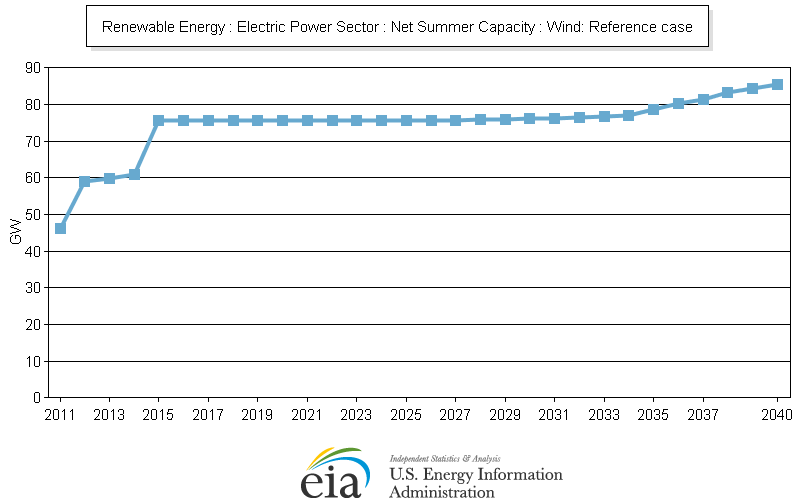
Wind energy development in the United States has slumped.

Despite record installations in 2012, and eking out a 1-year, $12 billion extension of the wind production tax credit (PTC), new wind capacity last year fell to just 1,087 megawatts, a level not seen in more than a decade. Development in 2014 is showing signs of improvement but the year may not fare much better.

The industry blames Congress and the uncertainty surrounding the PTC for the slowdown, but such thinking is overly simplistic and ignores the fundamental challenges facing big wind. This slump, like others that plagued wind development in prior years, can be traced directly to generous government assistance, current energy prices, and the inherent limitations of wind power.


Reasons for the slowdown

The Section 1603 cash grants enacted under ARRA fueled a wind bubble as developers raced to build and qualify their sites. By the end of 2012, the industry’s project pipeline was exhausted with just 43 MW of wind under development in two states. The surge in new capacity created a glut in RPS-qualified generation and eroded demand for wind as states met and/or exceeded their renewable mandates. The shale gas boom further hampered growth by driving down energy prices and harming wind’s economic competitiveness against cheaper, more reliable fuels.

Proponents insist wind energy is a few short years away from thriving without government assistance, but the trends do not support the claim.

For wind to go it alone, average wind capacity factors need to increase dramatically and/or project construction costs must drop dramatically. But that’s not happening according to the U.S. Department of Energy’s (DOE) Wind Technologies Market Report 2013, just released.

The authors, Ryan Wiser and Mark Bolinger from the Lawrence Berkeley National Laboratory (LBNL), report that average capacity factors for projects built after 2005 have been stagnant despite advances in turbine technology. The interior region of the country covering Texas and the plains states continues to show the best capacity factors (36-38%) and lowest project costs ($/kw) but it’s also the most remote. A smaller population means miles of expensive new transmission is needed to transport the energy to higher demand centers east and west.

Turbine prices and project costs may have declined somewhat from 2012, but with only 11 projects in LBNL’s 2013 sample, drawing a firm conclusion about construction costs is premature. The same applies for average wind pricing. According to the report, the national average price for wind dropped to a surprising $25/MWh in 2013, but again, the small sample of power purchase agreements examined was skewed by projects sited in the lowest-priced interior region of the country.

We agree that wind PPAs from 2012-13 have seen some decline in prices but nowhere near $25/MWh in most areas of the country and not for the reasons cited. Wind power is not more competitive. Rather, its pricing in the U.S. is under severe pressure because of the shale gas boom and the accumulation of new wind capacityconcentrated in just twelve states, which has lowered demand.

Also, by constructing tens of thousands of megawatts of generation that produces largely off peak, wind developers actually hurt their own energy sales by driving down wholesale prices, which makes the PTC even more critical.


Subsidizing Big Wind

The PTC offsets the high price of wind energy, giving the false impression that wind is competitive with other resources, but at 2.3¢/kWh, the subsidy’s pre-tax value (3.5¢/kWh) equals, or exceeds the wholesale price of power in much of the country! The tax credit provides a significant out-of-market revenue source for developers by shifting costs to taxpayers at large. At current energy prices, we’re not convinced wind power can demonstrate sustained growth without the PTC, and this is confirmed in EIA’s latest Annual Energy Outlook 2014.

According to EIA, if the expired PTC is allowed to stay expired, their models show an expected stair-step increase in wind capacity by 2015 that flattens out for the next decade until gas prices rise and technology improvements make wind more competitive (see chart). If the PTC and the 30% ITC were made permanent EIA shows it would drive more renewables, particularly wind and solar, but at a significant cost: $4.5 billion/year from 2014 to 2040.


So what’s next

Big wind grew up on the tax credit, developed market plans and forecasts that relied on it, and now the wind PTC appears to be a required component of the industry’s economics. That was never the intent of Congress when this temporary tax credit was enacted 24 years ago. The PTC and ITC are now expired and we can expect roughly 15,000 MW of new wind to be built in response to the 1-year extension passed in 2013. After that, it’s over. It’s now time for taxpayers to consider better ways to spend their money.


High Court in Denmark Awards Damages to Victims, for Noise, and Property Devaluation!

Environment & Climate Change – Denmark

High Court rules on compensation for noise from wind turbines

September 01 2014

Background

Depending on their location, wind turbines can cause noise, visual interference and light reflections.

These issues are governed by public and private law, including neighbour law. The main rules regarding noise from wind turbines can be found in Executive Order 1284 of December 15 2011 on wind turbine noise, issued pursuant to the Environmental Protection Act. To some extent, the order safeguards neighbours from noise inconvenience by establishing maximum noise levels from wind turbines in outdoor areas. The noise limit varies depending on the surroundings.

Wind turbines may also cause visual interference which may negatively affect the value of surrounding properties. Thus, the location of wind turbines on land has proved a difficult political issue for years. Every municipality supports the idea of more wind turbines – just not within its own borders.

In order to promote local support for wind energy projects, the Parliament passed the Promoting Renewable Energy Act, which establishes a compensation scheme for neighbours of wind turbines. Under the scheme, those who build one or more wind turbines are obliged to compensate their neighbours for any reduction in property value that the wind turbines may cause, regardless of whether the wind turbines accord with the necessary permits.

The compensation scheme departs from the court-based neighbour law in that it does not operate with a tolerance limit which the neighbour must prove has been exceeded.

The starting point is that the issue of compensation must be settled before the wind turbines are built. However, the Promoting Renewable Energy Act does allow neighbours to claim compensation in certain circumstances thereafter. The competent authority to deal with claims for compensation is the assessment authority set up by the act.

Compensation granted to neighbours under the act has been relatively low so far.

Facts

In a recent case before the High Court for Western Denmark the plaintiffs had been awarded Dkr250,000 in compensation for the erection of eight wind turbines by the assessment authority. They brought the matter before the courts seeking higher compensation.

Before the erection of the wind turbines, an environmental study had concluded that the noise level at their property would amount to 38.8 decibels at wind speeds of 12 knots and 40.9 decibels at wind speeds of 16 knots.

Before the city court, a court-appointed expert stated that the reduction in the value of the property amounted to between Dkr600,000 and Dkr800,000. The city court also arranged a visit to the property.

Where the assessment authority found that the plaintiffs’ property would be subject to limited noise pollution, the city court found the level to be more significant. The court further ruled that the plaintiffs had documented their loss of value at Dkr600,000 and thus awarded them an additional Dkr350,000.

Finally, the court held that the plaintiffs had suffered no other economic loss covered by the Promoting Renewable Energy Act. In particular, the court held that the fact that the wind turbines had been erected with all necessary permits prevented the plaintiffs from claiming compensation under neighbour rules.

The High Court for Western Denmark upheld the city court’s judgment, but fixed the compensation at Dkr500,000 because, among other things, there were certain deficiencies in the masonry of the house. However, the court also considered the findings of the court-appointed expert witness who had seen the plaintiffs’ house after the erection of the wind turbines – which the assessment authority had not done – as well as the city court’s own observation of the property. Finally, the court ruled that the Promoting Renewable Energy Act does not restrict the courts’ competence to review decisions from the assessment authority.

Comment

The judgment is significant as it granted compensation after the erection of the wind turbines. This is contrary to the main rule in the Promoting Renewable Energy Act; however,both the city court and the high court found sufficient legal authority under the act to admit the claim after the erection of the wind turbines.

Moreover, both courts paid considerable attention to the evaluation of the court-appointed expert. While this is quite normal in Danish case law, it is unusual in cases where an authority such as the assessment authority has previously dealt with the matter.

Finally, the high court paid attention to the city court’s own observations of the property. It is quite unusual to see such a reference to the observations of a lower court in a higher court’s grounds of judgment.

The judgment gives cause for optimism to those who intend to challenge decisions of the assessment authority under the Promoting Renewable Energy Act. From a procedural point of view, it seems to be important for the court to see the property at issue to form its own opinion of the level of noise pollution caused by wind turbines.

For further information on this topic please contact Søren Stenderup Jensen at Plesner by telephone (+45 33 12 11 33), fax (+45 33 12 00 14) or email (ssj@plesner.com). The Plesner website can be accessed at www.plesner.com.


Comment or question for author

ILO provides online commentaries as specialist Legal Newsletters. Written in collaboration with over 500 of the world’s leading experts and covering more than 100 jurisdictions, it delivers individually requested information via email to an influential global audience of law firm partners and international corporate counsel. Please click here to register for the service.

The materials contained on this website are for general information purposes only and are subject to the disclaimer.

ILO is a premium online legal update service for major companies and law firms worldwide. In-house corporate counsel and other users of legal services, as well as law firm partners, qualify for a free subscription. Register at www.iloinfo.com.

Frauds, Crooks and Criminals

Demonstrating daily that diversity is not strength!

Family Hype

All Things Related To The Family

DeFrock

defrock.org's principal concern is the environmental and human damage of industrial wind turbines on rural communities

Gerold's Blog

The truth shall set you free but first it will make you miserable

Politisite

Breaking Political News, Election Results, Commentary and Analysis

Canadian Common Sense

Canadian Common Sense - A Unique Perspective from Grassroots Canadians

Falmouth's Firetower Wind

a wind energy debacle

The Law is my Oyster

The Law and its Place in Society

Illinois Leaks

Edgar County Watchdogs

stubbornlyme.

My thoughts...my life...my own way.

Oppose! Swanton Wind

Proposed Wind Project on Rocky Ridge

Climate Audit

by Steve McIntyre

4TimesAYear's Blog

Trying to stop climate change is like trying to stop the seasons from changing. We don't control the climate; IT controls US.

Wolsten

Wandering Words

Patti Kellar

WIND WARRIOR

John Coleman's Blog

Global Warming/Climate Change is not a problem