Spain’s Failed Green Energy Experiment….Another Case Study from Institute for Energy Research

Spain’s Green Energy Experiment

AUGUST 27, 2014

The Institute for Energy Research released today a case study on Spain’s failed green energy policies. This is the second entry in a series of case studies on Europe’s green energy disaster (click here to read IER’s case study on Germany).

For years, President Obama has pointed to Europe’s energy policies as an example that the United States should follow. However, those policies have been disastrous for countries like Spain, where electricity prices have skyrocketed, unemployment is over 25 percent, and youth unemployment is over 50 percent

IER’s study found:

  • In 2000, Spain began a new program to subsidize renewable energy with the passage of its “Promotion Plan for Renewable Energies.”
  • Spain’s feed-in tariffs have created a “rate deficit” amounting to $41 billion (about $850 per person).
  • In 2011, Spain’s domestic electricity prices (including taxes) amounted to 29.46 U.S. ¢/kilowatt-hour (kWh), nearly 2.5 times more than U.S. prices.
  • Spain’s electricity prices increased by 92 percent from 2005 to 2011.
  • Rising energy costs hit low-income Spaniards the hardest–driving them into energy poverty
  • Despite myriad renewable subsidies and mandates, Spain’s CO2 emissions increased by 34.5% from 1994-2011.

Click here to read the full case study.

Click here to read IER’s previous study on Spain by Dr. Gabriel Calzada Alvarez.

When Will All Governments Follow the Aussies lead? Not soon enough!

Australian Wind Industry Doomed: Tony Abbott Signals the End of the Mandatory RET

wind_turbine_fire

STT followers have been delighted with news that Tony Abbott, Joe Hockey and Mathias Cormann have teamed up to axe the mandatory RET (see our post here).

In response to the PM’s mooted plan, the wind industry and its parasites have been reduced to making idle threats of “revenge” and bleating about “sovereign risk”. Despite a rear-guard effort by Environment Minister, Greg Hunt to salvage something of the mandatory RET, his boss has confirmed that his mission is to kill it outright. And that pretty much means the end of the wind industry as we’ve known and grown to despise it. Here’s the Australian Financial Review on the beginning of the end.

Coalition fails to budge on RET pruning
Australian Financial Review
Phillip Coorey
26 August 2014

Pleas by solar and wind companies to leave the Renewable Energy Target untouched have fallen on deaf ears with the government deciding to proceed with a phasing down of the scheme.

While a final position will not be announced until next month, The Australian Financial Review understands the intent is to cut the scheme harder than a compromise scenario that was being pursued by the Environment Minister, Greg Hunt.

The end result will be closer to the abolition scenario advocated by Prime Minister Tony Abbott which would end the scheme by closing it to new entrants and grandfathering existing large scale projects.

Seeking to overcome the cabinet split, Mr Hunt, Mr Abbott and Industry Minister Ian Macfarlane met on Sunday to discuss a policy position to be put to the bureaucracy for analysis and then to the cabinet for a final decision.

The government is being guided by the findings of the review into the RET conducted by businessman Dick Warburton, a person the industry has argued is ill-suited to the task because he is a climate-change sceptic.

The guiding principles of the final decision will be to balance investor risk with the impact of the RET on household and business power bills. Mr Abbott claims the RET has had a significant impact on power prices. The government’s own modelling shows while the RET has added $40 a year to average household power bill, prices will fall over the medium term as more renewable energy is produced.

The industry is ramping up its warnings that any dilution of the current scheme will not only jeopardise more than $11 billion in the renewable energy investment pipeline, but create a broader sovereign risk perception for Australia.

Close watch on outcome

Philip Green, the London-based partner of the Children’s Investment Master Fund (TCI), which has a 33 per cent stake in renewable energy company Infigen, said the issue was being watched closely. “Sovereign risk has already increased in Australia given the media coverage of the carbon debate and now the RET. Sovereign risk will increase more if the stories about cuts to the RET are confirmed,” he said in a statement.

“This comes at a cost to the nation through higher capital costs as it seeks future investment in infrastructure. The Australian RET had strong bi-partisan political support [including from the current prime minister]. It can take a long time to restore trust and in some cases this is only achieved with a change in leadership/policy/party.”

Under the RET, a policy which hitherto had bipartisan support, 20 per cent of Australian’s energy production by 2020 would come from renewable sources. Based on earlier predictions of power production in 2020, this 20 per cent target was calculated at an annual production of 41,000 gigawatt hours.

But the 2020 production total has been downgraded following the decline of the manufacturing sector, including automotive and aluminium.

Consequently, 20 per cent of the revised production target is 27,000 GWh. This is the “real 20 per cent” scenario for which Mr Hunt is advocating.

Under the push by Mr Abbott, renewable energy output would be frozen at current levels of about 16,000 GWh.

Any proposed change faces a near impossible passage through the Parliament with Labor and the Greens opposed to any alteration, while Clive Palmer says he will not allow any change unless Mr Abbott goes to the next election in 2016 and wins a mandate.
Australian Financial Review

dick-warburton

STT thinks the constant reference to Dick Warburton as a “climate-change sceptic” is just churlish bitterness from the vanquished. From STT’s viewpoint, Dick did precisely what he was supposed to do: standing up for Australian power consumers and helping to bring an end to the most costly and pointless piece of policy ever devised.

And, yet again, the wind industry – and those with shirts to lose when it collapses – trot out the furhpy about “sovereign risk”. Not only is it utter bunkum (see our posts here and here and here and here), harping on about it won’t save the wind industry from the inevitable demolition of the mandatory RET.

The AFR talks about Australia risking “$11 billion in the renewable energy investment pipeline” as if that were some kind of loss to Australian power consumers, in an already over-supplied market. As we’ve previously pointed out, the threatened “investment” is hardly a “no-strings attached-gift”. The would be investors are after annual gross returns in the order of 20% on that figure – ie, a cool $2.2 billion, every year – which can only be recouped from power consumers through higher power bills – with a fat pile of RECs underwriting the “investment” (see our post here).

As a piece of friendly advice, we wouldn’t be betting the house on Clive Palmer blocking any changes to the RET in the Senate. Horse trading is the life-blood of politics; and a week can be a very long time for anyone engaged in the political caper. As you’d expect, STT hears that Tony Abbott is already doing business with the Senate’s cross-benchers, including the PUP in order to come up with a workable solution to the debacle that is the mandatory RET, which has utterly failed as a cost-effective CO2 abatement policy.

Clive Palmer wants an Emissions Trading Scheme (albeit with the price of credits set at zero). So the Coalition’s Direct Action policy is being reworked by top energy market economist, Danny Price in a manner that will not only resemble something like what Clive is after, but in a way that will slash the value of the subsidies to wind power outfits (as promised by the RET) by around 90%. One of the cross-benchers, Nick Xenophon – who works closely with Danny Price – is in on the mission to kill off the wind industry, by introducing some tweaks of his own to Coalition policy, aimed at achieving least-cost CO2 abatement (see our posts here andhere). Another cross-bencher, David Leyonhjelm penned a piece for The Australian today (we’ll cover it shortly) setting out his eagerness to kill the mandatory RET, which he sees as “just government mandated corporate welfare” that will cost power consumers $billions “for no measurable environmental benefit”. No, STT didn’t write David’s article.

But, in the result, whether or not changes to the mandatory RET occur during the life of this parliament is a matter of passing academic interest. The wind industry is doomed simply because – from here on – NO retailer in touch with their earthly senses will enter a long-term Power Purchase Agreement with a wind power outfit – which means that those desperados still hoping to build wind farms will never obtain the finance needed to do so. Moreover, the REC price is bound to head south over the coming weeks and months, placing outfits with current wind farm operations in mortal financial jeopardy.

One of those facing an early exit from the stage is our old favourite, Infigen. These boys have just announced an $8.9 million loss for 2013/14, which follows a $55 million loss in 2011/12 and an $80 million loss for 2012/13 (see our posts here and here). Those hefty losses were all racked up at a time when the mandatory RET was set in stone, such that the regulatory cards were all firmly stacked in Infigen’s favour.

With the mandatory RET set for the chop, Infigen is preparing to emulate its predecessor (Babcock & Brown) with another spectacular financial collapse. Here’s the Australian Financial Review setting the scene for Babcock & Brown Mk II.

Infigen at risk if RET wound up
Australian Financial Review
Angela Macdonald-Smith
26 August 2014

Wind power producer Infigen Energy has warned it could fall into breach of its debt covenants within three months should the 2020 Renewable Energy Target be wound back with no compensation for affected investors.

Managing director Miles George said either of the two outcomes apparently being favoured by the government for the overhaul of the RET would be “disastrous” for both the industry and Infigen.

He said significant write-downs would follow, with the loss of value for Infigen more than its current market cap of about $185 million.

The government is thought to be considering two potential outcomes for its RET review, one involving reining the 2020 target back to represent a “real” 20 per cent of electricity use, rather than the 26 per cent to 28 per cent it is currently expected to represent.

The other involves closing off the scheme to new entrants, while honouring existing contracts only.

“Either of these scenarios is disastrous for our industry,” Mr George said, after Infigen posted an $8.9 million full-year net loss, affected by the regulatory uncertainty. “They are both death for the renewable energy industry and, to be frank, they are death for Infigen.”

He said if no compensation was provided for investors, the resulting weakness in the price of large-scale renewable energy certificates would cut cash flow for debt servicing. As a result, Infigen would be at risk of breaching its covenants within three months.
Australian Financial Review

This couldn’t be happening to a nicer bunch of lads.

dirtyrottenscoundrelsoriginal

Anti-Wind Protesters Take Their Issues, Right to the Pollies!

Pollies hit spot of turbulence

THE Premier and Planning Minister walked into an Indian restaurant.

One was told he “wouldn’t know if his arse was on fire”; the other urged to wear a caricature mask mockingly depicting her own face.

Anti wind farm protesters made sure Mike Baird and Pru Goward received their message loud and clear at lunchtime on Friday.

The crowd – made up predominately of members from the Residents Against Jupiter Wind Farm group – used placards, T-shirts, masks, verbal jibes and even a replica turbine to reinforce their point outside the Southern Star Inn.

Premier Mr Baird and Planning Minister Ms Goward were among those who converged on the Reynolds Street restaurant for a Liberal Party fundraiser.

Some of the very people protesting out front laid down their signs and strolled into the luncheon – at a cost of $50-a-head.

They urged Mr Baird and Ms Goward to better consider landowners’ views and ensure consumers were exempt from paying a wind farm excess that benefits operators.

One protestor pleaded with the government to consider compensation for landholders whose property values have plummeted courtesy of wind farm developments.

Both the Premier and Planning Minister handled flak diplomatically.

“Good on you,” Mr Baird said in response to banter that claimed he wouldn’t know if his own backside was alight.

Ms Goward politely refused to wear one of the many masks indicating the Member for Goulburn was being figuratively gagged by Cabinet.

“I’m not going to wear myself,” she said.

Others present at the protest and Liberal Party fundraiser included mayor Geoff Kettle, his neighbouring compatriots John Shaw from Upper Lachlan and Wingecarribee’s Juliet Arkwright, Goulburn Mulwaree councillor Sam Rowland, outspoken anti wind farm campaigner Humphrey Price-Jones, and Christian Democrat candidate from the 2013 federal election, Adrian Van Der Byl.

The protesters’ motives transcended party politics, Residents Against Jupiter Wind Farm member Michael Crawford said.

“We’re aiming to get a message across to the government in terms of the resistance here,” he said on Friday.

“Clearly the Premier is ill-advised in terms of the policy he’s following. It’s harmful to local residents, it’s awful to ordinary citizens who are the consumers of the state and it benefits no-one except the developers.”

Boro Road property owner Greg Faulkner played recordings of wind turbine noises through loudspeakers on the back of his ute.

A lack of respect for property owners most affected by the proposed Jupiter Wind Farm, east of Lake George, drove him to act.

“It takes no account of local residents who live near the developments,” he said.

“A lot of the people here are committed to renewable power, but we make the distinction between all types of renewable energy and giant wind farms.

“There’s a world of difference between having some solar panels on your roof and living with 550 wind turbines placed as close as 350 metres from your front door.”

Tamsin Hanbrook estimates she and her family will lose a potential $440,000 due to the Jupiter Wind Farm project.

“We owe more than what our place will ever be worth, we can’t sell it,” she said of their Braidwood Road property.

“The people we were going to exchange contracts with pulled out because of the wind farms.

“The other block [on the Kings Highway], we’ve been trying to sell it for six months. We can’t sell it for love or money. As soon as people find out about the wind farms, they don’t want a bar of it.”

World-wide Climate Scam is the Result of Corruption and Collusion!

AUSTRALIAN BUREAU OF METEOROLOGY ACCUSED OF CRIMINALLY ADJUSTED GLOBAL WARMING


The Australian Bureau of Meteorology has been caught red-handed manipulating temperature data to show “global warming” where none actually exists.

At Amberley, Queensland, for example, the data at a weather station showing 1 degree Celsius cooling per century was “homogenized” (adjusted) by the Bureau so that it instead showed a 2.5 degrees warming per century.

At Rutherglen, Victoria, a cooling trend of -0.35 degrees C per century was magically transformed at the stroke of an Australian meteorologist’s pen into a warming trend of 1.73 degrees C per century.

Last year, the Australian Bureau of Meteorology made headlines in the liberal media by claiming that 2013 was Australia’s hottest year on record. This prompted Australia’s alarmist-in-chief Tim Flannery – an English literature graduate who later went on to earn his scientific credentials with a PhD in palaeontology, digging up ancient kangaroo bones – to observe that global warming in Australia was “like climate change on steroids.”

But we now know, thanks to research by Australian scientist Jennifer Marohasy, that the hysteria this story generated was based on fabrications and lies.

Though the Bureau of Meteorology has insisted its data adjustments are “robust”, it has been unable to come up with a credible explanation as to why it translated real-world data showing a cooling trend into homogenized data showing a warming trend.

She wrote:

“Repetition is a propaganda technique. The deletion of information from records, and the use of exaggeration and half-truths, are �others. The Bureau of Meteorology uses all these techniques, while wilfully ignoring evidence that contradicts its own propaganda.’’

This is a global problem. Earlier this year, Breitbart reported that similarly dishonest adjustments had been made to temperature records by NASA and NOAA. Similarly implicated are the UK temperature records of the Met Office Hadley Centre and at Phil “Climategate” Jones’s disgraced Climatic Research Unit at the University of East Anglia.

One of the many disingenuous arguments used by climate alarmists against sceptics is mockingly to accuse them of being conspiracy theorists. “How could global warming possibly not be a problem when all the world’s temperature data sets from Australia to the US to the UK clearly show that it is? Are you seriously suggesting that so many different scientists and so many distinguished institutions from across the globe would collude in such a massive lie?” their argument runs.

Our answer: yes we bloody well are.

Why are there no Industrial Wind Complexes in Toronto? Ontario Place Grounds, would be perfect!

TIME TO TURN THE TABLES ON WIND PROPONENTS WHO ACCUSE OPPONENTS OF ‘NIMBYISM’.

It’s astounding to read these days how pleased with themselves liberals are that the Wynne Ont gov’t is remaining steadfast in their refusal to amend the Green Energy Act in any meaningful way. It’s as easy as water off a ducks back for these progressives to delight in calling opponents to Industrial Wind Turbines as NIMBY’s and having democracy essentially waived to accomplish the policy goals backed by the GEA.

I only have this to say;

I want all these cheering Liberals to consider this;

Take your worst nightmare of a conservative leader. An amalgam of the very worst of Harper. Harris, throw in a little Ralph Klein and some Tea Party Timmy Hudak. I can sense your blood pressure rising as I write this. Oh the horror.
In the Legislature, a new bill is to be introduced called the “Nuclear Waste Recovery Act”

It will allow land owners to store nuclear waste on their properties until at such time facilities are available to neutralize the radioactive waste. Of course a setback of 550 metres would be required to non- participating “receptors” Land owners would negotiate 20 year contracts with the private companies running the nuclear facilities such as Bruce , Darlington and Pickering. Big time subsidies from the government ensure that developers and landowners alike are lining up out the door to cash in. Industrial Park areas sprinkled about the GTA sound like swell places to make this work.

Facilities that would eventually deal with the waste will be developed and the process of nuetralizing all that radioactive material would come online. The program would be a model to the world and create 50,000 jobs, ( Actually, this program could actually have a better shot at creating said number of jobs.) lowering the unemployment rate in the GTA which at present is above the national average.

So, developers with empty space in industrial parks in say, Scarborough, Pickering, North York or Mississauga, could apply for this and as long as they’re 550metres from residential areas, hey, it’s game on.

In addition, a special urban home owner program will be enacted. This unique initiative would allow home owners in large urban areas to sign contracts allowing a special individual-sized container of nuclear waste to be buried in their backyards. For doing this, each home owner will be paid $5,000 a year for 25 years. There will be no setback distances, because the government has done it’s homework and found numerous experts in the nuclear field who have testified that these containers are 100% safe. No neighbourhood input or objections would be allowed, since “nimbyism” will not be tolerated.

I sense it could face some opposition. Municipal governments would complain as their constituents would be going apoplectic over a nuclear waste facility in their neighborhood. Proponents, funded by Big Nuclear, would just refer to them as NIMBY’s. It would slowly dawn upon these residents that the NWR act strips away all municipalities rights to oppose this very much needed service.

Residents would come armed with health studies, but those dastardly conservatives in power have studies of their own citing that their own Medical Officer Of Health has signed off on the policy and states that there is “No significant hazard to health.” Tribunals set up to hear citizens grievances, would be stacked by the conservatives with sympathetic board members making any challenge an exercise in futility.

So now, with some facilities now open, reports of radiation leaks are ubiqutous. MoE will come to investigate and essentially find nothing since they’re not even equipped to measure anything. Wildlife , such as it is would be struggling to adapt to these conditions. Local human health could also suffer an immeasurable toll. Meanwhile, the developers and landowners are far,far away counting and folding all that taxpayer booty.

My point to all you liberal cheerleaders is that you’re all for this when it suits you. When it’s on the other foot, you’d be unspooling.  My contention is that no government, be it Liberal ,Conservative or otherwise should EVER be able to wield this kind of power over it’s citizens, urban or rural.

Paul Kuster

nuclearwaste-2

Time to Put an End, to the Renewables Scam!!! Aussies to Axe the RET!

Lost In Translation: How a CO2 Abatement Scheme Became “Corporate Welfare on Steroids”

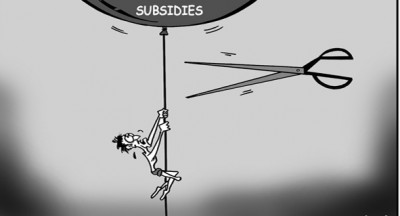
subsidies

Time to remember the original aim of the RET
Australian Financial Review
Danny Price
21 August 2014

The RET was intended to cut carbon. Opening it up to more forms of efficient generation would help get that result.

The debate over the renewable energy target has ended up exactly where you would expect a debate on subsidies to end up. The beneficiaries of the subsidy are taking the high moral ground while those adversely affected by the subsidy are crying foul.

We see similar debates in the agricultural sector. Australian farmers complain they face unfair market conditions because the international farmers they compete with have the protection of subsidies, while our government provides none.

In this case, the coal-fired generators claim they are finding it hard to recover their costs on existing investments while the renewable generators who earn a subsidised return, claim their future investments are threatened.

Both arguments are founded on the same concept – investment certainty.

What has been lost in all this debate is the original objective of the RET. The renewable industry has focused on the benefits it brings to customers by suppressing the price coal and gas generators can charge customers. But as PJ O’Rourke once observed about the US health system, “If you think healthcare is expensive now, wait until you see what it costs when it’s free.” The economic costs of lowering the wholesale price charged by thermal generators by subsidising renewable generators will be enormous.

The renewable energy sector has cleverly confused the concepts of economic costs, which are the costs of the resources used to produce renewable energy, with prices. They do this to disguise the real cost impact of the RET on the economy and to make themselves a smaller political target.

RET never about pricing

The goal of the RET was never about suppressing prices, but this is now the cause célèbre of the renewable industry because they know this will appeal to politicians looking to reduce electricity price pressure. The RET was aimed at encouraging a reduction in greenhouse gas emissions by actively promoting the, then-fledgling renewable industry.

The debate about the RET really should be re-focused on how we can achieve our environmental targets most economically. If we can minimise the costs of reducing emissions, then it follows that we are more likely to reduce emissions further, which Australia will inevitably be pressured to do at the Paris round of climate negotiations in late 2015.

More recently the renewable generators claim they are now cost-competitive with thermal generators. While these claims are probably overstating the relative economics of the thermal versus renewable generation, there is certainly less need to continue to subsidise investors in renewable generators as the RET has done its job in developing a local renewable industry. It is now time for the renewable industry to face competition and this competition should lead to lower economic costs and lower consumer prices.

This could be achieved by progressively levelling the playing field between all potential sources of electricity supply and demand so that all technologies can compete to supply emissions reductions.

Recent analysis of the opportunity to reduce the economic costs and price impacts of the RET by making it more technologically neutral, for example by allowing gas generators to compete with renewable generators and create partial credits under the scheme to reflect emissions abated, has shown that this approach can simultaneously reduce the economic cost of the RET by more than $1 billion and reduce prices for customers by more than $50 a year. This cost could fall further if other forms of cleaner generation could also compete vigorously with gas and renewable generators.

Part of the reason that this cost and price reduction occurs is that it makes use of existing gas capacity that mostly sits idle that could compete with coal under a more technologically neutral RET. This approach of broadening the RET to allow a wider range of technologies to compete to supply emissions reductions, is one of those rare no-regrets policies.

Competitive pressure

If no technology is able to compete with the renewable technologies (for example due to the risk of rising gas prices) then the worst thing that would happen is that wind generators would continue to be built. The only complaint that the renewable industry could have against such a proposal is that they would be subject to more competitive pressure.

With lower costs and prices from such a transformation of the RET, the government could afford to leave the target where it is and rely on the transformed RET to do more work to contribute towards the achievement of Australia’s emissions reduction.

Unfortunately, the only beneficiaries from such a transformation of the RET are customers and the economy and, sadly, there is nobody to advocate for these stakeholders in the current RET debate.

Danny Price is managing director of Frontier Economics.
Australian Financial Review

When Danny Price says: “The economic costs of lowering the wholesale price charged by thermal generators by subsidising renewable generators will be enormous” he’s playing as the master of understatement.

As Liberal Member for Hume, Angus “the Enforcer” Taylor has repeatedly pointed out, the mandatory RET is nothing short of “corporate welfare on steroids” (see our posts here and here and here).

Putting aside the hidden costs of providing fossil fuel back up to cover the occasions when wind power output plummets every day – and for days on end (see our post here); putting aside the need for a duplicated network to carry wind power from the back blocks to urban markets (seeour post here); putting aside the cost of running highly inefficient Open Cycle Gas Turbines to cover wind power “outages” (see our post here), the cost of Renewable Energy Certificates and their bedmate – the mandated shortfall charge will add a minimum of $39 billion, and – if the price of RECs reaches $100 (as is forecast under the current RET of 41,000 GWh) – up to $60 billion, to power consumer’s bills over the next 17 years (see our post here).

As Danny Price points out, the original purpose of (and justification for) the mandatory RET was the cost-effective abatement of CO2 emissions in the electricity sector. So Australian power punters – lumped with the task of propping up near-bankrupt outfits like Infigen (aka Babcock & Brown) via the redirection of $40-60 billion of their hard-earned cash over the next 17 years – might reasonably ask just how much CO2 abatement “bang” they’re getting for those very considerable bucks?

It’s the very question that Danny Price has been grappling with over the last few months.

STT followers will be pleased to know that Danny Price hates intermittent, unreliable and insanely expensive wind power with a passion – and that he’s been tasked by the Coalition with coming up with a workable method of achieving least-cost CO2 abatement.

Danny’s mission is to amalgamate the entirely unsustainable REC Tax – filched from unwitting power consumers and directed to wind power outfits – into the Direct Action policy, under which an Australian Carbon Credit Unit (CCU) will be issued to anyone stumping up audited proof that they’ve reduced or abated 1 tonne of CO2. The CCU will be tradeable on international markets and the equivalent of European carbon credits, which trade around A$8. Under Danny’s plan, RECs will be replaced with CCUs – and the subsidy per MWh of wind power will plummet from a projected $100 to less than $10. For a run-down on the mechanics of Danny’s plan – see our post here.

While seeing their subsidy gravy train slashed by 90% might sound a little like “bad news” for wind power outfits, earning CCUs comes with a BIG catch: CCUs will ONLY be issued where there is credible proof that the applicant has reduced or abated CO2. For wind power outfits this means coming up with actual proof (not smoke and mirrors “modelling”) that they have in fact reduced CO2 emissions in the electricity sector.

As youngsters sceptical of their peers’ more ambitious pronouncements say: “well, good luck with that”.

The need for 100% of wind power capacity to be backed up 100% of the time by fossil fuel generation sources means that wind power cannot and will never reduce CO2 emissions in the electricity sector (see our postshere and here and here and here and here and here and here).

E.ON operates numerous transmission grids in Germany and, therefore, has the unenviable task of being forced to integrate the wildly fluctuating and unpredictable output from wind power generators, while trying to keep the German grid from collapsing (E.ON sets out a number of the headaches caused by intermittent wind power in the Summary of this paper at page 4). Dealing with the fantasy that wind power is an alternative to conventional generation sources, E.ON says:

“Wind energy is only able to replace traditional power stations to a limited extent. Their dependence on the prevailing wind conditions means that wind power has a limited load factor even when technically available. It is not possible to guarantee its use for the continual cover of electricity consumption. Consequently, traditional power stations with capacities equal to 90% of the installed wind power capacity must be permanently online [and burning fuel] in order to guarantee power supply at all times.”

STT is happy to go all out and say that in Australia wind power requires 100% of its capacity to be backed up 100% of the time by conventional generation sources. As just one recent example, on 3 consecutive days (20, 21 and 22 July 2014) the total output from all of the wind farms connected to the Eastern Grid (total capacity of 2,952 MW – and spread over 4 states, SA, Victoria, Tasmania and NSW) was a derisory 20 MW (or 0.67% of installed capacity) for hours on end (see our post here). The 99.33% of wind power output that went AWOL for hours (at various times, 3 days straight) was, instead, all supplied by conventional generators; the vast bulk of which came from coal and gas generators, with the balance coming from hydro generators.

For wind power to reduce CO2 emissions in the electricity sector it has be a true “substitute” for conventional generation sources. Because it can’t be delivered “on-demand” (can’t be stored) and is only “available” at crazy, random intervals (if at all) wind power will never be a substitute for conventional generation sources (see our post here). Accordingly, wind power is simply incapable of reducing CO2 emissions in the electricity sector

The wind industry has never produced a shred of evidence to show that wind power has reduced CO2 emissions in Australia’s electricity sector. To the contrary of wind industry claims, the result of trying to incorporate wind power into a coal/gas fired grid is increased CO2 emissions (see thisEuropean paper here; this Irish paper here; this English paper here; thisAmerican article and this Dutch study here).

STT hears that Danny Price is well and truly alive to all that.

With Tony Abbott about to go on the offensive in his quest to wind up the mandatory RET (expect to hear more from the PM this week) the wind industry’s wild and unsubstantiated claims about CO2 abatement in the electricity sector provide the PM with just another reason to bring the greatest environmental and economic fraud of all time to a shuddering halt.

DannyPrice_banner1

Liberal Government Won’t Put a Wind Project Near Their Home in Toronto!!!

Ontario Place Grounds Would be Perfect For A Wind Project!

Bow Lake makes wind farm fight tough: MILLS 

By Tom Mills, Sault Star

With a government that continues to stack the procedural and legal deck against those who oppose the intrusion of wind farms on their neighbourhoods, you might expect to see turbines almost everywhere.

But it would take a sharp eye to spot one anywhere near the GTA. Wind-energy-watching is much easier in Algoma, Bruce and Chatham-Kent, which house about a third of Ontario’s turbines.

In a past column I mentioned the Toronto waterfront, where offshore wind turbines were seriously proposed. Then a Liberal government moratorium in 2011 put an end to the foolish notion of locating green energy generation where it might be consumed.

I’ve also suggested turbines be put in shopping malls, industrial parks and other places of large-scale ugliness within the bounds of the Greater Toronto Area.

One reader came up with the very feasible idea of lining Highway 400 with turbines from Barrie to Canada’s Wonderland.

Last week I found a couple of new prime locations: the Niagara Escarpment and the quaint main street of Niagara-on-the-Lake. Both seem to have wind in abundance.

Now NOTL, whose strict bylaws preserving the character of the historic village were strong enough to give a McDonalds sign fallen arches, would break out the 1812 muskets at the idea of blades whooshing o’er the fudge shoppes and inns.

And wine country doubtless would sour at the idea of blinking red lights festooning the limestone ridge like a strand of tacky Christmas lights.

But could they do much about it? I doubt it.

Preposterous, you say?

Well, a ruling last month by an environment ministry review panel on a wind farm north of Sault Ste. Marie makes it more daunting for anyone anywhere in Ontario to oppose a wind farm.

That panel shot down attempts by seasonal resident James Fata and others to block installation of turbines on a scenic hill area near the Lake Superior coast, the Bow Lake wind farm near Montreal River.

In the process, it pared down the grounds anyone could use to oppose a wind farm.

Both the approval and appeal processes set up by Ontario’s MOE already were heavily weighted against wind farm opponents.

As the tribunal’s decision notes, “An appellant is required to prove . . . that a project will cause the harm,” not just raise “the potential for harm.” No onus on the developer.

That seems akin to the government allowing pharmaceutical companies to dump drugs on the market and then requiring consumers to conduct scientific studies proving them to be unsafe.

And a tribunal is severely limited as to what reasons it can allow an opponent to use to object to a wind farm. None of that “scenic beauty” stuff for our ministry, even though this particular tribunal granted that the Superior landscape is “iconic.”

But the tribunal narrowed things even more by chopping references to property devaluation, economic impact on the tourism industry and a “prejudiced and unilateral consultation process” from the appeal.

That left Fata et al trying to prove turbines cause indisputably serious harm to human health, something many others have tried and failed, or latching on to an animal species that would be seriously and irreversibly harmed, in this case some little brown bats.

Evidence at the hearing suggested while turbines would doom a whole bunch of little brown bats, there are plenty more little brown bats where those came from.

And the tribunal rejected arguments by people such as adventurer Joanie McGuffin that the visual and social impacts of wind turbines on a natural landscape so striking as to have been featured by the historic Group of Seven artists could result in human health consequences.

So I’d say that leaves folks in Niagara with not too many weapons in their arsenal if some incentive-hungry developer proposed a wind farm.

Scenic beauty? Forget it. Historical significance? Nope. Tourist industry? Not likely.

About all that could stop a wind farm on NOTL’s Queen Street or along the escarpment is the fact that those places lie in the Greater Toronto Area’s back yard, much beloved of Kathleen Wynne’s Liberal government.

Yep. That should do it.

Email tom.mills@sunmedia.ca to contact Tom Mills. Comment at saultstar.com.


Sherri Lange Appeals to the Auditor General to Audit the Disastrous GEA

Canada’s Wind Power Disaster Laid Bare

Ontario april-28-protest-rally-3

Ontario is about to boil over, as impacted and threatened communities unite in seething rage at what their political betters have done to energy policy (see our post here).

The hard-green-left Liberals have created a wind power policy so insane as to beggar belief: sending power prices through the roof (referred to as “hydro bills”, as the bulk of their energy comes from hydro power); killing hundreds of thousands of real jobs; and destroying the lives of thousands of hard-working rural people, who’ve been left to endure a swathe of giant fans speared into the heart of the most productive agricultural country in Canada, rendering hundreds of perfectly good family homes uninhabitable.

One of those taking up the fight is Sherri Lange, who heads up the NA-PAW (North American Platform Against Wind Power), is the Founding Director Toronto Wind Action, the Executive Director Canada, Great Lakes Wind Truth and is the VP Canada, Save the Eagles International.

In this brilliant letter to Ontario’s Auditor General, Sherri lays out the disaster that is wind power in Canada and details the scale and scope of the greatest economic and environmental fraud of all time.

Ms. Bonnie Lysyk
Auditor General for Ontario
20 Dundas Street West, Suite 1530
Toronto
M5G 2C2
Fax 416 327 9862
August 11, 2014

Dear Ms Lysyk,

Please consider this letter as an urgent formal request for a complete and impartial audit for all matters pertaining to the Green Energy and Green Economy Act, 2009, and its false assertions and negative results for Ontario: these misrepresentations include vigorous job creation, suggested cleaner air space, the ability to create energy facilities, wind and solar, in particular, in a cost savings manner, or competitive manner.

The Green Energy and Green Economy Act has suggested with not a little hyperbole, that it will “spark” growth in “renewables sources in Ontario, while creating savings, and producing 50,000 jobs, direct and indirect,” and “make a positive contribution towards climate change objectives,” whereas in fact the GEA threatens to eviscerate the economy of Ontario and Canada as a whole. The factual results of the GEA are of economic chaos, massive job losses, environmental degradation of the highest order, a decay of our treasured environmental protections in law, and yet uncounted human health and productivity costs.

Under the guise of positive net growth, and climate change objectives, this Act has been used to gouge and tyrannize the province, materially and economically.

We believe that the mandate of the Auditor General to provide access to “value for money” data, within an audit, will provide even more information with respect to the waste and perhaps fraud at the highest levels; consumers are indeed not being provided with fair business practices, but are continually subjected to even more egregious attacks in their daily “energy expensive” lives due to a battered and debt ridden economy.

Jobs continue to leave Ontario. Some are relocating to Buffalo, to save, in one instance, $4 million per year in energy savings, or to Saskatchewan, for example. The bleed of jobs cannot continue, and we believe that an assertive and clear look at the funding and economic threat of the Green Energy Act will bear striking similarities to the international failure of wind power and Green Energy policies. Even information provided years ago by your office and the Fraser Institute did nothing to change the course.

We contend that none of the GEA assertions and projections have proven valid, and have in fact been a major contributor, likely THE major contributor, to the near demise of manufacturing in Ontario, to energy poverty for many Ontarians whose hydro bills have risen 30-40% with promises of more hikes, to the loss of jobs to the USA and western Canada, to the ill health of hundreds of Ontarians, some of whom have been forced to abandon homes, or been bought out by developers, or who reside in parking lots at Walmart, or at cottages, or with relatives. The energy chaos of Ontario now handily competes with that of Spain, Germany, or the UK.

All of this should be and should have been preventable, since the facts are well known. Indeed, the facts of the Green Energy failures of Europe should have been a lesson learned before this Ontario failure of a massive scale. (Ontario now has the unenviable position of having the highest cost of power in North America. The significance of this is not lost on Moody’s Credit Ratings system, with the threat of downgrades to Ontario.) The lessons of Europe have been put before the Legislature, all parties, on many occasions, without benefit or improvement.

The Fraser report of 2013 has already indicated that the assertions of the GEA are egregiously false.

“Already, the GEA has caused major price increases for large energy consumers, and we’re anticipating additional hikes of 40 to 50 per cent over the next few years,” said Ross McKitrick, Fraser Institute senior fellow and author of Environmental and Economic Consequences of Ontario’s Green Energy Act.”

“The Ontario government defends the GEA by referring to a confidential 2005 cost-benefit analysis on reducing air pollution from power plants. That report did not recommend pursuing wind or solar power; instead it looked at conventional pollution control methods which would have yielded the same environmental benefits as the GEA, but at a tenth of the current cost. If the province sticks to its targets for expanding renewables, the GEA will end up being 70 times costlier than the alternative, with no greater benefits.” (News release, April 2013)

The study goes on to indicate that returns to investment in manufacturingare “likely to decline by 29 per cent, mining by 13 per cent, and forestry by less than one per cent.”

Professor McKitrick explains in his report that wind is especially wasteful, as surplus generation occurs generally when demand is low, and the resulting “dumping” also results in net losses to Ontario.

“The Auditor General of Ontario estimates that the province has already lost close to $2 billion on surplus wind exports, and figures from the electricity grid operator show the ongoing losses are $200 million annually”, says the report.

Terrance Corcoran in the Financial Post quotes from the Auditor’s report that the cost of power is estimated to rise again another 46% in the next four years. In his analysis of the Auditor General’s 2011 report on electricity, Mr. Corcoran writes of “wilful negligence” and a “high level of fiscal negligence and abuse of process and disdain for taxpayers and electricity consumers.”

The Fraser report of 2013 has already indicated that the assertions of the GEA are egregiously false.

“Already, the GEA has caused major price increases for large energy consumers, and we’re anticipating additional hikes of 40 to 50 per cent over the next few years,” said Ross McKitrick, Fraser Institute senior fellow and author of Environmental and Economic Consequences of Ontario’s Green Energy Act.”

“The Ontario government defends the GEA by referring to a confidential 2005 cost-benefit analysis on reducing air pollution from power plants. That report did not recommend pursuing wind or solar power; instead it looked at conventional pollution control methods which would have yielded the same environmental benefits as the GEA, but at a tenth of the current cost. If the province sticks to its targets for expanding renewables, the GEA will end up being 70 times costlier than the alternative, with no greater benefits.” (News release, April 2013)

The study goes on to indicate that returns to investment in manufacturing are “likely to decline by 29 per cent, mining by 13 per cent, and forestry by less than one per cent.”

Professor McKitrick explains in his report that wind is especially wasteful, as surplus generation occurs generally when demand is low, and the resulting “dumping” also results in net losses to Ontario.

“The Auditor General of Ontario estimates that the province has already lost close to $2 billion on surplus wind exports, and figures from the electricity grid operator show the ongoing losses are $200 million annually”, says the report.

Terrance Corcoran in the Financial Post quotes from the Auditor’s report that the cost of power is estimated to rise again another 46% in the next four years. In his analysis of the Auditor General’s 2011 report on electricity, Mr. Corcoran writes of “wilful negligence” and a “high level of fiscal negligence and abuse of process and disdain for taxpayers and electricity consumers.”

A prime example of the negative impact on the Ontario jobs situation is reflected in Magna’s (the largest automotive parts manufacturer in Canada) announcement that due to the high cost of electricity in Ontario, it will not make any further investments. (Specifically, for Magna between 2013 and 2014, normal business activities resulted in an increased cost of electricity of 30 million dollars.)

The expressed primary purpose of the 2011 audit was to ensure that the OEB had sufficient and adequate systems in place to protect consumers, ratepayers. As noted also in the report, consumers are protected under the Energy Consumer Protection Act, 2010, and that under this legislation consumers shall be provided with the information they require about contracts, prices, and that they will be protected by fair business practices. This fairness has not been brought to fruition.

And the serial negligence continuing until this day, despite hearty and clear directives from the Fraser Institute and your office, has resulted merely in the advance of even more industrial wind in Ontario under Premier Wynne. Consumers are indeed not being increasingly protected, and continue to be recklessly thrown under the fiscal bus.

What we find most egregious is that the people of Ontario have warned the Premier(s) McGuinty and Wynne, and made reports to the Finance Committee, as well as reporting to these offices the results of energy chaos in Germany, Spain, the UK as well as other European states previously under the spell of “renewables.” (Please note the letter to the Editor, Financial Post, March 3, 2011: “No such thing as renewable energy.”) These abject economic failures in Europe should have provided clear warning of the folly of subsidizing inefficient non base load sources of power, particularly wind turbines.

The government and lobbying association CanWEA’s (Canadian Wind Energy Association) assertion that the wind turbine industry operates safely and without damage to human health is false and must also be examined, since the reports of ill health given to the MOE (Environment) now number in the thousands. The MOE (Ministry of the Environment) has recognized the problem, and admitted in an email obtained from an FOI that they “did not know what to do.” The costs of wind power to our medical system and human productivity have not yet been accounted for.

We remind you that with about 240,000 wind turbines worldwide, we yet only receive one half of one percent, NET ZERO, of our power needs from this source. This industry is a failure, plain and simple; does the build out then have something to do with massive subsidies deep in the pockets of developers? Who is receiving these massive double or quadruple profits?

We would like to see a chart of the major beneficiaries of the FIT program in Ontario. In Spain, the profits have been so tidy, that the Government recently asked for some retroactive repayments, understandably chilling the wind developers’ aspirations. (The lineup of crimes against consumers continues in Ontario: with 86% of Ontario’s wind power being produced on days when we are already in a surplus export mode. Another net loss for consumers is obvious.)

Please also include an environmental impacts costs study in your findings. The extreme damage to water tables, prime farm land, general ecological tragedies and killing of wildlife, has an external cost factor as well, to be borne, sadly, by our future generations.

Mr. Geoffrey Cox, a UK Conservative MP, expressed his disgust for the “gigantic machines” which are terrorizing his country:

“The reality is there is a Klondike-type gold-rush going on in rural areas where developers are anxious to get their applications through to pick up the vast profits that can be made.

“This is having a disruptive, devastating and distressing effect on dozens of small rural communities that are being torn apart by these huge industrial machines that are just yards away from their home.

“The number of applications seems to be going up rather than receding. What is going on is a stealthy, silent revolution of the most beautiful landscapes in Great Britain. “If we carry on we will have ruined this most extraordinary inheritance.”

SNAPSHOT
What we know

  • Industrial wind turbines are inefficient and pitiably useless
  • Industrial wind installations, factories, create energy sprawl and high levels of environmental pollution and toxic waste
  • Industrial wind does not work when we need it to and over performs at times to the extent that developers are sometimes paid to NOT produce
  • Huge subsidies support the industry, without which, the industry does not survive
  • The GEA suppresses all democratic opposition to wind and solar power, and the cards are stacked in favor of preferred accelerated promotion of wind turbines at the expense of Municipal and community cohesion and preferences
  • Massive amounts of base load back up power are always required; there is zero reduction in GHG’s
  • The industry (lobby) gets to sit at the table with policy makers and lay the table for the feast
  • There has been no reasonable or realistic or honest explanation for the massive outlay of wind turbines in Ontario
  • Energy poverty is abundant now in Ontario, along with massive job losses and gutting of the public purse
  • Lessons from Europe are not being acknowledged
  • IS THIS CRIMINAL NEGLIGENCE?

We look forward to your prompt reply and a rapid advancement into an impartial audit of these matters in their complete impacts on Ontario, on the economy, and on fairness, or in this case, unfairness, to each consumer and job seeker. It will be extremely useful to untangle some of the Byzantine financial and undemocratic policy arrangements that have led to this “made in Ontario” crisis. We must immediately stop this re-creation of the catastrophic results of Green Energy failures in Europe.

Please conduct an impartial and in depth assessment of all financial matters pertaining to the GEA and relay these findings to the people of Ontario at your earliest convenience. We anticipate that your report might reflect also on the medical costs to Ontario families, the loss of economic vibrancy and stability of rural Ontario which continues to bear the assault fully on its shoulders, the loss of tourism, and the loss of property values, which also contribute to economic stagnancy. Please also conduct a study on a trace of the profits to developers, kWh by kWh, if possible. We have a right to know where our hydro dollars are going.

The high octane waste of the “Green Energy and Green Economy Act”, which has been repeatedly explained to legislators, must cease immediately. It must also be retroactively remediated. Your office has the ability to further outline to the Government not only how it may alter course, but how it must immediately repair.

(We will be writing under separate cover to Commissioner Hawkes, as we fully believe the waste and apparent fraud of the GEA far overpowers the ORNGE, E-Health, and Gas Plant scandals.)

Thanking you in advance,
Sherri Lange
CEO NA-PAW (North American Platform Against Wind Power)
Founding Director Toronto Wind Action
Executive Director Canada, Great Lakes Wind Truth
VP Canada, Save the Eagles International
www.na-paw.org

C.c. Vince Hawkes, Commissioner of the OPP
C.c. Honorable Joe Oliver, MP and Minister of Finance, Canada
C.c. Interested parties

sherriwithwildasterspp

Faux-green Agenda is Not Healthy for People, or the Environment!

Climate-Cooling Policies threaten Food Supplies

A warmer, wetter climate with more carbon dioxide in the atmosphere would undoubtedly produce more plant growth and more food.
 
However climate-cooling policies that claim to prevent global warming by throttling the use of carbon fuels will definitely reduce food supply and increase food prices.
 
The promotion of ethanol for motor fuel is anti-food. This “food for fuel” program has absorbed significant quantities of corn, soy beans, sugar and palm oils. Consequently prices for ethanol crops are higher than they would otherwise be, encouraging farmers to convert land currently devoted to grazing animals and other food crops to growing more profitable crops for ethanol.

Extreme greens also practise plant discrimination, favouring more trees at the expense of natural grasslands and open forest that support many grazing animals. These polices take many forms including planting carbon credit forests, banning regrowth clearing, anti-development zoning and blanket tree protection reserves. All such policies reduce food production from grasslands.

Climate-cooling policies also aim to decrease demand for carbon fuels, including coal, oil, gas and refined motor fuels, by increasing their costs and prices. Modern food production is totally dependent on low-priced carbon fuels for all farming activities. Diesel fuels are needed for cultivation, planting, harvesting and transport; and coal/gas powered electricity for irrigation, processing and distribution. Higher prices for carbon fuels will send some marginal farms out of business. The same policies will reduce profits and production in the fishing industry. All of these policies are anti-food.
 
Modern food production needs nitrogen fertilizer, which is made from atmospheric nitrogen and natural gas, with carbon dioxide as a by-product. Extreme greens all over the world are delaying and opposing the exploration and production of natural gas, and their carbon taxes are increasing the costs of this key fertilizer.

Finally, climate-cooling policies favour silly schemes like carbon capture and burial, which aims to pump carbon dioxide underground. The promoters should be told that current levels of carbon dioxide in the atmosphere are below those that maximize plant growth and food production. The rise in atmospheric carbon dioxide levels was a major contributor to increased world food production over the last century. To bury this free plant food is not food-smart.
 
These unproven solutions to unproven problems are unlikely to change the climate. But there is a 50:50 chance that instead of warming, the globe may cool naturally, which will cause dramatic reduction in food production.
 
Food is not easily storable, and supply and demand are always finely balanced. If natural cooling comes on top of all these man-made anti-food policies, the world will see cascading food shortages.

For those who wish to read more:

The Ethanol Disaster:
http://reason.com/archives/2014/05/06/the-ethanol-disaster

The Unintended Consequences of Ethanol:
http://news.newsmax.com/?ZKORXYGhQIAlL8s41ytI6BaZUxleNLU1Z&ns_mail_uid=32310041&ns_mail_job=1566641_04272014
 
Ethanol from corn waste may release more greenhouse gases than petrol:
http://www.news.com.au/world/breaking-news/corn-waste-fuel-not-better-than-petrol/story-e6frfkui-1226890856876?from=public_js
 
The Ethanol Disaster:
http://carbon-sense.com/2013/11/25/the-ethanol-disaster/
 
World turns against Ethanol:
http://canadafreepress.com/index.php/article/63444

Current solar cycle may be the weakest in 200 years:
http://informthepundits.wordpress.com/2014/08/17/sunspots-2014-two-big-surprises/
 

 A warmer, wetter climate with more carbon dioxide in the atmosphere would undoubtedly produce more plant growth and more food.

 
However climate-cooling policies that claim to prevent global warming by throttling the use of carbon fuels will definitely reduce food supply and increase food prices.
 
The promotion of ethanol for motor fuel is anti-food. This “food for fuel” program has absorbed significant quantities of corn, soy beans, sugar and palm oils. Consequently prices for ethanol crops are higher than they would otherwise be, encouraging farmers to convert land currently devoted to grazing animals and other food crops to growing more profitable crops for ethanol.

Extreme greens also practise plant discrimination, favouring more trees at the expense of natural grasslands and open forest that support many grazing animals. These polices take many forms including planting carbon credit forests, banning regrowth clearing, anti-development zoning and blanket tree protection reserves. All such policies reduce food production from grasslands.

Climate-cooling policies also aim to decrease demand for carbon fuels, including coal, oil, gas and refined motor fuels, by increasing their costs and prices. Modern food production is totally dependent on low-priced carbon fuels for all farming activities. Diesel fuels are needed for cultivation, planting, harvesting and transport; and coal/gas powered electricity for irrigation, processing and distribution. Higher prices for carbon fuels will send some marginal farms out of business. The same policies will reduce profits and production in the fishing industry. All of these policies are anti-food.
 
Modern food production needs nitrogen fertilizer, which is made from atmospheric nitrogen and natural gas, with carbon dioxide as a by-product. Extreme greens all over the world are delaying and opposing the exploration and production of natural gas, and their carbon taxes are increasing the costs of this key fertilizer.

Finally, climate-cooling policies favour silly schemes like carbon capture and burial, which aims to pump carbon dioxide underground. The promoters should be told that current levels of carbon dioxide in the atmosphere are below those that maximize plant growth and food production. The rise in atmospheric carbon dioxide levels was a major contributor to increased world food production over the last century. To bury this free plant food is not food-smart.
 
These unproven solutions to unproven problems are unlikely to change the climate. But there is a 50:50 chance that instead of warming, the globe may cool naturally, which will cause dramatic reduction in food production.
 
Food is not easily storable, and supply and demand are always finely balanced. If natural cooling comes on top of all these man-made anti-food policies, the world will see cascading food shortages.

For those who wish to read more:

The Ethanol Disaster:
http://reason.com/archives/2014/05/06/the-ethanol-disaster

The Unintended Consequences of Ethanol:
http://news.newsmax.com/?ZKORXYGhQIAlL8s41ytI6BaZUxleNLU1Z&ns_mail_uid=32310041&ns_mail_job=1566641_04272014
 
Ethanol from corn waste may release more greenhouse gases than petrol:
http://www.news.com.au/world/breaking-news/corn-waste-fuel-not-better-than-petrol/story-e6frfkui-1226890856876?from=public_js
 
The Ethanol Disaster:
http://carbon-sense.com/2013/11/25/the-ethanol-disaster/
 
World turns against Ethanol:
http://canadafreepress.com/index.php/article/63444

Current solar cycle may be the weakest in 200 years:
http://informthepundits.wordpress.com/2014/08/17/sunspots-2014-two-big-surprises/

Read more: http://www.americanthinker.com/blog/2014/08/climatecooling_policies_threaten_food_supplies.html#ixzz3B01PWKKu
Follow us: @AmericanThinker on Twitter | AmericanThinker on Facebook

Sherri Lange, from NAPAW, calls for an Audit of the Green Energy, and Green Economies Act!

Letter to Auditor General for Ontario from North American Platform Against Windpower

To: Ms. Bonnie Lysyk (Auditor General for Ontario)       (Letter of August 11, 2014)

Dear Ms Lysyk,

Please consider this letter as an urgent formal request for a complete and impartial audit for all matters pertaining to the Green Energy and Green Economy Act, 2009, and its false assertions and negative results for Ontario: these misrepresentations include vigorous job creation, suggested cleaner air space, the ability to create energy facilities, wind and solar, in particular, in a cost savings manner, or competitive manner.

The Green Energy and Green Economy Act has suggested with not a little hyperbole, that it will “spark” growth in “renewables sources in Ontario, while creating savings, and producing 50,000 jobs, direct and indirect,” and “make a positive contribution towards climate change objectives,” whereas in fact the GEA threatens to eviscerate the economy of Ontario and Canada as a whole. The factual results of the GEA are of economic chaos, massive job losses, environmental degradation of the highest order, a decay of our treasured environmental protections in law, and yet uncounted human health and productivity costs.

Under the guise of positive net growth, and climate change objectives, this Act has been used to gouge and tyrannize the province, materially and economically.

We believe that the mandate of the Auditor General to provide access to “value for money” data, within an audit, will provide even more information with respect to the waste and perhaps fraud at the highest levels; consumers are indeed not being provided with fair business practices, but are continually subjected to even more egregious attacks in their daily “energy expensive” lives due to a battered and debt ridden economy. Jobs continue to leave Ontario. Some are relocating to Buffalo, to save, in one instance, $4 million per year in energy savings, or to Saskatchewan, for example. The bleed of jobs cannot continue, and we believe that an assertive and clear look at the funding and economic threat of the Green Energy Act will bear striking similarities to the international failure of wind power and Green Energy policies. Even information provided years ago by your office and the Fraser Institute did nothing to change the course.

We contend that none of the GEA assertions and projections have proven valid, and have in fact been a major contributor, likely THE major contributor, to the near demise of manufacturing in Ontario, to energy poverty for many Ontarians whose hydro bills have risen 30-40% with promises of more hikes, to the loss of jobs to the USA and western Canada, to the ill health of hundreds of Ontarians, some of whom have been forced to abandon homes, or been bought out by developers, or who reside in parking lots at Walmart, or at cottages, or with relatives. The energy chaos of Ontario now handily competes with that of Spain, Germany, or the UK.

All of this should be and should have been preventable, since the facts are well known. Indeed, the facts of the Green Energy failures of Europe should have been a lesson learned before this Ontario failure of a massive scale. (Ontario now has the unenviable position of having the highest cost of power in North America. The significance of this is not lost on Moody’s Credit Ratings system, with the threat of downgrades to Ontario.) The lessons of Europe have been put before the Legislature, all parties, on many occasions, without benefit or improvement.

The Fraser report of 2013 has already indicated that the assertions of the GEA are egregiously false.

“Already, the GEA has caused major price increases for large energy consumers, and we’re anticipating additional hikes of 40 to 50 per cent over the next few years,” said Ross McKitrick, Fraser Institute senior fellow and author of Environmental and Economic Consequences of Ontario’s Green Energy Act.”

“The Ontario government defends the GEA by referring to a confidential 2005 cost-benefit analysis on reducing air pollution from power plants. That report did not recommend pursuing wind or solar power; instead it looked at conventional pollution control methods which would have yielded the same environmental benefits as the GEA, but at a tenth of the current cost. If the province sticks to its targets for expanding renewables, the GEA will end up being 70 times costlier than the alternative, with no greater benefits.” (News release, April 2013)

The study goes on to indicate that returns to investment in manufacturing are “likely to decline by 29 per cent, mining by 13 per cent, and forestry by less than one per cent.”

Professor McKitrick explains in his report that wind is especially wasteful, as surplus generation occurs generally when demand is low, and the resulting “dumping” also results in net losses to Ontario.

“The Auditor General of Ontario estimates that the province has already lost close to $2 billion on surplus wind exports, and figures from the electricity grid operator show the ongoing losses are $200 million annually”, says the report.

Terrance Corcoran in the Financial Post quotes from the Auditor’s report that the cost of power is estimated to rise again another 46% in the next four years. In his analysis of the Auditor General’s 2011 report on electricity, Mr. Corcoran writes of “wilful negligence” and a “high level of fiscal negligence and abuse of process and disdain for taxpayers and electricity consumers.”

A prime example of the negative impact on the Ontario jobs situation is reflected in Magna’s (the largest automotive parts manufacturer in Canada) announcement that due to the high cost of electricity in Ontario, it will not make any further investments. (Specifically, for Magna between 2013 and 2014, normal business activities resulted in an increased cost of electricity of 30 million dollars.)

The expressed primary purpose of the 2011 audit was to ensure that the OEB had sufficient and adequate systems in place to protect consumers, ratepayers. As noted also in the report, consumers are protected under the Energy Consumer Protection Act, 2010, and that under this legislation consumers shall be provided with the information they require about contracts, prices, and that they will be protected by fair business practices. This fairness has not been brought to fruition.

And the serial negligence continuing until this day, despite hearty and clear directives from the Fraser Institute and your office, has resulted merely in the advance of even more industrial wind in Ontario under Premier Wynne. Consumers are indeed not being increasingly protected, and continue to be recklessly thrown under the fiscal bus.

What we find most egregious is that the people of Ontario have warned the Premier(s) McGuinty and Wynne, and made reports to the Finance Committee, as well as reporting to these offices the results of energy chaos in Germany, Spain, the UK as well as other European states previously under the spell of “renewables.” (Please note the letter to the Editor, Financial Post, March 3, 2011: “No such thing as renewable energy.”) These abject economic failures in Europe should have provided clear warning of the folly of subsidizing inefficient non base load sources of power, particularly wind turbines.

The government and lobbying association CanWEA’s (Canadian Wind Energy Association) assertion that the wind turbine industry operates safely and without damage to human health is false and must also be examined, since the reports of ill health given to the MOE (Environment) now number in the thousands. The MOE (Ministry of the Environment) has recognized the problem, and admitted in an email obtained from an FOI that they “did not know what to do.” The costs of wind power to our medical system and human productivity have not yet been accounted for.

We remind you that with about 240,000 wind turbines worldwide, we yet only receive one half of one percent, NET ZERO, of our power needs from this source. This industry is a failure, plain and simple; does the build out then have something to do with massive subsidies deep in the pockets of developers? Who is receiving these massive double or quadruple profits? We would like to see a chart of the major beneficiaries of the FIT program in Ontario. In Spain, the profits have been so tidy, that the Government recently asked for some retroactive repayments,understandably chilling the wind developers’ aspirations. (The lineup of crimes against consumers continues in Ontario: with 86% of Ontario’s wind power being produced on days when we are already in a surplus export mode. Another net loss for consumers is obvious.)

Please also include an environmental impacts costs study in your findings. The extreme damage to water tables, prime farm land, general ecological tragedies and killing of wildlife, has an external cost factor as well, to be borne, sadly, by our future generations.

Mr. Geoffrey Cox, a UK Conservative MP, expressed his disgust for the “gigantic machines” which are terrorizing his country:

“The reality is there is a Klondike-type gold-rush going on in rural areas where developers are anxious to get their applications through to pick up the vast profits that can be made.

“This is having a disruptive, devastating and distressing effect on dozens of small rural communities that are being torn apart by these huge industrial machines that are just yards away from their home.

“The number of applications seems to be going up rather than receding. What is going on is a stealthy, silent revolution of the most beautiful landscapes in Great Britain.

“If we carry on we will have ruined this most extraordinary inheritance.”We look forward to your prompt reply and a rapid advancement into an impartial audit of these matters in their complete impacts on Ontario, on the economy, and on fairness, or in this case, unfairness, to each consumer and job seeker. It will be extremely useful to untangle some of the Byzantine financial and undemocratic policy arrangements that have led to this “made in Ontario” crisis. We must immediately stop this re-creation of the catastrophic results of Green Energy failures in Europe.

Please conduct an impartial and in depth assessment of all financial matters pertaining to the GEA and relay these findings to the people of Ontario at your earliest convenience. We anticipate that your report might reflect also on the medical costs to Ontario families, the loss of economic vibrancy and stability of rural Ontario which continues to bear the assault fully on its shoulders, the loss of tourism, and the loss of property values, which also contribute to economic stagnancy. Please also conduct a study on a trace of the profits to developers, kWh by kWh, if possible. We have a right to know where our hydro dollars are going.

The high octane waste of the “Green Energy and Green Economy Act”, which has been repeatedly explained to legislators, must cease immediately. It must also be retroactively remediated. Your office has the ability to further outline to the Government not only how it may alter course, but how it must immediately repair.

(We will be writing under separate cover to Commissioner Hawkes, as we fully believe the waste and apparent fraud of the GEA far overpowers the ORNGE, E-Health, and Gas Plant scandals.)

Thanking you in advance,

Sherri Lange

CEO NA-PAW (North American Platform Against Wind Power); Founding Director Toronto Wind Action; Executive Director Canada, Great Lakes Wind Truth; VP Canada, Save the Eagles International (www.na-paw.org)

Appendix

What we know

· Industrial wind turbines are inefficient and pitiably useless

· Industrial wind installations, factories, create energy sprawl and high levels of environmental pollution and toxic waste

· Industrial wind does not work when we need it to and over performs at times to the extent that developers are sometimes paid to NOT produce

· Huge subsidies support the industry, without which, the industry does not survive

· The GEA suppresses all democratic opposition to wind and solar power, and the cards are stacked in favor of preferred accelerated promotion of wind turbines at the expense of Municipal and community cohesion and preferences

· Massive amounts of base load back up power are always required; there is zero reduction in GHG’s

· The industry (lobby)gets to sit at the table with policy makers and lay the table for the feast

· There has been no reasonable or realistic or honest explanation for the massive outlay of wind turbines in Ontario

· Energy poverty is abundant now in Ontario, along with massive job losses and gutting of the public purse

· Lessons from Europe are not being acknowledged

IS THIS CRIMINAL NEGLIGENCE?


– See more at: http://www.masterresource.org/2014/08/letter-to-auditor-general-for-ontario-from-north-american-platform-against-windpower/#more-31441