Global Warming….Global Cooling….Climate Change….Science is DEFINITELY NOT Settled

 NASA Scientists Puzzled by Global Cooling on Land and Sea

Image: NASA Scientists Puzzled by Global Cooling on Land and Sea(iStock)

Monday, 06 Oct 2014

The deep ocean may not be hiding heat after all, raising new questions about why global warming appears to have slowed in recent years, said the US space agency Monday.

Scientists have noticed that while greenhouse gases have continued to mount in the first part of the 21st century, global average surface air temperatures have stopped rising along with them, said NASA.

Some studies have suggested that heat is being absorbed temporarily by the deep seas, and that this so-called global warming hiatus is a temporary trend.

But latest data from satellite and direct ocean temperature measurements from 2005 to 2013 “found the ocean abyss below 1.24 miles (1,995 meters) has not warmed measurably,” NASA said in a statement.

The findings present a new puzzle to scientists, but co-author Josh Willis of NASA’s Jet Propulsion Laboratory (JPL) said the reality of climate change is not being thrown into doubt.

“The sea level is still rising,” said Willis.

“We’re just trying to understand the nitty-gritty details.”

A separate study in August in the journal Science said the apparent slowdown in the Earth’s surface warming in the last 15 years could be due to that heat being trapped in the deep Atlantic and Southern Ocean.

But the NASA researchers said their approach, described in the journal Nature Climate Change, is the first to test the idea using satellite observations, as well as direct temperature measurements of the upper ocean.

“The deep parts of the ocean are harder to measure,” said researcher William Llovel of NASA JPL.

“The combination of satellite and direct temperature data gives us a glimpse of how much sea level rise is due to deep warming. The answer is — not much.”

Read Latest Breaking News from Newsmax.comhttp://www.Newsmax.com/Newsfront/Science-US-climate-oceans/2014/10/06/id/598864/#ixzz3FTZYhwTG
Urgent: Should Obamacare Be Repealed? Vote Here Now!

Wind Energy…Not Only Unnaffordable, but does NOTHING to improve our Environment!

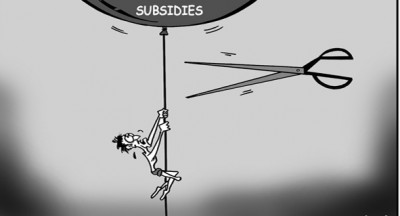
Pac Hydro Write-Down Proves Wind Farms Don’t Run on Wind, they Run on Subsidies

subsidies

Remember all that huff and puff put out over the last few months by the Clean Energy Council and near-bankrupt wind power outfit, Infigen about wind power becoming so cheap as to be competitive with coal and gas fired generators?

You know, the fantastic tales about wind power causing a reduction in Australian retail power prices?

Never mind, that nowhere in Australia have retail power prices decreased; and that – thanks to its ludicrous efforts to “rely” on wind power – South Australians pay the highest retail power prices in the world (see our post here).

In a “hey, quick look over there” approach to media manipulation, the CEC and its clients bang on about the effect of wind power on the wholesale market (on those rare occasions when the wind happens to be blowing, of course – see our post here) – while steering well clear of the actual cost of wind power to retailers.

These hucksters never talk about the prices fixed under Power Purchase Agreements with retailers – set at $90-120 per MWh versus $30-40 for conventional power – and recovered from retail customers, irrespective of the wholesale price (see our post here); and they run a mile from any mention of the Renewable Energy Certificates that get directed to wind power outfits; that have added $9 billion to power bills already; and that will add $50 billion to Australian power bills over the next 17 years, if the Large-Scale RET remains in place (see our post here).

No, the wind industry’s main pitch over the last few months has been that it’s delivering a “stand-alone” product at a price which is lower than its conventional generation “competitors” (see our post here).

Now, if there was a just a whiff of substance to the wind industry’s spin, then you’d think the industry would welcome the chance to stand on its own two feet – and jump at the opportunity to finally take on coal and gas generators in a head-to-head battle that the wind industry (with its abundant source of “free” fuel) is just bound to win, right?

But, hold the phone. It seems all that wind industry talk was … well …, just “talk”.

Despite all that chest-thumping and “big-boy” posturing, the wind industry turns out to be a sooky little mummy’s boy, after all. Here’s The Age stripping away a little of the wind industry’s false bravado.

Pacific Hydro write-down
The Age
Tim Binsted
6 October 2014

Heavyweight fund manager IFM Investors has taken a $685 million write-down on its Pacific Hydro renewable energy business due to the adverse impact of the Abbott government’s Warburton review, weaker electricity demand in Australia, and tax changes in Chile.

IFM Investors has $50 billion in assets under management and is owned by 30 pension funds with more than 5 million Australian members, including funds such as AustralianSuper, Cbus and HostPlus.

The hefty valuation changes to Pacific Hydro – which has hydro, wind, solar and geothermal projects in Australia, Brazil and Chile – were driven partly by businessman Dick Warburton’s review into the renewable energy target. His report is with the government for its consideration.

IFM Investors chief executive Brett Himbury said the review had undermined confidence for renewable energy investors.

“There’s two primary factors [impacting the Australian assets]: a lowering of energy demand and uncertainty around the current laws,” he said.

“It’s a great shame that at a time when the likes of President Obama are saying there’s no bigger challenge for the globe than climate change, we’ve got this policy uncertainty.”

On August 28, the Warburton RET review made two recommendations to the government: either allow the large-scale RET to continue to operate until 2030 for existing and committed renewable generators, but close it to new investment, or modify the fixed target for 20 per cent renewable energy by 2020 to a “real 20 per cent” of actual electricity demand.

Both of these outcomes would be negative for the renewable energy sector. Pacific Hydro has assumed a “20 per cent real” RET in its valuation.

The “real target” would reduce the annual production of renewable energy in 2020 from 41,000 gigawatt hours to about 27,000GWh.

Compounding the sector’s woes, the Australian Energy Market Operator in June made big cuts in its annual forecasts for electricity demand over the next decade.

The combined impact of lower anticipated energy demand and assuming a “20 per cent real” RET have hit the valuation of Pacific Hydro by $220 million.

“We’d like to see continued commitment to the current bipartisan agreed target and more broadly as investors we’d prefer to see a relatively certain [regulatory] environment,” Mr Himbury said. “As long-term investors you’d like to think that there is economic value in renewable energy, but what we need is clarity and certainty.”

Infigen Energy boss Miles George has previously warned that an overhaul of the target would be “disastrous” for the industry and push investment overseas.

Infigen, one of Australia’s biggest wind farm operators, has warned it could breach its debt covenants within three months if the RET is wound back without compensation for investors.

The renewable energy industry has warned any moves to scrap the target would jeopardise $15 billion in renewable energy investment.

The RET review also contributed to a further $60 million write-down on the value of the company’s development portfolio in Australia and South America.

“Under the current environment it wouldn’t be economic to bring the development book to market. There’s a knock-on effect that could impact thousands of construction jobs,” Mr Himbury said.

Grattan Institute energy director Tony Wood said the proposed Warburton RET changes were not just a headache but entering “serious migraine territory” for anyone exposed to renewable energy investments.

“It’s not like a slight change in the offside rule in AFL or NRL. This is changing the game,” he said.

“Existing projects are almost certainly not making money at the moment. The REC [renewable energy credit price] is suppressed because there is an oversupply of credits, and renewable energy itself has suppressed the wholesale [energy] price. It’s good for consumers but it hurts the return on capital.”

Underscoring the dangers of regulatory change, Pacific Hydro’s Chilean assets have taken a $210 million hit after tax reforms proposed by Chilean President Michelle Bachelet were approved by the country’s congress.

The reforms include a rise in the base corporate tax rate from 20 per cent to 25 per cent by 2017 and an increase in the stamp tax payable on financing proceeds from 0.4 per cent to 0.8 per cent.

Chilean hydro generation has also been hurt by prolonged drought in that country.

Primarily as a result of the Pacific Hydro write-downs, IFM’s mammoth Australian Infrastructure Fund is expected to decline in value by about 5 per cent for the September quarter. This is a major hit given infrastructure investments are supposed to be stable, defensive assets for the long term.

IFM will host an investor briefing, with a special focus on Pacific Hydro, on October 7.

The fund manager is undertaking a strategic review of Pacific Hydro called Project Primavera that is expected to be completed by the end of the year.

The RET was introduced with bipartisan support by the Howard government in 2001 and was expanded by the Labor government in 2009.

According to its 2013 report, Pacific Hydro has 18 operating assets, employs 294 people and generates annual revenues of $224 million.
The Age

There. Pac Hydro’s write-down proves it: wind farms don’t run on wind, they run on subsidies (see our post here).

The wind industry was created by the mandated target set by the LRET – and the $billions worth of RECs directed to wind power outfits at power consumer expense, issued under it.

Without the guaranteed transfer of $billions worth of RECs, wind power outfits would be out of business in a heartbeat – which explains the wind industry’s desperation to maintain the mandatory LRET at all costs.

It also explains why wind industry rhetoric never seems to match reality. Or, as the Americans put it, why “money talks, and bullshit walks.”

cow_dung

Governments No Longer Seem to Care About Risking the Health of Citizens.

The CDC & The UN Are Forced to Admit That Ebola is Airborne

The United Nations is preparing the world for an overt admission that Ebola is airborneAnthony Banbury, the United Nations’ Ebola response chief warned of the “nightmare scenario” that Ebola is possibly now, and probably soon will be an airborne pathogen. This is precisely what I reported when I cited several peer review studies which demonstrated that Ebola was already known, by many researchers in the scientific community, to be airborne.

isis ebola

In order to maintain any semblance of credibility, the CDC, through the process ofincrementalism, is moving towards the position that Ebola is indeed airborne. The clearly constitutes an about face reversal of the CDC on this issue and this about face is clearly on display in the following paragraphs in which the very words of the CDC are used to expose their lies and subsequent endangerment of the public health and welfare.

This Was Then

The Original CDC Position on How is Ebola Spread

The following was on the CDC website in early September and this is the mantra that the mainstream media is parroting as the “official and irrefutable doctrine of science”.

“The virus is spread through direct contact (through broken skin or mucous membranes) with blood and body fluids (urine, feces, saliva, vomit, and semen) of a person who is sick with Ebola, or with objects (like needles) that have been contaminated with the virus. Ebola is not spread through the air or by water or, in general, by food; however, in Africa, Ebola may be spread as a result of handling bushmeat (wild animals hunted for food) and contact with infected bats.”

This Is Now

The Present CDC Position on How Ebola Is Spread

The following represents the present position on how Ebola is spread by the CDC.

“Ebola is killed with hospital-grade disinfectants (such as household bleach). Ebola on dried on surfaces such as doorknobs and countertops can survive for several hours; however, virus in body fluids (such as blood) can survive up to several days at room temperature.

If a symptomatic patient with Ebola coughs or sneezes on someone, and saliva or mucus come into contact with that person’s eyes, nose or mouth, these fluids may transmit the disease.

Ebola on dried on surfaces such as doorknobs and countertops can survive for several hours; however, virus in body fluids (such as blood) can survive up to several days at room temperature.”

A CDC released a very hastily prepared advisory entitled Interim Guidance about Ebola Virus Infection for Airline Flight Crews, Cleaning Personnel, and Cargo Personnel. This smoking gun document reveals that the CDC is clearly concerned about likely airborne contamination of Ebola. The CDC urges airline staff to provide surgical masks to potential Ebola victims in order “to reduce the number of droplets expelled into the air by talking, sneezing, or coughing”. The phrase “expelled into the air” means that there is clearly the existence of the “airborne transmission of Ebola “.

Of course, the aforementioned facts do not constitute new revelations to the CDC and the NIH. On May 8, 2002, over 12 years ago, a National Institute of Health publication stated that airborne transmission of Ebola “cannot be ruled out”. And for 12 years, the CDC has been publishing lies to contrary.

Doctors Are Dramatically and Openly Questioning the Integrity of the CDC

Dr. Gil Mobley, a microbiologist and physician stated in The Atlanta Journal-Constitution:

“If they’re not lying, they are grossly incompetent,” said Mobley, a microbiologist and emergency trauma physician from Springfield, Mo.

Mobley said the CDC is “sugar-coating” the risk of the virus spreading in the United States.

“For them to say last week that the likelihood of importing an Ebola case was extremely small was a real bad call,” he said.

“Once this disease consumes every third world country, as surely it will, because they lack the same basic infrastructure as Sierra Leone and Liberia, at that point, we will be importing clusters of Ebola on a daily basis,” Mobley predicted. “That will overwhelm any advanced country’s ability to contain the clusters in isolation and quarantine. That spells bad news.”

To call attention to the fraud being perpetrated by the CDC, Dr. Mobley dressed himself up in a biohazard suit and paraded through the Atlanta airport to call attention the danger that the Center for Disease Creation (CDC) is posing to the general health and welfare of the American people.

Dr Lisa Brosseau and Dr Rachael Jones, in a research article published by CIDRAP, the Center for Infectious Disease Research and Policy, clearly state that Ebola currently has “unclear modes of transmission…We believe there is scientific and epidemiologic evidence that Ebola virus has the potential to be transmitted via infectious aerosol particles both nearand at a distance from infected patients, which means that healthcare workers should be wearing respirators, not facemasks…and the CDC’s contention that  Ebola is only communicable via direct contact is inaccurate.”

The Omnipresent Threat of Bioterrorism on American Soil

As recently as this week, ISIS has clearly, and unmistakably threatened, the United States and their allies with spreading the Ebola virus within those countries if they continue to wage war on the organization inside Syria and Iraq. It is now rumored that Jihadist suicide “disease spreaders” will deliberatively allow themselves to be infected with Ebola and expose the American public before their suicidally imposed demise. Don’t believe it? Well, did you believe 19 terrorists only armed with box cutters could bring down the four planes 9/11 narrative perpetrated by the Bush administration? Of course this rhetorical question is only for those who believe everything that is broadcasted on CNN and their controlled opposition, FOX News.

Gross Incompetence by Local Health Officials

Dallas health officials are a prime example that even local health officials cannot be trusted to ensure the safety of the public and even its own employees.

Dallas Paramedic Geoffrey Aklinski, has expressed his concern that the ambulance he was driving was the same ambulance used to transport the infamous Ebola patient, Thomas Duncan, a couple of days earlier.  in a discussion on Facebook stated that ““All the people in the back of the ambulance 48 hours later before they finally took the ambulance out of service… none of them have been contacted. None of the paramedics that were on that shift and went in the ambulance were contacted. I’ve been off three days now. No one contacted me and I was in and drove that ambulance after it was infected…This is definitely a concern and exposed workers have not been contacted or tested…I had to call into control in Dallas at 8 pm and complain to get evaluated… Three days after the fact… I had to demand exposure testing and they are reporting following up with all the people in the ambulance??? Bull crap!!! They haven’t even followed up with the ten firefighters that were on duty Sunday.”

Obama’s Two-Pronged Approach to His Overt Malfeasance of Office

treason obamaBy my count, there are over 50 peer reviewed studies which demonstrate that Ebola can be transmitted  through various airborne means. Further, it is an indisputable fact that Ebola cannot be contained in Africa. Subsequently, this current President needs to answer two very pressing questions:

1).Why isn’t air travel, both through direct and indirect flights from West Africa, being immediately banned under the name of national security?

2). Why haven’t you used your Executive authority to close the southern border given the threat of bioterrorism?

The CDC, a private corporation operating with a government charter, owns the patent on Ebola. This would only be possible if Ebola had already mutated from its original state. This means that it was more than likely weaponized. Maybe we should ask the boys at Ft. Dietrich how that could happen? Having the CDC oversee the diagnosis, institute mythical containment procedures and subsequent treatment is like having the fox watch the henhouse. Because the CDC owns the patent to Ebola and all strains within 70% of the original pathogen, they will make money on all treatment of Ebola through royalties because treatment would constitute a violation of their intellectual property rights under US patent law. The inescapable conclusion is that the CDC will make money on the spread of Ebola throughout the United States. If this is such an outrageous allegation, then I publicly call on the CDC to renounce all claims to intellectual property rights on Ebola and any resulting treatments. I make the same challenge to the NIH who owns the patent on the 8 year old vaccine for Ebola created by Crucell.

Until these public renouncements take place, I heretofore refer to the CDC as the Center for Disease Creation and the NIH as the National Institute of Harm. I am also calling on President Obama to revoke the charters that allows the CDC and the NIH to act with impunity as a monopoly with selfish purposes being perpetrated upon  the people of this nation.

Final Questions

Why has the State Department ordered 160,000 HAZMAT suits? My immediate suspicion is that these suits will be needed for the Russian and Chinese troops, operating under the guise of the UN, to enforce medical martial law.

How many biocontainment, Ebola-ready Level-4 beds are there in America? Americans need to be aware of the fact that the United States only has 19 Ebola-ready Level-4 Biocontainment beds in the entire country.

Please spare me the emotional rhetoric in response to this article. I have provided documented links to the claims presented here. In response, I only want to see the same which may serve to refute my position that the people of this country are deliberately and purposefully being endangered for purposes of profit and political control. Until I see documentable proof that this position is wrong and the evidence presented in this article is in error, I stand by this position.

Dave Hodges is the Editor and Host of The Common Sense Show.

Are the Liberals Finally Waking Up, in Britain? Green taxes are Absurd!

Green taxes DO harm the British economy and let other countries carry on polluting, Vince Cable admits

  • Business Secretary said levies on energy were undermining British exports
  • He said Lib Dems had to recognise green tax meant pollution was ‘exported’
  • Remarks will be seized on by the Tories who have warned of green tax harm

Vince Cable has launched an astonishing broadside against the party’s green agenda, saying that it imposes too high a cost on industry.

The Business Secretary said industries with high energy costs such as steel, are struggling against their international competitors because of soaring electricity costs.

Chancellor George Osborne has given £250million compensation to ‘energy intensive’ industries, but Mr Cable admitted this ‘doesn’t go the whole hog’.

It is a surprise admission from a Liberal Democrat, because the party is passionate about renewable energy which is funded by levies on households and businesses.

Vince Cable today warned Lib Dems not to overlook the fact that pollution could simply be 'exported' abroad if green taxes put British companies out of business

Vince Cable today warned Lib Dems not to overlook the fact that pollution could simply be ‘exported’ abroad if green taxes put British companies out of business

Read more: http://www.dailymail.co.uk/news/article-2781433/Green-taxes-DO-harm-British-economy-let-countries-carry-polluting-Vince-Cable-admits.html#ixzz3FNBNbfWM
Follow us: @MailOnline on Twitter | DailyMail on Facebook

Wind Poised to Be Blown Out of Australia? Let’s hope so!

Is this the death of Australia’s renewable energy industry?

d0196-_users_viv_appdata_local_temp_tmpf05_files_image002

The Australian government – and ministers Greg Hunt and Ian Macfarlane in particular, like to tell everyone how much they support renewable energy. But they seem to be doing their level best to trash the industry in Australia.

Key data released late last week underlines the disastrous state of the large-scale renewable sector: for all intents and purposes, it doesn’t exist.

Bloomberg New Energy Finance data shows that Australia is on track to record its lowest level of asset financing for large-scale renewables since 2002 – as just $193 million was committed in the third quarter of the year. From ranking No 11, in the world in 2013, Australia has fallen behind Algeria and even Myanmar.

bnef investment

Australia, which should be one of the world’s leaders in the industry, is seeing its industry collapse. The three biggest Australian investors in renewable energy are in deep trouble.

Industry Funds Management is being forced to write down the value of Pacific Hydro, the largest specialised investor in renewables in the country, by $685 million, according to the Australian Financial Review. This from a business that was to have been floated a year or so ago with a value of more than $2 billion.

Infigen Energy, the largest listed investor in renewables, has said it is facing massive writedowns, and potentially taking dramatic action to protect shareholder funds. It has brought Australian investments to a halt. So has Silex Systems, which has effectively abandoned the solar industry.

International investors have also made clear that their investment in Australia will end soon un less policy stability is restored. These include First Solar, Chinese wind turbine leader Goldwind, and numerous others. The US-based Recurrent Energy has already packed its bags, Spanish based FRV has said its $1.5 billion pipeline is at risk.

The reason for this? Despite the protestations of the Abbott government, it is the uncertainty they have created. Each of the private companies has cited uncertainty about the RET, a situation that Hunt and Macfarlane know only too well because they kept complaining about it in opposition when the RET legislation was delayed in 2009 and 2010.

IFM CEO Brett Hinbury said the two biggest factors affecting the company was the fall in energy demand – and the uncertainty around the current laws.

As BNEF explains:

“The severe downturn in investment – and total freeze in private investment – has been caused by the Abbott government’s review of the Renewable Energy Target,” it writes.

“Its controversial review panel recommended scrapping the target or radically diminishing it in August, but the government is yet to announce its position and faces blockage in the Senate to changes.

“Private investment is likely to remain frozen until the government’s position is clarified, which is expected in the coming months. However the hiatus in investment will continue for several years if the recommendations of the review panel are not rejected.”

Of course, it makes an absolute nonsense of the claims by Macfarlane and Hunt that the government supports the industry. They understand full well the impact of their decision to appoint a group of climate science deniers and fossil fuel lobbyists to “review” the RET under the tutelage of Dick Warburton, and of comments by Treasurer Joe Hockey that he finds wind turbines “absolutely offensive” and from Prime Minister Tony Abbott, who complains about cost impact.

This is despite the findings of  the Warburton review that the target could be met, and would deliver cost savings to consumers. Still, it recommended the RET be stopped in its tracks or halted, for fear of a “transfer of wealth” from fossil fuel generators to consumers.

The irony is that even the paltry $193 of new finance in the third quarter came from initiatives put in place by the previous Labor government, and by institutions that the Abbott government wants to shut down.

A total of 7 projects have been financed since the start of the calendar year – all are the subject of government funding through the Australian Renewable Energy Agency, Clean Energy Finance Corporation or state governments. None were backed by non-government lenders or investors.

In the first two quarters of the year, there was just $45 million of financing.

This contrasts with the continuing surge in rooftop solar – mostly for the purposes of self consumption – and the growing boom in renewables investment across the world.

Globally, clean energy investment in the first three quarters of this year was 16 per cent ahead of the same period of 2013, at $175.1billion.

The highlight of the third quarter was a leap in Chinese solar investment to a new record of $12.2 billion. China is building a large number of utility-scale photovoltaic projects linked to its main transmission grid.

In Japan, investment grew 17 per cen to $8.6 billion, with solar again the dominant renewable energy source. Other countries showing a bounce in investment in the latest quarter were Canada, France and India, while there were significant projects financed in a number of new markets, including Myanmar and Sri Lanka.

Michael Liebreich, chairman of the advisory board at BNEF said the figures were heartening, but still not enough to herald the “rapid transformation of the power systems” that is required. That would require investment of $200 billion and $300 billion a year.

The third quarter figures showed that global investment in wind farms, solar parks and geothermal plants reached $33.3 billion, a slight rise on year earlier figures, while investment in small-scale projects such as rooftop solar was $18.3 billion, up nearly a third from a year earlier.

Of course, there is a way that Hunt and Macfarlane can deliver on their claim that they really do want the best for the Australian renewable energy industry. That is to quickly reach a deal with the Labor Party and the industry on the way forward.

The Labor Party has indicated it may be prepared to defer the target to 2022, the Clean Energy Council has indicated it could accept an exemption for the aluminium industry. All the Coalition government has to do is to drop the ideological nonsense from the Warburton Review, and accept that Australia has to follow the rest of the world and put in place a rapid de-carbonisation of its electricity industry.

Unaffordable Electricity Prices, Scaring Away Manufacturing Jobs!

Ontario electricity policies hamper economic growth: Fraser Institute

In May 2014, the Fraser Institute, based in British Columbia, published a report authored by Professor Ross McKitrick and PhD candidate Elmira Aliakbari of the University of Guelph. The report, Energy Abundance and Economic Growth, endeavoured to answer an important question in economic research: does economic growth cause an increase in energy consumption or does an increase in energy availability cause an increase in economic activity, or both?

The question has important implications for government policy. Suppose GDP (i.e., national income) growth causes increased energy consumption, but is not dependent on it. In this view, energy consumption is like a luxury good (like jewelry), the consumption of which arises from increased wealth. If policy makers wanted to, they could restrict energy consumption without impinging on future economic and employment growth. The alternative view is that energy is a limiting factor (or essential input) to growth. In that framework, if energy consumption is constrained by policy, future growth will also be constrained, raising the economic costs of such policies. If both directions of causality exist (i.e., if economic growth causes increases in energy consumption and increases in the availability, and use of energy causes economic growth), it still implies that restrictions on energy availability or increases in energy prices will have negative effects on future growth.

The main contribution of the report, in terms of economic theory, is that it shows how new statistical methods have been developed that allow for investigation of whether the relationships between economic growth and growth in energy use are simply correlated or are causal in nature. The theoretical and methodological discussion in the report is quite complex, even for a trained economist, which is probably why the report received very little public attention. The clear conclusion of the analysis, however, is that growth and energy either jointly influence each other, or that the influence is one-way from energy to GDP. Further, of all the OECD countries studied, Canada shows the most consistent evidence on this, in that studies under a variety of methods and time periods have regularly found evidence that energy is a limiting factor in Canadian economic growth.

In other words, real per-capita income in Canada is definitely constrained by policies that restrict energy availability and/or increase energy costs, and growth in energy abundance leads to growth in Canadian GDP per capita.

The report concludes with a reference to Ontario’s electricity policies.

“These considerations are important to keep in mind as policymakers consider initiatives (especially related to renewable energy mandates, biofuels requirements, and so forth) that explicitly limit energy availability. Jurisdictions such as Ontario have argued that such policies are consistent with their overall strategy to promote economic growth. In other words, they assert that forcing investment in wind and solar generation systems – while making electricity more expensive overall – will contribute to macro-economic growth. The evidence points in the opposite direction. Policies that engineer energy scarcity are likely to lead to negative effects on future GDP growth.”

One can read the entire Fraser Institute report at:

http://www.fraserinstitute.org/uploadedFiles/fraser-ca/Content/research-news/research/publications/energy-abundance-and-economic-growth.pdf

Robert Lyman

Ottawa

Global Warming Alarmists Have an Agenda. Science Has NO Consensus!

The Corruption of Science

The late Dr. Michael Crichton in a speech at the California Institute of Technology made the following observation:

“I want to …talk about … the rise of what has been called consensus science. I regard consensus science as an extremely pernicious development that ought to be stopped cold in its tracks. Historically, the claim of consensus has been the first refuge of scoundrels; it is a way to avoid debate by claiming that the matter is already settled. …

“Let’s be clear: the work of science has nothing whatever to do with consensus. Consensus is the business of politics. Science, on the contrary, requires only one investigator who happens to be right, which means that he or she has results that are verifiable by reference to the real world. In science consensus is irrelevant. What is relevant is reproducible results … .

“There is no such thing as consensus science. If it’s consensus, it isn’t science. If it’s science, it isn’t consensus. … .”  … Consensus is invoked only in situations where the science is not solid enough. Nobody says the consensus of scientists agrees that E = mc². Nobody says the consensus is that the sun is 93 million miles away. It would never occur to anyone to speak that way.”

 In recent decades, the term consensus science has come to be associated with climate change/global warming.  The appeal to a consensus has been used to avoid honest and open debate about the extent of human influence on the climate system.  Climate change has become the poster child for the widely documented corruption in many fields of science resulting from competition for funding, tying funding to specific policy outcomes, and the increasing pressure to publish or perish.

Norman Rogers in the May 14 issue of the American Thinker began his article citing President Eisenhower’s farewell address warning that a “scientific-technological elite” dependent on government money would exert undue influence on government policy”. Scientific advice to policy makers has become heavily influenced by political agendas and rewards to organizations and scientists that provide the necessary scientific support for political objectives.  In the case of climate change, the influence can be traced back to the White House and Al Gore.

Climate change is the primary example of how science can be perverted by money and politics.  Today there is an international climate establishment that is supported annually by billions of dollars to advance a war on fossil energy, promote an agenda of fear, and undermine capitalism’s market driven system.  Anyone who does not subscribe to the climate orthodoxy is subjected intimidation and not to subtle threats to their careers.  Some climate advocates have called so called skeptics war criminals who should be jailed, the equivalent of holocaust deniers, flat earthers, and industry pawns.

The crime of these skeptics is to challenge the asserted consensus that human activities involving fossil energy and economic development are threatening the planet.  Advocates point to computer model results that project dramatic increases in global temperatures that will lead to extreme climate events—more intense hurricanes, extended droughts, and sea level rises that threaten coastal cities for example.

To increase their power and influence, the climate establishment has adopted the mantra that the “science is settled” and 97% of scientists agree that human activities are the primary cause of climate change over the past 50 plus years.

The Intergovernmental Panel on Climate Change (IPCC) does not claim that the science is settled.  Its latest report has a chart that shows level of understanding about major climate forcing processes.  Many are shown as low or medium levels of understanding.  Throughout its report, the IPCC refers to topics reflecting great uncertainty—natural variability, cloud formation, climate sensitivity, for example. The now 18-year pause in warming has so befuddled the establishment that it has come up with 52 different explanations.

In making projections of future global temperatures, the IPCC relies on over 50 models, each of which reflects different assumptions about how the climate system functions.  None of the models has been able to project actual temperatures or the pause. And, the only way these models can “back cast” past temperatures is by a process of adjustments. If climate science was settled, 50 plus models would be unnecessary and they would be highly accurate.

Finally, there is the claim that 97% of climate scientists agree that climate change is real and man-made. It is a bogus claim based on a paper by John Cook of the University of Queensland’s Climate Change Institute.  Reviews of Cook’s work demonstrate that is a case of cooking the books.  One of those critiques was by Richard Tol, a professor at the University of Sussex and an IPCC lead author, while the most detailed and quantitative was by Steve McIntyre—Climate Audit website.  Other critiques have included articles in the American Thinker, Debunking the 97% Consensus on Global Warming, February 4, 2014, The New American, Global Warming “Consensus: Cooking the Books, May 21, 2013, and a blog The Collapsing Consensus by Christopher Monckton of Brenchley.

The Cook paper is a classic example of what Darrell Huff wrote about in his book, How to Lie With Statistics.  The fact that the climate change establishment creates such misleading information to manipulate opinion is clear evidence that its scientific foundation doesn’t exist.  It is also evidence of desperation because the climate is not conforming to its orthodoxy of dread.

Science has provided the foundation for tremendous advances in technology, innovation that have contributed to advances in  human health and wealth.  Its corruption threatens to undermine the potential future advances that will benefit the generations of tomorrow.

When Windweasels Disobey the Rules, the Projects should be Cancelled!

Crookwell Crooks: Goldwind Slammed for its “Rules are for Fools” Approach

brando

The Gullen Range wind farm has been a disaster from the get go (see our post here) – with hundreds of homes lined up as sonic torture traps (seeour post here). There are 32 non-involved residences within 1.5 km of the turbines; about 60 within 2 km; and 118 within 3 km. Within 5 km there are about 240 non-involved residences.

The planning “process” has been high farce from go to whoa. The locations of 69 of the 73 turbines were changed from those authorised in the Project Approval, without the proponent, Goldwind bothering to seek approval for the changes; until after the event. Why bother when you’ve got the Department in your back pocket, hey?

The so-called “independent” Environmental Representative – Erwin Budde – whose job was to ensure compliance with the planning permit, is anything but independent. Budde – is the Director of a consultancy that has been flat-out working for the proponent since 2007. Budde was, apparently, quite happy to sign off on all the developer’s location changes, which the Department of Planning now accepts were unauthorised (see our post here).

In a “too late she cried” decision, the Planning Assessment Commission has slammed the developer for its flagrant breaches of its planning permit as “inconsistent with the intent and spirit of the Draft NSW Planning Guidelines.”

Here’s the Crookwell Gazette detailing the scale of Goldwind’s arrogant “rules are for fools” approach to wind farm development.

Commission comes down against wind turbine changes
Crookwell Gazette
3 October 2014

The Planning Assessment Commission which has investigated the non-compliance by Goldwind developers of the Gullen Range wind farm has come down heavily against the developers.

In its findings released today, Friday October 3, 2014, the Commission declared the application for modification of the original approval was “inconsistent with the intent and spirit of the Draft NSW Planning Guidelines.”

Further, the Commission found that “the application, if approved, would have significant visual impact on the non-associated residences and the proposed vegetation screening would not be able to mitigate the impact on all affected residences to an acceptable level.”

The Commission’s findings were signed by chairman Mr. Garry Payne AM and Mr. Richard Thorp.

In its finding, the Commission stated “it does not consider the benefit of the proposed modification outweighs the potential adverse impacts on the community, the rural and natural environment or on non-associated properties.”

The Gullen Range Wind Farm was originally approved by the Department of Planning in June, 2009.

This decision was upheld in an appeal to the Land and Environment Court.

However, the developers placed 69 of the 73 turbines away from the originally approved plan, 68% by less than 50 metres, others of significant distance, up to 187 metres.

An Environmental Assessment of the changes made to the positions of many of the 70-some turbines recommended that approval for modification for most be given, with one to be the subject of negotiations with a neighbouring landholder, and another to be moved back to its approved position – 187 metres away.

Most of the turbines have already been commissioned, and the remainder are currently being wired for operation.

In the finding, Mr. Payne said the commission had to consider every modification application on its merits “even if a breach has occurred – which means the Commission must consider the application in the same way it would have done if the turbines had not yet been erected.”

During its investigations, the Commission met with the developers, who claimed that project approval only provided an indicative turbine layout, and that the final layout is consistent with the approval.

The Commission had meetings with the Department of Planning, with individual owners of land affected by the wind farm, with Upper Lachlan Council, as well as calling a public meeting at Crookwell, where they heard from 39 speakers.

One argument put to the Commission at the Crookwell meeting urged refusal of the application arguing that a proponent who breached the planning legislation “should not be rewarded for committing that breach by validation of the wrongdoing.

It was argued that the turbines had been erected in breach of the original approval, and this breach should be remedied before any consideration given to any application.

The Commission met with non-host landowners Mr. and Mrs. Sam Hyde, who raised concern about the impact of turbines on their property value and noise.

“The background noise level of 48 dBA was regarded as unreasonable on a rural property,” the Commission noted.

The Hydes had been unable to sell their property, even at a 33% deduction in price.

Mr. Humphrey Price-Jones had told the Commission that the independent environmental representative had actually worked on the project and therefore was not independent.

Upper Lachlan Council advised the erected turbines were impacting radio frequencies, and public roads damaged in the construction phase should be repaired in their entirety as patch fixing caused ongoing issues.

In making their decision against the wind farm developers, the Commission noted the original wind farm approval had up to 49 non-associated residences within 2 kilometres of a turbine.

“However, the current modification seeks to locate many of these turbines even closer to non-associated residents.”

It found the developer’s proposal was inconsistent with “the intent and spirit of the draft guidelines, which proposes a 2 km distance between turbine and non-associated residence unless agreed to be the landowner or a site compatibility certificate issued.”

The Commission agreed that the increased proximity of the turbines to non-associated residences would result in visual impact on these properties.

“The proposed vegetation screening may in some instances by ultimately sufficient to reduce/block the view, but the vegetation screen itself will change the outlook and vista of the residence.

“In other cases the screen will not be adequate to mitigate the imposing view of a close-by turbine.”

On depreciated land values, the Commission noted that this was not a planning issue, but this aspect require further research and consideration..

The noise factor was a matter for the Environmental Protection Authority, not the Planning Department – “the EPA, with technical specialists in the field, is equipped the ensure the wind farm complies with noise conditions.”

In making its determination, the Commission declared it had “carefully considered the proposal, its associated impacts, the Assessment Report, stakeholders’ submissions and views expressed at various meetings, including the public meeting (at Crookwell).”
Crookwell Gazette

The PAC’s determination is available here: Signed Gullen Range Determination Report 2.10.14

And the document setting out the PAC’s refusal of the developer’s modification application is available here: Signed Refusal Instrument Gullen Range Mod 1 2.10.14

dirtyrottenscoundrelsoriginal

We Should have Seen It All Along…..It’s the Bat’s Fault…..

“Confused Bats” to Blame for “Unprecedented” Wind Farm Bat Slaughter

bat2

Wind farms are certified bird and bat slaughterhouses, where millions are clobbered, sliced and diced every year (see our post here).

Now, apparently, it’s turned out to be all the bats’ fault.

If only they’d undergone turbine recognition and awareness training they wouldn’t be belted to kingdom come, night after bloody night.

You see, bats (or at least the dimmest of them) apparently can’t tell the difference between trees (a source of food and shelter) and giant turbines (a guaranteed pathway to the promised land).

Maybe, over time, as Darwin’s rules about survival of the fittest and natural selection start to bite, the eradication of bats too stupid to know the difference between friendly oaks and mechanical bat thrashers will lead to a bat “super race” – not only capable of spotting certain death, but equipped with superlative “blade-dodging” flying powers and indestructible lungs.

In the meantime, however, they’ll continue to cop a battering. Here’s The Telegraph on the “unprecedented” wind farm bat slaughter.

Bats lured to deaths at wind farms ‘because they think turbines are trees’
The Telegraph
Emily Gosden
29 September 2014

Flashing red lights may be needed to prevent bats making potentially-fatal mistake, scientists say

Bats may be lured to their deaths at wind farms because they think turbines are trees in which they can find shelter, food and sex, according to new research.

The creatures fly towards slow-moving turbines, only to be killed when gusts of wind spin the blades, scientists investigating “unprecedented” numbers of bat deaths at wind farms suggested.

Flashing red lights may need to be installed at wind farms to help prevent the animals making the potentially-fatal mistake, they said.

Bats were “attracted to and actively approach” turbines when they were either stationary or moving only very slowly, according to the researchers from the United States Geological Survey.

About 600,000 bats are estimated to have been killed by wind farms in the US in 2012.

“Bats may not have the cognitive ability to differentiate wind turbines or other tree-like structures from real trees either at a distance or at close range,” the researchers said.

“The simplest explanation for bats closely approaching turbines may be that they are seeking places to roost in what they perceive as trees while migrating.”

The scientists suggested that the central pole of the wind turbine resembled a tree trunk, while blades resembled branches.

These misleading visual signals – “such as similar silhouettes against the night sky” – were compounded by similar airflow patterns generated by the stationary turbines.

Bats were less likely to approach turbines when the blades were spinning quickly, potentially because this created turbulence, according to the scientists.

“Our observations that tree bats show a tendency to closely investigate inert turbines and sometimes linger for minutes to perhaps hours … highlight the plausibility of a scenario in which bats are drawn toward turbines in low winds, but sometimes remain long enough to be put at risk when wind picks up and blades reach higher speeds,” they said.

The scientists suggested one remedy would be to alter the appearance of wind farms, for example by installing lights on the turbines, which might “might make some bats less likely to mistake them for trees”.

They cited the example of one wind farm in Texas where “fewer fatalities of eastern red bats were found under turbines with flashing red aviation lights”.

They suggested that wind farm operators should also only allow the turbines to spin when the wind speeds were consistently high, in order “to prevent gusts from intermittently pushing blades to lethal speed during low-wind periods”.

In a paper, published in the journal Proceedings of the National Academy of Sciences on Monday, the researchers said that as well as seeking shelter, bats may also be lured toward turbines with the expectation of finding “social opportunities or food”.

Bats may head toward what they think are trees in search of a mate, especially as some species of bat carrying out mating displays at trees. The highest death rates from bats at wind farms were documented around the start of the mating season.

The bats may also be drawn toward the tree-like machines with the expectation of finding insects. The researchers said it was not clear whether the bats actually found insects when they arrived at the turbines – as some previous theories have suggested – but that the animals “may be acting upon the expectation of resources rather than the actual presence of resources”.

Other theories have suggested that bats may suffer bends-like symptoms from air pressure changes caused by the turbines, resulting in their internal organs exploding.
The Telegraph

bat

Despite the Pause In Global Warming, Politicians Still Clinging To the Climate Money Grab!

Ben Santer’s 17 year itch, revisited – he and a whole stable of climate scientists have egg on their faces

Now that “the pause” has come of age, and has exceeded 18 years, it is time to revisit a post a made back in November 2011.

Ben Santer’s 17 year itch

Bill Illis reminded me in comments of this spectacular failure of peer reviewed climate science:

Let’s remember several years ago when all the heavy-weights of climate science produced a paper that said the lower troposphere pause had to be at least 17 years long before a clear signal that human-made CO2 warming theories should start to be questioned.

Carl Mears was the second author on that paper along Ben Santer (lead) [and Tom Wigley, Susan Solomon, Tom Karl, Gerald Meehl, Peter Stott, Peter Thorne, Frank Wentz].

Well, that time has now been exceeded and they all have egg on their face.

http://nldr.library.ucar.edu/repository/assets/osgc/OSGC-000-000-010-476.pdf

Alhough, if you read Carl Mears article carefully, he is starting the discussion that maybe the theories need to be revised. His use of the d’word may be needed just to keep him in the club and not being shown the door by his other compatriots who accept no questioning at all.

Santer_17yearsHere’s the current lower troposphere temperature from RSS:

clip_image002.png

Here’s the reminder press release boasting of their discovery. Emphasis mine.

Separating signal and noise in climate warming

LIVERMORE, Calif. — In order to separate human-caused global warming from the “noise” of purely natural climate fluctuations, temperature records must be at least 17 years long, according to climate scientists.

To address criticism of the reliability of thermometer records of surface warming, Lawrence Livermore National Laboratory scientists analyzed satellite measurements of the temperature of the lower troposphere (the region of the atmosphere from the surface to roughly five miles above) and saw a clear signal of human-induced warming of the planet.

Satellite measurements of atmospheric temperature are made with microwave radiometers, and are completely independent of surface thermometer measurements. The satellite data indicate that the lower troposphere has warmed by roughly 0.9 degrees Fahrenheit since the beginning of satellite temperature records in 1979. This increase is entirely consistent with the warming of Earth’s surface estimated from thermometer records.

Recently, a number of global warming critics have focused attention on the behavior of Earth’s temperature since 1998. They have argued that there has been little or no warming over the last 10 to 12 years, and that computer models of the climate system are not capable of simulating such short “hiatus periods” when models are run with human-caused changes in greenhouse gases.

“Looking at a single, noisy 10-year period is cherry picking, and does not provide reliable information about the presence or absence of human effects on climate,” said Benjamin Santer, a climate scientist and lead author on an article in the Nov. 17 online edition of the Journal of Geophysical Research (Atmospheres).

Many scientific studies have identified a human “fingerprint” in observations of surface and lower tropospheric temperature changes. These detection and attribution studies look at long, multi-decade observational temperature records. Shorter periods generally have small signal to noise ratios, making it difficult to identify an anthropogenic signal with high statistical confidence, Santer said.

“In fingerprinting, we analyze longer, multi-decadal temperature records, and we beat down the large year-to-year temperature variability caused by purely natural phenomena (like El Niños and La Niñas). This makes it easier to identify a slowly-emerging signal arising from gradual, human-caused changes in atmospheric levels of greenhouse gases,” Santer said.

The LLNL-led research shows that climate models can and do simulate short, 10- to 12-year “hiatus periods” with minimal warming, even when the models are run with historical increases in greenhouse gases and sulfate aerosol particles. They find that tropospheric temperature records must be at least 17 years long to discriminate between internal climate noise and the signal of human-caused changes in the chemical composition of the atmosphere.

“One individual short-term trend doesn’t tell you much about long-term climate change,” Santer said. “A single decade of observational temperature data is inadequate for identifying a slowly evolving human-caused warming signal. In both the satellite observations and in computer models, short, 10-year tropospheric temperature trends are strongly influenced by the large noise of year-to-year climate variability.”

The research team is made up of Santer and Livermore colleagues Charles Doutriaux, Peter Caldwell, Peter Gleckler, Detelina Ivanova, and Karl Taylor, and includes collaborators from Remote Sensing Systems, the National Center for Atmospheric Research, the University of Colorado, the Canadian Centre for Climate Modeling and Analysis, the National Oceanic and Atmospheric Administration, the U.K. Meteorology Office Hadley Centre, and Lawrence Berkeley National Laboratory.

###

Source: http://www.llnl.gov/news/newsreleases/2011/Nov/NR-11-11-03.html


The lower troposphere temperature has been flat now for 18 years on one dataset, RSS. No human effects can be seen.  What say you Dr. Santer?

  1. Ignore your own folly?
  2. Say your paper was mistaken and publish a new goalpost mover paper saying that we really need 30 years?
  3. Or, will you simply admit that the posited warming isn’t happening?

I’m guessing you’ll go with #2.

Frauds, Crooks and Criminals

Demonstrating daily that diversity is not strength!

Family Hype

All Things Related To The Family

DeFrock

defrock.org's principal concern is the environmental and human damage of industrial wind turbines on rural communities

Gerold's Blog

The truth shall set you free but first it will make you miserable

Politisite

Breaking Political News, Election Results, Commentary and Analysis

Canadian Common Sense

Canadian Common Sense - A Unique Perspective from Grassroots Canadians

Falmouth's Firetower Wind

a wind energy debacle

The Law is my Oyster

The Law and its Place in Society

Illinois Leaks

Edgar County Watchdogs

stubbornlyme.

My thoughts...my life...my own way.

Oppose! Swanton Wind

Proposed Wind Project on Rocky Ridge

Climate Audit

by Steve McIntyre

4TimesAYear's Blog

Trying to stop climate change is like trying to stop the seasons from changing. We don't control the climate; IT controls US.

Wolsten

Wandering Words

Patti Kellar

WIND WARRIOR

John Coleman's Blog

Global Warming/Climate Change is not a problem