Proof that the Wind Industry and Gov’t Know That Wind Turbines Decrease Home Values!

Secret wind farm report into house price blight

The official report at the centre of the Coalition row over renewable energy will disclose for the first time the impact of wind farms on rural house prices, The Telegraph has learned.

Environment Secretary Owen Paterson Photo: REX FEATURES

Coalition sources said the report is being blocked by officials at the Department of Energy and Climate Change (DECC), run by Ed Davey, a Liberal Democrat, amid fears it will conclude that turbines harm property prices.

Mr Paterson has made clear that he intends to make the document public as soon as it is completed.

On Tuesday, this newspaper disclosed that a report into renewable energy had been commissioned by Mr Paterson’s Department for Food, Environment and Rural Affairs (Defra).

The decision to order the report is said to have caused anger within Mr Davey’s department, which viewed it as encroachment upon its remit.

Mr Davey has strongly denied that anyone in his department is trying to suppress the investigation.

It has emerged that a significant focus of the report will be the financial impact of wind farms upon the value of neighbouring properties.

Opponents of wind farms claim it is “highly likely” that the report will reveal that turbines in rural areas will detract from the value of nearby homes.

The consultancy company, Frontier Economics, has been asked by Defra to calculate how house prices will be affected by a series of energy projects across Britain. It has been asked to look at onshore and offshore wind, overhead power lines, shale gas, anaerobic digestion plants and nuclear power plants.

The remit of the report states that it “aims to determine whether [energy projects] have a significant impact on the prices of houses nearby and, if so, compare how that impact differs between different types”.

It will feed into Mr Paterson’s final report on how renewables affect the countryside and the rural economy.

MPs tonight said that Mr Paterson must be allowed to publish his department’s findings.

Chris Heaton-Harris, the Conservative MP for Daventry, said: “Wind farms definitely affect house prices and it is highly likely that this report will come to that conclusion.

“I would expect there to be billions of pounds of planning blight because of wind turbines close to properties.”

He added: “It’s almost like elements of DECC are acting like a mafia … now you’ve got DECC trying to stick its dirty great footprints all over another department’s work.

“While this is unsurprising, it will all unravel in the end and I’m sure the evidence will come out soon that proves a number of these points correct.”

He said that one of his constituents had seen the value of their £700,000 property fall by £250,000 because of approved plans for a wind turbine.

Glyn Davies, the Conservative MP for Montgomeryshire, said: “I’m expecting this report to find that house prices will be reduced over the country by a measure of billions. It is my view that any unbiased study will show that. What is absolutely crucial is that this report is allowed to come out.” He added: “I can’t see how anyone wouldn’t want the public to know the conclusions – irrespective of what the report says.”

In a letter to The Daily Telegraph today, Mr Davey says: “My department is not blocking a Defra report on the impact of wind farms.

“The Government is committed to moving to a secure, affordable, low carbon energy system, without excessively relying on any single technology.

“So, this cross-government study will look at maximising the benefits and minimising the negative impacts of all technologies, including shale gas and nuclear.”

Details of the study, the first major review of renewables and their impact on house prices, were disclosed in The ENDS Report , an environmental policy magazine. A spokesman for Defra said: “It is our role to rural-proof policy. We need to ensure that energy is generated in a way that is sustainable. Sustainability includes the economic as well as social and environmental impacts.”

Jennifer Webber, of RenewableUK, said: “All the expert academic research published in this country and abroad over the last few years shows there’s no conclusive evidence to suggest that wind farms affect house prices.”

The dispute between Defra and DECC comes after a series of Coalition rows over wind farms. Mr Davey last year slapped down a former Conservative energy minister, John Hayes, after he said the spread of wind farms across the countryside would be brought to a halt.

David Cameron this month said people should not “expect to see a lot more wind power onshore in the UK” and that there was a “limited potential for onshore wind”.

Agenda 21, and How it Affects Rural Ontario! A MUST-READ!

Rural Ontario is certainly in the throes of a “correction”.

http://cherylgallant.com/2014/08/28/report-parliament-9/

Report from Parliament

August 28, 2014

I hope everyone had an enjoyable summer. Thank-you to all who attended the various constituency clinics that have been held throughout our Renfrew-Nipissing-Pembroke riding. Whether it was just to drop by and say hi, or to share an interest or concern, I appreciate the opportunity of you letting me know what is on your mind.

After the high cost of electricity, one of the issues that has arisen as a topic of concern is the public move by the City of Ottawa to petition the province to use its legislation to restrict growth in places like Renfrew County. That could mean no more provincial funding for roads, sewers, hospitals and other infrastructure renewal. Without infrastructure renewal, employment opportunities would leave as would residents who need services, and particularly our young people who need jobs. It has been suggested this is a result of “Agenda 21”, a United Nations’ policy the provincial government has adopted in an extreme form. This radicalized environmental version is now being pushed in Ottawa by the same liberal advisors behind the so-called “Green Energy Act” that has meant crippling electricity prices, resulting in high provincial unemployment and energy poverty.

In 2005, the liberal government in Ontario passed legislation called the “Places to Grow Act” to align its land use/planning codes and government policies to United Nations Agenda 21. Like many ideas that may sound good on paper, when it comes to implementation by individuals with no real-world experience, these ideas can become dangerous.

While many people support the United Nations for its ‘peacekeeping’ efforts, hardly anyone knows the organization has very specific land use policies they would like to see implemented in every village, town, city, county, province and nation.  The specific plan is called United Nations Agenda 21 Sustainable Development, which has its basis in Communitarianism.  Most Canadians have heard of sustainable development, but are largely unaware of the U.N. initiative Agenda 21. A non-governmental organization headquartered in Toronto called theInternational Council of Local Environmental Initiatives, ICLEI, is tasked with carrying out the goals of Agenda 21 worldwide.

In a nutshell, the plan calls for government to eventually take control of all land use removing decision making from the hands of private property owners.  It is assumed people are not good stewards of their land and “the government” will do a better job if it is in total control.  Individual rights in general are to give way to the needs of communities as determined by the governing body.

Human habitation, as it is referred to in Agenda 21, would be restricted to lands within the “Urban Growth Boundaries” of a city like Ottawa.  Only certain building designs are permitted.  Opponents of Agenda 21 also assert that rural property could be more and more restricted in what uses can be done on it.  The provincial government says it will support agricultural uses, eating locally produced food, and farmer’s markets, etc. In fact there are so many regulations restricting water and land use (there are scenic corridors, inland rural corridors, baylands corridors, area plans, specific plans, redevelopment plans, tree-cutting by-laws, endangered species legislation, huge fees, fines, etc.) that small farmers and rural landowners are struggling to keep their lands altogether.  County roads will not get paved. The push will be for people to get off of the land, become more dependent, and go into the cities.  People will have to move from private homes and into single dwellings like apartments, as homeownership will become largely unaffordable the way it is in many urban areas like Toronto today. More extreme measures like a federal liberal carbon tax will force people out of private cars and onto public transit that only exists in cities.

U.N. Agenda 21 proponents cite the affluence of North Americans as being a major problem which needs to be corrected. The document calls for a redistribution of wealth, lowering the standard of living for Canadians so that maybe the people in poorer countries will have more.  Although people around the world aspire to achieve the levels of prosperity we have in our country, and will risk their lives to get here, North Americans are cast in a very negative light for our energy consumption. Agenda 21 aims to reduce Canadians to a condition closer to average in the world.  Only then, say the promoters of Agenda 21, will there be their social justice which is the so-called cornerstone of the U.N. Agenda 21 plan.

I am pleased to thank members of County Council who are voicing their opposition to provisions of the “Places to Grow Act” ‘Agenda 21-type’ provincial legislation, and against the City of Ottawa’s position,  standing up for the people of Renfrew County. As your Federal Member of Parliament, I will oppose any effort by the liberal party in Ontario to redirect Federal Infrastructure funding away from rural or small town communities the way it takes provincial gas taxes away from rural drivers to pay for Toronto’s subways.

With your support and encouragement, I will continue to expose the hidden agenda of the merged liberal party of Toronto in Ottawa. They have condemned our children to a lifetime of debt repayment by promoting wacky social experiments like Agenda 21, the Places to Grow, Green Energy Acts and similar misguided policies.

Mike Barnard…..Windweasel – EXPOSED! A Paid Shill for the Wind Industry.

Mike Barnard’s disreputable wind industry propagandist role revealed

J A Rovensky

Vicious, grossly inaccurate and sometimes defamatory attacks on professionals and researchers are relentless from the wind industry and its vocal cheer squad. Their targets include individuals such as Dr Nina Pierpont, Professor Bob McMurtry, Dr Michael Nissenbaum, Dr Sarah Laurie, Mr Steven Cooper, Professor Colin Hansen, Mr Les Huson, Mr Rick James and numerous others, who work to uncover the truth of reported acoustic emission related adverse health impacts linked to Industrial Wind Turbines.

One of the most prolific and virulent is someone called Mike Barnard, an IBM employee. It seems he began his attacks when living in Canada, and is now physically located in Singapore. Whilst Barnard claims to be operating independently of his employer, IBM, the amount of time he spends blogging on wind power and smart grid related issues, and the business connections IBM have with the renewables industry with respect to smart grid technology and renewable energy, make his assertion that IBM are not involved and supporting his activities questionable.

When one of Barnard’s cyber bullying victims informed him what he’d written was libellous, Barnard’s comment in response was to the effect that he was laughing at them because he was untouchable by living in Singapore and utilising free blogging software in a “Cloud”? IBM has a strict policy on cyberbullying, and has been specifically made aware of Barnard’s activities. What action has IBM taken to discipline their vocal employee, who is bringing their organisation into considerable international disrepute with his behaviour?

So who is Mike Barnard, and what are his professional qualifications? On Barnard’s personal blog site he states he became interested in blogging on energy concerns several years ago, and this led:

to significant contacts, research and writing related to wind energy and its myriad societal and commercial interconnections, including the electrical grid, wind energy innovations, social license, health, noise and legal aspects.[1]

In a response to comment on one of his blogs he responded with:

For a little context on my background, I was the Business Architect responsible for delivery of the world’s first full public health surveillance system for communicable diseases, … funded by the Canadian government …

On his blog site introduction he states:

IBM was engaged to build the major technical solution which automated management of communicable disease and public health surveillance.

This related to Canada. He goes on to state he:

joined the program in the late 2000’s as the business architect, responsible for understanding policy, epidemiology and other business drivers and balancing them with what was pragmatically possible …

IBM was contracted in 2006 to design a system to be completed in 2007. They completed the design of the program in 2008, but in June 2013 the Canadian Medical Association Journal : Journal de l’Association medicale canadienne (CMAJ:JAMC) published an article which reported since then progress had been delayed because of numerous technical problems and confusion among provinces and little had been heard of the program since, “The concept has gone almost nowhere” [2].

Barnard continues to inform us how he has read through health studies and reviews related to wind power from around the world and claims:

constant and deep access and conversations related to public health management, epidemiology and the nature of medical evidence … That experience and on-the-job education has been invaluable as I’ve read through health studies and reviews related to wind power from around the world …

This has apparently also led to

recognition of my expertise … I’m pleased to say that my material is helping to shape legal defences of wind energy, advocacy programs and investments in several countries.

In addition in 2013 he was assigning a blog “debate” relating to bird flight paths through a proposed Wind Turbine site, as being his impetus to start collecting material, and creating his own personal blog saying:

A few years ago I started down a road that has led to an unexpected place.

However, blogs can be found from him on energy from around 2010 [3], his voyage into health issues seems to have begun around 2012 when he attacked Dr Nina Pierpont and Dr Nissenbaum. Barnard has been involved in blogging on wind energy issues for some time, and he considers himself to be an integral part of the wind industry’s product defence strategy, which is certainly consistent with his behaviour. This is also consistent with how he is perceived by others who are also actively engaged in the same dishonest activities of denying the known adverse health impacts of wind turbine acoustic emissions; known to the wind industry and acousticians to cause damage to health via “annoyance” symptoms including sleep disturbance and body vibrations for nearly thirty years, since the work undertaken by Dr Neil Kelley et al in collaboration with NASA and a number of research organisations and wind turbine manufacturers.

The list of “publications” following these claims relate to blog sites and/or websites which are sites supporting Renewable Energy production and blogs which repeat the misinformation. They are not peer reviewed journal articles, nor has Mr Barnard been qualified to give expert evidence in any jurisdiction on wind turbine health and noise issues.

Barnard proudly displays a list of his 50 “Skills and Expertise” which includes “Wind Energy and Health”. None of the others cover any medical or health skill or expertise, and it hasn’t been possible to locate any medical or health related training or degree, or indeed any other relevant technical, professional or academic qualifications he has achieved with direct relevance to wind turbine noise or health, as he does not provide details of them. This suggests that Mr Barnard does not have that relevant professional background, academic training or expertise.

Just what is Mr Barnard’s specific expertise in this area?

Throughout Barnard’s blogging career he has concentrated on castigating, defaming and ridiculing those who do have qualifications, research and/or authorships, and who are demonstrably independent of the wind industry and from those who benefit financially from its operations.

One person in particular he’s taken aim at is Dr Sarah Laurie from South Australia, who is the CEO of the Waubra Foundation. The Waubra Foundation was established to facilitate independent multidisciplinary research into the impacts of infrasound and low frequency noise and vibration on human health. Wind turbine noise is just one source of noise the Foundation is concerned with.

Dr Sarah Laurie is a fully trained and qualified doctor, with clinical experience as a highly regarded rural General Practitioner, but she is not currently registered to practice medicine because of personal and family health issues and caring responsibilities. In Australia, it is a requirement that to practice medicine, you must be currently registered with the Australian Health Practitioners Regulatory Agency (AHPRA). Dr Laurie is not currently practising medicine with her current work as CEO of the Waubra Foundation. She is not seeing patients, she is not diagnosing conditions, and she is not prescribing medicine. She is listening carefully to what people adversely impacted by environmental noise tell her about their health problems, and the diagnoses their treating health practitioners have given them, if they choose to share that information with her.

Claims made by Mr Barnard (and others working with the wind industry such as Infigen Employee Laura Dunphy, and VESTAS employee Ken McAlpine) that she is deregistered are deliberately false. Implying that she has been “struck off” for professional misconduct is just one example of Barnard’s regular defamatory utterances, which are then repeated by others. Further his claims that she was “forced” to stop using the title of Doctor are also false. Mr Barnard continually deliberately misleads his readers with such comments and is clearly disinterested in the truth.

Because of a spurious complaint to the regulatory authority that she was “practising medicine whilst being unregistered” Dr Laurie voluntarily offered to AHPRA not to use the title “Dr” which retired or non-practising doctors are legally entitled to do in Australia, because she did not wish to mislead anyone about her current non registered status in her work with the Waubra Foundation. There had been no complaints to AHPRA from anyone who Sarah had interacted with that she had misled them as she had always been careful to ensure that anyone contacting her directly for information about their own circumstances was well aware of her current unregistered status. Indeed anyone with any awareness of this issue would be well aware of her current unregistered status because of the wide and frequent publicity this issue was given by the wind industry and its vocal supporters, particularly Professor Simon Chapman, the ABC and Fairfax media.

There is no restriction on anyone else referring to her as “Dr”, nor is there a restriction on her using the title if she was not performing her role as the Waubra Foundation CEO. AHPRA staff expressed their gratitude to her for this offer not to use the title “Dr”, which they accepted, with the proviso that when she reregistered to practice she would resume using the title “Dr”.

This issue was specifically clarified in the Environmental Review Tribunal Decision: Bovaird v. Director, Ministry of the Environment where the judgment stated the following:

The Tribunal finds that this evidence supports Ms. Laurie’s assertion that the AHPRA did not make any finding in respect of the complaint made against her.

Why did Mike Barnard ignore this finding of the Tribunal?

It is clear that he did not mention it because his intent was to deliberately smear Dr Laurie’s professional and personal reputation. It is also clear that the original widely publicised complaint to the NHMRC and AHPRA alleging professional and research misconduct, was done for precisely the same reasons by those within public health and wind industry circles in Australia who were unhappy with the attention the issue of health damage from wind turbine noise was attracting.

Those involved in this sordid episode include senior people in the ranks of public health bodies in Australia, including the Public Health Association of Australia, whose CEO, Michael Moore made the complaint, and whose computer created the defamatory “anonymous” allegation document. Mr Moore has since apologised to Dr Laurie, and the NHMRC CEO Professor Warwick Anderson has also apologised for the NHMRC’s behaviour towards Dr Laurie in a letter to the Chair of the Waubra Foundation, Peter Mitchell. The NHMRC unnamed “spokesperson” had leaked information about the allegations to crikey journalist Amber Jamieson, specifically naming Dr Laurie. Others such as Professor Simon Chapman have admitted they “saw a draft” of the defamatory allegations document, and Infigen Energy’s propagandist Ketan Joshi is uncharacteristically silent when challenged by others on various blog sites about his knowledge and involvement in the production and distribution of this defamatory document. The format of the document was remarkably similar to the way Infigen energy prepares their responses to issues raised by objectors to their environmental assessments.

Among Dr Laurie’s credentials are her positions as a former Examiner for the Australian College of General Practitioners, a former Mid-North Division of General Practice representative and former member of the regional Mental Health Advisory Committee. She was a provider of pro bono services to the local Aboriginal community and a cofounder of the regional Rape and Sexual Assault service. She also undertook emergency care work at the local rural hospital as a visiting medical officer, in addition to her role as an employee, associate and then partner in a local medical practice.

These credentials are not confidential, and are available to Mr Barnard and anyone else who wishes to ascertain her qualifications, just by looking at the Waubra Foundation website [4], and reading the speech given in the Australian Federal Parliament about this matter, by the former Member for Hume, Alby Schultz [5].

Dr Laurie states clearly she has no expertise in acoustics, but does consult regularly and collaborates closely with those who are acousticians, to help ensure she understands what she needs to in relation to exposure levels of infrasound, audible noise and vibration and correlations with reported health symptoms. She also repeats constantly she does not undertake and is not trained to do research in an academic manner, but is actively facilitating the research being conducted by others. What she goes to great pains to explain is that she listens very carefully to the symptoms people living near environmental noise experience themselves and then try and describe. This is a core skill required by rural general practitioners, something she was specifically trained to do and was particularly skilled at. Rural doctors need excellent diagnostic skills, most of which is dependent on taking a very careful clinical history, as they do not have the luxury of specialists “next door” and easy and rapid access to a range of diagnostic facilities which city counterparts take for granted.

Dr Laurie then collects and collates pieces of information given to her by people reporting changes to their health after wind turbines and other industrial noise sources begin operating in their vicinity, looking for similarities and patterns which give important clues as to direct causation. Occasionally people provide her with some of their medical records and other health data, which is kept confidential unless the person concerned gives their permission for the information to be out in the public domain, or the information has already been reported publicly in the media or in oral or written testimony to courts, tribunals, and parliamentary inquiries.

Dr Laurie always maintains confidentiality, even when under significant and very public pressure from others demanding she release information to them for their research. One example is the repeated private and public harassment from Professor Simon Chapman, Professor of Public Health at Sydney University, and Expert Adviser to the Climate and Health Alliance, to release the names of residents forced to leave their homes and other details such as locations of their abandoned homes [6]. Much of that information had been provided to her in confidence, and some of the information could have caused significant harm to the people concerned – for example because of non-disclosure clauses in legal documents signed by people providing the information, or by their close relations. Others requested privacy because of concerns about property damage, burglary or arson to unoccupied homes. It has subsequently emerged from inquiries made by Senator Madigan’s staff, that at the time Professor Chapman conducted his inquiries, he did not have in place prior ethics committee approvals from the Sydney University Ethics Committee. Requests for information were made directly to wind turbine noise affected residents, causing them considerable distress.

Whatever the Bovaird ERT Tribunal said in Ontario, Dr Laurie cannot be objectively considered as having been “diagnosing” patients since she ceased practicing.

Examination of information consisting of health issues diagnosed by treating physicians and discussing this information with the informants does not constitute “making a diagnosis”, which is a process requiring a thorough clinical evaluation by a treating health practitioner. What Dr Laurie did in the Boviard case is no different to what she has done elsewhere, and can only be considered as evaluating the combination of specific individual clinical circumstances with respect to the available research evidence and clinical knowledge. That was precisely what Dr Laurie had been asked to do. She was not asked to diagnose patients, nor would she have done so, as she is well aware of the appropriate constraints on such activities for those who are not currently registered to practice medicine.

Irrespective of the Environment Review Tribunal’s questionable determination in the Boviard case, which is consistent with other questionable decisions made by the same Tribunal resulting in many rural Ontarians being harmed by wind turbine noise because of unsafe and continuing wind turbine development approvals, it is logically impossible for anyone to diagnose someone “before” they have symptoms.

Identifying that some people who have one or more acknowledged risk factors prior to Industrial Wind Turbines beginning to operate provides information about predictable health problems which may ensue with exposure to infrasound and low frequency noise. You don’t have to be a trained doctor or research academic to come to that conclusion, but clearly the knowledge attained from years of study and subsequent clinical practice does put a formerly registered practising medical practitioner in a position where her expertise can be utilised, as an expert witness in this field, without her currently “practising” medicine.

The complete lack of critical thinking used by members of the Ontario Environment Review Tribunal who used such irrational logic to determine whether someone has the ability to offer a hypothesis, is mind boggling at best and disturbingly suggestive of bias at worst.

There are constant references to Dr Laurie not being able to stipulate what distance she determines is a safe distance these turbines should be from people. Dr Laurie consistently states she cannot provide a fixed distance, as there are many variables to be considered and the multi-disciplinary research needs to be undertaken first. After all, not only are turbines becoming larger, and installed in greater numbers in individual projects or through extending existing project many other variables have to be taken into account, such as the geology, wind directions and speed, seasonal changes, temperatures to name some.

Professor Colin Hansen’s research group’s latest acoustic survey at Waterloo Wind Development in South Australia [7] is a good example of the sort of research Dr Laurie has been stating is required for the last four years. That acoustic survey demonstrated that there is indeed a low frequency noise problem for neighbours to Waterloo wind development, and that it can extend out even beyond 8km under certain circumstances.

This is precisely what Dr Laurie stated three years ago; when the Waubra Foundation’s explicit Cautionary Notice was issued on 29th June, 2011. The information which led to the distance of 10km being specified in that document came from adversely impacted residents at Waterloo. Professor Hansen’s team’s research findings have now supported Dr Laurie’s statement in 2011 about the distance of impact and are consistent with the residents’ consistent reports for nearly four years of a low frequency noise problem from the wind turbines at Waterloo, which severely disrupts their sleep.

Much is made by Mr Barnard and others of the “nocebo” effect, whilst they dismiss the existence of “wind turbine syndrome”. However Mr Barnard fails to disclose that British Acoustician Dr Geoff Leventhall specifically acknowledges the existence of the symptoms of wind turbine syndrome, indeed Leventhall stated in June 2011 in a presentation to the National Health and Medical Research Council [8] that he had been familiar with the identical symptoms to WTS which he calls “noise annoyance” for “years”. Leventhall further noted that Dr Nina Pierpont’s contribution to the field of environmental noise was to identify certain risk factors for developing “noise annoyance” symptoms.

For those interested, the presentation and the slide show are available on the NHMRC website, and also on www.wind-watch.org. The relevant slides are slides 42–44, and the footage is between 49 and 52 minutes of the video.

Mr Barnard has also failed to disclose that leading otologist, and Harvard Professor Steven Rauch has recently confirmed that he is seeing patients with the characteristic symptoms of “wind turbine syndrome”. Journalist Alex Halperin had this to say in a recent article [9]:

Dr Steven Rauch, an otologist at the Massachusetts Eye and Ear Infirmary and a professor at Harvard Medical School, believes WTS is real. Patients who have come to him to discuss WTS suffer from a “very consistent” collection of symptoms, he says. Rauch compares WTS to migraines, adding that people who suffer from migraines are among the most susceptible to turbines. There’s no existing test for either condition but “Nobody questions whether or not migraine is real.”

“The patients deserve the benefit of the doubt,” Rauch says. “It’s clear from the documents that come out of the industry that they’re trying very hard to suppress the notion of WTS and they’ve done it in a way that [involves] a lot of blaming the victim.”

Mr Barnard also fails to mention the opinions of rural family physicians such as Dr Sandy Reider, from Vermont, who is at the front line of clinical care for those affected by wind turbine noise, that “wind turbine syndrome” is a euphemistic description which does not sufficiently depict the clinical severity of the clinical cases he is seeing [10].

Mr Barnard fails to mention the opinion of Irish Deputy Chief Medical Officer, Dr Colette Bonner, who has also publicly acknowledged the existence of “wind turbine syndrome” and said that those affected need to be treated with understanding. A recent media report from Ireland stated the following [11]:

The Department of Health’s Deputy Chief Medical Officer, Dr Colette Bonner, has said that older people, people who suffer from migraine, and others with a sensitivity to low-frequency vibration, are some of those who can be at risk of “wind turbine syndrome”.

“These people must be treated appropriately and sensitively as these symptoms can be very debilitating,” she commented in a report to the Department of the Environment last year.”

Mr Barnard, and those whose commercial interests he is working so hard to protect, is involved in a grubby, dishonest, misinformation and vilification campaign, as part of a global defence strategy for the global wind industry. This industry has been well aware of the problems directly caused by wind turbine noise since 1987, when Dr Neil Kelley’s research [12] establishing direct causation of annoyance symptoms from infrasound and low frequency noise was presented at the American Wind Energy Association conference.

Mr Barnard and his associates’ behaviour is further eroding the personal and professional reputations of all those involved, and eroding the reputations of the companies and organisations they work for, including in this instance IBM.

However, perhaps more importantly Mr Barnard’s behaviour is further eroding the public’s confidence in the global wind industry and its social licence to operate. Such tactics in Australia will only result in the lessening of political and public support for the large subsidies from electrical consumers which are required to keep the wind industry operating.

As Professor Ross McKitrick from the University of Guelph in Ontario, Canada, recently pointed out, the wind industry runs on subsidies [13]. Without the support of the public who are funding the wind industry via their mounting electricity bills, and the politicians responsible for the legislation which forces the subsidies to be collected directly from the public, the wind industry in Australia and elsewhere around the world is doomed – a fitting consequence for such a dishonest and health damaging industry which has shattered the lives of too many rural residents and their families for too long.

It’s time, as a growing number of professionals and researchers are openly saying, for the wind industry to accept the problem, and work to eliminate it. “Shooting the professional messengers” as the Energy and Policy Institute publication by Barnard [14] has tried to do, will not stop the litigation for noise nuisance, negligence against complicit acousticians, or applications for injunctions to cease the operation of turbines, and will only further reduce the diminishing social licence for the wind industry to operate.

Footnotes:

1. http://www.barnardonwind.com

2. CMAJ 2013. DOI:10.1503/cmaj.109-4450 June 11 2013. National electronic disease surveillance: a dream delayed

3. http://www.umrscblogs.org.

4. http://www.waubrafoundation.com.au

5. http://www.stopthesethings.com May 31, 2013, Schultz Slams Simon Chapman and Mauls Michael Moore in the Big House on the Hill.

6. http://www.reneweconomu.com.au by Simon Chapman, Where are Australia’s wind farm refugees, by Simon Chapman. 3 October 2013 and Abandoning homes due to wind farm : the deep fragrance of factoid. 25 July 2014

7. Kristy Hansen, Branko Zajamesek and Colin Hansen, Noise Monitoring in the vicinity of the Waterloo Wind Farm. School of Mechanical Engineering, University of Adelaide, May 2014

8. http://www.nhmrc.gov.au Leventhalls June 2011 NHMRC presentation, Wind Farms and Human Health Scientific Forum, 7 June 2011

9. http://www.newrepublic.com/article/118138/big-wind-is-better-than-big-oil- by Alex Halperin, June 15, 2014

10. http://www.waubrafoundation.com.au Dr Sandy Reider, Testimony, Wind Noise & Adverse Health Effects PBS Hearing July 29, 2914: Wind Noise and Adverse Health Effects

11. http://www.waubrafoundation.com/2014/i-need-protect-my-child-from-wind-farms Credit: by Celine Naughton/Irish Independent/ Published 9 June 2014

12. Kelly, et al, 1898, Acoustic Noise Associated with the MOD 1 Wind Turbine. Solar Energy Research Institute, Feb 1985

13. http://www.stopthesethings.com Professor Ross McKitrick: Wind Turbines don’t run on wind, they run on subsidies, August 31 2014.

14. http://www.energyandpolicy.org Wind Health Impacts Dismissed in Court, Authors: Gabe Elsner and Matt Kasper, Forward Simon Chapman, August 2014.

Additional References:

http://waubrafoundation.org.au/resources/shepherd-k-hubbard-h-noise-radiation-characteristics- westinghouse-wwg-0600-wind-turbine-generator/
http://waubrafoundation.org.au/resources/swinbanks-m-nasa-langley-wind-turbine-noise-research/
http://waubrafoundation.org.au/resources/moller-pedersen-low-frequency-noise-from-large-wind- turbines/
http://waubrafoundation.org.au/resources/falmouth-mass-judge-muse-decision-shut-down-wind- turbines-causingirreparable-harm/
http://waubrafoundation.org.au/resources/judgement-erikson-v-min-environment-suncor-kent-breeze- case/
http://waubrafoundation.org.au/resources/cherry-tree-wind-farm-vcat-heating/
http://waubrafoundation.org.au/resources/vcat-cherry-tree-wind-farm-hearing-orders/
http://waubrafoundation.org.au NSW Planning Assessment Commission concerning Gullen Range Wind Development. 5 September 2014
https://www.wind-watch.org

You Cannot Trust the Climate Alarmists. They Have an Agenda & They’re Willing to Lie!

But….but….the truth won’t scare the masses!


Who’s going to be sacked for making-up global

warming at Rutherglen?

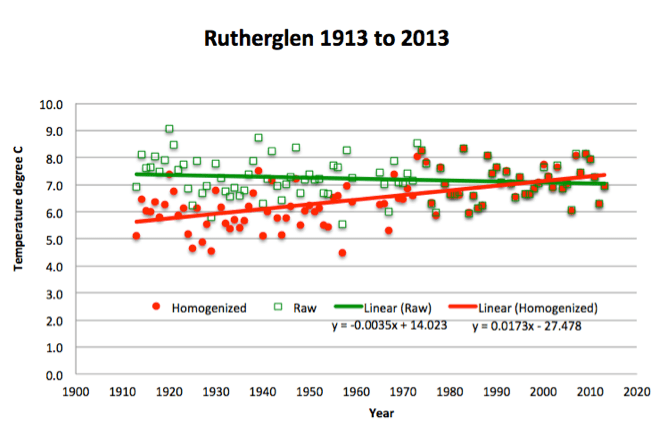
HEADS need to start rolling at the Australian Bureau of Meteorology. The senior management have tried to cover-up serious tampering that has occurred with the temperatures at an experimental farm near Rutherglen in Victoria. Retired scientist Dr Bill Johnston used to run experiments there. He, and many others, can vouch for the fact that the weather station at Rutherglen, providing data to the Bureau of Meteorology since November 1912, has never been moved.

Senior management at the Bureau are claiming the weather station could have been moved in 1966 and/or 1974 and that this could be a justification for artificially dropping the temperatures by 1.8 degree Celsius back in 1913.

Surely its time for heads to roll!

The temperature record at Rutherglen has been corrupted by managers at the Australian Bureau of Meteorology.


Some background: Near Rutherglen, a small town in a wine-growing region of NE Victoria, temperatures have been measured at a research station since November 1912. There are no documented site moves. An automatic weather station was installed on 29th January 1998.

Temperatures measured at the weather station form part of the ACORN-SAT network, so the information from this station is checked for discontinuities before inclusion into the official record that is used to calculate temperature trends for Victoria, Australia, and also the United Nation’s Intergovernmental Panel on Climate Change (IPCC).

The unhomogenized/raw mean annual minimum temperature trend for Rutherglen for the 100-year period from January 1913 through to December 2013 shows a slight cooling trend of 0.35 degree C per 100 years. After homogenization there is a warming trend of 1.73 degree C per 100 years. This warming trend is essentially achieved by progressively dropping down the temperatures from 1973 back through to 1913. For the year of 1913 the difference between the raw temperature and the ACORN-SAT temperature is a massive 1.8 degree C.

There is absolutely no justification for doing this.

This cooling of past temperatures is a new trick* that the mainstream climate science community has endorsed over recent years to ensure next year is always hotter than last year – at least for Australia.

There is an extensive literature that provides reasons why homogenization is sometimes necessary, for example, to create continuous records when weather stations move locations within the same general area i.e. from a post office to an airport. But the way the method has been implemented at Rutherglen is not consistent with the original principle which is that changes should only be made to correct for non-climatic factors.

In the case of Rutherglen the Bureau has just let the algorithms keep jumping down the temperatures from 1973. To repeat the biggest change between the raw and the new values is in 1913 when the temperature has been jumped down a massive 1.8 degree C.

In doing this homogenization a warming trend is created when none previously existed.

The Bureau has tried to justify all of this to Graham Lloyd at The Australian newspaper by stating that there must have been a site move, its flagging the years 1966 and 1974. But the biggest adjustment was made in 1913! In fact as Bill Johnston explains in today’s newspaper, the site never has moved.

Surely someone should be sacked for this blatant corruption of what was a perfectly good temperature record.

———-

Climate records contradict Bureau of Meteorology by Graham Lloyd, 27th August
http://www.theaustralian.com.au/national-affairs/climate/climate-records-contradict-bureau-of-meteorology/story-e6frg6xf-1227037936046

The story is behind a paywall. But if you don’t already have a subscription perhaps its time… this could just be the biggest story of the year.

** There are a lot of tricks that climate science managers have implemented over the years to fix the temperature record; that is fix it so it shows global warming. “Trick” was the word Phil Jones, a leading United Nation’s Intergovernmental Panel on Climate Change (IPCC) scientist, used to explain to his peers that, when constructing very long global temperature series using proxy data based on tree ring measurements that can extend back thousands of years, it was best to substitute thermometer data for this proxy data from about 1960 because the proxy data started to show cooling from about then. Indeed from about 1960 until 2002 the thermometer data mostly did show warming. But now even this instrumental record is starting to show cooling. Enter the relatively new trick of homogenization.

Windweasels Swarming US Market, After Europeans Started to “Wise Up”, and say NO!

Big Wind’s latest deceitful ad campaign

Siemens_big_wind_TV_adFacing trouble abroad, Siemens ads seek to tap into US taxpayers and wind welfare system

Guest essay by Mary Kay Barton

If you watch much mainstream TV, you’ve probably seen Siemens’ new multi-million-dollaradvertising blitz  to sell the American public on industrial wind. Why the sudden ad onslaught? Watch the video below.

The wind business abroad has taken a huge hit of late. European countries have begun slashing renewable mandates, due to the ever-broadening realization that renewables cost far more than industrial wind proponents have led people to believe: economically, environmentally, technically, and civilly.

Siemens’ energy business took a €48m hit in the second quarter due to a bearings issue with onshore turbines, and a €23m charge due to ongoing offshore grid issues in Germany – on top of subsidy and feed-in tariff cutbacks, recent articles have pointed out.

As Siemens’ tax-sheltering market dries up in Europe, its U.S. marketing efforts are clearly geared toward increasing its income and profits via wind’s tax sheltering schemes in the United States. The company stands to make millions, so Siemens ad campaign is obviously part of an overall pitch to persuade Congress to extend the hefty wind Production Tax Credit (PTC), more accurately called“Pork-To-Cronies.” As Warren Buffett recently admitted, “We get tax credits if we build lots of wind farms.  That’s the only reason to build them. They don’t make sense without the tax credit.”

Taxpayers and ratepayers, beware!

President Obama often says he intends to “close corporate loopholes,” but his PTC and other policies continue funneling billions of taxpayer dollars to his wealthy corporate insiders and campaign contributors – while we continue to rack up unconscionable debt for our children and grandchildren.

Increasing public awareness of the wind energy scam has led to increased opposition to extendingany more corporate welfare to Big Wind via the PTC and energy investment tax credit (ITC). Enter another bureaucratic end-run around once clear statutory language by this Administration.

As reported by the Wall Street Journal, the increasingly politicized IRS recently relaxed the definition of “commence construction” to the point where the definition bears no resemblance to the actual words.  During a hearing by the House Energy Policy, Health Care and Entitlements subcommittee last October, Curtis G. Wilson of the IRS admitted that developers can now game the system to the point where projects built years in the future could still meet the eligibility requirement for “commence” now.

U.S. taxpayers and ratepayers are doomed when, instead of allowing the markets to work, crony-corruptocrats are picking the winners and losers in the energy marketplace, using such nefarious tactics.

Sadly, most people don’t even know the difference between energy and power. This reality has built the framework for the biggest swindle ever perpetrated on citizens worldwide.  Many have bought into the alarmist argument that “we have to do something” to stop “dangerous manmade global warming.” Enter the wind industry sales department, primed to capitalize on public fears and alarmist hype.

Siemens also needs to convince the 80% of U.S. citizens who live in suburbia that industrial wind factories are “environment-friendly,” and everyone loves them. Thus, as usual for these disingenuous ad campaigns, a sprawling wind facility is pictured among green fields, with no homes anywhere to be seen, no birds are being slaughtered, while a happy Iowa leaseholder smiles and says she loves wind.

A drive out Route 20A in Wyoming County, western New York State, however, tells a far different story. The western side of Wyoming County – which used to be some of the most beautiful countryside in New York State, has been industrialized with 308 giant, 430-foot-tall towers, and their 11-ton, bird-chopping blades spinning overhead, only hundreds of feet from peoples’ homes and roadways. There’s no doubt that Siemens won’t be showing you this reality in any of their TV ads!

Unfortunately for the residents of Orangeville in Wyoming County, greed at the top in Washington, DC determined their fate. The sole reason Invenergy went ahead with its plan to build its 58-turbine project was that, in the early morning hours of January 1, 2013, the PTC was added as pork for companies sucking at the wind welfare teat.

Ever appreciative of the handouts, Invenergy owner Ukrainian Michael Polsky rewarded President Obama by holding a $35,000 a plate fundraiser at his Chicago mansion. Mr. Obama is so committed to Big Wind that he’s even legalized 30-year eagle kill permits just for the wind industry. Anyone else harming an eagle, or even possessing a single bald eagle feather, is penalized with an iron fist.

There you have it – corporate cronyism in all its glory, with bird murder as its crowning achievement.

Word of impending lawsuits lingers in Orangeville. It remains to be seen if disenchanted leaseholders will end up suing Big Wind, as others have. In the meantime, we’re hoping we don’t have any 11-ton blade breaks that throw shrapnel for thousands of feet, or any airplanes crashing into wind turbines during fog, as occurred in South Dakota earlier this year, killing all four on board. (I’ll bet you won’t be seeing any of these facts in Siemens’ ads, either.)

Our elected officials need energy literacy. Even a small dose would help.

What’s most frustrating, when attempting any kind of correspondence regarding these energy issues with many elected officials, is the kind of response I received from Senator Chuck Schumer (D-NY)when I wrote him a letter about ending the Wind PTC. Senator Schumer never even mentioned the PTC in his response. Instead, he rambled on about the need to “reduce foreign oil imports,” and increase “efficiency” – neither of which has a thing to do with wind-generated electricity.

Mr. Schumer recently feigned alarm following complaints by citizens about soaring electric rates – demanding answers about it, while simultaneously supporting yet another Wind PTC extension (plus other rate-increasing “renewable” projects). Senator Schumer’s hypocrisy is outrageous, and unacceptable.

Perhaps it’s time for U.S. ratepayers and taxpayers to demand that their elected officials first pass an energy literacy exam, before they pass such cost-exorbitant, “green” boondoggles on to consumers.

Congress is on vacation through Labor Day, which makes this the perfect time to approach your senators and representatives while they’re home.  Attend town hall meetings and in-district fundraisers. Remind your representatives that we put them in office, and that we can also vote them out!

Since energy plays a pivotal role in our national economy – impacting the cost of absolutely everything else – candidates should have “energy” listed on their “issues” webpage.

Good candidates will support an All of the Sensibleenergy policy, as opposed to the “All of the Above” energy policy which President Obama has been pushing on behalf of the “green” movement.“Sensible” alternative energy options are those that are backed up by scientific and economic proof that they provide net societal benefits. Industrial wind fails this test miserably!

For more information, refer friends and elected officials to Robert Bryce’s excellent book, Power Hungry: The myths of “green” energy and the real fuels of the future.

Continue to call and write their offices, and encourage them to oppose any extension of the PTC and ITC! Write letters to your local newspapers, copy their district offices, and post information on their social media pages (e.g., Face Book & Twitter).

We must demand accountability from elected officials, or vote them out! Reliable, affordable energy is what has made America great. We need to keep it that way.

Mary Kay Barton is a retired health educator, New York State small business owner, Cornell-certified Master Gardener, and is a tireless advocate for scientifically sound, affordable, and reliable electricity for all Americans.

Liberal Government Won’t Put a Wind Project Near Their Home in Toronto!!!

Ontario Place Grounds Would be Perfect For A Wind Project!

Bow Lake makes wind farm fight tough: MILLS 

By Tom Mills, Sault Star

With a government that continues to stack the procedural and legal deck against those who oppose the intrusion of wind farms on their neighbourhoods, you might expect to see turbines almost everywhere.

But it would take a sharp eye to spot one anywhere near the GTA. Wind-energy-watching is much easier in Algoma, Bruce and Chatham-Kent, which house about a third of Ontario’s turbines.

In a past column I mentioned the Toronto waterfront, where offshore wind turbines were seriously proposed. Then a Liberal government moratorium in 2011 put an end to the foolish notion of locating green energy generation where it might be consumed.

I’ve also suggested turbines be put in shopping malls, industrial parks and other places of large-scale ugliness within the bounds of the Greater Toronto Area.

One reader came up with the very feasible idea of lining Highway 400 with turbines from Barrie to Canada’s Wonderland.

Last week I found a couple of new prime locations: the Niagara Escarpment and the quaint main street of Niagara-on-the-Lake. Both seem to have wind in abundance.

Now NOTL, whose strict bylaws preserving the character of the historic village were strong enough to give a McDonalds sign fallen arches, would break out the 1812 muskets at the idea of blades whooshing o’er the fudge shoppes and inns.

And wine country doubtless would sour at the idea of blinking red lights festooning the limestone ridge like a strand of tacky Christmas lights.

But could they do much about it? I doubt it.

Preposterous, you say?

Well, a ruling last month by an environment ministry review panel on a wind farm north of Sault Ste. Marie makes it more daunting for anyone anywhere in Ontario to oppose a wind farm.

That panel shot down attempts by seasonal resident James Fata and others to block installation of turbines on a scenic hill area near the Lake Superior coast, the Bow Lake wind farm near Montreal River.

In the process, it pared down the grounds anyone could use to oppose a wind farm.

Both the approval and appeal processes set up by Ontario’s MOE already were heavily weighted against wind farm opponents.

As the tribunal’s decision notes, “An appellant is required to prove . . . that a project will cause the harm,” not just raise “the potential for harm.” No onus on the developer.

That seems akin to the government allowing pharmaceutical companies to dump drugs on the market and then requiring consumers to conduct scientific studies proving them to be unsafe.

And a tribunal is severely limited as to what reasons it can allow an opponent to use to object to a wind farm. None of that “scenic beauty” stuff for our ministry, even though this particular tribunal granted that the Superior landscape is “iconic.”

But the tribunal narrowed things even more by chopping references to property devaluation, economic impact on the tourism industry and a “prejudiced and unilateral consultation process” from the appeal.

That left Fata et al trying to prove turbines cause indisputably serious harm to human health, something many others have tried and failed, or latching on to an animal species that would be seriously and irreversibly harmed, in this case some little brown bats.

Evidence at the hearing suggested while turbines would doom a whole bunch of little brown bats, there are plenty more little brown bats where those came from.

And the tribunal rejected arguments by people such as adventurer Joanie McGuffin that the visual and social impacts of wind turbines on a natural landscape so striking as to have been featured by the historic Group of Seven artists could result in human health consequences.

So I’d say that leaves folks in Niagara with not too many weapons in their arsenal if some incentive-hungry developer proposed a wind farm.

Scenic beauty? Forget it. Historical significance? Nope. Tourist industry? Not likely.

About all that could stop a wind farm on NOTL’s Queen Street or along the escarpment is the fact that those places lie in the Greater Toronto Area’s back yard, much beloved of Kathleen Wynne’s Liberal government.

Yep. That should do it.

Email tom.mills@sunmedia.ca to contact Tom Mills. Comment at saultstar.com.