Falmouth Liars! Same Corrupt Behaviour In Ontario!!

FALMOUTH HID NOISE LETTER 5 YEARS TO AVOID ABUTTER NOTIFICATIONS

The 2010 Vestas noise warning letter kept secret for 5 years. It is clear public officials always knew the turbines were too loud.
FALMOUTH HID NOISE LETTER 5 YEARS TO AVOID ABUTTER NOTIFICATIONS

FALMOUTH HID NOISE LETTER 5 YEARS TO AVOID ABUTTER NOTIFICATIONS AND SPECIAL PERMITS WHICH WOULD REQUIRE ADDITIONAL NOTIFICATIONS

Section 240-166 incorporates by reference the Bylaw’s general special permit requirements and also states that the ZBA shall consider adverse impacts on the neighborhood including noise. The ZBA has the power to impose conditions on the grant of a windmill permit.

THE TOWN FAILED TO FILE THE SPECIAL PERMITS TO AVOID ABUTTER NOTIFICATIONS & SPECIAL PERMITS

The Town of Falmouth has never posted or made public the Vestas 2010 wind turbine noise letter.

Falmouth public officials owe it to the public to explain why they hid the letter for 5 years.

After 5 years of noise complaints why didn’t at least one public official come forward.

Thousands of certified written noise complaints have been made.

The letter warned the town that the Vestas wind turbines they were purchasing were 6 decibels higher than the smaller General Electric turbines used in prior noise study models.

The public-duty doctrine holds that the government and its officials owe a legal duty to the public at large. Why was the letter omitted and when do omissions become lies ?

Federal prosecutors have weapons to prosecute public corruption, especially with respect to state and local corruption, where the pertinent statutes empowers them to challenge almost any unlawful, questionable or unethical conduct of a public official, subject to the prosecutor’s exercise of sound discretion.

More from Falmouth Patch

RICO prosecutions give prosecutors even more discretionary prosecution power.

The Town of Falmouth never applied for Special Permits for their two town owned wind turbines.

The turbines are named Falmouth Wind 1 and Falmouth Wind 2.

Prior to the installations a private company conducted flawed acoustic noise models using 1.5 megawatt General Electric wind turbines that generate a maximum of 104 decibels of noise.

The original flawed tests “mistakes” were admitted by the Massachusetts Clean Energy Center three years after the installation of Falmouth Wind 1. The admission date came in a memo from MassCEC staff to the MassCEC Board of Directors on April 2, 2013

The private wind testing company actually prepared Special Permit applications under the Town of Falmouth wind turbine bylaws. The Town of Falmouth never filed Special Permits for either turbine.

In the past few months information has come to light that shows why the Town of Falmouth never filed “ Special Permits.”

The Town of Falmouth ignored its own wind turbine bylaw 240 -166 because the bylaw would require additional wind studies, notifications and additional time to install the Vestas wind turbines with a high rating of 110 decibels of noise .

Recently through a FOIA, Freedom of Information Request it has been found the Town of Falmouth was holding back a year 2010 warning letter from Vestas wind company that the wind turbines being installed generated up to 110 decibels of noise. This is 6 decibels higher than the Falmouth Community Wind Project Site Screening Report November 2005.

Special Permits would never have been issued under the Falmouth wind turbine bylaw 240 -166 with turbines that generated 110 decibels of noise. Under the Special Permit process additional notifications and time may have alerted local residents. There were NO noise studies for Falmouth Wind II. There were NO studies for a combination of Falmouth Wind 1 and Wind II.

The town hid the embarrassing letter from public view. The town has never posted the letter on its website or mentioned the letter at any public meeting.

The town while in possesion of the August 2010 letter made abutters to the wind turbines file elaborate certified written notifications to the town that the turbines were too loud. The town had always know the turbines were too loud. Vestas wind company told them in writing . It’s in Black and White !

Falmouth Town Meeting Members and the public in general are being kept in the dark over this letter while the town spends hundreds of thousands of dollars on a legal defense that is indefensable.

Taxpayers are paying litigation fees for up to eleven types of ongoing litigation including nuisance, bylaw. permitting and appeals while the Town of Falmouth sat on this letter for five years.

The Town of Falmouth was aware the turbines were 7 Decibels higher that the manufactures specifications. Every 3 DCB increase is a doubling of sound and acoustic power to the human ear and that is simply an intolerable increase.

In the following letter Vestas wind company reiterates in writing that the Town of Falmouth had been previously warned the turbine generates up to 110 decibels


“The Town has previously been provided with the Octave Band Data / Sound performance for the V82 turbine. This shows that the turbine normally operates at 103.2dB but the manufacturer has also stated that it may produce up to 110dB under certain circumstances.”

August 3, 2010
Mr. Gerald Potamis
WasteWater Superintendent
Town of Falmouth Public Works
59 Town Hall Square
Falmouth, MA 02540

RE: Falmouth WWTF Wind Energy Facility II “Wind II”, Falmouth, MA
Contract No. #3297

Dear Mr. Potamis,

Due to the sound concerns regarding the first wind turbine installed at the wastewater treatment facility, the manufacturer of the turbines, Vestas, is keen for the Town of Falmouth to understand the possible noise and other risks associated with the installation of the second wind turbine.

The Town has previously been provided with the Octave Band Data / Sound performance for the V82 turbine. This shows that the turbine normally operates at 103.2dB but the manufacturer has also stated that it may produce up to 110dB under certain circumstances. These measurements are based on IEC standards for sound measurement which is calculated at a height of 10m above of the base of the turbine.

We understand that a sound study is being performed to determine what, if any, Impacts the second turbine will have to the nearest residences. Please be advised that should noise concerns arise with this turbine, the only option to mitigate normal operating sound from the V82 is to shut down the machine at certain wind speeds and directions. Naturally this would detrimentally affect power production.

The manufacturer also needs confirmation that the Town of Falmouth understands they are fully responsible for the site selection of the turbine and bear all responsibilities to address any mitigation needs of the neighbors.

Finally, the manufacturer has raised the possibility of ice throw concerns. Since Route 28 is relatively close to the turbine, precautions should be taken in weather that may cause icing.

To date on this project we have been unable to move forward with signing the contract with Vestas. The inability to release the turbine for shipment to the project site has caused significant [SIC] delays in our project schedule. In order to move forward the manufacturer requires your understanding and acknowledgement of these risks. We kindly request for this acknowledgement to be sent to us by August 4, 2010, as we have scheduled a coordination meeting with Vestas to discuss the project schedule and steps forward for completion of the project.

Please sign in the space provided below to indicate your understanding and acknowledgement of this letter. If you have any questions, please do not hesitate to call me.

Sincerely,

(Bruce Mabbott’s signature)
___________________
Bruce Mabbott Gerald Potamis
Project Manager Town of Falmouth

CC: Sumul Shah, Lumus Construction, Inc.
(Town of Falmouth’s Wind-1 and Wind-2 Construction contractor)

Stephen Wiehe, Weston & Sampson
(Town of Falmouth’s contract engineers)

Brian Hopkins, Vestas
(Wind-1, Wind-2’s turbine manufacturer, and also Webb/NOTUS turbine)

http://www.windaction.org/posts/41357-vestas-raises-concerns-about-turbine-noise-letter#.Ve9oyhFVikp

Note #

The specific problems with location of wind turbines near human populations are as follows:

1.) Health of nearby residents at serious risk: Sleep deprivation from wind turbine low frequency noise (thumping and rumbling heard and felt inside the homes of neighbors) have caused problems for many families.

2.) Turbine malfunctions, fires, ice throw sudden catastrophic blade failures: Wind turbine manuals detail that workers should “run upwind” a minimum distance of 1640 feet from a wind turbine which is on fire or in danger of blade failure to avoid the danger of flying debris.

More Proof that Wind Energy is a SCAM! It’s NOT About the Environment!!!

UK’s Wind ‘Powered’ Disaster: Britain to Roll Out Thousands of Diesel Generators for 1.5GW of Wind Farm ‘Back-Up’

diesel generators UK

It’s either spending £billions on 1.5GW worth of these, or …..

****

Thanks to its ludicrous wind rush, Britain is reeling with a combination of skyrocketing power prices and a grid on the brink of total collapse:

Another Wind Power Collapse has Britain Scrambling to Keep its Lights On (Again)

Now, in the mother of all ironies, Brits are turning to the most inefficient and costly to run source of commercial power generation there is: diesel generators. Not, as it turns out, that they have much choice in the matter.

UK turns to diesel to meet power supply crunch
Financial Times
Kiran Stacey
3 November 2015

Britain is set to grant hundreds of millions of pounds in subsidies to highly polluting diesel generators as a way to help solve the energy supply crunch facing the country over the next 15 years.

Analysis of publicly available figures shows that companies have registered to build a total of about 1.5 gigawatts of diesel power under a government scheme to encourage back-up energy for the grid. The figures have been analysed by the Financial Times and experts at both the Institute of Public Policy Research and Sandbag, an environmental think-tank.

If all of those registered are successful in their bids — which analysts believe is likely — it could cost the taxpayer £436m, provide enough energy to power more than 1m homes and emit several million tonnes of carbon a year.

The subsidies on offer are so appealing that even solar-power developers, which have recently had their own subsidies cut, are building diesel generation on their sites as a way of maximising their returns. Lark Energy, a solar-power developer, is bidding for subsidies to build 18MW of diesel generation on its Ellough project in Suffolk, for example.

The UK is facing serious energy-supply difficulties over the next few years as old coal plants are taken offline without new power plants being built to replace them. National Grid, which runs the country’s power network, has predicted that the gap between electricity supply and demand this winter could get as close as 5 per cent — the tightest in a decade.

As part of the solution to that problem, ministers last year decided to start paying electricity providers extra money to make additional capacity available at short notice should the need arise.

They did so by holding an auction where companies bid for those subsidies, which they hoped would encourage gas plants to be built. Instead, it was more successful in giving incentives to other forms of generation such as nuclear power.

This year diesel looks to be one of the main beneficiaries of the process, with 1.5GW of generation having successfully registered for the bidding process.

The collapse in the oil price over the past year has driven down the price of electricity supply, making it uneconomic for companies to build capacity with high capital costs, such as new gas plant.

Dave Jones, power sector expert at Sandbag, said: “All diesel operators have to do is buy in diesel units in shipping containers from China and plug them into a grid connection.

“The low capital cost means that they can undercut things like gas.”

If all of those schemes secure government funding at the same level as last year, it would cost the taxpayer £436m.

According to the International Energy Agency, diesel electricity production emits only slightly less carbon than burning coal, and if the power plants were to run full-time for a year, they would emit 10m tonnes of carbon. They will avoid having to pay for their carbon pollution under the European emissions trading scheme, however, because they are too small to do so.

They would also emit a significant amount of nitrous oxide, though the exact figure is unknown. As a comparison, 1.5GW of power is equivalent to that used by 24,000 Volkswagen Golfs.

Ed Davey, the former energy secretary who set up the scheme, known as the “capacity market auction”, said the problem arose because of EU rules that forbid discriminating against any one type of generation.

Mr Davey told the FT: “At no time when I was secretary of state did people say we were going to get flexible diesel, but I have now heard about large amounts of diesel being preregistered for the auction.

“The government has got to take measures to stop it, because it is extraordinarily counterproductive and absolutely was not what was intended by the capacity auction. We don’t want diesel plants being built anywhere.”

Until last week, many diesel operators expected to be eligible for two types of subsidy: through the capacity auction and via tax breaks granted through a separate enterprise investment scheme.

But ministers have recently decided to close this loophole, writing a clause into the finance bill passing through parliament to ban companies participating in the capacity auction from also claiming these tax advantages.

A wider boom in diesel is also being driven by measures taken by National Grid to encourage industry to cut its power usage. In an attempt to widen the gap between supply and demand this winter, the company has agreed to pay large energy users, such as factories and hospitals, to switch over to back-up generation — much of which is diesel-powered — when necessary.

Doug Parr, chief scientist at Greenpeace, said: “Ministers claim to be helping consumers by cutting support for the cleanest energy sources but are about to force them to pay millions to one of the dirtiest.”

Tim Emrich, chief executive of UK Power Reserve, which owns existing diesel-power generation but now concentrates on gas, called on ministers to halt the auction altogether.

He said: “The only way to avoid this happening is to delay or cancel the 2015 capacity market auction. The government needs to ensure that we as taxpayers are buying the right kind of generation for the future . . .  not wasting Treasury incentives on the diesel generation of the past.”

A spokesperson for the energy department said: “Small-scale flexible generation, such as diesel, has a small but important role to play in securing our electricity system. It responds quickly, doesn’t have to warm up and is run for short periods, so emission impacts are limited.”
Financial Times

ed davey DECC

Ed Davey: about as bright as an energy saving 5 watt globe …

****

There’s only one reason that Britain is about to spend 100s of £millions on diesel generation; and that’s to cover routine, total and totally unpredictable wind power output collapses.

ukgrid_19jan_2015

On that score, STT notes a particularly valiant effort from former wind industry front man, Ed Davey – with his suggestion that “At no time when I was secretary of state did people say we were going to get flexible diesel” and that diesel generation “was not what was intended by the capacity auction. We don’t want diesel plants being built anywhere”.

You see, Ed is well and truly on the hook for the debacle that is Britain’s energy ‘policy’; and the claim that he didn’t see the need for diesel coming is utter bunkum.

James Delingpole was all over it more than 2 years ago, at a time when Davey was top banana at the DECC, and fully aware of the diesel roll-out that was on in earnest, way back then:

Delingpole On Fire: Exposes $Billions Spent on Diesel Generators for Wind Power Backup

No, Ed’s political legacy has left Britain facing the choice between millions of highly inefficient diesel generators, costing taxpayers and power consumers £billions to subsidise, set up and run; or a whole lot more candlelit, cold baked bean dinners.

baked beans in the dark

or … tucking into cold baked beans every other night, with
the enforced ‘romance’ of a few flickering candles.

Not Often CNBC Allows an Article Like This….”How Mother Nature Helps prevent Climate Change!”

How Mother Nature helps prevent climate change

1 Hour Ago

Large floating contraptions, used by scientists to predict the acidity in the oceans, sit offshore the scientific outpost of Ny-Alesund. The cold water at the poles is able to absorb more carbon dioxide than tropical waters and therefore increases acidity quicker. Though it is a relatively small amount, the effects on the ocean's chemistry can be dramatic.

Martin Bureau | AFP | Getty Images
Large floating contraptions, used by scientists to predict the acidity in the oceans, sit offshore the scientific outpost of Ny-Alesund. The cold water at the poles is able to absorb more carbon dioxide than tropical waters and therefore increases acidity quicker. Though it is a relatively small amount, the effects on the ocean’s chemistry can be dramatic.

Humans worried about climate change are getting some help from Earth — for now.

Earth’s land and ocean currently absorb about half of all carbon dioxide emissions from the burning of fossil fuels and other sources. But the amount of carbon entering the atmosphere may be changing nature in ways that leave scientists uncertain whether the planet can keep absorbing even that amount of carbon in the future.

Since the Industrial Revolution, carbon levels have increased 2.5 times to more than 400 parts per million at present, said Michael Freilich, director of NASA’s Earth Science Division, in a call with reporters Thursday. That is higher than it has been in the last 400,000 years.

He added that scientists know, from ice cores and other information, that carbon levels in the atmosphere hovered between 180 and 280 parts per million until about the 1800s.

Freilich and his colleagues at NASA and other institutions discussed the need for more research into how the planet absorbs greenhouse gases, such as carbon dioxide. They also discussed new evidence taken from Orbiting Carbon Observatory-2 — NASA’s first satellite designed to measure carbon dioxide “from the top of Earth’s atmosphere to its surface,” according to a NASA press release.

The data from space gives a significant advantage in getting an idea of the total carbon cycle around the entire planet, said Annmarie Eldering, OCO-2 deputy project scientist at NASA‘s jet propulsion laboratory in Pasadena, California.

On average about half of all of the carbon that enters the atmosphere is absorbed by the ocean or by forests — though that can vary, and some evidence suggests the increased levels of carbon in the ocean may be creating conditions — such as raised acidity levels in seawater — that are making it more difficult to absorb carbon, said Scott Doney, chair of the Marine Chemistry and Geochemistry Department of the Woods Hole Oceanographic Institute.

“The land and the ocean are really doing us a big favor,” said Lesley Ott, an atmospheric scientist in the Global Modeling and Assimilation Office at NASA‘s Goddard Space Flight Center in Greenbelt, Maryland, in a press release. “Otherwise you would have carbon building up in the atmosphere twice as fast as it does now.”

Forests on land — increasingly prone to wildfires — may be emitting more carbon than they take in, as well. Wildfires were rampant across much of the western United States in 2015. Research released this year said wildfire seasons are lasting longer almost everywhere on the planet. Even Alaska saw an unusually high number of wildfires this year.

Warming is also causing permafrost on the world’s tundras to thaw, which is releasing greenhouse gases into the atmosphere as well, according to research.

Even natural gas harvesting is leaking small amounts of methane into the air, and there are questions about whether that could be making any contribution to the total amounts of gases in the air, Doney said.

And natural processes — including weather patterns and periodic climate phenomena such as El Niño — have been seen to have some kind of effect on atmospheric carbon levels, but scientists need to study this further.

Added together, these factors may have considerable effects on the natural processes that absorb carbon, and on the effects of higher carbon levels in the atmosphere.

NASA has been working on several projects that are attempting to get an accurate assessment of the carbon cycle around the globe. They hope they will be able to provide policymakers with more accurate data in the future. Atmospheric carbon levels will be a major topic of discussion at the United Nations climate conference scheduled for Paris in a few weeks.

Windpusher’s Noise Studies Have Fatal Flaws…..Not Surprising!

Major Flaw Massachusetts : Wind Turbine Health Impact Study 2012

Vestas, is keen for the Town of Falmouth to understand the turbines produce up to 110 decibels of noise. Twice the written specifications.
Major Flaw Massachusetts : Wind Turbine Health Impact Study 2012

Major Flaw Massachusetts : Wind Turbine Health Impact Study 2012

Falmouth turbines110 decibels not 103.5 decibels

The Massachusetts expert panel reviewed literature and public media sources and met three times.

During 2012 the time of the Massachusetts wind health impact study it was assumed the Vestas V-82 commercial wind turbine in Falmouth had a manufacturers specification of a maximum output of 103.5 decibels.

The expert panel was unaware that in 2004 NEG Micon was a former Danish wind turbine manufacturer of the V-82 turbine and had merged with Vestas wind company. The V 82 generates up to 110 decibels before the cut out speed.

A University of Massachusetts overview of the ” 2012 Wind Turbine Health Impact Study” highlights chest pounding at 110 decibels.

The Massachusetts expert panel had no knowledge in 2012 the Vestas V 82 wind turbine generated 110 decibels.

Recently the Town of Falmouth released a warning letter from Vestas Wind Company in 2010 that stated the Vestas V 82 does in fact produce 110 decibels of noise. See letter bottom of page.
………………………………………………………………………………………………………………………………..

The Study :

Massachusetts : Wind Turbine Health Impact Study: Report of Independent Expert Panel January 2012 Prepared for: Massachusetts Department of Environmental Protection Massachusetts Department of Public Health ;http://www.mass.gov/eea/docs/dep/energy/wind/turbine-impact-study.pdf
—————————————————————————————————————————————————
The Overview

Overview: Wind Turbine Health Impact Study. MA, 2012. Overview of. Wind Turbine Health Impact Study: Report of Independent Expert Panel. James Manwell. Department of Mechanical and Industrial Engineering. UMass

Slide 1
webcache.googleusercontent.com

http://webcache.googleusercontent.com/search?q=cache:VB0rwexXu_AJ:https://www.umass.edu/windenergy/sites/default/files/downloads/mwwg/Wind_Turbine_Health_Impact_Study_Panel_Presentation_2-1-12.pptx+&cd=3&hl=en&ct=clnk&gl=us

See this section under scroll down the page to infrasound and see section about 110 decibels
MA, 2012
Noise and Vibration –

Infrasound (less than 20 Hz)
can be heard if at very high level (> 110 dB)
can be felt (chest pound) if at very high level (> 110 dB)

Windpushers are so Corrupt, it Will Turn Your Stomach! Liars & Thieves!

Next on Patch » John Wesley United Methodist Church Youth Group Holds…

Massachusetts Epicenter Of US Wind Turbine Corruption

Falmouth, Massachusetts Ground Zero For Poorly Placed Wind Turbines Using Vestas Wind Turbine Company.
Massachusetts Epicenter Of US Wind Turbine Corruption

Massachusetts Epicenter Of US Wind Turbine Corruption

Falmouth, Massachusetts Ground Zero For Poorly Placed Wind Turbines Using Vestas Wind Turbine Company.

The Massachusetts Technology Collaborative, MTC, today known as the Massachusetts Clean Energy Center, MassCEC, bought two massive commercial Vestas V-82 commercial wind turbines to place in residential communities.

The trail of corruption starts in 2004 with the Massachusetts state legislature and former Governor Deval Patrick also known as “Sally Reynolds” to wind turbine contractors.

The former author of the “Green Communities Act” Massachusetts Speaker of the House Sal DiMasi sits in an undisclosed federal prison serving an eight year sentence for corruption.

Vestas wind company had to OK site plans to install any of its wind turbines in the United States. They gave the OK to install two town owned Vestas V-82 commercial 1.65 megawatt wind turbines in Falmouth, Massachusetts.

Vestas wind company had merged with a company called NEG Micon and was well aware the V-82 megawatt turbine installed in Falmouth produced 109 decibels of noise over twice the manufacturers written specifications. Vestas admitted the noise level in an August 3, 2010 letter to the Town of Falmouth, Massachusetts. The Town of Falmouth hid the letter from the public until recently.

The MassCEC also dropped the warning of two distinct types of noise found in all boiler plate noise studies prior to the Falmouth wind turbine installations. The two types of noise were “regulatory” measured in decibels and “human annoyance” measured in low frequency. The noise tests were corrupt because they omitted warnings that would have alerted residents as they did in other towns prior to Falmouth. If this wasn’t corrupt was is corrupt ?

The Massachusetts Clean Energy Center unable to place the wind turbines in other communities extrapolated acoustic noise test results in Falmouth to come in under Massachusetts Department of Environmental Protection laws. As soon as the first turbine started in 2010 in Falmouth the noise complaints started. The corruption started to take the health and property rights of the residents. The MassDEP notified the Town of Falmouth the turbines are out of state noise compliance. The corrupt politicians always knew it would be.

Everyone involved in the installations of the Falmouth turbines knew the turbines were too loud. They needed a hook to fish in the local officials. The MassCEC unable to sell the loud turbines anywhere including an auction had to bribe local officials with one million dollars in renewable energy funds. They took the bait and went forward illegally permitting the turbines knowing the special permit requirements would require additional tests and notifications. How do you spell c-o-r-r-u-p-t-i-o-n?

Massachusetts officials embarrassed over the corruption over the poor placement of commercial wind turbines in Massachusetts are now going all in on the gamble they took with the health and property rights of its own citizens. More taxpayer money to cover up the corruption !

The MassCEC has provided the Town of Falmouth with another 1.8 million more in renewable energy funds to hire a Boston law firm to outspend the Falmouth victims who lost their health and property rights.

The plan now is to take the victims property through Article 2 at Falmouth Special Town Meeting November 10, 2015. The town wants to take up to 200 residential homes or purchase easements from the homes within 3000 feet of the turbines. The article creates the possibility of a 70 million dollar class action litigation of the homes based on an average cost of 350 thousand per home. The Falmouth Select Board has endorsed this article. The Boston attorneys may as well move to Falmouth for the foreseeable future. Another ten years of litigation.

The Massachusetts courts have ruled the wind turbines were illegally installed. The town now wants to go back in time and ask Town Meeting Members to change the laws in Article 3 at Falmouth Special Town Meeting November 10, 2015. This article creates a group of second class citizens living around the wind turbines. The Massachusetts constitution does not allow second class citizens.

There are many other communities in Massachusetts facing the same issues. Massachusetts has created a special class of second class citizens in Massachusetts who have had their health and property rights taken with no compensation.

It should be noted the news media in Massachusetts has to share the guilt as well. Over the years the main stream media has reproduced state press releases about commercial wind as real stories or what I call “puff” stories. It’s no secret editors of local news papers have retired and gone on the work for the Massachusetts Wind Energy Center. You be good to us and we will be good to you in the old boy network.

When Falmouth Wind 1, the first town owned wind turbine began to spin residents around the turbines immediatly began to complain about noise. During the first year the Falmouth Board of Health issued a special wind turbine noise complaint form. Today the Falmouth Board of Heath is in posession of thousands of certified hand or electronically written noise complaints, documents, studies and memos.

The certified noise complaints are the number one proof that the turbines were built far too close to residential homes. The written certified noise complaints are documents that show the main complaint of a lack of sleep.

Sleep deprivation causes impaired memory and cognitive functioning, decreased short term memory, speech impairment, hallucinations, psychosis, lowered immunity, headaches, high blood pressure, cardiovascular disease, stress, anxiety and depression.

Sleep deprivation is the major complaint from the wind turbine victims in Falmouth and other communities with megawatt turbines placed in residential communities.

The Falmouth Board of Health recently ignored all the thousands of complaints, documents and studies and only produced one document out of thousands for the Special Permitting process going on today. The omission of all the other documents is corruption. What else do you call the constant omission and deleting of the truth ?

Town Meeting Member David Moriarty discusses the upcoming Special Town Meeting concerning Wind 1 on youtube :https://www.youtube.com/watch?v=Vs8SwaR4KjE&feature=youtu.be

Harvey Wrightman Explains How One Wind Company is Bilking Taxpayers for $287,040,645.00 Per Year.

Here’s how NextEra makes $287,040,645/year from Ontario wind projects

NexterasMillionsOntarioby Harvey Wrightman
Seven years ago when we first entered the fight against wind projects, everyone including myself assumed that wind companies sought to put their turbines on the sites with the most wind. Wind data was gathered and fiercely guarded by wind companies, the data being “proprietary.”  That’s how it is in the real world – performance is the goal or should be.

Well, in the alter-world that is Ontario Energy Policy, real data is undesirable. Imaginary data is much more useful. It’s almost impossible to find out how much the wind companies are getting paid. The terms of the Feed in Tariff (FiT) contracts are never released to the public – that’s also proprietary and confidential information.  However, from the minutes of the final Community Liaison Committee (CLC) meeting for NextEra’s Adelaide wind project in mid July this year, a smidgeon of real data did surface revealing how much power NextEra was claiming to have produced – it’s a lot more than anyone ever expected.


Here Operations Manager, Peter Miller, let slip how much NextEra was billing the Ontario Power Authority for power production (p 7):

“ … over 160,000 MWH of wind energy has been produced since commercial operation.”

That’s 160,000 MWh for 9 months, or 213,000 MWh/year.

Nameplate capacity for  Adelaide Wind is 60 MW which means Adelaide Wind will produce 60 MWh x 24h x 365 days = 525,600 MWh/year if at 100% of capacity.  This means that Adelaide Wind is claiming production efficiency of 41%!

At $135/MWh the Adelaide Wind project will rake in $28,755,000/year.

But, but, but… real world operational efficiency in SW Ontario rarely exceeds 25%according to the Independent System Operator (IESO) records. The windiest sites mightgenerate close to 40%, but that’s definitely the exception. It seems the Ontario government has decreed that the wind industry shall be paid what the wind industry believes it should be paid. Real numbers/data don’t matter.


Then a question is posed as to how the  Independent System operator (IESO) determines who gets to put power into the grid (p 9). Ben Greenhouse, NextEra Executive Director of Development states:

 “… our electricity system is bizarre … If we bid zero [to IESO, system operator], we would get zero from IESO but we would get compensated at the end of the month for our contract price which is 13.5 cents per kilowatt [$135/MWh].”

Greenhouse conveniently neglects to say that the grid must take renewable (wind/solar/biomass) if available over any other source, and the price for wind is 13.5 cents/KWH. He also doesn’t explain the complex calculation process used to determine the “theoretical availability” of a wind project. Whether it is operating or not doesn’t matter. It’s the theoretical or imaginary availability that does matter for payment purposes.

What the grid managers do to fill in the “theoretical” gaps is their headache. Wind companies could care less.

With payments based on an imagined capacity factor of a whopping 40%, it hardly matters where the project is sited – it could be in a cave!  A little bit of creative data and you’ll be paid close to max. No doubt this is standard industry practice.


Let’s see how much of the $28.755 million filters down to the community. NextEra presents the annual payments to the municipality and lease-signed landowners (p 5):

Property taxes                        $250,000
Lease payments                     $500,000
Community contribution         $150,000

Total:               $900,000 or 3% of earnings goes to host community. 

Estimating maintenance at ~ $2 million/year, total annual costs of Adelaide Wind come in around $3,000,000/year. This leaves NextEra Adelaide Wind with a tidy profit of $25,755,000/year.

Adelaide Wind cost ~$132 million to build.  The return on investment is 19.5%! Where else can you get that?

I haven’t included the financing costs because these projects offer so many “securities packages” that are secured by liens on the farmland.  Since the operating companies are “shell” entities lacking any real assets, attaching a lien to the leaseholder property is rather convenient.

Note also that NextEra states:

“Previous estimates included taxation on transmission line infrastructure, which we have determined is currently not being assessed.”

Once again Nexterror delights in rubbing a bit of dirt in your face.


Presently NextEra has 592 MW of nameplate capacity in its Ontario wind projects.  Using the same calculated 41% capacity factor, NextEra will earn $287,040,645/year from its Ontario wind projects. Not much wonder they want to build more!

…and on an even larger scale, Ontario has 4042 MW of nameplate wind capacity.  Using that figure from CanWEA , the yearly cost to Ontario homes and industry is about $2 billion/year for wind turbines – most of it imaginary power that has never been produced.

Wind Industry Thugs….Destroying Lives, With Impunity. (Gov’t sanctioned)

Fighting a Monstrous & Cruel Industry: Ireland Declares War on the Great Wind Power Fraud

1397574371-dublin-thousands-gather-to-protest-against-pylons-and-wind-turbines_4479876

****

What kills the wind industry is facts; including the fact that rural communities are fighting back, simply because THESE THINGS DON’T WORK at any level. Here’s a tale from the Emerald Isle that combines just about every pertinent fact, of the kind that spells inevitable doom for the wind industry and its parasites, everywhere.

Families forced to move out of homes due to industrial monster wind turbines
Irish Mirror
Henry Fingleton
9 October 2015

Prolonged exposure to this low frequency noise causes insomnia, headaches, nosebleeds, anxiety and a general inability to function normally

turbines pylons

****

A war is taking place in rural Ireland. Not one with guns, bullets or bombs but with wind turbines and pylons.

Families are being forced to move out of their homes due to the negative health impacts of these giant industrial monsters.

The enormous turbines make so much noise, people who live near them cannot sleep.

Prolonged exposure to this low frequency noise causes insomnia, headaches, nosebleeds, anxiety and a general inability to function normally. Children are especially vulnerable.

Were you ever in the toilets of a night club and noticed how you could feel the base drum in your chest – that’s low frequency noise.

Imagine your children trying to sleep with that sensation.

Shortly after a turbine was built 1.6km from their home, one Co Cork family noticed their kids falling asleep at breakfast. This quickly became a rush to hospital with severe headaches and nosebleeds.

This family was forced to move from their home.

Thankfully, once at a safe distance away, they eventually returned to full health.

The wind developers denied liability and are facing legal action.

Meanwhile, this family can’t live in their home and can’t sell it because once a windfarm is built near a home, the value plummets.

Families are effectively being evicted by these developers.

But who can they turn to for help? Who is protecting our families, our children?

Alan Kelly is Environment Minister and it is his department’s job to make sure proper guidelines are in place to protect us.

But the wind industry is a cruel business and is forcing the Government to ignore the problem.

These turbines are so big – up to 185m. If you laid this out flat in Croke Park it wouldn’t fit in the stadium.

Labour Minister Alex White certainly isn’t helping.

He has been heavily lobbied by the wind industry not to publish guidelines so they have effectively blocked any measures that would help prevent this terrible situation where families all over the country are being made so sick they have to leave their homes.

Mr White says we can’t put anything in place that might impinge on wind developers because it’s the only way to meet renewable energy targets.

But opponents point to a fully-costed and assessed plan to convert Moneypoint power station in Co Clare from coal to sustainable biomass as a viable alternative.

If this was done, there would be no need for the massive grid upgrade with towering pylons snaking through the countryside to carry the power from the wind farms.

And we would save the country almost €3.5billion.

That’s almost €2,000 for every single worker in Ireland – €2,000 of your taxes wasted on pylons we don’t need.

But it gets worse. You also have to pay for the expensive electricity created by all these wind farms.

Look at your next ESB bill, see the PSO levy – most of it is meant for the wind developers.

Another way of taking money out of your pocket.

Converting Moneypoint could be done for a tenth of the cost of the Government’s plans for all the turbines and pylons.

Mr White admits, incredibly, they’ve never even looked at this alternative.

Besides the tragedy of families having to move from their homes, all of us have to pay huge electricity prices.

We have the third highest in Europe, mainly because of the cost of wind energy.

Contrary to popular belief, it turns out wind farms are not even good for the environment, giving us tiny CO2 savings.

So much for the “green, clean” image – turns out it’s a marketing slogan churned out by public relations gurus.

If there’s one thing this country can be really proud of is our truly world-class racehorses and stud farms.

Ann Marie O’Brien of world-renowned Ballydoyle racing stables says: “Wind turbines and pylons are incompatible with racehorses.”

This energy policy will destroy our bloodstock industry which directly employs 15,000 people.

That would be a devastating loss for our country.

Government energy policy is to turn our beautiful country into a pin cushion of massive industrial wind turbines, pylons and power lines.

And ALL for what?

No benefit for the economy, no benefit for the environment, and definitely no benefit for the ordinary working people.

It’s time this Government called a halt to the marching terror these wind farms and pylons are bringing to all corners of the country.

Time to stop the war that is being waged on our landscape.

Until that happens, nowhere is safe.
Irish Mirror

armed robber

There’s Much Going On, That Government’s Are Covering Up! We Have the Right To Know!

#NOAAgate latest – gag order by Obama on NOAA staff

It’s too late for me to check this news from geoengineering in detail, but it looks like #NOAAgate is just the tip of the iceberg with growing discontent in various agency staff, which has got to end up in a leak somewhere by a real scientist fed up with the Climate Extremists who seem to run these agencies under Obama:

The power structure is beginning to panic as the public wakes up to the criminal climate engineering insanity. The growing police state is completely out of control and becoming unimaginably blatant with their actions. In recent weeks Washington has placed “gag orders” on the following agency employees, “The National Weather Service”, the “National Oceanic and Atmospheric Administration”, and the “US Department of Commerce”. This is a massive red flag that should trigger alarm bells everywhere.

Bill Hopkins, the executive vice president for the National Weather Service employees organization (NWSEO) said this:

“As a taxpayer, I find it highly disturbing that a government agency continues to push gag orders to hide how they operate. This is the work of the American government, owned by the American public, and should be open to the American public.”

Jeff Ruch, the executive director “PEER” (Public Employees for Environmental Responsibility) said this about the “gag orders”.

“The National Weather Service is about the last place where national security-style secrecy rules need to be enforced,” Ruch noted that the broad scope of the gag orders put much of what goes on inside the agency under wraps.  “Everyone is free to talk about the weather except for the people working inside the National Weather Service. Go figure.”

Some time ago I personally spoke to an NOAA scientist that said “we all know it is going on (climate engineering) but we are afraid to speak out, we have no first amendment protection”. The new “gag order” is a further muzzling of the NWS and NOAA. It is likely there are many in the National Weather Service and NOAA that have had enough of lying about what is really going on in our skies.

Southern Australians Suffering Due to Foolish Adoption of Wind Turbine Agenda…

Wind Power Disaster Unfolds: SA Facing Total Blackouts, Rocketing Power Prices & Thousands More Chopped from the Grid

jay weatherill

****

To call what South Australia’s Labor government has ‘gifted’ their constituents an energy ‘policy’, is to flatter it as involving some kind of genuine ‘design’. It’s an economic debacle, pure and simple.

The current mess started under former Premier, Mike Rann –  a former spin-doctor, whose relatives lined up at the wind power subsidy trough from the get-go.

Under its current vapid leader, Jay Weatherill, SA’s Labor government has been talking up a wind powered future for months now; swanning off to Labor’s fantasy world, where the wind blows and the sun shines 24 x 365; and the power is, of course, totally “free” – with his claims that SA can ‘enjoy’ more than 50% of its power from the sun and the wind, with just a little (more) government “help”.

Back in ‘harsh reality land’, however, Jay’s presiding over the worst unemployment in the Nation, at 8% – and soon to rocket – worse still than perpetual basket case, Tasmania. Here’s In Daily on the latest dole queue figures.

SA jobless down but still worst in nation
In Daily
15 October 2015

sa unemployment

South Australia unemployment figures experienced a slight drop of 0.2 per cent in September, but the state still has the highest jobless rate in Australia.

Date released by the Australian Bureau of Statistics on Thursday morning show the SA jobless rate fell from 7.9 to 7.7 per cent, seasonally adjusted, the second biggest fall after Tasmania (down 0.4 per cent).

However, more South Australians are also leaving the job search.

SA had the largest decrease in the seasonally adjusted participation rate (down 0.8 percentage points), followed by Western Australia (down 0.6 percentage points) and Tasmania (down 0.5 percentage points).

Seasonally adjusted figures for September show SA had 864,200 people in jobs, with 66,400 people looking for work.

Victoria was the only state with an increase in the seasonally adjusted unemployment rate, up 0.1 per cent.

The trend rate for South Australia increased to 8 per cent.

National unemployment figures remained at 6.2 per cent (seasonally adjusted).

Employment, Higher Education and Skills Minister Gail Gago said the State Government had directed its focus on struggling South Australians.

“We recognise the difficult road ahead for many workers as we transition from the old economy to the new economy.

“Last week, we saw Alinta announce it will close its coal-fired power station by March next year.

“We are also seeing a downturn in resources jobs across the nation as a result of a global collapse in commodity prices.”

Gago said diversifying the economy while investing in new and growing industries were part of the government’s long-term structural reform.
In Daily

With economics ‘maestros’ like Gail Gago focusing on ‘struggling South Australians’, they’re in for a bumpy ride on her “difficult road”; to be sure. That the road was laid by megalomaniacs like Mike Rann and ‘serviced’ by the completely ‘Clueless’ Jay Weatherill, seems to be lost on Gail Gago, much to the miserable disadvantage of those they pretend to govern.

You see, most with the slightest grip on the basics of economics pick up on the fact that producers of widgets (and the like) are driven by profits (a motive lost on Labor/Green apparatchiks), which, in turn depend upon input costs. For widget makers, butchers, bakers and the like, drive up input costs and, all things equal, their profits will fall; and their ability to invest in their business and employ people will drop off, too.

Where the item is high on the list of inputs, a jump in its cost may see that business, or even whole industries, collapse; as they end up insolvent.

As just the most glaring example, where the input is electricity, industries that use stacks of it – like manufacturers, miners and mineral processors – have been literally crushed, as power prices have skyrocketed; thanks to wind power subsidies and the additional and unnecessary costs of peaking power to back it up when it disappears every day:

Britain’s Economic Nightmare Unfolds: Wind Power Costs Killing Thousands of REAL Jobs

South Australia’s economic debacle is, in no small part, due to its diabolical wind power policy; that’s led to South Australians paying the highest power costs in the Nation – if not (on a purchasing power parity basis) the highest in the world.

The fact that SA is an economic train wreck (see our posts here and here) is clearly lost on the likes of Gail Gago, when she talks about a “transition from the old economy to the new economy” – a place where, apparently, the rules of economics are permanently suspended, with skyrocketing power prices having no effect on investment, growth in incomes or employment. Maybe Weatherill & Co’s heralded “new economy” runs on moonbeams and fairy dust?

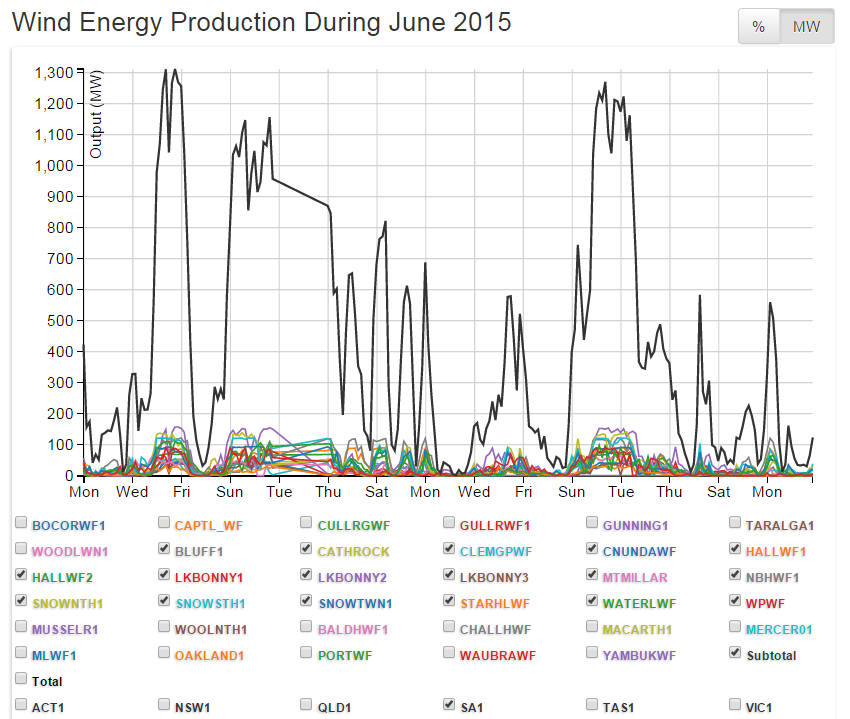
It’s going to need to – SA ‘relies’ on 17 wind farms and their ‘notional’ installed capacity of 1,477MW. However, its faith in the Wind Gods, pixies and the like seems to disappoint more than deliver:

May 2015 SA

We covered the dismal data from SA depicted above and more besides here:

The Wind Power Fraud (in pictures): Part 1 – the South Australian Wind Farm Fiasco

That woeful missive drew focus on the pathetic performance of the 17 wind farms that have led to SA being known as ‘Australia’s wind farm capital’: it has the greatest number of turbines per capita of all States – and the highest proportion of its generating capacity in wind power by a country mile. But that tag is far more a curse than a blessing, as the following pieces attest.

SA renewables use may lead to blackouts
Australian Financial Review
Ben Potter
29 October 2015

South Australia’s rising share of renewable power could cause blackouts if the Australian Energy Market Operator doesn’t intervene, the agency’s chief executive, Matt Zema, said.

SA’s rooftop solar panels could meet electricity demands during the middle of some days by 2024-25 if uptake continued at the current rate, he said, but this would lead to more volatility and less reliability, and a greater reliance on the interconnector, with the large eastern state generators to keep power flowing on some days.

The warning is relevant for the federal Labor opposition, which has called for 50 per cent of Australia’s electricity to come from renewable sources by 2030. An interconnector is a high-capacity transmission line connecting two electricity markets.

Mr Zema said prices are becoming more volatile in SA because of the withdrawal of coal power plants and the strong uptake in solar energy.

Prices have hit the National Electricity Market limit of $13,800 a megawatt hour several times in the state in recent months. That makes industrial users uneasy and has led to speculation the government may have to pay thermal-coal generators to provide standby capacity. “The signal in that market is you actually need more thermals in reserve,” Mr Zema told a Committee for Economic Development of Australia lunch in Melbourne.

He said rather than Germany, which has a large share of renewable generation and is fretting over security of supply, SA is “more like Portugal – it’s at the end of the grid”. “So if they are going to go completely renewable, they are going to rely more and more on the interconnectors for system security.”

Mr Zema said the Energy Market Operator was intervening to balance the market to avoid blackouts in SA while the interconnector is upgraded, causing outages and complaints.

Peter Dobney, the head of energy and resources at packaging company Orora, told the lunch SA “has become a basket case for large industry energy users” and the outages were costing industry millions of dollars.

But Mr Zema said the upgrade had to be completed before the summer of 2016-17 because Alinta will close its Northern and Playford B thermal power stations in 2016, dropping 15 per cent of current capacity in SA.

He said the Energy Market Operator was purchasing frequency controlled ancillary services or FCAS “to stop SA actually going black if the interconnector drops out”. “How much do you want to pay for system security in SA? Because that’s what we are buying,” Mr Zema asked. “If we don’t buy FCAS and the system trips, we lose the whole state.”

Mr Zema said Germany, Spain and Italy were dealing with a similar problem by relying on interconnectors with France, which has a large surplus of nuclear power.
Australian Financial Review

elephant-in-the-room1

****

Hmmm… Not a single mention of SA’s wind farm fleet from the Fin Review. How curious? Could it just be the result of a little ‘group-think’ over at Fairfax?

True it is that the struggling Fairfax rags run with a maniacal cult-like veneration of wind power (see our post here).

But to head up an article as ‘SA renewables use may lead to blackouts’; and to avoid mention of wind power altogether (especially where wind power capacity in SA ‘outshines’ solar capacity by a whopping margin), smells like Ben Potter was deliberately directed to avert his eyes from the enormous, economy-destroying ‘elephant in the room’.

No, revealing that pesky-pachyderm was left to The Australian which, funnily enough, while covering exactly the same AEMO report, managed to draw reference to SA’s woefully wanting wind farms (or ‘wind’/’wind generation’) no less than 6 times (8, including the headline and the caption to its photo of a turbine: “The AEMO report will reignite debate about wind farms”); and referred to solar panels, just once.

SA ‘risks power shortfalls’ because of wind farm dependence
The Australian
Annabel Hepworth
26 October 2015

South Australia could experience electricity supply shortfalls as it becomes more reliant on wind farms and imports from Victoria, a new report finds.

The report by the Australian Energy Market Operator finds the closure of Alinta’s Northern Power Station by the end of March next year could have an impact in “extreme” conditions over the next three years.

The document, to be released today, is likely to reignite debate over wind farms just as the renewables industry hopes for more support after the change of prime minister.

Malcolm Turnbull’s backing for a carbon trading scheme contributed to him being toppled as opposition leader in 2009, while Environment Minister Greg Hunt has recently suggested that criticism of wind farms was confined to “views expressed by particular individuals”.

Under Tony Abbott the Coalition scaled back the renewable energy target, directed the $10 billion Clean Energy Finance Corporation not to invest in wind farms, and axed the carbon tax.

According to the new AEMO report, the planned closure of the Northern Power station will impact the balance of demand and supply in South Australia over the next three years, increasing the state’s reliance on wind and on imports from Victoria.

“When high demand coincides with low wind generation, plant outages, or low levels of imports, South Australia may experience supply shortfalls,” the report says.

In July, Alinta said it would close its Flinders operation in South Australia’s Port Augusta, which comprises the Northern and Playford B power stations and the nearby Leigh Creek mine, by March 2018, if not as early as March 2016.

Alinta boss Jeff Dimmery attributed the decision to policies aimed at supporting renewables and falling power demand that had led to a glut of power in South Australia. Earlier this month, the company confirmed the closure would be next year.

AEMO has produced its new report on the impacts of the Northern closure because it is considered significant enough for AEMO to update its yearly ­guidance on the adequacy of power generation in the National Electricity Market for the next decade.

Overall, the report finds the earlier withdrawal of Northern would not impact the point at which South Australia could breach the “reliability standard”, which says that just 0.02 per cent of power can go unserved in an area in a year.

AEMO has previously forecast that South Australia could breach the standard in 2019-20 and 2024-25, with the potential uptake of solar rooftop panels alleviating the situation in the years between.
The Australian

Could it be that Fairfax hacks have been engaged in a little ‘cherry-picking’, in order to keep spinning its ‘wonders-of-wind’ editorial line? Same AEMO report being covered, but an entirely different story. George Orwell generated a whole lingua franca – including terms such as “newspeak”; “doublespeak”; and “doublethink”- to capture what Fairfax considers should pass for ‘journalism’, these days (see our post here).

When the AEMO report talks about times when: “high demand coincides with low wind generation, plant outages, or low levels of imports, South Australia may experience supply shortfalls” it’s referring to data like this from June this year (the graph above is from May), showing the chaos that is wind power generation in South Australia:

June 2015 SA

In the AFR piece it talks about occasions when: “Prices have hit the National Electricity Market limit of $13,800 a megawatt hour several times in the state in recent months”.

But, for some strange reason, the AFR fails (or refuses) to join the dots: those occasions – when the spot price paid to generators goes from around $70 per MWh to the market cap of $13,800 per MWh perfectly coincide with sudden (and often, complete) wind power output collapses, as detailed here:

South Australia’s Unbridled Wind Power Insanity: Wind Power Collapses see Spot Prices Rocket from $70 to $13,800 per MWh

The cost of SA’s insane wind power policy is borne, of course, by its beleaguered (remaining) businesses; and struggling households (think old-age pensioners and the thousands of unemployed).

This is a State where some 50,000 homes have been disconnected from the grid – families simply no longer able to pay their power bills; who’ve been reduced to lighting their homes with candles, and, unable to power a fridge, using Eskies (coolers) to keep their perishables – cooking on wood stoves and trying to keep warm using barbeques.

With the fall-out from its wind power fiasco unfolding fast, hundreds of businesses will hit the wall; and thousands more households will soon get to join the tens-of-thousands, already sitting freezing (or boiling) in the dark.

SA power prices to surge by $150 a year, report warns
The Advertiser
David Nankervis
22 October 2015

POWER prices will surge up to $150 a year for hundreds of thousands of householders under controversial changes to electricity charges, an investigative report warns.

The SA Council of Social Services report also says small businesses face a 50 per cent rise in power costs and that this could force some to close.

The findings are based on a SACOSS investigation into the impact of rule changes by the Australian Electricity Market Commission.

The change is designed to shift the demand for power away from peak periods to take pressure off the network.

In response to the new rules, SA Power Networks has proposed introducing a monthly network charge calculated on a customer’s highest half-hour of energy use between 4pm and 9pm on any given day.

This will provide a “pricing signal” to customers to ration the use of appliances, SAPN spokesman Paul Roberts said.

“That means not turning on all major appliances at once during peak periods such as tea time on a hot day, instead delaying using the dishwasher or washing machine until later,” he said.

But SACOSS executive director Ross Womersley said the changes, beginning as early as 2017, would see half of all householders worse off.

“It would be madness for this to proceed and any changes should be deferred for at least a few years,” he said.

“And this new system should be introduced only on a voluntary basis, which would allow people to opt in only if they believe they will be better off.

“This is because people on low income and many other householders would be worse off.”

According to the SACOSS report, which will be submitted to SAPN as part of the network company’s consultation process:

APPROXIMATELY 50 per cent of householders would be worse off

THE biggest bill increases could reach $150 a year

THE biggest savings could be just $10 a year

HALF of small businesses would be worse off

ALMOST one-in-five small business would face a 50 per cent increase in energy costs

The report also said there was “limited (public) support” for the changes to the billing system.

SACOSS research revealed consumers were concerned about big variation in bills amounts, making it more difficult to budget for electricity costs.

The report said this would have a serious impact on low-income households over summer.

Mr Roberts said SAPN invited “consultation” on its proposed billing changes earlier this month because “we know people care about electricity prices”.

“We’re not only consulting on the detail of the changes, but also an appropriate transition that protects the interests of customers and gives them time to adjust to the changes.
The Advertiser

studying candle

Sleep Deprivation, and The Effects! (Wynne Gov’t Torturing Rural Residents Near Wind Turbines!)

The Spooky Effects of Sleep Deprivation
by Sara G. Miller, Staff Writer | October 27, 2015
It’s no surprise that a night without enough Zzzs can lead to a groggy morning. But bleary eyes and gaping yawns aren’t the only things that can happen when your body needs more shut-eye.

Indeed, there are more nightmarish side effects to sleep deprivation.

If a person is deprived of sleep, it can lead to “tremendous emotional problems,” said Dr. Steven Feinsilver, the director of the Center for Sleep Medicine at Icahn School of Medicine at Mount Sinai in New York City. “Sleep deprivation has been used as a form of torture,” he said. [7 Strange Facts About Insomnia]
There isn’t a clear definition of exactly how long a person must go without sleep, or how little sleep a person has to get to be considered sleep-deprived, and different people need different amounts of sleep, so there may be no universal definition of “sleep deprivation.” Rather, a person is considered sleep-deprived if they get less sleep than they need to feel awake and alert, researchers say.

But still, research over the years has shown that people can be physically and psychologically damaged from not getting enough sleep, said David Dinges, a professor of psychology and the director of the Unit for Experimental Psychiatry at the University of Pennsylvania.

In fact, the damage is so apparent that it is unethical to coercively deprive someone of sleep, Dinges said. In the studies of sleep deprivation that Dinges and his colleagues conduct in their lab, healthy volunteers are placed in medically safe environments and constantly monitored.

But studying sleep deprivation is important, according to these researchers and others who study the condition. They say that learning what happens in people who are deprived of sleep can help researchers better understand the function of sleep and its importance for both physical and emotional health.

Emotions askew

The problems can start on a somewhat minor scale.

“Clearly, your brain doesn’t work very well when you’re sleep-deprived,” Feinsilver said. Even a low level of sleep deprivation has an impact on cognitive and emotional function, he said.

Dinges explained that some of the first emotional impacts of sleep deprivation involve positive emotions. “When people get sleep-deprived, they don’t show positive emotion in their faces,” Dinges said. A sleep-deprived person may say they’re happy, but they still have a neutral face, he said.

And they won’t recognize other people as happy, either. A positive look on someone’s face can appear neutral to a sleep-deprived person, and neutral look is often interpreted as a negative look, Dinges said. The sleep-deprived brain may not be as capable of detecting positive emotions as a more rested brain, he said.

And sleep-deprived people also don’t tolerate disappointment very well, Dinges added.

Microsleeps

As little as a single night of sleep deprivation can result in a person having a phenomenon called “microsleeps,” the next day, Feinsilver said.

A person begins to fall into mini-snooze sessions, which last up to 30 seconds. Some people’s eyes remain open during microsleeps, but the disturbing thing about microsleeps is that during sleep, the person is essentially blind, even if their eyes are open, Feinsilver said. They’re not processing information, he said.

Studies show that during microsleeps, the brain goes into a sleep state rapidly and uncontrollably, Dinges said. People can force themselves awake, but they will soon fall into another microsleep, he said.

Both Dinges and Feinsilver said that this condition can be incredibly dangerous, especially if you’re behind the wheel.

Delirium

People often say they feel loopy after a night of no sleep. But in more extreme cases, losing sleep may cause delirium.

True delirium occurs when a person becomes completely disoriented, Feinsilver said. “Sleep can play a role in that,” he said. [5 Things You Must Know About Sleep]

Patients who have been hospitalized in intensive care units — where lights and sounds may continue all day and night — can develop a condition that doctors call “ICU delirium,” he said. And while it’s unclear if sleep deprivation is the cause of this delirium, doctors do think that loss of sleep is one reason people in the hospital for extended periods develop bizarre behavior, he said.

The worst thing you can do for sleep is put someone is a hospital, Feinsilver added. It’s fairly common for for hospitalized patients to develop insomnia, he said.

Hallucinations

Seeing things that aren’t there can be a side effect of chronic sleep deprivation, but whether sleep deprivations can induce true hallucinations may be up for debate.

Feinsilver said he personally experienced hallucinations due to sleep deprivation, in October of his first year out of medical school. A newly minted medical resident, Feinsilver said he had been chronically sleep-deprived for several months.

“I [knew] it was October, because I was in the ICU after a night on call,” and there was pumpkin by the nurses’ station, he said. “I had a very vivid feeling of the pumpkin talking to me,” he said.

But Dinges was more skeptical about hallucinations.

“There’s no question that misperceptions can occur,” Dinges said. When people are very sleepy and performing a task, they may see something flicker in their peripheral vision, or they may think they see blinking lights, but not be sure, he said. All of these are indications that the brain isn’t interpreting information clearly, he said.

Can you die of sleep deprivation?

In a famous series of animal experiments, researcher found that total sleep deprivation could kill lab rats.

In 2012, a Chinese man reportedly died after going 11 days without sleep. However, it’s unlikely that lack of sleep alone caused his death (other factors likely played a role, such as drinking and smoking).

Of course, studying this phenomenon in humans is difficult – even when you put aside the clear ethical dilemmas.

“Can you die of sleep deprivation? It’s not easy,” Feinsilver said. “Because you’ll fall asleep,” he added.

Dinges agreed.

“I don’t believe that people can keep themselves awake until they succumb to death,” because the drive to sleep turns on, and then continues to turn on, he said. “You can’t will yourself to stay awake that long,” he said.

Still, there’s no question that sleep deprivation has “serious adverse health effects,” Dinges said.

“Everything we know about sleep loss is harmful,” he said. But — on a more positive note — most of the effects of sleep deprivation dissipate after you sleep, he added.

Follow Sara G. Miller on Twitter @SaraGMiller. Follow Live Science @livescience, Facebook & Google+. Originally published on Live Science.

Frauds, Crooks and Criminals

Demonstrating daily that diversity is not strength!

Family Hype

All Things Related To The Family

DeFrock

defrock.org's principal concern is the environmental and human damage of industrial wind turbines on rural communities

Gerold's Blog

The truth shall set you free but first it will make you miserable

Politisite

Breaking Political News, Election Results, Commentary and Analysis

Canadian Common Sense

Canadian Common Sense - A Unique Perspective from Grassroots Canadians

Falmouth's Firetower Wind

a wind energy debacle

The Law is my Oyster

The Law and its Place in Society

Illinois Leaks

Edgar County Watchdogs

stubbornlyme.

My thoughts...my life...my own way.

Oppose! Swanton Wind

Proposed Wind Project on Rocky Ridge

Climate Audit

by Steve McIntyre

4TimesAYear's Blog

Trying to stop climate change is like trying to stop the seasons from changing. We don't control the climate; IT controls US.

Wolsten

Wandering Words

Patti Kellar

WIND WARRIOR

John Coleman's Blog

Global Warming/Climate Change is not a problem