Faux-green wind turbines are not worth a dime!

This is why wind energy can neither have nor produce nice things

POSTED AT 9:21 PM ON MAY 7, 2014 BY ERIKA JOHNSEN

The wind lobby has yet to give up on their quest to renew the egregiously generous production tax credit that essentially keeps the wind industry afloat by providing 2.3 cents for every kilowatt-hour of energy output during the first ten years of a given project’s operation; that lucrative subsidy expired on January 1st of this year, but it wouldn’t be the first time — or the second, or the third –  that Congress has belatedly bestowed a retroactive extension. Most recently, the wind industry was awarded a one-year extension of the credit at the start of 2013, with the new and convenient condition that any project that simplybegan construction in 2013 would receive the full benefits of the credit (whereas in the past, installations had to be completed) — and for a demonstration of just how precious that credit really is, here are a couple of handy visuals via The Atlantic:

According to the AWEA, a Washington, D.C.-based trade group, wind turbine installations hit a record 8,385 megawatts in the fourth quarter of 2012 only to crash in the first quarter of 2013 to 1.6 megawatts—and, yes, the decimal place is in the right place. In other words, thousands of wind turbines went online at the end of 2012 to power about 2.1 million American homes. Three months later, about one more turbine had been installed, generating just enough juice to supply about 405 homes.

The downdraft continued in the first quarter of this year, according to the AWEA, when 133 turbines producing 433 megawatts went online. …


Read: Installations skyrocketed in 2012 before dropping off like crazy when the credit expired, and then when the credit was renewed with the new and more flexible condition that projects only needed to have begun construction before it expired at the end of 2013, a bunch of projects got in just under the wire. Could the wind industry’s utter dependence ongovernment taxpayer “help” (which actually discourages the price efficiency that could make wind viable in the long run) be any more apparent?

But rather than heeding my umpteenth rant on the mind-boggling perversity of supporting a technology that so clearly cannot survive in the free market based on its own competitive merits, let’s mix it up and look to — oh, I don’t know — how about billionaire Warren Buffet, noted supporter of hiking taxes on the wealthy, in Omaha this past weekend? Via the editors of the WSJ:

So it was fascinating to hear Mr. Buffett explain that his real tax rule is to pay as little as possible, both personally and at the corporate level. “I will not pay a dime more of individual taxes than I owe, and I won’t pay a dime more of corporate taxes than we owe. And that’s very simple,” Mr. Buffett told Fortune magazine in an interview last week.

The billionaire was even more explicit about his goal of reducing his company’s tax payments. “I will do anything that is basically covered by the law to reduce Berkshire’s tax rate,” he said. “For example, on wind energy, we get a tax credit if we build a lot of wind farms. That’s the only reason to build them. They don’t make sense without the tax credit.”

Think about that one. Mr. Buffett says it makes no economic sense to build wind farms without a tax credit, which he gladly uses to reduce his company’s tax payments to the Treasury. So political favors for the wind industry induce a leading U.S. company to misallocate its scarce investment dollars for an uneconomic purpose. Berkshire and its billionaire shareholder get a tax break and the feds get less revenue, which must be made up by raising tax rates on millions of other Americans who are much less well-heeled than Mr. Buffett.

Just take a moment and let that really wash over you, and then take a gander at the still other subsidy-goodies the Obama administration is doling out to its politically preferred pet projects. …Just today. Via The Hill:

The Department of Energy (DOE) Wednesday said it will give up to $47 million each to three offshore wind power projects over the next four years to pioneer “innovative” technology.

The planned projects are off the costs of New Jersey, Oregon and Virginia. DOE said the money will help speed the deployment of efficient wind power technologies as part of the government’s effort to expand the use of wind power.

This Amazing Documentary is Being Funded Very Eagerly, and Should be Ready Soon!

Down Wind

Down Wind is a documentary film project about the destructive impact of wind turbines being forced into communities across Ontario.
DOWN WIND
This documentary examines the human and economic consequences of the Ontario Liberal government’s headlong rush into wind power. It’s a huge story, but it’s also a personal story, focusing on individual families and the damage these turbines have caused.

Down Wind reveals the trauma suffered by those whose lives were turned upside down when the towering turbines went in. It exposes the health and psychological problems that followed, and the warnings of medical experts about “wind turbine syndrome.”

From economists we’ll hear about the mind-boggling costs, including the massive taxpayer funded subsidies going to mega corporations.

And we’ll look at the cosy Liberal connections to Big Wind, and how cronies of Dalton McGuinty and Kathleen Wynne have made a fortune off the backs of taxpayers.

Please contribute now to tell this important story.


Kevin McGee, Farmer and Activist


We Need Your Help

With your support, we’ll be able to tell this important story, and keep a focus on it in the future. In gratitude for your generosity, we’ll send you one of the packages listed on the side of this page.


$23,273CAD
RAISED OF $30,000 GOAL
78%
 24 days left
This campaign started on May 07 and will close on June 01, 2014 (11:59pm PT).
Help make it happen

Safety Issues for Planes Near Wind Turbines!

4 killed as Plane slams into Giant Fans in South Dakota

plane_new_crop_t607-665x385

There are at least 2 critical dangers for flyers created by giant fans: 1) air turbulence – generated by a sea of 50-60m blades with their outer tips travelling at around 400km/h – interfering with the ability of the pilot to control their kite (see our post here); and 2) slamming into them – with reasonably predictable results.

As to 1) here’s a report submitted last year to the Civil Aviation Safety Authority by Ted McIntosh (a highly experienced agricultural pilot from NSW):

Date: 18-03-2013
Local time: 0730
State: NSW
Location: 9kms WNW of Gunning Wind Farm, Gunning NSW. Damage to aircraft: nil Most serious injury: nil
Summary:

Whilst on descent to my operating airstrip near Biala NSW, I suddenly experienced severe turbulence at about 500-600ft AGL. The wind at this time had been approx. 5-8 knots from the SE. After landing I ascertained that there was only a slight breeze at ground level. I suspected that the turbulence was caused by the wind turbines at the Gunning Wind Farm but was amazed that the effect could be felt 9kms away.

After the next take-off I confirmed that the turbulence was indeed caused by the turbines.

There are many fixed wing & helicopter aircraft which operate at or below 500 ft AGL legitimately from hundreds of airfields around Australia.

CASA & the Dept. of Infrastructure & Transport have released a study, the National Airports Safeguarding Framework Guidelines D (Wind Turbines) to protect major airports, but it should be apparent that the greater threat to air safety from wind turbine turbulence lies around country airports, both public & private, which threat CASA & the Dept of Infrastructure & Transport have glossed over or ignored.

For aircraft trying to stay aloft or take-off and land safely, weather related turbulence is an unseen menace that often strikes without warning. But it’s hard to envision turbulence being generated by turbines troubling a skilled flyer over 9 km away. So here’s a picture for the uninitiated:

horns_rev

As to 2) here’s a tragic report from South Dakota, where a light plane slammed into a turbine in foggy conditions. And here’s a picture of the culprit:

turbine-plane collision SD

4 dead as plane crashes at South Dakota wind farm
SFGate (Associated Press)
Dirk Lammers
28 April 2014

SIOUX FALLS, S.D. (AP) — A small airplane heading back to South Dakota after a Texas cattle sale crashed into a wind farm in foggy weather, killing the pilot and three passengers.

Elizabeth Cory, a spokeswoman for the Federal Aviation Administration, said the Piper 32 was traveling from Hereford, Texas, to Gettysburg, South Dakota. The single-engine plane was registered to Donald J. “D.J.” Fischer of Gettysburg, according to the FAA.

The National Transportation Safety Board is investigating, but authorities have not released any details on the crash.

Authorities have not released the names of the victims, but Luce Funeral Home confirmed that Fischer, the 30-year-old pilot, died. Lien Funeral Home confirmed the deaths of cattlemen Brent Beitelspacher, of Bowdle, and Logan Rau, of Java.

The funeral home handling arrangements for the fourth victim said it could not release any information.

The three passengers were in Hereford to attend a sale of live cattle and embryos, primarily for the production of show steers, said Mike Mimms, a veterinarian who runs the annual event.

Mimms, who performs cattle embryo transfers, said he has probably bought 3,000 cows from Beitelspacher through telephone calls but hadn’t had the opportunity to meet him until this past weekend.

“I got a Christmas card from him this Christmas,” Mimms said. “It was the first time I even knew what he looked like, and he’s standing there with his family with young kids. And I can’t get that image out of my mind.”

Fischer, a crop sprayer for Air Kraft Spraying Inc., followed in his father’s footsteps into the aerial business and was extremely involved in his community, said state Rep. Corey Brown, R- Gettysburg.

Brown, a longtime family friend, said Fischer had just gotten married in March and was a volunteer emergency medical technician who was often out on calls.

“This is one of those things that’s going to hit the community pretty hard, because I would venture to say there are probably are not many people here who D.J. didn’t touch their life in some way,” Brown said.

Fischer attended South Dakota State University and played defensive tackle for the school’s football team from 2002-2005.

John Stiegelmeier, SDSU’s head football coach, described Fischer as a gifted athlete who was a great friend to his teammates.

“I’m a small school guy and he was the same — phenomenal work ethic, phenomenal loyalty to the coaching staff and his teammates,” Stiegelmeier said. “Whatever you asked D.J. to do, he did it, with a smile on his face, too. He didn’t hesitate.”

Mimms said the three cattlemen noted that they had a rough flight down to Texas due to high winds, and conditions were similar in Hereford when they left Sunday morning.

“They made it through the windy weather, and the fog was the problem when they got there,” he said.

The wreckage was found Monday at the South Dakota Wind Energy Center, a site south of Highmore with 27 turbines that are about 213 feet tall, plus the length of the blade.

Steve Stengel, a spokesman with Florida-based NextEra Energy Inc., said there was damage to a turbine but he couldn’t say what part of the tower was hit.

“It’s been so foggy up there and we haven’t had a chance to investigate,” Stengel said Monday.

Fog and low clouds combined for reduced visibility in the Highmore area on Sunday night, and winds were out of the east at about 15 to 25 mph, said Renee Wise, meteorologist with the National Weather Service office in Aberdeen. There were also scattered showers across region Sunday night, and some might have been heavy at times, she said.

Mimms, said the news has sent shock and sadness through the close-knit ranching community.

“There are a lot of people out there who feel like they lost one of their best friends,” Mimms said.

Similar conditions contributed to a 2008 crash in southeast Minnesota. Federal investigators concluded the pilot of a 1948 Cessna 140 lacked proper instrument training for the day’s foul weather. The National Transportation Safety Board’s probable cause report also noted the pilot’s failure to maintain control of the airplane while maneuvering around a wind farm.
Associated Press SF Gate

This may be the first time this has happened, but it won’t be the last. Stick a line of obstacles taller than the Sydney Harbour Bridge on top of elevated ridgelines and it’s a matter of when (and how many) not if.

For flyers just trying to get from A to B the additional (and unnecessary) risk created by giant fans is bad enough. But spare a thought for those called on to fly in and among these things on routine basis – eg, crop dusters and fire-fighters involved in water-bombing (see our post here).

Just another reason to can the fans.

plane turbines

Ezra Levant, Rebecca Thompson and Sun News, Producing a Documentary about Windscam!

WE NEED YOUR HELP


– Help expose the ugly truth behind Wind Turbine power generation 

Ezra Levant

We’re working on something big – a made-for-TV documentary that you will not see on any other TV network in Canada.

It’s something only the Sun News Network would do. It would probably be banned at the CBC.

We’re making a documentary exposing the fraud of Ontario’s wind turbine schemes.

We’ll expose the Liberal insiders who managed to get huge government subsidies for their green schemes. We’ll show you how Ontario power prices have shot up to pay for these wind turbines – but that the wind turbines are so unreliable, most of the them don’t even generate power!

But the most heart-breaking part of the movie is the impact these skyscraper-high monstrosities have on the lives of ordinary Canadians who have been crushed by the wind turbine lobby.

We’ll show you how local communities were shut out of the regulatory process; how bird-killing wind turbine companies were forced into once-peaceful communities against their will; how wind mega-corporations were exempted from environmental laws and sued local mothers who dared to speak out against them. And we’ll show you how the health impact of these massive, flickering, noise-making blades have been covered-up by Liberal politicians who have put their wind obsession above everything else – including the very health and safety of Canadian families.

Simply put, if the Sun News Network doesn’t make this film, no-one will.

But we need your help. We’re deep into the film right now – we’ve done the field research, we’ve done the interviews, we’ve got the damning facts. Now we just have to produce and edit the project. And then we’ll shout it from the rooftops – and broadcast it all across Canada.

The film is called Down Wind, and it’s hosted by Rebecca Thompson, one of our fearless Sun News reporters. You’ve seen her work as a reporter. Now comes the big time for her, as the driving force behind the feature film.

Making a documentary isn’t like making a regular TV show. There are extra expenses, everything from travel costs, to equipment, to extra production and editing work. We need to buy music rights, graphics and pay promotional costs that we wouldn’t have with a regular broadcast.

That’s why I’m writing to you today: will you help us cross the finish line with Down Wind, and make this important movie a reality?

We need $30,000 to get the job done. That’s not a lot of money for the big guys – the CBC’s annual taxpayers bail-out of $1.1 billion a year works out to $30,000 every fifteen minutes. That’s a rounding error for them – that’s a fraction of the CBC president Hubert Lacroix’s personal expense account. But for us, $30,000 is enough to finish an entire documentary film, and one you know the CBC would never broadcast.

Because the Media Party believes in the cult of environmental extremism. If some CBC producer even dared to suggest making a show critical of wind turbines, he’d probably be fired. I mean, the CBC is the channel that has given David Suzuki a propaganda show for the past 40 years. They would never show the dark side of wind turbines.

It’s up to Sun News to tell the other side of the story. Sun News – and you.

Will you help make this film a reality? I chipped in $100 myself. If you can afford more, please do. Even $10 will help. Even $1. You can do it online, quickly and securely, atwww.DownWindMovie.com.

Put it this way: if this film helps stop this costly, failed experiment with wind turbines, your contribution could end up saving you much more in lower electricity rates alone!

You know we can do amazing documentaries – stuff the other guys won’t touch. Last year our first Sun News documentary, called Broken Trust, blew the lid off the High River gun grab.

With your assistance, we can expose the wind energy fraudsters for what they are.

Contribute what you can and we’ll reward you for your support. For a contribution of $25, we’ll send you a DVD copy of the movie; for $50 you’ll receive a second DVD and a Sun News Prize Pack (pen, bumper sticker, and mug). For $100 you’ll get all that and a promotional poster signed by Rebecca Thompson and me. And for a contribution of $250 we’ll send you all of the above, plus give you an associate producer credit at end of movie – we’ll actually put your name in the credits!

Finally, if you really hate those wind turbines – or just love stuff from the Sun! – for a contribution of $1,000 or more, you’ll receive all the above plus a fancy Sun News jacket. (They’re awesome.) To learn more, visit www.DownWindMovie.com. Help us tell the story – and be part of Canadian movie-making history!

Yours gratefully,

Ezra Levant

P.S. I chipped in $100 myself, safely and securely, right online atwww.DownWindMovie.com 

VISIT DOWNWINDMOVIE.COM TO DONATE

Energy Poverty in the UK…

Families ‘struggling with problem debt’

street sceneThe report says “problem debt” affects 18% of households with children in the UK

Related Stories

Nearly 2.5 million children are living in families struggling with “problem debt”, according to a report.

The Children’s Society and StepChange debt charity say many families are in an “extremely precarious” position and taking out loans to pay for the basics.

The stress of keeping up with repayments leads to arguments, emotional distress for children and even bullying, the charities say.

Problem debt means being in arrears on at least one bill or credit commitment

The report – The Dept Trap – is backed by the Archbishop of York, the Most Rev John Sentamu, and is based on:

  • a survey of 2,000 UK households with dependent children
  • an online survey of 4,442 adults
  • 15 in-depth interviews with families with debt problems
  • a focus group of young people in Manchester

The survey of UK households suggested “problem debt” currently affected nearly one in five (18%).

On average these households owed £3,437 – giving an estimated total of £4.8bn for all households across the UK – to service providers, lenders and government, the research found.

Archbishop of York, Dr John SentamuThe report has the backing of the Archbishop of York, the Most Rev John Sentamu

The findings suggested 1.4 million families across the UK, with 2.4 million dependent children, were in “problem debt”, the charities said.

And a further 2.9 million households with dependent children were on the brink of sliding into financial difficulties and had been struggling to keep up with payments on household bills or credit over the past year.

CHILDREN’S COMMENTS

“I hate [school] because my mum and dad can’t afford the trousers so I have to wear trackies. But my head of my college, I always really annoy him, he goes, ‘You got to get your trousers sorted out.'”

“I like to go out with my friends quite often, and to do that I need a fiver or something to get on the bus home and maybe some food while I’m out. But I’ve sort of like stopped going out with my friends quite recently because a fiver is bread-and-milk money.”

“I hate it when my mum cries. It’s the worst thing in the world.”

“[On your birthday] your parents just want a special day and want you to have, want you to be happy, so they will end up… spending more and need more money… to spend on you and so end up… borrowing.”

Source: Children’s Society and StepChange report

The report says the impact of debt problems on children means many are suffering from anxiety, face bullying at school and having to go without essentials.

Nearly one in five (19%) children aged between 10 and 17 years in families with debt problems told the survey they had been bullied at school as a result of their family’s financial difficulties.

More than half (51%) said they felt embarrassed by their lack of money.

Advertising

The report calls on government to work with creditors and other groups to develop a “breathing space” scheme to give struggling families an extended period of protection from default charges and enforcement action.

There should also be a review of the protection given to families with children against debt enforcement, including the potential harm caused by evictions, bailiffs and court action, it said.

The charities are also calling on the government to review the case for tighter restrictions on loan advertising seen by children.

Children were being exposed to a “barrage” of advertising for credit products that underplayed the risks of falling into debt, the report said.

housing estateThe charities say children should not pay the price of debt

Matthew Reed, Children’s Society chief executive, said: “Families are increasingly relying on debt as a way to make ends meet – but we’re in danger of ignoring the impact this is having on children now and in the future.

“We cannot allow children to pay the price of debt.”

‘Stark warning’

Mike O’Connor, chief executive of StepChange, said: “This report is a stark warning to policy makers, creditors and the wider society of the devastating effects of debt on children.”

Dr Sentamu said: “When the monthly struggle to pay the bills becomes too much, often families think they have no option but to borrow money to provide the basics for their children.

“We need to make sure families living in poverty have somewhere to turn other than to usury-lenders.”

Peter Fleming, from the Local Government Association, said councils had a duty to taxpayers to collect taxes so that “important services like caring for the elderly, collecting bins and fixing roads” were not affected.

“Bailiffs are only ever used as a last resort by councils and struggling families are always encouraged to get in touch with their council for financial support and advice when having trouble paying their bills,” he said.

“New payments plans can be arranged before the situation reaches a stage where bailiffs are involved.”

Is sad sack Ontario ‘dragging down’ the rest of Canada?

 Armina Ligaya | April 14, 2014 | Last Updated: Apr 14 8:19 PM ET

Ontario Premier Kathleen Wynne is facing growing calls to get the province's fiscal house in order.

Canadian PressOntario Premier Kathleen Wynne is facing growing calls to get the province’s fiscal 

Ontario’s government is facing growing calls to get its fiscal house in order, with a Fraser Institute study pegging the province as an economic ball and chain “dragging down the country as a whole.”

Respected tax policy expert Jack Mintz made a similar claim in a Financial Post opinion piece last week.

“Ontario is sagging under the weight of monstrous public debt, uncompetitive energy prices and rising taxes,” wrote Mr. Mintz, Palmer Chair, School of Public Policy, University of Calgary. “Given Ontario’s size, other regions of Canada are being hurt.

But economists are split over how much a weak Ontario — with its shrinking per-capita GDP and weak private-sector employment amid other struggles — is being felt across the country, or whether the province is bearing the brunt of its own demise itself.

Livio di Matteo, a senior fellow at the Fraser Institute and lead author of the think-tank’s study released Monday, says Ontario’s economic struggles over the last decade to become a “have-not” province, receiving federal transfers instead of serving as a foundation for the national economy, has implications beyond its borders.

He blames an “incomplete transition to a more competitive world economy,” aggravated by high energy costs, reliance on manufacturing tied to the U.S. market and interventionist government policies.

“Ontario’s failure to come to grips with its economic productivity and growth issues has serious implications for itself as well as the future growth of the Canadian economy… Ontario is a vast pool of human, physical and financial capital that is not living up to its potential,” he wrote.

Ontario is facing a projected $11.7-billion deficit in the current fiscal year, as well as a hobbled manufacturing industry, once the province’s strongest economic engine.

AdvertisementAmong the dire metrics Mr. di Matteo, an economics professor at Lakehead University, cites in the Fraser Institute study is the province’s shrinking per-capita GDP. Ontario’s real per capita GDP in 2012 was 5.6% lower than the rest of Canada, compared to 2004 when it was 0.36% higher. What’s more, if Ontario was taken out of the mix, Canada’s 2012 real per capita GDP would rise 2.2%, he wrote.

As well, Ontario’s share of Canada’s capital formation — new additions to productive assets such as buildings, machinery and equipment — is shrinking, Mr. di Matteo said. It is now at 31%, another indication the economic engine is stalling.

“That’s probably one of the more disturbing ones, because it suggests that the productivity decline in Ontario, where output has been stagnant for a decade, will continue,” Mr. di Matteo said in an interview.

Doug Porter, chief economist at the Bank of Montreal, says there is no question that Ontario has struggled over the last decade, particularly over the last five years. But, he says, the finger should be pointed at the deterioration of the manufacturing industry in industrialized economies, and not solely at a province’s performance.

U.S. demand for Canadian goods collapsed during the recession, while the loonie went from 60 cents to parity in a heartbeat, he added.

“This reflects a reality that’s been imposed on the broader Canadian economy… Manufacturing has absolutely been sideswiped by global events, and that manufacturing industry happens to be concentrated in Ontario,” Mr. Porter said.

Ontario’s weakness does have a spillover effect to the rest of the country, in terms of transfer payments and weaker demand within the province for goods from other parts of Canada, he said.

Still, there’s no indication that Ontario’s transfer payments will balloon in the coming years, he said.

“There’s a case to be made that Ontario might be a bit better in the next decade, especially if the U.S. does get back on its feet,” he said.

Robin Boadway, professor emeritus of economics at Queen’s University, agrees that there is no doubt that Ontario has faced economic malaise over the last decade.

However, it is unclear what direct impact the economic pain in Ontario will have on other provinces, he said.

While there is obviously a knock-on effect in the form of transfer payments to Ontario from other provinces, there could also be other consequences, such as Ontarians looking for greener economic pastures elsewhere in the country, resulting in a net benefit for another province, he added.

“In the absence of more evidence, it’s not clear that Ontario’s doing poorly is going to have an overall negative effect on the rest of Canada,” he said.

“Most of the impact is gong to be on Ontario itself, I guess. But having said that, there are certainly some inter-dependencies between Ontario and the rest of Canada that could go either way.”


Nothing but Corruption, from the McWynnty Liberals!

Aide to McGuinty's chief of staff refuses OPP interview

Ontario Provincial Police investigating the destruction of emails in the final days of Dalton McGuinty’s term in office believe that an executive assistant’s password used to access staff computers without a trace was either voluntarily given up or  stolen, but they may never find out because she has refused to be interviewed.

Photograph by: Peter J. Thompson , Ottawa Citizen

Ontario Provincial Police investigating the destruction of emails in the final days of Dalton McGuinty’s term in office believe that an executive assistant’s password used to access staff computers without a trace was either voluntarily given up or stolen, but they may never find out because she has refused to be interviewed.

Wendy Wai, executive assistant to the ex-premier’s chief of staff David Livingston, refused a second request by anti-rackets detectives in April.

The last time detectives came calling, they met up with Wai at her new office at Ryerson University in Toronto.

Wai told detectives on July 30, 2013 that David Nicholl, the corporate chief information officer, had given her “some sort of access but I didn’t know anything about what to do with it.” She then declined to answer questions. Detectives tried again to interview her in April as part of the criminal investigation, but she declined a second time.

Her colleagues described Wai’s computer skills as weak and an IT technician said “she used to panic a lot if something wasn’t working as expected and that’s why we got a lot of calls from her.”

Reached by the Citizen, Wai politely declined to say to whom, if anyone, she gave her password. She directed the question to her lawyer, who did not return messages.

Wai is not accused of any wrongdoing and the only suspect in the criminal case so far is Livingston.

The OPP investigation, called Project Hampden, is trying to find out who, if anyone, had a hand in deleting records related to the true costs of the gas-plants scandal.

Livingston is suspected of bringing in Peter Faist, the boyfriend of McGuinty aide Laura Miller, to access hard drives in the premier’s office, four days before Kathleen Wynne was sworn in.

Detectives say that Livingston allegedly enlisted Faist to access hard drives using the cover of Wendy Wai’s profile, which had been boosted with global access powers for the specific purpose to allow someone to do whatever they wanted to any computer in the former premier’s office without leaving a footprint.

So while the powers of her profile were were given super capabilities, her password didn’t change and police believe that she either gave it to someone or it was taken without her permission.

Detectives have built a breach of trust by public officer case against Livingston, and are now looking to see if there are other cases to be made.

But they’ve been having a hard time talking to some of those who played key roles in McGuinty’s office.

Police say Miller and Faist have refused interviews although their lawyers maintain the pair have co-operated fully with police. Livingston, too, has refused to be interviewed.

Months before Faist was allegedly enlisted to access staff computers, Livingston was asking around about storage protocols at the premier’s office and asked cabinet secretary Peter Wallace how existing email accounts could be deleted, according to a search warrant.

“I advised (Livingston) at that point in time that if he was interested in deleting records associated with the public service, this would be futile because we retained our records,” Wallace told detectives.

On Jan. 25, 2013, Livingston went to see then-corporate chief information officer David Nicholl about getting an administrative password “to clean hard drives during the transition period to the new Wynne government,” according to the search warrant application.

The police investigation continues and no one has been charged. The allegations against Livingston have not been tested in court.

Follow on twitter @crimegarden

gdimmock@ottawacitizen.com

Wind Industry to see Money-Tap shut off!

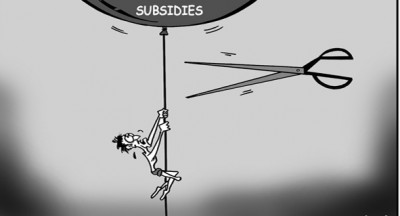
Slash Wind Power Subsidies

& Bring Power Prices Back to Earth

subsidies

With Australia’s wind industry gasping its last breath, their hired spruikers at the Clean Energy Council have taken to peddling the incredible tale that wind power has led to a REDUCTION in our power bills.

Trouble is that wind power generation (the product of the mandatory RET- which has been in operation since 2001) has been a key contributor to Australian household electricity costs rising 110 per cent in the past 5 years (see our post here). But the way the CEC plays it, it’s as if we hadn’t noticed.

But step back a moment. Assume that the CEC is not speaking with “forked tongue”.

If it were true – as the CEC asserts – that wind power was in fact delivering power at prices equal to or less than conventional generation sources – so as to lower retail power prices – then why the need for the mandatory RET?

Why the need for Renewable Energy Certificates? Why the need for the shortfall charge (fine) of $65 per MWh for every MW the retailer falls short of the mandated RET, which “encourages” (we mean “forces”) retailers to enter Power Purchase Agreements and, thereby, purchase RECs from wind power generators? Why the need for unsecured, taxpayer underwritten loans from the Clean Energy Finance Corporation?

If there was a shred of substance to the CEC’s spin, then surely, wind power generators wouldn’t need any extra pennies from hard pressed power punters – in the form of RECs, or at all; nor would they need to have inbuilt threats to retailers to purchase RECs; and there would be no need for “soft money” to back their projects.

Hell, retailers and power consumers would be knocking each other over in the rush to get the cheapest power around; and, what with all those willing customers for wind power, there wouldn’t be any need for taxpayer subsidised loans from the CEFC – commercial lenders would be piling in to wind power projects, ready to reap the returns.

Call us just a tad “cynical” – but STT for one doesn’t buy it.

The hint that there’s something rotten in Denmark is in the “die in a ditch” efforts the CEC and its wind industry clients are currently making to retain the mandatory RET at its current 41,000 GWh annual target – and to, therefore, preserve the REC price, at all costs.

So which is it?

Is wind power really competitive with conventional generation sources? If so, then there’s simply no need for a mandated target at all – this stuff will sell itself.

Or is wind power simply the product of ideological nonsense – a power generation source which can only ever be delivered at crazy, random intervals – requiring 100% of its capacity to be backed up 100% of the time by fossil fuel generation sources, including ridiculously expensive OCGTs (with that exorbitant, additional and unnecessary cost borne by power consumers) – and which, for wind power generation to be commercial, has to be sold to retailers at guaranteed rates 3-4 times the cost of conventional sources, as stipulated in Power Purchase Agreements with retailers?

Call us “suspicious”, but STT thinks that it’s only ever been about a guaranteed stream of other peoples’ money. But on that score, we’ll leave the final word to America’s most successful corporate investor (see below).

Staying with the US, the Americans are catching on quick that their political betters have signed them up to a future of crippling power prices through the exorbitant subsidies guaranteed to wind power generators.

America’s equivalent to our Clean Energy Council is the American Wind Energy Association (AWEA). Lately, they’ve been singing from the same hymn sheet – both claiming that power prices are falling, thanks to wind power.

Where the CEC ignores the cost of the REC as a direct subsidy to wind power generators (and its concomitant cost as a tax on power consumers) its American doppelganger, the AWEA ignores the Production Tax Credit (PTC) – which, in substance and effect, is precisely the same thing.

Here’s a neat little summary from Ohio.

Wind farms come with big cost
limaohiho.com
Dawn Davis Contributing Columnist
17 April 2014

Don’t believe claims that wind energy does not cost Ohio a penny. Although the fuel is free, this industry has an addiction to subsidies. Subsidies do cost someone.

The Wind Production Tax Credit is a federal subsidy given to the wind industry which amounts to $0.022/kWh for electricity produced. It was designed, in 1992, to help a new industry grow. Is an industry still an infant after 20 years? This subsidy has been renewed eight times, with this year being the 9th. The U.S. Senate, with the help of five Republicans (including Sen. Rob Portman), recently, agreed to renew this credit. A two-year extension will cost our children $12 billion in additional debt, not including interest. After 20 years, the entire renewable industry generates less than 5 percent of our nation’s electricity.

Despite their low output, renewables were given 75 percent of the energy subsidies in 2013. Wind is currently being subsidized more than 80 times that of conventional fossil fuels, per unit of energy production. The American Tradition Institute hired analysts George Taylor and Thomas Tanton to calculate the cost of wind generation, as a FULL-time replacement. Their analysis shows wind costs $0.15/kWh if natural gas is the back-up and $0.192/kWh if coal is the back-up. What do you pay per kWh?

Our Energy Information Administration estimates that federal subsidies, alone, give the wind industry $56.29/MW hour. This is so high that it allows wind producers to pay the grid to take their electricity even when it is not needed, so they can claim the federal credit. Foreign-owned companies are making a huge profit, at our expense, despite selling their product at a loss, because our tax dollars make up the difference; meanwhile, wind interrupts the efficient operation of our traditional plants.

We are frequently told these incentives make the market fair since coal, gas, and nuclear receive subsidies; however, wind requires the constant back-up from those fossil fuel burning power plants because their energy output looks like a polygraph test. It forces fossil fuel plants to ramp up and down as wind speeds vary every moment across a region. Not only does this require fossil fuel plants to remain fully operational, but it makes their electricity more expensive. Wind facilities in Ohio have not, annually, even produced 30 percent of their advertised potential. Ohio wind speeds at 100 meters average a mere 6m/s, which does not place even place us in the top 20 states for wind generation potential.

Yet, current Ohio law mandates the purchase and generation of renewable energy. When wind comes to a town, county commissioners are asked to approve a payment-in-lieu-of-taxes which allows developers to pay up to $9,000/turbine. Their payments create an annual media frenzy, with big checks given to local governments and schools. If they abided by the rules of the Ohio tax code, though, they would pay, an estimated, $45,000/turbine annually. County commissioners give them an 80 percent tax reduction when they say yes to a PILOT.

History tells us that these handouts will, eventually, cost each of us in our electric bills.

Denmark has more turbines, per capita, than any place in the world, and their electric bills have tripled in the past 20 years.

Germany has announced that renewable subsidies will be slashed because electricity rates have increased more than 80 percent since 2000. They are building 10 coal plants to be completed in the next two years.

Last year, England paid wind developers 32.6 million pounds to turn OFF because their energy was produced when it wasn’t needed. Their rates have risen 50 percent. In Scotland, 80 million pounds have been paid to wind producers to shut them OFF and 40 percent of their residents live in fuel poverty.

Spain recently announced slashes to their wind subsidies. In 2009 a Spanish economics professor claimed that each green MW of energy destroyed 5.39 jobs in the private sector and each green job cost them $774,000. These events have driven wind developers here, where the subsidies are still flowing.

China is home to some of the largest turbine manufacturers in the world. They also have 90 percent of the world’s Neodymium, required for every industrial wind turbine. They produce a mere 0.23 percent of their energy from renewables. We sell them a lot of coal, though.

In the USA, electricity rates are rising in 9 out of 11 of the top wind power consumption states. According to the Energy Information Administration, the rates are: Colorado up 14 percent, Idaho up 33 percent, Iowa up 17 percent, Kansas up 29 percent, Minnesota up 22 percent, North Dakota up 24 percent, Oklahoma down 1 percent, South Dakota up 26 percent, Texas down 19 percent. Many economists agree that Texas rates are dropping because of deregulation, not because of the wind.

Electricity rates affect the cost of everything Ohio produces, sells, buys, and consumes. According to the steel manufacturers association, the industry employs 60,000 people and spends $18 billion on electricity annually. A 10 percent increase in electricity rates translates to $30,000/year/employee. Timken, a steel company in Ohio, estimates spending $2 million this year just for our renewable energy riders.

Last year, for the first time, the American Wind Energy Association hosted an Ohio Wind Energy Summit. They are here because of our mandates, our generous PILOT, and our vast land. In addition to our two operational wind sites, the Ohio Power Siting Board has certified eight more to begin construction. Ohio Senate Bill 310, being debated now, will freeze our mandates. Encourage our senators to support it. Ohio Senator Cliff Hite is an obstacle.

Do you remember what, then U.S. Sen. Barrack Obama, said about his energy policy? Under his policy, electricity rates will necessarily skyrocket. Get ready, Ohioans, someone is getting ready to pay a lot more for energy.
limaohio.com

The equation detailed above holds the world over – a subsidy paid to any firm supplying goods or services to households has to picked up by someone else. Where the subsidy is levied directly against household power bills (as the REC is) it’s householders that pay the subsidy, adding to the cost they would otherwise pay for power. That inescapable fact is simply Economics 101 – and provides a perfect explanation for spiralling power prices – wherever giant fans have sprung up.

And subsidies – like the REC and PTC – provide the ONLY explanation for the wind industry – as recognised by the “Sage of Omaha”, billionaire Warren Buffett – whose company Berkshire Hathaway has invested $billions in wind power in order to get at federal subsidies – namely the PTC – which is worth US$23 per MW/h for the first 10 years of operation.

A subsidiary of the Buffett-owned MidAmerican Energy Holdings owns 1,267 turbines in the US with a capacity of 2,285 MW – eventually when the company’s Wind VIII expansion is finished, MidAmerican will own 1,715 turbines with a capacity of 3,335 MW. Buffett has piled into giant fans for one reason only: to lower the tax rate paid by Berkshire Hathaway.

As Buffett recently put it at his annual investor jamboree in Omaha, Nebraska:

“I will do anything that is basically covered by the law to reduce Berkshire’s tax rate. For example, on wind energy, we get a tax credit if we build a lot of wind farms. That’s the only reason to build them. They don’t make sense without the tax credit.”

There, Warren Buffett said it, not us.

At least he had the honesty and integrity to explain the only conceivable basis for the greatest rort of all time. And isn’t it so much better when those that profit from it chose not to speak with “forked tongue”. Maybe the CEC and AWEA can take a leaf out of Warren’s book?

lone ranger and tonto