“Load-shedding”. As Countries Lose More Reliable Power Sources….this will result.

Rolling blackout

From Wikipedia, the free encyclopedia

Rolling blackouts are a common or even a normal daily event in many developing countries where electricity generation capacity is underfunded or infrastructure is poorly managed. Rolling blackouts in developed countries are rare because demand is accurately forecasted, adequate infrastructure investment is scheduled and networks are well managed; such events are considered an unacceptable failure of planning and can cause significant political damage to responsible governments. In well managed under-capacity systems blackouts are scheduled in advance and advertised to allow people to work around them but in most cases they happen without warning, typically whenever the transmission frequency falls below the ‘safe’ limit. Rolling blackouts are also used as a response strategy to cope with reduced output beyond reserve capacity from power stations taken offline unexpectedly such as through an extreme weather event.

Canada

In January 2014, the Canadian province of Newfoundland & Labrador renewed rolling blackouts to compensate for the cascading failure of the Holyrood generating station after a fire at the Sunnyside substation on Jan 4 following a blizzard. The rolling blackouts started before the storm on the 4th, rather were caused by extreme cold weather and a high demand for power at the time.[1]

On 9 July 2012, the Alberta Electric System Operator ordered power companies in the province of Alberta to institute rolling blackouts during a heat wave as six generating plants failed during peak demand in the heat of the afternoon. Because the shortage increased the amount consumers paid to generators, Members of the Alberta Legislative Assembly voiced concerns that price manipulation might have been involved[2]

In both cases the blackouts were rolled fairly rapidly, so that no area had to spend more than one hour without power.[1][2]

Egypt

Summer blackouts have been common in Egypt since 2010 but became more severe and widespread after the 2011 revolution. In April 2014, the Minister of Electricity and Renewable Energy said that the problem would take a few years to resolve.[3] The government is blaming on the unrest the country is experiencing for the blackouts. However, blame between the different ministries reveals their poor organization. Some also point to the fact that the infrastructure is old and lacks maintenance.[4]

Ghana

See main article at dumsor

In Ghana, rolling blackouts occurred in 2007-2008 and again after 2012. At the beginning of 2015, the dumsor schedule went from 24 hours with light and 12 without to 12 hours with light and 24 without.[5]

Italy

After the great 2003 blackout in Italy, a rolling blackout program PESSE (it:Piano di Emergenza per la Sicurezza del Sistema Electrico en: Emergency plan for national grid safety) was issued. It has 5 degrees of severity, any controlled blackout can’t exceed 90 minutes.

India

Due to a chronic shortage of electricity, power-cuts are common throughout India, adversely affecting the country’s potential for economic growth.[6][7] Even in the country’s capital of New Delhi, rolling blackouts are common, especially during the hot summer season when demand far outstrips supply capacity. Rural areas are the most severely affected; it is common for the 44% of rural households having access to electricity to lose power for more than 12 hours each day.[8] The states periodically and chronically affected by load-shedding are Delhi, Uttar Pradesh, Tamil Nadu, Bihar, Odisha, Assam, Maharashtra, Madhya Pradesh,Rajasthan and Andhra Pradesh. The states of Punjab, Goa, Gujarat and Kerala are largely free of any load-shedding due to surplus power. Karnataka still occasionally experiences power cuts.[9]

Japan

Rolling blackout in Japan after the 2011 Tohoku Earthquake.

South Africa

There is a long history of rolling blackouts in South Africa, with multiple causes. In South Africa the major producer and distributor of electricity is Eskom, which provides over 95% of the country’s energy usage. During the 1980s Eskom mothballed three of their coal-fired power stations, as there was an excess of generation capacity at the time. With the demise of Apartheid in the 1990s came massive investment and economic growth. At the same time the government tried to deregulate the electricity supply industry by inviting the private sector to build new power stations to meet the rapidly growing demand for electricity. Eskom was at the time prevented from building new power stations (including de-mothballing the three existing power stations) or from strengthening the transmission network. The transmission network is especially important in delivering power from Mpumalanga, where the majority of the power stations are located, to other parts of the country such as KwaZulu-Natal and the Western Cape. With no bidders coming forward to construct new power stations, there was effectively no investment into new generation plants during the early 1990s, which eventually led to the shortage of capacity that was experienced in the 2000s.

In 1998, the Department of Minerals and Energy released a detailed energy review in which it explicitly warned that unless “timely steps were taken to ensure that demand does not exceed available supply capacity”, generating capacity would reach its limit by 2007.[15]

Country-wide blackouts 2007–2008

With the freeze on any new developments being placed on Eskom during the early 1990s, South Africa was faced with a situation where for the next few years the electricity demand kept rising, without any new power stations being built to keep up the necessary supply. By October 2007 the situation had deteriorated to such an extent that Eskom implemented rolling blackouts throughout the country. Blackouts occurred in most suburbs throughout the country for a period of two hours at a time.

The situation came to a head on 24 January 2008 when the national grid was brought to near collapse. Multiple trips at a number of different power stations rapidly reduced the available supply, resulting in Eskom declaring force majeure[16] and instructing its largest industrial customers (mainly gold and platinum mining companies) to shut down their operations and reduce consumption to “minimal levels”, just sufficient to evacuate workers that were still in the mines.[17]

In January 2008, with no short- or medium-term relief available to ease the power shortages, Eskom warned the public that the country’s electricity demand would exceed the supply until 2013 (when the first new power stations would be brought online).

Eskom also began recommissioning older power stations which had been mothballed in earlier decades.[18]

Country-wide blackouts 2014-2015

Load shedding was reintroduced in early November 2014. The Majuba power plant lost its capacity to generate power after a collapse of one of its coal storage silos on 1 November 2014. The Majuba power plant delivered approximately 10% of the country’s entire capacity and the collapse halted the delivery of coal to the plant.[19] A second silo developed a major crack on 20 November causing the shut down of the plant again. This was after temporary measures were instated to deliver coal to the plant.[20]

On 5 December, Eskom launched a major stage three load shedding in South Africa after the shut down of two power plants on Thursday 4 November 2014 due to diesel shortages. It was also reported that the Palmiet and Drakenburg stations were also experiencing difficulties due to a depletion of water reserve to the Hydro plants.[21] On Thursday 4 November, Eskom fell 4,000MW short of the electricity countries demand of 28,000MW. The power utility has the ability to produce 45,583MW, but could only supply 24,000MW due to “planned and unplanned” maintenance. One turbine at Eskom’s Duvha Power Station is also currently out of commission due to an “unexplained incident” in March 2014.[22]

Tajikistan

In January 2008 Tajikistan faced its coldest winter in 50 years, and the country’s energy grid began to fail. By February 2008 Tajikstan’s energy grid was near collapse and there were blackouts in most of the country. Hospitals throughout the country were on limited electricity use, and nurses and doctors were forced to keep newborn babies warm with hot water bottles. There were reports of newborns freezing to death. The UN reported that with so much energy required to keep warm there was a danger of people starving to death.[23][24]

Ukraine

Lack of coal for Ukraine’s coal-fired power stations due to the War in Donbass and a shut down one of the six reactors of the Zaporizhia Nuclear Power Plant lead to rolling blackouts throughout Ukraine from early till late December 2014.[25]

United States

Texas

In February 2011, North and Central Texas experienced rolling blackouts due to 50 power plants tripping offline.[26] Temperatures ranged between 8 °F and 19 °F, the coldest in 15 years. The time of the power outages ranged from twenty minutes to over eight hours. Areas affected included Bell, Bexar, Brazos, Collin, Comal, Dallas, Delta, Denton, El Paso, Fort Bend, Guadalupe, Harris, Hays, Hill, Hidalgo, Hunt, McLennan, Montgomery, Navarro, Palacios, Smith, Tarrant, Travis, Webb and Williamson counties, as well as some counties in New Mexico, including Doña Ana, Otero, and Eddy Counties.[27]

The 2006 and 2011 blackouts were the only two to occur in two decades.[28]

California

Though the term did not enter popular use in the U.S. until the California electricity crisis of the early 2000s, outages had indeed occurred previously. The outages were almost always triggered by unusually hot temperatures during the summer, which causes a surge in demand due to heavy use of air conditioning. However, in 2004, taped conversations of Enron traders became public, showing that traders were purposely manipulating the supply of electricity to raise energy prices.[29]

On 13 December 2003, shortly before leaving office, Governor Gray Davis officially brought the energy crisis to an end by issuing a proclamation ending the state of emergency he declared on 17 January 2001. The state of emergency allowed the state to buy electricity for the financially strapped utility companies. The emergency authority allowed Davis to order the California Energy Commission to streamline the application process for new power plants. During that time, California issued licenses to 38 new power plants, amounting to the addition of 14,365 megawatts of electricity production when completed.

References

  1. Jump up to:a b “Newfoundland outages worsen amid sudden ‘generation problems'”. January 5, 2014.
  2. Jump up to:a b Gerein, Keith (9 July 2012). “Rolling electricity blackouts strike Edmonton and across the province”The Vancouver Sun. Archived from the original on 18 July 2012.
  3. Jump up^ “Preventing summer blackouts in Egypt is ‘impossible’: Minister”.Daily Egypt News. April 13, 2014.
  4. Jump up^ “Egypt to see blackouts for three years at least: Experts”Ahram Online. June 12, 2013.
  5. Jump up^http://www.ghanaweb.com/GhanaHomePage/NewsArchive/artikel.php?ID=344788
  6. Jump up^ “Electricity and power shortage holding India back”. Free-press-release.com.
  7. Jump up^ Range, Jackie (28 October 2008). “India Faulted for Failure to Improve Power Supply”The Wall Street Journal.
  8. Jump up^ [1][dead link]
  9. Jump up^ “Serving Mangaloreans Around The World!”. Mangalorean.Com.
  10. Jump up^ [2] – Tokyo Electric Power Company
  11. Jump up^ [3] – nikkansports.com
  12. Jump up^ “India offers Pakistan electricity to curb load-shedding”The Express Tribune.
  13. Jump up^ “Unscheduled loadshedding irks people in Punjab”The Nation. 2 October 2011.
  14. Jump up^ “Another day of outrage at outages across Punjab”Dawn (Karachi, Pakistan). 18 June 2012. Archived from the original on 18 June 2012. Retrieved 18 June 2012.
  15. Jump up^ “Mail and Guardian – Govt chose guns over power stations”. Mg.co.za.
  16. Jump up^ “Eskom declares force majeure”Moneyweb. 25 January 2008. Retrieved 12 February 2009.[dead link]
  17. Jump up^ McGreal, Chris (26 January 2008). “Gold mines shut as South Africa forced to ration power supply”The Guardian (London). Retrieved12 February 2009.
  18. Jump up^ Old Eskom power stations revived, Fin 24, 2 February 2011
  19. Jump up^ “http://citizen.co.za/269093/video-majuba-power-station-seconds-silo-collapse/”The citizen. 4 November 2014. Retrieved 6 December2014.
  20. Jump up^ “Eskom admits another coal-storage silo at Majuba is cracked”.Business day live. 21 November 2014. Retrieved 6 December 2014.
  21. Jump up^ “Tripped coal stations add to load shedding burden”Business day live. 5 December 2014. Retrieved 6 December 2014.
  22. Jump up^ “This is a catastrophe: electricity expert”Moneyweb. 6 December 2014. Retrieved 6 December 2014.
  23. Jump up^ Farangis Najibullah (13 January 2008). “Tajikistan: Energy shortages, extreme cold create crisis situation”EurasiaNet. Retrieved2008-02-08.
  24. Jump up^ Situation Report No. 4 – Tajikistan – Cold Wave/C

Solar…..Another Faux-green Way to Suck Money Out of Taxpayers!

If startups are bears, thermal solar startups are large bears.

The $2.2 billion Ivanpah solar plant is about 40% of design after 15 months.From Market Watch, High-tech solar projects fail to deliver

The plant is struggling to overcome some design/engineering glitches:

  • More cloud cover than anticipated
  • More water (steam) required than anticipated
  • 4 times the natural gas than anticipated for morning startups
  • steam leaks from flex tubes due to turbine vibrations
  • Has only achieved 40% of design output
  • ~3,500 birds per year incinerated

All startups need a shake down period to find design and construction problems. Most of these are caught in the commissioning phase.  New technologies have more problems than existing technologies.  Is this a poor design abetted by a rush for the “free” green money?  It certainly is beginning to look like the poster child for not doing thermal solar.  How many more of these green boondoggles are out there?

Global Wind Day….Let this be the Day to Ramp Up Education and Discussion of the Windscam!

WORLD COUNCIL FOR NATURE

PRESS RELEASE
14 June 2015

GLOBAL WIND SCAM DAY

Tomorrow June 15th, the wind lobby will be celebrating Global Wind Day.
Its choice of day coincides with the WORLD ELDER ABUSE AWARENESS DAY, as
per United Nations’ resolution A/RES/66/127. This evidences a lack of
respect for the elders, especially those that are victims of abuse. Is
it surprising? – Not really. Wind farm victims are also treated with
contempt. They are ignored, or even accused of imagining their
insomnias, headaches, nauseas, tachycardias,  etc.

On June 15th, abused elders will take a second seat as they watch the
hundreds of events organised worldwide to convince people that wind
farms are useful, cheap, harmless to birds and people, good for property
values and great for tourism and the economy.

But are wind farms useful, they might ask?
– Not in the least, say independent engineers. The following cartoon
explains why:

On this special occasion, copyrights to the cartoon are waived by the
author, http://www.cartoonsbyjosh.com [1]  We are grateful to him for
this attention.

Wind turbines have been operating since the eighties, yet the problem of
their intermittency hasn’t been solved. Nor has their cost, which
makes their electricity three times more expensive than that generated
by conventional power. This, and other unsolved problems listed below,
make many windfarm opponents claim that WIND TURBINES ARE A SCAM. Their
real purpose would be threefold:
– finance political parties (part of the subsidies are returned through
the famous “revolving door”);
– provide large, guaranteed profits to a new class of “green” crony
capitalists;
– hurt the economies of entire countries or states (starting with Spain,
California, Ontario, etc.), as a prelude to the political takeover by
“anti-establishment” political parties (e.g. “Podemos” in Spain).

Hence the nickname given by some to the Global Wind Day:

GLOBAL WIND SCAM DAY

OTHER UNRESOLVED ISSUES RELATED TO WIND TURBINES:
– infrasound emitted by these machines make some residents seriously
ill,
– allowed noise limits are frequently exceeded,

– shadow flicker at certain hours of the day causes added stress to
residents,

– properties within view of the turbines suffer losses in value ranging
from roughly 10% to 50%,

– turbine blades kill birds and bats by the million every year;

– wind turbines depreciate landscapes and heritage sites, and horrify
most tourists;

– subsidies and other financial advantages granted by governments to
support unprofitable and unreliable wind energy cause budget deficits to
soar;

– taxpayers, then consumers foot the bill – fuel poverty soars;

– the high price of electricity causes companies to relocate abroad;

– investors prefer states or countries where energy is cheaper;

– states or countries relying on renewable energy become less
competitive, therefore poorer.

CONTACT:

Mark Duchamp    +34 693 643 736 [2]

Chairman
www.wcfn.org [3]

References available here:
http://wcfn.org/2015/06/04/global-wind-day-2/ [4]

The Left Uses “Climate Change”, as their “New Religion”!

Why The Left Needs Climate Change

Try this out as a thought experiment: what would happen if, tomorrow morning, we had definitive proof that catastrophic climate change was impossible, wasn’t happening, and would never happen. Would Al Gore breathe a big sigh of relief and say—“Well good; now we can go back to worrying about smoking, or bad inner city schools, or other persistent, immediate problems.”

Of course not. The general reaction from environmentalists and the left would be a combination of outrage and despair. The need to believe in oneself as part of the agency of human salvation runs deep for leftists and environmentalists who have made their obsessions a secular religion. And humanity doesn’t need salvation if there is no sin in the first place. Hence human must be sinners—somehow—in need of redemption from the left.

I got to thinking about this when reading a short passage from an old book by Canadian philosopher George Grant, Philosophy in the Mass Age:

“During the excitement over Sputnik, it was suggested that the Americans were deeply depressed by Russian success. I thought this was a wrong interpretation. Rather, there was a great sigh of relief from the American elites, for now there was an immediate practical objective to be achieved, a new frontier to be conquered—outer space.”

This tracks closely with Kenneth Minogue’s diagnosis of liberalism in his classic The Liberal Mind.  Minogue compared liberals to medieval dragon hunters, who sought after dragons to slay even after it was clear they didn’t exist. The liberal, like the dragon hunter, “needed his dragons. He could only live by fighting for causes—the people, the poor, the exploited, the colonially oppressed, the underprivileged and the underdeveloped. As an ageing warrior, he grew breathless in pursuit of smaller and smaller dragons—for the big dragons were now harder to come by.”

Hence on college campuses today the liberal mind is relentlessly hunting after “microaggressions,” which is pretty pathetic as dragons of injustice go. Environmentalists are still after the fire-breathing dragon of climate change, now that previous dragons like the population bomb have disappeared into the medieval mists—so much so that even the New York Times recently declared the population bomb to have been completely wrongheaded.

Or perhaps a better metaphor for true-believing environmentalism is drug addiction: the addictive need for another rush of euphoria, followed by the crash or pains of withdrawal, and the diminishing returns of the next fix. For there’s always a next fix for environmentalists: fracking, bee colony collapse disorder, de-forestation, drought, floods, plastic bags . . . the list is endless.

The political scientist Anthony Downs diagnosed this aspect of environmentalism in a famous 1972 essay in The Public Interest entitled “Up and Down with Ecology—The Issue-Attention Cycle.”  In analyzing the then fairly new public enthusiasm over environmentalism (though it tended to go by the term “ecology” back then), Downs laid out a five-step cycle for most public policy issues. A group of experts and interest groups begin promoting a problem or crisis, which is soon followed by the alarmed discovery of the problem by the news media and broader political class. This second stage typically includes a large amount of euphoric enthusiasm—you might call this the dopamine stage—as activists conceive the issue in terms of global salvation and redemption.

But then reality starts to intrude. The third stage is the hinge. As Downs explains, there comes “a gradually spreading realization that the cost of ‘solving’ the problem is very high indeed.” This is where we have been since the Kyoto process proposed completely implausible near-term reductions in fossil fuel energy—a fanatical monomania the climate campaign has been unable to shake.

“The previous stage,” Downs continued, “becomes almost imperceptibly transformed into the fourth stage: a gradual decline in the intensity of public interest in the problem.” Despite the relentless media and activist drumbeat and millions of dollars in paid advertising, public concern for climate change has been steadily waning for the last several years.

“In the final [post-problem] stage,” Downs concluded, “an issue that has been replaced at the center of public concern moves into a prolonged limbo—a twilight realm of lesser attention or spasmodic recurrences of interest.”

Activist liberal elites always need a Grand Cause to satisfy their messianic needs, or for the political equivalent of a dopamine rush. For such people, the only thing worse that catastrophic climate change is the catastrophe of not having a catastrophe to obsess over—and use as an excuse to extend political control over people and resources, which is the one-side-fits-all answer for every new crisis that starts through the issue-attention cycle.

Downs did think that the issue-attention cycle would be longer for environmental issues that other kinds of issues like civil rights and crime, for a variety of reasons.  So environmental junkies should chill. They’ll find new ways to get their fix. They always do.

Aussie Governments Pandering to the Wind Industry, and Enraging Their Own Constituents!

Time to Tune-In Tony: Coalition’s $46 Billion Wind Industry Rescue Package has Liberal Voters Seething

Tony Abbott macfarlane 18.12.13

****

A week or so back, Tony Abbott’s Coalition struck a deal with Labor involving a $46 billion electricity tax aimed at salvaging what’s left of Australia’s wind industry (see our post here).

The ‘deal’ – which has passed the House of Reps – and is on its way to the Senate – is seen by thousands of people in rural communities spread out across the country as a betrayal, not only of their interests, but of the interests of the Nation as a whole (see our posts here and here).

One line from within the ranks is that the Coalition are playing for votes by backing “renewables”. However, there’s a mighty big distinction between the shiny solar panels on a suburban rooftop, and endless seas of bat-chomping, bird slicing, blade-chucking, pyrotechnic, sonic-torturedevices. The former don’t bother anyone much; the latter drive those equipped with the full-range of earthly senses to a state just below (and sometimes above) white-hot fury:

Angry Wind Farm Victims Pull the Trigger: Turbines Shot-Up in Montana and Victoria

What Tony Abbott & Co need to pick up on (real fast) is the fact that it’s ONLY the lunatics of the hard-‘green’-left that are ready to die in a ditch to ‘save’ the wind industry – pumped up by astroturfing outfits like GetUp! – people that will never, ever vote for the Coalition.

Meanwhile – thanks to wind industry front men, Ian “Macca” Macfarlane and his youthful ward, Greg Hunt – the Coalition is pandering to a crowd they can never hope to win; and forsaking those who have – till now – loyally thrown their votes at the Liberals and Nationals.

That loyalty is being sorely tested, as this cracking little piece from STT Champion, Patina Schneider spells out. Patina quite rightly lays into the Liberal’s ‘Disappointing’ Dan Tehan (as have many others – see our postshere and here) for his switch to the dark-side.

Alarmed and Disappointed
Hamilton Spectator
Opinion
Patina Schneider
30 May 2015

I wish to relay my alarm and disappointment with Dan Tehan’s recent appearance on the ABC’s 7.30 report on Thursday 30th April, where he appeared in conjunction with Keppel Prince, Portland Aluminium and Committee of Portland representatives.

Dan Tehan broke ranks with his Coalition members, and urged that the Renewable Energy Target should be higher than the 32,000 gigawatt hours proposed by the Coalition.

He claimed he was “putting jobs before politics”. However he was putting JOBS before the HEALTH of hundreds of his constituents in the electorate of Wannon.

On behalf of the Australian Industrial Wind turbine Awareness Network I ask of Mr. Tehan, member for Wannon, what “hold” does the wind turbine industry have over you, to have steered you so far to the left?

I ask of Mr. Tehan, please declare your interests. They must be significant, given that you are the member responsible for representing the residents harmed and nuisanced by the Cape Bridgewater, Macarthur, Glenthompson and Waubra wind power stations, on a daily basis?

Are these constituents collateral damage?

No one wants to see jobs leave Portland but is the solution to blindly advocate for a Renewable Energy Target which would sanction further harm and misery in the south-west of Victoria, opening the flood gates for the construction of so many additional monster wind farms in your electorate?

The wind industry and its intermittent and acoustically toxic technology have failed Victorians, as I’m afraid, has Dan Tehan. It is simplifying matters to the point of embarrassing, that Dan Tehan is doing the bidding of the Labour Opposition, and continues to blame Keppel Prince’s woes on the Renewable Energy Target’s uncertainty.

The Australian government’s Anti-dumping Commission’s ‘Investigation 221’ tells the real Keppel Prince story. It appears to be one of the wind industry’s abject failure to support local manufacture of wind turbine and tower components.

Keppel Prince is well aware of the dumping of wind towers from China and Korea. In 2007, Keppel Prince had 182 staff employed in the production of wind towers. But in 3.6 ‘Employment numbers’, the Commission’s report reveals; ‘Keppel Prince had a total workforce of 362 at December 2012 of which 71 were employed in the production of wind towers, the number of employees in the production of wind towers had reduced to 64 by June 2013’.

Inflated numbers in tower production were gradually whittled down while the RET enjoyed bipartisan support. Only 20% or so of Keppel Prince’s employees were making wind towers in 2012 while the other 298 employees – the majority of Keppel Prince’s jobs – were largely servicing the aluminium industry which, incidentally, was also being devastated by the same RET, which resulted in exorbitant electricity prices, which Dan was advocating for!

In 2013, as a result of reported dumping and price cutting, it appears that only 64 staff remained employed at Keppel Prince in wind tower manufacture.

There were no further wind tower orders taken after the wind farm at Taralga in N.S.W. But Keppel Prince and its Clean Energy Council associates told the media that RET uncertainty had “made 100 workers redundant today, in direct response to the Abbott government’s move to lower the Renewable Energy Target”.

If Anita Rank from the Committee for Portland (appearing on the same 7.30 report with Dan Tehan) thinks that 80 jobs are the equivalent of 40,000 jobs in Melbourne, Keppel Prince, it would appear just overstated the 60 or so Portland jobs by 20,000 in Melbourne’s terms!!

‘Move to lower renewable energy target claims 100 jobs at Keppel Prince’ was published in The Australian on October 23, 2014. It reported a statement from Keppel Prince: “The continuing uncertainty over large-scale renewables (including the Renewable Energy Target) and related wind tower fabrication projects, TOGETHER with the SIGNIFICANT LOSSES SUSTAINED FROM SUCH ACTIVITIES over the PAST SEVERAL YEARS, have forced Keppel Prince Engineering to review this aspect of its business”.

The real situation is that Keppel Prince had experienced hardships as a consequence of wind tower dumping, and price cutting of wind towers, over a number of years. These hardships, significant losses and resulting job losses, occurred independent of, and irrespective of what was going on with the RET.

Portland has been dudded by the wind industry and its greedy apologists. The former Brack’s government failed to legislate laws that would protect Portland’s interests and didn’t bother to task the wind industry to hold them to their empty claims.

After your appalling display on ABC’s 7.30 Report on Thursday 14th May, we can add you to that list of disappointment, Mr. Tehan.

How about representing those loyal conservative voters who put you in office, the hundreds of your constituents whose health is severely impacted by wind farms in your electorate?

You have turned your back on your traditional Liberal voters.

By promoting Labour party policy, maintaining the Renewable Energy Target at 33,000 gigawatt hours, and putting jobs (I question accuracy of the figures) before HEALTH, you are sentencing thousands of rural Australian families to a life of ongoing pain and suffering, due to infrasound emitted by wind turbines.

You, and your government’s capitulation to the Labor party policy, are also committing millions of Australian power consumers to skyrocketing power prices in the near future.

Last year 34,000 Victorian households were cut off power, due to inability to pay their electricity bills.

What will this figure of “power poor” families, denied the basic necessity of electricity to their homes, skyrocket to as a result of the Coalition’s support for Labor’s higher figure of 33,000 gigawatt hours?
Hamilton Spectator

dan tehan2

****

Nice work Patina! We couldn’t have said it better ourselves. But it’s this observation that deserves a little further notice:

You have turned your back on your traditional Liberal voters“.

life organic

****

The Coalition are setting themselves up for a monumental electoral backlash by pumping a policy that plays well with the inner-city skinny-soy-latte crowd, but which is going to drive power prices through the roof – alienating small business owners and struggling families (see our postshere and here) – and which leaves rural communities broken, bitter and divided:

Unwilling Turbine Hosts Set to Revolt, as NSW Planning Minister – Pru Goward – Slams Spanish Fan Plans at Yass

To continue to pander to urban trendsetters (who will never vote for your team) at the expense of your natural constituents is political suicide.

Tony, keep alienating the previously faithful and they’ll turn to micro parties; or start running independent candidates of their own.  STT hears that plans are afoot to do just that in an effort to unseat Disappointing Dan Tehan. Loyalty doesn’t last so long in the face of political arrogance and contempt.

The Coalition were gifted with the perfect weaponry to bring the LRET debacle, and the great wind power fraud, to an end – in the form of the recommendations made by their own RET Review Panel (see our post here).

Instead, at the beckoning of their wind industry mates and backers, Ian Macfarlane and Greg Hunt cooked up a wind industry rescue package that will cost all Australian power consumers $46 billion: half of which will be directed to wind power outfits – like near-bankrupt Infigen (akaBabcock and Brown); with the balance being recovered as a $65 per MWh fine (aka “the shortfall charge”) – and directed to general revenue (ie a ‘stealth tax’):

Out to Save their Wind Industry Mates, Macfarlane & Hunt Lock-in $46 billion LRET Retail Power Tax

The stench attached to Hunt and Macca’s efforts to save their mates in the wind industry will easily outlast religion (see our post here); and, for their thousands of rural victims, will never be forgiven; or forgotten.

hunt macfarlane

****

Meanwhile, one of Pac Hydro’s Cape Bridgewater victims, Crispin Trist let fly with this cracking riposte to plans by Synergy Wind to spear dozens of blade-chucking monsters in the flight-path of Portland’s airport.

Collision course!
Warrnambool Standard
Letters
30 May 2015

I refer to the article in the Portland Observer dated 22nd May 2015, “New wind tower hope”.

I read with concern the proposal by wind developer Synergy Wind to build a wind facility at the Bridgewater Lakes. It is my understanding that to do so would present a clear conflict of interest to the safe operations of aircraft movements into and out of Portland airport. A quick search of any aerial satellite imagery shows that the Bridgewater Lakes are located directly under the flightpath to the western approach of runway 08, this being the main runway at Portland airport.

Wind turbines can present a real risk to aviation. Inflow turbulence up to 200 metres in front of an operating industrial scale wind turbine can suck light aircraft or microlights into the blades. Wake turbulence of up to 500 metres or more behind the spinning blades could throw an aircraft to the ground! One pilot nearly discovered this in NSW when attempting to fly a light plane behind an operating wind turbine. Fortunately in that instance the land dropped away and they were able to recover the aircraft out of the dive and fly to safety. There have even been recorded instances around the world of aircraft crashing into wind turbine infrastructure with fatalities!

Any proposal to erect wind turbines in alignment with runway 08 only 2-3 kilometres from the runway threshold would to my mind be completely irresponsible and could present a high risk of collision to approaching or departing aircraft. Add to this the risks of bad weather with reduced visibility, high winds and driving rains or flying at night and you have a recipe for disaster.

Does the Glenelg Shire Council intend to close Portland airport? The airport has already been moved once to make way for the Aluminium Smelter. To do so again would be an extremely costly exercise and many funds have already been spent upgrading the existing airport. The current operations at the airport that I am aware of include regular scheduled passenger operations, the Flying Doctor, the CFA fire fighting operations, crop dusting, the Coastguard, various light aircraft movements, and the RAAF for touch and goes, the Roulettes and runway approach practise by Orion and Globemaster aircraft. This states to me that the airport is serving its purpose well and should not be interfered with. If anything the facility should be expanded to cater for future requirements.

It has been explained to me that the current maximum aircraft type able to use the facility is the DC-9 (or Boeing 717) passenger or freighter jet. Surely upgrading to Boeing 737 or Airbus A320 standards might be a more sensible option in future. These are the most popular jets flying in the world today. Indeed the Prime Minister`s VIP transport is a Boeing 737!

Wind operator Pacific Hydro are also on record as stating to a packed community meeting at the Cape Bridgewater Kiosk back in 2008/09 that no further wind towers could be developed any further north of the current wind facility site as they would interfere with operations at the airport. Danny Halstead stated this clearly to the assembled community. So how has this proposal by Synergy Wind been allowed to progress to this stage?

A similar wind facility development has been proposed under the western flightpath into Warrnambool airport. The site is located approximately 2 kilometres to the north of Koroit on the Woolsthorpe Road. A MET mast has been erected and is visible from the road on the left when driving north. And yet the Warrnambool Council in a positive move is spending money to upgrade the airport.

Why undermine this investment by allowing a wind facility to be built under the flightpath? What is going on here? Who is in charge of these absurd and downright dangerous planning conflicts in the South West? There is a worrying trend that is occurring here in the rush to develop industrial scale wind turbines. The lives of both pilots and passengers could be put at risk if these two wind developments are built. And what do CASA the Civil Aviation Safety Authority have to say about this?
Crispin Trist
Cape Bridgewater

As Crispin points out, planes and giant fans just don’t mix:

4 killed as Plane slams into Giant Fans in South Dakota

plane_new_crop_t607-665x385

Wind Refugee, Barb Ashbee, Speaks Out About the Trauma She Has Been Forced to Endure!

A Short Essay on Misguided Environmentalism, Bullies and Losing One’s Home

You were able to move. Now you have to forgive and carry on. Move on with your life and find the path back to happiness you enjoyed before it all happened.
This is what my mind tells my heart. That is what some of my friends are thinking, I can feel it. A gentle sort of ‘get over it’. And some days I feel like that is what I need to do.
But the heart still feels the pain. The heart feels the injustice for an event that wasn’t an accident, or being in the wrong place at the wrong time, or brought on by our own actions, or a natural disaster or single tragedy that all our families suffer throughout our lives. No, this tragedy has been intense, life changing; trust destroying, personality maiming and spirit crushing because it simply did not have to happen.
Why am I still angry?
I am angry that our perfectly healthy bodies were pummeled into illness by infrasound and relentless noise. That we were no longer allowed the right to get sleep in our home. That with thumping noise on too many nights over 60 decibels at times and a house that vibrated almost every day we were unable to thrive. Headaches, heart palpitations, chest pressure, sleep deprivation, and eventually hyper- thyroidism, nosebleeds requiring treatment, anxiety in pets with some crying and vomiting at the same time we felt the worst effects. I am angry that our government leaders knew all this from our very first letter asking for help and they lied to us, let us continue on for months and months until we just couldn’t take it anymore and hired a lawyer with money we really didn’t have to spare. And I am really angry that our awful experience was not enough, piled on top of all of the others we found out about, not enough to make it stop.
Instead new projects forged ahead and more families are sick.

And what of the non- physical impacts?
My husband fretted because there was one last piece of board that needed to go on to finish the inside of the dream shop he had just built and he didn’t have the energy or desire to do it. The perfect shop to house his classic car, with the fully insulated walls, painted floor and housing his collection of car memorabilia was barely used when he had to give it up.
He stressed over our future.
We lived in uncertainty, wondering how we were going to be able to stay there yet knowing we could never sell and if we did we could never pass this on to some innocent family. I thank the stars that we had even bought the house so that the previous family who had 6 children didn’t have this set upon them. What would they have done?

While most friends and family are sympathetic others ask why we are complaining so much when obviously, according to government research, there are no ties between the turbines and what has happened to us. How do we explain these erroneous and deceitful government statements on a complicated issue in a sentence or two without sounding nuts?
I want people to be angry; I want them to write letters to our leaders asking how they can treat people so bad but would I do that if I were on the periphery? I’m not so sure. In fact, when I first heard about the earliest families in phase one having problems, I felt sure they would be resolved. After all, is that not the role of government? To put the citizens foremost, to protect our health and home and look after people in harm? That’s what I thought.
People not connected to this issue are not sure. It’s hard to explain the impacts when you don’t have anything more to show but exhausted faces that can be caused by anything. The rest is hidden. The headaches are hidden, the sleep deprivation is debilitating but you can’t see it. The heart palpitations, head and chest pressure, incredible frustration trying to sleep in a vibrating home is hidden.

What do you do when you do get up the courage to speak with your doctor about it and they stare stone faced with no comment, so unworthy are you that they don’t even bother to note the symptoms in your records. Or when they do finally speak they offer a condescending comment that leaves you in tears? Nobody sees that either.

I could go on and on about the injustice and the long term effects but until this government takes a stand to stop this industry and turns their help to those suffering instead of funding the perpetrators then I am severely overpowered. If only people knew the real story.

There are
those who are involved in perpetrating and covering up the harm;
those who know and are fighting with every breath, some loudly, some quietly;
those who know but don’t know what to do;
those who know but don’t care;
and thanks to an impressive 5 star cover-up,
those who don’t know and will never know.
Unfortunately for all, the last two hold the majority of the population.
And so it continues….

Corrupt Ontario Liberals are Accused of Lying, Covering Up Evidence, and Erasing e-mails…..Again!

Trillium accuses Liberals of destroying wind farm lawsuit documents

An offshore wind farm developer that is in the midst of a lawsuit against the province of Ontario is now accusing the Liberal government of destroying documents related to its case.

In a notice of motion filed with the Ontario Superior Court, Trillium Power Wind Corp. says: “It has become apparent … that documents have been destroyed and records of communications have been wiped clean or deleted from computers, or assigned a code name to render their retrieval impossible.

Trillium spent years and millions of dollars developing plans for an offshore wind farm in Lake Ontario near Kingston, but it had the rug pulled out from under it in February, 2011, when the province said it would not consider any offshore development until more scientific studies were done. The decision came the same day Trillium was to sign a large financing deal.

Trillium sued the government – initially for $2.25-billion in damages – but most of the grounds for the suit were thrown out of court.

However, in 2013 the Ontario Court of Appeal said the company could go ahead with one specific allegation, that the government’s decision amounted to “malfeasance in public office.”

As the revised suit – which reduced the claim for damages to $500-million – wound through the discovery process, Trillium found that some government documents it expected to see were not handed over.

Now the company has filed a notice of motion asking that its claim be amended to include the allegation of “spoliation,” or the “deliberate destruction or elimination of incriminating evidence.” None of these allegations, or the claims in the broader suit, have been proven in court.

Ontario’s Liberal government has been hit with accusations that staff members under former premier Dalton McGuinty deleted documents related to the cancellation of two gas-fired power plants. Police are investigating the destruction of e-mails and other records.

The Trillium court filing alleges that the destruction and concealment of documents related to its case were done “concurrently with, and by the same persons” in the office of Mr. McGuinty and the cabinet office who deleted files in the gas plant case.

Jennifer Beaudry, a spokeswoman for Ontario Energy Minister Bob Chiarelli, said it is inappropriate for the minister to comment on the Trillium allegations because the case is before the courts.

However, she said, “we take our record-keeping obligations very seriously. We’re committed to being open, accountable and transparent.” The government has implemented “significant record-keeping reforms” including mandatory staff training and new legislation that implements recommendations of the Privacy Commissioner, she said.

Trillium’s lawyer Morris Cooper said his client’s claim is that “the energy brief was destroyed” pretty much in its entirety when the gas plant files were erased. “All of the communications from the cabinet office and the office of the premier are gone. And there are e-mails confirming an intention to purge, and e-mails confirming an instruction to alter the offshore file to a codeword,” he said.

Among Trillium’s evidence for the destruction of documents, its court filing says, is that some of the communications the company had with the government are “nowhere to be found in the [government’s] documentary productions.”

Trillium also said that the government has not produced any documents regarding internal discussions in the premier’s office or the cabinet about cancelling offshore wind projects, even though it has said that decision was a “core policy decision” of the government.

The provincial government has denied any wrongdoing. A trial in the case is not likely before late in the summer, at the earliest.

Sanity returning to the UK! Are our politicians smart enough to follow their lead?

New curbs can block ‘health risk’ wind farms

Government grants new powers for critics to stop the building of turbines.

  • Critics of huge wind farms have been handed power to block developments
  • Energy Secretary Amber Rudd has promised to strip her department of its power to force through large wind-farm projects against local opposition
  • Move comes amid new health warnings for those living close to turbines

 Energy Secretary Amber Rudd promised to strip her department of its power to force through wind-farms against local opposition. The move comes amid new health warnings for those living near turbines.

By Glen Owen and Brendan Carlin for The Mail on Sunday

Critics of huge wind farms received a boost last night after the Government gave them new powers to block the developments.

The move, by Energy Secretary Amber Rudd, comes amid new health warnings for those living close to turbines.

Ms Rudd has promised to strip her department of its power to force through large wind-farm projects against local opposition.

She is also expected to crack down on Government subsidies for the onshore farms.

Under current rules, the Energy Secretary can have the final say on giant wind farms of 50 megawatts and over.

But Ms Rudd will today pledge to lay down that power. It means farms will in future be treated in the same way as a planning application for a home extension – a matter to be decided purely by the local council.

The action was backed by anti-wind-farm campaigner Tory MP Chris Heaton-Harris, who has presented Ministers with a report warning that sleep deprivation, migraines and hearing problems could be just some of the effects of living within a mile of a wind farm.

More Proof of Harm, that Windpushers & Government Choose to Ignore!

Systematic Review 2013: Association Between Wind Turbines and Human Distress


Abstract

Background and Objectives: The proximity of wind turbines to residential areas has been associated with a higher level of complaints compared to the general population. The study objective was to search the literature investigating whether an association between wind turbines and human distress exists.

Methods: A systematic search of the following databases (EMBASE, PubMed, OvidMedline, PsycINFO, The Cochrane Library, SIGLE, and Scirus) and screening for duplication led to the identification of 154 studies. Abstract and full article reviews of these studies led to the identification of 18 studies that were eligible for inclusion as they examined the association of wind turbines and human distress published in peer-review journals in English between 2003-2013. Outcome measures, including First Author, Year of Publication, Journal Name, Country of Study, Study Design, Sample Size, Response Rate, Level of Evidence, Level of Potential Bias, and Outcome Measures of Study, were captured for all studies. After data extraction, each study was analyzed to identify the two primary outcomes: Quality of Study and Conclusion of Study Effect.

Results: All peer-reviewed studies captured in our review found an association between wind turbines and human distress. These studies had levels of evidence of four and five. Two studies showed a dose-response relationship between distance from wind turbines and distress, and none of them concluded no association.

Conclusions: In this review, we have demonstrated the presence of reasonable evidence (Level Four and Five) that an association exists between wind turbines and distress in humans. The existence of a dose-response relationship (between distance from wind turbines and distress) and the consistency of association across studies found in the scientific literature argues for the credibility of this association. Future research in this area is warranted as to whether or not a causal relationship exists.

Introduction

Unlike most industries, the global wind industry grows annually by 21% despite the recent economic challenges. Canada is the ninth largest producer of wind energy in the world with a 45-fold growth in the industry in the year 2012 relative to 2000 [1-2].

The invention of the wind turbine as an electricity generating machine dates back to 1887 by James Blyth, a Scottish academic, and it used to light his holiday home in Marykirk, Scotland[3]. Wind turbines were at first welcomed by the public as being a source of energy that is both renewable and carbon emission-free. The need to generate electrical power on a large scale was the main driver in establishing the industrial wind turbines (IWTs) [4].

Wind turbines can be located as solo wind or in groups called “Wind Farms”. In either form and for various reasons (e.g., minimizing transmission costs), wind turbines are usually positioned in close proximity to residential areas (farms, villages, towns, and cities). This proximity to residential areas has been associated with a higher level of complaints compared to the general population [5]. These complaints are coined in research conducted and articles written on the subject under different terms, such as “Extreme Annoyance”, “Wind Turbine Syndrome (WTS)”, and “Distress”, among others. In this article, the term “distress” will be used unless we are quoting other articles.

Complaints resulting from the proximity to wind turbines vary in their nature, and distress is often attributed to different mechanisms, such as noise, visual impact, sleep disturbance, infrasound, and others [5-7]. Noise is the complaint that has been studied most often, especially given that environmental noise has become one of the major public health concerns of the 21st century [8].

These complaints triggered the debate about possible mechanisms of effect. Several hypothetical mechanisms have been suggested to explain the possible link(s) between wind turbines and the reported distress; some of these hypotheses attribute distress to one or more of the following: chronic noise exposure, infrasound effect, visual impact, perceived lack of control over noise, attitudes, personality, and age [5-6].

To assess the possible effects of wind turbines on human health, different outcome measures have been suggested, including annoyance, sleep disturbance, and cortisol levels. An alternative approach to health assessment involves the subjective appraisal of health-related quality of life, a concept that measures general well-being in all domains, including physical, psychological, and social domains [8].

Although the focus on researching mechanisms of effect may very well be a good first step to identifying the cause, finding an association is a cornerstone of establishing any causality, according to Hill’s Criteria of Causality [9]. A key missing piece of the scientific literature is that of an up-to-date and thorough review that examines the possible existence of an association between wind turbine and human distress. Therefore, the objective of our study was to search the literature investigating whether or not an association between wind turbines and human distress exists.

Materials & Methods

Study design

A systematic review of the existing literature of published peer-reviewed studies investigating the association between wind turbines and human distress between January 2003 – January 2013 was undertaken. This study was conducted as a collaboration between the Northern Ontario School of Medicine (NOSM), Sudbury, and Grey Bruce Health Unit, Owen Sound, Ontario, Canada.

Eligibility criteria

Inclusion Criteria:

– Peer-reviewed studies

– Studies examining association between wind turbines and distress

– Studies published in peer-review journals

– English language

– Studies involving humans

– Studies published between January 2003 – January 2013

Exclusion Criteria:

– Non-English language reports

– Investigations reporting interim analysis that did not result in stopping the study

– Secondary and long-term update reports

– Duplicate reports

– Cost effectiveness and economic studies

– Engineering studies

– Studies involving animals

Information sources

The following bibliographic databases were searched: EMBASE, PubMed, Ovid Medline, PsycINFO and The Cochrane Library, SIGLE, and Scirus, the last two of which deal with grey literature (materials that cannot be found easily through conventional channels, such as publishers; for example, thesis, dissertations, and unpublished peer-reviewed studies). Authors who published multiple studies included in our review were also contacted to identify any additional studies.

Search

Two search approaches were taken: subject heading and keyword searching. Electronic keyword searches were conducted in EMBASE, PubMed, PsycINFO, The Cochrane Library, SIGLE, and Scirus for published peer-reviewed studies according to the study inclusion criteria. All search strategies included the same search terms and combinations ([Wind power OR wind farm OR air turbine OR wind turbine] AND [Distress OR annoyance, sleep disturbance, noise OR sound OR infrasound OR sonic OR low-frequency OR acoustic OR hear OR ear OR wind turbine syndrome]).

Appropriate subject headings and limiters were identified in consultation with the corresponding author and were used to conduct electronic searches in the following bibliographic databases: EMBASE, PsycINFO, Ovid Medline, and PubMed. In order to retrieve all relevant published studies, subject headings were exploded; select subject headings were also chosen as the major focus of the search. Searches were refined by setting a publication restriction of 2003 to current and limiting results to humans.

Study selection

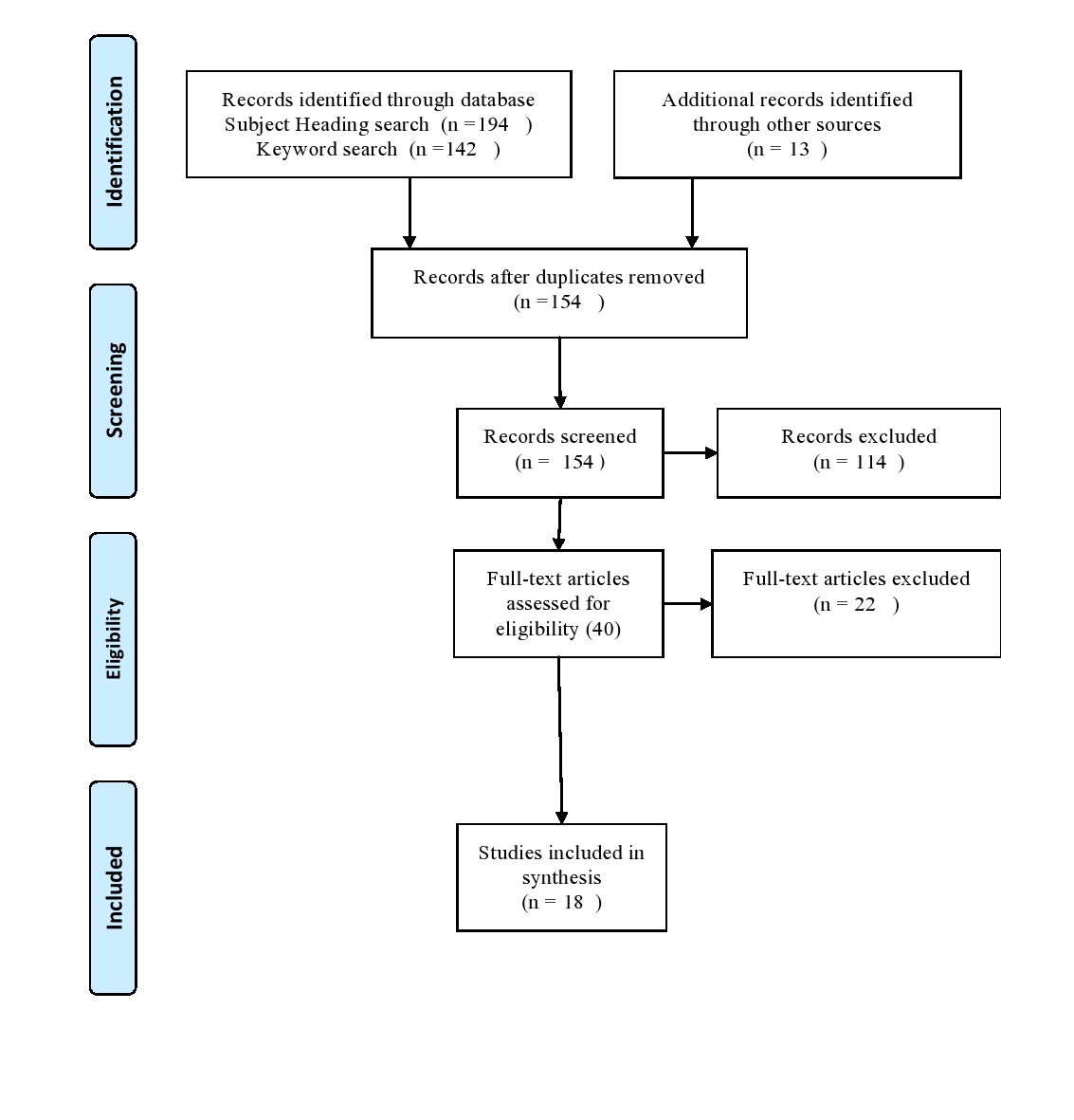
Study selection was performed in three stages (Figure 1):

Stage 1: Database Search

The studies that were identified through the database subject heading search (194 studies), the keyword search (142), and other sources (13 studies) were screened for duplication, yielding 154 studies.

Stage 2: Titles and Abstract Review

Screening of the titles and abstracts of the 154 retrieved studies was conducted by one qualified reviewer (the first author) in order to exclude any obvious non-eligible studies. Of these, 40 studies were deemed eligible for inclusion in a full article review.

Stage 3: Full Article Review

Two qualified reviewers conducted a full article review of the 40 studies. This review had two goals: first, to exclude any studies of non-eligible trials; second, to extract data on specific variables for further analyses. Of the 40 studies, 18 studies were deemed eligible for inclusion in our analysis.

Flowchart of the Review Screening Process

Data collection process

Data extraction was conducted by a qualified reviewer (the first author) during the full article review of the 18 included studies. The source of data in the individual studies was confirmed by contacting investigators who authored multiple studies included in the review, due to the aggregated weight of these studies potentially affecting our conclusion. The confirmation aimed to verify whether the data examined in the individual studies were collected from a single population and used in more than one study, or from different independent populations.

Data items

Primary Outcomes:

– Quality of Study: The quality of the study was categorized into three groups (Low, Moderate, High) (categorical variable)

– Conclusion of Study Effect: (whether the study concluded association of wind turbines with the effect on human health that was under investigation) (binary variable)

Variables (Outcome Measures of Individual Studies):

– First Author: The name of the first author (nominal variable)

– Year of Publication: The year in which the study was published (ordinal variable)

– Journal Name: The name of the publishing journal (nominal variable)

– Country of Study: The name of the country where the trial was originated (nominal variable)

– Study Design: The design of the study (nominal variable)

– Sample Size: The study sample size (continuous variable)

– Response Rate: The response rate of subjects in the study (continuous variable)

– Level of Evidence: The Level of evidence of the study (nominal variable)

– Level of Potential Bias: The level of risk of bias. Categorized into three groups according to Cochrane’s recommendations [10]. (Low risk of bias: Plausible bias unlikely to seriously alter the results; Unclear risk of bias: Plausible bias that raises some doubt about the results; High risk of bias: Plausible bias that seriously weakens confidence in the results) (categorical variable)

– Outcome Measures of Study: The outcome measure under investigation in the study (nominal variable); these outcome measures are:

– Annoyance (Sensitivity to Noise)

– Sleep disturbance

– Visual impact

– Well-being (Quality of Life/Mental Effect)

– Dose-response (description of the change in distress caused by differing distances from a wind turbine)

– Infrasound effect

– Existing background noise (comparison of stress associated with wind turbines to stress associated with road traffic noise/quiet rural environment)

– Attitude to wind turbines (whether people who complain have negative personal opinions toward wind turbines)

– Economical benefit (whether people who benefit economically from wind turbines have a decreased risk of distress)

Risk of bias in individual studies

Assessing the risk of bias of individual studies was performed at both the study level (study design, sample size, response rate, direction and magnitude of any potential bias and how it was handled, limitations, and reporting quality) and the outcome level (a cautious overall interpretation was drawn of the study’s conclusions, whether effect of human distress exists, considering the specific study’s objectives).

Summary measures and synthesis of results

After data extraction, each study was analyzed to identify the two primary outcomes: First, quality of study, taking into account the study’s principle outcome measures; all outcomes, exposures, predictors, potential confounders, and effect modifiers; how the study size was arrived at; how quantitative variables were handled in the analyses; description of all statistical methods; and how loss to follow-up and missing data were addressed. Second, conclusion of study effect as a cautious overall interpretation of the study’s conclusions, taking into account the specific study’s objectives and how well these conclusions were supported by the study results.

Risk of bias across studies

To reduce potential sampling bias (for example, the quality of study could be confounded by journal name and name of first author), the reviewers blinded themselves to the name of the journal and authors until all data on the other variables of interest were collected. To reduce potential measurement bias, the following three measures were undertaken: The data were directly entered into the database instead of using collection forms, quality assurance on all steps of data collection and management was performed, and in any case of uncertainty in deciding the quality of study, the reviewer consulted one of our senior authors to confirm the decision. Furthermore, the source of data was confirmed by contacting investigators who authored multiple studies included in the review, due to the weight their aggregated studies would have in affecting our conclusions.

Ethics approval

This study used previously published data making it exempt from institutional ethics board approval.

Results

Study selection

Figure 1 presents a flowchart depicting the study screening process. The database searches produced 154 publications. From this group, 40 publications were eligible following screening the titles and abstracts. From this group, 18 publications were eligible for inclusion after full article review. These 18 studies, shown in Table 1, consist of six original studies and 12 non-original studies (secondary analyses and literature reviews based on some of these original studies). Only the six original studies were included in the final analysis shown in Table 2. The 12 non-original studies were excluded from the analysis to minimize potential bias associated with repeated results.

This review used previously published data; therefore, there was no missing data for any of the variables of interest.

                                                                                  Study Characteristics
1st Author, Year Country Design Sample Size Response Rate % Level of Evidence Risk Of Bias Within Studies Quality of Study
Bakker [11]2012 ^ Netherlands Cross-sectional 725 37 4 Unclear risk of bias Moderate
Hanning [12]2012 ^ UK Expert Opinion/Review N/A N/A 5 Unclear risk of bias Moderate
Nissenbaum[13] 2012 ¥ USA Cross-sectional 106 75 4 Low risk of bias Moderate
Knopper [6]2011 ^ Canada Review 15 N/A 4 Unclear risk of bias High
Shepherd[14] 2011 ¥ New Zealand Cross-sectional 39, 158 34, 32 3,4 Low risk of bias High
Janssen [15]2011 ^ Netherlands Secondary analysis 1820 68, 58,  <30 4 Low risk of bias High
Pedersen[16] 2011 ^ Sweden Secondary analysis 1755 * 4 Low risk of bias High
Bolin [17]2011 ^ Sweden Review N/A N/A 4 Unclear risk of bias Low
Pedersen[18] 2010 ^ Sweden Secondary analysis 725 37 4 Low risk of bias High
Salt [7] 2010 ¥ USA Expert Opinion Report N/A N/A 5 Unclear risk of bias High
Pedersen[19] 2009 ¥ Netherlands Cross-sectional 1948 37 4 Low risk of bias High
Keith [20]2008 ^ Canada Expert Review N/A N/A 5 Unclear risk of bias High
Pedersen[21] 2008 ^ Sweden Secondary analysis 1095 N/A 4 Low risk of bias High
Pedersen[22] 2008 ^ Sweden Secondary analysis 1822 60 4 Low risk of bias High
Pedersen[23] 2007 ^ Sweden Qualitative Study 15 N/A 5 Low risk of bias High
Pedersen [5]2007 ¥ Sweden Cross-sectional 754 58 4 Low risk of bias High
Leventhall[24] 2006 ^ UK Report N/A N/A 5 Unclear risk of bias High
Pedersen[25] 2004 ¥ Sweden Cross-sectional 351 68 4 Low risk of bias High
1st Author, Year Does-response Road Traffic Noise / quiet rural environment Sleep Disturbance Annoyance/ sensitivity to noise Visual impact Attitude to wind turbines Infrasound effect Well-being (Quality of Life / mental effect) Economical Benefit
Nissenbaum[13] 2012 p < 0.05 p = 0.03 p = 0.002
Shepherd[14] 2011 U-R = 0.43 p < 0.001 U-R = 0.44 p < 0.001 U-R = 0.20 p < 0.01
Salt [7] 2010 Exp Exp
Pedersen[19] 2009 LRC = 0.50 p < 0.001 LRC = 1.07- p < 0.01 LRC = 0.35 p < 0.001 LRC = 1.04 p <0.001 LRC = 0.54 p < 0.001 LRC = -2.77 p < 0.001
Pedersen [5]2007 OR = 1.1 (95% CI 0.91 to 1.21) OR = 1.1 (95% CI 1.01 to 1.25) OR = 1.1 (95%  CI 0.97 to 1.21) OR = 1.1 (95%  CI 1.00 to 1.25)
Pedersen[25] 2004 Rs = 0.35  p < 0.001 Rs = 0.42  p < 0.001 Rs = 0.52  p < 0.001 Rs = 0.33  p < 0.001

Study characteristics and risk of bias within studies

Table 1 shows data on the 18 peer-reviewed studies captured in our review, including individual study characteristics, level of potential bias, and quality of study.

Results of individual studies

Table 2 shows summary data on the six original studies’ objectives, p-values, and outcome measures.

Risk of bias across studies

One main source of potential bias across these studies was that 10 of them, listed below, were mainly based on three data sets. The first data set (SWE00) was collected in Sweden in the year 2000 in agricultural areas, the second (SWE05) was collected in different environments in Sweden 2005, and the third (NL07) was collected all over the Netherlands in 2007. This potential bias was eliminated by using only the three original studies that collected the data sets [5, 19, 25].  The rest of the 10 studies (non-original studies) were excluded from the analysis to avoid repeated results.

– Bakker [11] 2012 Science of the Total Environment (NL07)

– Pedersen [16] 2011 Noise Control Eng J (SWE00) + (SWE05) + (NL07)

– Janssen [15] 2011 Acoustical Society of America (SWE00) + (SWE05) + (NL07)

– Pedersen [18] 2010 Energy Policy (NL07)

– Pedersen [19] 2009 Acoustical Society of America (NL07)

– Pedersen [21] 2008 Journal of Environmental Psychology (SWE00) + (SWE05)

– Pedersen [22] 2008 Environ Res Lett (SWE00) + (SWE05)

– Pedersen [23] 2007 Qualitative Research in Psychology (SWE00)

– Pedersen [5] 2007 Occup Environ Med (SWE05)

– Pedersen [25] 2004 Acoustical Society of America (SWE00)

Another source of bias was that three of the studies were reviews of previous literature [6, 12, 17].

Key results

– All 18 peer-reviewed studies captured in our review found an association between wind turbines and one or more types of human distress. These studies had a level of evidence of four and five.

– None of the studies captured in our review found any association (potential publication bias).

– These studies were published in a variety of journals (representative sample).

– Two of these studies showed a dose-response relationship between distance from wind turbines and distress (Table 2).

– There is still no evidence of whether or not a causal relationship between distance from wind turbines and distress exists.

Discussion

Summary of evidence

The peer-reviewed studies we reviewed provide reasonable evidence (Levels Four and Five) that an association exists between wind turbines and distress in humans.

Two of these studies showed a dose-response relationship between distance from wind turbines and distress, and none of the 18 studies concluded no association (consistency of association). The existence of a dose-response relationship and consistency, two of the Hill’s Criteria of Causality, argues for the credibility of the association.

All the evidence comes from expert opinion, case studies, and cross-sectional studies. No higher level of evidence observational studies, namely case-control and cohort studies, were utilized to investigate the subject. For example, although Shepherd, et al’s study [14] had a sound design and was well conducted and reported, it is considered at a lower level of evidence as a cross-sectional study has an increased potential for bias of its results.

Although three of the studies [6-7, 24] suggested that low-frequency sound energy wind turbines (i.e., infrasound below 20 Hz) may directly and negatively affect health, the level of evidence for these studies is also weak (expert opinions [7, 24] and a review [6] citing these two studies).

Economic benefit found in two of the studies [15, 19] could be intuitively and prematurely viewed as a factor lowering the credibility of the complaint. However, in our opinion, compensation would have lowered the credibility of the complaint only if these people had no distress following compensation. People in the studies who benefited economically from wind turbines had a decreased risk of distress but not a complete elimination of distress. Furthermore, the fact that the level of distress could be altered with financial compensation only speaks to the existence of distress.

It is worth pointing out that no causality has been established. The distress could be due to factors other than actual noise exposure. For example, the distress experienced by the participants in the original studies may have been generated or exaggerated by exposure to negative opinions on wind turbine.

Limitations

This study has a number of limitations and sources of bias. One source of bias is the exclusion of non-English studies. For example, China is the world’s leading country in the number of wind turbines [1]. The exclusion of non-English studies might have affected the overall conclusions of our review.

Another source of bias is the fact that the reviewer could not be completely blinded to the journals’ or authors’ names. There might be a theoretical incline to give studies in high impact journals higher quality because of their reputation (potential sampling bias). Nevertheless, if this bias took place, it would have an effect on the magnitude of evidence and not on the existence of the association due to the dichotomous nature of this variable (the number of studies that speaks for an association will not change).

Publication bias could be the reason for the finding that none of the 18 peer-reviewed studies captured in our review found no association. However, potential publication bias was decreased by conducting a search in two major grey literature databases (SIGLE, and Scirus).

Generalizability

The 18 studies were published in a variety of journals, making the captured studies a representative sample, which in turn increases our results’ generalizability (external validity).

The fact that the data in two of the three mentioned data sets were collected in Sweden may decrease the external validity, but simultaneously may increase the internal validity following the above logic. Furthermore, although these data were collected from one country, it still would be a safe assumption that the people and their experience with wind turbines, on which these data were collected, are not fundamentally different from people and experiences in other countries.

Future research

Further research in the area of exposure assessment and measurement is needed. The mechanism and physiology of harm needs to be confirmed. There is a need to identify the actual risk of harm and the health outcomes in people exposed. Until research can separate out specific sets of significant factors for the exposure with higher-level evidence than is available now, our ability to mitigate the harm is limited. Possible future research could be conducting longitudinal studies, performing measurements before wind turbines and after, and observing what happens to people over time.

Conclusions

We have demonstrated in our review the presence of reasonable evidence (Levels Four and Five) supporting the existence of an association between wind turbines and distress in humans. The existence of a dose-response relationship between distance from wind turbines and distress as well as the consistency of association across studies found in the scientific literature argues for the credibility of this association. Future research in this area is warranted.


References

  1. The Global Wind Energy Council. Accessed: October 30, 2013: http://www.gwec.net/?s=canada.
  2. The Global Wind Energy Council.. (2012). Accessed: October 30, 2013:http://www.gwec.net/wp-content/uploads/2012/06/Top-10-Cumulative-Capacity-December-2012.jpg.
  3. University of Strathclyde Archives. Accessed: January 20, 2014:http://stratharchives.tumblr.com/post/85511105886/week-18-windmill-designed-and-built-by-james.
  4. Krogh C, Gillis L, Kouwen N, Aramini J: WindVOiCe, a self-reporting survey: adverse health effects, industrial wind turbines, and the need for vigilance monitoring. Bull Sci Technol Soc. 2011, 31:334-45.
  5. Pedersen E, Hallberg L, Waye KP: Living in the vicinity of wind turbines–a grounded theory study. Qualitative Research in Psychology. 2007, 4:49–63.
  6. Knopper LD, Ollson CA: Health effects and wind turbines: A review of the literature. Environ Health. 2011, 10:78. 10.1186/1476-069X-10-78
  7. Salt AN, Hullar TE: Responses of the ear to low frequency sounds, infrasound and wind turbines. Hear Res. 2010, 268:12-21. 10.1016/j.heares.2010.06.007
  8. World Health Organisation: Night noise guidelines for Europe. (2009). Accessed: October 30, 2013:http://www.euro.who.int/__data/assets/pdf_file/0017/43316/E92845.pdf.
  9. Hill AB: The Environment and Disease: Association or Causation?. Proc R Soc Med. 1965, 58:295-300.
  10. Higgins JPT, Altman DG, Sterne JAC on behalf of the Cochrane Statistical Methods Group and the Cochrane Bias Methods Group: Chapter 8: Assessing risk of bias in included studies. Cochrane Handbook for Systematic Reviews of Interventions. 2011, Version 5.1.0:Accessed: October 30, 2013:http://handbook.cochrane.org/chapter_8/8_assessing_risk_of_bias_in_included_studies.htm.
  11. Bakker RH, Pedersen E, van den Berg GP, Stewart RE, Lok W, Bouma J: Impact of wind turbine sound on annoyance, self-reported sleep disturbance and psychological distress. Sci Total Environ. 2012, 425:42-51. 10.1016/j.scitotenv.2012.03.005
  12. Hanning CD, Evans A: Wind turbine noise. BMJ. 2012, 344:e1527. 10.1136/bmj.e1527
  13. Nissenbaum MA, Aramini JJ, Hanning CD: Effects of industrial wind turbine noise on sleep and health. Noise Health. 2012, 14:237-43. 10.4103/1463-1741.102961
  14. Shepherd D, McBride D, Welch D, Dirks KN, Hill EM: Evaluating the impact of wind turbine noise on health-related quality of life. Noise Health. 2011, 13:333-9.10.4103/1463-1741.85502
  15. Janssen SA, Vos H, Eisses AR, Pedersen E: A comparison between exposure-response relationships for wind turbine annoyance and annoyance due to other noise sources. J Acoust Soc Am. 2011, 130:3746-53. 10.1121/1.3653984
  16. Pedersen E: Health aspects associated with wind turbine noise—Results from three field studies. Noise Control Eng J. 2011, 59:47-53.
  17. Bolin K, Bluhm G, Eriksson G, Nilsson ME: Infrasound and low frequency noise from wind turbines: Exposure and health effects. Environ Res Lett. 2011, 6:1-6. 10.1088/1748-9326/6/3/035103
  18. Pedersen E, van den Berg F, Bakker R, Bouma J: Can road traffic mask the sound from wind turbines? Response to wind turbine sound at different levels of road traffic. Energy Policy. 2010, 38:2520–2527. 10.1016/j.enpol.2010.01.001
  19. Pedersen E, van den Berg F, Bakker R, Bouma J: Response to noise from modern wind farms in The Netherlands. J Acoust Soc Am. 2009, 126:634-43. 10.1121/1.3160293
  20. Keith SE, Michaud DS, Bly SHP: A proposal for evaluating the potential health effects of wind turbine noise for projects under the Canadian Environmental Assessment Act. Low Freq Noise Vib Active Control. 2008, 27:253-65.
  21. Pedersen E, Larsman P: The impact of visual factors on noise annoyance among people living in the vicinity of wind turbines. J Environ Psychol. 2008, 28:379–89.10.1016/j.jenvp.2008.02.009
  22. Pedersen E, Waye KP: Wind turbines – low level noise sources interfering with restoration?. Environ Res Lett. 2008, 3:1–5.
  23. Pedersen E, Waye KP: Wind turbine noise, annoyance and self-reported health and well-being in different living environments. Occup Environ Med. 2007, 64:480-6.
  24. Leventhall HG: Low frequency noise and annoyance. Noise Health. 2004, 6:59-72.
  25. Pedersen E, Waye KP: Perception and annoyance due to wind turbine noise–a dose-response relationship. J Acoust Soc Am. 2004, 116:3460-70.