Southern Australians Suffering Due to Foolish Adoption of Wind Turbine Agenda…

Wind Power Disaster Unfolds: SA Facing Total Blackouts, Rocketing Power Prices & Thousands More Chopped from the Grid

jay weatherill

****

To call what South Australia’s Labor government has ‘gifted’ their constituents an energy ‘policy’, is to flatter it as involving some kind of genuine ‘design’. It’s an economic debacle, pure and simple.

The current mess started under former Premier, Mike Rann –  a former spin-doctor, whose relatives lined up at the wind power subsidy trough from the get-go.

Under its current vapid leader, Jay Weatherill, SA’s Labor government has been talking up a wind powered future for months now; swanning off to Labor’s fantasy world, where the wind blows and the sun shines 24 x 365; and the power is, of course, totally “free” – with his claims that SA can ‘enjoy’ more than 50% of its power from the sun and the wind, with just a little (more) government “help”.

Back in ‘harsh reality land’, however, Jay’s presiding over the worst unemployment in the Nation, at 8% – and soon to rocket – worse still than perpetual basket case, Tasmania. Here’s In Daily on the latest dole queue figures.

SA jobless down but still worst in nation
In Daily
15 October 2015

sa unemployment

South Australia unemployment figures experienced a slight drop of 0.2 per cent in September, but the state still has the highest jobless rate in Australia.

Date released by the Australian Bureau of Statistics on Thursday morning show the SA jobless rate fell from 7.9 to 7.7 per cent, seasonally adjusted, the second biggest fall after Tasmania (down 0.4 per cent).

However, more South Australians are also leaving the job search.

SA had the largest decrease in the seasonally adjusted participation rate (down 0.8 percentage points), followed by Western Australia (down 0.6 percentage points) and Tasmania (down 0.5 percentage points).

Seasonally adjusted figures for September show SA had 864,200 people in jobs, with 66,400 people looking for work.

Victoria was the only state with an increase in the seasonally adjusted unemployment rate, up 0.1 per cent.

The trend rate for South Australia increased to 8 per cent.

National unemployment figures remained at 6.2 per cent (seasonally adjusted).

Employment, Higher Education and Skills Minister Gail Gago said the State Government had directed its focus on struggling South Australians.

“We recognise the difficult road ahead for many workers as we transition from the old economy to the new economy.

“Last week, we saw Alinta announce it will close its coal-fired power station by March next year.

“We are also seeing a downturn in resources jobs across the nation as a result of a global collapse in commodity prices.”

Gago said diversifying the economy while investing in new and growing industries were part of the government’s long-term structural reform.
In Daily

With economics ‘maestros’ like Gail Gago focusing on ‘struggling South Australians’, they’re in for a bumpy ride on her “difficult road”; to be sure. That the road was laid by megalomaniacs like Mike Rann and ‘serviced’ by the completely ‘Clueless’ Jay Weatherill, seems to be lost on Gail Gago, much to the miserable disadvantage of those they pretend to govern.

You see, most with the slightest grip on the basics of economics pick up on the fact that producers of widgets (and the like) are driven by profits (a motive lost on Labor/Green apparatchiks), which, in turn depend upon input costs. For widget makers, butchers, bakers and the like, drive up input costs and, all things equal, their profits will fall; and their ability to invest in their business and employ people will drop off, too.

Where the item is high on the list of inputs, a jump in its cost may see that business, or even whole industries, collapse; as they end up insolvent.

As just the most glaring example, where the input is electricity, industries that use stacks of it – like manufacturers, miners and mineral processors – have been literally crushed, as power prices have skyrocketed; thanks to wind power subsidies and the additional and unnecessary costs of peaking power to back it up when it disappears every day:

Britain’s Economic Nightmare Unfolds: Wind Power Costs Killing Thousands of REAL Jobs

South Australia’s economic debacle is, in no small part, due to its diabolical wind power policy; that’s led to South Australians paying the highest power costs in the Nation – if not (on a purchasing power parity basis) the highest in the world.

The fact that SA is an economic train wreck (see our posts here and here) is clearly lost on the likes of Gail Gago, when she talks about a “transition from the old economy to the new economy” – a place where, apparently, the rules of economics are permanently suspended, with skyrocketing power prices having no effect on investment, growth in incomes or employment. Maybe Weatherill & Co’s heralded “new economy” runs on moonbeams and fairy dust?

It’s going to need to – SA ‘relies’ on 17 wind farms and their ‘notional’ installed capacity of 1,477MW. However, its faith in the Wind Gods, pixies and the like seems to disappoint more than deliver:

May 2015 SA

We covered the dismal data from SA depicted above and more besides here:

The Wind Power Fraud (in pictures): Part 1 – the South Australian Wind Farm Fiasco

That woeful missive drew focus on the pathetic performance of the 17 wind farms that have led to SA being known as ‘Australia’s wind farm capital’: it has the greatest number of turbines per capita of all States – and the highest proportion of its generating capacity in wind power by a country mile. But that tag is far more a curse than a blessing, as the following pieces attest.

SA renewables use may lead to blackouts
Australian Financial Review
Ben Potter
29 October 2015

South Australia’s rising share of renewable power could cause blackouts if the Australian Energy Market Operator doesn’t intervene, the agency’s chief executive, Matt Zema, said.

SA’s rooftop solar panels could meet electricity demands during the middle of some days by 2024-25 if uptake continued at the current rate, he said, but this would lead to more volatility and less reliability, and a greater reliance on the interconnector, with the large eastern state generators to keep power flowing on some days.

The warning is relevant for the federal Labor opposition, which has called for 50 per cent of Australia’s electricity to come from renewable sources by 2030. An interconnector is a high-capacity transmission line connecting two electricity markets.

Mr Zema said prices are becoming more volatile in SA because of the withdrawal of coal power plants and the strong uptake in solar energy.

Prices have hit the National Electricity Market limit of $13,800 a megawatt hour several times in the state in recent months. That makes industrial users uneasy and has led to speculation the government may have to pay thermal-coal generators to provide standby capacity. “The signal in that market is you actually need more thermals in reserve,” Mr Zema told a Committee for Economic Development of Australia lunch in Melbourne.

He said rather than Germany, which has a large share of renewable generation and is fretting over security of supply, SA is “more like Portugal – it’s at the end of the grid”. “So if they are going to go completely renewable, they are going to rely more and more on the interconnectors for system security.”

Mr Zema said the Energy Market Operator was intervening to balance the market to avoid blackouts in SA while the interconnector is upgraded, causing outages and complaints.

Peter Dobney, the head of energy and resources at packaging company Orora, told the lunch SA “has become a basket case for large industry energy users” and the outages were costing industry millions of dollars.

But Mr Zema said the upgrade had to be completed before the summer of 2016-17 because Alinta will close its Northern and Playford B thermal power stations in 2016, dropping 15 per cent of current capacity in SA.

He said the Energy Market Operator was purchasing frequency controlled ancillary services or FCAS “to stop SA actually going black if the interconnector drops out”. “How much do you want to pay for system security in SA? Because that’s what we are buying,” Mr Zema asked. “If we don’t buy FCAS and the system trips, we lose the whole state.”

Mr Zema said Germany, Spain and Italy were dealing with a similar problem by relying on interconnectors with France, which has a large surplus of nuclear power.
Australian Financial Review

elephant-in-the-room1

****

Hmmm… Not a single mention of SA’s wind farm fleet from the Fin Review. How curious? Could it just be the result of a little ‘group-think’ over at Fairfax?

True it is that the struggling Fairfax rags run with a maniacal cult-like veneration of wind power (see our post here).

But to head up an article as ‘SA renewables use may lead to blackouts’; and to avoid mention of wind power altogether (especially where wind power capacity in SA ‘outshines’ solar capacity by a whopping margin), smells like Ben Potter was deliberately directed to avert his eyes from the enormous, economy-destroying ‘elephant in the room’.

No, revealing that pesky-pachyderm was left to The Australian which, funnily enough, while covering exactly the same AEMO report, managed to draw reference to SA’s woefully wanting wind farms (or ‘wind’/’wind generation’) no less than 6 times (8, including the headline and the caption to its photo of a turbine: “The AEMO report will reignite debate about wind farms”); and referred to solar panels, just once.

SA ‘risks power shortfalls’ because of wind farm dependence
The Australian
Annabel Hepworth
26 October 2015

South Australia could experience electricity supply shortfalls as it becomes more reliant on wind farms and imports from Victoria, a new report finds.

The report by the Australian Energy Market Operator finds the closure of Alinta’s Northern Power Station by the end of March next year could have an impact in “extreme” conditions over the next three years.

The document, to be released today, is likely to reignite debate over wind farms just as the renewables industry hopes for more support after the change of prime minister.

Malcolm Turnbull’s backing for a carbon trading scheme contributed to him being toppled as opposition leader in 2009, while Environment Minister Greg Hunt has recently suggested that criticism of wind farms was confined to “views expressed by particular individuals”.

Under Tony Abbott the Coalition scaled back the renewable energy target, directed the $10 billion Clean Energy Finance Corporation not to invest in wind farms, and axed the carbon tax.

According to the new AEMO report, the planned closure of the Northern Power station will impact the balance of demand and supply in South Australia over the next three years, increasing the state’s reliance on wind and on imports from Victoria.

“When high demand coincides with low wind generation, plant outages, or low levels of imports, South Australia may experience supply shortfalls,” the report says.

In July, Alinta said it would close its Flinders operation in South Australia’s Port Augusta, which comprises the Northern and Playford B power stations and the nearby Leigh Creek mine, by March 2018, if not as early as March 2016.

Alinta boss Jeff Dimmery attributed the decision to policies aimed at supporting renewables and falling power demand that had led to a glut of power in South Australia. Earlier this month, the company confirmed the closure would be next year.

AEMO has produced its new report on the impacts of the Northern closure because it is considered significant enough for AEMO to update its yearly ­guidance on the adequacy of power generation in the National Electricity Market for the next decade.

Overall, the report finds the earlier withdrawal of Northern would not impact the point at which South Australia could breach the “reliability standard”, which says that just 0.02 per cent of power can go unserved in an area in a year.

AEMO has previously forecast that South Australia could breach the standard in 2019-20 and 2024-25, with the potential uptake of solar rooftop panels alleviating the situation in the years between.
The Australian

Could it be that Fairfax hacks have been engaged in a little ‘cherry-picking’, in order to keep spinning its ‘wonders-of-wind’ editorial line? Same AEMO report being covered, but an entirely different story. George Orwell generated a whole lingua franca – including terms such as “newspeak”; “doublespeak”; and “doublethink”- to capture what Fairfax considers should pass for ‘journalism’, these days (see our post here).

When the AEMO report talks about times when: “high demand coincides with low wind generation, plant outages, or low levels of imports, South Australia may experience supply shortfalls” it’s referring to data like this from June this year (the graph above is from May), showing the chaos that is wind power generation in South Australia:
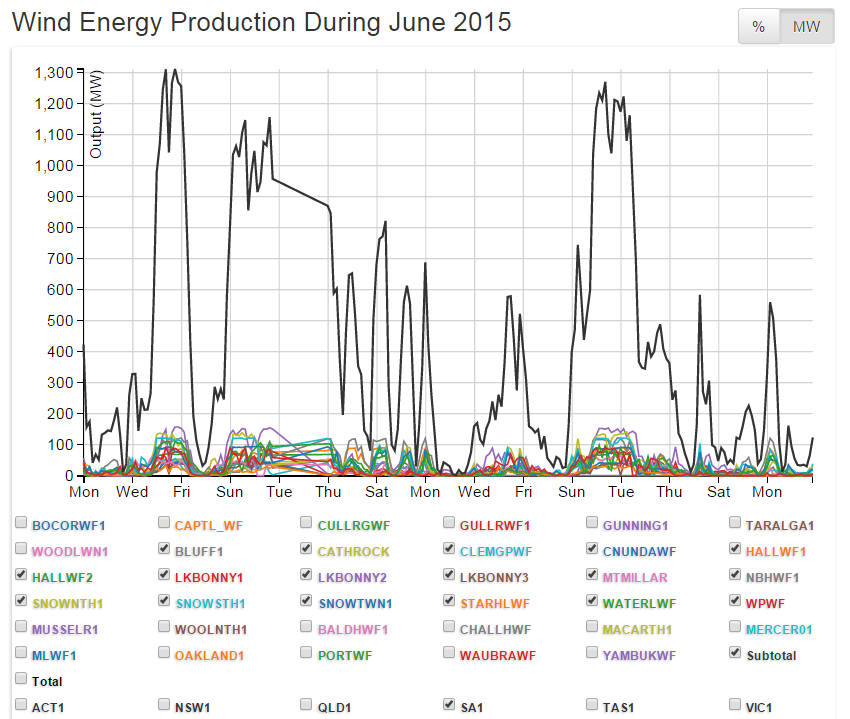
June 2015 SA

In the AFR piece it talks about occasions when: “Prices have hit the National Electricity Market limit of $13,800 a megawatt hour several times in the state in recent months”.

But, for some strange reason, the AFR fails (or refuses) to join the dots: those occasions – when the spot price paid to generators goes from around $70 per MWh to the market cap of $13,800 per MWh perfectly coincide with sudden (and often, complete) wind power output collapses, as detailed here:

South Australia’s Unbridled Wind Power Insanity: Wind Power Collapses see Spot Prices Rocket from $70 to $13,800 per MWh

The cost of SA’s insane wind power policy is borne, of course, by its beleaguered (remaining) businesses; and struggling households (think old-age pensioners and the thousands of unemployed).

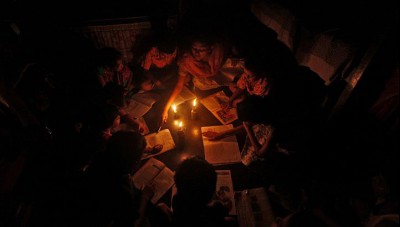
This is a State where some 50,000 homes have been disconnected from the grid – families simply no longer able to pay their power bills; who’ve been reduced to lighting their homes with candles, and, unable to power a fridge, using Eskies (coolers) to keep their perishables – cooking on wood stoves and trying to keep warm using barbeques.

With the fall-out from its wind power fiasco unfolding fast, hundreds of businesses will hit the wall; and thousands more households will soon get to join the tens-of-thousands, already sitting freezing (or boiling) in the dark.

SA power prices to surge by $150 a year, report warns
The Advertiser
David Nankervis
22 October 2015

POWER prices will surge up to $150 a year for hundreds of thousands of householders under controversial changes to electricity charges, an investigative report warns.

The SA Council of Social Services report also says small businesses face a 50 per cent rise in power costs and that this could force some to close.

The findings are based on a SACOSS investigation into the impact of rule changes by the Australian Electricity Market Commission.

The change is designed to shift the demand for power away from peak periods to take pressure off the network.

In response to the new rules, SA Power Networks has proposed introducing a monthly network charge calculated on a customer’s highest half-hour of energy use between 4pm and 9pm on any given day.

This will provide a “pricing signal” to customers to ration the use of appliances, SAPN spokesman Paul Roberts said.

“That means not turning on all major appliances at once during peak periods such as tea time on a hot day, instead delaying using the dishwasher or washing machine until later,” he said.

But SACOSS executive director Ross Womersley said the changes, beginning as early as 2017, would see half of all householders worse off.

“It would be madness for this to proceed and any changes should be deferred for at least a few years,” he said.

“And this new system should be introduced only on a voluntary basis, which would allow people to opt in only if they believe they will be better off.

“This is because people on low income and many other householders would be worse off.”

According to the SACOSS report, which will be submitted to SAPN as part of the network company’s consultation process:

APPROXIMATELY 50 per cent of householders would be worse off

THE biggest bill increases could reach $150 a year

THE biggest savings could be just $10 a year

HALF of small businesses would be worse off

ALMOST one-in-five small business would face a 50 per cent increase in energy costs

The report also said there was “limited (public) support” for the changes to the billing system.

SACOSS research revealed consumers were concerned about big variation in bills amounts, making it more difficult to budget for electricity costs.

The report said this would have a serious impact on low-income households over summer.

Mr Roberts said SAPN invited “consultation” on its proposed billing changes earlier this month because “we know people care about electricity prices”.

“We’re not only consulting on the detail of the changes, but also an appropriate transition that protects the interests of customers and gives them time to adjust to the changes.
The Advertiser
studying candle

Sleep Deprivation, and The Effects! (Wynne Gov’t Torturing Rural Residents Near Wind Turbines!)

The Spooky Effects of Sleep Deprivation
by Sara G. Miller, Staff Writer | October 27, 2015
It’s no surprise that a night without enough Zzzs can lead to a groggy morning. But bleary eyes and gaping yawns aren’t the only things that can happen when your body needs more shut-eye.

Indeed, there are more nightmarish side effects to sleep deprivation.

If a person is deprived of sleep, it can lead to “tremendous emotional problems,” said Dr. Steven Feinsilver, the director of the Center for Sleep Medicine at Icahn School of Medicine at Mount Sinai in New York City. “Sleep deprivation has been used as a form of torture,” he said. [7 Strange Facts About Insomnia]
There isn’t a clear definition of exactly how long a person must go without sleep, or how little sleep a person has to get to be considered sleep-deprived, and different people need different amounts of sleep, so there may be no universal definition of “sleep deprivation.” Rather, a person is considered sleep-deprived if they get less sleep than they need to feel awake and alert, researchers say.

But still, research over the years has shown that people can be physically and psychologically damaged from not getting enough sleep, said David Dinges, a professor of psychology and the director of the Unit for Experimental Psychiatry at the University of Pennsylvania.

In fact, the damage is so apparent that it is unethical to coercively deprive someone of sleep, Dinges said. In the studies of sleep deprivation that Dinges and his colleagues conduct in their lab, healthy volunteers are placed in medically safe environments and constantly monitored.

But studying sleep deprivation is important, according to these researchers and others who study the condition. They say that learning what happens in people who are deprived of sleep can help researchers better understand the function of sleep and its importance for both physical and emotional health.

Emotions askew

The problems can start on a somewhat minor scale.

“Clearly, your brain doesn’t work very well when you’re sleep-deprived,” Feinsilver said. Even a low level of sleep deprivation has an impact on cognitive and emotional function, he said.

Dinges explained that some of the first emotional impacts of sleep deprivation involve positive emotions. “When people get sleep-deprived, they don’t show positive emotion in their faces,” Dinges said. A sleep-deprived person may say they’re happy, but they still have a neutral face, he said.

And they won’t recognize other people as happy, either. A positive look on someone’s face can appear neutral to a sleep-deprived person, and neutral look is often interpreted as a negative look, Dinges said. The sleep-deprived brain may not be as capable of detecting positive emotions as a more rested brain, he said.

And sleep-deprived people also don’t tolerate disappointment very well, Dinges added.

Microsleeps

As little as a single night of sleep deprivation can result in a person having a phenomenon called “microsleeps,” the next day, Feinsilver said.

A person begins to fall into mini-snooze sessions, which last up to 30 seconds. Some people’s eyes remain open during microsleeps, but the disturbing thing about microsleeps is that during sleep, the person is essentially blind, even if their eyes are open, Feinsilver said. They’re not processing information, he said.

Studies show that during microsleeps, the brain goes into a sleep state rapidly and uncontrollably, Dinges said. People can force themselves awake, but they will soon fall into another microsleep, he said.

Both Dinges and Feinsilver said that this condition can be incredibly dangerous, especially if you’re behind the wheel.

Delirium

People often say they feel loopy after a night of no sleep. But in more extreme cases, losing sleep may cause delirium.

True delirium occurs when a person becomes completely disoriented, Feinsilver said. “Sleep can play a role in that,” he said. [5 Things You Must Know About Sleep]

Patients who have been hospitalized in intensive care units — where lights and sounds may continue all day and night — can develop a condition that doctors call “ICU delirium,” he said. And while it’s unclear if sleep deprivation is the cause of this delirium, doctors do think that loss of sleep is one reason people in the hospital for extended periods develop bizarre behavior, he said.

The worst thing you can do for sleep is put someone is a hospital, Feinsilver added. It’s fairly common for for hospitalized patients to develop insomnia, he said.

Hallucinations

Seeing things that aren’t there can be a side effect of chronic sleep deprivation, but whether sleep deprivations can induce true hallucinations may be up for debate.

Feinsilver said he personally experienced hallucinations due to sleep deprivation, in October of his first year out of medical school. A newly minted medical resident, Feinsilver said he had been chronically sleep-deprived for several months.

“I [knew] it was October, because I was in the ICU after a night on call,” and there was pumpkin by the nurses’ station, he said. “I had a very vivid feeling of the pumpkin talking to me,” he said.

But Dinges was more skeptical about hallucinations.

“There’s no question that misperceptions can occur,” Dinges said. When people are very sleepy and performing a task, they may see something flicker in their peripheral vision, or they may think they see blinking lights, but not be sure, he said. All of these are indications that the brain isn’t interpreting information clearly, he said.

Can you die of sleep deprivation?

In a famous series of animal experiments, researcher found that total sleep deprivation could kill lab rats.

In 2012, a Chinese man reportedly died after going 11 days without sleep. However, it’s unlikely that lack of sleep alone caused his death (other factors likely played a role, such as drinking and smoking).

Of course, studying this phenomenon in humans is difficult – even when you put aside the clear ethical dilemmas.

“Can you die of sleep deprivation? It’s not easy,” Feinsilver said. “Because you’ll fall asleep,” he added.

Dinges agreed.

“I don’t believe that people can keep themselves awake until they succumb to death,” because the drive to sleep turns on, and then continues to turn on, he said. “You can’t will yourself to stay awake that long,” he said.

Still, there’s no question that sleep deprivation has “serious adverse health effects,” Dinges said.

“Everything we know about sleep loss is harmful,” he said. But — on a more positive note — most of the effects of sleep deprivation dissipate after you sleep, he added.

Follow Sara G. Miller on Twitter @SaraGMiller. Follow Live Science @livescience, Facebook & Google+. Originally published on Live Science.

Wind Pushers Want to Evict People From Their Homes, via “Eminent domain”…

Falmouth Wind Turbines 2nd American Civil War

Falmouth Wind Turbines 2nd American Civil War

When the Town of Falmouth evicts the wind turbine neighbors and absorbs their properties through an act of eminent domain, those same townspeople will have to open their doors to their own wind power refugees. They may need to be reminded of the hard hearted turning back of the New Orleans Hurricane Katrina refugees as they tried to cross the bridge into the next parish by the Parish Sheriffs.

When civility disappears, it can get pretty brutal.

Anyone reading this needs to understand that this is the 2nd American Civil War, and it is being fought in many American communities.
The sooner the people can come to their senses about the “Falmouth Version of Climate Change BS”, the sooner they will be able to recover from this folly that is destroying them.

Already there is a significant feeling among the Town Meeting members that they are now reluctant to vote on the proposed Articles 1,2,&3 because they were not truthfully explained to them by the Select Board . (Obfuscation, anyone?)

The eminent domain presentation can be viewed on the link below Article 2 :
Board of Selectmen 10/5/15 part 2— 1:30 minute mark presentation and endorsement 2:24 minutes
http://www.fctv.org/v3/vod/board-selectmen-10515-part-2

All this erodes the people’s trust in government, and feeds anarchy. The situation in Falmouth, seized by anarchy, has behaved horribly. The very prospect, the very thought of seizing someone’s home by phony, 50% valuation, eminent domain turns one’s stomach. Some land of the free!

The noise torture :

While there are many sources of Infra-sound, most of them are generated by passing and sporadic sources, like rockets, aircraft, volcanoes, etc. Wind turbines are permanent installations. They operate at variable speeds. The kinds of noise that they produce is modulated, increases and decreases in intensity, dependent on local wind speeds. They confuse the nervous system and trigger the “fight, flight, freeze response” that all humans have hardwired into our nervous systems.

We developed this response to sense the approach of low growling lions and tigers back when we roamed the African savannah in search of food and shelter. This was a MOVING source of noise that we recognized as lethal.

Now, the wind turbines, a technological source of lethal noise, while fixed in place, produce (infra-sound and low frequency noise) in a modulated fashion, triggering the FFF response, causing a cascade of alarm hormones; adrenalin to flood the nervous system.

This may be adaptive to modern humans; case in point, some imbecile cuts you off in traffic and forces you to suddenly swerve and apply the brakes. You fuss and fume, but you are able to recover from this and continue to drive on normally.

When wind turbines sporadically impact on people in their sleep, they are aroused in a state of anxiety, and are unable to get back to sleep. This systematic sleep deprivation far exceeds any methods of interrogation so far devised, and presents these unsuspecting residents with the most exquisite form of torture yet.

When they finally seek legal redress they are met by measures of eminent domain to silence them and remove them from the state-driven wind power agenda.

Town Meeting Member Dave Moriarty discusses the upcoming Special Town Meeting concerning Wind 1
Click here to watch the youtube video : Falmouth MA Wind Turbine Fiasco 2015
https://www.youtube.com/watch?v=Vs8SwaR4KjE&feature=youtu.be

Last please view the presentation by Attorney Chris Senie

Falmouth ZBA Sept 17 with Chris Senie -This link :
Zoning Board of Appeals September 17, 2015 Senie & Associates, P.C. Representing Impacted Neighbors
https://windwisema.files.wordpress.com/2015/09/senie-to-zba-ceasedesist-2015-09-17.pdf

Wind Industry Deserves to “Collapse”, just like one of it’s Useless Turbines!

UK Wind Industry Collapses as David Cameron Slashes Subsidies for Wind Power

SWITZERLAND-WEF-DAVOS-CAMERON

****

While the wind industry, its parasites and spruikers continue to wail like banshees about dreaded ‘uncertainty’ all over the globe, there seems to be another ‘certainty’ keen to muscle up alongside the usual pair cited as examples of dead-set certainties in life: “death and taxes”.

The newest absolute certainty is that, in the absence of massive and endless subsidies, the wind industry will die a sudden, natural and inevitable death.

When David Cameron romped to absolute control of the UK Parliament, earlier this year, he did so on a promise to end subsidies to wind power outfits. Seen by delusional wind worshippers as a mere idle threat, Cameron’s election manifesto has now been realised, as the necessary amendments wind their way through Westminster.

Best deal for bill payers and investors as subsidies for onshore wind end
Department of Energy & Climate Change, Lord Bourne of Aberystwyth and The Rt Hon Amber Rudd MP
8 October 2015

The Government is pushing ahead with its commitment to end public subsidies for onshore wind farms, by closing the Renewables Obligation across Great Britain from 1 April 2016.

The Government is pushing ahead with its commitment to end public subsidies for onshore wind farms, by closing the Renewables Obligation across Great Britain from 1 April 2016.

In amendments to the Energy Bill we have set out the grace period criteria, providing further certainty for investors. We estimate that around 2.9GW of onshore wind capacity will be eligible for the grace periods, meaning that bill payers will be protected.

The projects that are eligible for the grace period will need to demonstrate either that they had planning consent as at 18 June; that they have successfully appealed a planning refusal made on or before 18 June; or that they have successfully appealed after not receiving a planning decision due by 18 June. They will also need to show that they had a grid connection and land rights in place. Projects that have met all these criteria and can demonstrate that they have struggled to secure finance from lenders since 18 June will be allowed extra time but no longer than nine months.

In total, the amount of onshore wind capacity that could be deployed by 2020 is still 12.3GW and will ensure we meet our renewable energy commitments.

Energy Minister Lord Bourne said: “We have a long-term plan to keep the lights on and our homes warm, power the economy with cleaner energy, and keep bills as low as possible for hard-working families and businesses.

“To do this we will help technologies stand on their own two feet, not encourage a reliance on public subsidies. By bringing forward these amendments we are protecting bill payers whilst meeting our renewable energy commitments.”
Gov.uk

While wind worshippers continue to make wild claims about wind power already being “free” – and, apparently, getting cheaper all the time – it appears that selling a product with no commercial value is getting tougher all the time.

Even the merest mention of a cut to subsidies has the wind industry’s parasites quaking in their boots. Follow through on the threat and big talking wind farm developers head for the hills:

Deliverance for Brits: David Cameron Empties Subsidy Trough & 250 Wind Farms Get Scrapped

In a predictably waffly piece from a wind worship blog, here’s the story of another wind farm being scrapped: this time in Wales, due to “changing market conditions” – which is wind industry code for “the subsidies have gone”.

Vattenfall ditches North Wales wind farm project that was 10 years in the making
businessGreen
Jessica Shankleman
17 August 2015

Nant Bach project has failed to keep up with changing market conditions, says developer

Swedish energy giant Vattenfall has scrapped plans for an 11-turbine wind farm near Conwy in North Wales after 10 years in development, partially blaming a shift in government policy for the decision.

In a statement today, Vattenfall said the Nant Bach wind farm, which was granted planning consent four years ago, no longer fitted with its strategy of developing and operating the “very best wind energy sites capable of delivering low-cost, competitive green power that finds a route to market”.

The developer said the 100m-high wind turbines were no longer economically viable in current market conditions. In order to use larger turbines the company would have had to refile for planning permission.

Industry insiders suggested larger turbines may have struggled to secure consent now the government has announced changes to planning policies for onshore wind farms, which effectively give locals the final say over applications.

The lodging of a second planning application may have also compromised the project’s ability to access the current Renewables Obligation (RO) subsidy scheme, which the government is preparing to close for new wind farm projects from next year.

A spokesman for Vattenfall said a range of policy changes had made the wind farm unviable, adding that the changes had created a “complex” situation for the developer.

Jonny Hewett, Vattenfall’s project manager for the Nant Bach scheme, said the market had moved on “and left Nant Bach behind”.

“It’s obviously disappointing to have to stop the Nant Bach wind energy project after 10 years of development,” he said in a statement. “We have had local support and the region’s economy would have benefited from any investment but the reality is that Nant Bach was a scheme conceived 10 years ago when energy policy encouraged the maturity of the new wind power industry.”

Vattenfall refused to disclose how much money it has spent developing Nant Bach.
businessGreen

turbine collapse 9

The Wind Turbine Scam, in Ontario….A Financial Disaster!

Ontario’s Wind Power Disaster Sends Power Prices Into Orbit, Driving REAL Industries Offshore

industrial-decline-2

****

Ontario is the place where the most bizarre energy policy in the world has seen thousands of these things speared into the backyards of homes – in the most agriculturally productive part of Canada. When we say “bizarre” we mean completely bonkers.

Canada has one of the “cleanest” power generation mixes on the planet, with the vast bulk of its electricity coming from zero emissions sources such as nuclear and hydro.

Adding to the lunacy is the fact that wind power outfits are guaranteed to reap fat profits despite market conditions.

Where the wholesale market price for power in Ontario is between $30-50 per MWh, wind power generators pocket a fixed price of $135 MWh – even if there is absolutely no market for it and the Province literally has to pay neighbouring US States to take it.

Adding insult to injury is the fact that truly productive industries are being crushed by skyrocketing power prices, sending their activities offshore and taking thousands of (previously) stable, well-paying jobs with them. Here’s Parker Gallant on the nightmare being visited upon Ontario.

Surplus power sold at discount: the sad sad story of electricity bills in Ontario
Ontario Wind Concerns
Parker Gallant
4 October 2015

Ontario ratepayer fatigue: covering the costs of bargain basement sale of surplus power from wind and solar

When will it end?

Another month goes by and another $168 million from Ontario ratepayer’s pockets went to subsidize surplus electricity exports to our neighbours in New York, Michigan and Quebec. The month of August saw another 1,759,000 megawatts (MWh) or 1.76 terawatts of excess electricity generation exported. That cost Ontario’s electricity ratepayers $209 million—the Independent Electricity System Operator (IESO) sold it for $41 million.

The 1.76 terawatts (TWh) sold at the big discount was enough to supply 183 thousand “average” Ontario households with power for a full year. That sale brings our exports to 15.09 TWh for the first 8 months of 2015, enough to supply almost 1.6 million “average” households with power for a full year!

The costs of those export losses fall to all ratepayers; for the eight months ended August 31st, that means a “green energy tax” of $1.4 billion, or about $300 per average household. Quick math will disclose that the average monthly cost is $177 million meaning the total cost for Ontario’s ratepayers in 2015 may reach $2.1 billion or roughly $460 per ratepayer. The 23 TWh we will probably export would have provided 2.4 million ratepayers with their average annual power needs.

What about wind power in all this? In August, wind produced 3.5% (459.3 gigawatts or GWh) of total generation (13.05 TWh) and just over 26% of our exports; solar produced about 29 GWh (not including “embedded generation”). Combined, they represented 27.7% of our exports which begs the question – what benefit do they provide and why do we keep adding more generation at subsidized rates, if we lose money because we must export our surplus generation?

That question is unfortunately not going to be answered any time soon, if we look at the recently released IESO 18 month outlook (Oct 2015 to March 2017).   The IESO report notes:

“About 1,900 MW of new supply – mostly wind and solar generation – will be added to the province’s transmission grid over the Outlook period. By the end of the period, the amount of grid-connected wind generation is expected to increase by 1,300 MW to about 4,500 MW. The total distribution-connected wind generation over the same period is expected to be about 700 MW. Meanwhile, grid-connected solar generation is expected to increase to 380 MW, complementing the embedded solar generation capacity of about 2,200 MW located within distribution networks by the end of the Outlook.”

According to the IESO report, Ontario will add 1,700 MW of generation from wind and solar generation over the next 15 months, which brings wind turbine capacity to 5,200 MW and solar to almost 2,600 MW. This is clearly not needed or dependable.

The IESO report also highlights what we have been told by various business associations that have expressed concern about the effects of rising electricity costs: “For the three months, wholesale customers’ consumption posted a 5.9% decrease over the same months a year prior with Pulp & Paper, Iron & Steel and Petroleum Products accounting for most of the reductions.”

That’s evidence that our primary processors are exiting Ontario, in large part because of high electricity prices, taking jobs with them.

The Ontario Wynne government is bent on ensuring Ontario leads the way to the highest prices of electricity in all of North America; they have only a couple of jurisdictions to overtake.

Time to turn the lights off!

studying candle

Aussies Not Going to Force Wind Turbines on Communities….For Real??

Angus Taylor MP: Retailer Boycott – Wind Farms will NOT be Built where there is ‘Negative Community Reaction’

Angus Taylor

****

Angus Taylor, the Liberal Federal Member for Hume gave a wind industry scorching interview on Alan Jones’ Breakfast show on 2GB last week. For Australian rural communities fighting the threat of these things, STT thinks that what Angus had to say is the best news that they will have heard, since their battles began.

Alan Jones AO: Which brings us back, thank God we’ve got some like it, to the man I’ve talk to you about many times, Angus Taylor, this bloke has ability. He is an outstanding Federal member for the seat of Hume, a Rhodes scholar. He’s from the bush. He’s got degrees in economics and law from Sydney University, a masters degree from Oxford University in economics and let me fire a warning shot here, because I now learn that the factions, remember Malcolm Turnbull said there were no factions in the Liberal party? The left are cutting loose. Just as the leader now, Tony Abbott has gone, and they’re lining up probably to have a shot at people like Angus Taylor and Craig Kelly and others, mobilising pre-selection. Malcolm Turnbull said at the Liberal party council meeting a couple of weeks ago – the party is not run by factions – Malcolm, you’re kidding us. Joe Hockey’s resigned. I’m telling you the next member for the seat of North Sydney has already been decided. You can forget about your pre-selection. The bloke the factions have decided will be Trent Zimmerman. Now as I told you last time, this gifted and talented Angus Taylor, didn’t make it amongst the 41 ministries handed out by Malcolm Turnbull. It doesn’t worry him because he is very strong on policy. He’s on the line, Angus Taylor, good morning.

Angus Taylor MP: Morning Alan.

Alan Jones AO: Where do we go on all of this? ‘Cos there is an interconnectedness isn’t there, between carbon dioxide, global warming, Paris and a a fortune being spent and then suddenly, embracing renewable energy. And you’ve got this in your electorate.

Angus Taylor MP: I certainly do, I mean I’ve probably got more wind farms planned in my electorate than anywhere else and at the end of the day Alan what we’ve got is a situation where people will move into my electorate from Sydney or Canberra. They’ll pull all of their savings into buying a block of land, a few acres, and a little farm only to discover a year or two later that a big 170 metre wind turbine is going to be overlooking them. And it’s just not on Alan when these things are getting $600,000 or more of subsidies a year …

Alan Jones AO: Each, each.

Angus Taylor MP: Each. Each turbine, each one of them.

Alan Jones AO: Stop stop Angus. Out there, remember what this man has said, this is not some dumbbell from you know out the back blocks, we’re talking to a Rhodes scholar. A bloke with masters from Oxford University in economics. $700,000 of your money per wind turbine and they’re owned by foreign interests.

Angus Taylor MP: The extraordinary thing about is that we don’t have a planning system to deal with it. This is the equivalent of a factory being built in the middle of a new suburb. That’s what’s happening here. And of course if anyone moved into a new suburb and built their house and then suddenly found, without expecting it, without knowing it, a factory was going to turn up next door, ‘cos they’d scream about it, and so they should.

Alan Jones AO: See people are writing to me Angus they’re refugees in their own homes now – they have to leave.

Angus Taylor MP: Well that’s right, practically speaking,  there’s only 2 ways that we can sort this out. One is, we need a planning system that recognises these areas that I’ve got, that are really rural residential now and zones them in a way where you can’t have these sort of industrial developments, or, and this is very important that the energy retailers who enter into long term contracts to allow these developments to be built, say look we are not going to build developments like this in areas where there’s community reaction, very negative community reaction. People like AGL and Origin, Energy Australia, and the ACT Government as well.

Alan Jones AO: But Angus, you’re trained, your academic discipline was economics, but you weren’t just academic, you then worked in that field at an international level.

Angus Taylor MP: That’s right.

Alan Jones AO: Just explain this to me why does it, when the pastry cook whose listening to you now. He’s been up making bread and pastry since 2 o’clock doesn’t get one dollar in subsidy, why should wind turbines be getting billions of dollars of tax payer’s money in subsidies? I don’t understand.

Angus Taylor MP: Well it’s extraordinary, isn’t it. So, let me give you some numbers that I think are really, really stunning. We are – and just accept for the moment, I heard your introduction. But just accept for the moment that we are going to reduce carbon emissions by some amount. We are doing it now, through the Direct Action program, a lot of which is about land use, agricultural land use, at about $15 a tonne. But we are paying these wind turbines about $50 or $60 a tonne to do it. So it’s 4 times more than we know we can do it. Greg Hunt has been able to do this for $15 and yet we are choosing to do it for 4 times that. So it doesn’t make economic sense. And I think the important point here is that if we are going to go down this path, we can not make ourselves uncompetitive, we can’t throw this sort of money at it, particularly when, particularly when we know that significant communities are being very, very negatively affected by what’s going on.

Alan Jones AO: But Angus all this environment crap about carbon and wind turbines – how much carbon dioxide, if that’s the fear, if that’s the demon, how much carbon dioxide is created by building these blasted things? What about you know, when you’re constructing the turbine? You’ve got to get iron ore to build the turbine. You’ve got to make steel to build the turbine. You’ve got to transport the turbines. You’ve got to have tens of thousands of concrete that go into each of these turbines. How much carbon dioxide is created to build these “environmentally friendly” wind turbines? This is a nonsense.

Angus Taylor MP: Well there is a light, and of course the other factor, which you mentioned earlier on, is the volatility of it. It’s unpredictable, it’s  interruptable as they say. And the important point about that is that electricity is no good to anyone unless its at the right place at the right time. And of course you can’t predict when you’re going to get electricity from wind turbines.

Alan Jones AO: And if they weren’t injurious to health, why wouldn’t you put them on Bondi beach, Queens street Brisbane, Collins Street Melbourne, Paramatta road? If they weren’t injurious to health.

Angus Taylor MP: And this is my point. What we are effectively doing is putting big factories into areas which are increasingly subdivided. Look, in my electorate between Sydney and Canberra, there’s more and more people moving in, which is great thing, a great thing. But they’re moving in and suddenly discovering that they’re next door to a cluster of wind turbines and the impact that’s having on their land values, on their peace of mind is enormous.

Alan Jones AO: Astonishing, Astonishing. Now look, we’re going to keep talking to you and I hope that you can persuade some of those people in your Caucasus to all of this because this nonsense somewhere has got to end. But well done, you continue to do terrific work, we’ll talk again soon.

Angus Taylor MP: Thanks Alan.

Alan Jones AO: It’s Angus Taylor, the Federal member for Hume.
2GB Alan Jones’ Breakfast

Angus Taylor delivering with the very substance and style that earned him the well-deserved tagline, “The Enforcer“; and, with one quibble, an exceptional effort.

Where Angus starts talking about the cost of CO2 reductions in the electricity sector purportedly attributable to wind power, he heads off into the land of myth and make believe.

The wind industry has yet to produce a single shred of credible evidence that demonstrates wind power reducing CO2 emissions in the electricity sector (to any degree; or at all). Instead, the hard evidence suggests precisely the opposite result:

Wind Industry’s Bogus CO2 Abatement Claims Smashed Again

Why Intermittent Wind Power Increases CO2 Emissions in the Electricity Sector

But, with that aside, Angus’ considered observations deliver a body blow to the wind industry, its parasites and spruikers – when he talks about how Australia’s power retailers are boycotting planned wind farms in communities that make it clear they do not want them. As the message is critical to every community defender, wherever they are in Australia, we’ll set it out again:

this is very important that the energy retailers who enter into long term contracts to allow these developments to be built, say look we are not going to build developments like this in areas where there’s community reaction, very negative community reaction. People like AGL and Origin, Energy Australia, and the ACT Government as well.

Angus delivered the same message at the recent packed-hall meeting at Yass in NSW, where 160 turned up to make it clear that more than 90% of the Yass/Rye Park communities are bitterly opposed to plans by Kiwi owned Trustpower to turn their slice of Southern Tablelands’ Heaven into an industrial wasteland:

NSW Minister – Pru Goward – Joins Forces with Community Defenders to Kill Plans for Trustpower’s Rye Park Wind Farm Disaster

Not least because the thugs employed by Trustpower and Epuron belted into a 79 year-old pensioner and a disabled farmer at an earlier meeting (see our post here), the crowd at the Yass meeting were keen for revenge (probably why, despite a cordial invitation, Trustpower’s thugs lacked the nerve to show their heads).

The communities’ attitude is pretty well captured by this letter from local STT Champion, Jayne Apps to the local rag, the Boorowa News.

A Letter to the Editor
22 October 2015

To the Editor,

On Friday, October 9 a Public Meeting organised by the Rye Park Action Group was held in Yass. The meeting was widely advertised and open to anyone who wanted more information on the large number of ‘Wind Farms’ being planned and built on the Southern Tablelands and South West Slopes.

Attendees were given information about the effects of sound, including infrasound, from people living at the Gullen Range WF near Crookwell.

Speakers also came from South Australia to tell the audience about the problems of being a WF host on their land and their inability to continue living so close to operating turbines resulting in the eventual sale of their property, and a Yass Real Estate agent gave his opinion about the difficulties he is having selling properties that will be visually impacted by the proposed Yass Valley and Rye Park WFs and the price reductions vendors are taking as a result.

A solar expert also gave a talk, and had a display, on one of the alternatives to wind power and local residents and business owners stressed the need for people to research and ask questions of the developers before agreeing to, and signing, contracts with wind power developers.

The meeting was attended by 160 people, and although the meeting was open to supporters of wind power as well as those seeking more information the majority of these people came from the villages and farming communities that will be impacted by the many developments.

When you take into account that most of these people would have been representing families and friends I think it could be said that there is a large amount of opposition to wind power development in the area.

Trustpower (Rye Park WF) tell us there is widespread community support for their development but after several years of promoting community knowledge on wind power in rural areas I have yet to see any sign of these supporters.

The only supporters I have come across are those who will be benefiting financially, and those who trespass on my land and steal signs, most recently a 760mm high x 1830 wide sign that was several metres inside my boundary fence.

I find it disturbing that a person who is supporting wind power can be offended by a ‘No Wind Turbines” sign that is less that a metre high, but will allow Rye Park to be surrounded with 109 wind turbines that will be 175 metres high and will make a lot of noise, without even taking into consideration the impact it will have on the community as a whole and the precious remnant vegetation and animal habitats that will be destroyed in the construction process.

As a matter of interest, a poll was taken on the night of the Public Meeting.

The question was asked ‘Are you in favour of wind turbines being built in Yass Valley, Boorowa, Rye Park and the surrounding villages and rural areas?.’

Of the 160 people in attendance 138 of them voted. 136 voted no and 2 voted yes.

This is in stark contrast to the survey done several years ago that the wind power companies love to quote saying 80% of people want wind power.

I would also like to note that I personally invited Trustpower representatives Michael Head, Wind Development Officer, and Rontheo Van Zyl, Development Manager, to speak at the public meeting and have a display but they were adamant they would not be attending such a meeting.

I again urge those living in Boorowa to take notice of what is going on around you, give support to your local farmers and residents of Rye Park and do some research on the impact the Rye Park WF, Bango WF and Rugby WF will have if they are approved for construction.

If you would like more information please email: ryeparkactiongroup@gmail.com or get onto Trustpower’s Rye Park Wind Farm website and look at their maps.

Also talk to your Boorowa Councillors.

They are currently deciding on the future of our roads that are to be used in the development stages of the Rye Park WF and if approved will be allowing the huge amount of oversized traffic to pass through Boorowa streets and local roads.

Jayne Apps – Rye Park

Nice work, Jayne. With that sort of response from locals, STT is happy to call the ‘community reaction’ from Rye Park and Yass, ‘very negative community reaction’ – of precisely the kind that will see power retailers refusing to sign the Power Purchase Agreements which are an essential pre-requisite for wind power outfits, like Trustpower to obtain the finance needed to build the wind farms still threatened. No PPAs; means no new wind farms – it’s a simple as that.

For every community defender, wherever you are in Australia, follow the lead set by Rye Park and Yass.

Get angry, get organised, get vocal and help prevent your community from being treated as ‘road-kill’ in the greatest economic and environmental fraud of all time. Fight them now; and they will flee – empty handed.

poster

Wind and Solar….Nothing more than Unaffordable Novelty Energy!

Top Danish Economist Bjoern Lomborg Declares Wind And Solar Energies A “Fata Morgana” …”Powerless And Expensive”!

LomborgThe German online Die Welt here has a commentary on wind energy by Danish economist Bjorn Lomborg. The title of his guest commentary: “Wind energy, powerless and expensive“.

Hat-tip Peter H at Facebook.

Wind and sun energy are often viewed by fossil fuel critics as the go-to green energies. But careful analyses show that these energies are in reality impractical due to their haphazard supply and very poor efficiency. Most wind installations fail to reach 20% of their rated capacities; sun only provides power when it’s daytime and not cloudy. The figures that Lomborg presents are sobering, inconvenient and totally discouraging for wind and sun power proponents.

Citing the International Energy Agency, Lomborg writes so far today only 0.4% of global energy comes from wind and sun, despite the tens of billions of dollars invested in the energy sources. He adds:

Even in 2040, if all governments stick to their promises, sun and wind will cover only 2.2 percent of the world’s energy by 2040.”

Lomborg says that the reason why sun and wind will be “no decisive solution against climate change” is the energies’ inability to be effectively stored. He calls the belief that the energies are cheaper than fossil fuels a “Fata Morgana”.

The problem remains that storage technologies today are cumbersome, horrendously expensive and thus unfeasible. Wind and sun remain a luxury for the rich. Lomborg explains to readers how wind energy are dependent on subsidies, and that without them they make no sense. The Danish star economist points out that not only do wind and sun need subsidies, but now also so do fossil fuel plants so that they can remain on standby when the wind and sun go AWOL. He also says that wind and sun only save about half of the claimed CO2 emissions, and that under some circumstances they actually cause greater emissions.

$131 trillion for 1°C less warming

He writes the planned expansion of green energies by the year 2040 will cost 2.3 trillion dollars and result in only in a mere 0.o175 °C less temperature rise by the end of the century (using the climate forcing figures provided by the climate models).

That means 1°C of theoretical less warming would cost 131 trillion dollars! If there ever was a new definition for insanity, that’s it.

– See more at: http://notrickszone.com/2015/10/25/top-danish-economist-bjoern-lomborg-declares-wind-and-solar-energies-a-fata-morgana-powerless-and-expensive/#sthash.BcQQl393.SHzlouYB.dpuf

Doctor Stands Up for People, that are Suffering from Wind Turbine Emissions!

Wind turbines proven to be threat to people’s health

Saint Albans Messenger; October 16, 2015

This review is intended to educate the public on the concerns and eventualities of the implementation of Wind Turbine energy on the health and welfare of those who will live close by and within the radius of that construction and the susceptibility to the impact of the noise and light levels that will have an impact Vermonters. There is clinical evidence that substantiates that there is a clear correlation between the dba levels and the distance of the effect of the noise and specifically the infrasound that will adversely affect residencies and the respective residents. This particular stance is not contrived or based on conjecture, the facts stand on the complaints of individuals who have suffered greatly to include lost sleep, severe headaches, increases in blood pressure and increased levels of stress and eventually, having had to abandon homes and properties as a result of their continued deteriorating health and welfare. Here are some responses that offer some insight and come from the study: Wind Turbines and Proximity to Homes:

The Impact of Wind Turbines Noise on Health a review of the literature I discussion of the issues by Barbara J Frey, MA (University of Minnesota) & Pater J. Hadden (Est Man), FRICS January 2012:

“Whereas, assessing the potential health impact of wind turbines has been difficult to measure but if present would be of significant concern. This is especially apparent regarding the noise level and other noise characteristics specific to industrial wind turbines.

“Therefore be it resolved that the Maine Medical Association work with health organizations and regulatory agencies to bring to the public’s attention the scientific information of known medical consequences of wind development.

“Further Resolved that the Maine Medical Association (1) encourage performance of studies on health effects of wind turbine generation by independent qualified researchers at qualified research institutions, (2) ensure that physicians and patients alike are informed of evidence-based research results.” [Maine Medical Association. Resolution Re: Wind Energy and Public Health.

MMA (USA), 2009] Here is one individual’s status: “Her symptoms came on quickly. She experienced bad headaches, dizziness, queasiness, a heart rhythm sensation and a vibration inside her body…”

[Woman Tells a Tale of Turbine Torment: Retired Pharmacist Speaks to Killaloe, Hagarty and Richards about the Effects Industrial Wind Turbines had on her. Health. Barry’s Bay This Week, 11 February 2009] “It was just like the whole room was spinning says Lisa Michaud of Thamesville, Ontario, as she recalled the weeks after the Kent Breeze wind farm began operating in May. The noise at night keeps you awake. But it’s not just the noise that you hear.

It’s something else that’s coming at you constantly that you don’t hear, but you feel. It’s just not right.”

[Seglins D and Nicol J. Wind Farm Health Risks Claimed in $1.5M Suit: Ontario Family Sues Suncor, Alleging Health Problems. CBC News, 21 September 2011http://www.cbc.ca/news/canada/ toronto/story/2011/09/21/seglins- windfarms.html; see also Seglins D and Nicol J. Ontario Wind Farm Health Risks Downplayed: Documents. CBC News, 22 September 2011 This particular study offers many more responses from individuals adversely affected by the con struction of the Wind Turbines. In addition, there is a multitude of articles that one can access and review that substantiate health risks and adverse affects from the construction of the Wind Turbines especially as that relates to a safe radius from residencies and respective residents.

Our group who opposes the construction of the Wind Turbines on Rocky Ridge by Mr. Travis Belisle’s company is not in opposition to embracing alternative energy sources and embracing renewable energy as a means of self-sustaining our economies and advancing our independence from fossil fuels. Our stance and position is that Vermont lives matter and the health and welfare of our residents in the towns of Fairfield, Swanton and St. Albans.

This is especially true for those who have young children who will be affected and the elderly.

As legislators, you need to be concerned as well and should be thinking of the heath issues and not just focusing on the return on investment for grants. When the realities of the noise and dba levels come to fruition and the respective health degradations, you cannot stand on the sidelines and state you were not aware of the consequences; this letter and many more of us who have factored this critical point in our essays have gone on the record and advised you of the facts. The call to question is this; do Vermont lives matter? Your actions will obviously answer that question.

What is the solution? First recognize there is an impact on health and welfare for those who live close to the construction sites. Second, there needs to be disciplined reviews and measurements by third party resources that trend the noise levels and if those levels exceed the recommended levels for safe operations then the turbines will be shut down until they can be successfully run or are run when the noise levels will not aversely affect those residents.

If these points are ignored, many Vermont residents will be adversely affected and we can then argue that Vermont lives do not matter. We need to learn from previous construction sites of Lowell and Georgia, Vermont and the lessons that those resident’s health and welfare and economic security to include homes and property value were adversely impacted.

Robert Perkins PhD, Fairfield

Wind Weasels Have No “Concern”, for Anything But MONEY!

Deadly Aircraft/Turbine Disaster at Highland Wind Farms ‘Just a matter of time’

plane wind-farm-scotland

****

A couple of weeks back, we looked at a report on how the RAF’s best of the best have been involved in dozens of near misses with these things in the UK, unnecessarily risking their lives every time they hit the skies:

RAF’s Top Guns Call Wind Farms a ‘Disaster in the Making’ for Flyers

The predictably glib and callous response from the wind industry and its parasites is that the risk of life and limb to flyers is just another one of those pesky “concerns” to be glossed over with a PowerPoint presentation, some soothing words and promises to fully “consult” stakeholders. Provided the consultation of “stakeholders” includes air crash investigators, paramedics and mortuary owners, then the wind industry will have truly covered the field.

You see, the risks to flyers are not merely “concerns”, they’ve become deadly reality. In the post above were referred to a pilot and his three passengers killed in a light plane in South Dakota, as it struck a turbine blade in foggy conditions; and we also referred to a highly experienced Ag pilot who was killed when his plane slammed into a wind farm MET tower.

Following on from the fears of the RAF’s Top Guns, light aircraft pilots in Scotland are predicting the obvious, inevitable and thoroughly unnecessary disaster, that’s just waiting to happen.

Pilots warn of a disaster as wind farms flourish
Sunday Express
Paula Murray
4 October 2015

Light aircraft pilots have warned it is “just a matter of time” before wind farms cause a “disastrous” accident in Scotland.

Small planes along with helicopters, gliders, microlights and other hobbyists make up the biggest user group of the UK airspace in terms of low level flying and contribute some £3billion to the economy supporting close to 40,000 jobs.

Member organisations admit the fast-growing renewables sector has created some “fairly significant” issues which they have fought hard to resolve.

Their main concerns relate to downwind turbulence from the turbine blades plus problems with visibility especially in poor conditions.

The fast pace of development mean maps and charts are often well behind of the size of existing farms and new developments with anenometer masts springing up to scout potential development sites.

Last month this newspaper revealed RAF pilots had reported a catalogue of near misses with wind farms and are making over 1,000 manual corrections to their charts every month to try and keep up with the changes.

However, general aviation industry is also struggling with the pace of development.

Last night the Light Aircraft Association (LAA) warned there was potential for a mid-air disaster.

LAA inspector Neil Geddes, of Bridge of Weir, Renfrewshire, said: “Certainly there is a risk.

“You only really understand how cluttered parts of Scotland are with wind turbines when you are flying a light aircraft – you won’t really get the picture tens of thousands of feet high on board a passenger plane.

“They cause downwind turbulence which can be an issue but at least we can spot them and take evasive action.

“It is the anenometer masts put up to measure wind speed and such like that are the real problem. They are practically impossible to see because they are so tall and slim. If you don’t know there is one on your flight path – and lets face it, it takes maps a year to catch up and by then there will be more of them – there is little you can do.

“In certain weather and light conditions they will be impossible to detect. It’s only a matter of time before we have a disastrous accident in our hands.”

Microlight aircraft instructor Colin MacKinnon, who operates Scotland’s oldest airfield in Strathaven, Lanarkshire, near to Whitelee wind farm which is among the largest in Europe, said new developments had the potential to put people out of business unless they were willing to put up a fight.

He added: “For about four years, I spent at least one day a week to respond to wind development planning applications and despite promises of community benefits we never received a penny of any funds, which is a bit frustrating.

“If Whitelee decided to expand eastward and was given the planning permission to do so we’d be out of business.

“While millions of pounds have been spent to investigate the impact and guarantee the safety of commercial aviation such as relocating radars to avoid problems with readings, very little has been done for the general aviation sector which is us.

“One of the issues is turbulence. There is no research done as to how close to a turbine it will be safe to fly. We do not have the resource to fund such studies unlike the wind industry which has millions.

“So we err in the side of caution. None of us is brave or stupid enough to be a test pilot to see how close to a turbine you can fly before your plane is ripped to shreds.

“I think we are among the most experienced in the world when it comes to flying safely in the vicinity of turbines with Whitelee so near to us.”

Over the past five years there have been around 10,000 applications to construct approximately 24,000 turbines across the UK.

With prime locations already in use developers are looking at alternative sites, many of which are closer to population and activity centres.

A UK Government report to general aviation from earlier this year admitted some airfields had their operations threatened by wind turbine developments.

The LAA also admitted some energy companies were eyeing “inappropriate” spots for their structures.

CEO Stephen Slater said: “I would say that more than 90 per cent of the turbines run no aviation issues.

“The general aviation sector is the main user of low level air space. It’s not just light aircrafts we are talking about but also helicopters, gliders, microlights, parachuters and so on.

“But we do have certain factors that have to be considered. There is the risk of potential collision especially in poor, deteriorating conditions when turbines or masts near an airfield may limit the pilot’s options of approach and we know of the radar issues with turbines interfering with readings.

“We are also aware of the concerns over turbulence with anecdotal evidence from pilots.

“But I would say that over the years we have developed a good working relationship with the wind energy industry to mitigate any problems that may occur.”

Meanwhile campaigners opposing wind farms have drawn information from abroad to highlight issues to aviation.

Christine Metcalfe, of Loch Avich, Argyll, has requested confirmation under Freedom of Information legislation from Civil Aviation Authority that turbines and turbulence from them do not impact emergency landings at airports such as Prestwick in Ayrshire and Glasgow after receiving evidence from Australia, USA and Europe on safety issues.

She raised concerns Whitelee was constructed without appropriate safeguards in place and now wants to know what sort of radar and safety impact studies were carried out prior the vast development went up.

Ms Metcalfe also wants to know why there has been no studies into the effect turbulence from wind farms has on planes when the organisation itself said in 2012 there was an “urgent need” for an assessment.

CAA has issued guidance to aerodrome operators saying a “large number of turbines in an area” will have a cumulative effect that is “of far more significant concerns” but it is yet to respond to the FoI request in more detail.

The anti-wind farm campaigner said: “I have learned that during the early 90s the management of the CAA were very supportive of the campaign involving resistance wind turbines as they had real and valid concerns even then. It is a great pity that times appear to have changed somewhat – almost certainly due to governmental pressures.

“Without the overall checks and balances in place for this technology, if such pressures were applied they are being proven to be misguided at best and at worst contributing to dangerous decisions being made.”
Sunday Express

plane_new_crop_t607-665x385

Renewable Energy is Unaffordable, Unreliable, and Not Fit for Commercial Use…

Tom Steyer: Wrong on the facts, economics and morality… And “all in for 2016.”

Guest post by David Middleton

If being green was a mental illness, this guy would be the poster child…

HOME | NEWS | POLICY | ENERGY ENVIRONMENT
Dem mega-donor all in for 2016

Billionaire environmentalist Tom Steyer plans to invest at least as aggressively in the 2016 presidential election as he did last year, when he became the biggest individual donor on either side of American politics.

[…]

Steyer is undeterred by critics who say he squandered more than $75 million of his own money supporting Democratic candidates who promised tough action on climate change — half of whom lost — during the 2014 election cycle.

The California-based former hedge fund manager, who said recently that he had quit investing “cold turkey” to focus full-time on climate change, refutes this charge of failure. He points out that last year was “an absolutely terrible” one for the Democratic Party, which lost control of the Senate to Republicans.

[…]

Steyer sees the 2016 presidential election as his greatest opportunity yet to turn more Americans into climate change activists and to pressure candidates to present detailed plans to reach his target of getting 50 percent of U.S. power from clean energy sources by 2030.

[…]

Steyer has already spent at least $5 million this campaign cycle to convince voters to pressure politicians on climate change. That’s a major investment at this early stage that puts him on pace with the biggest super-PAC donors on the Republican side.

Last week he announced a “seven-figure” advertising campaign in early-voting states, and his super-PAC NextGen Climate is investing heavily in digital technology and has opened offices in four key states: Iowa, New Hampshire, Florida and Ohio.

[…]

NextGen ran ads attacking the Koch brothers in the midterm election season, but asked whether he would do so again, Steyer said he is now less interested in negativity and more concerned about telling a positive story about why people should care about climate change.

“Their influence is gigantic,” Steyer said of the Kochs.

[…]

“They’re much bigger. They have much more money,” Steyer added. “Of course that’s important. … [But] we have to rely on the fact that the facts are on our side, the morality is on our side and the economics are on our side.

“And, you know if that weren’t true, we wouldn’t have a chance in hell.”

Hey Tom! It ain’t true…

“We have to rely on the fact that the facts are on our side”…

World Surface Temperature Index -vs- Atmospheric Carbon Dioxide Concentration since 1997 to present

The facts are:

  1. There has been no global warming since the late 20th century.
  2. The climate is far less sensitive to changes in atmospheric CO2 than the so-called consensus says it is.
  3. Your “50 by 30” delusion would not affect the Earth’s climate in any statistically significant manner.

“The economics are on our side.”

The economics are on the side of natural gas and nuclear power.

“The morality is on our side.”

WSJ_Lomborg

OPINION COMMENTARY
This Child Doesn’t Need a Solar Panel
Spending billions of dollars on climate-related aid in countries that need help with tuberculosis, malaria and malnutrition.

By BJORN LOMBORG
Oct. 21, 2015 6:36 p.m. ET

In the run-up to the 2015 U.N. Climate Change Conference in Paris from Nov. 30 to Dec. 11, rich countries and development organizations are scrambling to join the fashionable ranks of “climate aid” donors. This effectively means telling the world’s worst-off people, suffering from tuberculosis, malaria or malnutrition, that what they really need isn’t medicine, mosquito nets or micronutrients, but a solar panel. It is terrible news.

[…]

http://www.wsj.com/articles/this-chi…nel-1445466967

The morality is on your side?

Frauds, Crooks and Criminals

Demonstrating daily that diversity is not strength!

Family Hype

All Things Related To The Family

DeFrock

defrock.org's principal concern is the environmental and human damage of industrial wind turbines on rural communities

Gerold's Blog

The truth shall set you free but first it will make you miserable

Politisite

Breaking Political News, Election Results, Commentary and Analysis

Canadian Common Sense

Canadian Common Sense - A Unique Perspective from Grassroots Canadians

Falmouth's Firetower Wind

a wind energy debacle

The Law is my Oyster

The Law and its Place in Society

Illinois Leaks

Edgar County Watchdogs

stubbornlyme.

My thoughts...my life...my own way.

Oppose! Swanton Wind

Proposed Wind Project on Rocky Ridge

Climate Audit

by Steve McIntyre

4TimesAYear's Blog

Trying to stop climate change is like trying to stop the seasons from changing. We don't control the climate; IT controls US.

Wolsten

Wandering Words

Patti Kellar

WIND WARRIOR

John Coleman's Blog

Global Warming/Climate Change is not a problem