Renewable Energy Claims are Unsustainable

Renewables also hurt the poor through higher prices

Renewable energy claims are unsustainable

  • dung

groWhereas “renewable energy” conjures up visions of wind, solar, and tidal power, “clean” energy sources that will last forever to power the world into a “green,” sustainable future, it won’t happen without an Orwellian restructuring of the world’s social and economic fabric as envisioned by the UN’s Commission on Environment and Development more commonly known as the Bruntland Commission.

Chaired in the late 1980s by Gro Harlem Brundtland, a former prime minister of Norway, the commission set about to advance what appeared to be a noble and desirable cause.

Its foundational report, titled Our Common Future, stated: “Humanity has the ability to make development sustainable in order to ensure that it meets the needs of the present without compromising the needs of future generations.” So far, it seems pretty hard to argue with a goal like that.

Unfortunately, while it would be great if wind and solar power could accomplish this, their potential capacities and reliabilities just aren’t there.

As for tidal power, applications for utility scale power generation are both unproven and doubtful. Ditto for geothermal, which is another geographically and capacity-limited source.

In other words, none of these “renewables” offer anything remotely close to a sustainability panacea . . . either now or likely ever. Nuclear power, breeder reactors in particular, come much nearer to making a real difference, yet never seem to get the same credit.

As Roger Andrews observes in his August 26 Energy Matters: Environment and Policy blog, the Brundtland Commission went on to link sustainable development objectives to eradicating world poverty . . . again something that sounds really good. Its report stated: “Poverty is not only an evil in itself, but sustainable development requires meeting basic needs of all and extending to all the opportunity to fulfill their aspirations for a better life. A world in which poverty is endemic will always be prone to ecological and other catastrophes.”

Sure, let’s all agree that poverty is a truly tragic condition.

The big rub here is that eradicating poverty won’t be accomplished by depriving desperate world populations of access to affordable and buildingthegridreliable energy — those who now depend upon animal dung fuel for heating, cooking, and water purification — people who lack electricity essential for refrigeration to keep perishable food safe or provide periodic lighting.

And that’s exactly what is happening through international lending programs that emphasize costly and anemic “renewables” while denying vital funds needed to develop abundant local fossil fuel resources.

So the Bruntland Commission offered another condition. In order to raise underdeveloped countries out of poverty, “Sustainable global development requires that those who are more affluent adopt lifestyles within the planet’s ecological means — in their use of energy, for example.” In other words, the solution is for rich countries to send money and become subordinate to a U.N.-run world government which will ensure equal distribution of financial and natural resources.

Needless to say, that world government would also decide what common lifestyle levels and ecological means are acceptable.
Such decisions must include social engineering to control optimum population size. As Our Common Future admonishes: “Sustainable development can only be pursued if population size and growth are in harmony with the changing productive potential of the ecosystem.”

genocideIf any of this sounds familiar, you might understand that the Brightland Commission’s sustainable development mantra provided the foundation for the UN’s Agenda 21 program, which calls for reorienting lifestyles away from consumption, encouraging citizens to pursue free time over wealth, resource-sharing through co-ownership, and global wealth redistribution — beginning with ours.

A 1993 UN report, titled Agenda 21: The Earth Summit Strategy to Save Our Planet, proposes “a profound reorientation of all human society, unlike anything the world has ever experienced — a major shift in the priorities of both governments and individuals and an unprecedented redeployment of human and financial resources.”

The report emphasizes that “this shift will demand a concern for the environmental consequences of every human action be integrated into individual and collective decision-making at every level.”

Last year President Obama’s Council on Sustainable Development was organized to develop recommendations for incorporating sustainability into the U.S. federal government. Predictably, grant programs issued through HUD, the EPA, and nearly every other alphabet agency will spread their Kool-Aid policies throughout the nation.

As Tom DeWeese forewarns in a “Reality News Media” blog, while such grants will be represented as voluntary, expect ongoing restrictions on energy use, development, building material, plumbing and electric codes, land use and water controls, public transportation, and light rail subsidies, and pressures for communities to impose politically correct and economically disastrous and socially unsustainable Agenda 21 development plans.

Welcome to life in the ant colony they have in mind.

A version of this article also appears at: http://www.newsmax.com/LarryBell/Climate-Change-United-Nations-Barack-Obama-Global-Warming/2015/09/08/id/678545/#ixzz3lHNUoowU

– See more at: http://www.cfact.org/2015/09/09/renewable-energy-claims-are-unsustainable/?utm_source=CFACT+Updates&utm_campaign=60afca75a3-Lights_out_9_16_2015&utm_medium=email&utm_term=0_a28eaedb56-60afca75a3-270346293#sthash.WELUHMdk.dpuf

We Must Fight Back Against Government-Induced Climaphobia! Our lives depend upon it…

OP/Ed: The climate scare’s ‘useful idiots’

firefighters-fire
Industry leaders must stop feeding the fires that are burning down their homes

By Tom Harris

A useful idiot is someone who supports one side of a philosophical debate while unaware of the overarching agenda driving the ideology they promote.

The term was used during the Cold War to describe communist sympathizers in the West. They were accused of viewing themselves as standing for benign socialism and allies of the Soviet Union, when they were actually scorned by the Soviets who used them as tools to help weaken democratic nations.

Climate activists undoubtedly regard many industry leaders as useful idiots on the climate front. Although seriously threatened by the global warming movement, most energy and manufacturing organizations try to appease campaigners by using biased and misleading language that unwittingly supports climate alarmism, destroys jobs, and impairs the well-being of millions.

Here are some examples.

The U.S. Chamber of Commerce, the world’s largest business federation, sensibly opposes the Obama administration’s Clean Power Plan (CPP). Yet the Chamber inadvertently promotes it on its website, asserting, “We support efforts to reduce greenhouse gas [GHG] emissions through a comprehensive legislative solution that does not harm the economy, recogniz[ing] that the problem is international in scope…”

The Chamber cites findings by Cato Institute climate experts Chip Knappenberger and Patrick J. Michaels that the new EPA rule would result in “an estimated 0.018 degrees Centigrade reduction by the year 2100.” The Chamber correctly concludes, “it’s essentially undetectable.”

So why would it advocate “a comprehensive legislative solution” to GHG emissions? The CPP will have no discernible impact on climate and yet, according to Chamber President and CEO Thomas J. Donohue, will “impose tens of billions in annual compliance costs, and reduce our nation’s global competitiveness.” That means any carbon dioxide (CO2) reduction plan that might have significant climatic impact would almost certainly destroy the U.S. economy. A “solution that does not harm the economy” undoubtedly does not exist.

The Chamber’s contention that the “the problem is international in scope” is true only if climate change is being driven by humanity’s GHG emissions. If it isn’t—and the Chamber should do nothing to promote the idea that it is—then climate change is obviously a regional problem, and each region should adapt to whatever is happening in their area, independent of global trends.

Similarly, the 35,000-member United Mine Workers of America (UMWA) officially opposes the CPP but unintentionally supports it in the points they suggest mine workers bring up in their own letters to newspapers and government representatives. For example, the union suggests workers write, “No one can deny that greenhouse gas emissions represent a problem that needs to be addressed.”

The reports of the Nongovernmental International Panel on Climate Change demonstrate that thousands of climate experts dispute the idea that CO2 emissions are a serious problem. UMWA executives are not qualified to judge these scientists wrong, and it clearly sabotages their members’ interests to do so.

Duke Energy, the largest electric power company in the United States, says on its website that it is “committed to finding new ways to confront one of our industry’s biggest challenges – global climate change.” While regulations to restrict CO2 emissions present serious challenges to the industry, trends in an imaginary “global” climate have no impact on the sector.

Yet Lynn Good, Duke’s President and CEO, promised to work with state officials to keep moving toward “a lower carbon future” and said in her April 15 open letter to stakeholders that the company is “advocating for climate change policies that reduce emissions.”

While all corporations must follow applicable government regulations, they are under no obligation to encourage them. Considering that a significant fraction of the power Duke generates comes from natural gas and coal, both significant CO2 sources, it makes no sense for the company to urge tighter CO2 controls. While coal is the primary target of the EPA right now, gas will undoubtedly come under increasing attack as the new rules eliminate coal power.

Arch Coal, one of the world’s largest coal producers and marketers, also has clear reasons to fear the consequences of the global warming scare. Yet in its August 3 press release Senior Vice President of Strategy and Public Policy Deck Slone said, “To truly address the threat of climate change, these [developing] countries will need low-cost, low-carbon mitigation tools for fossil fuels.” Talk about shooting yourself in the foot.

While these groups have obviously decided that it is not in their interests to contest the official excuse for the CPP—the supposed threat of CO2 emissions—it is a serious strategic mistake for them to promote it. Effective leaders know that you can never satisfy those whose ultimate agenda includes eliminating you.

Industry must stop acting as useful idiots who feed the fires burning down their homes.


Tom Harris is executive director of the Ottawa, Canada-based International Climate Science Coalition.

– See more at: http://westmorelandtimes.com/news/17081/17/oped-the-climate-scares-useful-idiots/#sthash.WxjlfBS0.dpuf

Falmouth Wind Turbine Emissions Ignored….Nearby Residents, Tormented!

Falmouth ZBA Following Dangerous Wind Turbine Script

Neighbors are far better acoustic analyzers for determining the quality of their life

Falmouth ZBA Following Dangerous Wind Turbine Script

Falmouth ZBA Following Dangerous Wind Turbine Script

Tonight ,September17, 2015 at 6:30 PM the Falmouth Zoning Board of Appeals will hear several appeals regarding lack of zoning enforcement by the Zoning Enforcement Officer to cease and desist operations of Wind 1 and Wind 2 turbines located at 154 Blacksmith Shop Rd, West Falmouth.

The Board of Appeals acts on matters within its jurisdiction under Sections 10 and 11 of Chapter 40A of the Massachusetts Generals Laws, as amended and subject always to the rule that it will give due consideration to promoting the public health, safety, convenience and welfare, encouraging the most appropriate use of land, and conserving property value, that it shall permit no building use, injurious, noxious, offensive or detrimental to a neighborhood, and that it shall prescribe appropriate conditions and safeguards in each case.

The ZBA’s determination should be a belief that there’s nothing more important than good health.

Neighbors are far better acoustic analyzers for determining the quality of their life.

The Massachusetts Clean Energy Center (MassCEC) is a publicly-funded agency dedicated to a renewable energy agenda of 2000 megawatts of renewable energy at the cost of residential home owners health, property and all Massachusetts taxpayers. The agenda calls for an all out war on fossil fuels. They are fighting the war as a real war taking the health, property rights and tax money of anyone who has property in the way of the agenda.

The MassCEC state agency has an agenda likened to a 1943 country in Europe where like Falmouth human dignity has been ignored.

Falmouth has lost sight of the non-negotiable demands of human dignity. Health and saftey is primary in a civilized society.

Falmouth public officials are following a “Dangerous” script paid for by the Massachusetts Clean Energy Center. The MassCEC recently gave Falmouth 1.8 million taxpayer dollars to help pay litigation costs and finance a drawn out protracted legal defense of Falmouth wind turbine # 1. Falmouth officials are being “advised” how to vote.

You can say wind turbine victims and taxpayers are being shot with their own tax dollars paying massive litigation fees making law firms rich at taxpayer expense.

The Friends of Falmouth Wind a group of former and present elected officials have convinced a majority of Falmouth voters its OK to take the health and property rights of their neighbors for the greater good for the past five years with no compensation. They are playing God. They should hang their heads in shame.

The Town of Falmouth has broken two of the Ten Commandments;

Thou shalt not bear false witness against thy neighbour.

Thou shalt not covet thy neighbour’s house, thou shalt not covet thy neighbour’s wife, nor his manservant, nor his maidservant, nor his ox, nor his ass, nor any thing that is thy neighbour’s.

Falmouth taxpayers are obvious to the tax liabilty they are incuring torturing their neighbors for the past 5 years. The town commercial general liability insurance will not pay one dime towards any court restitution with the wind turbine victims. At some point in time in the future the court is going to order taxpayes to pay restitution to pay back the damage you caused to the victims.

The taxpayes are on the hook because the MassCEC knew the Falmouth Wind 1 turbine had noise problems prior to the installation. The town had been warned prior to the installation by the manufacturer Veatas Wind Company. The MassCEC was the owner and seller of the turbine to the Town of Falmouth. The MassCEC in April of 2013 three years after the installation sent a memo to the Town of Falmouth admitting they knew and extrapolated noise tests to pass Massachusetts noise regulations. As expected the turbine broke state noise guidlines. They always knew they would.

The town hid the noise warning letter for five years, memos, not posted wind studies and in general kept negative information from the public. The town was found guilty of not following its own bylaws in Massachusetts Superior Court. The Falmouth Zoning Board of Appeals found twice in the past the turbines are a nuisance. The Massachusetts courts shut the turbines down 12 hours a night and Sundays.

In the written injunction to shut the turbines down. Judge Muse said the court finds the wind turbine victims claims that they did not experience such symptoms prior to the construction and operation of the turbines, and that that each day of operation produces further injury, to be credible.

The Court rejected the town’s claim that reducing the turbines in hours would cause financial harm, as it was counting on revenue generated by the sale of excess energy back to the grid.

The Falmouth taxpayers had a chance to take down the turbines for 12 or 15 million dollars. Today with all the facts including the hidden letters, documents, videos and studies how much is a jury going to award up to 200 residential home owners for five plus years of torture ?
The Town of Falmouth always knew the turbines were too loud

Massachusetts Judge Robert Rufo did not rule out imposing a cease and desist order at any point it time.

Wind Weasels Whine, When Wind Welfare Threatened!

US Wind Industry Wilts as Wind Welfare Gets Slashed

subsidies

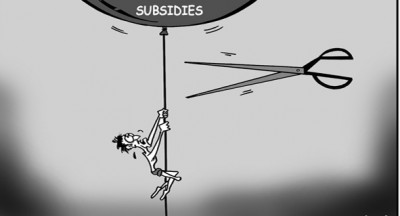
The wind industry exists – and ONLY exists – for one single purpose: to wallow in a massive subsidy stream that – in order to keep this monstrous Ponzi scheme alive – will need to outlast religion.

In Australia, the – already overflowing – wind power subsidy trough is designed to be refilled with $3 billion annually from 2019; and to continue being filled at that colossal rate, until 2031.

From hereon, the cost of the greatest subsidy rort in the history of the Commonwealth will exceed $45 billion – every last cent of which will be recovered from Australian power consumers through retail power bills.

But, with commercial retailers boycotting wind power – flatly refusing to sign up to long-term power purchase agreements – wind power outfits here are screaming ‘blue murder’. It’s still all about dreadful ‘uncertainty’ – or so we’re told:

Wind Industry Still Wailing About ‘Uncertainty’ as Australian Retailers Continue to Reject Wind Power ‘Deals’

Faced with a recommendation, made a month or so back, from the Senate Inquiry into the great wind power fraud, that the mandated subsidy – in the form of renewable energy certificates (RECs) – should be limited to a period of 5 years – rather than running from 2001 to 2031 – the wind industry, its parasites and spruikers started  howling like Banshees about their imminent “doom”.

The response has left STT just a little perplexed.

You see, the impression given by the wind industry and its worshippers is that wind power outfits are driven by a kind of ‘divine altruism’, under which their only objective is to power the world for free, while saving the planet from the ‘dreaded’ CO2 gas; and otherwise spreading health, wealth and happiness all over the planet.

But, truth be told, ‘altruism’ is running a poor second to the ‘main wind industry game’ – pocketing massive and endless subsidies:

The Wind Industry: Always and Everywhere the Result of Massive & Endless Subsidies (Part 1)

The Wind Industry: Always and Everywhere the Result of Massive & Endless Subsidies (Part 2)

It shouldn’t be so. You see, on the wind-worshippers’ ‘case’, wind power is the ‘perfect product’: it’s already “free” and, it’s getting cheaper by the day (see this piece of fantasy from ruin-economy).

Back in the real world, however, the ‘perfect product’ is having more than just a little trouble selling itself on its own merits.

Here’s a pair of pieces from the US, that simply confirm the bleeding obvious: THESE THINGS DON’T WORK – on any level.

Wind power growth faces sharp decline without federal aid, report says
Jordan Blum
Fuel Fix
9 September 2015

The growth of wind power projects could come screeching to a halt if Congress fails to extend the renewable energy Production Tax Credit by the end of the year, according to a new American Wind Energy Association report being released later this week.

While critics oppose the continuation of what they call “wind welfare,” Texas leads the nation in wind power, which makes up about 14 percent of the Texas grid’s generation capacity. Failing to extend the renewable energy tax credit could lead to a dramatic 70 percent to 90 percent drop off in new wind power installation projects, said Rob Gramlich, AWEA senior vice president.

“Wind is the unfortunate poster child for unstable government policy,” Gramlich said, adding that the tax credit’s past and current stops and starts “lead to disruption and layoffs.”

For instance, Dokka Fasteners recently said it is closing its Michigan wind power manufacturing plant largely because of uncertainty on U.S. energy policy and the tax credit, as well as congressional gridlock.

The argument for the tax credit is that wind power is becoming increasingly competitive with traditional coal and natural gas-fired power plants, but that cheap natural gas from U.S. shale and other factors are preventing an equal playing field for now. So the AWAE contends the competitive tax credit is needed until wind is truly equally competitive in the next decade as wind turbine costs keep coming down.

“America has been lulled into complacency during downturns in energy prices before, believing cheap energy would last forever, only to be hit harder each successive time when energy prices inevitably increased,” the report states. “Smart energy policy can help us avoid falling into this trap as we have before by ensuring that America maintains a diverse portfolio of energy options.”

Businesses and investors need “long-term clarity” on credits and public policy in order to make decisions on major wind projects that take years to complete, the report added. The AWEA said wind energy supports 73,000 direct jobs nationwide and enough energy to power 18 million homes. The association also argues the growth of wind power saves lives because of the decreased reliance on fossil fuel  power and its carbon emissions.

The Production Tax Credit is competitive and gives a 2.3 cents credit for every kilowatt-hour of electricity sold for the first 10 years of a project’s life. The tax break renewal was estimated to cost $6.4 billion over 10 years. Gramlich added that there are some federal incentives for every type of power generation and that wind is not being singled out. The tax credit still supports wind projects that were already in progress before the end of 2014, but the AWEA report stated that the policy uncertainty will slow the rate of cost reductions in wind power projects.

Still, opponents like the American Energy Alliance argue the AWEA and other groups are guilty of doublespeak for touting the vibrancy of wind power while begging for more government subsidies. The wind industry keeps pushing back the timeline on when it will become truly cost competitive, the alliance adds, so it is time for wind power to stand on its own two feet. Critics also contend wind power is unreliable because wind is intermittent.

Houston-based Calpine, which owns natural gas-fired power plants, opposes the tax credit under the argument that it limits a competitive market.

“Government should not pick winners and losers by subsidizing certain market participants,” Calpine spokesman Brett Kerr said in an email response. “The (tax credit) should not be renewed and market participants should all compete on the same level playing field. Additionally, if the policy goal is carbon reduction, the best approach is to put a price on it and let market sort out most efficient reductions, not having subsidies and set-asides.”

The tax credit is a partisan hot potato that is largely supported by Democrats but has limited GOP backing. The Senate Finance Committee recently approved a bundle of two-year, business tax credit extensions, including the Production Tax Credit, but the full Senate has not yet taken up the legislation. After an August recess, Congress is primarily focusing now on the Iran nuclear deal and government funding legislation.

Gramlich said Congress typically addresses tax credit extensions nearer to the end of the year.

In Texas, the state government requires utility companies to buy a certain amount of their electricity from renewable sources such as wind and solar. An effort to dismantle the state program, called the Renewable Portfolio Standard, failed in the Legislature last spring.
Fuel fix

brat

****

Domestic market for distributed wind turbines faces several challenges
Owen Comstock
Today in Energy
27 August 2015

1

***

The domestic market for distributed wind turbines has weakened since the record capacity additions in 2012. Last year’s installations of mid-size and small wind turbines were the lowest in a decade. Relatively low electricity prices, competition from other distributed energy sources, and relatively high permitting and other nonmaterial costs have presented challenges to the distributed wind market in the United States.

Most distributed wind turbines installed in 2014 were connected directly to distribution lines to serve local loads. Distributed wind turbines can also be installed either off-grid or grid-connected at local sites to offset all or a portion of a site’s electricity consumption. Compared with electric utility wind facilities, distributed wind turbine installations are often smaller units, below 1 megawatt (MW), and thus may not appear on EIA’s survey of utility-scale electric generators, which has a 1-MW threshold at the project level. Although some large-scale turbines (1 MW or greater) are used in distributed generation applications, large-scale turbines are more often used at wind farms for wholesale power generation, which is sent through transmission lines to more distant customers.

Based on information in the U.S. Department of Energy’s Distributed Wind Market Report, most of the 2014 distributed wind capacity was installed on institutional sites, such as schools, universities, and electric cooperatives. Government installations on city, municipal, or military facilities made up more than one quarter of 2014 installed capacity. Other sectors (industrial, commercial, agricultural, and residential) were relatively small in terms of capacity, but larger in terms of number of installations, as the average turbine size on these sites is relatively small compared with institutional and government sites.

2

***

Some customers who install these turbines are eligible for federal tax credits, in particular the investment tax credit (ITC), which provides a 30% cost incentive for turbines with capacities of 100 kilowatts or less. The investment tax credit was one of the largest factors in both the increase in installations from 2010 to 2012 and the decline after 2012. In 2009, as part of the American Recovery and Reinvestment Act, the U.S. Treasury allowed projects to receive cash payments instead of tax credits. To qualify, projects had to be under construction or in service by the end of 2011 and must have applied for a grant by October 1, 2012.

Even though these tax credits are still available, the expiration of the cash payment option drastically reduced the installation of small and mid-size wind turbines. Further affecting the outlook for distributed wind is theU.S. Internal Revenue Service requirement, added this year, that small wind turbines meet performance and safety standards in order to qualify for the ITC.

Other factors cited in the recent decline in distributed wind installations are the relatively low price of grid electricity and lower cost of solar photovoltaic systems, which also receive the 30% ITC. Nonhardware costs associated with distributed wind, such as permitting, financing, installation, and supply chain costs, have not fallen as much as they have for solar photovoltaics. U.S.-based manufacturers and supply-chain vendors in the distributed wind market have been vulnerable to market downturns, preventing the market from growing at a faster rate. For these reasons, U.S.-based manufacturers may look to international opportunities, particularly in Japan and South Korea, to find more favorable markets.
Today in Energy

Money Wasted

Important Information on the MOECC Proposal for Removal off 550m Setbacks…

Click on to read…

https://mail.google.com/mail/u/0/?ui=2&ik=442e1005fd&view=att&th=14fd7eec07ee4bb6&attid=0.1&disp=inline&realattid=c1783546396d8a1_0.1&safe=1&zw

https://mail.google.com/mail/u/0/?ui=2&ik=442e1005fd&view=att&th=14fd7eec07ee4bb6&attid=0.2&disp=inline&realattid=c1783546396d8a1_0.2&safe=1&zw

https://mail.google.com/mail/u/0/?ui=2&ik=442e1005fd&view=att&th=14fd7eec07ee4bb6&attid0.3&disp=inline&realattid=c1783546396d8a1_0.3&safe=1&zw

Video of Senator John Madigan Speaking About the Victims of the Wind Turbine Industry…Brilliant!

Below, is the transcript of Senator Madigan’s speech.

Fraud and corruption in the power generation industry

Tonight I speak about corruption and fraud in the power generation industry.

The Senate Wind Turbine Inquiry’s final report made 15 important recommendations. Today, I rise to speak in support the Labor senators’ Dissenting report’s fifth recommendation:

that state and territory government consider reforming the current system whereby windfarm developers directly retain acoustic consultants to provide advice on post-construction compliance.

Avoiding noise from wind turbines is an expensive bother that does not hold any appeal to windfarm operators.  Slowing down turbines increases costs and slows down profits.

So I was not surprised to learn that in the seven years of its controversial operation, the adjustments necessary to ensure Cape Bridgewater Windfarm operated in compliance with its planning permit have never been applied.

Mr President, wind farm operators have found a far less expensive and simple process to game the system. They employ compliant “experts.”

In 2006, Marshall Day Acoustics with consultant Christophe Delaire prepared a pre-construction Noise Impact Assessment for the Cape Bridgewater Windfarm.

The report predicted that compliance could not be achieved at Cape Bridgewater windfarm without operating 13 of 29 wind turbines in reduced operational noise modes.

Before it was even built, developers knew this windfarm would operate in breach of permit unless adjustments were made.

But Delaire told the committee of inquiry:

following measurements on site, it was found  that noise optimisation was not required.

How did Delaire’s “expert” pre-construction and post construction reports come to draw such contrasting conclusions?

The answer is simple.  Pacific Hydro didn’t noise optimise turbines at Cape Bridgewater because they knew they wouldn’t have to!  They only had to commission a post-construction noise report to say the windfarm was compliant.

On both occasions, Pacific Hydro got exactly the report they wanted from MDA.  But the compliance assessments were not compliant with the standard and neither were the reports!

Questions of multiple reports reaching opposite conclusions were raised at the Portland Hearing.

During the Cape Bridgewater windfarm’s noise monitoring program, measurements were taken every month and monthly noise reports were generated to assess compliance at dwellings.

Let’s look at a few from House 63.

October 2008: “windfarm noise levels exceed the NZ noise limits.”

June 2009:  “the NZ limits are significantly exceeded”.

July 2009: “the NZ limits are significantly exceeded”.

MDA’s original reports identified noncompliance at multiple homes and every wind speed.

This didn’t satisfy the client.

On 22 July, MDA reissued revised monthly reports for every house and every month.  These reports were to Pacific Hydro’s satisfaction (but not the permit’s.)

The reissued versions for October and July said: there is reasonable correlation between measured noise levels and wind speeds.

References to exceeding the NZ limits, erased.

Without incriminating original reports, MDA’s final report concluded:  noise emissions from the Cape Bridgewater Windfarm comply with the NZ noise limits at all houses and at all assessed wind speeds.

Pacific Hydro submitted it to the Planning Minister as “proof” the Cape Bridgewater Windfarm was compliant.

But how?

MDA combined all the reissued monthly reports and averaged them out for each property.

There is nothing in the 1998 NZ standard that allows acousticians to find “average” post- construction noise levels and yet Pacific Hydro told the Committee:

Current noise standards require the average post-construction wind farm noise level.

There is no tolerance within the Standard that would allow a windfarm to casually comply with its noise limits, in some months but not others. Condition 13 does not allow the windfarm to occasionally comply with its permitted use.

NZ Standard is supposed to protect amenity and night time sleep. Windfarm planning permits are issued with conditions that decision-makers expect will protect the communities that host them – in real time.

In February 2009, the panel assessing the Lal Lal windfarm stated:

There is little point in giving permission for a windfarm to operate under certain conditions unless compliance with those conditions can be demonstrated.

adding,

Any exceedance of the limit should be considered as a breach of the condition.

An “average” noise level means nothing.  That’s why the permit requires that when the windfarm is operated it must comply with the NZ noise limits at all dwellings and clearly, this one doesn’t.

The Cape Bridgewater windfarm has never been compliant, despite the falsified conclusions drawn by MDA and the claims of its master, Pacific Hydro.

A Victorian Planning officer told the Committee: “studies need to be done in a way which is robust.  That is why the peer review of the work is important.”

So why wasn’t a review of the Cape Bridgewater report commissioned as a matter of due diligence, not to mention consistency?

When Acciona gave the Minister its report, the Minister sent a copy to the EPA and within a week, he had commissioned an independent technical review.

He promptly wrote to Acciona describing multiple breaches of permit and expressing his dissatisfaction that compliance had been achieved with the noise monitoring program required by condition 17.

He said that the report shows that the operation of the Waubra Windfarm does not comply with the noise standard at several dwellings and he was not satisfied in accordance with Condition 14 that the operation of the facility complies with the relevant standard.

Then he asked Acciona to “noise optimise the turbines.”

Delaire from MDA prepared Waubra’s Windfarm’s preconstruction noise report which predicted noise would exceed the NZ limits and would only comply if 50 of its 128 turbines were noise optimised.

Same preconstruction formula, same post-construction problems.

If not for that pesky peer-review, Acciona might have got away with it.  They had never intended to operate noise optimise turbines in compliance with the limits.

WHY? Acciona had a MDA post construction noise report that concluded Waubra Windfarm operated in compliance with noise limits without needing to noise optimise any turbines, let alone fifty of them.

The Minister wrote to Acciona again a year later, stating that the MDA report it submitted showed non-compliance and that testing wasn’t undertaken in accordance with the NZ standard.  The Minister queried “who it was that undertook the assessment and whether this person or people were qualified and experienced to do so.”

MDA’s website says Delaire graduated with an engineering diploma in 2002 after beginning with MDA as a work experience student the year before.

Delaire has prepared acoustic reports for 50 wind farms.

MDA’s website promotes its: “Proven record of successful wind farm approvals” and credits Delaire for developing a ‘specialty’ in wind farm environmental noise assessments.”

At the beginning of MDA’s reports there is an extraordinary disclaimer which acknowledges that reports are written to satisfy the client’s brief.  It says their reports ‘may not be suitable’ for other uses.

MDA’s disclaimer proves they are not fit for purpose as independent compliance documents.

MDA is a member firm of the Association of Australian Acoustical Consultants whose Code of Professional Conduct requires that members avoid making statements are misleading or unethical and endeavour to promote the well-being of the community.

They must not knowingly omit from any finalised report any information that would materially alter the conclusion that could be drawn from the report.

MDA has clearly failed the community. Consistently.

There’s no doubt that MDA’s commercial arrangements with both Acciona and Pacific Hydro adversely affected the independence of reports and the legitimacy of conclusions.

This example alone shows exactly why we needed an Inquiry that examined the regulatory governance of wind farms and why the scrutiny of an independent, national wind farm commissioner is essential.

There must be arm’s length relationships between acousticians and windfarm operators.  Independence would put a stop to the practice where false compliance documents allow operators to gain pecuniary advantage!

Local, state and Commonwealth government authorities, departments and agencies have been duped by sham compliance reports.

A windfarm that is “compliant” with state laws can receive RECs.

A “compliant” windfarm can secure finance – like the $70 million Pacific Hydro swindled from the Clean Energy Finance Corporation.

But those who these reports fail most are decent rural people left suffering the consequences of deception.  A shonky noise report can’t erase away the harm and nuisance it has caused for those living, working and suffering beside excessively noisy industrial machines.

Last month I asked the Victorian government to take a good hard look at all the submissions we received, in particular, from people duped by the regulatory failures of the Waubra and Cape Bridgewater windfarms.

Samantha Stepnell’s submission is #470.  Melissa Ware’s submission is #206.

While Acciona and Pacific Hydro were busy breaching their permits to maximise their profits, residents were and still are often exposed to horrendously excessive noise.  Twenty or more of these same people had sent affidavits to former Health Minister and current Victorian Premier, Daniel Andrews, in June 2010.

They reported severe sleep disturbances and a series of unexplained adverse health effects that were not present before the windfarm started operating.  Local doctors and a Sleep specialist confirmed concerns of a correlation.

By December 2010, eleven families around Waubra alone had vacated their homes, citing noise nuisance as the reason.

But the Victorian government refused Pyrenees Council’s request for a Health Impact Assessment, citing the NHMRC’s Rapid Review.  That very rapid review found that there was no evidence of adverse effects when planning guidelines were followed.

At Waubra, we know that they were not.  A simple peer review would have found that they weren’t followed at Cape Bridgewater either.

With callous indifference, the Victorian government has consistently failed in its duty of care to these people.

These people represent the human cost of corporate fraud, regulatory failure and political indifference.

These families still have the right to be able to sleep at night, to work safely on their farms and to live in the peace and quiet enjoyment of their homes.  This is as much a human rights issue as it is an environmental one.

The nocebo theory is obliterated by the fact that the noise measured at Waubra and Cape Bridgewater exceeds World Health Organisation recommendations for sleep protection.  Sleep deprivation is an indisputable adverse health effect.

Even the NHMRC now admits there are “probably” adverse health impacts for residents living within 1.5kms of a wind turbine.

I have been writing to the AMA since May 2014 about its windfarm position statement, asking why audible noise impacts had not been considered.  The AMA has failed to respond but blindly endorses the disproven nocebo drivel by Chapman and Crichton stating:

The available Australian and international evidence does not support the view that the infrasound or low frequency sound generated by wind farms, as they are currently regulated in Australia, causes adverse health effects on populations residing in their vicinity.

That’s because infrasound and low frequency sound from windfarms aren’t regulated in Australia!

Irrespective of what the AMA has been told or wants to admit, exposures to excessive audible noise, low frequency pressure and vibration cause debilitating nuisance, sleep disturbance and compromised health and amenity that reduces quality of life.

So where does that leave those suffering the continuing nuisance at Cape Bridgewater?

In submission #206, Melissa Ware said she was driven beyond despair and wretchedness.

Last year, Pacific Hydro told residents: “it is our goal to improve your quality of life or at least restore it to what it was before the wind farm was there.”

They told me personally: “We recognise that the wind farm has reduced their quality of life, and we want to help them get it back.”

But that was before Steven Cooper’s study found that all six residents surveyed are adversely impacted by the operation of the Cape Bridgewater Windfarm.

Funnily enough, Cooper was instructed not to test compliance!

Despite the infamous screeching, thumping, whirring, whistle and siren-like audible sounds produced by the Cape Bridgewater windfarm, Special Audible Characteristics weren’t assessed in MDA’s report.  If the 5 db SAC penalty were properly applied, an independent report would identify non-compliance at every dwelling, at every wind speed.

The Waubra and Cape Bridgewater reports were written within months of each other by the same acoustician from the same firm, using the same formula.

Perhaps the Planning Minister hasn’t commission a review of Cape Bridgewater’s report because he already knows it shows non-compliance?

Is this the real reason why the Planning Minister insists that it’s Glenelg Shire’s responsibility to enforce noise compliance at Cape Bridgewater, not his?

Glenelg Shire can’t enforce compliance without any access to noise reports and the complaints procedure. Only the minister has that information.

Condition 13 says compliance must be to the satisfaction of the Minister.  Council cannot legally exercise that judgement.

Condition 13 remains un-resolved, Cape Bridgewater windfarm continues to operate at full capacity and maximum noise without any regulatory authority accepting responsibility for enforcement.

In submission 456, Sonia Trist explains how officers from the Victorian Planning Department admitted noise limits are exceeded at her home, one apologising that:

“The Department adjusts information to obtain the required results.”

In June 2014, this retiring officer called me and later sent me an email, blowing-the-whistle on his department.

There is so such more to convey and I am sorry that I cannot do so now. Department incompetence and indifference is the primary reason for the current situation.

I found it hard to find the truth, working inside, so it must be hard for your side.

On “my side” are those exposed to excessive and harmful, sleep destroying, audible noise emissions at levels that exceed noise standards and breach permits.

Those not on my side include complicit regulators, wilfully blind health bodies, greedy operators who put corporate profits before country people.  And neither are crooked acousticians flaunting a fraudulent reporting formula, that concludes compliance when there isn’t.

Notable for their refusal to attend the senate inquiry and be questioned, the Australian Medical Association were not alone.  Others who similarly refused were the authors of the two NHMRC commissioned Literature Reviews from both Adelaide University and Monash University, and Professor Gary Wittert.

In December, 2013, I warned about the culture of non-compliance arising from systemic regulatory failure in Victoria.

But that culture of non-compliance, aided, abetted and enabled by recklessly irresponsible reporting and regulatory indifference will only continue for as long as we tolerate it.

This industry demands root and branch regulatory reform.

Those who have actively and deceptively harmed communities, gamed the planning system, rorted the RET and exposed the CEFC and the private sector to investment risk must be investigated and held to account.

I urge the government to swiftly adopt the prudent Recommendations of the Wind Turbine Inquiry. We insist that the Labour Senator’s fifth recommendation is acted upon as a matter of urgency.

Acoustics Experts Help to Expose the Corrupt Practices of the Wind Industry…

Incessant Wind Turbine Infrasound: An Acoustic Invader

when-is-wind-energy-noise-pollution

Among the growing list of what’s getting to the wind industry, its parasites and spruikers is the fact that – despite their relentless efforts to cover up both the work and the results – highly skilled people are working flat out around the world to discover the precise mechanism that causes the adverse health effects from incessant turbine generated low-frequency noise and infrasound, including sleep deprivation, vertigo and the like.

It’s not only the fact of their rather obvious conclusions that has wind-spinners in apoplexy, it’s the fact that they’re looking at all.

You see, the line being run is that there is NO problem – a tobacco advertising guru said so – so why on earth should anyone be looking?

For the wind industry and its parasites, the problem is, that there IS a problem: teams of highly skilled scientific investigators don’t generally devote their every waking hour to chase answers and solutions, when there’s nothing to chase.

Here’s just another example of what properly qualified people can do when looking for answers to real problems.

This time the work is that of Rob Rand – a Maine boy, who’s been hunting down acoustic trespassers for 20 years; and who – unlike the wind industry’s pet acoustic ‘experts’ – regards his ethical responsibility to “hold paramount the safety, health and welfare of the public” as a way of professional life, not some throwaway line.

Rob Rand

***

Wind farm and health issues
Lindsey Harrison
New Falcon Herald
September 2015

According to an Aug. 26 El Paso County press release, construction at the NextEra Energy Resources wind farm project in Calhan is nearing completion. “All 145 concrete foundations to support the wind turbine towers have now been completed … and 120 of the authorized 145 turbines are now fully erected, with only electrical work remaining to be completed.”

Although the press release states that the turbines will not be functional until the electrical work has been finished, it also states that the turbines could move in the wind, which is already causing health concerns for residents living within the wind farm’s footprint.

One resident, who wished to remain anonymous, said she knew right away that the turbines were moving because she began to feel nauseous, along with a headache. “I have 100 turbines to the north of me, 25 to the west and 20 to the southwest,” she said. “When the wind was coming out of the north, I woke up feeling dizzy and nauseous.”

She also said her animals were acting strangely. “My donkeys and horses keep wanting to go back into their stalls,” she said. “They have not wanted to leave the barn all day.”

Robert Rand, a Boulder, Colorado, resident and an acoustic investigator and member of the Acoustical Society of America, said the reason for the headaches and nausea is directly related to the wind turbines. It has to do with infrasound and low frequency noise, he said.

According to an article written by acoustic engineer Richard James, published at http://wiseenergy.org Feb. 20, “Infrasound is acoustic energy, sound pressure, just like the low to high frequency sounds that we are accustomed to hearing. What makes infrasound different is that it is at the lowest end of the acoustical frequency spectrum even below the deep bass rumble of distant thunder or all but the largest pipe organ tones.

“As the frequency of an infrasonic tone moves to lower frequencies: 5Hz, 2Hz, 1Hz and lower, the sounds are more likely to be perceived as separate pressure pulsations … . Unlike mid and high frequency sound, infrasound is not blocked by common construction materials. As such, it is often more of a problem inside homes, which are otherwise quiet, than it is outside the home.”

Rand said the separate pressure pulsations are like the “whump, whump, whump,” people sometimes experience when they are riding in a car with the windows down. “I have been attempting to acoustically measure phenomena that could present a conflict to human physiology that could then provide a basis to do more research,” Rand said. “My work in acoustics has really been designing and planning. I don’t need more medical research because I know what they (wind turbines) do to people because it happened to me.”

According to an article accepted into The Journal of the Acoustical Society of America Feb. 4, when the body experiences an external force on the inner ear, such as acoustic pressure pulses — but there is no visual input to associate with that pressure — a sensory conflict occurs. That conflict is felt as motion sickness, and it is felt to the same degree as seasickness.

The wind energy industry has claimed for decades that this phenomenon does not exist, in part, because about one-third of the human population is essentially immune to the effects of motion sickness, which is what these pressure pulsations induce, Rand said. Similarly, about one-third of the population appears to be readily prone to motion sickness, he said. “The third that is not affected by this will never understand it and will not know what you are talking about,” Rand said.

According to an article published in the Bulletin of Science, Technology & Society March 2, 2011, written by Dr. Alec Salt: “Infrasound from wind turbines is unlikely to be harmful in the same way as high-level audible sounds.”

However, Salt also states that numerous reports “are highly suggestive that individuals living near wind turbines are made ill, with a plethora of symptoms, which commonly include chronic sleep disturbance. The fact that such reports are being dismissed on the grounds that the level of infrasound produced by wind turbines is at too low a level to be heard appears to totally ignore the known physiology of the ear.”

Dirty electricity concerns
Rebecca Rivas, a Calhan resident with a wind turbine located about 1 mile from her house, said there are other serious health concerns to consider. “My husband had open heart surgery in 2007 and had a mitral valve replaced,” she said. “It is a metal valve now, and he can’t go through metal detectors or any thing.” Rivas said her husband’s cardiologist told him that, with wind turbines that close to their residence, staying there would be like playing Russian roulette with his life.

Rivas said the reason is because the wind turbines emit not only sound waves or pressure waves, but electromagnetic waves as well.

According to an article published online in the Bulletin of Science, Technology & Society Sept. 30, 2011, “The electromagnetic waves are generated by the conversion of wind energy to electricity. This conversion produces high-frequency transients and harmonics that result in poor power quality … . High-frequency transient spikes that contribute to poor power quality, also known as dirty electricity, can flow along wires, damage sensitive electronic equipment, and adversely affect human and animal health.”

Rivas said she was advised that the electromagnetic waves could send her husband into atrial fibrillation. AFib is a quivering or irregular heartbeat that can lead to blood clots, stroke, heart failure and other heart-related complications, according to the American Heart Association. “I’ve watched doctors flatline my husband (stop his heart) five times to try to get his heart back into rhythm,” Rivas said. “Because my husband’s life is at stake, I have to speak up.”

Brown County, Wisconsin
Residents of Brown County, Wisconsin also decided to speak up when the Shirley Wind Farm, owned by Duke Energy, was under construction.

Barbara Vanden Boogart, vice president of the Brown County Citizens for Responsible Wind Energy, worked with other members of the BCCRWE to present a case in front of the Brown County Wisconsin Board of Health about the dangers of the wind turbines.

Vanden Boogart said the presentation contained various pieces of evidence, including the following: 21 peer-reviewed articles on health and industrial wind turbines; analyses of the effects of wind turbines on property values; personal accounts from residents near the wind farm; and studies done in the homes near the Shirley Wind Farm where infrasound and low frequency noise was detected that emanated from the turbines.

According to the minutes from the Brown County Board of Healthmeeting on Oct. 14, the board voted 4-0 to “declare the Industrial Wind Turbines at Shirley Wind Project in the Town of Glenmore, Brown County, WI a human health hazard for all people (residents, workers, visitors, and sensitive passersby) who are exposed to infrasound/low frequency noise and other emissions potentially harmful to human health.”

“They (Duke Energy) were planning to put up 100 turbines within our town and two other adjacent ones, with six on our country block alone,” Vanden Boogart said. “We fought hard, fast and loud in every way we could, and they succeeded in shutting down the wind farm.

“Wind farms are making people ill and the wind energy industry has known about it since 1979. They knew for decades and instead of notifying people, they have been changing the attention to audible noise. This industry is filthy, dirty, corrupt and committing crimes knowingly against people.”

Laura Wilson, a member of the El Paso County Property Rights Coalition, said Vanden Boogart shared all the information that the BCCRWE presented to their board of health with her; and, on Aug. 26, Wilson and 11 other concerned residents attended the El Paso County Public Health board meeting.

“I gave them all the information and told them everything I knew, and they just looked at me with total indifference,” Wilson said. “They were actually eating their lunches while we were all testifying.”

The EPCPRC has a lawsuit pending against the El Paso County Board of County Commissioners and NextEra, citing that the BOCC “exceeded its jurisdiction when it approved the (Golden West Wind Farm) project” at the Feb. 5 meeting, according to the article, “Wind farm goes to roads,” in the May issue of The New Falcon Herald. No hearing date has been set yet. Because of the pending lawsuit, EPC Public Health declined an interview with the NFH.

David Gil, project manager with NextEra, also declined an interview but sent an email to the NFH, with this statement about the Brown County Board of Health declaration: “I am not aware of the declaration.”

Chris Ollson, who testified on behalf of NextEra at the Feb. 5 BOCC meeting also declined an interview, but sent an email stating he was “on holiday.”

Ollson, vice president of strategic development for Intrinsik Inc., is considered an authority in environmental health issues related to the energy sector and has provided risk communication support for wind turbine projects, according to Intrinsik’s website. Ollson has a doctorate in Environmental Sciences from the Royal Military College of Canada.

Wilson said the property rights coalition is hoping to raise more funds to pay the attorney’s fees for the pending litigation; she and the other coalition members intend to keep fighting.
New Falcon Herald

RobertRand_logo

Wind Turbines….Nothing More than “Novelty Energy”!

Wind Power: Just an Ugly ‘Hood Ornament’ on the Conventional Power System

hood ornament

****

As time marches on, the ability of the wind industry to ‘hood’-wink power punters is running into a deluge of ‘unhelpful’ facts: here’s some more from Michigan Capitol Confidential’s Jack Spencer.

Renewables Just a Hood Ornament on Fossil Fuel Power System
You can’t have renewable energy without fossil fuels backing it up
CapCon
Jack Spencer
4 September 2015

General Electric Co. and the Environmental Protection Agency know better than most that renewable energy sources — which are the recipients of billions of dollars of taxpayer largesse in many forms — are in the end dependent on fossil fuels. In a document submitted to the EPA on June 25, 2012, GE urged the agency to keep this fossil fuel dependency in mind when considering emissions standards:

“However, if flexible generation assets, such as gas turbines, are not available, these renewable technologies will not be deployed. In other words, gas turbines are an essential component of renewable energy sources’ ability to penetrate the market.”

Nevertheless, the public remains mostly unaware of the degree to which the heavily subsidized or mandated renewable energy sources, including wind and solar, rely on fossil fuels. More than half the electric generation nominally credited to wind power is actually produced by fossil fuels, mostly natural gas. And on the rare occasions when renewable energy advocates are forced to admit the fossil fuel dependency, they refer to it as only “backing up” the renewable source.

GE, the huge multinational corporation, has been described as President Barack Obama’s “favorite corporation.” It has contributed heavily to Obama’s political campaigns. And like all other large corporations it is vulnerable to the administration’s regulatory arms. So it is not a company one would expect to state so unambiguously facts that the administration would prefer to downplay, such as descriptions of why renewables are dependent on fossil fuels.

Nevertheless, here’s another example from the GE document:

“Renewable power, especially from wind and solar, will be expected to fluctuate hourly and even minute-to-minute with changes in wind speed, cloud cover, and other environmental factors. With this generation mix, electric supply must be available to quickly compensate for the combined variability of demand and fluctuation in the renewable supply.”

The GE document is titled: “Comments of the General Electric Company: Proposed standards of performance for greenhouse gas emissions for new stationary sources: Electric utility generating units.” The document includes a great deal of technical information and is available for public viewing.

However, as is typical of such documents, it omits the percentage of electricity attributed to the “renewables” that is actually generated by the fossil fuel component. When this information is repeatedly denied to the public it is fair to ask: “What are they trying to hide?”
CapCon

Jack Spencer is on the right track, but the missing answer as to GE’s love of wind power is staring him in the face – as his following pieces detail.

GE isn’t backing the wind power fraud to sell wind turbines – these things are being slapped together in workshops in China and India at a fraction of the cost of the American built GE units.

GE’s real interest in wind power is about selling thousands of fast-start-up Open Cycle Gas Turbines (OCGTs) – which are being rolled out any where that there is any significant wind power capacity.

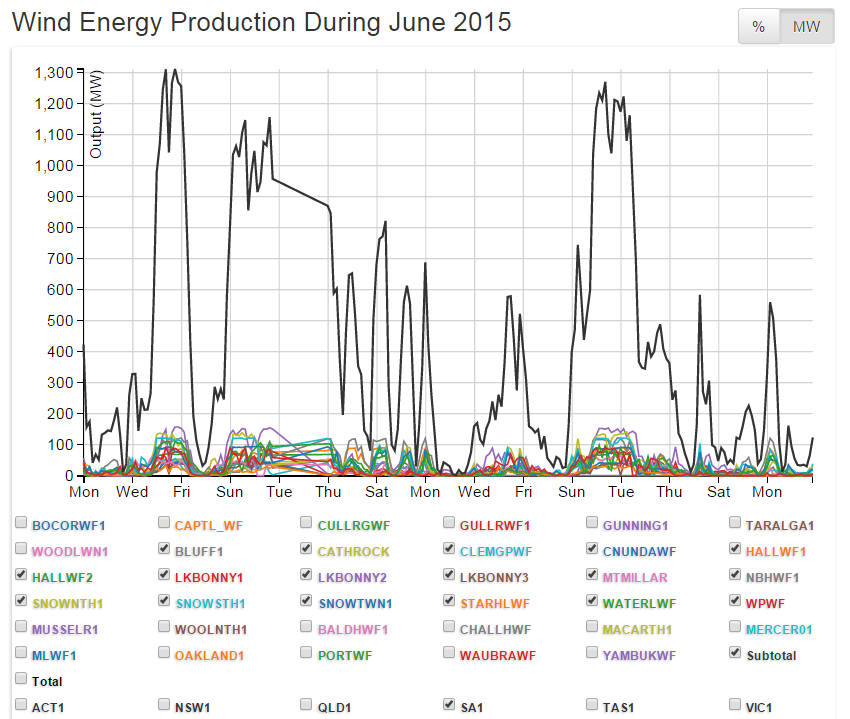
OCGT peaking plants are essential to covering the inevitable, but wholly unpredictable collapses in wind power output that occur almost every day, and for days on end (see our posts here and here).

Whether or not GE sells wind turbines (and it hasn’t sold many in Australia) – as long as these things are being speared into rural communities, GE still gets to sell OCGTs – a market in which it dominates.

In an effort to flog its gas turbines, GE advertised heavily in The Guardian – under the banner “Powering People” and in The Australian – where, earlier this year, GE “sponsored” numerous “features” under its banner “Powering Australia” (see our post here).

OCGTs are used – along with gazillions of gallons of gas, diesel or kerosene that run them – to plug the ‘gaps’ in wind power output around the globe: they’re a daily occurrence; total; and totally unpredictable.

June 2015 SA

We’ll let Jack off the leash again, as he homes in on the fact that wind power’s really just a ‘gas’.

How Wind Energy Creates More Dependence on Fossil Fuels
‘Any informed student of wind energy … understands that’
CapCon
Jack Spencer
2 March 2015

Truth has a habit of emerging from unexpected places. An article in the Daily Kos about the desire to end dependence on fossil fuels for energy needs reveals a “nasty little secret” about wind energy: It relies on fossil fuels. That’s a message wind energy opponents in Michigan have been trying to get across to the news media and the public over the past few years.

The article is part of a series titled “Getting to Zero,” by Keith Pickering, and is written with the premise that global warming is a dire and immediate threat. It states, “If civilization is to survive, we need to get to zero emission of fossil carbon, and we need to get there rapidly.” Overall it paints a pessimistic portrait of efforts to reduce carbon emissions from human sources.

A major aspect of the article’s pessimism about actually “getting to zero” pertains to wind energy. The following paragraphs serve as an example:

Wind farms are dependent on the weather to work, and most of the time they’re sitting idle or underperforming because the wind isn’t strong enough to turn the blades. The capacity factor (CF) for wind varies by location, but Iowa is pretty good, so let’s assume a CF of 35 [percent]. Nuclear has no such dependency and can operate around the clock.

In the [U.S.], nuclear plants have an average CF of 90 [percent].

So when we factor CF into those prices … most of wind’s advantage is wiped out by just that factor alone.

Over the long term it gets even worse for wind, because nuclear plants today are engineered for a 60-year lifetime, and wind generators are engineered for a 20 or 25 year lifetime. … That means that wind is cheaper than nuclear in the short term, but more expensive in the long term. Then there’s the backup problem. … When the wind dies, the lights still have to stay on. Right now that’s done with natural gas. …”

According to Kevon Martis, director of the Interstate Informed Citizens Coalition, a non-profit organization concerned about the construction of wind turbines in the region, what the Daily Kos article shows is that people knowledgeable about the technology understand that wind energy depends more on fossil fuels than on wind, no matter their views on contentious issues like global warming.

“Any informed student of wind energy, regardless of whether they are on the left or the right politically, understands that, far from freeing Michigan ratepayers from fossil-fueled electricity, wind energy actually binds us to fossil fuels at roughly a two-parts-fossil one-part-wind ratio,” Martis said. “Properly understood, wind energy should always be called ‘fossil-wind.’ What’s sad is that the vast majority of Michigan residents and probably members of the news media as well are not aware of this information. That situation needs to be remedied.”

In its assessment of wind energy, the Daily Kos article states: “Wind-plus-gas-backup is certainly better than gas alone, but it’s not the endpoint of a fossil-free grid, and it never will be.”

One of the strongest arguments against wind energy is the assertion that “natural gas alone” would produce fewer emissions than when it is combined with wind. That’s because having to switch natural gas generation on and off, literally at the whim of the way the wind blows, is less efficient and therefore less clean.

However, a news media and public that mistakenly believe wind energy is just wind, rather than two-thirds fossil fuels, cannot be expected to comprehend or participate in such a debate. Restricting important facts or (as some still insist) “alleged facts” about wind energy to the province of “experts only” is an affront to transparency and an obstacle to open public discourse. The Legislature owes the people of Michigan a hearing or series of hearings on this issue.

David Wand, deputy director of strategic communications with the American Wind Energy Association, did not return a phone call offering him the opportunity to comment.
CapCon

coal-seam-gas

****

Natural Gas to Wind Energy: You’re Nothing Without Me
Energy from windmills is mostly backed up by fossil fuels
CapCon
Jack Spencer
11 April 2015

Wind energy in Michigan is approximately two-thirds fossil fuels (predominantly natural gas) used in a less than efficient way, coupled with one-third wind. Most people are unaware of that reality and misinformation flourishes as a result.

Case in point: a new study claims to provide comparisons between wind and natural gas by treating them as if they were two totally separate and distinct forms of energy generation.

The University of Michigan and Lansing-based consulting firm 5 Lakes Energy are touting a joint study based on a “model” produced at the university. The stated purpose of the study is to provide policymakers with a “tool” to help them choose between wind and natural gas. Unfortunately the model upon which the study was based is so flawed that the only “tool” it brings to mind is a toy hammer used in an attempt to force a square peg into the proverbial round hole.

The outputs of the model and resulting study attempt to justify the expansion of wind energy (the term “renewables” is used — but that means wind) in Michigan to meet energy demands resulting from the impending closure of coal plants. Its main argument is that wind energy would be a wise choice because natural gas prices are likely to fluctuate.

The idea here is that wind energy should be seen as a hedge against the possibility that natural gas prices could increase. It is basically an attempt to use the old “don’t put all your eggs in one basket” analogy. This is persuasive only when one ignores the fact that wind energy is 65 percent natural gas, which is precisely what the model does.

For those who understand that a dependable blend which includes wind energy must contain mostly natural gas, the analogy of “not putting all your eggs in one basket” used to promote the study is ludicrous.

“The operative word is ‘or,’” said Tom Stacy, an electricity generation analyst and independent regulatory and policy consultant who signs his correspondence “Ohioan for Afford Electricity.” He explains that the “eggs in one basket” warning doesn’t make sense. “There is no ‘or.’ It is either 100 percent gas or 65 percent gas plus 35 percent wind.”

“The catch,” he continued, “is that compared to the cost of the natural gas basket, consumers are forced to pay triple for baskets because the wind basket costs twice what the gas basket does, yet the gas basket is still required to hold 65 percent of the eggs.” He continued, “The end result: For our dozen eggs, we pay for three baskets when we could have paid for one. In exchange we get four free eggs. The problem is the extra baskets cost far more than the eggs.”

Although fortified with the usual officious-sounding phrases and sprinkled with expert-speak acronyms, the 5 Lakes study is rooted in the popular, but inaccurate, fantasy that wind energy is what wind supporters wish it could be, rather than what it actually is. At one point the study report reveals its imaginary basis with the following statement: “If we choose the natural gas path and natural gas prices rise, we may regret that we are stuck using expensive natural gas when we could have had free wind or solar fuel.”

Free wind? That phrase alone seems contrived to deceive the uninitiated and validate the green faithful. Again, since wind is so unreliable, wind energy has to be backed up by natural gas 65 percent of the time. Under that circumstance — obviously — the cost of wind energy will always largely reflect the price of natural gas. What’s more, the impact of any natural gas price change on wind energy is really more that 65 percent, because natural gas, when hooked up to wind energy, is put to a less efficient use. This is due to the requirement that it be constantly adjusted for when the wind is or is not blowing or not blowing enough. It is exactly the same dynamic that takes place with an automobile’s use of gasoline when driving in city traffic as compared to coasting down the open highway.

In the real “power pool,” wind is not physically paired with just natural gas; it is also paired with coal. The example used in this article gives wind the benefit of the doubt by only using natural gas, and not coal, as the balancing source in the hybrid. The average emissions intensity of coal plus wind is far higher than for gas plus wind. In other words, coal gets terrible “city mileage MPG” compared to natural gas and the pairing of wind with coal results in the excessive inefficiency of stop and go traffic.

The flawed and dishonest premise of the 5 Lakes Energy Study marks it as just the latest attempt by wind energy advocates to promote their product by masking wind energy’s true nature. Wind energy is a less than 30 percent add-on to natural gas. Its effect on emissions, as compared to just natural gas alone, is debatable and at best minimal. The failure of the study to acknowledge this spoils all of its conclusions and suggestions.

A glance at a list of 5 Lakes Energy principle founders reveals more than one official from the administration of former Gov. Jennifer Granholm. Michigan Capitol Confidential emailed the following questions to Douglas Jester, the author of the report on the study, and later to other 5 Lakes Energy officials. They were: Are you denying that wind energy is primarily fueled by natural gas? Why does your study appear to have not accounted for this reality? Is there something we are missing here that you should make us aware of?

Thus far, there has been no response to these questions.
CapCon

yacht

Europeans Regret….Wind Energy is a Bad Deal, No Matter Where You Go!

Europeans Lament their Wind Power Fiasco

German wind farm

The colossal, hugely expensive windfarms that are spread across huge areas of Europe’s land and sea, which are projected to drive up household energy bills by more than 50 per cent in coming years, have achieved … almost nothing in terms of reducing EU carbon emissions.

We here on the Reg energy desk only noticed this particularly this week because of a chirpy press release that flitted past us just the other day, claiming that “wind energy provides 8 per cent of Europe’s electricity.”

Hey, we thought, that sounds almost like it’s getting somewhere! So we looked into it. The eight per cent figure comes from the latest Wind Status Report (pdf) from the EU Joint Research Centre, and sure enough, it’s claimed therein that all those massive wind farms produced no less than 238 terawatt-hours of the 2,942 TWh of ‘leccy used in the EU nations last year.

That’s eight per cent, right enough – and that’d be a noticeable bite out of EU carbon emissions, maybe even one worth tying an energy-prices ball and chain round the ankles of the European economies.

Except it isn’t, of course. Like most developed economies, the EU nations use the great bulk of their energy in non-electric forms: we burn fuels to run transport, to provide heating and cooking and hot water, to power most of our industry. And this accounts for most of our energy use and carbon emissions.

By the most recent figures available, in fact, the EU is using around 1,666 million-tonnes-of-oil-equivalent of energy from all sources every year:that’s 20,710 TWh. Wind electricity makes up just over one measly percentage point of that. Solar? About half that again, for a total renewable-‘leccy contribution of around 1.5 per cent and a roughly corresponding CO2 reduction.

The large majority of the “renewable energy” figure claimed by the EU is produced by optimistic accounting on biomass and renewable-waste, much of which is dubiously renewable at best. Even the proper renewable electricity figures are not to be relied on, particularly in southern Italy where the Mafia is well known to be heavily involved in the industry.

Actual renewables, despite their horrific expense, are not even scratching the surface of real-world modern civilisation’s energy requirements.

Comment

It really is getting clearer and clearer. Bill Gates is right: top Google engineers are right: global-warming high priest James Hansen is right: theUN IPCC is wrong. The renewable energy technologies of today simply cannot provide the power needed to keep the lights on, not at any cost.

Anybody who thinks that carbon emissions are a big threat to humanity – or alternatively, anybody who thinks that becoming ever more dependent on Russian gas and Middle Eastern oil is a bad idea, for instance – needs to get their head around this and move on. The current, cripplingly expensive schemes which crank up the price of energy and channel the resulting cash to windfarms and solar panels need to be scrapped – they will never achieve anything useful.

Perhaps the money saved could be spent on R&D instead, to find some new source of low-carbon energy. But in fact, such a source already exists; the problem is really one of public understanding, rather than a lack of low-carbon energy in the world.
The Register

turbine collapse 9

Windweasels are Definitely a Despicable Bunch of Miscreants!

Scottish Council Demands Copy of Noise Report for Non-Compliant Wind Farm & Its Operator Predictably Runs for Cover

RUN-HIDE-logo_crop

****

One of the slickest moves wind weasels ever made was to have their team write the so-called “wind farm noise guidelines” – which deliberately exclude all reference to the real bane of wind farm neighbours – incessant turbine generated low-frequency noise and infrasound:

Wind Turbine Infrasound: What Drives Wind Farm Neighbours to Despair

Three Decades of Wind Industry Deception: A Chronology of a Global Conspiracy of Silence and Subterfuge

And the next slickest was to write the planning ‘rules’ – designed to have the operators themselves cook up the so-called “compliance data”, which they then hand over to the gullible country bumpkins that work on local Councils; untrained dimwits who simply accept whatever’s dropped on their dreary little desks, by the operator’s highly-paid, pet acoustic consultants.

Fox

****

Some might liken it to handing over security detail at your backyard hen-house to ‘Le Renard & Co’.

That wind power outfits might pull just one or two punches in their obvious commercial interest, might come as a shock to some. However, the same malevolent approach to the manufacture of helpful ‘evidence’ – and the deliberate concealment of the unhelpful stuff – has been adopted all around the globe.

In Australia, Spanish wind conquistadors, Acciona have been turning in fabricated noise data, ever since its Waubra wind farm kicked into gear in 2010.

The operator knows full well that it cannot, and will never, comply with the noise conditions of its planning consent; so does the local Council and the Victorian Planning Department – all of which are sitting on a damming document prepared by an independent consultant, Heggies – which they steadfastly refuse to hand over to their dozens of victims, for obvious reasons:

Victorian Planning Department involved in Waubra Wind Farm Non-Compliance Cover Up

The same ‘method’ has been applied to two other Victorian public health disasters: Macarthur and Cape Bridgewater.

Here’s more of the same from the Highlands of Scotland.

Angus Council may pull plug on Ark Hill windfarm
The Courier
Graham Brown
5 September 2015

Angus planners are on the brink of instigating enforcement action against the operators of the district’s largest windfarm.

The patience of council chiefs is running out over a demand for a noise monitoring report for the eight-turbine Ark Hill windfarm, near Glamis, where the 266-foot structures have been operational since spring of 2012.

A deadline of Friday was set for operators Green Cat Renewables to give an update on the noise monitoring report previously requested by the authority last November.

Residents in the area around the Strathmore site have complained about turbine noise since the windfarm became operational and they said the company was “giving Angus Council the run around”.

Following crunch council discussions within the past week, concerned residents were told that the close of business on Friday was set as the deadline for the operators to give a firm indication of when they plan to submit the monitoring report, or face enforcement action.

The ultimate sanction available to the council is to shut down the windfarm.

One resident said: “These problems have gone on since the turbines went up and they affect our lives, our pets and livestock in the fields around Ark Hill.

“There are so many things which can make a difference to the noise from the turbines, and quite often it is when there is little or no wind.

“People in the area suffering health problems are starting to link them to the windfarm and yet all this time we are still waiting on this noise report.

“The council are not at fault here, they have asked Green Cat for the report and it has not been produced — they are being given the run around.

“No-one can say that there’s not a problem here and it needs to be sorted.”

A council spokesperson said: “Angus Council understands that the wind turbine operator has completed noise monitoring and data gathering at the site and is in the process of preparing a finalised report.

“We have requested a clear timescale for the submission of that report and hope to have clarity on the matter shortly.”

Green Cat Renewables were contacted but made no comment.
The Courier

What? A non-compliant wind farm’s operator running for cover? Who ever heard of such a thing?

Wind Industry RUNS & HIDES as World Wakes Up to the Great Wind Power Fraud

The fact that wind weasels and inconvenient truths are unlikely to appear on the same stage anytime soon, is – these days – pretty much common knowledge – as the following comments to the article above attest.

Anonymous

Green Cat has been dragging its feet for months producing the monitoring report. What have they got to hide?

If anyone has any doubts about the excessive noise visit the site and listen for yourselves.

Disgraceful behaviour from this company.

A public apology from Green Cat would be appropriate. While residents suffer – some without a good night’s sleep – they have dragged their feet in resolving the noise problem.

An appalling stare of affairs.

Concerned Observer

How stupid is this. Has Angus Council learned nothing from the Seed Crushers fiasco in Arbroath?

Asking the offender to provide information is like asking someone to jail themselves – stupid, just plain stupid.

The correct way for noise monitoring is:

1 – the council commission an independent noise monitoring report before any development takes place for which the applicant pays the council.

2 – the noise level above that, then established ambient level, is included in the planning consent as a condition and included in the Environmental Impact Assessment.

3 – the operator is required to keep a noise monitoring log at pre-determined times as part of the planning consent (something like a set date of each month).

4 – any breach is checked against that log.

5 – any continual complaints are investigated by the council, once again commissioning an independent noise monitoring report chargeable to the owners of the site.

6 – any breach of the planning conditions are then rectified by the issuing of an enforcement notice.

Angus Council is at fault here for not applying strict rules to the planning consent and relying on the owners to hang themselves. SEPA who are equally as useless operate in the same way as the council.

It is about time the Scottish government clamped down on the shoddy practices of enforcement and to lackadaisical planning conditions, without any firm pre permission conditions and agreed methods of implementation. Green Cat are at fault, Angus Council are at fault, the Scottish government are at fault. Good luck to the residents but honestly – you are not going to get anywhere now the turbines are up and running and the operator remains responsible for providing evidence.

brave_shield3

Frauds, Crooks and Criminals

Demonstrating daily that diversity is not strength!

Family Hype

All Things Related To The Family

DeFrock

defrock.org's principal concern is the environmental and human damage of industrial wind turbines on rural communities

Gerold's Blog

The truth shall set you free but first it will make you miserable

Politisite

Breaking Political News, Election Results, Commentary and Analysis

Canadian Common Sense

Canadian Common Sense - A Unique Perspective from Grassroots Canadians

Falmouth's Firetower Wind

a wind energy debacle

The Law is my Oyster

The Law and its Place in Society

Illinois Leaks

Edgar County Watchdogs

stubbornlyme.

My thoughts...my life...my own way.

Oppose! Swanton Wind

Proposed Wind Project on Rocky Ridge

Climate Audit

by Steve McIntyre

4TimesAYear's Blog

Trying to stop climate change is like trying to stop the seasons from changing. We don't control the climate; IT controls US.

Wolsten

Wandering Words

Patti Kellar

WIND WARRIOR

John Coleman's Blog

Global Warming/Climate Change is not a problem