Wind Energy…Not Only Unnaffordable, but does NOTHING to improve our Environment!

Pac Hydro Write-Down Proves Wind Farms Don’t Run on Wind, they Run on Subsidies
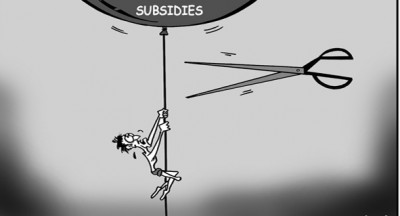
subsidies

Remember all that huff and puff put out over the last few months by the Clean Energy Council and near-bankrupt wind power outfit, Infigen about wind power becoming so cheap as to be competitive with coal and gas fired generators?

You know, the fantastic tales about wind power causing a reduction in Australian retail power prices?

Never mind, that nowhere in Australia have retail power prices decreased; and that – thanks to its ludicrous efforts to “rely” on wind power – South Australians pay the highest retail power prices in the world (see our post here).

In a “hey, quick look over there” approach to media manipulation, the CEC and its clients bang on about the effect of wind power on the wholesale market (on those rare occasions when the wind happens to be blowing, of course – see our post here) – while steering well clear of the actual cost of wind power to retailers.

These hucksters never talk about the prices fixed under Power Purchase Agreements with retailers – set at $90-120 per MWh versus $30-40 for conventional power – and recovered from retail customers, irrespective of the wholesale price (see our post here); and they run a mile from any mention of the Renewable Energy Certificates that get directed to wind power outfits; that have added $9 billion to power bills already; and that will add $50 billion to Australian power bills over the next 17 years, if the Large-Scale RET remains in place (see our post here).

No, the wind industry’s main pitch over the last few months has been that it’s delivering a “stand-alone” product at a price which is lower than its conventional generation “competitors” (see our post here).

Now, if there was a just a whiff of substance to the wind industry’s spin, then you’d think the industry would welcome the chance to stand on its own two feet – and jump at the opportunity to finally take on coal and gas generators in a head-to-head battle that the wind industry (with its abundant source of “free” fuel) is just bound to win, right?

But, hold the phone. It seems all that wind industry talk was … well …, just “talk”.

Despite all that chest-thumping and “big-boy” posturing, the wind industry turns out to be a sooky little mummy’s boy, after all. Here’s The Age stripping away a little of the wind industry’s false bravado.

Pacific Hydro write-down
The Age
Tim Binsted
6 October 2014

Heavyweight fund manager IFM Investors has taken a $685 million write-down on its Pacific Hydro renewable energy business due to the adverse impact of the Abbott government’s Warburton review, weaker electricity demand in Australia, and tax changes in Chile.

IFM Investors has $50 billion in assets under management and is owned by 30 pension funds with more than 5 million Australian members, including funds such as AustralianSuper, Cbus and HostPlus.

The hefty valuation changes to Pacific Hydro – which has hydro, wind, solar and geothermal projects in Australia, Brazil and Chile – were driven partly by businessman Dick Warburton’s review into the renewable energy target. His report is with the government for its consideration.

IFM Investors chief executive Brett Himbury said the review had undermined confidence for renewable energy investors.

“There’s two primary factors [impacting the Australian assets]: a lowering of energy demand and uncertainty around the current laws,” he said.

“It’s a great shame that at a time when the likes of President Obama are saying there’s no bigger challenge for the globe than climate change, we’ve got this policy uncertainty.”

On August 28, the Warburton RET review made two recommendations to the government: either allow the large-scale RET to continue to operate until 2030 for existing and committed renewable generators, but close it to new investment, or modify the fixed target for 20 per cent renewable energy by 2020 to a “real 20 per cent” of actual electricity demand.

Both of these outcomes would be negative for the renewable energy sector. Pacific Hydro has assumed a “20 per cent real” RET in its valuation.

The “real target” would reduce the annual production of renewable energy in 2020 from 41,000 gigawatt hours to about 27,000GWh.

Compounding the sector’s woes, the Australian Energy Market Operator in June made big cuts in its annual forecasts for electricity demand over the next decade.

The combined impact of lower anticipated energy demand and assuming a “20 per cent real” RET have hit the valuation of Pacific Hydro by $220 million.

“We’d like to see continued commitment to the current bipartisan agreed target and more broadly as investors we’d prefer to see a relatively certain [regulatory] environment,” Mr Himbury said. “As long-term investors you’d like to think that there is economic value in renewable energy, but what we need is clarity and certainty.”

Infigen Energy boss Miles George has previously warned that an overhaul of the target would be “disastrous” for the industry and push investment overseas.

Infigen, one of Australia’s biggest wind farm operators, has warned it could breach its debt covenants within three months if the RET is wound back without compensation for investors.

The renewable energy industry has warned any moves to scrap the target would jeopardise $15 billion in renewable energy investment.

The RET review also contributed to a further $60 million write-down on the value of the company’s development portfolio in Australia and South America.

“Under the current environment it wouldn’t be economic to bring the development book to market. There’s a knock-on effect that could impact thousands of construction jobs,” Mr Himbury said.

Grattan Institute energy director Tony Wood said the proposed Warburton RET changes were not just a headache but entering “serious migraine territory” for anyone exposed to renewable energy investments.

“It’s not like a slight change in the offside rule in AFL or NRL. This is changing the game,” he said.

“Existing projects are almost certainly not making money at the moment. The REC [renewable energy credit price] is suppressed because there is an oversupply of credits, and renewable energy itself has suppressed the wholesale [energy] price. It’s good for consumers but it hurts the return on capital.”

Underscoring the dangers of regulatory change, Pacific Hydro’s Chilean assets have taken a $210 million hit after tax reforms proposed by Chilean President Michelle Bachelet were approved by the country’s congress.

The reforms include a rise in the base corporate tax rate from 20 per cent to 25 per cent by 2017 and an increase in the stamp tax payable on financing proceeds from 0.4 per cent to 0.8 per cent.

Chilean hydro generation has also been hurt by prolonged drought in that country.

Primarily as a result of the Pacific Hydro write-downs, IFM’s mammoth Australian Infrastructure Fund is expected to decline in value by about 5 per cent for the September quarter. This is a major hit given infrastructure investments are supposed to be stable, defensive assets for the long term.

IFM will host an investor briefing, with a special focus on Pacific Hydro, on October 7.

The fund manager is undertaking a strategic review of Pacific Hydro called Project Primavera that is expected to be completed by the end of the year.

The RET was introduced with bipartisan support by the Howard government in 2001 and was expanded by the Labor government in 2009.

According to its 2013 report, Pacific Hydro has 18 operating assets, employs 294 people and generates annual revenues of $224 million.
The Age

There. Pac Hydro’s write-down proves it: wind farms don’t run on wind, they run on subsidies (see our post here).

The wind industry was created by the mandated target set by the LRET – and the $billions worth of RECs directed to wind power outfits at power consumer expense, issued under it.

Without the guaranteed transfer of $billions worth of RECs, wind power outfits would be out of business in a heartbeat – which explains the wind industry’s desperation to maintain the mandatory LRET at all costs.

It also explains why wind industry rhetoric never seems to match reality. Or, as the Americans put it, why “money talks, and bullshit walks.”


cow_dung

Oil Companies Losing Interest In Investing In Renewables….Smart Move!

Why the oil majors are backing away from renewable energy

Chevron Corp.’s new solar and geothermal business seemed to be having a great year. In January, after just one year in operation, it had established projects with returns of 15 to 20 percent and had plans to build several geothermal plants in Europe.

Then Chevron changed its mind. In a series of transactions, it sold off the unit, as well as others that do smaller solar installations and energy efficiency upgrades, and canceled a pair of giant solar farms in Hawaii, according to reports fromBloomberg Businessweek. With that, the oil majors have beaten a near-final retreat from solar power.

Why? It is a puzzling question for those who have watched the oil majors bestow their dollars and attention on clean energy and a few years later abruptly walk out the door.

Three of the supermajors — BP PLC, Chevron and Royal Dutch Shell PLC — have since 2000 taken on ventures in wind, biofuels and geothermal. All took big positions in solar, sometimes more than once. They were positioned to compete or even dominate.

Now, as solar is gaining market momentum like never before, the oil majors are nowhere to be found.

Analysts who cover the industry say it isn’t that oil and gas companies want to kill their brood of adopted low-carbon children, or that they even perceive them as a threat. They have a straightforward answer: The oil business is changing, and times are tough. Projects that made sky-high profits are a little lower in the sky.

“It’s not their strong suit to be spending a lot of money and time on [renewables] when they are definitely challenged in their core industry,” said Lysle Brinker, an oil and gas equity analyst at IHS.

Even those depressed profits tower over the margins earned in renewables, where projects are slow, bureaucratic and hard-won. If there are any profits to be had, they are too meager to impress an oil executive.

But there is yet another explanation.

An executive who has worked with both Chevron and the solar industry says that although the oil company was happy to nurture solar power with seed money, it lost interest when the investment began to require real money — real money for a business that, at its heart, it didn’t understand.

It’s all about the core

When talking to experts about why the oil industry has turned away from renewables, the word “core” comes up a lot. An oil industry buffeted by change has needed to return to the basics, even though the basics are a lot more exotic than they used to be.

In recent years, the major oil players have been absorbed with searching for and extracting fuels from a bewildering array of new places.

A growing portion of oil companies’ portfolios these days is in the “unconventionals” — the oil sands of Alberta, the natural gas formations of the Marcellus Shale, the ultra-deep waters of the Gulf of Mexico, the frigid Arctic, and the tight oil reserves that underlie South and West Texas and western North Dakota.

They require new techniques that are extraordinarily risky and expensive, and so the companies have turned their venture dollars away from “clean” technology and toward innovations in drilling, subterranean mapping and hydraulic fracturing.

The supermajors were “caught quite unaware of the potential of shale,” said Chirag Rathi, an energy analyst at Frost & Sullivan. A flood of shale gas has upended America’s fuel markets in recent years, and it took a lot of investment to get there. “All those trends kind of meant that it was important to focus on the core again,” Rathi said.

Meanwhile, the big oil firms are finding themselves less welcome at the foreign oil fields that have been mainstays for decades. National oil companies like Aramco of Saudi Arabia and Petronas of Malaysia are renegotiating old contracts and exerting more control over their turf, Rathi added.

The Arctic Circle provides just one example of the difficulties. Shell has so far spent $6 billion on setting up drilling rigs in the Chukchi Sea between Alaska and Russia but has been beleaguered with safety and equipment problems (EnergyWire, July 18). Two weeks ago, Exxon announced it would scuttle plans to drill in Russia’s Kara Sea because of Western sanctions against Russia related to its aggressions in Ukraine.

Shell is in trouble with investors for stagnant production figures and rising exploration and development costs that are eating away at company revenues. In response, the company is in the midst of a major restructuring effort, vacating much of the U.S. shale oil business and focusing investments instead on offshore exploration and production and other projects that could help the company make major gains in its global oil and gas output figures.

Meanwhile, as venture dollars have become more precious, those earlier investments in renewable energy projects often struggled or floundered.

KiOR Inc., a once-promising maker of biofuel from wood chips and switchgrass, is in severe financial trouble. In general, biofuels have labored under uncertainly about how much the federal government will mandate to be blended into fuels. The renewable energy production tax credit expired at the end of 2013, depressing the profits of all future wind farms.

Since the tax credit expired, “there wasn’t much meat in the market,” Rathi said.

“I have this much money to spend,” said Daniel Choi, an energy analyst at Lux Research. “Am I going to use it to buy new plots of land, to develop this plot of land, or will I allot it to investing in a new renewable energy company?”

Investments in wind and solar shine, then fade

Remember a few years ago, when BP said it stood for “Beyond Petroleum” and Chevron’s ads declared, “It’s time oil companies get behind the development of renewable energy”?

A survey of the oil majors’ holdings reveals that the investments that gave those claims a ring of truth are now mostly stalled or sold. What momentum exists is near the oil majors’ core competencies: biofuels, geothermal and solar projects that make fossil fuel extraction more efficient.

Shell and BP still have significant holdings in wind but seem to hold them at arm’s length.

Shell WindEnergy Inc. pulled out of a major project in California two years ago but still operates eight U.S. wind farms that comprise 720 wind turbines, said Shell spokesman Ray Fisher. The corporate parent, Royal Dutch Shell, maintains a small wind energy branch, though its future is only vaguely defined. Investors are watching for signs that Shell may move out of the wind business in the coming years.

BP invested $3 billion in wind farms starting in 2005, eventually operating 16 of them in nine states, producing 2,600 megawatts of power. In 2013, as the company struggled to pay for the damage from its Gulf of Mexico oil spill, it was determined to sell them. Then, a few months later, it decided to hold onto wind after all because no one offered a good buying price.

“Despite receiving a number of bids, the company determined that it was not the right time to sell the business,” said Jason Ryan, a BP spokesman.

Investments in solar photovoltaics (PV), where the oil majors were once formidable, have vanished.

BP at one point boasted of having the most efficient thin-film solar panels in the world, and in 2001 hatched a plan to put solar on all new BP service stations. In 2009, it arranged to build solar plants on the roofs of Wal-Mart stores in California (ClimateWire, April 23, 2009). But BP shut down these operations in 2011.

“The continuing global economic challenges have significantly impacted the solar industry, making it difficult to sustain long term returns for the company, despite our best efforts,” BP said in an internal letter to staff.

Shell in 2002 bought a German solar company (from Siemens AG), established it as one of the leaders in the then-tiny U.S. solar market, and then sold it back to the Germans (to SolarWorld AG) in 2006.

Chevron’s exit has been the most recent. In the wake of its divestments this year, Chevron’s holdings are limited to a few solar photovoltaic projects in California and a small wind farm in Wyoming. It says it is experimenting in solar technology.

The one oil company that maintains a vital interest in solar panels is Total SA, the French petroleum giant. In 2011, it spent almost $1.4 billion to buy a controlling interest in SunPower Corp., one of the U.S.’s leading solar panel makers, which it runs as a semi-independent arm.

Clean, as long as it’s core

For the oil industry’s other big players, though, the remaining oomph in solar power is in what is called “enhanced oil recovery.” Mirrors are positioned to bounce sunbeams to a central point, where a fluid is superheated to create steam. The steam, in turn, is injected in the ground to increase the productivity of an existing oil well.

Chevron has a demonstration enhanced oil recovery plant in Coalinga, Calif., that has 7,600 mirrors, while Shell has allied with GlassPoint Solar Inc. on a project in Oman.

In geothermal power, which uses hot subterranean rocks to create steam that makes electricity, Chevron operates sizable plants in the Philippines and in Indonesia.

One vein that almost all the supermajors still pursue is biofuels, though often on a smaller scale than a few years ago, according to Bloomberg.

Chevron and Exxon Mobil Corp. both dabble in advanced biofuels research. By comparison, Shell and BP are more bullish. Shell has a deep history with biofuels that spans about three decades, said Shell’s Fisher, adding that Shell is one of the world’s largest distributors of biofuels and that capacity expansions are ongoing. BP’s green-fuels scope includes the largest bioethanol plant in the United Kingdom, operated with DuPont, and three mills in Brazil that help convert sugar cane into ethanol. In 2012, BP scrapped plans for a $300 million cellulosic ethanol refinery in Florida.

One name that rarely enters the conversation, when it comes to renewables, is Exxon Mobil.

America’s second-largest company by gross revenue showed relatively little enthusiasm for renewable energy projects and ventures in the past, even as interest in renewables grew prominently in 2008 and 2009, and the firm largely maintains this attitude today.

Exxon Mobil officials have also expressed deep skepticism of electric cars at past events, arguing that it was unlikely that advanced batteries would ever match the energy density that is contained in liquid petroleum fuels.

Exxon Mobil does, however, support renewable energy research indirectly, as a sponsor of the Global Climate and Energy Project, a research initiative at Stanford University that exists to “conduct fundamental research on technologies that will permit the development of global energy systems with significantly lower greenhouse gas emissions,” according to the GCEP website.

Chevron’s 2 flirtations with solar

When it comes to understanding why the big oil companies can’t seem to embrace clean energy, the experience of Robert Redlinger proves instructive.

Redlinger began at Chevron in 2003, when it bought the energy contracting company he worked for, Viron Energy Services. Redlinger headed up Viron’s distributed solar business and became a leader in Chevron’s clean energy subsidiary, Chevron Energy Services. By the mid-2000s, Chevron Energy Services had become the second-biggest solar integrator in California. It built ground-mount systems and solar canopies, and on rooftops.

But by 2007, Redlinger said in an interview, it was becoming clear to him that solar panels were becoming a commodity and that Chevron would make tiny profits.

So at his prodding, Chevron expanded into building utility-scale plants. Redlinger headed the team that secured attractive sites for solar farms. For a brief time, it appeared that a major oil company would have been in a leading position in what is now one of the world’s top utility-scale markets for solar.

Along with the budding projects came the need for letters of credit and deposits to create interconnections to the grid. It was when it began to require millions of dollars of capital investment that Redlinger’s bosses started having second thoughts. “In fact, my superiors at Chevron Energy Solutions never even took it to the corporation and never asked for the funds because they knew it would be rejected,” Redlinger said in an email.

By 2009, Chevron had sold its solar assets, and Redlinger left the company in 2010.

“There was always a disconnect,” Redlinger said of Chevron’s relationship with solar. “It never really had the buy-in of the corporation. It was always a bottom-up effort of the staff rather than a top-down strategy directed from above.”

Around 2012, after Redlinger’s departure, Chevron Energy Solutions again got an infusion of cash from its parent to pursue big geothermal and solar projects. And again, last month, the company got cold feet.

Do oil companies understand electrons?

Many aspects of the electricity business were unfamiliar and uncomfortable to an oil executive, Redlinger said.

One was debt. Like most equipment-intensive industries, the solar industry incurs lots of debt to build its projects. But Chevron’s leaders were allergic to incurring debt and employing other financing structures commonly used to build electric infrastructure. The oil industry, with its huge cash reserves and extraordinary appetite for risk, is used to paying costs from its own pocket. One loan on an oil field gone bad can bankrupt an entire company.

As a result, Redlinger said, he could never make the case that a solar project, despite its lower returns, in the end could be as profitable as an oil project if you structured it differently.

Furthermore, Chevron executives bristled at the relationship with a solar plant’s primary customer — the electric utility.

The oil companies are used to high risk and high reward. The utilities offered low risk, low reward — and an inferior bargaining position. Utilities are monopolies, and a monopoly defines the terms. Chevron does tango with the utilities as the operator of some big cogeneration electric stations. But when it came to building solar plants, Chevron was distressed by its lower status.

“The utility business is not a good one,” Redlinger said, “unless you’re a utility.”

Redlinger addressed a question that occurs to many when they think of the oil companies and renewable energy. The oil majors are better than anyone at energy. Solar, wind and geothermal power are all energy. So what’s the problem?

The problem, Redlinger said, is that the oil companies know molecules, and solar isn’t about molecules. It’s about electrons.

What the oil companies do, Redlinger said, is one part exploration — geology, geophysics, computer simulation of oil reserves, drilling and heavy earthwork. The other part is chemical engineering, massaging chemical bonds with treatment and heat to convert crude into usable fuels like diesel and gasoline.

What solar and other electricity-generation business do, by contrast, is electronics engineering and manufacturing. “The electrons business is just not core to what the oil majors do,” Redlinger said.

“It’s not that the oil companies can’t get good at it,” he said. “They’re very, very talented and have very good personnel. The question they have to ask themselves is why. If you have a business model that is profitable, and will remain profitable for 20 or 30 years, and that takes all your resources to remain profitable, why change it?”

Windweasels Always Try to Deny the Health Experts that Don’t Back up Their Lies!

An inconvenient study draws fire from the wind/climate coalition

Measuring the effects of low-frequency sound (LFS) on the inner ear, WINDFARMS
An inconvenient study draws fire from the wind/climate coalition

Author
By Guest Column –Mark Duchamp October 6, 2014 | Comments| Print friendly |
On October 1st and 2nd, two leading UK newspapers wrote about a new study from the University of Munich which found a way of measuring the effects of low-frequency sound (LFS) on the inner ear (1). This is an important discovery in that it could lead to progress in the understanding of hearing loss, an impairment that affects millions of people and causes much grief.

One of the most controversial sources of LFS lies in the nacelles of wind turbines and around their huge moving blades. Yet, governments stubbornly refuse to investigate their effects on health, thus protecting the wind industry and unprotecting the citizens. So, with reason, the authors of the press articles titled: “Could living near a wind farm make you DEAF?” and “Living close to wind farms could cause hearing damage”. This is a legitimate way of blowing the whistle, in a world where the wind/climate coalition has successfully blocked official research on LFS emitted by wind turbines since the Kelley studies in 1985-1987.

When health authorities refuse to measure accurately infrasound and low-frequency noise emitted by wind turbines, they are obviously protecting the wind industry. But they are also in breach of the criminal codes of most countries, which contain provisions for doing no harm to people, particularly of a physical nature. There is such a wealth of first hand reports of harm to health, chronic sleep deprivation and home abandonment from rural residents (2); there is such a number of relevant studies (3) that politicians can’t just sit there and deny, deny, and deny that serious harm to human health is occurring. They MUST repeat the experiments of the U. of Munich study (1), but in the field this time, next to wind turbines, using actual LFS pulses emitted by these machines, including infrasound. Length of exposure is key, as windfarm neighbours are submitted to this bombardment 24/7 when the wind is blowing and turbines are operating, and this over many years. Thus, the research should span over one year, minimum, and be conducted at various installations: some brand new, some with 1, 3, 6, 9 and 12 years of operation, with victims who have lived there since their inception.

World-renowned ear specialists Alec Salt and Jeffery Lichtenhan wrote last year to the health authorities of the State of Victoria, Australia: “There are a number of false statements in your report. One severe example is “…the available evidence does not support claims that inaudible sounds can have direct physiological effects”.

“Below we have provided citations to six publications from our group where we showed how the ear responds to low-frequency sounds up to 50 dB below the levels that would be heard. The experimental methods that were used are well established in the field of auditory physiology. Three of the below citations were peer-reviewed and published in some of the most well-respected journals in the field of acoustics and hearing science. Our publications, which were clearly neglected or conveniently overlooked, show that inaudible low-frequency sounds do indeed stimulate the ear and produce marked physiological effects”. (4)

So YES, the above newspapers did the right thing in blowing the whistle on the risk for windfarm neighbours of damage to their inner ears, which can lead to deafness. The risk exists. As a matter of fact, we have a written testimony of such damage reported by a chronically exposed resident from Germany.

The wind/climate coalition reacted strongly, trying to rubbish the articles which could hurt their business. They used superficial arguments, such as the fact that the U. of Munich study does not mention wind farms. Indeed it doesn’t, because it is about research into the physiological impacts of LFS in general: it does not have to list the possible sources of LFS.

The lesson to be learned is that the U. of Munich study has made an important discovery, and that its experiments need now to be repeated in the field, with wind turbines as the source of LFS stimulation.
References:

1)—University of Munich study: Low-frequency sound affects active micromechanics in the human inner ear

2)—The NASA/Kelley research: As early as 1982, authors find that low-frequency noise is the major cause of adverse health effects for residents living near wind and gas turbines

– Emeritus Professor Colin Hansen et al.: The results show that there is a low-frequency noise problem associated with the Waterloo wind farm

– Testimony of a turbine host: “Whenever we are staying at the new farmhouse and the turbines are operating [2.5 km away] I have trouble getting to sleep at night. Frequently, I wake up in the morning feeling desperately tired, as though I have not slept at all. Often I simply fall asleep from exhaustion but still wake up tired. On numerous occasions I experience a deep, drumming, rumbling sensation in the skull behind my ears which is like pressure and often a pulsating, squeezing sensation at the base of my skull. I also experience irregular heartbeat while I am trying to sleep and while I am relaxing (sitting or reclining) in our house. I did not have any trouble sleeping before the turbines started operating.

Away from that home, I have not ever experienced problems with my heartbeat or with the pressure pulse sensation in my head; and I sleep incredibly well by comparison. My tinnitus comes and goes when I am away from home, but whenever I am living at the new farmhouse it is a constant source of irritation when the turbines are running. Alida does not complain of dizzy spells or head pressure when we are away from home.”

– Testimony of Mrs Linke: The first turbines to be turned on at Macarthur were about 6‚Äì7 km from the Linke house. After a period overseas prior to the turbines being commissioned Mrs Linke returned home and immediately began feeling pressure in her ears, and began to experience sleep deprivation.

As weeks passed Mrs Linke began to experience quickened heart beat and an inner vibration. Symptoms such as buzzing ears, pressure, tight chest, rapid heart beat and vibration developed and sleep was disturbed. As time passed Mr Linke also began to experience symptoms. The noise from the turbines is described as rumbling, thundering, humming, thudding and roaring and was often heard over the TV.

– etc.

– Waubra Foundation: sleep deprivation and torture: Sleep deprivation (suffered by thousands who live near wind turbines) is used by certain regimes as a form of torture .

3)—European Heart Journal: evidence from epidemiologic studies demonstrates that environmental noise is associated with an increased incidence of arterial hypertension, myocardial infarction, and stroke.

– Cherry Tree Wind Farm—Waubra Foundation Statement: Waubra Foundation CEO Sarah Laurie’s statement to the Victorian Civil & Administrative Tribunal hearing is the most comprehensive and up to date report on current research into the adverse health effects experienced by those living and working near industrial wind turbines, January 2013.

4)—Dr. Alec Salt, and Dr. Jeffery Lichtenhan: physiological effects of inaudible sound.

Wind Poised to Be Blown Out of Australia? Let’s hope so!

Is this the death of Australia’s renewable energy industry?

d0196-_users_viv_appdata_local_temp_tmpf05_files_image002

The Australian government – and ministers Greg Hunt and Ian Macfarlane in particular, like to tell everyone how much they support renewable energy. But they seem to be doing their level best to trash the industry in Australia.

Key data released late last week underlines the disastrous state of the large-scale renewable sector: for all intents and purposes, it doesn’t exist.

Bloomberg New Energy Finance data shows that Australia is on track to record its lowest level of asset financing for large-scale renewables since 2002 – as just $193 million was committed in the third quarter of the year. From ranking No 11, in the world in 2013, Australia has fallen behind Algeria and even Myanmar.

bnef investment

Australia, which should be one of the world’s leaders in the industry, is seeing its industry collapse. The three biggest Australian investors in renewable energy are in deep trouble.

Industry Funds Management is being forced to write down the value of Pacific Hydro, the largest specialised investor in renewables in the country, by $685 million, according to the Australian Financial Review. This from a business that was to have been floated a year or so ago with a value of more than $2 billion.

Infigen Energy, the largest listed investor in renewables, has said it is facing massive writedowns, and potentially taking dramatic action to protect shareholder funds. It has brought Australian investments to a halt. So has Silex Systems, which has effectively abandoned the solar industry.

International investors have also made clear that their investment in Australia will end soon un less policy stability is restored. These include First Solar, Chinese wind turbine leader Goldwind, and numerous others. The US-based Recurrent Energy has already packed its bags, Spanish based FRV has said its $1.5 billion pipeline is at risk.

The reason for this? Despite the protestations of the Abbott government, it is the uncertainty they have created. Each of the private companies has cited uncertainty about the RET, a situation that Hunt and Macfarlane know only too well because they kept complaining about it in opposition when the RET legislation was delayed in 2009 and 2010.

IFM CEO Brett Hinbury said the two biggest factors affecting the company was the fall in energy demand – and the uncertainty around the current laws.

As BNEF explains:

“The severe downturn in investment – and total freeze in private investment – has been caused by the Abbott government’s review of the Renewable Energy Target,” it writes.

“Its controversial review panel recommended scrapping the target or radically diminishing it in August, but the government is yet to announce its position and faces blockage in the Senate to changes.

“Private investment is likely to remain frozen until the government’s position is clarified, which is expected in the coming months. However the hiatus in investment will continue for several years if the recommendations of the review panel are not rejected.”

Of course, it makes an absolute nonsense of the claims by Macfarlane and Hunt that the government supports the industry. They understand full well the impact of their decision to appoint a group of climate science deniers and fossil fuel lobbyists to “review” the RET under the tutelage of Dick Warburton, and of comments by Treasurer Joe Hockey that he finds wind turbines “absolutely offensive” and from Prime Minister Tony Abbott, who complains about cost impact.

This is despite the findings of  the Warburton review that the target could be met, and would deliver cost savings to consumers. Still, it recommended the RET be stopped in its tracks or halted, for fear of a “transfer of wealth” from fossil fuel generators to consumers.

The irony is that even the paltry $193 of new finance in the third quarter came from initiatives put in place by the previous Labor government, and by institutions that the Abbott government wants to shut down.

A total of 7 projects have been financed since the start of the calendar year – all are the subject of government funding through the Australian Renewable Energy Agency, Clean Energy Finance Corporation or state governments. None were backed by non-government lenders or investors.

In the first two quarters of the year, there was just $45 million of financing.

This contrasts with the continuing surge in rooftop solar – mostly for the purposes of self consumption – and the growing boom in renewables investment across the world.

Globally, clean energy investment in the first three quarters of this year was 16 per cent ahead of the same period of 2013, at $175.1billion.

The highlight of the third quarter was a leap in Chinese solar investment to a new record of $12.2 billion. China is building a large number of utility-scale photovoltaic projects linked to its main transmission grid.

In Japan, investment grew 17 per cen to $8.6 billion, with solar again the dominant renewable energy source. Other countries showing a bounce in investment in the latest quarter were Canada, France and India, while there were significant projects financed in a number of new markets, including Myanmar and Sri Lanka.

Michael Liebreich, chairman of the advisory board at BNEF said the figures were heartening, but still not enough to herald the “rapid transformation of the power systems” that is required. That would require investment of $200 billion and $300 billion a year.

The third quarter figures showed that global investment in wind farms, solar parks and geothermal plants reached $33.3 billion, a slight rise on year earlier figures, while investment in small-scale projects such as rooftop solar was $18.3 billion, up nearly a third from a year earlier.

Of course, there is a way that Hunt and Macfarlane can deliver on their claim that they really do want the best for the Australian renewable energy industry. That is to quickly reach a deal with the Labor Party and the industry on the way forward.

The Labor Party has indicated it may be prepared to defer the target to 2022, the Clean Energy Council has indicated it could accept an exemption for the aluminium industry. All the Coalition government has to do is to drop the ideological nonsense from the Warburton Review, and accept that Australia has to follow the rest of the world and put in place a rapid de-carbonisation of its electricity industry.

Unaffordable Electricity Prices, Scaring Away Manufacturing Jobs!

Ontario electricity policies hamper economic growth: Fraser Institute

In May 2014, the Fraser Institute, based in British Columbia, published a report authored by Professor Ross McKitrick and PhD candidate Elmira Aliakbari of the University of Guelph. The report, Energy Abundance and Economic Growth, endeavoured to answer an important question in economic research: does economic growth cause an increase in energy consumption or does an increase in energy availability cause an increase in economic activity, or both?

The question has important implications for government policy. Suppose GDP (i.e., national income) growth causes increased energy consumption, but is not dependent on it. In this view, energy consumption is like a luxury good (like jewelry), the consumption of which arises from increased wealth. If policy makers wanted to, they could restrict energy consumption without impinging on future economic and employment growth. The alternative view is that energy is a limiting factor (or essential input) to growth. In that framework, if energy consumption is constrained by policy, future growth will also be constrained, raising the economic costs of such policies. If both directions of causality exist (i.e., if economic growth causes increases in energy consumption and increases in the availability, and use of energy causes economic growth), it still implies that restrictions on energy availability or increases in energy prices will have negative effects on future growth.

The main contribution of the report, in terms of economic theory, is that it shows how new statistical methods have been developed that allow for investigation of whether the relationships between economic growth and growth in energy use are simply correlated or are causal in nature. The theoretical and methodological discussion in the report is quite complex, even for a trained economist, which is probably why the report received very little public attention. The clear conclusion of the analysis, however, is that growth and energy either jointly influence each other, or that the influence is one-way from energy to GDP. Further, of all the OECD countries studied, Canada shows the most consistent evidence on this, in that studies under a variety of methods and time periods have regularly found evidence that energy is a limiting factor in Canadian economic growth.

In other words, real per-capita income in Canada is definitely constrained by policies that restrict energy availability and/or increase energy costs, and growth in energy abundance leads to growth in Canadian GDP per capita.

The report concludes with a reference to Ontario’s electricity policies.

“These considerations are important to keep in mind as policymakers consider initiatives (especially related to renewable energy mandates, biofuels requirements, and so forth) that explicitly limit energy availability. Jurisdictions such as Ontario have argued that such policies are consistent with their overall strategy to promote economic growth. In other words, they assert that forcing investment in wind and solar generation systems – while making electricity more expensive overall – will contribute to macro-economic growth. The evidence points in the opposite direction. Policies that engineer energy scarcity are likely to lead to negative effects on future GDP growth.”

One can read the entire Fraser Institute report at:

http://www.fraserinstitute.org/uploadedFiles/fraser-ca/Content/research-news/research/publications/energy-abundance-and-economic-growth.pdf

Robert Lyman

Ottawa

Wind Relies on Exorbitant Subsidies, Special Favours, and lack of Regulation!

Time for Wind to Stand on Its Own

Susan Combs | 09/25/2014 |
Time for Wind to Stand on Its Own

We in Texas are proud of our economic successes over the past several years. One topic that keeps popping up is our energy sector. Texas consumes a great deal of electricity because of its energy-intensive industries. And of course, we have hot summers.

Regular consumers pay the price tag for their air conditioning and these taxpayers hope that there is a rational basis for their energy costs. But when government puts its thumb on the scale and tips the balance toward one energy source over another, things can go awry. Remember Solyndra? The federal government put more than their thumb on the scales on that one – they put $536 million on the scales to support a solar panel maker and the taxpayers had to foot the bill when it went belly up.

With the population and economy growing, and the demand thereby increasing in Texas, it is critical that taxpayers and consumers not be disadvantaged by government policy. My office just issued Texas Power Challenge, a report that looks at the various energy sources used for electricity in Texas. When it comes to the rich subsidies they receive from the state and federal governments, wind generators and their turbines tower above other sources of electricity generation – this is particularly troubling considering the actual electricity they generate, especially during the times when Texans really needs the power.

Texas made a bet on wind nearly 15 years ago by mandating that power companies provide a certain amount of power from wind. The challenge for wind is that it is well, windy, only sometimes. When it is not, it needs a more reliable partner.  That is most often natural gas. Nonetheless, we doubled our bet for wind by mandating extensive and very expensive transmission lines that are primarily for wind. When the wind is not blowing, the lines are not being used to their capacity.

The lines, built to provide transmission infrastructure from the Competitive Renewable Energy Zones in West Texas, were projected to cost about $5 billion, but instead spiked to nearly $7 billion (a 40 percent increase in cost to consumers). And consumers are going to be paying these costs for 15 to 20 years. Adding insult to injury, the bulk of wind farms here are least productive at the time of highest demand, in the middle of hot summer days. The Energy Reliability Council of Texas (ERCOT), which manages system reliability for most of the state’s customers, says that summer capacity of wind is about 11,000 megawatts (MW), but it only counts on 963 MW because summer wind generation is so weak.

Subsidies and financial encouragement by states or federal agencies often look to fledgling industries that need a bit of help. With the wind capacity Texas now has, I would argue that market forces would produce a more efficient outcome and that the time for subsidies has passed. Texas has more than twice the amount of wind it originally mandated, and now has more subsidized wind power than any other state.

Because subsidies undoubtedly distort the market, caution should be used in their application. Texas has an economic development program that the wind industry has used extensively to limit property tax value on wind farms. For example, my office estimated in 2011 that wind projects qualified at that time under the property tax value limitation statute would receive nearly $850 million in total tax savings. Those wind projects were expected to create 480 jobs, which equates to about a $1.7 million tax benefit per job. That contrasts sharply with non-energy projects in the same program where the tax benefit per job was $195,565 — for 5,552 jobs. So instead of generating jobs and providing a reliable and consistent energy source, wind projects just generate higher costs. And there are increasing concerns about subsidies being used to encourage wind turbines close to homes, airports, military bases and migratory bird routes.

As the comptroller and chief financial officer of Texas, I worry about choices by policymakers that can have significant and adverse consequences. It seems to me that it is time for wind energy to stand on its own towers.

Susan Combs is the comptroller and chief financial officer of the state of Texas.

We Should have Seen It All Along…..It’s the Bat’s Fault…..

“Confused Bats” to Blame for “Unprecedented” Wind Farm Bat Slaughter

bat2

Wind farms are certified bird and bat slaughterhouses, where millions are clobbered, sliced and diced every year (see our post here).

Now, apparently, it’s turned out to be all the bats’ fault.

If only they’d undergone turbine recognition and awareness training they wouldn’t be belted to kingdom come, night after bloody night.

You see, bats (or at least the dimmest of them) apparently can’t tell the difference between trees (a source of food and shelter) and giant turbines (a guaranteed pathway to the promised land).

Maybe, over time, as Darwin’s rules about survival of the fittest and natural selection start to bite, the eradication of bats too stupid to know the difference between friendly oaks and mechanical bat thrashers will lead to a bat “super race” – not only capable of spotting certain death, but equipped with superlative “blade-dodging” flying powers and indestructible lungs.

In the meantime, however, they’ll continue to cop a battering. Here’s The Telegraph on the “unprecedented” wind farm bat slaughter.

Bats lured to deaths at wind farms ‘because they think turbines are trees’
The Telegraph
Emily Gosden
29 September 2014

Flashing red lights may be needed to prevent bats making potentially-fatal mistake, scientists say

Bats may be lured to their deaths at wind farms because they think turbines are trees in which they can find shelter, food and sex, according to new research.

The creatures fly towards slow-moving turbines, only to be killed when gusts of wind spin the blades, scientists investigating “unprecedented” numbers of bat deaths at wind farms suggested.

Flashing red lights may need to be installed at wind farms to help prevent the animals making the potentially-fatal mistake, they said.

Bats were “attracted to and actively approach” turbines when they were either stationary or moving only very slowly, according to the researchers from the United States Geological Survey.

About 600,000 bats are estimated to have been killed by wind farms in the US in 2012.

“Bats may not have the cognitive ability to differentiate wind turbines or other tree-like structures from real trees either at a distance or at close range,” the researchers said.

“The simplest explanation for bats closely approaching turbines may be that they are seeking places to roost in what they perceive as trees while migrating.”

The scientists suggested that the central pole of the wind turbine resembled a tree trunk, while blades resembled branches.

These misleading visual signals – “such as similar silhouettes against the night sky” – were compounded by similar airflow patterns generated by the stationary turbines.

Bats were less likely to approach turbines when the blades were spinning quickly, potentially because this created turbulence, according to the scientists.

“Our observations that tree bats show a tendency to closely investigate inert turbines and sometimes linger for minutes to perhaps hours … highlight the plausibility of a scenario in which bats are drawn toward turbines in low winds, but sometimes remain long enough to be put at risk when wind picks up and blades reach higher speeds,” they said.

The scientists suggested one remedy would be to alter the appearance of wind farms, for example by installing lights on the turbines, which might “might make some bats less likely to mistake them for trees”.

They cited the example of one wind farm in Texas where “fewer fatalities of eastern red bats were found under turbines with flashing red aviation lights”.

They suggested that wind farm operators should also only allow the turbines to spin when the wind speeds were consistently high, in order “to prevent gusts from intermittently pushing blades to lethal speed during low-wind periods”.

In a paper, published in the journal Proceedings of the National Academy of Sciences on Monday, the researchers said that as well as seeking shelter, bats may also be lured toward turbines with the expectation of finding “social opportunities or food”.

Bats may head toward what they think are trees in search of a mate, especially as some species of bat carrying out mating displays at trees. The highest death rates from bats at wind farms were documented around the start of the mating season.

The bats may also be drawn toward the tree-like machines with the expectation of finding insects. The researchers said it was not clear whether the bats actually found insects when they arrived at the turbines – as some previous theories have suggested – but that the animals “may be acting upon the expectation of resources rather than the actual presence of resources”.

Other theories have suggested that bats may suffer bends-like symptoms from air pressure changes caused by the turbines, resulting in their internal organs exploding.
The Telegraph

bat

All over the World….Where there are Windweasels, there is Corruption!

Britain’s Green Energy Fiasco Deepens

From The GWPF and Dr. Benny Peiser

Expensive Green Energy A ‘Bad Gamble’ As Gas Price Drops

Families face paying up to £40 extra each year for wind and solar farms to meet climate change targets after the government revised its energy price forecasts. The subsidy required for each unit of renewable electricity will rise after the Department of Energy and Climate Change (DECC) conceded that gas was much cheaper than it had predicted. A glut of gas on the world market means gas-fired power stations have become cheaper to run, making wind and solar farms comparatively even more expensive. –Tim Webb & Ben Webster, The Times, 3 October 2014

green_money_windmills

Peter Atherton, energy analyst at Liberum Capital, said that green energy was “always a hell of a gamble and now looks like an increasingly bad gamble”. “Year after year [energy secretary] Ed Davey has been banging on that one of the core reasons [for backing green energy] is to protect ourselves against inevitably high and volatile fossil fuel prices. Now their own forecasts are saying fossil fuel prices are going to be very affordable,” he said. –Emily Gosden, The Daily Telegraph, 3 October 2014

The impact of rising household energy bills will be greatly reduced by climate change policies which could save consumers around £166 by 2020, according to the energy and climate secretary, Ed Davey. “Global gas price hikes are squeezing households. They are beyond any government’s control. The analysis shows that our strategy of shifting to alternatives like renewables and of being smarter with how we use energy is helping those who need it most to save money on their bills,” he said. –John Vidal, The Guardian, 27 March 2013

In a bizarre statement, energy and climate change secretary Chris Huhne told the House of Commons that his [green energy] policies mean consumers will actually be better off. Dr Benny Peiser, of the Global Warming Foundation, said Mr Huhne’s reassurances were ‘political spin’. Government policy is based on an assumption that gas prices will continue to rise, but Dr Peiser said the price could fall. He said: ‘Prices are likely to come down very significantly.’ –Sean Poulter, Daily Mail 24 November 2011

By 2020, British Energy & Climate Change Secretary Chris Huhne routinely insists, families and businesses in the United Kingdom will be better off – despite his plan to shift the country towards expensive renewable energy. His claim is based on the assumption that the price of fossil fuels can only go up as we “run out” of oil and gas supplies. As a result, energy prices will inevitably shoot into the stratosphere, making very costly renewables competitive in the future. I am afraid Huhne’s assumptions are misguided. In reality, we are in the middle of a global natural gas revolution. Indeed, gas prices have dropped by half in the United States in the last two years as a result of a glut in cheap shale gas. –Benny Peiser, Public Service Europe, 19 January 2012

As we look at UK energy policy now, DECC has had the country make a massive financial gamble on the back of a prediction that was wholly unfounded and which has been obviously so for many years. We now learn that DECC has also distributed this astonishing wave of public money in a manner that can only be described as monstrously incompetent, and which many will assume to be monstrously corrupt.
Any reasonable person would close down DECC right now and lay off all the environmentalists who staff it. –Andrew Montford, Bishop Hill, 3 October 2014

Global warming is a ‘public health emergency’ that will cause thousands of deaths worldwide, a leading medical journal warns. The BMJ’s editor Dr Fiona Godlee calls on the World Health Organisation to declare the issue a public health emergency – putting it on a par with the current ebola outbreak in West Africa. Dr Benny Peiser of the Global Warming Policy Forum accused the BMJ report of being needlessly alarmist. ‘The World Health Organisation would become a global laughing stock if they were to follow the ridiculously over-the-top demands of a green alarmist editor. There is a real disconnect between what they are saying and the reality.’ –Sophie Borland and Ben Spencer, Daily Mail, 2 October 2014

Unaffordable, Unreliable Wind Turbines, Create Energy Poverty

Bjørn Lomborg: Wind Power – The Rich Man’s Curse on the Poor

Bjorn-Lomborg-wsj

When it comes to assessing the costs, risks and benefits of environmental policy Bjørn Lomborg has always tried to provide balanced, detailed analysis supported by facts and evidence. The economic choices we make – about allocating scarce resources to unlimited wants – should – as Lomborg consistently points out – be made taking into account all of the costs weighed against properly measured benefits (see our post here).

Bjørn Lomborg has become one of the most high profile critics of insanely expensive and utterly pointless renewable energy policies across the globe (see our posts here and here).

Bjørn’s back –  in this piece published by The Australian – in which he hammers the insane cost and utter pointlessness of tying our energy futures to unreliable and intermittent renewables, like wind power.

Poverty Must Be the World’s Top Priority
The Australian
Bjørn Lomborg
1 October 2014

Ban Ki-Moon overstates the case while renewables kill millions in poor countries 

LAST week, UN Secretary-General Ban Ki-moon gathered the heads of government from more than 120 countries for a climate summit “to make climate change a top priority for all leaders”. Of the world’s many ills, he unequivocally finds that “top of the priority list is climate change”.

Yes, global warming is a real problem, but it makes no sense to claim it is the world’s first priority.

And the UN knows it. Its outreach program, The World We Want, asked more than five million people from every nation to name their top priorities: better education and healthcare, less corruption, more jobs and affordable food. And they placed global warming as priority No 17.

This is no surprise when you consider the poorest half of our world. If your kids are at risk of dying from malaria or malnutrition, those are your first priorities. Even Europe, with the world’s strongest climate policies, ranks global warming 10th.

Yet politicians use catastrophic alarmism to bolster the claim that climate is our “generational mission”. Britain’s winter floods predictably were held up as a “wake-up call for climate change”, although study after study has shown that so far more flooding is due entirely to more houses being built on more flood plains. In the long run, climate also likely will make a smaller contribution, but blaming global warming simply takes away attention from political failure to focus on the real game changers: building better levies and setting aside some flood plains for floods.

An analysis of climate communication by the University College London found that appeals to fear are ineffective and often lead to a suspicion that “they are trying to manipulate me”. Remember when Al Gore told us in his Nobel speech in 2007 that the north polar ice cap is “falling off a cliff” and it could be gone in “as little as seven years. Seven years from now”.

That is now. Arctic ice definitely shows a long-term decline, but from the low point in 2012 it has actually increased 47 per cent.

Ban declared that climate posed “sweeping risks” while we’re heading towards a “cataclysm”. Yet the UN climate panel finds the total cost of climate change by the 2070s is less than 2 per cent of gross domestic product. This is a problem, but not the end of the world. Weigh the 2 per cent loss against the fact the UN expects the world to be 800 per cent richer in 2070.

Compare it to the very real challenges the world faces right now. There are still 1.2 billion people living in abject poverty, and they need economic growth. In the past 30 years China has lifted 680 million people out of poverty, the greatest poverty reduction ever, and it did it with lots of cheap, if polluting, coal.

Yet well-meaning Western leaders (including Barack Obama, Francois Hollande and David Cameron, but not Tony Abbott) descended on New York to reiterate the solution to global warming that has failed for more than two decades: we must switch to renewables. But look how that is going. The EU’s climate policies cost an unaffordable €209 billion ($303bn) a year, yet at the end of the century, after costing more than €18 trillion, they will have reduced temperature rises by 0.05C.

Moreover, pushing renewables is hypocritical: according to the International Energy Agency, Europe gets just 12 per cent of its energy from renewables and just 1.5 per cent from solar and wind. Africa gets almost 50 per cent from renewables — because it is poor — and the renewable source is mostly wood, which kills more than half a million a year as a result of indoor air pollution and contributes to deforestation.

Not surprisingly, when African leaders went to Washington last month, they said they wanted to use more coal. Even the climate-worried World Bank president accepted that “there’s never been a country that has developed with intermittent power”.

A new study from Washington-based Centre for Global Development starkly shows the cost of pushing renewables. Spending $US10bn ($11.4bn) on renewables in Africa can lift 20 million out of darkness and poverty. But spending $US10bn on gas would lift 90 million. Insisting on renewables means deliberately leaving 70 million people in darkness.

This does not mean we shouldn’t tackle global warming. But as long as renewables are much more expensive than fossil fuels, rich countries may spend a couple of hundred billion to make themselves feel virtuous, but it won’t make a difference to the climate. Right now, the world pays more than $60bn a year in subsidies to solar and wind, yet they supply less than 0.6 per cent of its energy. Even in its extremely ­optimistic scenario, the IEA estimates solar and wind will supply just 3.5 per cent of our energy by 2035 — and the bill for subsidies will run to about $US100bn a year.

Some campaigners claim that renewables are already competitive. But this is wishful thinking — if they were, they wouldn’t need subsidies. Look at Spain: with lower but still substantial wind subsidies, Spain has this year put up just one wind turbine.

Instead of wasting billions in current subsidies, we should invest much more in green innovation to reduce the cost to future generations of clean energy. When innovation takes the price of green energy below fossil fuels, everyone will switch.

But in a world where four million die each year from burning wood and dung in open fires inside, while poverty, lack of clean water, infectious diseases, poor education and too little food afflict billions, we cannot with a straight face claim that climate should be our top priority.
The Australian

Bjørn doesn’t limit his criticism of the impact of ludicrously expensive intermittent renewables on the poor in the developing world; he makes the same point in relation to poorest in, supposedly, first world economies like Australia (see our post here).

With $50 billion to be transferred from power consumers to wind power outfits over the next 17 under the Large-Scale RET (see our post here) – and that cost added to already spiralling power bills – there will be many more households who will be unable to afford power; adding to the tens of thousands of homes already deprived of what was once a basic necessity of (a decent) life. And thousands more destined to suffer “energy poverty” as they find themselves forced to choose between heating (or cooling) and eating.

If our political betters in Canberra don’t line up to kill the LRET very soon – in less than a decade – Australia will have created an entrenched energy underclass, dividing Australian society into energy “haves” and “have-nots”.

For a taste of an escalating social welfare disaster, here are articles from Queensland (click here); Victoria (click here); South Australia (click here); and New South Wales (click here).

There’s something deeply troubling about thousands of Australian households descending into gloom after dark – unable to afford the power needed for electric lighting; or troubling, at least, for those with a social conscience.

Beyond the LRET’s perverse impact on the poorest and most vulnerable there is, of course, its wealth and job destroying impact on the economy as a whole (see our post here).

For those that claim to be “friends of the poor” there’s no time like the present to prevent a mere disaster from becoming an all-out catastrophe. How about it Clive? It’s time to scrap the LRET and give the poor a truly bright (ie “well-lit”) future.

clive palmer sleeping

Rebecca Thompson is Wise to the Windweasels!

A Lesson in Journalism: Rebecca Thompson Exposes the Great Wind Power Fraud

Rebeca Thompson Sun
Rebecca Thompson is the brilliant young journo behind the recent Sun News documentary, Down Wind – that tipped a bucket on the great wind power fraud in Canada (see our post here).

Down Wind, which runs for 96 minutes, can be purchased as a file and downloaded or as a DVD for those in the US and Canada (here’s the link). For those outside the US and Canada the file can be purchased and downloaded (using this link). If you’re in there fighting the great wind power fraud, Down Wind is essential viewing. For a detailed synopsis of Down Wind – see our post here.

Rebecca is a stand-out not simply because she exhibits the proper temerity to challenge the lunacy of wind power and those behind the fraud (it’s what journalists are supposed to do), but because she has taken the time and trouble to understand every aspect of the most destructive government sanctioned rort of all time: be it the infantile pointlessness of throwing $billions at an intermittent and unreliable power source; spiralling power prices; the utterly flawed economics; the slaughter of thousands of birds and bats; and the harm caused to thousands of hard-working rural people through incessant turbine generated low-frequency noise and infrasound – Rebecca has a complete grip on the facts.

It’s almost incredible what happens when journalists open their eyes, ears and minds – instead of knocking out endless streams of drivel from the wind industry and its highly paid spin-masters – readers and viewers are gifted with a real insight into the insane costs and non-existent benefits of wind power. It’s a pity there aren’t more journos like Rebecca.

Here she is being interviewed by Alex Pierson on Sun News (22 September 2014) (transcript follows):

Straight Talk – Alex Pierson with Rebecca Thompson

Alex Pierson: Well call it the latest David verses Goliath kind of fight – as an Ontario farming family begs the court to help them stop an enormous wind farm that’s going to go up in their farming town, just in a little tiny farming community called Goderich, which is about an hour outside of Toronto.

And it’s bringing Rebecca Thompson to talk about the realities facing this particular family. What are we talking as far as this latest wind farm v turbine …

Rebecca Thompson: So interestingly, Downwind, which is a documentary that Sun News network aired a couple months ago, that featured this family that is asking the Divisional Court in Ontario, the Ontario Divisional Court to review their appeal to not have this 140 wind turbine project put up. And essentially the Divisional Court has never – this would be precedent-setting – if in fact this family among other families who are part of this appeal would be able to win this on the grounds that this would cause problems for their health.

So right now Health Canada, which is at the Federal level, is reviewing whether or not wind turbines cause health concerns. Given the fact that in Ontario the setbacks of wind turbines are only 500 feet. This is a concern because it’s too close to people’s homes.

Alex Pierson: You did a lot of work of on this in your documentary, and I urge any of you who haven’t yet seen Downwind – watch it. I don’t care if you are living in the city of Toronto. I don’t care if you’re living in a big urban centre – watch it because until you’ve seen what Rebecca exposes you don’t really truly get an understanding. And you made some really a valid points in the documentary that – what absolutely confounds me is that there are so many questions about health issues that are being looked into, and nobody seems to know what the long-term implications are. But yet the province is forging full steam ahead building these things.

Rebecca Thompson: The province is forging full steam ahead and they have indicated that there are no health concerns even though they haven’t done sufficient research into whether the or not there are health concerns. Look at places like Alberta. There are wind turbines set up, but they’re 2 miles away from anyone’s home. And in Ontario there was a theory that the reason why the wind turbines were admitted to be put up 500 foot away was because farms in Ontario are only an acre. So basically if the Ontario government can get away with putting wind turbines along a transmission line which is you know, a few turbines every other farm, then they could get away with a 500 foot setback.

The challenge with this that Health Canada is currently researching. I interviewed them – they said absolutely we’re seeing evidence that families have health issues, specifically …

Alex Pierson: sleeping issues, depression issues …

Rebecca Thompson: Sleeping, tinnitus, headaches, feeling faint, having stomach issues. There’s all sorts of issues.

Alex Pierson: So why wouldn’t the Courts then be listening to this and saying well hold on we don’t have enough conclusive evidence to say that there are no health problems, we have to rule in favour, there is doubt?

Rebecca Thompson: Well so far, the Provincial government has written its laws and its rules to be heavily in favour of the companies. And so essentially when any family, and there have been more than 20 appeals that have gone to Environmental review tribunals in Ontario, when any – and by the way these families they dip into their RSPs, they have to take it from their own small farming business, or whatever kind of businesses they have. They have to take it from the profits to pay for these appeals. Hire lawyers all the rest and they essentially lose the appeals because the Ontario government has written the regulations in a way where the wind turbine companies, often foreign companies, win time and time and again.

Alex Pierson: But when it comes to the bigger picture because all I’m hearing right now is massive lawsuits. Maybe not tomorrow, but in the next 5 or 6 years, when Health Canada finally comes out and says yes there are long-term health implications. So does the Ontario government not want to look at the bigger picture?

Rebecca Thompson: I don’t think they do. You know, I asked Kathleen Wynne, the Premier of Ontario point-blank will you put a moratorium on wind turbine projects that have not yet been built, given the fact that they’re causing endless amounts of communities serious concerns? Not only with health, but also property values. And also the fact that we pay through the nose for electricity now as a result of wind turbines, wind farms and wind power. And she said no we’re not going to put a stop to this.

Essentially they’ve offered the opportunity for wind turbine companies, often foreign based, to come in and have a 20 year contract to provide a source of wind power which is often intermittent. So the issue with these farmers – and you know I went out for the documentary and had an opportunity to meet with a ton of families. Thinking, you know what are the health issues?

Alex Pierson: What are they complaining about?

Rebecca Thompson: And I spoke with doctors, I spoke with researchers and experts and what they indicated is that yes, when it comes to the average person, it does effects to them – not everybody is affected – but children are seriously affected. Senior citizens are affected. You know it’s a concern that has driven these families to actually get a lawyer to fight at Divisional Court for them.

Alex Pierson: And I should point out one of the best lawyers in the country so I’m hoping that at least, under his guidance, they can get this seen – because I think it’s going to be one of these issues that ends up going to the Supreme Court and finally you’ll have someone ruling in on behalf of them.

You know it was interesting over the weekend I was reading an article by a Mexican ecologist who has opened the door, he’s blown the whistle on the corruption, the lies and what he calls the incompetence of the wind industry. And he talked about a whole bunch of countries – whether it be the United States, Australia and Canada – talking about the massive environmental damage these windmills are creating. And he talks about – it doesn’t seem that the environmentalists care about the clear cutting, they don’t care about the birds, they don’t care about the bees, they don’t care about the environmental ecosystems that are destroyed by these stupid windmills. But they’re aren’t doing anything. They’re just all about optics and there are people behind-the-scenes making billions of dollars. So it’s such a hypocritical hype.

Rebecca Thompson: Absolutely. You know what’s interesting is that these individuals – there’s a mass movement, not only in Ontario but across Canada to try to stop, to try to curtail wind power, or at least stop to research it before it goes up. And they reached out to a number of environmental groups. Specifically when it came to the mutilation of migratory birds by these wind turbine blades.

And the bird organisations in Ontario, sorry in Canada, said you know, we’re not interested. It’s partially because, you know Sierra is …

Alex Pierson: Are they getting funding from someone?

Rebecca Thompson: Well, they certainly rely on government funding. And essentially you have the Ontario government or the Canadian government or whoever offering these groups funding for in return they’re going to stay silent on these major issues.

Alex Pierson: It’s such an incestuous industry. You know we make a big stink about birds flying into buildings within city centres. And we do all sorts of things to protect birds by asking people ‘turn off your lights’ or do whatever, don’t seem to care about the birds. Don’t seem to care about the bees.

Rebecca Thompson: No, you know it’s interesting.

Alex Pierson: Certainly don’t care about bats.

Rebecca Thompson: They certainly don’t – and it’s the bats in fact, which are an endangered species in Ontario. You know, there’s evidence that in Northern Ontario, the bats that are an endangered species, could be obliterated as a result of wind turbines and you know maybe the Ministry of Natural Resources has stood by idly and said ‘Oh well’.

Alex Pierson: So where is David Suzuki? Because I would think that this is something he should care about. Because he should know. I’m no scientist. I’m no bat expert. But I do know that when you take out one species from the ecosystem, you unbalance the whole infrastructure of it. So if you take out the bats, that means other birds and bugs and all the rest of it, it unbalances the systems, and you get big problems.

Rebecca Thompson: Yes, and David Suzuki was out over few months ago saying what’s the big deal? Everybody should endorse wind power. You know this is the big question. It’s not only the environmental lies. It’s not only the major health concerns that right now are being researched and we don’t know the extent of the health problems. But it’s also the fact that our wallets and pocket books are being heavily hit because of the fact that electricity prices have gone through the roof. And I’m not just saying that. The Auditor General researched this. There have been countless studies researching and identifying the fact that wind power all around is just bad economics.

Alex Pierson: I think the Green Energy Act, maybe not this year but in the next few years is going to be exposed as the biggest, biggest failure, fraud and sham that we’ve ever seen. So we’ll continue watching it. Rebecca Thompson joining us here this morning. Thank you Ma’am.
Sun News

Definition of fraud

Frauds, Crooks and Criminals

Demonstrating daily that diversity is not strength!

Family Hype

All Things Related To The Family

DeFrock

defrock.org's principal concern is the environmental and human damage of industrial wind turbines on rural communities

Gerold's Blog

The truth shall set you free but first it will make you miserable

Politisite

Breaking Political News, Election Results, Commentary and Analysis

Canadian Common Sense

Canadian Common Sense - A Unique Perspective from Grassroots Canadians

Falmouth's Firetower Wind

a wind energy debacle

The Law is my Oyster

The Law and its Place in Society

Illinois Leaks

Edgar County Watchdogs

stubbornlyme.

My thoughts...my life...my own way.

Oppose! Swanton Wind

Proposed Wind Project on Rocky Ridge

Climate Audit

by Steve McIntyre

4TimesAYear's Blog

Trying to stop climate change is like trying to stop the seasons from changing. We don't control the climate; IT controls US.

Wolsten

Wandering Words

Patti Kellar

WIND WARRIOR

John Coleman's Blog

Global Warming/Climate Change is not a problem