Windpushers in Panic Mode, as Subsidies are Being Slashed!

SNP will fight Tories over lifting wind farm subsidies, energy spokesman indicates

Fergus Ewing says scrapping subsidies would be ‘irrational’ in comments that could undermine Tory manifesto promise to ‘halt’ spread of onshore wind farms

The energy sector has launched the UK’s first wind turbine apprenticeship scheme. Photo: PA

Fergus Ewing MSP, who holds the brief in the Scottish Parliament, said removing such subsidies was “irrational” and could cost taxpayers up to £3 billion.

While subsidies remain a reserved matter with the UK Government, the SNP have demanded a veto over the policy in Scotland.

It emerged last week that UK ministers will consult with the Scottish Government over lifting the subsidy, raising the prospect of English consumers having to pay for new wind farms in Scotland.

The Conservatives pledged to “halt the spread of onshore wind farms” in their election manifesto, explaining they had failed to “win public support”.

However the majority of onshore wind farm projects awaiting planning permission – 1,642 out of 2,836 turbines – are in Scotland.

Nicola Sturgeon has demanded a veto on David Cameron’s plans

Mr Ewing, Scottish Minister for Business, Energy and Tourism, indicated that the SNP would oppose the proposals in a new consultation which was launched at the Queen’s Speech last week.

He warned on BBC Radio Four’s Today programme that there was a “headlong rush by the UK government to make apparent policy statements regarding scrapping new subsidies for onshore wind without a proper engagement either with ourselves or with the industry”.

“It’s our view that it is irrational to reduce or even scrap on shore wind subsidies when in fact … onshore wind is clearly still the most cost-effective large-scale way of deploying renewable technology in the UK. Economically, therefore, why would you want to bring that to a premature halt?”

Quoting figures from Scottish Power, Mr Ewing added: “If you prematurely bring onshore wind to a halt you will end up costing UK consumers an extra £2-3bn and you will end up having to deploy more expensive technologies.”

He said bodies like Scottish Renewables and UK Energy had said privately they are “very, very concerned” about the plans and the warned the move could prove “costly, irrational, and even expose the taxpayer to the risk of judicial review”.

While Mr Ewing fell short of pledging the SNP will block the proposals outright, his comments will disappoint Conservative voters.

The Tory manifesto read: “Onshore wind farms often fail to win public support, however, and are unable by themselves to provide the firm capacity that a stable energy system requires. As a result, we will end any new public subsidy for them and change the law so that local people have the final say on wind farm applications.”

Inefficient, Unreliable, Wind Turbines, the Parasite of the Energy Grid.

Wind Power Subsidies: A Bottomless Money Pit

money pit

****

Way back in 1984, Christopher Flavin, the President emeritus of the Worldwatch Institute, ran a pitch that in a few years’ time wind energy would not need to be subsidised.

Over 30 years later, and the wind industry the world over still keeps talking itself into circles: one minute it’s ready to take on conventional generators head-to-head; the next it’s wailing about the need to keep the subsidy gravy train running just that little bit longer.

In Australia, the wind industry spin-cycle is just the same.

Here, the wind industry, its parasites and spruikers – like The Climate Speculator’s, Tristan Edis (see our post here) – keep telling us in one breath how cheap wind power is by comparison with conventional power sources – a story pitched up in order to counter the recent challenge to the Large-Scale Renewable Energy Target and its insane cost to power consumers. Some of the wind industry’s more deluded champions have tripped off to fantasy land, peddling the claim that wind power is (now) actually cheaper than coal-fired power – see this piece of twaddle from ruin-economy, for example.

The pitch is found to be tinged with internal inconsistency, because, in the very next breath, these clowns start wailing – like Tristan has – about it being “totally unacceptable that the Renewable Energy Target should be reduced”. Either wind power is economically viable, or it isn’t? If the former, then there’s no need for mandated subsidies and/or massive penalties, at all.

leeches1

****

In the US, the wind industry exhibits the same blood-sucking tendency of a long-starved jungle leech: once it’s latched on, it ain’t ever letting go. But, as any host grappling with a voracious parasite knows, there’s only so much life in the leech’s targeted victim.

Which begs the question: for all that’s stolen, does the parasite offer ANYTHING in return?

One effort to unscramble that little poser has been made by the Institute for Energy Research.

Oil and Gas Growth Outpaces Wind and Solar 9-Fold
Institute for Energy Research
14 May 2015

President Obama has bragged that during his time in office “wind and solar electricity production has doubled” and should play a major role in the future energy mix of the country.

So, let’s examine how much wind and solar have contributed to U.S. energy growth and how that growth compares to the growth in oil and natural gas production during the same time period.

Examining data on energy production from the Energy Information Administration (EIA), it turns out that oil and natural gas productionincreased more than 9 times faster than wind and solar production.

Since 2007, wind production grew by 452 percent and solar production grew by 462 percent.[1]

These percentage increases are impressive, but that’s because they produced a relatively small amount of energy in 2007 and still produce a small fraction of the energy that the U.S. economy needs.

When compared with the energy produced by oil and natural gas during the same time period, wind and solar energy production clearly have a long way to go to demonstrate their relevance in the energy industry as the chart below shows.

Increase-in-Energy-Production-Since-2007-Oil-and-Natural-Gas-vs.-Wind-and-Solar

****

According to EIA data, since 2007, wind and solar production increased by 1.74 quadrillion BTUs. Over the same time period, natural gas and oil production increased by 15.98 quadrillion BTUs—a factor of 9 difference.

Not only is the amount of energy produced by natural gas and oil increasing much faster than wind and solar energy, but the increase in solar and wind energy is due to massive government subsidies and state mandates.

According to EIA, in fiscal year 2013—just one year, wind and solar received $11.26 billion in federal subsidies compared with $2.35 billion for oil and gas—almost 5 times more.

In fiscal year 2010, EIA reports that wind and solar received $6.54 billion compared to $2.92 billion for oil and natural gas, which means that wind and solar received more than double the subsidies of the oil and gas industry.[2]

When compared on a unit of production basis to produce electricity, the federal subsidy for solar in fiscal year 2013 cost $231 per megawatt hour, while the federal wind subsidy cost $35 per megawatt hour.

These federal subsidies for wind and solar compare to federal oil and gas subsidies for electricity production of just $0.67 per megawatt hour. So, on a unit of production basis for electricity generation, solar subsidies are 345 times more than oil and gas subsidies and wind subsidies are 52 times more.[3]

Further, more than half the states have Renewable Portfolio Standards that require renewable power be used to generate electricity within the state by specific dates. Government compulsion to buy renewable generation sources obviously has also spurred the growth of solar and wind power.

The boom in oil and natural gas production in the United States has been mainly due to technology—hydraulic fracturing and horizontal drilling. The environmental lobby claims that this growth in natural gas and oil production was only possible because of large amounts of government backing. However, this is not true.

The Breakthrough Institute produced a report highlighting the government’s role in developing hydraulic fracturing and the expansion of the natural gas industry into shale formations.

Alex Trembath, a researcher who worked on that report, estimated that the U.S. Department of Energy invested only $137 million in research and development for the natural gas sector over a 30-year span.[4]

The purpose of the program was “to assess the resource base, in terms of volume, distribution, and character and to introduce more sophisticated logging and completion technology to an industry made up mostly of small, independent producers. The goal was to substantially increase production from these basins at a time when increased national supply was critically important.”[5]

Lately much of the focus in the energy discussion has been centered on the growth and development of renewables while less notice has been given to the truly impressive growth of the United States in oil production.

Between 2008 and 2014, the United States increased oil production by 3.7 million barrels per day, bringing total U.S. oil production to 8.7 million barrels per day.  The increase alone equates to more oil than the total production of Canada, Iraq, Iran, the United Arab Emirates, Kuwait, Venezuela, Mexico, Nigeria, or Brazil—to name just a few of the world’s oil producing countries.

Put another way, this increase in U.S. oil production is equivalent to the total production of six and a half Ecuador’s—an OPEC member country.[6]

In fact, the increase in U.S. oil production since 2008 is greater than the oil production of every OPEC country except Saudi Arabia.

U.S.-Increase-in-Oil-Production-2008-2014-vs.-Select-Country-Oil-Production-in-2014

****

As the President sets out to enact his energy plan, it is essential for policy makers, taxpayers, and industry leaders to recognize the limitations of the green revolution and to simultaneously acknowledge the magnitude of the oil and gas renaissance taking place in the country.

Understanding this relationship will lead to lower energy costs for consumers and greater economic growth nationwide. Recognizing the relative effect future policies will have on our energy security, economy and international relations is critical for America to realize fully its new found status as a world power in energy production.

References

[1] Energy Information Administration,http://www.eia.gov/totalenergy/data/monthly/pdf/sec1_5.pdf

[2] Energy Information Administration, Direct Federal Financial Interventions and Subsidies in Energy in Fiscal Year 2013, March 12, 2015, http://www.eia.gov/analysis/requests/subsidy/

[3] Institute for Energy Research, EIA Report: Subsidies Continue to Roll In For Wind and Solar, March 18, 2015,http://instituteforenergyresearch.org/analysis/eia-subsidy-report-solar-subsidies-increase-389-percent/

[4] Yahoo, Decades of federal dollars helped fuel gas boom, September 23, 2012, http://news.yahoo.com/decades-federal-dollars-helped-fuel-141648115.html

[5] Resources for the Future, A Retrospective Review of Shale Gas Development in the United States, April 2013,http://www.rff.org/RFF/documents/RFF-DP-13-12.pdf

[6] Energy Information Administration, International Energy Statistics, http://www.eia.gov/cfapps/ipdbproject/iedindex3.cfm?tid=5&pid=57&aid=1&cid=regions&syid=2010&eyid=2014&unit=TBPD

Institute for Energy Research 

turbine fintona 4jpg

Shut Off the Subsidy Tap….and the Windweasels Scurry!

Brits’ Wind Power Nightmare to End Soon: Tories Set to Take the Axe to Subsidies

chop-wood-axe-downgrade

****

Contrasting with the delusions that continue to grip Australian’s political betters in Canberra (see our post here), sensible governments are rapidly retreating from the brink of energy market madness.

The Americans are pulling the plug on Federal and State based subsidies for wind power outfits. Its ‘wind power’ states have cut their state based subsidies to wind power outfits (or are well on the path of doing so); and Republicans are out to prevent the extension of the Federal government’s PTC wind power subsidy:

Texans Move to Slam Wind Power Subsidies

2015: the Wind Industry’s ‘Annus Horribilis’; or Time to Sink the Boots In

US Republicans Line Up to Can Subsidies for Wind Power

And David Cameron’s Tories strode to power on the back of a manifesto pledge to slam the door on wind power outfits eager to carpet Britain in 10s of thousands of giant fans, in terms that couldn’t be clearer:

“I want to make it clear that if there is a Conservative Government in place we will remove all subsidy for on-shore wind and local people should have a greater say.  Frankly I think we have got enough on-shore wind and we have enough to be going on with, almost 10 per cent of our electricity needs, and I think we should give local people a say if they want to block these sorts of projects.  The only way to stop more on-shore wind is to vote Conservative there is no other party with this policy. We are saying very clearly we would remove the subsidy and give local people the power to say yes or no. This would end the growth of on-shore wind and if that’s what you care about you must vote Conservative.”

Now, Cameron’s Tories are sharpening their axes ready to bring the lunacy to an end even faster than Brits could have dreamed of, even a month ago.

Wind farm subsidies facing the axe
The Telegraph
Emily Godsen
31 May 2015

Generous taxpayer subsidies will be cut off earlier than expected, effectively preventing thousands of turbines from being built, under plans being considered by Amber Rudd, the energy secretary

amberrudd

****

Subsidies that have fuelled the spread of onshore wind farms are to be dramatically curtailed, under Government plans to be unveiled within days.

The Telegraph has learnt that a generous subsidy scheme will be shut down earlier than expected, effectively preventing thousands of turbines from getting built, under plans being considered by Amber Rudd, the new energy secretary.

The proposals, which could be announced as soon as this week, will set out for the first time how the Conservatives will implement their manifesto pledge to end any new public subsidy for onshore wind farms – amid concerns that turbines are unpopular with local communities.

Under current policy, any big onshore wind turbines built before the end of March 2017 would automatically be able to qualify for generous payments through a scheme called the Renewables Obligation (RO), which is funded through green levies on consumer energy bills.

The Department of Energy and Climate Change has now confirmed it plans to “reform” the RO scheme. It is understood to be looking at ending the free-for-all by shutting the scheme down early – effectively preventing thousands of turbines getting built. The action follows similar moves taken to curb subsidies for solar farms last year.

After the RO shuts, the only possible subsidies for wind farms will be through a new scheme that is less generous and also much more strictly rationed, with ministers deciding how many projects – if any – are awarded subsidy contracts, enabling them to block further onshore wind if desired.

As well as big wind farms, subsidies for small individual wind turbines such as those popular with farmers – funded through a separate scheme called the Feed in Tariff – are expected to be limited under the plans.

A spokesman for the DECC said: “We are driving forward plans to end new public subsidy for onshore wind farms.

“We will shortly be publishing our plans to reform the Renewables Obligation and Feed in Tariff scheme to implement this commitment. With the cost of supplying onshore wind falling, government subsidy is no longer appropriate.

“We have supported new technologies when they’ve been a good deal for the consumer – providing start-up funding and certainty about future payments to help them become competitive. However, those subsidies won’t continue when costs come down – that’s not value for money for billpayers in the long run.”

Ms Rudd said: “We promised people clean, affordable and secure energy supplies and that’s what I’m going to deliver. We’ll focus support on renewables when they’re starting up – getting a good deal for billpayers is the top priority.”

Government plans to tackle climate change and hit EU renewable energy targets envisage that between 11 and 13 gigawatts (GW) of onshore wind power is needed by 2020.

More than 9.5 GW of projects – about 5,500 turbines – have either already been built or are under construction in the UK. At least 5.2 GW more wind farms – almost 3,000 more turbines – have already been granted planning permission.

Even if not all of these are built there would still be enough to hit the top end of Government plans.

On top of that, there are close to 3,000 more big new turbines with a combined capacity of more than 7GW seeking planning permission.

The DECC spokesman said: “Looking at what has already had planning permission, there is enough onshore wind to contribute what’s needed to reach the ambition set out in the Coalition Government’s renewables roadmap that 30 per cent of our electricity should come from renewables by 2020.”

Many of the projects that already have planning permission would have been expecting to secure subsidies under the RO scheme and it is not clear whether they will still be able to if the scheme shuts early. Ministers may consider offering a ‘grace period’, enabling some of those that already have permission to still get built while blocking off subsidies for those that do not.

One of the biggest factors determining the impact of the proposed changes will be whether or not they apply in Scotland, where the majority of proposed turbines are due to be built.

The Government said last week that it would “consult with the devolved administrations on changes to subsidy regimes for onshore wind farms”.

Nicola Sturgeon, the SNP Scottish First Minister, wants more onshore wind farms and has already demanded a veto on the Tory plans – raising the prospect that subsidies could continue to be paid to new projects in Scotland.

However the Conservatives will be under pressure from their own backbenches to ensure the subsidies are scrapped across the UK.

The Government also announced in the Queen’s Speech last week that it would bring forward legislation to give local communities “the final say” by ensuring large wind farm projects are decided at local rather than national level.

Ms Rudd said: “We need to make decisions on energy more democratic and give our communities a direct say into new onshore wind farms where they live. In future, I want planning decisions on onshore wind farms to be made by local people – not by politicians in Westminster.”

However those in the green energy industry had been most concerned about the pledge to end subsidies, amid uncertainty over the detail of the plans.

Critics of the Conservative pledge, including Tim Yeo, the former Tory head of the energy committee, and Ed Davey, the former Lib Dem energy secretary, have argued that it will actually push up bills as ministers instead offer subsidies to more offshore wind farms that are even more expensive.
The Telegraph

What’s spelt out above is just the accelerated passage of the inevitable.

Britain’s insane wind power policy has been accompanied with all the usual stuff: an unstable grid, with increased risk of widespread blackouts; subsidy-soaked, institutional corruption; spiralling power costs;splattered birds and bats; and divided and angry rural communities.

In those circumstances, David Cameron had little choice but to promise to end the madness. By answering the brewing rage among rural constituents about the adverse impacts of thousands of giant fans on home, hearth and health, he headed off an attack from the UKIP – which had run a solid pro-community stance against the wind power fraud.

And, by decoupling from the Lib-Dem’s deluded love of giant fans (an outfit peopled with wind industry shills like Ed Davey), Cameron dragged in votes from those hundreds of thousands of households and businesses being belted by escalating power bills (see our post here).

And the Conservatives have also seized on a report into the health complaints of those subjected to incessant turbine generated low-frequency noise and infrasound; promising to add adverse health effects as a basis to refuse planning approval, with local communities to have the final say, in any event (see this article from the Daily Mail).

Any policy that is unsustainable will either fail under its own steam; or its creators will eventually be forced to scrap it. Endless streams of massive subsidies for a meaningless power source fits the “unsustainable” tag to a T.

The wind industry has been telling the world it’s almost ready to stand on its own two feet for over 30 years (see our post here). Now, in Britain, David Cameron, Amber Rudd & Co will give it the chance to do so. We wish it the best of luck.

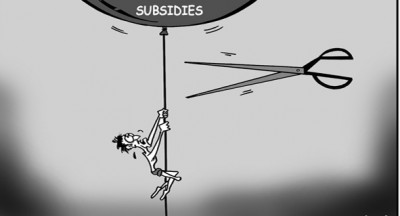
subsidies

Wind Turbine Fires Much More Common Than Previously Thought.

Wind turbine fire risk: Number that catch alight each year is ten times higher than the industry admits

  • Nearly 120 turbines catch fire each year – the reported industry figure is 12
  • Fire is second-largest cause of accidents after blade failure, research shows
  • Figures compiled by Imperial College and University of Edinburgh engineers

Nearly 120 wind turbines catch fire each year, according to new research – ten times the number reported by the industry.

The figures, compiled by engineers at Imperial College London and the University of Edinburgh, make fire the second-largest cause of accidents after blade failure.

The researchers claim that out of 200,000 turbines around the world, 117 fires take place annually – far more than the 12 reported by wind farm companies.

Scroll down for video

Engineers at Imperial College London and the University of Edinburgh say 120 wind turbines catch fire each year. Here, a turbine in Ardrossan, North Ayrshire, catches fire during severe weather

Engineers at Imperial College London and the University of Edinburgh say 120 wind turbines catch fire each year. Here, a turbine in Ardrossan, North Ayrshire, catches fire during severe weather

Fire has a huge financial impact on the industry, the researchers report in the journal Fire Safety Science.

Each wind turbine costs more than £2 million and generates an estimated income of more than £500,000 per year.

Any loss or downtime of these valuable assets makes the industry less viable and productive.

Dr Guillermo Rein of Imperial’s department of mechanical engineering, said: ‘Fires are a problem for the industry, impacting on energy production, economic output and emitting toxic fumes.

‘This could cast a shadow over the industry’s green credentials.

‘Worryingly our report shows that fire may be a bigger problem than what is currently reported. Our research outlines a number of strategies that can be adopted by the industry to make these turbines safer and more fire resistant in the future.’

Wind turbines catch fire because highly flammable materials such as hydraulic oil and plastics are in close proximity to machinery and electrical wires.

These can ignite a fire if they overheat or are faulty. Lots of oxygen, in the form of high winds, can quickly fan a fire inside a turbine, the paper found.

Wind turbine explodes

It contradicts the findings of a report into the wind industry, commissioned by the Health and Safety Executive in 2013, which concluded that the safety risks associated with wind turbines are very low.

The wind industry last night questioned the validity of the new research.

Chris Streatfeild, of Renewable UK which represents wind firms, said: ‘The industry would challenge a number of the assumptions made in the report, including the questionable reliability of the data sources and a failure to understand the safety and integrity standards for fire safety that are standard practice in any large wind turbine.

‘Wind turbines are designed to international standards to meet mandatory health and safety standards including fire safety risks.

‘The industry remains committed to promoting a safe environment for its workers and the public, and no member of the public has ever been injured by a wind turbine in the UK.

Read more: http://www.dailymail.co.uk/news/article-2695266/Wind-turbine-fire-risk-Number-catch-alight-year-ten-times-higher-industry-admits.html#ixzz3boBgvPZu

Stop the Subsidies, and the Windweasels will Scurry Away!

Texans Move to Slam Wind Power Subsidies

texan flag 2

****

The great wind power fraud is in meltdown around the globe.

In the US, ‘wind power’ states have cut their state based subsidies to wind power outfits (or are well on the path of doing so); and Republicans are out to prevent the extension of the Federal government’s PTC wind power subsidy:

2015: the Wind Industry’s ‘Annus Horribilis’; or Time to Sink the Boots In

US Republicans Line Up to Can Subsidies for Wind Power

In Texas, the great wind power fraud launched off with a frenzy of construction, a decade ago. Thousands of giant fans were speared all over West Texas (mostly in the North).  However, with the demand for power centred to the South-East in Dallas and Houston, they spent nearly $7 billion on wind driven grid capacity expansion (see our post here).

But, as everywhere, the wind industry is long on its insatiable demand for an endless stream of massive subsidies, but short on delivery of anything more than empty promises. In Texas, that familiar tale brought the retort from its Comptroller, Susan Combs that it was time for wind power outfits to put up or shut up:

Texas Blames Wind Power Slump on (you guessed it) … the Wind

Now, the Lone Star State’s Legislators have cried “enough is enough”, with its Senate voting to scrap its State-based wind power subsidy, in a move that spells the beginning of the end for BIG WIND in Texas.

Texas Moves to Abolish Renewable Energy Mandates (but much damage has been done)
Master Resource
Josiah Neeley
29 April 2015

“With Texas wind power capacity at more than double the state’s RPS minimum, repeal is unlikely to do much to change the profile of renewable energy in Texas. But repeal is still important, because it sends a clear signal that markets, not politics, should decide what kinds of energy Texans use.”

Texas has always been big on energy. The state’s long history of oil and gas production is well known. And on the electric generation side, Texas ranks first in the nation for nuclear power and has the most installed wind capacity of any state.

While the willingness to develop our energy potential is unrivaled, the means has not always been the best. Like in other states, and the U.S. as a whole, Texas has periodically tried to prop up or hold back different forms of energy via special protections, subsidies, or mandates, rather than letting markets and the price system decide the best energy mix.

That’s why recent events at the state capitol are so interesting. Earlier this month, the Texas Senate voted to repeal the state’s Renewable Portfolio Standard, as well as some related subsidies to the wind industry. If passed by the House and signed into law, the move could signal a broader change in how lawmakers treat energy in the U.S.

How We Got Here

Texas first created its Renewable Portfolio Standard (RPS) as a sweetener to the 1999 legislation introduction of electrical competition. The initial mandate required the state’s competitive electric providers to cumulatively install 2,000 MW of new renewable energy capacity by 2009. Individual companies were responsible for a portion of the total proportionate to their overall share of the competitive electrical market, and could meet their requirement either directly (by building the capacity themselves) or indirectly (by purchasing credits from other producers).

Once in place, the RPS mandate inevitably grew (what Milton Friedman calls the tyranny of the status quo). In 2005, the Texas legislature expanded the RPS to require 10,000 MW of installed capacity from renewables by 2025.

The legislature also acted to deal with a geographical inconvenience: Most of Texas’ wind capacity was in the sparsely populated west, while our electrical demand is centered in urban areas hundreds of miles to the east. In response, the legislature created the Competitive Renewable Energy Zone (CREZ), to build a thousand miles of transmission line to link wind farms with urban demand (to solve the nowhere-to-somewhere problem).

These programs have been costly for Texas. Transmission lines under the CREZ program have cost nearly $7 billion, or $270 per Texan. The cost of transmission lines is socialized across all electrical consumers, and will start appearing on Texans’ utility bills in the near future. Costs of meeting the RPS have been lower, but still have been estimated at approximately$543 million since 2005. 

Blown Away

Yet upon close analysis, these programs appear to have achieved very little. Texas met the 10,000 MW target for installed renewable capacity in 2010, a full 15 years ahead of the deadline, suggesting that the RPS itself was not the major factor. And the CREZ lines are only now being completed.

If Texas’ RPS wasn’t responsible for the big increase in wind capacity, what was? Answer: federal subsidies.

The federal Production Tax Credit, which provided up to $22 per MWh for renewable energy generation, dwarfed any effect of Texas’ RPS. The PTC was so generous that wind generators would often bid electricity onto the grid at a negative price (i.e. they pay you to take it) just to be eligible for the subsidy.

Needless to say, this posed some serious challenges to the long-term reliability of the Texas electrical grid. It has also compromised the economics of conventional sources of power such as gas-fired power plants and even nuclear plants.

Texas’ RPS, more than realized, was an exercise in political symbolism. The costs were real, but the main benefit was that it allowed the state to take a share of credit for the expanding use of wind energy, as explained by Kenneth Anderson Jr. of the Texas Public Utility Commission in the appendix below.

A New Direction

The value of that symbolism appears to be changing. The federal government began phasing out the PTC at the end of 2013 and is currently looking at ways to reform the federal Renewable Fuel Standard.

And here in Texas, there is a growing sense that programs like the RPS and CREZ outlived their usefulness (if they were ever useful to begin with). Wind, in particular, has been the recipient of billions in subsidies over the course of several decades. If the technology can’t survive on its own by now, there’s no reason to think that a few more years of subsidies would change that.

Even if the CREZ program is repealed, Texans will still be paying the cost of these projects for years to come. With Texas wind at more than double the state’s RPS minimum, repeal is unlikely to do much to change the profile of renewable energy in Texas wither. But repeal is still important, because it sends a clear signal that markets, not politics, should decide what kinds of energy Texans use.

———————————

Appendix: Texas Public Utility Commissioner Kenneth Anderson [1]

EnergyWire: After a [Texas] PUC report to lawmakers, bills have been moving forward on possibly scrapping a renewable energy standard and specifying commission oversight of certain direct-current (DC) ties to ERCOT. Some people are pretty upset, particularly on the renewable one (EnergyWire, April 14).

Anderson: I think their concerns are way overstated. … To be clear, we’re still counting renewable energy credits. We wanted to make sure that that continues to happen because it is the way that load-serving entities distinguish products. …

We just felt that there was no real reason to continue to have a mandatory purchase program because … we blew past our target years ago.

EnergyWire: A wind coalition has said the value of some credits could be affected.

Anderson: Will the price be affected slightly? It is possible, but I’m not sure why we should be continuing to have a mandatory program.

EnergyWire: Some environmental groups say Texas would be sending a bad message.

Anderson: How long do you have to subsidize something before it’s finally grown up? … We spent $7 billion to build out a transmission system that doesn’t cost them anything so that it would facilitate their interconnection to the grid. That is an ongoing and continuing, basically, social subsidy. …

Wind does not have to meet a schedule. They’re just a price-taker. ERCOT schedules the wind effectively first, you know, absent constraints on the system. … But, all things being equal, wind gets a free pass from the obligation to meet a schedule. So that in itself is a huge incentive.

[1] Source: Edward Klump, “From renewables to the grid, regulator seeks to keep Texas on its own path,” EnergyWire (E&E News), April 28, 2015 (subscription required).
Master Resource

The Texan’s retreat contrasts with the ridiculous push by Tony Abbott’s (conservative?) Coalition to carpet Australia’s countryside with 2,500 more giant fans. A “plan” which is backed by his $46 billion electricity tax on all Australian power consumers – a punitive and regressive tax, the entire proceeds of which is designed to be funneled off to outfits likenear-bankrupt Infigen as a whopping $3 billion a year subsidy that runs over the horizon, until 2031 (see our post here).

Note though, that Australia is in about the same position as Texas was in 2005, when it had no grid capacity to take power from its planned fan-expansion program. The missing grid had to built for no other purpose than taking wind power from North to South, as noted above. In:

2005 the Texas Legislature approved a major transmission project, the Competitive Renewable Energy Zones (CREZ), to carry mostly wind energy generated in West Texas and the Panhandle to high-demand cities. The project was forecast to cost less than $5 billion but ballooned to more than $6.9 billion to build nearly 3,600 miles of transmission lines and dozens of substations.

As pointed out in the piece above, in part, it’s that whopping cost that has legislators in Texas pulling the plug on subsidies for wind power, in an effort to protect power consumers from ballooning power bills.

In Australia, as we’ve pointed out a few times (see our posts here andhere), there simply is no (or insufficient) capacity to absorb the 17,000 GWh of intermittent wind power (needed each year to satisfy the latest 33,000 GWh LRET annual target) that can – like Texas – only be built in areas altogether remote from major population centres and markets.

Here, however, grid operators have absolutely no incentive to throw $billions at building transmission lines, substations etc running to the back-of-beyond, to take power delivered at crazy, random intervals which – apart from the REC Subsidy that comes with it – has no commercial value at all. The REC Subsidy goes to wind power outfits, not grid operators – and wind power outfits pay nothing to use the grid – that’s a cost that’s extracted by retailers from their dwindling pool of retail customers (see our posts here and here).

And, grid operators in Australia have just been prevented by the Australian Energy Regulator from recovering hundreds of $millions in network infrastructure costs – making the chances of them throwing any more at transmission lines slimmer than a German Supermodel. Why invest a penny, when a regulator is going to prevent you from getting anything like the whole return on that investment back?

Australia’s ‘lack’ of grid infrastructure is just another insurmountable obstacle for an industry in its death throes; and a guarantee that the LRET will go to penalty – with the inevitable imposition of the $65 per MWh shortfall charge.

That charge – which (carpeting the) Environment (in giant fans) Minister Greg Hunt refers to as his “massive $93 per tonne carbon tax” – will see all Australian power consumers end up paying more than $20 billion in fines; on top of the $25 billion that will go as subsidies (in the form of RECs) to wind power outfits.

In their constant need for massive subsidies – that’ll have to outlast religion in order for them to survive – the behaviour of wind power outfits the world over is just like Disney’s doyen of eternal youth – Peter Pan: the boy who could never grow up.

Peter-Pan-disney-200177_490_430

Windscam….Just a matter of Time, Before it Implodes….Which Country Gets Smart First?

Greg Hunt Delivers Coalition’s Political Suicide Manifesto: Liberals Lock-In $46 Billion Power Tax as Wind Industry Rescue Package

hunt macfarlane

****

The wind industry in Australia is doomed.

Australia’s commercial lending institutions know it (calling in their loans and refusing to lend for any new wind farms). And the wind industry knows it – hence the big players’ frantic efforts to ditch their wind farms, cut and run – although these fire sales are as much a product of their bankers’ refusal to extend credit (see our post here).

The big power retailers know it (see our post here).

And, from the panic exhibited in Canberra, every Federal MP knows it too (see our post here).

However, in an effort to Keep Up Appearances, wind industry front man, young Gregory Hunt delivered a speech last week that not only defies reality, it almost defies measured description (we’ll do our best in a moment).

WARNING: The speech comes with a public health warning: readers gifted with a modicum of knowledge of Australia’s energy market and/or commonsense are likely to experience sensations such as skin crawling; skin rashes; high blood pressure; and nausea.

These sensations will not arise by reason of some “nocebo” effect: the greater the reader’s understanding of the debacle that is the Large-Scale Renewable Energy Target and the great wind power fraud, the more severe these effects will be. Accordingly, we suggest securing a suitably sized bucket, clean towels and some iced water before passing this point. You have been WARNED.

COMMONWEALTH OF AUSTRALIA
House of Representatives
Hansard
WEDNESDAY, 27 MAY 2015

Renewable Energy (Electricity) Amendment Bill 2015

First Reading

Bill—by leave—and explanatory memorandum presented by Mr Hunt.

Bill read a first time.

Second Reading

Mr HUNT (Flinders—Minister for the Environment) (09:12): I move:

That this bill be now read a second time.

The Renewable Energy (Electricity) Amendment Bill 2015 will implement changes to the Renewable Energy Target to better reflect market conditions and allow sustainable growth in both small- and large-scale renewable energy.

The bill will lead to more than 23½ per cent of Australia’s electricity being sourced from renewable energy by 2020—not 20 per cent but 23½ per cent.

It also addresses problems which emerged more than three years ago with the Renewable Energy Target. Despite the presence of the 41,000 gigawatt-hour target, it was unlikely that it would be met.

First, there was a significant drop in electricity demand which occurred following the global financial crisis and it coincided with the closure of energy-intensive manufacturing plants. Together, they played havoc with wholesale electricity prices.

This was compounded by rising retail electricity costs associated with the carbon tax, network charges and feed-in tariffs resulting in households and industry changing their consumption patterns.

Second, the changes to the Renewable Energy Target introduced by the Rudd government and the subsequent creation of the phantom credit bank of what is currently 23 million certificates is still being felt today. This overhang continues to suppress demand for renewable energy certificates and stymie the signing of power purchase agreements.

These combined to make it increasingly difficult for renewable energy projects to attract finance.

Added to this, the increasing realisation that new subsidised capacity was being forced into an oversupplied electricity market made it likely that financial institutions would be approaching the new investments in the renewable energy space with significant caution and reluctance.

It is in this context that we have sought to place the Renewable Energy Target on a sustainable footing and to overcome the legacy of the problems created by the phantom credit scandal.

So this then brings me to the fact that the Renewable Energy (Electricity) Amendment Bill 2015 amends the Renewable Energy (Electricity) Act 2000 to:

adjust the large-scale renewable energy target (LRET) to 33,000 gigawatt hours in 2020. This will reflect a commitment to achieve approximately 23½ per cent of electricity from all renewable sources by 2020;

increase the partial exemptions for all emissions-intensive trade-exposed activities to full exemptions. This will be of particular importance to trade-exposed industries throughout the country, as recognised by the opposition and as in particular has been championed by many members such as the members for Bass, Braddon, Lyons, Wannon and Corangamite;

reinstate biomass from native forest wood waste as an eligible source of renewable energy; and

remove the requirement for Labor’s legislated biennial reviews of the RET.

These changes will ensure that there is continued support for sustainable growth in the large scale renewable sector. And, the 33,000 target, I repeat, is higher in its ultimate effect than the originally conceived objective of 20 per cent, which was the purpose, the intended outcome and the stated objective of the original legislation.

There will be no changes to the Small-scale Renewable Energy Scheme. The scheme will continue in line with household and small business demand.

The removal of Labor’s phantom credit scheme federally and the rationalization of feed-in-tariffs at the state level have reduced many of the distortions outlined in this week’s Grattan Institute report. I am delighted that this bill is proceeding in a bipartisan fashion.

Key features of the revised Renewable Energy Target

The Large Scale Renewable Energy Target

This then leads me to the fact that the bill will adjust the large-scale renewable energy target, or LRET, to reflect the 23½ per cent target. We will therefore adjust the LRET from 41,000 gigawatt hours in 2020 to 33,000 gigawatt hours in 2020. It will adjust the profile of annual renewable generation targets from 2016 to 2030 so that the target reaches 33,000 gigawatts in 2020 and is maintained at 33,000 gigawatt hours per annum from 2021 to 2030. This target is separate to the 850 gigawatt hours that is to come from waste coalmine gas generation each year until 2020 under pre-existing transitional arrangements previously agreed between the parties.

As highlighted in our energy white paper released by the Minister for Industry, Australia has an over-supply of generation capacity and some of that is aged. From 2009-10 to 2013-14, electricity demand has fallen by approximately 1.7 per cent per year on average.

This is due to many factors: sadly, declining activity in the industrial sector; increasing energy efficiency, which is a positive for Australia; and strong growth in rooftop solar PV systems, which is also a benefit for Australia, which does, however, reduce demand for electricity sourced from the grid.

While the Government welcomes a diverse energy mix in Australia, it also recognises that circumstances have changed since the original target of 41,000 gigawatt hours was set in order to achieve what had been hoped would be a 20 per cent outcome.

This new target of 33,000 gigawatt hours directly addresses these issues and gives the industry an opportunity to grow. It represents a sound balance between the need to continue to diversify Australia’s portfolio of electricity generation assets, the need to encourage investment in renewables while also responding to market conditions, the need to reduce emissions in the electricity sector in a cost-effective way, and the need to keep electricity prices down for consumers.

Most importantly, this new target of 33,000 gigawatt hours by 2020 is achievable. It will require in the order of six gigawatts of new renewable electricity generation capacity to be installed between now and 2020.

Even at the adjusted level of 33,000 gigawatt hours, the renewable sector will have to build as much new capacity, on the advice that I have, in the next five years as it has built in the previous fifteen. This will not be an easy task, but, on all the advice we have, it is achievable and therefore real construction will occur.

This new target will therefore be good for jobs in the renewable energy sector and, as I have said, lift the proportion of Australia’s electricity generation to approximately 23½ per cent by 2020.

Assistance to emissions-intensive trade-exposed industries

When the RET scheme was expanded in 2010, partial exemptions were introduced for electricity used in emissions-intensive trade-exposed activities. These were hard-fought and negotiated by the coalition. The exemptions only apply to the additional RET costs that were incurred as a result of the expansion of the scheme.

The RET scheme regulations currently prescribe that electricity used in activities defined as highly emissions intensive and trade exposed is exempted at a 90 per cent rate, and electricity used in activities defined as moderately emissions intensive and trade exposed is exempted at a 60 per cent rate.

This bill will increase support for all emissions-intensive trade-exposed activities to full exemptions from all RET costs—that is, from the costs of the original target as well as the costs of the expanded target. A full exemption will protect jobs in these industries and ensure they remain competitive. This has been of particular concern, as I mentioned earlier, to the members for Bass, Braddon, Lyons, Wannon and Corangamite—each of whom has played an extremely important role in securing this agreement between the parties.

The reduction in the direct costs of the RET resulting from the lower large-scale renewable energy target will more than offset the impact on other electricity users of the increase in assistance for emissions-intensive trade-exposed activities.

Reinstating biomass from native forest wood waste as an eligible source of renewable energy Native forest wood waste was in place as an eligible source of renewable energy under Labor’s own legislation until November 2011.

The use of such native forest wood waste for the sole or primary purpose of generating renewable electricity has never been eligible to create certificates under the scheme. Eligibility was subject to several conditions, including that it must be harvested primarily for a purpose other than energy production. This is about the use of wood waste; it is not about cutting down biomass to burn.

Consistent with our election commitment, as was set out in our forestry policy on the first page and further within the policy, this bill reinstates native forest wood waste as an eligible source of renewable energy under the RET, basing eligibility on exactly the same conditions—precisely the same conditions—as were previously in place under the ALP when they were in government.

One of the objectives of the RET is to support additional renewable generation that is ecologically sustainable. We are reinstating, therefore, the provision allowing native forest wood waste as an eligible renewable energy source, because there is no evidence that its eligibility leads to unsustainable practices or has a negative impact on Australia’s biodiversity. This was the experience of the 10 years during which this provision was in place.

We believe that the safeguards that were in place previously were, and are still, sufficient assurance that native forest wood waste is harvested and used in a sustainable way. The regulations were underpinned by ecologically sustainable forest management principles which provide a means for balancing the economic, social and environmental outcomes from publicly owned forests.

In all cases, the supply of such wood waste is subject to the Commonwealth and state or territory planning and environmental approval processes, either within, or separate to, the regional forest agreement frameworks.

Using wood waste for generation is more beneficial to the environment than burning the waste alone on the forest floor or simply allowing it to decompose and to produce methane—a greenhouse gas with very high global warming potential. Its inclusion as an eligible energy source is another contribution to the target.

We understand that regular reviews of policy settings create uncertainty for investors, business and consumers. That is why this bill removes the requirement for two-yearly reviews of the RET. Providing policy certainty is crucial to attracting investment, protecting jobs, and encouraging economic growth.

Protecting electricity consumers, particularly households, from any extra costs related to the RET, has been a priority from the start and the government understands that the 33,000 gigawatt-hour target remains a challenge for industry.

For these reasons, instead of the reviews, the Clean Energy Regulator will prepare an annual statement on the progress of the RET scheme towards meeting the new targets and the impact it is having on household electricity bills.

Again, this bill is about appropriately balancing different priorities; replacing the biennial reviews with regular status updates better meets the needs of industry and the needs of consumers, and any concerns within the parliament. It is about increased transparency at the same time as increased certainty.

Importantly, both the government and the opposition have agreed to work cooperatively on a bipartisan basis to resolve any issues which may arise with the operation of the Renewable Energy Target through to 2020. Against that background I do wish to thank many people, beginning with the opposition. We have negotiated in good faith with Mark Butler, Gary Gray and Chris Bowen. I particularly thank my opposite, the shadow minister for the environment, Mark Butler, and his staff for their work. These negotiations can be difficult but I believe both sides conducted an honourable process, and this was an example of the parliament operating as a parliament for an outcome which will be, ultimately, beneficial to Australia. So I acknowledge and appreciate the work of my colleagues on the opposite side of the chamber.

I want to thank my colleagues, in particular: Ian Macfarlane, whose knowledge of the electricity is peerless, not just within the parliament but arguably almost anywhere within Australia; the Prime Minister who, himself, proposed the compromise and suggested the notion of the Clear Energy Regulator providing the annual outdates—it was an important breakthrough and step forward and he engaged deeply in this process and was always seeking a balanced outcome; as I have mentioned, my colleagues Dan Tehan, Sarah Henderson, Eric Hutchinson, Andrew Nikolic and Brett Whiteley; and Angus Taylor, whose knowledge of the electricity sector and whose concerns for his electors were absolutely vital in helping us to achieve this outcome. He is a very informed individual and the parliament benefits from having another Rhodes Scholar enter this chamber.

From within the Department of the Environment, David Parker and Brad Archer played a critical role throughout the review process. I thank Lyndall Hoitink and John Jende—whose knowledge of the Renewable Energy Act and the implications are extraordinary. Mark Scott, Candice El-Asmar, Kieran McCormack and Peter Nicholas all played critical roles.

From the Clean Energy Regulator I thank Chloe Monroe, who performed an extraordinary role in executing the first Emissions Reduction Fund auction and also provided invaluable advice. She and her team are outstanding policy professionals. Although appointed by a previous government, we have proudly and happily continued her role. As far as I am concerned, she is invited to stay in the job for as long as she wishes to do it. She is really one of the great public servants in Australia. Similarly, she is supported by people such as Mark Williamson and Amar Rathore, both of whom have done a great job.

At the Office of Parliamentary Counsel I thank Iain McMillan and his staff. From others who have contributed significantly there is Jessi Foran from Ian Macfarlane’s office. From within industry Miles George, as chair of the Clean Energy Council, and Kane Thornton, CEO of the Clean Energy Council, were indefatigable and fundamental in pressing the concerns and needs of their sector. This deal would not have been achieved without their work, and I honour and acknowledge it.

Similarly, Miles Prosser, from the Aluminium Council; Innes Willox, from the Australian Industry Group; and Kate Carnell and John Osborn, from the Australian Chamber of Commerce and Industry, all played critical roles in helping to bring us to this point.

Finally, I want to acknowledge two people from my office: my chief of staff, Wendy Black, whose counsel and guidance on every topic is really outstanding; and Patrick Gibbons, who is my senior adviser and whose knowledge of the electricity sector is surpassed only by that of Ian Macfarlane, who has spent hundreds and hundreds of hours helping to bridge the gaps between different parties. Again, this would not have been possible without him.

To all of those parties I say thank you. Let me conclude by saying this: this bill is consistent with the government’s conviction that policy decisions must be based on sound economic principles and real-world experience. It also represents the government’s commitment to maintain stable and predictable settings that encourage growth, encourage competitiveness, encourage efficiency and that produce better outcomes for electricity consumers.

The RET had to be reformed in response to changing circumstances. This bill achieves balanced reform. It will provide certainty to industry, encourage further investment in renewable energy and better reflect market conditions. It will also help Australia reach its emissions targets, and it will protect jobs and consumer interests.

As the energy white paper points out, Australia has world-class solar, wind and geothermal resources, and very good potential across a range of other renewable energy sources. In addition to the support for small- and large-scale renewables, which this bill provides, the government is providing over $1 billion towards the research, development and demonstration of renewable energy projects.

This bill recognises that renewable energy is an important part of Australia’s future, while also recognising that its deployment must be supported in a responsible way with minimal disruption to our energy markets. I thank all of those involved in reaching this point. I am delighted that we have achieved a sensible balance which will allow the industry to grow to 23½ per cent of Australia’s total energy production by 2020.

I commend the bill to the House.

Debate adjourned.

Hansard, 27 May 2015

Where to begin?

Before we do, please note, we cannot rule out the possibility that the speech was in fact written in its entirety by the lunatics from the Greens. It is so far to the hard-green-left that it is unrecognisable as a statement purportedly emanating from a so-called Conservative government.

Stomach churning content aside, perhaps we’ll start with a take on young Gregory’s “style” and “themes”.

miss world

****

The gushing delivery reminds STT of the gorgeous Venezuelan gal who bags the Miss World title and who, on cue, reacts with welled-upped eyes, and hands-to-face (faux) surprise.

Brushing away an alloy of tears and top-quality mascara, the winner hits us with her suitably ambitious manifesto. Starting with her wish list of an end to hunger; world peace; an end to disease and so on, the soon-to-be Hollywood starlet thanks all those that got her to the winner’s podium, from her personal trainer, her publicist, right down to her hairdresser.

Of course, young Greg’s speech didn’t go so far. However, as to plausible realisation, Greg’s manifesto is on precisely the same footing.

No-one in their right mind expects Miss World to follow through on her promise to save the world from hunger and disease etc.

Likewise, there is absolutely no way that Greg’s ultimate annual 33,000 GWh LRET will be satisfied by the “due date” of 2020, or at all.

Greg knows it; and so does everybody on his seemingly endless thank you list.

For those new to this site, STT is all about smacking people with the reality that wind power is meaningless as a power source, because it can only ever be delivered at crazy, random intervals. In the absence of mandated fines on retailers and/or whopping subsidies to wind power outfits, the wind industry simply would not exist. The claim that wind power is “clean” and “green” is nothing more than a cynical marketing ploy; and a cruel hoax played on the gullible and naïve.

The politicians who support wind power have simply devoured the lies and myths spouted by the wind industry and fall into 2 camps:

  1. those who are simply “pig” ignorant; or
  1. little piggies with their trotters in the wind scam trough

Most of the line up on Greg’s “thank you list” have been in the game long enough to know precisely what’s going on, which tends to rule out their inclusion in the first category above.

The inclusion of energy market lightweights, and economic illiterates, from the ranks of the Coalition – such as Disappointing Dan Tehan, Sarah Henderson, Eric Hutchison, Andrew Nikolic and Brett Whiteley is no surprise (none of them have the foggiest clue about the cost or operation of the LRET, the impact of Power Purchase Agreements on retail power prices, dispatch prices, grid stability etc, etc).

Dimwits in politics are a dime-a-dozen; and this won’t be the first time that elected representatives chimed in with support for a policy that they haven’t got the faintest understanding of.

And glad to see young Greg outing all those who STT readers have always placed in the second category above:

The wind industry’s plants and stooges within Hunt and Macfarlane’s offices, like Patrick Gibbons (who’s best mates with Vesta’s former front man, Ken McAlpine). As well as wind industry shills like Chloe Monroe (and her gang from the CER).

And the boys from the so-called Clean Energy Council, Miles George (who conveniently heads up Infigen – cutting down on lobbying time and costs) and head wind industry spin-master, Kane Thornton. Reports that Kane slept on a camp stretcher in Greg Hunt’s office during the weeks of negotiations cannot be confirmed.

What can be confirmed is that the Clean Energy Regulator (a statutory authority paid for entirely by taxpayers) has been shovelling tens of thousands of dollars into the coffers of the Clean Energy Council (a lobbying outfit set up – and meant to be fully paid for – by wind power outfits). During Senate estimates last week, Chloe Monroe conceded that the CER and the CEC are singing from precisely the same hymn sheet; and that the CER is stumping up taxpayers’ cash to help them do so:

Ms Munro: There was one question that we just took on notice which I think I can now answer. It was about the cost of our subscription to the Clean Energy Council and our membership there. For the current financial year it is $14,520. I might just mention that we regard that as an important membership to have because of the very significant role the Clean Energy Council plays in disseminating information to its membership which assists with the overall regulatory performance of the industry. Also, as a member, we do not exercise our right to vote, for example, so we do not play any part in the decision making of the Clean Energy Council, for example, in the recent elections for the chair of the council. We would not take any part in that. We are very much at arm’s length from that.

Hmmm … unfortunately for Chloe, her efforts to distance herself from the tens of $thousands thrown by the CER at the wind industry’s spin-masters, fell flat with her special mention in Greg Hunt’s thank you list, right next to Miles George and Kane Thornton.

While the shills from the CER, CEC, Infigen & Co were obvious among those Hunt was bound to thank (although, as their very existence depends on Hunt’s efforts to save the LRET, they should all be thanking him) the inclusion of the PM, Tony Abbott and Angus “the Enforcer” Taylor on Hunt’s little list is a bridge way too far.

Angus Taylor

****

STT hears that Angus Taylor is close to furious about the manner in which Hunt and Macfarlane double-crossed their party on the terms of the LRET deal with Labor – and he’s not alone – STT hears that the PM is less than amused, too.

Leading up to the deal, both Hunt and Macfarlane were under strict instructions to maintain the provision in the Renewable Energy (Electricity) Act 2000 (section 162) that provides that reviews of the mandatory RET must take place every two years; taking into account the cost and benefits of any recommendation made, as part of the review.

Their colleagues, from the PM down, understood that the retention of two yearly reviews was a ‘deal breaker’. However, as evidenced in Hunt’s political suicide manifesto above, Hunt and Macfarlane ‘caved in’ (under the slightest ‘pressure’ from their wind industry mates); much to the disgust and horror of the majority of their party colleagues.

The two yearly reviews were understood by all those in the Coalition giving licence to Hunt and Macfarlane to cut a deal with Labor, to be a critical mechanism available to pull a halt to the runaway costs of the LRET, in general; and the ludicrous costs of wind power, in particular.

The review process was set up to allow the government of the day to act on recommendations; such as scrapping the LRET in its entirety; or to deny RECs to wind power outfits, simply because the demonstrated and extraordinary costs of wind power (the key beneficiary of the LRET) completely outweighs any of its purported benefits.

STT fully expects Angus Taylor (among others) to set the cat amongst the pigeons this week, by challenging Hunt and Macfarlane on their backdoor deal to drop the two yearly reviews, at the wind industry’s behest, among other things.

Double-dealing aside, there’s also the small matter of substance. The Coalition (the combination of the Liberals and the Nationals) is purportedly made up of conservative, pro-business, small government types. Their core constituency will be less than impressed to learn that Hunt and those on his “thank you list” have set them up with a $46 billion electricity tax: half of which will be directed to wind power outfits – like near-bankrupt Infigen (aka Babcock and Brown); with the balance being recovered as a $65 per MWh fine (aka “the shortfall charge”) – and directed to general revenue (ie a ‘stealth tax’):

Out to Save their Wind Industry Mates, Macfarlane & Hunt Lock-in $46 billion LRET Retail Power Tax

Hunt, Macfarlane and the CER have given a “guarantee” to the PM that wind power outfits will easily build the capacity needed to generate the extra 17,000 GWh required to satisfy the ultimate annual 33,000 GWh target (thus avoiding the politically toxic penalty set under the LRET). However, that little “promise” is, again, more like Miss World’s promise to achieve world peace: something that everyone with a hint of common sense considers as pure nonsense.

The other furphy being pitched by Hunt, Macca and the CER is that – provided the shortfall charge is avoided – the LRET carries absolutely no cost to power consumers at all (see the post above). However, if that were the case, why was Greg so pleased to announce that Energy Intensive Industries will be exempt from “all RET costs”?

So which is it Greg? Is the LRET a family and small business ‘friendly’, that’s as cheap as chips and a guaranteed vote winner? Or is the effort to protect the Aluminium sector etc a dead-set giveaway, that – at $3 billion a year – the LRET is the largest, single electricity tax ever cooked up?

It’s going to Penalty

STT hears that the finance sector has absolutely no intention of providing any money to build new wind power capacity. The expectation is that RECs will, in the longer term, trade in the order of $30, at which price wind power outfits will not break even, placing lenders at enormous and perfectly avoidable RISK (see our post here).

STT hears that the major retailers are of the same view.

Greg Hunt talks about “the phantom credit bank of what is currently 23 million [REC] certificates” – what’s called the “overhang”.

Retailers, such as Origin, hold the bulk of those certificates and will be able to use them to avoid the shortfall charge, until they run out. That means that there is no need for them to enter long-term Power Purchase Agreements with wind power outfits to obtain RECs, for some time. One scenario involves those holding RECs simply hanging on to them until the penalty set by the LRET kicks in, such that they can cash them in at prices over $90 (many were purchased at $20 or less).

STT also hears that the major retailers have no interest in wind power at all: remember, that commercial retailers have not entered PPAs with wind power outfits since November 2012.

output vs demand

****

As we’ve pointed out (just once or twice) wind power can only ever be delivered at crazy, random intervals (if at all); and is usually generated late at night, or very early in the morning, when there is little demand for power. The only reason retailers sign up to purchase wind power, is to obtain the RECs that come with the deal – power that can never be delivered on demand, is of no commercial value, otherwise.

Solar power, on the other hand, is available almost every day during daylight hours and is, therefore, capable of satisfying demand, as it rises during the daytime.

STT hears that the big retailers are planning to wait until they look like exhausting the pile of RECs that they’re sitting on at present, at which point they’ll build some large-scale solar power facilities, in order to obtain the RECs needed to avoid the shortfall charge.

The retailers still believe that the politics of the LRET are inherently toxic; which will lead to its inevitable implosion (hence the belief that REC’s will end up at less than $30). By investing in a few solar panels, these boys will avoid the impact of the LRET penalty, in the short term. And, once the LRET implodes, they will be able to sell those panels for re-use by householders in domestic situations.

And the implosion of the LRET is as inevitable as death and taxes.

So, if you run into young Gregory, be the first to congratulate him on his speech.

It’ll be the one that comes back to bite him and his team as the LRET disaster unfolds; power prices go through the roof; and householders and businesses realise that a government that they elected on a promise to scrap the Labor/Green Alliance’s business and economy destroying – and family punishing – “carbon” tax, set them up to pay for the most ridiculously generous corporate welfare scheme in the history of the Commonwealth. And all because Hunt and Macfarlane’s wind industry mates wanted it that way.

dumb 3

This Is A Good Start, But World-Wide Reforms Needed!

Robson: Good winds blowing

Credit:  By Frank Robson, Guest Columnist | The Journal Record | May 29, 2015 | journalrecord.com ~~

I applaud the Oklahoma Legislature and Gov. Mary Fallin for implementing much-needed reform of the wind industry, addressing both excessive subsidies and lack of regulation for protection of property owners. The progress made this year is important in establishing a regulatory framework. Yet there is still work to do.

Senate Bill 808 by state Sen. Brian Bingman, R-Sapulpa, and Rep. Earl Sears, R-Bartlesville, signed by Fallin on April 17, established a 1.5-nautical-mile setback of wind turbines from schools, airports and hospitals and provides a stronger decommissioning statute that protects landowners and taxpayers from being financially responsible for taking down turbines at the end of their life. The legislation also requires notification to landowners at least six months before construction begins.

The new law doesn’t take into consideration protection of wind turbines from homes, neighborhoods, public parks and other land where natural habitat may be disturbed. We hope the Legislature will consider the need for further requirements that address reasonable restrictions on the placement of wind turbines near other areas of public safety concern.

Senate Bill 498 by state Sen. Mike Mazzei, R-Tulsa, and Sears, signed May 20, repeals the ability of the wind industry to qualify for a five-year property tax exemption. This provides a good start in addressing the magnitude of industrial wind’s subsidies and negative impact on Oklahoma’s budget.

Senate Bill 502 by state Sen. Marty Quinn, R-Claremore, and Sears, signed May 20, repeals the ability of the wind industry to qualify for the new jobs investment tax credit effective Jan. 1, 2017. This eliminates an unnecessary and potentially costly subsidy for an industry that creates few jobs here.

Wind developers may still qualify for zero-emission tax credits, which amount to $5 per megawatt-hour for all electricity produced from industrial wind facilities for 10 years. The current law saddles Oklahoma taxpayers with this burden for all wind facilities built prior to Jan. 1, 2021. Payment of subsidies under this program may extend until Dec. 31, 2030.

We look forward to continued forthright discussions with state leadership regarding the need for further safety regulations, and the need to evaluate the legitimacy of the remaining subsidies available to industrial wind. Let’s continue to make progress for the betterment of Oklahoma.

Frank Robson is a member of the Oklahoma Property Rights Association.

The Greed Energy Scam is Crippling Germany!

German Government In Crisis Over Escalating Cost Of Climate Policy

European Power Plants Face Widespread Bankruptcies

An aerial view shows Vattenfall's Jaenschwalde brown coal power station near Cottbus, eastern Germany August 8, 2010. Photo: Reuters/Fabrizio Bensch

Germany’s economics minister Sigmar Gabriel (SPD) wants to levy penalty payments onto coal plants if they produce CO2 emissions above a certain threshold. Against this plan intense resistance is growing in Germany: Within the Christian Democrat, within industry and – for especially dangerous for Gabriel – within the trade unions. The Christian Democrats (CDU) in particular are taking on Gabriel’s climate levy. And Merkel is allowing her party colleagues to assail him. Armin Laschet, the vice chairman of the Federal CDU, is accusing Gabriel of breaking the coalition agreement.  –Jochen Gaugele , Martin Greive , Claudia Kade, Die Welt, 25 May 2015

The transition to renewable power generation is accelerating closures of coal and gas-fired power generation plants at a quicker rate than expected. According to UBS, policymakers may have to take measures to prevent widespread bankruptcies in the European electricity market. That’s the conclusions drawn by investment bank UBS, who have produced a report on the subject. According to their data, some 70 GW of coal and gas-fired power generation shut-downs have occurred in the last five years, and the pace is increasing, according to the analysis. –Diarmaid Williams, Power Engineering International, 11 May 2015

The world’s richest nations are unlikely to reach a deal to phase out subsidies for coal exports at talks in June, reducing the chances of a new global climate change agreement at a U.N. conference in Paris, officials and campaigners say. One European Union official, speaking on condition of anonymity, said the EU hoped to “nudge forwards” the debate, but that within the EU, Germany was an obstacle, while Japan was the main opponent in the OECD as a whole. –Barbara Lewis and Susanna Twidale, Reuters, 27 May 2015

To many western environmentalists, who are determined to see a binding global deal to reduce greenhouse gas emissions at the UN climate change conference in Paris later this year, India’s rising coal use is anathema. However, across a broad range of Delhi politicians and policymakers there is near unanimity. There is, they say, simply no possibility that at this stage in its development India will agree to any form of emissions cap, let alone a cut. — David Rose, The Guardian, 27 May 2015

The idea that India can set targets in Paris is completely ridiculous and unrealistic. It will not happen. This is a difficult concept for eco-fundamentalists, and I say this as a guy who is considered in India to be very green. Copenhagen failed because of climate evangelism. I was sitting for days with Gordon Brown, Ed Miliband, Angela Merkel, Barack Obama and Sarkozy. It was absolutely bizarre. It failed because of an excess of evangelical zeal, of which Brown was the chief proponent. Even with the most aggressive strategy on nuclear, wind, hydro and solar, coal will still provide 55% of electricity consumption by 2030, which means coal consumption will be 2.5 or three times higher than at present. –Jairam Ramesh, India’s former environment minister, The Guardian, 27 May 2015

Wind Turbines – Unaffordable, Unreliable, Novelty Energy!

The Obscene, Hidden Costs of Wind Power

Facts

****

True costs of wind electricity
Planning Engineer and Rud Istvan
12 May 2015
Climate Etc. 

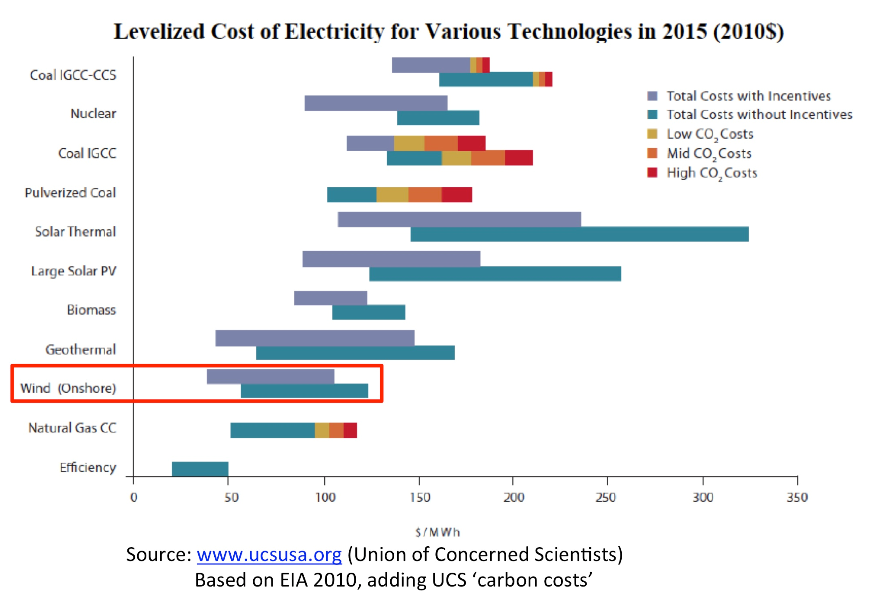
Wind turbines have become a familiar sight in many countries as a favorite CAGW mitigation means. Since at least 2010, the US Energy Information Agency (EIA) has been assuring NGOs and the public that wind would be cost competitive by now, all things considered. Many pro-wind organizations claim wind is cost competitive today. But is it? [if any of the graphs below look fuzzy, click on them and they’ll pop up clear as crystal in a new window]

Curry1-400

Yet incentives originally intended only to help start the wind industry continue to be provided everywhere. This fact suggests wind is not competitive with conventional fossil fuel generation. How big might the wind cost gap be? Will it ever close? We explore these questions in four sections: incentives, lifetime cost of electricity generation (LCOE), system costs, and market distortions. We examine onshore wind, since EIA says offshore is almost 3x more expensive. For simplicity, we examine EIA national averages, rather than regional ranges.

Incentives

The main US federal incentive is the wind Production Tax Credit (PTC), created by the Energy Policy Act of 1992. It is now $21.50/MWh for the first ten years of generation. It was intended to jumpstart the industry, so has expired via sunset provisions several times over the past 23 years. Each time, US wind investment promptly collapsed. Each time, Congress promptly renewed PTC at the same or higher incentive rates. Why? At Berkshire Hathaway’s (BH) 2014 annual meeting (BH’s Iowa based electric utility MidAmerican Energy has $5.6 billion invested in wind generation) Warren Buffet said:

“I will do anything that is basically covered by the law to reduce Berkshire’s tax rate. For example, on wind energy, we get a tax credit if we build a lot of wind farms. That’s the only reason to build them. They don’t make sense without the tax credit.” [1]

Curry2-400

U.S. Congressman Lamar Smith asked the Congressional Budget Office to estimate PTC’s 2013 cost (as part of that year’s reinstitution debate): the 2013 cost was $13 billion.

Iowa has enacted an additional state PTC of $10/MWh. Buffet gets a total PTC of $31.5/MWh from both federal and Iowa taxpayers. YE2014, BH’s MidAmerican Energy, had 2953MW of Iowa wind capacity. Warren Buffet wind farms are receiving $253 million of annual tax credit from Iowa wind generation on an investment of $5.6 billion (2953 MW * 0.31CF * 8766 hr/year *$31.5/MWh). BH’s effective tax rate last year was 31%. Those wind credits are equivalent to earning (253/0.31) $816 million on his $5.6 billion wind investment—a 15% return before any operating profit from selling electricity. That is a good deal for the Nebraska billionaire, but not for the rest of us.

The EIA estimates wind costs five years in the future. Since 2010, each cost estimate has had a separate entry for subsidies. Each estimate since 2012 (for 2017) has zero wind subsidies. EIA assumes the PTC expires (it has yet again YE2014). The Obama administration is proposing it be made permanent, with strong support from the AWEA (American Wind Energy Association). This suggests EIA’s estimated wind costs are too low, and partly political rather than mostly factual. How much is shown by closer examination of their other cost components.

LCOE

The most recent ‘official’ EIA estimates are available in Table 1 of EIA’s Annual Energy Outlook 2015, Electricity Generation Forecasts. The EIA explains:

Levelized cost of electricity (LCOE) is often cited as a convenient summary measure of the overall competiveness of different generating technologies. It represents the per-kilowatthour cost (in real dollars) of building and operating a generating plant over an assumed financial life and duty cycle. Key inputs to calculating LCOE include capital costs, fuel costs, fixed and variable operations and maintenance (O&M) costs, financing costs, and an assumed utilization rate for each plant type. The importance of the factors varies among the technologies. For technologies such as solar andwind generation that have no fuel costs and relatively small variable O&M costs, LCOE changes in rough proportion to the estimated capital cost of generation capacity.

EIA’s LCOE is the annualized net present value (aka annual annuity cost). The estimate is always 5 years into the future. That is why their 2010 estimate above was only verifiable in 2015.

EIA calculates LCOE as the sum of five components: Capital, Fixed O&M, Variable O&M (including fuel), Transmission (incremental), and Subsidies (none). Capital costs are spread over a 30-year life at an interest rate of 6.5%. This appears superficially reasonable, but as we show below, isn’t. Following are the basic LCOE generation comparisons in $/MWh and capacity factor (CF) %, from the EIA AEO 2012 and 2014.

CF% ($2017) ($2019)
CCGT 87 66.1 66.3
Conv. Coal 85 97.7 95.6
Wind 35 96.0 80.3
GT (peaker) 30 127.9 128.4

Three things stand out. Combined cycle gas turbine (CCGT) costs are cheaper than coal. That makes directional sense; in the US CCGT is gaining share at the expense of coal. CCGT cost advantages include: (a) better net thermal efficiency (61% versus 41% for USC coal), (b) abundant inexpensive natural gas thanks to fracked shale, and (c) cheaper capacity. It takes three years to build a CCGT for about $1000-1250/kw. USC coal takes 4 years to build for about $2850/kw.[2] Peak load gas turbine (GT) capacity only costs about $750/kw, but its LCOE is twice CCGT because its capital is under utilized–only operating 30% of the time. Finally, EIA says wind is competitive with coal and will become more so (about 20% more in just three years!).

‘True’ wind LCOE is understated since the PTC is missing. The annuity value of $21.5/MWH for 10 years at 6.5% interest, annuitized over 30 years is $7.2/MWh. A ‘truer’ comparison to coal is (96+7) ~$103/MWh from the general taxpayer perspective, rather than from Warren Buffet’s.

This unsurprising result just shows the PTC was intended to make wind ‘grid competitive’, and seems to do so—at taxpayer expense. That is why investment collapses toward zero in its absence. There are, however, two further ‘obvious’ plus two additional ‘hidden in the fine print’ issues with the EIA LCOE comparisons that are equally consequential, and similarly biased.

Wind capital cost

Wind capital declines 22% from 2017 to 2019; CCGT only declines 8%. This difference is not attributable to turbine production volume. According to GWEC, 51,473 MW was delivered globally in 2014, comprising at least 17000 units (at ~3MW each). Installation costs don’t scale. Past reductions in wind capital per megawatt came from developing larger turbines, not from increased volume.

Curry3-400.png

But actual installed cost/MW stopped declining, and started rising around 2005. There are few onshore turbines larger than 3 MW because of transportation (road/rail) constraints on blade length. The above 2012 NREL composite chart is deliberately misleading; it ended in 2005 although LBNL data was available to 2011.

Curry4-400

EIA’s projected 22% decline in wind capital LCOE is very dubious. We shall use $96/MWh total, the same as EIA’s 2010 LCOE midpoint charted above.

Capacity Factor

The record US annual wind capacity factor was 2014 at 33.9%. EIA itself says the median CF over the past decade is 31%. (Still better than the UK, where CF ranged from a low of 21.5% in 2010 to a record high 27.9% in 2013.) The assumed US 35% CF is unrealistically optimistic. [3]

Curry5-400

Using the historic median CF, a ‘truer’ wind LCOE is roughly (35/31*$96/MWh) $108/MWh.Using the historic median CF, a ‘truer’ wind LCOE is roughly (35/31*$96/MWh) $108/MWh.

Fine Print interest rate

The first fine print fudge is the annuity interest rate. The 2014 EIA text says 6.5% (same as 2012). Ah, but the fine print also says that for coal generation without carbon capture and sequestration (CCS), 9.5% is used. EIA’s fine print inside that fine print says this is the equivalent of a $15/ton CO2 emissions tax on coal (buried inside Capital rather than exposed in Variable O&M explicitly including fuel cost).

EIA says conventional coal produces about 2.15 pounds of CO2 per kWh (depending slightly on coal rank). That is ~2.15 tons of CO2 /MWh, a ‘hidden’ LCOE coal fuel penalty of (2.15*$15) $32.25. There is no US ‘carbon tax’; Congress refused to enact Obama’s proposal. A ‘truer’ comparison is wind at $108/MWh to coal at $65.45/MWh.

This also makes intuitive sense. The newest technology UltraSuperCritical (USC) coal must be similar in cost to CCGT in favorable locations (considering coal transport and quality). One was just completed for $1.8 billion (SWEPCO’s 600MW Turk plant in Arkansas) and 10 additional USC coal facilities are presently planned for the US. None of these will be built until the constitutionality of EPA’s proposed CO2 limit (which effectively prohibit them) is settled.

Fine Print lifetime

EIA comparisons are based on a 30-year lifetime; this introduces a large bias. The EIA itself says the average age of the US coal fleet is 42 years; effective coal lifetime is at least that. GE’s marketing materials say the expected life of its CCGT is at least 40 years. In other words, the capital annuity component of non-wind LCOE should be reduced by ~25% to reflect longer useful lives (40 rather than 30 year annuity, EIA capital only, 0.065 r). That is $8.35/MWh lower LCOE for coal after first subtracting the $32.25 fuel penalty hidden in capital, and $4.30/MWh lower for CCGT.

On the other hand, the design life for wind is 20 years; with maintenance they may last 25 years. EIA’s assumed wind lifetime is longer than the industry’s most cheery estimate, thereby understating LCOE. A ‘truer’ comparison would be wind at (capital component annuity 25 rather than 30 years, 0.065 r) $121/MWh compared to 40 year CCGT $57.5/MWh and Coal $57.1/MWh. ‘True’ wind LCOE is about twice the cost of conventional generation from either coal or natural gas.

Studies of UK and Denmark wind farms suggest their actual economic lives appear to be 12-15 years due to wear and tear.[4] One of the unanticipated problems that arose with larger turbines is premature cracking failure of the main axial bearing(s). These failures arise from two very difficult engineering conditions. First is uneven loading. Wind speeds increase with altitude so the three blades, which span great distances, are never evenly loaded. The bearing(s) wobble under the tremendous forces generated. Second, braking when wind speed exceeds 25mph suddenly loads reverse torque on the axial side where previously unloaded (and wobbling) individual bearings are in natural misalignment to their trace. If things go ‘well’, cracking can be caught before catastrophic failure. It is expensive to repair. The blades must be detached so the turbine can be dismounted and sent back to the factory. The following image shows a 3MW unit.

Curry6-400

Sometimes things do not go well.

Curry7-400

To summarize the second section on LCOE: EIA’s wind future capital, capacity factor, and lifetime all understate the ‘true’ cost of wind. Conventional coal generation is misleadingly overstated. Given other information provably at EIA’s disposal, its wind-biased US findings appear driven by political considerations.

System Costs

We have looked at wind from the perspective of wind farmers and electricity generators. But that is not the whole story, since wind is intermittent. Intermittency has two broad utility system consequences not captured in generation LCOE. First, the grid has to have some level of offsetting backup generation to maintain stability. Those costs are not borne by wind operators unless they also happen to own the regional grid. Most don’t. Second, transmission capacity has to be added. The full extent of those costs is not usually borne by windfarms, but rather (again) by grid owners.

Intermittent backup

Grids always have some spare capacity beyond average peak load. This safety margin handles unexpected peaks, unplanned outages, and other random fluctuations. How much depends on a grid’s many specific details, but 10 – 20% reserve margins are typical. A portion of this amount must be fast start gas turbines, or spinning reserves (older smaller depreciated plants operating at minimum capacity that can be ramped as needed), or flexible hydro, or (newly) flexible CCGT. For very small wind generation proportions, the ‘normal’ reserve suffices. As the percentage of wind in the generation mix grows, it increasingly does not. There are inefficiency costs and (depending on the grid) additional backup capacity costs incurred by the system as a whole.

Additional backup requirements depend on grid details beyond just wind generating penetration. For example, Ontario generation is about 58% nuclear, 24% hydro, and 4% wind (although wind is growing since Ontario subsidizes it with above market feed in tariffs). Nuclear is base loaded. Hydro is flexed for peak loads. The large proportion of hydro in Ontario means wind can grow to double-digit penetration without any significant additional backup capacity costs.

Backup has been studied for the UK National Grid and the Texas ERCOT grid, both of which have a more traditional generation mix than Ontario as well as higher wind penetration.

UK’s zero wind for three days 12/11-13/12 during its winter peak load season illustrates the National Grid’s need for wind backup. UK peak load is handled by flexing fossil fuel generation.

Curry8-400

Newer CCGT is specifically designed to flex as efficiently as possible. In recent years GE, Siemens, Alstom, and Mitsubishi have all introduced units. For example, GE’s FlexEfficiency 50 is a 510MWCCGT that can ramp 50MW/minute. At rated output, it operates 61% efficient. It is 60% efficient down to 87% load, and 58% efficient at 40% load (and not designed to operate below 40%). Cycling at less than rated output increases capital cost/MWh via under utilization, and increases fuel cost via reduced efficiency. Notionally, wind 30% CF means a supporting FlexEfficiency 50 running 70% of the time at rated capacity, and the remainder at 40% minimum load. Using GE’s numbers, that would add about $7.20/MWh LCOE of wind intermittency flex cost on a 30-year annuity basis.[5]

The Texas ERCOT grid is quite different. It has high summer peak load demand because of air conditioning. Texas backup capacity is therefore from high LCOE gas turbine peaker units which are unused except in summer.

Curry9-400

As the proportion of wind generation increases, grids less blessed than Ontario have to add additional standby capacity of some sort. How much of which sort depends on grid details like those illustrated above. The UK National Grid has published estimates. An analysis by the UKERC suggested 15-22% additional for 10% wind production. A different analysis by the IEA ranged from 6% at 2.5% wind generation, to 12% at 5%, to 18% at 15%.[6] UK wind is presently 9.3% of generation. For the UK National Grid using flexed CCGT, these estimates imply about ($66.1+$7.2/MWh *0.15) ~$11/MWh for additional backup, a ‘truer’ wind LCOE of ($121+$11) $132/MWh for UK’s National Grid

On the Texas ERCOT grid, wind in 2014 was 10.6% of generation. For ERCOT’s summer gas peakers, wind’s ‘true’ cost is about ($121+ 0.15*$128) $140/MWh. Little wonder the Austin, Texas utility finds its renewable generation portfolio loses $80 million, while its fossil fuel generation earns $180 million annually at grid wholesale electricity rates! [7]

Transmission constraints

ERCOT also illustrates clearly the wind impact on transmission planning. Much of the wind capacity is in northern Texas, whereas the demand is in Dallas and Houston. ERCOT’s ‘CREZ’ wind driven grid capacity expansion added/upgraded 3600 miles of transmission lines at a cost of $6.9 billion over 3 years. That compares to $26 billion of cumulative (YE2014) investment in Texas wind generation. Annualized over 30 years at 6.5% and spread over ERCOT’s 36.1 million MWh of 2014 wind generation, CREZ adds wind LCOE of $6.44/MWh. That is 6.7% of EIA’s wind LCOE. EIA’s own incremental transmission estimate is 4%–yet again biased substantially low. The ‘true’ system LCOE of ERCOT wind is ($140+$6) ~$146/MWh, not anywhere near the general EIA estimate of $96/MWh — it is off by half.

Curry10-400

In the UK, lack of transmission capacity between Scotland’s wind farms and England/Wales consumers has led to National Grid Balancing Mechanism ‘constraint payments’ netting about £165/MWh for wind NOT produced when it could have been. That comes out of British ratepayer pockets, even though they get no electricity in return.

Market Distortions

In 2011, MIT’s Paul Joskow circulated a Sloan School discussion paperpointing out that non-dispatchable generation (wind) not only has a different cost profile, it has a different value (price) profile.

“Wholesale electricity prices reach extremely high levels for a relatively small number of hours each year (see Figure 1) and generating units that are not able to supply electricity to balance supply and demand at those times are (or should be) at an economic disadvantage. These high-priced hours account for a large fraction of the quasi-rents that allow investors in generating capacity to recover their investment costs (Joskow 2008) and failing properly to account for output and prices during these critical hours will lead to incorrect economic evaluations of different generating technologies.”

Here’s a rough overview of studies that have looked at the impact of intermittent wind upon energy markets. This British study found that wind serves to change the capacity mix more so than the pattern of prices. The market shift to lower fixed cost higher variable cost stations results in relatively small price changes. This study from Ireland finds that increased wind penetration does not impact the pricing of electricity in Ireland (that is argued in the paper as a plus for encouraging more wind). This study found that wind in Denmark reduced costs to consumers. This study of ERCOT in Texas found that the spot market prices were reduced but price variance, volatility and risk increased. Thisstudy of the Pacific Northwest concluded that despite being more economical and easier to integrate in a hydro-rich area, “the direct economic benefits to end-users from greater investment in wind power may be negligible.” There are many factors to consider and the interactions between spot prices and long term cost savings are uncertain. Perhaps the situation is best summed up as this reportconcluded,

“the financial impacts of wind power generation are unclear due to the complex nature of wholesale power markets and the many variables that can impact wholesale electricity prices and generator revenues (i.e., location, natural gas prices, generation mix, and electricity demand).”

It is not clear in any case that subsidizing wind production will lower overall energy prices in any region, and we already showed that subsidized wind raises generation costs.

Wind generation is associated with challenges in scheduling resources and participation in energy markets. Operators serve load with a varied generation mix. Generation plants have limited flexibility including minimum and maximum output levels, ramp up limitations, minimum down times and startup costs. The unpredictability of wind complicates the resource scheduling process. For more background see these Climate Etc postings: Watch out for the Duck Curve and All Megawatts Are Not Equal.

There is a limit to how far conventional plants can be backed down and remain available for service when they may be needed in the upcoming scheduling period. Wind availability coupled with low load periods can present major problems for system operators. It may be the case of simply having mismatched loads and generation of conventional plants may be needed to maintain grid reliability. Under “constraint payments” generators are paid for not injecting power into the grid. Under “negative power pricing” generators are charged for injecting power into the grid. Overwhelmingly conventional resources are not giving favorable treatment relative to intermittent resources.

This study notes the additional harm caused by the US Production Cost Credit, which incents wind generators to make money by injecting power even during times of oversupply. Short term this impacts reliability and raises costs for others. Long term this serves to destabilize the market for conventional generation, which will defer investment and lead to further reliability concerns.

The ERCOT region was plagued by negative pricing concerns until the CREZ transmission improvements reduced such instances.

Curry11-400

Some have argued from this that increased transmission build up cansolve the problem of negative pricing and touted Texas as an example. However, what the transmission build out did was expose the wind resources to a larger market pool, thus reducing the effective penetration level of wind. The problem that wind at significant penetration levels will cause negative pricing remains. If you increase the penetration level in the larger pool, negative problems will remerge. Consistent with that, as Texas has continued to add wind resources, negative pricing problemsre-emerged in March of this year.

Conclusion

It is reasonable to ask why utilities still invest in wind, when even after PTC ‘true’ wind generation is very uncompetitive with Coal or CCGT, as well as distorting the entire wholesale electricity marketplace. EIA LCOE is not the whole story. EIA does not include other incentives such as state level above market feed in tariffs. Ontario wind gets 13.5¢/kwh versus the Province’s 2014 average wholesale generation price of 9.25¢/kwh–a 46% premium. Texas has a variety of state wind incentives (e.g. job credits and property tax breaks) estimated to cost $1 billion in 2014. Oklahoma has a complete income tax moratorium on wind farms. In 2011, California mandated 33% renewables by 2020 no matter the cost (up from 20% in 2006). The UK has the 2008 Climate Change Act. Germany has the Energiewende. Wind operators generally do not pay a price penalty for the market distortions they create. The most severe example of distorted consequences is Germany’s E.ON utility. Late in 2014 E.ON announced it was taking a $5.6 billion impairment charge on its conventional generating assets then spinning them off into a separate (unprofitable) company.[8] Conventional generation simply is no longer profitable in Germany given Energiewende’s renewables pricing distortions and forced flexing.

We can only approximate the ‘true’ cost of wind, and how much the reality differs from ‘official’ EIA (and industry) claims. Wind resources have often been presented in a far more favorable light than they deserve. Looking at the costs presented here they are far higher than can be justified. It has been hoped that subsidies would make wind self-sustaining in short order, but wind appears no closer to economic viability today than years ago.

The impacts of subsidized wind upon electricity markets are highly uncertain, and in many cases demonstrably harmful. Wind serves to raise costs, complicate scheduling, destabilize markets, and adversely impact reliability all in a hopeless effort to receive “free” energy that is actually quite costly.

The potential for wind is limited. Any sub area can have a high penetration of renewables if those resources are diluted into a larger area. Wind can provide adequate performance when correctly integrated with hydro and fossil resources. But the challenges are significant at this time to reach high penetration levels within most standalone resource mixes in most system grids.

[1] US News and World Report 5/12/2014

[2] Essay No Fracking Way in ebook Blowing Smoke.

[3] The aptly named National Renewable Energy Lab (NREL) has an even worse bias. Their 2013 “Transparent Cost Database” (a misnomer) has a selection biased sample of 109 onshore wind farms with a CF of 39% used for LCOE.

[4] Renewable Energy Foundation, Wear and Tear Hits Windfarm Output and Economic Life (2012). Available at www.ref.org.uk. See also Staffel and Green, How does wind farm performance decline with age?, Renewable Energy 66: 775-786 (2014).

[5] We decided not to put this calculation in the text due to its complexity. CCGT LCOE capital $14.3/MWh. 70% operating at rated capacity, and 30% operating at 40% (14.3/.4) costing $21.45. Fuel inefficiency at 40% rated output is (61/58) times LCOE $49.1, a difference of $2.54. Total rated output difference is $23.99/MWh, but only for 0.3 of the time, so Δ$7.20/MWh.

[6] Holttinen et. al., Design and operation of power systems with large amounts of wind power, Final Report IEA Wind Task 25, p.170 (2009)

[7] Texas Comptroller of Public Accounts, Texas Power Challenge (2014)

[8] BloombergBusiness 11/30/14
Climate Etc.

dirtyrottenscoundrelsoriginal

Windpushers Tell Many Lies, to Achieve Their Nasty Goals…

Hammering Wind Industry Myths: the ‘In-a-Nutshell’ Version

Facts

****

Here’s a sold little wrap-up on the great wind power fraud from Mary Kay Barton – it’s so clear and thumpingly sound for STT to add, would only detract. Hats off, Mary. Over to you.

Wind energy myths spun by lobbyists and salesmen
Principia Scientific
Mary Kay Barton
13 May 2015

Industrial wind energy is a net loser: economically, environmentally, technologically and civilly.

A recent letter in my local paper by American Wind Energy Association (AWEA) representative Tom Vinson is typical of wind industry sales propaganda. It deserves correction.

This is the reality:  Industrial wind energy is a NET LOSER – economically, environmentally, technically and civilly. Let’s examine how.

Economically:

New York State (NYS) has some of the highest electricity rates in the United States – a whopping 53% above the national average. This is due in large part to throwing hundreds of billions of our taxpayer and ratepayer dollars into the wind. High electricity costs drive people and businesses out of the state, and ultimately hurt poor families the most.

A NYS resident using 6,500 kWh of electricity annually will pay about $400 per year more for their electricity than if our electricity prices were at the national average. That’s over $3.2 BILLION dollars annually that will not be spent in the rest of the state economy.

Why destroy entire towns, when just one single 450-MW gas-fired combined-cycle generating unit located near New York City (NYC) – where the power is needed – operating at only 60% of its capacity, would provide more electricity than all of NYS’s wind factories combined.

Furthermore, that one 450 MW gas-fired unit would only require about one-fourth of the capital costs – and would not bring all the negative civil, economic, environmental, human health and property value impacts that are caused by the sprawling industrial wind factories. Nor would it require all the additional transmission lines to NYC.

The Institute for Energy Research tallied the numbers and found that each wind job costs $11.45 million and costs more than four jobs that are lost elsewhere in the economy, because of all the subsidies and the resulting “skyrocketing” cost of electricity. In fact, on a unit of production basis, wind is subsidized over 52 times more than conventional ‘fossil’ fuels.

In the United Kingdom, David Cameron has finally awakened to the folly of wasting billions on the failed technology of wind. He recently declared, “We will scrap funds for wind farms.”

Environmentally:

According to the AWEA, the USA has some 45,100 Industrial Wind Turbines (IWTs). Remotely sited IWTs are located far from urban centers where the power is needed. This requires a spider web of new transmission lines (at ratepayers’ expense), which exponentially adds to the needless bird and bat deaths caused by IWTs themselves.

Additionally, sprawling industrial wind factories cause massive habitat fragmentation, which is cited as one of the main reasons for species decline worldwide.

Studies show MILLIONS of birds and bats are being slaughtered annually by these giant “Cuisinarts of the sky,” as a Sierra official dubbed IWTs in a rare moment of candor.

Governor Cuomo’s environmental hypocrisy is also worth noting. Cuomo is supporting “dimming the lights” in New York City to help stop migrating birds from becoming disoriented and crashing into buildings. Yet simultaneously, Cuomo is pushing for many more giant bird-chopping wind turbines – with 600-foot-high blinking red lights, along the shores of Lake Ontario (a major migratory bird flyway), and across rural New York State.

Technically:

Because wind provides NO capacity value, or firm capacity (specified amounts of power on demand), wind requires constant “shadow capacity” from our reliable, dispatchable baseload generators to cover for wind’s inherent volatile, skittering flux on the grid.  Therefore, wind cannot replace those conventional generation sources.  Instead, wind locks us into dependence on fossil fuels – and represents a redundancy (two duplicate sources of electricity), which Big Wind CEO Patrick Jenevein admitted “turns ratepayers and taxpayers into double-payers for the same product.”

The list of accidentsblade failures (throwing debris over a half mile), fires (ten times more than the wind industry previously admitted) and other problems is updated quarterly at a website in the UK. This lengthy and growing list is evidence of why giant, moving machines do NOT belong anywhere near where people live.

Even the AWEA admits that the life of a typical wind turbine is only 10 to 13 years (January 2006: North American Wind Power). This is substantiated by studies on these short-lived lemons.

Adding insult to injury, the actual output of all of New York State’s wind factories combined has been averaging a pathetic 23 percent.  If IWTs were cars, they would have been correctly dubbed ‘lemons’ and relegated to the junkyard a long time ago.

Civilly:

The only thing that has ever been reliably generated by industrial wind is complete and utter civil discord. Neighbor is pitted against neighbor, and even family member against family member. Sprawling industrial wind factories have totally divided communities, which is already apparent in towns across NYS and the country.  It is the job of good government to foresee and prevent this kind of civil discord – not to promote it.

Regarding human health, NYS officials admitted at a 2009 NYSERDA meeting on wind that they knew “infrasound” from wind turbines was a problem worldwide. The growing list of problems globally highlights that these problems are only getting worse.

At the NYSERDA meeting, a former noise control engineer for the New York State Public Service Commission, Dr. Dan Driscoll, testified that ‘infrasound’ (sounds below 20 Hz) are sounds you can’t hear, but the body can feel.

Dr. Driscoll said that ‘infrasound’ is NOT blocked by walls, and it can very negatively affect the human body – especially after prolonged, continuous exposure.  He said symptoms include headache, nausea, sleeplessness, dizziness, ringing in the ears and other maladies.

NYS Department of Health official Dr. Jan Storm testified that, despite knowing the global nature of the “infrasound” problem, NYS still had not done any health studies (despite having federal money available to do so). Here we are sixyears later, and indefensibly, NYS officials still have not called for any independent studies to assure the protection of New York State citizens.

“The Golden Rule,” as espoused by Rotary International’s excellent ‘Four-Way Test’ of the things we think, say and do, should be the moral and ethical standard our public servants aspire to uphold.  The test asks:

1.      Is it the truth?

2.      Is it fair to all concerned?

3.      Will it build goodwill and better friendships?

4.      Will it be beneficial to all concerned?

When applied to the industrial wind issue, the answers are a resounding, “NO!”
Principia Scientific

turbine fire