Renewable Energy Targets Force Consumers to Use Inefficient, Unreliable, Overpriced Products!

The crazy world of Renewable Energy Targets

Nothing makes sense about Renewable Energy Targets, except at a “Bumper-Sticker” level. Today the AFR front page suggests* the federal government is shifting to remove the scheme (by closing it to new entrants) rather than just scaling it back. It can’t come a day too soon. Right now, the Greens who care about CO2 emissions should be cheering too. The scheme was designed to promote an  industry, not to cut CO2.

UPDATE: Mathias Cormann later says “that the government’s position was to “keep the renewable energy target in place” SMH.  Mixed messages indeed.

We’ve been sold the idea that if we subsidize “renewable” energy (which produces less CO2) we’d get a world with lower CO2 emissions. But it ain’t so. The fake “free” market in renewables does not remotely achieve what it was advertised to do — the perverse incentives make the RET good for increasing “renewables” but bad for reducing CO2, and, worse, the more wind power you have, the less CO2 you save. Coal fired electricity is so cheap that doing anything other than making it more efficient is a wildly expensive and inefficient way to reduce CO2. But the Greens hate coal more than they want to reduce carbon dioxide. The dilemma!

The RET scheme in Australian pays a subsidy to wind farms and solar installations. Below, Tom Quirk shows that this is effectively a carbon tax (but a lousy one), and it shifts supply — perversely taxing brown coal at $27/ton, black coal at $40/ton and gas at up to $100/ton. Because it’s applied to renewables rather than CO2 directly, it’s effectively a higher tax rate for the non-renewable but lower CO2 emitters.

Calculating the true cost of electricity is fiendishly difficult. “Levelized costs” is the simple idea that we can add up the entire lifecycle cost of each energy type, but it’s almost impossible to calculate meaningful numbers. Because wind power is fickle, yet electricity demand is most definitely not, the real cost of wind power is not just the construction, maintenance and final disposal, but also the cost of having a gas back-up or expensive battery (give-us-your-gold) storage. It’s just inefficient every which way. Coal and nuclear stations are cheaper when run constantly rather than in a stop-start fashion (just like your car is). So the cost of renewables also includes the cost of shifting these “base load” suppliers from efficient to inefficient use — and in the case of coal it means producing more CO2 for the same megawatts. South Australia is the most renewable-dependent state in mainland Australia, and it’s a basketcase (look at the cost stack below). Real costs only come with modeling, and we all know how difficult that is.

If the aim is really the research and development of renewables (and not “low CO2″) then I’ve long said that we should pay for the research and development directly, not pay companies to put up inefficient and fairly useless versions in the hope that companies might earn enough to pay for the research out of the profits. Tom Quirk points out that it’s all frightfully perverse again, because most innovations come from industry, not government funded research, but in Australia we hardly have any industry making parts used in power generation — we don’t have the teams of electrical engineers working on the problem anymore. I suppose the theory is that Chinese companies will profit from solar panels and do the R&D for us (keeping “our” patents too)? It would be cheaper just to gift them the money direct wouldn’t it — rather than pay an industry to produce and install a product that no one would buy, which doesn’t work, and hope that the “profits” translate into discoveries that will produce royalties and jobs for people overseas. I’m sure Chinese workers and entrepreneurs will be grateful. Yay.

Meanwhile, Green fans have suddenly discovered the idea of sovereign risk (where were they while the Rudd-Gillard team blitzed Australia’s reputation for stable, predictable policy?). According to the AFR, the government is scornful (and rightly so):

The government source said the market was oversupplied with energy and there was no longer any cause for a mandated use of any specific type of power. The source said while there would be investment losses if the RET was abolished, or even scaled back, investors “would have to have been blind to know this wasn’t coming’’.

On Catalaxy files, Judith Sloan mocks the Fin for pushing a press release from a rent-seeking firm, and guesses the Abbott government will be too “gutless” to ditch this economic and environmental dog of a policy.

—   Jo


Investing in the Wind Turbine Scam, is a Risky Business!

Australia’s wind turbines may stop spinning as banks foreclose


Australian analysts have warned that some of the country’s wind farms could be forced to close down under proposals made by the Abbott government’s RET Review panel.

Insiders are aghast at the assumptions made by the panel about the possibility of closing the scheme to new entrants and providing “grandfathering” arrangements for existing assets.

They say the proposals – and the assumption that LGCs, the certificates that are the currency of the scheme – will hold value are flawed, and the panel has not considered the basic refinancing risks of all projects under any scenario.

“I’m amazed at how flawed this document is,” said one close observer. “It is internally inconsistent, it is intellectually flawed … and it doesn’t even try to cover up its bias. It is 160 pages of self-serving logic.”

Another noted that almost every wind farm in the country will be up for refinancing for next 3 years. “They will be in major financial distress, and they are all at risk of falling over.”

While wind farms in Australia can have long term power purchase agreements out to 2030, the financing arrangements are much shorter, usually around 5 years.

This means that most, if not all, wind farms, will be up for refinancing in the next few years. When that happens, the major banks will review the state of the market, and are either likely to raise the price of debt, or do an “equity sweep” – calling on project owners to invest more cash.

None are likely to do so.

And in some cases – because the value of the LGCs will be effectively zero – as Bloomberg New Energy Finance has pointed out – and the price of wholesale electricity has fallen due to the removal of the carbon price and over-capacity brought about by the construction of thousands of megawatts of gas-fired generation – many wind farms will struggle to make debt obligations under current terms.

In its report, BNEF warned that a “whole host of Australian and foreign companies and lenders could be exposed to asset impairments, and almost all will suffer significant write-downs in the mark-to-market value of their investments.”

This dire situation was confirmed last week by Infigen Energy, which warned of potential bankruptcieslast week (an extraordinary enough statement for a listed company). Infigen Energy head Miles George – who doubles as the chair of the Clean Energy Council – warned that many other companies are in a similar situation.

Those wind farms on merchant contracts are most at risk, but even those with PPAs have clauses which allow bankers to review the financing arrangements.

Analysts suggest that Australian banks will be mortified when they understand the full implications of the review panel’s recommendations.

“Every time there is a refinancing, banks redo the base case model for the project. As the situation gets worse – with a lower LGC price – they will have to squeeze all of their parameters to make sure they get repaid,” one said.

“When they pull all those levers – a shorter amortisation period, a higher debt-equity ratio, then the equity holders are going to have to tip in additional capital to keep the projects going. The project owners are not in position to do that.

“And if the equity holders start falling over, banks might be left with wind farms to run and operate. But there will be no real market left, and no real market value in those projects. It may be that they have to turn them (the wind turbines) off.”

Even the other scenario recommended by the RET Review panel – that of downgrading the target from its current level of 41,000GWh to a “real” 20 per cent target of around 25,000GWh with targets set annually, would not be practical.

Analysts warn that there would unlikely be any new entrants because of the price uncertainty with rolling targets and – as a result – the higher cost of capital.  It is highly unlikely that any Australian bank would provide debt finance in these circumstances.

All of Australia’s big four banks are at risk, but particularly NAB and ANZ, who have project financed most wind farms in Australia.

bnef debt

“Professional” Windweasel, Mike Barnard, Tries to Defend Harm Caused by Wind Turbines

Bullying
Bullying a windfarm victim


In an article of August 22, 2014 by Lindsay Abrams, trying to discredit the claims of wind farm victims, we read: “Since 1998, 49 lawsuits in five countries have alleged that the clean energy source [wind farms] is making people sick. But according to new research published by the Energy and Policy Institute, the courts have shut those claims down in all cases but one.” http://www.suntimes.com/news/otherviews/29416340-452/wind-turbines-dont-make-people-sick.html

– I say: we could find similarly meaningless statistics if we went back in time, when the courts were absolving the Tobacco Industry.

– Most courts, like governments, have swallowed the windfarm scam hook, line and sinker. This recent judgment, evidencing a strong pro-wind bias, says it all:http://www.epaw.org/media.php?lang=en&article=pr48

– Court decisions can’t be held as the gold standard of truth and fairness. All the more in a society obsessed with political correctness, where certain ideas are arbitrarily declared “consensual”, and turned into dogmas which become ipso facto more important than the facts. Don’t we know that progress in science is almost always achieved by rejecting the “consensus”? And so it is with infrasound emitted by wind turbines: the dogma saying these emissions are benign is about to be blown apart, and this is what sparks desperate attempts at bullying and discrediting windfarm victims and the health professionals who support them.


The article proceeds to say: “The name “wind turbine syndrome” was coined by Nina Pierpont, a pediatrician who also happens to be an anti-wind activist”.

– This is the pot calling the kettle black. Mike Barnard, cited as a reference, is one of the world’s best known activists of the windfarm scam. He is in fact a professional activist, making a living from it, and receiving all kinds of help from the industry.

Mike Barnard
Mike Barnard

– Barnard, as quoted by the author of the article, criticizes people who “have declared themselves as experts”, forgetting that this includes himself. Indeed, he has no qualifications for doing what he does, yet he calls himself the “lead researcher” in the “new study” that is calling thousands of windfarm victims “liers”. The man does not know the meaning of the words “consistency” and “intellectual honesty”. He is the typical odious bully, and so appears to be Lindsay Abrams, who quotes him while adding a layer of smear of his own brew.

– Dr Nina Pierpont, on the other hand, is a courageous pediatrician who conducted field research years ago, paid with her own money, in which she found that wind farm neighbors who were complaining of sleep disruption, headaches, nauseas etc. had very consistent symptoms, which prompted her to coin a new ailment: the Wind Turbime Syndrome. She published a book on her findings, and is giving evidence in court around the world: does that make her an activist?

Dr Nina Pierpont
Dr Nina Pierpont


The propaganda piece continues: “But a review of 60 peer-reviewed articles published earlier this summer in the journal Frontiers of Public Health found only that audible noise from turbines can be annoying to some people — electromagnetic fields, low-frequency noise, infrasound and “shadow flicker” all were deemed unlikely to be affecting human health.”

– How could all these articles pretend that infrasound is “unlikely” to affect people, when we know that the military and the police have developed weapons using infrasound for debilitating enemy troops or unruly crowds? The technology is not mature yet, as a way must be found to spare friendly troops. But more devices are being patented all the time:http://www.schizophonia.com/archives/index.htm (click article: “Deadly Silence”)

– And what about the Vibro Acoustic Disease, a long-known ailment which affects people exposed to machines that produce infrasound? http://wcfn.org/2014/07/15/open-letter-to-the-danish-government/

– Then ask yourselves: if infrasound were harmless, would the wind industry and governments that promote it systematically refuse to conduct research into infrasound emitted by wind turbines? And this at the risk of being sued one day for gross negligence?
I can smell a rat, can’t you?


Finally, the author of the article resorts to personal attack: “When Dr. Pierpont attempts to appear in court as an expert witness, she is rejected outright along with her 294-page vanity press book, as happened in a tribunal related to the Adelaide wind farm in Ontario.”

– She did not “attempt to appear in Court”. Her testimony was called by windfarm victims but, abusively, the judge refused to hear their expert witness. What does that tell you about the independence of justice in Ontario, a Canadian Province thoroughly corrupted by the windfarm scam?
In other countries, she was allowed to testify, and her interventions have been very helpful, whatever the outcome.

– “rejected outright along with her 294-page vanity press book” says Lindsay Abrams.
– I say: while pro-wind litterature flourishes thanks to billions of dollars of public money spent to inundate the world with it, independent researchers must finance their own publications. Does that make these less valuable?
But Abrams could not resist bullying Dr Pierpont on this score, thereby bringing discredit upon himself.

Oh My…Enercon Floundering? What a Shame! Subsidies end….Turbines NOT Sustainable!

Brazil Tax Exemption Removal Curbs Wobben’s Wind Turbine Orders

Enercon GmbH’s Wobben Windpower is losing contracts in Brazil after tax authorities canceled some exemptions for wind turbine manufacturers in the country, an official said.

The Brazil unit of Germany’s Enercon had a single customer so far this year, Mathias Moser, a vice president of Wobben, said in an interview yesterday in Rio de Janeiro. The company had considered leaving South America’s fastest-growing market after Brazilian tax authorities in April removed a tax incentive and required turbine makers such as Wobben, Spain’s Gamesa Corp., Tecnologica SA and Denmark’s Vestas Wind Systems A/S to pay back taxes for the exemption.

“This is definitely a restructuring year for us in Brazil,” said Mathias, who came to the country in April amid a management change.

Enercon, based in Aurich, Germany, decided to stay in Brazil last month after filing an appeal on the tax incentive ruling, according to Mathias. He didn’t disclose how much the company owes in back taxes. Brazil is seeking the previous five fiscal years of back taxes for the exemption.

“We have always produced in Brazil, so we have had the benefit for many years,” Mathias said. “It is a lot of money.”

Wobben started manufacturing turbines in Brazil in 1995, the first turbine maker to install a facility in the country. It has four facilities in the country, and has the capacity to produce as many as 200 turbines at its Sorocaba plant in Sao Paulo state. In its sole contract this year, the company delivered 23 turbines for Elecnor SA of Spain’s wind park in southern Brazil.

“It is a drop from last year’s,” Mathias said, without specifying 2013 deliveries.

Turbine Talks

Brazil’s Ministry of Finance is considering reinstating the tax exemption for turbine makers, according to Elbia Melo, president of the country’s wind power association known as Abeeolica.

“The wind industry is facing problems with the government’s special incentive plan for the equipment manufacturers and it is relevant to solve it,” Melo said in a phone interview from Sao Paulo. “We are in talks with the government.”

The Ministry of Finance’s press office said it does not comment on potential rule changes.

Wind energy in Brazil is among the cheapest sources of power. The country has the biggest capacity in Latin America, according to a Global Wind Energy Council report of 2013.

Wobben is optimistic about winning its appeal in court, according to Mathias.

“We are staying, given the good prospects for the Brazilian market,” said Mathias. “The size of the company’s business in the country can be affected if we don’t sign contracts in the future.”

To contact the reporter on this story: Vanessa Dezem in Sao Paulo at vdezem@bloomberg.net

To contact the editors responsible for this story: Reed Landberg at landberg@bloomberg.netRobin Saponar, Carlos Caminada

  • Faux-green Climate Alarmists are Harming our Planet! Don’t Believe Their Lies!


    image003 (640x640)
    That old canard that “97% of scientists support Anthropogenic Global Warming (AGW)” is cropping up again in social media, parroted cheerfully without critical analysis, so I’ve been drawing attention to my rebuttal on the subject.  This was based on Lord Monckton’s painstaking analysis of the original study on which the 97% claim is based.  It seems that those who produced the 97% figure cheerfully assumed that any paper that failed to deny AGW outright was supporting it.  Far from 97% backing the theory, Monckton showed that less than 3% of the papers cited specifically endorsed it.

    Yet the 97% claim keeps coming up, just like the “3½ million jobs at risk if we leave the EU” claim, which is equally fraudulent.

    Of course the Warmists are in disarray because all their climate models predicted rising global temperatures based on increasing levels of atmospheric CO2, yet for seventeen years there’s been no further warming.  Here we have the classic scientific method: make a hypothesis (AGW); make predictions based on the hypothesis (the computer models); then test the predictions against the real world.  We’ve done that, and the predictions have failed.  Therefore we have to reject the hypothesis.


    Rather than reject their cherished mythology, however, they’ve chosen to come up with ingenious ad hoc explanations of why the models appear to be wrong.  Lord Lawson’sGlobal Warming Policy Foundation has been keeping tabs on these explanations (or as some would describe them, “Just So Stories”) and has counted over 30 so far.


    The latest idea is that the world is indeed getting hotter, but because of the circulation of ocean currents, the extra heat is hiding away in the deep oceans, and will come out again in a couple of decades to bite our ankles.  You have been warned.  The Warmists don’t seem to have realised that if you need to introduce a new and previously unknown concept to explain the failure of your original models, you are simply admitting that the models themselves were wrong, wrong, wrong.  The need for major post-facto tweaks is an admission of failure.  At the very least, they are admitting that the climate system is far more complicated, and the future trajectory of climate far less certain, than they would have had us believe.  Yet they still want us to mortgage our children and bankrupt our grandchildren on the strength of their predictions.


    Of course no one disputes that CO2 is a greenhouse gas — if we had none, the world would be frozen.  But its effect is governed by a negative logarithmic relationship — a law of diminishing returns.  From where we are now, further increases have little effect, and anyway man-made emissions are small compared to the natural CO2 cycle (wait for the next Icelandic volcano!).


    The IPCC gets its alarmist results by assuming an exaggerated climate sensitivity to CO2.  It justifies this by postulating “positive feedbacks”.  But these feedbacks are neither proven nor demonstrated, and many scientists point to negative feedbacks (greater cloud formation and higher albedo, for example) and believe that the balance of feedback effects could be negative.


    In any case CO2 is just a single factor amongst many that influence a highly complex climate system that is poorly understood (witness the Warmist need it invent Just So Stories when their predictions fail).  Clearly the largest influence on terrestrial climate is the Sun, and well-established, long-term climate cycles are clearly driven by the Sun and other astronomical factors.


    The slight warming since the late 18th Century is entirely consistent with the long-term cyclical pattern (like the Mediæval Warm Period and the Roman Optimum).  And the historical record clearly shows that CO2 level changes come after temperature changes (since temperature drives the CO2 balance between oceans and atmosphere).  The slight recent warming predates the industrial revolution, and the current increase in CO2 is therefore likely the result, not the cause, of the warming.


    So let’s stop panicking, and start worrying instead about the damage which “green” policies are doing to our economy.


    SSE and Centrica have Cancelled Economically Unfeasible Big Wind Projects! Check this out!

    Funding boost will help fuel SSE joint venture


    A JOINT venture between energy giant SSE and Intelligent Energy which is developing technology to change the way domestic energy is generated and consumed has received £800,000 in fresh funding.


    Bellshill-based IE-CHP will use the latest funds from its backers, which also include the Scottish Investment Bank, to develop its mini power station or smart power unit prototype.

    It says the fuel cell technology, which works alongside existing heating systems, has the potential to reduce the fuel bills of millions of home owners.

    The technology takes mains gas and converts it into hydrogen, which is then fed into a hydrogen fuel cell stack. The cell then acts like a mini power station by converting the hydrogen into low-cost electrical power and heat, which can be used in the home.

    IE-CHP technical director Mark Bugler, who hopes to start rolling out the technology in 18 months, said the latest funds will allow it “to finish some of the development work we are doing”.

    He noted: “We’ve got some political lobbying to do to get a fuller understanding really of the potential for fuel cells. Certainly on the technology side, it [the funding] helps.

    “This is really the start of the journey to get the whole of the UK excited about the potential for what ultimately is the best form of using a gas in a chemical process, rather than burning it.”

    The funding boost, which takes the total raised by IE-CHP to £5 million, coincides with research suggesting the installation of millions of mini power stations could transform the UK power market.

    A report by Ecuity, the energy analyst, claimed the roll out of five million fuel cell smart power units across the UK by 2030 would generate annual energy bill savings of £1000 for five million consumers.

    It is understood smart units are significantly more efficient than power stations, where energy is lost through production and transmission. More than 80,000 smart power units have been installed in Japan, which plans to roll out 5.3 million by 2030 as it replaces nuclear power with fuel cells.

    Mr Bugler said: “We see this as part of the UK energy mix for the future. At the moment you have got centralised power stations, which generate electricity at less than 50 per cent efficiency.

    “By decentralising power and putting power stations at the homes, rather than centrally in the country, you avoid all the emissions plus all the losses and extra cost of upgrading and maintaining the network.”

    He added: “SSE and Centrica have announced cancellation of their big wind farms because the economics don’t stack up. There will have to be some other low carbon technology which replaces that. We think fuel cells is probably that technology.”

    The Good People of Maine have made Radio Commercials to Educate the Public about Wind Turbines!

    Listen to Saving Maine’s first three radio commercials exposing wind power in Maine

    Click right here and turn your speakers on. These spots are being aired as part of Saving Maine’s continuing advertising effort to counter the wind propaganda spewed by the wind industry and their sock puppets at Maine’s so called environmental groups who have sold out the people of Maine.

     
    Click here and then click on each of the three :60 radio spots.


    Wind power sailed into Maine on a free pass and has survived thus far based on cheer leading from the Baldacci administration which in 2008 pushed through a law written by and for the wind industry. That law, which completely stacked the deck against ordinary Mainers, will be changed and advertising will speed up the process. For the first time, through the power of paid advertising, large numbers of Mainers are learning the other side of the wind story – paid for by their fellow Mainers.
     
    These wind companies are on the ropes. It is time to put them away. So make sure we keep the pressure on by clicking the DONATE button at http://savingmaine.org/ Even a small amount will add up so go ahead and click that button and ask everyone you know to do the same. Please do this today.
     
    The following is from a wind industry consultant and it speaks volumes about the importance of getting our message out:


    During the webinar, Justin Rolfe-Redding, a doctoral student from the Center for Climate Change Communication at George Mason University, discussed ways for wind-energy proponents to get their message out to the public.Rolfe-Redding said that polling data showed that “after reading arguments for and against wind, wind lost support.” He went on to say that concerns about wind energy’s cost and its effect on property values “crowded out climate change” among those surveyed.


    The most astounding thing to come out of Rolfe-Redding’s mouth — and yes, I heard him say it myself — was this: “The things people are educated about are a real deficit for us.” After the briefings on the pros and cons of wind, said Rolfe-Redding, “enthusiasm decreased for wind. That’s a troubling finding.” 

    When Will All Governments Follow the Aussies lead? Not soon enough!

    Australian Wind Industry Doomed: Tony Abbott Signals the End of the Mandatory RET

    wind_turbine_fire

    STT followers have been delighted with news that Tony Abbott, Joe Hockey and Mathias Cormann have teamed up to axe the mandatory RET (see our post here).

    In response to the PM’s mooted plan, the wind industry and its parasites have been reduced to making idle threats of “revenge” and bleating about “sovereign risk”. Despite a rear-guard effort by Environment Minister, Greg Hunt to salvage something of the mandatory RET, his boss has confirmed that his mission is to kill it outright. And that pretty much means the end of the wind industry as we’ve known and grown to despise it. Here’s the Australian Financial Review on the beginning of the end.

    Coalition fails to budge on RET pruning
    Australian Financial Review
    Phillip Coorey
    26 August 2014

    Pleas by solar and wind companies to leave the Renewable Energy Target untouched have fallen on deaf ears with the government deciding to proceed with a phasing down of the scheme.

    While a final position will not be announced until next month, The Australian Financial Review understands the intent is to cut the scheme harder than a compromise scenario that was being pursued by the Environment Minister, Greg Hunt.

    The end result will be closer to the abolition scenario advocated by Prime Minister Tony Abbott which would end the scheme by closing it to new entrants and grandfathering existing large scale projects.

    Seeking to overcome the cabinet split, Mr Hunt, Mr Abbott and Industry Minister Ian Macfarlane met on Sunday to discuss a policy position to be put to the bureaucracy for analysis and then to the cabinet for a final decision.

    The government is being guided by the findings of the review into the RET conducted by businessman Dick Warburton, a person the industry has argued is ill-suited to the task because he is a climate-change sceptic.

    The guiding principles of the final decision will be to balance investor risk with the impact of the RET on household and business power bills. Mr Abbott claims the RET has had a significant impact on power prices. The government’s own modelling shows while the RET has added $40 a year to average household power bill, prices will fall over the medium term as more renewable energy is produced.

    The industry is ramping up its warnings that any dilution of the current scheme will not only jeopardise more than $11 billion in the renewable energy investment pipeline, but create a broader sovereign risk perception for Australia.

    Close watch on outcome

    Philip Green, the London-based partner of the Children’s Investment Master Fund (TCI), which has a 33 per cent stake in renewable energy company Infigen, said the issue was being watched closely. “Sovereign risk has already increased in Australia given the media coverage of the carbon debate and now the RET. Sovereign risk will increase more if the stories about cuts to the RET are confirmed,” he said in a statement.

    “This comes at a cost to the nation through higher capital costs as it seeks future investment in infrastructure. The Australian RET had strong bi-partisan political support [including from the current prime minister]. It can take a long time to restore trust and in some cases this is only achieved with a change in leadership/policy/party.”

    Under the RET, a policy which hitherto had bipartisan support, 20 per cent of Australian’s energy production by 2020 would come from renewable sources. Based on earlier predictions of power production in 2020, this 20 per cent target was calculated at an annual production of 41,000 gigawatt hours.

    But the 2020 production total has been downgraded following the decline of the manufacturing sector, including automotive and aluminium.

    Consequently, 20 per cent of the revised production target is 27,000 GWh. This is the “real 20 per cent” scenario for which Mr Hunt is advocating.

    Under the push by Mr Abbott, renewable energy output would be frozen at current levels of about 16,000 GWh.

    Any proposed change faces a near impossible passage through the Parliament with Labor and the Greens opposed to any alteration, while Clive Palmer says he will not allow any change unless Mr Abbott goes to the next election in 2016 and wins a mandate.
    Australian Financial Review
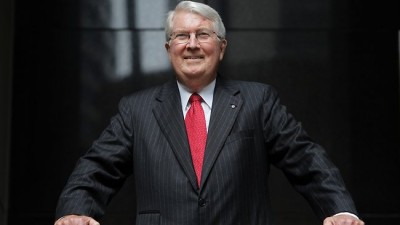
    dick-warburton

    STT thinks the constant reference to Dick Warburton as a “climate-change sceptic” is just churlish bitterness from the vanquished. From STT’s viewpoint, Dick did precisely what he was supposed to do: standing up for Australian power consumers and helping to bring an end to the most costly and pointless piece of policy ever devised.

    And, yet again, the wind industry – and those with shirts to lose when it collapses – trot out the furhpy about “sovereign risk”. Not only is it utter bunkum (see our posts here and here and here and here), harping on about it won’t save the wind industry from the inevitable demolition of the mandatory RET.

    The AFR talks about Australia risking “$11 billion in the renewable energy investment pipeline” as if that were some kind of loss to Australian power consumers, in an already over-supplied market. As we’ve previously pointed out, the threatened “investment” is hardly a “no-strings attached-gift”. The would be investors are after annual gross returns in the order of 20% on that figure – ie, a cool $2.2 billion, every year – which can only be recouped from power consumers through higher power bills – with a fat pile of RECs underwriting the “investment” (see our post here).

    As a piece of friendly advice, we wouldn’t be betting the house on Clive Palmer blocking any changes to the RET in the Senate. Horse trading is the life-blood of politics; and a week can be a very long time for anyone engaged in the political caper. As you’d expect, STT hears that Tony Abbott is already doing business with the Senate’s cross-benchers, including the PUP in order to come up with a workable solution to the debacle that is the mandatory RET, which has utterly failed as a cost-effective CO2 abatement policy.

    Clive Palmer wants an Emissions Trading Scheme (albeit with the price of credits set at zero). So the Coalition’s Direct Action policy is being reworked by top energy market economist, Danny Price in a manner that will not only resemble something like what Clive is after, but in a way that will slash the value of the subsidies to wind power outfits (as promised by the RET) by around 90%. One of the cross-benchers, Nick Xenophon – who works closely with Danny Price – is in on the mission to kill off the wind industry, by introducing some tweaks of his own to Coalition policy, aimed at achieving least-cost CO2 abatement (see our posts here andhere). Another cross-bencher, David Leyonhjelm penned a piece for The Australian today (we’ll cover it shortly) setting out his eagerness to kill the mandatory RET, which he sees as “just government mandated corporate welfare” that will cost power consumers $billions “for no measurable environmental benefit”. No, STT didn’t write David’s article.

    But, in the result, whether or not changes to the mandatory RET occur during the life of this parliament is a matter of passing academic interest. The wind industry is doomed simply because – from here on – NO retailer in touch with their earthly senses will enter a long-term Power Purchase Agreement with a wind power outfit – which means that those desperados still hoping to build wind farms will never obtain the finance needed to do so. Moreover, the REC price is bound to head south over the coming weeks and months, placing outfits with current wind farm operations in mortal financial jeopardy.

    One of those facing an early exit from the stage is our old favourite, Infigen. These boys have just announced an $8.9 million loss for 2013/14, which follows a $55 million loss in 2011/12 and an $80 million loss for 2012/13 (see our posts here and here). Those hefty losses were all racked up at a time when the mandatory RET was set in stone, such that the regulatory cards were all firmly stacked in Infigen’s favour.

    With the mandatory RET set for the chop, Infigen is preparing to emulate its predecessor (Babcock & Brown) with another spectacular financial collapse. Here’s the Australian Financial Review setting the scene for Babcock & Brown Mk II.

    Infigen at risk if RET wound up
    Australian Financial Review
    Angela Macdonald-Smith
    26 August 2014

    Wind power producer Infigen Energy has warned it could fall into breach of its debt covenants within three months should the 2020 Renewable Energy Target be wound back with no compensation for affected investors.

    Managing director Miles George said either of the two outcomes apparently being favoured by the government for the overhaul of the RET would be “disastrous” for both the industry and Infigen.

    He said significant write-downs would follow, with the loss of value for Infigen more than its current market cap of about $185 million.

    The government is thought to be considering two potential outcomes for its RET review, one involving reining the 2020 target back to represent a “real” 20 per cent of electricity use, rather than the 26 per cent to 28 per cent it is currently expected to represent.

    The other involves closing off the scheme to new entrants, while honouring existing contracts only.

    “Either of these scenarios is disastrous for our industry,” Mr George said, after Infigen posted an $8.9 million full-year net loss, affected by the regulatory uncertainty. “They are both death for the renewable energy industry and, to be frank, they are death for Infigen.”

    He said if no compensation was provided for investors, the resulting weakness in the price of large-scale renewable energy certificates would cut cash flow for debt servicing. As a result, Infigen would be at risk of breaching its covenants within three months.
    Australian Financial Review

    This couldn’t be happening to a nicer bunch of lads.

    dirtyrottenscoundrelsoriginal

    Anti-Wind Protesters Take Their Issues, Right to the Pollies!

    Pollies hit spot of turbulence

    THE Premier and Planning Minister walked into an Indian restaurant.

    One was told he “wouldn’t know if his arse was on fire”; the other urged to wear a caricature mask mockingly depicting her own face.

    Anti wind farm protesters made sure Mike Baird and Pru Goward received their message loud and clear at lunchtime on Friday.

    The crowd – made up predominately of members from the Residents Against Jupiter Wind Farm group – used placards, T-shirts, masks, verbal jibes and even a replica turbine to reinforce their point outside the Southern Star Inn.

    Premier Mr Baird and Planning Minister Ms Goward were among those who converged on the Reynolds Street restaurant for a Liberal Party fundraiser.

    Some of the very people protesting out front laid down their signs and strolled into the luncheon – at a cost of $50-a-head.

    They urged Mr Baird and Ms Goward to better consider landowners’ views and ensure consumers were exempt from paying a wind farm excess that benefits operators.

    One protestor pleaded with the government to consider compensation for landholders whose property values have plummeted courtesy of wind farm developments.

    Both the Premier and Planning Minister handled flak diplomatically.

    “Good on you,” Mr Baird said in response to banter that claimed he wouldn’t know if his own backside was alight.

    Ms Goward politely refused to wear one of the many masks indicating the Member for Goulburn was being figuratively gagged by Cabinet.

    “I’m not going to wear myself,” she said.

    Others present at the protest and Liberal Party fundraiser included mayor Geoff Kettle, his neighbouring compatriots John Shaw from Upper Lachlan and Wingecarribee’s Juliet Arkwright, Goulburn Mulwaree councillor Sam Rowland, outspoken anti wind farm campaigner Humphrey Price-Jones, and Christian Democrat candidate from the 2013 federal election, Adrian Van Der Byl.

    The protesters’ motives transcended party politics, Residents Against Jupiter Wind Farm member Michael Crawford said.

    “We’re aiming to get a message across to the government in terms of the resistance here,” he said on Friday.

    “Clearly the Premier is ill-advised in terms of the policy he’s following. It’s harmful to local residents, it’s awful to ordinary citizens who are the consumers of the state and it benefits no-one except the developers.”

    Boro Road property owner Greg Faulkner played recordings of wind turbine noises through loudspeakers on the back of his ute.

    A lack of respect for property owners most affected by the proposed Jupiter Wind Farm, east of Lake George, drove him to act.

    “It takes no account of local residents who live near the developments,” he said.

    “A lot of the people here are committed to renewable power, but we make the distinction between all types of renewable energy and giant wind farms.

    “There’s a world of difference between having some solar panels on your roof and living with 550 wind turbines placed as close as 350 metres from your front door.”

    Tamsin Hanbrook estimates she and her family will lose a potential $440,000 due to the Jupiter Wind Farm project.

    “We owe more than what our place will ever be worth, we can’t sell it,” she said of their Braidwood Road property.

    “The people we were going to exchange contracts with pulled out because of the wind farms.

    “The other block [on the Kings Highway], we’ve been trying to sell it for six months. We can’t sell it for love or money. As soon as people find out about the wind farms, they don’t want a bar of it.”

    The Global Warming Hoax is a Ploy to Push Agenda 21. It’s Got to Stop!

    The Debate is Over!

    Global Warming Fraud Exposed

    al gore climate change

    The first known video promoting the scam of “Man made global warming”  showing

    how they demonized the life gas CO2 and make man earth’s enemy in the process….

    is from 1958!

    Environment was the chosen mechanism to bring about global gov. “They” need

    a global problem that required a global solution… Enjoy some early Al Gore type hype

    from 1958 in this video.

    According to the Club of Rome: “The common enemy of humanity is man. “In searching

    for a common enemy against whom we can unite, we came up with the idea that pollution,

    the threat of global warming, water shortages, famine and the like, would fit the bill.

    “we came up with the idea “

    Not based on any facts! They just came up with the idea.  What is the Club of Rome?

    A think tank created by men and women who want a global communist system that they

    control.  Who are these people? Here is a list of present and notable members from the

    Green Agenda (highly recommended you spend so time on this site) Members include

    David Rockefeller, George Soros, Henry Kissinger, Bill Clinton, Jimmy Carter, Mikhail

    Gorbachev, Kofi Annan, Maurice Strong, Bill Gates, Ted Turner, Tony Blair, Robert Muller,

    The Dalai Lama, Hassan bin Talal, Javier Solana, Javier Perez de Cuellar, Gro Harlem Bruntland,

    Garret Hardin, King Juan Carlos of Spain and his wife Queen Sophia, Queen Beatrix of the

    Netherlands, Prince Philippe of Belgium, and about 80 other wealthy elites, new age cultists,

    former and current U.N. figures, and political figures.

    First earth day 1970

    Stockholm 1972 – United Nations Environment Programme (UNEP)

    The (false) oil crisis of 1973-1974

    United Nations Conference on Human Settlements was held at Vancouver

    from 31 May to 11 June 1976

    Our Common Future 1987

    Rio Earth Summit 1992 which brought the world Agenda 21

    The fraud and deception started long ago and is being implemented by ever level

    and faction of gov. including UN NGO’s

    The fraud is well documented and the peoples of the world need to take action.

    Not to save us from “climate change” but the people who “came up with the idea. 

    They cause the environmental crisis, the wars, famines, depressions etc. 

    They are the enemy, not you and I


    Now for some truth about climate Change.

    The Sea Around Us by Rachel Carson shows the effects of the ocean cycles. 

    Those who constructed the MMGW fraud knew when the natural ocean and sun

    cycles would produce the most natural warming. They used this information for the

    basis of the fraud. Those natural cycles are now moving into the cooling cycle.

    The global warming lie is used to bring about UN corporate world gov. by the same

    people who created the UN, Israel, Wars, Depressions, Famines etc. Their disturbing

    visions are laid out in Agenda 21.

    As the global warming fraudsters like to say “the debate is over.”

    I agree, the debate is over and the fraud exposed!

    Check and Mate!

    – We have now entered the cooling cycle.

    Elected officials (who represent the corporation, not the voters), teachers,

    preachers, media, health etc.  (bow to their corporate masters) and law

    enforcement (Policy enforcers of the corporation)  are  the useful idiots used

    to spread the propaganda and implement “their” evil plan.

    Some know what they are doing …  most don’t. It is our job to inform all of them

    and insist they STOP immediately! They’re involved in fraud, conspiracy to commit, 

    genocide and breach of trust.