The Wind Scam is Much More Financially Detrimental, Than the Windpushers Claimed.

STUDY: WIND FARMS EVEN MORE EXPENSIVE AND POINTLESS THAN YOU THOUGHT

The cost of wind energy is significantly more expensive than its advocates pretend, a new US study has found.

If you believe this chart produced by the US Energy Information Administration (EIA), then onshore wind is one of the cheapest forms of power – more competitive than nuclear, coal or hydro, and a lot more than solar.

EIA_LCOE_AEO2013

But when you take into account the true costs of wind, it’s around 48 per cent more expensive than the industry’s official estimates – according to new research conducted by Utah State University.

“In this study, we refer to the ‘true cost’ of wind as the price tag consumers and society as a whole pay both to purchase wind-generated electricity and to subsidize the wind energy industry through taxes and government debt,” said Ryan Yonk Ph.D., one of the report’s authors and a founder of Strata Policy. “After examining all of these cost factors and carefully reviewing existing cost estimates, we were able to better understand how much higher the cost is for Americans.”

The peer-reviewed report accounted for the following factors:

  • The federal Production Tax Credit (PTC), a crucial subsidy for wind producers, has distorted the energy market by artificially lowering the cost of expensive technologies and directing taxpayer money to the wind industry.
  • States have enacted Renewable Portfolio Standards (RPS) that require utilities to purchase electricity produced from renewable sources, which drives up the cost of electricity for consumers.
  • Because wind resources are often located far from existing transmission lines, expanding the grid is expensive, and the costs are passed on to taxpayers and consumers.
  • Conventional generators must be kept on call as backup to meet demand when wind is unable to do so, driving up the cost of electricity for consumers.

“Innovation is a wonderful thing and renewable energy is no exception. Wind power has experienced tremendous growth since the 1990’s, but it has largely been a response to generous federal subsidies,” Yonk stated.

Among the factors wind advocates fail to acknowledge, the report shows, is the “opportunity cost” of the massive subsidies which taxpayers are forced to provide in order to persuade producers to indulge in this otherwise grotesquely inefficient and largely pointless form of power generation.

In the US this amounts to an annual $5 billion per year in Production Tax Credits (PTC). Here is money that could have been spent on education, healthcare, defence or, indeed, which could have been left in the pockets of taxpayers to spend as they prefer.

Instead it has been squandered on bribing rent-seeking crony-capitalists to carpet the landscape with bat-chomping, bird-slicing eco-crucifixes to produce energy so intermittent that it is often unavailable when needed most (on very hot or very cold days when demand for air-conditioning or heating is high) and only too available on other occasions when a glut means that wind producers actually have to pay utilities to accept their unwanted energy. This phenomenon, known as “negative pricing”, is worthwhile to wind producers because they only get their subsidy credits when they are producing power (whether it is needed or not). But clearly not worthwhile to the people who end up footing the bill: ie taxpayers.

Hence the observation of serial wind energy “investor” Warren Buffett, who says: “We get a tax credit if we build a lot of wind farms. That’s the only reason to build them. They don’t make sense without the tax credit.”

But even this report may underestimate the real costs of wind energy. It doesn’t account for the damage caused to the health of people unfortunate enough to live near wind turbines, as acknowledged officially for the first time in this report produced for the Australian government.

Nor does it account for the environmental blight caused to the landscape – far greater, asChristopher Booker has reported, than that created by the greenies’ bete noire fracking.

When Professor David MacKay stepped down as chief scientific adviser to the Department of Energy and Climate Change (Decc) last year, he produced a report comparing the environmental impact of a fracking site to that of wind farms. Over 25 years, he calculated, a single “shale gas pad” covering five acres, with a drilling rig 85ft high (only needed for less than a year), would produce as much energy as 87 giant wind turbines, covering 5.6 square miles and visible up to 20 miles away. Yet, to the greenies, the first of these, capable of producing energy whenever needed, without a penny of subsidy, is anathema; while the second, producing electricity very unreliably in return for millions of pounds in subsidies, fills them with rapture.

Nor yet does it factor in the epic destruction of avian fauna caused by these supposedly eco-friendly devices. According to Oxford University ecologist Clive Hambler:

Every year in Spain alone — according to research by the conservation group SEO/Birdlife — between 6 and 18 million birds and bats are killed by wind farms. They kill roughly twice as many bats as birds. This breaks down as approximately 110–330 birds per turbine per year and 200–670 bats per year. And these figures may be conservative if you compare them to statistics published in December 2002 by the California Energy Commission: ‘In a summary of avian impacts at wind turbines by Benner et al (1993) bird deaths per turbine per year were as high as 309 in Germany and 895 in Sweden.’

Because wind farms tend to be built on uplands, where there are good thermals, they kill a disproportionate number of raptors. In Australia, the Tasmanian wedge-tailed eagle is threatened with global extinction by wind farms. In north America, wind farms are killing tens of thousands of raptors including golden eagles and America’s national bird, the bald eagle. In Spain, the Egyptian vulture is threatened, as too is the Griffon vulture — 400 of which were killed in one year at Navarra alone. Norwegian wind farms kill over ten white-tailed eagles per year and the population of Smøla has been severely impacted by turbines built against the opposition of ornithologists.

Nor are many other avian species safe. In North America, for example, proposed wind farms on the Great Lakes would kill large numbers of migratory songbirds. In the Atlantic, seabirds such as the Manx Shearwater are threatened. Offshore wind farms are just as bad as onshore ones, posing a growing threat to seabirds and migratory birds, and reducing habitat availability for marine birds (such as common scoter and eider ducks).

In Britain, Chancellor of the Exchequer George Osborne has belatedly acknowledged the problem – which his Prime Minister’s “greenest government ever” helped create – by promising to rein in green energy subsidies.

The cost of subsidising new wind farms is spiralling out of control, government sources have privately warned.

Officials admitted that so-called “green” energy schemes will require a staggering £9 billion a year in subsidies – paid for by customers – by 2020. This is £1.5 billion more than the maximum limit the coalition had originally planned.

The mounting costs will mean every household in the country is forced to pay an estimated £170 a year by the end of the decade to support the renewable electricity schemes that were promoted by the coalition.

But given the damage that has already done to the British landscape by wind turbines it may well be a case of shutting the stable door after the horse has bolted. Especially when you consider that this man has already made £100 million out of the scam and that there are no mechanisms to get any of that wasted money back.

When Bill Gates Says Wind is A Waste of Time, and Money, He Knows What He’s Talking About!

Bill Gates says Subsidies for Wind Power a Pointless Waste: Time to Back Nuclear & R&D on Systems that Can Actually Work

Bill-Gates

****

Gates: Renewable energy can’t do the job. Gov should switch green subsidies into R&D
‘Only way to a positive scenario is innovation’

The Register
Lewis Page
26 Jun 2015

Retired software kingpin and richest man in the world Bill Gates has given his opinion that today’s renewable-energy technologies aren’t a viable solution for reducing CO2 levels, and governments should divert their green subsidies into R&D aimed at better answers.

Gates expressed his views in an interview given to the Financial Timesyesterday, saying that the cost of using current renewables such as solar panels and windfarms to produce all or most power would be “beyond astronomical”. At present very little power comes from renewables: in the UK just 5.2 per cent, the majority of which is dubiously-green biofuel burning1 rather than renewable ‘leccy – and even so, energy bills havesurged and will surge further as a result.

In Bill Gates’ view, the answer is for governments to divert the massive sums of money which are currently funnelled to renewables owners to R&D instead. This would offer a chance of developing low-carbon technologies which actually can keep the lights on in the real world.

“The only way you can get to the very positive scenario is by great innovation,” he told the pink ‘un. “Innovation really does bend the curve.”

Gates says he’ll personally put his money where his mouth is. He’s apparently invested $1bn of his own cash in low-carbon energy R&D already, and “over the next five years, there’s a good chance that will double,” he said.

The ex-software overlord stated that the Guardian’s scheme of everyone refusing to invest in oil and gas companies would have “little impact”. He also poured scorn on another notion oft-touted as a way of making renewable energy more feasible, that of using batteries to store intermittent supplies from solar or wind.

“There’s no battery technology that’s even close to allowing us to take all of our energy from renewables,” he said, pointing out – as we’ve noted on these pages before – that it’s necessary “to deal not only with the 24-hour cycle but also with long periods of time where it’s cloudy and you don’t have sun or you don’t have wind.”

So what are the possible answers, in Gates’ view?

Gates is already well known as a proponent of improved nuclear power tech, and it seems he still is. He mentioned the travelling-wave reactors under development by his firm TerraPower, which are intended to run on depleted uranium stockpiled after use in conventional reactors. He also spoke of methods of using solar power to produce liquid hydrocarbons, which, unlike electricity, can be stored practicably in useful amounts: “one of the few energy storage things that works at scale”, as he put it.

Gates also spoke of the radical plan of high-altitude wind farming using kite-balloons flying high up in the jet stream – though he admitted that that one was something of a long shot.

In Gates’ view, decades from now a few of today’s new-energy companies will have become massive and early investors will have reaped the sort of rewards that he, Paul Allen and Steve Ballmer have from Microsoft. But many others won’t be so lucky.

“Now there’s a tonne of software companies whose names will never be remembered,” he told the FT interviewers.

Analysis

Gates has said a lot of this before. The main new thing is the firm assertion that renewable energy technology as it now is has no chance of powering a reasonably numerous and well-off human race.

This is actually a very simple thing to work out, and just about anybody numerate who thinks about the subject honestly comes to the same conclusion – examples include your correspondent, Google renewables experts, global-warming daddy James Hansen, even your more honest hardline greens (they typically think that the answer is for the human race to become a lot less numerous and well-off).

Unfortunately a lot of people aren’t numerate and/or aren’t honest, so it’s far from sure that the colossal subsidies pumped into today’s useless renewables will get diverted into R&D which could produce something worthwhile.

In the UK at least this would be quite difficult, as the subsidies are not actually subsidies as such – no tax money is paid out to windfarmers and solar-panellists from the Treasury.

Rather, the system works by artificially pumping up the price of ‘leccy and gas and channelling the extra cash – minus various margins for various people involved – to the windfarmers and panel people, such that they get paid vastly more than the market price of the power they produce.

A lot of people – including the government at times – prefer to pretend that this isn’t happening at all: that prices are going up because of the gas market, or corporate profiteering, or something, and that green policy isactually saving people money in some way.

So given that officially nobody is paying any more money and therefore there aren’t any subsidies, they probably can’t be diverted to anywhere. The newly-reelected Chancellor is trying to stop them getting bigger, but he probably won’t manage to seriously reduce them overall, let alone re-purpose them.

Bootnote

1DUKES chapter 1 (pdf page 1) and chapter 6 (pdf page 4)
The Register

turbine collapse 9

The Windfighters in Scotland, are not Easily Duped. Windweasel lies do not pass the muster!

Scots Fight-back as Wind Power Outfit Aims to Thump its ‘Community Message’ Home

bond-jaws-moonraker

****

Remember all those glowing stories about wind power outfits being welcomed into rural communities with open arms? You know, tales about how farmers are dying to have turbines lined up all over their properties? How locals can’t wait to pick up some of the thousands of permanent,high paying jobs on offer? How developers are viewed with the kind of reverence reserved for Royalty?

No?

We’ve forgotten them too.

If such a place ever existed? – it was probably just a case of one too many Single Malts, causing the usual senses to take an unscheduled break.

After years of being lied to, bullied, berated and treated like fools (at best) and “road-kill” (at worst), for most, the ‘gloss’ comprising wind industry PR efforts to ‘win hearts and minds’ has well and truly worn off.

These days, the communities aren’t so gullible; they aren’t so welcoming; and they aren’t willing to take it lying down. Despite having the skills of the best spin doctors in the business at its disposal, it’s “outrage” that’s become the word synonymous with the wind industry, wherever it goes. In short, rural communities have had enough – and they’re fighting back, by fair means and foul:

Angry Wind Farm Victims Pull the Trigger: Turbines Shot-Up in Montana and Victoria

Having lost the battle to ‘shape the debate’ – with soothing words about listening to ‘community concerns’ – wind power outfits are sending in the muscle, instead. Here’s a story from the Highlands on how one wind power outfit’s “Fight Club” inspired PR effort ended.

Drama at Highland windfarm event as man is allegedly assaulted by security staff
The Press and Journal
Jamie McKenzie
24 June 2015

Scots Windfarm

Police were called to a north windfarm exhibition yesterday after a member of the public claimed he was assaulted by security staff brought in to prevent trouble.

The drama unfolded outside Kiltarlity Village Hall, where plans for a 10-turbine scheme went on display for the first time.

Druim Ba Sustainable Energy Ltd (DBSE Ltd) wants to build the devices on the nearby Blairmore Estate.

It is the company’s second attempt to build a windfarm in the area after previous plans were rejected by the Scottish Government in 2013.

People attending the exhibition were shocked to find four employees from a local firm, Castle Security, had been drafted in for one-day event.

And just a few minutes after the display opened, one visitor complained that he had been involved in an altercation with a member of the team.

Cosmo MacKenzie, of Fanblair, Kiltarlity, said the man was “not pleased” and tried to stop him going into the hall.

He claimed he was then shoved as he tried to enter a second and third time.

“I called the police,” he said.

“It’s a distressing way to start the event. I am going in the door and the first thing I come to are security guards preventing people from coming into public property.”

Mr MacKenzie was allowed inside to view the plans after speaking to a security supervisor.

Two police officers arrived a short time later and spent 45 minutes taking statements from him and the staff at the centre of the allegations.

The security workers said they were there to provide “a bit of reassurance and to make people feel more comfortable” after problems at a consultation event for the previous application.

DSBE representatives at the event refused to comment on the windfarm plans or the security presence.

The company’s previous proposals – for 23 turbines – sparked outrage locally and prompted a huge campaign against the development.

Some of those protesters attended the exhibition yesterday.

The new plans involve reducing the size of the windfarm and cutting the height of turbines from 490ft to 415ft.

After viewing the designs, opponents sat at a table and chairs outside the hall and asked others to sign a petition against the development.

Denise Davis, who is leading the local campaign against the scheme, said: “We have been to dozens of exhibitions and have never seen security before.

“The proposal was refused locally by Highland Council and the Scottish Government. How much more of a message do they (DSBE) need? This new proposal is not really an improvement and they are continuing to use old noise monitoring data.”

Fellow campaigner Lyndsey Ward said: “There are more security guards here than there are members of staff inside.

“This is a ridiculous proposal and the community is fully against it.”
The Press and Journal

brave_shield3

Wind Will Never Be More Than “Novelty Energy”. Investors are Waking Up to Reality!

Global Investment Collapses: Investors Wake Up to the Wind Power Delusion

delusion

***

The wind industry is in meltdown around the globe, simply because investors have woken up to the monumental RISKS.

Risks like: – turbines falling apart in less than 2 years; under pressure from voters, governments pulling the plug on the massive subsidies essential to keep the scam rolling; neighbours suing the operators toobtain compensation and/or to have turbines shut down or removed.

In response to these pretty obvious risks, the amount being stumped up by investors to build more of these things has plummeted.

The scam is little more than the latest Ponzi scheme – with Australia’s best and brightest at Union Super Fund backed Pacific Hydro losing $700 million of mum and dad retirement savings; with its parent – IFM Investors – deciding to ditch Pac Hydro and Pac Hydro deciding to ditch its Cape Bridgewater wind farm disaster.

While the wind industry’s parasites and spruikers try hard to pin their woes in Australia on dreaded policy “uncertainty”, the situation in Europe – held up by eco-fascists as the wind power Super Model – is just as dire.

The amount being thrown by investors at wind power has dropped off a cliff; in the UK, with David Cameron’s election win, subsidies have been pulled to a halt and, as an inevitable result, hundreds of threatened projects have been blown to the four winds.

Behind it all is the simple fact that wind power is not, and will never be, a meaningful power generation source. Here’s a solid analysis, that exposes the delusion and details the imminent collapse of the greatest economic and environmental fraud of all time.

The Difficulties Of Powering The Modern World With Renewables
Roger Andrews
10 June 2015
Energy Matters

In the May 12, 2015 “G7 Hamburg Initiative for Sustainable Energy Security”, the energy ministers of Canada, France, Germany, Italy, Japan, the United Kingdom and the United States, plus the European Commissioner for Climate Action and Energy, said this:

An increasing number of countries are following the path of a rapid expansion of renewable energy. There (are) a number of challenges as energy systems change and related greenhouse gas emissions are reduced, one of which is how to integrate growing shares of variable renewable energy into electricity systems.

The G7 energy ministers are correct in their assessment. Integrating growing shares of variable renewable energy into electricity systems is indeed a challenge – and so far one without a good solution.

A few quick facts before proceeding. In 2013 renewables supplied the world with 21.7% of its electricity, according to BP. Take out hydro and they supplied the world with only 5.3% of its electricity. Then take out “other” renewables such as biomass and geothermal and the percentage falls to 3.3%.

Why take out hydro and “others”? Because their growth potential is limited by resource availability – too few good hydro sites, too few high-temperature geothermal fields, not enough wood to make biomass pellets etc. – and for these reasons they may never make a significant contribution to future global energy needs. Their growth performance since 1997, the year the Kyoto Protocol set the renewables bandwagon rolling, has certainly been less than impressive, as illustrated in Figure 1. “Others” have gained market share, but at a painfully slow rate, and hydro has actually lost ground:

1-400

****

Not so, however, for wind and solar, which aren’t resource-limited (the amount of solar energy hitting the earth in a year, for example, vastly exceeds annual global energy consumption). They show rapid growth since 1997, although from small beginnings. Clearly they are the energy sources the world must concentrate on developing if it is ever to “go green”.

And why shouldn’t continued rapid growth in wind and solar allow the world to go green? I’ve discussed the reasons piecemeal before. Here I summarize them all in the same post:

Intermittency

Intermittency, or non-dispatchability, is the Achilles heel of wind and solar. So far it hasn’t caused widespread problems because wind and solar still contribute only a small fraction of total power generation in most countries. Integrating wind power into the UK grid in February 2013, for example, was not difficult because wind only supplied 5% of the UK’s electricity in that month:

2-400

***

But if in February 2013 the UK had had enough installed wind capacity to generate 50% of its electricity from wind Figure 2 would have looked like this:

3-400

***

Now it’s a different ball game. How do we match a generation curve like that to demand, or at least smooth it out to the point where it becomes manageable? There is in fact a way of doing it, but we’ll get to it later. First we will discuss the options that won’t work.

Energy Storage

This is the obvious solution; store intermittent renewable energy during periods of surplus generation and release it during deficit periods. But the only existing technology that can do this at the scale necessary is pumped hydro, and as discussed at length in previous posts here,here and here the amount of pumped hydro storage needed is enormous. At only moderate levels of solar & wind penetration the UK would need several terawatt-hours of storage, maybe as much as a hundred times the capacity of its existing pumped hydro plants, while Europe and the US would need tens of TWh each and the world proportionately more. There is no realistic prospect of bringing this much new pumped hydro – or even conventional hydro, which can also function in an energy-storage mode – into service in the foreseeable future even if enough suitable hydro sites could be found.

The alternative is battery (or flywheel, or compressed air, or thermal) storage. These technologies are so far from deployment on the multi-terawatt-hour scale that they can be discounted. (According toWikipedia total world battery + CAES + flywheel + thermal storage capacity still amounts to only about 12GWh, enough to fill global electricity demand for all of fifteen seconds.)

Another option that’s been mooted as a potential solution to the storage problem is electric vehicle batteries, which can be charged from the grid during periods of generation surplus and discharged back into the grid during periods of deficit. But this option also founders on the rock of scale. Assuming a 100% charge/discharge capability and no energy losses during the charge/discharge process we would still need 12 million 85kWh Teslas (or 42 million 24kWh Nissan Leafs) to get a single terawatt-hour of storage.

Grid Interconnections

It’s frequently assumed that a smart grid covering a large enough area, like the proposed European supergrid, will be able to smooth out local spikes and troughs in renewables generation and provide “reliable electricity” to all. Unfortunately it won’t. Figure 4, reproduced from Wind Blowing Nowhere compares 2013 wind generation in Spain, the largest producer, with combined wind generation in Belgium, the Czech Republic, Denmark, Finland, France, Ireland, Germany, Spain and the UK. Combining wind generation from all nine countries doesn’t flatten out the Spanish spikes or fill in the Spanish troughs. It just moves them around:

4-400

***

What about solar? Seasonal and diurnal variations in solar generation can be smoothed out by combining output from different areas, but the European supergrid would have to link up with New Zealand to do it.

Combining Generation from Different Renewable Sources

It’s also been claimed that because the wind and the sun blow and shine at different times we will get smoother power output when we combine them. That doesn’t work either. Figure 5 re-plots the Figure 2 case with the UK getting 40% of its electricity from wind and 10% from solar instead of 50% from wind. Adding the midday solar spikes, which lead evening peak demand by about five hours in the winter, if anything makes things worse:

5-400

***

Demand-side management

A lot of faith is pinned on the potential of DSM, which instead of matching generation to demand seeks to match demand to generation, or at least to match it as closely as possible. But there’s no way demand could be matched to the generation curves shown in Figures 3 or 5. The best that could be hoped for is an incremental improvement, maybe a flattening of the daily demand curve and/or a reduction in total demand, but the larger problem of how to smooth out bursts of intermittent power into a manageable form would remain unresolved.

And then there’s the great unexploited renewable resource:

Tide Power

It’s predictable, infinitely renewable and has near-unlimited potential. What’s not to like about it? As discussed in the Swansea Bay post (link above), quite a lot. Arguably the best indicator of tide power’s lack of potential, however, is that almost fifty years after the world’s first tide power plant went in at La Rance in France it still supplies less than 0.005% of the world’s electricity.

So if energy storage, supergrids, combining output from different sources, demand-side management and tide power won’t work, what will? Only one thing:

Fossil Fuel Backup

The concept is simple: use load-following fossil fuel capacity – I’m going to assume gas turbines – to generate the electricity needed to meet demand whenever renewable energy can’t generate enough. The approach requires no storage and imposes no theoretical limits on the level of wind & solar penetration, as discussed in How much windpower can the UK grid handle and Wind power and the island of Denmark. Figure 6 illustrates how it would apply to the 50% wind penetration case shown in Figure 2:

6-400

***

Inevitably, however, there are problems. One is that there are times when wind generation exceeds demand and has to be curtailed, and as a result the UK gets only about 47% of its electricity from wind instead of 50% in the above case. Another is the generation curve the gas turbines would have to follow to fill demand when wind generation can’t, which looks like this:

7-400

***

Tracking this erratic generation curve would severely stress the gas turbines (and probably the grid operators too). Wear, tear, downtime and generation costs would all increase, as would fuel consumption because of the constant start-up and shutdown, thereby offsetting some of the CO2 emissions reductions generated by the wind energy.

And that’s with 47% wind penetration. At higher levels the system becomes progressively more inefficient until at 80-90% penetration it’s running at load factors as low as 10% and well over half of the wind generation has to be curtailed (more details in the tables in the How much windpower post linked to above). We can therefore anticipate that this approach will also eventually run up against the hard wall of reality, if only because sooner or later it will occur to someone that it would be a lot easier to keep the dispatchable gas generation and do away with the non-dispatchable wind generation altogether.

But the way things are going there’s a good chance that this point will never be reached. Why? Because of a problem that’s rarely taken into consideration:

Lack of Investment

Every year UNEP publishes a chart of annual global investment in renewable energy, the lion’s share of which (92% in 2014) goes to wind and solar. Here’s the latest version:

8-400

***

Total investment in renewables since 2004 now exceeds $2 trillion – a lot of money, but it’s still far short of what’s needed to stimulate growth to the point where renewable energy, assuming it can be made to work, eventually powers the world. The $232 billion invested in renewables in 2013 was dwarfed by the $1.6 trillion total global energy investment in that year reported by IEA, and of the 235GW of new generation capacity installed globally in 2012 only 76GW was wind or solar, according to EIAand BP. If investments in conventional generation continue to dominate to this extent then wind and solar are doomed to remain also-rans. A very substantial transfer of investment from conventional generation to wind and solar will be needed if they are ever to become the dominant players, but the investment climate needed to achieve this just isn’t there.

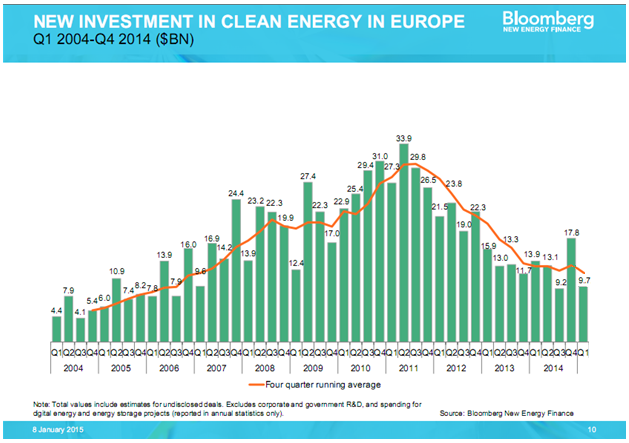
Another question is whether global renewables investment might not already have peaked (as shown in Figure 8, it’s certainly flattened out). Renewables investment is still increasing in the developing countries – notably China – but it’s been essentially flat in the US since 2008 and in Europe it’s been declining since 2011. Europe in particular bears watching because if the decline continues at the rate shown in the Bloomberg New Energy Finance chart below it won’t be long before Europe will have had all the clean energy it’s going to get:

9-400

***

And finally the big problem. Even if the world succeeds in developing wind and solar to the point where they supply 100% of its electricity the job is still less than half-done because electricity supplies the world with only about 40% of its energy. The remaining ~60% comes from the oil, gas and coal consumed in transportation, heating etc. How to decarbonize that? Again no solution is presently in sight.
Energy Matters  

mirror-delusion-deluded

How the Wind Scam Is Destroying Europe’s Economy….Do We want to be Next?

Europe’s Wind Powered Recipe for Economic Disaster

spain unemployment

****

Lessons from Europe: Recipe for a high-cost energy system
Communities Digital News
Steve Goreham
26 May 2015

CHICAGO, May 26, 2015 — While President Obama promotes renewable energy and members of Congress argue about energy policy, a renewable energy disaster is unfolding in Europe. Driven by a desire to halt climate change, Europe has created a high-cost energy system where everyone loses. U.S. policy leaders should learn from the debacle occurring overseas.

European energy policy today is dominated by the European Climate Change Program (ECCP), which was established by the European Community in 2000. The program called for the nations of Europe to adopt measures to cut greenhouse gas emissions. The goal was for Europe to collectively meet the targets of the Kyoto Protocol climate treaty signed in 1997.

The ECCP was based on two assumptions. The first was that changes to national energy systems were needed to fight global warming. Second, that coal, gas and oil fuels would become more expensive, allowing renewable energy to compete. But policies to promote renewables resulted in substantially higher electricity prices for Europe.

Europe used subsidies and mandates to promote renewables. Feed-in tariffs were enacted in most nations, providing a payment to homeowners and businesses for electricity fed into the grid from solar or wind facilities. Governments paid a fixed subsidy of four to 10 times the wholesale electricity price, guaranteed for up to 20 years, for generated electricity.

Electricity from renewables is also granted grid priority. Utilities are required to accept wind and solar-generated electricity as a first priority, regardless of market demand. Output from traditional coal, natural gas and nuclear plants is scaled back or shut down when renewable output is high. Wholesale electricity prices, once driven by market demand, are today dominated by the weather. When the wind blows and the sun shines, large amounts of electricity are dumped onto the grid from wind and solar installations, forcing wholesale electricity prices negative.

Other factors added to the growing debacle. In 2011, Germanyannounced a complete phase-out of nuclear power in the wake of the Fukushima disaster in Japan, closing nuclear power plants and straining the electrical system of Europe’s largest economy. In addition, Germany and France banned hydraulic fracturing, ensuring that European natural gas prices will remain high for the next decade.

The results of Europe’s green energy measures have been bizarre. Feed-in tariffs in Germany stimulated more than one million rooftop solar installations. But Germany is not exactly the sun belt. The latitude of central Germany is the same as that of Calgary, Canada. As a result, German solar installations generate electricity at less than 10 percent of rated output. Over a million solar installations provide only 6 percent of Germany’s electricity and 1 percent of the nation’s energy. For this solar miracle, German citizens are obligated to pay over $400 billion in current and future payments to solar providers through higher electricity rates.

Denmark erected over 5,000 wind turbine towers, one for every thousand Danish citizens. Turbines blanket the nation, providing a beautiful view of a 300- to 500-foot tall tower from almost every house, farm, field, forest and beach. But the turbines produce only 1.3 gigawatts each of electricity on average. All could be replaced by a single large conventional power plant. Today, Denmark has the highest electricity prices of the developed nations.

Europe has created an energy system where everyone loses. Consumers, industry, traditional power plants and even renewable energy companies are now losing. Even though wholesale electricity prices are falling, consumer electricity prices have doubled over the last 10 years due to large subsidy payments to renewable companies. Nations with the largest percentage of renewable energy also have the highest electricity prices.

Citizens of Spain pay 23 eurocents per kilowatt-hour, three times the U.S. price, and citizens of Germany and Denmark pay more than 25 eurocents per kilowatt-hour, four times the U.S. price.

European industrial companies are also big losers. French firms pay more than twice the U.S. electricity rate and German firms pay three times the rate. European industrial electricity rates have risen more than 50 percent since 2007, while U.S. industrial rates have been flat. European firms also pay double the U.S. price for natural gas. European chemical firms are now building plants in America to utilize low-cost ethane from shale fracking, a technology not available in Europe.

Traditional European electrical power companies are losing as well. The wholesale price of electricity is down 50 percent in the last five years and conventional plants can no longer break even. An example is the Irsching high-efficiency natural gas plant in Germany. Built in 2010, it can operate at 60 percent efficiency. But the plant is not profitable as a backup to renewables. In March, the owners announced a shutdown of the plant.

Last year, E.ON, the largest German utility, suffered its first loss in more than 50 years. Both E.ON and Swedish utility Vattenfall have announced plans to exit their conventional power plant business in Germany in favor of renewables. Magnus Hall, president of Vattenfall, stated last year, “It makes it difficult to see how you could invest in conventional generation under these circumstances.”

Finally, even renewable energy companies are now losing. European governments have realized that they can no longer afford the green energy revolution. Subsidies have recently been cut in Belgium, Germany, Greece, Italy, Spain and the United Kingdom. In Germany, solar employment dropped 50 percent and many renewable companies declared bankruptcy. Spain ended its feed-in tariff subsidy and placed a cap on renewable industry profits, resulting in 75,000 lost renewable jobs and a 90 percent reduction in solar installations.

U.S. energy policy makers should learn from Europe’s energy experience and pursue sensible energy economics.

Steve Goreham is executive director of the Climate Science Coalition of America and author of the book The Mad, Mad, Mad World of Climatism: Mankind and Climate Change Mania.
Communities Digital News

economics101

If the Dutch Hate Windmills, They Must Be Useless. Who would know better?

Dutch Quixote: Why the Dutch oppose windmills

Credit:  Wind energy once powered the Netherlands. Not anymore | The Economist | Jul 4th 2015 | www.economist.com ~~

During its 17th-century golden age, the Netherlands was the world’s most enthusiastic exploiter of wind technology. Over 10,000 windmills dotted the landscape; the city walls of Amsterdam were crowned with a row of them. Today many Dutch find the stereotype of their country as the land of windmills irritating—and inaccurate. Wind turbines supplied just 5.2% of the Netherlands’ electricity in 2014, far behind Germany, Spain or Denmark. Renewable sources as a whole make up 4.2% of the country’s energy mix, putting the Netherlands 26th in the European Union, ahead only of Malta and Luxembourg.

That leaves the government in a fix. It has five years to meet an EU-wide mandate to generate 14% of energy from renewable sources. Among other things, it plans to build a lot of new wind turbines. This, however, runs up against the reason why the Netherlands has so few of them: a severe case of not-in-my-backyard syndrome. Almost everywhere new turbines are mooted, locals howl that they will be ugly and noisy. One proposed wind park prompted a group calling itself the Don Quixote Foundation to block a drawbridge on the 32km dike connecting North Holland and Friesland. The far-right Party for Freedom rails against “the sinister green-windmill subsidy complex”.

To minimise local anger, the government has turned to the sea. A national energy accord reached in 2013 calls for new wind parks in the North Sea that could generate 3,450 megawatts, more than triple the country’s current offshore capacity. But these parks are meeting resistance as well. Two of them will be as little as 18km from shore, within sight of beach towns north of The Hague. The town governments say the 200-metre masts will ruin the view and drive away German tourists. They want to push the parks back to an area midway between the Netherlands and Britain. The Dutch government says the more distant site would cost an extra €45m ($50m) per year, in part due to longer cables.

Those costs may be the least of the government’s worries. On June 24th a climate-action group won a suit in a Dutch court arguing that the government’s target for reducing greenhouse gases is not ambitious enough. Current policy would reduce emissions in 2020 to 17% below 1990 levels. But the court ruled that if the world’s governments cut 2020 emissions by anything less than 25%, it will ultimately put Dutch citizens in danger from rising sea levels. Since all governments should meet that 25% reduction, the court reasoned, the Dutch government must do so as well. If the decision is upheld, the government will have to slash emissions even further within five years.

Doing so is not impossible, says Pieter Boot, an economist at the Dutch government’s environmental assessment agency. The agency estimates that if the government fulfills its promises under the 2013 energy accord—which it is not currently on track to do—that could generate half of the necessary reductions. But more renewable energy would also be needed. New wind parks will not be part of the solution, as it would take five years to build them.

Despite the opposition to individual wind parks, polls show that over 70% of Dutch approve of wind energy in principle, a figure similar to Germany. The problem may simply be that the Netherlands is very densely populated; nearly every mast is in someone’s backyard. But other polls show that once turbines are built, local opposition tends to fade. As readers of Don Quixote know, not everyone liked 17th-century windmills either, at first.

Wind-Pushers in Denial, to Avoid Being Held Accountable…Gov’t covers up for them.

Wind farm impact ‘under-assessed’

2 July 2015 by Press Association

The impact of wind farm noise and appearance on residents living nearby is sometimes under-assessed by developers, a report said

Developers are sometimes under-assessing the impact of wind farm noise and appearance on residents living nearby, according to new research.

The two-year study looked at how the visual, shadow flicker and noise impacts predicted by developers at the planning stage of ten wind farms across Scotland compared to the reality once operational.

The test sites included wind farms at Dalswinton in Dumfries and Galloway, Achany in the Highlands, Drone Hill in the Borders, Hadyard Hill in South Ayrshire, Little Raith in Fife and West Knock Farm in Aberdeenshire.

In some cases what was set out in planning applications did not match the actual impact, the research by climate change body ClimateXChange concluded.

It also found that efforts to engage with the public had not always adequately prepared residents for the visual, shadow flicker and noise impacts of a development.

The information was gathered through a combination of residents’ surveys and assessments by professional consultants.

The report said: “T here was a reasonable correspondence between the predicted impacts at application stage and the study team’s assessment of the as-built impacts.

“However, there were some instances in respect of each of the topics where impacts were under-assessed.

“This divergence between objective measurement and experience of impacts was evident from the residents’ survey which captured a range of responses.

“In respect of all three types of impacts considered by the study there were instances where no or limited impacts were predicted by the expert team, but residents reported experiencing adverse impacts.

“This finding points to the difficulties of predicting or assessing experiential responses.

“It is therefore important that the assessment process and subsequent consideration of applications by relevant authorities takes account of this.”

Researchers said this could be achieved through good project siting and design, rigorous impact assessments and improved public engagement.

Project manager Ragne Low said: “As the study has focused on issues relating to the planning process, we are confident that the findings will feed into improved practice in measuring the predicted impacts of proposed wind farms and in communicating this to decision-makers and those likely to be affected.

“The findings point to several possible improvements in planning guidance and good practice.

“Some have been implemented in the time between the case study wind farms being planned and built, and the present. The study will contribute to building on these improvements.”

Linda Holt, spokeswoman for the campaign group S cotland Against Spin, welcomed the findings.

She said: “For too long, people who have complained about wind farms have been dismissed as nimbies and we applaud the energy minister Fergus Ewing for commissioning this work.

“The recommendations show that the planning system is ill-equipped to address potentially adverse impacts on wind farm neighbours and we urge the Scottish Government to lose no time in implementing them.

“For too long, decision-makers on wind farms have been asked to determine applications while blind-folded about the true impacts of placing enormous industrial machines near people’s homes.”

A spokesman for Scottish Renewables said: “This study highlights the high standards of guidance available for those planning an onshore wind farm in Scotland, and we were pleased to see the sector has been putting these into practice.

“The industry has long worked with government and its agencies to put these high standards in place and this report demonstrates how much we have continuously improved, while identifying areas for further improvements for future schemes.”

A Scottish Government spokeswoman said: ” We welcome the publication of the wind farm impacts study report which is the first of its kind in the world and presents the findings of a two-year study involving a wide-range of interest groups.

“The report shows improvements have already been made in our planning system, which is rigorous and ensures appropriate siting of wind farms, and studies like this will make sure this improvement continues, and we look forward to considering the recommendations carefully.

“Our policy on wind farm applications strikes a careful balance between maximizing Scotland’s huge green energy potential and protecting environmental interests and residential amenity.”

Those Wonderful Aussies are at it again!~ Love them! Fighting the Wind Scam!

Senator Bob Day Aims the Blowtorch at the Great Wind Power Fraud

blow-torch_01

****

Bob Day is the Family First Senator for South Australia. He’s one of the good Senators sitting on the Senate’s Inquiry into the great wind power fraud; and he gets it.

Here’s a recent press release from Bob which requires no further introduction or comment from us.

WIND TURBINES NOW FACE OVERDUE SCRUTINY
Wednesday 24 June 2015

Family First Senator for South Australia Bob Day marked the end of the contentious Renewable Energy Target (RET) debate by welcoming new government commitments on wind turbines: “For a long time Family First has been receiving complaints about wind turbines.

When I was elected to the Senate in 2013 it became apparent that something needed to be done about this, so together with a number of Senate crossbenchers, I moved to establish a Senate inquiry. I have been deputy chair of this inquiry which has held hearings all over Australia,” he said.

“In at least fifteen (15) countries around the world, people from all walks of life have come forward complaining about the health impacts of wind turbines – nausea, blurred vision, vertigo, tachycardia, high blood pressure, ear pressure, tinnitus, headache, exacerbated migraine disorders, sleep deprivation, motion sensitivity and inner ear damage.

Many of these people initially welcomed turbines into their area. It has been found that the principal cause of these symptoms is ‘infrasound’ or low frequency noise which is emitted by wind turbines.

People living up to 10 kilometres from turbines have been affected. Acoustics experts, biologists, engineers, farmers, doctors, nurses, sleep experts, pharmacists and others have all come forward from throughout Australia and the world testifying about the impact that wind turbines have had on people’s lives.

Only now are non-English speaking countries finding voice about the impact of turbines in their backyards. Yet the wind turbine industry and its environmental supporters all claim this is either a conspiracy driven by anti-wind activists or it’s all psychological and have at times treated these victims in an offensive, dismissive and uncompassionate fashion.

To add insult to injury, wind turbines have had negative impacts on property values, have driven up power prices, compromised local shire councils and divided what were once friendly & harmonious communities.”

“After receiving evidence from well over 500 people all over the nation so far, the inquiry tabled an interim report which made several recommendations. Key among these were to:

  1. Improve scientific knowledge about the health impacts of wind turbines;
  1. Appoint a wind farm commissioner to provide independent assistance with complaints about wind turbines; and
  1. Ensure the government finance corporation responsible for funding renewable energy will stick to its charter of supporting new technologies rather than established technology like wind.

These measures put the brakes on the out-of-control wind turbine juggernaut so, at last, some oversight, scrutiny and accountability can be imposed on this damaging mass-scale energy experiment.”

“South Australians have been asking for these reforms on wind turbines. I have endeavoured to secure them.”

Senator Bob Day
24 June 2015

Senator Bob Day: determined to bring an end to the madness.

****

Now, while STT feels no need to add to Bob’s solid presentation of plain, old common sense, we’re moved to allow STT Champion, Annie Gardner to respond in terms that can only turn up the heat. As soon as it hit the network, Annie forwarded Bob’s Press Statement to all and sundry among our political betters and journos, along with this pointed missive.

Dear All,

I am forwarding to you all, Senator Bob Day’s recent Press Release, which outlines what the Senators have learnt since the Senate Inquiry into wind farms began hearings on 30th March 2015, in Portland.

To date, I am aware at least seven hearings have been held, with another in Sydney next week, with no doubt more disturbing revelations which have till now been denied, and swept under the carpet.

We thank Senator Day and his Senate Inquiry colleagues very much, for listening to so many rural Australians impacted by acoustic emissions from wind turbines, and for issuing, to begin with, the Interim Report from the Senate Inquiry, and for this Press Release, which really tells the TRUTH about what’s happening to thousands of innocent, hard-working rural Australians, the backbone of this country.

No matter what the outcome of the Senate Inquiry, whether it is acted upon, or deliberately ignored due to close association or direct pressure from the wind industry, the evidence is “out there” that there definitely are health impacts caused by the acoustic emissions from wind turbines.

We seize on Senator Day’s description of wind power as an energy “experiment”.  We have heard wind power described in this manner on several occasions previously, and the impacted families here at Macarthur align this description as an “experiment,” side by side with the Nuremberg code.

We are of the opinion we have been the “guinea pigs” with the “experiment” of AGL’s Macarthur wind energy facility, as have so many other rural Australians been used, in similar situations. Seehttp://waubrafoundation.org.au/resources/video-health-windfarms-experimentation-people/

Googling the Nuremberg Code Section 1, I read as follows –

“The voluntary consent of the human subject is absolutely essential. This means that the person involved should have legal capacity to give consent, should be so situated as to be able to exercise free power of choice, without the intervention of any element of force, fraud, deceit …..”

Section 4 reads –

“The experiment should be so conducted as to avoid all unnecessary physical and mental suffering and injury.”

However, we DID NOT GIVE OUR INFORMED CONSENT to this energy “experiment” at the Macarthur Wind Factory. We had NO CHOICE in the matter.

We request that this experiment ceases IMMEDIATELY and that in particular, as we have requested of AGL hundreds of times to no avail, the wind turbines are TURNED OFF AT NIGHT, so we can sleep, just as Justice Muse ordered in the Falmouth Court case in the USA:

http://waubrafoundation.org.au/resources/falmouth-mass-judge-muse-decision-shut-down-wind-turbines-causing-irreparable-harm/

The Amended Renewable Energy Target passed in the Senate last week will ensure possibly double the amount of wind turbines constructed during the next four years, in order to reach this new target. As a result of this, thousands more rural Australians will be sentenced to a life of pain and suffering (without their consent) particularly as these new turbines will be considerably higher than the monsters here at Macarthur, and have far greater generating capacity, emitting far greater infrasound.

Those persons impacted as a result of this “energy experiment” will suffer ongoing sleep deprivation, as our families suffer constantly. Our sleep deprivation is most likely to increase with the most probable construction (thanks to the new RET deal) of yet another enormous wind farm to the north and east of our properties (Penshurst), literally surrounding our homes and farming properties with 365 monster turbines of at least 3, and possibly 4 megawatts (4 mw turbines never having been used in Australia before).

Sleep deprivation is recognised as TORTURE, by the UN Committee against Torture.

“The Committee against Torture (CAT) has noted that sleep deprivation used for prolonged periods constitutes a breach of the CAT, and is primarily used to break down the will of the detainee. Sleep deprivation can cause impaired memory and cognitive functioning, decreased short term memory, speech impairment, hallucinations, psychosis, lowered immunity, headaches, high blood pressure, cardiovascular disease, stress, anxiety and depression.”

The truth is emerging ….. countries such as the United Kingdom and Germany realise this and are taking action, whilst Australia is foolishly forging ahead with the very damaging Amended Renewable Energy Target, despite being warned ….. the consequences will be disastrous, both physically and financially, opening the door for what would appear to be, inevitable litigation.

Ann Gardner

Annie Gardner

Institute for Energy Research Tells the Truth About Renewables…

One more time–fossil fuel based (coal fired) energy is the most affordable/efficient and it is clean

You say could evil coal be clean enough–well it is.

And there is no air pollution risk that justifies the economic and human welfare damage that attaches to stupid renewables.

Nuke, Hydro, gas fired, coal in rank for emissions.

For affordable the ranks are hydro, coal, gas fired coal, gas, then the silly renewables like biomass, wind, with solar a dead last.

http://instituteforenergyresearch.org/wp-content/uploads/2015/06/ier_lcoe_2015.pdf

The Beginning of the End….For the Corrupt Wind Industry!!

Scots Go on the Offensive: Wind Power Outfits to be Sued & Wind Farms Shut Down Using Independent Noise Data

brave_shield3

****

As we pointed out in this recent post, the Scots are a tenacious bunch of lads and lassies:

Subsidies Scrapped: Scots Rejoice at Wind Industry’s Demise – Time for a Wee Highland Fling

Delighted with David Cameron’s win – which heralds the demise of the wind industry in the UK – Highlanders have turned their claymores on the calamity presently existing.

Thousands of bat-chomping, bird slicing, blade-chucking, pyrotechnic,sonic-torture devices have been speared across Scotland – destroying the ability of Scots to live in, use and otherwise enjoy their humble homes. Now, Scots are all set to turn the tables on their wind weasel tormentors – their weapon of choice: noise numbers.

Here’s a wee report from The Press and Journal on the Scots’ latest, and final, offensive.

Noise data new weapon in war on windfarms
The Press and Journal
Iain Ramage
22 June 2015

Protesters in the north are warning windfarm operators that some schemes could be shut down for breaching noise limits.

Highland activists are preparing to follow the lead of counterparts in England and Ireland who have collated extensive data they say proves that planning conditions have been flouted at a number of windfarms.

Campaigners in the north believe similar gauging of the industry in Scotland could open the floodgates for legal action against offending operators.

Sound estimates are usually carried out by developers as part of the groundwork for planning applications to give an indication of anticipated noise levels.

But there is currently no obligation to carry out monitoring once a scheme is built — at which stage councils merely respond to individual complaints about noise.

Residents living near a turbine development in Cambridgeshire have compiled what is thought to be the most comprehensive sound history of any UK windfarm.

Monitoring has taken place over two-and-a-half years, using industry-standard recording equipment to reveal what they claim have been regular breaches at the Cottonfarm scheme at Gravely.

Highland campaigners have seen the equipment operate and now plan to instal similar devices in the north. Bev Gray, 71, who worked in renewable energy before retiring, stopped holidaying in Scotland due to the spread of windfarms.

As an adviser to a residents’ group, he claims his local wind scheme – Cotton farm – is “one of the noisiest in the world”, based on data he gleaned by installing a £16,000 machine to measure the decibel output.

Residents there now want the equipment installed at every windfarm, at the owners’ expense, as part of planning conditions.

Mr Gray said: “Developer data is never tested because it’s always taken as being accurate.

“From a month’s worth of monitoring they take a minute’s worth of the lowest noise level to produce a figure.

“It’s part of the smoke and mirrors of an illusion that allows them to build windfarms close to homes.”

The Cotton farm scheme was taken over by a City of London investment group.

Spokesman Tom Rayner said: “Greencoat UK Wind has worked with the local environmental health officer to monitor noise levels and will continue to do so as required.”

Mr Gray said his data had been taken on board by the local authorities in south Cambridgeshire and would allow people to use “accurate information” as a basis for legal action.

“We’re gradually bringing the wind industry to account,” he said.

“At the moment they can do what the hell they like. Nobody can prove them wrong because the authorities aren’t monitoring things.”

Prominent Highland anti-windfarm campaigner Lyndsey Ward, from Beauly near Inverness, has visited Cambridge and Ireland to witness communities’ monitoring of various schemes. She said the move was prompted by plans tabled by ABO Wind for a turbine scheme at Allt Carach, south-west of Beauly.

She said: “The potential devastation on our lives from ABO Wind’s proposed 25-turbine development has forced us to research the noise issue in more depth.

“Our home would have the prevailing wind in direct line from the turbines. This is not just for us, but for others across Scotland.

“Sleep deprivation can lead to more serious illnesses. Why there’s no legislation to compel developers to constantly monitor their operations beggars belief.”

Tom Harrison, project manager with Inverness-based ABO Wind UK, said: “Allt Carach is still under investigation, therefore its planning submission is uncertain. We would always comply with any noise legislation or planning condition set by the relevant planning authority.

“Should a community have concerns over noise, after consultation with that relevant community, a decision as to whether noise monitoring equipment is required would be considered.”

On the plus side: Complaints ‘will be investigated’ and projects get ‘rigorous’ checks

Highland Council said last night it would investigate any complaints about noise levels at turbine developments.

An industry body insisted all projects were subjected to “rigorous” examination at the planning stage. A spokesman for the local authority said: “We seek to ensure that noise levels at a particular house nearby any turbine does not exceed minimum levels.

“Where there is a complaint this is investigated and, if necessary, a resolution sought to any breach of planning condition.”

Joss Blamire, of trade body Scottish Renewables, said: “All wind energy projects in Scotland go through a rigorous planning process that assesses the noise impacts of developments. Only those with acceptable impacts will be consented.”

Huntingdon District Council in Cambridgeshire plans to measure noise levels at Cottonfarm Windfarm after receiving a flood of complaints from residents in surrounding villages. The decision was prompted by evidence recorded by equipment installed by residents.

Locals argue the 413ft tall turbines were built too close to homes.

The sound of the turbines has been likened to that of an aircraft or helicopter in flight.
The Press and Journal

Before we turn to the tenacity and temerity of our Scottish brothers and sisters, we can’t help but notice the drivel pitched up by wind weasel advocate, Joss Blamire, where he blurbs about wind farm operations satisfying “rigourous planning processes”.

While it’s possible to refer to any “planning process” as “rigourous”, STT thinks that, in the general, we’re dealing in matters of degree, rather than absolutes. But when the benchmarks have been written by the applicant’s own team, the concept of “rigour” disappears, absolutely.

The wind industry has known about the debilitating impacts of incessant turbine generated low-frequency noise and infrasound for 30 years – getting its own to write noise ‘standards’ that deliberately excluded low-frequency noise and infrasound – allowing it to spear turbines within a stone’s throw of homes, and to run them around-the-clock:

Three Decades of Wind Industry Deception: A Chronology of a Global Conspiracy of Silence and Subterfuge

And, in that time, the wind industry has spent $millions pumping up pet acoustic consultants to lie, deceive and otherwise obfuscate the obvious – incessant night-time industrial noise kills a neighbour’s ability to sleep, which is itself an adverse health effect:

SA Farmers Paid $1 Million to Host 19 Turbines Tell Senate they “Would Never Do it Again” due to “Unbearable” Sleep-Destroying Noise

Sleep Deprivation the Most Common Adverse Health Effect Caused by Wind Turbine Noise

Wind Turbine Noise Deprives Farmers and Truckers of Essential Sleep & Creates Unnecessary Danger for All

Much easier to jump the hurdle, when you get to set the height of the bar.

Now to the Highlanders’ offensive.

With the rollout of more giant fans at an end, the Scots can now concentrate their forces on crushing their enemy where it stands. So much easier to destroy your adversary when the size of its force can no longer grow; its ‘supply’ lines have been cut; and it can no longer be reinforced.

In this battle, the good and righteous have always been outgunned: done in by political patsies, greased up by the beneficiaries of an endless stream of subsidies doled out by them. Now, however, the political tide has turned; the subsidies have been pulled to a halt; and the leeches have lost their subsidy-succour.

In their weakened state, wind power outfits will make easy prey for a group of dedicated, clever and rightly angry people.

When the malign and callous are called to account, their victims hold the choice between outright vengeance and mercy. The balance exercised depends on just how merciless were their antagonists when they held the whip hand.

In this case, it will only be the grace and inherent goodness of those whose lives have been wantonly destroyed that favours any kind of mercy.

Litigation is inevitable; compensation too. Injunctions will be granted and enforced – turbines will be shut down or removed.

Highlanders – like hard-pressed rural communities around the globe – have well and truly had enough.

Defence has turned to attack; outright victory is within reach. Wherever you are, no matter how dark the horizon seems, follow the Scots’ lead – keep fighting for what is rightfully yours. Never surrender.

Robert Browning pitched it right in Prospice: “For sudden the worst turns the best to the brave,”

winston-churchill-quotes