Wind Turbine Fires Much More Common Than Previously Thought.

Wind turbine fire risk: Number that catch alight each year is ten times higher than the industry admits

  • Nearly 120 turbines catch fire each year – the reported industry figure is 12
  • Fire is second-largest cause of accidents after blade failure, research shows
  • Figures compiled by Imperial College and University of Edinburgh engineers

Nearly 120 wind turbines catch fire each year, according to new research – ten times the number reported by the industry.

The figures, compiled by engineers at Imperial College London and the University of Edinburgh, make fire the second-largest cause of accidents after blade failure.

The researchers claim that out of 200,000 turbines around the world, 117 fires take place annually – far more than the 12 reported by wind farm companies.

Scroll down for video

Engineers at Imperial College London and the University of Edinburgh say 120 wind turbines catch fire each year. Here, a turbine in Ardrossan, North Ayrshire, catches fire during severe weather

Engineers at Imperial College London and the University of Edinburgh say 120 wind turbines catch fire each year. Here, a turbine in Ardrossan, North Ayrshire, catches fire during severe weather

Fire has a huge financial impact on the industry, the researchers report in the journal Fire Safety Science.

Each wind turbine costs more than £2 million and generates an estimated income of more than £500,000 per year.

Any loss or downtime of these valuable assets makes the industry less viable and productive.

Dr Guillermo Rein of Imperial’s department of mechanical engineering, said: ‘Fires are a problem for the industry, impacting on energy production, economic output and emitting toxic fumes.

‘This could cast a shadow over the industry’s green credentials.

‘Worryingly our report shows that fire may be a bigger problem than what is currently reported. Our research outlines a number of strategies that can be adopted by the industry to make these turbines safer and more fire resistant in the future.’

Wind turbines catch fire because highly flammable materials such as hydraulic oil and plastics are in close proximity to machinery and electrical wires.

These can ignite a fire if they overheat or are faulty. Lots of oxygen, in the form of high winds, can quickly fan a fire inside a turbine, the paper found.

Wind turbine explodes

It contradicts the findings of a report into the wind industry, commissioned by the Health and Safety Executive in 2013, which concluded that the safety risks associated with wind turbines are very low.

The wind industry last night questioned the validity of the new research.

Chris Streatfeild, of Renewable UK which represents wind firms, said: ‘The industry would challenge a number of the assumptions made in the report, including the questionable reliability of the data sources and a failure to understand the safety and integrity standards for fire safety that are standard practice in any large wind turbine.

‘Wind turbines are designed to international standards to meet mandatory health and safety standards including fire safety risks.

‘The industry remains committed to promoting a safe environment for its workers and the public, and no member of the public has ever been injured by a wind turbine in the UK.

Read more: http://www.dailymail.co.uk/news/article-2695266/Wind-turbine-fire-risk-Number-catch-alight-year-ten-times-higher-industry-admits.html#ixzz3boBgvPZu

Windscam….Just a matter of Time, Before it Implodes….Which Country Gets Smart First?

Greg Hunt Delivers Coalition’s Political Suicide Manifesto: Liberals Lock-In $46 Billion Power Tax as Wind Industry Rescue Package

hunt macfarlane

****

The wind industry in Australia is doomed.

Australia’s commercial lending institutions know it (calling in their loans and refusing to lend for any new wind farms). And the wind industry knows it – hence the big players’ frantic efforts to ditch their wind farms, cut and run – although these fire sales are as much a product of their bankers’ refusal to extend credit (see our post here).

The big power retailers know it (see our post here).

And, from the panic exhibited in Canberra, every Federal MP knows it too (see our post here).

However, in an effort to Keep Up Appearances, wind industry front man, young Gregory Hunt delivered a speech last week that not only defies reality, it almost defies measured description (we’ll do our best in a moment).

WARNING: The speech comes with a public health warning: readers gifted with a modicum of knowledge of Australia’s energy market and/or commonsense are likely to experience sensations such as skin crawling; skin rashes; high blood pressure; and nausea.

These sensations will not arise by reason of some “nocebo” effect: the greater the reader’s understanding of the debacle that is the Large-Scale Renewable Energy Target and the great wind power fraud, the more severe these effects will be. Accordingly, we suggest securing a suitably sized bucket, clean towels and some iced water before passing this point. You have been WARNED.

COMMONWEALTH OF AUSTRALIA
House of Representatives
Hansard
WEDNESDAY, 27 MAY 2015

Renewable Energy (Electricity) Amendment Bill 2015

First Reading

Bill—by leave—and explanatory memorandum presented by Mr Hunt.

Bill read a first time.

Second Reading

Mr HUNT (Flinders—Minister for the Environment) (09:12): I move:

That this bill be now read a second time.

The Renewable Energy (Electricity) Amendment Bill 2015 will implement changes to the Renewable Energy Target to better reflect market conditions and allow sustainable growth in both small- and large-scale renewable energy.

The bill will lead to more than 23½ per cent of Australia’s electricity being sourced from renewable energy by 2020—not 20 per cent but 23½ per cent.

It also addresses problems which emerged more than three years ago with the Renewable Energy Target. Despite the presence of the 41,000 gigawatt-hour target, it was unlikely that it would be met.

First, there was a significant drop in electricity demand which occurred following the global financial crisis and it coincided with the closure of energy-intensive manufacturing plants. Together, they played havoc with wholesale electricity prices.

This was compounded by rising retail electricity costs associated with the carbon tax, network charges and feed-in tariffs resulting in households and industry changing their consumption patterns.

Second, the changes to the Renewable Energy Target introduced by the Rudd government and the subsequent creation of the phantom credit bank of what is currently 23 million certificates is still being felt today. This overhang continues to suppress demand for renewable energy certificates and stymie the signing of power purchase agreements.

These combined to make it increasingly difficult for renewable energy projects to attract finance.

Added to this, the increasing realisation that new subsidised capacity was being forced into an oversupplied electricity market made it likely that financial institutions would be approaching the new investments in the renewable energy space with significant caution and reluctance.

It is in this context that we have sought to place the Renewable Energy Target on a sustainable footing and to overcome the legacy of the problems created by the phantom credit scandal.

So this then brings me to the fact that the Renewable Energy (Electricity) Amendment Bill 2015 amends the Renewable Energy (Electricity) Act 2000 to:

adjust the large-scale renewable energy target (LRET) to 33,000 gigawatt hours in 2020. This will reflect a commitment to achieve approximately 23½ per cent of electricity from all renewable sources by 2020;

increase the partial exemptions for all emissions-intensive trade-exposed activities to full exemptions. This will be of particular importance to trade-exposed industries throughout the country, as recognised by the opposition and as in particular has been championed by many members such as the members for Bass, Braddon, Lyons, Wannon and Corangamite;

reinstate biomass from native forest wood waste as an eligible source of renewable energy; and

remove the requirement for Labor’s legislated biennial reviews of the RET.

These changes will ensure that there is continued support for sustainable growth in the large scale renewable sector. And, the 33,000 target, I repeat, is higher in its ultimate effect than the originally conceived objective of 20 per cent, which was the purpose, the intended outcome and the stated objective of the original legislation.

There will be no changes to the Small-scale Renewable Energy Scheme. The scheme will continue in line with household and small business demand.

The removal of Labor’s phantom credit scheme federally and the rationalization of feed-in-tariffs at the state level have reduced many of the distortions outlined in this week’s Grattan Institute report. I am delighted that this bill is proceeding in a bipartisan fashion.

Key features of the revised Renewable Energy Target

The Large Scale Renewable Energy Target

This then leads me to the fact that the bill will adjust the large-scale renewable energy target, or LRET, to reflect the 23½ per cent target. We will therefore adjust the LRET from 41,000 gigawatt hours in 2020 to 33,000 gigawatt hours in 2020. It will adjust the profile of annual renewable generation targets from 2016 to 2030 so that the target reaches 33,000 gigawatts in 2020 and is maintained at 33,000 gigawatt hours per annum from 2021 to 2030. This target is separate to the 850 gigawatt hours that is to come from waste coalmine gas generation each year until 2020 under pre-existing transitional arrangements previously agreed between the parties.

As highlighted in our energy white paper released by the Minister for Industry, Australia has an over-supply of generation capacity and some of that is aged. From 2009-10 to 2013-14, electricity demand has fallen by approximately 1.7 per cent per year on average.

This is due to many factors: sadly, declining activity in the industrial sector; increasing energy efficiency, which is a positive for Australia; and strong growth in rooftop solar PV systems, which is also a benefit for Australia, which does, however, reduce demand for electricity sourced from the grid.

While the Government welcomes a diverse energy mix in Australia, it also recognises that circumstances have changed since the original target of 41,000 gigawatt hours was set in order to achieve what had been hoped would be a 20 per cent outcome.

This new target of 33,000 gigawatt hours directly addresses these issues and gives the industry an opportunity to grow. It represents a sound balance between the need to continue to diversify Australia’s portfolio of electricity generation assets, the need to encourage investment in renewables while also responding to market conditions, the need to reduce emissions in the electricity sector in a cost-effective way, and the need to keep electricity prices down for consumers.

Most importantly, this new target of 33,000 gigawatt hours by 2020 is achievable. It will require in the order of six gigawatts of new renewable electricity generation capacity to be installed between now and 2020.

Even at the adjusted level of 33,000 gigawatt hours, the renewable sector will have to build as much new capacity, on the advice that I have, in the next five years as it has built in the previous fifteen. This will not be an easy task, but, on all the advice we have, it is achievable and therefore real construction will occur.

This new target will therefore be good for jobs in the renewable energy sector and, as I have said, lift the proportion of Australia’s electricity generation to approximately 23½ per cent by 2020.

Assistance to emissions-intensive trade-exposed industries

When the RET scheme was expanded in 2010, partial exemptions were introduced for electricity used in emissions-intensive trade-exposed activities. These were hard-fought and negotiated by the coalition. The exemptions only apply to the additional RET costs that were incurred as a result of the expansion of the scheme.

The RET scheme regulations currently prescribe that electricity used in activities defined as highly emissions intensive and trade exposed is exempted at a 90 per cent rate, and electricity used in activities defined as moderately emissions intensive and trade exposed is exempted at a 60 per cent rate.

This bill will increase support for all emissions-intensive trade-exposed activities to full exemptions from all RET costs—that is, from the costs of the original target as well as the costs of the expanded target. A full exemption will protect jobs in these industries and ensure they remain competitive. This has been of particular concern, as I mentioned earlier, to the members for Bass, Braddon, Lyons, Wannon and Corangamite—each of whom has played an extremely important role in securing this agreement between the parties.

The reduction in the direct costs of the RET resulting from the lower large-scale renewable energy target will more than offset the impact on other electricity users of the increase in assistance for emissions-intensive trade-exposed activities.

Reinstating biomass from native forest wood waste as an eligible source of renewable energy Native forest wood waste was in place as an eligible source of renewable energy under Labor’s own legislation until November 2011.

The use of such native forest wood waste for the sole or primary purpose of generating renewable electricity has never been eligible to create certificates under the scheme. Eligibility was subject to several conditions, including that it must be harvested primarily for a purpose other than energy production. This is about the use of wood waste; it is not about cutting down biomass to burn.

Consistent with our election commitment, as was set out in our forestry policy on the first page and further within the policy, this bill reinstates native forest wood waste as an eligible source of renewable energy under the RET, basing eligibility on exactly the same conditions—precisely the same conditions—as were previously in place under the ALP when they were in government.

One of the objectives of the RET is to support additional renewable generation that is ecologically sustainable. We are reinstating, therefore, the provision allowing native forest wood waste as an eligible renewable energy source, because there is no evidence that its eligibility leads to unsustainable practices or has a negative impact on Australia’s biodiversity. This was the experience of the 10 years during which this provision was in place.

We believe that the safeguards that were in place previously were, and are still, sufficient assurance that native forest wood waste is harvested and used in a sustainable way. The regulations were underpinned by ecologically sustainable forest management principles which provide a means for balancing the economic, social and environmental outcomes from publicly owned forests.

In all cases, the supply of such wood waste is subject to the Commonwealth and state or territory planning and environmental approval processes, either within, or separate to, the regional forest agreement frameworks.

Using wood waste for generation is more beneficial to the environment than burning the waste alone on the forest floor or simply allowing it to decompose and to produce methane—a greenhouse gas with very high global warming potential. Its inclusion as an eligible energy source is another contribution to the target.

We understand that regular reviews of policy settings create uncertainty for investors, business and consumers. That is why this bill removes the requirement for two-yearly reviews of the RET. Providing policy certainty is crucial to attracting investment, protecting jobs, and encouraging economic growth.

Protecting electricity consumers, particularly households, from any extra costs related to the RET, has been a priority from the start and the government understands that the 33,000 gigawatt-hour target remains a challenge for industry.

For these reasons, instead of the reviews, the Clean Energy Regulator will prepare an annual statement on the progress of the RET scheme towards meeting the new targets and the impact it is having on household electricity bills.

Again, this bill is about appropriately balancing different priorities; replacing the biennial reviews with regular status updates better meets the needs of industry and the needs of consumers, and any concerns within the parliament. It is about increased transparency at the same time as increased certainty.

Importantly, both the government and the opposition have agreed to work cooperatively on a bipartisan basis to resolve any issues which may arise with the operation of the Renewable Energy Target through to 2020. Against that background I do wish to thank many people, beginning with the opposition. We have negotiated in good faith with Mark Butler, Gary Gray and Chris Bowen. I particularly thank my opposite, the shadow minister for the environment, Mark Butler, and his staff for their work. These negotiations can be difficult but I believe both sides conducted an honourable process, and this was an example of the parliament operating as a parliament for an outcome which will be, ultimately, beneficial to Australia. So I acknowledge and appreciate the work of my colleagues on the opposite side of the chamber.

I want to thank my colleagues, in particular: Ian Macfarlane, whose knowledge of the electricity is peerless, not just within the parliament but arguably almost anywhere within Australia; the Prime Minister who, himself, proposed the compromise and suggested the notion of the Clear Energy Regulator providing the annual outdates—it was an important breakthrough and step forward and he engaged deeply in this process and was always seeking a balanced outcome; as I have mentioned, my colleagues Dan Tehan, Sarah Henderson, Eric Hutchinson, Andrew Nikolic and Brett Whiteley; and Angus Taylor, whose knowledge of the electricity sector and whose concerns for his electors were absolutely vital in helping us to achieve this outcome. He is a very informed individual and the parliament benefits from having another Rhodes Scholar enter this chamber.

From within the Department of the Environment, David Parker and Brad Archer played a critical role throughout the review process. I thank Lyndall Hoitink and John Jende—whose knowledge of the Renewable Energy Act and the implications are extraordinary. Mark Scott, Candice El-Asmar, Kieran McCormack and Peter Nicholas all played critical roles.

From the Clean Energy Regulator I thank Chloe Monroe, who performed an extraordinary role in executing the first Emissions Reduction Fund auction and also provided invaluable advice. She and her team are outstanding policy professionals. Although appointed by a previous government, we have proudly and happily continued her role. As far as I am concerned, she is invited to stay in the job for as long as she wishes to do it. She is really one of the great public servants in Australia. Similarly, she is supported by people such as Mark Williamson and Amar Rathore, both of whom have done a great job.

At the Office of Parliamentary Counsel I thank Iain McMillan and his staff. From others who have contributed significantly there is Jessi Foran from Ian Macfarlane’s office. From within industry Miles George, as chair of the Clean Energy Council, and Kane Thornton, CEO of the Clean Energy Council, were indefatigable and fundamental in pressing the concerns and needs of their sector. This deal would not have been achieved without their work, and I honour and acknowledge it.

Similarly, Miles Prosser, from the Aluminium Council; Innes Willox, from the Australian Industry Group; and Kate Carnell and John Osborn, from the Australian Chamber of Commerce and Industry, all played critical roles in helping to bring us to this point.

Finally, I want to acknowledge two people from my office: my chief of staff, Wendy Black, whose counsel and guidance on every topic is really outstanding; and Patrick Gibbons, who is my senior adviser and whose knowledge of the electricity sector is surpassed only by that of Ian Macfarlane, who has spent hundreds and hundreds of hours helping to bridge the gaps between different parties. Again, this would not have been possible without him.

To all of those parties I say thank you. Let me conclude by saying this: this bill is consistent with the government’s conviction that policy decisions must be based on sound economic principles and real-world experience. It also represents the government’s commitment to maintain stable and predictable settings that encourage growth, encourage competitiveness, encourage efficiency and that produce better outcomes for electricity consumers.

The RET had to be reformed in response to changing circumstances. This bill achieves balanced reform. It will provide certainty to industry, encourage further investment in renewable energy and better reflect market conditions. It will also help Australia reach its emissions targets, and it will protect jobs and consumer interests.

As the energy white paper points out, Australia has world-class solar, wind and geothermal resources, and very good potential across a range of other renewable energy sources. In addition to the support for small- and large-scale renewables, which this bill provides, the government is providing over $1 billion towards the research, development and demonstration of renewable energy projects.

This bill recognises that renewable energy is an important part of Australia’s future, while also recognising that its deployment must be supported in a responsible way with minimal disruption to our energy markets. I thank all of those involved in reaching this point. I am delighted that we have achieved a sensible balance which will allow the industry to grow to 23½ per cent of Australia’s total energy production by 2020.

I commend the bill to the House.

Debate adjourned.

Hansard, 27 May 2015

Where to begin?

Before we do, please note, we cannot rule out the possibility that the speech was in fact written in its entirety by the lunatics from the Greens. It is so far to the hard-green-left that it is unrecognisable as a statement purportedly emanating from a so-called Conservative government.

Stomach churning content aside, perhaps we’ll start with a take on young Gregory’s “style” and “themes”.

miss world

****

The gushing delivery reminds STT of the gorgeous Venezuelan gal who bags the Miss World title and who, on cue, reacts with welled-upped eyes, and hands-to-face (faux) surprise.

Brushing away an alloy of tears and top-quality mascara, the winner hits us with her suitably ambitious manifesto. Starting with her wish list of an end to hunger; world peace; an end to disease and so on, the soon-to-be Hollywood starlet thanks all those that got her to the winner’s podium, from her personal trainer, her publicist, right down to her hairdresser.

Of course, young Greg’s speech didn’t go so far. However, as to plausible realisation, Greg’s manifesto is on precisely the same footing.

No-one in their right mind expects Miss World to follow through on her promise to save the world from hunger and disease etc.

Likewise, there is absolutely no way that Greg’s ultimate annual 33,000 GWh LRET will be satisfied by the “due date” of 2020, or at all.

Greg knows it; and so does everybody on his seemingly endless thank you list.

For those new to this site, STT is all about smacking people with the reality that wind power is meaningless as a power source, because it can only ever be delivered at crazy, random intervals. In the absence of mandated fines on retailers and/or whopping subsidies to wind power outfits, the wind industry simply would not exist. The claim that wind power is “clean” and “green” is nothing more than a cynical marketing ploy; and a cruel hoax played on the gullible and naïve.

The politicians who support wind power have simply devoured the lies and myths spouted by the wind industry and fall into 2 camps:

  1. those who are simply “pig” ignorant; or
  1. little piggies with their trotters in the wind scam trough

Most of the line up on Greg’s “thank you list” have been in the game long enough to know precisely what’s going on, which tends to rule out their inclusion in the first category above.

The inclusion of energy market lightweights, and economic illiterates, from the ranks of the Coalition – such as Disappointing Dan Tehan, Sarah Henderson, Eric Hutchison, Andrew Nikolic and Brett Whiteley is no surprise (none of them have the foggiest clue about the cost or operation of the LRET, the impact of Power Purchase Agreements on retail power prices, dispatch prices, grid stability etc, etc).

Dimwits in politics are a dime-a-dozen; and this won’t be the first time that elected representatives chimed in with support for a policy that they haven’t got the faintest understanding of.

And glad to see young Greg outing all those who STT readers have always placed in the second category above:

The wind industry’s plants and stooges within Hunt and Macfarlane’s offices, like Patrick Gibbons (who’s best mates with Vesta’s former front man, Ken McAlpine). As well as wind industry shills like Chloe Monroe (and her gang from the CER).

And the boys from the so-called Clean Energy Council, Miles George (who conveniently heads up Infigen – cutting down on lobbying time and costs) and head wind industry spin-master, Kane Thornton. Reports that Kane slept on a camp stretcher in Greg Hunt’s office during the weeks of negotiations cannot be confirmed.

What can be confirmed is that the Clean Energy Regulator (a statutory authority paid for entirely by taxpayers) has been shovelling tens of thousands of dollars into the coffers of the Clean Energy Council (a lobbying outfit set up – and meant to be fully paid for – by wind power outfits). During Senate estimates last week, Chloe Monroe conceded that the CER and the CEC are singing from precisely the same hymn sheet; and that the CER is stumping up taxpayers’ cash to help them do so:

Ms Munro: There was one question that we just took on notice which I think I can now answer. It was about the cost of our subscription to the Clean Energy Council and our membership there. For the current financial year it is $14,520. I might just mention that we regard that as an important membership to have because of the very significant role the Clean Energy Council plays in disseminating information to its membership which assists with the overall regulatory performance of the industry. Also, as a member, we do not exercise our right to vote, for example, so we do not play any part in the decision making of the Clean Energy Council, for example, in the recent elections for the chair of the council. We would not take any part in that. We are very much at arm’s length from that.

Hmmm … unfortunately for Chloe, her efforts to distance herself from the tens of $thousands thrown by the CER at the wind industry’s spin-masters, fell flat with her special mention in Greg Hunt’s thank you list, right next to Miles George and Kane Thornton.

While the shills from the CER, CEC, Infigen & Co were obvious among those Hunt was bound to thank (although, as their very existence depends on Hunt’s efforts to save the LRET, they should all be thanking him) the inclusion of the PM, Tony Abbott and Angus “the Enforcer” Taylor on Hunt’s little list is a bridge way too far.

Angus Taylor

****

STT hears that Angus Taylor is close to furious about the manner in which Hunt and Macfarlane double-crossed their party on the terms of the LRET deal with Labor – and he’s not alone – STT hears that the PM is less than amused, too.

Leading up to the deal, both Hunt and Macfarlane were under strict instructions to maintain the provision in the Renewable Energy (Electricity) Act 2000 (section 162) that provides that reviews of the mandatory RET must take place every two years; taking into account the cost and benefits of any recommendation made, as part of the review.

Their colleagues, from the PM down, understood that the retention of two yearly reviews was a ‘deal breaker’. However, as evidenced in Hunt’s political suicide manifesto above, Hunt and Macfarlane ‘caved in’ (under the slightest ‘pressure’ from their wind industry mates); much to the disgust and horror of the majority of their party colleagues.

The two yearly reviews were understood by all those in the Coalition giving licence to Hunt and Macfarlane to cut a deal with Labor, to be a critical mechanism available to pull a halt to the runaway costs of the LRET, in general; and the ludicrous costs of wind power, in particular.

The review process was set up to allow the government of the day to act on recommendations; such as scrapping the LRET in its entirety; or to deny RECs to wind power outfits, simply because the demonstrated and extraordinary costs of wind power (the key beneficiary of the LRET) completely outweighs any of its purported benefits.

STT fully expects Angus Taylor (among others) to set the cat amongst the pigeons this week, by challenging Hunt and Macfarlane on their backdoor deal to drop the two yearly reviews, at the wind industry’s behest, among other things.

Double-dealing aside, there’s also the small matter of substance. The Coalition (the combination of the Liberals and the Nationals) is purportedly made up of conservative, pro-business, small government types. Their core constituency will be less than impressed to learn that Hunt and those on his “thank you list” have set them up with a $46 billion electricity tax: half of which will be directed to wind power outfits – like near-bankrupt Infigen (aka Babcock and Brown); with the balance being recovered as a $65 per MWh fine (aka “the shortfall charge”) – and directed to general revenue (ie a ‘stealth tax’):

Out to Save their Wind Industry Mates, Macfarlane & Hunt Lock-in $46 billion LRET Retail Power Tax

Hunt, Macfarlane and the CER have given a “guarantee” to the PM that wind power outfits will easily build the capacity needed to generate the extra 17,000 GWh required to satisfy the ultimate annual 33,000 GWh target (thus avoiding the politically toxic penalty set under the LRET). However, that little “promise” is, again, more like Miss World’s promise to achieve world peace: something that everyone with a hint of common sense considers as pure nonsense.

The other furphy being pitched by Hunt, Macca and the CER is that – provided the shortfall charge is avoided – the LRET carries absolutely no cost to power consumers at all (see the post above). However, if that were the case, why was Greg so pleased to announce that Energy Intensive Industries will be exempt from “all RET costs”?

So which is it Greg? Is the LRET a family and small business ‘friendly’, that’s as cheap as chips and a guaranteed vote winner? Or is the effort to protect the Aluminium sector etc a dead-set giveaway, that – at $3 billion a year – the LRET is the largest, single electricity tax ever cooked up?

It’s going to Penalty

STT hears that the finance sector has absolutely no intention of providing any money to build new wind power capacity. The expectation is that RECs will, in the longer term, trade in the order of $30, at which price wind power outfits will not break even, placing lenders at enormous and perfectly avoidable RISK (see our post here).

STT hears that the major retailers are of the same view.

Greg Hunt talks about “the phantom credit bank of what is currently 23 million [REC] certificates” – what’s called the “overhang”.

Retailers, such as Origin, hold the bulk of those certificates and will be able to use them to avoid the shortfall charge, until they run out. That means that there is no need for them to enter long-term Power Purchase Agreements with wind power outfits to obtain RECs, for some time. One scenario involves those holding RECs simply hanging on to them until the penalty set by the LRET kicks in, such that they can cash them in at prices over $90 (many were purchased at $20 or less).

STT also hears that the major retailers have no interest in wind power at all: remember, that commercial retailers have not entered PPAs with wind power outfits since November 2012.

output vs demand

****

As we’ve pointed out (just once or twice) wind power can only ever be delivered at crazy, random intervals (if at all); and is usually generated late at night, or very early in the morning, when there is little demand for power. The only reason retailers sign up to purchase wind power, is to obtain the RECs that come with the deal – power that can never be delivered on demand, is of no commercial value, otherwise.

Solar power, on the other hand, is available almost every day during daylight hours and is, therefore, capable of satisfying demand, as it rises during the daytime.

STT hears that the big retailers are planning to wait until they look like exhausting the pile of RECs that they’re sitting on at present, at which point they’ll build some large-scale solar power facilities, in order to obtain the RECs needed to avoid the shortfall charge.

The retailers still believe that the politics of the LRET are inherently toxic; which will lead to its inevitable implosion (hence the belief that REC’s will end up at less than $30). By investing in a few solar panels, these boys will avoid the impact of the LRET penalty, in the short term. And, once the LRET implodes, they will be able to sell those panels for re-use by householders in domestic situations.

And the implosion of the LRET is as inevitable as death and taxes.

So, if you run into young Gregory, be the first to congratulate him on his speech.

It’ll be the one that comes back to bite him and his team as the LRET disaster unfolds; power prices go through the roof; and householders and businesses realise that a government that they elected on a promise to scrap the Labor/Green Alliance’s business and economy destroying – and family punishing – “carbon” tax, set them up to pay for the most ridiculously generous corporate welfare scheme in the history of the Commonwealth. And all because Hunt and Macfarlane’s wind industry mates wanted it that way.

dumb 3

This Is A Good Start, But World-Wide Reforms Needed!

Robson: Good winds blowing

Credit:  By Frank Robson, Guest Columnist | The Journal Record | May 29, 2015 | journalrecord.com ~~

I applaud the Oklahoma Legislature and Gov. Mary Fallin for implementing much-needed reform of the wind industry, addressing both excessive subsidies and lack of regulation for protection of property owners. The progress made this year is important in establishing a regulatory framework. Yet there is still work to do.

Senate Bill 808 by state Sen. Brian Bingman, R-Sapulpa, and Rep. Earl Sears, R-Bartlesville, signed by Fallin on April 17, established a 1.5-nautical-mile setback of wind turbines from schools, airports and hospitals and provides a stronger decommissioning statute that protects landowners and taxpayers from being financially responsible for taking down turbines at the end of their life. The legislation also requires notification to landowners at least six months before construction begins.

The new law doesn’t take into consideration protection of wind turbines from homes, neighborhoods, public parks and other land where natural habitat may be disturbed. We hope the Legislature will consider the need for further requirements that address reasonable restrictions on the placement of wind turbines near other areas of public safety concern.

Senate Bill 498 by state Sen. Mike Mazzei, R-Tulsa, and Sears, signed May 20, repeals the ability of the wind industry to qualify for a five-year property tax exemption. This provides a good start in addressing the magnitude of industrial wind’s subsidies and negative impact on Oklahoma’s budget.

Senate Bill 502 by state Sen. Marty Quinn, R-Claremore, and Sears, signed May 20, repeals the ability of the wind industry to qualify for the new jobs investment tax credit effective Jan. 1, 2017. This eliminates an unnecessary and potentially costly subsidy for an industry that creates few jobs here.

Wind developers may still qualify for zero-emission tax credits, which amount to $5 per megawatt-hour for all electricity produced from industrial wind facilities for 10 years. The current law saddles Oklahoma taxpayers with this burden for all wind facilities built prior to Jan. 1, 2021. Payment of subsidies under this program may extend until Dec. 31, 2030.

We look forward to continued forthright discussions with state leadership regarding the need for further safety regulations, and the need to evaluate the legitimacy of the remaining subsidies available to industrial wind. Let’s continue to make progress for the betterment of Oklahoma.

Frank Robson is a member of the Oklahoma Property Rights Association.

More Reasons To Stop the Wind Turbines!

Wind Turbine Noise Causes Greater Prairie Chicken Run

chicken run

****

Ardman Animation’s Chicken Run is a rollicking remake of WWII POW breakout favourite, The Great Escape. The tale takes place in the ‘Stalag’ of Tweedy’s Farm – minus the machine gun towers and jackboots – and comes with a feathery twist; and from a feminist perspective.

Ginger, along with her band of intrepid inmates – and a little swashbuckling help from her beau, Rocky the Rhode Island Red, plots an early exit to avoid Mrs Tweedy’s dreaded pie-maker.

In their efforts to avoid a date with a dismal destiny (and gallons of gravy) the hens crack on and build an improbable flying contraption, designed to vault the barbed wire and spirit them to freedom.

All hopes are pinned on Fowler – an ageing rooster with military pretensions, who tuts, struts and sounds every bit the RAF officer he claims to be. But when the time comes to fly the coop, Fowler’s anticipated prowess as pilot is found wanting:

Ginger: But you’re supposed to be up there – you’re the pilot.

Fowler: Don’t be ridiculous. I can’t fly this contraption.

Ginger: Back in your day? The Royal Air Force?

Fowler: 644 Squadron, Poultry Division – we were the mascots.

Ginger: You mean you never actually *flew* the plane?

Fowler: Good heavens, no! I’m a chicken! The Royal Air Force doesn’t let chickens behind the controls of a complex aircraft.

Needless to say, the ladies’ pluck, dash and derring-do prevails on Fowler, who faster that you can say “tally-ho, chocks away”, has the clumsy-craft airborne, on its way to exodus, and all on-board flying like poultry in motion.

chicken run plane

****

Now, to another story of chickens out to escape their tormentors – not malevolent manufacturers with automated pie-machines – this time it’s Greater Prairie Chickens fleeing the sonic torture of giant fans speared into the hills of Kansas.

Vulnerable grassland birds abandon mating sites near wind turbines
environmentalresearchweb
May 7, 2015

Shifting to renewable energy sources has been widely touted as one of the best ways to fight climate change, but even renewable energy can have a downside, as in the case of wind turbines’ effects on bird populations.

In a new paper in The Condor: Ornithological Applications, a group of researchers demonstrate the impact that one wind energy development in Kansas has had on Greater Prairie-Chickens (Tympanuchus cupido) breeding in the area.

Virginia Winder of Benedictine College, Andrew Gregory of Bowling Green State University, Lance McNew of Montana State University, and Brett Sandercock of Kansas State University monitored prairie-chicken leks, or mating sites, before and after turbine construction and found that leks within eight kilometers of turbines were more likely to be abandoned.

Leks are sites at which male prairie-chickens gather each spring to perform mating displays and attract females. The researchers visited 23 leks during the five-year study to observe how many male birds were present and to record the body mass of trapped males.

After wind turbine construction, they found an increased rate of lek abandonment at sites within eight kilometers of the turbines as well as a slight decrease in male body mass. Lek abandonment was also more likely at sites where there were seven or fewer males and at sites located in agricultural fields instead of natural grasslands.

This paper is the latest in a series of studies on the effects of wind energy development on prairie-chickens. “To me, what is most interesting about our results is that we are now able to start putting different pieces of our larger project together to better understand the response of Greater Prairie-Chickens to wind energy development at our field site,” says study co-author Virginia Winder. “We have found that both male and female prairie-chickens have negative behavioral responses to wind energy development.

The data we collected to monitor this response have also allowed us new insights into the ecology of this species. For example, lek persistence at our study site depended not only on distance to turbine, but also male numbers and habitat.”

The findings of this study reinforce the U.S. Fish and Wildlife Service recommendation that no new wind energy development should be done within an eight-kilometer buffer around active lek sites. “It is critical to have rigorous evaluations of direct and indirect effects of wind energy facilities on species such as prairie-chickens,” according to grassland wildlife management expert Larkin Powell, who was not involved with the research. “The potential for trade-offs between renewable energy and wildlife populations on the landscape is one of the key questions of our day.”
environmentalresearchweb

The full paper is available here:http://www.aoucospubs.org/doi/full/10.1650/CONDOR-14-98.1

turbines giant

****

Sure, it’s possible that these plucky little Kansan ground dwellers aren’t happy with the impact on the aesthetics of their neighbourhood, from hundreds of whirling wonders towering over 160m in height.

However, the fact that these birds have voted with their feet – abandoning their nesting sites within 8 km of the turbines – and, after 5 years, still refuse to return to them – suggests that their distaste isn’t driven by disdain for the hideous look of these things.

That birds – unused to communicating in English – should take flight in order to avoid the daily torment thrown up by these things suggests forces at work way beyond the wind industry’s favoured “nocebo” defence.

The Prairie Chicken’s self-imposed 8 km turbine exclusion zone has an eerily familiar ring to it. It’s the same sort of distance from turbines that has humans – living within that range – troubled by incessant infrasound invading their homes, causing sleep disturbance and otherwise annoying the hell out of them (unless they too, like the Prairie Chickens of Kansas, haven’t already left their homes for good).

At Waterloo in South Australia, Professor Colin Hansen and his team from Adelaide University found turbine generated low-frequency noise and infrasound annoying families in homes out to 8.7 km from turbines:

“Unscheduled” Wind Farm Shut-Down Shows Low-Frequency Noise Impact at Waterloo, SA

While it could be that Greater Prairie Chickens have cut and run from wind turbines because they’re “climate denying, anti-wind, wing-nuts”; or that they’re part of a BIG COAL backed conspiracy, the more plausible explanation is that these feathered little fellas just can’t stand incessant turbine generated low-frequency noise and infrasound.

No doubt the wind industry, its parasites and spruikers will invent some tale in an effort to explain the great Prairie Chicken Run. In the meantime, wherever fans get speared, it’s every chicken for themselves.

Greater_Prairie-Chickens

Tom Harris Fights for the Right to 2nd Opinions, Re: The Climate Change Debate!

Citizens’ Climate Lobby founder must rein in overaggressive volunteers

Posted: 28 May 2015

By Tom Harris
In my December 29, 2014 Augusta Free Press article, “Taming the climate debate”, I wrote about the importance of working to establish a social climate in which “leaders in science, engineering, economics, and public policy” can “contribute to the [climate change] debate without fear of retribution.”

At stake are trillions of dollars, countless jobs, the security of our energy supply, and, if people like Citizens’ Climate Lobby (CCL) founder and president, Marshall Saunders, are right, the fate of the global environment itself.

So, it is a tragedy that, because the debate is now riddled with censorship, personal attacks, and even death threats, many experts are afraid to comment publicly. Saunders should consider whether the behaviour of some of his CCL volunteers is exacerbating this problem.
In describing their “Methodology,” CCL assert on their Website that they “believe in respect for all viewpoints, even for those who would oppose us.” In his September 20, 2014 article, “Speaking Truth to Power – and to Friends,” former NASA scientist and now CCL Advisory Board Member Dr. James Hansen writes, “Founder Marshall Saunders espouses respect and love for political opponents of a carbon fee…”
In that light, let’s examine how some CCL volunteers have behaved when faced with opponents of their belief that human emissions of greenhouse gases are causing a climate crisis.
My interactions with the group started in late 2012 when CCL (Canada) spokesperson Cheryl McNamara had the following letter to the editor published in the Vancouver Sun in response to my December 26 article, ”Ottawa must get real on climate change”:
Readers Get Real About Climate Change, Vancouver Sun, December 28, 2012

Any self-respecting newspaper would not seriously consider printing an opinion piece by
someone who claimed smoking isn’t harmful to human health. The evidence on human-
caused climate change is clear, too. Tom Harris is funded by the oil industry and denies what 97 per cent of climate scientists confirm: greenhouse gases are contributing to our warming planet. The irony is that Harris also worked with the APCO, an independent communications consultancy which tried to advance the idea that tobacco isn’t harmful to human health.

Cheryl McNamara, Toronto
The points made in McNamara’s letter are completely false.
  • I have always opposed smoking; both my grandfather and aunt died miserable deaths due to smoking excessively. As an airworthiness engineer at Transport Canada, I contributed to getting smoking banned on long haul flights in our country. We found that aircraft air filters would become plugged, so pilots were exposed to so much second hand smoke that their visual acuity was significantly reduced, presenting a flight safety hazard, especially at night. My engineering peers would laugh to see me now accused of helping the tobacco industry.
  • I have never been “funded by the oil industry.”
  • I have never denied that “greenhouse gases are contributing to our warming planet.”
  • My employment with APCO had nothing to do with tobacco and I only heard about their supposed promotion of “the idea that tobacco isn’t harmful to human health” after I left the company in 2006.
CCL had made similar erroneous charges against me earlier in the year in the Edmonton Journal which I ignored. However, since the falsehoods were continuing even though they were provably wrong, I notified the Vancouver Sun about the problem. They agreed with my corrections and took the CCL letter off their site and the original URL no longer functions.
Despite my requests to representatives within both the Canadian and American CCL that they remove the offending letter from their site in their list of media triumphs, they would not. How does this fit with Saunders’ goal of “respect and love” for opponents?
This sort of thing has continued ever since, CCL representatives repeatedly attacking me with erroneous and irrelevant charges when I disagree with their stance on climate science. A recent example was CCL’s Pete Kuntz’s May 23 letter to the editor of the Union-Bulletin in Walla Walla, Washington. Kuntz is listed as writing from Northglenn, Colorado.
Besides the usual CCL accusations of ICSC receiving funding from vested interests, Kuntz wrote “Harris is a lobbyist for the fossil fuel industry.”
A quick check of the Website of the Office of the Commissioner of Lobbying of Canada shows that I am not now, nor have I ever been, a lobbyist for anyone, let alone “the fossil fuel industry.” We consider lobbying mostly a waste of time until the public better understand the science, which is why we concentrate on public education.
Kuntz also repeated CCL’s old chestnut about my supposed pro-tobacco work: “Harris used to work for Big Tobacco back in the day when it was denying smoking causes lung cancer, fake ‘doctors’ and all (DeSmog Blog).”
I never respond in kind but simply make appropriate factual corrections when possible. But it isn’t long before CCL personal repeat their bogus claims in other media outlets.
So I was not surprised to see Kuntz’s May 25 Augusta Free Press piece “Climate change denial is a scam,” this time identifying himself as hailing from Lancaster, Pennsylvania. He repeated CCL’s tall tales about my pro-tobacco work as well as ICSC’s supposed funding sources, something he could not possibly know since the identities of those who help ICSC cover its operating expenses have been confidential since I started as Executive Director in 2008.
The suggestion that my opinion is for sale is, of course, seriously offensive, and begs the question: how does this fulfil Saunders’ goal of “respect and love” for opponents?
It does not matter who funds us. All that matters is whether what we are saying is correct or not, a point we are happy to debate with anyone. If funding sources did matter, then we note that most climate scientists are employed by organizations that promote the hypothesis of dangerous anthropogenic (man-made) global warming (DAGW). These researchers obviously have a direct interest in supporting their employers’ point of view.
Perhaps most ironic in Kuntz’s Free Press piece is his criticism that I and Bryan Leyland, my co-author, are not scientists but are engineers. He does not seem to know that engineering is applied science and requires a good understanding of science and applied mathematics. With both Leyland (MSC—Power Systems) and myself (MEng—thermofluids) having advanced degrees and having spent many years studying climate science and computer modelling, we are quite capable of commenting meaningfully on the evidence for and against DAGW.
But qualifications do not prove anyone right. All that counts is the validity of what is being said. For instance, before being trained by Al Gore in 2007, Saunders’ professional career was in real estate brokerage specializing in shopping center development and leasing. Yet we never criticize him for lacking a background in the field because, once again, the accuracy of his comments is all that matters.
Kuntz directs readers to a site critical of the second year climate science course I gave to 1,500 students at Carleton University in Ottawa. He fails to mention that both the course originator and current instructor, Earth Sciences professor Tim Patterson, and I have debunked the critique as hopelessly naïve and misleading. I even went on TV (see here) to respond to the attack.
In defense of his position on the science, Kuntz proclaims, “Every climate scientist publishing in peer-reviewed science journals worldwide agrees.” Nonsense. The Nongovernmental International Panel on Climate Change reports list hundreds of peer-reviewed papers published in the world’s leading science journals that either question or refute the DAGW hypothesis that CCL holds dear.
Kuntz concludes by directing readers to the CCL Website, saying, “They’ve got a realistic plan.” Like many of CCL’s published letters, there is no mention of his affiliation with CCL.
Kuntz and McNamara are just two examples of CCL spokespeople who seem to ignore the respectful approach advocated by their founder. Saunders will soon have an ideal platform from which to remind them that their passionate belief in their cause does not give them license to abuse opponents. From June 21—23, one thousand CCL volunteers gather in Washington DC to “hear from inspiring speakers, receive lobby training and go to Capitol Hill to meet with members of Congress.” Let’s hope CCL’s president and founder uses the opportunity to rein in overly aggressive members of his team.
Tom Harris is Executive Director of the Ottawa, Canada-based International Climate Science Coalition (www.ClimateScienceInternational.org).

The Greed Energy Scam is Crippling Germany!

German Government In Crisis Over Escalating Cost Of Climate Policy

European Power Plants Face Widespread Bankruptcies

An aerial view shows Vattenfall's Jaenschwalde brown coal power station near Cottbus, eastern Germany August 8, 2010. Photo: Reuters/Fabrizio Bensch

Germany’s economics minister Sigmar Gabriel (SPD) wants to levy penalty payments onto coal plants if they produce CO2 emissions above a certain threshold. Against this plan intense resistance is growing in Germany: Within the Christian Democrat, within industry and – for especially dangerous for Gabriel – within the trade unions. The Christian Democrats (CDU) in particular are taking on Gabriel’s climate levy. And Merkel is allowing her party colleagues to assail him. Armin Laschet, the vice chairman of the Federal CDU, is accusing Gabriel of breaking the coalition agreement.  –Jochen Gaugele , Martin Greive , Claudia Kade, Die Welt, 25 May 2015

The transition to renewable power generation is accelerating closures of coal and gas-fired power generation plants at a quicker rate than expected. According to UBS, policymakers may have to take measures to prevent widespread bankruptcies in the European electricity market. That’s the conclusions drawn by investment bank UBS, who have produced a report on the subject. According to their data, some 70 GW of coal and gas-fired power generation shut-downs have occurred in the last five years, and the pace is increasing, according to the analysis. –Diarmaid Williams, Power Engineering International, 11 May 2015

The world’s richest nations are unlikely to reach a deal to phase out subsidies for coal exports at talks in June, reducing the chances of a new global climate change agreement at a U.N. conference in Paris, officials and campaigners say. One European Union official, speaking on condition of anonymity, said the EU hoped to “nudge forwards” the debate, but that within the EU, Germany was an obstacle, while Japan was the main opponent in the OECD as a whole. –Barbara Lewis and Susanna Twidale, Reuters, 27 May 2015

To many western environmentalists, who are determined to see a binding global deal to reduce greenhouse gas emissions at the UN climate change conference in Paris later this year, India’s rising coal use is anathema. However, across a broad range of Delhi politicians and policymakers there is near unanimity. There is, they say, simply no possibility that at this stage in its development India will agree to any form of emissions cap, let alone a cut. — David Rose, The Guardian, 27 May 2015

The idea that India can set targets in Paris is completely ridiculous and unrealistic. It will not happen. This is a difficult concept for eco-fundamentalists, and I say this as a guy who is considered in India to be very green. Copenhagen failed because of climate evangelism. I was sitting for days with Gordon Brown, Ed Miliband, Angela Merkel, Barack Obama and Sarkozy. It was absolutely bizarre. It failed because of an excess of evangelical zeal, of which Brown was the chief proponent. Even with the most aggressive strategy on nuclear, wind, hydro and solar, coal will still provide 55% of electricity consumption by 2030, which means coal consumption will be 2.5 or three times higher than at present. –Jairam Ramesh, India’s former environment minister, The Guardian, 27 May 2015

Wind Turbines – Unaffordable, Unreliable, Novelty Energy!

The Obscene, Hidden Costs of Wind Power

Facts

****

True costs of wind electricity
Planning Engineer and Rud Istvan
12 May 2015
Climate Etc. 

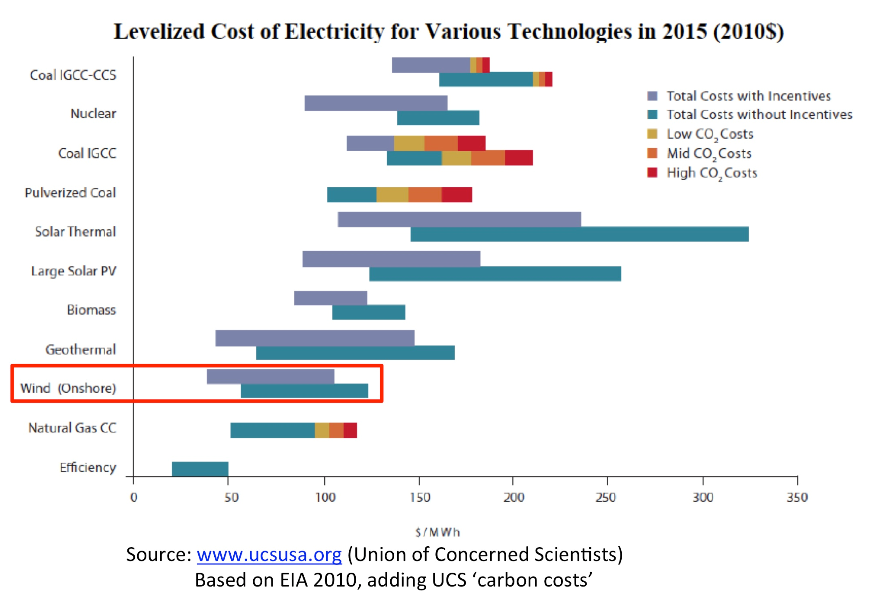
Wind turbines have become a familiar sight in many countries as a favorite CAGW mitigation means. Since at least 2010, the US Energy Information Agency (EIA) has been assuring NGOs and the public that wind would be cost competitive by now, all things considered. Many pro-wind organizations claim wind is cost competitive today. But is it? [if any of the graphs below look fuzzy, click on them and they’ll pop up clear as crystal in a new window]

Curry1-400

Yet incentives originally intended only to help start the wind industry continue to be provided everywhere. This fact suggests wind is not competitive with conventional fossil fuel generation. How big might the wind cost gap be? Will it ever close? We explore these questions in four sections: incentives, lifetime cost of electricity generation (LCOE), system costs, and market distortions. We examine onshore wind, since EIA says offshore is almost 3x more expensive. For simplicity, we examine EIA national averages, rather than regional ranges.

Incentives

The main US federal incentive is the wind Production Tax Credit (PTC), created by the Energy Policy Act of 1992. It is now $21.50/MWh for the first ten years of generation. It was intended to jumpstart the industry, so has expired via sunset provisions several times over the past 23 years. Each time, US wind investment promptly collapsed. Each time, Congress promptly renewed PTC at the same or higher incentive rates. Why? At Berkshire Hathaway’s (BH) 2014 annual meeting (BH’s Iowa based electric utility MidAmerican Energy has $5.6 billion invested in wind generation) Warren Buffet said:

“I will do anything that is basically covered by the law to reduce Berkshire’s tax rate. For example, on wind energy, we get a tax credit if we build a lot of wind farms. That’s the only reason to build them. They don’t make sense without the tax credit.” [1]

Curry2-400

U.S. Congressman Lamar Smith asked the Congressional Budget Office to estimate PTC’s 2013 cost (as part of that year’s reinstitution debate): the 2013 cost was $13 billion.

Iowa has enacted an additional state PTC of $10/MWh. Buffet gets a total PTC of $31.5/MWh from both federal and Iowa taxpayers. YE2014, BH’s MidAmerican Energy, had 2953MW of Iowa wind capacity. Warren Buffet wind farms are receiving $253 million of annual tax credit from Iowa wind generation on an investment of $5.6 billion (2953 MW * 0.31CF * 8766 hr/year *$31.5/MWh). BH’s effective tax rate last year was 31%. Those wind credits are equivalent to earning (253/0.31) $816 million on his $5.6 billion wind investment—a 15% return before any operating profit from selling electricity. That is a good deal for the Nebraska billionaire, but not for the rest of us.

The EIA estimates wind costs five years in the future. Since 2010, each cost estimate has had a separate entry for subsidies. Each estimate since 2012 (for 2017) has zero wind subsidies. EIA assumes the PTC expires (it has yet again YE2014). The Obama administration is proposing it be made permanent, with strong support from the AWEA (American Wind Energy Association). This suggests EIA’s estimated wind costs are too low, and partly political rather than mostly factual. How much is shown by closer examination of their other cost components.

LCOE

The most recent ‘official’ EIA estimates are available in Table 1 of EIA’s Annual Energy Outlook 2015, Electricity Generation Forecasts. The EIA explains:

Levelized cost of electricity (LCOE) is often cited as a convenient summary measure of the overall competiveness of different generating technologies. It represents the per-kilowatthour cost (in real dollars) of building and operating a generating plant over an assumed financial life and duty cycle. Key inputs to calculating LCOE include capital costs, fuel costs, fixed and variable operations and maintenance (O&M) costs, financing costs, and an assumed utilization rate for each plant type. The importance of the factors varies among the technologies. For technologies such as solar andwind generation that have no fuel costs and relatively small variable O&M costs, LCOE changes in rough proportion to the estimated capital cost of generation capacity.

EIA’s LCOE is the annualized net present value (aka annual annuity cost). The estimate is always 5 years into the future. That is why their 2010 estimate above was only verifiable in 2015.

EIA calculates LCOE as the sum of five components: Capital, Fixed O&M, Variable O&M (including fuel), Transmission (incremental), and Subsidies (none). Capital costs are spread over a 30-year life at an interest rate of 6.5%. This appears superficially reasonable, but as we show below, isn’t. Following are the basic LCOE generation comparisons in $/MWh and capacity factor (CF) %, from the EIA AEO 2012 and 2014.

CF% ($2017) ($2019)
CCGT 87 66.1 66.3
Conv. Coal 85 97.7 95.6
Wind 35 96.0 80.3
GT (peaker) 30 127.9 128.4

Three things stand out. Combined cycle gas turbine (CCGT) costs are cheaper than coal. That makes directional sense; in the US CCGT is gaining share at the expense of coal. CCGT cost advantages include: (a) better net thermal efficiency (61% versus 41% for USC coal), (b) abundant inexpensive natural gas thanks to fracked shale, and (c) cheaper capacity. It takes three years to build a CCGT for about $1000-1250/kw. USC coal takes 4 years to build for about $2850/kw.[2] Peak load gas turbine (GT) capacity only costs about $750/kw, but its LCOE is twice CCGT because its capital is under utilized–only operating 30% of the time. Finally, EIA says wind is competitive with coal and will become more so (about 20% more in just three years!).

‘True’ wind LCOE is understated since the PTC is missing. The annuity value of $21.5/MWH for 10 years at 6.5% interest, annuitized over 30 years is $7.2/MWh. A ‘truer’ comparison to coal is (96+7) ~$103/MWh from the general taxpayer perspective, rather than from Warren Buffet’s.

This unsurprising result just shows the PTC was intended to make wind ‘grid competitive’, and seems to do so—at taxpayer expense. That is why investment collapses toward zero in its absence. There are, however, two further ‘obvious’ plus two additional ‘hidden in the fine print’ issues with the EIA LCOE comparisons that are equally consequential, and similarly biased.

Wind capital cost

Wind capital declines 22% from 2017 to 2019; CCGT only declines 8%. This difference is not attributable to turbine production volume. According to GWEC, 51,473 MW was delivered globally in 2014, comprising at least 17000 units (at ~3MW each). Installation costs don’t scale. Past reductions in wind capital per megawatt came from developing larger turbines, not from increased volume.

Curry3-400.png

But actual installed cost/MW stopped declining, and started rising around 2005. There are few onshore turbines larger than 3 MW because of transportation (road/rail) constraints on blade length. The above 2012 NREL composite chart is deliberately misleading; it ended in 2005 although LBNL data was available to 2011.

Curry4-400

EIA’s projected 22% decline in wind capital LCOE is very dubious. We shall use $96/MWh total, the same as EIA’s 2010 LCOE midpoint charted above.

Capacity Factor

The record US annual wind capacity factor was 2014 at 33.9%. EIA itself says the median CF over the past decade is 31%. (Still better than the UK, where CF ranged from a low of 21.5% in 2010 to a record high 27.9% in 2013.) The assumed US 35% CF is unrealistically optimistic. [3]

Curry5-400

Using the historic median CF, a ‘truer’ wind LCOE is roughly (35/31*$96/MWh) $108/MWh.Using the historic median CF, a ‘truer’ wind LCOE is roughly (35/31*$96/MWh) $108/MWh.

Fine Print interest rate

The first fine print fudge is the annuity interest rate. The 2014 EIA text says 6.5% (same as 2012). Ah, but the fine print also says that for coal generation without carbon capture and sequestration (CCS), 9.5% is used. EIA’s fine print inside that fine print says this is the equivalent of a $15/ton CO2 emissions tax on coal (buried inside Capital rather than exposed in Variable O&M explicitly including fuel cost).

EIA says conventional coal produces about 2.15 pounds of CO2 per kWh (depending slightly on coal rank). That is ~2.15 tons of CO2 /MWh, a ‘hidden’ LCOE coal fuel penalty of (2.15*$15) $32.25. There is no US ‘carbon tax’; Congress refused to enact Obama’s proposal. A ‘truer’ comparison is wind at $108/MWh to coal at $65.45/MWh.

This also makes intuitive sense. The newest technology UltraSuperCritical (USC) coal must be similar in cost to CCGT in favorable locations (considering coal transport and quality). One was just completed for $1.8 billion (SWEPCO’s 600MW Turk plant in Arkansas) and 10 additional USC coal facilities are presently planned for the US. None of these will be built until the constitutionality of EPA’s proposed CO2 limit (which effectively prohibit them) is settled.

Fine Print lifetime

EIA comparisons are based on a 30-year lifetime; this introduces a large bias. The EIA itself says the average age of the US coal fleet is 42 years; effective coal lifetime is at least that. GE’s marketing materials say the expected life of its CCGT is at least 40 years. In other words, the capital annuity component of non-wind LCOE should be reduced by ~25% to reflect longer useful lives (40 rather than 30 year annuity, EIA capital only, 0.065 r). That is $8.35/MWh lower LCOE for coal after first subtracting the $32.25 fuel penalty hidden in capital, and $4.30/MWh lower for CCGT.

On the other hand, the design life for wind is 20 years; with maintenance they may last 25 years. EIA’s assumed wind lifetime is longer than the industry’s most cheery estimate, thereby understating LCOE. A ‘truer’ comparison would be wind at (capital component annuity 25 rather than 30 years, 0.065 r) $121/MWh compared to 40 year CCGT $57.5/MWh and Coal $57.1/MWh. ‘True’ wind LCOE is about twice the cost of conventional generation from either coal or natural gas.

Studies of UK and Denmark wind farms suggest their actual economic lives appear to be 12-15 years due to wear and tear.[4] One of the unanticipated problems that arose with larger turbines is premature cracking failure of the main axial bearing(s). These failures arise from two very difficult engineering conditions. First is uneven loading. Wind speeds increase with altitude so the three blades, which span great distances, are never evenly loaded. The bearing(s) wobble under the tremendous forces generated. Second, braking when wind speed exceeds 25mph suddenly loads reverse torque on the axial side where previously unloaded (and wobbling) individual bearings are in natural misalignment to their trace. If things go ‘well’, cracking can be caught before catastrophic failure. It is expensive to repair. The blades must be detached so the turbine can be dismounted and sent back to the factory. The following image shows a 3MW unit.

Curry6-400

Sometimes things do not go well.

Curry7-400

To summarize the second section on LCOE: EIA’s wind future capital, capacity factor, and lifetime all understate the ‘true’ cost of wind. Conventional coal generation is misleadingly overstated. Given other information provably at EIA’s disposal, its wind-biased US findings appear driven by political considerations.

System Costs

We have looked at wind from the perspective of wind farmers and electricity generators. But that is not the whole story, since wind is intermittent. Intermittency has two broad utility system consequences not captured in generation LCOE. First, the grid has to have some level of offsetting backup generation to maintain stability. Those costs are not borne by wind operators unless they also happen to own the regional grid. Most don’t. Second, transmission capacity has to be added. The full extent of those costs is not usually borne by windfarms, but rather (again) by grid owners.

Intermittent backup

Grids always have some spare capacity beyond average peak load. This safety margin handles unexpected peaks, unplanned outages, and other random fluctuations. How much depends on a grid’s many specific details, but 10 – 20% reserve margins are typical. A portion of this amount must be fast start gas turbines, or spinning reserves (older smaller depreciated plants operating at minimum capacity that can be ramped as needed), or flexible hydro, or (newly) flexible CCGT. For very small wind generation proportions, the ‘normal’ reserve suffices. As the percentage of wind in the generation mix grows, it increasingly does not. There are inefficiency costs and (depending on the grid) additional backup capacity costs incurred by the system as a whole.

Additional backup requirements depend on grid details beyond just wind generating penetration. For example, Ontario generation is about 58% nuclear, 24% hydro, and 4% wind (although wind is growing since Ontario subsidizes it with above market feed in tariffs). Nuclear is base loaded. Hydro is flexed for peak loads. The large proportion of hydro in Ontario means wind can grow to double-digit penetration without any significant additional backup capacity costs.

Backup has been studied for the UK National Grid and the Texas ERCOT grid, both of which have a more traditional generation mix than Ontario as well as higher wind penetration.

UK’s zero wind for three days 12/11-13/12 during its winter peak load season illustrates the National Grid’s need for wind backup. UK peak load is handled by flexing fossil fuel generation.

Curry8-400

Newer CCGT is specifically designed to flex as efficiently as possible. In recent years GE, Siemens, Alstom, and Mitsubishi have all introduced units. For example, GE’s FlexEfficiency 50 is a 510MWCCGT that can ramp 50MW/minute. At rated output, it operates 61% efficient. It is 60% efficient down to 87% load, and 58% efficient at 40% load (and not designed to operate below 40%). Cycling at less than rated output increases capital cost/MWh via under utilization, and increases fuel cost via reduced efficiency. Notionally, wind 30% CF means a supporting FlexEfficiency 50 running 70% of the time at rated capacity, and the remainder at 40% minimum load. Using GE’s numbers, that would add about $7.20/MWh LCOE of wind intermittency flex cost on a 30-year annuity basis.[5]

The Texas ERCOT grid is quite different. It has high summer peak load demand because of air conditioning. Texas backup capacity is therefore from high LCOE gas turbine peaker units which are unused except in summer.

Curry9-400

As the proportion of wind generation increases, grids less blessed than Ontario have to add additional standby capacity of some sort. How much of which sort depends on grid details like those illustrated above. The UK National Grid has published estimates. An analysis by the UKERC suggested 15-22% additional for 10% wind production. A different analysis by the IEA ranged from 6% at 2.5% wind generation, to 12% at 5%, to 18% at 15%.[6] UK wind is presently 9.3% of generation. For the UK National Grid using flexed CCGT, these estimates imply about ($66.1+$7.2/MWh *0.15) ~$11/MWh for additional backup, a ‘truer’ wind LCOE of ($121+$11) $132/MWh for UK’s National Grid

On the Texas ERCOT grid, wind in 2014 was 10.6% of generation. For ERCOT’s summer gas peakers, wind’s ‘true’ cost is about ($121+ 0.15*$128) $140/MWh. Little wonder the Austin, Texas utility finds its renewable generation portfolio loses $80 million, while its fossil fuel generation earns $180 million annually at grid wholesale electricity rates! [7]

Transmission constraints

ERCOT also illustrates clearly the wind impact on transmission planning. Much of the wind capacity is in northern Texas, whereas the demand is in Dallas and Houston. ERCOT’s ‘CREZ’ wind driven grid capacity expansion added/upgraded 3600 miles of transmission lines at a cost of $6.9 billion over 3 years. That compares to $26 billion of cumulative (YE2014) investment in Texas wind generation. Annualized over 30 years at 6.5% and spread over ERCOT’s 36.1 million MWh of 2014 wind generation, CREZ adds wind LCOE of $6.44/MWh. That is 6.7% of EIA’s wind LCOE. EIA’s own incremental transmission estimate is 4%–yet again biased substantially low. The ‘true’ system LCOE of ERCOT wind is ($140+$6) ~$146/MWh, not anywhere near the general EIA estimate of $96/MWh — it is off by half.

Curry10-400

In the UK, lack of transmission capacity between Scotland’s wind farms and England/Wales consumers has led to National Grid Balancing Mechanism ‘constraint payments’ netting about £165/MWh for wind NOT produced when it could have been. That comes out of British ratepayer pockets, even though they get no electricity in return.

Market Distortions

In 2011, MIT’s Paul Joskow circulated a Sloan School discussion paperpointing out that non-dispatchable generation (wind) not only has a different cost profile, it has a different value (price) profile.

“Wholesale electricity prices reach extremely high levels for a relatively small number of hours each year (see Figure 1) and generating units that are not able to supply electricity to balance supply and demand at those times are (or should be) at an economic disadvantage. These high-priced hours account for a large fraction of the quasi-rents that allow investors in generating capacity to recover their investment costs (Joskow 2008) and failing properly to account for output and prices during these critical hours will lead to incorrect economic evaluations of different generating technologies.”

Here’s a rough overview of studies that have looked at the impact of intermittent wind upon energy markets. This British study found that wind serves to change the capacity mix more so than the pattern of prices. The market shift to lower fixed cost higher variable cost stations results in relatively small price changes. This study from Ireland finds that increased wind penetration does not impact the pricing of electricity in Ireland (that is argued in the paper as a plus for encouraging more wind). This study found that wind in Denmark reduced costs to consumers. This study of ERCOT in Texas found that the spot market prices were reduced but price variance, volatility and risk increased. Thisstudy of the Pacific Northwest concluded that despite being more economical and easier to integrate in a hydro-rich area, “the direct economic benefits to end-users from greater investment in wind power may be negligible.” There are many factors to consider and the interactions between spot prices and long term cost savings are uncertain. Perhaps the situation is best summed up as this reportconcluded,

“the financial impacts of wind power generation are unclear due to the complex nature of wholesale power markets and the many variables that can impact wholesale electricity prices and generator revenues (i.e., location, natural gas prices, generation mix, and electricity demand).”

It is not clear in any case that subsidizing wind production will lower overall energy prices in any region, and we already showed that subsidized wind raises generation costs.

Wind generation is associated with challenges in scheduling resources and participation in energy markets. Operators serve load with a varied generation mix. Generation plants have limited flexibility including minimum and maximum output levels, ramp up limitations, minimum down times and startup costs. The unpredictability of wind complicates the resource scheduling process. For more background see these Climate Etc postings: Watch out for the Duck Curve and All Megawatts Are Not Equal.

There is a limit to how far conventional plants can be backed down and remain available for service when they may be needed in the upcoming scheduling period. Wind availability coupled with low load periods can present major problems for system operators. It may be the case of simply having mismatched loads and generation of conventional plants may be needed to maintain grid reliability. Under “constraint payments” generators are paid for not injecting power into the grid. Under “negative power pricing” generators are charged for injecting power into the grid. Overwhelmingly conventional resources are not giving favorable treatment relative to intermittent resources.

This study notes the additional harm caused by the US Production Cost Credit, which incents wind generators to make money by injecting power even during times of oversupply. Short term this impacts reliability and raises costs for others. Long term this serves to destabilize the market for conventional generation, which will defer investment and lead to further reliability concerns.

The ERCOT region was plagued by negative pricing concerns until the CREZ transmission improvements reduced such instances.

Curry11-400

Some have argued from this that increased transmission build up cansolve the problem of negative pricing and touted Texas as an example. However, what the transmission build out did was expose the wind resources to a larger market pool, thus reducing the effective penetration level of wind. The problem that wind at significant penetration levels will cause negative pricing remains. If you increase the penetration level in the larger pool, negative problems will remerge. Consistent with that, as Texas has continued to add wind resources, negative pricing problemsre-emerged in March of this year.

Conclusion

It is reasonable to ask why utilities still invest in wind, when even after PTC ‘true’ wind generation is very uncompetitive with Coal or CCGT, as well as distorting the entire wholesale electricity marketplace. EIA LCOE is not the whole story. EIA does not include other incentives such as state level above market feed in tariffs. Ontario wind gets 13.5¢/kwh versus the Province’s 2014 average wholesale generation price of 9.25¢/kwh–a 46% premium. Texas has a variety of state wind incentives (e.g. job credits and property tax breaks) estimated to cost $1 billion in 2014. Oklahoma has a complete income tax moratorium on wind farms. In 2011, California mandated 33% renewables by 2020 no matter the cost (up from 20% in 2006). The UK has the 2008 Climate Change Act. Germany has the Energiewende. Wind operators generally do not pay a price penalty for the market distortions they create. The most severe example of distorted consequences is Germany’s E.ON utility. Late in 2014 E.ON announced it was taking a $5.6 billion impairment charge on its conventional generating assets then spinning them off into a separate (unprofitable) company.[8] Conventional generation simply is no longer profitable in Germany given Energiewende’s renewables pricing distortions and forced flexing.

We can only approximate the ‘true’ cost of wind, and how much the reality differs from ‘official’ EIA (and industry) claims. Wind resources have often been presented in a far more favorable light than they deserve. Looking at the costs presented here they are far higher than can be justified. It has been hoped that subsidies would make wind self-sustaining in short order, but wind appears no closer to economic viability today than years ago.

The impacts of subsidized wind upon electricity markets are highly uncertain, and in many cases demonstrably harmful. Wind serves to raise costs, complicate scheduling, destabilize markets, and adversely impact reliability all in a hopeless effort to receive “free” energy that is actually quite costly.

The potential for wind is limited. Any sub area can have a high penetration of renewables if those resources are diluted into a larger area. Wind can provide adequate performance when correctly integrated with hydro and fossil resources. But the challenges are significant at this time to reach high penetration levels within most standalone resource mixes in most system grids.

[1] US News and World Report 5/12/2014

[2] Essay No Fracking Way in ebook Blowing Smoke.

[3] The aptly named National Renewable Energy Lab (NREL) has an even worse bias. Their 2013 “Transparent Cost Database” (a misnomer) has a selection biased sample of 109 onshore wind farms with a CF of 39% used for LCOE.

[4] Renewable Energy Foundation, Wear and Tear Hits Windfarm Output and Economic Life (2012). Available at www.ref.org.uk. See also Staffel and Green, How does wind farm performance decline with age?, Renewable Energy 66: 775-786 (2014).

[5] We decided not to put this calculation in the text due to its complexity. CCGT LCOE capital $14.3/MWh. 70% operating at rated capacity, and 30% operating at 40% (14.3/.4) costing $21.45. Fuel inefficiency at 40% rated output is (61/58) times LCOE $49.1, a difference of $2.54. Total rated output difference is $23.99/MWh, but only for 0.3 of the time, so Δ$7.20/MWh.

[6] Holttinen et. al., Design and operation of power systems with large amounts of wind power, Final Report IEA Wind Task 25, p.170 (2009)

[7] Texas Comptroller of Public Accounts, Texas Power Challenge (2014)

[8] BloombergBusiness 11/30/14
Climate Etc.

dirtyrottenscoundrelsoriginal

Windpushers Tell Many Lies, to Achieve Their Nasty Goals…

Hammering Wind Industry Myths: the ‘In-a-Nutshell’ Version

Facts

****

Here’s a sold little wrap-up on the great wind power fraud from Mary Kay Barton – it’s so clear and thumpingly sound for STT to add, would only detract. Hats off, Mary. Over to you.

Wind energy myths spun by lobbyists and salesmen
Principia Scientific
Mary Kay Barton
13 May 2015

Industrial wind energy is a net loser: economically, environmentally, technologically and civilly.

A recent letter in my local paper by American Wind Energy Association (AWEA) representative Tom Vinson is typical of wind industry sales propaganda. It deserves correction.

This is the reality:  Industrial wind energy is a NET LOSER – economically, environmentally, technically and civilly. Let’s examine how.

Economically:

New York State (NYS) has some of the highest electricity rates in the United States – a whopping 53% above the national average. This is due in large part to throwing hundreds of billions of our taxpayer and ratepayer dollars into the wind. High electricity costs drive people and businesses out of the state, and ultimately hurt poor families the most.

A NYS resident using 6,500 kWh of electricity annually will pay about $400 per year more for their electricity than if our electricity prices were at the national average. That’s over $3.2 BILLION dollars annually that will not be spent in the rest of the state economy.

Why destroy entire towns, when just one single 450-MW gas-fired combined-cycle generating unit located near New York City (NYC) – where the power is needed – operating at only 60% of its capacity, would provide more electricity than all of NYS’s wind factories combined.

Furthermore, that one 450 MW gas-fired unit would only require about one-fourth of the capital costs – and would not bring all the negative civil, economic, environmental, human health and property value impacts that are caused by the sprawling industrial wind factories. Nor would it require all the additional transmission lines to NYC.

The Institute for Energy Research tallied the numbers and found that each wind job costs $11.45 million and costs more than four jobs that are lost elsewhere in the economy, because of all the subsidies and the resulting “skyrocketing” cost of electricity. In fact, on a unit of production basis, wind is subsidized over 52 times more than conventional ‘fossil’ fuels.

In the United Kingdom, David Cameron has finally awakened to the folly of wasting billions on the failed technology of wind. He recently declared, “We will scrap funds for wind farms.”

Environmentally:

According to the AWEA, the USA has some 45,100 Industrial Wind Turbines (IWTs). Remotely sited IWTs are located far from urban centers where the power is needed. This requires a spider web of new transmission lines (at ratepayers’ expense), which exponentially adds to the needless bird and bat deaths caused by IWTs themselves.

Additionally, sprawling industrial wind factories cause massive habitat fragmentation, which is cited as one of the main reasons for species decline worldwide.

Studies show MILLIONS of birds and bats are being slaughtered annually by these giant “Cuisinarts of the sky,” as a Sierra official dubbed IWTs in a rare moment of candor.

Governor Cuomo’s environmental hypocrisy is also worth noting. Cuomo is supporting “dimming the lights” in New York City to help stop migrating birds from becoming disoriented and crashing into buildings. Yet simultaneously, Cuomo is pushing for many more giant bird-chopping wind turbines – with 600-foot-high blinking red lights, along the shores of Lake Ontario (a major migratory bird flyway), and across rural New York State.

Technically:

Because wind provides NO capacity value, or firm capacity (specified amounts of power on demand), wind requires constant “shadow capacity” from our reliable, dispatchable baseload generators to cover for wind’s inherent volatile, skittering flux on the grid.  Therefore, wind cannot replace those conventional generation sources.  Instead, wind locks us into dependence on fossil fuels – and represents a redundancy (two duplicate sources of electricity), which Big Wind CEO Patrick Jenevein admitted “turns ratepayers and taxpayers into double-payers for the same product.”

The list of accidentsblade failures (throwing debris over a half mile), fires (ten times more than the wind industry previously admitted) and other problems is updated quarterly at a website in the UK. This lengthy and growing list is evidence of why giant, moving machines do NOT belong anywhere near where people live.

Even the AWEA admits that the life of a typical wind turbine is only 10 to 13 years (January 2006: North American Wind Power). This is substantiated by studies on these short-lived lemons.

Adding insult to injury, the actual output of all of New York State’s wind factories combined has been averaging a pathetic 23 percent.  If IWTs were cars, they would have been correctly dubbed ‘lemons’ and relegated to the junkyard a long time ago.

Civilly:

The only thing that has ever been reliably generated by industrial wind is complete and utter civil discord. Neighbor is pitted against neighbor, and even family member against family member. Sprawling industrial wind factories have totally divided communities, which is already apparent in towns across NYS and the country.  It is the job of good government to foresee and prevent this kind of civil discord – not to promote it.

Regarding human health, NYS officials admitted at a 2009 NYSERDA meeting on wind that they knew “infrasound” from wind turbines was a problem worldwide. The growing list of problems globally highlights that these problems are only getting worse.

At the NYSERDA meeting, a former noise control engineer for the New York State Public Service Commission, Dr. Dan Driscoll, testified that ‘infrasound’ (sounds below 20 Hz) are sounds you can’t hear, but the body can feel.

Dr. Driscoll said that ‘infrasound’ is NOT blocked by walls, and it can very negatively affect the human body – especially after prolonged, continuous exposure.  He said symptoms include headache, nausea, sleeplessness, dizziness, ringing in the ears and other maladies.

NYS Department of Health official Dr. Jan Storm testified that, despite knowing the global nature of the “infrasound” problem, NYS still had not done any health studies (despite having federal money available to do so). Here we are sixyears later, and indefensibly, NYS officials still have not called for any independent studies to assure the protection of New York State citizens.

“The Golden Rule,” as espoused by Rotary International’s excellent ‘Four-Way Test’ of the things we think, say and do, should be the moral and ethical standard our public servants aspire to uphold.  The test asks:

1.      Is it the truth?

2.      Is it fair to all concerned?

3.      Will it build goodwill and better friendships?

4.      Will it be beneficial to all concerned?

When applied to the industrial wind issue, the answers are a resounding, “NO!”
Principia Scientific

turbine fire

Windpushers Lie about CO2 Abatement from Wind Turbines. Top Physics Professor Disputes Their Claims.

Wind Industry’s CO2 Abatement Claims Smashed by Top Physics Professor – Dr Joseph Wheatley

lies

****

The mandatory RET has seen the cost of around $9 billion worth of Renewable Energy Certificates added to retail power prices and recovered from all Australian power consumers.

Under the Large-Scale Renewable Energy Target, a further $45 to $55 billion will be transferred from power consumers to wind power outfits via the REC Tax/Subsidy over the next 17 years; depending on whether Ian “Macca” Macfarlane and his youthful ward, Gregory Hunt strike a deal with Labor to cut the ultimate annual target from 41,000 GWh to 33,000 GWh (see our post here). The ‘deal’ is aimed at saving their mates at Infigen, Vestas & Co – and is doomed to fail, in any event (see our postshere and here).

With that phenomenal cost being added to already spiralling power bills – there will be many more households who will be unable to afford power; adding to the tens of thousands of homes already deprived of what was once a basic necessity of (a decent) life. And thousands more destined to suffer “energy poverty” as they find themselves forced to choose between heating (or cooling) and eating:

Victoria’s Wind Rush sees 34,000 Households Chopped from the Power Grid

Casualties of South Australia’s Wind Power Debacle Mount: Thousands Can’t Afford Power

If our political betters in Canberra don’t get a grip and line up to kill the LRET very soon – in less than a decade – Australia will have created an entrenched energy underclass, dividing Australian society into energy “haves” and “have-nots”.

For a taste of an escalating social welfare disaster, here are articles from Queensland (click here); Victoria (click here); South Australia (click here); and New South Wales (click here).

There’s something deeply troubling about thousands of Australian households descending into gloom after dark – unable to afford the power needed for electric lighting; or troubling, at least, for those with a social conscience.

The ONLY justification for the massive stream of subsidies filched from power consumers and directed to wind power outfits is the claim that wind power reduces CO2 emissions in the electricity sector and, therefore, provides a solution to climate change (or what used to be called “global warming”). The former proposition is a proven fallacy (seeour post here). And, because the planet hasn’t reached boiling point (in bitter defiance of the IPCC’s models), the once concrete relationship between CO2 emissions and increasing global temperature now seems murky, at best.

Claiming the “global warming” moral high ground, wind power proponents continue to blindly chant the mantra that wind power reduces CO2 emissions – although they rarely, if ever, talk about the actual cost of the claimed reductions.  Probably because there are, in fact, no reductions.

STT has focused on the fact that industrial scale wind power does not – and will never – reduce CO2 emissions simply because it is intermittent; being delivered at crazy, random intervals, such that 100% of its capacity must be backed up 100% of the time by fossil fuel generation sources (see our post here).  Accordingly, we call it an environmental fraud.

Because wind power fails to deliver on its primary claim (and the wind industry’s only reason for existence) the $billions in subsidies purloined from taxpayers and power consumers have been received on an utterly false premise. Accordingly, we call it an economic fraud. Wind power, whichever way you slice it, is not, and will never be, a meaningful power generation source.

With that in mind, power consumers and taxpayers are clearly entitled to ask whether the subsidies received by wind power generators represent a cost-effective means of reducing CO2 emissions; if, indeed, there is any such reduction at all.

One such group is the Association for Research of Renewable Energy in Australia (ARREA): a band of hard-hitting, pro-farming and pro-community advocates, with a mission to ensure Australia gets the sensible energy policy it needs. Rather than the present policy fiasco, foisted on power consumers and rural communities by eco-fascist nutjobs – that wouldn’t know the first thing about markets and/or power generation – and the rent-seekers from the wind industry and its parasites that profit from the useful idiots they pay handsomely to run cover on their behalf: like yes2-ruining-us, GetUp!, the Climate Speculator and ruin-economy.

On that score, ARREA’s latest effort is to put some facts before the Senate Inquiry into the great wind power fraud – that kicked off in Portland on 30 March, and which continues at a clip this week in Cairns and Canberra.  ARREA’s submission is available here: sub372_ARREA

ARREA has a very solid crack at the most colossal industry subsidy scheme in the history of the Commonwealth; and the fact that, despite the ridiculous cost of the LRET (set up as a $3.8 billion a year subsidy for wind power), there has never been any cost/benefit analysis of the policy in its 15 years of operation.

ARREA also takes a well-aimed swipe at the ludicrous claims by the wind industry that each and every MWh of wind power dispatched to the grid results in the abatement (or reduction) of 1 tonne of CO2 gas in the electricity generation sector.

It’s that relationship that is said to justify – what Greg Hunt calls – the “massive $93 per tonne carbon tax” imposed on all Australian power consumers under the LRET (see our post here).

Under the LRET, a REC is issued for each MWh of wind power dispatched to the grid, on the assumption that it in fact reduces or abates 1 tonne of CO2, that would otherwise be emitted by a conventional generator. The figure of $93 talked about by Hunt as a 1 “tonne carbon tax” is the full cost of a REC, that will be reached when the shortfall penalty starts to apply: the full cost of the REC is added to retail power bills.

STT hears that young Greg has taken to arguing that there is no such assumption: his argument appears to be that a REC is issued for a MWh of wind power, irrespective of whether any CO2 is abated elsewhere in the electricity sector; which simply begs the question as to what Australians are getting for their $93 per MWh electricity tax? Hmmm …

ARREA’s submission also picks up on the work done by Dr Joseph Wheatley, a graduate of Trinity College Dublin with a PhD in condensed matter physics from Princeton University. Here’s a little primer on Dr Wheatley’s submission from Graham Lloyd.

Emission cuts due to wind power ‘not so big as claimed’
The Australian
Graham Lloyd
16 May 2015

Carbon dioxide emissions savings from wind turbines were 20 per cent less than claimed, leading to the overpayment of renewable energy certificates worth about $70 million last year, according to an inter­national analysis of Australia’s national electricity market.

The study found wind farm inefficiencies were likely to grow as more turbines were added to the grid under the renewable energy target.

Joseph Wheatley analysed the output of 256 generators connected to the national electricity market last year. His research, funded by private individuals through the Association for Research of Renewable Energy in Australia, found that while wind provided 4.5 per cent of national electricity generation, it reduced emissions by only 3.5 per cent.

“This represents a significant loss of effectiveness,” Dr Wheatley said. His research found the possibility that wind power was 100 per cent effective in reducing carbon dioxide emissions, as is the current basis for issuing renewable energy certificates, was not supported by evidence.

“The evidence in this study suggests that effectiveness in the national electricity market would fall to less than 70 per cent if the proportion of energy provided by wind is doubled from 2014 levels,” the report says.

Dr Wheatley said more data was needed on actual fuel consumption at coal-fired power stations but there were several reasons for the inefficiencies of wind in abating emissions.

“Lower emissions gas and black-coal plant were displaced more than brown-coal plant,” he said. “Displaced thermal generators operating under part load were less efficient on average and wind power also tended to be subject to larger system losses.”

Dr Wheatley is a graduate of Trinity College Dublin with a PhD in condensed matter physics from Princeton University. He has worked as a researcher at Cambridge University. A report of his findings has been submitted to the Senate inquiry into wind turbines and health issues.

The Clean Energy Council said it would not respond to the detailed findings in Dr Wheatley’s paper. But Clean Energy Council policy director Russell Marsh said “the vast majority of Australians support renewable energy and would be better served by objective scientific analysis rather than a group of grumblers brainstorming imaginary problems”.

ARREA is a not-for-profit organisation founded in 2013 by a group of senior businessmen including former liquidator, Tony Hodgson. ARREA spokesman Rodd Pahl said the group believed “the behaviour of wind farm companies and the level of subsidies they are given is the result of bad policy settings and sloppy administration”.
The Australian

Nice ‘work’ there from wind industry spruiker, “Rusty” Marsh!

STT followers will remember Rusty as the creator of the “Atari defence“, which he conjured up in answer to the highly relevant work done by NASA in the 1980s, that proved the direct causal relationship between turbine generated low-frequency noise and infrasound and adverse health effects, and which Rusty and his ilk have spent 30 years covering up, ever since (see our post here).

Now, Rusty appears to be more than just a little flummoxed by the hard-hitting qualifications of Jo Wheatley and what he has to say. So, as is the wind industry fashion, he sets out to attack the boys at ARREA, instead. Clever!

Jo Wheatley’s submission to the Senate Inquiry is available here:sub348_Wheatley

STT thinks that Dr Wheatley is on the right track – he’s travelled the path before (see his paper on the Irish situation here).

However, his findings are estimates, based on assumptions, rather than a complete set of actual fuel use data. As is noted in the piece above, where Dr Wheatley says: “more data was needed on actual fuel consumption at coal-fired power stations”. For that reason, his finding that the chaotic delivery of wind power connected to a coal/gas fired grid might reduce CO2 emissions in the electricity sector as a whole is a form of polite flattery.

The coal and gas generators have never been that keen to hand over their fuel use data; the ‘carbon’ tax set up under the Green/Labor alliance would have seen them liable for a much greater whack if they did. And, with the threat of such a tax always on the horizon, they have no incentive in opening their fuel use books to public scrutiny, any time soon.

hamish-cumming

****

And it was for that reason that, STT Champion, Hamish Cumming ran into a brick wall, as he set about thumping the wind industry’s wild claims about CO2 abatement. Hamish – a farmer and grazier and engineer with 20 years of international experience – has already given evidence to the Inquiry about the wind industry’s bogus CO2 abatement claims:

Senator LEYONHJELM: Thank you. I have a couple more questions, and then I will give someone else a go. Mr Cumming, in your submission you say that the Loy Yang A power station annual report shows a rising carbon intensity, which is increasing proportionally to the increase in wind turbine output. Why is this so?

Mr Cumming: If you look through the annual reports from 2005 report through to about 2013 you will see that carbon intensity has continued to rise. Off the top of my head, it was something like 1.14 tonnes of carbon per megawatt and it is currently running at about 1.35. If you look at all the power stations, you will see where you can get the information – it is very hard to get some of it – and you will see that it is happening across the board, even in Queensland.

The Queensland power stations are the same. It is all to do with backing up wind farms and making the grid safe so that it will not blackout. The more wind farms that come on, the higher the backup has to be. In 2005, it was something like 600 megawatts and now it is over 1,000. Nothing has changed in the grid. In fact, demand is less. The reasons for having it should be less. Industry is less. And it is all in line with wind farms coming on line.

Senator LEYONHJELM: So you think Loy Yang, Yallourn and Hazelwood burn more coal now than prior to the penetration of wind energy capacity into the grid?

Mr Cumming: Very much so. The data for Loy Yang is very clear and very public – much to their horror when I point it out to them. Now they have even changed the way they do their carbon intensity calculation. They have removed a third of the input data to try and make it look smaller, but it is very public for Loy Yang.

If you look at the savings that they have made in thermal efficiency and other in-house savings of performance of the plant and then you look at the coal-led burning, there is a gap for Loy Yang of six million tonnes of coal a year today versus 2005.

Senator LEYONHJELM: Did you hear the evidence of Pacific Hydro this morning?

Mr Cumming: No. I was not here for that, sorry.

Senator LEYONHJELM: They basically put a completely alternative point of view to us on that.

Mr Cumming: Did he use Loy Yang’s annual reports and public data?

Senator LEYONHJELM: He did not provide any data. The view was simply that there was no increase in spinning capacity.

Mr Cumming: That is incorrect. You have to look at the documents that the industry runs on. There is a guy called Hugh Saddler, who works for Pitt & Sherry. He does what are called CEDEX reports, ACIL Tasman reports. That is what the industry is always based on. All the emissions, all the RECs – everything – is based on that.

It is all reverse calculated. It is all calculated from what power is sold through theoretical thermal efficiency and data. It has a number of errors in it, including a seven per cent error for the Yallourn power station. When I highlighted this to them, they said, yes, they know. It is the closest thing they have got, whereas carbon intensity is actual fuel burnt. You cannot get away from it.

Senator LEYONHJELM: Do you think the Clean Energy Regulator’s reports of emissions reductions are accurate?

Mr Cumming: No, not at all.

Senator LEYONHJELM: Why is that?

Mr Cumming: Because they are relying on the CEDEX reports and the ACIL Tasman reports and those are all based on reverse calculation. None of it is based on fact. The fact has to come from the actual carbon, the actual fuel burnt –

Senator LEYONHJELM: The actual fuel burnt?

Mr Cumming: The actual fuel burnt. If you have actual fuel burnt for a half-hour period and then you use the AEMO data for the same half-hour period, you can see exactly what is happening.

And this was highlighted in my submission on 4 July 2013, when Macarthur, Lake Bonney and another one went off line at the same time. The power was instantly picked up, without a flicker of a light bulb, without down time of any industry. It was picked up by New South Wales and Queensland coal-fired power stations – 450 megawatts. That is a massive amount of power. It is bigger than the largest Victorian single generating plant, and it was picked up instantly. The only way they can do that is if they are burning the coal already and venting for steam as backup. None of that is covered in the reports that are used officially by government.

Senator LEYONHJELM: Do you have a view on how effectively the Clean Energy Regulator is performing its legislated responsibilities?

Mr Cumming: My personal belief is that they cannot perform their responsibilities if they are not using facts. If they are using reverse calculated data estimates, they cannot perform their responsibilities. They have got to get the facts.

Senator LEYONHJELM: What would you do? Would you broaden their responsibilities or change the way they calculate what they are supposed to calculate already?

Mr Cumming: I would change the rules so that they have to use base data from the entire power industry. That will force the generators to provide the hourly coal feed, gas feed, fuel feed data.

At the moment there is no regulation to enforce those companies to provide the data – and it is not in their interests to because it affects how they get paid. If they tell the truth about what they are doing then the investors are not going to allow AGL to buy more wind farms or build more wind farms when AGL owns Loy Yang A. It is the same with the other power stations. They all own wind farms, power stations and coal seam gas. It is in none of their interests to tell the truth.

Hansard, 30 March 2015

Hamish hits the bulls-eye! The actual fuel use data needed to make any definitive statement on the purported ability of wind power to reduce CO2 emissions just simply isn’t made available, in order to protect the commercial interests of all parties involved. However, getting at that data is very much on the Senate Inquiry’s radar.

No wonder the wind industry and its spruikers, like the CEC’s Rusty Marsh are working in a pool of cold sweat, as they try to deflect, diminish, deny and otherwise attempt to throw cold water on the work of ARREA; and the likes of Jo Wheatley and Hamish Cumming.

STT predicts that this week will see the wind industry, its parasites, spruikers and their institutional aiders and abetters enter a new world of pain, as the Senators on the Inquiry start smacking into the lies, treachery and deceit, that defines the greatest fraud of all time, with an unparalleled zeal for the task.

STT will bring you blow-by-blow descriptions of the carnage; it won’t be pretty, but, in a “let’s get it over with”, kind of way, it will be fun.

“Bring it on”, as the REAL contenders say.

Ali Vs Patterson

Human-hating Eco-fascists Want to Send Us Back to the Dark Ages!

The Fossil Fuel-Free Fantasy: Robert Bryce Hammers Harvard’s Human-Hating Ecofascist Hit Squad

robert bryce 2

****

Robert Bryce picked the wind power fraud for what it is from the very beginning.

In his 2010 book “Power Hungry: The Myths of “Green” Energy and the Real Fuels of the Future” (Public Affairs), Bryce skewered every one of the myths relied upon by the wind industry to peddle its wares; and went on to predict the massive benefits of the US shale gas revolution – in terms of both cheap energy – operating as a boost to a flagging economy – and as a method of reducing CO2 emissions in the electricity sector.

We’ve covered some of his recent writings on US energy policy and the wind power fraud (see our posts here and here and here).

Bryce recently published another cracking book “Smaller Faster Lighter Denser Cheaper: How Innovation Keeps Proving the Catastrophists Wrong” (Public Affairs) that loads up on the nonsense that is US energy policy today: we covered a review of Bryce’s latest by the New York Timesin this post.

Robert also gave a brilliant lecture here last year, which is worth revisiting, as the lunatics from Getup! & Co work themselves into an astroturfing eco-frenzy selling (at a handsome mark-up – worth over $1 million, so far) the myth that the world can happily run on millions of giant fans and a lot of ‘luck’ (such as the wind Gods agreeing to blow at a constant 11m/s 24 x 365, say):

Robert Bryce: Want to live in Stone-Age Poverty? Then tie your future to Wind Power

In the post above, Robert lays out the key arguments as to why cheap, reliable sparks are critical to the growth, wealth and development of Nations.

While access to power is something we – in the developed world – smugly take for granted, for the billion or so at the bottom of the development heap it is the ONLY path out of poverty. And for those struggling to escape deprivation and darkness, the answer is most certainly not insanely expensive and unreliable wind power. To the contrary, reliable and affordable power is a guarantee of both wealth and freedom.

Energy policy has been over-run by “green” ideologues who are determined to ensure that the poorest remain that way by wedding the world to the fiction that wind power provides a meaningful answer to growing energy demand, while “solving” the climate change “problem”.

Robert picks up the theme in this piece from the National Review in response to the fantasy that the world could operate, as it does, on the strength of a friendly (occasional) breeze – and goes on to hammer the misanthropy of an intellectually dishonest elite, who would – on the strength of little more than an ideological whim – deprive the poorest on the planet that, which they happily take for granted.

The Environmentalists’ Civil War
National Review
Robert Bryce
17 April 2015

It’s a manifesto smackdown, a fight among the members of the green Left for the intellectual and moral high ground. It’s also a fight that reflects the growing schism within American environmentalism. On one side are the pro-energy, pro-density humanists. They call themselves ecomodernists and are led by the Breakthrough Institute, a centrist, Oakland-based environmental group. On Wednesday, it released what it describes as an “ecomodernist manifesto,” a document that, at root, states the obvious: Economic development is essential for environmental protection.

On the opposite side are the anti-energy, pro-sprawl absolutists. Their views are evident in the ongoing protests this week in Harvard Yard. A group called Divest Harvard is pushing the Harvard Corporation, the school’s governing body, to divest the school’s $36 billion endowment of any investments in companies that provide coal, oil, and natural gas to consumers. This group’s manifesto, issued in February, demonizes energy use.

The absolutists like to use the squishy term “climate justice.” They believe that the threat of climate change trumps all other concerns, including the welfare of people living in energy poverty. For the absolutists, the only path to salvation is through the exclusive use of renewable energy. And in that regard, Divest Harvard falls smack in the middle of mainstream liberal-left environmentalism in America.

The anti-energy, pro-sprawl absolutists — a designation that, in my view, fits the Sierra Club, 350.org, Greenpeace, and Natural Resources Defense Council — are anti-nuclear, anti-hydrocarbon, and anti-hydraulic fracturing. They routinely peddle slogans such as “fossil-free” and continually claim that we can rely solely on increased efficiency and renewable energy.

They push these claims despite overwhelming evidence from Germany and Japan that shuttering nuclear power plants and relying too much on renewables results in higher electricity prices and decreased reliability. (For more on that, see this April 13 Reuters piece about the potential shuttering of dozens of conventional power plants in Germany.)

The absolutists are anti-energy. In a Divest Harvard video posted on YouTube, the group stated that its goal is to “stigmatize the fossil fuel industry.” The absolutists try to do that all the time. Just last week, the Sierra Club announced the expansion of its “beyond coal” campaign.

The group’s backers — who include former New York mayor Michael Bloomberg — have pledged some $60 million in funding for the effort, which aims to shutter half of U.S. coal plants by 2017.

Celebrating the fundraising effort, the group’s executive director, Michael Brune, declared, “Dirty, outdated, deadly coal is a thing of the past.” Never mind that coal remains the world’s fastest-growing source of energy and that it has been the fastest-growing source of energy since 1973. Never mind that countries from Germany to Bangladesh are building hundreds of gigawatts of coal-fired power plants. Never mind that the United States has more coal reserves than any other country does. Coal must be stigmatized.

Based on the logic that the Sierra Club and Divest Harvard put forward, companies such as Coal India Limited must be stigmatized. Coal India is deemed untouchable because it provides coal to generation stations in a poverty-stricken country that gets about 70 percent of its power from coal. Coal India provides fuel to 82 of India’s 86 coal-fired generators. Therefore, it must be stigmatized. Never mind that more than 300 million Indians — a group approximately equal to the entire population of the United States — lack access to electricity.

To be clear, the absolutists at Divest Harvard don’t mention Coal India in their manifesto. But the open letter published in mid-February and signed by about three dozen Harvard graduates — including 350.org founder Bill McKibben, Robert F. Kennedy Jr., author Susan Faludi, former U.S. senator Tim Wirth, and actress Natalie Portman — condemns investment in what it calls the “dirtiest energy companies on the planet.”

The manifesto lays bare Divest Harvard’s anti-human outlook. They write: “Global warming is the greatest threat the planet faces . . . . This issue demands we all make changes to business as usual — especially those of us who have prospered from the systems driving climate change.”

Who might be included in “those of us who have prospered” from the use of coal, oil, and natural gas — fuels that, when burned, emit carbon dioxide and therefore contribute to climate change? My back-of-the-envelope calculation shows that it would include nearly every person in America, (approximately 319 million), as well as anyone who has ever made money by taking a car, bus, plane, or ship to work, baked a loaf of bread, or delivered a piano. In all, the number of who’ve prospered thanks to the availability of hydrocarbons probably totals 3 billion to 4 billion people.

Despite energy poverty that afflicts hundreds of millions of people in countries such as India, Pakistan, Bangladesh, and Indonesia (all of which, by the way, are in the process of adding huge amounts of new coal-fired generation capacity), the absolutists equate energy use with evil.

In their February manifesto, the absolutists claim that selling the Harvard’s investments in hydrocarbon producers will make the school “accountable for the future” and that the school should divest because “Harvard eventually divested from apartheid, from tobacco, and from the genocide in Darfur.”

By comparing energy producers (and therefore, energy consumers) with the people involved in racist repression and mass murder, the absolutists are, in effect, saying that consumers who use gasoline, diesel fuel, natural gas, or coal-fired electricity are as morally bankrupt as those who aided racial repression and mass murder.

This is nonsense on stilts. Even if the divestment push at Harvard were to succeed — and dozens of other institutions were to follow suit — it wouldn’t halt the consumption of any hydrocarbons. It won’t give us a “safe climate.” The investments that Harvard sells will simply be purchased by another entity.

To argue that divestment of companies that produce coal, oil, and natural gas will make a difference on climate change is akin to arguing that if investors sell their equity in a McDonalds or Burger King franchise, hungry people will quit buying cheeseburgers.

The divestment movement is predicated on the fantastical assumption that we humans can, as the organizers of 350.org have repeatedly claimed, live “fossil free.” And they continue to claim, wrongly, that the world can be run on nothing more than solar panels and wind turbines.

The absolutists claim that we only need to “do the math” to understand their position. Okay. Let’s do some math. And by doing so, we will show how the absolutists favor sprawl and therefore the destruction of the very environment they say they want to protect.

To make it easy on the Harvard grads, let’s focus solely on Massachusetts, which consumes about 56 terawatt-hours (1 terawatt-hour is equal to 1 trillion watt-hours) of electricity per year. To create that much electricity solely with wind energy would require, in rough terms, about 31 gigawatts of wind-energy capacity. (The annual productivity of wind energy, based on the BP Statistical Review 2014, is 1.8 terawatt-hours per gigawatt of capacity. That’s the average over nine years, from 2005 to 2013.)

The power density of wind energy — as I have repeatedly proven — is 1 watt per square meter. Therefore, the land area needed to produce that much renewable electricity would total about 31 billion square meters or 31,000 square kilometers, which is about 12,000 square miles. Put another way, just to meet electricity demand in Massachusetts with wind energy would require an area larger than the state itself, which, including water area, covers about 27,000 square kilometers, or 10,500 square miles.

And remember, these calculations ignore the essentiality of oil for transportation and home heating. The latter is important because about 30 percent of all Bay State residents rely on heating oil to stay warm in the winter. Staying warm can be a challenge in the Boston area, which got about 100 inches of snow this past winter.

The absolutist, pro-sprawl outlook touted by McKibben and his allies provides a stark contrast to the pro-human outlook the ecomodernists support. Perhaps the key line of their manifesto is in the concluding sentence, which says they want to “achieve universal human dignity on a biodiverse and thriving planet.”

Toward that end, the 18 signers of the manifesto — a group that includes Breakthrough Institute founders Ted Nordhaus and Michael Shellenberger, as well as Whole Earth Catalog founder Stewart Brand, and the University of Tasmania’s Barry Brook — support increased energy use. They note, rightly: “Climate change and other global ecological challenges are not the most important immediate concerns for the majority of the world’s people. Nor should they be. A new coal-fired power station in Bangladesh may bring air pollution and rising carbon dioxide emissions but will also save lives.” That’s it exactly.

While the absolutists want one of America’s most prestigious universities to sell some of its investments — with the only goal being to stigmatize the world’s biggest and single most important business — the ecomodernists are arguing not only that greater global energy consumption is inevitable, but that it’s good, that more energy use will allow more people in the developing world to live fuller, freer lives.

As part of that, they are adding, rightly, that nuclear energy must be a central element of climate policy if we are going to reduce the rate of growth in global carbon dioxide emissions. The ecomodernists oppose sprawl. Their manifesto talks of the need to intensify “many human activities — particularly farming, energy extraction, forestry, and settlement — so that they use less land and interfere less with the natural world.”

Increasing density, they continue, “is the key to decoupling human development from environmental impacts.” The absolutists don’t have any credible plans for producing the vast quantities of energy the world demands. They not only ignore energy poverty in the developing world, they also have worked to block the American government from providing any financing for coal-fired power plants in developing counties. (See my 2013 piece on that issue here.)

At the same time, they promote landscape and wildlife-destroying schemes such as wind energy that will result in unprecedented sprawl. That’s the very same energy sprawl that property owners all over the world are objecting to. (Among the property owners who don’t want wind turbines near their property, of course, is Robert F. Kennedy Jr. The Divest Harvard proponent vociferously objected to the Cape Wind project, the now-dead proposal to install more than a hundred 440-foot-high turbines in Nantucket Sound, near the Kennedy family’s vacation compound at Hyannisport.)

The manifesto smackdown exposes our need to rethink what it means to be an environmentalist. The ecomodernists have laid out a thoughtful position paper that dares the absolutists to go beyond sloganeering and stigmatizing. I will be pleasantly surprised if Divest Harvard, 350.org, Sierra Club, and their allies respond to that dare. But I’m not holding my breath.

Robert Bryce is a senior fellow at the Manhattan Institute. His most recent book is Smaller Faster Lighter Denser Cheaper: How Innovation Keeps Proving the Catastrophists Wrong.
National Review

A solid analysis from go to whoa, as we’ve come to expect from Robert. What he does better than most is to throw the spotlight on the malign aspects of an ideology that has all the hallmarks of an insidious, quasi-religious cult.

hipsterbike1

****

The concept that one can – by ticking a box, or signing up to an outfit like GetUp! etc – become “fossil-fuel-free”, is up there with belief in the tooth fairy or Father Christmas; which requires an intellect so soggy that it hasn’t got the ability to connect the creation and production of things – like the steel and aluminium in their hipster, urban commuting devices –  with the fuel and resources incorporated in them, or needed to make them.

It’s a point well made by Ian Plimer in his book, Not For Greens, available from News Weekly Books (see our post here).

The worship of wind power also runs into the same paradox, for the “faithful”.

Far from being an antidote to the fossil fuels they dread, and are at pains to publicly eschew, fossil fuel producers are delighted with the opportunity to make wild profits, on the back of a meaningless power source, that requires 100% of its capacity to be backed up 100% of the time with conventional generation sources, which, in practical effect, means coal, gas and diesel:

Why Coal Miners, Oil and Gas Producers Simply Love Wind Power

What people like Plimer and Bryce do so well is throw a little reality back at the fantasists, who are happy to live with every modern convenience, product and device made possible by oil, gas and coal. But, in the same breath, are quick to deny the lifestyle, they take for granted, to anyone, anywhere in the world with the simple human ambition to live just a little better than their parents did. “Green” hypocrisy is hardly a crime (more a symptom of intellectual infancy, really); but when its energy impoverished victims run into the millions, it gets mighty close; and becomes even harder to defend, on any level.

poverty india