Cape Bridgewater Wind Facility- Acoustic Engineering Investigation

Acoustic Engineering Investigation at Cape Bridgewater Wind Facility

Acoustic Engineering Investigation into Airborne and Ground-Borne Pressure Pulses from Pacific Hydro’s Wind Turbines at Cape Bridgewater

Waubra Foundation Definitive Document
1 February, 2015

A Simplified Explanation of the Findings, Previous Research, and the Consequences

1. Background

  • Turbines create “waste energy” in the form of airborne pressure waves (sound) and ground-borne pressure waves (vibration).
  • Noise is that part of the sound frequency spectrum which is audible, but “noise” is also defined by psychoacousticians as “unwanted sound”.
  • The strength (sometimes expressed as a loudness in the case of noise) of the sound is measured in decibels (“dB”).
  • The wavelength of individual sound waves is a measure of the distance between the peaks of the pressure waves. The speed of sound divided by the wavelength gives the frequency of the sound and is expressed in hertz (Hz).
  • Where the frequency of the sound waves is below 20 Hz, the distance between the waves is relatively long, and the general term for this portion of the frequency spectrum is known as infrasound. Infrasound is only audible at very high levels (dB). However it can be damaging to the human body at levels well below audibility.
  • Impulsive infrasound from a variety of industrial sources has long been known to have the potential to be harmful to humans, especially with chronic exposure. For example, human and animal studies have shown infrasound directly causes both physiological stress, and collagen thickening in a variety of tissues including cardiac valves, arteries, and pericardium which themselves lead to a variety of cardiovascular diseases.
  • Infrasound persists for much greater distances than audible sound and, unlike audible sound, penetrates well insulated building structures (including double glazing) with ease; and often increases the impact by resonating within the house, like a drum. This occurs, regardless of the source of sound & vibration energy. Penetration of buildings and amplification via resonance can also occur from sound and vibration from natural sources such as earthquakes and thunder.
  • Standards for wind turbine noise pollution in Australia are set in audible decibels (“dBA”) outside houses. Use of dBA excludes accurate measurement of frequencies below 200 Hz, including both infrasound (0 – 20 Hz) and low frequency noise (20 – 200 Hz). These Standards do not require infrasound (either within or outside homes) to be predicted in planning submissions nor to be measured in the required compliance testing to the planning permit noise conditions. Most jurisdictions do not require wind turbine generated low frequency noise to be predicted or measured either (unlike other sources of industrial noise). In fact most noise measuring instruments and microphones are unable to measure accurately in the infrasound range, especially below 8 Hz., and some Standards explicitly specify the use of equipment which cannot measure infrasound.
  • Wind turbines produce infrasound along with audible noise. The more powerful the wind turbine the greater the proportion of infrasound and low frequency noise emitted, which then increases significantly if the turbines are sited too close together, now common practice in Australia. Most newer wind turbines are now 3 MW or 3.5 MW, compared to2MW at Cape Bridgewater.
  • By the use of different sound meters and microphones, and in narrow (frequency) bands it is quite possible to identify and measure infrasound specifically from wind turbines, in the field. This unique “wind turbine signature” has now been demonstrated by the acoustic consultants involved in the Health Canada Study, and by Professor Colin Hansen’s team at Waterloo, in addition to Mr Cooper’s measurements at a number of locations in Australia prior to, and including, the Cape Bridgewater Acoustic Investigation.
  • Increasing numbers of residents living within 10km of wind turbines have suffered, and are still suffering, severe adverse health impacts since the wind turbines started operating. Many have left their homes repeatedly, and eventually permanently, to live in greatly diminished financial circumstances, as their homes are no longer habitable or saleable. Some residents become too unwell to work. Wind turbines are not the only source of impulsive infrasound and low frequency noise causing severe health damage. The same pattern of identical serious adverse health effects, sleep deprivation and home abandonments, sometimes out to similar distances are being reported by neighbours to other known sources of infrasound and low frequency noise, at open cut coal mining (e.g. Hunter Valley in New South Wales), underground mines with large extractor fans (eg Lithgow, in New South Wales), gas turbine power stations (e.g. Uranquinty, in New South Wales, Port Campbell in Victoria) and numerous other sources (eg Tara gas field in Queensland).
  • Wind power projects and other energy generating noise polluting industrial developments involve very large sums of money in construction, in revenues and in the case of industrial wind turbines — public subsidies. It is not uncommon to find companies with large investments and large cash flows going to great and improper lengths to maintain their cash flows.
  • The wind industry has never been asked to prove that their machines are safe, unlike other products on the market. When queries are raised about impacts on neighbours, the industry and its supporters trigger the “Four Ds” of denial, dissemble, delay and destroy the messenger, despite the wind industry being well aware of the seminal research by Dr Neil Kelley and NASA which established direct causation of symptoms from impulsive infrasound and low frequency noise from wind turbines and other sources in the 1980s, by both field and laboratory research.

2. The Purpose of the Cape Bridgewater Acoustic Investigation

The purpose of the investigation was simply to find out what was causing the symptoms and sensations, resulting in sleep disturbance and health damage, reported to Pacific Hydro between 2009 and 2014 by the residents of three homes sited between 600 – 1600 metres from wind turbines sited at the Cape Bridgewater Wind Project in Victoria, Australia.

3. What Are the Key Findings of the Cooper Acoustic Investigation?

The findings include:

  • By using sound meters and microphones that can accurately measure infrasound and recording the infrasound levels in narrow frequency bands (rather than dBA or 1/3 octave bands) it was clear that infrasound generated specifically by the wind turbines was present in the three homes.
  • Wind turbines emit a recognisable and repeatable sound “signature” (or profile), being the relationship between the blade pass frequency and multiple harmonics of that frequency. At times the acoustic signature included audible characteristics and modulation across the full frequency spectrum. Further, this signature, whilst it contains significant energy in the infrasound range, is in no way comparable to other sources of infrasound such as waves on the beach, other fast rotating machinery, i.e. refrigerators, trains, road traffic, as claimed by wind industry “experts” and supporters.

This discovered profile ”wind turbine signature” does not need further research, and has been independently documented by other acousticians and researchers around the world.

  • Wind turbine infrasound is present inside each of the three homes investigated (when the turbines are operating), at levels known thirty years ago to directly cause the same symptoms and sensations including sleep disturbance and body vibrations. The intensity of the infrasound levels inside the houses varied between and within rooms (probably due to resonances and different outlooks to the wind farm).

A potentially causative energy problem was identified in each of the three houses.

  • It was determined from early testing by Steven Cooper and the residents that recording of impacts solely by the previously used parameters of noise and vibration was not enough. A third impact being “sensation” was added to cover, as it transpired, the reaction of the body to infrasound.

Diaries used by the SA EPA at the Waterloo project were not designed to investigate the reported impacts from “sensations”. The SA EPA’s conclusions in that study were wrong, and are therefore now irrelevant.

  • The residents’ impact diaries (based on the South Australian EPA Waterloo Acoustic Survey diary format) were substantially modified to improve their ease of use, reliability and differentiation between perceptions of noise, vibration (external to the body), and “sensations” (determined in this study to be reactions to infrasound).

The form of these diaries must be the minimum standard for future multidisciplinary investigations.

  • Since measurements and predictive noise models for wind turbines being expressed in dBA exclude accurate measurement of infrasound and low frequency noise, it follows that dBA is useless as a proxy for predicting damage to neighbours, or for setting Standards to protect them from harm. Even before Steven Cooper’s investigation, the wind turbine noise Standards were known to be dangerously inadequate. Responsible authorities should have altered the Standards to include sound as a whole and infrasound in particular, especially after Dr Neil Kelley’s work establishing direct causation from infrasound and low frequency noise resurfaced in mid 2013. Steven Cooper’s work at Cape Bridgewater reinforces the need for urgent revision of existing Australian standards and regulations, and to develop a standard for “sensation”.

These current Standards are now known to be dangerous, clearly do not protect people, and must not ever be used again.

  • Methods of measuring sound must: utilise instruments able to monitor the whole spectrum of sound; be conducted inside as well as outside homes; produce results in narrow bands not one third octaves or dBA as is currently standard, and must continue over sufficient periods of time, to cover most if not all environmental conditions (wind speed and direction etc.).

No other acoustic investigations have been so inclusive of a range of environmental conditions, apart from Dr Neil Kelley and NASA’s work, funded by the US Department of Energy in the 1980’s which originally identified the direct causal relationship between symptoms and sensations and impulsive ILFN from the various sound sources which included wind turbines, gas turbines and military aircraft.

  • Changes in wind speed, wind direction, turbine start up, and operating at near shutdown speed coincided with sensations being at the highest level (characterised as equivalent to a compulsive need to flee the house).

Causality of intolerable symptoms and sensations from infrasound has been established, repeatedly and predictably. This means it is now indefensible for any public authority or official to rely on the nocebo nonsense to explain residents’ symptoms and sensations.

  • Without any argument the investigation showed that the six residents in the three houses were regularly subject to wind turbine derived infrasound, inside their homes particularly in the 4 to 5 hertz range of infrasound frequencies, at levels known thirty years ago to be dangerous to health. The residents’ own diaries and personal health histories demonstrate that all of the residents have been severely impacted.

4. Commentary

With better instruments, more reliable and useful diaries, plus eight weeks of data and the opportunity to measure sound and vibration when the turbines were shut down, this thorough acoustic investigation by a highly regarded, ethical acoustic engineer was established to find the truth whatever it may be.

A number of lesser studies previously conducted by other acousticians, show signs of intellectual corruption and/or ineptitude, and of being designed to find no problems; thereby shielding the flow of cash to wind project owners; whilst holding off the liability for supposedly expert but incorrect opinions delivered by a group of acousticians on behalf of project operators and of companies seeking planning permits.

Predictably, the wind turbine product defence team are still trying to fault the Cooper investigation.

A guide to understanding the key claims follows.

a) Misrepresenting an Engineering Investigation as an all embracing academic research project, and then criticizing it because it was not.

The brief was very specific — to determine whether certain wind speeds and certain sound levels related to disturbances related to specific local residents. This was a thorough, independent, acoustic investigation into why these three houses were virtually uninhabitable. The answer was found and the cause established. Evidence of court quality has been established. It was not a generously funded academic research project.

b) No Peer Review

It is correct that this report was not peer reviewed prior to public release.

Pacific Hydro did not allow peer review to occur, prior to its publication. However, peer reviews by acoustic consultants are occurring now, and preliminary peer reviews from acousticians with first hand knowledge of the reported health problems and the challenges of conducting research inside the homes of impacted residents have acknowledged the quality and usefulness of this acoustic investigation.

Engineers seek a repeatable result. The way a repeatable result is sought includes checking the suitability and location of the instruments, then painstakingly calibrating them before measurements start. The calibration and measurement processes are repeated ad nauseumuntil it is clear, without out any doubt, that the results are repeatable. This is precisely what Steven Cooper has done. It is also of great value that the methodology of the study, and the problems he encountered, have been so clearly described in detail in the report, for the benefit of future researchers.

c) No Control Group

Some non epidemiologists and wind industry employees and supporters who have commented publicly on this research have said it is meaningless because there is no “control” group for comparison. The brief from Pacific Hydro prohibited a separate control group of separate non exposed “controls”. In fact, the residents were their own controls in this acoustic investigation, which in epidemiological terms is a “prospective case (series) crossover” design, also used in pharmacological research to assess the individual responses to differing doses of drugs over time.

In other words this particular study design gives detailed information about a number of individuals’ responses to specific doses (in this instance “exposure doses at specific sound frequencies”) over time, and also the human responses when no drug (wind turbine infrasound) is present. Prospective case (series) crossover studies are well known to epidemiologists as a powerful epidemiological study design, and help to establish causation, as well as therapeutic and safety thresholds, depending on those varied individual responses.

d) Small Sample Size

This was a detailed investigation into three houses, over eight weeks, with six residents who had reported serious adverse health impacts for many years. The sample size limits were established by Pacific Hydro, who commissioned the study, and are to be commended for doing so. This level of detailed direct investigation of acoustic exposures and human impacts has not been seen for thirty years, since the US Department of Energy funded acoustic field research conducted by Dr Neil Kelley and NASA in 1985.

The results are consistent with Kelley’s research, which established direct causation between infrasound and low frequency noise emissions and reported sensations. Predictably the wind industry and its supporters have denied the current relevance of the Kelley research, despite it being instrumental in forcing a significant design change of wind turbines to reduce the generation of impulsive infrasound and low frequency noise, in order to prevent health damage.

e) Can the Results be Extrapolated to Other Locations?

To answer this question it is necessary to consider probabilities. The relevant inputs are:

  • modern wind turbines produce impulsive infrasound, in increasing proportions as the turbine power increases;
  • impulsive infrasound can and does cause serious impacts on humans, known for thirty years;
  • impulsive infrasound from wind turbines penetrates homes, and the characteristic symptoms are being reported by residents at distances of at least 8km –10km from wind turbines, and correlate directly with exposure to operating wind turbines;
  • multiple home abandonments at multiple wind projects have taken place because the owners are suffering symptoms associated with turbine proximity, and their medical practitioners are increasingly advising them to move, in order to prevent further serious health damage;
  • in Australia nearly every wind project with turbines of 1.5MW or more has generated public complaints from residents who live nearby, unless those residents have been silenced with non disclosure clauses in various agreements – the use of which have been denied by the industry despite documented evidence to the contrary.

The answer to the question posed is:

“where there are or have been multiple complaints of the characteristic symptoms and “sensations” by residents, there is a very high probability of infrasound at health damaging levels being present inside those homes, and that being the cause of the complaints and serious adverse health effects reported by residents.”

The research protocol and tools developed by Steven Cooper and the residents are easily reproducible at other locations where similar adverse health impacts are being reported, regardless of the source of the sound and vibration.

This study can be easily extended to include concurrent physiological data collection with the full spectrum acoustic measurements inside and outside homes. There is no reason why information about specific indicators of health status cannot also be collected from study participants, such as those used by Dr Bob Thorne , Dr Daniel Shepherd and Dr Michael Nissenbaum in their respective studies, which have established adverse health effects in different wind turbine noise affected study populations previously.

The realization that this acoustic investigation study design is also a prospective case (series) cross over design increases the power of this specific study design to provide important answers as to causation and safety thresholds, when replicated at any site where these characteristic symptom and sensation complaints have been reported by residents living within ten km. As one of the acoustic peer reviewers said, “may the medical testing begin”.

5. Finally – the Consequences

The operator at Cape Bridgewater and the responsible authorities now have to deal fairly and equitably with these three families.

More broadly, the various public authorities involved in regulating the wind industry (and indeed noise pollution regulation in Australia from any source) need to take notice.

Steven Cooper’s study design can now be used to investigate the acoustic impacts at any wind power or other noise emitting development where the characteristic health problems have been reported by nearby residents. When combined with the concurrent physiological data collection (e.g. heart rate, sleep EEG, non invasive blood pressure, and stress hormones) the results will demonstrate both direct causation of the physiological impacts the residents are clearly describing, and also reliable and consistent thresholds of perception for those chronically exposed, from which new and much safer “noise” pollution guidelines can be implemented and properly enforced, to prevent further serious harm to physical and mental health.

The relevant politicians, public authorities and officials need to ensure that the requisite research is adequately funded, and properly conducted, as a matter of urgency. Research directly investigating the sound frequencies inside people’s homes was recommended “as a priority” in June 2011, by the Senate Committee Report into the Social and Economic Impacts of Rural Wind Farms, chaired by Greens Senator Rachel Siewert and has since been endorsed by both houses of Australian Federal Parliament. This multidisciplinary research was also a pre election promise of the current Federal Government.

The conduct of such research must be undertaken in a transparent manner adhering to the highest ethical standards and must involve the community in such investigations and vetting the investigation team. It cannot be conducted in laboratories but must use operational wind farms and existing residents (for both affected and control groups). The wind development operators and owners must be required to provide all necessary operational data, and to cooperate without restriction with “on off testing”.

If this Cape Bridgewater research, commissioned by a wind developer, conducted by an ethical independent acoustician with the cooperation of both the wind developer and the affected residents, is not acted upon immediately to prevent further harm, the public authorities and politicians who choose not to act are then in a position of knowingly allowing the serious damage to physical and mental health from impulsive infrasound and low frequency noise from wind turbines to continue.

Given that the most serious and common complaint around the world from neighbours to industrial wind turbines and other sources of impulsive infrasound and low frequency noise is repeatedly disturbed and interrupted sleep, (resulting in prolonged and chronic sleep deprivation, which itself is acknowledged as a method of torture by the UN Committee against Torture ), the individual public officials are risking future charges against them of either committing or acquiescing to torture, which if proven could lead to custodial sentences. The maximum penalty under the Criminal Code Act 1995 as amended in 2010 for torture or acquiescence to torture is a twenty year jail sentence.

Immediate action is required from public officials at every level of government who are responsible for the current situation. This is not only to prevent further serious damage to human health, but also to reduce officials’ personal risk of future successful prosecution against them by severely impacted rural residents, for torture or acquiescence to torture, or for ignoring ongoing cruel, inhuman and degrading treatment, about which officials have been repeatedly personally advised.

—————————————-

[i] For example the 1985 study from the University of Toronto by Nussbaum and Reinishttps://www.wind-watch.org/documents/some-individual-differences-in-human-response-to-infrasound/ , the Chinese study from 2004 http://waubrafoundation.org.au/resources/an-investigation-physiological-and-psychological-effects-infrasound-persons/ , the work cited in the National Institute of Environmental Health Sciences Literature Review in 2001http://waubrafoundation.org.au/resources/infrasound-brief-review-toxicological-literature/

[ii] the extensive body of work by the Portuguese research team into Vibroacoustic disease and collagen thickening is summarised in this review article:http://waubrafoundation.org.au/resources/vibroacoustic-disease-biological-effects-infrasound-alves-periera-castelo-branco/

[iii] see for example the Falmouth acoustic survey by Rand and Ambrose, December 2012http://waubrafoundation.org.au/resources/bruce-mcpherson-infrasound-low-frequency-noise-study/

[iv] Also Mr William Palmer’s research measuring infrasound from wind turbines inside rural farmhouses in Ontario https://www.wind-watch.org/documents/wind-turbine-annoyance-a-clue-from-acoustic-room-modes/

[v] for a discussion about the origins of the various Australian Standards by two acousticians who helped write the South Australian Wind Turbine Noise guidelines see Chris Turnbull and Jason Turner’s paper delivered in Denver, Colorado in 2013http://waubrafoundation.org.au/resources/turnbull-c-turner-j-recent-developments-wind-farm-noise-australia/

[vi] The Danish research which established this was by Professors Moller and Pedersen in 2011http://waubrafoundation.org.au/resources/moller-pedersen-low-frequency-noise-from-large-wind-turbines/

[vii] see the exchanges between Dr Malcolm Swinbanks and Mr Les Huson about the distances between wind turbines at AGL’s Macarthur Wind Development in Western Victoria, at the end of the Waubra Foundation submission to the RET reviewhttp://waubrafoundation.org.au/resources/renewable-energy-target-review-waubra-foundation-submission-2014/

[viii] MG Acoustics, Ottowa and Ontario, Canada, “Wind Turbine Noise Propagation” report for Health Canada Study, 2014, Figure 3 https://www.wind-watch.org/documents/wind-turbine-noise-propagation-below-100-hz/

[ix] https://www.wind-watch.org/documents/comparison-of-the-noise-levels-measured-in-the-vicinity-of-a-wind-farm-for-shutdown-and-operational-conditions/

[x] Please see the noise impact surveys on the Waubra Foundation website for further details of the systematically gathered data by Morris (2012, Waterloo, South Australia), Schneider (2012 &2013, Cullerin, New South Wales) and Schafer (2013, Macarthur, Victoria) which concur with what the Waubra Foundation has been told directly by individuals living near wind developments in Australia, out to distances of ten km and in some locations even further under some weather (temperature inversion) and wind (downwind) conditions:http://waubrafoundation.org.au/library/community-noise-impact-surveys/

[xi] For adverse health effects confirmed in residents at Waubra and Cape Bridgewater wind developments, see Dr Bob Thorne’s study from 2012, reissued in 2014http://waubrafoundation.org.au/resources/thorne-r-victorian-wind-farm-review-updated-june-2014/

[xii] For other details see the references at the bottom of the document “Environmental Noise, Sleep Deprivation, and Torture” http://waubrafoundation.org.au/resources/environmental-noise-sleep-deprivation-torture-september-2014/

[xiii] Dr Neil Kelley’s research is summarised in the Waubra Foundation’s Explicit Warning Notice, November 2013. http://waubrafoundation.org.au/2013/explicit-warning-notice/

[xiv] the Cape Bridgewater Acoustic Survey can be accessed on the Pacific Hydro website:http://www.pacifichydro.com.au/english/our-communities/communities/cape-bridgewater-acoustic-study-report/?language=en and the resident’s statement can be found here:http://waubrafoundation.org.au/2015/steven-coopers-cape-bridgewater-acoustic-research-commissioned-by-pacific-hydro-released/

[xv] Further information about the SA EPA Acoustic survey is here:http://waubrafoundation.org.au/resources/open-letter-premier-south-australia-clean-energy-regulator-concerning-sa-epa-acoustic-survey-2/ and Professor Colin Hansen’s team’s report of their acoustic survey (concurrent with the SA EPA is here:http://waubrafoundation.org.au/resources/hansen-zajamsek-hansen-noise-monitoring-waterloo-wind-farm/

[xvi] The pro forma of the diaries used by the residents can be downloaded here (scroll down to the bottom of the webpage): http://waubrafoundation.org.au/information/residents/journals/

[xvii] The research in the USA into military aircraft noise perception by Harvey Hubbard in 1982 is here: http://waubrafoundation.org.au/resources/hubbard-h-1982-noise-induced-house-vibrations-human-perception/ , and the early research into gas and wind turbines from 1982 is here:http://waubrafoundation.org.au/resources/kelley-et-al-methodology-for-assessment-wind-turbine-noise-generation-1982/

[xviii] For a simple explanation of a case cross over designed study, see this description:https://onlinecourses.science.psu.edu/stat507/node/51 and for an example of how it can be used in pharmaceutical and clinical epidemiological research please seehttp://smm.sagepub.com/content/18/1/53.abstract

[xix] The 1985 Kelley / NASA acoustic field research report:http://waubrafoundation.org.au/resources/kelley-et-al-1985-acoustic-noise-associated-with-mod-1-wind-turbine/

[xx] Senator Chris Back’s speech to Federal Parliament in October 2012 contains extracts from a number of contracts which contain non disclosure clauses (also known as “gag” clauses)http://waubrafoundation.org.au/resources/senator-back-reveals-gag-clauses-wind-developer-contracts/

[xxi] Thorne’s research at Cape Bridgewater and Waubra in Victoria, Australia, first submitted to the Senate Inquiry in 2012, and reissued in 2014 :http://waubrafoundation.org.au/resources/thorne-r-victorian-wind-farm-review-updated-june-2014/

[xxii] Shepherd et al’s research at Makara in New Zealand, published in Noise and Health in 2011http://waubrafoundation.org.au/resources/evaluating-impact-wind-turbine-noise-health-related-quality-life/

[xiii] Nissenbaum et al’s research at Maine and Vinalhaven, USA, published in Noise and Health in October 2012 http://waubrafoundation.org.au/resources/effects-industrial-wind-turbine-noise-sleep-and-health/

[xxiv] Mr Rob Rand, acoustician from the USA http://waubrafoundation.org.au/resources/rand-r-congratulations-cape-bridgewater-acoustic-study-report/

[xxv] other acoustic peer reviewers include Mr Steven Ambrosehttp://waubrafoundation.org.au/resources/ambrose-se-congratulations-steven-cooper-cape-bridgewater-report/ and Dr Bob Thorne http://waubrafoundation.org.au/resources/thorne-r-congratulation-cape-bridgewater-investigation/

[xxvi] Justice Muse, in Falmouth USA issued an injunction in December 2013 to prevent wind turbines operating at night time in order to “prevent irreparable harm to physical and psychological health” http://waubrafoundation.org.au/resources/falmouth-mass-judge-muse-decision-shut-down-wind-turbines-causing-irreparable-harm/

[xxvii] The Australian Senate inquiry recommendations from 2011 are here:http://waubrafoundation.org.au/resources/australian-federal-senate-inquiry-into-wind-farms-health-report/

[xxviii] the text of the UN Convention, and the words of the UN Committee Against Torture concerning sleep deprivation are here: http://waubrafoundation.org.au/resources/un-convention-against-torture/

[xxix] More detailed information about “Environmental Noise, Sleep Deprivation and Torture” is here: http://waubrafoundation.org.au/resources/environmental-noise-sleep-deprivation-torture-september-2014/ , and the risks for public officials who acquiesce to acts of torture is here:http://waubrafoundation.org.au/resources/public-officials-at-risk-criminal-charges-for-torture-public-statement/

Download the Definitive Document, including all references →

Legislators Finally Realizing That Wind Power is Useless! Pull the Subsidy Plug!

US “Wind Power States” Pull the Plug on Massive Wind Power Subsidy Schemes

plug LifeSupportSlider

****

This time last year, we took a look at the States in the US where $billions filched from power consumers and taxpayers have been thrown at wind power outfits, as a massive, and seemingly endless, stream of subsidies; and the skyrocketing power prices that have been the result:

Want skyrocketing power prices? Just add Wind Power

In that post, James M Taylor laid out the wind power driven blowout in power prices, noting that:

Skyrocketing Costs in Wind Power States

The 11 states that AWEA identifies as deriving more than 7 percent of their electricity from wind power are Colorado, Idaho, Iowa, Kansas, Minnesota, North Dakota, Oklahoma, Oregon, South Dakota, Texas, and Wyoming. AWEA says these 11 states have had slightly falling electricity prices since 2008, but official U.S. Energy Information Administration (EIA) data show nine of the 11 have dramatically rising prices. Here are EIA’s data on changes in electricity prices for each of the 11 states since 2008:

Colorado – up 14%

Idaho – up 33%

Iowa – up 17%

Kansas – up 29%

Minnesota – up 22%

North Dakota – up 24%

Oklahoma – down 1%

Oregon – up 15%

South Dakota – up 26%

Texas – down 19%

Wyoming – up 33%

The objective U.S. Energy Information Administration data show nine of the 11 largest wind power states are experiencing skyrocketing electricity prices, rising more than four times the national average. Moreover, prices in eight of the 11 states are rising more than twice as fast as in the 39 states with less than 7 percent wind power generation.

James goes on to explain the two outliers, Texas and Oklahoma:

The Two Outliers Explained

Other important factors further rebut AWEA’s claims in the two heavy wind power states where electricity prices are not skyrocketing.

In Oklahoma, where electricity prices remained essentially flat, there is no renewable power mandate. To the extent wind power is produced in Oklahoma, market forces, rather than state government, determine its generation. AWEA curiously argues relatively stable electricity prices in a state without renewable power mandates justify AWEA’s call for renewable power mandates.

In Texas, economists agree, electricity prices have been falling in recent years as a result of the state’s deregulation efforts during the past decade. Texas coal power, natural gas power, nuclear power, and wind power are all experiencing declining prices due to deregulation. Yet AWEA falsely ascribes the state’s declining electricity prices to wind power.

AWEA’s self-serving formula uses Texas’ deregulation to hide the cumulatively skyrocketing electricity prices in the 10 other states that generate the most wind power.

Now, in a cry of “enough is enough”, numerous States, including Ohio, Kansas, New Mexico and West Virginia have either pulled the plug on their “Renewable Energy Mandates” (State based subsidy schemes) or are set on the path to do so. What’s spooked them into action is the fact that:

“Electricity prices in states with mandates are 40 percent higher than in non-REM states.”

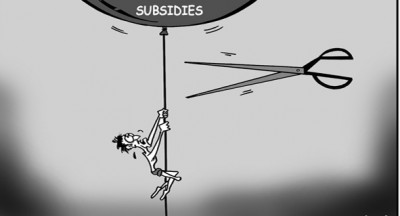
Remember, as Ross McKitrick puts it: “wind turbines don’t run on wind, they run on subsidies” (see our post here).

With States chopping the massive and endless subsidies on which the wind industry critically depends, the wind industry will finally be put to proof on its wild claims about about being “competitive” with conventional generators (see this nonsense from ruin-economy and our post here). As the Americans say to the foolish and/or brave: “well, good luck with that!”

Here’s the Washington Times on the beginning of the end for BIG WIND in the US.

Pulling the plug on renewable energy: States with mandates suffer exploding electricity prices
The Washington Times
Sterling Burnett
29 March 2015

There is never a good time for bad public policy. For few policies is this more evident than renewable energy mandates (REM), variously known as renewable portfolio standards, alternative energy standards and renewable energy standards.

The first renewable energy mandate was adopted in 1983, but most states did not impose these mandates until the 2000s. Though the details vary from state to state, in general, renewable energy mandates require utilities to provide a certain percentage of the electric power they supply from “renewable” sources, notably wind and solar, with the required percentages rising over time.

At the height of the renewable-energy mania, 30 states and the District of Columbia had imposed REMs and another seven had established voluntary standards.

Renewable energy mandate proponents included environmental lobbyists with a hatred for capitalism and fossil fuels that make modern society possible, crony socialists who saw the mandates as way of strong-arming exorbitant payments from government and ratepayers alike, and paternalistic politicians who look down on people’s choices in the marketplace, believing they know best what sources of energy people ought to choose.

Green-energy advocates, crony socialists and government elitists have seen their fortunes wax and wane over five decades. Government subsidies for unreliable, expensive renewable fuels had risen, fallen, been scrapped and begun anew since the 1970s. The existence and amount of subsidies tended to rise in fall with various energy crises — crises often created by the same government that then proposed subsidies for renewable energy as the solution for the problems it created.

For 50 years, green-energy gurus in industry and the environmental movement have sold the snake oil that renewable power would soon be as cheap and reliable as coal, oil, nuclear and natural gas. The nation has been told the turning point has always been just around the corner, always requiring a little more public funding and tax breaks before we have abundant, cheap, clean, reliable energy materializing from thin air.

All these promises were false, and the public and more-honest politicians have seen through the sales pitch. Now, support for renewables is as unreliable as the energy it provides.

To guarantee a market for renewables, green lobbyists fought successfully for mandates ensuring green-energy producers a slice of the electricity market regardless of the price and quality of the energy they produced.

Energy prices skyrocketed, as predicted by numerous energy analysts.

Though cost is an important concern, it is not the only problem with renewable power sources.

Renewable energy is not environmentally friendly. Renewable energy mandates have turned millions of acres of wild lands and wildlife habitats into a vast wasteland of wind and solar industrial energy facilities. In the process, renewable energy facilities have condemned to death hundreds of thousands of animals, including endangered birds, bats and tortoises. Finally, the construction and maintenance of these facilities have polluted the air and water. There is nothing green about all this. Still, continuing high costs, not environmental concerns, may finally spell doom for the mandates.

Citing high costs, Ohio became the first state to freeze its renewable energy mandate. Under Ohio’s mandate, utilities would have been required to provide 25 percent of the state’s electricity from qualified renewable sources by 2025. Under a law signed by Republican Gov. John Kasich in June 2014, Ohio froze its mandate at the current level of 12.5 percent, halving the mandated level.

In January, West Virginia repealed its renewable energy mandate entirely, and the New Mexico House of Representatives passed a bill freezing the state’s renewable standards in March.

Kansas has also recently held hearings on repealing its renewable energy mandate, spurred on in part by a new report from Utah State University reporting Kansas ratepayers are paying $171 million more than they would without the mandate. These additional costs have resulted in a loss of $4,367 each year in household disposable income.

What’s true for Kansas is true for other states with renewable energy mandates. States with mandates experienced 10 percent greater unemployment, due to higher energy prices resulting from the REM, than states without mandates. In addition, the U.S. Department of Energy has found electricity prices in states with renewable energy mandates have risen twice as fast as in states with no renewable requirement. Electricity prices in states with mandates are 40 percent higher than in non-REM states.

With these facts, it is little wonder that states are doing a slow walk back from their previous support of costly, environmentally harmful renewable energy mandates. It’s a classic case of legislate in haste, repent in leisure.

H. Sterling Burnett is a research fellow on energy and the environment at the Heartland Institute.
The Washington Times

subsidies

If any further proof were needed for Ross McKitrick’s “wind turbines don’t run on wind, they run on subsidies” adage, this little piece from Associated Press should do the trick.

Plans pulled for 223-turbine wind farm in Central Oregon
The Associated Press
27 March 2015

BEND — Plans for a big wind farm in north-central Oregon have been scrapped, state regulators say.

The Brush Canyon Wind Power Facility would have had as many as 223 turbines in Sherman and Wasco counties, The Bend Bulletin reported Friday.

It would have been in an area of 76,000 acres, or 119 square miles.

The turbines that have spread across the windy Columbia plateau in recent decades have benefited from two government initiatives: requirements by West Coast states that utilities include alternative energy among their energy sources and a federal tax credit based on turbine production.

But in December, Congress let lapse the federal tax break enacted in 1992 to nurture the fledgling wind industry.

The Brush Canyon proposal had its origin like many in the Northwest, proposed by the North American arm of a European or Scandinavian utility company, in this case the German firm E.ON (EE’-ahn) AG.

“We don’t know why they pulled out, but it’s not unusual,” said spokesman Rachel Wray of the state Department of Energy. “We’ve had a number of projects pulled over the last couple of years. Some that had gone a ways through the process . and others that were a lot less far along. It really varies.”

Calls and messages from The Associated Press to the company’s Chicago office and German headquarters were not immediately returned.

In Central Oregon, some were happy and relieved at the decision, saying the project was far too big and disruptive.

Residents of the high-desert town Antelope were anticipating that construction traffic would increase traffic by 600 percent, Mayor John Silvertooth said.

“It’s like a doctor telling a patient he’s in remission, or waking up from brain surgery and hearing everything was a success,” he said.

Antelope’s population is now about 50. It was larger in the 1980s, and got a lot of attention, when thousands of followers of the Indian guru Bhagwan Shree Rajneesh tried to establish a political power base on a commune that was eventually forced out.
The Associated Press

dirtyrottenscoundrelsoriginal

Sign a Wind Turbine Contract in Haste? Repent at Your Leisure!

Turbine Hosts’ Lament: Hammered by Wind Power Outfits; Hated by Former Friends, Relatives & Neighbours

She's had a few

****

After years of being shunned by former friends and neighbours for introducing turbines into their communities (or signing up for that to happen in future), many turbine hosts are keen to wind the clock back and make amends. Community division, angry former friends and hostile neighbours are just one aspect of what’s causing actual and potential turbine hosts to regret their decisions; and, in Australia, encouraging them to present their cases to the Senate Inquiry:

Unwilling Turbine Hosts Set to Revolt, as NSW Planning Minister – Pru Goward – Slams Spanish Fan Plans at Yass

Turbine Hosts Line Up to Tip a Bucket on Wind Power Outfits, as Senate Submissions Deadline Extended to 4 May 2015

For Australian turbine hosts, the Senate Inquiry into the great wind power fraud provides a golden opportunity to take the lid off the wind industry’s ‘stinky pot’, by exposing the goons and hucksters employed by wind power outfits for what they are: a bunch of liars and chancers. Your chance to tip a bucket by making submissions; to present documents; and to make it known that you’d like to give evidence, has been extended to 4 May. For details on what to do and who to contact see the posts above.

In the posts above we covered the grab-bag of lies and subterfuge used by the goons that stitch up land holder contracts for their masters.

One of the well-worn favourites was to convince a potential target farming family that they were the ONLY farmers who had NOT signed a contract to host turbines for the project concerned.

The development being scoped out might involve a dozen separate farming properties, say; all of which needed to be stitched up in contracts to make the project stack-up in terms of REC subsidies and/or infrastructure layout and associated engineering costs.

The developer’s goons would lob up at each and every one of them – on a one-on-one basis – telling them the very same story: “that all of their neighbours had already signed up”. These words were usually uttered at a point in time when the developer had not signed ANY contracts in relation to its proposed development at all. Pressure was often added by telling the targets that they needed to sign up quickly, because if they didn’t they would be holding up hundreds of $millions in investment, hundreds of jobs etc, etc.

Working on the adage of “loose lips sink ships”, on each occasion, the farmers being targeted were told that they mustn’t breathe a word about the contract being offered to any living soul: so much easier to perpetuate a lie when it can’t be tested by your target with a quick phone call to their neighbours.

In order to add a little more pressure to their targets – and to get their monikers on the contract being offered – the developer’s goons would tell the target farming family that, because everyone else had signed up, they would end up with turbines right up to the boundaries of their properties (sometimes within a few hundred metres of their homes); so they “may as well sign up anyway”, because that way they would at least get paid for hosting some turbines on their own property.

The thrust of the developer’s pitch being that: your life is going to be ruined by dozens of turbines on your neighbour’s property, so you may as well receive a few grand a year for your pending troubles.

The same set of lies would be told repeatedly; until such time as ink appeared on all of the contracts needed to get the wind farm project off the ground, and on its way to a dodgy-development approval.

So far, so insidious. And that particular ruse is one that’s been used around the world, as is made plain from the stories below, one of which reports a turbine host from Wisconsin saying that:

[W]e were also told that we were the ones holding up the project. That all of our neighbors had signed, and we were the last hold-outs. It persuaded us.

What we didn’t know then was the developer was not being truthful. We were not the ‘last hold-out’ at all. In later discussions with our neighbors we found out that in fact we were the very first farmers to sign up. I have since found out this kind of falsehood is a common tactic of wind developers.

But, it’s not just being duped that has turbine hosts wringing their hands.

Oh no.

It’s the fact that wind power outfits couldn’t care less about their farming operations; and being the subjects of social ostracism from former friends, relatives and neighbours that has really hit home.

Over the years, STT has been in contact with a number of disgruntled turbine hosts, from all over the country; and more of them have come forward in the last few months; particularly those who are in contracts where the turbines planned are yet to go up.

One of the facts that tends to rub salt into the turbine hosts’ wounds is just how derisory is the “compensation” they receive in exchange for their personal grief and the hatred of former friends and neighbours.

wind turbine host

In Australia, turbine hosts receive a piddling $10,000-$15,000 a year, for a turbine that will receive upwards of $800,000 a year in REC subsidies, alone.

A REC is issued for each MWh of wind power delivered to the grid. A 3 MW turbine – if it operated 24 hours a day, 365 days a year – would receive 26,280 RECs (24 x 365 x 3). Assuming, generously, a capacity factor of 35% (the cowboys from wind power outfits often wildly claim more than that) that single turbine will receive 9,198 RECs annually.

At $94 – the expected price for RECs once the shortfall penalty bites this year – that single turbine will rake in $864,612 in Commonwealth mandated subsidy, which is drawn from all Australian power consumers as a tax on their power bills. But wait, there’s more: that subsidy doesn’t last for a single year.

A turbine operating now will continue to receive the REC subsidy for 16 years, until 2031 – such that a single 3 MW turbine can pocket a further $13,833,792 over the remaining life of the LRET.

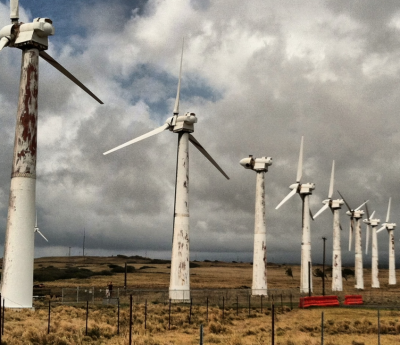
In the meantime, the host gets a nominal $160,000 over the same period (with no index for inflation, the real value falling over time) and will end up with a pile of rusting turbines that they will have to pay to remove when the things fall apart, fling their blades to the four-winds, burst into flame or the subsidy scam inevitably gets scrapped – whichever occurs first.

Hawaii rusting turbines

****

The themes outlined above and detailed below are common, tragic and perfectly avoidable.

The pieces below dealing with the laments of turbine hosts popped up in Wisconsin, but the narratives could have come from anywhere.

“By signing that contract, I signed away the control of the family farm, and it’s the biggest regret I have ever experienced and will ever experience.”

Gary Steinich, Cambria, Wisconsin. June 2011.

Here’s the tale of Gary’s great regret from Better Plan, Wisconsin.

Sometime in late 2001 or early 2002, a wind developer working for Florida Power and Light showed up near the Wisconsin Town of Cambria looking to get in touch with someone at the Steinich family farm.

He wanted to talk to the landowner about leasing a bit of land for the installation of a met tower. He needed to measure the winds in the area for a possible windfarm and Walter Steinich’s land looked like a good place to do it.

The wind developer seemed like a good guy to Mr. Steinich who was in his early 70’s at the time. The money seemed good. A met tower didn’t seem like a big deal. It was just a tall pole with some guy wires, and it was temporary. Mr. Steinich signed the contract.

That was nearly ten years ago. Mr. Steinich has since passed away and now his son, Gary, runs the farm. He’s written an open letter to Wisconsin farmers about his experience with the wind company since then.

From One Wisconsin Farmer to Another:

This is an open letter to Wisconsin farmers who are considering signing a wind lease to host turbines on your land. Before you sign, I’d like to tell you about what happened to our family farm after we signed a contract with a wind developer.

glacier hills aerial 2

In 2002, a wind developer approached my father about signing a lease agreement to place a MET tower on our land. My father was in his 70’s at the time. The developer did a good job of befriending him and gaining his trust.

He assured my father that the project wasn’t a done deal and was a long way off. They first had to put up the MET tower to measure the wind for awhile.

He told my father that if the project went forward there would be plenty of time to decide if we wanted to host turbines on our farm. There would be lots of details to work out and paperwork to sign well before the turbines would be built. The developer said my father could decide later on if he wanted to stay in the contract.

glacier hills aerial 1

In 2003 the developer contacted us again. This time he wanted us to sign a contract to host turbines on our land. We were unsure about it, so we visited the closest wind project we knew of at the time. It was in Montfort, WI.

The Monfort project consists of 20 turbines that are about 300 feet tall and arranged in a straight line, taking up very little farmland with the turbine bases and access roads. The landowners seemed very satisfied with the turbines. But we were still unsure about making the commitment.

glacier hills detail 3

We were soon contacted again by the developer, and we told him we were undecided. Then he really started to put pressure on us to sign.

This was in March of 2004, a time of $1.60 corn and $1200 an acre land. It seemed worth it have to work around a couple of turbines for the extra cash. We were told the turbines would be in a straight line and only take up a little bit of land like the ones in Monfort.

And we were also told that we were the ones holding up the project. That all of our neighbors had signed, and we were the last hold-outs. It persuaded us.

What we didn’t know then was the developer was not being truthful. We were not the ‘last hold-out’ at all. In later discussions with our neighbors we found out that in fact we were the very first farmers to sign up. I have since found out this kind of falsehood is a common tactic of wind developers.

My father read through the contract. He said he thought it was ok. I briefly skimmed through it, found the language confusing, but trusted my father’s judgment. We didn’t hire a lawyer to read it through with us. We didn’t feel the need to. The developer had explained what was in it.

The wind contract and easement on our farm was for 20 years. By then my dad was 75. He figured time was against him for dealing with this contract in the future so we agreed I should sign it. A few months later, my father died suddenly on Father’s Day, June 20th, 2004

After that, we didn’t hear a whole lot about the wind farm for a couple years. There was talk that the project was dead. And then in 2007 we were told the developer sold the rights to the project. A Wisconsin utility bought it.

After that everything changed. The contract I signed had an option that allowed it to be extended for an additional 10 years. The utility used it.

The turbines planned for the project wouldn’t be like the ones in Monfort. They were going to be much larger, 400 feet tall. And there were going to be 90 of them.

They weren’t going to be in a straight row. They’d be sited in the spots the developer felt were best for his needs, including in middle of fields, with access roads sometimes cutting diagonally across good farm land. Landowners could have an opinion about turbine placement but they would not have final say as to where the turbines and access roads would be placed. It was all in the contract.

Nothing was the way we thought it was going to be. We didn’t know how much land would be taken out of production by the access roads alone. And we didn’t understand how much the wind company could do to our land because of what was in the contract.

In 2008 I had the first of many disputes with the utility, and soon realized that according to the contract I had little to no say about anything. This became painfully clear to me once the actual construction phase began in 2010 and the trucks and equipment came to our farm and started tearing up the field.

In October of 2010 a representative of the utility contacted me to ask if a pile of soil could be removed from my farm. It was near the base of one of the turbines they were putting on my land. I said no, that no soil is to be removed from my farm.

The rep said that the pile was actually my neighbor’s soil, that the company was storing it on my land with plans to move it to another property.

Shortly afterwards I noticed the pile of subsoil was gone.

In November of 2011 I saw several trucks loading up a second pile of soil on my land and watched them exiting down the road. I followed them and then called the Columbia County Sheriff. Reps from the company were called out. I wanted my soil back.

A few days later the rep admitted they couldn’t give it back to me because my soil was gone. It had been taken and already dispersed on someone else’s land. I was offered 32 truck loads of soil from a stockpile they had. I was not guaranteed that the soil would be of the same quality and composition as the truck loads of soil they took from my farm.

I was informed by the lawyer for the utility that I had until April 30, 2011 to decide to take the soil. There would be no other offer. Take it or leave it.

I contacted the Public Service Commission for help. The PSC approved the terms of project and I believed the utility was violating those terms. The PSC responded by telling me they could do nothing because the issue involved a private contract between myself and the utility.

They told me my only option was to sue the utility.

My father and I both worked those fields. Watching the way they’ve been ripped apart would sicken any farmer. But what farmer has the time and money it would take to sue a Wisconsin utility?

By signing that contract I signed away the control of the family farm, and it’s the biggest regret I have ever experienced and will ever experience. I have only myself to blame for not paying close enough attention to what I was signing.

We had a peaceful community here before the developer showed up, but no more. Now it’s neighbor against neighbor, family members not speaking to one another and there is no ease in conversation like in the old days. Everyone is afraid to talk for fear the subject of the wind turbines will come up. The kind of life we enjoyed in our community is gone forever.

I spend a lot of sleepless nights wishing I could turn back the clock and apply what I’ve learned from this experience. Now corn and bean prices are up. The money from the turbines doesn’t balance out our crop loss from land taken out of production. The kind of life we enjoyed on our family farm is gone forever too.

I would not sign that contract today. As I write this, the utility is putting up the towers all around us. In a few months the turbines will be turned on and we’ll have noise and shadow flicker to deal with. If I have trouble with these things, too bad. I’ve signed away my right to complain. These are some of the many problems I knew nothing about when I signed onto the project.

If you are considering signing a wind lease, take the contract to a lawyer. Go over every detail. Find out exactly what can happen to your fields, find out all the developer will be allowed to do to your land. Go through that contract completely, and think hard before make your decision.

I can tell you from first hand experience, once you sign that contract, you will not have a chance to turn back.

Gary Steinich
Steinich Farms, Inc.
Cambria, WI
June, 2011

head slap

A Fond Du Lac Farmer has regrets about agreeing to host a wind turbine – Why can’t he speak openly about it?

When you sign a 20 to 30 year contract to host a wind turbine on your property you may be signing away many rights you’re unaware of. A confidentiality agreement in the contract may mean legal action can be taken against you if you complain publicly about the project. A Fond Du Lac farmer signed away his rights. He was interviewed by Don Bangart who wrote the following on behalf of the farmer, whose contract with the wind company prevents him from speaking openly about any problems.

WHAT HAVE I DONE?

Now each morning when I awake, I pray and then ask myself, “What have I done?”

I am involved with the BlueSky/Greenfield wind turbine project in N.E. Fond du Lac County. I am also a successful farmer who cherishes his land. My father taught me how to farm, to be a steward of my fields, and by doing so, produce far better crop production. As I view this year’s crops, my eyes feast on a most bountiful supply of corn and soybeans. And then my eyes focus again on the trenches and road scars leading to the turbine foundations. What have I done?

In 2003, the wind energy company made their first contacts with us. A $2,000 “incentive” started the process of winning us over, a few of us at a time. The city salesmen would throw out their nets, like fishermen trawling for fish. Their incentive “gift” first lured some of us in. Then the salesmen would leave and let us talk with other farmers. When the corporate salesmen returned, there would be more of us ready to sign up; farmers had heard about the money to be made. Perhaps because we were successful farmers, we were the leaders and their best salesmen.

Sometime in 2004 or 2005, we signed $4,000 turbine contracts allowing them to “lease” our land for their needs. Our leases favored the company, but what did we know back then? Nobody knew what we were doing. Nobody realized all the changes that would occur, over which we would have no control. How often my friends and I have made that statement: What have I done?!

I watched stakes being driven in the fields and men using GPS monitors to place markers here and there. When the cats and graders started tearing 22-foot-wide roads into my fields, the physical changes started to impact not only me and my family, but, unfortunately, also my dear friends and neighbors. Later, a 4-foot-deep by 2-foot-wide trench was started diagonally across my field. A field already divided by their road was now being divided again by the cables running to a substation. It was now making one large field into 4 smaller irregularly shaped plots. Other turbine hosts also complained about their fields being subdivided or multiple cable trenches requiring more of their land. Roads were cut in using anywhere from 1,000 feet to over half a mile of land to connect the locations. We soon realized that the company places roads and trenches where they will benefit the company most, not the landowner. One neighbor’s access road is right next to some of his outbuildings. Another’s is right next to his fence line.

At a wind company dinner presented for the farmers hosting the turbines, we were repeatedly told — nicely and indirectly — to stay away from the company work sites once they start. I watched as my friends faces showed the same concern I had, but none of us spoke out. Months later, when I approached a crew putting in lines where they promised me they definitely would not go, a representative told me I could not be there. He insisted that I leave. The line went in. The company had the right. I had signed the lease.

Grumbling started almost immediately after we agreed to 2% yearly increases on our 30-year lease contracts. Some felt we should have held out for 10%. What farmer would lock in the price of corn over the next 5 years, yet alone lock one in at 2% yearly for 30 years? Then rumors emerged that other farmers had received higher yearly rates, so now contracts varied. The fast-talking city sales folk had successfully delivered their plan. Without regard for our land, we were allowing them to come in and spoil it. All of the rocks we labored so hard to pick in our youth were replaced in a few hours by miles of roads packed hard with 10 inches of large breaker rock. Costly tiling that we installed to improve drainage had now been cut into pieces by company trenching machines.

Each night, a security team rides down our roads checking the foundation sites. They are checking for vandals and thieves. Once, when I had ventured with guests to show them foundation work, security stopped us and asked me, standing on my own property, what I was doing there. What have I done?

Now, at social functions, we can clearly see the huge division this has created among community members. Suddenly, there are strong-sided discussions and heated words between friends and, yes, between relatives about wind turbines. Perhaps this is a greater consequence than the harm caused to my land — life is short, and friendships are precious.

I tried, as did some of the other farmers, to get out of our contracts, but we had signed a binding contract. If you are considering placing wind turbines on your property, I strongly recommend that you please reconsider. Study the issues. Think of all the harm to your land, and, in the future, to your children’s land, versus the benefits from allowing companies to lease your land for turbines.

WHAT HAVE I DONE?

PLEASE DO NOT DO WHAT I HAVE DONE!

whathaveidone-350

This was printed as a full page ad in the Chilton, Wisc., Times-Journal, October 25, 2007.

Why A Wisconsin Farmer is Having Regrets

As told in a recent ad, a Johnsburg farmer who will host wind turbines now has many regrets.

He regrets having been the “lure” to draw in other unsuspecting landowners. He regrets that he has allowed fields to be subdivided, road base to be spread on land once picked bare of rocks, costly tiling to be cut up. He regrets that he’s no longer the person who controls his own land and is now told where to go by security guards. He regrets the divide he has created between friends, between neighbors and between family members.

He regrets not having looked into all the ramifications first. That farmer is now locked in to a binding contract. But there are many landowners who have not yet suffered this fate.

Calumet County Citizens for Responsible Energy asks that landowners considering a contract first step back and study the issues. As with any financial transaction, don’t put a lot of trust in those who stand to gain financially.

Look for Web sites and information from those experiencing the effects of this worldwide “gold” rush for wind power. People across world are rebelling. They’re finding that they’ve lost control of their land and their lives. And they’re in danger of financial hardship if these companies dissolve.

Our irresponsible government representatives are forcing this “windfall” for wind investors on us. Their knee-jerk reaction to the global climate change alarms will cause billions of dollars to be wasted, lives to be ruined, and environments degraded for what is, in actuality, a very inefficient energy source.

With a declining tax base and state and U.S. legislators driving us further into massive debt, taxpayer subsidies for wind will be impossible to maintain.

And with the subsidies gone, what will you be left hosting?

Don Bangert,
Chilton, Wisconsin

Ashamed head-in-hands

Australian “Unknown Soldier’s Gravesite” Receives No Respect From Wind Industry, in France!

The Wind Industry Knows No Shame: Turbines to Desecrate the Unknown Graves of Thousands of Australian Soldiers in France

13thBattalionAIF_Le_Verguier

****

This coming Anzac Day, 25 April 2015, looms large in Australia’s history, and collective consciousness, marking the Centenary of Australia’s bloody entry to the War to end all Wars, on the beaches of Gallipoli.

Not so much a celebration, as a reflection on the honour, courage and spirit of Australia’s fighting men and women, Anzac Day causes even the hardest heart to melt in awe at the extreme sacrifice offered, and made, by the finest young men this country had to offer.

Consider a country, remote from the rest of the world, barely a “Nation”, with a little over 4 million people, largely clinging to the south-eastern cities and coasts of its wide brown land, that saw some 420,000 men, from all over it, and from all walks of life – farmers, bankers, lawyers, doctors, teachers, Aboriginal stockmen, and everything in between – enlist for service in the First World War; representing 38.7 per cent of the male population aged between 18 and 44. The whole country missed them all at the time; and far too many of them were missed forever after.

Of that number, some 330,000 joined the Australian Imperial Force (AIF) and saw action overseas: at Gallipoli, in the Middle East, Belgium and France.

In France, the AIF often saw the thickest of the fighting; took the most ground, artillery and prisoners; and suffered more than their fair share of casualties: by 1918, Lieut.-General Sir John Monash had honed his skills as a commander, and those of his troops, to be without equal.

Of the more than 295,000 members of the AIF who served in France and Belgium – at places like Fromelles, the Somme, Bullecourt, Messines, Passchendaele and Villers-Bretonneux – over 46,000 lost their lives, and 132,000 were wounded. Of those who were killed in action, some 11,000 have no known grave.

villers_bretonneux_main-L

****

For Australians, that ground is our most hallowed. The contribution made by these men was Second to None: in valour, life and limb.

In the fearless recapture of towns like Villers-Bretonneux – an action involving a counter-attack at night, without artillery support – described by those that witnessed it as “the Most Brilliant Feat of Arms in the War” – the AIF earned the enduring respect of an embattled French people who, as this sign above the playground in their school declares, will never forget what was done by so many fine young men, so far from home.

Ecole Villers Brittenaux

Not only did Australian Diggers save many a French Town and Village, as they waited for the scarce shipping needed to bring them home after the Armistice on 11 November 1918, many remained in France and helped to rebuild their schools; and, on their return, rallied and raised funds back home to help with that fine and noble task.

vb school

The deep ancestral connection between many Australians and those who fought to save the French, and who endured indescribable suffering in doing so, brings with it a mixture of pride in the sacrifices made, and a sense of collective grief for the tragic loss of so many promising young lives; lives of precisely the kind needed to fulfill the hopes of a young Nation.

One of those is Peter Norton, whose great uncle, Private Alfred William King, from Port Melbourne, was killed on 12 May 1917 at the second battle of Bullecourt. In two battles, the AIF suffered horrendous casualties: more than 10,000 killed, wounded or captured (for a moving understanding of what these men suffered see this article).

peter norton

****

Peter Norton, is rightly incensed at plans to spear wind turbines all over the Bullecourt battlefield; an act which can only be described as a monstrous affront to both the Australians who fought and died there; and to the French people, who still honour them on that sacred ground.

If we didn’t know the wind industry better, STT would be shocked. But these people know no bounds, moral decency or shame. To STT, this outrage is just the latest example of their callous disregard for their human victims; whether trying to live peaceful prosperous lives; or, having made the supreme sacrifice, to rest in peace.

Here’s the Sydney Morning Herald on the wind industry’s latest disgrace.

Battle to stop wind turbines being built on WWI battlefield
Bridie Smith
Sydney Morning Herald
22 March 2015

The Australian government has been asked to intervene to stop wind turbines being built on a former World War I battlefield in northern France, where 10,000 Australians became casualties of the Great War.

Six wind turbines have been proposed for the former Bullecourt battlefield, including two on the German trench lines where intense fighting took place during two battles in 1917.

Now farming land abutting the French towns of Bullecourt and Riencourt, the flat clay soil was the site of a flashpoint between the Germans attempting to move south and the Australians pushing north in their attempt to break through the Hindenburg Line.

Peter Norton, a battlefield guide of seven years, has written to Veterans’ Affairs Minister Michael Ronaldson asking for the government to “protest and prevent the desecration” of the former battlefield.

Mr Norton argues that, while the former battlefield has long been worked for farming, the ploughs used did not go further than 300 millimetres deep. They did not disturb graves because the German army had a minimum grave depth of 600 millimetres. It meant many remains of Australian and German soldiers had been left untouched for almost a century. They were now at risk, he said.

“Now we are talking heavy engineering, not just a farmer’s plough,” he said.

Mr Norton said the foundations for each of the six proposed turbines would go deep underground. Existing farmers’ tracks would need to be widened to support heavy haulage equipment and the cable runs connecting the turbines underground would involve digging trenches more than a metre underground.

Of greatest concern, he said, were turbines number one and two. They are planned for one of the most sensitive parts of the battlefield, where there was heavy fighting in April and May 1917.

“I’m in no doubt that there are quite a number of Australian dead still lying in and around turbine number one … it was a hot spot of the battlefield,” he said.

At the end of the second battle in May 1917, the Australians did what no one else had managed to do, breaking and holding the Hindenburg Line.

Breaking the German defences and capturing the village of Bullecourt, while a significant strategic advantage, came at a cost. The two battles resulted in 10,000 Australian casualties.

Among them was Mr Norton’s great uncle, Alfred William King. Private King, from Port Melbourne, was killed on May 12 when a shell landed near the foxhole he was sheltering in with five others. All were killed and buried nearby, but the location was lost in the chaos of war. The grave was re-located in 1955, and Private King and Charles Edgar Strachan from Albert Park were the only ones identified.

Mr Norton said his concerns were echoed by French locals, particularly in Riencourt, 2.5 kilometres east of Bullecourt, where they had formed a lobby group to stop the turbines being built.

“There is a hardcore number of locals who say we must never forget … that the Australians must never be forgotten,” he said.

The wind turbine project proposed by French group Maia Eolis is now before the local government, which will decide if it can go ahead.

A spokesman for the group said the proposed wind farm was part of a French government commitment for 23% of energy to be renewable by 2020, and that the Riencourt area had been defined as favourable for windfarms. He said the project was at feasibility stage, and there were ongoing landscape, heritage, ecological and acoustic studies.

“We know the past of this territory and we will be very vigilant on this issue. Thus, the necessary precautions will be taken to ensure an implantation respectful of the site of Bullecourt,” the spokesman said.

A spokesman for Veterans’ Affairs Minister Michael Ronaldson said the government was keen for the project to be handled appropriately.

He noted French authorities had well established protocols to ensure any disturbed remains were recovered and reinterred within a Commonwealth War Graves cemetery.

The response failed to impress Mr Norton.

“I’ve called on the Australian government to be active and what they’ve come back and said is that we’re going to stand by and watch. I’m not happy about that. I am extremely concerned.”
Sydney Morning Herald

STT notes the plea made to Michael Ronaldson to intervene on behalf of those Australians who hold the memory of what was achieved, and what was lost, in those French fields.

The Victorian Senator is one of very few Liberals who has thrown any kind of public support behind the disgrace that is the wind industry in Australia – a position based more on mercenary opportunism, and family ties, than on anything worthy of note or merit (see our post here). So, his pathetic response is of no surprise.

How decent Australians respond will be another matter.

Now “Ronno” can count among the victims of his wind industry mates, the final resting places of thousands of young men who perished at Bullecourt; and those who, like Peter Norton, live to keep the memory of their timeless sacrifice alive.

uncle WW1

When the Money Tap Shuts Off, the Wind Pushers Will Scatter!

US Take on the Colossal Subsidies ‘Essential’ For Wind Power Outfits to Survive

Money Wasted

****

As the world wakes up to scale and scope of the great wind power fraud, the numbers men have started to put pen to paper, in an effort to get a proper bead on the size of the massive subsidies being filched from power consumers and taxpayers, and pocketed by wind power outfits – a merry band of blood-sucking leeches, if ever there was one.

One of the numbers men is Rob Nikolewski, the National Energy Correspondent for Watchdog.org. He’s based in Santa Fe, New Mexico and tallies up the damage to power consumers and taxpayers in this little piece.

Solar and wind energy pack a wallop — in federal subsidies
Rob Nikolewski
Watchdog.org
20 March 20 2015

Wind and solar make up but a small percentage of the U.S. energy portfolio, yet lead the pack when it comes to federal energy subsidies.

A study by the nonpartisan Energy Information Administration shows wind and solar finished in top two among all energy sectors in raking in federal subsidies. In fiscal year 2013, wind subsidies topped $5.9 billion. The solar industry received $5.3 billion.

The solar sector saw the biggest jump in federal subsidies between fiscal years 2010 and 2013 — climbing nearly five-fold, from $1.1 billion to $5.3 billion — “with declining solar costs and state-level policies also supporting additional growth,” the EIA report said.

While wind energy received the most subsidies, its rate of increase was less than 10 percent between 2010 and 2013.

Here’s the chart the EIA put out March 13:

WHO GETS WHAT: Federal subsidies by energy source

****

Despite the increase in solar and wind subsidies, overall federal energy subsidies decreased 23 percent, dropping from $38.0 billion to $29.3 billion.

Fossil fuel subsidies declined by 15 percent, from $4.0 billion to $3.4 billion, according to the numbers by the EIA, which is an independent arm of the U.S. Department of Energy.

The EIA report came at the request of Congress, but officials at the Solar Energy Industries Association say the study’s parameters were too confining.

“The request was narrowly defined to only include subsidies with clear identifiable impacts on the U.S. Treasury and that are provisions specific to energy,” Ken Johnson,  SEIA’s vice president of communications, told Watchdog.org in an email. “This restrictive definition leaves out some of the largest fossil and nuclear subsidies, which, unfortunately, results in a skewed, apples-to-oranges comparison.”

Johnson also said the EIA report did not include loan guarantees.

The American Wind Energy Association criticized the EIA report as well, calling it “incomplete and distorted.”

“Fossil fuels have benefited from permanent incentives for nearly a century, and nuclear for more than half a century, while tax incentives for less mature renewable energy technologies such as wind came only recently and have often been enacted for only short-term periods,” said Shauna Theel, AWEA deputy director of digital media, wrote in a blog post on the organization’s website. 

The Institute for Energy Research, a research organization that advocates free-market solutions to energy issues, took the EIA study a step further.

The IER calculated federal subsidies and support per unit of electricity production from the EIA charts and concluded that on a per dollar basis, the solar industry is subsidized 345 times more than coal and oil and natural gas electricity production, and wind is subsidized 52 times more than more conventional fossil fuels.

2

****

“Wind and solar are vastly more subsidized than these other sources,” said Chris Warren, director of communications at the IER. “Despite this massive amount of taxpayer dollars going towards these energy sources, they still produce such a small, small potion of our electricity. So you’re not getting a lot of bang for your buck.”

According to another EIA report  published last year, wind and solar combine for 4.36 percent of the nation’s total electricity generation.

But wind and solar’s supporters point out that those numbers have been increasing, and say the EIA and IER studies don’t take into account the value of clean energy to the environment.

“Wind energy creates billions of dollars in economic value by drastically reducing pollution that harms public health and the environment, but wind energy does not get paid for that even though consumers bear many of those costs,” Theel wrote.

Johnson, the solar spokeman, said breaking down the energy sources by unit of production is misleading.

“… (M)ost subsidies are front-loaded, traditional generation, such as coal, nuclear and hydro, received their government support years or decades ago, and the plants built with that support continued to exist and generate energy in 2013 — even if their support did not include substantial outlays in 2013,” Johnson said.

“The big takeaway is that no matter how many subsidies and taxpayer dollars we throw at these energy sources, they can’t meet our everyday electricity needs,” Warren said in a telephone interview. “And that’s what’s most important about energy and electricity resources. Are they going to be there on demand when we need them and are they going to be affordable? No amount of subsidies to wind or solar is going to fix that.”

The charts bring up a question that’s been debated for years in the energy industry: What constitutes a government subsidy? Does it include tax breaks? What about incentives?

“The Energy Information Administration data do not account for the uncertainty that renewable energy businesses have had to face as a result of temporary incentives that are extended for only short periods of time,” Theel said.

Johnson cited a study showing solar incentives are in line with those given to other energy industries.

“What’s more, solar is following a similar curve in development as traditional energy sources (coal, gas, oil), which received substantial subsidies during their growth period and are now still getting many of them,” Johnson said in his email.

Warren said subsidies “across the board distort the market.”

“We’re for a level playing field. That means getting rid of all these different subsidies, whether it’s for the fossil fuel industry, for nuclear, for wind and for solar,” Warren said. “We should just do away with them all and let these energy sources compete based on merit and the values they provide consumers.”

Click here to read the entire EIA report on energy subsidies and click hereto read the IER study.
Watchdog.org

highwayman lg

Do NOT Invest in Wind, (Unless You Want to Lose Money)!

Community Wind Farm Investors Losing their Shirts

webHepburn_SimonHolm_39802b

****

As the wind industry Ponzi scheme unravels around the globe, it’s so-called “community wind farms” that are taking a pounding.

In the US, a bunch of farmers got fleeced for $millions as a wind power outfit running two small wind farms went belly up on the prairie (see our post here).

STT has also had a go at unpicking the scale and scope of the financial precariousness at the BIG end of town in our posts:

The Wind Industry: You Know It’s a ‘Ponzi’ Scheme When its Targets Include Schools & Councils

Pacific Hydro’s Ponzi Scheme Implodes: Wind Power Outfit Loses $700 Million of Mum & Dad Retirement Savings

In the first of the above, we pointed to the efforts of Simon Holmes a Court to build an “empire” around 2 clapped out Suzlon/REPower 2MW turbines speared into Leonard’s Hill, using money siphoned from 1,900 gullible, greentard ‘investors’. That community calamity (see our post here) kicked off in 2011, but has yet to return a single cent to investors in that time.

For a little more background, here’s some work done by Bon (as it appeared in comments to the earlier post) on the question of Simon’s rollicking, commercial ‘success’:

In Hepburn Wind’s annual report for the year ended June 2013 the Notes to the Financial Statements, we find:

18 Dividends
There were no dividends declared or paid in the current or previous financial year.”

The annual report for the year ended June 2014 does not appear to refer to payment or non-payment of dividends although there could be a reference buried somewhere in the report.

To which, Hepburn Results in the Wind popped back:

Thanks Bon. I also checked the more recent Hep W 2014 Annual report. Nice green photos, and HaC is smiling in this one.

But board is clearly worried. They clearly cut back their own ‘community bribe’ so as to tinker with their bottom line loss so it did not look worse than the year before to their shareholders. It would logically be consistent therefore for the Feds to follow suit and to cut the REC bribe don’t you think, so as to tinker with their own negative balance sheet? You know, to follow the example set by Hep W.

Perhaps STT could do a forensic analysis? The Hep W’s also seem a wee bit concerned re maintenance costs and “mechanical issues” now the turbines are out of warranty. And I thought turbines were oh so reliable and the wind was free!

And thanks for the warning STT.

Ever helpful, Bon chimed in again, reporting:

Yes “Hepburn Results in Wind” and why wouldn’t Simon Holmes a Court and his mates be more than a little worried about being on their own in maintaining their two REpower 2.05MW wind turbines. REpower was rebadged after numerous turbines bearing its former name Suzlon started chucking their blades off, sorry I mean started liberating components.

I note that REpower has recently taken on another name, the new moniker is Senvion?

Compounding questions over the dubious ancestry of Hepburn Wind’s REpower turbines is recent research showing that the useful life of wind turbines in general falls well short of the 20 plus years claimed by manufacturers.

But I suspect the long suffering locals of once peaceful Leonards Hill might see any early demise of Hepburn Wind’s two noisy monsters as simply a matter of karma.

Karma, indeed!

STT’s said it before, and we’ll keep saying it: if you have so much as a nickel anywhere near a wind power outfit – whatever the size of it – grab it, and get out NOW.

As to Hepburn Results in the Wind’s request for a ‘forensic analysis’ of Hepburn Wind’s blistering results, it’s pretty hard to turn pages full of year-after-year, profit ‘doughnuts’ into figures of meaning, so, we’ll pass on that score.

However, in a TV cooking show “here’s one we’ve prepared earlier” moment, we’ll cross to Germany.

German Wind Turbine Investors Dissolve Operating Company After 13 Years Of Poor Returns, Technical Failures
No Tricks Zone
19 July 2014

There are lots of claims on how successful Germany’s renewable energy program has been. Feed-in tariffs mandated by the government guaranteed profits for windpark investors and operators. You couldn’t lose. So it seemed at first.

Unfortunately outputs promised by wind turbine manufacturers and proponents have fallen short of expectations. Moreover, high maintenance costs have in many cases eliminated profits and resulted in losses for investors. As generous as the subsidies may be, profit from wind can be elusive.

So it comes as no surprise when we here how a group of 60 limited partners near Ettenheim southwest Germany have decided to dissolve the wind turbine operating company they had set up in December, 2000. Story in German at www.windwahn.de here. It lost money.

The 60 limited partners unanimously voted on Wednesday to shut down and liquidate the Windpark Ettenheim GmbH & Co. According to Windwahn, the wind turbine had been supplied by Nordex and “did not yield the expected performance“, so says managing director Andreas Markowsky.

Windwahn writes:

It stood still for years, and finally it was taken down in the summer of 2013. In the meantime the concrete pad has also been removed. After the liquidation is completed, the area where the turbine stood will be re-naturalized under the supervision of forest authorities. …The wind turbine did not pay off.”

Windwahn writes that the turbine had been supplied by Nordex and came with a 5-year maintenance contract. But in the end, the turbine remained plagued by technical problems and the 60 partners all had to take a moderate loss on the investment: a bit more than 1000 euros per 2500 euro share.

Markowsky says that the turbine had serious technical problems from the start. For example when winds were strong during stormy weather, the turbine stood still instead of producing maximum output. The limited partners even had to take Nordex to court in bid to be awarded compensation in the amount of 1.8 million euros. Windwahn writes that the case dragged on for 5 years, during which the turbine remained idle and did not deliver any power. Finally, the court awarded the limited partners 1.4 million euros in compensation.

The limited partners had the chance to reduce their losses by taking advantage of the re-powering bonus offered by the German government. Under the scheme turbine operators are paid a bonus to trade up their old turbines for newer, more efficient ones. However, the bonus has been scrapped by the German government, effective August 1, and the offer ultimately was passed up.

The 60 limited partners have had enough of the wind energy business.
No Tricks Zone

empty-wallet1

Trouble in Paradise? Aussie Windpushers Quaking in Their Boots!

Labor, Greg Hunt & Australia’s Wind Industry Panic as LRET Set to Implode

panic-disorder-971
****

Back in October last year, STT predicted that Australia’s Labor opposition would reject any moves by the Coalition to scale back the (completely unsustainable) Large-Scale Renewable Energy Target (LRET) (see our posts here and here).

It was around that time, that the Coalition’s (killing) Industry Minister, Ian “Macca” Mcfarlane; and his youthful ward, (carpeting the) Environment (in giant fans) Minister, Greg Hunt started running around like headless chooks – looking to salvage the wreckage of the LRET; look after their mates at Infigen & Co; and otherwise save their political skins.

As predicted, the Labor opposition has resisted; and these panic stricken efforts have come to nowt. Here’s The Australian on the beginning of the end for the LRET and the wind industry.

Labor rejects ‘final’ offer on new energy concession
The Australian
Sid Maher
20 March 2015

NEGOTIATIONS over the renewable energy target remain deadlocked a week before it is likely to spark a cost crisis in the aluminium sector with Labor rejecting the government’s final peace offer.

Industry Minister Ian Macfarlane offered the Clean Energy Council, which represents major renewables producers, an extra 1000GWh hours for large-scale renewable power generation by 2020. Mr Macfarlane said it was his final offer and he would not go higher.

Opposition environment spokesman Mark Butler rejected the compromise as “too low”.

“We know it would be a 40 per cent reduction in the investment that would have taken place between now and 2020 if Tony Abbott had stuck to his election promise and also, all of the advice we’ve got from the industry is that 32,000GWh simply won’t sustain a viable industry into the future,” he said.

Australian Workers Union national secretary Scott McDine called on the Coalition and Labor to agree to rebate the RET cost for aluminium and other trade exposed industries if a deal was not struck by the end of next week. Mr McDine criticised the government, saying Labor had moved further in a bid to reach a deal.

Today, social and environment groups will write to the government demanding the RET be maintained as it is.

Mr Macfarlane’s latest offer would take the large-scale component of the RET from 31,000GWh to 32,000GWh, with about 13,400GWh reserved for rooftop solar panels. If an agreement is not brokered by the end of next week, regulators will set the level of the scheme for 2015 using the existing numbers.

The aluminium industry and the AWU have warned that if this happens, jobs in the industry will be at risk because the RET costs it about $80 million a year.
The Australian

The insane costs of the LRET to REAL industries – like aluminium smelters – are not lost on the old style Labor/Union men – the blokes with ample frames that fill out fluoro-coloured work shirts and vests, rather than hand-tailored Italian suits.

port henry smelter

****

However, the flipside of that enormous cost to all Australian power consumers – whether critically endangered aluminium smelters (see our posts here and here); or tens of thousands of households cut off from the power grid because they can no longer pay their bills – is the $50 billion in subsidies that will be filched from power consumers and directed to wind power outfits over the life of the LRET.

The value of that massive stream of subsidies to the “new” style Labor/Union (‘Industry’) Super Fund men – blokes who wouldn’t be caught dead in a fluoro work shirt – has opened a rift between the “old” Labor/Union boys and the “new” boys – who waddle off each day to run Union Super Funds, that have $billions invested in wind power outfits, like Pacific Hydro.

Labor’s political war chest is filled to the brim by the returns made by its Union contributors, controlling the $billions that are siphoned through Union Super Funds – run by the likes of former Labor Climate Change Minister, Greg Combet – with help from his best mate, Garry Weaven.

These funds have poured $billions into wind power outfits like Weaven’s Pac Hydro – backed by IFM Investors (controlled by Weaven and Combet); and – with a 41,000 GWh LRET – Union Super Funds were keen to throw $billions more at new wind farms in order to wallow around in the $50 billion in REC Tax/Subsidy, that’s potentially up for grabs.

The Coalition’s proposed cuts to the 41,000 GWh LRET not only throw a spanner in the works for Labor’s plans to cover Australia in thousands of giant fans in future – and to have their union buddies reap obscene profits at the expense of every power consuming household and business – the very fact of the proposal will (ultimately) result in a collapse in the price paid for RECs. An actual cut to the LRET would see the REC price plummet. Any fall in the REC price threatens the viability of every established wind farm.

In a sign that the greatest Ponzi scheme of all time is about to collapse, Pac Hydro – an outfit renowned for its “social conscience” (see our post here) – has just clocked up one of the largest single corporate losses ever seen in Australian corporate history: Pac Hydro’s books apparently record an annual loss of $685 million – the Australian Financial Review says “$700 million” – but with losses of that magnitude a lazy $15 million is probably just a rounding error (see our post here). From what STT can glean, around half of that whopping figure is attributable to losses incurred by Pac Hydro’s wind farm operations in Australia. Pac Hydro has announced it will sack around 25% of its staff, starting from the top down: directors Garry Weaven and Brett Himbury were the first to go; and community “favourite”, Lane Crockett has been given the ‘pink-slip’, too.

The fact that ALL of Pac Hydro’s corporate pain and woe is being suffered at a point when the subsidy ‘rules’ have not been altered at all, gives a pretty fair hint as to what’s on the cards for the entire wind industry when the subsidies inevitably get cut or scrapped.

For those – clearly mercenary reasons – what used to be known as the “workers party” has no other choice but to shackle itself to the LRET policy debacle, as it inevitably implodes.

And implode it will: whatever talk there is about targets being set at a “real 20% by 2020” (or being “amended”, “adjusted” or somehow “fixed”), retailers have decided that they will simply pay the “shortfall charge” – and leave the government of the day to deal with the inevitable political punishment that will be meted out by voters (see our posts here andhere).

No doubt, the “modern” Labor Party (a pack of policy pygmies that runs in lockstep with the lunatics from the Greens) would love to round up Grant King (head of Australia’s largest electricity retailer, Origin) and send him off to the Gulags as punishment for his LRET recalcitrance: “Ah, the good old days”.

Josef Stalin

****

But, absent a Bolshevik putsch, the worst fate that retailers, like Grant King’s Origin, face is the imposition of the $65 per MWh fine under the LRET – which will be passed on to all Australian power consumers – along with the tax implications attached to the fine – at a full cost of $94, as the shortfall starts to bite within the next couple of months.

Here’s the numbers for those who might have missed what they’re about to be belted with.

With the total contribution going to satisfy the LRET from eligible renewable sources stuck at 16,000 GWh, in the table, the “Shortfall in MWh (millions)” appears as 16,000,000 MWh (1GWh = 1,000MWh). The LRET target is, likewise, set out in MWh (millions).

Year Target in MWh (millions) Shortfall inMWh(millions) Penalty on Shortfall @ $65 per MWh Minimum Retailers recover @ $94
2015 18 2 $130,000,000 $188,000,000
2016 22.6 6.6 $429,000,000 $620,400,000
2017 27.2 11.2 $728,000,000 $1,052,800,000
2018 31.8 15.8 $1,027,000,000 $1,485,200,000
2019 36.4 20.4 $1,326,000,000 $1,917,600,000
2020 41 25 $1,625,000,000 $2,350,000,000
2021 41 25 $1,625,000,000 $2,350,000,000
2022 41 25 $1,625,000,000 $2,350,000,000
2023 41 25 $1,625,000,000 $2,350,000,000
2024 41 25 $1,625,000,000 $2,350,000,000
2025 41 25 $1,625,000,000 $2,350,000,000
2026 41 25 $1,625,000,000 $2,350,000,000
2027 41 25 $1,625,000,000 $2,350,000,000
2028 41 25 $2,665,000,000 $2,350,000,000
2029 41 25 $1,625,000,000 $2,350,000,000
2030 41 25 $1,625,000,000 $2,350,000,000
Total 587  331 $22,555,000,000 $31,114,000,000

The more than $30 billion that retailers will be collecting from all Australian power consumers – commencing in a matter of weeks – has sharpened the limited focus of young Gregory Hunt.

When it comes to calculating the full cost of the LRET, young Greg seems to have difficulty in getting his, no doubt solar-powered, calculator to spit out the full number – the one that adds the inevitable cost of the shortfall charge AND the cost of RECs – which will ALL be recovered from retail power consumers – as to the recovery of the cost of RECs, Origin’s Grant King correctly puts it:

[T]he subsidy is the REC, and the REC certificate is acquitted at the retail level and is included in the retail price of electricity”.

It’s power consumers that get lumped with the “retail price of electricity” and, therefore, the cost of the REC Subsidy paid to wind power outfits. The REC Tax/Subsidy has, so far, added $9 billion to Australian power bills.

No matter how hard Greg tries to deflect attention from the cost of the LRET to Australian power punters, at the end of the day, retailers will have to recover the TOTAL cost of BOTH RECs AND the shortfall charge from Australian power consumers, via retail power bills.

In order to overcome the glitch in Greg’s, less than candid, policy presentation matrix, we’ve tallied up the costs below. In the right hand column we’ve combined the annual cost to retailers of 16 million RECs at $94 (ie $1,504,000,000) and the shortfall penalty, as it applies each year from now until 2031, at the same ultimate cost to power consumers of $94.

Year Target in MWh (millions) Shortfall in MWh (millions) Shortfall Charge Recovered by Retailers @ $94 Total Recovered by Retailers as RECs & Shortfall Charge @ $94
2015 18 2 $188,000,000 $1,692,000,000
2016 22.6 6.6 $620,400,000 $2,124,400,000
2017 27.2 11.2 $1,052,800,000 $2,556,800,000
2018 31.8 15.8 $1,485,200,000 $2,989,200,000
2019 36.4 20.4 $1,917,600,000 $3,421,600,000
2020 41 25 $2,350,000,000 $3,854,000,000
2021 41 25 $2,350,000,000 $3,854,000,000
2022 41 25 $2,350,000,000 $3,854,000,000
2023 41 25 $2,350,000,000 $3,854,000,000
2024 41 25 $2,350,000,000 $3,854,000,000
2025 41 25 $2,350,000,000 $3,854,000,000
2026 41 25 $2,350,000,000 $3,854,000,000
2027 41 25 $2,350,000,000 $3,854,000,000
2028 41 25 $2,350,000,000 $3,854,000,000
2029 41 25 $2,350,000,000 $3,854,000,000
2030 41 25 $2,350,000,000 $3,854,000,000
Total 587 331 $31,114,000,000 $55,178,000,000

So, once regard is had to the legislation on which the LRET is based, and the fact that retailers will be recovering BOTH the cost of the shortfall charge AND the cost of purchasing whatever RECs might be available, it’s hard to see how “saving” the LRET and building new wind power capacity will “protect people’s power prices” – as young Gregory claims.

Greg is on record now, calling the shortfall charge (and its total cost to retailers and, therefore, power consumers) a “massive penalty carbon tax of $93 per tonne which nobody wants to see.At $93 per tonne, it’s more than 3 times the initial cost of the one set up by the Greens and Labor; and, therein, lies Greg’s little political difficulty.

Greg and his team-mates strode to power in September 2013 on a mandate – spelt out in advance, and loud and clear – that they would scrap the carbon tax set up under the previous Green-Labor Alliance.

Now, the “massive penalty carbon tax … which nobody wants to see” – hidden within the LRET – is about to bite young Greg and his Coalition buddies with a vengeance.

Hence reports last Friday that Greg is off to do a deal with the 8 cross-bench Senators, in an effort to save his and the government’s political skins. Maybe, just maybe, Greg can cut a deal, and pick up the six votes he needs. But, as with any deal, the devil’s always in the detail.

When Greg sits down to talk turkey, he’s going to have to explain why Australian power consumers are about to be whacked with the most expensive tax on CO2 emissions anywhere in the world: his $93 per tonne whopper, compares with the European price bouncing around €4-6 (AU$5-8); and how that hidden ‘carbon’ (they mean CO2 gas) tax is going to cost Australian power consumers $30 billion, all by itself.

Then he’s also going to have to explain the full $50 billion cost of the shortfall charge and RECs to be collected from power consumers under the LRET, to all of those senators; and how that can possibly be justified: with 34,000 homes disconnected from the grid in Victoria last year alone (see our post here); with more than 50,000 homes without power in Australia’s wind power capital, South Australia (see our post here); and the same kind of power price penury seen in NSW (click here) and Queensland (click here).

STT thinks that Greg’s shortest and safest route home is to start talking (real fast) about cutting that “massive penalty carbon tax of $93 per tonne which nobody wants to see.

It’s a whopper; it’s inevitable; and it’s looming just over the hill.

Over to you Greg …

greg hunt

Wind Turbines, and Their Proponents, Ruin Lives With Impunity!

Eric Jelinski
Eric Jelinski 1:43pm Mar 21
Hydro One takes whatever hydro is generated and distributes the hydro plus adding their own costs. However, a major part of the high costs of Hydro is the wind turbines and the line upgrades for the wind turbines that are added to the cost of hydro.

The costs of hydro is not just in dollars but in human lives ruined becuase people have to abandon their homes due to the noise or stray voltage that impacts them and cattle on the farms. The government is ignoring the impacts even though there are many testimonials by affected people including testimonials from medical doctors and noise experts.

One of our friends who was forced to move out of her house due to wind turbine noise has composed this e-mail to the MPP’s. It is intended to share this and everybody to please also forward this to their provincial MP. Maybe the Wynne liberals can be shamed into a moratorium on wind turbines.
http://ogra.sclivelearningcenter.com/index.aspx?PID=11355&SID=206932

Date: Thu, Mar 19, 2015 at 12:36 PM
Subject: Wind turbines, Ontario and Health Canada

To: lalbanese.mpp@liberal.ola.org, ganderson.mpp.co@liberal.ola.org,tarmstrong-qp@ndp.on.ca, ted.arnott@pc.ola.org, bob.baileyco@pc.ola.org,ybaker.mpp.co@liberal.ola.org, Bas Balkissoon <bbalkissoon.mpp.co@liberal.ola.org>, cballard.mpp.co@liberal.ola.org, toby.barrettco@pc.ola.org,lberardinetti.mpp.co@liberal.ola.org, gbisson@ndp.on.ca,jbradley.mpp.co@liberal.ola.org, scmpp@ndp.on.ca, MPPChan <mchan.mpp.co@liberal.ola.org>, Minister Bob Chiarelli <bchiarelli.mpp.co@liberal.ola.org>, steve.clark@pc.ola.org, Mike Colle <mcolle.mpp@liberal.ola.org>, mcoteau.mpp@liberal.ola.org,gcrack.mpp@liberal.ola.org, ddamerla.mpp@liberal.ola.org,bdelaney.mpp@liberal.ola.org, sdelduca.mpp.co@liberal.ola.org, Vic Dhillon <vdhillon.mpp.co@liberal.ola.org>, jdickson.mpp@liberal.ola.org, dinovoc-qp@ndp.on.ca, hdong.mpp.co@liberal.ola.org, BradDuguid <bduguid.mpp.co@liberal.ola.org>, garfield.dunlop@pc.ola.org,christine.elliott@pc.ola.org, vic.fedeli@pc.ola.org, cfife-qp@ndp.on.ca,kflynn.mpp@liberal.ola.org, cforster-qp@ndp.on.ca, John Fraser Ottawa South <Jfraser.mpp.co@liberal.ola.org>, JFrench-QP@ndp.on.ca, wgates-qp@ndp.on.ca, fgelinas-qp@ndp.on.ca, mgravelle.mpp.co@liberal.ola.org,LGretzky-CO@ndp.on.ca, ernie.hardeman@pc.ola.org,michael.harrisqp@pc.ola.org, PHatfield-QP@ndp.on.ca,randy.hillierco@pc.ola.org, ahoggarth.mpp.co@liberal.ola.org, ahorwath-qp@ndp.on.ca, ehoskins.mpp@liberal.ola.org, tim.hudakco@pc.ola.org, “Mitzie Hunter, MPP” <mhunter.mpp.co@liberal.ola.org>,hjaczek.mpp.co@liberal.ola.org, “Jones-co, Sylvia” <sylvia.jonesco@pc.ola.org>, skiwala.mpp.co@liberal.ola.org,mkwinter.mpp@liberal.ola.org, Marie-France Lalonde <mflalonde.mpp.co@liberal.ola.org>, jleal.mpp.co@liberal.ola.org,dlevac.mpp.co@liberal.ola.org, TracyMacCharles <tmaccharles.mpp.co@liberal.ola.org>, jack.maclaren@pc.ola.org, Lisa MacLeod <lisa.macleod@pc.ola.org>,hmalhi.mpp.co@liberal.ola.org, amangat.mpp.co@liberal.ola.org, mmantha-qp@ndp.on.ca, Cristina Martins <cmartins.mpp.co@liberal.ola.org>,gila.martow@pc.ola.org, dmatthews.mpp@liberal.ola.org, BillMauroTBayAtik <bmauro.mpp.co@liberal.ola.org>, jim.mcdonellco@pc.ola.org, Kathryn McGarry <kmcgarry.mpp.co@liberal.ola.org>, emcmahon.mpp.co@liberal.ola.org, tmcmeekin.mpp.co@liberal.ola.org, “Monte McNaughton, MPP” <monte.mcnaughton@pc.ola.org>, mmeilleur.mpp@liberal.ola.org,Pmilczyn.mpp.co@liberal.ola.org, norm.miller@pc.ola.org, pmiller-co@ndp.on.ca, rmoridi.mpp@liberal.ola.org, julia.munro@pc.ola.org, Minister Glen Murray <gmurray.mpp@liberal.ola.org>, inaidoo-harris.mpp.co@liberal.ola.org, ynaqvi.mpp@liberal.ola.org, tnatyshak-qp@ndp.on.ca,rick.nicholls@pc.ola.org, dorazietti.mpp@liberal.ola.org,randy.pettapiece@pc.ola.org, apotts.mpp.co@liberal.ola.org,sqaadri.mpp.co@liberal.ola.org, lrinaldi.mpp.co@liberal.ola.org, Liz Sandals <lsandals.mpp@liberal.ola.org>, Psattler-co@ndp.on.ca,laurie.scottco@pc.ola.org, msergio.mpp@liberal.ola.org, jsingh-co@ndp.on.ca,todd.smith@pc.ola.org, csousa.mpp@liberal.ola.org, tabunsp-qp@ndp.on.ca,htakhar.mpp@liberal.ola.org, mtaylor-qp@ndp.on.ca, Lisa Thompson <lisa.thompson@pc.ola.org>, jvanthof-qp@ndp.on.ca, Daiene Vernile <dvernile.mpp.co@liberal.ola.org>, “Bill Walker, MPP” <bill.walker@pc.ola.org>, Jim WilsonMPP <jim.wilson@pc.ola.org>,swong.mpp.co@liberal.ola.org, Kathleen Wynne <kwynne.mpp@liberal.ola.org>, john.yakabuski@pc.ola.org, Jeff Yurek <jeff.yurek@pc.ola.org>, dzimmer.mpp@liberal.ola.org, Prime Minister Stephen Harper <pm@pm.gc.ca>, mcu@justice.gc.ca, minister_ministre@hc-sc.gc.ca, David Michaud <david.michaud@hc-sc.gc.ca>, katya.feder@hc-sc.gc.ca, tara.bower@hc-sc.gc.ca, brooks@phac-aspc.gc.ca,Shirley.Bryan@statcan.gc.ca, Allison Denning <allison.denning@hc-sc.gc.ca>,Paul.Dockrill@nrcan-rncan.gc.ca, Christopher.Duddek@statcan.gc.ca,Ken_LCDC_johnson@phac-aspc.gc.ca, stephen.keith@hc-sc.gc.ca,Antoine.Lacroix@nrcan-rncan.gc.ca, eric.lavigne@phac-aspc.gc.ca,Serge.Legault@statcan.gc.ca, tony.leroux@umontreal.ca, leonora.marro@hc-sc.gc.ca, darcy.mcguire@hc-sc.gc.ca, mbrian.murray@sunnybrook.ca,Denis.Poulin@statcan.gc.ca, wricharz@echologics.com, Jason.Tsang@otc-cta.gc.ca, paul.villeneuve@carleton.ca, Stacey.Wan@statcan.gc.ca,shelly.weiss@sickkids.ca, lbertrand@toh.on.ca, r.h.bakker@med.umcg.nl,nbroner@skm.com.au, tachiban@biol.sci.kobe-u.ac.jp,fvdberfvdberg@ggd.amsterdam.nl, tilson.D@parl.gc.ca

Ontario Good Roads Association, Rural Ontario Municipal Association

http://ogra.sclivelearningcenter.com/index.aspx?PID=11355&SID=206932

I request that you to listen to the audio on the Green Energy in Ontario portion of the OGRA/ROMA Conference. February 24, 2015

Listen as Mayor Randy Hope, the first presenter, trivializes the health complaints from residents living in wind projects to a single item; growing obesity.
For your information, when Mayor Hope states he presented at the Standing Committee on Bill 150, so did multiple families who were being impacted at that time, in fact 6 of those families had to leave their homes permanently. That was in 2009 and nothing has changed.

19:30 “…I’ve dealt with the people complaining that the wind turbine has created obesity……
Even the Health Canada study….done, completed, no issue.”

Listen also to the third presenter, Ted Cowan, President of the Ontario Federation of Agriculture, as he shamefully and openly mocks the families in rural Ontario who have been experiencing adverse health impacts, many who are trapped and many who have been displaced.

46:52 “….so every time you hear somebody complain about the health effects of a wind tower, cough at em ”

47:50 “ Health effects…the federal government completed their health study the middle of this past year, they found no health problems from wind, no dead people, no people in hospital, no people sick, no evidence of days off of work from wind related health problems.
They did find that it contributes to some sleep problems and irritation and there is a fix. I believe that where there are homes where there are significant problems they should either be bought or they should be substantially insulated so that the problem goes away or is greatly reduced, but, the evidence on this is in, further debate on it is a waste of time and hiring 30 or 40 incredibly good medical researchers to look at ‘this kind of problem’ is a waste of talent that we cannot afford.”

1:04:09 “ The studies, the evidence is in on health, no health impacts but some? and no general property value harm, but irritation, sleep problems no question.

This disgusting and offensive display is a direct result of the federal and provincial government’s alliance with the wind industry to systematically ignore the adverse health impacts being experienced in industrial wind turbine developments.
The damage that the Health Canada preliminary release alone has done to the citizens of this province is a disgrace.

There has been no opportunity for victims to talk with authorities or speak at these types of meetings and conferences to give evidence of and question some of these statements that audiences are receiving.
It is incredible that in Canada, in 2015, the victims continue to be blamed, ridiculed and their complaints rejected.

My comment:
To the comment on sleep problems and irritation, I don’t believe Mr. Cowan understands the health impacts of sleep disturbance and deprivation, or “irritation” for that matter. The frustration and stress alone at not being able to shut off the noise and vibration when trying to sleep is tremendous.
Trying to get by on 4 out of 7 night’s sleep is not OK. In fact, it is dangerous.
Furthermore, loud audible noise and low frequency noise and vibration penetrates walls and glass, regardless of insulation level. Mr. Cowan’s knowledge of the cause of and remedy for the impacts is minimal.

Attached is some testimony from impacted residents that needs to be reviewed and not deleted.
It represents the tip of the iceberg. Every single wind project started has resulted in more people sick.

The following 2 links have videos of impacted residents who want you to listen to them.
Please be respectful and give them your time as they gave theirs under some very trying situations and at the expense of being mocked by the likes of those above, to educate us.
Some of them are from the Chatham area.
http://windvictimsontario.com/videos—recent-videos.html
http://windvictimsontario.com/videos—page-2.html

Wind Power….A way to Make the Rich Richer, and the Rest of Us, Dirt Poor!

How Wind Power Subsidies Destroy Both Electricity Markets & Economies

industrial-decline-2

****

Around the globe, the wind industry behaves like an enormous, bloodsucking leech – latching onto power consumers and taxpayers; and ever ready to drain its hosts dry and leave nothing but empty shells behind.

In Australia, those soon to be empty shells will include what’s left of ourmanufacturing industries; mineral processors and the tens of thousands of families that cannot afford power now – and the thousands more who will soon join them sitting freezing (or boiling) in the dark (see our postshere and here).

Australian businesses and families are all set to be pounded by the entirely unsustainable Large-Scale Renewable Energy Target (LRET), which is designed to see more than $50 billion filched from power consumers (as a Federal Tax) and transferred to wind power generators (as a mandated subsidy) over the remaining life of the LRET (see our post here).

Under the LRET, from here on – as a simple arithmetical and legislated FACT – power retailers are meant to purchase and surrender 587 million RECs in order to avoid the shortfall charge: described recently by Environment Minister, Greg Hunt as a “massive penalty carbon tax of $93 per tonne which nobody wants to see.” (see our post here).

As the shortfall begins to bite (within the next few months) RECs will – due to the tax treatment of RECs – soon exceed the cost of the shortfall charge ($65 per MWh) and end up trading around $94 – at that price the cost to power punters would top $55 billion.

The fact the Australian electricity retailers have jacked up and are refusing to enter Power Purchase Agreements with wind power generators (the method by which retailers purchase RECs) means that the LRET is all set to implode, but that’s another story (see our posts here andhere).

One of the topics before the Senate Inquiry is whether the insane costs drawn in the form of the REC Tax/Subsidy can be justified on any level, the Inquiries terms of reference including:

(a) the effect on household power prices, particularly households which receive no benefit from rooftop solar panels, and the merits of consumer subsidies for operators;

(b) how effective the Clean Energy Regulator is in performing its legislative responsibilities and whether there is a need to broaden those responsibilities;

(h) the energy and emission input and output equations from whole-of-life operation of wind turbines; and

(i) any related matter.

STT thinks these little policy-posers simply highlight the fact that there has NEVER been any cost benefit analysis carried out in relation to Australia’s Renewable Energy Target, since it was thrown into the energy policy arena, over 15 years ago.

That a scheme, which has already added $9 billion to power bills (in the form of RECs) and which would see the transfer of a further $50 billion from the poorest to the richest, has never seen the slightest scrutiny from independent economists is, let’s just say, more than a little surprising.

But this outlandish policy predicament is not unique to Australia. Oh no, the Brits are well and truly in the same boat. The UK has seen power prices rocket out of control with its rush to plant thousands of giant fans all over Ol’ Blighty – its broad sunlit uplands, and as far as the eye can see, out to sea.

The fact that the UK’s political betters haven’t bothered themselves with the usual type of economic inquiry (ie is there any energy, or environmental, bang for the massive subsidy $bucks?) is one of the key points raised in a very recent, and truly brilliant, study by Rupert Darwall.

Rupert Darwall

****

Rupert has already shone the spotlight on the insane hidden costs of wind power (see our post here). But, now he has excelled himself, with a very detailed analysis of what is nothing short of an energy market debacle.

His study, “Central Planning with Market Features: How renewables subsidies destroyed the UK electricity market”, should be mandatory reading for any Australian politician purporting to support the unsustainable LRET. The full paper can be accessed here as a PDF. We’ve picked out the parts most relevant to Australia’s wind power debacle below.

Central Planning with Market Features: How renewable subsidies destroyed the UK electricity market
Rupert Darwall
March 2015

The story so far

Energy policy represents the biggest expansion of state power since the nationalisations of the 1940s and 1950s. It is on course to be the most expensive domestic policy disaster in modern British history. By committing the nation to high-cost, unreliable renewable energy, its consequences will be felt for decades.

Yet it wasn’t so long ago that Britain led the world with electricity privatisation and liberalisation – the last big policy achievement of the Thatcher years – cutting bills and driving huge gains in capital and labour productivity, gains which are now being reversed.

  • What went wrong?
  • What are the costs?
  • What can be done?

The re-imposition of state control is not because privatisation failed. As the Government concedes, ‘historically, our electricity market has delivered secure supplies, largely due to competitive markets underpinned by robust regulation.’ Instead, state control is the result of imposing an arbitrary form of decarbonisation involving an extremely costly European target for renewables generation (principally wind and solar energy) which Tony Blair negotiated at his farewell European Council in 2007. The result is that the privatised electricity sector is being transformed into a vast, ramshackle Public Private Partnership, an outcome that promises the worst of all worlds – state control of investment funded by high-cost private sector finance, with energy companies being set up as the fall guys to take the rap for higherelectricity bills.

The Government justifies the return of state control on the presumption that the price of fossil fuels will rise continuously, a view now rapidly overtaken by falling coal prices and the halving of oil prices in the space of five months.

What went wrong: Key errors in the decision-making process

….

Foundational Error. The turning point which led to the demise of the market was not proceeded by extensive policy appraisals or analysis of alternatives to the market, but from the adoption of the renewables target at a European Council meeting. Target-driven policy objectives are inflexible. They prevent exploration of trade-offs. The more compressed the deadline, the higher the costs. The overriding focus on meeting the target narrows the field of vision, so that emerging difficulties from other countries, notably Spain and Germany, were ignored as evidence for reappraising the target.

Policy Lesson #4

Setting a target before analysing the costs, operational implications and likely unintended consequences, without considering alternatives constitutes the foundational error in the entire process from which, in one way or another, subsequent errors flowed.

Target-driven policy-making. Cost, efficiency and affordability were subordinated to the goal of meeting an arbitrary target. Instead of seeing the market as a price discovery mechanism to reveal the lowest-cost producer, policy sought to disguise (socialise) the true costs and implications of renewables to minimise the apparent cost of the policy.

Policy Lesson #5

A policy framework to encourage renewables that systematically conceals their true costs will result in higher costs and higher electricity bills for the same quantum of renewable capacity.

Form over function. Having decided to adopt a renewables target, there has been no comprehensive analysis of its costs, benefits and implications for the market. In particular, decision-makers did not ask what exactly electricity consumers get in return for the use of high cost private sector capital and whether it represented value for money for them.

Policy Lesson #6

Before adopting EMR [Energy Market Reforms], policymakers should have evaluated it against a public sector comparator so that the net cost/benefit of using private sector capital is identified and quantified, rather than being implicitly assumed.

What are the costs: Renewables’ hidden costs

The costs of intermittent renewables are massively understated. In addition to their higher plant-level costs, renewables require massive amounts of extra generating capacity to provide cover for intermittent generation when the wind doesn’t blow and the sun doesn’t shine. Massively subsidised wind and solar capacity floods the market with near random amounts of zero marginal cost electricity. It is therefore impossible to integrate large amounts of intermittent renewables into a private sector system and still expect it to function as such.

To keep the lights on, everything ends up requiring subsidies, turning what was once a profitable sector into the energy equivalent of the Common Agricultural Policy. Worse still in a highly capital intensive sector, because prices and therefore revenues are dependent on government interventions, private investors end up having to price and manage political risk, imparting a further upwards twist to costs and prices.

Without renewables, the UK market would require 22GW of new capacity to replace old coal and nuclear. With renewables, 50GW is required, i.e. 28GW more to deal with the intermittency problem. Then there are extra grid costs to connect both remote onshore wind farms (£8 billion) and even more costly offshore capacity (£15 billion) – a near trebling of grid costs.

Including capacity to cover for intermittency and extra grid infrastructure, the annualised capital cost of renewables is approximately £9 billion. Against this needs to be set the saved fuel costs of generating electricity from conventional power stations. For gas, this would be around £3 billion a year at current wholesale prices, implying an annual net cost of renewables of around £6 billion a year. The cost of renewables is even higher compared to coal (which is being progressively outlawed).

What can be done: The worst of both worlds

Intermittent renewables destroy markets. You can have renewables. Or you can have the market. You cannot have both. The hybrid of state control and private ownership is far from optimal and inherently unstable. At no stage has there been any published analysis demonstrating that the use of private capital delivers better value for money than a public sector comparator.

There are two options to align ownership and control:

  • If renewables are a must-have – although no government has made a reasoned policy case for them – then nationalisation is the answer; or
  • the state cedes control, ditches the renewables target and returns the sector to the market.

THE PROBLEM WITH INTERMITTENT RENEWABLES

It is hard to understate the implications of the UK’s growing exposure to wind for its electricity. According to the Royal Academy of Engineering, which is sympathetic to renewables, it requires ‘a fundamental shift in society’s attitude to and use of energy.’ Success, the Academy says, depends on the ability to manage demand to reflect the output from wind, going on to note that despite increasing efforts to research demand management techniques (to match consumption to the variability of the weather), ‘there is still much uncertainty on how effective it will be and at what cost.’ So called ‘smart grids’ will be vital, the Academy says, but their potential and effectiveness at scale ‘are yet to be proven.’

Electricity has a set of uniquely demanding characteristics:

  • It cannot be stored, except to a limited extent, with batteries and pumped hydro, and that storage is limited and incurs a cost;
  • Supply must respond almost instantaneously to demand;
  • If too little is produced, there is a danger of degraded quality and, eventually, of power cuts, which are costly to users;
  • Too much production can damage the transmission system, leading to wires becoming deformed or even melting;
  • Failing to equalise demand and supply can also lead to changes in the frequency of the power supply – too high, and it can damage appliances; too low, equipment can underperform.

Wind and solar technologies pose huge integration challenges. They are difficult to predict, particularly wind, which is highly variable – on gusty days, wind speeds can vary enormously over a few minutes or even seconds. According to Malcolm Grimston of Imperial College, London, low wind speed tends to be weakly correlated with high power demand (cold, windless winter evenings and hot, windless summer days). Depending on how wind-generated electricity is connected to the grid, large amounts of wind power can reduce system inertia and make it less stable.

When renewables account for a significant proportion of generating capacity, the whole electricity system becomes exposed to weather risk as it has to cope with what an OECD/ Nuclear Energy Agency (NEA) report calls ‘random amounts of intermittent electricity.’ The uncertainty inherent in farming is one reason why governments end up heavily subsidising farmers.

The logic of exposing all electricity generators to weather risk implies that the Government subsidises all forms of electricity generation, something wholly unanticipated by policymakers. MIT professors John Deutsch and Ernest Moniz remarked in a 2011 report that policies to encourage renewables have been successful in promoting large-scale deployment, before observing:

‘It is becoming clear that the total costs and consequences of these policies were not fully understood.’

In other words, politicians adopted pro-renewables policies with their eyes wide shut. Britain’s target of deriving 15 per cent of its total energy consumption from renewables was agreed before the system-wide consequences had been analysed. Energy policy has been trying to play catch-up ever since. Renewables policy is truly a leap into the dark.

According to Project Discovery, the capital cost of onshore wind is double that of CCGT. For offshore wind, the capital cost per kW is nearly five times higher – before accounting for the thermal (gas and coal) capacity needed to cover wind intermittency. For Project Discovery, Ofgem applied de-rating factors to adjust the nameplate capacity of different generation types to reflect better the probable contribution each is likely to make to meet peak demand. Therefore, wind assets have a significant de-rating to reflect the lower average availability and risks of correlated periods of low output.

Table 2 below applies these to illustrate the capital cost for onshore and offshore wind compared to CCGT to meeting peak demand on the basis that CCGT is used as dispatchable capacity (i.e. which can be turned on and off when required). To derive the overall capital cost for each plant type, it applies Ofgem’s de-rating factors, assuming the balance is met with additional CCGTs.

Table 2: Capital Cost per kW adjusted for Ofgem 2009 De-rating Factors
Plant type Cost per kW (£) De-rating factor (%) Cost per kW of additional (dispatchable) capacity (£) Total cost per kW (£) Capital cost per kW as multiple of CCGT
CCGT 600 95 32 632 n/a
Onshore wind 1,200 15 510 1,710 2.7
Offshore wind 2,800 15 510 3,310 5.2
Source: Ofgem (2009), Project Discovery Energy Market Scenarios, p.90.

Cost and capacity implications

Since 2009, the relative cost of CCGTs to wind has fallen. DECC’s 2013 estimate of the ‘overnight’ capital costs of onshore wind (i.e. excluding capitalised interest) at £1,600 per kW compares to £610 per kW for CCGT. Thus the capital cost of onshore wind has risen from being twice as expensive as CCGT to 2.6 times in just five years. The costs of offshore wind have also worsened. Based on analysis of actual build costs in the US and adjusting for higher UK offshore construction costs, Edinburgh University’s Professor Gordon Hughes estimates 2013 prices would be at least £3,300 per kW compared to Ofgem’s 2009 assumption of £2,800 per kW – a rise of 17.9 per cent.

The need for intermittent renewable capacity to be twinned with dispatchable capacity drives a colossal investment requirement.

For the same peak electricity demand of 60GW as today, which was met by 85GW of capacity in 2011, the Government estimates the UK will need 113GW of capacity in 2025 – an increase of 28GW. Because the Government did not seek a derogation from the EU Large Combustion Plant Directive, 12GW of coal-fired capacity will also need to be replaced plus 10GW of time-expired nuclear capacity, implying a total requirement of 50GW of new capacity, of which two thirds (33GW) is planned to be renewables.

Thus meeting the UK’s renewable target requires 28GW more capacity than if peak demand was met conventionally. Assuming a 50:50 split between onshore and offshore wind, on the basis of Project Discovery’s numbers, this implies an additional capital cost of £56 billion. The additional cost of deploying the extra 5GW of renewables (33GW less 28GW) instead of CCGTs is £7 billion, implying a £63 billion extra cost of renewables to provide the same peak capacity as from conventional power stations.

Wind and solar also require heavy extra investment in transmission infrastructure. For onshore wind, proposed reinforcements of the transmission grid are of the order of £8 billion, which represents a doubling of the Regulatory Asset Value of National Grid’s existing transmission network. This extra capital cost has a material impact on the underlying (and disguised) economics of wind, particularly in remote, windy locations. According to electricity industry expert Alex Henney, the implication is the cost of transmission of Scottish wind power is of the order of £500 per kW – making the capital cost of onshore wind 3.7 times higher than that of CCGT.

THE CHOICE

Appearing before the House of Lords Select Committee on Economic Affairs in November 2013, Lord Lawson asked Dieter Helm: ‘So if you were Secretary of State for Energy, what would you do now?’ Helm replied,

‘I would probably emigrate as quickly as possible; I would hate to perform such a task. The obvious answer is that when you are in a hole, the first thing you do is stop digging. Many things are currently being pursued that would make things significantly worse.’

This dead-end has come about because policymakers ignored the likely effects of subsidising high fixed cost/near-zero variable cost intermittent energy on the functioning of the energy market before adopting the policy. Attempting to mitigate the damage by subsidising the provision of capacity, the Government is taking control of electricity generation, but not taking ownership of it.

The bottom line is if the state wants renewables, it should do it properly and get out its cheque book.

In reality, there are two choices:

(1) If meeting the UK’s renewables target is the over-riding policy goal, then the most efficient solution is using the Government’s balance sheet to directly finance investment in generating assets and buy out existing assets, i.e. full or partial renationalisation; or

(2) Abandoning the renewables target, isolating the market from the price-destructive effects of embedded renewable capacity and setting a clear path to return the sector to the market.

Either would result in substantially lower electricity bills than where they are heading under EMR and 2) would enhance the UK’s economic performance.

A DESCENT INTO POLICY INCOHERENCE

….

What of energy policy being ‘evidence-based, fair and just’? Assessed against the Government’s three objectives for energy policy, renewables policy is not remotely rational, fair of affordable:

  • Keeping the lights on. Weather-dependent renewables are inherently poor at reliably generating electricity to meet demand. Indeed, the Government has acknowledged the ‘significant challenge’ represented by ‘operational security (i.e. enough responsiveness to ensure real-time balancing of supply and demand)’, though DECC couldn’t bring itself to name the culprit.
  • Keeping energy bills affordable. Self-evidently, setting strike prices for renewables (and nuclear) that are double the current wholesale price of electricity puts upward pressure on energy bills – and that’s before taking account of the higher system grid level costs of renewables which the Government tends to ignore (Figure 3). If affordability really were a driver, nationalisation would provide a lower cost renewables route.
  • Decarbonising energy generation. A 2014 Brookings analysis quantified the avoided carbon emissions per MW from wind displacing baseload coal generation at $106,697 a year and $69,502 a year for solar, based on a value of at $50 per tonne of carbon. By contrast, CCGT-generated electricity saves $416,534 of carbon per MW a year – nearly four times that for wind and six times that of solar in the US, where solar capacity factors are nearly double those in the UK.

Overall, the Brookings analysis, which does not explicitly incorporate the extra grid infrastructure costs of renewables, found that wind and solar generated respectively annual net disbenefits of $25,333 and $188,820 per MW at a carbon price of $50 a tonne whereas CCGTs generated an annual net benefit of $535,382 per MW. The conclusion is inescapable: ditching renewables and encouraging shale fracking is better economics and more effective at reducing carbon dioxide emissions.

Despite all the energy white papers, official analyses and the Government conceding that renewables are on course to cost £48.3 billion (before extra grid and dispatchable capacity costs), the Government has yet to produce a document analysing the costs and benefits of intermittent renewables to justify its leap into the dark. Delay in changing course merely adds to wasteful spending on renewables capacity for which the Government has no objective policy case. Deciding to opt out of the EU’s renewables target would take Britain off the escalator of higher energy bills and enable electricity supply and demand to be determined by the market, not central planners in Whitehall.

A LESSON FROM THOMAS EDISON

At 3pm on 3 September 1882, Thomas Edison switched on the first incandescent bulbs powered by his Pearl Street generator several blocks away. It was a huge technical accomplishment. In Edison’s words:

‘It was not only necessary that the lamps should give light and the dynamos generate current, but the lamps must be adapted to the current of the dynamos, and the dynamos must be constructed to give the character of the current required by the lamps, and likewise all parts of the system must be constructed with reference to all other parts, since, in one sense, all the parts form one machine, and the connections between the parts being electrical instead of mechanical.’

Edison’s brilliance was not solely that of an inventor. He was an entrepreneur who changed the world. According to the economic historian Thomas Hughes, from the start, Edison realised his system would have to be economically competitive. Thus he conceived of the problem to be solved by invention as inseparably technical and economic. Every technical step was informed by the need to beat the economics of gaslight. An example of Edison’s understanding of the integrated nature of electrical production, transmission and consumption is opting for high resistance filament light bulbs, otherwise the current required such large copper wires for mains distribution as to make it uncommercial.

When politicians decided to impose renewables on the electricity system, they took the opposite approach to Edison. Renewables didn’t have to be cost competitive. They didn’t have to be reliable. The extra costs they impose on the system were ignored. Politicians did not want to think about the wholly predictable destruction of the electricity market from their policies. The world would have to fit around their preferred generating technology.

Edison’s approach ushered in the age of electricity. If central planning worked, the Berlin Wall would still be standing.

Rupert Darwall
March 2015

Thomas-Edison globe

Village Destroyed to Accommodate Wind Turbines.

Company’s extreme wind strategy: “Recently we bought most of a village to make a windpark.”

Kølby in northern Jutland is being bought up by the Swedish energycompany Vattenfall.

We solve the problem of unsellable properties in peripheral regions. We solve the problem of neighbours being critical of wind farms.”

Farm in Bollerup
Farmhouse purchased by Vattenfall for demolition.(photo: René Schütze)
The Copenhagen Post

Company’s extreme wind strategy: Towns today, turbines tomorrow

By Philip Tees

Swedish energy company Vattenfall is going to extreme lengths for the sake of its Danish windfarms – buying up whole villages in rural Denmark, razing them to the ground and replacing the buildings with wind turbines, Børsen reports.

Mette Korsager, who is responsible for Vattenfall’s onshore wind projects in Denmark, told the business newspaper that the strategy was to make it easier for the company to achieve the goal of installing 250 MW of wind turbines in Denmark by 2018-2019. “We typically buy up farms in bad condition and demolish the farmhouse,” she said.

Recently we bought most of a village to make a windpark.

Helps the region, according to Vattenfall

That village is Kølby in northern Jutland, and Vattenfall plans to acquire a total of 20 properties.

Korsager told Børsen the strategy served a number of purposes. “We solve the problem of unsellable properties in peripheral regions,” she said.

We solve the problem of neighbours being critical of wind farms, and we make it easier to reach agreements about the installation of wind turbines at the municipalities because we go in and help them by developing problem areas.

Kølby in northern Jutland
Kølby in northern Jutland.(photo: Google Street View