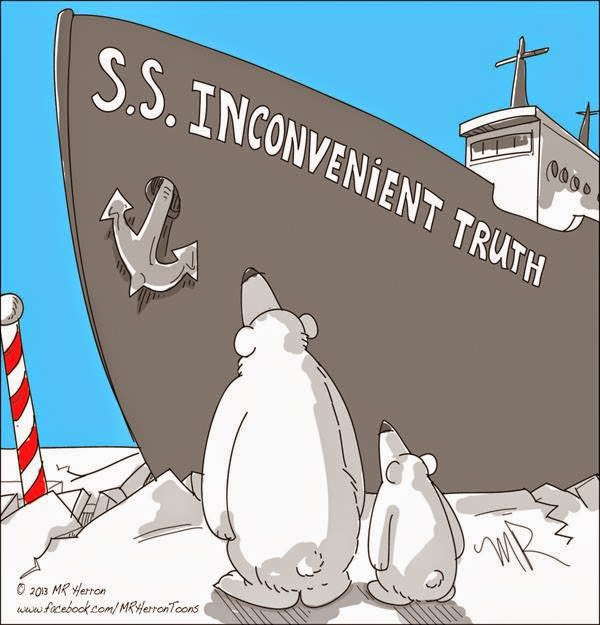
People Fed Up With Climate Change Scam…Reality is Gaining Popularity!

The age of climate alarmism is coming to an end

JIM LAKELY| OCTOBER 19, 2013 | 12:00 AM

You can be forgiven for not noticing that the United Nations’ Intergovernmental Panel on Climate Change released a summary of its Fifth Assessment Report late last month.

The report landed with a thud, criticized and even mocked by many leading climate scientists. The distinguished science journal Nature editorialized that this should be the last report issued by the UN body.

This is just the latest signal that the age of climate alarmism is over. Given five tries to convince the world that human activity is causing catastrophic warming of the planet, runaway sea-level rise and various weather disasters, the public still doesn’t buy it.

We’re all skeptics now because the science simply does not back up the hypothesis. For starters, there’s been no rise in global temperatures for 15 years.

The IPCC’s Fifth Assessment Report concedes for the first time that global temperatures have not risen since 1998, despite a 7 percent rise in carbon dioxide (CO2) emissions.

To put that into perspective, global human CO2 emissions in the last 15 years represent about one-third of all human CO2 emissions since the start of the Industrial Revolution, and yet temperatures didn’t budge.

Nearly all of the UN-approved climate computer models were wrong. The IPCC finally admitted as much.

The IPCC also admits that the “hockey stick” it used to feature in past reports wasn’t accurate. Penn State professor Michael Mann has been dining out for years on his infamous “hockey stick,” a dread graph featured by Al Gore in his Oscar-winning documentary “An Inconvenient Truth.”

The graph looked so dramatic — like a hockey stick — only because it ignored the Medieval Warm Period, a time about a thousand years ago when temperatures were warmer than today — when wine grapes grew in England and Greenland was green.

The “hockey stick” is missing from the Fifth Assessment Report, and the IPCC admits the Medieval Warm Period was warmer and more global than it claimed in the past.

A third major admission by the IPCC: No increases in droughts, hurricanes, typhoons and other extreme weather. Every time severe weather hits the United States, you could count on IPCC-related scientists, professional climate alarmists and the media to attribute it all to man-made global warming. No more.

The latest IPCC report admits to having “low confidence” in predictions of more frequent or more extreme droughts and tropical cyclones.

While the IPCC is taking its lumps for being wrong on these and other matters, a new kid on the block of climate science is taking a victory lap: The Nongovernmental International Panel on Climate Change released its own report, Climate Change Reconsidered II: Physical Science. Packed with 1,000 pages of peer-reviewed literature — and then peer-reviewed again by NIPCC’s team of some 50 scientists from around the world — Climate Change Reconsidered II comes to the conclusions the United Nations is only now and reluctantly admitting.

The NIPCC report concludes that human impact on climate is very modest, especially when compared to natural cycles. Future warming due to human greenhouse gases is likely to be only 1-2 degrees Celsius, and be a boon for flora and fauna alike.

Higher levels of carbon dioxide will not cause weather to become more extreme, seas level rise isn’t accelerating and polar ice caps aren’t melting at alarming rates.

Global warming isn’t the crisis many people said it was a few years ago. That’s bad news for the IPCC and the many environmental groups and politicians that hooked their wagon to it. But it’s good news for the rest of us.

Jim Lakely (jlakely@heartland.org) is director of communications at The Heartland Institute, which published Climate Change Reconsidered II: Physical Science on behalf of the Nongovernmental International Panel on Climate Change. For more information, visit ClimateChangeReconsidered.org.

Wind Turbine Contracts…Lefty’s Use Them To Reward Their Cronies! Corruption!

Ex-Rep. Istook: Wind Energy a Crony Capitalist Gift

Thursday, 23 Oct 2014 10:13 PM

By Sean Piccoli

Wealthy investors in wind power are reaping profits from an expensive — and subsidized — form of green energy that is driving up the electricity bills of ordinary Americans, a former Oklahoma congressman told Newsmax TV on Thursday.

Under the guise of saving the planet from global warming, wind power has become a taxpayer ripoff and a boon to investors claiming massive federal subsidies for an industry that cannot compete on price with traditional energy sources, former Republican Rep. Ernest Istook told “MidPoint” host Ed Berliner.

Of the $40 billion annually doled out to various green energy incentives, grants and loans, one of the biggest magnets for public funds is a wind energy tax credit first enacted in 1992, said Istook.

“For every megawatt hour that [producers] generate through wind energy, they get $23 from the U.S. Treasury,” he said, “and of course you multiply that by the many thousands of megawatt hours that are generated — which is still a small fraction of what the country uses — and they’re talking about an $18 billion renewal of this.

“Now, this was supposed to be a temporary tax credit back in 1992 to help the industry get on its feet,” said Istook. “Well, the problem is wind power is such an expensive way to generate electricity, that even with these major subsidies — plus all sorts of subsidies from different states — it still is one of the costliest forms of power. And it makes people’s electric bills skyrocket.”

Istook said a new study from the Energy Information Administration — the U.S. Department of Energy’s statistical service — finds electric rates rising four times faster in the states that use the most wind power.

He said the arrangement continues year in and year out thanks to a classic “vicious cycle,” in which subsidy recipients use their profits to secure more subsidies.

“I want to give you a quote, though, from one individual who was a major wind energy investor and getting a lot of these tax benefits: Warren Buffett,” said Istook, citing the Nebraska-based billionaire investment guru.

“These are his words, not mine: ‘We get a tax credit if we build a lot of wind farms. That’s the only reason to build them. They don’t make sense without the tax credit.’ Those are Warren Buffett’s words,” said Istook.

“The people that are making this investment recognize that unless they can get these crony capitalism dollars, it’s a bad investment,” he said. “But government is paying them to do that. It’s paying some people to get rich at our expense while our utility bills go up”.

Istook said the public has a chance to put a stop to the tax credit, which expired last December, but is being pushed for retroactive renewal by the administration during the lame-duck congresional session that begins after the Nov. 4 midterm elections.

“They’ve got the skids greased in the U.S. Senate to do it,” said Istook.

And they will, too, he said, “unless people call their member of Congress and say, ‘Don’t vote for anything that renews this $18 billion giveaway, no matter what it’s packaged with. Don’t vote for it.’ That’s the only way we’re going to put a stop to this crony capitalism.”

Wind Turbines are a Waste of Time, Money, Agricultural lands, and Won’t Help the Environment!

Greens’ silence on folly of wind and solar power

by Ian Plimer

News Weekly, October 25, 2014

A simple evaluation of ideological electricity shows that it is unsustainable. The answer is certainly not blowing in the wind.

The amount of energy embedded in steel pylons, concrete footings, blades, wiring, magnets, land clearing and roads is more than a wind pylon would ever generate in its working life. Wind farms cannot generate electricity in a gentle zephyr or a gale, cannot operate continuously and optimistically operate at 20 per cent of nameplate capacity.

Professor Ian Plimer

Wind farms have the life of a parasite because they freeload themselves onto existing grids paid by conventional efficient energy, need subsidies and drain electricity from the grid when it is too cold. Wind turbines don’t run on wind; they run on subsidies.

A single 1,000-megawatt wind farm produces at least 7 million tonnes of carbon dioxide in component construction and concrete. Almost 100,000 truckloads of concrete are required just for the footings. Maintenance by diesel-powered vehicles only adds to emissions. Wind farms need 24/7 back-up from carbon dioxide emitting coal-fired power stations.

Wind farms do not reduce human emissions of carbon dioxide; they increase emissions.

A wind farm using 660-kilowatt generators requires 7,600 generators at 20 per cent efficiency to produce 1,000 megawatts. At $2,000 per kilowatt installation, this would cost $10 billion. This is more than twice the cost of a reliable, clean, coal-fired 1,000-megawatt generator.

The environmental effects of wind farms are devastating. Construction of wind farms in rural areas results in a decline in residents’ mental and physical health, decreased property values and community disharmony. A recent study showed hearing loss for people experiencing low frequency noise.

In the United Kingdom, renewable energy costs, principally from wind, create fuel poverty for 2.4 million folk. In the 2012-2013 UK winter, there were an additional 35,000 deaths. This translates as six sick, elderly or vulnerable people killed every year for each installed wind turbine.

At 20 per cent efficiency, 1,000 megawatts of delivered electricity requires about 800 square kilometres of cleared land. A nuclear or coal-fired power station requires up to 60 hectares of cleared land.

Habitats are destroyed by land-clearing to reduce turbulence. Generator fires are common, and the resultant grass and bushfires cannot be water-bombed from the air as wind pylons are a flight hazard. Is this the modern face of environmentalism?

In Spain, at least 18 million birds are slaughtered annually by wind-turbine blades. Bird deaths in Germany are more than 300 per turbine, and in Sweden almost 900 per turbine. German turbines kill more than 200,000 bats per year, and in the U.S. turbines kill some 2.8 million bats.

Not to worry. Greens feel morally superior because they think that wind farms emit less carbon dioxide into the atmosphere and hence are saving the planet. We are certainly saving the planet from birds and bats. If a nuclear or coal-fired electricity generator damaged the environment as much as wind farms, there would be an outcry.

Wind farms are meant to be a contribution to prevent global warming. However, patient people have been waiting for three decades for the evidence showing human emissions of carbon dioxide drive climate change. The evidence is missing in action.

The same calculations can be made for solar power. The amount of embedded energy in the metal, concrete, glass and roads is far greater than can ever be produced in a solar farm’s life. Construction of solar panels leaves toxic chemicals in someone else’s back yard. The amount of carbon dioxide released in manufacture and maintenance is greater than the saving, and coal-fired generators need to be on standby all the time because solar power is not continuous. Solar power has an efficiency of about 10 per cent and, until the laws of physics are changed, this cannot be improved.

Greens must be very pleased that the 4,000-megawatt Drax power station in Yorkshire is changing from coal to wood-burning. Some 70,000 tonnes of wood will be burned each day. Clear felling of forests in North Carolina, rail transport, pelletising, ship loading, 5,000 km of ship transport, unloading and train transport do not sound very environmentally friendly and result in huge carbon dioxide emissions from diesel and bunker fuels.

The EU has deemed that carbon dioxide emitted from wood burning is recycled by plants yet carbon dioxide emitted from fossil fuel burning is dangerous. Go figure!

Why are the Greens silent about the environmental damage of wind and solar electricity generation?

Wind power is unreliable, uneconomic and environmentally damaging. No wind farm could provide mains power without generous subsidies, increased electricity charges and horrendous damage to the environment.

Few jurisdictions have plans for disassembling a wind farm after its useful life. Defunct wind farms should remain on the skyline as a reminder to future generations of our environmental ecocide and a memorial to our stupidity resulting from caving in to green pressure.

Fund managers have invested in wind energy to make money, not to save the environment. Their due diligence would have shown that wind farms are a costly, subsidised, high-risk method of ruining the environment and that a Renewable Energy Target was unsustainable ideology.

Rather than plead to the government for even more money, fund managers should be sacked. It is not the role of government to bail out high-risk investors who follow fads and spend more money on advertisements in The Australian than on due diligence.

Ian Plimer is an Australian geologist, professor emeritus of earth sciences at the University of Melbourne, professor of mining geology at the University of Adelaide, and the director of multiple mineral exploration and mining companies. He has published many scientific papers, six books and is one of the co-editors of Encyclopedia of Geology. His most recent book, Not For Greens, is available from News Weekly Books. 

Unaffordable, Unreliable, Impractical, Unwanted Wind Turbines

October 23, 2014

Of the 10 states most reliant on wind power, nine of them have seen their electricity prices rise at least five times faster than the national average, writes James Taylor, senior fellow at the Heartland Institute. While wind advocates claim that wind power reduces costs, on-the-ground evidence suggests the opposite is true.

Taylor cites a recent report from the Texas Comptroller, which found that Texas were paying higher prices due to wind power, despite an overall drop in electricity prices. According to the report:

  • Not only is wind power more costly than traditional power, but it is unpredictable, as it only generates power when the wind blows. As a result, conventional power plants must stand ready to fill in when wind power fails, requiring additional output on short notice and making wind power far less efficient.
  • Electricity demand in Texas in Texas is at its highest on hot summer days; wind power is at its lowest production point on hot summer days.
  • Delivering wind power to residents requires the construction of new transmission lines, costing Texas households an average of $70 to $100 annually. Expanding the power grid further for more wind power will cost $2 billion in additional funds.

While Texas electricity prices have fallen, Taylor says the drop is due to deregulation and a fall in price of other energy sources. It is not, however, due to wind power, which has only slowed a drop in electricity prices.

Source: James M. Taylor, “Texas Comptroller Report Destroys Wind Industry Claims,” Heartland Institute, October 21, 2014.

MI Wind Turbine Lawsuit Settled….Operating out of Compliance!

aeinews.org


MI turbine suit settled; another lesson in operating too close to already-generous noise limits

Posted: 22 Oct 2014 03:22 PM PDT

MI Lake Winds under constructionFor the past couple of years the Lake Winds Energy Park in Mason County, Michigan has been embroiled in a contentious dispute about its noise levels (image to left is the “Park” under construction).  In April 2013, five months after the 56 turbines began operating, 17 neighbors filed suit, claiming that wind farm noise, vibrations and flickering lights were adversely affecting their health. After commissioning an independent sound study, the Mason County Planning Commission formally declared the wind farm out of compliance and demanded a mitigation plan; the developer, Consumers Energy, disputed the findings yet lost two appeals, one at the Zoning Board of Appeals and one in Circuit Court. During that series of challenges, Consumers developed a plan to modify turbine operations for 7 turbines closest to the four sites where they were found to be marginally too loud.

Marginal is indeed the word: the sound study found 4 locations where the sound level peaked at 0.3 to 1.2 decibels over the 45dBA noise limit (it takes 3dB for a difference between two sounds to be audible); when using 10-minute averages, there were no violations.  The various explanations by the consultant, Brian Howe, illustrated the fine line that the turbine operations were walking.  His report stressed “general compliance with sound level criteria,” and noted that the brief violations “do not represent a statistically significant portion of time and do not indicate a systemic exceedance.” In his initial testimony at an August Planning Commission meeting, he said that there are no recommendations to correct for these times because “there is not a situation where they are predictably going over 45.”  Later, in a November letter to the Commission, after learning that the county had previously decided NOT to allow for occasional exceedances, he stressed that “I can assure the County that competent, material and substantive evidence supports the conclusion that the turbines are not in compliance at certain residences on occasion” and elaborated:

Excursions over 45 dBA should have been anticipated since, as outlined in the acoustic study by Tech Environmental prepared in June 2011, the wind energy park was designed with sound levels identically equal to the 45 dBA criteria at some key receptors with no factor of safety to address the fact that the prediction methodology has a stated accuracy worse than +/- 3 dBA. If Tech Environmental was aware that achieving the criteria even 95% of the time was unacceptable to the County, it would have been prudent to incorporate a suitable safety margin to account for the statistical variation in sound levels.

And this the first half of the central lesson here: it’s essential that enough of a safety factor is built in to the sound models to account for known variability in sound production (how loud the blades are in various unsteady wind conditions) and sound propagation (how far sound travels as it gradually loses power).  Regular readers will know that variability is indeed, as Howe mentioned, often more than the simplified 3dB margin of error that was neglected here (see AEI’s 2012 report). The second half the lesson is related: when noise limits—for the sound of the turbines when it reaches nearby homes—are set as high as 45dBA, they will be regularly audible at these homes, and likely well above night-time ambient sound levels.  As many acousticians have stressed for years, these situations are very apt to trigger a significant number of complaints, especially if there are dozens of homes in that nearby range.  Here, we had the worst of both worlds: turbine siting plans that pushed sound right at the limit into nearby homes, and a limit that was on the high end of tolerability for many neighbors.  Indeed, after one such cautionary report was presented to the Mason County Planning Board, it decided to lower the limit to 40dB, but that change was revoked after push-back from Consumers Energy.

With this backdrop, this week the 17 original plaintiffs in the noise nuisance lawsuit agreed to a settlement offer from Consumers;
the financial and possible operational details are confidential (2 later additional litigants are yet to settle, but negotiations are ongoing).  While many such lawsuits languish, as it can be very hard to prove causality of health effects or to prove nuisance, it is always notable when a company decides it’s more advantageous to settle than to push through a court hearing (which was set to begin, with the jury already seated).  This is the latest of several such suits that were settled behind closed doors—other high profile compensation cases include Mars Hill, Maine and the Davis family in the UK, while property buy-outs of people who’ve either moved from their homes or become vocal about their issues are widespread, if not common, including a recent buy-out settlement with a family in Vermont, and purchases of multiple homes in Ontario’s Bruce and DufferinCounties.  It’s unfortunate that confidentiality clauses leave the rest of us in the dark, for one of the ways forward is for the wind industry to more willingly compensate those most impacted by their operations, and these cases could offer some guidance as to what level of compensation may be mutually agreeable.

Meanwhile, to the best of my knowledge, Consumers Energy’s challenge to the Mason County demand for mitigation is ongoing; the latest report I’ve found is that the company filed an appeal in July after its loss in Circuit Court.  The implications of how that plays out could be far-reaching.  The challenge consists of two related technical points: whether instantaneous exceedances should be considered violations, and  whether unattended sound monitoring can reliably identify violations. The latter question gets down into the technical weeds, including accounting for the presence of other ambient noise as well as turbine sounds, and the choice of measurement metric (L90 or Leq, as well as strict adherence to other sound measurement standards identified in the ordinance, which, like many local ordinances, is not necessarily savvy about all the implications and options for measurement).  As reported by Michigan Capital Confidential, a good source for coverage of this issue:

Arguing that the County’s decision was an “erroneous ruling,” the utility filed a 38-page appeal with the Michigan Court of Appeals on July 18. In addition, Consumers Energy is saying that if the ruling by 51st Circuit Court Judge Richard Cooper were allowed to stand, it could have an impact on many other wind turbine plants across the state.

“This has implications beyond just Mason County,” Dennis Marvin, spokesman for Consumers Energy told Capitol Confidential. “We believe the study the county based its decision on was flawed. We took this decision (to appeal) very seriously, but ultimately our legal staff determined this was in the best interest of our customers and the landowners at the wind park.”

Rick James, of East Lansing-based E-Coustic Solutions, is an acoustician specializing in the production, control, transmission, reception and effects of sound. According to James, Consumers Energy is not exaggerating when it talks about the potential impact of the Lake Winds case.

“Consumers’ appeal has less to do with the supposed 1 decibel error, the topic of the appeal, and more to do with the wind industry’s broader concerns,” James said. “A decision by the Appeals Court in favor of Mason County would make it easier for other counties and townships with wind energy utility noise regulations to prove non-compliance.”

“Consumers would have been better advised if they had not accepted the conclusions of their acoustical consultant that the proposed project could be fit into the host community without causing problems,” James continued.

Leading Meterologist Tells Us What We Already Knew….Climate Alarmism is a Scam!

Climate change PROVED to be ‘nothing but a lie’, claims top meteorologist

THE debate about climate change is finished – because it has been categorically proved NOT to exist, one of the world’s leading meteorologists has claimed.

Published: Wed, October 22, 2014

climate-changeClimate change has been ‘disproved’ and polar ice is ‘increasing’ [ AP]

John Coleman, who co-founded the Weather Channel, shocked academics by insisting the theory of man-made climate change was no longer scientifically credible.

Instead, what ‘little evidence’ there is for rising global temperatures points to a ‘natural phenomenon’ within a developing eco-system.

In an open letter attacking the Intergovernmental Panel on Climate Change, he wrote: “The ocean is not rising significantly.

“The polar ice is increasing, not melting away. Polar Bears are increasing in number.

“Heat waves have actually diminished, not increased. There is not an uptick in the number or strength of storms (in fact storms are diminishing).

“I have studied this topic seriously for years. It has become a political and environment agenda item, but the science is not valid.”

climate change global warming mythMan made climate change is a myth according to Coleman, inset [AP]

I have studied climate change seriously for years. It has become a political and environment agenda item, but the science is not valid

John Coleman, co-founder of the Weather Channel

Mr Coleman said he based many of his views on the findings of the NIPCC, a non-governmental international body of scientists aimed at offering an ‘independent second opinion of the evidence reviewed by the IPCC.’

He added: “There is no significant man-made global warming at this time, there has been none in the past and there is no reason to fear any in the future.

“Efforts to prove the theory that carbon dioxide is a significant greenhouse gas and pollutant causing significant warming or weather effects have failed.

“There has been no warming over 18 years.”

The IPCC argue their research shows that man-made global warming will lead to extreme weather events becoming more frequent and unpredictable.

US News and World Report noted that many of the world’s largest businesses, including Coke, Pepsi, Walmart, Nestle, Mars, Monsanto, Kellogg, General Mills, Microsoft, and IBM, “are now engaged and actively responding to climate science and data.”

Mr Coleman’s comments come as President Barack Obama came under fire from climatologists as federal data revealed The United State’s energy-related carbon pollution rose 2.5 per cent despite the President’s pledges to decrease it.

President Obama told 120 world leaders at the United Nations climate summit last month that America had done more under his watch in cutting greenhouse gases than any other country.

Despite this, the Energy Information Administration’s Monthly Energy Review showed an increase in the use of energy from coal.
World leaders have pledged to keep the global average temperature from rising two degrees Celsius above pre-industrial levels to prevent the worst consequences of climate change.

The US, along with the UK and other developed countries, is expected to pledge furtheractions on climate change early next year.

Owen Paterson No Longer Silent. Willing to Tell the Truth About the Faux-Green Scam!!!

A Green Mess

With the Right of the Tory party mutinous, and clear signs that the Conservatives’ support in their rural hinterland is drifting away, the decision by David Cameron to fire environment minister Owen Paterson, a leading figure on the Conservative right who also appeared to “get “ the countryside, earlier this year made little political sense.

Predictably enough, Paterson has taken advantage of the freedom that his firing has brought him, proclaiming a series of inconvenient truths about Britain’s environmental policy and, for that matter, environmental-policy-making.

EUReferendum’s Richard North discusses this here and here at some length, noting Paterson’s opposition to the wind turbines that are so loathed in the countryside:

In the Global Warming Policy Foundation lecture on Wednesday, Mr Paterson said of wind farms that “this paltry supply of onshore wind, nowhere near enough to hit the 2050 targets, has devastated landscapes, blighted views, divided communities, killed eagles” . . .

He went on to say that wind turbines had devastated ‘the very wilderness that the ‘green blob’ claims to love, with new access tracks cut deep into peat, boosted production of carbon-intensive cement, and driven up fuel poverty, while richly rewarding landowners”.

This, Mr Paterson also said, is “the single most regressive policy we have seen in this country since the Sheriff of Nottingham” . . .

North continues:

Readers here do not need to rehearse Mr Paterson’s arguments, but it can never be said too many times that the current energy policy is unattainable – and at a cost of £1.3 trillion, which is roughly the size of the national debt….

We hear quite a bit — and rightly so — about what the current Conservative-led coalition has done to fix the British economy, but the ever-increasing costs of its climate-change policy ought not to be left out of the equation.

Back to North:

Even if Britain and the whole of the EU were to stick to our emissions targets (which we surely won’t), and to hit them (which, actually, we can’t), we would still not come anywhere close to what we are told is needed to save the planet. This is for a very simple reason: the rest of the world won’t do it. Last year, carbon emissions per head in China exceeded those of Britain for the first time, and China has more than 20 times as many heads as we do. The EU is responsible for less than 10 percent of global emissions, so when we set our targets we knew – and said – that we were in no position to stop global warming. The point was to set a lead which others would follow.

They haven’t…

Isn’t it rather extraordinary, [British journalist Charles] Moore concludes, that no mainstream party has dared to point any of this out? Don’t they know there’s an election on? Is it surprising that voters think: “They’re all the same?”

When it comes to orthodoxies of contemporary environmentalism there’s quite a bit to that: There’s a reason that UKIP is winning the support that it is.

Unreliable, Unaffordable Wind Turbines Sending Power Prices Skyward!

Wind Power Sending Power Prices Through the Roof

electricity-price-rise

The wind industry in Australia is still reeling at the RET Review Panel’s recommendation to prevent any more wind farms being built by closing off the ability of “new entrants” to participate in the Large-Scale Renewable Energy Target (LRET) (see our post here).

In response, the wind industry and its parasites have been frantically trying to salvage the RET – bombarding the Senate cross-benchers with propaganda and irritating members of the Coalition – especially Tony Abbott.

One falsehood being pedalled is their pitch that wind power is lowering retail power prices (see our post here).

The falling power price furphy must come straight from the same “play-book” used by the wind industry the World over – because it seems to pop up everywhere lately. Trouble is – it’s a complete fiction.

The places where giant fans have sprouted like mushrooms have all seen retail power prices skyrocket faster than those without.

Denmark, with more turbines per capita than anywhere in the world has seen power bills triple in the past 20 years. Germans – who have slung up thousands of giant fans in the last decade or so – have been belted with power bills that have increased by more than 80% since 2000. And Australia’s “wind power capital”, South Australia jockeys with Denmark and Germany for the “honour” of having the highest power prices in the World (see page 11 of this paper: FINAL-INTERNATIONAL-PRICE-COMPARISON-FOR-PUBLIC-RELEASE-19-MARCH-2012 – the figures are from 2011 and SA has seen prices jump substantially since then).

And it’s not just South Australians, the Danes and the Germans facing escalating power bills thanks to wind power. In the USA a number of States have been madly slinging up giant fans – with the inevitable consequence of spiralling electricity prices. Funny about that.

A little while back we covered a report by James Taylor on how those states in the US that have seen increases in wind power capacity are being belted by phenomenal power price increases – way above the National average (see our post here).

James is back with a piece that revisits the topic and brings the figures up to date – slamming wind industry claims about wind power reducing power prices; and creating millions of “green” jobs.

Electricity Prices Soaring In Top Wind Power States
James Taylor
Forbes
17 October 2014

Electricity prices are soaring in states generating the most wind power, U.S. Energy Information Administration data show. Although U.S. electricity prices rose less than 3 percent from 2008-2013, the 10 states with the highest percentage of wind power generation experienced average electricity price increases of more than 20 percent.

According to the U.S. Energy Information Administration (EIA), the 10 states in which wind power accounts for the highest percentage of the state’s electricity generation are:

Iowa – 27%
South Dakota – 26%
Kansas – 19%
Idaho – 16%
Minnesota – 16%
North Dakota – 16%
Oklahoma – 15%
Colorado – 14%
Oregon – 12%
Wyoming – 8%

The wind power industry claims switching from conventional power to wind power will save consumers money and spur the economy. However, data from the top 10 wind power states show just the opposite. From 2008-2013 electricity prices rose an average of 20.7 percent in the top 10 wind power states, which is seven-fold higher than the national electricity price increase of merely 2.8 percent.

The 2008-2013 price increases in the top 10 wind power states were:

Iowa – 16%
South Dakota – 25%
Kansas – 26%
Idaho – 34%
Minnesota – 22%
North Dakota – 23%
Oklahoma – -2%
Colorado – 14%
Oregon – 16%
Wyoming – 33%

With the sole exception of Oklahoma, every one of the top 10 wind power states saw its electricity prices rise at least 14 percent. For each of these states, electricity prices rose at least five times faster than the national average.

The electricity price increases in states producing the most wind power don’t tell the whole story. Federal and state taxpayer subsidies to wind power producers hide additional costs of wind power. The federal wind power Production Tax Credit (PTC), for example, gave wind power producers 2.3 cents for every kilowatt hour of wind power production last year. With U.S. retail electricity prices at 10.08 cents per kilowatt hour, the PTC allowed wind power producers to hide over 20 percent of wind power costs. This allowed the wind power industry to charge the American people still more money in backdoor tax bills, in addition to the higher retail electricity prices documented above.

Higher electricity prices in states producing the most wind power are taking a devastating toll on disposable incomes and the overall economy.

In Colorado, for example, electricity consumers spent $5.3 billion on electricity in 2013. Had Colorado electricity prices risen at merely the national average from 2008-2013, however, Colorado electricity consumers would have spent only $4.8 billion on electricity. That’s $500 million in excess electricity costs in 2013. If we divide that up among Colorado’s 2 million households, the extra electricity costs drained $250 from the average Colorado household in 2013.

In Minnesota, electricity consumers spent $6.4 billion on electricity in 2013. Had Minnesota electricity prices risen at merely the national average from 2008-2013, however, Minnesota electricity consumers would have spent only $5.4 billion on electricity. That’s $1 billion in excess electricity costs in 2013. If we divide that up among Minnesota’s 2.1 million households, the extra electricity costs drained $476 from the average Minnesota household in 2013.

In Kansas, electricity consumers spent $3.8 billion on electricity in 2013. Had Kansas electricity prices risen at merely the national average from 2008-2013, however, Kansas electricity consumers would have spent only $3.1 billion on electricity. That’s $700 million in excess electricity costs in 2013. If we divide that up among Kansas’ 1.1 million households, the extra electricity costs drained $636 from the average Kansas household in 2013.

The wind power industry’s fallback position is wind power benefits state economies, despite rapidly rising electricity costs, because the switch from conventional power to wind power generates jobs within the wind power industry. This argument, however, amounts to nothing more than a misleading head-fake. Shifting electricity production from conventional power to wind power does not create any net new jobs – it merely shifts jobs from one sector (conventional power) to another sector (wind power). Jobs created in the wind power industry come at the price of eliminating jobs in the conventional power industry.

Worse yet, the jobs shifted to the wind power industry fail to equal the number of jobs eliminated in other sectors of the economy for two important reasons.

First, wind power employs very few workers. After the tremendous start-up costs necessary to build wind turbines and place them in industrial wind farms, operational wind power facilities employ few workers. Nor does wind turbine manufacturing adds many jobs in top wind power states. Of the world’s top 10 wind turbine manufacturers, only one is located in the United States. Wind turbine manufacturing jobs are created in places like Germany, Denmark, and China more than in the United States.

Even among the top seven manufacturers of the wind turbines that are deployed in the United States, only one is located in the United States.

By contrast, conventional power plant operation requires far more workers than wind farms. More jobs are created in the conventional power industry even while electricity production costs go down. And unlike wind power jobs, nearly all U.S. conventional power plant manufacturing and operational jobs go to American workers – and especially to workers within the resident state of the conventional power plant.

Second, higher electricity prices caused by wind power kill jobs throughout the entire state and national economy. For example, when the average household in Kansas spends an extra $636 on electricity each year due to unnecessarily high electricity prices, that means the average Kansas household spends $636 less on other goods and services. The aggregate effect of such reduced spending in the Kansas economy (equaling $700 million in Kansas economy-wide reduced spending in 2013) eliminates thousands of jobs that would otherwise be created or sustained throughout all segments of the Kansas economy with higher consumer spending.

Any way you cut it, wind power is needlessly raising living costs, reducing living standards, and destroying American jobs. Fortunately, states can easily rectify the problem by repealing renewable power mandates and taxpayer subsidies that perpetuate higher electricity costs and widespread job destruction.
Forbes

Jame’s brilliant analysis applies with equal force in Australia. The LRET has cost Australian power consumers around $9 billion so far; and will cost a further $50 billion between now and 2031, when the scheme (or, rather scam) expires (see our post here).

STT hears that the Coalition – alive to this brewing political disaster – is muscling up in an effort to do a deal with Labor that would see the price of Renewable Energy Certificates – the life-blood of the wind industry – plummet.

The main ingredients of the deal being proposed are that the current LRET target of 41,000 GWh (set to run annually from 2020 to 2031) would become a “true” 20% target, relating to actual demand in 2020 – which will end up somewhere between 23,000 and 26,000 GWh.

Where, in 2010, the RET was split into the Small-Scale Renewable Scheme (SRES) and Large-Scale RET (LRET) the plan is to bring both under the same roof, so that the certificates issued under the SRES (STCs) would be used by retailers to satisfy the LRET.

The new (reduced) LRET target would bring into account behind the meter solar: meaning power generated by rooftop solar, heat pumps and solar hot water systems – power used up by households, not being fed into the grid and not currently included in the SRES target (behind the meter solar is currently producing around 1,000-2,000 GWh annually). More generally, rooftop solar fed to the grid (currently producing around 7,000 GWh annually) would be also included in the LRET. All of this would be included – taking domestic solar’s total contribution to the target to around 9,000 GWh annually – and go towards satisfying the reduced LRET target.

Then there’s “old” hydro: hydro generation capacity built before 1998, which is excluded from the LRET; meaning the operators do not receive RECs at all.

Clive and his  PUPettes, take note - there are cheaper ways of abating carbon and saving job.

This stands as a travesty for Tasmanians – like PUP Senator Jacqui Lambie, who rails at the fact that – despite almost 100% of its power coming from hydro – because 95% of it is “old” hydro – only 5% is eligible to receive RECs. As a result, Tasmanian retailers will have to purchase millions of RECs from wind power outfits on the mainland or, otherwise, be whacked with the $65 per MWh shortfall charge – both of which will be added to Tasmanian retail power bills. Seems unfair, but that’s the LRET.

STT hears Jacqui is pulling out all stops to see that Tasmania’s “old” hydro gets included in the LRET, with RECs going to Tasmanian hydro generators (for a taste of Jacqui’s fury, see her press release here). In that event, Tasmania would satisfy the target in an eye-blink.

Which leads to a bigger question as to why – so far – “old” hydro hasn’t been included in the LRET?

STT hears that hydro is back on the Coalition’s LRET radar – with the announcement that some 27 dams have been slated for construction, expansion or upgrading all over the Country. A number of these have hydro generation potential, including the Apsley dam in NSW – the Nullinga dam; and the Burdekin Falls dam expansion in QLD – and the Wellington dam in WA.

Any new hydro capacity would be entitled to participate in the LRET and receive RECs.

If the Coalition can’t get any changes to the LRET target through the Senate, the current target will stand and it will not be satisfied; which leads back to the treatment of “old” hydro under the LRET.

With Tony Abbott making no secret of his desire to scrap the RET outright, NO retailer is going to sign a Power Purchase Agreement with a wind power outfit; and, without a PPA, hopeful developers will never get the finance needed to construct any new wind farms.

This means that – in a few short years – as the annual target for the LRET starts to rocket towards its ultimate 41,000 GWh target – power prices will skyrocket under the weight of the shortfall charge – simply because there will be a shortfall in renewable energy production of around 18,000 GWh (see our post here).

Whichever side is in charge of the Federal government at the time the target starts to bite (around 2017), it will be pilloried for setting up the addition of some $15 billion to power consumers’ bills by way of the shortfall charge levied on retailers – but doing so with: NO additional renewable energy; NO “break-through” on-demand renewable energy technologies; and NO reduction in CO2 emissions.

With that political time-bomb already ticking, the need to avoid the LRET simply turning into a great big toxic tax on all power consumers is starting to sharpen the focus of Coalition MPs.

With political suicide looming on the not-too-distant horizon, the temptation to satisfy the escalating (current) annual target set by the LRET by including “old” hydro will become irresistible.

By bringing in “old” hydro now, the Coalition would avoid the imposition of the shortfall charge altogether; would “flood” the REC market, causing REC prices to crash; and with a REC price anything less than $40, would choke off any further investment in wind power.

And the Coalition would make a life-long friend in Jacqui Lambie, whose Senate vote is one that they need to pick up whenever the Greens-Labor Senators unite to block legislation passing the upper house.

STT thinks that if Tony Abbott doesn’t get his wish of scrapping the LRET outright, the Coalition will be left with no choice but to bring “old” hydro under the LRET. In that event, the current target will be satisfied in a heartbeat; the REC price would plummet; and the wind industry would grind to a halt.

In the longer term, the RECs issued under the SRES and LRET are lined up to be amalgamated with Carbon Credits Units issued under the Coalition’s Direct Action policy – with the price of credits likely to trade around $8-10 (see our post here) – or, if Clive Palmer has his way, the CCUs will be priced at exactly ZERO (see our post here).

STT thinks that, whichever way you slice it, the wind industry is in for an old fashioned Snowy Scheme soaking.

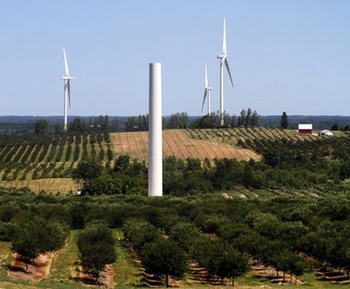
snowy hydro

Britts Will Suffer, Because of The Insane Energy Practices of their Government!

Brits Belted by Insanely Expensive and Utterly Unreliable Wind Power

ed-davey_885751c

Britain’s political betters have set it up for one enormous gamble.  Britain is wagering its entire economic future on its – out of control – wind power boondoggle.

Back in January, The Economist reported on the INSANE cost of delivering offshore wind power – where generators are guaranteed obscene returns – being able to charge “three times the current wholesale price of electricity and about 60% more than is promised to onshore turbines.”

The Economist reported that “offshore wind power is staggeringly expensive” and “among the most expensive ways of marginally reducing carbon emissions known to man”.  But that is merely to compare the insane costs of onshore wind power with the completely insane costs of offshore wind power (see our post here).

Now Britain’s House of Lords has weighed in with an inquiry into their runaway wind power policy – a policy which promises to not only put them in the poor house, but to leave them in the dark. Here’s the Daily Express with the latest on Britain’s wind power debacle.

UK’s wind farm ‘folly’: Electric bills to soar by £1000 thanks to reliance on wind power
Daily Express
John Ingham
15 October 2014

HOUSEHOLDERS are facing soaring energy bills and winter power cuts thanks to the “folly” of relying on wind power, experts said last night.

The green crusade of successive governments is set to double electricity bills for households and cost homes £26billion a year by 2030, it was claimed yesterday.

The cost of renewable energy and carbon taxes will put an extra £983 a year on household bills by then, compared to relying on a mix of nuclear and new gas-fired power stations, three experts told a Lords committee.

They also said the “foolhardy” green policy will do little to cut emissions of the greenhouse gases blamed for global warming.

The Scientific Alliance report highlights warnings by the regulator Ofgem that the margin for electricity production for the 2015-16 winter will be at an all-time low of 2 per cent compared to the pre-privatisation requirement of at least 20 per cent.

It means that in times of high demand, such as during very cold weather, Britain would be at risk of power cuts.

The alliance argues that wind power – which is the main renewable energy source depended on by Government – is unreliable.

One of the experts, Sir Donald Miller, former chairman of Scottish Power, said: “The blind reliance by successive governments on unreliable, intermittent renewable energy has reduced the margin of safety to a critical level.

“This has brought the country to a position where power cuts could become a regular feature of cold winters for several years.”

The written report has been submitted to the Lords Science and Technology Committee’s inquiry into the nation’s electricity infrastructure.

At the inquiry’s launch its chairman, the Earl of Selborne, said: “We are set to see our safety cushion between demand and supply drop to particularly low levels over the next two winters.”

And yesterday’s report stated: “The foolhardy policy of replacing reliable and efficient gas, nuclear and coal power stations by expensive and inefficient wind turbines and solar farms has raised energy prices while doing little to cut emissions of carbon dioxide.

“The total costs are some £12billion per year more in 2020 than an optimum programme of gas turbines and nuclear, and almost £26billion per year more by 2030.”

The alliance calls for new nuclear power plants to help plug shortfalls caused by the closure of ageing coal-fuelled power stations and rising demand.

The report was released as former Environment Secretary Owen Paterson prepares to deliver a lecture tonight urging the Government to stand up to green bullies and go nuclear.

Last night Dr Benny Peiser of the Global Warming Policy Forum said: “The irony is that energy prices around the world are falling, particularly for oil and gas. But households are not profiting because Government policies are making energy more expensive.”

The wind energy body RenewableUK said the study was “out of line” with other research.

The Department of Energy and Climate Change said onshore wind is cheaper than coal, gas or nuclear energy when the costs of factors like air quality, toxicity and climate change are taken into account.

“Our policies are designed to keep the lights on, cut energy use and reduce polluting emissions, at the lowest possible cost to gas and electricity customers.”
Daily Express

Predictably deluded ramblings coming from RenewableUK and the Department of Energy and Climate Change. We’d love to see the evidence to support the story about wind power reducing CO2 emissions.

DECC’s wild claims about wind power reducing “polluting emissions, at the lowest possible cost” is, well, nothing more than hot air.

Nowhere in the world has the wind industry produced a shred of evidence to support its – long on emotion and short on facts – claims about cutting emissions in the electricity sector. Probably because all of the evidence that’s been properly gathered points in the opposite direction – ie, that trying to incorporate wildly intermittent wind power into a gas and coal-fired grid results in an increase in CO2 emissions (seeour post here).

If DECC was serious about reducing CO2 emissions in the electricity sector, it would be pushing for massive investment in nuclear power plants: nuclear power plants, which run at about 90% of capacity, avoid almost four times as much CO2 per unit of capacity as do wind turbines, which run at about 25% (although they can’t tell you just which 25% of the time that might be) and at a fraction of the cost (see our post here).

As DECC says it’s all about reducing “pollution” (although we’re pretty sure they’re talking about CO2 gas – an odourless, colourless, beneficial trace gas essential for life on earth – plants are lapping it up, right now) – but their perverted ideology means they can’t see the gas for the trees.

STT has long held the view that if governments were seriously committed to reducing CO2 emissions to avert “climate change” (formerly known as “global warming”), they would have started building nuclear power plants at a cracking pace 20 years ago, when the alarmists started wailing “climate catastrophe” at every available opportunity.

But, no. Instead they’ve redirected $billions of subsidies to wind power outfits – filched from unwitting taxpayers and power consumers – to support a “technology” that will never be any kind of sensible alternative to anything (unless freezing or boiling in the dark are your kind of thing) – let alone a substitute for coal, gas, hydro or nuclear power (see our post here).

Luckily for Brits, the House of Lord’s inquiry is being presented with some of these (unavoidable) facts about the cost and pointlessness of wind power.

As the second leg of a ripping “Daily Double”, here’s the Editor.

Costly, ineffective and ugly: It is time to confront wind power
Daily Express
15 October 2014

ENERGY sources should be cheap and reliable but wind power is neither.

A Lords committee was told by energy experts yesterday that our “foolhardy” reliance on wind energy will double electricity bills for households by 2030 so it cannot be considered cheap.

And because they do not work when there is too much or too little wind they cannot be considered reliable.

The experts say this unreliability has left us at risk of power cuts.

In fact wind power does not even have a significant impact on reducing greenhouse gas emissions.

Due to their extreme unreliability, conventional power stations have to be kept on standby, burning coal or oil all the while to make up for when wind turbines are out of action.

Hitting us in the pocket may be bad enough but wind farms have also ruined huge swathes of our most picturesque countryside as well as being deafeningly loud and presenting a significant danger to various forms of wildlife.

These facts mean nothing to the green lobby who will continue to forcefully oppose shale gas exploration and the building of nuclear power plants even though these sources could provide us with reliable energy at a fraction of the cost of wind power.

The Government needs to stand up to environmentalists, stop listening to their misleading claims and start putting our energy security first.
Daily Express

Hear, hear!!

house of lords

The Undeniable Facts About Useless Wind Energy!

With wind turbines, ‘rotten’ cuts both ways

Bill Lueder’s Oct. 13 Money & Politics column in The Reporter — Wisconsin Lags on Renewable Energy — focuses on the progress of renewable energy projects in our state. He discusses solar and wind project development.

The author quotes Matt Neumann, president of the Wisconsin Solar Energy Industries Association, who says that Wisconsin’s recent record on renewable energy is “rotten.”

As a resident for six years in the Blue Skies Green Fields industrial wind project in Fond du Lac County, “rotten” is how I would describe what life has been like for my family and a number of my neighbors.

Yes, most citizens likely want energy policies that include a conservation plan, as well as different forms of renewable energy. I am not against renewable options. But what wind developers and the author of this article won’t tell you is that increasing numbers of wind turbine project residents report being sick in their homes with headaches, ear pressure, ear pain, nausea, dizziness and sleep deprivation from the infrasound and inaudible Low Frequency Noise emitted by the giant wind turbine blades.

Lueder’s article used numbers and percentages to make his case supporting renewable energy. In regard to industrial wind turbines (IWTs), what the article fails to tell readers is that industrial-scale wind turbines after 20 years of federal tax dollar subsidies in the form of Production Tax Credits have a capacity factor rated from only 17 percent to 25 percent. IWTs are not reliable and cost-effective.

When there is no measurable wind, the IWTs are not adding electricity to the grid. In fact, they require winds up to eight miles per hour before they add electricity to the grid. The money could be better spent on biomass, solar and conservation programs because wind-generated electricity is not only unsafe when sited too close to people, but is 45 percent more expensive than conventional energy systems in the state of Wisconsin.

Michael Vickerman, a spokesman for Renew Wisconsin and lobbyist for wind turbine projects, stated in the column that wind projects have “flatlined.” He added that no new wind turbine projects have been built in 2013 and 2014.

In my opinion, that is because rural Wisconsinites are educating themselves on the hazards of living 1,250 feet from these massive wind generators as set by Public Service Commission guidelines. They won’t tell you about the over 100 wind project residents in five counties who have completed notarized affidavits submitted to their county Boards of Health and reporting the above adverse health symptoms.

When these residents leave their homes for a few days, the adverse symptoms disappear. They can sleep at night. They do not experience the ear pressure and pain and tinnitus. After years of the state ignoring these complaints and their calls for a state-ordered scientific health study, last week the Brown County Board of Health weighed the scientific data collected, including the December 2012 noise testing from Shirley Wind in southern Brown County, and voted unanimously on the following resolution:

“To declare the Industrial Wind Turbines at Shirley Wind Project in the Town of Glenmore, Brown County, WI a Human Health Hazard for all people (residents, workers, visitors, and sensitive passersby) who are exposed to Infrasound/Low Frequency Noise and other emissions potentially harmful to human health.” (Brown County Board of Health, 10/14/2014)

These victims in five Wisconsin counties can no longer be dismissed and discredited by some journalists and the wind lobbyists.

Joan M. Lagerman of the town of Marshfield is a member of Concerned Citizens of Fond du Lac County.