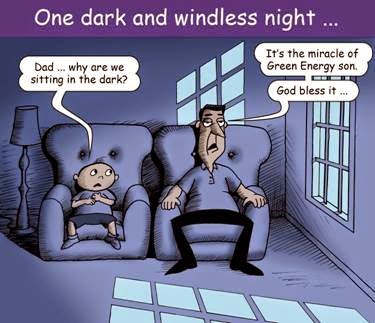
Unreliable, Unaffordable, Unwanted Wind Turbines…They’ve got to go!

Parker Gallant Uncovers the Hidden Costs of Ontario’s Insane Wind Power Policy

turbines ontario

Ever tried to imagine hell on earth?

Ever imagined a nightmare turned to reality?

Then you’ve probably landed in Ontario.

Ontario is the place where the most bizarre energy policy in the world has seen thousands of giant fans speared into the backyards of homes – in the most agriculturally productive part of Canada. When we say “bizarre” we mean completely bonkers.

Canada has one of the “cleanest” power generation mixes on the planet, with the vast bulk of its electricity coming from zero emissions sources such as nuclear and hydro.

Ontario energy mix 2013

As Professor Ross McKitrick explains in this post, Ontario has built a policy that sees wind power (when the wind is blowing) “displace” emissions free hydro at enormous cost to power consumers and taxpayers.

And then there’s the colossal human impact of plonking thousands of turbines as close as 550m from hundreds of homes (see our posts hereand here).

image

Adding to the lunacy is the fact that wind power outfits are guaranteed to reap fat profits despite market conditions.

Where the wholesale market price for power in Ontario is between $30-50 per MWh, wind power generators pocket a fixed price of $135 MWh – even if there is absolutely no market for it and the Province literally has to pay neighbouring US States to take it.

Parker Gallant – a former banker – is out to ensure that Ontario’s power consumers and taxpayers are aware of just how ludicrous its energy policy has become.

Parker Gallant: the cost of curtailing wind is borne by all

Parker has been busy letting everyone know about the the hidden financial costs of Ontario’s wind farm fever.

Late last year the Ontario Energy Minister said that the cancelling a gas plant would cost the people of Ontario no more than the price of a cup of “Timmies”: coffee brewed up by Canada’s favourite coffee franchise, Tim Horton’s.

A few weeks back, during a windy weekend, Ontario was “blessed” with an abundance of wind power – which – on the first pass – cost it $135 per MWh in guaranteed payments to wind power outfits. But – because what was produced was excess to requirements – Ontario’s taxpayers were stung a second time for the cost of paying New York and Michigan and Quebec to take it.

The total cost was hardly small change – whether measured in cups of coffee or hard cold cash. Here’s Parker doing the sums.

Another expensive weekend, thanks to Ontario wind farms
Parker Gallant
7 October 2014

On the weekend just past, October 4 and 5, wind turbines in Ontario once again proved they can produce lots of electricity—when demand for power is low. At the same time, they drove down the hourly Ontario electricity price (HOEP) and played a role in generating lots of power that was then exported to our neighbours at a substantial cost to Ontario’s ratepayers.

Total demand for electricity on October 4 was 393,816 MWh (megawatt hours); 18.1% (71,328 MWh) of it was exported. In the process of exporting the HOEP generated a negative “weighted average price” of minus 32 cents a MWh. Ontario paid our neighbours to snap up our excess power which presumably included all of wind’s production of 32,958 MWh. Ontario’s ratepayers picked up the tab which for wind power alone ($135.00/MWh + .32 cents = $135.32 MWh) was $4,459,877.

Sunday, October 5 wasn’t much better: total demand was 379,656 MWh and 66,408 MWh (17.5%) was exported at a negative “weighted average price” of minus $2.64 a MWh. Wind production for that day was 30,359 MWh and we must assume it again played a role in driving down the HOEP. So, those wind exports alone cost Ontario’s ratepayers $4,181,649 ($135/MWh + $2.64 = $137.24 MWh).

Ontario ratepayers picked up the tab of approximately $8.6 million for those two days. That $8.6 million would be equivalent, to paraphrase our Energy Minister Bob Chiarelli, the price of a “Timmies” coffee for Ontario’s 4.6 million ratepayers.

If one also includes the $7 million or so that the other 75,000 MWh exported cost it becomes two “Timmies”! Add in the price of the steamed off power from Bruce Nuclear, payments to the gas plants for idling, to OPG for the Atikokan biomass plant and their spilled hydro, to the NUG (non utility generators) contracted parties, the weekend probably hit the ratepayers with total costs well over $20 million.

If that happened every weekend the cost would be equivalent to the cost of moving a couple of gas plants! Lots and lots of Timmies.

When will Ontario’s Energy Minister, Bob Chiarelli wake up and smell the coffee?

This story was also picked up Sun News – aptly describing Ontario’s wind turbines as a money pit. Here’s an interview between journalist Jerry Agar and Parker Gallant, that was aired on October 8. The transcript follows…

**********

Jerry Agar: So over the weekend, this one just past it was proven in Ontario, that by golly those big wind turbines can pump out some power so Parker Gallant is here. So this is all good news?

Parker Gallant: Well not really Jerry, no because when they were pumping….

Jerry Agar: Are you going to be grumpy about this?

Parker Gallant:  I am, that’s my usual ploy isn’t it?

Jerry Agar: I see.

Parker Gallant: Yes they were pumping out out the power, but we didn’t need it so that meant we had to export it. As a result of that it drove down the wholesale price so we were paying New York and Michigan and Quebec to take our excess power.

Jerry Agar: I see, so when we export power – we don’t sell it, we pay people to take it from us.

Parker Gallant: You’ve got it.

Jerry Agar: Are we making it up in volume – I mean – how exactly does that make any sense?

Parker Gallant: It doesn’t make any sense and that’s certainly been my efforts is to make the Ministry of energy aware of that. We shouldn’t be handing out any more wind turbine contracts because we don’t need the excess power.

Jerry Agar:: Well what was the point of even producing power then?

Parker Gallant:  Well, there was a lot, believe it or not, there was a lot of wind turbine developers in that same weekend, that were paid for not producing power. That’s on top of those that were paid for producing the power.

Jerry Agar: Just a minute, I want to add this up. We were paying people not to produce power then we were producing power and we were paying people to take that power.

Parker Gallant: You’ve got it.

Jerry Agar: All right. This from the government that spent $1 billion not building a power plant.

Parker Gallant: That’s right, or moving a power plant.

Jerry Agar: Yes, yes. Now the government got re-elected.

Parker Gallant: I know. Its unfortunate but.

Jerry Agar: We live in a world we could never have imagined.

Parker Gallant: No we can’t.

Jerry Agar: So then what’s the addiction to these wind turbines if in fact they were pumping out power, and they were reducing our cost because hey they turn around and around for free apparently with wind power, it would all be great.

Parker Gallant:  it would be yeah, but we don’t offer, we don’t get competitive contracts. We just simply say we are going to pay you $135 a MWh four 13 1/2 cents per kilowatt hour
if you throw up a wind farm. You know that makes…

Jerry Agar: So for the producers it’s a no lose situation.

Parker Gallant: It’s a no lose situation. Exactly. They get paid whether they produce power or they don’t produce power as long as that wind turbine up, and they don’t actually produce power,
they still get paid.

Jerry Agar: But we don’t need the power. So what are we building them for?

Parker Gallant: Well, I don’t know. Perhaps to green the province, to save the planet from climate change. I mean that seems to be the objective.

Jerry Agar:  Its ideological?

Parker Gallant: Yes it’s very ideological.

Jerry Agar: Because it’s certainly not economical.

Parker Gallant: No it doesn’t make any economic sense and of course they never did a cost benefit analysis.

Jerry Agar: There is another issue here. Do you give credence to those people who actually say that living next to them is damaging?

Parker Gallant: Oh definitely. I’ve met people that have lived next to them and are forced to move out of their homes. There is a percentage of the population – there was a study just came out of the UK I believe that says that a certain percentage of the population will be affected by the infrasound, the noise that we can’t hear, that’s emanating from these wind turbines throughout the province.

Jerry Agar: It doesn’t bother everybody?

Parker Gallant: No it doesn’t bother – its like (sea sickness) …

Jerry Agar: So I’d go and it would bother me but it wouldn’t bother you.

Parker Gallant: That’s correct. Yes. There’s a percentage of the population, so 5 to 15% that will be affected. Autistic children are very much at risk when they live near a wind turbine.

Jerry Agar: Really?

Parker Gallant: Yes.

Jerry Agar: Okay but there’s never any consideration. This government  has, I would use the word foisted these things on communities. They haven’t even asked the community. They haven’t even had the deference to go to the Mayor – much less the local citizens.

Parker Gallant: No. That’s true. The Green Energy Act gave the provincial government all the powers to be able to put these wind turbines up no matter where, just as long as they meet the setback requirements and you know the minimum standards that they set under the Green Energy Act.

Jerry Agar: There are more being built. Construction of a giant wind turbine project in Huron County will go on. The judge denied the work stoppage proposed by local residents.

Parker Gallant: The judge did not grant the stay that the citizens had brought to stay motion before the courts to basically stop the construction. But there is still an appearance that will be coming up in the Superior Court of Ontario. So that means that if the citizens win in the Superior Court, the developers will have to remove and decommission those wind turbines. So why they’re taking the chance is beyond me, except maybe they get them in before the cold weather season hits.

Jerry Agar: You know, this is one of those situations I believe where the mass of the population in urban areas here in Toronto, where you and I are right now, love these things, because they love that greenie idea, but they don’t live next to them.

Parker Gallant: No they don’t. Well a lot of people in the green movement will say “Oh we live next to one” because there is one at Exhibition Place.

Jerry Agar: The thing barely turns.

Parker Gallant: It barely turns and it doesn’t provide any power. And it’s mostly all…

Jerry Agar: Not hooked up? A show thing?

Parker Gallant: It’s sort of hooked up. It really is a show thing. If you go back …

Jerry Agar: And nobody lives there anyway.

Parker Gallant: Yes, no, right.

Jerry Agar: All right. But if they went and stuck one right next to one of the condo buildings, although I don’t know if you will be able to fit one in now in down town Toronto. They will feel differently about it.

Parker Gallant: Yeah, I thought they should mandate putting 49 metre blades on top of the buildings that they’re allowing to be built here. The condo buildings. And maybe we could generate some power because they would be way up there in the higher atmosphere and….

Jerry Agar: And then your condo could just jiggle you to sleep. That would be nice. All right, thanks very much.

Parker Gallant: Well thank you Jerry.

Jerry Agar: I don’t know if you made us feel better but thanks for the information.
Sun News

Toronto turbine at Exhibition Place

Parker then knocked up this spreadsheet itemising the total cost of paying neighbours to take Ontario’s excess wind power.

Ontario’s expensive electricity week: what could $44M have bought?
Ontario Wind Concerns
13 October 2014

Blowing Ontario’s ratepayer dollars Money lost in just one week could have paid for 580 nurses

So far this October, Ontario’s electricity sector has been blowing our money away at an awesome pace.

Scott Luft, whom I admire for his ability to assimilate comprehensible data, posted on Tumblr some disturbing information about the first 10 days of electricity production (and curtailed production) in Ontario. Because the fall means low demand for electricity, our current surplus energy supply (principally, wind, solar and gas) was curtailed to the extent that it cost ratepayers $20 million, while the HOEP (hourly Ontario energy price) generated only $8.2 million. That $20 million of curtailment cost will find its way to the Global Adjustment (GA) pot and onto ratepayers’ bills.

I took a different route and looked at the cost of Ontario’s exports for the week of October 3rd to October 9th —those numbers are also disturbing. During those seven days, Ontario exported 399,048 MWh (megawatt hours) which was 15.7% of total Ontario demand. Wind turbines generated and delivered 184,204 MWh, which was surplus to our needs and probably exported. The money generated via the HOEP from all of the export sales was $56,300 or 14 cents a MWh. Wind turbines produced just $15,164 and we sold that production for just 8 cents a MWh.

To put this in perspective, the exported production’s cost all-in (contract value per MWh + regulatory + transmission + debt retirement charge) averaged $110/MWh, according to the latest monthly IESO Market Summary August 2014 report’s findings. Using $110/MWh the 399,000 MWh exported in those seven days hit Ontario’s ratepayers with about $44 million (less the $56,300) via allocation to the GA—that will show up on the electricity line on our bills.

Wind generation alone at the contracted rate of $135/MWh cost ratepayers $24,900,000 plus another $5 to $6 million for their curtailed production, according to Scott Luft. That $30 to $31 million plus the cost of steaming off Bruce Nuclear, paying idling gas plants, etc., and the additional cost of solar generation, would confirm the $44 million is a reasonable estimate.

What has Ontario missed out on by having ratepayers subsidizing those exports by $44 million for those seven days?

  • the annual salary of 293 family physicians, or
    580 nurse practitioners, or
  • repairing all the Toronto District School Board’s school roofs, or
  • one and a half days of interest on Ontario’s public debt, or
  • all of Ontario’s 301 MPP salaries for a full year, or
  • 40 MRI machines, or
  • 100 months of mortgage payments on the empty MaRS Phase 2 building, or
  • increasing funding for autistic children by 30% over current levels.

Just a few examples of how the wasted subsidy money that cost each Ontario ratepayer $10 for just one week could have been used!
Parker Gallant

Wind is Novelty Energy…..Scrap the Climate Change Act!

UK’s Wind Power Debacle Threatens to Leave Brits in the Dark

Owen-Paterson_323885k

Scrap the Climate Change Act to keep the lights on, says Owen Paterson
The Telegraph
Christopher Hope
11 October 2014

The Climate Change Act 2008, which ties Britain into stringent environmental measures, should be suspended – and then scrapped – if other countries refuse to agree legally binding targets, says Owen Paterson MP

Britain will struggle to “keep the lights on” unless the Government changes its green energy policies, the former environment secretary will warn this week.

Owen Paterson will say that the Government’s plan to slash carbon emissions and rely more heavily on wind farms and other renewable energy sources is fatally flawed.

He will argue that the 2008 Climate Change Act, which ties Britain into stringent targets to reduce the use of fossil fuels, should be suspended until other countries agree to take similar measures. If they refuse, the legislation should be scrapped altogether, he will say.

The speech will be Mr Paterson’s first significant intervention in the green energy debate since he was sacked as environment secretary during this summer’s Cabinet reshuffle.

In his address, he will set out an alternative strategy that would see British homes serviced by dozens of small nuclear power stations.

The Climate Change Act 2008, which ties Britain into stringent environmental measures, should be suspended – and then scrapped – if other countries refuse to agree legally binding targets, says Owen Paterson MP

He will also suggest that home owners should get used to temporary power cuts — cutting the electricity to appliances such as fridges for two hours at a time, for example — to conserve energy.

Mr Paterson will deliver the lecture at the Global Warming Policy Foundation, a think tank set up by Lord Lawson of Blaby, a climate-change sceptic and former chancellor in Margaret Thatcher’s Cabinet.

In the speech, entitled “Keeping the lights on”, he will say that Britain is the only country to have agreed to the legally binding target of cutting carbon emissions by 80 per cent by 2050.

Campaigners fear that this will bring a big increase in the number of wind farms.

They say that to hit the target Britain must build 2,500 wind turbines every year for 36 years.

Mr Paterson will say that the scale of the investment required to meet the 2050 target “is so great that it could not be achieved”. He will warn that Britain will end up worse off than if it adopted less ambitious but achievable targets. Mr Paterson voted for the 2008 Climate Change Act in opposition and loyally supported it when he was in power.

However, since he left office he has considered the effect of the legislation and has decided that Britain has to change course.

He will argue this week that ministers should exercise a clause in the Act that allows them to suspend the law without another vote of MPs.

In his speech, on Wednesday night, Mr Paterson will state that, without changes in its current policy, large-scale power cuts will plunge homes across the country into darkness.

“Blind adhesion to the 2050 targets will not reduce emissions and will fail to keep the lights on,” he will say. “The current energy policy is a slave to flawed climate action.

“It will cost £1,100 billion, fail to meet the very emissions targets it is designed to meet, and will not provide the UK’s energy requirements.

“In the short and medium term, costs to consumers will rise dramatically, but there can only be one ultimate consequence of this policy: the lights will go out at some time in the future.

“Not because of a temporary shortfall, but because of structural failures, from which we will find it extremely difficult and expensive to recover.”

He will say that the current “decarbonisation route” will end with the worst of all possible worlds.

The Government will have to build gas and coal power stations “in a screaming hurry”.

Britain’s energy needs are better met by investing in extracting shale gas through fracking and capturing the heat from nuclear reactors, Mr Paterson will argue.

He proposes a mix of energy generation based on smaller “modular” nuclear reactors and “rational” demand management. This would see dozens of small nuclear power stations, using reactors that are already fitted into submarines, being built around the country.

Home owners would also have to get used to timed power cuts using special switches that would cut electricity used by appliances.

“Let us hope we have an opportunity to put it into practice,” he will say. “We must be prepared to stand up to the bullies in the environmental movement and their subsidy-hungry allies.

“What I am proposing is that instead of investing huge sums in wind power, we should encourage investment in four possible common sense policies: shale gas, combined heat and power, small modular nuclear reactors and demand management.

“That would reduce emissions rapidly, without risking power cuts and would be affordable. What’s stopping this programme? Simply, the 2050 target is.”

Mr Paterson has spent the past few months visiting rural Tory seats — he visited six in the week after he was sacked by David Cameron in July.

He said he was appalled at the damage to the countryside from new pylons to take electricity from remote onshore wind farms.

This week’s speech will be Mr Paterson’s first intervention since he lost his job in the Cabinet reshuffle in the summer. He is to make another speech on Europe before Christmas as he seeks a more active role on the Right.

Mr Paterson has already set up a think tank called UK2020 to consider new policies on personal taxation, immigration and the economy.

However, his intervention was dismissed last night by Edward Davey, the Liberal Democrat Energy and Climate Change Secretary.

Mr Davey said: “Ripping up the Climate Change Act would be one of the most stupid economic decisions imaginable.

“The overwhelming majority of scientists agree that climate change exists while most leading British businesses and City investment funds agree with the Coalition that taking out an ‘insurance policy’ now will protect the UK against astronomical future costs caused by a changing climate.

“The majority of European countries are ready to implement proposals that would see [them] adopt targets similar to our Climate Change Act in a deal the Prime Minister should seal later this month.

“With the USA, China and India also now taking the climate change threat seriously, the global marketplace for green technology is increasingly strong.”
The Telegraph

ed-davey_885751c

Windweasels Using “Faux-green Shills”, to Scream for Subsidies….Useful Idiots!

The Wind Industry Pays “Green” Groups $millions to Chant for More Subsidies

Pied_Piper

A little while back, the good Senator from Victoria, John “Marshall” Madigan launched an Exocet missile at the seedy world of hard-green-left politics and the wind power outfits that fund the Australian Greens (seeour post here).

The Greens have been particularly coy about where the hundreds of thousands of dollars used to fund their last Federal election campaign (including the rerun of the West Australian Senate election) came from. The key beneficiaries of that fat pile of corporate cash have been lunatics like Sarah Hanson-Young, Senator from South Australia. Sarah set out to crush SA’s favourite Greek, Nick Xenophon but, in the result, she was lucky to sneak over the line herself. Nick (a true STT Champion) – who ran as an independent candidate – polled a snicker under 25% in the South Australian Senate race (beating the Labor Party’s vote of 22.7%) – an all-time record for an independent Senator.

But, we digress. Since the launch of Vestas’ “Act on Facts” campaign in June last year it was evident that the Greens “fortunes” had – mysteriously – improved (see this article and see our post here). Since then the Greens have been very keen to “sing” for their supper. Recently, it’s come to light that the billionaire founder of wotif.com, Graeme Wood has poured hundreds of thousands of dollars into the Green’s coffers. And, just like Vestas, is looking to use the Greens to advance his wind farm interests, proving that the Greens truly are the best party money can buy.

Paying $millions to so-called “green” politicians and astro-turfing propaganda outfits like the WWF (see our post here), Getup! and 350.org (see our post here) has become a central wind industry strategy: if you’re a foreign owned company worth $billions, with no political credibility and rolling in mountains of (other peoples’) cash, why not pay a bunch of slick little political manipulators to plead and beg to governments on your behalf?

It’s a strategy employed around the globe: the US providing just another example of the tangled web woven by wind industry rent-seekers. Here’s an American take on the mother of all scams.

Wind Cronies Funding Anti-GOP Attack Ads Through LCV: Seeking Tax Subsidies as Their Reward
Daily Surge
Roberto Escoban
8 October 2014

Republicans in targeted Senate races are finding themselves under attack from millions of dollars in attack ads from the League of Conservation Voters (LVC). Seen as anti-business, the LVC has a new ally that has opened their pocketbooks in a big way to support their efforts — the wind energy industry.

Wind power is inefficient, kills endangered birds at alarming rates and relies on taxpayer handouts and subsidies to survive. One of the subsidies is a tax credit that has been described as a “Wall Street wolf in green clothing.” Most of the tax benefits goes to big investors to offset tax liabilities on their other investments. Warren Buffet, for instance, admitted he invested in wind farms to lower his tax rates. “That’s the only reason to build them,” he said.

The tax credit expired in the last Congress but the Democrat Senate is prepared to renew it. That’s why the wind power industry has become tight allies with LCV. For instance, Tom Kiernan, the CEO of the American Wind Energy Association (AWEA) sits on the board of LCV and currently serves as Treasurer.

Peter Mandelstam also sits on the board of LCV. Mandelstam served for 13 years on the Board of American Wind Energy Association (AWEA) and chaired AWEA’s Offshore Group for 7 years. Mendelson even founded his own wind energy company, Green Sail Energy in 2012.

The incestuous relationship between wind power industry and the LCV doesn’t end there.

Theodore Roosevelt IV, the Managing Director at Barclays Capital for Investment Banking and Chairman of their CleanTech Initiative sits on the board of LCV too. Barcalys provided the financing for the Cape Wind offshore wind farm.

Flush with cash and the help of the cronies who rely on the tax credit to profit, LCV and AWEA have launched ads in the Iowa and Colorado Senate races attacking Republican candidates and supporting Democrat candidates eager to keep the flow of taxpayer funds moving to these enterprises.

It should be noted that when Tom Kiernan became the CEO of the American Wind Energy Association (AWEA) saying he wanted to strengthen ties between conservationists and the business community.

Kiernan wrote in The Huffington Post, “For my entire career, I’ve sought to strengthen the ties between conservation and the American business community, because a strong environment and a strong economy go hand in hand. Wind power has enormous potential to reduce humanity’s overall footprint on the environment and the planet.”

Kiernan does not talk about how LCV has become a front for the corporate effort to extend a tax benefit that does little to help the environment and a lot to help Wall Street investors pocket more money. AWEA’s top priority is “keeping the production tax credit” because “the political climate in Washington is getting tougher.” He has spent nearly $3 million so far lobbying to get the job done.

If you live in a state with a targeted Senate seat and see one of these LCV attack ads, it would be prudent to remember the cronies priming the pump to put these ads on the air.
Daily Surge

dirtyrottenscoundrelsoriginal

Climate Alarmists are Looking Rather Foolish, as the Earth Cools Down……

Global warming scare declared over

Source: WND  agw-earth

‘Past time to stop the madness of wasting great sums of money on EPA’s imaginary threat’

Scientists and others on a team assembled by the Chicago-based Heartland Institute, which focuses on free-market solutions to today’s problems, say the “scare” of global warming from the use of carbon fuels and other human activities “is over.”

It’s “past time” for the world to realize that and “stop the madness of wasting great sums of money on EPA’s imaginary threat,” contends Kenneth Haapala, the executive vice president of the Science and Environmental Policy Project at the Heartland Institute.

Institute experts said Thursday the Remote Sensing Systems, which provide data to NASA, NOAA and the National Science Foundation, have confirmed “the global mean surface temperature has not risen for 18 consecutive years.”

“This extends the so-called ‘pause’ in global warming to a new record, one not predicted by the climate models of the United Nations’ International Panel on Climate Change,” the organization said.

Craig Idso, senior fellow in environment for the Heartland Institute and co-editor of the Nongovernmental International Panel on Climate Change, a counterpart to the IPCC, said that to “the world’s climate alarmists, atmospheric carbon dioxide is a dangerous trace gas, and for years, they have been insisting its increase will raise global temperatures and wreak havoc upon Earth’s climate and biosphere.”

“Yet, despite a 9 percent increase in CO2 over the past 18 years, there has been no rise in global temperature,” he said.

“Think about that. Over this time period the air’s CO2 content has risen some 40 parts per million, which represents fully one-third the total global CO2 increase since the beginning of the Industrial Revolution, yet contrary to model projections, planetary temperatures have failed to rise,” Idso said.

Idso said it’s “time for global warming diehards to face the facts.”

“Stop denying the models have got global temperature projections wrong. Stop denying CO2 has a lower climate sensitivity than you have been claiming. Stop denying the societal benefits of continued fossil fuel use. It’s not too late to make a course correction and support sound science,” he said.

James Taylor, the institute’s senior fellow for environmental policy, said, based on the latest results in the climate studies, that the “ongoing 18 years without any warming strongly contradict alarmist predictions of global warming doom-and-gloom.”

“According to nearly all of the United Nations’ computer models, this lack of warming could not occur,” he noted. “The real-world climate proves the alarmist computer models overstate the warming properties of carbon dioxide. Even when Earth resumes its modest warming, which it likely will at some point in the next couple of decades, the pace of warming will continue to be quite modest and beneficial to human welfare and global ecosystems.”

Haapala dinged the federal EPA over the issue.

“The EPA claimed that carbon dioxide emissions are pollutants that endangers human health, even though carbon dioxide is necessary for life on this planet. Green plants need carbon dioxide for photosynthesis to create the food plants and animals need to survive. The EPA stated that it based its finding on three lines of evidence. These lines of evidence do not exist, or no longer exist. They are: (1) a distinct human fingerprint in the atmosphere over the tropics; (2) late 20th century warming was unusual; and (3) climate models predict that human-caused warming would become dangerous to humans in the 21st century. No one, including the National Academy of Sciences, has been able to find the distinct human fingerprint except those who falsely claim such a warming is uniquely human-caused,” he said.

“Late 20th century warming stopped about 18 years ago. Climate models cannot explain why, even though, according to the White House, federal expenditures on climate science and programs to fight global warming/climate change amount to about $22.5 billion a year. There is no scientific reason to assume significant warming will occur in the future from human carbon dioxide emission.”

Haapala said it’s “past time to stop the madness of wasting great sums of money on EPA’s imaginary threat to human health.”

Tom Harris, executive director of the International Climate Science Coalition, pointed out that the established criteria of global-warming alarmists shows their models are not reliable.

“In 2008, the NOAA ‘State of the Climate’ report specified exactly what observations would indicate whether the models are reliable or not: Fifteen years of no warming. In 2009, climate scientist Phil Jones agreed, telling a colleague in one of the leaked Climategate emails: ‘Bottom line: the ‘no upward trend’ has to continue for a total of 15 years before we get worried,’” Harris said.

“Having just passed 18 years with no warming, the criteria, as set by alarmists themselves, is now satisfied. The global warming scare is over,” Harris said.

H. Sterling Burnett, research fellow at the institute and managing editor at Environment & Climate News, said this year’s high school graduates “were raised to believe in and fear something that stopped happening before they were born.”

“Growing Antarctic ice sheets, increased greening of the earth, more walruses and polar bears than at any time since the beginning of the 20th century, fewer hurricanes and tornadoes, only a modest sea level rise, longer life spans and better overall health … if these are the terrors of global warming, I’ll have more please.”

James Rust, retired professor of nuclear engineering at Georgia Tech, said there have been dozens of “explanations” for the “pause in global warming – most claiming heat is hidden somewhere in the ocean.”

“These claims are fiction, as was the claim by a British meteorologist in 2001 that children today, in 2014, would never witness snow,” he said.

Marc Morano, publisher of Climate Depot, said the evidence simply shows carbon dioxide is not the “overriding driver of the climate.”

And meteorologist John Coleman said it’s time to get over it.

“There has not been any significant man-made global warming in the past, there is none now, and there is no reason to expect any in the future,” he said. “The computer models that predicted the warming have failed to verify. There has been no warming in 18 years. The ice at the poles is stable. The polar bears are increasing. The oceans are not rising.”

Mischa Popoff, institute policy adviser, said, “Here we are in 2014 and there has been no global warming for the past 18 years.”

Alan Caruba of the National Anxiety Center said that after 18 years of observing no increase in average global temperature, it’s bad enough that the IPCC and it’s defenders won’t concede they were wrong, and the media won’t report it.

“But the worst of this 18-year anniversary of the lack of warming is the fact we have a president, a secretary of state and others in the Obama administration who continue not only to proclaim warming – now called climate change – but suggesting that it is the greatest threat to the nation and the world,” he said. “The absurdity of this should hold them up to ridicule, but these pronouncements are published without criticism.”

He said the current cooling cycle Earth is experiencing will continue for many years to come.

The cause, he said, is “nothing more mysterious than our sun – which is, itself, in a natural cycle of lower radiation.”

“As always, nature, not man, will have the last word.”

Just days ago, WND columnist Lord Monckton wrote: “Worldwide, the liarists – growing ever more desperate as the Great Pause grows ever longer – are taking up the cry that The Models Were Right All Along But The Warming Has Gone Into Hiding, Really And Truly It Has, With Knobs On, Cross My Heart And Hope To Die, So There.

“Just one problem with that. The catastrophist clique no longer entirely controls the scientific journals. It tried to, but it didn’t get away with it. In addition to ‘The ocean ate my global warming,’ the scientific journals contain a host of recent papers giving between them no less than 25 – yes, 25 – mutually incompatible explanations of the Great Pause.”

One year ago, Cairo saw its first snow in 100 years. Oregon, like several other states, reached its coldest temperature in 40 years. Chicago saw its coldest days ever, and – as if to add finality to the trend – Antarctica reached the coldest temperature ever recorded anywhere on earth.

The holes in the theory have been documented. For example, London’s Independent newspaper declared at the turn of the millennium “Snowfalls are now just a thing of the past.” The report quoted David Viner, senior research scientist at the Climatic Research Unit of the University of East Anglia, long considered an authoritative resource for global warming research, as saying snow would soon be “a very rare and exciting event” in Britain.

“Children just aren’t going to know what snow is,” he claimed at the time.

But the authoritative reputation of East Anglia was seriously downgraded in 2009 when leaked emails proved researchers there were engaged in a major scheme to manipulate and suppress evidence against global warming, misconduct London’s Telegraph newspaper called “the worst scientific scandal of our generation.”

The rhetoric and predictions of global warming acolytes have been every bit as confusing in the United States, with former vice president and carbon-credit entrepreneur Al Gore telling an audience in a 2009 speech that “the entire north polar ice cap during some of the summer months could be completely ice-free within the next five to seven years.” And his 2006 documentary “An Inconvenient Truth” famously predicted increasing temperatures would cause earth’s oceans to rise by 20 feet, a claim many scientists say is utterly without rational basis.

Well-known scientist Art Robinson has spearheaded The Petition Project which to date has gathered the signatures of 31,487 scientists who agree that there is “no convincing scientific evidence that human release of carbon dioxide, methane, or other greenhouse gases is causing or will, in the foreseeable future, cause catastrophic heating of the Earth’s atmosphere and disruption of the Earth’s climate.”

They say, “Moreover, there is substantial scientific evidence that increases in atmospheric carbon dioxide produce many beneficial effects upon the natural plan and animal environments of the Earth.”

Robinson, who has a Ph.D. in chemistry from Cal Tech, where he served on the faculty, co-founded the Linus Pauling Institute with Nobel-recipient Linus Pauling, where he was president and research professor. He later founded the Oregon Institute of Science and Medicine.

He told WND that weather does change over time and that the global system goes through cycles, some slightly warmer and some slightly cooler than others.

Right now it’s cooler, he said.

Be Sociable, Share!

Intelligent people Know the Climate Agenda is an Unaffordable Waste of Time and Resources!

Owen Paterson To Call For Suspension Of UK Climate Change Act

power-lines-ukBritain will struggle to “keep the lights on” unless the Government changes its green energy policies, the former environment secretary will warn this week. Owen Paterson will say that the Government’s plan to slash carbon emissions and rely more heavily on wind farms and other renewable energy sources is fatally flawed. He will argue that the 2008 Climate Change Act, which ties Britain into stringent targets to reduce the use of fossil fuels, should be suspended until other countries agree to take similar measures. If they refuse, the legislation should be scrapped altogether, he will say. Mr Paterson will deliver the lecture at the Global Warming Policy Foundation, a think tank set up by Lord Lawson of Blaby, a climate-change sceptic and former chancellor in Margaret Thatcher’s Cabinet. –Christopher Hope, The Sunday Telegraph, 12 October 2013

It is safe to predict that no speech made by a British politician this week will be more surprising or significant than that to be delivered by Owen Paterson, a senior Conservative, who was sacked from the Cabinet last July for being too good at his job. –Christopher Booker, The Sunday Telegraph, 12 October 2014

The high cost of energy could drive companies out of the UK, according to the EEF, the manufacturers’ organisation.  The EEF claims that the projected 50 per cent rise in electricity prices by 2020 would harm British manufacturing. The warning follows research from the EEF which shows that rising energy costs would lead to a quarter of manufacturers considering investment overseas. —Yorkshire Post, 13 October 2014

The very idea that an advanced economy such as ours faces an energy crisis within the next few years should attract the most urgent attention of our political leaders. Yet we appear to be drifting into a situation of great seriousness because they are all wedded to unrealistic decarbonisation targets that none seems willing to revisit. Owen Paterson has begun a debate that cannot be shut down simply because it raises some difficult political questions. If this is not gripped now, then the next government, of whatever stripe, will need to explain to the country why they could have prevented the lights going out, but didn’t. –Editorial, The Sunday Telegraph, 12 October 2014

EU leaders face difficult negotiations to agree a package of climate change targets for 2030 at an end-of-October summit, with coal-reliant Poland leading objections, sources said on Friday. “The European Council will agree on the 2030 climate and energy policy framework for the European Union,” said the draft prepared for the bloc’s 28 member state leaders. But the question of “burden sharing” is central to actually closing a deal, a European source said, with sharp differences between those dependent on fossil fuels, such as Poland, compared with France and Britain which favour nuclear, and Germany which is looking towards renewables. Poland’s new prime minister, Ewa Kopacz, said earlier this month that her coal-reliant country would not rule out vetoing the high carbon cuts. —AFP, 10 October 2014

Forget QE, surely the precipitous oil price decline in the last couple of weeks will finally give the down-trodden European economy the big boost it needs. After three years of prices north of $100 a barrel, surely a big cut in Europe’s energy bill will provide a stimulus effect that Mario Draghi could only dream of? I’m afraid not. Why? Europe is overwhelmed by taxation, subsidy, over-capacity and green incentivisation plans that have conspired to make hydrocarbons a dirty and expensive source of energy. –Steve Sedgwick, City A.M., 7 October 2014

Wind Industry is NOT Viable, and we Can’t afford to Support Them!

Photo: Ingram/Getty Images

One of the world’s largest wind turbine manufacturers let loose a bit of truth and self-admission to the Financial Times: We still need help, and that help must come from taxpayers.

The wind production tax credit, a generous $23 per-megawatt-hour tax credit the producer receives for 10 years, expired last year. At that rate, taxpayers are effectively covering half the wholesale price of electricity and, in some areas of the country, the entire wholesale price. The PTC expired at the end of 2013, but several policymakers are pushing for an extension.

Lisa Davis, who leads the global energy business at Siemens, told the Financial Times the wind industry was close to grid parity with conventional sources of electricity such as coal and natural gas, but “we’re not there yet.”

“We’ve not yet got to the point where it’s truly self-sustaining,” she said. “We’ve got to focus on cost competitiveness.”

So the way to become self-sustaining and cost-competitive is to plead for extended reliance on the taxpayer? That is exactly why Congress needs to cut the cord on wind energy subsidies from the federal government. The wind industry cannot focus on lowering costs while it is so heavily subsidized because subsidies enable them to ignore costs. So, rather than trying to achieve the true price point necessary for cost-competitiveness, the wind industry concentrates on securing more subsidies. Eliminating the PTC for good will allow wind producers to become self-sustaining if the technology truly can compete with other sources of energy.

If wind cannot compete, then it doesn’t belong in our energy mix. America has a robust and diverse supply of electricity generation where our energy demands are met through coal, natural gas, nuclear, hydropower and other renewable sources. We don’t need the federal government to create artificial diversity that wastes taxpayer dollars and promotes stagnation. This holds true for all energy sources.

The reality is startups and new ideas and technologies succeed and fail all of the time. Failure should not be a signal for the federal government to come to the rescue; it’s a signal those resources can be put to more productive use in the economy. But the wind industry is no start-up. It’s been more than 22 years since Matthew Wald of the New York Times wrote, “Because of striking improvements in technology, the commercial use of these windmills, or wind turbines as the builders call them, has shown that in addition to being pollution free, they can now compete with fossil fuels in the cost of producing electricity.”

There is no justification for propping up established companies, either. If Chi Chi’s pleaded for handouts to stay competitive with the likes of Applebees, or Microsoft told America it needed support from the taxpayer to sell more Zunes, policymakers rightfully would scoff. Those companies didn’t fail because they weren’t cost competitive; they simply offered a product consumers didn’t want to buy.

Rather than creating a sustainable industry, the PTC artificially propped up an industry, advanced special interests and allocated labor and capital away from more competitive uses in the marketplace. Extending the credit would only exacerbate those problems and complicate opportunities for real tax reform. Congress should hold its ground and keep the sun set on the wind PTC.

Wind Poised to Be Blown Out of Australia? Let’s hope so!

Is this the death of Australia’s renewable energy industry?

d0196-_users_viv_appdata_local_temp_tmpf05_files_image002

The Australian government – and ministers Greg Hunt and Ian Macfarlane in particular, like to tell everyone how much they support renewable energy. But they seem to be doing their level best to trash the industry in Australia.

Key data released late last week underlines the disastrous state of the large-scale renewable sector: for all intents and purposes, it doesn’t exist.

Bloomberg New Energy Finance data shows that Australia is on track to record its lowest level of asset financing for large-scale renewables since 2002 – as just $193 million was committed in the third quarter of the year. From ranking No 11, in the world in 2013, Australia has fallen behind Algeria and even Myanmar.

bnef investment

Australia, which should be one of the world’s leaders in the industry, is seeing its industry collapse. The three biggest Australian investors in renewable energy are in deep trouble.

Industry Funds Management is being forced to write down the value of Pacific Hydro, the largest specialised investor in renewables in the country, by $685 million, according to the Australian Financial Review. This from a business that was to have been floated a year or so ago with a value of more than $2 billion.

Infigen Energy, the largest listed investor in renewables, has said it is facing massive writedowns, and potentially taking dramatic action to protect shareholder funds. It has brought Australian investments to a halt. So has Silex Systems, which has effectively abandoned the solar industry.

International investors have also made clear that their investment in Australia will end soon un less policy stability is restored. These include First Solar, Chinese wind turbine leader Goldwind, and numerous others. The US-based Recurrent Energy has already packed its bags, Spanish based FRV has said its $1.5 billion pipeline is at risk.

The reason for this? Despite the protestations of the Abbott government, it is the uncertainty they have created. Each of the private companies has cited uncertainty about the RET, a situation that Hunt and Macfarlane know only too well because they kept complaining about it in opposition when the RET legislation was delayed in 2009 and 2010.

IFM CEO Brett Hinbury said the two biggest factors affecting the company was the fall in energy demand – and the uncertainty around the current laws.

As BNEF explains:

“The severe downturn in investment – and total freeze in private investment – has been caused by the Abbott government’s review of the Renewable Energy Target,” it writes.

“Its controversial review panel recommended scrapping the target or radically diminishing it in August, but the government is yet to announce its position and faces blockage in the Senate to changes.

“Private investment is likely to remain frozen until the government’s position is clarified, which is expected in the coming months. However the hiatus in investment will continue for several years if the recommendations of the review panel are not rejected.”

Of course, it makes an absolute nonsense of the claims by Macfarlane and Hunt that the government supports the industry. They understand full well the impact of their decision to appoint a group of climate science deniers and fossil fuel lobbyists to “review” the RET under the tutelage of Dick Warburton, and of comments by Treasurer Joe Hockey that he finds wind turbines “absolutely offensive” and from Prime Minister Tony Abbott, who complains about cost impact.

This is despite the findings of  the Warburton review that the target could be met, and would deliver cost savings to consumers. Still, it recommended the RET be stopped in its tracks or halted, for fear of a “transfer of wealth” from fossil fuel generators to consumers.

The irony is that even the paltry $193 of new finance in the third quarter came from initiatives put in place by the previous Labor government, and by institutions that the Abbott government wants to shut down.

A total of 7 projects have been financed since the start of the calendar year – all are the subject of government funding through the Australian Renewable Energy Agency, Clean Energy Finance Corporation or state governments. None were backed by non-government lenders or investors.

In the first two quarters of the year, there was just $45 million of financing.

This contrasts with the continuing surge in rooftop solar – mostly for the purposes of self consumption – and the growing boom in renewables investment across the world.

Globally, clean energy investment in the first three quarters of this year was 16 per cent ahead of the same period of 2013, at $175.1billion.

The highlight of the third quarter was a leap in Chinese solar investment to a new record of $12.2 billion. China is building a large number of utility-scale photovoltaic projects linked to its main transmission grid.

In Japan, investment grew 17 per cen to $8.6 billion, with solar again the dominant renewable energy source. Other countries showing a bounce in investment in the latest quarter were Canada, France and India, while there were significant projects financed in a number of new markets, including Myanmar and Sri Lanka.

Michael Liebreich, chairman of the advisory board at BNEF said the figures were heartening, but still not enough to herald the “rapid transformation of the power systems” that is required. That would require investment of $200 billion and $300 billion a year.

The third quarter figures showed that global investment in wind farms, solar parks and geothermal plants reached $33.3 billion, a slight rise on year earlier figures, while investment in small-scale projects such as rooftop solar was $18.3 billion, up nearly a third from a year earlier.

Of course, there is a way that Hunt and Macfarlane can deliver on their claim that they really do want the best for the Australian renewable energy industry. That is to quickly reach a deal with the Labor Party and the industry on the way forward.

The Labor Party has indicated it may be prepared to defer the target to 2022, the Clean Energy Council has indicated it could accept an exemption for the aluminium industry. All the Coalition government has to do is to drop the ideological nonsense from the Warburton Review, and accept that Australia has to follow the rest of the world and put in place a rapid de-carbonisation of its electricity industry.

All over the World….Where there are Windweasels, there is Corruption!

Britain’s Green Energy Fiasco Deepens

From The GWPF and Dr. Benny Peiser

Expensive Green Energy A ‘Bad Gamble’ As Gas Price Drops

Families face paying up to £40 extra each year for wind and solar farms to meet climate change targets after the government revised its energy price forecasts. The subsidy required for each unit of renewable electricity will rise after the Department of Energy and Climate Change (DECC) conceded that gas was much cheaper than it had predicted. A glut of gas on the world market means gas-fired power stations have become cheaper to run, making wind and solar farms comparatively even more expensive. –Tim Webb & Ben Webster, The Times, 3 October 2014

green_money_windmills

Peter Atherton, energy analyst at Liberum Capital, said that green energy was “always a hell of a gamble and now looks like an increasingly bad gamble”. “Year after year [energy secretary] Ed Davey has been banging on that one of the core reasons [for backing green energy] is to protect ourselves against inevitably high and volatile fossil fuel prices. Now their own forecasts are saying fossil fuel prices are going to be very affordable,” he said. –Emily Gosden, The Daily Telegraph, 3 October 2014

The impact of rising household energy bills will be greatly reduced by climate change policies which could save consumers around £166 by 2020, according to the energy and climate secretary, Ed Davey. “Global gas price hikes are squeezing households. They are beyond any government’s control. The analysis shows that our strategy of shifting to alternatives like renewables and of being smarter with how we use energy is helping those who need it most to save money on their bills,” he said. –John Vidal, The Guardian, 27 March 2013

In a bizarre statement, energy and climate change secretary Chris Huhne told the House of Commons that his [green energy] policies mean consumers will actually be better off. Dr Benny Peiser, of the Global Warming Foundation, said Mr Huhne’s reassurances were ‘political spin’. Government policy is based on an assumption that gas prices will continue to rise, but Dr Peiser said the price could fall. He said: ‘Prices are likely to come down very significantly.’ –Sean Poulter, Daily Mail 24 November 2011

By 2020, British Energy & Climate Change Secretary Chris Huhne routinely insists, families and businesses in the United Kingdom will be better off – despite his plan to shift the country towards expensive renewable energy. His claim is based on the assumption that the price of fossil fuels can only go up as we “run out” of oil and gas supplies. As a result, energy prices will inevitably shoot into the stratosphere, making very costly renewables competitive in the future. I am afraid Huhne’s assumptions are misguided. In reality, we are in the middle of a global natural gas revolution. Indeed, gas prices have dropped by half in the United States in the last two years as a result of a glut in cheap shale gas. –Benny Peiser, Public Service Europe, 19 January 2012

As we look at UK energy policy now, DECC has had the country make a massive financial gamble on the back of a prediction that was wholly unfounded and which has been obviously so for many years. We now learn that DECC has also distributed this astonishing wave of public money in a manner that can only be described as monstrously incompetent, and which many will assume to be monstrously corrupt.
Any reasonable person would close down DECC right now and lay off all the environmentalists who staff it. –Andrew Montford, Bishop Hill, 3 October 2014

Global warming is a ‘public health emergency’ that will cause thousands of deaths worldwide, a leading medical journal warns. The BMJ’s editor Dr Fiona Godlee calls on the World Health Organisation to declare the issue a public health emergency – putting it on a par with the current ebola outbreak in West Africa. Dr Benny Peiser of the Global Warming Policy Forum accused the BMJ report of being needlessly alarmist. ‘The World Health Organisation would become a global laughing stock if they were to follow the ridiculously over-the-top demands of a green alarmist editor. There is a real disconnect between what they are saying and the reality.’ –Sophie Borland and Ben Spencer, Daily Mail, 2 October 2014

Main Stream Media Refuses to Report the Truth About Climate Change.

The Obvious Failures of Climate Science That Mainstream Media Ignores

Guest Post by Bob Tisdale –

The National Science Foundation press release Cause of California drought linked to climate change found its way into the mainstream media, with science reporters around the globe adding their hype. That press release is based on the recently published study Swain et al. (2014) “The Extraordinary California Drought of 2013/2014: Character, Context and the Role of Climate Change”, which can be found in the Special Supplement to the Bulletin of the American Meteorological Society (BAMS report)Vol. 95, No. 9, September 2014, Explaining Extreme Events of 2013 From A Climate Perspective.

I’ll publish a few comments about Swain et al. (2014) in a few days. But this post is not about that paper.

THE CALIFORNIA DROUGHT – WHO’S TO BLAME FOR THE LACK OF PREPAREDNESS?

As I was reading Anthony Watts excellent post about Swain et al. (2014), Claim: Cause of California drought linked to climate change – not one mention of ENSO or El Niño, a number of reoccurring thoughts replayed, thoughts that have struck me numerous times as the Western States drought unfolded last year and intensified this year.

Was California prepared for a drought?

Obviously, California was not prepared for a drought this intense, and the impacts of that lack of preparedness on California residents will grow much worse if the drought continues.

Why wasn’t California prepared for a short-term (multiyear) drought this intense?

The realistic blame should be the focus of climate science in general under the direction of the IPCC. In the opening paragraph of the IPCC’s History webpage, they state (my boldface and caps):

Today the IPCC’s role is as defined in Principles Governing IPCC Work, “…to assess on a comprehensive, objective, open and transparent basis the scientific, technical and socio-economic information relevant tounderstanding the scientific basis of risk of HUMAN-INDUCED climate change, its potential impacts and options for adaptation and mitigation.

The fact that the IPCC has focused all of their efforts on “understanding the scientific basis of risk of human-induced climate change” is very important. The IPCC has never realistically tried to determine if natural factors could have caused most of the warming the Earth has experienced over the past century. For decades, they’ve worn blinders that blocked their views of everything other than the possible impacts of carbon dioxide. The role of the IPCC has always been to prepare reports that support the reduction of greenhouse gas emissions caused by the burning of fossil fuels. As a result, that’s where all of the research money goes. The decision to only study human-induced global warming is a political choice, not a scientific one. In efforts to justify agendas, politicians around the world jumped on the climate change stump and funded computer model-based studies of human-induced global warming…to the tune of billions of dollars annually.

Because of that political agenda, the latest and greatest climate models still cannot simulate the basic underlying processes that govern the naturally occurring, coupled ocean-atmosphere processes like ENSO (El Niños and La Niñas), like the Pacific Decadal Oscillation…processes that have strong influences on temperature and precipitation in west coast states. So there is no possible way climate models, as they exist today, could forecast what precipitation might be like in the future there. And that basic problem will persist until there is a redirection of climate-research funding. Yes, funding. Research follows the money.

What value do climate model-based studies provide?

None.

The paper Pierce et al. (2013) The Key Role of Heavy Precipitation Events in Climate Model Disagreements of Future Annual Precipitation Changes in California provides an overview of why the climate models have no value when it comes to forecasts like California drought. In their abstract Pierce et al. write (my boldface and caps):

Of the 25 downscaled model projections examined here, 21 agree that precipitation frequency will DECREASE by the 2060s, with a mean reduction of 6–14 days yr−1. This reduces California’s mean annual precipitation by about 5.7%. Partly offsetting this, 16 of the 25 projections agree that daily precipitation intensity will INCREASE, which accounts for a model average 5.3% increase in annual precipitation. Between these conflicting tendencies, 12 projections show drier annual conditions by the 2060s and 13 show wetter.

[Hat tip to blogger “Jimbo” on the WUWT thread Claim: Cause of California drought linked to climate change – not one mention of ENSO or El Niño.]

So some climate models say that daily precipitation intensity will increase and others say it will decrease. In other words, the climate science community is clueless about what the future might bring for west coast precipitation.

Some might say that climatologists for the State of California and other west coast states have been hampered by climate science. It’s tough to make recommendations to state and local governments for long-term planning when the climate science community provides them with nothing to work with.

Is California prepared for a drought that lasts multiple decades or even centuries?

Anthony Watts’s post included a graph from a paleoclimatological study of West Coast drought that showed past droughts have lasted for hundreds of years. For the original graph and discussion, see Figure 10 of Cook et al. (2007) North American drought: Reconstructions, causes, and consequences. (Note: That’s not the John Cook from SkepticalScience.)

Now I hate to make you think about bad news. But if it’s happened in the past, can it happen again?

Why are mainstream media simply parroting press releases?

Climate-change news reports have become echo chambers of the press releases put out by colleges, universities and government research agencies. Individual reporters might provide a more in-depth report by asking the scientist-authors for a few extra word of wisdom.

But why aren’t the media asking the tough questions, like:

  • Why weren’t west-coast residents warned 10 or 15 years ago that a severe drought is just a weather anomaly away?
  • Why aren’t there enough desalinization plants in place to supplement rainfall deficits?
  • Why are the people of the west coast protesting for, and why are state governments funding, more wind farms and solar arrays when they need something more basic to maintain life there, water?

Seems to me we may very soon be seeing a reversal of Steinbeck’s The Grapes of Wrath, with vast flocks of California residents migrating back to the Midwest, which also is subject to periodic droughts.

Poor planning on the parts of a few—based on politically motivated, unsound science—may make for emergencies for millions.

Frauds, Crooks and Criminals

Demonstrating daily that diversity is not strength!

Family Hype

All Things Related To The Family

DeFrock

defrock.org's principal concern is the environmental and human damage of industrial wind turbines on rural communities

Gerold's Blog

The truth shall set you free but first it will make you miserable

Politisite

Breaking Political News, Election Results, Commentary and Analysis

Canadian Common Sense

Canadian Common Sense - A Unique Perspective from Grassroots Canadians

Falmouth's Firetower Wind

a wind energy debacle

The Law is my Oyster

The Law and its Place in Society

Illinois Leaks

Edgar County Watchdogs

stubbornlyme.

My thoughts...my life...my own way.

Oppose! Swanton Wind

Proposed Wind Project on Rocky Ridge

Climate Audit

by Steve McIntyre

4TimesAYear's Blog

Trying to stop climate change is like trying to stop the seasons from changing. We don't control the climate; IT controls US.

Wolsten

Wandering Words

Patti Kellar

WIND WARRIOR

John Coleman's Blog

Global Warming/Climate Change is not a problem