Sherri Lange, from NAPAW, calls for an Audit of the Green Energy, and Green Economies Act!

Letter to Auditor General for Ontario from North American Platform Against Windpower

To: Ms. Bonnie Lysyk (Auditor General for Ontario)       (Letter of August 11, 2014)

Dear Ms Lysyk,

Please consider this letter as an urgent formal request for a complete and impartial audit for all matters pertaining to the Green Energy and Green Economy Act, 2009, and its false assertions and negative results for Ontario: these misrepresentations include vigorous job creation, suggested cleaner air space, the ability to create energy facilities, wind and solar, in particular, in a cost savings manner, or competitive manner.

The Green Energy and Green Economy Act has suggested with not a little hyperbole, that it will “spark” growth in “renewables sources in Ontario, while creating savings, and producing 50,000 jobs, direct and indirect,” and “make a positive contribution towards climate change objectives,” whereas in fact the GEA threatens to eviscerate the economy of Ontario and Canada as a whole. The factual results of the GEA are of economic chaos, massive job losses, environmental degradation of the highest order, a decay of our treasured environmental protections in law, and yet uncounted human health and productivity costs.

Under the guise of positive net growth, and climate change objectives, this Act has been used to gouge and tyrannize the province, materially and economically.

We believe that the mandate of the Auditor General to provide access to “value for money” data, within an audit, will provide even more information with respect to the waste and perhaps fraud at the highest levels; consumers are indeed not being provided with fair business practices, but are continually subjected to even more egregious attacks in their daily “energy expensive” lives due to a battered and debt ridden economy. Jobs continue to leave Ontario. Some are relocating to Buffalo, to save, in one instance, $4 million per year in energy savings, or to Saskatchewan, for example. The bleed of jobs cannot continue, and we believe that an assertive and clear look at the funding and economic threat of the Green Energy Act will bear striking similarities to the international failure of wind power and Green Energy policies. Even information provided years ago by your office and the Fraser Institute did nothing to change the course.

We contend that none of the GEA assertions and projections have proven valid, and have in fact been a major contributor, likely THE major contributor, to the near demise of manufacturing in Ontario, to energy poverty for many Ontarians whose hydro bills have risen 30-40% with promises of more hikes, to the loss of jobs to the USA and western Canada, to the ill health of hundreds of Ontarians, some of whom have been forced to abandon homes, or been bought out by developers, or who reside in parking lots at Walmart, or at cottages, or with relatives. The energy chaos of Ontario now handily competes with that of Spain, Germany, or the UK.

All of this should be and should have been preventable, since the facts are well known. Indeed, the facts of the Green Energy failures of Europe should have been a lesson learned before this Ontario failure of a massive scale. (Ontario now has the unenviable position of having the highest cost of power in North America. The significance of this is not lost on Moody’s Credit Ratings system, with the threat of downgrades to Ontario.) The lessons of Europe have been put before the Legislature, all parties, on many occasions, without benefit or improvement.

The Fraser report of 2013 has already indicated that the assertions of the GEA are egregiously false.

“Already, the GEA has caused major price increases for large energy consumers, and we’re anticipating additional hikes of 40 to 50 per cent over the next few years,” said Ross McKitrick, Fraser Institute senior fellow and author of Environmental and Economic Consequences of Ontario’s Green Energy Act.”

“The Ontario government defends the GEA by referring to a confidential 2005 cost-benefit analysis on reducing air pollution from power plants. That report did not recommend pursuing wind or solar power; instead it looked at conventional pollution control methods which would have yielded the same environmental benefits as the GEA, but at a tenth of the current cost. If the province sticks to its targets for expanding renewables, the GEA will end up being 70 times costlier than the alternative, with no greater benefits.” (News release, April 2013)

The study goes on to indicate that returns to investment in manufacturing are “likely to decline by 29 per cent, mining by 13 per cent, and forestry by less than one per cent.”

Professor McKitrick explains in his report that wind is especially wasteful, as surplus generation occurs generally when demand is low, and the resulting “dumping” also results in net losses to Ontario.

“The Auditor General of Ontario estimates that the province has already lost close to $2 billion on surplus wind exports, and figures from the electricity grid operator show the ongoing losses are $200 million annually”, says the report.

Terrance Corcoran in the Financial Post quotes from the Auditor’s report that the cost of power is estimated to rise again another 46% in the next four years. In his analysis of the Auditor General’s 2011 report on electricity, Mr. Corcoran writes of “wilful negligence” and a “high level of fiscal negligence and abuse of process and disdain for taxpayers and electricity consumers.”

A prime example of the negative impact on the Ontario jobs situation is reflected in Magna’s (the largest automotive parts manufacturer in Canada) announcement that due to the high cost of electricity in Ontario, it will not make any further investments. (Specifically, for Magna between 2013 and 2014, normal business activities resulted in an increased cost of electricity of 30 million dollars.)

The expressed primary purpose of the 2011 audit was to ensure that the OEB had sufficient and adequate systems in place to protect consumers, ratepayers. As noted also in the report, consumers are protected under the Energy Consumer Protection Act, 2010, and that under this legislation consumers shall be provided with the information they require about contracts, prices, and that they will be protected by fair business practices. This fairness has not been brought to fruition.

And the serial negligence continuing until this day, despite hearty and clear directives from the Fraser Institute and your office, has resulted merely in the advance of even more industrial wind in Ontario under Premier Wynne. Consumers are indeed not being increasingly protected, and continue to be recklessly thrown under the fiscal bus.

What we find most egregious is that the people of Ontario have warned the Premier(s) McGuinty and Wynne, and made reports to the Finance Committee, as well as reporting to these offices the results of energy chaos in Germany, Spain, the UK as well as other European states previously under the spell of “renewables.” (Please note the letter to the Editor, Financial Post, March 3, 2011: “No such thing as renewable energy.”) These abject economic failures in Europe should have provided clear warning of the folly of subsidizing inefficient non base load sources of power, particularly wind turbines.

The government and lobbying association CanWEA’s (Canadian Wind Energy Association) assertion that the wind turbine industry operates safely and without damage to human health is false and must also be examined, since the reports of ill health given to the MOE (Environment) now number in the thousands. The MOE (Ministry of the Environment) has recognized the problem, and admitted in an email obtained from an FOI that they “did not know what to do.” The costs of wind power to our medical system and human productivity have not yet been accounted for.

We remind you that with about 240,000 wind turbines worldwide, we yet only receive one half of one percent, NET ZERO, of our power needs from this source. This industry is a failure, plain and simple; does the build out then have something to do with massive subsidies deep in the pockets of developers? Who is receiving these massive double or quadruple profits? We would like to see a chart of the major beneficiaries of the FIT program in Ontario. In Spain, the profits have been so tidy, that the Government recently asked for some retroactive repayments,understandably chilling the wind developers’ aspirations. (The lineup of crimes against consumers continues in Ontario: with 86% of Ontario’s wind power being produced on days when we are already in a surplus export mode. Another net loss for consumers is obvious.)

Please also include an environmental impacts costs study in your findings. The extreme damage to water tables, prime farm land, general ecological tragedies and killing of wildlife, has an external cost factor as well, to be borne, sadly, by our future generations.

Mr. Geoffrey Cox, a UK Conservative MP, expressed his disgust for the “gigantic machines” which are terrorizing his country:

“The reality is there is a Klondike-type gold-rush going on in rural areas where developers are anxious to get their applications through to pick up the vast profits that can be made.

“This is having a disruptive, devastating and distressing effect on dozens of small rural communities that are being torn apart by these huge industrial machines that are just yards away from their home.

“The number of applications seems to be going up rather than receding. What is going on is a stealthy, silent revolution of the most beautiful landscapes in Great Britain.

“If we carry on we will have ruined this most extraordinary inheritance.”We look forward to your prompt reply and a rapid advancement into an impartial audit of these matters in their complete impacts on Ontario, on the economy, and on fairness, or in this case, unfairness, to each consumer and job seeker. It will be extremely useful to untangle some of the Byzantine financial and undemocratic policy arrangements that have led to this “made in Ontario” crisis. We must immediately stop this re-creation of the catastrophic results of Green Energy failures in Europe.

Please conduct an impartial and in depth assessment of all financial matters pertaining to the GEA and relay these findings to the people of Ontario at your earliest convenience. We anticipate that your report might reflect also on the medical costs to Ontario families, the loss of economic vibrancy and stability of rural Ontario which continues to bear the assault fully on its shoulders, the loss of tourism, and the loss of property values, which also contribute to economic stagnancy. Please also conduct a study on a trace of the profits to developers, kWh by kWh, if possible. We have a right to know where our hydro dollars are going.

The high octane waste of the “Green Energy and Green Economy Act”, which has been repeatedly explained to legislators, must cease immediately. It must also be retroactively remediated. Your office has the ability to further outline to the Government not only how it may alter course, but how it must immediately repair.

(We will be writing under separate cover to Commissioner Hawkes, as we fully believe the waste and apparent fraud of the GEA far overpowers the ORNGE, E-Health, and Gas Plant scandals.)

Thanking you in advance,

Sherri Lange

CEO NA-PAW (North American Platform Against Wind Power); Founding Director Toronto Wind Action; Executive Director Canada, Great Lakes Wind Truth; VP Canada, Save the Eagles International (www.na-paw.org)

Appendix

What we know

· Industrial wind turbines are inefficient and pitiably useless

· Industrial wind installations, factories, create energy sprawl and high levels of environmental pollution and toxic waste

· Industrial wind does not work when we need it to and over performs at times to the extent that developers are sometimes paid to NOT produce

· Huge subsidies support the industry, without which, the industry does not survive

· The GEA suppresses all democratic opposition to wind and solar power, and the cards are stacked in favor of preferred accelerated promotion of wind turbines at the expense of Municipal and community cohesion and preferences

· Massive amounts of base load back up power are always required; there is zero reduction in GHG’s

· The industry (lobby)gets to sit at the table with policy makers and lay the table for the feast

· There has been no reasonable or realistic or honest explanation for the massive outlay of wind turbines in Ontario

· Energy poverty is abundant now in Ontario, along with massive job losses and gutting of the public purse

· Lessons from Europe are not being acknowledged

IS THIS CRIMINAL NEGLIGENCE?


– See more at: http://www.masterresource.org/2014/08/letter-to-auditor-general-for-ontario-from-north-american-platform-against-windpower/#more-31441

UK Government Intends to Lead It’s Citizens Into Poverty…Sounds familiar!

Households face higher bills to cover

£250 billion cost of upgrading UK’s

crumbling roads, railways and utilities

and poor will be hit hardest, MPs warn

  • Most costs will be passed on to consumers through higher bills
  • Projects costing more than £375billion planned for the next 15 years 
  • ‘No one seems to be sticking up for the consumers in all this,’ said committee chair Margaret Hodge 

By RACHEL RICKARD STRAUS

Major energy, water and transport projects have all been planned over the next 15 years, but no regulator or government department has worked out whether households will be able to pay for them, they said.

 Energy and water bills have been rising considerably faster than wages in recent years and this trend is likely to continue, the Commons Public Accounts Committee warned.

Forking out: Upgrading Britain’s energy, road and rail infrastructure will cost billions over the next couple of decades

 But although pressure on cash-strapped families is likely to continue ‘no one seems to be sticking up for the consumers in all this,’ the committee’s chair Margaret Hodge said.

 The MPs urged government to step in to assess whether consumers can afford years of rising bills under plans to modernise Britain’s infrastructure.

The Treasury is planning to splash out more than £375billion to replace old assets that don’t comply with EU regulation, to support economic growth and prepare for the needs of a growing population.

As much as two-thirds of this investment will be taken on by private companies, but paid for by consumers through utility bills and user charges such as rail fares.

This is likely to lead to higher household bills, hitting poorest families hardest as they spend a higher proportion of their incomes on bills.

Energy bills alone are predicted to be 18 per cent higher in real terms in 2030 than in 2013, MPs warned.

‘Energy and water bills have risen considerably faster than incomes in recent years, and high levels of new investment in infrastructure mean that bills and charges are likely to continue to rise significantly,’ the MPs said.

 The report said that ‘no one in Government is taking responsibility for assessing the overall impact of this investment on consumer bills and whether consumers will be able to afford to pay’.

The cross-party committee said the Treasury should ensure that an assessment of the long-term affordability of bills is carried out.

Margaret Hodge added: ‘Currently, consumers rely solely on Government and regulators to protect their interests. But it doesn’t take much nous to work out that this is going to have a tough impact on the consumer.

‘This is of particular concern given that the poorest households are hit hardest by increases in bills. Poorer households spend more of their incomes on household bills relative to richer households, meaning that funding infrastructure through bills is more regressive than doing so through taxation.

Warning: MPs said household bills will have to rise to pay for the planned infrastructure projects

‘We are calling for the Treasury to produce and publish an assessment of the long-term affordability of bills across the sectors. They need to establish with departments and regulators who is responsible for what in each sector when it comes to assessing the long-term affordability of bills, and pull all the information together.

‘Crucially, they need to assess the combined impact of increased bills on different household types, including those households most vulnerable to price rises.’

The Commons Public Accounts Committee also warned that uncertainty caused by Government policies could potentially add to rising energy bills, with investment in new power stations being delayed and a ‘lack of urgency’ in replacing coal-fired plants.

The MPs heard there was planning consent for 15 gigawatts of gas-powered electricity generation but ‘investors are not going ahead due to a combination of unfavourable market prices for gas and electricity, and lack of certainty with regard to the Government’s electricity market reforms’.

The Committee said: ‘There is a challenge to the adequacy of supply which is made more difficult by current market interventions. There appears to be a lack of urgency in DECC (Department of Energy and Climate Change) when so much of our coal fired plants are being decommissioned before the end of 2015.’

The MPs said Energy Secretary Ed Davey’s department ‘needs to act quickly to give certainty and unlock much needed energy investment or the consequences for consumer bills will be worsened’.

A DECC spokesman said: ‘We’re preventing the predicted energy crunch by turning round a legacy of underinvestment and neglect. We have put reforms in place to drive up to £100billion of private sector investment in electricity between now and 2020 with £45billion invested already.

‘If we do not take action now, we are at risk of becoming over-reliant on expensive imported gas and demand for electricity could double by 2050.

‘Our analysis shows that household energy bills in 2020 are expected to be, on average, around £166 lower as a result of policies than they would have been without policies.’

Holding to account: Chair Margaret Hodge said no one was looking out for the consumer

Holding to account: Chair Margaret Hodge said no one was looking out for the consumer

 A Treasury spokesman said: ‘The country will pay a heavy price if we don’t invest in the infrastructure essential for our future.

‘The National Infrastructure Plan provides unprecedented certainty about what those investments are and making sure they are built in a way that delivers value for consumers and taxpayers is at the centre of it. The analysis in the PAC report fails to make a proper assessment of this.

‘We uphold a robust independent regulatory regime with powers to ensure the interests of consumers are properly protected, including the establishment of a new Competition and Markets Authority this year.

‘We are cutting taxes and have taken targeted action to reduce bills. At the last Autumn Statement alone we announced a series of steps which are saving the average household around £50 on their energy bills, and a cap on rail fare increases saving quarter of a million annual season ticket holders an average of £25 this year.

‘It is only because of the Government’s credible economic plan that we have been able both to invest in infrastructure and take action on bills. The single biggest risk now would be abandoning that plan – which would mean worse infrastructure, higher bills, and a weaker economy.’

But Richard Lloyd, executive director of consumer group Which?, said that the government has not gone far enough to ensure that costs are being kept down. ‘Despite calls from Which?, the NAO and the PAC, the Government has still not published an affordability assessment of the impact on consumer bills of infrastructure costs or made a convincing case that these are being kept under tight enough control,’ he said.

‘Today’s findings show why it’s vital that the Government and regulators get a tighter grip on the massive costs that are being passed on to household bills. We need to see rigorous, independent scrutiny to ensure that these costs are affordable and provide value for money for consumers.’

Lenar Whitney calls Global Warming, “the Greatest Deception in the History of Mankind!”

Republican Congressional Candidate Lenar Whitney released a video

Friday calling global warming “the greatest deception in the history of mankind.”

While announcing her candidacy for the 6th Congressional District in Louisiana, Whitney called global warming a “hoax.” The video is a response to those she describes as “liberals in the lamestream media” who “became unglued and attacked me immediately.”

Calling Al Gore and other liberal politicians pushing global warming “delusional,” Whitney reminds viewers that “The earth has done nothing but get colder each year since the film’s release.”

Whitney then goes on to cite a litany of other scientific facts to rebut and mock global warming believers, including President Obama, whom she calls “foolish” for blaming his lousy economy on warming.

“Last summer,” Whitney reminds, “Antarctica reached the coldest temperature in recorded history. There’s record sheet ice and a 60% rise of ice in the Arctic Sea.”

Using compelling video and a relentless musical score matched only by Whitney’s relentless list of facts, the candidate, who is proud of being described as “one of the most conservative members of the Louisiana Legislature,” rebuts global warming alarmists point by scientific point before reminding voters of the thousands of hacked emails that proved the Climate Research Center of East Anglia “falsified data.”

The video closes with Whitney making a case for developing America’s energy resources and blasts global warming alarmists for using this hoax as a fear tactic to give the federal government control over every aspect of our lives.

Global Warming Alarmists, have Some Bitter Pills to Swallow!

Forget Global Cooling Predictions…It’s Already Happening!

Global Temperature Falling More Than A Decade!

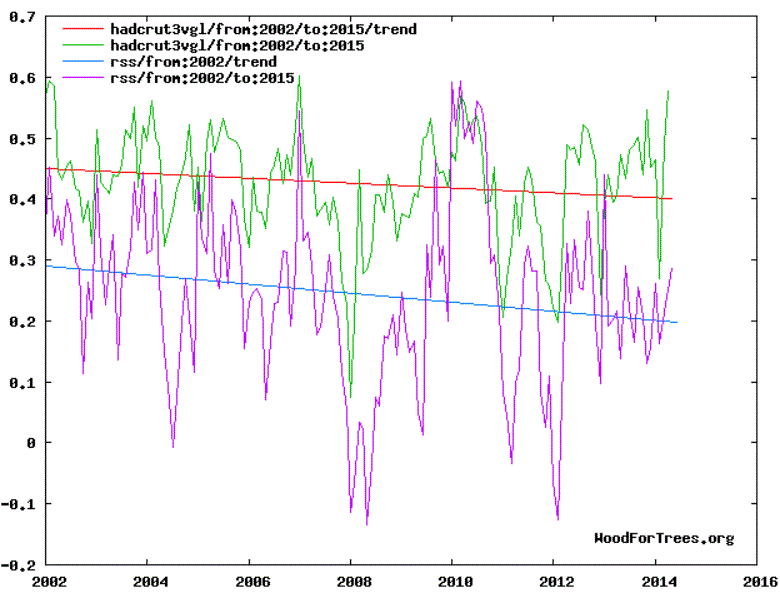
Climate scientists on both sides of the debate agree on one thing: the earth’s surface and atmosphere have (unexpectedly) stopped warming; there’s been no temperature increase in over 17 years and counting.

While global warming scientists insist the pause is only temporary and that warming will resume in earnest sometime in the future (once the missing heat comes out of hiding), other scientists are very skeptical. Today a growing number of distinguished scientists all over the globe believe the earth will be cooling due to the forces of natural cycles that have recently come into play.

Yet as many scientists are making forecasts of cooling, there’s one fact that seems to have escaped them: the datasets of the world’s leading climate data institutes clearly show that planetary cooling is already taking place and has been happening for over a decade.

2002_Cooling

Chart source: www.woodfortrees.org.

Danish solar scientist Henrik Svensmark recently declared: “Global warming has stopped and a cooling is beginning.” The cold reality, however, is that the cooling actually started 12 years ago!

There are more signs other than temperature readings that show global cooling is in full swing. Antarctica has just set a new record positive sea ice anomaly. Global sea ice has been mostly above average for a year and half, flying in the face of stunned scientists who warned just 5 years ago that the Arctic could soon be ice-free in the summertime. Moreover Asia, Europe and North America have been hard hit by a string of unexpectedly harsh winters.

So how cold is it going to get and for how long?

Although a large number of scientists agree on cooling, they differ widely on how much and for how long.

Geologist and climate researcher Sebastian Lüning of Germany in a just released video forecasts a global cooling of 0.2° by 2030, before it starts to warm up again. However, many scientists see this as too mild of a forecast. Russian solar physicist Habibullo Abdussamatov, for example, predicts another Little Ice Age by 2055. Also Russia’s Pulkovo Observatory claims we “could be in for a cooling period that lasts 200-250 years.”

Long list of experts

At his Climate Depot website, Marc Morano has a list of a number of renowned scientists who believe the data are clear on what’s ahead.

Prominent geologist Dr. Don Easterbrook warns that “global cooling is almost a slam dunk” for up to 30 years or more. The Australian Astronomical Society warns of global cooling as the sun’s activity “significantly diminishes”.

The reason for the cooling? Scientists agree that it’s natural solar and oceanic cycles overpowering the overhyped effects of greenhouse trace-gas CO2.


– See more at: http://notrickszone.com/2014/06/30/forget-global-cooling-predictions-its-already-happening-global-temperature-falling-more-than-a-decade/#sthash.iiRucSUK.dpuf

Clive Palmer Triggers the Warmist’s Scream!

Anguished cries in the global warming debate.

Anguished cries in the global warming debate.

TWO sentences neatly and completely capture the total irrationality and sheer, raging religious fervour of the global warming true, true believers.

They both came as deep primeval screams in delayed reaction to Clive Palmer’s climate change twostep with Mr Climate Hysteria himself, the man who used to be the next president of the US, until he found religion and fortune could be combined in very convenient climate untruths, Al Gore.

The initial reaction of true believers was one of almost euphoric rapture. Al and Clive had seemingly united to defeat the Climate Anti-Christ Abbott; Julia Gillard’s carbon tax and Gaia would be saved.

Nowhere was this reaction more extensive or ecstatic than at Climate Central Downunder, The Age. The paper revelled in the Anti-Christ’s coming discomfort.

Then as the truth sunk in that Gore had merely given cover to Palmer’s continued support for axing the tax, the scream erupted in The Age’s editorial on Friday. It included a delicious, utterly, if utterly unintentionally, revealing sentence.

The editorial noted that under the Palmer plan, while the scaffolding of an emissions trading scheme (ETS), would remain in place, the scheme would have no effect.

That’s actually not so, as we won’t even get that “scaffolding”. But returning to The Age, its lament was that such a scheme would have no effect because there’d be no price on carbon until Australia’s major trading partners implemented their own schemes.

Then the sentence: “That might occur next year, next decade, or never.”

A rational sentient human being would have then said; exactly, and thank you Clive. For there is absolutely no point in Australia going down the aggressive ETS path, cutting our emissions of carbon dioxide, unless precisely our major trading partners were doing the same.

To argue otherwise is to argue for Australia to unilaterally hurt both its industries and its citizens, to send industries and jobs to ‘our major trading partners,’ for absolutely no point. Our pain would have not the slightest effect on the global or even the local climate.

That lamenting sentence is so revealing; that to The Age rationality has absolutely nothing to do with the issue. It is all about religious fervour.

Quite irrespective of what the world does, quite irrespective of whether our CO2 cuts would achieve anything at all, we have to cut; we have to flagellate like a 12th century penitent, to exculpate our sins, to pay penance to Gaia.

The sentence is deeply revealing on another level. For The Age is also admitting that in its collective hearts of hearts, it really knows that the operative word in that sentence is ”never”.

Despite all the increasingly desperate propaganda nonsense pumped out that everyone else is taking big steps to cut emissions, and we are so laggard — including of course by The Age itself — the truth is the exact opposite.

Let a few more years run out, and apart from even more evidence that the planet, as opposed presumably to Gaia, ain’t warming as predicted, the emptiness of that claim will become almost undeniable.

And in its deepest, most inchoate scream, The Age is telling us that it just can’t bear that prospect.

The second primeval scream of pain and inchoate anger at Palmer assuaging the Climate Anti-Christ came from David Llewellyn-Smith on his MacroBusiness Blog.

Now LSD as we’ll call him, projects as at least a moderately intelligent human being. Yet he could come out with such a sentence, and more particularly one word, reveals an irrationality and stupidity so fundamental that it can only be explained by a religious belief. And a belief so fervent that a blinding curtain of rage isolates his brain.

LSD expressed sarcastic surprise that a hugely wealthy mining magnate would rubber stamp the end of a carbon price costing him millions of dollars per year for “tipping filth into the atmosphere”. Filth? FILTH?

Does LSD walk around all day in total self-hatred for doing exactly the same thing, pumping out his own filth with every exhaling breath?

Does he awake in complete despair every morning, at the prospect of another totally unavoidable day of exhaling filth? How many times a day does he flagellate himself, penitent-style if figuratively, or perhaps even literally?

For this is all we are talking about, whether it is Palmer’s business emissions or their shared personal emissions. CO2. Carbon dioxide. Plant food. The basis of life on Earth. And nothing else.

No, despite the best efforts of a battalion of modern day Goebbelian wannabes, from Gillard down, none of this — carbon tax or ETS — is about real pollution.

That’s the dirty bits of grit that used to come out of both power stations and home hearths and killed thousands, and will continue to kill thousands if people like The Age, LSD & Co succeed in denying Africa modern, clean, coal-fired power stations that would stop them relying on burning wood and dung.

Lamentably, the way pollution has been able to be attached to CO2 — presumably in time we’ll start renaming heavy rain as ‘water pollution’ — seems to have succeeded with people like LSD.

So when he thinks — more accurately, emotes — about emissions, cognitive dissonance, the disease of the modern intelligentsia, kicks in and he sees in his minds-eye, those dirty bits of grit, the ‘filth’ of modern civilisation.

So there you have it; the religion of global warming in two sentences.

No matter what anyone does, we must cut in self-flagellation for our sins against Gaia.

The self-hatred flowing from the original sin of personal exhalation of CO2 “filth” makes for even more aggressive warriors against business emissions of that same “filth”.

Originally published as Palmer triggers warmest screamCOMMENTS

Farmers in Sweden, Too Smart to Fall for Climate Alarmist B.S.!

Swedish farmers have doubts about climatologists

June 27, 2014 – 06:10

Farmers rely more on their own experiences with changing weather than on climatologists who have no agricultural experience, according to Swedish research.

Climatologists are not often found in the Swedish countryside. So farmers have their doubts about climate predictions. (Photo: Microstock)

Researchers the world over almost unanimously agree that our climate is changing because of the increasing amounts of carbon dioxide humankind pumps into our fragile atmosphere. But many farmers – at least Swedish ones – have experienced mild winters and shifting weather before and are hesitant about trusting the scientists.

Surprised

The researcher who discovered the degree of scepticism among farmers was surprised by her findings.  Therese Asplund, who recently presented her PhD thesis at Linköping University, was initially looking into how agricultural magazines covered climate change.

Asplund found after studying ten years of issues of the two agricultural sector periodicalsATL and Land Lantbruk that they present climate change as scientifically confirmed, a real problem.

But her research took an unexpected direction when she started interviewing farmers in focus groups about climate issues.

Asplund had prepared a long list of questions about how the farmers live with the threat of climate change and what they plan to do to cope with the subsequent climate challenges. The conversations took a different course:

“They explained that they didn’t quite believe in climate changes,” she says. “Or at least that these are not triggered by human activities.”

Used to changes

The climate of course has previously gone through natural spells, and the farmers tend to think in terms of their experiences in recent decades.

“Many have a lot of experience, for instance they recall the mild winters of the 1960s,” explains Asplund.

The farmers also distrust climatologists partly on the grounds of what they perceive of as too much concurrence.

“They think information about climate change is too uniform. Credibility would increase if more contrary perspectives were presented,” she says.

Office science

And above all: They think climatologists lack the experience they have living in keeping with the soil, weather and growth seasons.

The climate of course has previously gone through natural spells, and the farmers tend to think in terms of their experiences in recent decades. (Photo: Mary Evans Picture)

“Climate researchers also are given less credence by farmers because they think the scientists draw their conclusions from theoretical analyses rather than practical experience,” says Asplund.

She finds it hard to say how climatologists can make use of the farmers’ experiences:

“For the research of a scientifically trained climatologist, the opinions of farmers might not be all that essential.  But that does not necessarily make their views irrelevant. For a sociological approach to climate research the farmers’ opinions are highly relevant, on a par with those of other social groups,” asserts Asplund.

Information is not enough

She is concerned about understanding disparate ways of thinking and responding with regard to climate issues.

“With insufficient knowledge, we risk believing that information will readily alter human perceptions and behaviour. The example of climate communication in Swedish agriculture shows what challenges a climatological point of departure for communication can encounter,” says Asplund.

After talking with focus groups all over Sweden, she thinks that information alone cannot change attitudes and behaviour – no matter how well rooted it is in empirical science.

Does this mean it is harder than thought to get Swedish farmers to engage in climate-friendly agriculture? The researcher says both “yes” and “no”.

It will be hard as long as the implementation of improvements is voluntary. But in the discussions the farmers signal that they can adapt – if not to physical climate changes, at least to climate policy decisions. Thus it should be no harder to get them to adjust to climate measures as to other political mandates.

But there is one proviso: “This is a resistance to decrees which they think undermine competitive Swedish agricultural production,” says Therese Asplund.

————

Bad Investments in “Novelty Energy Sources” are a Burden for Ratepayers!

Power price hikes bite in Queensland

By AUSTRALIAN ASSOCIATED PRESS

Queenslanders face a dramatic hike in power bills with the start of the new financial year, and households with solar panels are also likely to take a hit to the hip pocket.

The average power bill is expected to rise by $191, or 13.6 per cent, pushed up by green policies and the increasing cost of poles, wires, and electricity generation.

However, prices will only go up by about 5.1 per cent if the federal government’s carbon tax is repealed.

Queensland’s Energy Minister Mark McArdle has blamed much of the hike on the former Labor government’s over-investment in the power distribution network.

“Every power bill that is issued, 54 per cent of that bill relates to the cost of poles and wires – the gold-plated legacy of Labor that we’re now having to unravel,” Mr McArdle told ABC radio.

Pensioners and seniors will be able to apply for an electricity rebate of $320 after the government upped concessions to $165 million for this financial year.

“The Queensland government promised to lower the cost of living wherever we could and we’re making sure that pensioners and other vulnerable Queenslanders get some relief on household costs,” Mr McArdle said.

Consumers are forking out 50 per cent more for electricity than they did three years ago, and shadow treasurer Curtis Pitt says price hikes under the Newman government total $560.

“Campbell Newman arrogantly promised to lower Queenslanders’ electricity bills, yet ever since he’s become premier they’ve just gone up and up and up,” he said.

This financial year, about 50,000 homeowners who have solar panels will no longer be guaranteed a feed-in tariff of eight cents.

Government-owned distributors will no longer be responsible for paying the tariff and households will have to negotiate directly with electricity retailers for the price they are paid for the solar power they generate.

The 44 cent tariff, paid to some 284,000 people who were first to sign up to the scheme, will remain unchanged.

Australian Solar Council chief executive John Grimes says consumers need to shop around, or join forces to negotiate as a block with electricity retailers.

“As an independent customer, with an average-size system on your roof, you really have little leverage when talking to a utility,” Mr Grimes told ABC radio.

Read more: http://www.dailymail.co.uk/wires/aap/article-2675908/Power-price-hikes-bite-Queensland.html#ixzz36B33NYym
Follow us: @MailOnline on Twitter | DailyMail on Facebook

This Article, written in May….hit the Nail, right on the head….Scary!

Warning: Reading about How the Ontario Liberals

Keep on Winning Might Make You Sick

Enough is enough.

You would think the sheer waste of taxpayer dollars through scandals and mismanagement would be enough to hang the Liberals.

Especially since, at the same time your money swirls down the toilet, the Liberals continue to run deficits (seven in a row) andIllustration: Truth and Lie pile up debt that your grandchildren’s children will still be paying off.

Yet in spite of their mistakes and outright lies (the hit parade includes: the billion-dollar gas plant cancellation and the failure to provide proper oversight of Ornge air ambulance expenses and out-of-control spending at the Ontario Lottery and Gaming Corporation and elsewhere) they’ve managed to hold onto power for 11 years. How is that?

I’ll give you three reasons. (Hold on, it’s a long explanation.)

1. They buy votes with big spending promises.

George Bernard Shaw got it right. “A government that robs Peter to pay Paul can always depend on the support of Paul.”

When even the tax-the-rich NDP recognize that Ontarians are taxed to the hilt and refuse to put up with any “new taxes, tolls or fees that hit middle-class families,” you know Ontario must be in financial trouble.

Net debt is projected to climb to $269.2 billion for 2013–14 and hit $324.5 billion by 2017–18 (nearly 40% of Ontario’s economy). In fact, Ontario’s debt has more than doubled since the Ontario Liberals came to power in 2003–04 when the provincial debt stood at $138.8 billion (or 27.5% of the economy).

Interest payments are the third largest expense in the budget. And right now interest rates are low. When rates go back up, each point will add another $3 billion to our annual interest payment, points out economist Jack Mintz.

But in spite of repeated warnings about the need for spending cuts, from former Liberal finance minister Dwight Duncan (who conveniently woke up to the Ontario’s debt problem in his last few months in office) and public servants in Ontario’s finance ministry, what did the Liberals propose in the budget that forced an election?

Big spending promises, of course. Billions for schools and hospitals, roads and bridges, billions more for corporate grants, and millions for a smorgasbord of social services.

With this budget, the Liberals are in fact driving toward a deficit $2.4 billion higher(or 24% more) than they previously projected—in spite of hiking taxes by almost $1 billion. The deficits planned for 2015–16 and 2016–17 also increased by $1.7 billion and $1.8 billion.

In other words, the Liberals forecast spending to jump by $3.4 billion this year, $900 million more than projected in the 2013 budget, with program spending expected to climb by nearly $3 billion to $119.4 billion.

With Ontario already in a fiscal mess, the NDP (yes, the NDP, a party not known for financial responsibility), criticized the budget as “a mad dash to escape the scandals by promising the moon and the stars.”

2. They pander to unions, whose members make up a big chunk of the electorate.  

The real beneficiary of the tax-and-spend Liberals has been the unions.

For starters, over half of Ontario’s program spending goes to pay public-sector workers their salaries and pension benefits.

What’s more, when the Liberals came into power in 2003, only 14,926 public-sector employees were making $100,000 or more. Today, 97,796 Ontario public-sector workers are on the so-called Sunshine List, an increase of 655% in just 10 years.

But, really, who can be surprised when about 70 percent of public-sector employees are unionized (compare this to the roughly 15 percent unionization rate in the private sector)?

The fact is the Liberals have pandered to unions, especially teacher’s unions, handing out massive, unaffordable pay hikes.

From 2003 to 2011, the McGuinty Liberals increased education spending by 45%, hiring 14,000 more teachers (up 10%) and increasing salaries by 24%—all while student enrollment actually dropped by 6%.

And teachers repaid the favour, “volunteering and voting for McGuinty’s Liberals in huge numbers during the past three elections.”

But following a narrow election win in 2011 (voters were angry over broken promises and higher taxes), McGuinty shifted direction, proposing to freeze teacher wages for two years and curb benefits to reduce the government’s alarming $14.4 billion deficit.

The teachers reacted with predictable outrage.

So despite all their talk about austerity, the Liberals just couldn’t say “no” to their vote-rich cash cow.

While the McGuinty government was calling for wage freezes publicly, it secretly negotiated a three percent wage increase with the Ontario Public Service Employees Union, which represents 35,000 voters, er, government workers.

And forget about Kathleen Wynne taking a firm stance on public-sector wages and benefits.

In a clear bid to win back union support, one of her first moves as premier was to negotiate an LCBO contract that gave 7,000 unionized workers a $1,600 signing bonus over two years—about $9 million— and wage increases of two% in 2015–16.

Her education minister also renegotiated new contracts with the province’s two biggest teachers unions, the Ontario Secondary School Teachers’ Federation and the Elementary Teachers’ Federation of Ontario, offering better maternity benefits, fewer unpaid days off, and an improved “sick-day bank.”

And the quid pro quo?

Millions of dollars spent on attack ads directed exclusively against Tory leaders in Ontario’s 2003, 2007, and 2011 elections—by a powerful coalition of special interest unions that includes the Ontario English Catholic Teachers Association, the Canadian Auto Workers, and the Ontario Secondary School Teachers’ Federation and calling itself the Working Families Coalition.

The so-called Working Families coalition first “came together in 2003 to discredit then Tory premier Ernie Eves and get Dalton McGuinty elected.” Their ad campaigns had such a big impact on the election results, they followed up with more of the same in the 2007 and 2011 elections. For this campaign, they’re just getting started, but expect a barrage of attack ads aimed squarely at Tim Hudak.

The coalition’s negative ads effectively doubles the advertising budget of the Liberals at the expense of the Tories through loose election laws around third-party advertising. Unlike political parties, third parties “can spend as much as they want, take contributions as large as they want and keep their financial backers hidden until long after the campaign is over.”

In Ontario’s 2011 general election, Working Families spent $1.6 million to help the Liberals.

Other big spenders included the Elementary Teachers’ Federation—$2.6 million—and the English Catholic Teachers’ Association, which spent $1.9 million to help defeat the PC party. For comparison’s sake, out of 21 registered political parties, only two spent more than $2 million on advertising. The Elementary Teachers’ Federation, the biggest third-party advertiser, spent more on advertising than nineteen political parties combined.

Spending records for the 2007 election (the first year third parties had to register with Elections Ontario) show a similar story. A shocking “90 per cent of the $2.3 million raised by third-party advertisers for the 2007 campaign went to organized labour or groups opposed to specific Tory policy positions.”

Plainly, Ontario’s election laws are giving Liberals with their deep-pocketed union allies an unfair advantage.

3. They reward party insiders with lucrative contracts.

In Ontario, it’s not what you know, but who you know.

From eHealth Ontario and Cancer Care Ontario to the Local Health Integration Networks, the Liberals have a history of rewarding party loyalists with “cushy, untendered contracts” and well-paid appointments.

In 2004, Mike Crawley, the then-president of the Ontario Liberals, was awarded awind power contract that guarantees his company AIM PowerGen $66,000 a day for 20 years. That’s a total of $475 million dollars.

In 2010, nearly two-thirds of the $68 million of taxpayers’ money spent on the 14 LHINs went to cover the salaries and remuneration of government-appointed board members.

Pat Dillon, the business manager of the Provincial Building and Construction Trades Council and the head of the infamous Working Families Coalition, has received a number of appointments—to Premier Wynne’s Transit Panel, the Ontario College of Trades, the WSIB Board, Infrastructure Ontario, and more.

The Globe and Mail recently reported that Ontario Liberal friends and allies were awarded millions of dollars in taxpayer-funded contracts because of loopholes in the rules surrounding government expenditures. The report goes on to say that, “while there is no indication that any of the transactions were illegitimate, the lack of transparency makes it difficult to determine what services were provided at taxpayers’ expense.”

The sad truth? It pays to be a friend of the Liberals. Ontario taxpayer, not so much.

The Ontario Liberals are long past their best-before date

After 11 years, it’s time to hold the Liberals to account.

Imagine if some pimply-faced thug robbed a gas station and got caught, he’d get what? A thousand dollars tops and some jail time.

But the Liberals who have “stolen” billions of taxpayer money through incompetence and cronyism remain unpunished.

It’s time to throw the Liberals out. They’ve inflicted enough damage on the province. It’s time they answered for their crimes against taxpayers.


What Sleep can do for us….and Lack of Sleep can do to us!

One of the Most Common Complaints, from Residents

near Wind Turbines, is lack of sleep!

The Miracle and Mystery of Sleep: 12 Remarkable Psychological Studies

Post image for The Miracle and Mystery of Sleep: 12 Remarkable Psychological Studies

“Sleeping is no mean art: for its sake one must stay awake all day.” ~Friedrich Nietzsche

What beautiful rewards sleep delivers– if you can get enough of it.

Sleep has profound effects on our memories, desires, self-control, learning, relationships and more.

Here are twelve studies which demonstrate some of the psychological benefits of sleep and a few of the dangers of not getting enough.

1. Placebo sleep

Sleep is slippery beast, not least in how it’s susceptible to our perceptions of its quality.

If we think we’ve had a wonderful sleep last night, we feel and perform better, even if our sleep was actually the same as usual.

This is what Draganich and Erdal (2014) found in a study which had participants hooked up to sensors which they were told were measuring the quality of their sleep.

Actually the sensors weren’t measuring anything. Instead the researchers randomly told some people they’d had better sleep than others.

When they were given a cognitive test the next day, those who’d been told they slept the best also did the best in the test.

Their self-reported sleep quality had little effect on the test results.

The researchers dubbed this ‘placebo sleep’.

2. Emotional sleep

During sleep our memories are reorganised and made stronger–in particular the emotional centres of the brain are highly active.

Psychologists have found that the mind is cataloguing our memories and deciding what to keep and what to throw away.

Sleep expert Elizabeth A. Kensinger explains:

“Sleep is making memories stronger. It also seems to be doing something which I think is so much more interesting, and that is reorganizing and restructuring memories.”

A review of studies on sleep found that we tend to hold on to the most emotional parts of our memories (Kensinger & Payne, 2010).

3. Blame bad sleep on the full moon

If your sleep wasn’t up to scratch last night, perhaps it was partly down to the phase of the moon.

People often complain of worse sleep around the full moon, but until recently scientists have been sceptical.

A study by Cajochen et al., 2013, though…

“…studied 33 volunteers in two age groups in the lab while they slept. Their brain patterns were monitored while sleeping, along with eye movements and hormone secretions.”

This is what they found:

“The data show that around the full moon, brain activity related to deep sleep dropped by 30 percent. People also took five minutes longer to fall asleep, and they slept for twenty minutes less time overall.

The researchers think it may be because we have a kind of ‘moon clock’ inside us that tracks its cycles and affects our hormone levels. This is in addition to the better known circadian rhythms which affect many bodily processes during the day.

→ Read on: Bad Night’s Sleep? Blame the Full Moon

sleeping29

4. Junk food cravings

One of the dangers of not getting enough sleep is craving junk food.

Recent research from UC Berkeley scanned the brains of 24 participants after both a good and a bad night’s sleep (Greer et al., 2013).

After disturbed sleep, there was increased activity in the depths of the brain, areas which are generally associated with rewards and automatic behaviour.

It seems a lack of sleep robs people of their self-control and so their good intentions are quickly forgotten.

Hence those junk food cravings get out of control.

→ Read on: Why the Sleep-Deprived Crave Junk Food and Buy Higher Calorie Foods

5. Learn in your sleep

It’s not possible to learn something new when you sleep, like a foreign language, but you can reinforce something you already know.

Gobel et al. (2012) found that students learned to play a series of musical notes better after listening to them during a 90-minute nap.

One of the authors, Paul Reber explained:

“The critical difference is that our research shows that memory is strengthened for something you’ve already learned. Rather than learning something new in your sleep, we’re talking about enhancing an existing memory by re-activating information recently acquired.”

→ Read on: Offline Learning: How The Mind Learns During Sleep

6. Benefits of a six-minute nap

Even tiny amounts of sleep can be beneficial.

A study by Lahl (2008) found that even a short six-minute nap was enough to measurably improve performance on a test of word recall.

Tell that to the boss the next time your caught ‘resting your eyes’ at work!

sleeping

7. Night owls have lower integrity white matter

Different neural structures have been discovered between people who are night owls and early risers.

Research on 59 participants, those who were confirmed night owls (preferring late to bed and late to rise) had lower integrity of the white matter in various areas of the brain (Rosenberg et al., 2014).

Lower integrity in these areas has been linked to depression and cognitive instability.

Unfortunately work, school and other institutions mostly require early rising, which, for night owls, causes problems.

As night owls find it difficult to get to sleep early, they tend to carry large amounts of sleep debt.

In other words, they’re exhausted all the time and their brains clearly show the consequences.

→ Read on: Like to Stay Up Late? Different Neural Structures Found in the Brains of Night Owls

8. Children’s sleep

Children are processing way more information than adults because everything is so new to them.

That is why irregular bedtimes at a young age can reduce their cognitive performance.

One study had children learning a task which had a hidden pattern. After a night’s sleep they were much more likely to guess the secret pattern without being told (Wilhelm et al., 2013).

Children also outperformed adults, suggesting that sleep was more important to them for this task.

9. Adolescents need more sleep

Adolescents typically require an hour or two more sleep than adults.

If so, why do we make them get up so early for school?

One study has delayed the waking up time of adolescents at a boarding school by just 25 minutes (Boergers et al., 2013).

They found that afterwards the number of students getting more than 8 hours sleep a night jumped from 18% to 44%.

On top of this, the students experienced less daytime sleepiness, were less depressed, and found themselves using less caffeine.

→ Read on: Later School Start Times Improve Sleep and Daytime Functioning in Adolescents

10. Consolidate motor skills

When we are learning a motor skill, like playing the piano, our brains continue to process the information after we’ve finished.

In research by Allen (2012), musicians who practised a new song had improved in speed and accuracy compared with before a night’s sleep.

Like memory, a good night’s sleep can also improve motor performance.

sleeping19

11. Relationship damage

People are usually at their worst after a bad night’s sleep, but what does that do to their intimate relationships?

A new study finds that even one bad night’s sleep can be surprisingly damaging to a relationship (Gordon & Chen, 2013).

They found that even for those who were good sleepers, just a single night’s poor sleep was associated with increased relationship conflict the next day.

→ Read on: How Just One Night’s Poor Sleep Can Hurt a Relationship

12. Hidden caves open up during sleep

If sleep has such amazing restorative powers then what is going on physiologically?

New research has discovered “hidden caves” inside the brain, which open up during sleep, allowing cerebrospinal fluid (CSF) to flush out potential neurotoxins, like β-amyloid, which has been associated with Alzheimer’s disease (Xie et al., 2013).

The flushing out of toxins by the CSF may be central to sleep’s wondrous powers.

→ Read on: Hidden Caves in the Brain Open Up During Sleep to Wash Away Toxins

Last word

Last word to the playwright Wilson Mizner who said:

“The amount of sleep required by the average person is five minutes more.”

Quite right.