Europeans Regret….Wind Energy is a Bad Deal, No Matter Where You Go!

Europeans Lament their Wind Power Fiasco

German wind farm

The colossal, hugely expensive windfarms that are spread across huge areas of Europe’s land and sea, which are projected to drive up household energy bills by more than 50 per cent in coming years, have achieved … almost nothing in terms of reducing EU carbon emissions.

We here on the Reg energy desk only noticed this particularly this week because of a chirpy press release that flitted past us just the other day, claiming that “wind energy provides 8 per cent of Europe’s electricity.”

Hey, we thought, that sounds almost like it’s getting somewhere! So we looked into it. The eight per cent figure comes from the latest Wind Status Report (pdf) from the EU Joint Research Centre, and sure enough, it’s claimed therein that all those massive wind farms produced no less than 238 terawatt-hours of the 2,942 TWh of ‘leccy used in the EU nations last year.

That’s eight per cent, right enough – and that’d be a noticeable bite out of EU carbon emissions, maybe even one worth tying an energy-prices ball and chain round the ankles of the European economies.

Except it isn’t, of course. Like most developed economies, the EU nations use the great bulk of their energy in non-electric forms: we burn fuels to run transport, to provide heating and cooking and hot water, to power most of our industry. And this accounts for most of our energy use and carbon emissions.

By the most recent figures available, in fact, the EU is using around 1,666 million-tonnes-of-oil-equivalent of energy from all sources every year:that’s 20,710 TWh. Wind electricity makes up just over one measly percentage point of that. Solar? About half that again, for a total renewable-‘leccy contribution of around 1.5 per cent and a roughly corresponding CO2 reduction.

The large majority of the “renewable energy” figure claimed by the EU is produced by optimistic accounting on biomass and renewable-waste, much of which is dubiously renewable at best. Even the proper renewable electricity figures are not to be relied on, particularly in southern Italy where the Mafia is well known to be heavily involved in the industry.

Actual renewables, despite their horrific expense, are not even scratching the surface of real-world modern civilisation’s energy requirements.

Comment

It really is getting clearer and clearer. Bill Gates is right: top Google engineers are right: global-warming high priest James Hansen is right: theUN IPCC is wrong. The renewable energy technologies of today simply cannot provide the power needed to keep the lights on, not at any cost.

Anybody who thinks that carbon emissions are a big threat to humanity – or alternatively, anybody who thinks that becoming ever more dependent on Russian gas and Middle Eastern oil is a bad idea, for instance – needs to get their head around this and move on. The current, cripplingly expensive schemes which crank up the price of energy and channel the resulting cash to windfarms and solar panels need to be scrapped – they will never achieve anything useful.

Perhaps the money saved could be spent on R&D instead, to find some new source of low-carbon energy. But in fact, such a source already exists; the problem is really one of public understanding, rather than a lack of low-carbon energy in the world.
The Register

turbine collapse 9

Windweasels are Definitely a Despicable Bunch of Miscreants!

Scottish Council Demands Copy of Noise Report for Non-Compliant Wind Farm & Its Operator Predictably Runs for Cover

RUN-HIDE-logo_crop

****

One of the slickest moves wind weasels ever made was to have their team write the so-called “wind farm noise guidelines” – which deliberately exclude all reference to the real bane of wind farm neighbours – incessant turbine generated low-frequency noise and infrasound:

Wind Turbine Infrasound: What Drives Wind Farm Neighbours to Despair

Three Decades of Wind Industry Deception: A Chronology of a Global Conspiracy of Silence and Subterfuge

And the next slickest was to write the planning ‘rules’ – designed to have the operators themselves cook up the so-called “compliance data”, which they then hand over to the gullible country bumpkins that work on local Councils; untrained dimwits who simply accept whatever’s dropped on their dreary little desks, by the operator’s highly-paid, pet acoustic consultants.

Fox

****

Some might liken it to handing over security detail at your backyard hen-house to ‘Le Renard & Co’.

That wind power outfits might pull just one or two punches in their obvious commercial interest, might come as a shock to some. However, the same malevolent approach to the manufacture of helpful ‘evidence’ – and the deliberate concealment of the unhelpful stuff – has been adopted all around the globe.

In Australia, Spanish wind conquistadors, Acciona have been turning in fabricated noise data, ever since its Waubra wind farm kicked into gear in 2010.

The operator knows full well that it cannot, and will never, comply with the noise conditions of its planning consent; so does the local Council and the Victorian Planning Department – all of which are sitting on a damming document prepared by an independent consultant, Heggies – which they steadfastly refuse to hand over to their dozens of victims, for obvious reasons:

Victorian Planning Department involved in Waubra Wind Farm Non-Compliance Cover Up

The same ‘method’ has been applied to two other Victorian public health disasters: Macarthur and Cape Bridgewater.

Here’s more of the same from the Highlands of Scotland.

Angus Council may pull plug on Ark Hill windfarm
The Courier
Graham Brown
5 September 2015

Angus planners are on the brink of instigating enforcement action against the operators of the district’s largest windfarm.

The patience of council chiefs is running out over a demand for a noise monitoring report for the eight-turbine Ark Hill windfarm, near Glamis, where the 266-foot structures have been operational since spring of 2012.

A deadline of Friday was set for operators Green Cat Renewables to give an update on the noise monitoring report previously requested by the authority last November.

Residents in the area around the Strathmore site have complained about turbine noise since the windfarm became operational and they said the company was “giving Angus Council the run around”.

Following crunch council discussions within the past week, concerned residents were told that the close of business on Friday was set as the deadline for the operators to give a firm indication of when they plan to submit the monitoring report, or face enforcement action.

The ultimate sanction available to the council is to shut down the windfarm.

One resident said: “These problems have gone on since the turbines went up and they affect our lives, our pets and livestock in the fields around Ark Hill.

“There are so many things which can make a difference to the noise from the turbines, and quite often it is when there is little or no wind.

“People in the area suffering health problems are starting to link them to the windfarm and yet all this time we are still waiting on this noise report.

“The council are not at fault here, they have asked Green Cat for the report and it has not been produced — they are being given the run around.

“No-one can say that there’s not a problem here and it needs to be sorted.”

A council spokesperson said: “Angus Council understands that the wind turbine operator has completed noise monitoring and data gathering at the site and is in the process of preparing a finalised report.

“We have requested a clear timescale for the submission of that report and hope to have clarity on the matter shortly.”

Green Cat Renewables were contacted but made no comment.
The Courier

What? A non-compliant wind farm’s operator running for cover? Who ever heard of such a thing?

Wind Industry RUNS & HIDES as World Wakes Up to the Great Wind Power Fraud

The fact that wind weasels and inconvenient truths are unlikely to appear on the same stage anytime soon, is – these days – pretty much common knowledge – as the following comments to the article above attest.

Anonymous

Green Cat has been dragging its feet for months producing the monitoring report. What have they got to hide?

If anyone has any doubts about the excessive noise visit the site and listen for yourselves.

Disgraceful behaviour from this company.

A public apology from Green Cat would be appropriate. While residents suffer – some without a good night’s sleep – they have dragged their feet in resolving the noise problem.

An appalling stare of affairs.

Concerned Observer

How stupid is this. Has Angus Council learned nothing from the Seed Crushers fiasco in Arbroath?

Asking the offender to provide information is like asking someone to jail themselves – stupid, just plain stupid.

The correct way for noise monitoring is:

1 – the council commission an independent noise monitoring report before any development takes place for which the applicant pays the council.

2 – the noise level above that, then established ambient level, is included in the planning consent as a condition and included in the Environmental Impact Assessment.

3 – the operator is required to keep a noise monitoring log at pre-determined times as part of the planning consent (something like a set date of each month).

4 – any breach is checked against that log.

5 – any continual complaints are investigated by the council, once again commissioning an independent noise monitoring report chargeable to the owners of the site.

6 – any breach of the planning conditions are then rectified by the issuing of an enforcement notice.

Angus Council is at fault here for not applying strict rules to the planning consent and relying on the owners to hang themselves. SEPA who are equally as useless operate in the same way as the council.

It is about time the Scottish government clamped down on the shoddy practices of enforcement and to lackadaisical planning conditions, without any firm pre permission conditions and agreed methods of implementation. Green Cat are at fault, Angus Council are at fault, the Scottish government are at fault. Good luck to the residents but honestly – you are not going to get anywhere now the turbines are up and running and the operator remains responsible for providing evidence.

brave_shield3

Windpushers Want Guarantees, That Their Scam Will be Allowed to Continue!

Wind Industry Still Wailing About ‘Uncertainty’ as Australian Retailers Continue to Reject Wind Power ‘Deals’

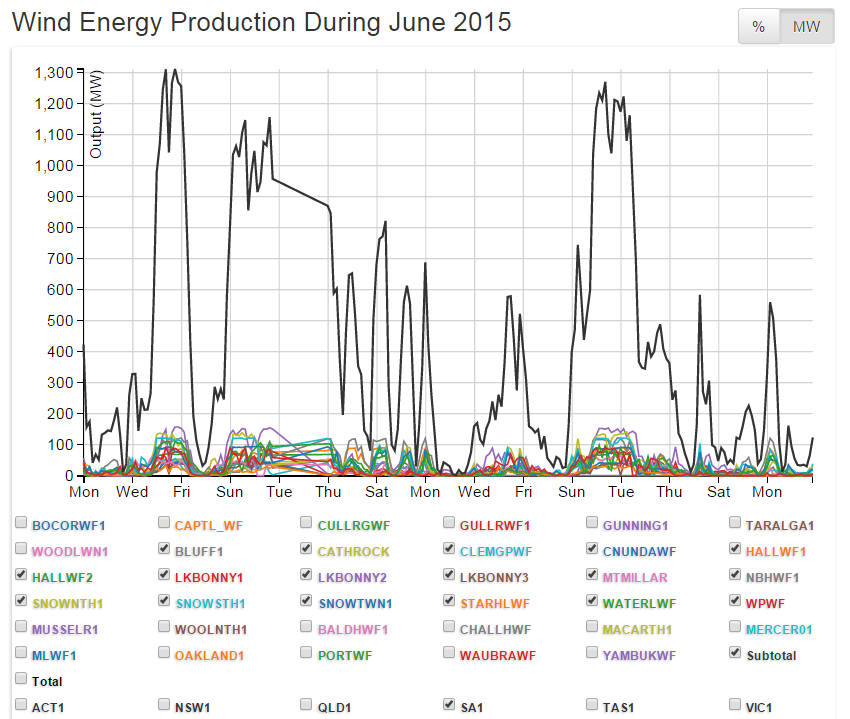
June 2015 SA

[Could it be something about the ‘product’, maybe?]

Back in February this year, STT covered the unassailable fact that Australia’s Large-Scale Renewable Energy Target (LRET) – then set at a colossal 41,000 GWh – was completely unsustainable on every level – economic, political and social:

LRET “Stealth Tax” to Cost Australian Power Punters $30 BILLION

Our little analysis came at a time when a debate was underway about not whether, but by how much, the ultimate annual target needed to be cut to preserve a little of the wind industry’s furniture.

You see – with the ultimate target set at 41,000 GWh for 2020 – barely 16,000 GWh of power available from eligible renewable sources – and no new wind power capacity being built and none likely to be built – the imposition of the whopping $65 per MWh “shortfall charge” was then looming fast.

The actual cost to consumers of what is, pure and simple, a Federally mandated fine on electricity retailers – which will be recovered from all Australian power consumers – is around $93 per MWh, which is added to the average wholesale price of around $35 per MWh.

The Coalition’s wind industry front man, young Gregory Hunt calls it his “massive $93 per tonne carbon tax”. Its particular political toxicity was what focused the minds of our political betters in Canberra; and resulted in the first cut to the LRET’s ultimate annual target from 41,000 GWh to 33,000 GWh.

The principal logic that drove both the Coalition and Labor to slash the LRET target being fear of a power consumer (read “voter”) backlash – a revolt that will inevitably result when power consumers receive spiralling bills spelling out the fact that they are being hit with a mammoth, Federal electricity stealth tax.

Politicians of all hues know it – and, more importantly, Australia’s major electricity retailers know it: there is absolutely no way that – in an economy about to start going backwards – struggling businesses, manufacturing industries and cash-strapped households will tolerate the imposition of an enormous (and utterly pointless) Federal tax on electricity consumption.

Remember, this is the same electorate that smashed Julia Gillard over her ‘carbon tax’ – which, as another Federally mandated tax on electricity, was seen by voters as economically ‘toxic’; and gifted government to Tony Abbott’s Coalition 2 years ago.

After a lot of huffing and puffing – and shenanigans in the Senate – the reduced LRET target passed in June. At the time, the wind industry, its parasites and spruikers were howling one minute about the attack on “wonderful wind”; and breathing a collective sigh of relief that the dreaded “uncertainty” about the target was finally over.

Well, the trouble is that certain “certainties” still, and will always exist, in relation to the greatest economic and environmental fraud of all time: THESE THINGS DON’T WORK.

The retailers are about selling power on demand; not according to the vagaries of the wind.

Now, our favourite wind-worship cult-commanders – the Climate Spectator’s Tristan Edis (see this piece of wishful thinking) and ruin-economy’s Giles Parkinson – are furious about the fact that – despite the ‘agreement’ that settled on the latest LRET target – Australia’s retail power companies have absolutely NO interest in signing up to buy a “product” that can only ever be delivered at crazy random intervals, if at all. A product that brings total chaos for grid managers and allows peaking power operators to scoop up $millions in minutes:

South Australia’s Unbridled Wind Power Insanity: Wind Power Collapses see Spot Prices Rocket from $70 to $13,800 per MWh

The Wind Power Fraud (in pictures): Part 1 – the South Australian Wind Farm Fiasco

The Wind Power Fraud (in pictures): Part 2 – The Whole Eastern Grid Debacle

On top of that, the Senate Inquiry’s report (see our post here) into the great wind power fraud concluded that the adverse health effects caused by incessant turbine generated low-frequency noise and infrasound – such as sleep deprivation – are real; and not the product of some BIG COAL plot.

With 200 pages setting out the evidence of victims like SA turbine hosts, Clive and Trina Gare (see our post here), retailers are fully alive to the fact that it’s a matter of when, not if, wind farm neighbours start suing wind power outfits for $millions in damages. ‘Slam dunk’ common law claims in nuisance for the loss of the use of their homes; loss of property values etc, are brewing up as we speak. The outcome of which is that the $2 outfits used as fronts for the likes of Infigen will be insolvent, as soon as the victims file their claims:

Potential Wind Farm Neighbour Finds Idyllic Property is Now ‘Unsaleable’ at Any Price

Brits to Force £2 Wind Power Outfits to Hold £Millions in Reserve to Pay Damages to Victims & for Decommissioning

Bankers, retailers and anyone else with real skin-in-the-game hate risk – of any description. Signing up to lend money to – or buy wind power from – an outfit liable to go under in heartbeat is bad enough, but where the wind power outfit in question is in the gun for $millions in liability claims for nuisance or negligence, then it’s RISK that only the crazy-brave would take on.

But it’s risk of a different kind that has poor old Giles Parkinson almost turning on the waterworks in this, his latest lament: Renewable investment drought to continue as utilities extend buyers’ strike

Giles cites Miles George – head of Australia’s most notorious wind power outfit, Infigen (aka Babcock and Brown) – as he rails against the fact that Australia’s 3 biggest retailers – Origin, EnergyAustralia and AGL – have no intention of entering power purchase agreements with wind power outfits, which means they will never obtain the finance needed to build any new wind power capacity, anywhere FULL STOP.

Although never one quick to join the dots, Giles fails to make the (fairly obvious) connection between the unwillingness of $billion outfits – like Origin – to contract with near-bankrupt Infigen – even though Giles focuses on Infigen’s latest whopping $304 million annual loss: ever heard of ‘due diligence’, Giles?

In the mother of all ironies, Infigen, again blames its latest financial disaster on ….. wait for it …. “PARTICULARLY POOR WIND CONDITIONS”.

Oh, mother!

But should Miles and the gang really be complaining? After all, the wind is – as they repeatedly tell us – “FREE”. Which calls to mind that old chestnut about “getting precisely what you pay for”.

We’ll pick up Infigen’s latest ‘be-calmed-cash-loss-calamity’ in another post, shortly.

The ONLY reason power retailers do any business with cowboys like Infigen and union backed thugs like Pacific Hydro, is to obtain renewable energy certificates (RECs); and, thereby, avoid the imposition of the shortfall penalty. However, the likes of Giles and Tristan are unable to recognise that power retailers do, in fact, have a ‘choice’, in that respect.

They do not need to purchase RECs at all – power retailers are perfectly entitled to pay the fine and collect it from their customers. Which brings us back to ‘pending political toxicity’.

The big retailers know full well that Australian power consumers will not tolerate being lumbered with fines that will add close to $22 billion to their power bills, over the life of the LRET scheme. Here’s the calculus of what no-one – on either side of government – is willing to reveal, let alone prepared to ‘sell’, to voters.

The LRET target is set by s40 of the Renewable Energy (Electricity) Act 2000 (here). At the present time, the total annual contribution to the LRET from eligible renewable energy generation sources is 16,000 GWh; and, because commercial retailers have not entered PPAs with wind power outfits for well over 2½ years – and have no apparent intention of doing so from hereon – that’s where the figure will remain.

In the table below, the “Shortfall in MWh (millions)” is based on the current, total contribution of 16,000,000 MWh, as against the current 33,000 GWh target, set out as the “Target in MWh (millions)”.

A REC is issued for every MWh of eligible renewable electricity dispatched to the grid; and a shortfall penalty applies to a retailer for every MWh that they fall short of the target – the target is meant to be met by retailers purchasing and surrendering RECs. As set out below, the shortfall charge kicks in this calendar year. Given the impact of the shortfall charge, and the tax treatment of RECs versus the shortfall charge, the full cost of the shortfall charge to retailers is $93. Using that figure, here is the cost of the shortfall penalty.

Year Target in MWh (millions) Shortfall in MWh (millions) Penalty on Shortfall @ $65 per MWh Minimum Retailers recover @ $93
2015 18.85 2.85 $185,250,000 $265,050,000
2016 21.431 5.431 $353,015,000 $505,083,000
2017 26.031 10.031 $652,015,000 $932,883,000
2018 28.637 12.637 $821,405,000 $1,175,241,000
2019 31.244 15.244 $990,860,000 $1,417,692,000
2020 33.85 17.85 $1,160,250,000 $1,660,050,000
2021 33 17 $1,105,000,000 $1,581,000,000
2022 33 17 $1,105,000,000 $1,581,000,000
2023 33 17 $1,105,000,000 $1,581,000,000
2024 33 17 $1,105,000,000 $1,581,000,000
2025 33 17 $1,105,000,000 $1,581,000,000
2026 33 17 $1,105,000,000 $1,581,000,000
2027 33 17 $1,105,000,000 $1,581,000,000
2028 33 17 $1,105,000,000 $1,581,000,000
2029 33 17 $1,105,000,000 $1,581,000,000
2030 33 17 $1,105,000,000 $1,581,000,000
Total 490.043 234.043 $15,212,795,000 $21,765,999,000

The almost $22 billion in fines payable by power consumers will sit on top of the $22-23 billion worth of RECs that will also be added to power bills (see our post here).

Now, while Giles Parkinson’s article misses the point, his headline, which includes the words “buyers’ strike” touches on the “golden rule”: whoever has the gold, makes the rules.

When we first looked at this issue in February, we drew the analogy with another Federal government backed producer subsidy scheme, which also imploded due to a “buyers strike”.

With Giles, among others, struggling to come to terms with the “golden rule”, we think that it would be rude not to give that analysis another run.

In a little case of déjà vu, STT thinks that there are some significant parallels and important lessons to be learnt from how the Australian wool industry saw its Federally mandated subsidy scheme implode during the 1990s; all but killing the industry and costing growers and taxpayers tens of billions of dollars.

The wool industry’s “cause of death” was the Federally backed Reserve Price Support scheme (RPS), which set a guaranteed minimum price for all Australian wool.

A little background on the RPS

For over 150 years, Australia happily rode on the sheep’s back: until the 1970s the wool industry was, for the Australian economy, the “goose that laid the golden egg”; textile manufacturers from all over the world clamoured for the fibre; which was, for most of that time, the largest single commodity export by value; Australia produces over 80% of the world’s apparel wool. However, as fashions changed (the three-piece wool suit became, well, so “yesterday”) and new synthetics began to eat into its market share, the dominance of Australian apparel wool was no longer a certainty.

Against the backdrop of increasing competition, for the wool industry there was always the perennial issue, not only of fluctuating demand, but also of wildly fluctuating swings in production. Dorothea McKellar’s land of “droughts and flooding rains” meant that a few years of meagre production (and favourable, and even phenomenal, wool prices) would be soon eclipsed by sheds and wool stores overflowing with fibre ready for market (sending prices and woolgrower profits plummeting).

The response to these (often climate driven) marketing “swings and roundabouts”, was the establishment of the Australian Wool Corporation (AWC) and the RPS in 1973.

The RPS would set a minimum price for all types of wool, guaranteeing woolgrowers a minimum return; such that if supply exceeded demand, the AWC would purchase any wool being offered, if it failed to reach the minimum price set (referred to as the “floor price”).

Wool being offered at auction that failed to meet the floor price was purchased by the AWC and “stockpiled” (ie stored), until such time as either supply fell or demand conditions improved; at which point the AWC would offer stockpiled wool to the trade. The aim being the smooth and more orderly marketing of wool over the supply and demand cycle; with higher average returns to growers; and less risk for buyers and sellers along the way.

The scheme worked swimmingly (as designed and intended) until the late 1980s.

The reserve price set under the RPS was fixed in Australian dollar terms. However, with the float of the Australian dollar in 1983 (resulting in a massive 40% depreciation of the dollar between February 1985 and August 1986), maintaining the reserve price without reference to the terms of trade and fluctuations in trading currencies (particularly the US dollar) set the scheme up for a spectacular failure; simply because what goes down can just as easily go up.

During the 1980s, there was a solid increase in demand for wool, driven by demand from the USSR, a then fast growing Japan, buoyant Europeans, and a newly emergent China, as a textile manufacturer and consumer. However, that surge in demand occurred in the context of an Australian dollar trading in a range around US$0.55-75.

During the 1980s, under pressure from wool grower lobby groups, the floor price was continually increased: from 1986 to July 1988 the floor price jumped 71% to 870 cents per kilogram.

That did not, in itself, create any problems: a general surge in demand, relatively low production and a plummeting Australian dollar generated auction room sale prices well above the rising floor price, which reached their zenith in April 1988: the market indicator peaked at 1269 cents per kg, and the market continued its bull run for most of that year, well above the 870 floor price set in July.

However, as international economic conditions worsened, Australian interest rates soared (the consequence of Paul Keating’s “recession that we had to have”) and the value of the Australian dollar with it (hitting US$0.80 by early 1990), the market indicator headed south and, over the next few years, the AWC was forced to purchase over 80% of the Australian wool clip at the 870 cent per kg floor price. Adding to the AWC’s difficulties was a massive surge in production; driven by growers responding to the high and “guaranteed” floor price; and a run of exceptional growing seasons (1989 being a standout across Australia). Production went from 727 million kg in 1983/84 to over 1 billion kg in 1990/91.

Despite worsening market conditions, the AWC, under pressure from wool grower lobby groups, was forced to maintain the 870 cent per kilogram floor price.

However, from around August 1989, international wool buyers simply sat on their hands in auction sale rooms (in May 1990 the AWC bought 87.5% of the offering); and waited for the RPS to implode.

Knowing that the system was unsustainable, the last thing that buyers wanted was to be caught with wool purchased at prices above the floor price which, when the floor price was cut or collapsed, would immediately be worth less than what they had paid for it. Moreover, traders were dumping stock as fast as they could to avoid the risk of a collapse in the RPS and, therefore, a collapse in the price of any wool they happened to hold.

The RPS was ultimately backed by the Federal government. With the buying trade sitting on their hands, those responsible for maintaining the floor price ended up in a staring competition, the only question was, who would blink first: the AWC (or, rather, the government underwriting the RPS); or the buyers?

With the AWC purchasing millions of bales of wool at the floor price the cost of supporting the RPS was running into the billions of dollars: primarily the support came from a grower levy on sales, but, at the point which that soon became insufficient to support the RPS (despite upping the levy from 8% to 25%), support came from $billions in mounting government debt; the buyers had no reason to blink.

Instead, in May 1990, the government announced its decision to retreat to a new floor price of 700 cents per kilogram, and directed the AWC to fight on in support of the reduced floor price. The Minister for Primary Industry, John Kerin boldly asserting that the 700 cent floor price was “immutable, the floor price will not be reduced”.

But, having blinked once, the buyers largely continued to sit on their hands and simply waited for the government to blink again. The stockpile continued to balloon; and with it government debt: by February 1991 the stockpile reached 4.77 million bales (equivalent to a full year’s production); the accrued government debt stood at $2.8 billion; and the cost of storing the stockpile was over $1 million a day.

Faced with the inevitable, the government blinked, again: John Kerin was forced to eat his words about the floor price being “immutable”; on 11 February 1991, announcing the suspension of the floor price. The RPS had totally collapsed; the buyers had won.

The wool industry’s saga is beautifully, if tragically, told by Charles Massy in “Breaking the Sheep’s Back” (2011, UQP), which should be required reading for any of our political betters pretending to know more than the market (eg, the power market).

Which brings us to the lessons and parallels.

The LRET effectively sets the price for RECs: the minimum price is meant to be set by the shortfall charge of $65 per MWh (rising to $93 when account is given to the tax benefit), as the penalty begins to apply on the shortfall (as detailed above). That equation is based on an ultimate 33,000 GWh target.

In the event that the cost of the shortfall charge was reduced, there would be a commensurate fall in the REC price. Likewise, if the LRET target was further reduced: the total number of MWhs which would then attract the shortfall charge if RECs were not purchased would fall too; also resulting in a fall in the REC price.

In addition, any reduction in the LRET would simply result in a reduction in the demand for RECs overall: fewer RECs would need to be purchased and surrendered during the life of the LRET; again, resulting in a fall in the REC price. Of course, were the LRET to be scrapped in its entirety, RECs would become utterly worthless.

The retailers, are alive to all of this, hence their reluctance to enter PPAs for the purpose of purchasing RECs; agreements which run for a minimum of 15 years.

In December last year, Ian “Macca” Macfarlane and his youthful ward, Greg Hunt started running around pushing for a target of 27,000 GWh; and their boss made clear that he wanted to kill it outright. There followed overtures from the Labor opposition pitching for a target around 35,000 GWh.

Whether they knew it or not – with their public debate on what an amended target should be – in the staring competition with retailers – these boys blinked.

Faced with the inevitable political furore that will erupt when power consumers (ie, voters) realise they are being whacked with the full cost (and some) of the shortfall charge (being nothing more than a “stealth tax” to be recovered by retailers via their power bills), the pressure will mount on both sides of politics to slash the LRET – once again.

That both Labor and the Coalition have already blinked (in obvious recognition of the brewing political storm in power punter land over the inevitable imposition of the shortfall charge) is not lost on the likes of Grant King from Origin, and all of Australia’s other electricity retailers.

And for retail power buyers the choice of sticking with permanent recalcitrance has been made even easier: Tony Abbot making it plain that he would have cut the LRET even harder, were it not for a hostile Senate; and Labor’s Bill Shorten pushing for an entirely ludicrous 50% LRET – that would require a further 10,000 of these things to be speared all over Australia’s rural heartland. Where there was once ‘bipartisan’ support for these things, the major parties are diametrically opposed.

Grant King

****

With the politics of the LRET already on the nose, like wool buyers sitting on their hands in sale rooms during 1990, waiting for the floor price to collapse, electricity retailers need only sit back and wait for the whole LRET scheme to implode.

Like wool buyers refusing to buy above the floor price and carry stock with the risk of the RPS collapsing, why would electricity retailers sign up for 15 year long PPAs with wind power outfits in order to purchase a stream of RECs over that period, knowing the value of those certificates depends entirely upon a scheme which is both economically and politically unsustainable?

However, the similarities between the wool market and the market for wind power end right about there.

There is, and always was, a natural market for Australian wool; the only issue during the late 80s and early 90s was the price that had to be paid by buyers to beat the floor price, set artificially under the RPS.

Wind power has no such market.

Available only in fits and spurts, and at crazy, random intervals, at a price which is 3-4 times that of conventional generation, retailers have no incentive to purchase it.

In the absence of the threat of the $65 per MWh fine (the stick), coupled with the promise of pocketing $93 as a subsidy in the form of a REC (the carrot), electricity retailers would not touch wind power with a barge pole: it simply has no commercial value.

Moreover, with an abundance of conventional generation capacity in Australia at present, retailers are very much in a “buyers’ market”. Overcapacity, coupled with shrinking demand (thanks to policies like the LRET that are killing mineral processors, manufacturing and industry) means that retailers can expect to see wholesale prices decline over the next few years, at least. And, for the first time in almost 20 years, a sharply declining Australian economy is a fast looming reality: unemployed households have an even tougher time paying rocketing power bills.

With those fundamentals in mind, electricity retailers will simply opt to pay the shortfall charge and recover it from power consumers, knowing that that situation will not last for very long.

Sooner or later, the Federal government (whichever side is in power) will have to face an electorate furious at the fact that their power bills have gone through the roof, as a result of a policy that achieved absolutely nothing.

Tony Abbott’s chances of leading his Coalition to a second term are tied to fundamental ‘mum and dad’ policies like electricity costs. Power prices matter; and in a battle between Australia’s Big 3 Retailers and the LRET, STT’s money is firmly on commercial self-interest.

STT hears that the big retailers are planning to wait until they look like exhausting the pile of RECs that they’re sitting on at present. At which point they’ll build some large-scale solar power facilities, in order to obtain the RECs needed to avoid the shortfall charge; for as long as it takes for the politics to turn gangrenous. As soon as the LRET gets scrapped, the plan is to sell the panels back into the residential roof-top market.

The cost of the LRET – and all that comes with it – to retail customers is at the heart of what’s driving retailers’ efforts to crush the LRET; and the wind industry with it.

This might sound obvious, if not a little silly: electricity retailers are NOT in the business of NOT selling power.

Adding a $45 billion electricity tax to retail power bills can only make power even less affordable to tens of thousands of households and struggling businesses, indeed whole industries, meaning fewer and fewer customers for retailers like Origin, AGL and EnergyAustralia.

The strategy adopted by retailers of refusing to ‘play ball’ by signing up for PPAs will, ultimately, kill the LRET; it’s a strategy aimed at being able to sell more power, at affordable prices, to more households and businesses.

And it’s working a treat, so far.

The wind industry’s incessant daily whining about “uncertainty”, is simply a signal that the retailers’ have already won. Once upon a time, the wind industry and its parasites used to cling to the idea that the RET “has bi-partisan support“, as a self-comforting mantra: but not anymore. And it’s the retailers refusal to sign PPAs that’s thrown the spanner in the wind industry’s works.

While the likes of Tristan, Giles and Miles will continue to work themselves into a lather about their inevitable fate, in the meantime, retailers, like Origin, AGL and EnergyAustralia, can simply sit back, watch the political fireworks, and wait for the inevitable and complete collapse of the LRET; and, with it, the Australian wind industry.

wind turbine Screggah-wind-turbine-Padraig-McNulty-6-460x345

People All Over the World are Fighting Back Against the Wind Scam!

Forces Marshall in International Revolt Against the Great Wind Power Fraud

storming_the_bastille1-e1318690559144

***

Across the Globe – wherever these things things have been threatened upon rural communities – or the threat has been realised – outrage follows.

One line spun is that the hostility is an entirely English speaking phenomenon. That piffle was firmly skewered by Lilli-Anne Green (an American researcher and documentary film-maker, who has spoken to hundreds of victims around the World) – when she appeared before the Australian Senate:

Lilli-Anne Green – no ‘Green’ Dupe – tells Senate: Wind Farm Health Impacts ‘Universal’

And STT has picked up plenty of examples to the same effect:

Winning Taiwanese Hearts and Minds?

Turkish Court Shuts Down 50 Turbines: Yaylaköy Residents Delighted at 1st Chance to Sleep in Years

Germany’s Wind Power ‘Dream’ Becomes a Living Nightmare

Vestas’ Danish Victims Lay Out the FACTS

Now, that’s not to overlook the fact that the English themselves are just as hostile to the concept of massive streams of government mandated subsidies, being filched from power consumers and taxpayers and used by wind power outfits to literally steal peoples’ homes.

This ripping little website shows just how switched on our British counterparts are – going head-to-head with the most polished band of liars and fraudsters ever assembled in the same tent:http://www.aswar.org.uk/

The site is a cracker; and leaves no room for error about what is – to those gifted with our good friends ‘logic’ and ‘reason’ – patently obvious: THESE THINGS DON’T WORK – on any level.

Here’s a sample of the unassailable from its pages – in relation to an effort by RES to destroy another idyllic part of Ol’ Blighty:

The subsidy farming McAlpine/RES, the same massive group who the BBC’s Panorama accused of setting up the illegal blacklist in the building trade, have put in another application to build four wind turbines in the Warwickshire heritage and wildlife beauty spot of the Upper Swift Valley.

Home-page-no-appeal-2012-banner

This new application, along with bribes for the NIMBYs, will not only receive the same degree of local rejection on the same grounds as the earlier proposal was unanimously rejected but with the encroachment of an intense windfarm landscape in the last two years, there are even more planning reasons now for rejection.

There is no rational energy or economic reason in favour of these wind turbines that steal some 15% of everybody’s bills and stuff the subsidies into the pockets of speculators and rent-seeking landowners – 10% (33% by 2020) in green taxes plus a proportion of the new infra-structure cost of linking turbines to the grid.

ASWAR-Town-Hall.400

How can it be right for companies to be paid twice to three times the going rate for electricity when they are damaging the environment and communities?

The alarmist propaganda in favour of wind turbines relies on the argument that they reduce the UK’s 2% of the world’s man-made CO2 emissions and thereby infinitesimally reduce global warming.

But actually the intermittency of wind makes it necessary to have fossil-fuel back-up spinning the whole time for the National Grid to maintain an even voltage; (electricity cannot be stored) therefore wind turbines don’t even save CO2 anyway. (also the scientists say that GW has not increased since 1997 – seventeen years of stand-still).

aswar-community-rally-250613-660

Mr Lorne Smith from ASWAR (Against Subsidised Windfarms Around Rugby) said:

“The community around Churchover/Cotesbach turned out in force to show their dislike at being victims of the windfarm scam for a second time. With each windfarm job in the UK being subsidised by £100,000 from our electricity bills, and 10 McAlpine/RES staff supporting their propaganda exhibition, there was £1 million of our money walking around Churchover today!”

It is surprising that anybody can support this energy policy that is making this nation globally uncompetitive, driving manufacturing jobs overseas and ordinary people into fuel poverty (a record number of people died from cold last winter), while attacking the asset values of innocent property owners and killing birds and bats (scientists say 900,000 bats are killed by wind turbines every year).

“Surprising”, indeed!

In the latter stages of 2015 – with the scale and scope the fraud laid bare for all to see – continuing ‘support’ for wind power can’t be explained by simple, seasoned ignorance. As Ben Franklin put it:

“We are all born ignorant, but one must work hard to remain stupid”.

Those that parade as ‘journalists’ – especially at wind-worship cult-compounds – like The Guardian, the BBC – and here at Fairfax and the ABC – they’re clearly working very hard; with obvious success.

But – despite long, sweaty sessions inside their editorial bunkers, aimed at ensuring the public remain blissfully ignorant, too – the FACTS keep bubbling to the surface.

Facts like the obvious impacts caused to health – like constant sleep deprivation – from incessant turbine generated low-frequency noise and infrasound, that leads to homes being uninhabitable and, therefore, worthless:

Brits to Force £2 Wind Power Outfits to Hold £Millions in Reserve to Pay Damages to Victims & for Decommissioning

Along with every other sensate being on the face of the Earth, the Poles have long-since had enough of being treated as wind industry “road-kill”, too. Hence, this promise made in April this year, by Presidential hopeful, Andrzej Duda:

“… if I am elected to be the President of Poland, I will propose a legislative initiative to introduce safe setbacks of wind parks from people’s dwellings…”

Andrzej_Duda

***

Andrzej Duda
Candidate in the Polish Presidential Elections
Zabkowice Slaskie, 8 April 2015

Fellow Poles!

The recent weeks have brought many intense encounters with people across Poland in the context of this presidential campaign. There have also been numerous opportunities to discuss the maladies encountered by citizens and their everyday worries. It has become apparent that the siting of wind farm developments gives rise to frequent protests, which are heard in hundreds of municipalities in our country.

Poles complain that their voices are being ignored, and large wind turbines that are placed excessively close to dwellings not only ruin the landscape, but also cause a serious reduction in the value of their properties. Furthermore, they bring attention to numerous procedural irregularities. These were also identified by the Supreme Audit Office (NIK) in its July 2014 report. I am sorry to say that the governing coalition of the Civic Platform and Polish Peasants’ Party have successfully prevented, during the last several years, the adoption of measures intended to properly regulate the matter of where wind farms are located.

I do recognise the importance of the issues addressed here. Therefore, I declare that, if I am elected to be the President of Poland, I will propose a legislative initiative to introduce safe setbacks of wind parks from people’s dwellings, ban such developments in municipalities where no zoning plans are currently in place, and, most importantly, to ensure effective participation of society in ongoing administrative proceedings.

Yours faithfully,

Andrzej Duda

[original in Polish available here]

Setting out with a sensible policy, built on common sense and human compassion, Mr Duda was duly elected. No surprises there.

STT hears that hundreds of Australian rural communities are gearing up, too.

The Coalition’s LRET policy is designed by its instigator and head wind industry spruiker – young Gregory Hunt – to see another 2,500 of these things speared into thousands of backyards across the Country. Labor’s insane 50% RET would up the ante, by carpeting the best, most productive and densely populated regions with more than 10,000:

Labor’s Renewable Target is Pure Insanity: the Coalition’s Target is Simply Madness

Given that our political betters are encumbered with ‘tin ears’ and ‘flat feet’, it’s now down to every man, woman and child to fight for what’s rightfully theirs: the ability to live, sleep in and otherwise comfortably use their very own homes.

revolution

Climate Change Rhetoric is Nothing More Than a Cover for Wealth Redistribution.

Nine Experts Slam EPA Administrator Gina McCarthy’s ‘Clean Power Plan’ Speech
Like a river in Colorado, the EPA is poisoning the climate debate.
by Tom Harris
August 24, 2015
Anyone trying to understand why the climate change debate has become so toxic need look no further than the August 11 speech by U.S. Environmental Protection Agency Administrator Gina McCarthy.

In her presentation at the Resources for the Future (RFF) Policy Leadership Forum, her first public appearance since the August 3 release of the EPA’s “Clean Power Plan“ (CPP), McCarthy demonstrated everything that is wrong with the Obama administration’s approach to the issue. The EPA employs error-riddled interpretations of climate science and economics, and couples this with language designed to trick the public and the press into thinking the plan is something it is not.
————-

A Biased Host

The forum started with an introduction by Dr. Raymond Kopp, RFF’s Energy & Climate Economics co-director, who told the audience:

As many of you know, we’re not an advocacy organization. We’re not cheerleaders for any particular policy or point of view. Our goal is really to provide the best scholarly research to the policy community so it can develop the most efficient, efficacious, affordable, and best public policies possible.

Laudable goals indeed … but Kopp immediately betrayed RFF’s supposed objectives when he next said:

The Clean Power Plan in its current form as a final rule is likely the most significant development in U.S. history with respect to climate change. I don’t think any of us believe otherwise. It is a tremendously substantial rule and one that will have significant impact.

[Developing the rule] took a lot of hard work by many people inside and outside of government and it took an awful lot of leadership and luckily Gina McCarthy was available, ready, and willing to undertake that leadership role and for that we are most thankful.

Addressing McCarthy directly, Kopp concluded:

Thank you for getting the job done, for doing it exceedingly well, and shepherding the Clean Power Plan through all of these hurdles that were necessary to bring it to a final rule today. And, I think, thank you for doing it in an environment where the politics and the rhetoric really make this job as difficult as possible.

Considering Kopp’s remarks, it is not surprising that, according to RFF Forum attendee Dr. Alan Carlin — former EPA senior analyst and manager, and past chairman of the Angeles Chapter of the Sierra Club — “RFF went all out to prevent me from handing out my comments and to keep out any skeptical comments from the Q&A.”

So much for RFF’s claim to not be “cheerleaders for any particular policy or point of view.”

—————

EPA Misrepresents Climate Science

McCarthy started the climate change part of her presentation with a politically correct assertion:

Climate change is one of the most important issues that we face. It is a global challenge but, in many ways, it’s also very personal to all of us because it affects everything and everyone we know and we love.

Climate change is, of course, a regional challenge, not a global one.

There is no super being straddling the planet, experiencing global trends. All that matters is what is happening — increases or decreases in the incidence of floods and droughts, heat waves and cold spells, and so on — in regions where people, plants, and animals are found. For example, what sense would it make for a community to prepare for a global sea level rise if, in that particular region, sea level was falling?

New Zealand-based renewable energy consultant Bryan Leyland pointed out:

Climate change has been a problem to mankind for hundreds of thousands of years. But we survived the last ice age, compared with which, the recent change in climate is but a minor wiggle. The greatest climate risk we face at the moment is a high probability that we are entering a period of cooling comparable to the Little Ice Age.

Many scientists agree with Leyland. For example, Dr. Howard Hayden, emeritus professor of physics at the University of Connecticut, explained:

The Earth is on a descent into the next 100,000-year ice age. For the moment, the glaciers seem to be in retreat, but they are not remnants of the last ice age. They have been growing during the last 8,000 years.

High-resolution spectroscopy specialist Dr. John Nicol, former senior lecturer of physics and dean of science at James Cook University in Australia, elaborated:

Since 1997, the Earth has not warmed but has, in fact, very slightly cooled even though atmospheric CO2 levels have been increasing. McCarthy’s assertion that climate change is “very personal to all of us” clearly demonstrates her emotional rather than the scientific approach to this non-issue.

————–

Gina McCarthy next said:

By now we all know that climate change is driven in large part by carbon pollution and it leads to more extreme heat, cold, storms, fires, and floods.

Referring to carbon dioxide (CO2) as “carbon pollution” is one of the most common rhetorical tricks employed by the Obama administration. In the EPA’s news release announcing the CPP, they referenced “carbon pollution” five times in the release’s first four sentences.

Calling the gas “carbon” encourages the public to think of it as something dirty, like graphite or soot — which really are carbon.

Calling CO2 by its proper name would help the public remember that it is a non-toxic, odorless, invisible gas essential to plant photosynthesis. It is no more pollution than is water vapor, by far the principal greenhouse gas in the atmosphere. The EPA website is riddled with this “carbon” deception.

Leyland replied to the EPA chief:

It is shocking that McCarthy does not understand the difference between carbon dioxide — a harmless gas that benefits agriculture — and genuine pollutants like particulates, sulphur dioxide and the like emitted from old obsolete power stations. Modern coal-fired stations do not emit these pollutants.

McCarthy is not fit to head the EPA if she doesn’t know such basic science. Regardless, neither theory nor observations support the EPA chief’s claim that CO2 rise causes “more extreme heat, cold, storms, fires and floods.” Hyderabad, India-based Dr. S. Jeevananda Reddy — formerly chief technical advisor for the UN World Meteorological Organization and author of Climate Change – Myths & Realities — said that McCarthy’s statement is “not true”:

Extreme heat, cold, storms and floods are part of natural variation. These are modified by local general circulation patterns existing over different parts of the globe over different seasons.

Nicol also contested McCarthy’s assertion:

Not only is the claim that CO2 is to blame [for increases in extreme weather] wrong, but the contradictory statements regarding these weather events, which are NO different from those of 200 years ago, demonstrates the desperation of lobby groups trying to maintain this myth.

If the world were to warm appreciably due to increasing CO2 emissions, temperatures at high latitudes are forecast to rise the most, reducing the difference between arctic and tropical temperatures. Since this differential drives weather, we should see weaker midlatitude cyclones in a warmer world — and thus fewer extremes in weather, not more.

Indeed, the lack of extreme weather increase with global warming is one of the few areas of agreement between the United Nations Intergovernmental Panel on Climate Change (IPCC) and the Nongovernmental International Panel on Climate Change (NIPCC). In 2012, the IPCC asserted that a relationship between global warming and wildfires, rainfall, storms, hurricanes, and other extreme weather events has not been demonstrated. In their latest assessment report (Sep 2013), IPCC scientists concluded that they had only “low confidence” that “damaging increases will occur in either drought or tropical cyclone activity” as a result of global warming.

The Sep 2013 NIPCC report concluded the same, asserting:

In no case has a convincing relationship been established between warming over the past 100 years and increases in any of these extreme events.

NIPCC report chapter lead author Dr. Timothy Ball, environmental consultant and former climatology professor at the University of Winnipeg, explained that the EPA is taking the approach that American journalist Farhad Manjoo identified in his book True Enough: Learning To Live in a Post-Fact Society:

You create your theory then hire experts. The EPA agenda is political, not scientific.

Climate Change Is Normal

McCarthy then told the RFF Forum:

For farmers who are strained by the drought, for families with homes in the path of a wildfire, for small businesses along our coastlines, climate change is indeed very personal.

Nicol labeled these comments “utter rubbish,” writing:

Farmers do not believe in Global Warming or Climate Change as spruced by the human-caused global warming industry. Farmers have mostly been on their properties since they were children and have also been given detailed accounts of the weather and the seasons from when their great-grandfathers began farming.

This fact upsets those who try to claim that there are obvious changes. Farmers will tell you that the seasons come in cycles and any season we have now has been seen in the past — possibly 100 years ago.

Reddy also replied to McCarthy:

These [phenomena McCarthy lists] are associated with human actions on nature — land use and land cover changes, pollution (air, water, soil, and food) and adulterated foods, etc. For example, recent devastations in Jammu & Kashmir and Himalayan states of India were associated with occupation/building houses on river banks.

—————

McCarthy continued:

We all know that climate change is impacting us today and will continue to get worse if we don’t take action.

The EPA chief knows full well that this is not true.

After intense questioning from Representative Mike Pompeo (R-KS) at the September 18, 2013 hearing of the House Subcommittee on Energy and Power, McCarthy admitted that the CPP will have essentially no impact on climate. Hayden agreed:

Even if the restrictions were enacted, the effect on worldwide temperature would be too tiny to measure.

——————

McCarthy Suppresses Open Scientific Debate

McCarthy said:

We are way past any further discussion or debate.

Scientists are as sure that humans are causing climate change as they are that cigarette smoke causes lung cancer. So, unless you want to debate that point, don’t debate about climate change any longer because it is our moral responsibility to act.

Comparing the science linking cigarette smoke and cancer with the science of climate change is ridiculous. Climate science is becoming more uncertain as the field advances — we don’t even know if warming or cooling lies ahead.

University of Western Ontario applied mathematician Dr. Chris Essex, an expert in the mathematical models that are the basis of the climate scare, explained:

Climate is one of the most challenging open problems in modern science. Some knowledgeable scientists believe that the climate problem can never be solved.

The NIPCC reports list hundreds of peer-reviewed science papers that show that much of what we thought we knew about climate is wrong or highly debatable. In particular, the lack of global warming over the past 18 years, a period during which CO2 concentration in the atmosphere has risen 10%, shows there is something seriously wrong with the human-caused warming theory.

Reddy responded to McCarthy’s statement:

We still need to discuss global warming science since the IPCC is not sure of the correct sensitivity factor that relates anthropogenic greenhouse gas increases to temperature rise.

This is illustrated by the fact that they changed the sensitivity factor [the temperature rise in degrees Celsius forecast to occur due to a doubling of CO2], from 1.95 in the IPCC Fourth Assessment Report (2007) to 1.55 in their Fifth Assessment Report (2013).

They are merely employing trial and error, and not physical process paths.

Ball points out what the IPCC itself admitted in its Third Assessment Report (2001):

In climate research and modeling, we should recognize that we are dealing with a coupled non-linear chaotic system, and therefore that the long-term prediction of future climate states is not possible.

John Nicol said of the scientists who support McCarthy’s position:

They are mistaken since they do not have a proper understanding of the spectroscopic behavior of carbon dioxide or its interactions in a mixture of other gases — oxygen and nitrogen.

—————

McCarthy next told the audience that Obama:

… reminded us that, while we are the first generation to feel the impacts of climate change, we are the last that can effectively do something about it.

Nicol answered:

We are not the first people to experience climate change. The Navajo in America, civilizations in the Middle East, and many others moved across continents to escape climate change-related events which were totally the responsibility of Nature and caused huge upheaval.

The changes claimed to be perceived today are, by comparison, trivial.

Carbon dioxide is not causing changes to the climate — Nature causes changes and always has, always will.

Ball asked:

How on Earth did we ever survive the climate change that has gone on for five billion years?

Of course, the idea that we can do something about it speaks to the arrogant godlessness of Obama and the environmentalists. If you get rid of God, you have to play God, and Obama’s angels are the bureaucrats like McCarthy. It’s interesting that another McCarthy, Mary, said: “Bureaucracy, the rule of no one, [is] the modern form of despotism.”

————

McCarthy concluded her comments:

Science has spoken on this. A low-carbon future is inevitable. We’re sending exactly the right signals on what, at least EPA believes to be, a future of lower pollution that is essential for public health and the environment.

Nicol replied:

Advocates for the destruction of society and world control of our societies are the actual offenders who have spoken on this.

Real and demonstrable science shows that a low carbon future will have no influence on the world’s climate and will destroy our ability to care for the world’s poor.

Energy is essential for the distribution of health and wealth to the poorer nations. This means that coal-fired power is essential, as recognized by the world’s largest economies, China and India.

Who are we to dictate the living standards of these and other nations?

Leyland added:

The main effect of the drive for a low carbon future is that energy will become more and more expensive and more and more people will die in the winter from the cold and in summer because they cannot afford to run the air conditioning.

The health effects would be seriously negative. The environmental effects will be a reduction in plant growth that could cost the agricultural economy trillions of dollars.

CPP’s Fictitious Health and Financial Benefits

McCarthy made numerous excited claims about the health impacts of the new climate rule:

As a result [of the CPP], in 2030, we are going to be avoiding thousands of premature deaths and hospital admissions, tens of thousands of asthma attacks and hundreds of thousands of missed school days and missed work days.

But the CPP does not regulate pollution. It regulates CO2, which has no detrimental impact on human health.

Only by assuming that enabling the CPP will force the closure of coal-fired electricity stations – and that that will reduce pollution emissions – can one claim the health benefits claimed by McCarthy. As explained by William Yeatman, environmental policy expert and editor of the Cooler Heads Coalition:

[This is] an EPA scam, known as “co-benefits,” by which the agency has justified a number of recent highly politicized regulations.

[T]here are entire sections of the Clean Air Act given to the regulation of particulate matter and nitrogen oxides. There is, therefore, neither a public health purpose nor a need for EPA to use a climate plan to regulate particulate matter and nitrogen oxides emissions under the Clean Air Act.

Furthermore, Yeatman demonstrates that the EPA’s methodology for estimating health benefits of the Clean Air Act “is based almost entirely on controversial, ‘secret’ science.” Not only do their forecasts of lives saved make no sense, but the agency refuses to release the data used to make these calculations. Carlin labeled the supposed health benefits of the CPP “dubious if not imaginary,” and asked:

If these benefits actually exist, why has EPA not already obtained them directly and more efficiently using “conventional” pollutant regulations?

McCarthy concluded her presentation by claiming that in 2030, as a result of the CPP:

The average American family will start seeing $85 in annual savings on their utility bills.

This is lunacy. Independent climate researcher Willis Eschenbach demonstrated on Watts Up With That that the CPP will almost quadruple U.S. electricity prices by 2030 if the Obama administration’s latest CO2 rule is fully implemented. As seen in Figure 1 below, Eschenbach calculated that “renewable” capacity per capita accounts for 84% of electricity cost variations between European countries (about €1 trillion has been spent so far in Europe on the installation of renewable energy technologies for electricity generation).

Figure 1: Electricity costs as a function of per capita installed renewable capacity. Wind and solar only, excludes hydropower.

Eschenbach explained:

We get about 4% of our electricity from wind and solar. He [Obama] wants to jack it to 28%, meaning we need seven times the installed capacity. Currently we have about 231 kW/capita of installed wind and solar (see Figure 1).

So Obama’s plan will require that we have a little less than seven times that, 1537 kW/capita. And assuming that we can extend the relationship we see in Figure 1, this means that the average price of electricity in the U.S. will perforce go up to no less than 43 cents per kilowatt-hour [the current average U.S. price of electricity is about 12 cents per kilowatt-hour] (This includes the hidden 1.4 cents/kW cost due to the five cents per kilowatt-hour subsidy paid to the solar/wind producers).

In January 2008, Obama, then a candidate for the Democratic Party’s nomination for president, told the San Francisco Chronicle that under his energy plan “electricity rates would necessarily skyrocket.”

Eschenbach and other analysts (for example, here and here) show that the CPP will finally allow the president to fulfill this promise.

Climate Hoax Must Be Confronted

Dr. Jay Lehr, science director at The Heartland Institute, summed up the situation well:

There is no science behind the idea that man controls the climate. Yet, billions of dollars are being diverted from our taxes to scam artists for renewable energy, fallacious mathematical model research, and political rewards.

It is a scam that dwarfs all others that have come before. And this will continue unabated for years to come until the public rises up in dissent.

Rather than just go with the flow or try to game the system to their advantage, industry leaders, scientists, and ordinary citizens must speak out against the climate scare that threatens America. If they do not, operatives such as Gina McCarthy will have free rein to enable the president’s disastrous climate plans.

Wind Industry Shill, Simon Chapman, Forced to Apologize for Attacking Dr. Sarah Laurie…

Wind Industry’s Propaganda King – Simon Chapman Forced to Apologise to Dr Sarah Laurie for False & Malicious Taunts

self_immolation_0119

***

Australia is blessed with a former tobacco advertising guru who is paid a packet by wind power outfits – like near-bankrupt Infigen – to pedal a story that the adverse health impacts caused by incessant turbine generated low-frequency noise and infrasound (such as sleep deprivation) are the product of “scare-mongering” – which, on his story, affects only English-speaking “climate deniers”; and that never, ever affects those farmers paid to host turbines.

This grab bag of nonsense is pitched up under the tagline “nocebo”. Now, that doesn’t sound altogether scientific, but nor does the term “anti-wind farm wing-nut”, used by the guru as part of his efforts to diagnose (without clinical consultation, mind you) those said to be suffering from “nocebo”. We think he uses a magic stethoscope mounted in an orbiting satellite to reach his long-distance, infallible medical diagnoses.

Mean, nasty and narcissistic, the guru – and his nonsense ‘nocebo’ story – were repeatedly excoriated by highly qualified experts who appeared before the Senate Inquiry into the great wind power fraud:

Dr Bruce Rapley tells Senate: Wind Farm Nocebo Story “Nefarious Pseudoscience” & an “Insult to Intelligence”

Dr Bruce Rapley Slams Australian Medical Association as Totally Unqualified Wind Industry Propagandists

Dr Malcolm Swinbanks tells Senate: ‘NASA’s 1980s Research on Health Effects from Wind Farm Noise More Relevant Than Ever’

And, after the guru’s hand trembling appearance before the Committee, the Senate’s final report demolished what little remaining credibility he had with its findings (starting at page 18 of the Report) that:

Professor Chapman and his critics

2.1       Professor Simon Chapman AO, Professor of Public Health at the University of Sydney, has been an outspoken critic of those who suffer ill-effects from wind turbines. In both his written and oral submissions, Professor Chapman cited many of his own publications in support for his view that:

…the phenomenon of people claiming to be adversely affected by exposure to wind turbines is best understood as a communicated disease that exhibits many signs of the classic psychosocial and nocebo phenomenon where negative expectations can translate into symptoms of tension and anxiety.

2.2       Several highly qualified and very experienced professionals have challenged this argument. Dr Malcolm Swinbanks, an acoustical engineer based in the United Kingdom, reasoned:

The argument that adverse health reactions are the result of nocebo effects, ie a directly anticipated adverse reaction, completely fails to consider the many cases where communities have initially welcomed the introduction of wind turbines, believing them to represent a clean, benign form of low-cost energy generation. It is only after the wind-turbines are commissioned, that residents start to experience directly the adverse nature of the health problems that they can induce.

2.3       The committee highlights the fact that Professor Chapman is not a qualified, registered nor experienced medical practitioner, psychiatrist, psychologist, acoustician, audiologist, physicist or engineer. Accordingly:

  • he has not medically assessed a single person suffering adverse health impacts from wind turbines;
  • his research work has been mainly—and perhaps solely—from an academic perspective without field studies;
  • his views have been heavily criticised by several independent medical and acoustic experts in the international community; and
  • many of his assertions do not withstand fact check analyses.

2.4       Professor Chapman has made several claims which are contrary to the evidence gathered by this committee. First, he argues that the majority of Australia’s wind turbines have never received a single complaint. There are various problems with this statement:

(i)        wind turbines located significant distances from residents will not generate complaints;

(ii)       many residents suffering adverse health effects were not aware of any nexus between their health and the impact of wind turbines in order to make a complaint;

(iii)      just because residents do not lodge a formal complaint does not mean they are not suffering adverse health effects;

(iv)      data obtained by Professor Chapman from wind farm operators of the numbers of complaints lodged cannot be relied upon; and

(v)       the use of non-disclosure clauses and ‘good neighbour agreements’ legally restricts people from making adverse public statements or complaints.

2.5       Second, Professor Chapman has argued that complaints of adverse health effects from wind turbines tend to be limited to Anglophone nations. However, the committee has received written and oral evidence from several sources directly contradicting this view. The German Medical Assembly recently submitted a motion to the executive board of the German Medical Association calling for the German government to provide the necessary funding to research adverse health effects. This would not have happened in the absence of community concern. Moreover, Dr Bruce Rapley has argued that in terms of the limited number—and concentrated nature—of wind farm complaints:

It is the reporting which is largely at fault. The fact is that people are affected by this, and the numbers are in the thousands. I only have to look at the emails that cross my desk from all over the world. I get bombarded from the UK, Ireland, France, Canada, the United States, Australia, Germany. There are tonnes of these things out there but, because the system does not understand the problem, nor does it have a strategy, many of those complaints go unlisted.

2.6       Third, Professor Chapman has queried that if turbines are said to have acute, immediate effects on some people, why were there no such reports until recent years given that wind turbines have operated in different parts of the world for over 25 years. Several submissions to the committee have stated that adverse health effects from wind turbines do not necessarily have an acute immediate effect and can take time to manifest.

2.7       Fourth, Professor Chapman contests that people report symptoms from even micro-turbines. The committee heard evidence that once people are sensitised to low frequency infrasound, they can be affected by a range of noise sources, including large fans used in underground coal mines, coal fired power stations, gas fired power stations and even small wind turbines. As acoustician Dr Bob Thorne told the committee:

Low-frequency noise from large fans is a well-known and well-published issue, and wind turbines are simply large fans on top of a big pole; no more, no less. They have the same sort of physical characteristics; it is just that they have some fairly unique characteristics as well. But annoyance from low-frequency sound especially is very well known.

2.8       Fifth, Professor Chapman contends that there are apparently only two known examples anywhere in the world of wind turbine hosts complaining about the turbines on their land. However, there have been several Australian wind turbine hosts who have made submissions to this inquiry complaining of adverse health effects. Paragraphs 2.11–2.12 (above) noted the example of Mr Clive Gare and his wife from Jamestown. Submitters have also directed attention to the international experience. In Texas in 2014, twenty-three hosts sued two wind farm companies despite the fact that they stood to gain more than $50 million between them in revenue. The committee also makes the point that contractual non-disclosure clauses and ‘good neighbour’ agreements have significantly limited hosts from speaking out. This was a prominent theme of many submissions.

2.9       Sixth, Professor Chapman claims that there has been no case series or even single case studies of so-called wind turbine syndrome published in any reputable medical journal. But Professor Chapman does not define ‘reputable medical journal’ nor does he explain why the category of journals is limited to medical (as distinct, for example, from scientific or acoustic). The committee cannot therefore challenge this assertion. However, the committee does note that a decision to publish—or not to publish—an article in a journal is ultimately a business decision of the publisher: it does not necessarily reflect the quality of the article being submitted, nor an acknowledgment of the existence or otherwise of prevailing circumstances. The committee also notes that there exist considerable published and publicly available reports into adverse health effects from wind turbines.

2.10     The committee also notes that a peer reviewed case series crossover study involving 38 people was published in the form of a book by American paediatrician Dr Nina Pierpont, PhD, MD. Dr Pierpont’s Report for Clinicians and the raw case data was submitted by her to a previous Australian Senate inquiry (2011) to which Dr Pierpont also provided oral testimony. Further, at a workshop conducted by the NHMRC in June 2011, acoustical consultant Dr Geoffrey Leventhall stated that the symptoms of ‘wind turbine syndrome’ (as identified by Dr Pierpont), and what he and other acousticians refer to as ‘noise annoyance’, were the same. Dr Leventhall has also acknowledged Dr Pierpont’s peer reviewed work in identifying susceptibility or risk factors for developing wind turbine syndrome/’noise annoyance’. Whilst Dr Leventhall is critical of some aspects of Dr Pierpont’s research, he does state:

Pierpont has made one genuine contribution to the science of environmental noise, by showing that a proportion of those affected have underlying medical conditions, which act to increase their susceptibility.

2.11     Seventh, Professor Chapman claims that no medical practitioner has come forward with a submission to any committee in Australia about having diagnosed disease caused by a wind farm. Again, Professor Chapman fails to define ‘disease’. Nonetheless, both this committee, and inquiries undertaken by two Senate Standing Committees, have received oral and written evidence from medical practitioners contrary to Professor Chapman’s claim.

2.12     Eighth, Professor Chapman claims that there is not a single example of an accredited acoustics, medical or environmental association which has given any credence to direct harmful effects of wind turbines. The committee notes that the semantic distinction between ‘direct’ and ‘indirect’ effects is not helpful. Dr Leventhall and the NHMRC describe stress, anxiety and sleep deprivation as ‘indirect’ effects, but these ailments nonetheless affect residents’ health.

2.13     Finally, Professor Chapman queries why there has never been a complainant that has succeeded in a common-law suit for negligence against a wind farm operator. This statement is simply incorrect. The committee is aware of court judgements against wind farm operators, operators making out of court settlements or withdrawing from proceedings, injunctions or shutdown orders being granted against operators, and properties adjacent to wind turbines being purchased by operators to avoid future conflict. The committee also reiterates its earlier point that contractual non-disclosure clauses have discouraged legal action by victims.
Select Committee on Wind Turbines

Not only did the Australian Senate find that the guru and the truth are involved in a somewhat ‘troubled’ relationship, STT Champion Dr Sarah Laurie called him out for falsely and maliciously claiming that she had been ‘struck-off’ by the Medical Board of Australia; in a clear breach ofthe Ninth Commandment.

Sarah has been the voice for rural communities set upon by the wind industry. For over 5 years, she has been advocating for an Australian ‘fair go’ for people trying to get a decent night’s sleep in their own homes; and, to that end, has relentlessly sought to get relevant, meaningful and enforceable noise standards drawn up to cover all industrial noise sources, including wind turbines:

Senate Wind Farm Inquiry – Dr Sarah Laurie says: “Kill the Noise & give Neighbours a Fair Go”

Fortitude, resilience, stoicism, fearlessness, and an overall desire to let right be done: terms that only begin to capture the essence of a remarkable women.

Set upon by the attack dogs that help run media and political interference for the wind industry, Sarah has been subjected to more than her fair share of utterly unwarranted, vilification and abuse. And the lion’s share of that has been generated, or orchestrated, by the guru.

The guru, along with fellow wind power propagandists, Vesta’s, Ken McAlpine, Infigen’s Ketan Joshi and the Sydney Morning Herald’s Peter Hannam sent Tweets to their band of intellectually challenged followers, asserting that Dr Laurie had been “deregistered”; implying that she had engaged in professional misconduct, causing the Medical Board to chop her registration.

For no apparent reason – save malice – Joshi and Hannam sent the malicious Tweet (first sent by McAlpine) around once more during the guru’s appearance before the Senate Inquiry. In a “we’re not going to take it any more” move, in response, Sarah Laurie sent in her legal attack dogs, who forced the guru to eat a very generous serving of humble pie. Here’s The Australian’s Graham Lloyd detailing how far the guru has fallen.

Wind farm advocate Simon Chapman sorry for false allegations
The Australian
Graham Lloyd
19 August 2015

Simon Chapman

Public health professor and wind farm advocate Simon Chapman has published a long apology to ­industrial noise campaigner Sarah Laurie for falsely claiming she had been deregistered as a doctor.

The apology exposes a long-running campaign to discredit Dr Laurie, who has spoken out for residents affected by noise from wind turbines and other industrial ­sources through the Waubra Foundation.

Dr Laurie welcomed the apology but said Professor Chapman’s personal attacks on her professional integrity were “just one example of a broader strategy ­employed by the wind industry to denigrate, marginalise and, therefore, exclude from public and political discourse anyone sincerely investigating a worldwide public health issue’’.

Lawyers for Dr Laurie have threatened action against wind ­industry employees Ken McAlpine, formerly from Vestas, Ketan Joshi from Infigen and Fairfax Media over a tweet first posted by Mr McAlpine in March last year.

Professor Chapman, who is not a medical practitioner, repeated the tweet, which said “NOT DROWNING, RANTING: Deregistered “Dr” Sarah Laurie doesn’t like the medicine dished up by @ama_media Waubrafoundation.org.au/resources/open”.

In his apology, Professor Chapman said the tweet implied that Ms Laurie had given cause to the Medical Board of Australia to deregister her on account of unprofessional conduct, that she was not entitled to use the title “Dr”, and that she did so in contravention of the laws that govern the conduct of medical practitioners.

“These allegations were ­implied without foundation and are entirely false,” Professor Chapman said.

“Ms Laurie is not deregistered and has never been sanctioned by the Medical Board of Australia.’’

Dr Laurie told a Senate committee into wind turbines and health this year that she graduated from Flinders University with a bachelor of medicine and a bachelor of surgery in 1995 and attained a fellowship of the Royal Australian College of General Practitioners in 1998.

Dr Laurie had been a councillor on the South Australian Medical ­Association branch but that was prematurely cut short when she was diagnosed with an illness.

Dr Laurie said she was still ­legally entitled to use the honorific Dr but voluntarily offered not to use it for her work with the ­Waubra Foundation to prevent members of the public from thinking she was currently registered.

Dr Laurie told a Senate committee she had been “very reluctant to accept that there could be anything wrong (with wind ­turbines)”.

“I used to take my children to go and watch wind turbines being built locally near our home,” she said. “I had no idea about any ­adverse health impacts from wind turbines.

“But, when you listen to the ­stories of people affected by noise when they are trying to sleep in their beds at night, it does not matter what the source of the noise is if they cannot sleep and they are having these other very distressing symptoms and deteriorating health.”

Professor Chapman has been widely criticised for his outspoken advocacy for the wind industry and research, which found complaints about wind turbines were due to a “nocebo” effect.

Senator John Madigan told parliament in June last year that Professor Chapman “obtained his PhD from the Department of Preventive and Social Medicine, a self-proclaimed expert in marketing and public manipulation via media sources”.

“He is a person who is not lawfully permitted to conduct any form of medical research or study in relation to human health,” ­Senator Madigan said.

He said Professor Chapman’s undergraduate qualifications were in sociology and his PhD looked into the relationship between cigarette smoke and advertising.

Professor Chapman told the ­recent Senate inquiry he had “a PhD in medicine and I am a fellow of the Academy of the Social ­Sciences in Australia”.

He was awarded an Order of Australia for distinguished service to medical research, particularly in the area of public health policy.

Asked about the offending tweet by the Senate committee, he said: “I would regret having re­tweeted that one, because obviously ‘deregistered’ is incorrect.”

He did not ­respond to The Australian yesterday.
The Australian

Ouch!! How much the very first dose of public humility must have hurt?

And never ones to miss an opportunity to belt a blow-hard when he’s down, here’s the Correction and Apology in full:

CORRECTION & APOLOGY FROM PROFESSOR SIMON CHAPMAN TO SARAH LAURIE

I am a Professor of Public Health at the University of Sydney.

On 20 March 2014, I retweeted the following tweet concerning Sarah Laurie:

NOT DROWNING, RANTING: Deregistered “Dr” Sarah Laurie doesn’t like the medicine dished up by @ama_media Waubrafoundation.org.au/resources/open”

My tweet implied that Ms Laurie had given cause to the Medical Board of Australia to deregister her as a medical practitioner, on account of unprofessional conduct: that she is not entitled to use the title “Dr”; and that she does so in contravention of the laws that govern the conduct of medical practitioners.

These allegations were implied without foundation and are entirely false.

Ms Laurie is not deregistered and has never been sanctioned by the Medical Board of Australia. Sarah Laurie allowed her registration as a medical practitioner to lapse for personal reasons; and accordingly, does not currently practice.

I sincerely apologise to Sarah Laurie for the harm, embarrassment and distress caused by my allegations, which I unreservedly retract.

Professor Simon Chapman
University of Sydney
NSW

And rightly so! Australians that dig in and fight for a ‘fair go’ for all, shouldn’t have to take that kind of malicious and unwarranted abuse from anyone, let alone former tobacco advertising gurus, parading as medical experts.

sarah laurie

Global Warming is Socialism, Through the Back Door! Don’t Fall For It!

George Will: “Global Warming Is Socialism By The Back Door”

George Will sits down with The Daily Caller‘s Jamie Weinstein.

GEORGE WILL: Global warming is socialism by the back door. The whole point of global warming is that it’s a rationalization for progressives to do what progressives want to do, which is concentrate more and more power in Washington, more and more Washington power in the executive branch, more and more executive branch power in independent czars and agencies to micromanage the lives of the American people — our shower heads, our toilets, our bathtubs, our garden hoses. Everything becomes involved in the exigencies of rescuing the planet.

Second, global warming is a religion in the sense that it’s a series of propositions that can’t be refuted. It’s very ironic that the global warming alarmists say, “We are the real defenders of science,” and then they adopt the absolute reverse of the scientific attitude, which is openness to evidence. You cannot refute what they say.

I own a house in Kiawah Island, South Carolina, facing the Atlantic, where the hurricanes come from. After Katrina, the global warming people said, “This is just a sign of the violent weather that’s going to become more common because of global warming.” Well, that certainly interested me. Of course, since then, there’s been a collapse of hurricane activity.

I was a columnist in the 1970s when Newsweek, Time, all sorts of media outlets said the real problem is global cooling. I remember the Washington Post reporting that the armadillos were going south to escape the coming chill, the threat of glaciation over northern Europe. We’ve been through this before. You say, “What happened to global cooling?” They say, “Well, our models were wrong.” Now we’re supposed to risk several trillion dollars of global growth and spending on new models that might be wrong?

One other thing, the Intergovernmental Panel on Climate Change produced a report. The New Yorker, which is impeccably alarmed about global warming, the writer being their specialist began her story something like this: “In a report that should be but unfortunately will not be viewed as the final word in climate science.” Now, just think about that. The final word in microbiology, the final word in quantum mechanics. There are no final words in science. But there you have the deeply anti-scientific temper of the global warming advocacy groups: Final words.

Wind Pushers, and Their Supporters, In For a Rude Awakening!

Got Money in the Great Wind Power Ponzi Scheme? Then, Grab it & Get Out Now!

house-of-cards

****

The wind industry in Australia – as elsewhere – is in its death throes.

STT has likened it to the great corporate Ponzi schemes, pointing out, just once or twice, that the wind industry is little more than the most recent and elaborate effort to fleece gullible investors, in a list that dates back to “corporate investment classics”, like the South-Sea Bubble and Dutch tulip mania.

In the wind industry, the scam is all about pitching bogus projected returns (based on overblown wind “forecasts”) (see our posts here andhere and here and here); claiming that wind turbines will run for 25 years, without the need for so much as an oil change (see our posts hereand here and here); and telling investors that massive government mandated subsidy schemes will outlast religion (see our posts here andhere and here).

In Australia, one of the wind industry’s BIG players – Pacific Hydro – managed to rack up an annual loss of $700 million, last year; in circumstances where the subsidy scheme – on which its profits depend – hadn’t changed at all (see our post here).

But – if you needed any more convincing that wind power outfits are taking their cues from Charles Ponzi and Bernie Madoff – then this little tale from Britain should do the trick.

Savers asked to wait three months for interest due on windfarm bonds that promised 7.5% annual return
Daily Mail
Tania Jefferies
29 July 2015

  • Wind firm blames Tory green subsidy revamp for interest delay
  • Business to be restructured in response to ‘attack’ on wind projects
  • Savers bought four-year bonds for minimum investment of £500 each

Wind Prospect Group plans to delay interest payments to its mini-bond holders for three months, blaming a ‘sustained attack by the Conservative Government’ on onshore wind projects following the election.

Savers who lent money to the renewable energy company in 2011 via its four-year mini-bonds were promised 7.5 per cent annual interest, to be paid out in January and July every year, in return for a minimum investment of £500.

But bondholders wanting their capital returned this month are also set to wait an extra three months for the cash, as the company restructures its business in response to the Tories’ planned overhaul of green subsidies.

Unlike retail bonds, which are tradeable on the London Stock Exchange’s Orb markets, mini-bonds must be held to maturity meaning there is no exit route for investors who want to get out.

Savers are routinely warned to tread with care when buying any company bonds, because if you lend money to firms this way the money you make back depends on their financial strength – and ultimately on them staying in business.

Unlike with a savings account, you are not protected by the UK’s Financial Services Compensation Scheme, which guards against losses of up to £85,000 at present and up to £75,000 from next January.

The varying interest rates on retail bonds and mini-bonds reflect the amount of risk attached to them – generally speaking, the higher the rate on offer, the higher the risk.

There are fears that people who do not invest into a number of bonds may be putting too many eggs in one basket, as their investment is dependent solely on one company’s solvency.

But mini-bonds and retail bonds have proved hugely popular in recent years as the annual returns on offer attract savers struggling to generate a decent income from their nest eggs in an era of low interest rates.

These bonds are routinely oversubscribed, with offer periods often ending early because the fundraising target has been easily met or beaten.

Wind Prospect said that like most renewable energy companies in the UK, it had ‘reviewed its options’ following the election and the Tory ‘attack’ on onshore wind.

It further explained its actions in a statement that said: ‘In order to minimise the impact of government announcements for its ReBond holders, the business is proposing to separate its services business and development assets.

‘The existing UK and overseas development assets will then be ring fenced so that the proceeds from these are directly and contractually available to pay interest and repay capital going forward.

‘To achieve this, Wind Prospect has asked its bondholders to agree to a three-month moratorium on payments of interest and capital while the details are confirmed and a productive consultation can take place.’

Wind Prospect reportedly also delayed its January 2014 interest payment for a few days, but the company was unavailable to confirm this.

The spokeswoman who released its statement said: ‘We do not have any further comment to make at this time.’

People who invested in Wind Prospect’s four-year bonds in 2011 had to give notice last January if they wanted their capital returned to them this month, instead of just being given it back automatically.

Wind Prospect boss Euan Cameron said: ‘We are confident that the plan we deliver will be in the best interests of our bondholders and that these assets, many of which are projects outside the UK, have sufficient value to enable us to meet our commitments to bondholders in full.

‘This measure will significantly increase bond security as well as improve the strength of our service business and the services we provide to our clients. It will also ensure that our services business is robust and clearly defined as we embark on diversifying into new technologies and markets.

‘It is business as usual for the Wind Prospect team and we look forward to fruitful discussions with our bondholders over the next three months to reach the most positive outcome for all parties.’
Daily Mail

please-take-a-moment-and-look-around-and-find-the-nearest-exit

Stop the Subsidies for Novelty “Wind Energy”! It is a waste!

Wind Industry Pockets Lion’s Share of Subsidies for Commercially Generated Power

Subsidies_for_electricity_production_2013-14 (1)

****

STT followers are painfully aware that the wind industry exists – and ONLY exists – to wallow in an endless stream of subsidies filched from power consumers and/or taxpayers:

The Wind Industry: Always and Everywhere the Result of Massive & Endless Subsidies (Part 1)

The Wind Industry: Always and Everywhere the Result of Massive & Endless Subsidies (Part 2)

One of the sillier claims made by wind-worshippers is that to focus on the massive pile of cash added to power bills and directed to these things, is to overlook what are said to be ‘colossal subsidies’ paid to BIG COAL and BIG GAS.

However, like most eco-fascist fictions, scratch the surface of their fossil-fuel subsidy myth, and you’ll find that there’s nary a tad of subsidy directed to electricity producers using coal or gas (see above).

True it is that solar generation is well soaked in subsidy (see above), but that’s to limit the analysis to the cost per MWh delivered to the grid.

Wind power – provided the subsidies keep flowing – is (occasionally) delivered in commercial quantities. Wind farms connected to the Eastern Grid sometimes deliver around 75% of their 3,669MW installed capacity – at least for a few short hours – until the whole outfit completely downs tools, and produces a tiny fraction of that, or even next-to-nothing, for hours; and even days at a time:

The Wind Power Fraud (in pictures): Part 2 – The Whole Eastern Grid Debacle

June 2015 National

Solar, however, is, in the main, generated on the rooftops of domestic dwellings; and barely adds 1% to total power production in Australia – there is very little ‘large-scale’ solar in Australia, as yet.

So, while the subsidy per MWh for solar is colossal, its impact on retail power prices pales by comparison to what is pocketed by the wind industry. Here’s a little wrap-up from the Minerals Council on a report put together by Principal Economics.

The high cost of renewable energy subsidies
Minerals Council
Brendan Pearson
7 August 2015

A report, undertaken by economic consultancy Principal Economics, has found that Australia’s renewable energy sector received subsidies (including the Renewable Energy Target, feed in tariffs and other green policy costs) worth $2.8 billion in 2013-14.  This dwarfed the public support for research and demonstration projects for low emissions coal technologies being conducted by the CSIRO and other research bodies (and matched by the coal industry).

On an output basis, these renewable subsidies translated into almost $412 per megawatt hour (MWh) for solar technologies, $42 per MWh for wind and $18 per MWh for all other renewable sources (including hydro).

By comparison coal fired power received less than $1 per MWh and natural gas less than 1 cent per MWh delivered.

In 2013/14, these renewable energy subsidies added between 3 to 9 per cent to the average household bill and up to 20 per cent for some industrial users.

The report uses the World Trade Organisation’s definition of subsidies, an approach similar to the method used by the Productivity Commission in its annual Trade and Assistance Review.

At face value, increasing Australia’s share of renewable energy is a laudable goal.  The minerals industry is a user of renewable energy and hopes that it will provide a solution to provision of competitively priced energy, especially in remote areas.  And renewable energy depends on the minerals sector – after all, every off shore wind turbine contains 250 tonnes of metallurgical coal.

But renewable energy must win increased market share on its own merits, not be guaranteed it by expensive mandatory targets and feed-in tariffs, the cost of which is simply borne by householders and industrial users. For household consumers, the burden falls heaviest on low income households.  For industrial users, the burden shackles export and import-competing businesses in many sectors.
Minerals Council

You can read the report in full here: Electricity production subsidies in Australia.

Here’s an important little snippet from the report.

Implications for electricity customers
Principal Economics
2015

While the cost of public support financed through government budgets is recovered from taxpayers, the subsidies created by the RET and FiT schemes are levied on electricity customers.

Given the very large sums involved, the impacts on electricity bills for households and businesses have been substantial.

Estimates of the impacts of the RET and FiT schemes on customer bills vary. According to the Australian Energy Market Commission (AEMC, 2014), an average household paid around $109 per annum in South East Queensland, $107 in New South Wales and $155 in South Australia for the combined LRET, SRES and FiT components of household bills in 2013-14. These payments are estimated by the AEMC to make up between 3 and 9 per cent of annual household bills. In contrast, the Independent Pricing and Regulatory Tribunal (IPART, 2013) estimated the combined costs of the RET and FiT schemes for a typical residential customer in New South Wales at around $145 in 2013-14.

ROAM/Synergies Consulting (2014) considered the impacts of renewable schemes on electricity bills of households and businesses, and concluded that the RET accounts for a significant component of bills (Chart 1). ROAM/Synergies estimate that during 2013-14, the RET comprised 3 per cent of the typical household or small business electricity bill and 9.6 per cent for a large business that consumes more than 5 GWh of electricity per annum and is not eligible for partial exemption certificates. They conclude that, as is the case for other renewable schemes, the LRET and SRES contribute a relatively higher percentage of costs for large businesses.

According to ROAM/Synergies (2014), state-based energy policies – of which FiT schemes are by far the most costly – impose comparable or higher costs than the LRET and SRES combined. They estimate that these state-based schemes account for up to 12 per cent of the electricity bill for a large business.

***

bills

***

Overall, ROAM/Synergies highlight the proliferation of green energy policies over the last decade at both the federal and state level and the significant cumulative impacts of these policies:

  • For residential and small business customers, green energy policies (excluding a carbon price) represents 5 per cent of electricity bills
  • For large business customers, green energy policies represent around 20 per cent of electricity bills (with the RET up to 9.6 per cent and state-based schemes up to 12 per cent respectively) excluding carbon price.

Looking forward, the burden on electricity customers as a result of the RET and FiT schemes is unlikely to diminish:

  • While the most generous FiT schemes have now been closed to new applicants, the obligations entered into by state governments imply that considerable subsidies will continue to have to be paid to eligible households for many years into the future. For instance, the Queensland Competition Authority (QCA 2013) has estimated that Energex and Ergon Energy will incur accumulated feed-in tariff payments of around $2.9 billion by the end of the scheme in 2028, and that these costs will flow directly through to network charges and electricity bills.
  • The RET will similarly continue to represent a significant burden on customers. The LRET has been revised to achieve a target of 33,000 GWh in 2020 (Australian Government 2015), almost double the 2014 target of 16,950 GWh. No changes have been made to the SRES, which will continue to offer significant financial incentives for customers with PV installations by legislating demand for the corresponding certificates.

Principal Economics

Like most efforts to tally up the insane costs of Australia’s Renewable Energy Target, Principal Economics largely takes the “rear-view mirror” approach, by focusing on what’s been and gone. Although, in the very last dot point above its at least noted that the LRET target doubles – from its current annual target of 16,950 GWh – to 33,000 GWh by 2020 – at which poverty inducing and economy killing level it remains until 2031.

STT has, instead, had its eyes peeled on the road ahead, from the very beginning, as did Victorian Senator, John Madigan, when spelling out in his speech to the Senate, that the future cost of the LRET will add $45 billion to retail power bills, in terms of the REC Tax/Subsidy alone:

Wind Power Fraud Finally Exposed: Senator John Madigan Details LRET’s Astronomical 45 Billion Dollar Cost to Power Consumers

But even that horrifying prospect for Australian power punters, is to ignore the chaos that attempting to integrate a wholly weather dependent power generation system has on power markets, such as Australia’s so-called wind power capital – and resultant economic basket case – South Australia:

South Australia’s Unbridled Wind Power Insanity: Wind Power Collapses see Spot Prices Rocket from $70 to $13,800 per MWh

So, with the Coalition’s 33,000 GWh LRET target – and Labor’s plan for a 100,000 GWh target – Australia’s poorest and most vulnerable can look forward to eating tins of cold baked beans, while sitting freezing (or boiling) in the dark.

Child-poverty-007

Every Country That Has Wind Turbines, Has People Suffering From the Effects!

Lilli-Anne Green – no ‘Green’ Dupe – tells Senate: Wind Farm Health Impacts ‘Universal’

senate review

****

Following almost 6 months of solid graft, 8 hearings in 4 States and the ACT, dozens of witnesses and almost 500 submissions, the Senate Inquiry into the great wind power fraud delivered its ‘doorstop’ final report, which runs to some 350 pages – available here: Senate Report

The first 200 pages are filled with facts, clarity, common sense and compassion; the balance, labelled “Labor’s dissenting report”, was written by the wind industry’s parasites and spruikers – including the Clean Energy Council (these days a front for Infigen aka Babcock & Brown); theAustralian Wind Alliance; and Leigh Ewbank from the Enemies of the Earth.

Predictably, Labor’s dissenting report is filled with fantasy, fallacy and fiction – pumping up the ‘wonders’ of wind; completely ignoring the cost of the single greatest subsidy rort in the history of the Commonwealth; and treating the wind industry’s hundreds of unnecessary victims – of incessant turbine generated low-frequency noise and infrasound – with the kind of malice, usually reserved for sworn and bitter foreign enemies.

To get to the truth, the Inquiry had to wade through a fairly pungent cesspit of ‘material’ dropped on it by the wind industry, its parasites and spruikers. No doubt to their great relief (or, in the case of wind industry stooge, Anne Urquhart, infuriation) the Senators heard from a raft of genuine and highly qualified people, who are clearly dedicated to protecting their fellow human beings – rather than ridiculing, denigrating or deriding them as “anti-wind farm wing-nuts” or “Dick Brains”.

One voice of common sense and compassion – to the contrary of the nasty nonsense pitched up by the shills that run interference for their wind industry clients – came from Lilli-Anne Green – an active environmentalist and CEO of a healthcare consultancy that covers the USA. Lilli-Anne was – with her late husband – the creator of ‘Pandora’s Pinwheels: the Reality of Living with Wind Turbines‘ – the first and best account of the hell-on-earth these things create for those who have to suffer incessant low-frequency noise and infrasound on a daily basis. If you haven’t seen it, here it is:

***

***

Backing up the insights in that hard-hitting documentary, here’s what Lilli-Anne told the Australian Senate.

Senate Select Committee on Wind Turbines – 29 June 2015

GREEN, Ms Lilli-Anne, Private capacity
Committee met at 08:35
Evidence was taken via teleconference

CHAIR ( Senator Madigan ): Welcome. I declare open this final public hearing of the Senate Select Committee on Wind Turbines. We acknowledge the traditional owners of the land on which we meet and pay our respect to elders past and present. This is a public hearing and a Hansard transcript of the proceedings is being made. The audio of this public hearing is also being broadcast via the internet. Before the committee starts taking evidence, I remind all present here today that in giving evidence to the committee witnesses are protected by parliamentary privilege. It is unlawful for anyone to threaten or disadvantage a witness on account of evidence given to the committee and such action may be treated by the Senate as a contempt. It is also a contempt to give false or misleading evidence to the committee.

The committee prefers all evidence to be given in public, but under the Senate’s resolutions witnesses have the right to request to be heard in private session. It is important that witnesses give the committee notice if they intend to ask to give evidence in camera. If you are a witness here today and you intend to request to give evidence in camera, please bring this to the attention of the secretariat staff as soon as possible.

Do you have any comments to make on the capacity in which you appear?

Ms Green:  I am CEO of a healthcare consulting firm with a national reach in the United States. My company works in all sectors of the healthcare industry. One of the core competencies of the firm is to develop educational programs to help doctors, nurses and other healthcare workers to better communicate with their patients around the various disease states. Currently, as a volunteer in my town, I am secretary of our energy committee and a delegate to the Cape Cod National Seashore Advisory Commission as an alternate. Cape Cod National Seashore is part of the United States National Park Service. In the late 1970s, I built a passive solar superinsulated home. I directed an environmental education school for several years. I work seasonally as a naturalist interpretive ranger for the National Park Service. I have been interested and active in the environmental movement since the early seventies. Today, I speak as a private citizen.

CHAIR:  Thank you. Could you please confirm that information on parliamentary privilege and the protection of witnesses and evidence has been provided to you?

Ms Green:  It has.

CHAIR:  Thank you. The committee has your submission and we now invite you to make a brief opening statement and at the conclusion of your remarks, I will invite members of the committee to put questions to you.

Ms Green:  Thank you. Until the beginning of 2010, I believed wind turbines were good and green. My town was interested in constructing wind turbines and a friend visited my office in early March 2010 to provide my husband and business partner and me with new information. Following the visit, I spent the next 10 hours researching wind turbines. That very day, after concluding my research, I was saddened but I became convinced there was credible evidence that wind turbines cause adverse health impacts for some people who live nearby. In the past, over five years, I have learned it is a global phenomenon that wind turbines make some people who live nearby sick and it is a dose response so these people become more ill over time.

My husband, who is now deceased, and I travelled to Australia and New Zealand in 2010-11 and subsequently created a film called Pandora’s Pinwheels: The Reality of Living with Wind Turbines. We then travelled around the world in 2012 and conducted interviews in 15 different countries. Most of the people we interviewed expressed that they were in favour of wind energy prior to wind turbine construction nearby. There are some common symptoms people the world over report who live and work too close to wind turbines. A good summary is found in the book Wind Turbine Syndrome: A Report on a Natural Experiment by Nina Pierpont, MD, PhD.

It does not matter whether people live in English-speaking countries or in countries where people do not speak English. People reported to us they are made sick when they live too close to wind turbines, no matter what country they live in. We interviewed people in both English-speaking countries and non-English-speaking countries alike who reported to us they were not ill prior to wind turbine construction nearby and after the wind turbines were operational nearby they were made sick.

We interviewed people in five countries — France, Germany, Holland, Denmark and Sweden — who either needed an interpreter to speak with us or who spoke broken English. Some locations were quite rural with little or no internet connection. Still, the people we interviewed through interpreters expressed the same symptoms, others the world over described to us. These people with no or limited internet connection even used similar phrases, analogies and gestures, as others did globally to describe their symptoms. What we actually found is most people are reluctant to speak about their health problems.

In the United States, there are privacy laws regarding medical information. Culturally, people do not openly discuss their health problems with strangers. We found this to be the case in the countries we visited around the world. It was a brave person who opened up to us about their health problems. Usually, the people we interviewed expressed they wanted to help others. If anything, people tended to minimise their symptoms of try to attribute the symptoms to other circumstances. Even when they acknowledged a common symptom such as sleep deprivation, many people who experienced additional common symptoms were reluctant to attribute these other symptoms to the wind turbines nearby. Furthermore, people the world over reported that they and their healthcare providers puzzled over health problems that appeared after wind turbines were constructed near their homes.

Many endured a huge battery of medical tasks to try to determine what the cause of their health problems were. The medical tasks, at a huge cost to the healthcare system, only ruled out various diseases. Typically, the cause of their sickness was not diagnosed by their healthcare professional. Frequently, we heard that the patients would be in a social situation with others in their neighbourhood and eventually people they knew well confided they had similar health problems that recently appeared, or after research online about a different topic these people reported stumbling upon the cause of their health problems, which were the wind turbines constructed nearby.

We even interviewed people who lived for 11 years near wind turbines in a non-English speaking country — and that was in 2012. Several people came to an interview to talk about their property devaluation. It was only during the interviews when they heard others speak about health problems that the people realised they had been suffering because they lived too close to wind turbines. One man in his 80s sobbed during his interview. He had been visiting his doctor for 11 years trying to figure out what was wrong with his health.

The woman who invited us to interview her and her neighbours learned about health problems from wind turbines when she saw the film I produced Pandora’s Pinwheels, with interviews conducted in Australia and New Zealand, that was translated into her language. These people needed an interpreter; they did not speak English. She told me that her husband had passed away in the not too distant past due to heart problems. Before he died, he had complained quite frequently of common health symptoms people living near wind turbines experience. Although they visited their doctor frequently, no-one could figure out why he was so sick. She thanked us because, in seeing our film, it helped her to understand what her husband had been going through and why. It gave her closure that she did not have prior to viewing our film.

Another person at the interview told us she had to hold on to the walls of her house some days in order to walk from room to room and felt nauseous frequently. She knew she was unwell in her home and abandoned it. She did not know why until she saw our film. She came back to the area for the interview because she wanted to tell the world that wind turbines made her so ill that she sold her home at a huge loss.

One of the people I have known for the past five years lives in Falmouth, Massachusetts, which is very close to where I live — it is an hour and a half away. In 2010, he had recently retired to his dream home of many years. He was in great physical health, very fit and has over a 20-year record of normal to low to blood pressure. Since the wind turbines have been constructed in Falmouth, Massachusetts, he has reported that his blood pressure skyrockets to heart attack and stroke levels when the wind is coming in the wrong direction for him.

In Falmouth there are three wind turbines that are 1.65 megawatts near this person’s home. This person’s doctor, whom he has seen over the past 20 years, is in the Boston area and his doctor has been quite blunt. The doctor has told the patient that his life is in danger and he must move. Unfortunately, the Falmouth resident is crushed and cannot bear to leave his dream home at this point in time. He goes to other locations when the wind is predicted to be coming from the wrong direction. Others we interviewed in many different countries told us similar stories. Many reported they have abandoned their homes, sold their homes at a huge loss, purchased other homes to live in when the wind is coming from the wrong direction or in order to sleep in, and others spend time away from their homes at a huge and unexpected expense. People considered their homes as sanctuaries prior to the construction of wind turbines nearby. Now their opinion is not the same.

We have interviewed people on three continents who live more than five miles from the nearest wind turbine and are sick since wind turbine construction. I contend that we need honest research to determine how far wind turbines need to be sited from people in order to do no harm. People report to us that over time their symptoms become more severe. Many report not experiencing ill effects for some time following wind turbine construction, meanwhile their spouse became ill the day the wind turbines nearby became operational. They speak of thinking they were one of the lucky ones at first, but after a number of months or years they become as ill as their spouse. Not one person who stayed near wind turbines reported to us that they got used to it or got better; they all became more ill over time.

Since we are dealing with a dose response, we do not know over the projected lifetime of a wind turbine — say, 20 to 25 years — how far from people it is necessary to site wind turbines. To me, it is just wrong to knowingly harm the health and safety of people. There are responsible solutions to environmental issues that do not impact the health and safety of people nearby. Our humanity is in question when we continue to knowingly harm others. I thank you for your time today. I sincerely hope that you do take active steps to help the people in your country who are suffering due to living and working too close to wind turbines, and I am glad to answer questions you may have.

CHAIR:  Thank you.

Senator LEYONHJELM:  Good morning, Ms Green — I suppose it is not morning there. Thank you for your submission —

Ms Green:  No, it is Sunday evening here.

Senator LEYONHJELM:  Sunday evening? I am sorry to being interrupting your evening.

Ms Green:  I am glad to speak with you.

Senator LEYONHJELM:  You have interviewed people in 15 countries, I think you said, under all different circumstances and so on. I appreciate we are not pretending this is a gold-plated, statistical survey, but I am interested in your impressions because I think you have more experience of this than any other witness we have heard from. What do you think, based on your experience, are the common factors in the people you have interviewed in different communities living near wind turbines? What are the common factors to all of them?

Ms Green:  I think we seriously do not have enough research to understand this problem fully. We saw the same symptoms. Slide 17 that I submitted has a listing of the common symptoms that Dr Pierpont lists in her book. I really believe that we just do not have enough information yet. But throughout the interviews, country by country, people described the same symptoms. Many times they used the same phrases to describe them and the same gestures — and they were not speaking English. There is a common thread here.

Senator LEYONHJELM:  Do you get the impression that not everybody exposed to wind turbines is affected the same? Have you seen evidence of substantial individual variation?

Ms Green:  I have, indeed. Just as some people are more prone to asthma and some people are more prone to lung cancer, let’s say, or any disease, we did see a variation. It appeared that if there were people who were, say, prone to migraine headaches, they were severely affected. But, again, there were people who did not seem to have the symptoms who were living either in the same house or nearby. I do not know whether it is a question of time, if over 20 years people become more sensitised and they will become sick. Very frequently we did hear the same theme running through the stories of the people we interviewed, where, say, the husband thought he was one of the lucky ones and six months later he could not sleep, he was experiencing ear pressure, ear pain and severe headaches or other symptoms.

Senator LEYONHJELM:  We are aware of community groups in English-speaking countries who have expressed opposition to wind turbines, but we are not aware of that sort of phenomenon in non-English speaking countries. Have you encountered that?

Ms Green:  Yes, indeed. We travelled around the world. It was a 10-year goal. We had it very well planned out and we thought it was for pleasure. But people kept emailing us and asking us to come and interview them. So we met people in a lot of non-English speaking countries, and they were such nice people, I have to say. They had just about any profession you would like to mention. They just wanted to tell their story. Many times these people wanted to talk to us for other reasons such as their house had been devalued because the wind turbines were nearby. As they were listening to other people in the room talking about their health problems, these people realised that they had been struggling with the same illness since the wind turbines were constructed nearby. They had never made that correlation before; in fact, they were quite frustrated. They told us that they would go back and back continually to their healthcare provider and talk about these symptoms, and they could not find a resolution or a reason. As I said, there is one man I recall quite vividly just sobbing — and that was in 2012; he was in his 80s. He had realised that since the wind turbines had been constructed nearby he was experiencing these symptoms that were the common symptoms.

Senator LEYONHJELM:  Some witnesses have suggested to us that there is a relationship between not only the distance their residence is from the turbine but also the power of the turbine, the size of the turbine. Have you been able to come to any conclusions on that or is that outside your interest area?

Ms Green:  No, it is not outside my interest area. In fact, it is quite alarming to me, because I have interviewed people who live near wind turbines that you in Australia would probably consider to be quite small and solitary — wind turbines that are 100 kilowatts, even — and they are experiencing health problems, even people living near a 10-kilowatt wind turbine. Frankly, it is the nearest wind turbine to where I live, and a number of neighbours are having problems, and not just with the audible noise but with the infrasound and low-frequency noise, based upon the symptoms they are reporting to me. It really is quite alarming. In my state, Massachusetts, there is a woman who has told me she lives more than five miles from the nearest wind turbine and she is quite ill. The onset of her symptoms was when the wind turbine was constructed. When she went on trips she was fine; when she came back she was ill, and it has only become worse over time. That wind turbine is not as powerful as wind turbines in Australia, and it is a solitary wind turbine.

Again, we travelled quite a distance in France — mid-south-eastern France — over a number of days at the invitation of the people in the area and visited several different communities where there were wind turbines. One of the situations is that the wind turbine is 10 kilometres from one of the neighbours who is very ill and 12 kilometres from the other neighbour. The person who lives 12 kilometres away reported to us that she had been very supportive of the wind turbines. She is very well known as an environmentalist in the area, has quite a reputation as an environmentalist and is highly regarded. But she is quite ill, and it was very difficult for her to speak with us.

The other person related a story of trying to detect what the problem was because he could not sleep and was becoming so frustrated that he would go in his car to try to find the source of what was keeping him awake. He talked about going night after night until he went into the wilderness. He could not imagine what was there, and then he found the wind turbines. They were creating a humming noise in his head at that point. He could actually hear this frequency. In our discussions with researchers, medical professionals and scientists, one of the scientists told us that what people hear is mostly a bell curve — that is the way it was described to us. Most people hear audible noise within a certain range, but there are people who are more sensitive to noise, and they hear sounds that most people would consider inaudible.

Senator URQUHART:  I have a lot of questions. I am not going to get through them all, so I am wondering whether you are able to take some on notice at the end.

Ms Green:  I will try. I am very busy, but I will try.

Senator URQUHART:  In your submission you say you run a healthcare consultancy. Do you have any qualifications in health care or medicine?

Ms Green:  I have a background in education.

Senator URQUHART:  What is the name of your company?

Ms Green:  I do not want that on the record.

Senator URQUHART:  Can I ask why?

Ms Green:  I am speaking today as a private citizen. I would be glad to give you that information if it is held as in-confidence.

Senator URQUHART:  Okay. How many employees do you have?

Ms Green:  My husband has passed away. He was my business partner, and I have scaled back the business. I am the only employee at this point in time. However, I will tell you that I have created in our company, with teams of people, educational programs that have been implemented throughout the United States. One of the oncology programs that was created by my team, which was quite a large team, interviewed over 100 oncology patients throughout the United States and numerous doctors and nurses and was mandatory for all of the nurses in the Kaiser health system in California.

Senator URQUHART:  In your submission you say that 300,000 physicians have undertaken training through your company.

Ms Green:  That is correct.

Senator URQUHART:  What are the products or services? Is it communication? What is it that you actually sell?

Ms Green:  There is a number of different core competencies in our company. One is developing educational programs around different disease states, such as oncology, diabetes, heart disease and various other disease states. Another path we have taken is to develop a service quality initiative. My husband was an extraordinary speaker and was often the keynote speaker for national conferences in all sectors of the healthcare industry.

Senator URQUHART:  In your opening statement you talked about how you had interviewed many people from various countries. I could not find any of the transcripts, either in your submission or online. I am sorry if I have missed them.

Ms Green:  You have not missed them. In the company we are still in the process of editing the films. It is a huge undertaking of many months, at huge expense. There is a lot of information that is still being edited.

Senator URQUHART:  Are you able to provide copies of the transcripts and the full names of the people you interviewed?

Ms Green:  No. It is on film; it is videotaped interviews, and the film is being edited.

Senator URQUHART:  You talked about how you undertook the research after you had new information from people within your area who were concerned about wind farms. Was that the purpose of the interviews?

Ms Green:  No. In my town, one month after we learned that our energy committee wanted to put a 1.65 wind turbine in our town — and we had conducted the research and people in our town were quite concerned — our board of selectmen, which is like your town councils, decided to not move forward with the project. I am on my energy committee, as secretary, and we are devising a plan to become 100 per cent electrical energy efficient without wind energy but using other alternative methods. Are you asking me what propels me to do the interviews?

Senator URQUHART:  Yes. I guess my real reasoning was whether the purpose of the interviews was to inform the body of research on international attitudes to wind farms. Is that why —

Ms Green:  No. It is not an attitude; it is to understand the realities of living near wind turbines — living, working, attending school, being incarcerated near wind turbines.

What happened was that my stepson was living in Australia and we went to Australia at the end of 2010. I knew there was a location called Waubra and I had seen the Dean report that had been recently published. I put out one little email asking ‘Do you happen to be in the Melbourne area and is it possible to meet some of the people that are living near the wind turbines at Waubra? Is it possible to see the Waubra area?’

It was amazing that I was connected with the people in that area of Australia. My husband and I drove to the area and we interviewed over 17 people in one day. They welcomed us into their homes. We did not know what to expect. We turned the camera on and we asked them questions, and they told us their story. We had no idea what we were going to find. We went to New Zealand and people emailed us after they had heard we had been to Waubra. They asked us if we would come and visit them and interview them. We did that in two different locations in New Zealand. When we came home we put together this film called Pandora’s Pinwheels —

Senator URQUHART:  You interviewed people —

Ms Green:  We just thought we would go back to Waubra and talk to the people at Waubra because we had been emailing them over the year. People around the world kept on emailing us and asking us to come and interview them.

Senator URQUHART:  So you conducted interviews in 15 countries, as I understand it from your submission. Is that how you got the contact information on the people you interviewed?

Ms Green:  I do not understand your question. Everywhere we were travelling people kept on emailing us and contacting us and asking if we would come and interview them and talk with them. They wanted to go on camera and tell their story. We had no agenda; we had no plan. We work in the healthcare industry; we talk about various illnesses and disease states, and we educate doctors and nurses about disease states. I am sorry; I want to retract that: we find a cross-section where patients are having issues with the communication around their disease state, and the doctors and nurses are having issues around communicating with their patients. We find those intersections and help doctors and nurses better communicate with the patients. So we are trying to improve patient care. That is what we do as one of the core competencies of our business.

When we found the health problems with the wind turbines and when we saw in every country we visited that people were saying the same thing, we wanted to get that word out to people like you who are hearing from your constituents that they are having health problems. That is all I want to do — to provide you with the truth.

Senator DAY:  Ms Green, as you might imagine, we have received submissions from hundreds of people who have reported adverse health impacts and yet we are being accused of trying to destroy the wind industry. We are being accused of rigging this inquiry and of being engaged in a political stitch up. What has been your experience with such hostility towards genuine inquiry?

Ms Green:  I really do not have a response for you, Senator. I have heard a lot of stories from people and I have experiences myself, but I really do not have a response on that topic.

Senator DAY:  Okay. I will follow up then: you say that a number of governments around the world are realising there is a need for more or better regulation surrounding the wind energy industry. Which governments are doing better in this area, in your opinion?

Ms Green:  I know that in my state, I have a new governor and my governor has a background in health care, and I am expecting that my governor understands that people do have health problems when they live and work too close to wind turbines in my state.

Senator BACK:  Ms Green, I have just one quick question; I know that we are over time. In Australia, we are proceeding to have independent medical research undertaken for the first time. One of the proposals put to us is that they try and simulate this effect of either noise or infrasound, and do so in a one-off exposure in a clinically sterile circumstance for exposure times of somewhere between 10 to 30 minutes and an hour. From what you have learned and heard — and from interviewing people — do you think there would be anything to be learned in exposing somebody for a very limited period of time, and once only, in a sort of laboratory-type circumstance? Do you believe that is likely to lead to any reasonable outcome or result that we might be able to use?

Ms Green:  Senator, I am not a researcher or a doctor. But given what I have heard from people and what people have reported to me, I find it highly unlikely that that would have any results that would have any validity.

Senator BACK:  Thank you.

CHAIR:  Thank you for evidence today to the committee, Ms Green. You will receive questions on notice and if you are able to come back to us with answers to those, that would be appreciated.

Ms Green:  Absolutely. I would like to thank the committee; the chair, Senator Madigan, and the members of the committee, and also to thank you, Graham.

CHAIR:  Thank you, Ms Green.

Hansard 29, June 2015

Ms Green’s evidence is available on the Parliament’s website here. And her submission to the Inquiry is available here (sub467_Green).

Ordinarily, STT has let the Senate’s witnesses do the talking, but the Inquisition launched by Labor’s Anne Urquhart is, self-evidently, worthy of a little passing comment.

That her questions were virulently loaded in favour of the wind power fraud, is largely a product of the fact that the vast bulk of them were drawn up by wind industry parasites and spruikers; like Andrew Brayfrom the Australian Wind Alliance and/or Leigh Ewbank from the Enemies of the Earth – who, during the Inquiry’s hearings, fed Urquhart with a constant stream of pointed fact-dodging, ‘Dorothy Dixers’ – directed to her iPad – in an infantile effort to protect their pay-masters’ interests.

Having adopted her usual tactic throughout the hearings – of trying to shoot the messenger because they did not hold highly relevant qualifications, such as journalism or sociology degrees – Urquhart – in a fit of disgust – drills Lilli-Anne about the obviously “insidious” purpose of the interviews that she’s carried out around the world.

And, from her – rabid-dog-with-a-bone – line of questioning, it’s apparent that Urquhart was utterly horrified that Lilli-Anne had the unmitigated temerity to interview ANYONE, ANYWHERE at ALL. This outrage would have never been sanctioned if Urquhart – and the other apparatchiks from the Ministry of Truth – had known about it.

You see, the wind industry, its parasites and spruikers – like Urquhart – cannot abide even the merest possibility that facts and evidence might see the light of day.

Suppression, obfuscation, denial – and, when all that fails – downright lying, characterises the wind industry; and all those that supp from the same subsidy trough.

Thankfully, however, those good Senators – not in the pay or thrall of the wind industry – were able to defeat efforts – by the likes of Urquhart – to suppress the truth; and, to thereby, maintain the stinking status quo.

URQUHART2