Global Warming Alarmists ….Causing Global Chaos!

Lawrence Solomon: How global warming policies have led to global insecurity

 Lawrence Solomon | September 4, 2014 7:30 PM ET
Lawrence Solomon: Over the last two decades, global warming activists succeeded in slowing the development of the oil sands, blocking major pipelines like Keystone XL, phasing out coal plants and banning shale gas and oil projects.

Nathan VanderKlippe /National Post, fileLawrence Solomon: Over the last two decades, global warming activists succeeded in slowing the development of the oil sands, blocking major pipelines like Keystone XL, phasing out coal plants and banning shale gas and oil projects.
  •  

Limits on energy production in the West enabled conflicts in the Ukraine and the Middle East

Global warming policies abet terrorism and global insecurity. If Western governments weren’t spooked by global warming, ISIS would be less of a threat to the West, the Middle East would be less of a cauldron of hate, Europe wouldn’t be held hostage by Russia and China wouldn’t be threatening its neighbours over islands in the South and East China Seas.

Over the last two decades, global warming activists succeeded in slowing the development of the oil sands, blocking major pipelines like Keystone XL, phasing out coal plants and banning shale gas and oil projects. Without their activism, the Western world would have years ago not only become self-sufficient in fossil fuels, it would have become an exporter. Even with the roadblocks, the U.S. managed a miraculous transformation — once the world’s largest energy importer, it is now becoming a major exporter. Only Europe among the Western continents remains subject to dictates from energy exporters, most of them from unsavoury and hostile areas such as the Middle East, Russia and Venezuela.

Had the West earlier become a major energy exporter, these hostile economies would have lost their chief markets and the bulk of their revenues, particularly since prices would also have collapsed in a world awash in energy. Russia, for example, relies on energy for 30% of its GDP, Venezuela for 33%, some Middle East countries for more than 50%. Their economies would have retrenched, unable to finance social services at home let alone military adventures abroad. Their regimes would have focused on self-preservation rather than spreading ideologies abroad.

Funders of Islamic terrorism would have been strapped for cash

In a world of low-cost, plentiful energy, ISIS could never have emerged as a major threat. This ultimate-Islamic-terror group largely relies on generous grants from energy-exporters like Qatar, a Muslim Brotherhood-friendly emirate, and on sales from its own oil fields, captured in battle. Without global warming dogma, neither of these revenue sources would have taken ISIS far.

Likewise Iran, Qatar’s rival for the title of No. 1 funder of Islamic terrorism, would have been strapped for cash. It would have been unable to bankroll such notables in the region’s terrorist gallery as Hamas and Islamic Jihad in Gaza, Hezbollah in Lebanon and Assad in Syria, not to mention their terror cells in the West.

Russia would also have been sapped of strength and unable to threaten its neighbours, much as occurred in the 1980s, when the USSR’s failed economy led to its breakup and the release from its grasp of Ukraine and the rest of eastern Europe. The potent Putin we created would instead have been Putin the Impotent.

China, too, would have been less belligerent with its neighbours. Its territorial disputes with Japan, Taiwan, the Philippines, Malaysia, and Vietnam often focus on barren islands — sometimes mere outcroppings — in the East and South China Seas. Their value lies mostly in the prospect that oil and gas will be found in their offshore waters. That value would greatly diminish, along with the logic of going to war for them, if energy became cheap and plentiful.

Ironically, the environmentalists who pushed global warming policies on the West thought they would be enhancing global security. Wars — particularly those in the Middle East — stemmed from the West’s desire for oil, they argued. By getting the West off oil and onto CO2-free renewables, the West would lose its lust for the Middle East’s energy resources, ushering in a new era of peace.

They were half right — it did make sense to rid the West of dependence on Middle East energy. And half wrong — the alternative to oil and gas from the Middle East was not renewable energy but oil and gas from Western countries. And they were entirely misguided — contrary to their claims, the planet has not warmed in almost 20 years now.

Today, most Western governments are reining in their global warming policies, slashing their ruinously expensive subsidies to renewables and aggressively developing fossil fuels. All that the global warming scare accomplished was to make people pay with their pocketbooks — tens of millions of Europeans now suffer “fuel poverty,” the household term in Europe for those who now can’t afford to pay their power bills — and to increase wars, terrorism and global insecurity.

People of Oklahoma to Fight the Wind Industry….In Courts of Law!!!

Oklahomans Launch Pre-Emptive Legal Action to Prevent Wind Farm Construction

For most non-Okies, their appreciation of the glories of life on the great prairies of Oklahoma comes from Gordon Macrae (as Curly) – bathed in “a bright golden haze on the meadow” and crooning from a fine looking mount about what was clearly a very “beautiful morning”.

While Curly waxed lyrically about seeing stratospheric corn, his profound sensory enjoyment included being able to hear nature at its untrammelled best, in a place where “all the sounds of the earth are like music”.

Well, they used to be.

Oklahoma hasn’t escaped America’s great wind power fraud: turbines have sprung up like mushrooms all over the, once tranquil, State. And, like everywhere else, the locals are fighting back.

Not content to let wind power outfits turn their beautiful mornings into sonic torture events, a group of Oklahomans have just launched court action, seeking an injunction to prevent 300 giant fans from being speared into their peaceful patch of prairie paradise.

The action, filed by 6 plaintiffs, is being pursued in “nuisance”: the common law right attached to property to be able to enjoy it free from any unreasonable interference from the activities of neighbours, which includes unreasonable interference from noise – particularly where the noise in question interferes with sleep (see our post here).

The plaintiffs’ claim (available here) sets out the nature of their action as:

This action seeks to enjoin Defendants from creating a nuisance that will cause unreasonable inconvenience, interference, annoyance, adverse health effects, and loss of use and value of each Plaintiff and class member’s property.

Where the plaintiffs say they are seeking to “enjoin Defendants” they mean that they are asking the court for an injunction preventing the developers from constructing the turbines proposed.

The plaintiffs face the prospect of being left with properties that are worth a fraction of what they would be without turbines as neighbours – and ending up with homes that are uninhabitable due to incessant turbine generated low-frequency noise and infrasound (see our post here). So, their planning authorities having failed them, it’s off to court.

Here’s a run down on the plaintiffs’ action from the Oklahoma Wind Action Association.

Oklahoma citizens file class action lawsuit against wind energy companies
Oklahoma Wind Action Association
27 August 2014

Seeking reasonable placement of wind farms to protect health of nearby residents.

Citizens of Canadian and Kingfisher counties filed a class action lawsuit in United States District Court for the Western District of Oklahoma today to prohibit the placement of wind turbines that will harm residents.

After exhausting all local and state legislative and government resources, members of the lawsuit are seeking protection from adverse health effects, and loss of use and value of their property, by requiring wind turbines be placed a safe distance from their homes.

There are multiple wind farms planned for Kingfisher and Canadian counties consisting of more than 300 industrial wind turbines. From plaintiff Julie Harris’ land, there are 47 turbines targeted near her home with the closest planned less than one-half mile from her property. The turbines are almost 500 feet tall, equivalent to approximately five-eighths (5/8) the size of Devon Tower in downtown Oklahoma City, Okla.

“Despite working tirelessly with local officials and the wind company to request a reasonable setback of wind turbines from our property, our only recourse now is litigation,” said Terra Walker, a plaintiff and property owner in Okarche, Okla. “There are real health concerns when turbines are placed too close to homes. This is about requiring safe setbacks to protect the health and safety of our families.”

The plaintiffs are concerned about health impacts and interference in the use and enjoyment of their land. In the complaint, the plaintiffs note that wind turbines emit infra and low frequency sounds that are inaudible to the human ear, but have a long history of causing adverse effects to the human body and mind, including sleep loss, increased stress and cardiac issues. The plaintiffs are also concerned about how noise and shadow flicker emitted from rotating blades deteriorates the ability — in both children and adults — to properly think, remember, or concentrate.

“The wind farms located next to our house have ruined our health and property,” said Tammy and Rick Huffstutlar, living outside of Calumet, Okla. and in the middle of the Canadian Hills Wind Farm.

The Huffstutlars live adjacent to wind turbines and experience significant shadow flicker, noise and disruptions in air pressure, resulting in a worsening heart condition, severe headaches, and lack of sleep.

“Industrial wind energy in Oklahoma is unregulated, allowing companies to build wind farms wherever they can make deals with landowners without any required notice to those impacted,” said Brent Robinson, Oklahoma Wind Action Association (OWAA) president. “Research shows a negative impact to health for people within three miles of a turbine. Therefore, we believe a three-mile setback from property lines is necessary to protect our families.”

OWAA, along with other Oklahoma organizations such as Oklahoma Property Rights Association and Wind Waste, are combining forces to advocate for sensible laws to protect people and oversee future development in Oklahoma. The non-profit associations are concerned about the long-term impact this unregulated industry will have on property owners, and are fighting for oversight to ensure turbines are appropriately placed, operated safely, well-maintained and there is adequate funding to remove abandoned wind farms.

The plaintiffs in the lawsuit are Terra Walker, Cheyenne Ward, Julie Harris, Janelle Grellner, Elise Kochenower, Karri Parson, Cindy Shelley, and Oklahoma Wind Action Association. The defendants are APEX Wind Construction, LLC, APEX Clean Energy, Inc., APEX Clean Energy Holdings, LLC, Kingfisher Wind, LLC, Kingfisher Wind Land Holdings, LLC, Campbell Creek Wind, LLC, and Campbell Creek Wind Transmission, LLC.

Oklahoma Wind Action Association was founded in February 2014 to protect its members from negative affects of industrial wind turbines. The organization serves more than 150 citizens in Canadian and Kingfisher counties.
Oklahoma Wind Action Association
27 August 2014

Curly & Laurey

People of Oklahoma to Fight the Wind Industry….In Courts of Law!!!

Oklahomans Launch Pre-Emptive Legal Action to Prevent Wind Farm Construction

For most non-Okies, their appreciation of the glories of life on the great prairies of Oklahoma comes from Gordon Macrae (as Curly) – bathed in “a bright golden haze on the meadow” and crooning from a fine looking mount about what was clearly a very “beautiful morning”.

While Curly waxed lyrically about seeing stratospheric corn, his profound sensory enjoyment included being able to hear nature at its untrammelled best, in a place where “all the sounds of the earth are like music”.

Well, they used to be.

Oklahoma hasn’t escaped America’s great wind power fraud: turbines have sprung up like mushrooms all over the, once tranquil, State. And, like everywhere else, the locals are fighting back.

Not content to let wind power outfits turn their beautiful mornings into sonic torture events, a group of Oklahomans have just launched court action, seeking an injunction to prevent 300 giant fans from being speared into their peaceful patch of prairie paradise.

The action, filed by 6 plaintiffs, is being pursued in “nuisance”: the common law right attached to property to be able to enjoy it free from any unreasonable interference from the activities of neighbours, which includes unreasonable interference from noise – particularly where the noise in question interferes with sleep (see our post here).

The plaintiffs’ claim (available here) sets out the nature of their action as:

This action seeks to enjoin Defendants from creating a nuisance that will cause unreasonable inconvenience, interference, annoyance, adverse health effects, and loss of use and value of each Plaintiff and class member’s property.

Where the plaintiffs say they are seeking to “enjoin Defendants” they mean that they are asking the court for an injunction preventing the developers from constructing the turbines proposed.

The plaintiffs face the prospect of being left with properties that are worth a fraction of what they would be without turbines as neighbours – and ending up with homes that are uninhabitable due to incessant turbine generated low-frequency noise and infrasound (see our post here). So, their planning authorities having failed them, it’s off to court.

Here’s a run down on the plaintiffs’ action from the Oklahoma Wind Action Association.

Oklahoma citizens file class action lawsuit against wind energy companies
Oklahoma Wind Action Association
27 August 2014

Seeking reasonable placement of wind farms to protect health of nearby residents.

Citizens of Canadian and Kingfisher counties filed a class action lawsuit in United States District Court for the Western District of Oklahoma today to prohibit the placement of wind turbines that will harm residents.

After exhausting all local and state legislative and government resources, members of the lawsuit are seeking protection from adverse health effects, and loss of use and value of their property, by requiring wind turbines be placed a safe distance from their homes.

There are multiple wind farms planned for Kingfisher and Canadian counties consisting of more than 300 industrial wind turbines. From plaintiff Julie Harris’ land, there are 47 turbines targeted near her home with the closest planned less than one-half mile from her property. The turbines are almost 500 feet tall, equivalent to approximately five-eighths (5/8) the size of Devon Tower in downtown Oklahoma City, Okla.

“Despite working tirelessly with local officials and the wind company to request a reasonable setback of wind turbines from our property, our only recourse now is litigation,” said Terra Walker, a plaintiff and property owner in Okarche, Okla. “There are real health concerns when turbines are placed too close to homes. This is about requiring safe setbacks to protect the health and safety of our families.”

The plaintiffs are concerned about health impacts and interference in the use and enjoyment of their land. In the complaint, the plaintiffs note that wind turbines emit infra and low frequency sounds that are inaudible to the human ear, but have a long history of causing adverse effects to the human body and mind, including sleep loss, increased stress and cardiac issues. The plaintiffs are also concerned about how noise and shadow flicker emitted from rotating blades deteriorates the ability — in both children and adults — to properly think, remember, or concentrate.

“The wind farms located next to our house have ruined our health and property,” said Tammy and Rick Huffstutlar, living outside of Calumet, Okla. and in the middle of the Canadian Hills Wind Farm.

The Huffstutlars live adjacent to wind turbines and experience significant shadow flicker, noise and disruptions in air pressure, resulting in a worsening heart condition, severe headaches, and lack of sleep.

“Industrial wind energy in Oklahoma is unregulated, allowing companies to build wind farms wherever they can make deals with landowners without any required notice to those impacted,” said Brent Robinson, Oklahoma Wind Action Association (OWAA) president. “Research shows a negative impact to health for people within three miles of a turbine. Therefore, we believe a three-mile setback from property lines is necessary to protect our families.”

OWAA, along with other Oklahoma organizations such as Oklahoma Property Rights Association and Wind Waste, are combining forces to advocate for sensible laws to protect people and oversee future development in Oklahoma. The non-profit associations are concerned about the long-term impact this unregulated industry will have on property owners, and are fighting for oversight to ensure turbines are appropriately placed, operated safely, well-maintained and there is adequate funding to remove abandoned wind farms.

The plaintiffs in the lawsuit are Terra Walker, Cheyenne Ward, Julie Harris, Janelle Grellner, Elise Kochenower, Karri Parson, Cindy Shelley, and Oklahoma Wind Action Association. The defendants are APEX Wind Construction, LLC, APEX Clean Energy, Inc., APEX Clean Energy Holdings, LLC, Kingfisher Wind, LLC, Kingfisher Wind Land Holdings, LLC, Campbell Creek Wind, LLC, and Campbell Creek Wind Transmission, LLC.

Oklahoma Wind Action Association was founded in February 2014 to protect its members from negative affects of industrial wind turbines. The organization serves more than 150 citizens in Canadian and Kingfisher counties.
Oklahoma Wind Action Association
27 August 2014

Curly & Laurey

Faux-green Climate Alarmists are Harming our Planet! Don’t Believe Their Lies!


image003 (640x640)
That old canard that “97% of scientists support Anthropogenic Global Warming (AGW)” is cropping up again in social media, parroted cheerfully without critical analysis, so I’ve been drawing attention to my rebuttal on the subject.  This was based on Lord Monckton’s painstaking analysis of the original study on which the 97% claim is based.  It seems that those who produced the 97% figure cheerfully assumed that any paper that failed to deny AGW outright was supporting it.  Far from 97% backing the theory, Monckton showed that less than 3% of the papers cited specifically endorsed it.

Yet the 97% claim keeps coming up, just like the “3½ million jobs at risk if we leave the EU” claim, which is equally fraudulent.

Of course the Warmists are in disarray because all their climate models predicted rising global temperatures based on increasing levels of atmospheric CO2, yet for seventeen years there’s been no further warming.  Here we have the classic scientific method: make a hypothesis (AGW); make predictions based on the hypothesis (the computer models); then test the predictions against the real world.  We’ve done that, and the predictions have failed.  Therefore we have to reject the hypothesis.


Rather than reject their cherished mythology, however, they’ve chosen to come up with ingenious ad hoc explanations of why the models appear to be wrong.  Lord Lawson’sGlobal Warming Policy Foundation has been keeping tabs on these explanations (or as some would describe them, “Just So Stories”) and has counted over 30 so far.


The latest idea is that the world is indeed getting hotter, but because of the circulation of ocean currents, the extra heat is hiding away in the deep oceans, and will come out again in a couple of decades to bite our ankles.  You have been warned.  The Warmists don’t seem to have realised that if you need to introduce a new and previously unknown concept to explain the failure of your original models, you are simply admitting that the models themselves were wrong, wrong, wrong.  The need for major post-facto tweaks is an admission of failure.  At the very least, they are admitting that the climate system is far more complicated, and the future trajectory of climate far less certain, than they would have had us believe.  Yet they still want us to mortgage our children and bankrupt our grandchildren on the strength of their predictions.


Of course no one disputes that CO2 is a greenhouse gas — if we had none, the world would be frozen.  But its effect is governed by a negative logarithmic relationship — a law of diminishing returns.  From where we are now, further increases have little effect, and anyway man-made emissions are small compared to the natural CO2 cycle (wait for the next Icelandic volcano!).


The IPCC gets its alarmist results by assuming an exaggerated climate sensitivity to CO2.  It justifies this by postulating “positive feedbacks”.  But these feedbacks are neither proven nor demonstrated, and many scientists point to negative feedbacks (greater cloud formation and higher albedo, for example) and believe that the balance of feedback effects could be negative.


In any case CO2 is just a single factor amongst many that influence a highly complex climate system that is poorly understood (witness the Warmist need it invent Just So Stories when their predictions fail).  Clearly the largest influence on terrestrial climate is the Sun, and well-established, long-term climate cycles are clearly driven by the Sun and other astronomical factors.


The slight warming since the late 18th Century is entirely consistent with the long-term cyclical pattern (like the Mediæval Warm Period and the Roman Optimum).  And the historical record clearly shows that CO2 level changes come after temperature changes (since temperature drives the CO2 balance between oceans and atmosphere).  The slight recent warming predates the industrial revolution, and the current increase in CO2 is therefore likely the result, not the cause, of the warming.


So let’s stop panicking, and start worrying instead about the damage which “green” policies are doing to our economy.


Climate Alarmists Never Let the Truth Stand in Their Way!

Nothing To See Here – Move Along

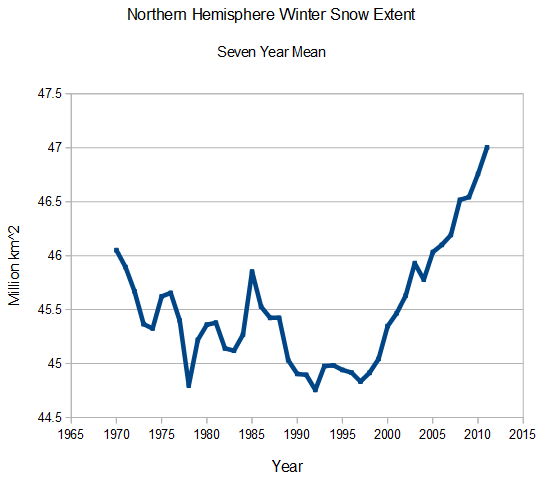
Northern Hemisphere winter snow extent is going through the roof, due to Arctic air pushing further south.

BvElMTCCAAAfGr6Rutgers University Climate Lab :: Global Snow Lab

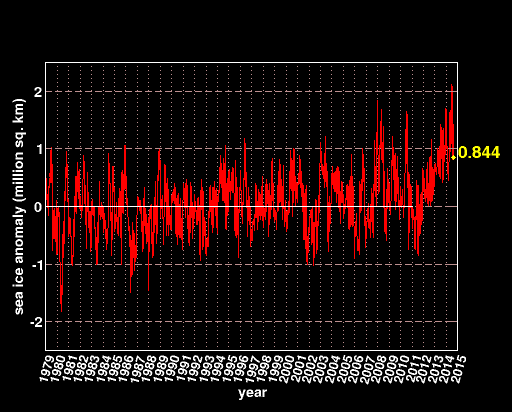
Antarctic sea ice extent is going through the roof

iphone.anomaly.antarctic (1)

iphone.anomaly.antarctic.png (512×412)

US summer temperatures are plummeting

ScreenHunter_2311 Aug. 26 05.44

Pay no attention to all this. Just keep believing the mindless propaganda being spewed by the White House and their minions.

The Global Warming Hoax is a Ploy to Push Agenda 21. It’s Got to Stop!

The Debate is Over!

Global Warming Fraud Exposed

al gore climate change

The first known video promoting the scam of “Man made global warming”  showing

how they demonized the life gas CO2 and make man earth’s enemy in the process….

is from 1958!

Environment was the chosen mechanism to bring about global gov. “They” need

a global problem that required a global solution… Enjoy some early Al Gore type hype

from 1958 in this video.

According to the Club of Rome: “The common enemy of humanity is man. “In searching

for a common enemy against whom we can unite, we came up with the idea that pollution,

the threat of global warming, water shortages, famine and the like, would fit the bill.

“we came up with the idea “

Not based on any facts! They just came up with the idea.  What is the Club of Rome?

A think tank created by men and women who want a global communist system that they

control.  Who are these people? Here is a list of present and notable members from the

Green Agenda (highly recommended you spend so time on this site) Members include

David Rockefeller, George Soros, Henry Kissinger, Bill Clinton, Jimmy Carter, Mikhail

Gorbachev, Kofi Annan, Maurice Strong, Bill Gates, Ted Turner, Tony Blair, Robert Muller,

The Dalai Lama, Hassan bin Talal, Javier Solana, Javier Perez de Cuellar, Gro Harlem Bruntland,

Garret Hardin, King Juan Carlos of Spain and his wife Queen Sophia, Queen Beatrix of the

Netherlands, Prince Philippe of Belgium, and about 80 other wealthy elites, new age cultists,

former and current U.N. figures, and political figures.

First earth day 1970

Stockholm 1972 – United Nations Environment Programme (UNEP)

The (false) oil crisis of 1973-1974

United Nations Conference on Human Settlements was held at Vancouver

from 31 May to 11 June 1976

Our Common Future 1987

Rio Earth Summit 1992 which brought the world Agenda 21

The fraud and deception started long ago and is being implemented by ever level

and faction of gov. including UN NGO’s

The fraud is well documented and the peoples of the world need to take action.

Not to save us from “climate change” but the people who “came up with the idea. 

They cause the environmental crisis, the wars, famines, depressions etc. 

They are the enemy, not you and I


Now for some truth about climate Change.

The Sea Around Us by Rachel Carson shows the effects of the ocean cycles. 

Those who constructed the MMGW fraud knew when the natural ocean and sun

cycles would produce the most natural warming. They used this information for the

basis of the fraud. Those natural cycles are now moving into the cooling cycle.

The global warming lie is used to bring about UN corporate world gov. by the same

people who created the UN, Israel, Wars, Depressions, Famines etc. Their disturbing

visions are laid out in Agenda 21.

As the global warming fraudsters like to say “the debate is over.”

I agree, the debate is over and the fraud exposed!

Check and Mate!

– We have now entered the cooling cycle.

Elected officials (who represent the corporation, not the voters), teachers,

preachers, media, health etc.  (bow to their corporate masters) and law

enforcement (Policy enforcers of the corporation)  are  the useful idiots used

to spread the propaganda and implement “their” evil plan.

Some know what they are doing …  most don’t. It is our job to inform all of them

and insist they STOP immediately! They’re involved in fraud, conspiracy to commit, 

genocide and breach of trust.


People of Scotland are Tired of Excuses, They Are Demanding Justice for Wind Turbine Victims!

Wind Farms Turn Scottish Highland Homes Into Sonic Torture Traps

when-is-wind-energy-noise-pollution

An ill wind blows as the surge of turbines stirs fears of silent danger to our health
Scottish Express
Paula Murray
 August 2014

TENS of thousands of Scots may be suffering from a hidden sickness epidemic caused by wind farms, campaigners have warned.

The Sunday Express can reveal that the Scottish Government has recently commissioned a study into the potential ill effects of turbines at 10 sites across the country.

More than 33,500 families live within two miles of these 10 wind farms – which represent just a fraction of the 2,300 turbines – already built north of the Border.

Hundreds of residents are now being asked to report back to Holyrood ministers about the visual impacts, and effects of noise and shadow flickers from nearby wind farms.

Campaigners fear that many people do not realise they are suffering from ailments brought on by infrasound – noise at such a low frequency that it cannot be heard but can be felt.

One such person is Andrew Vivers, an ex-Army captain who has suffered from headaches, dizziness, tinnitus, raised blood pressure and disturbed sleep since Ark Hill wind farm was built near his home in Glamis, Angus.

Mr Vivers, who served almost 10 years in the military, said the authorities had so far refused to accept the ill effects of infrasound despite it being a “known military interrogation aid and weapon”.

He said: “When white noise was disallowed they went on to infrasound. If it is directed at you, you can feel your brain or your body vibrating. With wind turbines, you don’t realise that is what’s happening to you.

“It is bonkers that infrasound low frequency noise monitoring is not included in any environmental assessments. It should be mandatory before and after turbine erection.”

He is raising concerns about an “acknowledged and unexplained increase of insomnia, dizziness and headaches in Dundee”, where two large wind turbines have been operating since 2006. Mr Vivers, 59, said all medical explanations of his own sudden health issues had been ruled out and it was more than 12 months before he was convinced of the link to the wind farm.

He said: “I was getting these headaches and dizziness and just not sleeping, but I was putting it all down to all sorts of other things. A couple of times I was walking on the hills around the house with my dogs and got a really bad dizzy spell.

“I actually had to sit down for a few minutes and while I was sitting down wondering what on earth was wrong with me, I did notice the wind was coming straight from the turbines.” Mr Vivers said he has also witnessed an “incredible number” of dead hares on the moors around Ark Hill and believes they may have succumbed to “internal haemorrhaging and death” as a result of the turbines.

He added: “If this coming winter is going to be anything like the last and with the plans to build a second wind farm much closer to us, I think we’ll have to sell our home and move elsewhere.”

The 10 sites under the microscope in the new survey include one in Dunfermline, where almost 23,000 households are nearby, and Little Raith near Lochgelly, Fife, where there are nearly 9,000 households.

The others are Achany in Sutherland, Baillie near Thurso, Caithness, Dalswinton in Dumfriesshire, Drone Hill, near Coldingham, Berwickshire, Griffin in Perthshire, Hadyard Hill in Ayrshire, Neilston in Renfrewshire and West Knock, near Stuartfield, Aberdeenshire.

About 2,000 questionnaires have been sent to residents in a move that is understood to have caused tension between the Scottish Government and the renewable energy industry.

The “wind farm impacts study” is being managed by ClimateXChange, which has published information about the project online.

It says: “The research will use two sources of information: how local residents experience and react to visual, noise and shadow-flicker impacts, and how the predicted impact at the planning stage matches the impact when the wind farm is operating.

“The final report is due in autumn 2014. It will inform the Scottish Government’s approach to planning policy on renewables and good practice on managing the impact of wind farms on local residents.”

One of the contractors involved in the project is Hoare Lea Acoustics, an international firm which specialises in measuring noise and vibration from wind farms.

However, Susan Croswaithe, the UK spokeswoman for campaign group European Platform Against Windfarms, said the study would be “little more than a box ticking exercise”.

She added: “On the face of it, it does look like a step in the right direction, but can we really trust it? My issue is that it is not independent enough.

“Our website is full of examples of people not being listened to.

“We have two very large wind farms near us in Ayrshire, Arecleoch and Mark Hill – 60 turbines and 28 turbines.

“If people in my area have noticed they are feeling better at the moment but do not understand why, it may be because the turbines have been switched off while they do maintenance on the grid.”
Scottish Express

Andrew Viviers

Andrew Viviers makes the following – perfectly reasonable – observation about noise testing:

“It is bonkers that infrasound low frequency noise monitoring is not included in any environmental assessments. It should be mandatory before and after turbine erection.”

The idea of “testing” for the impacts from turbine noise and vibration without including infrasound and low-frequency noise is “bonkers”, indeed. Dr Mariana Alves-Pereira – who has been studying low-frequency noise impacts with her research group for 30 years, certainly thinks so (see our post here).

The noise standards – written by the wind industry – rely on the dB(A) weighting and, therefore, deliberately ignore the vast bulk of the sound energy produced by turbines – which pervades homes as infrasound and in frequencies that cause sleep deprivation and other adverse health effects (see our post here).

The standards not only ignore infrasound, but the South Australian EPA’s noise guidelines even ludicrously assert that infrasound was a feature of earlier turbine designs that is not present at “modern wind farms”. SA’s EPA – despite being incapable of following its own guidelines when it came to noise testing at Waterloo – managed to find infrasound present inside neighbouring homes at a very modern wind farm, that started operation in 2010 (see our posts here and here). For a great little summary on wind turbine generated infrasound and its adverse affects on health, check out this video of Alex Salt, laying it out, in no uncertain terms.

blob:https%3A//www.youtube.com/5dcfb8f1-40b5-4c86-91c6-bcc4ee86c9f4

Given the work of Professor Salt (outlined in the video) and Steven Cooper’s findings at Cape Bridgewater (see our post here) “the recent unexplained increase of insomnia, dizziness and headaches in Dundee”, referred to by Andrew Viviers is not so difficult to explain at all.

The direct link between very low-frequency turbine noise, sleep disturbance and annoyance was well and truly established by Neil Kelley & Co over 25 years ago (see posts here and here and here). And the wind industry knew all about it (see our post here).

Well, Highlanders – it seems like the right time to grab your Claymores and bring your political betters to account.

brave_shield3

If the Ontario Liberal Gov’t was Smart, They Would Cancel These Wind Contracts!


Prospects of negative governmental

action in Ontario’s energy sector

When investments are made in the private sector sophisticated financial models are developed, complete with multiple inputs, all designed to predict a range of best and worst case scenarios. If a significant model input strays beyond its originally anticipated value range for example, if customer demand for a business’s products collapses then the financial model for the business may fail. If so, stakeholders in the business will likely face a restructuring of their investments. 

The chances of a restructuring are far less likely when government is the main customer of the business, not only because governments are presumed to have deep pockets, but also because, in those businesses where government acts as an intermediary between the business and the ultimate consumers of the business’s products, the government’s intermediation tends to insulate the business from model failure and its usual consequences. Nevertheless, if model failure is severe and persistent enough, history in Canada suggests that governments may be tempted to impose a restructuring even on these sorts of businesses. 

In the years leading up to Ontario’s Feed-in-Tariff (FIT) program, it was generally accepted that Ontario was approaching a near-term shortage of electricity as surging demand threatened massive brownouts.  Government financial models, no doubt, assumed that the cost of developing renewable energy infrastructure involving long-term power purchases at prices significantly above market could be recouped by steadily increasing electricity rates over time, all without unduly reducing customer demand.1 However, subsequent experience seems to suggest that Ontario’s electricity demand may have been more elastic than anticipated, especially as many urban and rural electricity consumers have reacted to increasing prices by switching some of their electricity needs to lower-priced natural gas and propane. Moreover, as price increases in the Province have outpaced those in neighbouring jurisdictions (leaving Ontario’s electricity prices 30-60% higher than in those jurisdictions), some large commercial users have reacted by moving their operations out of Ontario, further depressing overall demand.2  In fact, far from remaining steady, electricity demand in the Province is now projected to decline until at least 2021.3

Even as electricity demand has declined, Ontario’s generating capacity has increased.  Overall generating capacity in Ontario has increased by 13% since 2003, while demand has decreased by 10% since 2005.4 The end result has been a large and continuing surplus of generating capacity, with Ontario’s generating capacity expected to exceed forecast (normal weather peak) demand this summer by 25-50%.5  Partly as a consequence, electricity spot prices in the Province have plummeted, sometimes falling to $0.025/kWh.6  Higher-priced, surplus Ontario electricity is sometimes resold to neighbouring jurisdictions at a substantial discount7 and the Global Adjustment amount charged to Ontario consumers has now risen to record levels.8

In summation, some of the model inputs in the Province’s original financial models may already have strayed beyond their initially anticipated value ranges, suggesting at least the possibility that model failure has occurred in the sector or that it may be imminent.  If so, then recent entrants into Ontario’s energy sector, otherwise dependent on the continuance of long-term government purchases, are quite right to be concerned about the possibility of a government-imposed restructuring in their sector.

Unlike private sector restructurings which typically involve a court process, government-imposed restructurings generally take the form of confiscatory legislation or some other form of negative governmental action.  It should come as no surprise that governments in Canada have from time to time engaged in various sorts of negative governmental action, invariably with the intent of modifying (or even abrogating altogether) undesirable government obligations.  Such action has even occurred previously in Ontario’s utility sector.9 For example, in the 1930’s, successive Ontario governments enacted several pieces of legislation abrogating various contractual commitments to private sector power producers, all with the intent of assisting the then-fledgling, and government-owned Ontario Hydro to become the dominant power producer and distributor in the Province.  Indeed, overall, scholarly research suggests that negative governmental action usually occurs (if it occurs at all): (a) when technological change in a given industry sector is occurring rapidly, (b) when pricing, demand or other important financial variables cannot be perfectly forecast, and (c) when governments have entered into long-term contracts that cannot easily be altered.10 In other words, the restructuring risk increases on model failure occurring within this context.  

Negative governmental action can take many forms, including specifically, the passage of legislation modifying government payables, authorizing or curing contract breaches, limiting court access, amending or cancelling contract commitments, and even expropriating completed projects. A recent, well publicized, example of negative governmental action in Canada occurred in the early 1990s when the federal government summarily cancelled several long-term contracts with private sector participants for the redevelopment of Toronto’s Pearson Airport.11 Bill C-22, passed by the House of Commons provided that: (a) all contracts relating to the redevelopment were declared not to have come into existence or to have had any legal effect, (b) all obligations, rights and interests arising out of the contracts were declared not to have come into existence, (c) no action or proceeding, including for damages for breach of contract, could be brought against the government, and (d) every action against the federal government was summarily dismissed.  Bill C-22 also authorized the relevant federal Minister, for a period of 30 days, to enter into agreements with aggrieved stakeholders to pay compensation in such amounts as the Minister considered appropriate.  Notably, compensation for lost profits was expressly prohibited under the legislation. 

Using Bill C-22 as an example, it may appear at first blush that governments in Canada hold all the cards when it comes to negative governmental action. However, stakeholders should note that there are various countervailing influences that will moderate the actual exercise of such extraordinary power. For example, government will be mindful of reputational concerns.12 Specifically, international credit rating agencies may react to negative governmental action by downgrading the subject government’s public debt due to increased “country risk”, thereby increasing future borrowing costs for the subject government. Foreign governments may impose “tit-for-tat” sanctions on projects in their jurisdictions that are intended to hurt nationals of the expropriating state. Judgments rendered by sympathetic foreign courts may be executable against the subject government’s assets located in foreign jurisdictions. And finally, equity investors in non-related sectors may avoid investment in the jurisdiction altogether for fear of falling victim to similar governmental action.

Aside from reputational concerns, some jurisdictions offer constitutional safeguards against negative governmental action without due process. The Fifth and Fourteenth Amendments to the US Constitution are good examples.  Unfortunately, no such constitutional protection currently exists in Canada.13 Specifically, Canada’s Charter of Rights and Freedoms contains no express provision for the protection of property, economic, or even contract rights.14 And based on a string of Charter cases decided by the Supreme Court of Canada, it is unlikely that any general protection of this nature will be implied any time soon.15 Instead, stakeholders in Canada will have to derive comfort from the fact that Canadian courts will generally construe confiscatory legislation very strictly against the subject government, straining if at all possible to find that the legislation does not exclude the payment of appropriate levels of compensation or review by the judiciary. Nevertheless, if the legislation is sufficiently precise, even a strict constructionist approach will be of little use to an aggrieved stakeholder.

In such circumstances, Canada’s free trade agreements may assist, but only if the stakeholder is a national of a treaty-protected country. As is well known, Canada is a signatory to a number of free-trade and foreign investment protection agreements, some of which prohibit confiscatory action without payment of appropriate compensation.  For example, under Article 1110 of the North American Free Trade Agreement (NAFTA), no federal or provincial government is permitted to “nationalize or expropriate an investment of a [US or Mexican] investor…or take a measure tantamount to nationalization or expropriation”, unless such action is: (a) for a public purpose, (b) effected on a non-discriminatory basis, (c) effected in accordance with due process, and (d) carried out upon payment of compensation equivalent to the fair market value of the expropriated investment.  

Particularly instructive here is the case of Metalclad Corporation v. Mexico16, a NAFTA case brought by an American company against the state of Mexico in 2000.  In that case, an arbitral tribunal ruled that, as a result of numerous laws and other negative governmental actions passed and undertaken by Mexican state and municipal authorities, Mexico had effectively expropriated Metalclad’s newly-constructed waste facility in Guadalcaza. The tribunal awarded Metalclad US$16,685,000 in damages representing Metalclad’s sunk costs of the investment.17 While damages awarded against Mexico did not include an amount on account of discounted lost profits, such damages are thought to be sustainable under NAFTA in certain circumstances.

Equally instructive is a 2012 NAFTA case brought against Canada by the Abitibi-Bowater group and involving certain confiscatory legislation passed by the Province of Newfoundland. In this case, the provincial legislation provided for: (a) the expropriation of significant Abitibi-Bowater properties used for hydroelectric generation and transmission, (b) the cancellation of various hydroelectric contracts between the Abitibi-Bowater group and the Province, and (c) the termination of certain timber and water rights. While the legislation provided for compensation for the expropriated properties, no compensation was to be forthcoming for the terminated timber and water rights. The Abitibi-Bowater group brought a NAFTA claim asserting that the Newfoundland legislation constituted an expropriation of its assets without appropriate compensation contrary to NAFTA Article 1110. Faced with the prospect of an uphill fight, the Canadian government opted to settle the claim for $140 million.  

Besides NAFTA, and as indicated above, several bilateral trade arrangements exist which contain similar foreign investor protection.18 Importantly, the proposed multilateral Trans-Pacific Partnership currently being negotiated with several Asia-Pacific countries and the proposed Canada-European Union Comprehensive Economic and Trade Agreement (not yet in force) will also contain similar investor protection. Once implemented, these new trade arrangements will significantly expand the list of treaty-protected countries and the range of foreign stakeholders that will be able to benefit from investor protection.  Notably however Canada’s trade agreements cannot be used by Canadian nationals to protect themselves against negative governmental action occurring within Canada in relation to their domestic investments.   

With the recent re-election of Ontario’s Liberal government, stakeholders in Ontario’s energy sector are, no doubt, breathing a little easier, as putative threats to tear up the Province’s FIT contracts are now much more clearly off the table.19 Most assuredly, the restructuring risk has subsided.  Still, the issues here are as much financial as they are political, and history in Canada suggests that negative governmental action can never truly be ruled out.  If financial model failure occurs and is considered severe and persistent enough, then negative governmental action will remain a distinct (even if remote) possibility. 


1 The comprehensiveness of the Government’s original financial models has been questioned by Ontario Auditor General in the Annual Report of the Office of the Auditor-General of Ontario.

2 Remarks of Greg Abel, Chairman, President and CEO of Spectra Energy, to Economic Club of Canada, June 24, 2014.  See also “Environmental and Economic Consequences of Ontario’s Green Energy Act”, R. R. McKitrick, Report prepared for Fraser Institute, 2013, and also “High Ontario Electricity Prices Hamper Ring of Fire Processing and Other Industry”, L. Di Matteo, February 6, 2011.

3 Ontario’s Electricity Surplus: An Opportunity to Reduce Costs”(the “Ontario Surplus”), a publication of the Ontario Clean Air Alliance Research Inc., July 2012.

4 See Ontario Surplus, supra.  See also “Eighteen Month Outlook: From March 2014 to August 2015” (the “18 Month Outlook”), a publication of the IESO, p. 4.

5 Based on 18 Month Outlook, Tables 3.1, 4.3-4.5.
 
6 See Ontario Surplus, p.3.
 
7Ontario’s Power Trip: Power Dumping, Gallant, P., Financial Post, July 20, 2011, and “Ontario’s Power Trip: Province lost $1.2-billion this year exporting power”, Gallant, P., Financial Post, December 2, 2013.
 
8 “Ontario power fee sets new record: The global adjustment — a fee added to the market price of electricity in Ontario — has reached a record high”, Walton, T., The Toronto Star, September 3, 2013.
 
9Regulatory Failure and Renewal: The Evolution of the Natural Monopoly Contract”,  J. Baldwin, Ottawa: Economic Council of Canada 1989.
 
10 See Baldwin, Chaps. 3, 10 and 12, for example.  See also “Public Accountability in the Age of Contracting Out”, E. Atwood and M.J. Trebilcock, (1996) 27 Can. Bus. L.J., v. 27, n. 1, p. 1, at p. 38.
 
11 A more recent instance occurred when in 2008 the Government of Newfoundland expropriated various power generating and transmission assets of the Abitibi-Bowater group (discussed further below in this article) pursuant to the Abitibi-Consolidated Rights And Assets Act (Newfoundland).
 
12 See for example “A Constant Recontracting Model of Sovereign Debt”,  J. Bulow & K. Rogoff (1989) Journal of Political Economy, 155.
 
13 For a contrary view regarding the government’s right to implement negative governmental action, see “Is the Pearson Airport Legislation Unconstitutional?: The Rule of Law as a Limit on Contract Repudiation by Government”, P. Monahan, (1996) Osgoode H.L.J., v. 33, n. 3, p. 411, where the author argues that where legislation like Bill C-22 purports to deny access to the courts, the legislation breaches the rule of law implicitly enshrined in the Charter of Rights and Freedoms, and therefore is unconstitutional.
 
14 While the Canadian Bill of Rights provides an explicit right to the “enjoyment of property” and the right not to be deprived thereof without due process, the Canadian Bill of Rights only applies to federal laws, may not entitle the aggrieved party to compensation if the confiscatory legislation provides otherwise, and creates rights that do not have the same status as Charter rights. 
 
15 Siemens v. Manitoba (Attorney General), 2003 SCC 3; The Attorney General of Quebecv. Irwin Toy Limited, [1989] 1 S.C.R. 927; Whitbread v. Walley [1991] 2 W.W.R. 195 (SCC);Olympia Interiors Ltd. v. R. (1999), 167 F.T.R. 165 (Fed. T.D.), affirmed (1999), 1999 CarswellNat 1978 (Fed. C.A.), leave to appeal refused (2000), 252 N.R. 393 (S.C.C.);Energy Probe et al. v. The Attorney General Of Canada et al., (1994) 17 O.R. (3d) 717 (Ont. C.J.); and Shaw v. Stein, 2004 SKQB 194. 
 
16 See Metalclad Corporation v. Mexico, ICSID Case No. ARB(AF)/97/1 (NAFTA), Award. For an unsuccessful appeal of the NAFTA award to British Columbia Supreme Court, seeUnited Mexican States v. Metalclad Corp., 2001 BCSC 664.
 
17 Damages were based on the claimant’s actual investment in the property because the facility had not been operational long enough, and thus had not established a sufficient record of profitability, such that damages for lost profits could be proven.  The tribunal suggested that a “fair market value” award of damages for a going concern with a history of profitable operations would usually be based on an estimate of future profits, subject to a discounted cash flow analysis.  See  also Biloune, et al. v. Ghana Investment Centre, et al., 95 I.L.R.183, 207-10 (1993).
 
18 See, for example, Article 9.1 of the Canada-Panama Free Trade Agreement, Article G-10 of the Canada-Chile Free Trade Agreement, and Article 8.11 of the Canada-Korea Free Trade Agreement (not yet in force), all of which provide compensation for expropriatory measures taken by the federal or any provincial government.
 
19 See, for example, the Alliance for Renewable Energy’s view of the threat in: “June 12 Provincial Election will determine the Future of Ontario FIT Programs”,  June 3, 2014.
 
 
NOT LEGAL ADVICE. Information made available on the Web site in any form is for information purposes only. It is not, and should not be taken as legal advice. You should not rely on, or take or fail to take any action, based upon this information. Never disregard professional legal advice or delay in seeking legal advice because of something you have read on this Web site. Gowlings professionals will be pleased to discuss resolutions to specific legal concerns you may have.


Sherri Lange, from NAPAW, calls for an Audit of the Green Energy, and Green Economies Act!

Letter to Auditor General for Ontario from North American Platform Against Windpower

To: Ms. Bonnie Lysyk (Auditor General for Ontario)       (Letter of August 11, 2014)

Dear Ms Lysyk,

Please consider this letter as an urgent formal request for a complete and impartial audit for all matters pertaining to the Green Energy and Green Economy Act, 2009, and its false assertions and negative results for Ontario: these misrepresentations include vigorous job creation, suggested cleaner air space, the ability to create energy facilities, wind and solar, in particular, in a cost savings manner, or competitive manner.

The Green Energy and Green Economy Act has suggested with not a little hyperbole, that it will “spark” growth in “renewables sources in Ontario, while creating savings, and producing 50,000 jobs, direct and indirect,” and “make a positive contribution towards climate change objectives,” whereas in fact the GEA threatens to eviscerate the economy of Ontario and Canada as a whole. The factual results of the GEA are of economic chaos, massive job losses, environmental degradation of the highest order, a decay of our treasured environmental protections in law, and yet uncounted human health and productivity costs.

Under the guise of positive net growth, and climate change objectives, this Act has been used to gouge and tyrannize the province, materially and economically.

We believe that the mandate of the Auditor General to provide access to “value for money” data, within an audit, will provide even more information with respect to the waste and perhaps fraud at the highest levels; consumers are indeed not being provided with fair business practices, but are continually subjected to even more egregious attacks in their daily “energy expensive” lives due to a battered and debt ridden economy. Jobs continue to leave Ontario. Some are relocating to Buffalo, to save, in one instance, $4 million per year in energy savings, or to Saskatchewan, for example. The bleed of jobs cannot continue, and we believe that an assertive and clear look at the funding and economic threat of the Green Energy Act will bear striking similarities to the international failure of wind power and Green Energy policies. Even information provided years ago by your office and the Fraser Institute did nothing to change the course.

We contend that none of the GEA assertions and projections have proven valid, and have in fact been a major contributor, likely THE major contributor, to the near demise of manufacturing in Ontario, to energy poverty for many Ontarians whose hydro bills have risen 30-40% with promises of more hikes, to the loss of jobs to the USA and western Canada, to the ill health of hundreds of Ontarians, some of whom have been forced to abandon homes, or been bought out by developers, or who reside in parking lots at Walmart, or at cottages, or with relatives. The energy chaos of Ontario now handily competes with that of Spain, Germany, or the UK.

All of this should be and should have been preventable, since the facts are well known. Indeed, the facts of the Green Energy failures of Europe should have been a lesson learned before this Ontario failure of a massive scale. (Ontario now has the unenviable position of having the highest cost of power in North America. The significance of this is not lost on Moody’s Credit Ratings system, with the threat of downgrades to Ontario.) The lessons of Europe have been put before the Legislature, all parties, on many occasions, without benefit or improvement.

The Fraser report of 2013 has already indicated that the assertions of the GEA are egregiously false.

“Already, the GEA has caused major price increases for large energy consumers, and we’re anticipating additional hikes of 40 to 50 per cent over the next few years,” said Ross McKitrick, Fraser Institute senior fellow and author of Environmental and Economic Consequences of Ontario’s Green Energy Act.”

“The Ontario government defends the GEA by referring to a confidential 2005 cost-benefit analysis on reducing air pollution from power plants. That report did not recommend pursuing wind or solar power; instead it looked at conventional pollution control methods which would have yielded the same environmental benefits as the GEA, but at a tenth of the current cost. If the province sticks to its targets for expanding renewables, the GEA will end up being 70 times costlier than the alternative, with no greater benefits.” (News release, April 2013)

The study goes on to indicate that returns to investment in manufacturing are “likely to decline by 29 per cent, mining by 13 per cent, and forestry by less than one per cent.”

Professor McKitrick explains in his report that wind is especially wasteful, as surplus generation occurs generally when demand is low, and the resulting “dumping” also results in net losses to Ontario.

“The Auditor General of Ontario estimates that the province has already lost close to $2 billion on surplus wind exports, and figures from the electricity grid operator show the ongoing losses are $200 million annually”, says the report.

Terrance Corcoran in the Financial Post quotes from the Auditor’s report that the cost of power is estimated to rise again another 46% in the next four years. In his analysis of the Auditor General’s 2011 report on electricity, Mr. Corcoran writes of “wilful negligence” and a “high level of fiscal negligence and abuse of process and disdain for taxpayers and electricity consumers.”

A prime example of the negative impact on the Ontario jobs situation is reflected in Magna’s (the largest automotive parts manufacturer in Canada) announcement that due to the high cost of electricity in Ontario, it will not make any further investments. (Specifically, for Magna between 2013 and 2014, normal business activities resulted in an increased cost of electricity of 30 million dollars.)

The expressed primary purpose of the 2011 audit was to ensure that the OEB had sufficient and adequate systems in place to protect consumers, ratepayers. As noted also in the report, consumers are protected under the Energy Consumer Protection Act, 2010, and that under this legislation consumers shall be provided with the information they require about contracts, prices, and that they will be protected by fair business practices. This fairness has not been brought to fruition.

And the serial negligence continuing until this day, despite hearty and clear directives from the Fraser Institute and your office, has resulted merely in the advance of even more industrial wind in Ontario under Premier Wynne. Consumers are indeed not being increasingly protected, and continue to be recklessly thrown under the fiscal bus.

What we find most egregious is that the people of Ontario have warned the Premier(s) McGuinty and Wynne, and made reports to the Finance Committee, as well as reporting to these offices the results of energy chaos in Germany, Spain, the UK as well as other European states previously under the spell of “renewables.” (Please note the letter to the Editor, Financial Post, March 3, 2011: “No such thing as renewable energy.”) These abject economic failures in Europe should have provided clear warning of the folly of subsidizing inefficient non base load sources of power, particularly wind turbines.

The government and lobbying association CanWEA’s (Canadian Wind Energy Association) assertion that the wind turbine industry operates safely and without damage to human health is false and must also be examined, since the reports of ill health given to the MOE (Environment) now number in the thousands. The MOE (Ministry of the Environment) has recognized the problem, and admitted in an email obtained from an FOI that they “did not know what to do.” The costs of wind power to our medical system and human productivity have not yet been accounted for.

We remind you that with about 240,000 wind turbines worldwide, we yet only receive one half of one percent, NET ZERO, of our power needs from this source. This industry is a failure, plain and simple; does the build out then have something to do with massive subsidies deep in the pockets of developers? Who is receiving these massive double or quadruple profits? We would like to see a chart of the major beneficiaries of the FIT program in Ontario. In Spain, the profits have been so tidy, that the Government recently asked for some retroactive repayments,understandably chilling the wind developers’ aspirations. (The lineup of crimes against consumers continues in Ontario: with 86% of Ontario’s wind power being produced on days when we are already in a surplus export mode. Another net loss for consumers is obvious.)

Please also include an environmental impacts costs study in your findings. The extreme damage to water tables, prime farm land, general ecological tragedies and killing of wildlife, has an external cost factor as well, to be borne, sadly, by our future generations.

Mr. Geoffrey Cox, a UK Conservative MP, expressed his disgust for the “gigantic machines” which are terrorizing his country:

“The reality is there is a Klondike-type gold-rush going on in rural areas where developers are anxious to get their applications through to pick up the vast profits that can be made.

“This is having a disruptive, devastating and distressing effect on dozens of small rural communities that are being torn apart by these huge industrial machines that are just yards away from their home.

“The number of applications seems to be going up rather than receding. What is going on is a stealthy, silent revolution of the most beautiful landscapes in Great Britain.

“If we carry on we will have ruined this most extraordinary inheritance.”We look forward to your prompt reply and a rapid advancement into an impartial audit of these matters in their complete impacts on Ontario, on the economy, and on fairness, or in this case, unfairness, to each consumer and job seeker. It will be extremely useful to untangle some of the Byzantine financial and undemocratic policy arrangements that have led to this “made in Ontario” crisis. We must immediately stop this re-creation of the catastrophic results of Green Energy failures in Europe.

Please conduct an impartial and in depth assessment of all financial matters pertaining to the GEA and relay these findings to the people of Ontario at your earliest convenience. We anticipate that your report might reflect also on the medical costs to Ontario families, the loss of economic vibrancy and stability of rural Ontario which continues to bear the assault fully on its shoulders, the loss of tourism, and the loss of property values, which also contribute to economic stagnancy. Please also conduct a study on a trace of the profits to developers, kWh by kWh, if possible. We have a right to know where our hydro dollars are going.

The high octane waste of the “Green Energy and Green Economy Act”, which has been repeatedly explained to legislators, must cease immediately. It must also be retroactively remediated. Your office has the ability to further outline to the Government not only how it may alter course, but how it must immediately repair.

(We will be writing under separate cover to Commissioner Hawkes, as we fully believe the waste and apparent fraud of the GEA far overpowers the ORNGE, E-Health, and Gas Plant scandals.)

Thanking you in advance,

Sherri Lange

CEO NA-PAW (North American Platform Against Wind Power); Founding Director Toronto Wind Action; Executive Director Canada, Great Lakes Wind Truth; VP Canada, Save the Eagles International (www.na-paw.org)

Appendix

What we know

· Industrial wind turbines are inefficient and pitiably useless

· Industrial wind installations, factories, create energy sprawl and high levels of environmental pollution and toxic waste

· Industrial wind does not work when we need it to and over performs at times to the extent that developers are sometimes paid to NOT produce

· Huge subsidies support the industry, without which, the industry does not survive

· The GEA suppresses all democratic opposition to wind and solar power, and the cards are stacked in favor of preferred accelerated promotion of wind turbines at the expense of Municipal and community cohesion and preferences

· Massive amounts of base load back up power are always required; there is zero reduction in GHG’s

· The industry (lobby)gets to sit at the table with policy makers and lay the table for the feast

· There has been no reasonable or realistic or honest explanation for the massive outlay of wind turbines in Ontario

· Energy poverty is abundant now in Ontario, along with massive job losses and gutting of the public purse

· Lessons from Europe are not being acknowledged

IS THIS CRIMINAL NEGLIGENCE?


– See more at: http://www.masterresource.org/2014/08/letter-to-auditor-general-for-ontario-from-north-american-platform-against-windpower/#more-31441

The Faux-Green Scam, is Completely Unsustainable!

The Three Faces of Sustainability

June 23, 2014
 

Pressure from the United Nations, U.S. Environmental Protection Agency, and environmental activists to promote “sustainable” development has led to “economically harmful and environmentally counterproductive” policies that have resulted in completely unsustainable practices, writes environmental expert Paul Driessen in a new report for The Heartland Institute.

The failure to define exactly what true sustainability is “gives unelected regulators increasing control over energy use, economic growth, and all other aspects of life,” writes Driessen. Both wealthy and economically depressed regions of the world are pressured to avoid developing coal, oil, natural gas, hydroelectric power, and nuclear power despite evidence showing them to be “the only abundant, reliable, and affordable sources of energy.” Such anti-energy policies “perpetuate poverty for developing countries and reduce living standards in wealthier countries.”

In “The Three Faces of Sustainability,” Driessen calls for “true sustainable development” that “improves living standards instead of paying mere lip service to them.” This requires “allowing people the freedom to develop and use new technologies and best practices that conserve resources, reduce waste and pollution, and give people incentives to choose the most efficient energy and mineral sources and to abandon them once better ones are found.”

He concludes,

Wise resource use is consistent with sustainable development because the creative human mind – what economist Julian Simon called the ultimate resource – will continue to devise new technologies and new ways of finding and extracting important natural resources. We will never lack the resources needed to continue improving lives, unless misguided activists, politicians, and regulators succeed in placing those resources off-limits. Our most valuable natural resources are not endangered or approaching exhaustion under any reasonable analysis. … In sharp contrast, political sustainability impedes efforts to improve lives, protect the planet, and prolong resource availability for current and future generations.

Driessen is senior policy analyst for the Committee For a Constructive Tomorrow and a policy advisor to The Heartland Institute. His articles have appeared in The Wall Street Journal, Washington Times, Investor’s Business Daily, and numerous other newspapers and magazines, and on websites around the world.