CCSAGE Will Have Their Day In Appeals Court! Awesome!

Court of appeal to hear Prince Edward County turtle case

11th hour reprieve

For immediate release, June 20, 2014, Picton

Court of Appeal to Hear Prince Edward County Turtle Case

The Ontario Court of Appeal has granted leave and will hear the case involving the threatened Blanding’s turtles of Ostrander Point. In July of 2013, the Ontario Environmental Review Tribunal revoked the approval issued by the Ministry of the Environment to Ostrander Point GP. to operate nine wind turbines, citing “serious and irreversible harm” to the turtle population. In February 2014, the Divisional Court reversed that ruling.

Today, the Court of Appeal indicated that it will hear the appeal of this decision. “This is an important step forward in the public’s efforts to protect one of the Province’s most ecologically sensitive habitats” said Myrna Wood, representing the Appellant Prince Edward County Field Naturalists (PECFN). In March 2014, the Court of Appeal also halted further construction at the site. The granting of leave to appeal today will continue that stay.

“It normally takes at least a few months for an appeal to be heard. Everyone is looking forward to moving ahead” said Eric Gillespie, legal counsel for PECFN.

Global Warming Alarmists Willing to Lie, to Push Their Agenda!

President Obama wants to stake his legacy on fighting global warming even if he has to fake it, which he does.

whitfieldThat inconvenient truth will get a hearing Thursday by the House Energy and Commerce Committee, and it won’t be pretty. The Subcommittee on Energy and Power, led by Rep. Ed Whitfield  (R-KY), will convene the “Standing up for Jobs and Affordable Energy” hearing, an appropriate nickname for the expected slice-and-dice of “EPA’s Proposed carbon dioxide regulations for power plants.”

In early June President Obama’s heavy-handed Environmental Protection Agency unveiled a radical plan to destroy existing U.S. coal-fired power plants by imposing a deliberately impossible carbon dioxide emission limit — reduction of 30% by 2030.

Upon examination, the rule offers no real benefit to anyone — beyond EPA’s armed enforcers — but costs everyone, which prompted the subcommittee hearing.

Whitfield set the hearing’s tone in a news release: “Under the guise of regulating power plants, President Obama’s agency is seeking to expand its regulatory reach over the entire electricity sector.  Committee members are concerned over EPA’s unprecedented reach, and the potential of this plan to increase electricity prices, eliminate U.S. jobs, and threaten grid reliability, with no meaningful effect on future climate patterns.”

The panel will examine only one witness: Janet McCabe, the Environmental Protection Agency’s Assistant Administrator for the Office of Air and Radiation.

Whitfield is deeply committed to oversight of this rule. In an email exchange, he told me, “This is a very important hearing, as it will be the first timemccabe President Obama’s radical EPA comes to the Hill to defend the agency’s latest proposed rule designed to shut-down coal-fired power plants — a rule the Administration is pushing through without Congress’ direction or approval, despite its potential to completely disrupt our energy sector and cripple our economy.”

I asked about some of the highly controversial legal and policy issues surrounding this proposal. Whitfield said, “We have questions for Ms. McCabe about her agency’s authority and overreach in writing this proposed rule and how EPA’s actions will impact Americans and their jobs and pocketbooks.”

The record of EPA’s testimony before Congress invites cynicism, for it is without honor or conscience, not to mention the absence of facts. McCabe, as did her predecessor Gina McCarthy – now EPA boss – will predictably deflect tough questions because the truth would outrage most Americans and deny Obama his nightmare legacy. We can expect mischaracterization, obfuscation, and flat-out lies.

Whitfield appears unlikely to put up with that.  He said, “As I have promised repeatedly, Obama’s assault on affordable electricity will not go unchecked.”

McCabe faces a tough sell with this proposed rule: Everything EPA has said about its benefits has been ignominiously debunked, some from unlikely quarters. For example, the EPA’s claim that the rule will create $30 billion in climate benefits by 2030 has been deflated by the liberal Brookings Institution.  In a report, “Determining the Proper Scope of Climate Change Benefits,” Brookings fellow Ted Gayer and Vanderbilt University economist Kip Viscusi revealed that the EPA cleverly selected an “apples and oranges” methodology that overstates the benefits so the regulation looks more attractive.

The “apples” are $30 billion in benefits worldwide and the “oranges” are the American taxpayers who pay the whole world’s bill.

It’s something like asking New York City to pay the water bill for every toilet flush in China – and pleading America’s public health and welfare to convince New Yorkers to pay up.

We can thank the Obama Administration’s shameful Interagency Working Group on Social Cost of Carbon for developing those “worldwide guidelines” in 2010 to deliberately swindle the American people. Even Democratic President Bill Clinton wouldn’t allow that, issuing Executive Order 12866 in 1993 that requires regulations to benefit the U.S. citizenry only, not the world.

To see through Obama’s slimy stratagem, the Brookings scholars did an “apples and apples” comparison on his proposed anti-coal rule, and found the domestic benefit amount is only about $2.1 billion at the lowest, ranging up to an optimistic $6.9 billion at the top. But the estimated compliance cost is $7.3 billion.

Get it? In the best of all possible Obama worlds, American taxpayers are down nearly half a billion bucks and missing 40% of their electricity.

The Brookings report concluded that estimated climate benefits are “largely conjecture and certainly overstated.” And we’re expecting McCabe to tell the truth about that under oath?

I hope Whitfield gets around to asking McCabe about how much the once-respected-but-now-turned-shill American Lung Association loves the EPA. The ALA ought to love the Obama administration a lot: ALA’s 591 federal grants amount to $43,016,875, according to USASpending.gov. As a cogent post on JunkScience.com said, “EPA owns the American Lung Association.”

ala2But not entirely: Big Green foundations own a substantial chunk too: The Foundation Search database posts 2,806 grants to ALA totaling more than $76 million, with millions coming from Environmental Grantmakers Association members, tagged with purpose statements like pushing the EPA to hit coal-fired power plants, do media advocacy and grassroots organizing.

Come to the American Lung Association for all your propaganda needs.

Thursday’s McCabe testimony comes on the heels of collapsed UN negotiations to repair failing global carbon markets, the International Monetary Fund‘s slashed forecast of U.S. economic growth to a shocking 2%, and the headline-grabbing opposition of Canadian Prime Minister Stephen Harper and Australian leader Tony Abbott to “climate measures that would destroy their economies,” which our Climate Cultist in Chief Obama seems insanely eager to embrace.

Memo to McCabe: the truth, the whole truth, and nothing but the truth.

———————

– See more at: http://www.cfact.org/2014/06/19/house-panel-hopes-to-air-inconvenient-truths-about-epas-war-on-coal/#sthash.jN0vDBqI.dpuf

More Proof, that Green/Greed Energy, is All About the Money!

Failure of the primary mission at the VA – vets died while

VA bureaucrats obsessed over green energy installation

VA-Phoenix solar panels

Green energy gets the green light while people that served our country with honor have to wait in line, dying while waiting.

For example, does anyone other than Eco-zealots give a flying f about having solar car ports at the VA?

The Department of Veterans Affairs (VA) at its Phoenix Medical Center in Phoenix, Arizona, plans to install a 3.003-megawatt (MW) DC solar electric system. This project will expand a 630-kW carport system currently under construction by SunWize Systems at the site.

It seems to me that the VA has failed their primary mission, and in a spectacularly bad way. Nobody other than eco-zealots gives a rats-ass if your office is sustainable – but they DO want you to adhere to your primary mission take care of veterans.  The word “shameful” doesn’t begin to describe the FUBAR at the VA. – Anthony

From the Washington Times Opinion Section: 

The administrators at the Veterans Administration have apparently been busy while old soldiers waited to see a doctor, after all. Serving those who served is not necessarily a priority, but saving the planet is Job 1. Solar panels and windmills can be more important than the touch of a healing hand.

The department early on set up an Office of Green Management Programs designed to “help VA facilities nationwide recognize opportunities to green VA, and to reward innovative ‘green’ practices and efforts by individual facilities and staff within the VA.” This sometimes means paying more attention to greening the department and saving the polar ice caps than to health care.

In the department’s words, it adopted a far more important mission to “become more energy efficient and sustainable, focusing primarily on renewable energy, energy and water efficiency, [carbon-dioxide] emissions reduction, and sustainable buildings.”

Washington Post Dares to Tell the Truth about the “Warming Hiatus”? Wow!!!

The Washington Post verifies ‘the pause’ in global warming

Jason Samenow sends word of a new article in WaPo that does some of the same sort ofsurface temperature analyses we see right here on WUWT. Seeing what a good job Matt Rogers did in his defense against claims of cherry picking, statistical significance woes, and Trenberthian masking, it made me wonder; “How long before he gets called into the chief editors office at WaPo and reassigned to be the correspondent covering Botswana?”


Global warming of the Earth’s surface has decelerated – Matt Rogers, Capital Weather Gang

The recently-released National Climate Assessment (NCA) from the U.S. government offers considerable cause for concern for climate calamity, but downplays the decelerating trend in global surface temperature in the 2000s, which I document here.


Many climate scientists are currently working to figure out what is causing the slowdown, because if it continues, it would call into question the legitimacy of many climate model projections (and inversely offer some good news for our planet).

An article in Nature earlier this year discusses some of the possible causes for what some have to referred to as the global warming “pause” or “hiatus”.  Explanations include the quietest solar cycle in over a hundred years, increases in Asian pollution, more effective oceanic heat absorption, and even volcanic activity. Indeed, a peer-reviewed paper published in February estimates that about 15 percent of the pause can be attributed to increased volcanism. But some have questioned whether the pause or deceleration is even occurring at all.

 Verifying the pause

You can see the pause (or deceleration in warming) yourself by simply grabbing the freely available data from NASA and NOAA. For the chart below, I took the annual global temperature difference from average (or anomaly) and calculated the change from the prior year. So the very first data point is the change from 2000 to 2001 and so on. One sign of data validation is that the trends are the same on both datasets.  Both of these government sources show a slight downward slope since 2000:

(Matt Rogers)

You can see some of the spikes associated with El Niño events (when heat was released into the atmosphere from warmer than normal ocean temperatures in the tropical Pacific) that occurred in 2004-05 and 2009-10. But the warm changes have generally been decreasing while cool changes have grown.

Ontarians Shoot Themselves in the Foot! Again….and again!

Lakehead University Professor Livio Di Matteo Reports on Economy

But don’t cry for the province; it has mainly itself to blame

THUNDER BAY – EDITORIAL – Ontarians have re-elected a government whose decade long reign dovetails with the lowest growth rate of provincial real per capita GDP in the Canadian federation. In the face of economic decline, Ontarians have come to fear change and opted for the status quo in the hope that things may get better if enough time goes by. Sadly, Ontario has embarked on the road to Argentina.

Despite Ontario’s mounting public debt, laggard economic performance, new status as a have not province, general lack of competitiveness, as well as a government marked by scandals and charges of corruption, the opposition parties were unable to convince the electorate of the need for change. In the face of such abundant fodder, this also represents a notable failure on the part of the opposition parties. Like Argentina, Ontario’s economic decline has spilled over to pervade its institutions with an inability to articulate and effect change.

In the early 20th century, Argentina was a successful export-led economy rooted in agricultural production – particularly beef. During the 20th century, Ontario became a successful export-led economy based particularly on its manufacturing sector. During its heyday, Argentina had one of the highest standards of living in the world and believed it was on the verge of becoming the next United States. Meanwhile, Ontario has grown accustomed to one of the highest standards of living in the world and taken its role as an economic cornerstone of the Canadian federation for granted.

The First World War and Great Depression shocked the Argentine export economy and the beef export industry never fully recovered. The result was poor economic policies over the next half-century that aimed to recapture a fading standard of living. Argentina was marked by large public sector debts and deficits, corruption, high inflation, and protectionism for uncompetitive sectors of the economy. Most importantly, there were entrenched economic interests that benefitted from poor government economic policies and a general inability to implement changes that would reverse the long-term decline of the Argentine economy. With a set of poor political institutions that included military coups, Argentina settled into a long-term decline punctuated by bouts of economic crisis and an inability to resolve its problems.

For Ontario, its problems began with an incomplete transition to the economic changes brought about by a more competitive world economy after 1990. Ontario’s economic development reached a crucial watershed in the wake of the economic boom of the 1980s that saw free trade with the United States, a shift away from the traditional east-west economic alignment, and the recession of the early 1990s. While the mid-1990s saw the onset of public sector restructuring and economic reforms, these petered out in the early 21st century with the return of more interventionist government economic policy that saw tax increases, increased public sector spending and a flawed industrial strategy based on green energy initiatives that became a factor in higher electricity prices. Economic productivity faltered and the 2009 tilt into recession was compounded by an appreciating Canadian dollar.

Ontarians have become used to ever-larger amounts of public spending fueled by growing public debt to compensate for faltering private sector productivity. This has created clients with a vested interest in more interventionist government. The recent election campaign saw promises of new public infrastructure spending, a new pension plan as well as overt political meddling by some traditionally circumspect public sector unions. While Ontario police unions do not have the heft of the Argentine military, their election activity is nevertheless yet another sign that Ontario may be changing for the worse.

In towns and cities across the province ravaged by manufacturing decline, the public sector has picked up the slack with public works construction projects, expanded government initiatives and their associated employment. Ontarians have convinced themselves that what is needed to reverse their malaise is more government spending fueled by debt and deficits, despite the evidence that the past decade of such policies have yet to turn the economy around. It is still early on in Ontario’s economic and fiscal troubles but another decade of economic policy ineptness could well make Ontario’s decline terminal.

Don’t cry for Ontario, it has mainly itself to blame.

Livio Di Matteo

– See more at: http://www.netnewsledger.com/2014/06/13/ontario-the-new-argentina-di-matteo/#sthash.RvVq5SNA.dpuf

Governments and Wind Industries Know They are Harming Us!!

Wind turbines are a human health hazard: the smoking gun

Credit:  By James Delingpole | The Telegraph | July 25th, 2013 | telegraph.co.uk ~~


How much more dirt needs to come out before  the wind industry gets the thorough investigation it has long deserved?

The reason I ask is that it has now become clear that the industry has known for at least 25 years about the potentially damaging impact on human health of the impulsive infrasound (inaudible intermittent noise) produced by wind turbines. Yet instead of dealing with the problem it has, on the most generous interpretation, swept the issue under the carpet – or worse, been involved in a concerted cover-up operation.

A research paper prepared in November 1987 for the US Department of Energy demonstrated that the “annoyance” caused by wind turbine noise to nearby residents is “real not imaginary.” It further showed that, far from becoming inured to the disturbance people become increasingly sensitive to it over time.

This contradicts claims frequently made by wind industry spokesmen that there is no evidence for so-called Wind Turbine Syndrome (the various health issues ranging from insomnia and anxiety to palpitations and nausea reported by residents living within a mile or more of wind turbines). Until recently, RenewableUK – the British wind industry’s trade body – claimed on its website: “In over 25 years and with more than 68,000 machines installed around the world, no member of the public has ever been harmed by the normal operation of wind farms.”

In a section called Top Myths About Wind Energy’ section it claimed that accusations that wind farms emit ‘infrasound and cause associated health problems’ are ‘unscientific’.

Other pro-wind campaigners, such as Australian public health professor Simon Chapman, have gone still further by insisting that the symptoms reported by Wind Turbine Syndrome victims around the world are imaginary and often politically motivated.

But the 1987 report, based on earlier research by NASA and several universities, tells a different story. A team led by physicist ND Kelley from the Solar Energy Research Institute in Golden, Colorado tested under controlled conditions the impact of low-frequency noise generated by turbine blades.

It found that the disturbance is often worse when indoors than when outside (a sensation which will be familiar to anyone who has heard a helicopter hovering above their house).

In subsequent lab tests involving seven volunteers, it found that “people do indeed react to a low-frequency noise environment”. As a result of its findings, the report recommended that in future wind turbines should be subject to a maximum noise threshold to prevent nearby residents experiencing “low-frequency annoyance situations.”

However these recommendations – widely publicised at the Windpower 87 Conference & Exposition in San Francisco – fell on (wilfully, it seems more than plausible) deaf ears.

It found that the disturbance is often worse when indoors than when outside (a sensation which will be familiar to anyone who has heard a helicopter hovering above their house).

In subsequent lab tests involving seven volunteers, it found that “people do indeed react to a low-frequency noise environment”. As a result of its findings, the report recommended that in future wind turbines should be subject to a maximum noise threshold to prevent nearby residents experiencing “low-frequency annoyance situations.”

Rather than respond to the issues raised, the industry devised a code of practice apparently contrived to ignore those very acoustic levels of most concern. ETSU-R-97 – the UK industry standard, which became the model for wind developers around the world – places modest limits on sound within the normal human hearing range, but specifically excludes the lower frequency “infrasonic” noise known to cause problems.

Last month the Department of Energy and Climate Change  (DECC) published a report by the Institute of Acoustics examining whether ETSU-R-97 was still adequate to the task. Remarkably, instead of stiffening regulations, it made them more lax, not only continuing to ignore the Low Frequency Noise and infrasound issue, but actually giving wind farms leeway to make more noise at night and to be built even closer to dwellings.

John Constable, director of the Renewable Energy Foundation, commented: “The report may represent current wind industry practice but it is very poor guidance and fails in its duty of care.”

The industry’s response is that turbine design has grown so much more sophisticated since the late Eighties that the problems identified in the 1987 report – which built on work from another report two years before – no longer apply.

“We’re often hearing these weird and wacky reports on the effects of wind. It seems anyone can stand up and say anything, which we find somewhat worrying because it gives a false impression. We don’t accept the suggestion that there are any health impacts caused by wind turbine noise, though we welcome any new research into the issue,” a spokesman for Renewable UK told me.

However this is contradicted by the author of the original reports Neil Kelley. Kelley has told Graham Lloyd – the environment editor from The Australian who (uncharacteristically for an environment editor puts truth before green ideology) broke the story – that research has shown that it is still possible for modern wind turbines to create “community annoyance.”

Kelley, who served as the principal scientist (atmospheric physics) at the National Renewable Energy Laboratory’s National Wind Technology Centre from 1980 to 2011, told Lloyd:

“Many of the complaints I have heard described are very similar to those from residents who were exposed to the prototype wind turbine we studied.”

He said the original research was performed to understand the “totally unexpected community complaints from a 2MW downwind prototype wind turbine.”

He said: “While follow-on turbine designs moved the rotors upwind of the tower, the US Department of Energy funded an extensive multi-year research effort in order to develop a full understanding of what created this situation.”

“Their goal was to make such knowledge available to the turbine engineers so they could minimise the possibility of future designs repeating the experience. We found the majority of the physics responsible for creating the annoyance associated with this downwind prototype are applicable to large upwind machines.”

The wind industry has resisted demands from campaigners to investigate this problem further. For example, in Australia, Lloyd reports, the wind turbine manufacturer Vestas has argued in a submission to the NSW government that low frequency noise not be measured.

But as Kelley said to Lloyd, if low frequency noise from turbines does not influence annoyance within homes, “then why should [the industry] be concerned?”

Those readers with an appetite for even more technical detail may be interested in the views of acoustics expert Dr Malcolm Swinbanks:

The important aspect to understand is that the old-fashioned downwind rotor-turbines did indeed generate a wider spectrum of infranoise and low-frequency noise, extending from 1Hz to 50Hz or 60Hz. Modern upwind rotor turbines are definitely very much quieter in the 32 and 64 Hz octave bands, but under some circumstances they can be similarly noisy over the frequency range 1Hz – 10Hz.

The wind industry denies this aspect, namely that they do not generate impulsive infrasound – I was present at a public meeting, with 400 farmers enthusiastically wanting wind-turbines on their land, when a wind-industry representative argued that I was incorrect to quote NASA research because the NASA research related only to downwind turbines. In fact NASA led the world in developing upwind rotor turbines, with the first, MOD-2 in 1981. They were fully aware of the differences between downwind and upwind configurations as long ago as 1981. Although upwind turbines are indeed quieter in respect of audible sound, NASA was well aware that inflow turbulence or wind-shear could give rise to enhanced infrasound from upwind turbines.

In the context of that particular public meeting, the chairman refused to let me respond at that time to correct the wind-industry presentation, and argued that I could only send a letter to the Planning Committee, which I duly did under strong protest. So I have encountered the wind-industry position directly at first hand.

The problem is that while the acoustics community fully acknowledge that the audible component of low-frequency sound (>20Hz) can cause adverse human reaction, they consistently deny that infrasound (

The response of the Australian Senate Inquiry to this information was that wind-turbines don’t generate 110dB. But just as sound pressure levels are always weighted in the audible frequency range, using the dBA scale – one does not quote absolute sound pressure levels, but dBA levels, so the infrasound range is correctly measured using the weighted dBG scale. This is an ISO internationally approved scale, and 110dB at 2.14Hz represents 82 dBG on the dBG scale. Modern wind turbine peak infrasonic impulsive levels have been measured as high as 76-80dBG, which is only marginally below the 82dBG level that was found to cause adverse effects in the Chen laboratory tests.

It is notable that when some acousticians wish to argue that wind turbine infrasound is not a problem, they quote known problematic infrasonic sound levels using the unweighted decibel dB scale, which makes these levels seem well “out-of-reach” of wind turbine infrasound levels. Yet these same acousticians would not dream of using absolute sound pressure levels to evaluate conventional audible sound, but will always quote correctly weighted dBA levels.

Thus, for example, the Chen infrasonic tests were at 110dB at 2.14Hz. This is 82dBG. In contrast, a “child-on-a swing” is also quoted by some acousticians as “not-a-problem”, when it is experiencing 110dB. This 110dB is at around 0.5Hz, so the corresponding dBG level is only 50dBG. Although the absolute sound pressure levels are identical, the perceived infrasound levels in these two cases are very different and cannot be equated to each other.

So I am unimpressed by the casual practice of quoting absolute sound pressure levels for describing infrasound, in order to exaggerate differences, when it is well recognized that the response of the ear is not uniform, and weighted sound pressure levels should be used for describing the likely hearing response.

This feature is responsible for much of the confusion that arises – interchange of unweighted and weighted levels can lead to very different conclusions – a situation which does not help to clarify the overall impact of infrasound.

It is noteworthy that some recent research indicates that at the very lowest frequencies (around ~1Hz) infrasound may be perceived by a different, separate mechanism than the ear’s conventional auditory mechanisms, so that at these frequencies, the G-weighting may no longer be accurate. But this is only a very recent deduction. Wind turbines undoubtedly generate their strongest signals at around 1Hz, so this is a new area of investigation which may also reveal additional adverse effects.

And here is the expert opinion of another US acoustics expert, Rick James – who thinks it somewhat unlikely that the wind industry is unaware of the problem:

 The “Kelley paper” is just one of many studies and reports published in the period from 1980 to 1990 by acousticians and other researchers working under grants from the US Dept. of Energy (DOE), NASA, and other agencies and foundations. All of these papers are still available on web sites open to the public. I have attached one of the later papers (“Wind Turbine Acoustics, Hubbard and Shepherd”) that summarize many of those studies. The acoustical conferences, at least those here in the US, all had presentations on wind turbine noise and it was one of the “hot” topics in the field. Earlier papers such as the 1982 Hubbard paper on Noise Induced House Vibrations was reporting some of the early research showing wind turbines were heard at lower auditory thresholds and that the infrasound was affecting people inside homes in much the same was jet noise at airports was affecting communities along flight paths. As a general rule, all of this research noted the need for caution if large upwind wind turbines of the type being installed today were to be located near homes and communities. As you can see in the Kelly paper there was concern over health impacts by the research community. Concurrent with this type of work the US DOD and NASA were investigating human response to infrasonic sound and vibration to help select candidates for jet pilots and space missions. This led to studies of nauseogenicity like the “1987 report on Motion Sickness Symptoms and Postural Changes……” Suffice it to say that between the issues of dynamically modulated infra and low frequency sound causing adverse health effects called “Sick Building Syndrome,” similar effects observed from wind turbines leading to the Kelley paper, military interest in motion sickness and other similar issues for large ships with slowly rotating engines to jet aircraft noise few acousticians in that period would have discounted the premise that for some people these types of sounds posed serious issues.

Can anyone imagine a potential scandal of this magnitude in the fossil fuel industry going uninvestigated by the green lobby – and hitting the front pages of all the newspapers?

I can’t.

Wind and Solar are Crippling Economies, Foolish Enough to Have Them….

« How did CO2 necessary for life on Earth & only 4 parts in 10,000 of our atmosphere get rebranded as some sort of deadly gas? | Main

16 June 2014

The Disgusting Truth about the Renewables Scam, and Climate Alarmism!

EXPOSED: THE HORRIFIC COST AND UTTER POINTLESSNESS OF OBAMA’S WAR ON CARBON DIOXIDE

Here is the Obama administration’s green strategy reduced to one damning equation.

19 million jobs lost plus $4.335 trillion spent = a reduction in global mean temperature of 0.018 degrees C.

Yes. Horrifying but true. These are the costs to the US economy, by 2100, of the Environmental Protection Agency’s regulatory war on carbon dioxide, whereby all states must reduce emissions from coal-fired electricity generating plants by 30 per cent below 2005 levels.

A U.S. Chamber of Commerce study calculates that the new regulations will cost our economy another $51 billion annually, result in 224,000 more lost jobs every year, and cost every American household $3,400 per year in higher prices for energy, food and other necessities. Poor, middle class and minority families – and those already dependent on unemployment and welfare – will be impacted worst. Those in a dozen states that depend on coal to generate 30-95% of their electricity will be hit especially hard.

Millions of Americans will endure lower quality of life and be unable to heat or cool their homes properly, pay their rent or mortgage, or save for college and retirement. They will suffer from greater stress, worse sleep deprivation, higher incidences of depression and alcohol, drug, spousal and child abuse, and more heart attacks and strokes. As Senator Joe Manchin (D-WV) points out, “A lot of people on the lower end of the socio-economic spectrum are going to die.”

But surely, surely, for all this misery and expense we’re going to be rewarded with fantastical benefits, possibly up to and including the salvation of the entire world from catastrophic man-made global warming?

Nope. Not according climatologists “Chip” Knappenberger and Pat Michaels:


Using a simple, publically-available, climate model emulator called MAGICC that was in part developed through support of the EPA, we ran the numbers as to how much future temperature rise would be averted by a complete adoption and adherence to the EPA’s new carbon dioxide restrictions*.

The answer? Less than two one-hundredths of a degree Celsius by the year 2100.

0.018°C to be exact.

Faux-green Energy is Just a Novelty Power source. Not for Prime-Time!

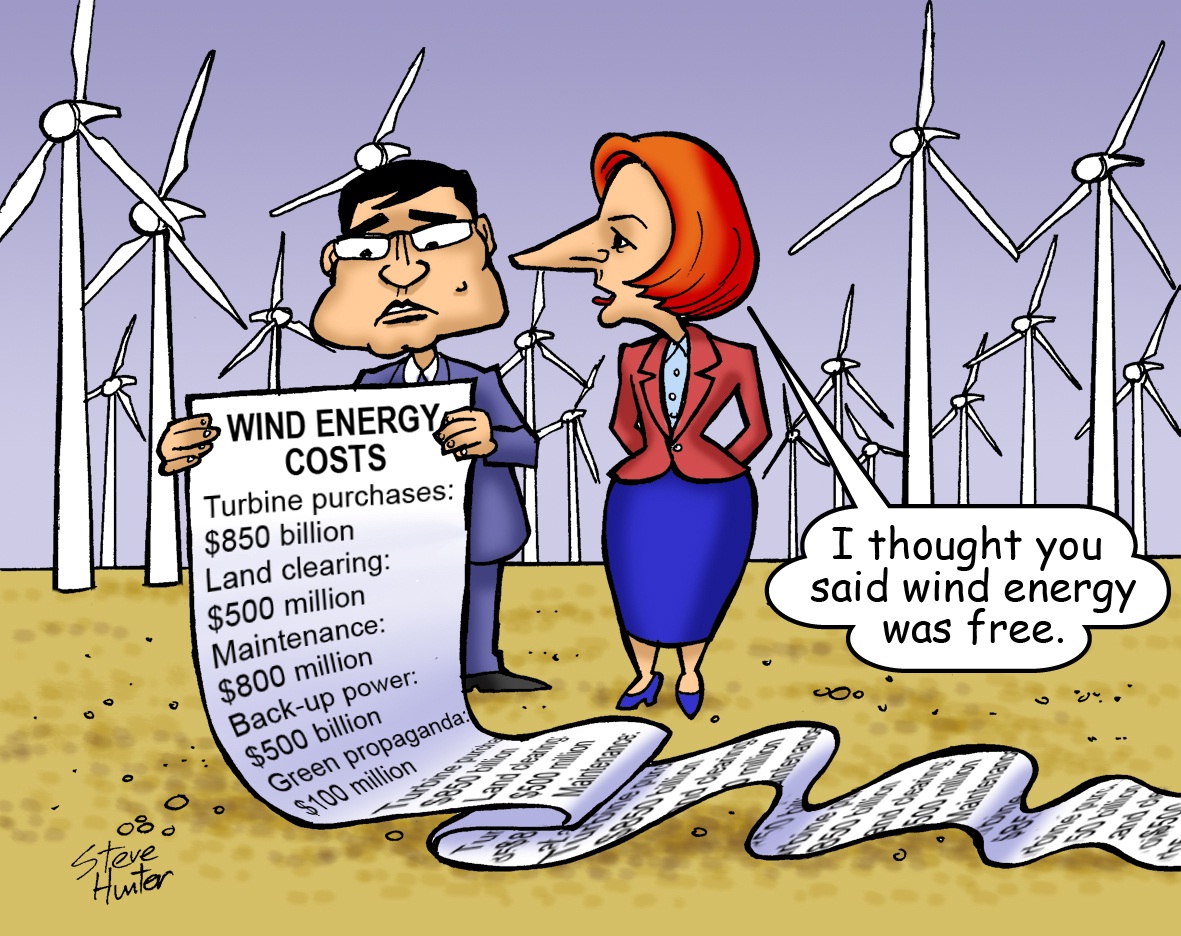
Britain’s economy comes under energy attack

The wind blows the hair of Britain  

Britain Braces For World War II-style Energy Rationing

Great Britain is in the midst of an energy crisis. The country’s climate agenda

has curtailed electricity production and now there may not be

enough power to continually keep the lights on in the UK.

Britain’s energy crisis is getting so bad that the country faces “Second World War-style” rationing in order to keep the lights on throughout the country, according to the Register.
The government is launching major energy reforms to lower power demand and reopen power plants previously shut down to comply with European Union environmental rules. One such reform is that the government will pay factories to “voluntarily” shut down during peak hours when wind energy can’t produce enough power.
The government will also start paying companies to provide their own back-up power and energy producers will be able to “name their own price” for bringing coal plants online that were shuttered due to strict environmental regulations.
EU environmental rules forced many UK coal plants and other fossil fuel-fired plants to shut down. The problem is they were largely replaced with green energy, like wind power, which only produces electricity when the wind is blowing.
Opting to build costly green energy with reliability issues means UK officials are going to look at more demand-side policies to lower energy consumption. Paying factories voluntarily to shut down is just one of those options.
Despite the huge problems, Britain still plans on building more wind turbines and other green energy sources to fight global warming, reports the UK Telegraph. The UK’s National Grid CEO Steve Holliday said plans to pay factories to shut down were “just the beginning” of more policies to reduce energy demand.
“We should be optimistic that demand response could avert the need to build significant amounts of power stations in ten years’ time or so,” Holliday said. He added that people have always had “expectations that the supply will always be there”, but this will no longer be the case with more green energy on the grid.
Holliday added that building new sources of green energy that are subject to wind speeds and sunlight would be much costlier than encouraging people to lower their demand for power.

Read more: http://dailycaller.com/2014/06/11/britain-braces-for-world-war-ii-style-energy-rationing/#ixzz34hfB0qdY