Ontario is Run By A Ship of Fools….They’re dragging us DOWN!

Ontario’s Great Wind Rush sees Power Prices Triple

electricity-price-rise

Wherever giant fans have been slung up in the world, power prices have risen at rates much faster than fan-free jurisdictions (see our post here).

The punishment wrought on the poorest and most vulnerable, as a result, is a political crime against the people (see our posts here and here). The ONLY purported justification is “saving the planet” by reducing CO2 emissions in the power generation sector, so that reduction ought to be pretty hefty to “balance” the social prosperity books, with a measurable environmental benefit at the bottom of the ledger.

Here’s a take on the disaster in Ontario by the Financial Post.

Ontario’s Power Trip: Irrational energy planning has tripled power rates under the Liberals’ direction
Financial Post
Parker Gallant
2 June 2014

Ontario Hydro may well have been a mess. But it was a mess that produced less expensive electricity.

In the summer of 2003, just before Dalton McGuinty’s Liberals gained power in Ontario, 50 million people in the U.S. Eastern Seaboard and Ontario suffered an electricity blackout caused “when a tree branch in Ohio started an outage that cascaded across a broad swath from Michigan to New England and Canada.” Back in 2003 Ontario’s electricity prices were 4.3 cents a kilowatt hour (kWh) and delivery costs added 1.5 cents per kWh. An additional charge of 0.7 cents — known as the debt retirement charge to pay back Ontario Hydro’s legacy debt of $7.8-billion — brought all-in costs to the average consumer to 6.5 cents per kWh.

The McGuinty Liberals claimed the province’s electricity sector was in a mess when they took over in 2003. The Liberals’ first Energy minister, Dwight Duncan, said then that he rejected the old Ontario Hydro model. “It didn’t work. We’re fixing it. We’re cleaning up the mess.”

Fast forward 11 years. Today, Ontario electricity costs average over 9 cents per kWh, delivery costs 3 cents per kWh or more, the 0.7-cent debt retirement charge is still being charged, plus a new 8% provincial sales tax. Additional regulatory charges take all-in costs to well over 15 cents per kWh. The increase in the past 10 years averaged over 11% annually. Recently, the Energy Minister forecast the final consumer electricity bill will jump another 33% over the next three years and 42% in the next 5 years.

Summing up: Whatever mess existed in 2003 is billions of dollars worse today. The cost of electricity for the average Ontario consumer went from $780 on the day Dalton McGuinty’s Liberals took power to more than $1,800, with more increases to come. The additional $1,020 in after-tax dollars extracted from the province’s 4.5 million ratepayers is $4.6 billion – per year!

Why?

First, the Liberal Party fell under the influence of the Green Energy Act Alliance (GEAA), a green activist group that evolved into a corporate industry lobby group that adopted anthropogenic global warming as a business strategy. The strategy: Get government subsidies for renewable energy. The GEAA convinced the McGuinty Liberals to follow the European model. That model was: Replace fossil-fuel-generated electricity with renewable energy from wind, solar and biomass (wood chips to zoo poo). In the minds of those who framed the Liberal’s energy policies, electricity generated from wind, solar, biomass – green energy – was the way of the future.

The plan was implemented through the 2009 Green Energy and Green Economy Act (GEA), a sweeping, even draconian, legislative intervention that included conservation spending and massive subsidies for wind, solar and biomass via a euro-style feed-in-tariff scheme. The GEA created a rush to Ontario by international companies seeking above market prices, a rush that pushed the price of electricity higher. The greater the increase in green energy investment, the higher prices would go.

At the same time, Liberals forced installation of smart meters, a measure that added $2-billion to distribution costs. Billions more were needed for transmission lines to hook up the new wind and solar generators. At the same time, wind and solar generation – being unstable – needed back-up generation, which forced the construction of new gas plants. The gas plants themselves became the target of further government intervention, leading to the $1-billion gas plant scandal.

To force adoption of often unpopular wind and solar plants, the GEA took away municipal rights relating to all generation projects, stripping rural communities of their authority to accept or reject them.

To pay for the rising subsidies to wind and solar, the Liberals adopted an accounting device that would spread the cost over all electricity consumers. The device was called the “Global Adjustment.” The Global Adjustment draw on consumers grew fast and will continue its upward movement. In effect, the Global Adjustment is a dump on ratepayers for energy costs that are above market rates. During 2013, the total global adjustment was $7.8-billion. Of that, 52% went to gas/wind/solar/biomass.

The GA for 2014 is expected to rise to $8.6-billion, adding another 2.9 cents per kWh for each electricity consumer.

To oversee all this, the Liberals established the Ontario Power Authority to do long-term energy planning (LTEP) and to contract renewable generation under the feed-in tariff (FIT) program that guaranteed wind and solar generators above-market prices for 20 years or more. In 10 years Ontarians have seen four versions of the so-called long-term plan, suggesting there is nothing long-term or planned. The Auditor General’s report of Dec 5, 2011, disclosed that no cost/benefit analysis was completed in respect to those feed-in tariff contracts.

The numerous Liberals who have sat in the Energy Minister’s chair have had a penchant for believing how the sector should function, issuing “directives” from the cabinet. The directives created the most complex and expensive electricity sector in North America. The Association of Major Power Consumers issued a “Benchmarking” report in which they stated: “Our analysis shows that Ontario has the highest industrial rates in North America. Ontario not only has the highest delivered rates of all these jurisdictions; the disparity in rates also is growing.”

The almost 100 directives over the past 11 years from Liberal energy ministers have instructed the OPA, the Ontario Energy Board, Ontario Power Generation and Hydro One on a wide variety of issues from building a tunnel under Niagara Falls to paying producers for not generating power, subsidizing industrial clients for conservation while subsidizing other industrial clients for consumption. Numerous new programs have been created that support clients in Northern Ontario, urban clients for purchasing EVs (electric vehicles), homeowners for purchasing CFL light bulbs and a host of other concepts without weighing the effect on employers or taxpayers.

Aside from the burden on consumers, Ontario’s Power Trip has cost jobs as companies – Caterpillar, Heinz, Unilever and others – closed Ontario operations while others, such as Magna, failed to invest in Ontario due to high electricity prices and high taxes that would have created private sector jobs.

Were “green energy” jobs created? Government claims hit 31,000 in a press release in June 2013 but since then no mention of green job claims appears in releases. The recent budget of Finance Minister Charles Sousa reported 10,100 jobs in the “clean tech” sector, a far cry from earlier claims.

Ontario Hydro may well have been a mess a decade ago. But it was a mess that produced electricity priced to consumers at 6.5 cents a kWh. Current prices of 15 cents a kWh will rise to over 20 cents a kWh by 2018/19, forcing the average Ontario ratepayer to pay an additional $700 annually. By that date the cost of “renewable energy” to Ontario’s 4.5 million ratepayers will result in an annual extraction of $8-billion to satisfy the perceived benefits of wind, solar and biomass. Over the 20 years of the FIT contracts, $160-billion in disposable income will be removed from ratepayer’s pockets to access a basic commodity, all in the name of “global warming” and renewable power without use of a cost/benefit analysis.

Perhaps it is time for a change in the governing of Ontario and particularly the way the electricity sector is overseen.

Parker Gallant is a former Canadian banker who looked at his local electricity bill and didn’t like what he saw.
Financial Post

And all that economic punishment for nothing; assuming the aim of Liberal policy was a reduction in CO2 emissions in the electricity sector?

Ontario has one of the “cleanest” energy mixes in the world, with 82% of its power coming from Nuclear and Hydro – (apart from geo-thermal) the only base-load power generation sources that don’t emit CO2. In Ontario, coal makes up a piddling 2%. Liberals’ claims that they replaced coal power with wind, is utter nonsense. Instead, their policy replaced coal with nuclear power and natural gas; and destroyed more jobs than it created (see our post here).

Ontario energy mix 2013

Parker Gallant – a seasoned local – appears to struggle to find a point to Ontario’s energy policy; he’s not alone.

From STT’s perspective, the “policy” (if that’s what barely restrained chaos is?) is utterly bonkers. What on earth were they thinking? There was clearly no justification for pouring $billions in subsidies into the pockets of wind power outfits, where the benefits in terms of reduced CO2 emissions (if any) could only ever be marginal (at best) and the cost of abatement, simply explosive. And that’s to put aside the destruction and havoc caused to otherwise peaceful and productive rural communities across Ontario (see our post here).

To come up with such a ludicrous policy, Dalton McGuinty must have gulped down much more than his fair share of Kool-Aid when the jug was passed around Liberal HQ. There’s no other explanation.

Dalton McGuinty

Congratulations are in Order…for Ohio Legislators! Windies Whine!

Industry: Setback changes will end new wind farms in Ohio

Blue Creek Wind Farm in Ohio. (Courtesy Iberdrola Renewables)

With little discussion or fanfare, Ohio legislators have essentially put a stop to new wind farms in the state, industry experts say.

Governor John Kasich signed House Bill 483 on Monday, just days after signing another bill thatfreezes and alters Ohio’s renewable energy and energy efficiency standards. HB 483 includes revised setback provisions that will likely make new projects economically unfeasible.

The bill “basically zones new wind projects out of Ohio,” says Eric Thumma, Director of Policy and Regulatory Affairs for Iberdrola Renewables, Inc.

Iberdrola’s Ohio wind farm projects include the 304 MW Blue Creek Wind Farm in Van Wert and Paulding County. About ten of its Ohio projects are fully permitted, but not yet constructed. The new law lets already-permitted projects continue, but only if no amendments to the permit become necessary.

Two additional projects in Putnam County and Van Wert County have not yet been permitted. Those probably will not go forward as a result of HB 483.

“It would take one of the projects from 50 turbines to 7, and another project from 75 to 3,” says Thumma. “The economics are not going to work if you have such reduced projects.”

Last-minute setback

For any new commercial wind farms, HB 483 will now require a setback of 1,125 feet from the tip of a turbine’s blades to the nearest property line. In practice, that will require setbacks of about 1,300 feet from each turbine’s base.

The new law makes an exception for existing facilities and ones that had already gotten permits. For those projects, the Ohio Power Siting Board measured the 1,125-foot setback to the outer wall of the “nearest, habitable, residential structure” on neighboring property. Otherwise, property line setbacks were roughly 550 feet.

HB 483 is part of Kasich’s mid-biennium budget review, and most of the law deals with tax cuts, spending for social programs, and other matters. An earlier version of the bill would havedoubled the maximum penalties for violations of gas pipeline rules. The Ohio House Finance Committee deleted that provision.

The wind setback provision appeared for the first time when the Ohio Senate Finance Committee reported the bill out in May.

“There was literally no public testimony” on the new setback provision, says Dayna Baird Payne. The Columbus lobbyist represents the American Wind Energy Association, as well as Iberdrola.

“They didn’t consult with industry. They didn’t consult with the Ohio Power Siting Board, who sites wind farms in Ohio,” Payne adds.

Indeed, the Ohio Senate spent barely ten minutes discussing the last-minute changes before passing the bill on May 21.

“A provision like this to change the setbacks will significantly hurt those projects in the pipeline and will significantly hurt jobs in Ohio,” protested state Sen. Mike Skindell, a Democrat from suburban Cleveland.

Issues regarding setbacks should be “debated [in] a reasonable manner, not just tucked away without any public discussion in a bill,” Skindell continued. “I’m dumbfounded.”

“Here we’re going to have a quarter-mile setback from a property line…for wind turbines,” Skindell added. “We only have a 100- or 200-foot setback for an oil or gas well being drilled next to a home.”

In response, Cincinnati-area Republican State Senator Bill Seitz railed against turbines’ noise, the possibility of snow being thrown from blades, and flicker that “would mess up even Tiger Woods’ game.”

“We are conforming setback law for wind turbines, making them play by the same rules that everybody else plays by,” Seitz insisted. “We are still being very friendly to the future development of wind farms in Ohio.”

Wind energy experts disagree.

‘Devastating’ and ‘cost-prohibitive’

“It’s really a bill that has the effect of making wind an uneconomic resource in Ohio,” Thumma says.

“It does kill all future wind development in the state of Ohio,” agrees Payne. Until now, Ohio has had two setbacks for wind turbines—one from property lines and one from residences or “habitable structures.”

Compared to other states, the property line setback was “right in the middle of the pack,” Payne says. With one unusual exception, though, Ohio’s setback from residences was “the toughest in the country.”

Now HB 483 “takes the residential structure setback where we’re the toughest in the country and applies it to property lines,” Payne says. That more than doubles the property line setbacks and in some cases increases them “almost threefold.”

If HB 483’s setback had applied to the Blue Creek Wind Farm, only about a dozen of its 152 wind turbines could have been built.

“You can’t lease that much land for only 12 turbines,” Payne says. “It would be cost prohibitive.”

“These are large capital projects,” stresses Thumma. To justify that expense, wind farms need sufficient turbines to produce enough electricity so they can make a profit.

Figuring out where to place each turbine is already a challenge. “First of all, it has to be windy at that site,” explains Thumma. “Even within hundreds of yards of each other, wind can be slightly better than at other locations.”

“You have to maximize that within the concept of public safety” and other factors, Thumma continues. That means accounting for general safety, possible ice throw, sound levels, and potential flicker effects. Analyzing all those factors requires substantial studies and engineering.

With additional setbacks from property lines, the siting job becomes “essentially impossible,” says Thumma. “You’re talking millions of dollars that’s been invested in all these projects that would be unrecoverable.”

Commercial wind farm developers aren’t the only ones who will lose out. Projects often use local labor to build and maintain equipment.

“This is a job killer,” Skindell said when he tried to get the provisions removed from HB 483.

Ohio farmers will lose money too. Wind energy companies generally place turbines on agricultural land leased from rural farmers. In return, each farmer gets guaranteed income.

“It takes about an acre out of production, and they’re getting a lease payment,” explains William Spratley, executive director of Green Energy Ohio. “That’s a true cash crop to the farmer to be paid that.”

Local communities will also miss out on tax money from wind energy developers. “That money largely supports schools,” Spratley says. Limits of future wind development will prevent more strapped school districts from getting that “huge boon.”

‘A double whammy’

Last Friday Kasich also signed Senate Bill 310 into law. The bill freezes Ohio’s clean energy law for two years and then dramatically changes the renewable energy and energy efficiency standards.

Kasich signed SB 310 despite opposition from multiple consumer, business, and environmental groups. The Office of the Ohio Consumers’ Counsel and the Ohio Manufacturers Association both predicted that the “inevitable outcome” of SB 310 “will be higher electricity costs for businesses and residential customers.”

Getting hit with the new wind setbacks plus the overall impacts of Senate Bill 310 is “kind of a double whammy,” says Spratley.

Among other things, SB 310 eliminates the in-state requirement for renewable energy. The law also broadens the scope of what counts under the standards.

Both changes will likely lower demand for Ohio-based wind energy and other forms of renewable energy.

“You would have Ohio ratepayers paying for existing resources in other states and not getting any benefit for it,” Thumma says.

Moreover, it’s not clear whether even the relaxed standards will kick back in after the two-year freeze.

SB 310 sets up an Energy Mandates Study Committee. However, the law defines the committee’s tasks narrowly. And it announces an intent to pass future legislation to reduce “the costs of future energy mandates, if there are to be any.”

Even if the freeze is just temporary, the uncertainty will disrupt business planning. That will increase the business risks for existing and planned clean energy projects. Potential new projects will become even more uncertain.

The uncertainty “over time is just going to dampen investment,” says Thumma. Ohio will become “just too risky a place” for companies to invest millions in capital resources.

The freeze, the study committee, and other provisions send “a signal that renewables aren’t going to happen in Ohio—certainly in the near term and under the structure of SB 310,” Thumma says.

“It’s the worst possible law you could write,” Thumma adds.

Green Energy Ohio is a member of RE-AMP, which publishes Midwest Energy News.

The Destruction of Ontario’s Economy, Will Soon be Complete. Thank the Liberals!

Release Date: June 19, 2014

Roughly 12 hours after Premier Kathleen Wynne was re-elected in Ontario with a majority government, bond markets and international credit rating agencies sent her a powerful message about the province’s dismal public finances. Ontario’s borrowing costs spiked the morning after the election (the highest daily jump in six months) and financial analysts warned that further credit downgrades are probable. So much for the post-election celebration. This swift reaction from markets is a wake-up call for Premier Wynne’s government.

The post-election market movement is likely driven by the perception that her government doesn’t have a credible plan to tackle Ontario’s deficit and debt problems.  Consider that the federal government’s borrowing costs were unchanged on the same day, the markets are signalling that the Wynne government must rein in Ontario’s debt.

Meanwhile, the Premier said her first priority is to pass the government’s budget that triggered the election nearly two months ago. With markets watching the province closely, a rehash of May’s budget will do nothing to temper concerns that the risks associated with Ontario’s debt are increasing.

Recall that the government’s May budget downplayed the need to eliminate the deficit and projected this year’s deficit to grow to $12.5 billion ($1.2 billion higher than last year’s projection). At $12.5 billion, Ontario’s deficit will be larger than the combined deficits of the federal and all provincial governments. And while the government maintains it will balance the budget in 2017/18, without any meaningful reforms or spending reductions, the plan lacks serious credibility.

Seven consecutive years of deficit spending has fuelled growing government debt. Ontario’s debt will hit $289.3 billion this year and is projected to reach $324.5 billion (almost 40 per cent of Ontario’s economy) by 2017/18, more than double the $138.8 billion debt (or 27.5 per cent of the economy) in 2003/04 when the Liberals came to power).

This considerable increase in provincial debt and the government’s apparent unwillingness to tackle the problem has prompted speculation that credit rating agencies such as Standard & Poor’s and Moody’s may once again downgrade Ontario’s creditworthiness.

A downgrade would drive up the government’s borrowing costs as the province would have to pay higher interest to investors buying its bonds. If this happens, the share of government spending dedicated to servicing the province’s debt could also increase as the government issues new debt to cover deficits and re-finances debt that matures.

The government already spends 9.2 per cent of its revenues to service its debt and, according to its own estimates, this will rise to nearly 11 per cent in the next four years. Put plainly, Ontario spends $1 out of every $10 sent to Queen’s Park to pay for past debt. This is money not spent on health care, education, transportation, or other public priorities. The increase in rates and the expectation for further hikes means even more tax revenues will go to paying interest instead of key government services.

But there is hope. Similar market pressures in the mid-1990s caused the Chretien-Martin Liberal government of the day to implement an ambitious plan to eliminate the deficit and reverse decades of rising government debt. A fresh majority mandate provides Premier Wynne with an opportunity to look beyond short-term political machinations. A good first step would be a reconsideration of May’s pre-election budget and the need to reassure markets her government is serious about getting the province’s deficit and debt under control.

While Premier Wynne and the Ontario Liberals can be lauded for their electoral win, there isn’t much time for merriment. Markets have sent a wake-up call. It’s time to get to work and start changing Ontario’s course of deficits and debt.

Climate Alarmists Are Not Speaking the Truth!

GREENPEACE CO-FOUNDER SAYS THAT MAN-MADE CLIMATE CHANGE

FAILS THE MOST BASIC PRINCIPLES OF SCIENTIFIC METHOD

James Delingpole — Breitbart.com — June 19, 2014

“Climate change” is a theory for which there is “no scientific proof at all” says the co-founder of Greenpeace. And the green movement has become a “combination of extreme political ideology and religious fundamentalism rolled into one.”

Patrick Moore, a Canadian environmentalist who helped found Greenpeace in the Seventies but subsequently left in protest at its increasingly extreme, anti-scientific, anti-capitalist stance, argues that the green position on climate change fails the most basic principles of the scientific method.

“The certainty among many scientists that humans are the main cause of climate change, including global warming, is not based on the replication of observable events. It is based on just two things, the theoretical effect of human-caused greenhouse gas emissions, predominantly carbon dioxide, and the predictions of computer models using those theoretical calculations. There is no scientific “proof” at all.”

Moore goes on to list some key facts about “climate change” which are ignored by true believers.
1. The concentration of CO2 in the global atmosphere is lower today, even including human emissions, than it has been during most of the existence of life on Earth.
2. The global climate has been much warmer than it is today during most of the existence of life on Earth. Today we are in an interglacial period of the Pleistocene Ice Age that began 2.5 million years ago and has not ended.
3. There was an Ice Age 450 million years ago when CO2 was about 10 times higher than it is today.
4. Humans evolved in the tropics near the equator. We are a tropical species and can only survive in colder climates due to fire, clothing and shelter.
5. CO2 is the most important food for all life on earth. All green plants use CO2 to produce the sugars that provide energy for their growth and our growth. Without CO2 in the atmosphere carbon-based life could never have evolved.  Continue reading here…..

Antarctic2-2

John Madigan, an Australian Hero! (If Only We Had a Man Like Him!!!)

A First Rate Senator (John Madigan) Skewers

a Third Rate Human Being (Simon Chapman)

Victorian Senator, John Madigan delivered an utterly brilliant speech in the Commonwealth Senate this week. See the video below; Hansard (transcript) follows.

As to the Senator, John Madigan provides a salient example of what can happen when decency, integrity and courage all combine in defence of the weak and vulnerable among us; and in pursuit of the truth. The man is made of fearless stuff; and, in our view, stands as one of the Parliamentary Greats: William Wilberforce and his 26 year campaign to end slavery readily springs to mind. The passion with which he delivers this speech is, self evidently, the product of the man’s compassion and empathy; as he says: “every life matters and every life is important”. Hear, hear!

As to the speech, it can be covered in two words: “truly wonderful”.

***

COMMONWEALTH OF AUSTRALIA
SENATE
Hansard
TUESDAY, 17 JUNE 2014
BY AUTHORITY OF THE SENATE
PROOF

Senator MADIGAN (Victoria) (23:20): I rise to speak tonight on the privilege of this parliament to operate without fear or favour. Members and senators have the right to undertake their duties freely to represent their constituents — it is the reason we are here. Any attempt to gag a senator or member of parliament, any attempt to exert influence by means of threat or intimidation is a breach of parliamentary privilege. This could incur the most serious penalties. Tonight I will speak of such an attempt by a high-profile Australian academic. This academic has a track record of making fun of people in regional and rural communities who are sick. He trades in scuttlebutt. He makes consistent attacks on anyone who makes a complaint against his network of corporate buddies. This academic has become the poster boy for an industry which has a reputation for dishonesty and for bullying.

I have a policy of playing the issue, not the man. Policies should always go before personalities. It is a personal credo, one I have practised all my life and specifically in my professional duties since my election in 2010. But since I have been investigating matters related to wind turbines for almost 10 years now I have recorded a consistent track record of vilification, denigration and attack by those on the other side of this debate. This is an industry that sucks hundreds of millions of dollars in subsidies from the public purse. This industrial power generation sector is an industry that masquerades under a false veneer of ‘saving the environment’.

The wind industry is about one thing in this country: it exists to make people rich at the expense of many rural and regional Australians, their lives and their communities. My investigation shows it does not decrease carbon dioxide, it does not reduce power costs, it does not improve the environment. And this academic in question stands shoulder to shoulder with the wind industry companies and their colourful — and I use that term deliberately — executives. He promotes their products. He attacks their critics. He attends their conferences. He rubs shoulders with their henchmen. He is, in the words of the former member for Hume, Alby Schultz — who was a great campaigner on this issue, I might add — devoid of any decency and courage.

But, first, some background. My party, the Democratic Labour Party, has a long tradition of standing up for principle in the face of enormous opposition. My party was born in conflict and forged in sacrifice. No other political party in Australia can boast that its parliamentary founders — 51 in total, including 14 ministers and a state Premier — were prepared to sacrifice promising political careers to uphold the belief dedicated to freedom from undue and corrupt influence. The DLP was the first Australian political party to promote the vote for 18-year-olds. We were the first political party to call for equal pay for equal work and equity in education funding. We were the first political party to call for an end to the White Australia policy. And when our veterans returned from Vietnam, bloody but unbowed, DLP parliamentarians marched in their ranks while the rest of Australia turned their backs.

The DLP is a party of principle. We respect the dignity and the sanctity of life. From the womb to the grave, from the primary school to the factory floor, we see every life as unique and having intrinsic value. This is the cornerstone of the DLP; this is the foundation upon which I place every vote. That is why my attention has been turned to the wind industry for almost a decade now, even before my election to the Senate. I have seen firsthand the devastation it has caused communities. I have listened firsthand to the stories of wrecked families’ lives: family farms destroyed and small outback areas torn apart. I have seen the empty homes in Victoria at Waubra, Macarthur, Cape Bridgewater and Leonards Hill. I have listened to country people tell me stories of corporate bullying and deceit, and of corporate fraud in matters of compliance. I have repeatedly called for one thing on this issue: independent Australian research into the health problems that wind farms apparently cause. That is all — independent research. It is a question of justice. It is about getting to the bottom of this issue.

So when I spoke with Alan Jones onto 2GB on 27 March, I made one simple point. I told Mr Jones we need to be careful about people who profess to be experts in this area. For the benefit of the Senate I repeat what I said in
that interview:

… when we talk about people, using the title, using a title, such as Professor, let us be clear crystal clear here Alan. Most people in the community assume that when you use the title Professor, that you are trained in the discipline of which you speak. And I ask people, look and check. What is the person making these proclamations about other people’s health? What is the discipline they are trained in of which they speak? Because most people in the public assume when you speak of an issue of health, that you are trained in the discipline of which you speak, and there are people making pronouncements and denigrating people who are not trained in human health.

I stand by this statement. It is fair and reasonable to encourage people to look behind the blatant campaigning done by people like Professor Chapman of the University of Sydney.

But it is the statement that has prompted him to threaten me, utilising a law firm that was instrumental in the set-up of Hepburn Wind. He has threatened to sue me for libel over this statement unless I pay him $40,000 plus costs. He has threatened to sue me for libel unless I organise an apology on the website of 2GB and an anti-wind farm website called Stop These Things. He has threatened me with contempt of parliament and a breach of parliamentary privilege if I raise these matters in the Senate. This reaction by Professor Chapman is something that my more experienced parliamentary colleagues have labelled a blatant try-on. It is another attempt by the wind industry to silence me, to scare me off and to intimidate me. It is a case of a Sydney university academic firing shots across the bow of the blacksmith from Ballarat.

This is something he has done before now, tweeting about my position on this issue, always in the context of my background as a blacksmith — a background, I add, that I am enormously proud of. I remain one of the wind industry’s most stubborn and outspoken critics. I will not be silenced. I will not give up on the injustice inflicted on people who claim to be impacted by living near turbines. I will not stop. My comments to Alan Jones were a series of rhetorical statements or questions about the assumptions members of the public should be entitled to make when somebody professes to be qualified to speak about an issue of public health. In other words, I was asking people to check that so-called experts on this issue are relevantly trained and qualified. It is a reasonable request. Our media and the internet are crawling with self-appointed experts. Daily we operate in a cacophony of opinion presented as fact.

Professor Chapman has been an outspoken critic of those who have dared to question the wind farm orthodoxy. But is Professor Chapman a medical doctor? Is he legally entitled to examine and treat patients? Is he qualified in acoustics or any other aspect of audiology? Is he a sleep specialist? Does he hold any qualifications in bioacoustics or physiology or neuroscience? How many wind farm victims has he interviewed directly? How many wind farm impacted homes has he visited? Professor Chapman claims to receive no payment from the wind industry. How many wind industry conferences, seminars and events has he spoken at? How many wind industry events has he attended? Writing on the Crikey website in November 2011, Professor Chapman lamented how many conferences do not pay speaker’s fees, and, when one conference organiser refused to pay his hotel bill, he withdrew. This is the same Professor Chapman who was photographed at a campaign launch in Melbourne by the Danish wind turbine manufacturer Vestas. Did Vestas pay your hotel bill and other costs, Professor Chapman? These are reasonable questions — they put in context his actions.

I take this opportunity to draw the attention of the Senate to the discovery of a 2004 PowerPoint presentation by Vestas employee Erik Sloth to the former Australian Wind Energy Association, now the Clean Energy Council. This demonstrated Vestas knew a decade ago that safer buffers are required to protect neighbours from noise. Vestas knew their preconstruction noise models were not accurate. I draw the attention of the Senate to a quote from the presentation that Vestas knew then that ‘noise from wind turbines sometimes annoys people even if the noise is below noise limits.’ This is confirmation that the global wind industry have known for more than a decade that their turbines impact on nearby residents. How can Professor Chapman reconcile his ridicule of the reasons numerous people have been forced to abandon their homes with the knowledge that the company initiating this campaign he attended knew a decade ago there were problems?

As a public health academic, Professor Chapman displays a lack of compassion for people who claim to be suffering debilitating effects from pervasive wind turbine noise. Professor Chapman’s undergraduate qualifications were in sociology. His PhD looked into the relationship between cigarette smoke and advertising. I question his expertise, I question his qualifications and I question his unbridled motivation to promote and support the wind industry at the cost of people’s lives, homes and communities. I question Professor Chapman’s lack of interest in speaking with wind industry victims. Professor Chapman has a record of public denigration of victims. I refer to his tweet in February this year about ‘wind farm wing nuts’.

One of the important things about this fight that is going on across rural Australia is that it is country women who are in the front line. Farmers’ wives are running hard, fighting to save their families, fighting to save their homes, fighting to save their communities. It is often these women who suffer the most denigration. It is a roll call of honour — people like Mary Morris of South Australia; Dr Andja Mitric Andjic in Victoria; Sonia Trist,Joanne Kermond and Melissa Ware at Cape Bridgewater; Colleen Watts in New South Wales; and, of course, the extraordinary Sarah Laurie in South Australia.

One more example: Annie Gardner and her husband, Gus, have lived and worked happily and healthfully for 34 years on their farming property in south-west Victoria. This came to a sudden halt in October 2012 when the first 15 turbines of the Macarthur wind farm began operation. In a recent letter to the AMA Annie said she is now able to get only two or three hours sleep each night in her own home. She writes: ‘At the time of writing this letter, I am suffering terribly from the infrasound emitted by the 140 turbines located far too close to our property. I have a bad headache. I have very strong pains shooting up through the back of my neck and into my head. I have extremely sore and blocked ears and very painful pressure in my nose. I have pressure in my jaws and my teeth. My heart is pounding. I can feel the vibration going through my body through the chair like an electric charge. The infrasound in our bedroom was appalling. I could feel the vibration through the mattress and the pillow like an electric charge through my body. My head felt as if a brick was on it, and the pressure and pain in my nose was extreme.’

Annie Gardner would be what Professor Chapman would call a ‘wind farm wing nut’. Writing on a green movement website earlier this year, Professor Chapman said protesting against wind farms is a fringe activity as if to suggest that the hundreds of people who attended and spoke at anti-wind farm forums I have held across my home state of Victoria and interstate are simply collateral damage. I cannot live with such a utilitarian view. As I said, even putting aside the highly questionable environmental, social and economic benefits of wind farms, every life matters and every life is important. I have sat in people’s homes and kitchens. I know firsthand the suffering they experience from these industrial developments. Professor Chapman’s attempts to gag me are the same as his attempts to silence those who object to the great wind farm scam. It is part of a greater attempt to silence open and transparent debate on this issue. It does no service to academia or to science already under much attack. It does nothing to advance discussion or progress.

Surely the big businesses behind this attempt — the entities who are funding it, like Bleyer Lawyers, who have worked for Hepburn Wind — should remember cases such as McDonald’s and Gunns. For the environmental movement to attempt this shallow legal shooting of a mere messenger is poor judgement in my view. Bullies corporate or otherwise never get far. Surely it is apparent that companies that use the courts to silence opposition lose out in the court of public opinion. To borrow words from the great human rights campaigner Malcolm X:

I’m for truth, no matter who tells it. I’m for justice, no matter who it’s for or against.

If Professor Chapman proceeds with this action, I look forward to having him answer in court those questions I have raised here tonight — questions about his qualifications, his expertise and his links with the wind industry financial or otherwise. I look forward to his cross-examination under oath as equally as I look forward to mine. I say this: his action, if it proceeds, is doomed in a legal setting or elsewhere for one reason; it is not based on the truth.
Senator Madigan 

One phrase sums up the Senator’s attitude and approach to the wind industry’s vast (and, as he puts it, “colourful”) cast of bullies and thugs: Sic semper tyrannis – “thus always to tyrants.” More power to John Madigan.

John Madigan


Excellent Article About Reading, and Understanding Scientific Papers…for all of us!

How to read and understand a scientific paper: a guide for non-scientists

Jennifer Raff 

Last week’s post (The truth about vaccinations: Your physician knows more than the University of Google) sparked a very lively discussion, with comments from several people trying to persuade me (and the other readers) that their paper disproved everything that I’d been saying. While I encourage you to go read the comments and contribute your own, here I want to focus on the much larger issue that this debate raised: what constitutes scientific authority?

It’s not just a fun academic problem. Getting the science wrong has very real consequences. For example, when a community doesn’t vaccinate children because they’re afraid of “toxins” and think that prayer (or diet, exercise, and “clean living”) is enough to prevent infection, outbreaks happen.

“Be skeptical. But when you get proof, accept proof.” –Michael Specter

What constitutes enough proof? Obviously everyone has a different answer to that question. But to form a truly educated opinion on a scientific subject, you need to become familiar with current research in that field.  And to do that, you have to read the “primary research literature” (often just called “the literature”). You might have tried to read scientific papers before and been frustrated by the dense, stilted writing and the unfamiliar jargon. I remember feeling this way!  Reading and understanding research papers is a skill which every single doctor and scientist has had to learn during graduate school.  You can learn it too, but like any skill it takes patience and practice.

I want to help people become more scientifically literate, so I wrote this guide for how a layperson can approach reading and understanding a scientific research paper. It’s appropriate for someone who has no background whatsoever in science or medicine, and based on the assumption that he or she is doing this for the purpose of getting a basic understanding of a paper and deciding whether or not it’s a reputable study.

The type of scientific paper I’m discussing here is referred to as a primary research article. It’s a peer-reviewed report of new research on a specific question (or questions). Another useful type of publication is a review article. Review articles are also peer-reviewed, and don’t present new information, but summarize multiple primary research articles, to give a sense of the consensus, debates, and unanswered questions within a field.  (I’m not going to say much more about them here, but be cautious about which review articles you read. Remember that they are only a snapshot of the research at the time they are published.  A review article on, say, genome-wide association studies from 2001 is not going to be very informative in 2013. So much research has been done in the intervening years that the field has changed considerably).

Before you begin: some general advice
Reading a scientific paper is a completely different process than reading an article about science in a blog or newspaper. Not only do you read the sections in a different order than they’re presented, but you also have to take notes, read it multiple times, and probably go look up other papers for some of the details. Reading a single paper may take you a very long time at first. Be patient with yourself. The process will go much faster as you gain experience.

Most primary research papers will be divided into the following sections: Abstract, Introduction, Methods, Results, and Conclusions/Interpretations/Discussion. The order will depend on which journal it’s published in. Some journals have additional files (called Supplementary Online Information) which contain important details of the research, but are published online instead of in the article itself (make sure you don’t skip these files).

Before you begin reading, take note of the authors and their institutional affiliations. Some institutions (e.g. University of Texas) are well-respected; others (e.g. the Discovery Institute) may appear to be legitimate research institutions but are actually agenda-driven. Tip: google “Discovery Institute” to see why you don’t want to use it as a scientific authority on evolutionary theory.

Also take note of the journal in which it’s published. Reputable (biomedical) journals will be indexed by Pubmed. [EDIT: Several people have reminded me that non-biomedical journals won’t be on Pubmed, and they’re absolutely correct! (thanks for catching that, I apologize for being sloppy here). Check out Web of Science for a more complete index of science journals. And please feel free to share other resources in the comments!]   Beware of questionable journals.

 As you read, write down every single word that you don’t understand. You’re going to have to look them all up (yes, every one. I know it’s a total pain. But you won’t understand the paper if you don’t understand the vocabulary. Scientific words have extremely precise meanings).

Step-by-step instructions for reading a primary research article

1. Begin by reading the introduction, not the abstract.

The abstract is that dense first paragraph at the very beginning of a paper. In fact, that’s often theonly part of a paper that many non-scientists read when they’re trying to build a scientific argument. (This is a terrible practice—don’t do it.).  When I’m choosing papers to read, I decide what’s relevant to my interests based on a combination of the title and abstract. But when I’ve got a collection of papers assembled for deep reading, I always read the abstract last. I do this because abstracts contain a succinct summary of the entire paper, and I’m concerned about inadvertently becoming biased by the authors’ interpretation of the results.

2. Identify the BIG QUESTION.

Not “What is this paper about”, but “What problem is this entire field trying to solve?”

This helps you focus on why this research is being done.  Look closely for evidence of agenda-motivated research.

3. Summarize the background in five sentences or less.

Here are some questions to guide you:

What work has been done before in this field to answer the BIG QUESTION? What are the limitations of that work? What, according to the authors, needs to be done next?

The five sentences part is a little arbitrary, but it forces you to be concise and really think about the context of this research. You need to be able to explain why this research has been done in order to understand it.

4. Identify the SPECIFIC QUESTION(S)

What exactly are the authors trying to answer with their research? There may be multiple questions, or just one. Write them down.  If it’s the kind of research that tests one or more null hypotheses, identify it/them.

Not sure what a null hypothesis is? Go read this, then go back to my last post and read one of the papers that I linked to (like this one) and try to identify the null hypotheses in it. Keep in mind that not every paper will test a null hypothesis.

5. Identify the approach

What are the authors going to do to answer the SPECIFIC QUESTION(S)?

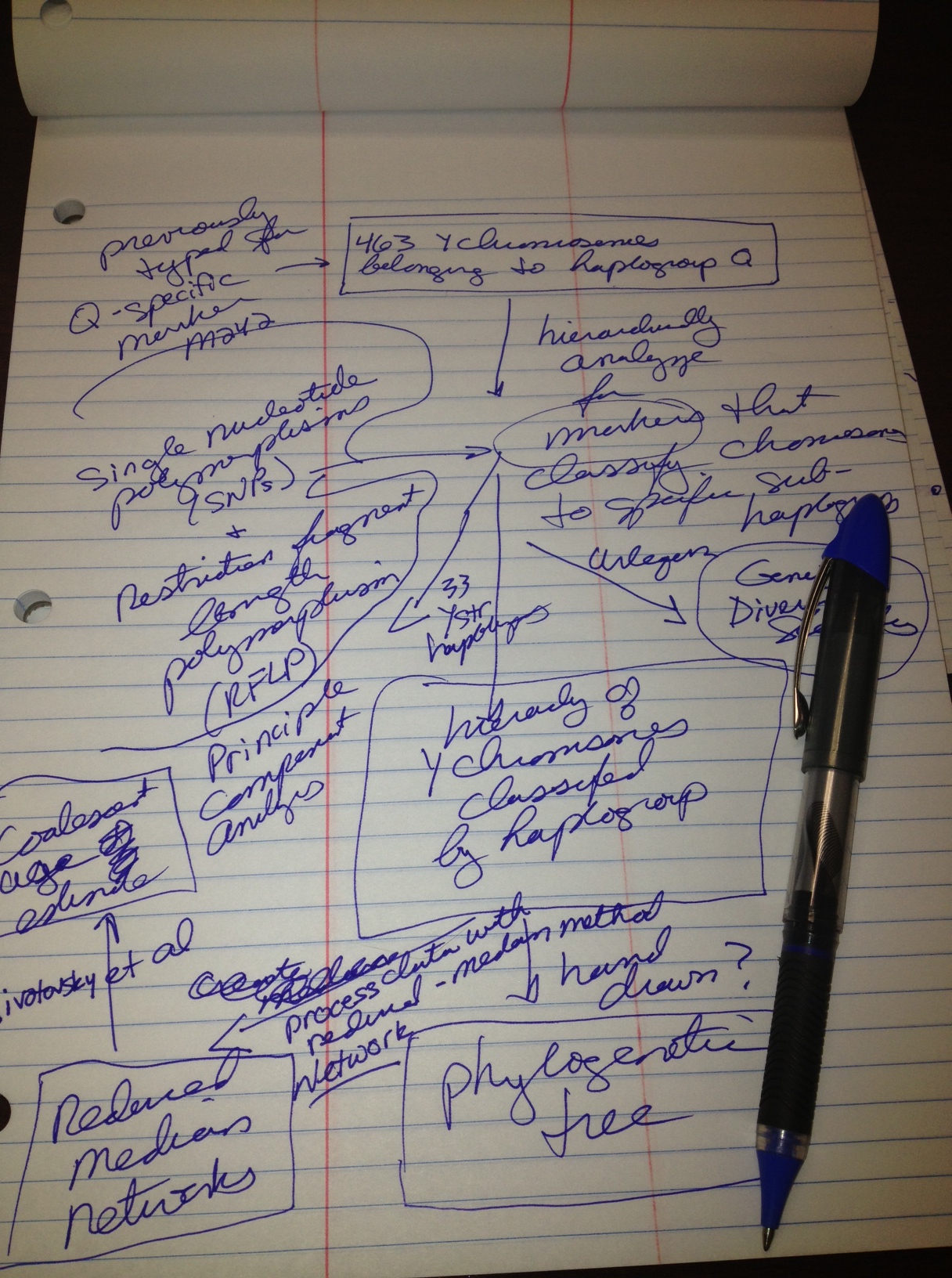
 6. Now read the methods section. Draw a diagram for each experiment, showing exactly what the authors did.

I mean literally draw it. Include as much detail as you need to fully understand the work.  As an example, here is what I drew to sort out the methods for a paper I read today (Battaglia et al. 2013: “The first peopling of South America: New evidence from Y-chromosome haplogroup Q”). This is much less detail than you’d probably need, because it’s a paper in my specialty and I use these methods all the time.  But if you were reading this, and didn’t happen to know what “process data with reduced-median method using Network” means, you’d need to look that up.

Battaglia et al. methods

You don’t need to understand the methods in enough detail to replicate the experiment—that’s something reviewers have to do—but you’re not ready to move on to the results until you can explain the basics of the methods to someone else.

7. Read the results section. Write one or more paragraphs to summarize the results for each experiment, each figure, and each table. Don’t yet try to decide what the resultsmean, just write down what they are.

You’ll find that, particularly in good papers, the majority of the results are summarized in the figures and tables. Pay careful attention to them!  You may also need to go to the Supplementary Online Information file to find some of the results.

 It is at this point where difficulties can arise if statistical tests are employed in the paper and you don’t have enough of a background to understand them. I can’t teach you stats in this post, butherehere, and here are some basic resources to help you.  I STRONGLY advise you to become familiar with them.

 THINGS TO PAY ATTENTION TO IN THE RESULTS SECTION:

-Any time the words “significant” or “non-significant” are used. These have precise statistical meanings. Read more about this here.

-If there are graphs, do they have error bars on them? For certain types of studies, a lack of confidence intervals is a major red flag.

-The sample size. Has the study been conducted on 10, or 10,000 people? (For some research purposes, a sample size of 10 is sufficient, but for most studies larger is better).

8. Do the results answer the SPECIFIC QUESTION(S)? What do you think they mean?

Don’t move on until you have thought about this. It’s okay to change your mind in light of the authors’ interpretation—in fact you probably will if you’re still a beginner at this kind of analysis—but it’s a really good habit to start forming your own interpretations before you read those of others.

9. Read the conclusion/discussion/Interpretation section.

What do the authors think the results mean? Do you agree with them? Can you come up with anyalternative way of interpreting them? Do the authors identify any weaknesses in their own study? Do you see any that the authors missed? (Don’t assume they’re infallible!) What do they propose to do as a next step? Do you agree with that?

10. Now, go back to the beginning and read the abstract.

Does it match what the authors said in the paper? Does it fit with your interpretation of the paper?

11. FINAL STEP: (Don’t neglect doing this) What do other researchers say about this paper?

Who are the (acknowledged or self-proclaimed) experts in this particular field? Do they have criticisms of the study that you haven’t thought of, or do they generally support it?

Here’s a place where I do recommend you use google! But do it last, so you are better prepared to think critically about what other people say.

(12. This step may be optional for you, depending on why you’re reading a particular paper. But for me, it’s critical! I go through the “Literature cited” section to see what other papers the authors cited. This allows me to better identify the important papers in a particular field, see if the authors cited my own papers (KIDDING!….mostly), and find sources of useful ideas or techniques.)

Now brace for more conflict– next week we’re going to use this method to go through a paper on a controversial subject! Which one would you like to do? Shall we critique one of the papers I posted last week?

UPDATE: If you would like to see an example, you can find one here
———————————————————————————————————


As an Industrial Source of Energy…..Wind Doesn’t Just Blow….It SUCKS!!

The Wind: Only Designed for Recreational Pursuits

kites

Why Not Wind?
wind-watch.org
Eric Rosenbloom

To whom it may concern:

This is a brief representation of the reasons industrial-scale wind is a destructive boondoggle that only fools – or worse – would approve.

Unlike “conventional” power sources, wind does not follow demand. As the Bonneville Power Authority in the Pacific Northwest of the USA has shown, the relationship between load and wind generation is essentially random (www.wind-watch.org/pix/493). That means that wind can never replace dispatchable sources that are needed to meet actual demand.

The contribution of wind generation is therefore an illusion, because the grid has to supply steady power in response to demand, and as the wind rises and falls, the grid maintains supply by relying on its already built-in excess capacity.

That is also why meaningful reductions in carbon emissions are not seen: because fuel continues to be burned in “spinning reserve” plants which are kept active to kick in when needed for meeting surges in demand or, now, drops in the wind. Denmark’s famously high wind penetration is possible only because it is connected to the large Nordic and the German grids – so that Denmark’s wind power actually constitutes a very small fraction of that total system capacity. To make further wind capacity possible (despite a public backlash that has essentially stopped onshore wind development since 2003), Denmark is now building a connection to the Dutch grid.

Another reason that meaningful reductions in carbon emissions are not seen is that the first source to be modulated to balance wind is usually hydro. This is seen quite clearly in Spain, another country with high wind penetration: The changes in electricity from hydro are an almost exact inverse of those from wind (https://demanda.ree.es/generacion_acumulada.html). This is also seen in the USA’s Pacific Northwest (http://transmission.bpa.gov/business/operations/Wind/baltwg.aspx).

Finally, on systems with sufficient natural gas–powered generators, which can ramp on and off quickly enough to balance wind’s highly variable infeed, wind forces those generators to operate far less efficiently than they would otherwise. It is like city versus highway driving. According to several analyses (e.g., www.wind-watch.org/doc/?p=1568), the carbon emissions from gas + wind are not significantly different from gas alone and in some cases may be more.

And again, whatever the effect, wind is always an add-on. The grid must be able to operate reliably without it, because very often, and often for very long stretches of time, wind is indeed in the doldrums: It is not there.

And beware the illusion of “average” output. The fact is that any wind turbine or group of turbines generates at or above its average rate (which is typically 20%–30% of the nameplate capacity, depending on the site) only about 40% of the time. Because of the physics of extracting energy from wind, the rest of the time production approaches zero. About one-third of the time, wind production is absolutely zero.

As an add-on, therefore, its costs are completely unnecessary and wasteful. And even if, by some miracle, it were a reliable, dispatchable, reasonably continuous source, its costs would still be enormous – not only economically, but also environmentally. Wind is a very diffuse resource and therefore requires a massive mechanical system to catch any useful amount. That means ever larger blades on ever taller towers in ever larger arrays. And the only places where that is feasible are the very places we need to preserve as useful agricultural land, scenic landscapes that are so important to our soul (and to tourism), and wild land where the natural world can thrive.

Besides the obvious damage to the land of heavy-duty roads for construction and continued maintenance, huge concrete platforms, new powerlines, and substations (while making no meaningful contribution to the actual operation of the grid) and the visual intrusion of 150-metre (500-ft) structures with strobe lights and rotating blades, there are serious adverse impacts from the giant airplane-like blades cutting through 6,000–8,000 square metres (1.5–2 acres) of vertical airspace both day and night: pulsating noise (including infrasound which is felt more than heard) that carries great distances and disturbs neighbors (especially at night, when there is a greater expectation of – and need for – quiet), even threatening their physical health, pressure vortices that kill bats by destroying their lungs, blade tip speeds of 300 km/h that also kill bats as well as birds, particularly raptors, many of which are already endangered, and vibration that carries through the tower into the ground with effects on soil integrity and flora and fauna that have yet to be studied.

In short, the benefits of industrial-scale wind are minuscule, while its adverse impacts and costs are great. Its only effect is to provide greenwashing (and tax avoidance) for business-as-usual energy producers and lip-service politicians, while opening up to vast industrial development land that has been otherwise fiercely protected – most disturbingly by many of the same groups now clamoring for wind.

Industrial-scale wind is all the more outrageous for the massive flow of public money into the private bank accounts of developers. It is not surprising to learn that Enron established the package of subsidies and regulatory “innovations” that made the modern wind industry possible. Or that in Italy, the Mafia was an early backer of developers. It is indeed a criminal enterprise: crony capitalism, anti-environment rapaciousness, and hucksterism at its most duplicitous.

After decades of recorded experience, there is no longer any excuse to fall for it.
Eric Rosenbloom
President, National Wind Watch, Inc. (www.wind-watch.org)

Eric Rosenbloom lives in Vermont, USA, where he works as a science editor, writer, and typographer. He has studied and written about wind energy since 2003. He was invited to join the board, and then elected President (a wholly volunteer position), of National Wind Watch in 2006, a year after it was founded by citizens from 10 states who met to share their concerns about the risks and impacts of wind energy development. National Wind Watch is a 501(c)(3) educational charity registered in Massachusetts.

yacht

Turn Off the Money Tap, the Windweasels will Scurry!

Fears for renewables after energy target ‘described as government largesse’


Report: wind farms
The renewable energy review is expected to deliver a draft report next week. Photograph: Picasa

Windfarm owners say the head of Tony Abbott’s renewable energy review recently told them they were foolish to “build a whole business model on government largesse”, raising fears he will recommend a severe winding back of the renewable energy target.

Simon Holmes a Court, the founding chair of Hepburn Wind, a community windfarm, told Guardian Australia he had been astonished by the comments from businessman Dick Warburton at a meeting last week.

Meanwhile, the now-independent Climate Council has released a report arguing Australia’s coal-fired power stations are among the oldest and dirtiest in the world and difficult to retrofit with carbon capture and storage technology – leaving renewables such as wind as the least-cost “zero emissions” option.

Holmes a Court said Warburton asked “didn’t we feel foolish basing a whole business model on government largesse”. The “government largesse” being referred to was the renewable energy target (RET) that was first introduced by the Howard government, has enjoyed bipartisan support ever since and has attracted about $18bn in investment.

“If the RET was to be abolished our project will fold. Two thousand people invested in this community windfarm on the basis that this was settled bipartisan policy. We are not feeling foolish, we are feeling betrayed,” Holmes a Court said.

Warburton’s review is expected to deliver a draft report to government next week.

The Coalition went into the election promising to keep the RET, which underpins investment in energy sources such as wind and solar, but saying it would review the fact that the policy was exceeding its original goal of delivering 20% renewable energy by 2020 because of falling electricity demand.

But, after the election, the Coalition began debating whether the RET should be scrapped altogether or – a more likely outcome – “grandfathered” so only existing projects will benefit.

The terms of reference for the RET review said it would look at “the extent of the RET’s impact on electricity prices, and the range of options available to reduce any impact while managing sovereign risk”.

And even government backbenchers who question the science of climate change and oppose the RET concede its total abolition would constitute “sovereign risk” – a situation where governments change the rules after investment decisions have already been made.

George Christensen, who the climate-sceptic Heartland Institute is sponsoring to address its conference in Las Vegas next month and who chairs the Coalition backbench industry committee, said there were “conflicting views within the Coalition because we are acutely aware of its impact on power prices but on the other hand there is a strong argument we should not disadvantage people who have invested on the basis of what was bipartisan policy”.

But the Institute of Public Affairs (IPA) thinktank – which has long lobbied against the RET – has used a submission to the Warburton review to argue for its abolition, dismissing concerns that abolishing the RET would constitute “sovereign risk”. Like Warburton, the IPA suggests businesses should not have based investments on government “favours”.

“Sovereign risk involves a ‘taking’ of property and should be avoided because, ethical issues aside, it creates great uncertainties for investment, especially investment with long payback times. But sovereign risk from the government withdrawing a favour is different from when it takes a property. No investor can reasonably expect a subsidy to prevail for 15 years as is notionally the case with windfarms and other exotic renewable facilities. And there would be few precedents for a government committing its successors to what would become 24 years of worthless expenditure,” the IPA says in its submission.

“If removal of such favourable and lengthy regulatory provisions was considered to constitute reimbursable sovereign risk, the motor vehicle manufacturers now abandoning production in Australia would have a case for compensation … The termination of the renewable energy requirements should be done immediately.”

According to the IPA, there are three options for modifying the RET scheme:

• Reduce it to a “real” 20% of the current electricity market. It says this would reduce the amount of renewables from 41,000 gigawatt hours (20% of what was the estimated size of the market in 2020) to a maximum of 33,000 GWh.

• Allow only the existing and committed projects to proceed as subsidised. This would mean about 15,000 GWh.

• Totally abandon the RET and force “renewables to immediately compete without subsidy, as their adherents always claimed they would eventually be able to do”.

The climate commission, which became a crowd-funded independent body after it was abolished by the Abbott government, will release a report on Tuesday arguing that “the least-expensive zero-emission option available at scale for deployment today in Australia is wind, closely followed by field-scale solar PV”.

“These costs are falling fast as take-up globally accelerates. Wind should be 20% to 30% cheaper by 2020, solar PV is expected to halve in cost,” the report says.

Assuming Australia does need to reduce emissions from its power sector, the report says moving to renewables would be cheaper than trying to “clean up” coal-fired plants.

It says that by 2030, 65% of australia’s power stations will be over 40 years old. The nation’s older power stations cannot be made more efficient without vast expense, and their age limits the potential for retrofit CCS investment, it says.

After the election, Abbott took control of the RET review of his own department and appointed Warburton – a self-professed climate sceptic – to head it.

Warburton, a veteran industrialist and the chairman of the Westfield Retail Trust, described his views on climate science in a 2011 interview on ABC in this way: “Well I am a sceptic. I’ve never moved away from that. I’ve always believed sceptical,’’ he said. “But a sceptic is a different person than a denier. I say the science is not settled. I’m not saying it’s wrong. I’ve never said it’s wrong, but I don’t believe it’s settled.”

Others, including Abbott’s top business adviser, Maurice Newman, want the RET scrapped altogether.

Newman, the former chairman of the ABC and the ASX, has said persisting with government subsidies for renewable energy represented a “crime against the people” because higher energy costs hit poorer households the hardest and there was no longer any logical reason to have them.

Under legislation, the next review of the RET is supposed to be undertaken by the independent Climate Change Authority (CCA) but the government is seeking to abolish the CCA.

Lenore Taylor

Lenore Taylor is the political editor of Guardian Australia. She is a Walkley award winner and a winner of the Paul Lyneham award for excellence in press gallery journalism. She co-authored a book, Shitstorm, on the Rudd government’s response to the global economic crisis.

Ontarians Shoot Themselves in the Foot! Again….and again!

Lakehead University Professor Livio Di Matteo Reports on Economy

But don’t cry for the province; it has mainly itself to blame

THUNDER BAY – EDITORIAL – Ontarians have re-elected a government whose decade long reign dovetails with the lowest growth rate of provincial real per capita GDP in the Canadian federation. In the face of economic decline, Ontarians have come to fear change and opted for the status quo in the hope that things may get better if enough time goes by. Sadly, Ontario has embarked on the road to Argentina.

Despite Ontario’s mounting public debt, laggard economic performance, new status as a have not province, general lack of competitiveness, as well as a government marked by scandals and charges of corruption, the opposition parties were unable to convince the electorate of the need for change. In the face of such abundant fodder, this also represents a notable failure on the part of the opposition parties. Like Argentina, Ontario’s economic decline has spilled over to pervade its institutions with an inability to articulate and effect change.

In the early 20th century, Argentina was a successful export-led economy rooted in agricultural production – particularly beef. During the 20th century, Ontario became a successful export-led economy based particularly on its manufacturing sector. During its heyday, Argentina had one of the highest standards of living in the world and believed it was on the verge of becoming the next United States. Meanwhile, Ontario has grown accustomed to one of the highest standards of living in the world and taken its role as an economic cornerstone of the Canadian federation for granted.

The First World War and Great Depression shocked the Argentine export economy and the beef export industry never fully recovered. The result was poor economic policies over the next half-century that aimed to recapture a fading standard of living. Argentina was marked by large public sector debts and deficits, corruption, high inflation, and protectionism for uncompetitive sectors of the economy. Most importantly, there were entrenched economic interests that benefitted from poor government economic policies and a general inability to implement changes that would reverse the long-term decline of the Argentine economy. With a set of poor political institutions that included military coups, Argentina settled into a long-term decline punctuated by bouts of economic crisis and an inability to resolve its problems.

For Ontario, its problems began with an incomplete transition to the economic changes brought about by a more competitive world economy after 1990. Ontario’s economic development reached a crucial watershed in the wake of the economic boom of the 1980s that saw free trade with the United States, a shift away from the traditional east-west economic alignment, and the recession of the early 1990s. While the mid-1990s saw the onset of public sector restructuring and economic reforms, these petered out in the early 21st century with the return of more interventionist government economic policy that saw tax increases, increased public sector spending and a flawed industrial strategy based on green energy initiatives that became a factor in higher electricity prices. Economic productivity faltered and the 2009 tilt into recession was compounded by an appreciating Canadian dollar.

Ontarians have become used to ever-larger amounts of public spending fueled by growing public debt to compensate for faltering private sector productivity. This has created clients with a vested interest in more interventionist government. The recent election campaign saw promises of new public infrastructure spending, a new pension plan as well as overt political meddling by some traditionally circumspect public sector unions. While Ontario police unions do not have the heft of the Argentine military, their election activity is nevertheless yet another sign that Ontario may be changing for the worse.

In towns and cities across the province ravaged by manufacturing decline, the public sector has picked up the slack with public works construction projects, expanded government initiatives and their associated employment. Ontarians have convinced themselves that what is needed to reverse their malaise is more government spending fueled by debt and deficits, despite the evidence that the past decade of such policies have yet to turn the economy around. It is still early on in Ontario’s economic and fiscal troubles but another decade of economic policy ineptness could well make Ontario’s decline terminal.

Don’t cry for Ontario, it has mainly itself to blame.

Livio Di Matteo

– See more at: http://www.netnewsledger.com/2014/06/13/ontario-the-new-argentina-di-matteo/#sthash.RvVq5SNA.dpuf