Don’t bet the Farm, on Wind and Solar! Bad Investments!


UPDATE 1-SunEdison solar power plant unit files for IPO

Thu May 29, 2014 5:29pm IST

May 29 (Reuters) – TerraForm Power Inc, a unit that solar company SunEdison Inc created to own and operate some of its solar power plants, filed for an initial public offering to raise up to $50 million.

SunEdison is following in the footsteps of NRG Energy Inc , which last July listed a unit holding some of its wind and natural gas assets, as solar firms seek newer and cheaper ways to finance new solar power plants.

Shares of the NRG’s unit, NRG Yield Inc, have gained 73 percent since it went public.

Rival SunPower Corp said in March that it would launch the first tranche of its bonds backed by solar assets in the second half of the year.

SunEdison’s TerraForm could be valued at between $800 million and $1 billion based on cash flow, SunEdison Chief Financial Officer Brian Wuebbels told Reuters in an interview last November.

TerraForm will operate as a “yield co”, which is a way for solar companies to bundle up existing solar power plants and then spin them off into separate entities.

Yield cos own and operate solar assets under long-term power-purchase agreements with utilities and any cash generated is paid out as dividends, with the remainder being re-invested in new plants.

TerraForm will own and operate solar power plants that it acquires from SunEdison and other parties, TerraForm said in a filing with U.S. Securities and Exchange Commission on Thursday. (link.reuters.com/jax69v)

Goldman Sachs & Co, Barclays and Citigroup are underwriting the offering.

TerraForm intends to list on the Nasdaq under the symbol “TERP”.

The filing did not reveal how many shares the company planned to sell or their expected price.

The amount of money a company says it plans to raise in its first IPO filings is used to calculate registration fees. The final size of the IPO could be different. (Reporting by Tanya Agrawal in Bangalore; Editing by Simon Jennings)


The Liberals have lied about the Conservative’s Platform!!

MATT YOUNG DENOUNCES FEAR MONGERING ABOUT PUBLIC SECTOR JOBS

Photo: Ottawa Citizen

During an all-candidates’ debate hosted by Rogers on May 27, PC candidate for Ottawa South Matt Young refuted misinformation being spread about public service job losses. “We’re not going to touch public safety. Our platform makes it clear. We’re going to hire more nurses and more doctors” he said, adding that a PC government will focus on hiring more front-line workers to improve the services that we all rely on.

“There has been a lot of misinformation out there,” he said, adding that out of Ontario’s 1.1 million public sector employees, 50,000 retire or quit each year, so it’s easier to reduce 100,000 jobs over four years by hiring one person for every two who retire.

“You don’t have to destroy our economy to provide good services,” he told his opponents. The PC plan calls for lower taxes, affordable energy, job creation, better services like healthcare, and a balanced budget. This will ease the burden on households and get Ontario businesses back to the province.

Rogers is re-broadcasting the debate on Monday June 2 at 10:00 a.m., Tuesday June 3 at 8 p.m., and Sunday June 8 at 6 p.m.

Two other debates are scheduled:

– Canterbury All-Candidates Debate: all candidates’ debate at Hillcrest High School this Thursday, May 29th, from 7:00 to 9:00 p.m

– Ottawa Muslim Coordinating Council: all-candidates’ debate at the Jim Durrell Recreation Centre on Walkley Road on Monday, June 2nd from 7:00 to 9:00 p.m.

Please share this page with your friends and family on Facebook and Twitter. Let’s all work with Matt for a better Ontario.

U.K. Villagers Willing to Have Solar Panels, Rather than Wind Turbines!

Haslington villagers welcome plans for 46,500

solar panels – if it stops wind farm being built

By The Sentinel  |  Posted: May 28, 2014

VILLAGERS have welcomed plans to install 46,500 solar panels in two fields to power about 3,700 homes – if it stops a wind farm being built at the site.

TGC Renewables plans to install 31,460 panels on 17.5 hectares of farmland off Maw Lane, Haslington, and 15,080 panels on 9.7 hectares off Clay Lane.

The equipment will stand just under three metres high and could take between two to three months to set up.

If approval is granted TGC hopes to have the panels in place by 2015. They have a 40-year life span but the firm is asking to use the field for only 25 years.

It has offered Haslington Parish Council £1,000 per year for each megawatt of power generated in the first 10 years

If both sites – which could generate 14.2 megawatts – go ahead, the council could receive up to £14,000 per year.

Yesterday, families visited Yoxall Village Hall to view the proposals.

Barrie Hacking, of Newtons Crescent, Winterley, said: “After looking at the plans I am happy in principle and would prefer it to a wind farm.”

Karen Harding, aged 38, of Winterley, said: “It is important that renewable energy is put into place.”

TGC leases lower grade land from farmers and landowners and pays them ‘higher than the average pasture rental rates’.

The company says animals will be able to graze on the fields when the panels are installed.

James Jamieson, senior town planner for TGC, which runs more than a dozen sites across the country, attended Tuesday’s consultation to discuss the plans with residents.

He said: “There’s a big demand for power in the Crewe area and the power created at these two sites will be sent to local houses.

“The great thing about these sites is that there are not many houses nearby and we will not have to move any hedges or trees.

“The technology has improved in the last few years so the panels will even work during a winter’s day. Also, the projects provide additional revenue for farmers.”

Haslington Parish Council chairman Richard Hovey said the solar farm would benefit the village.

He said: “The panels should be no higher than 10 feet so they will be screened by hedges.

“If both of the two sites were built they would power all of Haslington which has just over 2,500 houses.

“Personally I think it looks like a good idea. We have not come across any flaws yet and it will make the village more sustainable.”

A final decision will be made by Cheshire East Council when plans have been submitted.

Read more: http://www.stokesentinel.co.uk/Haslington-villagers-welcome-plans-46-000-solar/story-21153177-detail/story.html#ixzz33442pQpF
Read more at http://www.stokesentinel.co.uk/Haslington-villagers-welcome-plans-46-000-solar/story-21153177-detail/story.html#eROOS3AM2umSUVyQ.99

Ohio Puts Brakes On Green Energy “Targets”! Finally!


Posted: 4:04 p.m. Wednesday, May 28, 2014

Ohio House passes green energy freeze

Bill puts a hold on standards adopted five years ago.

By Laura A. Bischoff

Columbus bureau

Columbus —

A controversial bill moving swiftly through the GOP-controlled General Assembly would put a hold on green energy standards and set the stage for dismantling an energy law that took effect just five years ago.

After more than an hour of passionate debate, the Ohio House voted Wednesday 53-38 in favor of Senate Bill 310, which calls for freezing renewable energy benchmarks and energy conservation measures for the next two years. The vote fell largely along partisan lines with Democrats opposing the bill and Republicans supporting it. State Rep. Ross McGregor, R-Springfield, was among a handful of Republicans to vote no.

The Ohio Senate then quickly voted 21-11 in favor of the House changes. State Sen. Bill Beagle, R-Tipp City, opposed the bill and the House changes.

A law passed in 2008 during the Strickland administration requires utilities to get 12.5 percent of their electricity from renewable sources and assist customers in reducing energy usage by 22 percent by 2025. The law proscribes benchmarks to hit between now and 2025.

Senate Bill 310 would freeze those requirements at current levels for two years while a legislative committee studies the issues. It would also eliminate a requirement that utilities obtain half of their renewable energy from in-state sources.

Ted Ford, president and chief executive of Ohio Advanced Energy Economy, said in a written statement: “Ohio is poised to become the first state in the nation to move backwards on renewable energy and energy efficiency standards. This despite the fact that data from public filings of utility companies themselves show that these standards are saving money for customers.”

“The two-year freeze clearly sends a message to investors that this market is uncertain,” said Dayna Baird, lobbyist for the American Wind Association. She added that the mandate that 50 percent of renewable energy come from Ohio has been driving investment in wind farms in the state. Tossing out the mandate before the study group gets underway is “illogical,” she said.

The bill has divided business groups. The Ohio Chamber of Commerce and the NFIB Ohio are behind it but opponents include the Ohio Manufacturers Association, Ohio Consumers’ Counsel, AARP Ohio, Honda of America and environmental groups. Utility companies did not testify on the bill in the House or Senate.

Eric Burkland, president of the Ohio Manufacturer’s Association, issued a letter to House members urging a no vote. “The inevitable outcome…will be higher electricity costs for business and residential customers,” he said.

Proponents of the freeze say adhering to the benchmarks will lead to rate spikes. They also say conditions have changed since the standards were put in place. Natural gas prices have gone down and the state has seen new shale oil and natural gas discoveries.

State Rep. Peter Stautberg, R-Anderson Twp., said the mandates are “simply not achievable or sustainable” and that Ohioans don’t need anyone to tell them that turning off the lights when they leave a room will cut their energy usage.

Opponents, which include environmental groups, clean energy business interests and some manufacturers, say the renewable energy and conservation benchmarks set in the 2008 law have already saved utility customers more than $1 billion on their bills, slashed pollution and avoided the need for costly power plant construction.

State Rep. Mike Foley, D-Cleveland, and other Democrats scolded supporters of the bill, saying that abandoning renewable energy standards is environmentally irresponsible given the evidence of climate change. “This is a legacy vote. It’s a vote that we’ll all be judged on for years to come,” Foley said.

Republicans in the Ohio Senate initially wanted to scrap the renewable energy standards entirely.

Backers of the Buckeye Wind Farm in Champaign County have warned that the move to put the brakes on renewable energy requirements will chill green energy investment in Ohio and make it tougher to sell wind power in Ohio.

Seventy-percent of Ohio’s electricity is generated using coal, 16 percent comes from natural gas and 12 percent is from nuclear generation. Very little is generated from hydroelectric, solar and wind power.


Under current energy law, utilties must:

  • Buy 12.5 percent of their energy from renewable sources by 2025
  • Meet benchmarks along the way
  • Help customers reduce energy usage by 22 percent by 2025
  • Get half of their green energy from in-state sources by 2025

Senate Bill 310 would:

  • Freeze the renewable standards requirements at current levels for two years
  • Set up a legislative study committee
  • Eliminate the requirement that half of green energy must come from Ohio sources
  • Allow large industrial customers to opt out of the conservation requirements and self-report efforts made to cut energy use.

The Promise of an abundance, of “Green Jobs”, was just another “Green Lie!”

1) Germany’s Green Jobs Miracle Collapses
Die Welt, 26 May 2014

Daniel Wetzel

Renewable energy was supposed to create tens of thousands of green jobs. Yet despite three-digit Euro billions of subsidies, the number of jobs is falling rapidly. Seven out of ten jobs will only remain as long as the subsidies keep flowing.

Rund 70 Prozent der Beschäftigung im Bereich erneuerbare Energien ist vom EEG abhängig

The subsidisation of renewable energy has not led to a significant, sustainable increase in jobs. According to recent figures from the German Government, the gross employment in renewable energy decreased by around seven per cent to 363,100 in 2013.

Counting the employees in government agencies and academic institution too, renewable energy creates work for about 370,000 people.

This means, however, that only to about 0.86 percent of the nearly 42 million workers, which are employed in Germany, work in the highly subsidized sector of renewable energy. Much of this employment is limited to the maintenance and operation of existing facilities.

Further job cuts expected

In the core of the industry, the production of renewable energy systems, only 230,800 people were employed last year: a drop of 13 percent within one year, which is primarily due to the collapse of the German solar industry.

There is no improvement in sight, according to the recent report by the Federal Government. It says: “Overall, a further decline of employees will probably be observed in the renewable energies sector this and next year.”

15 years after the start of green energy subsidies through the Renewable Energy Sources Act (EEG), the vast majority of jobs from in this sector are still dependent on subsidies.

Hardly any self-supporting jobs in Green energy

According to official figures from the Federal Government, 70% of gross employment was due to the EEG last year. Although this is a slight decrease compared to 2012, seven out of ten jobs in the eco-energy sector are still subsidized by the Renewable Energy Sources Act (EEG).

Around 137,800 employees work in the wind sector which was the only eco-energy sector, besides geothermal, that increased employment. About 56,000 employees in photovoltaic sector depend on EEG payments.

Investments drop by 20 percent

Subsidies for the generation of green electricity have been paid for almost 15 years and have piled up into a three-digit billion sum, which has to be paid over 20 years by electricity consumers through their electricity bills. This year alone, consumers must subsidize the production of green electricity to the tune of around 20 billion Euros. A lasting effect on the labour market is not obvious.

The report, “Gross employment in renewable energy sources in Germany in 2013″, commissioned by the Federal Ministry of Economy and Energy, was jointly written by the institutes DLR, DIW , STW , GWS and Prognos.  According to the researchers, the cause of the decrease in employment is the declining investments in green energy systems.

The investments in renewable energy sources in Germany fell by a fifth, to 16.09 billion Euros in the past year. Only about half as many solar panels were installed in Germany as the year before. Investment in biomass plants and solar thermal dropped as well.

“Nothing left from the job miracle“

The researchers do not expect that the production of high quality green energy systems will still lead to a job boom in Germany. For this year and the next they expect a further decline in employment instead. Thereafter, low-tech sectors such as “operation and maintenance” as well as the supply of biomass fuels are expected to „stabilise the employment effect”.

„A few years ago the renewable sector was the job miracle in Germany, now nothing is left of all of that,” said the deputy leader of the Greens in the Bundestag, Oliver Krischer.

The Green politician is sceptical about the attempts by the Federal Government to reduce the subsidy dependence of the green energy sector: „The brakes on the expansion of renewables by the previous conservative-liberal government is now fully hitting the job market,” said Krischer: “Thanks to the current EEG reform by the Union and SPD, the innovative and young renewables industry will lose more jobs.”

The bottom line, no jobs remain

The report by the Federal Government explicitly estimates only the „gross employment“ created primarily by green subsidies. The same subsidies, however, have led to rising costs and job losses in many other areas, such as heavy industry and commerce as well as conventional power plant operators.  For a net analysis, the number of jobs that have been prevented or destroyed as a result would have to be deducted from the gross number of green jobs.

Official figures for the net effect of renewables on employment in Germany were originally supposed to be presented in July, according to the Federal Economics Ministry. However, the presentation has now been delayed until the autumn.
Researchers such as the president of the Munich-based IFO institute, Hans-Werner Sinn, believe that the net effect of subsidies for renewable energy on the labour market is equal to zero:

“Whoever claims that net jobs have been created must prove that the capital intensity of production in the new sectors is smaller than in the old ones. There are no indications for that. ”

“There is no positive net effect on employment by the EEG,” said Sinn: “Through subsidies for inefficient technologies not a single new job has been created, but wealth has been destroyed. “

Translation Philip Mueller


2) Reminder: Gordon Hughes: The Myth of Green Jobs
Global Warming Policy Foundation, September 2011

“Claims by politicians and lobbyists that green energy policies will create a few thousand jobs are not supported by the evidence. In terms of the labour market, the gains for a small number of actual or potential employees in businesses specialising in renewable energy has to be weighed against the dismal prospects for a much larger group of workers producing tradable goods in the rest of the manufacturing sector,” said Professor Gordon Hughes.

Full GWPF report: The Myth of Green Jobs


Wind Turbines Have a Very Short Shelf Life!! Useless!!

Wind Turbines: lucky to last 10 Years

wind_turbine_fire

Dr Gordon Hughes is a Professor of Economics at the University of Edinburgh and a while back produced this cracking study which destroyed yet another wind industry myth about the longevity of their giant fans: windfarm peformance UK hughes.19.12.12.

Instead of the much touted 25 years, the output from modern turbines starts to drop significantly after about 8 – and they’re well and truly ready for the scrapheap by the time they hit their teens. Here’s a story on Dr Hughe’s findings by The Courier.

Wind turbines’ lifespan far shorter than believed, study suggests
The Courier
29 December 2012

SCOTLAND’S LANDSCAPE could be blighted by the rotting remains of a failed regeneration of windfarms, according to a scathing new report.

A study commissioned by the Renewable Energy Foundation has found that the economic life of onshore wind turbines could be far less than that predicted by the industry.

The “groundbreaking” research was carried out by academics at Edinburgh University and saw them look at years of windfarm performance data from the UK and Denmark.

The results appear to show that the output from windfarms — allowing for variations in wind speed and site characteristics — declines substantially as they get older.

By 10 years of age, the report found that the contribution of an average UK windfarm towards meeting electricity demand had declined by a third.

That reduction in performance leads the study team to believe that it will be uneconomic to operate windfarms for more than 12 to 15 years — at odds with industry predictions of a 20- to 25-year lifespan.

They may then have to be replaced with new machinery — a finding that the foundation believes has profound consequences for investors and government alike.

Members of the renewables industry have attacked the findings, questioning the Edinburgh University research and describing them as “misleading”.

Scottish Renewables for one said that its oldest commercial windfarms in Scotland were around 16 years old and that none of them have been decommissioned or repowered.

Nonetheless, anti-windfarm campaigners believe that the evidence should be enough to halt the pace of development and force the Scottish Government to rethink its backing of the energy source.

Conservative MSP Murdo Fraser said that parts of the USA, where the industry is further advanced, were already home to what amounted to windfarm graveyards.

And he said the difficulties associated with the decommissioning of such machinery could blight the Scottish landscape for years.

“We already know that the average wind turbine must be in operation for a minimum of two years to pay back the carbon cost of construction,” he said.

“If the average lifespan of a wind turbine is only 10 years then the Scottish Government must seriously question wind energy’s role in displacing carbon emissions.

“However, the rapid wear and tear of wind turbines comes as no surprise. We need only cast our eye across the Atlantic to see 12,000 turbines rotting in the Californian desert.

“I have particular concerns surrounding the environmental costs of decommissioning and exactly who bears these burdens.

“With question marks raised over intermittency, noise, cost, efficiency, placement and now lifespan, when will the Scottish Government see sense and pull at the reins of wind energy?”

The Renewable Energy Foundation is a registered charity promoting sustainable development for the benefit of the public by means of energy conservation and the use of renewable energy. It claims to have “no political affiliation or corporate membership” and believes its findings have worrying implications for the investment being made in the UK in wind power.

The study also reports that the decline in the performance of Danish offshore windfarms had been greater than that of UK onshore windfarms.

Director Dr John Constable said: “This study confirms suspicions that decades of generous subsidies to the wind industry have failed to encourage the innovation needed to make the sector competitive.

“Put bluntly, wind turbines onshore and offshore still cost too much and wear out far too quickly to offer the developing world a realistic alternative to coal.”
The Courier

California has something like 14,000 giant fans that have been abandoned – erected in the late 1980s they lasted less than 20 years – most were clapped-out by 1998 – before the enormous cost of maintaining them saw them left to rust:

tehachapi-wind-turbines-p1

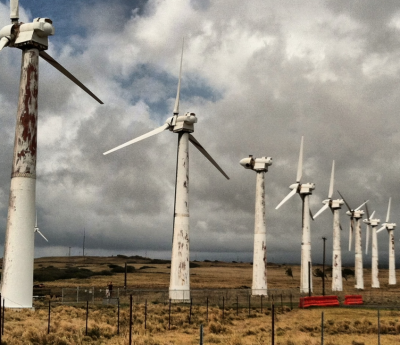
In Hawaii a stack went up at Kamaoa in 1985 – by 2004 they too were left to the elements:

Hawaii rusting turbines

So, you’re thinking, only in America could wind power outfits get away with leaving thousands of giant fans to rust in the paddock. Well, think again.

The company that wind power outfits use to hold the land holder agreements with farmers is usually a $2 company with no real assets and, therefore, the “promise” contained in those agreements to decommission turbines isn’t worth the paper it’s written on: the parent company will simply let the company with the land holder agreement be wound up in insolvency; and host farmers were too gullible to obtain decommissioning bonds to ensure the clean-up costs are covered. And planning authorities were just as stupid – they could have easily forced developers to provide decommissioning bonds as a condition of granting planning consent, but generally failed to do so.

So, once these things are past their economic use by dates, their owners will cut and run in a heartbeat. Expect to see fleets of dilapidated fans rusting on Australian ridge-lines in the not too distant future.


Climate Change Alarmists have Cried wolf…. Once too often!

Politics: Sorry, global warmists: The ’97 percent consensus’ is complete fiction

Image Credit: Spinster Cardigan via Flickr

Published by: Dan Calabrese on Tuesday May 27th, 2014

Dan Calabrese

How dare you question them?

You hear it all the time. Why, 97 percent of all climate scientists agree that global warming is dangerous and man is causing it.The debate is over and it’s time to act! (With the very kinds of tax and regulatory policies liberals would advocate anyway.)

Did you ever think to question, though, what the basis of this 97 percent figure might be? Joseph Bast and Roy W. Spencer did. Mr. Bast is president of the Heartland Institute, while Dr. Spencer is a principal research scientist for the University of Alabama in Huntsville and the U.S. Science Team Leader for the Advanced Microwave Scanning Radiometer on NASA’s Aqua satellite. Writing today in the Wall Street Journal, the two men examine the most frequently cited sources for this claim and find them wanting. No matter how many times you hear politicians repeat the claim, there is no 97 percent consensus:

Where did Mr. Kerry get the 97% figure? Perhaps from his boss, President Obama, who tweeted on May 16 that “Ninety-seven percent of scientists agree: #climate change is real, man-made and dangerous.” Or maybe from NASA, which posted (in more measured language) on its website, “Ninety-seven percent of climate scientists agree that climate-warming trends over the past century are very likely due to human activities.”

Yet the assertion that 97% of scientists believe that climate change is a man-made, urgent problem is a fiction. The so-called consensus comes from a handful of surveys and abstract-counting exercises that have been contradicted by more reliable research.

One frequently cited source for the consensus is a 2004 opinion essay published in Science magazine by Naomi Oreskes, a science historian now at Harvard. She claimed to have examined abstracts of 928 articles published in scientific journals between 1993 and 2003, and found that 75% supported the view that human activities are responsible for most of the observed warming over the previous 50 years while none directly dissented.

Ms. Oreskes’s definition of consensus covered “man-made” but left out “dangerous”—and scores of articles by prominent scientists such as Richard Lindzen, John Christy, Sherwood Idso and Patrick Michaels, who question the consensus, were excluded. The methodology is also flawed. A study published earlier this year in Nature noted that abstracts of academic papers often contain claims that aren’t substantiated in the papers.

That’s just the beginning. Bast and Spencer examine source after supposed source of this claim and methodically destroy the credibility of every single one. You’re left with the realization that this statistic, constantly cited by left-wing politicians, is completely bogus. And the very people who beat skeptics over the head with these bogus numbers are the ones who say we are “anti-science” for refusing to agree with them.

This explains a lot. It certainly explains the East Anglia e-mails, which sound like they were written by people who are trying to sustain a scam and are nervous about being exposed. It explains the insistence of the so-called “climate science community” to try to silence the work of skeptics and prevent their papers from being published. Science is not the practice of enforcing orthodoxies and siliencing apostates who question things, and yet that’s what these folks do with regularity and their backers in the political realm cheer them on.

And it exposes yet again the pliability of the mainstream media, which continually cites this “97 percent” number without ever questioning where it came from or whether there is any basis for it. It reminds me of activists used to claim back in the 1980s that there were 4 million homeless, and the media would repeat the number as a matter of course without ever questioning its validity or its origin. They just figured that since they heard it all the time from people who ought to know, that was authoritative enough for them. (Besides, it seemed to be an indictment of Reagan policies, so hey, why not?)

There’s all kinds of statistical nonsense floating around out there, and a lot of it that should be questioned never is because the people who ought to be doing the questioning want to believe. It’s like the X-Files.

Once you recognize this, it really shows how insidious is the effort of the political class to marginalize so-called “deniers.” These people are citing completely bogus data themselves – certainly to make the “consensus” claim and almost as certainly to make the claim of man-made global warming as well, not to mention their claims about what it will cause to happen in the future if we don’t “act” (i.e. raise taxes, put government in charge of industry, etc.). Their entire proposition is a lie, and they’re going to shut you up if you say anything about it, because the debate over, damn it!

And why should anyone be surprised about this? The same people who told you “if you like your plan you can keep your plan” now tell us there is no room for questioning them on man-made global warming or its future effects.

Usually people who are dealing in facts and truth don’t have a conniption fit when someone questions them. They are confident about their assertions and they figure they can withstand a healthy challenge. If it’s ever occurred to you that global warmists seem awfully insecure in the way they denounce their critics, now you know a little more about why.

Dorset Wind Farm Compromises World Heritage Status, of Jurassic Coast.

Explosive letter from UNESCO warns Dorset wind farm

could compromise World Heritage Status of Jurassic Coast

  • Proposed wind farm would place 194 turbines off the Jurassic Coast
  • Letter warns turbines will obscure view of the Isle of Wight
  • UNESCO review found project would have a ‘significant impact’ on the site

By TRAVELMAIL REPORTER

UNESCO has warned that plans for a wind farm of Dorset’s Jurassic Coast could compromise its status as a World Heritage Site.

The organisation has waded into the row over a controversial wind farm, writing an explosive letter to Whitehall outlining serious concerns about the project.

UNESCO also stressed that Britain could be in breach of the World Heritage Convention, which dictates that individual countries have a duty to ensure the ‘identification, protection, conservation and presentation’ of their World Heritage Site.

Controversy: The Jurassic Coast is famed for its lack of man-made buildings, keeping it as a natural attraction

Controversy: The Jurassic Coast is famed for its lack of man-made buildings, keeping it as a natural attraction

The director of UNESCO ends the letter by urging the relevant authorities to take the comments into account when deciding to grant the wind farm permission.

While it wasn’t outlined in the letter, some experts claim that if the wind farm goes ahead, the Jurassic Coast could be placed on UNESCO’s endangered list, meaning its status is in serious jeopardy.  The letter has been sent to the Department for Culture Media and Sport, which is responsible for managing England’s only natural World Heritage Site.

Earlier this year the department wrote to UNESCO, claiming the government-backed wind farm, called Navitus Bay, won’t impact on the Jurassic Coast.

The body then commissioned its own advisory body, the International Union for Conservation of Nature (IUCN), to look further into the matter and the letter is the result of the report.

Proposal: The plan is to build 194 wind turbines at sea, which would affect the view from the coast

Proposal: The plan is to build 194 wind turbines at sea, which would affect the view from the coast

In his strongly-worded letter, Kishore Rao, the director of UNESCO, wrote: ‘IUCN considers the project will have a significant impact on the natural setting of the property, in that it would adversely impact on important views.

‘The project would replace the Isle of Wight as the dominant feature on the horizon.

‘This is likely to significantly impact on visitors’ experience and appreciation of the property which could compromise the long term sustainability of the management of the property through loss of revenue.

‘Any potential impacts on this natural property are in contradiction to the overarching principal of the World Heritage Convention as the completion of the project would result in the property being presented to future generations in a form significantly different from what was there at the time of inscription until today.

‘The property will change from being located in a natural setting largely free from human-made structures to one where its setting is dominated by human-made structures.’

Warning: Experts claim that building the wind farm could put Dorset's Jurassic Coast on UNESCO's endangered list

Warning: Experts claim that building the wind farm could put Dorset’s Jurassic Coast on UNESCO’s endangered list

Navitus Bay would cover an area of 59 square miles, consist of 194, 600ft tall turbines and be positioned 8.8 miles off Durlston Head, near Swanage, Dorset, from where it will cover 45 per cent of the horizon.

The turbines will generate enough energy to power 710,000 homes.

Enco Wind UK and the French company EDF Energy Renewables are behind Navitus Bay and they have recently submitted an application to the Planning Inspectorate.

Local tourism chiefs have predicted a 14 per cent drop in tourism, equating to one billion pounds, as a result of the presence of the wind farm.

At a recent public meeting held to discuss the proposed development there was overwhelming opposition to it.

Fears: Locals have been campaigning against the wind farm and tourism chiefs have predicted a 14 per cent drop in visitors if it goes ahead

Fears: Locals have been campaigning against the wind farm and tourism chiefs have predicted a 14 per cent drop in visitors if it goes ahead

Dr Andrew Langley, of campaign group Challenge Navitus, has welcomed UNESCO’s intervention.

He said: ‘We think this letter is a very significant step in the whole process.

‘We have been stating the impact Navitus Bay will have on the Jurassic Coast for over two years now and this letter confirms that our concerns are real.

‘The government will be under pressure to respond accordingly.’

Malcolm Turnbull was the lead officer for Dorset County Council for the World Heritage bid in 2001.

He said: ‘The IUCN isn’t mincing its words on what they believe the impact will be.

‘Their report really focuses on the significant impact on the natural setting of the site which is what we have been saying for a long time.’