Faux-green Energy…..No more than an Over-priced Novelty!

Obama’s Green Unicorn


The true cost of renewable energy is being masked by government subsidies and bailouts.

Wind turbines are silhouetted by the setting sun Friday, Aug. 23, 2013, near Beaumont, Kan. The turbines are part of the 100-unit Elk River Wind Farm in south central Kansas.

Propped up by the government.

By    Aug. 25, 2014 
America is about as likely to become reliant on green energy to meet its baseload power requirements as a unicorn is to stroll down the middle of Washington’s Pennsylvania Avenue during rush hour followed by a pink elephant.

It’s just not happening – but that’s hasn’t deterred the modern day snake oil salesmen and their allies inside the Obama administration from continuing to make a push for wind and solar power as an eventual replacement for energy generated from traditional sources like coal, oil and natural gas. Renewable technology has improved, no doubt, but it’s a long way away from being ready to make a substantial contribution to the heating of our homes and the powering of our businesses unless the generous tax subsidies that create the illusion of cost competitiveness continue.

There’s nothing wrong per se with the pursuit of renewable energy; it’s just that what it actually costs is being masked by taxpayer subsidies, federal loan guarantees and renewable fuels mandates at the state level that force power companies to put wind and solar into the energy mix, sometimes at two to three times what traditional power costs. Ultimately, one way or another, the taxpayers and energy consumers are footing the bill even if they don’t know it

Congress has taken a few positive steps in the right direction. The federal Wind Production Tax Credit was allowed to expire at the end of the year, meaning new wind projects are going to have to be competitive at market rates to attract funding. Remember it was none other than billionaire Warren Buffett, the “Oracle of Omaha,” who explained recently to a group of investors that the tax credit was the only reason that any sensible person invested in wind projects in the first place.

Unfortunately, some federal agencies are trying to keep the program alive through the backdoor.

The worst offender in this regard may be the IRS, which recently issued new “guidelines” that make it even easier for wind projects currently in development to qualify for the tax credit on the basis of work already contemplated or completed. According to Politico, “The IRS says completed or in-progress facilities can be sold and the costs incurred by the seller will still count toward qualifying for the [credit], except in cases where tangible property (think equipment like wind turbines) bought for one project is sold and used at another site.”

To translate this into English, it’s a move to help keep the whole shell game alive until such time as wind power supporters can get the tax credit reauthorized. “There is a large pipeline of projects that were under development at some stage that by virtue of this guidance will be able to go forward. In that regard it is going to permit a lot of projects to be developed,” said one wind energy expert cited by Politico.

Outside groups are also weighing in, including the Sierra Club, which has targeted nine members of Congress in a pressure campaign over the August recess to push for reauthorization of the Wind Production Tax Credit. That is in addition to the online ad buys in 16 other districts that started in June.

[MORE: Cartoons on Gas Prices]

The Democrats who run the Senate want to keep the now-expired credit alive and have, in the Senate Finance Committee, already approved a package of so-called “extenders” that would breathe new life into it. The House has thus far refused to go along – and kudos to Texas Republican Rep. Randy Weber, who deserves credit for successfully introducing an amendment to shut the whole business down permanently. But he’s not just fighting the lobbyists and green groups in favor of the credit, but the entire federal bureaucracy which, once a program has been established, is loath to let it die.

Major government investment in speculative green projects may have at one time made sense. But even if that were once the case, it is so no longer. The Obama green energy push has enriched more than a few politically well-connected liberals who used tax credits and government bailouts to enlarge their portfolios, but it has done little to make energy more abundant or lower costs to consumers, which is the justification in the first place to get the taxpayers involved. If people want to build wind farms – on land or offshore – and they want to reap the benefits of their investments, then they should be willing to take the same risks as everyone else. The way the bureaucrats have it structured now, the taxpayers are making payments on both ends through subsidies for construction and higher rates on consumption. It’s a system only a bureaucrat could love.

Oh My…Enercon Floundering? What a Shame! Subsidies end….Turbines NOT Sustainable!

Brazil Tax Exemption Removal Curbs Wobben’s Wind Turbine Orders

Enercon GmbH’s Wobben Windpower is losing contracts in Brazil after tax authorities canceled some exemptions for wind turbine manufacturers in the country, an official said.

The Brazil unit of Germany’s Enercon had a single customer so far this year, Mathias Moser, a vice president of Wobben, said in an interview yesterday in Rio de Janeiro. The company had considered leaving South America’s fastest-growing market after Brazilian tax authorities in April removed a tax incentive and required turbine makers such as Wobben, Spain’s Gamesa Corp., Tecnologica SA and Denmark’s Vestas Wind Systems A/S to pay back taxes for the exemption.

“This is definitely a restructuring year for us in Brazil,” said Mathias, who came to the country in April amid a management change.

Enercon, based in Aurich, Germany, decided to stay in Brazil last month after filing an appeal on the tax incentive ruling, according to Mathias. He didn’t disclose how much the company owes in back taxes. Brazil is seeking the previous five fiscal years of back taxes for the exemption.

“We have always produced in Brazil, so we have had the benefit for many years,” Mathias said. “It is a lot of money.”

Wobben started manufacturing turbines in Brazil in 1995, the first turbine maker to install a facility in the country. It has four facilities in the country, and has the capacity to produce as many as 200 turbines at its Sorocaba plant in Sao Paulo state. In its sole contract this year, the company delivered 23 turbines for Elecnor SA of Spain’s wind park in southern Brazil.

“It is a drop from last year’s,” Mathias said, without specifying 2013 deliveries.

Turbine Talks

Brazil’s Ministry of Finance is considering reinstating the tax exemption for turbine makers, according to Elbia Melo, president of the country’s wind power association known as Abeeolica.

“The wind industry is facing problems with the government’s special incentive plan for the equipment manufacturers and it is relevant to solve it,” Melo said in a phone interview from Sao Paulo. “We are in talks with the government.”

The Ministry of Finance’s press office said it does not comment on potential rule changes.

Wind energy in Brazil is among the cheapest sources of power. The country has the biggest capacity in Latin America, according to a Global Wind Energy Council report of 2013.

Wobben is optimistic about winning its appeal in court, according to Mathias.

“We are staying, given the good prospects for the Brazilian market,” said Mathias. “The size of the company’s business in the country can be affected if we don’t sign contracts in the future.”

To contact the reporter on this story: Vanessa Dezem in Sao Paulo at vdezem@bloomberg.net

To contact the editors responsible for this story: Reed Landberg at landberg@bloomberg.netRobin Saponar, Carlos Caminada

  • Windweasels Swarming US Market, After Europeans Started to “Wise Up”, and say NO!

    Big Wind’s latest deceitful ad campaign

    Siemens_big_wind_TV_adFacing trouble abroad, Siemens ads seek to tap into US taxpayers and wind welfare system

    Guest essay by Mary Kay Barton

    If you watch much mainstream TV, you’ve probably seen Siemens’ new multi-million-dollaradvertising blitz  to sell the American public on industrial wind. Why the sudden ad onslaught? Watch the video below.

    The wind business abroad has taken a huge hit of late. European countries have begun slashing renewable mandates, due to the ever-broadening realization that renewables cost far more than industrial wind proponents have led people to believe: economically, environmentally, technically, and civilly.

    Siemens’ energy business took a €48m hit in the second quarter due to a bearings issue with onshore turbines, and a €23m charge due to ongoing offshore grid issues in Germany – on top of subsidy and feed-in tariff cutbacks, recent articles have pointed out.

    As Siemens’ tax-sheltering market dries up in Europe, its U.S. marketing efforts are clearly geared toward increasing its income and profits via wind’s tax sheltering schemes in the United States. The company stands to make millions, so Siemens ad campaign is obviously part of an overall pitch to persuade Congress to extend the hefty wind Production Tax Credit (PTC), more accurately called“Pork-To-Cronies.” As Warren Buffett recently admitted, “We get tax credits if we build lots of wind farms.  That’s the only reason to build them. They don’t make sense without the tax credit.”

    Taxpayers and ratepayers, beware!

    President Obama often says he intends to “close corporate loopholes,” but his PTC and other policies continue funneling billions of taxpayer dollars to his wealthy corporate insiders and campaign contributors – while we continue to rack up unconscionable debt for our children and grandchildren.

    Increasing public awareness of the wind energy scam has led to increased opposition to extendingany more corporate welfare to Big Wind via the PTC and energy investment tax credit (ITC). Enter another bureaucratic end-run around once clear statutory language by this Administration.

    As reported by the Wall Street Journal, the increasingly politicized IRS recently relaxed the definition of “commence construction” to the point where the definition bears no resemblance to the actual words.  During a hearing by the House Energy Policy, Health Care and Entitlements subcommittee last October, Curtis G. Wilson of the IRS admitted that developers can now game the system to the point where projects built years in the future could still meet the eligibility requirement for “commence” now.

    U.S. taxpayers and ratepayers are doomed when, instead of allowing the markets to work, crony-corruptocrats are picking the winners and losers in the energy marketplace, using such nefarious tactics.

    Sadly, most people don’t even know the difference between energy and power. This reality has built the framework for the biggest swindle ever perpetrated on citizens worldwide.  Many have bought into the alarmist argument that “we have to do something” to stop “dangerous manmade global warming.” Enter the wind industry sales department, primed to capitalize on public fears and alarmist hype.

    Siemens also needs to convince the 80% of U.S. citizens who live in suburbia that industrial wind factories are “environment-friendly,” and everyone loves them. Thus, as usual for these disingenuous ad campaigns, a sprawling wind facility is pictured among green fields, with no homes anywhere to be seen, no birds are being slaughtered, while a happy Iowa leaseholder smiles and says she loves wind.

    A drive out Route 20A in Wyoming County, western New York State, however, tells a far different story. The western side of Wyoming County – which used to be some of the most beautiful countryside in New York State, has been industrialized with 308 giant, 430-foot-tall towers, and their 11-ton, bird-chopping blades spinning overhead, only hundreds of feet from peoples’ homes and roadways. There’s no doubt that Siemens won’t be showing you this reality in any of their TV ads!

    Unfortunately for the residents of Orangeville in Wyoming County, greed at the top in Washington, DC determined their fate. The sole reason Invenergy went ahead with its plan to build its 58-turbine project was that, in the early morning hours of January 1, 2013, the PTC was added as pork for companies sucking at the wind welfare teat.

    Ever appreciative of the handouts, Invenergy owner Ukrainian Michael Polsky rewarded President Obama by holding a $35,000 a plate fundraiser at his Chicago mansion. Mr. Obama is so committed to Big Wind that he’s even legalized 30-year eagle kill permits just for the wind industry. Anyone else harming an eagle, or even possessing a single bald eagle feather, is penalized with an iron fist.

    There you have it – corporate cronyism in all its glory, with bird murder as its crowning achievement.

    Word of impending lawsuits lingers in Orangeville. It remains to be seen if disenchanted leaseholders will end up suing Big Wind, as others have. In the meantime, we’re hoping we don’t have any 11-ton blade breaks that throw shrapnel for thousands of feet, or any airplanes crashing into wind turbines during fog, as occurred in South Dakota earlier this year, killing all four on board. (I’ll bet you won’t be seeing any of these facts in Siemens’ ads, either.)

    Our elected officials need energy literacy. Even a small dose would help.

    What’s most frustrating, when attempting any kind of correspondence regarding these energy issues with many elected officials, is the kind of response I received from Senator Chuck Schumer (D-NY)when I wrote him a letter about ending the Wind PTC. Senator Schumer never even mentioned the PTC in his response. Instead, he rambled on about the need to “reduce foreign oil imports,” and increase “efficiency” – neither of which has a thing to do with wind-generated electricity.

    Mr. Schumer recently feigned alarm following complaints by citizens about soaring electric rates – demanding answers about it, while simultaneously supporting yet another Wind PTC extension (plus other rate-increasing “renewable” projects). Senator Schumer’s hypocrisy is outrageous, and unacceptable.

    Perhaps it’s time for U.S. ratepayers and taxpayers to demand that their elected officials first pass an energy literacy exam, before they pass such cost-exorbitant, “green” boondoggles on to consumers.

    Congress is on vacation through Labor Day, which makes this the perfect time to approach your senators and representatives while they’re home.  Attend town hall meetings and in-district fundraisers. Remind your representatives that we put them in office, and that we can also vote them out!

    Since energy plays a pivotal role in our national economy – impacting the cost of absolutely everything else – candidates should have “energy” listed on their “issues” webpage.

    Good candidates will support an All of the Sensibleenergy policy, as opposed to the “All of the Above” energy policy which President Obama has been pushing on behalf of the “green” movement.“Sensible” alternative energy options are those that are backed up by scientific and economic proof that they provide net societal benefits. Industrial wind fails this test miserably!

    For more information, refer friends and elected officials to Robert Bryce’s excellent book, Power Hungry: The myths of “green” energy and the real fuels of the future.

    Continue to call and write their offices, and encourage them to oppose any extension of the PTC and ITC! Write letters to your local newspapers, copy their district offices, and post information on their social media pages (e.g., Face Book & Twitter).

    We must demand accountability from elected officials, or vote them out! Reliable, affordable energy is what has made America great. We need to keep it that way.

    Mary Kay Barton is a retired health educator, New York State small business owner, Cornell-certified Master Gardener, and is a tireless advocate for scientifically sound, affordable, and reliable electricity for all Americans.

    Finally…the Scam is Being Exposed! They Know They Are NOT Helping Our Environment!

    It’s about something

    Ms. McCarthy is now saying that the Clean Power Plan is not about climate. Ms. McCarthy’s July 23 testimony on the Clean Power Plan was that it is not about climate or pollution control.  This contradicts the June testimony, the web site and the federal register notice.  So it’s about something.  

    From the Bonner Cohen, Heartland.org:

    EPA’s recently announced restrictions on carbon dioxide emissions have nothing to do with reducing pollution, EPA Administrator Gina McCarthy admitted in Senate hearings. Instead, said McCarthy, EPA imposed the restrictions based on a belief imposing expensive renewable energy on the electricity marketplace will stimulate the economy.

    ‘Not About Pollution Control’
    “The great thing about this proposal is that it really is an investment opportunity. This is not about pollution control,” McCarthy told the Senate Environment & Public Works Committee July 23. “It’s about increased efficiency at our plants. It’s about investment in renewables and clean energy. It’s about investments in people’s ability to lower their electricity bills by getting good, clean, efficient appliances, homes, rental units.”

    McCarthy’s comments came as a shock to utilities facing steep costs attempting to comply with the proposed restrictions. The comments also came at a time when the Obama administration’s prior EPA restrictions have pushed U.S. electricity prices to an all-time record high.

    Contradicts Prior Testimony
    McCarthy’s Senate testimony represents a significant departure from the way EPA defended its proposal before lawmakers just a month earlier. At a June hearing before the House Energy and Commerce Committee, Acting Assistant Administrator for Air and Radiation Janet McCabe offered a different explanation. Citing Section 111 (b) of the Clean Air Act, which authorizes EPA to regulate certain pollutants, McCabe made that argument in her testimony:

    “Chairman Upton, this is not an energy plan. This is a rule done within the four corners of 111 (b) that looks to the best system of emission reduction to reduce emission.… This is a pollution control rule as EPA has traditionally done under section 111 (d).”

    McCarthy’s comment didn’t escape the attention of climatologist Roy Spencer.

    “This gaffe could come back to bite the EPA,” Spencer wrote on his website. “The Endangerment Finding was all about the negative effect of ‘carbon pollution’ on the environment. Now we find out ‘this is not about pollution control’?”

    In her testimony, McCarthy repeatedly emphasized EPA views its rule as an investment opportunity for the business community, while downplaying the cost it would impose on consumers.

    “This is an investment strategy that will not just reduce carbon pollution but will position the United States to continue to grow economically in every state, based on their own design,” she said.

    So CO2 restrictions are not about climate and all the supposed health benefits are not about pollution control, they are energy efficiency, jobs and economic programs.  Sounds like EPA is getting caught with a reg that obviously doesn’t do what they said it was designed to do and are scrambling.

    Faux-green Agenda is Not Healthy for People, or the Environment!

    Climate-Cooling Policies threaten Food Supplies

    A warmer, wetter climate with more carbon dioxide in the atmosphere would undoubtedly produce more plant growth and more food.
     
    However climate-cooling policies that claim to prevent global warming by throttling the use of carbon fuels will definitely reduce food supply and increase food prices.
     
    The promotion of ethanol for motor fuel is anti-food. This “food for fuel” program has absorbed significant quantities of corn, soy beans, sugar and palm oils. Consequently prices for ethanol crops are higher than they would otherwise be, encouraging farmers to convert land currently devoted to grazing animals and other food crops to growing more profitable crops for ethanol.

    Extreme greens also practise plant discrimination, favouring more trees at the expense of natural grasslands and open forest that support many grazing animals. These polices take many forms including planting carbon credit forests, banning regrowth clearing, anti-development zoning and blanket tree protection reserves. All such policies reduce food production from grasslands.

    Climate-cooling policies also aim to decrease demand for carbon fuels, including coal, oil, gas and refined motor fuels, by increasing their costs and prices. Modern food production is totally dependent on low-priced carbon fuels for all farming activities. Diesel fuels are needed for cultivation, planting, harvesting and transport; and coal/gas powered electricity for irrigation, processing and distribution. Higher prices for carbon fuels will send some marginal farms out of business. The same policies will reduce profits and production in the fishing industry. All of these policies are anti-food.
     
    Modern food production needs nitrogen fertilizer, which is made from atmospheric nitrogen and natural gas, with carbon dioxide as a by-product. Extreme greens all over the world are delaying and opposing the exploration and production of natural gas, and their carbon taxes are increasing the costs of this key fertilizer.

    Finally, climate-cooling policies favour silly schemes like carbon capture and burial, which aims to pump carbon dioxide underground. The promoters should be told that current levels of carbon dioxide in the atmosphere are below those that maximize plant growth and food production. The rise in atmospheric carbon dioxide levels was a major contributor to increased world food production over the last century. To bury this free plant food is not food-smart.
     
    These unproven solutions to unproven problems are unlikely to change the climate. But there is a 50:50 chance that instead of warming, the globe may cool naturally, which will cause dramatic reduction in food production.
     
    Food is not easily storable, and supply and demand are always finely balanced. If natural cooling comes on top of all these man-made anti-food policies, the world will see cascading food shortages.

    For those who wish to read more:

    The Ethanol Disaster:
    http://reason.com/archives/2014/05/06/the-ethanol-disaster

    The Unintended Consequences of Ethanol:
    http://news.newsmax.com/?ZKORXYGhQIAlL8s41ytI6BaZUxleNLU1Z&ns_mail_uid=32310041&ns_mail_job=1566641_04272014
     
    Ethanol from corn waste may release more greenhouse gases than petrol:
    http://www.news.com.au/world/breaking-news/corn-waste-fuel-not-better-than-petrol/story-e6frfkui-1226890856876?from=public_js
     
    The Ethanol Disaster:
    http://carbon-sense.com/2013/11/25/the-ethanol-disaster/
     
    World turns against Ethanol:
    http://canadafreepress.com/index.php/article/63444

    Current solar cycle may be the weakest in 200 years:
    http://informthepundits.wordpress.com/2014/08/17/sunspots-2014-two-big-surprises/
     

     A warmer, wetter climate with more carbon dioxide in the atmosphere would undoubtedly produce more plant growth and more food.

     
    However climate-cooling policies that claim to prevent global warming by throttling the use of carbon fuels will definitely reduce food supply and increase food prices.
     
    The promotion of ethanol for motor fuel is anti-food. This “food for fuel” program has absorbed significant quantities of corn, soy beans, sugar and palm oils. Consequently prices for ethanol crops are higher than they would otherwise be, encouraging farmers to convert land currently devoted to grazing animals and other food crops to growing more profitable crops for ethanol.

    Extreme greens also practise plant discrimination, favouring more trees at the expense of natural grasslands and open forest that support many grazing animals. These polices take many forms including planting carbon credit forests, banning regrowth clearing, anti-development zoning and blanket tree protection reserves. All such policies reduce food production from grasslands.

    Climate-cooling policies also aim to decrease demand for carbon fuels, including coal, oil, gas and refined motor fuels, by increasing their costs and prices. Modern food production is totally dependent on low-priced carbon fuels for all farming activities. Diesel fuels are needed for cultivation, planting, harvesting and transport; and coal/gas powered electricity for irrigation, processing and distribution. Higher prices for carbon fuels will send some marginal farms out of business. The same policies will reduce profits and production in the fishing industry. All of these policies are anti-food.
     
    Modern food production needs nitrogen fertilizer, which is made from atmospheric nitrogen and natural gas, with carbon dioxide as a by-product. Extreme greens all over the world are delaying and opposing the exploration and production of natural gas, and their carbon taxes are increasing the costs of this key fertilizer.

    Finally, climate-cooling policies favour silly schemes like carbon capture and burial, which aims to pump carbon dioxide underground. The promoters should be told that current levels of carbon dioxide in the atmosphere are below those that maximize plant growth and food production. The rise in atmospheric carbon dioxide levels was a major contributor to increased world food production over the last century. To bury this free plant food is not food-smart.
     
    These unproven solutions to unproven problems are unlikely to change the climate. But there is a 50:50 chance that instead of warming, the globe may cool naturally, which will cause dramatic reduction in food production.
     
    Food is not easily storable, and supply and demand are always finely balanced. If natural cooling comes on top of all these man-made anti-food policies, the world will see cascading food shortages.

    For those who wish to read more:

    The Ethanol Disaster:
    http://reason.com/archives/2014/05/06/the-ethanol-disaster

    The Unintended Consequences of Ethanol:
    http://news.newsmax.com/?ZKORXYGhQIAlL8s41ytI6BaZUxleNLU1Z&ns_mail_uid=32310041&ns_mail_job=1566641_04272014
     
    Ethanol from corn waste may release more greenhouse gases than petrol:
    http://www.news.com.au/world/breaking-news/corn-waste-fuel-not-better-than-petrol/story-e6frfkui-1226890856876?from=public_js
     
    The Ethanol Disaster:
    http://carbon-sense.com/2013/11/25/the-ethanol-disaster/
     
    World turns against Ethanol:
    http://canadafreepress.com/index.php/article/63444

    Current solar cycle may be the weakest in 200 years:
    http://informthepundits.wordpress.com/2014/08/17/sunspots-2014-two-big-surprises/

    Read more: http://www.americanthinker.com/blog/2014/08/climatecooling_policies_threaten_food_supplies.html#ixzz3B01PWKKu
    Follow us: @AmericanThinker on Twitter | AmericanThinker on Facebook

    A Scientist’s Point of View, on CO2….A Must-Read!

    Earth’s Response to Increasing CO2: An Example of Hormesis?

    August 11th, 2014 by Roy W. Spencer, Ph. D.

    One of the dubious assumptions undergirding the environmental movement is that the Earth was in an optimum state of health before humans arrived on the scene and screwed everything up.

    But this is a religious assumption…which I don’t have a problem with, until it is foisted on the masses as “science”.

    The idea that everything humans do to the environment is bad is an emotional one, not scientific, especially when the “pollution” we are talking about (CO2) is necessary for life on Earth.

    There is a concept in toxicology called “hormesis”, around since at least the late 1800s, which states that for many chemicals the biological response is actually positive at low doses, before it becomes negative at high doses. I spent some time last week with Ed Calabrese, who has published extensively on the hormesis concept (here is a review paper by him, which includes a discussion of how the hormesis concept got unfairly grouped in with the homeopathy movement).

    For a very simple example, there is a wide variety of minerals necessary for human health in low doses, but which are toxic at high doses. Food and water are also necessary in low doses…but will kill you in high doses.

    More generally, there is also evidence that even for chemicals which are notnecessary in the human body, low doses can actually make a person healthier because some level of environmental stress on the body makes the body more resilient. For example, some non-zero level of bacteria and virus exposure helps keep us healthier. I’m told there has been some research that suggests that inhaling low levels of radon is beneficial..or at least benign. Physical exercise tears apart human tissue…but helps build more muscle as a response to the demands placed on the body.

    The hormesis concept is anathema to regulatory organizations such as the EPA, which want to regulate “pollution” to infinitesimally small values, no matter how many people those regulations might kill in the process. The supposed justification is linear dose-response curves which basically assume that there is no beneficial level of a “pollutant”, and even that the smallest level of exposure will cause harm.

    Needless to say, the possibility that low doses of many pollutants might actually be beneficial to human health would be a real paradigm changer in the regulatory community.

    This is the basis of statistical epidemiological studies which claim thousands of deaths each year from exposure to benign things like Justin Bieber’s music.

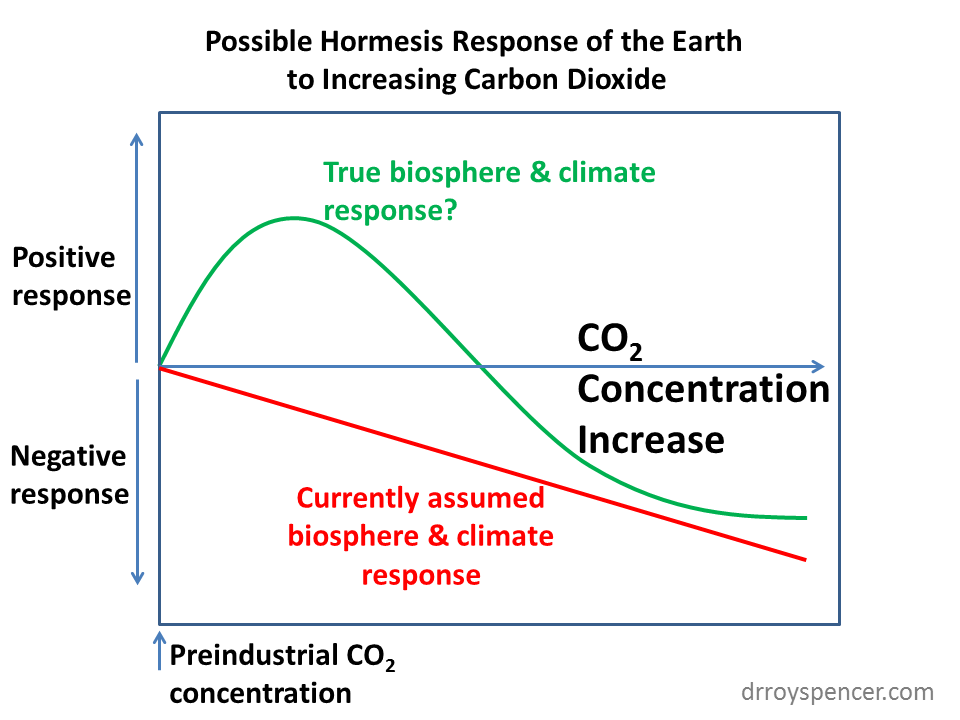
    For those who like graphs, the following cartoon shows what I’m suggesting in qualitative functional form for carbon dioxide:

    Hormesis-and-CO2

    An Earth scientist who has not already sold his soul to the government regulation bureaucracy might legitimately ask, “I wonder if some level of enrichment of atmospheric CO2 is actually a good thing for life on Earth?”, as suggested by the green curve in the above graph.

    The straight red line (linear dose response) is, in contrast, what is usually assumed…that any increase beyond that believed to exist before humans arrived is necessarily bad for Mother Earth.

    But atmospheric carbon dioxide is necessary for life on Earth, and has risen from a pre-industrial concentration of only 3 parts per 10,000, to (still only) 4 parts per 10,000 today. The result has been global greening and a moderation of global temperatures (at least partly due to more CO2, in my opinion). Theoretically expected negative impacts on severe weather and marine life have, so far, failed to reach any believable level of cause-and-effect, beyond normal natural variability.

    (And if you are tempted to cite statistics of a record number of whatever events, I will ask whether humans are also responsible for the recent “grand maximum” record high sunspot activity out of the last 3,000 years? Was that Bieber’s fault, too? Or maybe Manbearpig’s fault?).

    I’ve had plant physiologists tell me it’s almost as if nature has been sucking as hard as it can on atmospheric CO2, and has depleted it to the point where only the hardiest life forms can exist. But as we add more CO2 to the atmosphere, nature quickly gobbles up 50% of the extra, leading to a more luxurious and robust biosphere.

    So, it is reasonable from an unbiased scientific perspective to examine the possibility that more CO2 is actually good for life on Earth…not just the biosphere, but atmospheric effects as well. After all, we’re not talking about X-rays here…we’re talking about the elixir of life, CO2.

    Is there a level beyond which more carbon dioxide would be bad? Probably…but I don’t think we know what that level would be. And, just to be on the safe side, if there was a way to stop producing CO2 without killing millions (if not billions) of people in the process, I might be in favor of that.

    But that’s simply not possible with today’s energy technologies. Renewable energy sources cannot contribute to more than 15-20% of total energy demand in the coming decades, so we are stuck with fossil fuels for the time being.

    I really don’t care where our energy comes from, as long as it is abundant and affordable for the world’s poor. In the meantime, we need to stop thinking in simple linear dose-response terms which is contrary to so much real world experience and exists mainly to make jobs for regulators and companies that are made rich through subsides rather than through free choice by the public.


    Honest, Unbiased Scientists Reject Global Warming Hysteria!

    December 4, 2013

    Dr. Don Easterbrook Exposes Global Warming Hoax 

    Global Cooling is Here

    Evidence for Predicting Global Cooling for the Next Three Decades

    Department of Geology, Western Washington University
    Article originally published, 11/2/2008
    Re-Published 10/29/2013
    Addendum Video:  3/26/2013 Presentation to WA Senate committee added 12/4/2013 by HSaive
    .

    Global Research Editor’s note

    The following article represents an alternative view and analysis of global climate change, which challenges the dominant Global Warming Consensus.

    Global Research does not necessarily endorse the proposition of “Global Cooling”, nor does it accept at face value the Consensus on Global Warming. Our purpose is to encourage a more balanced debate on the topic of global climate change.

    INTRODUCTION

    Dr Don Easterbrook mugDespite no global warming in 10 years and recording setting cold in 2007-2008, the Intergovernmental Panel on Climatic Change (IPCC) and computer modelers who believe that CO2 is the cause of global warming still predict the Earth is in store for catastrophic warming in this century. IPCC computer models have predicted global warming of 1° F per decade and 5-6° C (10-11° F) by 2100 (Fig. 1), which would cause global catastrophe with ramifications for human life, natural habitat, energy and water resources, and food production. All of this is predicated on the assumption that global warming is caused by increasing atmospheric CO2 and that CO2 will continue to rise rapidly.

    3/26/2013 Presentation to Washington State Senate Committee on Climate Change – In addition to evidence contrary to IPCC, Dr. Easterbrook alleges media bias and manipulation of data by East Anglia, NASA, NOAA and NSF. (TVW Original Broadcast)

    Easterbrrok Video at TVW
    Archive Backup Video

    Easterbrook-1-glcool1

    Easterbrook-2-glcool1

    Figure 1. A. IPCC prediction of global warming early in the 21st century. B. IPCC prediction of global warming to 2100. (Sources: IPCC website)

    However, records of past climate changes suggest an altogether different scenario for the 21st century. Rather than drastic global warming at a rate of 0.5 ° C (1° F) per decade, historic records of past natural cycles suggest global cooling for the first several decades of the 21st century to about 2030, followed by global warming from about 2030 to about 2060, and renewed global cooling from 2060 to 2090 (Easterbrook, D.J., 2005, 2006a, b, 2007, 2008a, b); Easterbrook and Kovanen, 2000, 2001). Climatic fluctuations over the past several hundred years suggest ~30 year climatic cycles of global warming and cooling, on a general rising trend from the Little Ice Age.

    PREDICTIONS BASED ON PAST CLIMATE PATTERNS

    Global climate changes have been far more intense (12 to 20 times as intense in some cases) than the global warming of the past century, and they took place in as little as 20–100 years. Global warming of the past century (0.8° C) is virtually insignificant when compared to the magnitude of at least 10 global climate changes in the past 15,000 years. None of these sudden global climate changes could possibly have been caused by human CO2 input to the atmosphere because they all took place long before anthropogenic CO2 emissions began. The cause of the ten earlier ‘natural’ climate changes was most likely the same as the cause of global warming from 1977 to 1998.

    Easterbrook-3-glcool1

    Figure 2. Climate changes in the past 17,000 years from the GISP2 Greenland ice core. Red = warming, blue = cooling. (Modified from Cuffy and Clow, 1997)

    Climatic fluctuations over the past several hundred years suggest ~30 year climatic cycles of global warming and cooling (Figure 3) on a generally rising trend from the Little Ice Age about 500 years ago.

    Easterbrook-4-glcool1

    Figure 3. Alternating warm and cool cycles since 1470 AD. Blue = cool, red = warm. Based on oxygen isotope ratios from the GISP2 Greenland ice core.

    Relationships between glacial fluctuations, the Pacific Decadal Oscillation, and global climate change.

    After several decades of studying alpine glacier fluctuations in the North Cascade Range, my research showed a distinct pattern of glacial advances and retreats (the Glacial Decadal Oscillation, GDO) that correlated well with climate records. In 1992, Mantua published the Pacific Decadal Oscillation curve showing warming and cooling of the Pacific Ocean that correlated remarkably well with glacial fluctuations. Both the GDA and the PDO matched global temperature records and were obviously related (Fig. 4). All but the latest 30 years of changes occurred prior to significant CO2 emissions so they were clearly unrelated to atmospheric CO2.

    Easterbrook-5-glcool1

    Figure 4. Correspondence of the GDO, PDO, and global temperature variations.

    The significance of the correlation between the GDO, PDO, and global temperature is that once this connection has been made, climatic changes during the past century can be understood, and the pattern of glacial and climatic fluctuations over the past millennia can be reconstructed. These patterns can then be used to project climatic changes in the future. Using the pattern established for the past several hundred years, in 1998 I projected the temperature curve for the past century into the next century and came up with curve ‘A’ in Figure 5 as an approximation of what might be in store for the world if the pattern of past climate changes continued. Ironically, that prediction was made in the warmest year of the past three decades and at the acme of the 1977-1998 warm period. At that time, the projected curved indicated global cooling beginning about 2005 ± 3-5 years until about 2030, then renewed warming from about 2030 to about 2060 (unrelated to CO2—just continuation of the natural cycle), then another cool period from about 2060 to about 2090. This was admittedly an approximation, but it was radically different from the 1° F per decade warming called for by the IPCC. Because the prediction was so different from the IPCC prediction, time would obviously show which projection was ultimately correct.

    Now a decade later, the global climate has not warmed 1° F as forecast by the IPCC but has cooled slightly until 2007-08 when global temperatures turned sharply downward. In 2008, NASA satellite imagery (Figure 6) confirmed that the Pacific Ocean had switched from the warm mode it had been in since 1977 to its cool mode, similar to that of the 1945-1977 global cooling period. The shift strongly suggests that the next several decades will be cooler, not warmer as predicted by the IPCC. 

    Easterbrook-6-glcool1

    Figure 5.Global temperature projection for the coming century, based on warming/cooling cycles of the past several centuries. ‘A’ projection based on assuming next cool phase will be similar to the 1945-1977 cool phase. ‘B’ projection based on assuming next cool phase will be similar to the 1880-1915 cool phase. The predicted warm cycle from 2030 to 2060 is based on projection of the 1977 to 1998 warm phase and the cooling phase from 2060 to 2090 is based on projection of the 1945 to 1977 cool cycle.

    Implications of PDO, NAO, GDO, and sun spot cycles for global climate in coming decades

    The IPCC prediction of global temperatures, 1° F warmer by 2011 and 2° F by 2038 (Fig. 1), stand little chance of being correct. NASA’s imagery showing that the Pacific Decadal Oscillation (PDO) has shifted to its cool phase is right on schedule as predicted by past climate and PDO changes (Easterbrook, 2001, 2006, 2007). The PDO typically lasts 25-30 years and assures North America of cool, wetter climates during its cool phases and warmer, drier climates during its warm phases. The establishment of the cool PDO, together with similar cooling of the North Atlantic Oscillation (NAO), virtually assures several decades of global cooling and the end of the past 30-year warm phase. It also means that the IPCC predictions of catastrophic global warming this century were highly inaccurate.

    The switch of PDO cool mode to warm mode in 1977 initiated several decades of global warming. The PDO has now switched from its warm mode (where it had been since 1977) into its cool mode. As shown on the graph above, each time this had happened in the past century, global temperature has followed. The upper map shows cool ocean temperatures in blue (note the North American west coast). The lower diagram shows how the PDO has switched back and forth from warm to cool modes in the past century, each time causing global temperature to follow. Comparisons of historic global climate warming and cooling over the past century with PDO and NAO oscillations, glacial fluctuations, and sun spot activity show strong correlations and provide a solid data base for future climate change projections.

    The Pacific Ocean has a warm temperature mode and a cool temperature mode, and in the past century, has switched back forth between these two modes every 25-30 years (known as the Pacific Decadal Oscillation or PDO). In 1977 the Pacific abruptly shifted from its cool mode (where it had been since about 1945) into its warm mode, and this initiated global warming from 1977 to 1998. The correlation between the PDO and global climate is well established. The announcement by NASA’s Jet Propulsion Laboratory that the Pacific Decadal Oscillation (PDO) had shifted to its cool phase is right on schedule as predicted by past climate and PDO changes (Easterbrook, 2001, 2006, 2007). The PDO typically lasts 25-30 years and assures North America of cool, wetter climates during its cool phases and warmer, drier climates during its warm phases. The establishment of the cool PDO, together with similar cooling of the North Atlantic Oscillation (NAO), virtually assures several decades of global cooling and the end of the past 30-year warm phase.

    Eaterbrrok-7-globalcool7

    Figure 6. Switch of PDO cool mode to warm mode in 1977 initiated several decades of global warming. The PDO has now switched from its warm mode (where it had been since 1977) into its cool mode. As shown on the graph above, each time this has happened in the past century, global temperature has followed. The upper map shows cool ocean temperatures in blue (note the North American west coast). The lower diagram shows how the PDO has switched back and forth from warm to cool modes in the past century, each time causing global temperature to follow. Projection of the past pattern (right end of graph) assures 30 yrs of global cooling

    Comparisons of historic global climate warming and cooling over the past century with PDO and NAO oscillations, glacial fluctuations, and sun spot activity show strong correlations and provide a solid data base for future climate change projections. As shown by the historic pattern of GDOs and PDOs over the past century and by corresponding global warming and cooling, the pattern is part of ongoing warm/cool cycles that last 25-30 years. The global cooling phase from 1880 to 1910, characterized by advance of glaciers worldwide, was followed by a shift to the warm-phase PDO for 30 years, global warming and rapid glacier recession. The cool-phase PDO returned in ~1945 accompanied by global cooling and glacial advance for 30 years. Shift to the warm-phase PDO in 1977 initiated global warming and recession of glaciers that persisted until 1998. Recent establishment of the PDO cool phase appeared right on target and assuming that its effect will be similar to past history, global climates can be expected to cool over the next 25-30 years. The global warming of this century is exactly in phase with the normal climatic pattern of cyclic warming and cooling and we have now switched from a warm phase to a cool phase right at the predicted time (Fig. 5)

    The ramifications of the global cooling cycle for the next 30 years are far reaching―e.g., failure of crops in critical agricultural areas (it’s already happening this year), increasing energy demands, transportation difficulties, and habitat change. All this during which global population will increase from six billion to about nine billion. The real danger in spending trillions of dollars trying to reduce atmospheric CO2 is that little will be left to deal with the very real problems engendered by global cooling.

    CONCLUSIONS

    Global warming (i.e, the warming since 1977) is over. The minute increase of anthropogenic CO2 in the atmosphere (0.008%) was not the cause of the warming—it was a continuation of natural cycles that occurred over the past 500 years.

    The PDO cool mode has replaced the warm mode in the Pacific Ocean, virtually assuring us of about 30 years of global cooling, perhaps much deeper than the global cooling from about 1945 to 1977. Just how much cooler the global climate will be during this cool cycle is uncertain. Recent solar changes suggest that it could be fairly severe, perhaps more like the 1880 to 1915 cool cycle than the more moderate 1945-1977 cool cycle. A more drastic cooling, similar to that during the Dalton and Maunder minimums, could plunge the Earth into another Little Ice Age, but only time will tell if that is likely.

    Don J. Easterbrook is Professor Emeritus of Geology at Western Washington University. Bellingham, WA. He has published extensively on issues pertaining to global climate change. For further details see his list of publications