It will be Interesting to see if Student’s Results Match up with those of the Wind Industry.

Luther College studying wind turbine’s impact on local bats

 
Tuesday, August 26, 2014 8:07 AM
Luther students Mariah Crotty and Andrea Malek are working with Dawn Reding, Luther visiting assistant professor in biology, using several methods to survey bat populations and estimate bat mortality caused by the sweeping rotor blades. (Submitted photo)
 

Wind energy is becoming a prominent feature of both economic and visual landscapes across the United States. Wind turbines, like the one here in Decorah, are a sustainable energy resource, and help keep our air clean by reducing greenhouse gas emissions. But what effects do they have on the local wildlife, and how can any threats be minimized?

This summer, the Luther College Biology Department is investigating the Luther College wind turbine’s impact on bats. Dawn Reding, Luther visiting assistant professor in biology, and students Mariah Crotty and Andrea Malek are using several methods to survey bat populations and estimate bat mortality caused by the sweeping rotor blades.

Three acoustic monitoring sites have been set up around Decorah to learn more about species presence and abundance, and the researchers are conducting daily searches around the turbine to look for bat carcasses. Eight species have been detected in the area, and each detector has recorded from 50 to 600 bat calls per night this summer. Although a few carcasses have been found beneath the wind turbine, additional monitoring and analysis will be necessary to better estimate the turbine’s impact.

Bats are a very important part of the environment, and eat annoying insects, with some species eating 500 to 1,000 mosquitoes in a single hour.
With their work, the researchers aim to learn more about the bats in northeastern Iowa and provide information needed to lessen human impact on the area’s wildlife.

For more information on their research or to follow their results contact Professor Reding, redida01@luther.edu.


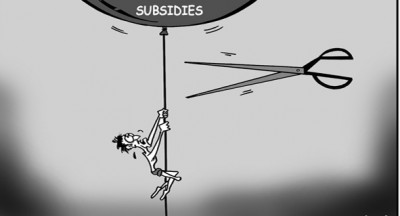
Time to Put an End, to the Renewables Scam!!! Aussies to Axe the RET!

Lost In Translation: How a CO2 Abatement Scheme Became “Corporate Welfare on Steroids”

subsidies

Time to remember the original aim of the RET
Australian Financial Review
Danny Price
21 August 2014

The RET was intended to cut carbon. Opening it up to more forms of efficient generation would help get that result.

The debate over the renewable energy target has ended up exactly where you would expect a debate on subsidies to end up. The beneficiaries of the subsidy are taking the high moral ground while those adversely affected by the subsidy are crying foul.

We see similar debates in the agricultural sector. Australian farmers complain they face unfair market conditions because the international farmers they compete with have the protection of subsidies, while our government provides none.

In this case, the coal-fired generators claim they are finding it hard to recover their costs on existing investments while the renewable generators who earn a subsidised return, claim their future investments are threatened.

Both arguments are founded on the same concept – investment certainty.

What has been lost in all this debate is the original objective of the RET. The renewable industry has focused on the benefits it brings to customers by suppressing the price coal and gas generators can charge customers. But as PJ O’Rourke once observed about the US health system, “If you think healthcare is expensive now, wait until you see what it costs when it’s free.” The economic costs of lowering the wholesale price charged by thermal generators by subsidising renewable generators will be enormous.

The renewable energy sector has cleverly confused the concepts of economic costs, which are the costs of the resources used to produce renewable energy, with prices. They do this to disguise the real cost impact of the RET on the economy and to make themselves a smaller political target.

RET never about pricing

The goal of the RET was never about suppressing prices, but this is now the cause célèbre of the renewable industry because they know this will appeal to politicians looking to reduce electricity price pressure. The RET was aimed at encouraging a reduction in greenhouse gas emissions by actively promoting the, then-fledgling renewable industry.

The debate about the RET really should be re-focused on how we can achieve our environmental targets most economically. If we can minimise the costs of reducing emissions, then it follows that we are more likely to reduce emissions further, which Australia will inevitably be pressured to do at the Paris round of climate negotiations in late 2015.

More recently the renewable generators claim they are now cost-competitive with thermal generators. While these claims are probably overstating the relative economics of the thermal versus renewable generation, there is certainly less need to continue to subsidise investors in renewable generators as the RET has done its job in developing a local renewable industry. It is now time for the renewable industry to face competition and this competition should lead to lower economic costs and lower consumer prices.

This could be achieved by progressively levelling the playing field between all potential sources of electricity supply and demand so that all technologies can compete to supply emissions reductions.

Recent analysis of the opportunity to reduce the economic costs and price impacts of the RET by making it more technologically neutral, for example by allowing gas generators to compete with renewable generators and create partial credits under the scheme to reflect emissions abated, has shown that this approach can simultaneously reduce the economic cost of the RET by more than $1 billion and reduce prices for customers by more than $50 a year. This cost could fall further if other forms of cleaner generation could also compete vigorously with gas and renewable generators.

Part of the reason that this cost and price reduction occurs is that it makes use of existing gas capacity that mostly sits idle that could compete with coal under a more technologically neutral RET. This approach of broadening the RET to allow a wider range of technologies to compete to supply emissions reductions, is one of those rare no-regrets policies.

Competitive pressure

If no technology is able to compete with the renewable technologies (for example due to the risk of rising gas prices) then the worst thing that would happen is that wind generators would continue to be built. The only complaint that the renewable industry could have against such a proposal is that they would be subject to more competitive pressure.

With lower costs and prices from such a transformation of the RET, the government could afford to leave the target where it is and rely on the transformed RET to do more work to contribute towards the achievement of Australia’s emissions reduction.

Unfortunately, the only beneficiaries from such a transformation of the RET are customers and the economy and, sadly, there is nobody to advocate for these stakeholders in the current RET debate.

Danny Price is managing director of Frontier Economics.
Australian Financial Review

When Danny Price says: “The economic costs of lowering the wholesale price charged by thermal generators by subsidising renewable generators will be enormous” he’s playing as the master of understatement.

As Liberal Member for Hume, Angus “the Enforcer” Taylor has repeatedly pointed out, the mandatory RET is nothing short of “corporate welfare on steroids” (see our posts here and here and here).

Putting aside the hidden costs of providing fossil fuel back up to cover the occasions when wind power output plummets every day – and for days on end (see our post here); putting aside the need for a duplicated network to carry wind power from the back blocks to urban markets (seeour post here); putting aside the cost of running highly inefficient Open Cycle Gas Turbines to cover wind power “outages” (see our post here), the cost of Renewable Energy Certificates and their bedmate – the mandated shortfall charge will add a minimum of $39 billion, and – if the price of RECs reaches $100 (as is forecast under the current RET of 41,000 GWh) – up to $60 billion, to power consumer’s bills over the next 17 years (see our post here).

As Danny Price points out, the original purpose of (and justification for) the mandatory RET was the cost-effective abatement of CO2 emissions in the electricity sector. So Australian power punters – lumped with the task of propping up near-bankrupt outfits like Infigen (aka Babcock & Brown) via the redirection of $40-60 billion of their hard-earned cash over the next 17 years – might reasonably ask just how much CO2 abatement “bang” they’re getting for those very considerable bucks?

It’s the very question that Danny Price has been grappling with over the last few months.

STT followers will be pleased to know that Danny Price hates intermittent, unreliable and insanely expensive wind power with a passion – and that he’s been tasked by the Coalition with coming up with a workable method of achieving least-cost CO2 abatement.

Danny’s mission is to amalgamate the entirely unsustainable REC Tax – filched from unwitting power consumers and directed to wind power outfits – into the Direct Action policy, under which an Australian Carbon Credit Unit (CCU) will be issued to anyone stumping up audited proof that they’ve reduced or abated 1 tonne of CO2. The CCU will be tradeable on international markets and the equivalent of European carbon credits, which trade around A$8. Under Danny’s plan, RECs will be replaced with CCUs – and the subsidy per MWh of wind power will plummet from a projected $100 to less than $10. For a run-down on the mechanics of Danny’s plan – see our post here.

While seeing their subsidy gravy train slashed by 90% might sound a little like “bad news” for wind power outfits, earning CCUs comes with a BIG catch: CCUs will ONLY be issued where there is credible proof that the applicant has reduced or abated CO2. For wind power outfits this means coming up with actual proof (not smoke and mirrors “modelling”) that they have in fact reduced CO2 emissions in the electricity sector.

As youngsters sceptical of their peers’ more ambitious pronouncements say: “well, good luck with that”.

The need for 100% of wind power capacity to be backed up 100% of the time by fossil fuel generation sources means that wind power cannot and will never reduce CO2 emissions in the electricity sector (see our postshere and here and here and here and here and here and here).

E.ON operates numerous transmission grids in Germany and, therefore, has the unenviable task of being forced to integrate the wildly fluctuating and unpredictable output from wind power generators, while trying to keep the German grid from collapsing (E.ON sets out a number of the headaches caused by intermittent wind power in the Summary of this paper at page 4). Dealing with the fantasy that wind power is an alternative to conventional generation sources, E.ON says:

“Wind energy is only able to replace traditional power stations to a limited extent. Their dependence on the prevailing wind conditions means that wind power has a limited load factor even when technically available. It is not possible to guarantee its use for the continual cover of electricity consumption. Consequently, traditional power stations with capacities equal to 90% of the installed wind power capacity must be permanently online [and burning fuel] in order to guarantee power supply at all times.”

STT is happy to go all out and say that in Australia wind power requires 100% of its capacity to be backed up 100% of the time by conventional generation sources. As just one recent example, on 3 consecutive days (20, 21 and 22 July 2014) the total output from all of the wind farms connected to the Eastern Grid (total capacity of 2,952 MW – and spread over 4 states, SA, Victoria, Tasmania and NSW) was a derisory 20 MW (or 0.67% of installed capacity) for hours on end (see our post here). The 99.33% of wind power output that went AWOL for hours (at various times, 3 days straight) was, instead, all supplied by conventional generators; the vast bulk of which came from coal and gas generators, with the balance coming from hydro generators.

For wind power to reduce CO2 emissions in the electricity sector it has be a true “substitute” for conventional generation sources. Because it can’t be delivered “on-demand” (can’t be stored) and is only “available” at crazy, random intervals (if at all) wind power will never be a substitute for conventional generation sources (see our post here). Accordingly, wind power is simply incapable of reducing CO2 emissions in the electricity sector

The wind industry has never produced a shred of evidence to show that wind power has reduced CO2 emissions in Australia’s electricity sector. To the contrary of wind industry claims, the result of trying to incorporate wind power into a coal/gas fired grid is increased CO2 emissions (see thisEuropean paper here; this Irish paper here; this English paper here; thisAmerican article and this Dutch study here).

STT hears that Danny Price is well and truly alive to all that.

With Tony Abbott about to go on the offensive in his quest to wind up the mandatory RET (expect to hear more from the PM this week) the wind industry’s wild and unsubstantiated claims about CO2 abatement in the electricity sector provide the PM with just another reason to bring the greatest environmental and economic fraud of all time to a shuddering halt.

DannyPrice_banner1

Here is a list of Companies Making Huge Profits, From the Physical, and Financial Fallout, Caused by Wind Turbines


CanWEA Members 2014*
 
 
3M Canada Company
 
ABB Inc.
 
Acciona Wind Energy Canada
 
Activa Environnement Inc
 
Aeolis Wind Power Corp.
 
Aercoustics Engineering Ltd.
 
Aird & Berlis LLP
 
Airway Services Canada
 
Alberta Wind Energy Corporation
 
Algonquin Power
 
ALL Canada Crane Rental Corp.
 
Alstom Power
 
AltaGas Ltd.
 
Alterra Power Corp.
 
Altus Group
 
AMEC Black & McDonald
 
American Wire Group
 
AMSOIL INC.
 
Anemos Energy Corporation
 
Ascent Solutions Inc.
 
ATCO Power
 
Atlantic Power
 
Automodular Corporation
 
Avanti Wind Systems Inc.
 
Avertex Utility Solutions Inc.
 
Avro Wind Energy Inc.
 
AWS Truepower LLC
 
Barnhart Canada LLC
 
BASF Canada
 
BBA Inc.
 
Bellemare Groupe
 
Benign Energy Canada Inc.
 
Bennett Jones LLP
 
BGB Technology Inc.
 
Black River Wind Ltd.
 
Blake, Cassels & Graydon LLP
 
Blattner Energy Inc.
 
BluEarth Renewables Inc.
 
Boralex Inc.
 
Borden Ladner Gervais LLP
 
Borea Construction
 
BowArk Energy Ltd.
 
Brookfield Renewable Energy Group
 
Brüel & Kjær Vibro
 
Bullfrog Power Inc.
 
Burndy Canada Inc.
 
BZEE Academy GmbH
 
C.H. Robinson Project Logistics Ltd.
 
Callon Dietz
 
Campbell Scientific (Canada) Corp.
 
CanACRE
 
Canadian Clean Energy Conferences
 
Canadian Copper & Brass Development Association
 
Canadian German Chamber of Industry and Commerce
 
Capital City Renewables LLC
 
Capital Power Corp.
 
Capstone Infrastructure
 
Carleton University
 
Carlsun Energy Solutions Inc.
 
Cartier Energie Eolienne Inc.
 
Challenger Motor Freight Inc.
 
Chinodin Wind Power
 
Chinook Power Corp.
 
Clark Wilson LLP
 
Consulate General of Argentina in Toronto
 
CSA International
 
CSS Wind Inc.
 
Curry & Kerlinger LLC
 
Customized Energy Solutions
 
Dale & Lessmann LLP
 
Dentons Canada LLP
 
DESSAU
 
Dialight Corporation
 
Dillon Consulting Ltd.
 
DNV GL
 
DP Energy Ireland Ltd.
 
E.ON Climate & Renewables Ltd.
 
EBC Inc.
 
EchoTrack Inc.
 
EDF EN Canada
 
EDP Renewables Canada Ltd.
 
Elemental Energy Inc.
 
Elevator One
 
Elexco Ltd.
 
EMA Electromechanics
 
Emera Inc.
 
Enbridge Inc.
 
Enel Green Power Canada Inc.
 
ENERCON
 
Enerfin Energy Company of Canada Inc.
 
Enmax Corporation
 
Enterprise Commercial Truck
 
Eolectric Inc.
 
Eon WindElectric Inc.
 
EPTCON / One Line Engineering
 
Ernst & Young
 
ESAC Inc.
 
Essar Steel Algoma
 
Exelon Wind, a Division of Exelon Power
 
F Rohmann
 
Fabrication Delta
 
Firelight Infrastructure Partners
 
Flash Technology
 
Fri-El Green Power
 
Fritz Construction Services Inc.
 
G Seven Generations Ltd.
 
G&W Electric Co.
 
Gamesa Technology Corporation
 
GasTOPS Ltd.
 
Gaz Metro
 
GDF SUEZ Canada Inc.
 
GE Power & Water
 
Gilead Power
 
Golder Associates Ltd.
 
Goldwind USA Inc.
 
Gowling Lafleur Henderson LLP
 
Graham Infrastructure Ltd.
 
Grand Valley Wind Farms Inc.
 
GRANT THORNTON LLP
 
Graybar Energy Ltd.
 
Greengate Power Corporation
 
Greenwind Global Inc
 
Groupe Delom Inc.
 
Groupe Robert
 
H.B. White Canada Corp.
 
Hatch Energy
 
Heenan Blaikie LLP
 
Hemmera
 
Hempel (Canada) Inc.
 
Henkels & McCoy Canada Inc.
 
HGC Engineering
 
Holland College
 
Honeywell Safety Products
 
Horizon Legacy Energy Corp.
 
Hydro One Networks
 
Hydro Quebec Distribution
 
Hytorc Ontario
 
IBI Group
 
Innergex Renewable Energy Inc.
 
Inspec-Sol Inc.
 
International Tower Lighting LLC
 
Invenergy Canada LLC
 
IPS Trico
 
Jones Group Engineering Ltd.
 
Joss Wind Power Inc.
 
Juwi Wind Canada Ltd.
 
K-Line Maintenance & Construction Ltd.
 
Knight Piesold
 
KPMG
 
Kruger Energy Inc.
 
Lafarge Canada Inc.
 
Lahave Renewables Inc.
 
Landstar Transportation Logistics
 
Lapp Canada
 
Le Groupe Ohmega Inc.
 
Leader Resources Services Corp.
 
LEITWIND
 
Lethbridge College
 
Lincoln Electric Company of Canada
 
Local Content Assurance Bureau
 
Longyuan Canada Renewables Ltd.
 
Mammoet Canada Western Ltd.
 
Manitoba Hydro
 
Manulife Financial
 
Maritime Electric Company Ltd.
 
Marmen Inc.
 
Mastec Renewables Construction, LTD
 
McCann Equipment Ltd.
 
McCarthy Tetrault LLP
 
McElhanney Land Surveys Ltd.
 
Michels Canada
 
Miller Thomson LLP
 
Moloney Electric Inc.
 
Morgan AM&T
 
Mortenson Construction
 
Motion Industries (Canada) Inc.
 
Moventas Ltd.
 
Myshak Crane & Rigging Ltd
 
Nalcor Energy
 
Natural Forces Wind Inc.
 
Natural Resource Solutions Inc.
 
NaturEner Canada Inc.
 
NB Power
 
NCSG Crane & Heavy Haul Services
 
Neoen North America
 
NextEra Energy Canada Development and Acquisitions, Inc.
 
Niagara Region Wind Corporation
 
Northern Lights College
 
Northland Power Inc.
 
Northwind Solutions
 
Norton Rose Fulbright Canada LLP
 
Olympus
 
Ontario Sustainable Energy Association
 
ORTECH Consulting Inc.
 
Osler, Hoskin & Harcourt LLP
 
Pattern Renewable Holdings Canada ULC
 
PCL Constructors Canada Inc.
 
PESCA Environnement
 
Power Climber Wind
 
PowerTel Utilities Contractors Ltd.
 
Prowind Canada Inc.
 
PSB Securite
 
R.J. Burnside & Associates Ltd.
 
R360 WIND INC. (A JR Group Company)
 
Rabobank
 
Rankin Construction Inc.
 
Regional Power
 
Renewable Energy Systems Canada Inc.
 
Renewable NRG Systems
 
Rigarus Construction Inc.
 
Rittal Systems Ltd.
 
Rodan Energy Solutions
 
Rombro Solar Energy Inc.
 
Rope Partner Canada, Inc.
 
Royal & Sun Alliance Insurance Co.
 
Run Energy
 
RWDI
 
S&C Electric Canada Ltd.
 
Samsung Renewable Energy Inc.
 
Samuel Son & Co. Ltd.
 
Saskatchewan Research Council
 
SaskPower
 
Saturn Power Inc.
 
Schaeffler Canada Inc.
 
Schneider Electric Canada Inc.
 
Schunk Graphite Technology
 
Scotian WindFields
 
Sea Breeze Power Corp.
 
Second Wind Inc.
 
Select Elevator Solutions Inc.
 
Sentrex Wind Services Inc.
 
Sentry Electrical (Canada) Inc.
 
Senvion Canada Inc.
 
SgurrEnergy Ltd.
 
Shell Canada Ltd.
 
Shermco Industries
 
Sherwood Electromotion Inc.
 
Siemens Canada Limited
 
Signal Energy Constructors
 
Sika Canada Inc.
 
SNC-Lavalin Environnement Inc.
 
Solas Energy Consulting Inc.
 
Spirit Pine Energy Corporation
 
SPX Hydraulic Technologies
 
Stantec
 
Stikeman Elliott LLP
 
Stoel Rives LLP
 
Stonebridge Financial Corporation
 
Suncor Energy Services Inc.
 
Surespan Wind Energy Services
 
Sussex Strategy Group
 
Suzlon Wind Energy Corporation
 
Synergy Cables USA Ltd.
 
Synergy Land Services Ltd.
 
TE CONNECTIVITY
 
TEAM-1 Academy
 
TechnoCentre Eolien
 
Technostrobe
 
Telecon Inc.
 
Terrafix Geosynthetics Inc.
 
Tetra Tech
 
Thomas & Betts Canada
 
Thunder Bay Port Authority
 
TimberWest Forest Corp.
 
Toronto Hydro Corporation
 
Torys LLP
 
TransAlta Corporation
 
TransCanada Energy Ltd.
 
Tribute Resources Inc.
 
TSP Canada Towers Inc.
 
Tulloch Engineering Inc.
 
TWR Lighting Inc.
 
Ultra Torq Hydraulic Bolting
 
Unirope Ltd.
 
Valard Construction
 
Vestas Canada
 
Virelec Ltd
 
WEB Wind Energy North America Inc.
 
Westburne
 
Williams Form Hardware & Rockbolt
 
Wind Dynamics Inc.
 
Wind Energy Institute of Canada
 
Wind Power Inc.
 
Wind Simplicity Inc.
 
Wind Systems Magazine
 
WindAxis
 
Winergy Drive System Corporation
 
Woodward Inc.
 
wpd Canada
 
WSP Canada Inc.
 
Zephyr North Ltd.


Sherri Lange Appeals to the Auditor General to Audit the Disastrous GEA

Canada’s Wind Power Disaster Laid Bare

Ontario april-28-protest-rally-3

Ontario is about to boil over, as impacted and threatened communities unite in seething rage at what their political betters have done to energy policy (see our post here).

The hard-green-left Liberals have created a wind power policy so insane as to beggar belief: sending power prices through the roof (referred to as “hydro bills”, as the bulk of their energy comes from hydro power); killing hundreds of thousands of real jobs; and destroying the lives of thousands of hard-working rural people, who’ve been left to endure a swathe of giant fans speared into the heart of the most productive agricultural country in Canada, rendering hundreds of perfectly good family homes uninhabitable.

One of those taking up the fight is Sherri Lange, who heads up the NA-PAW (North American Platform Against Wind Power), is the Founding Director Toronto Wind Action, the Executive Director Canada, Great Lakes Wind Truth and is the VP Canada, Save the Eagles International.

In this brilliant letter to Ontario’s Auditor General, Sherri lays out the disaster that is wind power in Canada and details the scale and scope of the greatest economic and environmental fraud of all time.

Ms. Bonnie Lysyk
Auditor General for Ontario
20 Dundas Street West, Suite 1530
Toronto
M5G 2C2
Fax 416 327 9862
August 11, 2014

Dear Ms Lysyk,

Please consider this letter as an urgent formal request for a complete and impartial audit for all matters pertaining to the Green Energy and Green Economy Act, 2009, and its false assertions and negative results for Ontario: these misrepresentations include vigorous job creation, suggested cleaner air space, the ability to create energy facilities, wind and solar, in particular, in a cost savings manner, or competitive manner.

The Green Energy and Green Economy Act has suggested with not a little hyperbole, that it will “spark” growth in “renewables sources in Ontario, while creating savings, and producing 50,000 jobs, direct and indirect,” and “make a positive contribution towards climate change objectives,” whereas in fact the GEA threatens to eviscerate the economy of Ontario and Canada as a whole. The factual results of the GEA are of economic chaos, massive job losses, environmental degradation of the highest order, a decay of our treasured environmental protections in law, and yet uncounted human health and productivity costs.

Under the guise of positive net growth, and climate change objectives, this Act has been used to gouge and tyrannize the province, materially and economically.

We believe that the mandate of the Auditor General to provide access to “value for money” data, within an audit, will provide even more information with respect to the waste and perhaps fraud at the highest levels; consumers are indeed not being provided with fair business practices, but are continually subjected to even more egregious attacks in their daily “energy expensive” lives due to a battered and debt ridden economy.

Jobs continue to leave Ontario. Some are relocating to Buffalo, to save, in one instance, $4 million per year in energy savings, or to Saskatchewan, for example. The bleed of jobs cannot continue, and we believe that an assertive and clear look at the funding and economic threat of the Green Energy Act will bear striking similarities to the international failure of wind power and Green Energy policies. Even information provided years ago by your office and the Fraser Institute did nothing to change the course.

We contend that none of the GEA assertions and projections have proven valid, and have in fact been a major contributor, likely THE major contributor, to the near demise of manufacturing in Ontario, to energy poverty for many Ontarians whose hydro bills have risen 30-40% with promises of more hikes, to the loss of jobs to the USA and western Canada, to the ill health of hundreds of Ontarians, some of whom have been forced to abandon homes, or been bought out by developers, or who reside in parking lots at Walmart, or at cottages, or with relatives. The energy chaos of Ontario now handily competes with that of Spain, Germany, or the UK.

All of this should be and should have been preventable, since the facts are well known. Indeed, the facts of the Green Energy failures of Europe should have been a lesson learned before this Ontario failure of a massive scale. (Ontario now has the unenviable position of having the highest cost of power in North America. The significance of this is not lost on Moody’s Credit Ratings system, with the threat of downgrades to Ontario.) The lessons of Europe have been put before the Legislature, all parties, on many occasions, without benefit or improvement.

The Fraser report of 2013 has already indicated that the assertions of the GEA are egregiously false.

“Already, the GEA has caused major price increases for large energy consumers, and we’re anticipating additional hikes of 40 to 50 per cent over the next few years,” said Ross McKitrick, Fraser Institute senior fellow and author of Environmental and Economic Consequences of Ontario’s Green Energy Act.”

“The Ontario government defends the GEA by referring to a confidential 2005 cost-benefit analysis on reducing air pollution from power plants. That report did not recommend pursuing wind or solar power; instead it looked at conventional pollution control methods which would have yielded the same environmental benefits as the GEA, but at a tenth of the current cost. If the province sticks to its targets for expanding renewables, the GEA will end up being 70 times costlier than the alternative, with no greater benefits.” (News release, April 2013)

The study goes on to indicate that returns to investment in manufacturingare “likely to decline by 29 per cent, mining by 13 per cent, and forestry by less than one per cent.”

Professor McKitrick explains in his report that wind is especially wasteful, as surplus generation occurs generally when demand is low, and the resulting “dumping” also results in net losses to Ontario.

“The Auditor General of Ontario estimates that the province has already lost close to $2 billion on surplus wind exports, and figures from the electricity grid operator show the ongoing losses are $200 million annually”, says the report.

Terrance Corcoran in the Financial Post quotes from the Auditor’s report that the cost of power is estimated to rise again another 46% in the next four years. In his analysis of the Auditor General’s 2011 report on electricity, Mr. Corcoran writes of “wilful negligence” and a “high level of fiscal negligence and abuse of process and disdain for taxpayers and electricity consumers.”

The Fraser report of 2013 has already indicated that the assertions of the GEA are egregiously false.

“Already, the GEA has caused major price increases for large energy consumers, and we’re anticipating additional hikes of 40 to 50 per cent over the next few years,” said Ross McKitrick, Fraser Institute senior fellow and author of Environmental and Economic Consequences of Ontario’s Green Energy Act.”

“The Ontario government defends the GEA by referring to a confidential 2005 cost-benefit analysis on reducing air pollution from power plants. That report did not recommend pursuing wind or solar power; instead it looked at conventional pollution control methods which would have yielded the same environmental benefits as the GEA, but at a tenth of the current cost. If the province sticks to its targets for expanding renewables, the GEA will end up being 70 times costlier than the alternative, with no greater benefits.” (News release, April 2013)

The study goes on to indicate that returns to investment in manufacturing are “likely to decline by 29 per cent, mining by 13 per cent, and forestry by less than one per cent.”

Professor McKitrick explains in his report that wind is especially wasteful, as surplus generation occurs generally when demand is low, and the resulting “dumping” also results in net losses to Ontario.

“The Auditor General of Ontario estimates that the province has already lost close to $2 billion on surplus wind exports, and figures from the electricity grid operator show the ongoing losses are $200 million annually”, says the report.

Terrance Corcoran in the Financial Post quotes from the Auditor’s report that the cost of power is estimated to rise again another 46% in the next four years. In his analysis of the Auditor General’s 2011 report on electricity, Mr. Corcoran writes of “wilful negligence” and a “high level of fiscal negligence and abuse of process and disdain for taxpayers and electricity consumers.”

A prime example of the negative impact on the Ontario jobs situation is reflected in Magna’s (the largest automotive parts manufacturer in Canada) announcement that due to the high cost of electricity in Ontario, it will not make any further investments. (Specifically, for Magna between 2013 and 2014, normal business activities resulted in an increased cost of electricity of 30 million dollars.)

The expressed primary purpose of the 2011 audit was to ensure that the OEB had sufficient and adequate systems in place to protect consumers, ratepayers. As noted also in the report, consumers are protected under the Energy Consumer Protection Act, 2010, and that under this legislation consumers shall be provided with the information they require about contracts, prices, and that they will be protected by fair business practices. This fairness has not been brought to fruition.

And the serial negligence continuing until this day, despite hearty and clear directives from the Fraser Institute and your office, has resulted merely in the advance of even more industrial wind in Ontario under Premier Wynne. Consumers are indeed not being increasingly protected, and continue to be recklessly thrown under the fiscal bus.

What we find most egregious is that the people of Ontario have warned the Premier(s) McGuinty and Wynne, and made reports to the Finance Committee, as well as reporting to these offices the results of energy chaos in Germany, Spain, the UK as well as other European states previously under the spell of “renewables.” (Please note the letter to the Editor, Financial Post, March 3, 2011: “No such thing as renewable energy.”) These abject economic failures in Europe should have provided clear warning of the folly of subsidizing inefficient non base load sources of power, particularly wind turbines.

The government and lobbying association CanWEA’s (Canadian Wind Energy Association) assertion that the wind turbine industry operates safely and without damage to human health is false and must also be examined, since the reports of ill health given to the MOE (Environment) now number in the thousands. The MOE (Ministry of the Environment) has recognized the problem, and admitted in an email obtained from an FOI that they “did not know what to do.” The costs of wind power to our medical system and human productivity have not yet been accounted for.

We remind you that with about 240,000 wind turbines worldwide, we yet only receive one half of one percent, NET ZERO, of our power needs from this source. This industry is a failure, plain and simple; does the build out then have something to do with massive subsidies deep in the pockets of developers? Who is receiving these massive double or quadruple profits?

We would like to see a chart of the major beneficiaries of the FIT program in Ontario. In Spain, the profits have been so tidy, that the Government recently asked for some retroactive repayments, understandably chilling the wind developers’ aspirations. (The lineup of crimes against consumers continues in Ontario: with 86% of Ontario’s wind power being produced on days when we are already in a surplus export mode. Another net loss for consumers is obvious.)

Please also include an environmental impacts costs study in your findings. The extreme damage to water tables, prime farm land, general ecological tragedies and killing of wildlife, has an external cost factor as well, to be borne, sadly, by our future generations.

Mr. Geoffrey Cox, a UK Conservative MP, expressed his disgust for the “gigantic machines” which are terrorizing his country:

“The reality is there is a Klondike-type gold-rush going on in rural areas where developers are anxious to get their applications through to pick up the vast profits that can be made.

“This is having a disruptive, devastating and distressing effect on dozens of small rural communities that are being torn apart by these huge industrial machines that are just yards away from their home.

“The number of applications seems to be going up rather than receding. What is going on is a stealthy, silent revolution of the most beautiful landscapes in Great Britain. “If we carry on we will have ruined this most extraordinary inheritance.”

SNAPSHOT
What we know

  • Industrial wind turbines are inefficient and pitiably useless
  • Industrial wind installations, factories, create energy sprawl and high levels of environmental pollution and toxic waste
  • Industrial wind does not work when we need it to and over performs at times to the extent that developers are sometimes paid to NOT produce
  • Huge subsidies support the industry, without which, the industry does not survive
  • The GEA suppresses all democratic opposition to wind and solar power, and the cards are stacked in favor of preferred accelerated promotion of wind turbines at the expense of Municipal and community cohesion and preferences
  • Massive amounts of base load back up power are always required; there is zero reduction in GHG’s
  • The industry (lobby) gets to sit at the table with policy makers and lay the table for the feast
  • There has been no reasonable or realistic or honest explanation for the massive outlay of wind turbines in Ontario
  • Energy poverty is abundant now in Ontario, along with massive job losses and gutting of the public purse
  • Lessons from Europe are not being acknowledged
  • IS THIS CRIMINAL NEGLIGENCE?

We look forward to your prompt reply and a rapid advancement into an impartial audit of these matters in their complete impacts on Ontario, on the economy, and on fairness, or in this case, unfairness, to each consumer and job seeker. It will be extremely useful to untangle some of the Byzantine financial and undemocratic policy arrangements that have led to this “made in Ontario” crisis. We must immediately stop this re-creation of the catastrophic results of Green Energy failures in Europe.

Please conduct an impartial and in depth assessment of all financial matters pertaining to the GEA and relay these findings to the people of Ontario at your earliest convenience. We anticipate that your report might reflect also on the medical costs to Ontario families, the loss of economic vibrancy and stability of rural Ontario which continues to bear the assault fully on its shoulders, the loss of tourism, and the loss of property values, which also contribute to economic stagnancy. Please also conduct a study on a trace of the profits to developers, kWh by kWh, if possible. We have a right to know where our hydro dollars are going.

The high octane waste of the “Green Energy and Green Economy Act”, which has been repeatedly explained to legislators, must cease immediately. It must also be retroactively remediated. Your office has the ability to further outline to the Government not only how it may alter course, but how it must immediately repair.

(We will be writing under separate cover to Commissioner Hawkes, as we fully believe the waste and apparent fraud of the GEA far overpowers the ORNGE, E-Health, and Gas Plant scandals.)

Thanking you in advance,
Sherri Lange
CEO NA-PAW (North American Platform Against Wind Power)
Founding Director Toronto Wind Action
Executive Director Canada, Great Lakes Wind Truth
VP Canada, Save the Eagles International
www.na-paw.org

C.c. Vince Hawkes, Commissioner of the OPP
C.c. Honorable Joe Oliver, MP and Minister of Finance, Canada
C.c. Interested parties

sherriwithwildasterspp

A Wonderful Initiative, that Deserves Our Support! Excellent Educational Tool!

TREES, NOT TURBINES!

Thank you Very Much Paul Kuster

 & Laura Griffin, for coming up with,

 and promoting, this wonderful idea!


TREES NOT TURBINES INITIATIVE

There’s no question that over the past 2 decades, there’s been a

heightened awareness for the environment. One of the more important

areas is how we obtain electricity. One of the proposals has been in the

form of Industrial wind turbines.  We feel there’s a better way to answer

the question of how to retain a reasonable quality of life with a view to

enhancing the environment that we could all mutually benefit. We feel trees

are the answer and wherever you may reside, you can participate.

Here are some of the reasons trees are a superior way to enhance the

environment over industrial wind turbines;

  • Trees absorb CO2 and release O2. An acre ( .405 hectares) of trees
  • will absorb enough CO2 to offset a city driven car for a year, while
  • producing enough O2 for 18 people per day. IWT’s can do neither.
  • IWT’s have a large initial carbon footprint before becoming operable.
  • Trees start their work right away with no initial carbon footprint.
  • IWT’s have within their components, many detrimental compounds
  • detrimental to the environment. Turbine blades contain bisphenol A,
  • a known carcinogen and the hubs contain gear oil that has high levels
  • of mercury. Trees, of course, are without these issues.
  • Trees are superior to IWT’s when it comes to preventing erosion,
  • providing shade, providing habitat for birds and attracting many other
  • forms of wildlife. IWT’s in fact enhance erosion, kill bats and birds and
  • provide no attraction to wildlife.
  • IWT’s are infinitely more costly than trees, trees require no electricity
  • to operate and are for the most part, maintenance free. Trees have
  • proven to enhance property values and provide years of enjoyment no
  • matter if you live in a rural or urban environment.
  • IWT’s require to work in tandem with other power generators. While
  • we’ve essentially eliminated coal as a source of generation, gas plants
  • have come on line to replace coal and to act to back-up wind generation.
  • In order to do this, gas plants run in the most inefficient way possible and
  • in the final tally don’t substantially reduce emissions at all. Trees of course
  • require no gas plant backup and can help reduce heating and cooling costs.

     We listed here just a few of the benefits of trees. We can replace IWT’s with trees

                 and accomplish our goals for a better environment.

                                 This is the REAL green movement.


More Physical and Financial Damage, Caused by Wind Turbines…

FOR IMMEDIATE RELEASE
July 10th 2014

… and kill another small business


The Danish press reports the case of a garden centre going out of business because of nearby wind turbines. Headaches are frequent among employees, and female workers complain of unusual bleeding and problems with their menstruation cycles. They are worried that more serious illnesses may follow and five of them recently resigned from their jobs. The owner is now closing shop for fear of being held responsible should a child be born with deformities, as happened to numerous mink puppies at a fur farm near wind turbines in Jutland (1).


Boye Jensen, the owner of Lammefjordens Perennials, is 67-year-old. He started his plant nursery 43 years ago, and it became a prosperous business with 15 employees and annual sales of 12 million krones (equiv. $ 2.1 million). He was planning to continue working for another 6-7 years, then sell the nursery. But his business is now worth nothing, causing him an important financial prejudice.


He is presently consulting with his lawyer whether he should sue Vattenfal, the company that owns the wind turbines, or the Municipality of Holbaek, which approved their installation 400-700 metres from his garden centre. He will go to court, and seek damages worth several million krones.


Himself a neighbour to 127-metre high wind turbines since their installation three years ago, Boye Jensen has long been convinced that low frequency noise emitted by the turbines makes people ill as they do animals” (2). Then, recently, the sorry news from Kaj Bank Olesen’s mink farm came to his ears (1). This, and the resignation of several of his employees for health reasons, made him realise his business had become unviable because of the wind turbines. “The nursery owner made this hard decision after a mink breeder in Jutland was able to establish a causal link between the loss of a third of his mink puppies, deformed or stillborn, and several giant wind turbines erected nearby” (2).


The story made the news in Denmark (2) (3), and Member of Parliament Karina Adsbøl expressed her concerns to the Minister of Health at a Parliamentary hearing. The Minister, typically, replied by addressing other, less important issues mentioned by the MP, and ignored the important ones, i.e. wind turbines causing birth defects in animals forced to live near them, and disrupting women’s menstruation cycles (4).


The World Council for Nature (WCFN) is calling attention to the fact that, as occurred for tobacco, asbestos, thalidomide etc, governments are siding with private financial interests in ignoring or denying the existence of obvious health problems linked to wind turbines. As is the case for the millions of birds and bats killed yearly by the turbines’ blades, mendacious studies are published by unscrupulous consultants, and by professionals and universities happy to oblige their benefactors. Hypocrisy is rampant, species are fast disappearing from our skies, and thousands of windfarm neighbours are being submitted to torture. The word is not an exaggeration: sleep deprivation is indeed a recognised form of torture.


In Denmark as elsewhere in the world, many country dwellers are suffering, particularly since the apparition of the mega turbines (1 MW and over), which emit more infrasound as they grow bigger. This may explain why the complaints are becoming more strident. But how much longer can this suffering be ignored, or even denied by health authorities? Some countries, like Canada or Australia, have commissioned studies into the matter of noise emitted by windfarms. But the studies’ scope and methodology condemn them to failure, perhaps intentionally. What is really needed is:
1) an epidemiological study, and
2) the measurement of low frequency sound (including infrasound down to 0.1 Hz), inside the homes of windfarm victims, at night, windows closed, when the wind is blowing from the direction that is causing problem.


Most importantly, as a precaution, no mega turbines should be erected less than 10 km from habitations until such time as these studies are completed, published and analysed. There is indeed compelling evidence that infrasound travels much further than other sounds, and tortures sensitive people in their homes at distances of 10 km and more. Shorter distances could be temporarily set for smaller turbines, in proportion with their generating capacity.


WCFN calls upon the Danish government to intervene in favour of victims. A wealth of evidence is available, including peer-reviewed studies, which warrants applying the precautionary principle without delay (5). Children are particularly at risk – even unborn ones, as suggested by the evidence presented in this release.


WCFN’s primary goal is the conservation of biodiversity. A sane and responsible human population is the single most important factor towards that end. Our interest in human health is therefore justified from a logical perspective, among others.


A letter is being addressed to the Danish government concurrently.


Mark Duchamp +34 693 643 736+34 693 643 736
Chairman, World Council for Nature
http://www.wcfn.org


References:


(1) – Kaj Bank Olesen’s mink farm: stillbirths and deformities:

http://wcfn.org/2014/06/07/windfarms-1600-miscarriages/


(2) – Translation of the article from the Nordvestnyt (North West News) on the closure of the garden center:

http://wcfn.org/documents/wind-turbines-affect-menstruation-danish-press/


(3) – Garden centre story mentioned in one of Denmark’s leading newswpaper, Jyllands-Posten (the Jutland Post):

http://jyllands-posten.dk/opinion/breve/ECE6846968/mink-som-forsoegsdyr/


(4) – Video: a Member of Parliament, Karina Adsbøl, addresses her concerns to the Minister of Health, mentioning the deformities at the mink farm and the menstruation problems at the garden center:

http://wcfn.org/documents/windfarms-affect-menstruation-danish-parliament/


(5) – Waubra Foundation:

http://waubrafoundation.org.au/


The Wind Developers should be Jumping at the Chance, to Make Reparations, for What They are Doing to Residents.

3rd time posting due to it being deleted.

Please all victim’s join Victim’s of Industrial Wind here on Facebook.

We would like to thank First Wind and all of their supporters for making our home a living hell. Trying to sit outside on a nice night enjoy a little bonfire, not happening. Hard to enjoy anything while sitting in that obnoxious noise, you just get angrier and angrier as you are pelted by this unnatural sound.

First Wind, kindly do the right thing. Buy us out at a reasonable price so we can find a new home that is not a crap hole. For the pittance you may be willing to part with wouldn’t be enough to get us into much more that a trailer rental. We only asked for $150,000. …….. pocket change to you folks, what is the problem? 
You have already set precedent when you bought out Mary Ellen Jones in New York. You gave her fair market value, moving expenses and she did not have to sign a non disclosure gag order. Just do what is right.


3 MW Wind Turbines a Threat to Rural Village of Cesme

Nina Pierpont Warns Against An Entirely Avoidable Turkish Wind Farm Disaster

Calvin-Nina001

NINA PIERPONT, M.D., Ph.D.

June 30, 2014
Ms. Esen Fatma Cesme Belediyesi (Municipality)
İnönü Mah. 2001 Sk. No: 2 Çeşme / İZMİR
Turkey

Dear Ms. Kabadayi-Whiting,

I write to you at the request of Madeleine Kura, who tells me the charming, historical town of Cesme is about to have half a dozen 3 MW industrial wind turbines built on the edge of town, a mere 500 m from people’s homes. (I’m told that at least one of the turbines will be 300 m from a school.) Furthermore, all this construction will be in hilly terrain.

Let me explain, clinically, why this is a bad idea. In 2009 I published what was then the definitive study of health effects caused by wind turbine infrasound on people living within 2 km of industrial turbines. The book, “Wind Turbine Syndrome: A Report on a Natural Experiment” (K-Selected Books), included 60 pages of raw data in the form of case histories (using case cross-over studies), demonstrating that living in proximity to wind turbines dys-regulates the inner ear vestibular organs controlling balance, position, and spatial awareness. Effectively, sufferers experience symptoms of sea-sickness, along with several related pathologies.

It turns out all this has been well known since the 1980s, when the US Department of Energy commissioned a report on wind turbine health effects — the report subsequently published by physicist Dr. N D Kelley and his colleagues at the Solar Research Institute in Golden, Colorado, bearing the title, “A Methodology for Assessment of Wind Turbine Noise Generation,” Transactions of the American Society of Mechanical Engineers, v. 104 (May 1982), pp. 112-120.

In this paper we have presented evidence to support the hypothesis that one of the major causal agents responsible for the annoyance of nearby residents by wind turbine noise is the excitation of highly resonant structural and air volume modes by the coherent, low-frequency sound radiated by large wind turbines.

Further, there is evidence that the strong resonances found in the acoustic pressure field within rooms [in people’s homes] . . . indicates a coupling of sub-audible energy [infrasound] to human body resonances at 5, 12, and 17-25 Hz, resulting in a sensation of whole-body vibration (p. 120).

I discovered the same thing in my research. What Kelly et al. refer to as a “sensation of whole-body vibration,” I refer to as Visceral Vibratory Vestibular Disturbance (VVVD): “The internal quivering, vibration, or pulsation and the associated complex of agitation, anxiety, alarm, irritability, tachycardia, nausea, and sleep disturbance together make up what I refer to as Visceral Vibratory Vestibular Disturbance (VVVD)” (“Wind Turbine Syndrome,” p. 59).

Five years later, Dr. Kelley gave a follow-up paper at the Windpower ‘87 Conference & Exposition in San Francisco, titled “A Proposed Metric for Assessing the Potential of Community Annoyance from Wind Turbine Low-Frequency Noise Emissions.” Just so you understand the terminology, “emissions” means “noise & vibration.” And the term “low frequency” includes infrasound. And the antiseptic phrase “community annoyance” is code for Wind Turbine Syndrome — except the name had not been coined in1987. (I created it decades later.) Kelley’s research once again had been funded by the US Department of Energy, Contract No. DE-AC02-83CH10093.

We electronically simulated three interior environments resulting from low-frequency acoustical loads radiated from both individual turbines and groups of upwind and downwind turbines. . . .

Experience with wind turbines has shown that it is possible . . . for low-frequency acoustic noise radiated from the turbine rotor to interact with residential structures of nearby communities and annoy the occupants. . . .

The modern wind turbine radiates its peak sound power (energy) in the very low frequency range, typically between 1 and 10 Hz [i.e., infrasound]. . . .

Our experience with the low-frequency noise emissions from a single, 2 MW MOD-1 wind turbine demonstrated that . . . it was possible to cause annoyance within homes in the surrounding community with relatively low levels of LF-range [low frequency range] acoustic noise. An extensive investigation of the MOD-1 situation revealed that this annoyance was the result of a coupling of the turbine’s impulsive low-frequency acoustic energy into the structures of some of the surrounding homes. This often created an annoyance environment that was frequently confined to within the home itself (p. 1, emphasis in original).

I am attaching a copy of Kelley’s 1987 paper.

Besides my research, which pretty much duplicates Kelley’s, there is the work of Dr. Alec Salt, Professor of Otolaryngology in the School of Medicine at Washington University (St. Louis, Missouri), where he is director of the Cochlear Fluids Research Laboratory. Professor Salt is a highly respected neuro-physiologist specializing in inner ear disorders and in particular the mysteries of the cochlea.

Prof. Salt’s research dovetails with mine and with Dr. Kelley’s. For many years, acousticians and noise engineers have vigorously maintained that “if you can’t hear it, it can’t hurt you.” That is to say in the case of wind turbines, “If you can’t hear the low-frequency noise in the infrasound range, it can’t hurt you.” (lnfrasound, by definition, is noise below the hearing threshold, typically pegged at 20 Hz and lower. People feel infrasound in various parts of the body, though typically they cannot hear it.) In any case, Professor Salt and his colleagues have demonstrated conclusively, definitively, that infrasound does in fact disturb the very fine hair cells of the cochlea.

With this discovery, one of the main arguments advanced by the wind energy industry — namely, that wind turbine infrasound was too low to be harmful to people, since they could not hear it — was demolished. Prof. Salt has proven that, “If you can’t hear it, it can still harm you.”

This past winter, Professor Salt and his colleague, Professor Lichtenhan, published “How Does Wind Turbine Noise Affect People?” Acoustics Today, v. 10 (Winter 2014), pp. 20-28. The following is a lengthy excerpt:

The essence of the current debate is that on one hand you have the well-funded wind industry (1) advocating that infrasound be ignored because the measured levels are below the threshold of human hearing, allowing noise levels to be adequately documented through A-weighted sound measurements; (2) dismissing the possibility that any variants of wind turbine syndrome exist (Pierpont 2009) even when physicians (e.g., Steven D. Rauch, M.D. at Harvard Medical School) cannot otherwise explain some patients’ symptoms; and (3) arguing that it is unnecessary to separate wind turbines and homes based on prevailing sound levels.

On the other hand, you have many people who claim to be so distressed by the effects of wind turbine noise that they cannot tolerate living in their homes. Some move away, either at financial loss or bought-out by the turbine operators. Others live with the discomfort, often requiring medical therapies to deal with their symptoms. Some, even members of the same family, may be unaffected. Below is a description of the disturbance experienced by a woman in Europe we received a few weeks ago as part of an unsolicited e-mail.

From the moment that the turbines began working, I experienced vertigo-like symptoms on an ongoing basis. In many respects, what I am experiencing now is actually worse than the ‘dizziness’ I have previously experienced, as the associated nausea is much more intense. For me the pulsating, humming, noise that the turbines emit is the predominant sound that I hear and that really seems to affect me.

While the Chief Scientist [the person who came to take sound measurements in her house] undertaking the measurement informed me that he was aware of the low frequency hum the turbines produced (he lives close to a wind farm himself, and had recorded the humming noise levels indoors in his own home) he advised that I could tune this noise out and that any adverse symptoms I was experiencing were simply psychosomatic. . . .

Given the knowledge that the ear responds to low frequency sounds and infrasound, we knew that comparisons with benign sources were invalid and the logic to A-weight sound measurements was deeply flawed scientifically. . .

From this understanding we conclude that very low frequency sounds and infrasound, at levels well below those that are heard, readily stimulate the cochlea. Low frequency sounds and infrasound from wind turbines can therefore stimulate the ear at levels well below those that are heard. . . .

No one has ever evaluated whether tympanostomy tubes alleviate the symptoms of those living near wind turbines. From the patient’s perspective, this may be preferable to moving out of their homes or using medical treatments for vertigo, nausea, and/or sleep disturbance. The results of such treatment, whether positive, negative, would likely have considerable scientific influence on the wind turbine noise debate. . . .

Another concern that must be dealt with is the development of wind turbine noise measurements that have clinical relevance. The use of A-weighting must be reassessed as it is based on insensitive, Inner Hair Cell (IHC)-mediated hearing and grossly misrepresents inner ear stimulation generated by the noise. In the scientific domain, A-weighting sound measurements would be unacceptable when many elements of the ear exhibit a higher sensitivity than hearing. The wind industry should be held to the same high standards. Full-spectrum monitoring, which has been adopted in some reports, is essential. . . .

Given the present evidence, it seems risky at best to continue the current gamble that infrasound stimulation of the ear stays confined to the ear and has no other effects on the body. For this to be true, all the mechanisms we have outlined (low frequency-induced amplitude modulation, low frequency sound-induced endolymph volume changes, infrasound stimulation of type II afferent nerves, infrasound exacerbation of noise-induced damage and direct infrasound stimulation of vestibular organs) would have to be insignificant. We know this is highly unlikely and we anticipate novel findings in the coming years that will influence the debate.

I suspect you are beginning to get a clear picture of the problem — and why I’m writing to you.

The typical symptoms of what is now known worldwide as Wind Turbine Syndrome are: sleep disturbance, headache, tinnitus (ringing or buzzing in the ears), ear pressure, dizziness (a general term that includes vertigo, light-headedness, sensation of almost fainting, etc.). nausea, visual blurring, tachycardia (rapid heart rate), irritability, problems with concentration and memory, and panic episodes associated with sensations of internal pulsation or quivering which arise when awake or asleep.

Does everybody living near wind turbines experience Wind Turbine Syndrome? By no means! What I discovered is that people with (a) motion sensitivity, (b) migraine disorder, (c) the elderly (50 years and older), (d) inner ear damage, and (e) autistic children and adults — all these are at statistically significant high risk.

The solution is simple: industrial wind turbines must be set back, well away from people’s homes, schools, places of work, and anywhere else people regularly congregate. In my 2009 report, I recommended a minimum setback of 2 km in level terrain. Studies done around the world since then have persuaded me that 2 km is not sufficient, especially in hilly or mountainous terrain — as with Cesme. In Cesme’s case, setbacks should be more in the order of 5 km or greater.

Hence my alarm when notified by Ms. Kura that Cesme is considering 500 m (or less) setbacks. This is wholly inadequate. I guarantee that, unless the setbacks are increased substantially, there will be numerous victims of Wind Turbine Syndrome.

There’s more. Dr. Salt referred to Dr. Steven Rauch, above. Dr. Rauch, a physician, is the Medical Director of Harvard Medical School’s renowned Clinical Balance and Vestibular Center, part of the Massachusetts Eye & Ear Infirmary. Dr. Rauch was recently interviewed by The New Republic:

Dr. Steven Rauch, an otologist at the Massachusetts Eye and Ear Infirmary and a professor at Harvard Medical School, believes WTS [Wind Turbine Syndrome] is real. Patients who have come to him to discuss WTS suffer from a “very consistent” collection of symptoms, he says. Rauch compares WTS to migraines, adding that people who suffer from migraines are among the most susceptible to turbines. There’s no existing test for either condition but “Nobody questions whether or not migraine is real.”

“The patients deserve the benefit of the doubt,” Rauch says. “It’s clear from the documents that come out of the industry that they’re trying very hard to suppress the notion of WTS and they’ve done it in a way that [involves] a lot of blaming the victim” (“Big Wind Is Better Than Big Oil, But Just as Bad at P.R.,” by Alex Halperin in The New Republic, June 16, 2014).

Dr. Rauch made a similar statement to ABC News last fall.

I met with Dr. Rauch in Cambridge, Mass., several years ago. He has read my “Wind Turbine Syndrome” book. You’re welcome to contact him for his clinical opinion. Notice, he actually treats WTS victims, and furthermore his specialty is neuro-otology — precisely the clinical specialty appropriate to WTS, since WTS is mainly a vestibular disorder. (You might consider Dr. Rauch the “pope” of vestibular disease.)

Shifting gears, a group of mechanical engineers at the University of Minnesota recently mapped the airflow turbulence patterns of a 2.5 MW wind turbine. Their technique was ingenious: “A large searchlight with custom reflecting optics generated a two-dimensional light sheet next to the 130-m-tall wind turbine for illuminating the snow particles in a 36-m-wide by 36-m-high area.” They literally mapped the vortices being hurled off the turbine blades, using a blizzard (!) as a kind of background screen. Visit this website to see and savor the dramatic results. http://discover.umn.edu/news/science-technology/new-study-uses-blizzard-measure-wind-turbine-airflow  Click open the video and notice the pulsed pressure waves from the blades — punching holes, as it were, in the swirling snow. You can watch the video on YouTube:http://www.youtube.com/watch?v=OHl_0s4qqUY.

Think of volleys of acoustic artillery, much of it in the low frequency and infrasound range. Imagine the residents of Cesme being bombarded by this day and night.

You are looking at the huge, pulsed, sound pressure waves responsible for Wind Turbine Syndrome.

Ms. Kura tells me the turbines destined for Cesme are 3 MW. Several years ago, the noted Danish noise engineer, Professor Henrik Moller at Aalborg University, published a paper titled “Low-Frequency Noise from Large Wind Turbines,” Journal of the Acoustical Society of America, vol. 129, no. 6 (June 2011), pp. 3727-3744. Moller and his colleague, Christian Sejer Pedersen, demonstrated that “the larger the turbine, the ongreater the ILFN (infrasound and low frequency noise) produced.” The following is the abstract of their paper:

As wind turbines get larger, worries have emerged that the turbine noise would move down in frequency and that the low-frequency noise would cause annoyance for the neighbors. The noise emission from 48 wind turbines with nominal electric power up to 3.6 MW is analyzed and discussed.

The relative amount of low-frequency noise is higher for large turbines (2.3–3.6 MW) than for small turbines (2 MW), and the difference is statistically significant. The difference can also be expressed as a downward shift of the spectrum of approximately one-third of an octave.

A further shift of similar size is suggested for future turbines in the 10 MW range.

Due to the air absorption, the higher low-frequency content becomes even more pronounced when sound pressure levels in relevant neighbor distances are considered.

Even when A-weighted levels are considered, a substantial part of the noise is at low frequencies and, for several of the investigated large turbines, the one-third octave band with the highest level is at or below 250 Hz.

It is thus beyond any doubt that the low-frequency part of the spectrum plays an important role in the noise at the neighbors.

Given all of the above, you can see why I am concerned for the residents of Cesme.

A final word. The clinical literature, including publications by the World Health Organization on health effects from infrasound exposure, typically use the word that Dr. Kelley used in his reports to the US Department of Energy — “annoyance.” It’s really not an appropriate word. It vastly understates the sickness caused by infrasound exposure. (A mosquito bite is an annoyance. Wind turbine infrasound, on the other hand, triggers a debilitating cascade of illnesses whose features I enumerated, above.)

In medicine, we clinicians are morally bound to exercise what’s called the “precautionary principle.” That is, if we don’t know for certain that a procedure is harmless, we are obliged to exercise extreme caution in performing the procedure, in this instance building industrial wind turbines — which are well-known to produce impulsive (i.e., amplitude-modulated) infrasound — near people’s homes. This is, after all, common sense.

For decades, the wind industry flatly denied their turbines produced infrasound. It took monumental efforts by people like me to debunk this fallacy. Wind industry advocates likewise argued that only downwind turbines created noise, that is, low-frequency noise. Dr. Kelley and his research team effectively debunked that falsehood, in the articles referred to above. Finally, the wind industry clung to the fiction that, “If you can’t hear it, it can’t hurt you.” Professor Salt deflated that one.

It’s time to recognize that the global wind industry has hidden behind a series of (what turned out to be) falsehoods. Their untruths have been exposed and corrected in the published clinical and scientific literature, as shown above.

There is no excuse for building wind turbines in proximity to people’s homes.

Sincerely,

Nina Pierpont, M.D.*, Ph.D.**
*M.D. from The Johns Hopkins University School of Medicine
**Ph.D. from Princeton University in Population Biology/Evolutionary Biology/Ecology
***B.A. (Biology, with honors), Yale University

For a pdf version of the letter click here.

To find out what Neil Kelley’s research was all about see our posts hereand here and here.

For an insight into Prof Alec Salt’s work see this video.

And, for a taste of what the good people of Çeşme will get to suffer if this disaster is realised, see our post here.

Cesme Turkey

Frauds, Crooks and Criminals

Demonstrating daily that diversity is not strength!

Family Hype

All Things Related To The Family

DeFrock

defrock.org's principal concern is the environmental and human damage of industrial wind turbines on rural communities

Gerold's Blog

The truth shall set you free but first it will make you miserable

Politisite

Breaking Political News, Election Results, Commentary and Analysis

Canadian Common Sense

Canadian Common Sense - A Unique Perspective from Grassroots Canadians

Falmouth's Firetower Wind

a wind energy debacle

The Law is my Oyster

The Law and its Place in Society

Illinois Leaks

Edgar County Watchdogs

stubbornlyme.

My thoughts...my life...my own way.

Oppose! Swanton Wind

Proposed Wind Project on Rocky Ridge

Climate Audit

by Steve McIntyre

4TimesAYear's Blog

Trying to stop climate change is like trying to stop the seasons from changing. We don't control the climate; IT controls US.

Wolsten

Wandering Words

Patti Kellar

WIND WARRIOR

John Coleman's Blog

Global Warming/Climate Change is not a problem

diaryofawindtravesty

bearing witness to the gov't sanctioned abuse of vulnerable children by wind developers